Showing posts with label Kerry. Show all posts

Sunday, August 23, 2020

How John Kerry Betrayed US

By David Harsanyi
It took approximately 20 seconds for former Secretary of State John Kerry to drop the first flagrant lie in his Democratic National Convention speech, when he claimed that the Obama administration’s so-called Iran deal had “eliminated the threat of an Iran with a nuclear weapon.” It didn’t get any better from there.
Kerry knows well that sunset provisions in the Joint Comprehensive Plan of Action provided Iran’s government with a pathway to building nuclear weapons in a few years. He knows well that Israel uncovered a giant cache of documents with instructions on how to jumpstart a program to build a nuclear arsenal, which undermined both the spirit and the rationale of the nonproliferation agreement Iran signed. He knows that Iran was developing ballistic-missile programs.
Kerry’s big accomplishment was to destroy a sanctions program that was working, thereby saving the Islamic Republic from economic ruin. This allowed the Islamist government to strengthen its proxies in Syria, Lebanon, the Palestinian territories, Yemen and Iraq.
Now Kerry says Trump “doesn’t know how to defend the troops”? Well, I’m not sure that the man who oversaw the billions in direct cash payments to a government that had a hand in murdering and maiming hundreds of American troops has the moral authority to level that criticism.
Kerry himself acknowledged that sanctions relief would likely end up in the coffers of Iran’s Revolutionary Guard — now a designated terror group.
Surely, then, he knew that the pallets of euros and Swiss francs he was shipping to Tehran in an unmarked cargo plane would also find their way to the groups triggering conflicts across the Middle East — not to mention subjugating people at home.
While many argued for a maximum-pressure campaign against the Islamic Republic, Kerry preferred the no-pressure route. The Iran deal, in fact, often seemed to be the Obama administration’s top obsession. Nothing would stand in the way. And while the media echo chamber was misleading the public at home, Kerry was placating Russia and allowing a humanitarian disaster to unfold in Syria in an effort to save the deal.
Around the time the Obama administration was chasing an Iran deal, the Syrian government, backed by the Islamic Republic, was crossing the president’s “red line” and gassing civilians. Even when the United States began funding rebel forces in Syria, the administration reportedly wouldn’t allow Iran’s ally to be touched.
When pressed on the matter by some Syrian civil-society workers in London, then-Secretary Kerry snapped, “What do you want me to do, go to war with Russia?” Obama officials — led by Kerry — long peddled this false choice: the Iran deal or war. Well, we are no longer a party to the Iran deal, and there is no war.
Kerry would continue to entertain Iranian officials even after he was out of government. When Trump ordered a drone strike on terrorist Qassem Soleimani, a man who masterminded the killing of American soldiers and thousands of Iraqi civilians, Kerry said the world was in “no way at all” safer and claimed that Trump was risking an “outright war.”
Kerry was wrong about Iran. Kerry was also wrong about Israel. When the US embassy was about to be moved to Jerusalem, Kerry warned it would lead to “an explosion” in the Middle East — more specifically, “an absolute explosion in the region, not just in the West Bank and perhaps even in Israel itself, but throughout the region.”
Moreover, Kerry declared, it would have serious and negative repercussions on relations between Israel and the Arab world, making peace far less likely.
Of course, outside of some typical Palestinian noise, the opposite has happened. Only recently, Israel and the United Arab Emirates agreed to a historic deal that normalized relations between them. Other Arab Gulf states are expected to join the UAE, though it is well-known that many of them already have clandestine working relationships with Israel.
This week, Sudan, the third-largest Arab nation, announced it was close to reaching its own peace deal with the Jewish state.
All of this seems pretty significant. It would surely have been massive news if the Obama administration had helped forge the pacts. Right now, though, Obama has one more Nobel Prize than he does a peace agreement.
And time keeps proving John Kerry wrong.

Sunday, November 13, 2016

Iran Violates Nuclear Deal Again

by JOHN HAYWARD
11 Nov 2016
FILE - In this Aug. 21, 2010 file photo, an Iranian security officer directs media at the Bushehr nuclear power plant, with the reactor building seen in the background, just outside the southern city of Bushehr, Iran. State TV says the Guardian Council, Iran's constitutional watchdog, ratified a bill Wednesday, June 24, 2015, banning access to military sites and scientists as Tehran and world powers approach a deadline for reaching a comprehensive nuclear deal. The bill would allow for international inspections of Iranian nuclear sites within the framework of the Nuclear Non-proliferation Treaty. (AP Photo/Vahid Salemi, File)
“On 2 November 2016, the director general expressed concerns related to Iran’s stock of heavy water to the vice president of Iran and president of the Atomic Energy Organization of Iran,” said the confidential IAEA report, a copy of which was obtained by Reuters.
Iran reportedly told the agency it would begin preparations to ship 5 tons of the excess heavy water out of the country within the next few days.
“It’s important to note that Iran made no effort to hide this, hide what it was doing from the IAEA,” U.S. State Department spokesman Mark Toner said at a press conference.
The U.N. also emphasized that the limit Iran violated was a “soft limit,” based on a calculation of how much heavy water Iran needs for its reactors, with a stipulation that excess material must be exported to the international market. The United States has purchased excess heavy water from Iran in the past.
Reuters invests several paragraphs in speculating that President-Elect Donald Trump would be unwilling to accept these “soft limit” violations because he was strongly critical of the nuclear deal during the campaign, although it cites no specific statement from him about heavy water or the export provisions of the agreement.
Also, Senator Tom Cotton (R-AR) is quoted castigating Iran: “It’s no surprise that Iran is once again testing the limits of the nuclear deal to see what it can get away with. In January, a President Trump and a Republican Congress will begin a new policy of resolve toward Iran’s ayatollahs.”
“On top of Iran’s illicit development of ballistic missiles, its hostage-taking, and its regional aggression, this latest violation is another sign that Iran has been emboldened by President Obama’s concessions and weakness,” Cotton said of the heavy water violation.

Wednesday, October 26, 2016

The Ironic Nuclear Deal (Ezekiel 17)

Al Arabiya
Tuesday, 25 October 2016
US Secretary of State John Kerry and Iranian Foreign Minister Mohammad Javad Zarif have won an international diplomatic prize for their part in a historic agreement on Iran’s nuclear program, organizers announced Monday.
The two officials, who negotiated the deal face-to-face and together with counterparts from the P5+1 powers (the United States, China, Russia, France, Britain and Germany) between 2013 and 2015, won the Chatham House Prize “in recognition of their crucial roles” to resolve “one of the most intractable diplomatic stand-offs in international affairs in the 21st century,” Britain’s Chatham House think-tank said in a statement.
The agreement – aimed at stopping Iran from using its civilian nuclear industry to develop a nuclear weapon in exchange for the lifting of sanctions against Tehran – was signed in July 2015 and implemented in January. The deal that “many thought impossible” sealed “a victory for diplomacy as well as against nuclear proliferation,” the prestigious London research center said.
In Washington, the State Department – which does not maintain full diplomatic relations with Tehran’s Foreign Ministry – said Kerry was “grateful for being selected for this prize,” stressing that the deal was “a team effort internationally, with the other members of the P5+1, as well as the European Union.”
After the deal’s signing, rumors circulated about a possible Nobel Peace Prize for the P5+1 group or Kerry and Zarif last year. The major diplomatic breakthrough helped initiate a tentative thaw in relations between the United States and Iran.
Recent Chatham House Prize recipients include former US secretary of state and current presidential candidate Hillary Clinton, Burmese leader Aung San Suu Kyi and the aid organization Doctors Without Borders.
Last Update: Tuesday, 25 October 2016 KSA 09:08 - GMT 06:08

Tuesday, June 28, 2016

Iran Nukes Courtesy Of Obama

Saudi Journalist: ‘Mullah Obama’ Is Paving Way For Iran To Go Nuclear
 
by DEBORAH DANAN
25 Jun 2016

Iranian Zarif and Obama Prayerful AP Photos

TEL AVIV – Saudi Arabia’s official daily Okaz published an article titled “Ayatollah Obama – A Tehran Love Story,” slamming President Barack Obama for going against traditional U.S. foreign policy by supporting Iran and abandoning the Middle East.

In the article, translated by the Middle East Media Research Institute (MEMRI), columnist Muhammad Al-Sa’id argues that the Islamic Republic is exploiting “romantic” Obama’s naïve affinity for revolutionary countries to realize its own nuclear aspirations.

Al-Sa’id writes, “The U.S. has always viewed Iran as a rogue country that violates international law and sponsors terrorism – [terrorism] that has targeted the U.S. in many places around the globe.”
However, Al-Sa’id asserts, Obama’s legal and academic background, coupled with the fact that he grew up as part of a minority community, have shaped his personality to run counter to the traditional profile of American presidents.

“Obama believes in revolutionary countries and feels that they are closer to his heart and his conscience than the veteran, stable nations. He believes Iran is a model for a successful revolution that can be improved upon, worked with, and transformed into a democratic revolution, as he sees in his senseless dreams. This is a romantic view that Obama holds.”

According to Al-Sa’id, officials at the Iranian foreign ministry have piggybacked on Obama’s delusions by “painting themselves as victims and as having adopted values of democracy and [human] rights.”

“All the world’s liberals, like Obama … support liberal ideology, yet they turn a blind eye to the hypocrites who use it as a means to seize power,” he writes.

The danger with Obama, Al-Sa’id says, is his belief that the National Security Council can help realize the fantasy of a democratic revolution in Iran, “even if it claims the lives of tens of millions of innocent people.”

Iran’s journey into the Obama administration’s good graces started with providing intelligence on Al-Qaeda and other affiliated terrorist organizations. Iran even “sacrificed the lives of commanders” who were no longer of use to the Islamic Republic in order to prove that it is combating terror.

Al-Sa’id expounds on the “rich and influential” Iranian diaspora, which he claims number in the tens of thousands in Washington alone, who have set aside their political differences in order to serve the Iranian cause.

“Naturally, Saudi Arabia was in the crosshairs of Iran, which saw the personality of ‘Mullah Obama’ as a safe haven to realize its interests. The ripeness of the Iranian lobby [in the U.S.] and its infiltration into American media, and especially into the State Department, enabled Iran to do this,” he writes.

Friday, June 17, 2016

Iran Continues To Build ICBMs


Iran’s Deadly Missiles Aren’t Up for Negotiation

Talks on the ballistic missile program are a dead end.

Robert Andrea

June 15, 2016

In March of this year, Iran conducted tests of two variants of the Qadr medium-range ballistic missile. Shortly afterwards, a group of GOP senators introduced new sanctions legislation which included provisions sanctioning persons and entities involved with Iran’s ballistic missile program.

Sound familiar?

For decades, the most contentious issue between Iran and the United States was the former’s nuclear program. Following the signing and implementation of the Joint Comprehensive Plan of Action (JCPOA), this has changed. To be sure, the nuclear deal itself still generates quite a debate, but Iran’s actual nuclear program has fallen out of the world’s attention.

Nature abhors a vacuum. It was only a matter of time before another issue took the place of the nuclear issue as the most intransigent point of contention between the U.S. and Iran. It would appear, from all indications, that Tehran’s ballistic-missile program will soon assume that dubious position.
Indeed, the missile issue seems to be picking up right where the nuclear one left off. Instead of repeating the same counterproductive diplomatic strategy, however, it’s time we learned from the past. It would be a similar mistake to approach Iran’s ballistic-missile program with the same political and diplomatic myopia that characterized both sides’ approach to the nuclear issue for decades. In fact, Iran’s missiles should not even be on the agenda at this point in time or, at the very least, they should not be an immediate diplomatic priority. There are several reasons for this.

First of all, despite rhetoric to the contrary, Tehran’s missile program is not a serious threat; none of the missiles currently in Iran’s arsenal could reach the United States. And without developing longer-range ICBMs, which would take many years, the U.S. will never be seriously threatened by an Iranian missile program.

However, many of our regional partners—namely Israel—do find themselves within range of the missiles most recently tested by the Iranians. According to the Iranian Revolutionary Guard Corps, (which runs Iran’s missile program) the Qadr-H variant has a range of 1,700 kilometers and the Qadr-F variant has a two-thousand-kilometer range. If you are inclined to believe these figures, Israel is now within range of the missiles, as Revolutionary Guards commander Mohammad Ali Jaafari has claimed. But merely being within range of the missiles does not necessarily mean that they are a threat, or at least not a serious threat.

Speaking to this point, Mike Elleman, a Consulting Senior Fellow for Missile Defense with the International Institute of Strategic Studies, gave testimony at a recent hearing on Iran’s ballistic missile program before the Senate Committee on Banking, Housing and Urban Affairs. In his testimony, Elleman explained that despite their range, Iran’s missiles are fairly inaccurate. Therefore, if Iran wanted to seriously damage a target—particularly a hardened military target— they would need to utilize a sizeable percentage of their arsenal against just one target to do so. Furthermore, as Elleman stated in his testimony, missile-defense systems would further limit the overall efficacy of Iran’s missiles. An example of such a system would be Israel’s Hetz (Arrow) program, which was developed in collaboration with the United States. The inaccuracy of Iran’s weapons is a weakness that significantly lessens the strategic threat Tehran’s ballistic-missile program poses, even to those regional states that find themselves within range of the missiles.

In addition to the risk that Iran’s ballistic-missile program poses being exaggerated, the current political situation, particularly inside Iran, is not conducive to negotiations on this issue.
First of all, the missile program is quite the touchy subject in Iranian domestic politics. Perhaps the best example of this was the to-do between Ayatollahs Khamenei and Rafsanjani. In an incident that showed that not even high-ranking Iranian Ayatollahs are immune from twenty-first-century public-relations minefields, Rafsanjani came under fire from Khamenei for a tweet the former posted in late March (roughly two weeks after the missile tests) saying that “the world of tomorrow is the world of discourse, not missiles”. In a speech soon after, Khamenei said in response to Rafsanjani that individuals who used such a phrase knowingly were “treasonous.” Rafsanjani was quick to correct his tweet, but not before enduring significant backlash from his harder-line opponents.

Whether or not the Iranian assessment of the post-deal situation is accurate is a fairly irrelevant question, however. Whatever their assessment, the fact is that the Iranian perception of the United States’ willingness (or a lack thereof) to follow through with a negotiated agreement would very likely lead them to harden their positions on the missile issue.
Not to be outdone, the American position is likely to harden as well with the new administration next January. Whichever of the two candidates is elected, it’s fairly safe to make the assumption that the American line towards Iran would be noticeably tougher in a Clinton or Trump administration than it was during the Obama administration.
In summary, you’re dealing with an Iranian side with very little flexibility and/or political will for negotiation on the missile issue and an American side with position that’s ambiguous at best, along with a new executive who will likely take an equally hard line. This would all be for negotiations on an issue that does not pose a very serious threat to the United States, nor to its regional partners.
Designating the Iranian missile program a priority under such conditions would achieve nothing except the perpetuation of the mutual enmity and gridlock that has defined U.S.-Iran relations since the revolution. The progress made towards ending (or at least reducing) the pervasive maximalism in both sides’ negotiating postures with the JCPOA should not be wasted on something that is, at this point in time, such a dead-end endeavor.

A more prudent diplomatic strategy would be to focus on an issue (or issues) where the interests of the United States and Iran are closer than they are on the missile program. One option could be narcotics trafficking from Afghanistan into Iran. Another potential option is discussing each other’s intentions in Persian Gulf waters. Whatever the choice, the specifics aren’t as important as the process. As long as it’s something that shows the other side that there is something to be achieved by negotiating with you.

Negotiating with Iran, or with the United States for that matter, will never be easy, nor will it ever be without hurt feelings. However, neither does it have to be doomed to devolve into the tit-for-tat exercise in positional bargaining that would almost surely come to pass if future negotiations between Iran and the United States are myopically focused on Iran’s missiles.

Robert Andrea is an incoming postgraduate student in the Department of War Studies at King’s College London. His research primarily focuses on Iranian politics & foreign policy, diplomatic strategy, and proxy warfare as statecraft.

Monday, June 6, 2016

Kerry and the Backdoor Iran Deal


S. Secretary of State John Kerry and Iranian Foreign Minister Mohammad Javad Zarif had back-channel talks over the Iran nuclear deal.

Kerry Deplores Doctoring Of Official Video On Iran Nuclear Talks

U.S. Secretary of State John Kerry said it was “clumsy and stupid and inappropriate” that someone in the department’s press office edited out embarrassing footage in a press briefing on the Iran nuclear talks.

Two committees of Congress said on June 3 that they were investigating evidence that several minutes of a videotape of a December 2, 2013 department news briefing were deleted, during which a spokeswoman was answering a question about the secret negotiations between the United States and Iran which led to last year’s Iran nuclear deal.

In the edited section, then department spokeswoman Jen Psaki appeared to confirm a Fox News reporter’s assertion that a previous spokesman had deliberately concealed the back-channel talks when they were occurring behind the scenes.

A key quote by Psaki, who is now director of communications at the White House, was edited out: “There are times where diplomacy needs privacy. This is a good example of that.”

Speaking to reporters in Paris on June 3, Kerry said the doctoring was “unacceptable,” and he is investigating the matter.

“Whatever happened was both clumsy and stupid and inappropriate, and I’m trying to find out more details… I would like to find out exactly what happened and why,” he said.

Psaki has denied ordering the doctoring, and Kerry said he believed her.

“There’s no question in my mind she didn’t even know about this and was as surprised and taken aback as I am,” he said.

The chairman of the House Oversight and Government Reform Committee has asked the department for more information, and the chairman of the House Foreign Affairs Committee has asked the department’s inspector general to investigate the matter.

In a letter to Kerry released on June 3, Representative Jason Chaffetz asked for documents identifying the official or officials involved in editing the videotape. Chaffetz, the oversight and government reform panel’s chairman, said he was making the request “to better understand the facts and circumstances surrounding the deletion.”

Separately, House Foreign Affairs Committee Chairman Ed Royce asked the department’s Inspector General Steve Linnick on June 3 to open an investigation, saying that the department’s explanation “raises disturbing questions.”

With reporting by Reuters, AP, and AFP

Friday, May 27, 2016

The Hypocrisy Of Obama’s Speech

Nuclear-free aspirations of Obama, Abe conflict with reality
5b8a0a39c0f743cbb648224559952942-1020x772
Originally published May 25, 2016 at 11:31 pm Updated May 26, 2016 at 7:26 am
U.S. President Barack Obama, left, talks with Japan’s Prime Minister Shinzo Abe on the Ujibashi bridge as they visit the Ise Jingu shrine in Ise, Mie prefecture, Japan Thursday, May 26, 2016 , ahead of the first session of the G-7 summit meetings. (Toru Hanai/Pool Photo via AP)
By FOSTER KLUG
The Associated Press
TOBA, Japan (AP) — There is the soaring rhetoric. And then there’s the messy reality.
When U.S. President Barack Obama and Japanese Prime Minister Shinzo Abe make a historic visit to Hiroshima on Friday — the first time a sitting U.S. president has visited the site of the first atomic bomb attack — their words advocating nuclear disarmament will clash with real-world security necessities.
Far from backing up the vision of a world without nuclear bombs that Obama laid out in a 2009 speech that helped secure a Nobel Peace Prize, his near-finished presidency has seen a multibillion-dollar modernization of the U.S. nuclear force.
Japan’s long postwar commitment to disarmament, meanwhile, is only possible because of its reliance on the so-called American “nuclear umbrella” that protects it from antagonistic North Korea and China. Tokyo, should it choose, could probably easily convert its advanced civilian nuclear program into a weapons program, and some conservatives in Abe’s ruling party have argued that the country’s pacifist constitution technically allows nuclear weapons.
In advance of flying to Hiroshima, Obama said Thursday that the dropping of the atomic bomb was an inflection point in modern history and something everybody must deal with.
“I do think that part of the reason I’m going is because I want to once again underscore the very real risks that are out there, and the sense of urgency that we all should have,” Obama told reporters in Shima, Japan, after meeting with leaders of major advanced economies. “It’s not only a reminder of the terrible toll of World War II and the death of innocents across continents, but it’s also to remind ourselves that the job’s not done.”
Despite his own mixed record on nukes, Obama likely sees his Hiroshima visit as a worthwhile expenditure of political capital in order to shore up a global nonproliferation effort that seems at times to be crumbling.
Before the most recent of a series of nuclear security summits meant to reduce and protect nuclear material, Obama wrote in March that eliminating all nuclear weapons may not happen in his lifetime. “But we have begun. As the only nation ever to use nuclear weapons, the United States has a moral obligation to continue to lead the way in eliminating them. Still, no one nation can realize this vision alone. It must be the work of the world.”
Obama’s vision of a world without nuclear weapons was challenged almost immediately.
His April 2009 speech in Prague happened within hours of North Korea’s launch of a long-range rocket that outsiders, including the United Nations, called a cover for a test of banned missile technology. Pyongyang is still barreling ahead in its push for nuclear-armed missiles that could reach the U.S. mainland.
Obama secured a deal meant to limit Iran’s nuclear program, if it can be implemented amid mistrust on both sides. But Pakistan and India are still locked in a nuclear standoff. The United States and Russia, which have most of the world’s nuclear weapons, often see their geopolitical jockeying for position interfere with disarmament efforts. And there are growing worries about the security of nuclear fuel sites around the world.
Obama’s trip to Hiroshima also comes amid anxiety that North Korea’s growing nuclear and missile capabilities could lead to the top U.S. allies in Asia, Japan and South Korea, starting their own nuclear weapons programs.
It is highly unlikely either country will go nuclear. It could cause huge political and economic damage — crippling sanctions, global condemnation — and jeopardize their alliances with the United States.
But a small group in South Korea, including some conservative members of the ruling party, and some in Japan see the North Korean danger as too grave to rely only on the protection of another country. They also question whether, despite rhetoric from U.S. officials about an “ironclad” alliance, Washington would really use nuclear weapons and risk the lives of thousands of American troops should a belligerent North Korea attack.
The Chosun Ilbo, South Korea’s top newspaper by circulation, said in an editorial weeks after North Korea’s nuclear test in January that discussions in Seoul on acquiring nuclear weapons were inevitable.
Judging by the level of American involvement in crises in Ukraine and Syria, for example, the newspaper said any U.S. help would come only after Seoul is turned into a “pile of ashes” by a North Korean nuclear attack.
This fear has been highlighted by Donald Trump, the presumptive presidential nominee for the Republican party in the United States. He has questioned the amount of money the U.S. military is forced to spend to protect its allies, and has suggested that Japan and South Korea should be allowed to develop their own nuclear weapons.
Japan prides itself on its pacifism and disarmament, but it is only through U.S. nuclear deterrence that the country can live alongside nuclear-armed North Korea, China and Russia, without going nuclear itself.
“Some say this is hypocritical,” said Ralph Cossa, president of the Pacific Forum CSIS think tank, “but I think it is just common sense and good national security policy. The Japanese would certainly be happier if no one had nuclear weapons, but as long as several of its neighbors have them, they welcome being under America’s nuclear umbrella.”
Yukio Okamoto, a former Japanese diplomat, said Tokyo “is in the most difficult position” because it is a nuclear bomb victim, surrounded by potentially hostile nuclear-armed states and dependent for its survival on U.S. nuclear deterrence.
“We have to walk through a very narrow passage of trying our sincere efforts toward total elimination in the long term, but at the same time trying to preserve the alliance with the United States and not to tarnish the security relationship, especially the nuclear deterrence,” Okamoto said.
Obama finds himself divided between his anti-nuclear vision and the realities of leading a global power.
Worries about Japan and South Korea producing nuclear weapons mean the United States must offer them nuclear protection, thereby “going against Obama’s own call for global denuclearization,” Charles Armstrong, an Asia expert at Columbia University, said. “At the same time, the U.S. is modernizing its own nuclear arsenal. Thus, U.S. actions and goals are not entirely consistent.”
Obama’s trip to Hiroshima will be filled with images of the horrors of nuclear war, and lofty statements about the need to eliminate those weapons. But some argue that for the visit to be successful, it must highlight Asia’s real nuclear dangers.
Michael Auslin, an analyst with the American Enterprise Institute think tank in Washington, told The Japan Times: “Asia is concerned about how Washington will deal with a more assertive China and a nuclear North Korea, not with an unrealistic aspiration to rid the world of nuclear weapons.”
Obama may not be able to escape criticism from all sides.
Many conservatives in the United States believe a Hiroshima visit will be a failure because it will be seen as an apology. Nonproliferation activists believe he has not gone far enough in efforts to “earn” his Nobel Prize.
“I did think Obama was serious about his nuclear-free world, but that was six or seven years ago. We are no closer today than we were when he took office to achieving that end,” said Bruce Cumings, an Asia expert at the University of Chicago. “I’m sure he will bring up getting rid of nukes in his speech, but he’s in a much weaker position today, because of the ongoing upgrading of American nuclear weapons.”
___
AP writer Ken Moritsugu contributed to this report from Tokyo.

Sunday, May 15, 2016

Pushing The Nuclear Race (Daniel 7)


U.S., Russia, India driving China’s nuclear modernisation: Pentagon

Updated: May 14, 2016 09:15 IST | PTI

In this photo taken on Sept. 3, 2013 and released by the Chinese Navy on Sunday, Oct. 27, 2013, sailors line up on a Chinese nuclear submarine at the Qingdao submarine base in east China’s Shandong province. In a sign of growing confidence, China’s navy gave Chinese media on Sunday unprecedented publicity on its first nuclear submarine fleet, one of its most secretive military programs. China is devoting increasing resources to its naval forces to safeguard its maritime interests and assert its territorial claims. Orange blur in foreground is of flowers.
“Similarly, India’s nuclear force is additional driver behind China’s nuclear force modernisation,” the Pentagon said in its report

The defence capabilities possessed by the U.S., Russia and India are among the main factors driving China to modernise its nuclear force and bolster its strategic strike capabilities, the Pentagon has said.
In a report to Congress detailing China’s nuclear power, Pentagon on Friday said the country was deploying new command, control and communications capabilities to its nuclear forces to improve control of multiple units in the field.

China, it said, insists that the new generation of mobile missiles, with warheads consisting of multiple independently targeted re-entry vehicles (MIRVs) and penetration aids, are intended to ensure the viability of its strategic deterrent in the face of continued advances in the U.S. and, to a lesser extent, Russian strategic ISR (Intelligence, surveillance and reconnaissance), precision strike, and missile defence capabilities.

“Similarly, India’s nuclear force is additional driver behind China’s nuclear force modernisation,” the Pentagon said in its report.

Through the use of improved communication links, ICBM (intercontinental ballistic missile) units now have better access to battlefield information and uninterrupted communications connecting all command echelons, the report said.

According to the Pentagon, China is working on a range of technologies to attempt to counter the U.S. and other countries’ ballistic missile defence systems, including manoeuvrable re-entry vehicles (MaRVs), MIRVs, decoys, chaff, jamming, and thermal shielding.

China has acknowledged that it tested a hypersonic glide vehicle in 2014. The country’s official media also cited numerous PLASAF (Peoples Liberation Army Second Artillery Force) training exercises featuring manoeuvre, camouflage, and launch operations under simulated combat conditions, which are intended to increase survivability, it said.
Together with the increased mobility and survivability of the new generation of missiles, these technologies and training enhancements strengthen China’s nuclear force and bolster its strategic strike capabilities.

China’s nuclear arsenal currently consists of approximately 75—100 ICBMs, including the silo—based CSS—4 Mod 2 (DF—5A) and Mod 3(DF—5B), the solid—fueled, road—mobile CSS—10 Mod 1 and Mod 2 (DF—31 and DF—31A), and the more—limited—range CSS—3 (DF—4).

This force is complemented by road—mobile, solid—fueled CSS—5 Mod 6 (DF—21) MRBM for regional deterrence missions.

Pentagon said China’s nuclear weapons policy prioritises maintaining a nuclear force able to survive an attack and to respond with sufficient strength to inflict unacceptable damage on an enemy.
“Further increases in the number of mobile ICBMs and the beginning of SSBN deterrence patrols will force the PLA to implement more sophisticated C2 systems and processes that safeguard the integrity of nuclear release authority for a larger, more dispersed force,” it said.

The Pentagon said China continues to produce the JIN—class nuclear—powered ballistic missile submarine (SSBN), with four commissioned and another under construction.

The JIN will eventually carry the CSS—NX—14 (JL—2) SLBM (submarine—launched ballistic missile) with an estimated range of 7,200 km. Together these will give the PLAN its first credible long—range sea—based nuclear capability. JIN SSBNs based at Hainan Island in the South China Sea would then be able to conduct nuclear deterrence patrols, it said.

Tuesday, April 12, 2016

Why Hiroshima Never Should Have Happened


Kerry says Hiroshima ‘gut-wrenching’ reminder world should abandon nuclear weapons

Kerry says Hiroshima ‘gut-wrenching’ reminder world should abandon nuclear weapons
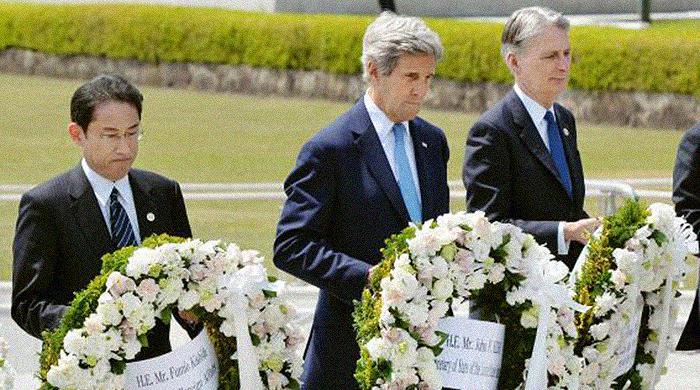
HIROSHIMA: US Secretary of State John Kerry on Monday called his visit to a memorial to victims of the 1945 US nuclear attack on Hiroshima “gut-wrenching” and said it was a reminder of the need to pursue a world free of nuclear weapons.

The first US secretary of state to visit Hiroshima, Kerry said President Barack Obama also wanted to travel to the city in southern Japan but he did not know whether the leader’s complex schedule would allow him to do so when he visits the country for a Group of Seven (G7) summit in May.

Kerry toured the Hiroshima Peace Memorial and Museum, whose haunting displays include photographs of badly burned victims, the tattered and stained clothes they wore and statues depicting them with flesh melting from their limbs.

“It is a stunning display. It is a gut-wrenching display,” he said. “It is a reminder of the depth of the obligation everyone of us in public life carries…to create and pursue a world free from nuclear weapons,” he told a news conference.

After the tour by Kerry and his fellow G7 foreign ministers, the group issued a statement reaffirming their commitment to building a world without nuclear arms but said the push had been made more complex by North Korea’s repeated “provocations” and by worsening security in Syria and Ukraine.
The ministers from Britain, Canada, France, Germany, Italy, Japan and the United States laid white wreaths at a cenotaph to the victims of the August 6, 1945, bombing, which reduced the city to ashes and killed some 140,000 people by the end of that year.

While he is not the highest-ranking US official to have toured the museum and memorial park, a distinction that belongs to then-US Speaker of the House of Representatives Nancy Pelosi in 2008, Kerry is the most senior executive branch official to visit.

“Everyone in the world should see and feel the power of this memorial. It is a stark, harsh, compelling reminder not only of our obligation to end the threat of nuclear weapons, but to rededicate all our effort to avoid war itself,” the chief US diplomat wrote in a guest book.

Asked later if this meant Obama should come, Kerry said: “Everyone means everyone. So I hope one day the president of the United States will be among the everyone who is able to come here. Whether or not he can come as president, I don’t know.”

‘First step’

At Kerry’s suggestion, the ministers also made an impromptu visit to the Atomic Bomb Dome, the skeletal remains of the only structure left standing near the hypocentre of the bomb explosion and now a UNESCO World Heritage site.

Three days after a US warplane dropped a nuclear bomb on Hiroshima, another atomic bomb was dropped on Nagasaki, on August 9, 1945. Japan surrendered six days later.

A visit by Obama could be controversial in America if it were viewed as an apology.

A majority of Americans view the bombings as justified to end the war and save US lives, while the vast majority of Japanese believe it was not justified.

Hopes for Obama’s visit to Hiroshima were raised after an April 2009 speech in Prague when he called for a world without nuclear weapons.

He later said that he would be honoured to visit the two nuclear-attacked cities.

The G7 foreign ministers’ trip to the museum and memorial is part of Japan’s effort to send a strong nuclear disarmament message from Hiroshima, the world’s first city to suffer atomic bombing.
“I think this first-ever visit by G7 foreign ministers to the peace memorial park is a historic first step towards reviving momentum toward a world without nuclear weapons,” Japanese Foreign Minister Fumio Kishida said in a statement.

He later told a news conference that it was “inconceivable” that Japan would ever decide to have nuclear weapons.

Last month, US Republican presidential candidate Donald Trump said Japan and South Korea should build such weapons to deter enemies.

In a separate, detailed statement, the G7 ministers singled out North Korea for sharp criticism, condemning its recent nuclear test and launches using ballistic missile technology.

And in a statement on maritime security, they voiced their strong opposition to provocative attempts to change the status quo in the East and South China Seas, an apparent reference to China, which is locked in territorial disputes with other nations including the Philippines, Vietnam and Japan.

Thursday, February 18, 2016

The New Nuclear Race (Daniel 7:7)


By Jordan Candler · Feb. 16, 2016 
 
By signing a lopsided nuclear “deal” with Iran, the Obama administration, in trying to keep nuclear weapons out of the mullahs’ hands, has instead busted the cache wide open. Now everyone in the Middle East wants a piece of the pie because nobody believes Iran will actually be contained. And on that count, they’re right. Remember, the nuclear deal is at best only a temporary setback because it grants Iran unsupervised leeway after a decade or so. That in itself is concerning, but making matters worse is the fact there’s no evidence the Iranians have stopped their nefarious missile development. That has Israel on high alert — not just as it pertains to Iran, but other nations as well.

According to remarks by Israeli Defense Minister Moshe Ya’alon, “We see signs that countries in the Arab world are preparing to acquire nuclear weapons, that they are not willing to sit quietly with Iran on brink of a nuclear or atomic bomb.” The Telegraph notes that Ya’alon avoided specifics, but Saudi Arabia and the United Arab Emirates make the most sense — the Saudis because their “vast oil wealth could help fund a nuclear programme while its ties with Pakistan, a nuclear power, could provide technical expertise,” and the UAE because it “has oil money and is already building a civilian nuclear power programme.” We should note though that poverty-ridden North Korea has managed to build an estimated 10 bombs — so far. And if Korea can do it, so can most nations with the right networks in place.

With regards to the Iranians, Ya’alon added, “If at a certain stage they feel confident, particularly economically, they are liable to make a break for the bomb.” Which adds to the ridiculousness of the U.S. returning billions of dollars and lifting economic sanctions. Furthermore, The Times of Israel reported over the weekend that Iran “exported its crude shipment to Europe for the first time since it reached a landmark nuclear deal with world powers last month.” With sanctions gone, this is just the beginning of what promises to be a lucrative period financially for Iran. And every dollar added to its coffers will go toward developing missiles to wipe out Western civilization. Other nations are now taking note. The paper tiger has made the world’s nuclear monster a much bigger nemesis.

Wednesday, February 17, 2016

The Arab Nuclear-Arms Race Courtesy Of Obama


Israel: The Arab nuclear-arms race has begun

Ed Morrissey, 4 hours ago

Who could have predicted that the deal John Kerry and Barack Obama cut with Iran would lead to a nuclear-arms race in the region? Well … everyone, really, especially since the deal frees Iran up after 15 years (or less) to openly pursue nuclear weapons, and gives them massive resources to covertly pursue them in the short run, too. Israel’s defense minister Moshe Ya’alon says that unnamed Sunni nations in the region have begun to prepare themselves for a nuclear Iran already, thanks to the deal:
Israel has picked up signs of the beginning of a nuclear arms race in the Middle East as Arab states seek nuclear weapons to counter Iran, the Israeli defence minister has warned.

Moshe Ya’alon said Sunni Arab nations were not reassured by last year’s nuclear deal between Iran and six world powers and were making their own preparations for nuclear weapons.

“We see signs that countries in the Arab world are preparing to acquire nuclear weapons, that they are not willing to sit quietly with Iran on brink of a nuclear or atomic bomb,” Mr Ya’alon said.

“Acquire” could have two meanings. These immensely wealthy nations — Saudi Arabia, of course, but other emirates in the region as well — could spend money to create a native nuclear-weapons development program. It would be a lot easier to simply buy weapons from Pakistan, which has been a nuclear-armed nation for decades. It’s not as if the Pakistani defense establishment has been shy about sharing their secrets in the past, after all. It would be surprising if the Saudis and others haven’t already acquired the technology for a jump-start on an arms race, especially since it was clear for months that the Obama administration was ready to throw in the towel on isolating Iran.

The Telegraph mentions Israel’s role — of necessity, not choice — in determining just how well Iran adheres to the agreement. That makes them a key player for these same Sunni nations, and Benjamin Netanyahu wants them to acknowledge it. Speaking to a coalition of American Jewish groups, the prime minister insisted that some of these nations are covert allies of Israel, and with the threat from Iran looming, it’s time for those ties to become public:

Addressing the Conference of Presidents of Major American Jewish Organizations, the prime minister maintained that most moderate Arab countries see Israel as their ally, not their enemy, as they share a common struggle against Iran and the Islamic State.

“Major Arab countries are changing their view of Israel … they don’t see Israel anymore as their enemy, but they see Israel as their ally, especially in the battle against militant Islam with its two fountainheads,” he said in English. “Now, this is something that is forging new ties, many of them discreet, some of them open. And I think there too we can expect and should expect and should ask to see a change.”

Er … don’t hold your breath on that one. Most of these Sunni nations have a substantial minority Shi’ite population, and any official link to Israel in opposition to Iran will inflame already-tense internal politics. Far better for Israel to maintain the “discreet” links and stabilize their security rather than risk a further meltdown in the region by demanding alliances be made public. Netanyahu knows this, too; this message is intended to remind Americans of Israel’s increasing strength in the chaos surrounding it, and hopefully to keep pressure on Washington not to interfere with it.

Friday, February 12, 2016

Babylon Trying To Halt Saudi Arabia’s Nuclear Venture (Daniel 7)


Saudi Arabia and the N word

US snub has pushed the desert kingdom in Pakistan’s corner
Saudi Arabia and the N word
Will Saudi Arabia and Pakistan heed America’s warning?
 
SAUDI ARABIA’S foreign minister Adel al-Jubeir faced some difficult questions in Washington on January 20, following a meeting with Secretary of State John Kerry. The visit to Washington took place amidst reports that the desert kingdom was set to acquire nuclear weapons from Pakistan, in response to perceived threats from Iran. Just a day earlier, Kerry had warned both Pakistan and Saudi Arabia against partnering in any transfer or deployment of Pakistani nuclear weapons in Saudi Arabia. He bluntly stated that there would be “all kinds of NPT consequences” if any such transfer took place. 

Responding to queries on Kerry’s comments, Jubeir retorted: “I will not discuss these things in a public forum, certainly not on television.” While not ruling out a Pakistani nuclear umbrella to guarantee his country’s security, Jubeir averred: “Saudi Arabia is committed to two things. I always say two things we do not negotiate over — our faith and our security. Saudi Arabia will do what it takes in order to protect its security.”  Referring to his discussions with Kerry, Jubeir said: “I discussed the bilateral relationship with Pakistan, which is a strategic one. We discussed the regional situation and ways to promote security and stability in the region. We discussed the negative and aggressive Iranian interference and the affairs of the region.” He predictably lashed out at Iran, saying: “Iran should cease support for terrorism. Iran should cease to assassinate diplomats and blow up embassies.” (This was perceived as a condemnation of alleged Iranian attacks on Israeli diplomatic missions.) For good measure, Jubeir added: “Iran should cease its negative propaganda in the region,” while adding that the nuclear deal with Iran would “release billions of dollars” for funding its “nefarious activities”. 

The concerns expressed by Kerry came after meetings that Saudi Arabia’s deputy crown prince and defence minister Mohammad bin Sultan had with General Raheel Sharif and Prime Minister Nawaz on January 10. After meeting Prince Salman in his office in Rawalpindi, Raheel Sharif warned that any threat to Saudi Arabia’s territorial integrity would evoke a strong response from Pakistan. Raheel Sharif’s nominal boss, Prime Minister Nawaz Sharif, was more circumspect, telling Prince Salman that the “people of Pakistan will always stand by the people of Saudi Arabia”, while holding that defence ties with Saudi Arabia were held in “high esteem”. Saudi Arabia has, however, rejected a Pakistani offer to promote dialogue with Iran, though the Pakistani offer has been welcomed in Washington and Moscow. 

Saudi Arabia has been assiduously wooing Pakistan, ever since it found out that it had landed itself in a military quagmire in Yemen, where its relentless bombing campaign has led to the displacement of 2.5 million Yemenis. About 78 per cent of the Yemeni population is today in desperate need of water, food and medical assistance. Despite the fierce and unrelenting bombing, the resistance to the Saudis, spearheaded by the Shia Houthi population and former President Abdullah Saleh is resolute in preventing Yemen’s takeover by a Saudi nominee, like former President Mansur Hadi. Saudi diplomatic woes have been compounded by the US led deal to end global sanctions on Iran and stern warning by President Putin that “Saudi Arabia will be utterly destroyed and annihilated” if it falls out of line, with military intervention in Syria. 

Shortly after the Saudi intervention in Yemen commenced, Nawaz Sharif was welcomed personally at the Riyadh Airport on March 3, 2015, by King Salman bin Abdul Aziz, together with Crown Prince Mukri and the entire Saudi cabinet. This was rare honour, especially for a country, which has depended for decades on Saudi doles and handouts. But the Saudis obviously had high expectations from Nawaz Sharif, whom they saved from possible execution and sheltered, after the Musharraf coup, in October 1999. More important, was a low-key visit to Riyadh, a few weeks earlier, by Pakistan’s seniormost military officer, who oversees the Strategic (Nuclear) Forces Command — the chairman of the joint chiefs of staff committee, General Rashad Mahmoud. 

Subsequent developments have made it clear that Pakistan will be unable to commit forces for backing the Saudi military misadventure in Yemen. But nuclear ties between Pakistan and Saudi Arabia go back decades, commencing with the Saudi financing of Pakistan’s nuclear ambitions in the 1970s. Saudi defence minister Prince Salman was given unprecedented access to the Kahuta uranium enrichment and missile facilities headed by Dr AQ Khan, popularly described as the chairman of “Pakistan’s nuclear Walmart”, just prior to Pakistan’s nuclear tests. Khan thereafter paid visits to Saudi Arabia. 

Significantly, just after the visits of General Mahmud and Nawaz Sharif to Riyadh, Pakistan tested its 2,750-km  range Shaheen 3 missile, which could well replace the obsolescent CSS 2 missiles supplied by Beijing to Riyadh, in the 1980s. The Chinese missiles have an adequate range to target Tehran. Pakistan’s Shaheen missiles are originally of Chinese design. The visits of President Xi Jinping to Saudi Arabia and Tehran clearly demonstrate the dexterity of Chinese diplomacy in the oil-rich Gulf region. Saudi insecurities resulting from the virtual U-turn in American policies following the nuclear deal with Iran are being addressed by China, with Beijing’s “all-weather friend” Pakistan, signaling that it has missiles that can replace the obsolescent Chinese missiles. 

Differences between Iran and Pakistan over Afghanistan will likely continue, as a Wahhabi oriented, Taliban dominated, Pakistan sponsored regime in Kabul will be seen as threatening in Iran and neigbouring Central Asian republics. It remains to be seen if the Saudis return to their earlier policies of support for a Pakistan sponsored, Taliban dominated setup in Kabul. Both Iran and Saudi Arabia have pledged to treat China as their “most favoured customer” for oil supplies. This should not cause undue concern in India, given the global glut in oil supplies and the reemergence of Iraq, as a growingly significant player in world energy markets. India will, however, have to move much faster in dealing with crucial projects like the development of the Chabahar Port in Iran, and in the development of undersea gas pipelines. We have to recognise that the inexcusable delays in the implementation of projects abroad, like the Kaladan Corridor in Myanmar and the Parliament building in Kabul have tarnished our image and reputation.

Thursday, January 28, 2016

US Fails to Convince the Asian Nuclear Horns


U.S. and China appear to be at an impasse over North Korea and the South China Sea

Jonathan Kaiman Contact Reporter

Secretary of State John F. Kerry and Chinese Foreign Minister Wang Yi appeared to reach an impasse Wednesday over the severity of prospective sanctions for North Korea, three weeks after the isolated country conducted its fourth nuclear bomb test.

Kerry arrived in Beijing on Tuesday night after two days in Laos and Cambodia, and met with Wang for more than four hours Wednesday morning. North Korea “topped the agenda,” he told reporters at a news conference afterward.

At the conference, Kerry and Wang painted a positive picture of U.S.-China relations in broad strokes, discussing “cooperation” on a range of issues including the Iranian nuclear deal, wildlife trafficking and combating the Ebola virus.

Yet their failure to bridge a deep divide on North Korea’s nuclear program and Beijing’s territorial ambitions in the South China Sea illustrated the fragility of the region’s security environment.
On Jan. 6, North Korea announced that it successfully conducted its first underground test of a hydrogen bomb; experts said that a nuclear bomb clearly detonated but raised doubts about Pyongyang’s claim of owning a significantly more powerful thermonuclear weapon.

Beijing has provided an economic lifeline to North Korea for decades and fears that unrest in the country could destabilize China’s northeastern provinces.

“North Korea poses an overt threat, a declared threat to the world,” Kerry told reporters. He proposed negotiating a U.N Security Council resolution to tighten sanctions on North Korea, dealing a potential blow to China-North Korea trade in industries including aviation, shipping, and the exchange of resources such as fuel and coal.

“The U.S. will do what is necessary to protect the people of our country and our friends and allies in the world,” he said. “All nations, particularly those who seek a global leadership role or have a global leadership role, share a fundamental responsibility to meet this challenge with a united front.”

Although Wang agreed that the U.N. Security Council must pass a new resolution in response to the nuclear test, he balked at the prospect of tightening sanctions. “Sanctions are not an end of themselves,” he said. “We must point out that the new resolution should not provoke new tension in the situation, much less destabilize the Korean peninsula.”

Experts said that China likely does not see much upside in adopting the U.S.’ proposed framework for dealing with Pyongyang.

“On the nuclear side, I’ve never had any doubt that the Chinese want to end this program but they don’t see a strategy in the international community to achieve that goal,” said Bonnie Glaser, a senior advisor for Asia at the Center for Strategic and International Studies. “A lot of people think China is the missing link and if only it would get on board with sanctions that North Korea could be compelled to give up its nuclear weapons. The Chinese just don’t look at it like that.

“They play out in their minds, what are the consequences if they really agree to very tough sanctions — if they cut off oil deliveries to North Korea?” she added. “So that creates instability in North Korea most likely, then China ends up with a crisis on its border that potentially brings U.S. troops closer to China, and you end up with a worse situation than when you started.”

On Wednesday morning, China’s New China News Agency accused Washington of “uncompromising hostility” toward North Korea, “flaring up the country’s sense of insecurity and thus pushing it towards reckless nuclear brinkmanship.”

Kerry also reached loggerheads with Wang regarding China’s maritime ambitions, which have riled the country’s neighbors and threatened the region’s U.S.-led security order.

China claims virtually all of the South China Sea, a potentially oil and gas-rich area of the western Pacific Ocean dotted with remote islands and reefs. Vietnam, the Philippines, Brunei, Malaysia and Taiwan also claim parts of the sea as their own.

China has stepped up its claims in recent years with a series of heavyweight projects, including building artificial islands on a shoal also claimed by the Philippines. In October, the U.S. sent a warship within 12 nautical miles of these islands, drawing harsh rebukes from Beijing.

“The South China Sea islands were historically China’s territory, and China has a right to protect its maritime sovereign and legal rights and interests,” Wang said at Wednesday’s news conference. He denied accusations that China has militarized its artificial islands, adding that Beijing has built “some necessary facilities for self-defense.”

Southeast Asian countries are indeed divided over how to handle the issue, and the lack of consensus has allowed China to advance its projects with limited opposition.

Kerry said he also met with Chinese President Xi Jinping and that they had a “constructive discussion.”

Before his meetings in China, Kerry visited Laos, a landlocked, deeply impoverished country of 7 million people between Thailand and Vietnam, and Cambodia, which enjoys close economic ties with China and tends to side with Beijing on issues of maritime rights.

Although the Assn. of Southeast Asian Nations, or ASEAN, a 10-member regional bloc, could band together to counter China’s territorial claims, internal divisions have stymied attempts at collective action. In 2012, Cambodia blocked mentions of the disputes at a summit in Phnom Penh, leading the association to fail to issue a joint communiqué.

ASEAN leaders will attend a summit hosted by President Obama in California in February. Laos is the association’s chair.

During his visit to Laos, Kerry — only the second U.S. secretary of State to visit the country since 1955 — promised to boost U.S.-funded programs to ameliorate malnutrition and remove unexploded ordnance left from the Vietnam war. China, meanwhile, has promised the country major investments in infrastructure, including a high-speed rail line.

China’s state media have responded to U.S. pressure on the South China Sea issue with significantly less restraint than the country’s foreign minister.

“Washington’s strategy has fed the strategic distrust between China and the US, and prompted smaller countries in the region to vacillate between the two powers and try to benefit from their contest,” said a Tuesday commentary in the state-owned, notoriously bombastic Global Times newspaper.

“Many of them are manipulated by Washington behind the scenes as a proxy to counter China. Washington instigates some smaller nations to challenge China in the South China Sea, one of China’s core interests, and sugarcoats itself as a defender of justice.”

Thursday, January 21, 2016

Obama’s Policy Will Make Saudi Arabia A Nuclear Horn (Daniel 7)


John Kerry warns Saudi Arabia of consequences if they get nuclear weapons

john-kerry
Top Pakistani leaders have in recent weeks warned Iran of serious consequences if it attacked Saudi Arabia, which many analysts see a nuclear threat from Islamabad to Tehran.
“Sure we’ve heard those things. But you can’t just buy a bomb and transfer (a nuclear bomb),” Kerry told CNN.
“There’s all kinds of NPT consequences. I mean, there are huge implications of that,” Kerry said, referring to the strong nuclear Non-Proliferation Treaty (NPT).
Pakistan is already under the radar of the international community for its previous nuclear proliferation activities and leaking the nuclear weapons technology to countries like Iran, Libya and North Korea.
“Saudi Arabia knows, I believe, that that is not going to make them safer, nor is it going to be easy because the very things that Iran went through, they would then be subject to with respect to inspection, NPT and so forth,” Kerry said.

Monday, January 18, 2016

How Obama Got Checked By the Chessmaster


So the seeds for today’s prisoner exchange seemed to have been sowed a month ago when the U.S. were considering sanctions to punish Iran for testing ballistics missiles that could deliver a nuclear warhead.Guess what – we gave in.
From Reuters:
The day before the Obama administration was due to slap new sanctions on Iran late last month, Iranian Foreign Minister Javad Zarif warned U.S. Secretary of State John Kerry the move could derail a prisoner deal the two sides had been negotiating in secret for months.
Kerry and other top aides to President Barack Obama, who was vacationing in Hawaii, convened a series of conference calls and concluded they could not risk losing the chance to free Americans held by Tehran.
At the last minute, the Obama administration officials decided to delay a package of limited and targeted sanctions intended to penalize Iran for recent test-firings of a ballistic missile capable of delivering a nuclear warhead.
This account of previously unreported internal deliberations was provided by two people with knowledge of the matter.
A third official said Obama had approved the decision to delay the sanctions.
Those unilateral U.S. sanctions are expected to be imposed quickly now after Iran freed five Americans, including Washington Post journalist Jason Rezaian, on Saturday. Eight Iranians accused in the United States of sanctions violations were having charges dropped or sentences commuted on Saturday under the complex prisoner deal, according to court filings and sources familiar with the cases.
The moves came as broader U.S. and international sanctions were set to be lifted after verification that it had met commitments to curb its nuclear program.
Well that’s just great.

Sunday, November 29, 2015

The Antichrist Calls Kerry A Terrorist (Revelation 13)


Muqtada Sadr describes Kerry as terrorist

November 28, 2015 – 7:06 PM
News Code : 721986Source : Agencies

On Thursday the cleric Muqtada al-Sadr described the US Secretary of State John Kerry as a “terrorist”, pointing out that Kerry does not have the right to rate who is the “terrorist,” while stressed that Israel is “a spoiled son” for America.

Sadr said in response to a question about his position regarding the US Secretary of State John Kerry statement, who described the “knives revolution” as a “terrorist act:” “We do not need his silly and biased opinion; he doesn’t have the right to rate who is the terrorist.”

It is noteworthy that US Secretary of State John Kerry described earlier the wave of attacks with knives, which has been carried out by Palestinians, as “terrorism” that must be condemned.