The prophecy is more than seeing into the future. For the prophecy sees without the element of time. For the prophecy sees things as they were, as they are, and as they always shall be.


Sadr’s uncompromising stances may lead to political stalemate in a country that still needs to recapture the remaining areas under Daesh control.A common thread since 2003 has been the opposition to foreign interference in Iraq, regardless whether it comes from the West (US, UK) or the East (Iran). His disenchantment as to the possibility of pursuing an alternative to sectarian politics was one of the reasons that led him to suddenly announce his withdrawal from political life in 2014, as one of his movement’s officials stated.


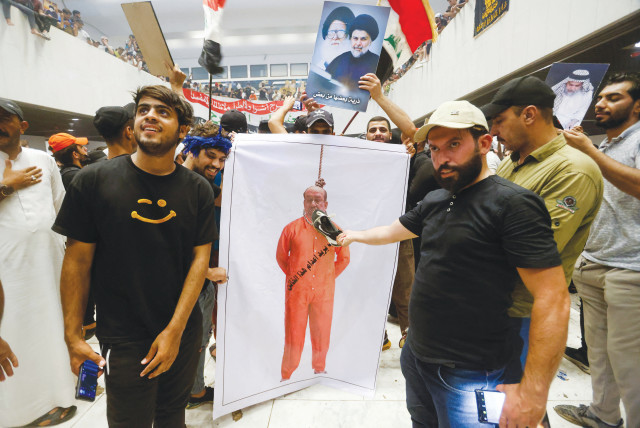
Followers of Shia cleric Muqtada al-Sadr hold posters with his photo during a sit-in, inside the parliament in Baghdad. AP
Muqtada al-Sadr is a mercurial figure who has emerged as a powerful force in Iraq’s cutthroat political scene with a nationalist, anti-Iran agenda. He is the son of Grand Ayatollah Sayyid Muhammad Muhammad-Sadiq al-Sadr, who Saddam Hussein had assassinated in 1999
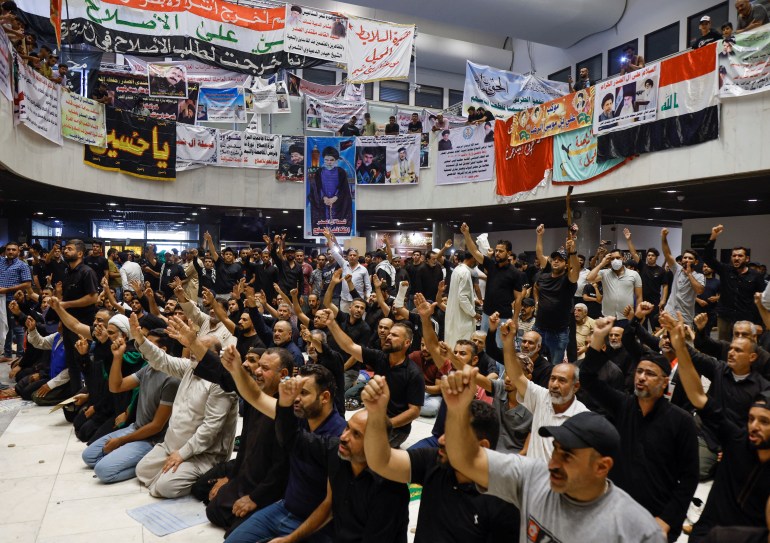
Iraq is in turmoil with hundreds of followers of influential Shia cleric Muqtada al-Sadr on Sunday camping inside the Iraqi parliament after toppling security walls around the building and storming in the previous day.
The followers of Muqtada al-Sadr have vowed to hold an open-ended sit-in to derail efforts by their rivals from Iran-backed political groups to form the country’s next government.
Their demands are lofty: early elections, constitutional amendments and the ouster of al-Sadr’s opponents.
The developments have catapulted Iraq’s politics to center stage, plunging the country deeper into a political crisis as a power struggle unfolds between the two major Shia groups.
But who the man who has mobilised hundreds and thrown the country in turmoil? Let’s take a closer look:
Life and career
Muqtada al-Sadr is a mercurial figure who has emerged as a powerful force in Iraq’s cutthroat political scene with a nationalist, anti-Iran agenda.
Born in 1974 in Kufa near the holy Shia city of Najaf, al-Sadr is described by some who are close to him as easily angered.
The round-faced Islamic leader comes from an influential clerical family and is the son of Grand Ayatollah Sayyid Muhammad Muhammad-Sadiq al-Sadr, who Saddam Hussein had assassinated in 1999.
As per Britannica, al-Sadr was greatly influenced by his father’s conservative thoughts and ideas and by those of his father-in-law, Ayatollah Muhammad Baqir al-Sadr, founder of the Islamic DaÊ¿wah Party, who in 1980 was executed for his opposition to Iraqi strongman Saddam Hussein.
As per Indian Express, al-Sadr founded the Al-Sadrist movement, which is it at its apex at the moment and draws the support of the poor of the Shia community across Iraq.
As per Reuters, members of the Al-Sadrist Movement have been appointed to senior jobs within the interior, defence and communications ministries.
They have had their picks appointed to state oil, electricity and transport bodies, to state-owned banks and even to Iraq’s central bank, according to more than a dozen government officials and lawmakers.
Power player
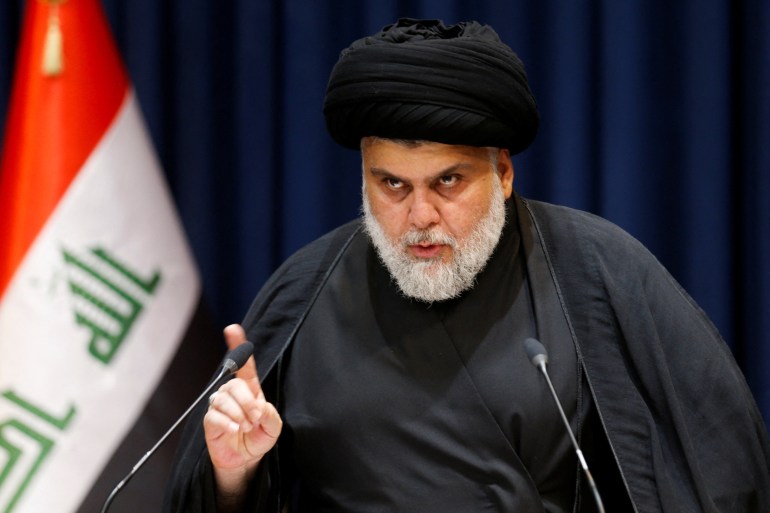
When he raises his index finger and frowns, Iraq holds its breath.
Al-Sadr has time and again emerged as a powerful player in Iraqi politics, and been able to mobilise his loyalists.
Hundreds of them have for days occupied the country’s parliament with adherence to one guiding principle: obedience to al-Sadr. He has urged other political factions to support the protest.

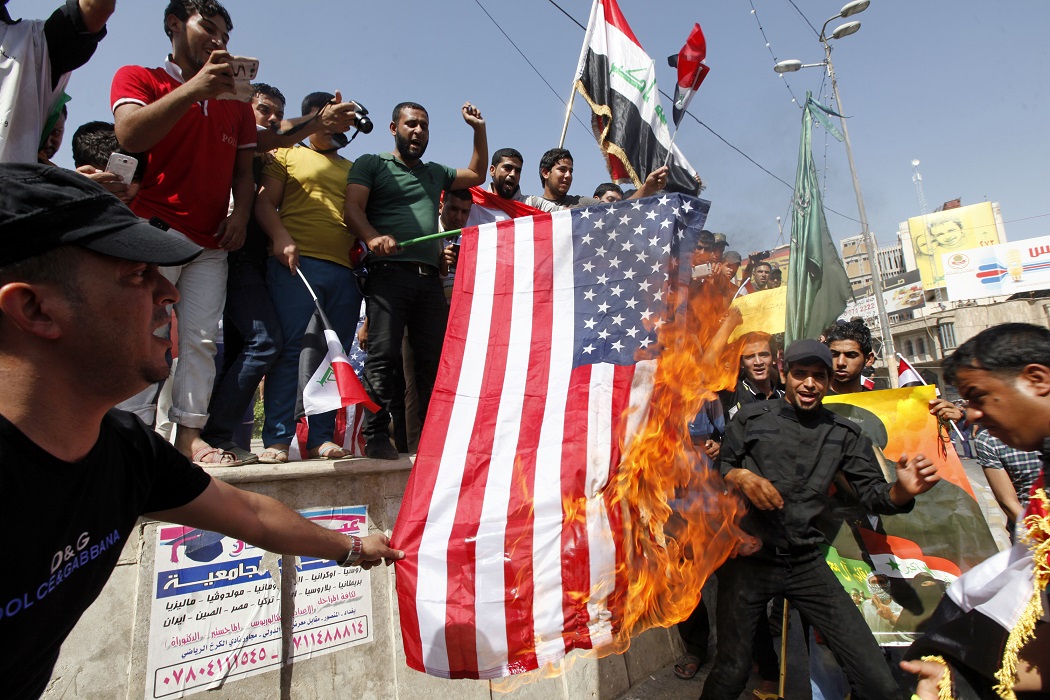
Today, as in past years following the 2003 US-led overthrow of dictator Saddam Hussein, Iraq cannot ignore the grey-bearded preacher who once led a militia against American and Iraqi government forces.
As per Indian Express, Al-Sadr emerged as US’ enemy number one after the fall of Saddam.
In 2004, The Guardian quoted Lieutenant General Ricardo Sanchez saying, “The mission of US forces is to kill or capture Muqtada al-Sadr.”
As per Indian Express, in 2003, the Al-Sadrist and the affiliated militia (Mahdi army) started a resistance against the US troops following the country’s invasion.
These militias under al-Sadr are now called the “peace companies,” as per the report.
Chameleon-like
Analysts have said Al-Sadr, who wears a black turban symbolic of a descendant of the Prophet Mohammed, is now using street protests to signal that his views must be taken into account in government formation.
On Sunday he lauded on Twitter the takeover of parliament inside the capital’s fortified Green Zone of diplomatic and government buildings.
Al-Sadr called it a “spontaneous revolution… a first step” towards “an extraordinary opportunity for a fundamental change”.
That’s his position now, but the chameleon-like figure has made several reversals over the years, including in 2008 when he suspended activities of his 60,000-member Mahdi Army, which had been one of Iraq’s most active and feared Shia militias.
He reactivated the group after a US drone strike in Baghdad killed Iranian General Qassem Soleimani in January 2020.
Al-Sadr retains a devoted following of millions among the country’s majority Shia population, including in the poor Baghdad district of Al-Sadr City.
“The Al-Sadrist base is significant in Baghdad and the southern provinces because it represents a Shia underclass that struggled during the previous government but viewed Muhammad al-Sadr as a religious authority who cared for them and preached to them when no one else dared to. This base continues to feel marginalised today, and al-Sadr appeals to them as the heir to his father’s position, but also as they feel he is their voice against all other political and religious factions,” Sajad Jiyad, a fellow at Century International and director of the Shia Politics Working Group, told Al Jazeera.
“He can occupy the streets. No one in Iraq can do it as well as him,” said Hamdi Malik, of the Washington Institute for Near East Policy.
Perhaps uniquely in Iraq, al-Sadr has “a very obedient base” which also comprises a formidable online presence attacking his rivals in cyberspace, Malik said.
“Everything is revolving around him. That in Iraq is very important,” he added.
During youth-led protests that erupted in 2019, Al-Sadr sent thousands of followers to support the movement.
He then called them back, and later invited them to “relaunch the peaceful reformist revolution”.
Ben Robin-D’Cruz, a specialist in Shia movements at Aarhus University in Denmark, said Al-Sadr “tries to position himself simultaneously in the centre of the political system while distancing himself from it”.

His religious character, the researcher said, “allows him to create this illusion of transcending politics”.
He has a chequered relationship with Iran.
Al-Sadr’s bloc contested the 2010 legislative election in an alliance with the Supreme Iraqi Islamic Council, a Shia group with links to the Islamic republic.
Nationalist, potential kingmaker
In October, though, Al-Sadr campaigned as a nationalist and emerged as a potential kingmaker.
Al-Sadr initially said he would not take part in the October election but then backtracked to campaign on vague themes of reconstruction, opposition to Iranian influence, and a pledge to “end corruption”.
Nearly 10 months after elections, the oil-rich but impoverished country is still without a new government.
Al-Sadr’s bloc emerged from the ballot as the biggest parliamentary faction, but intense negotiations since then have failed to bridge the divide between it and rival Shia groups.
In June, his 73 lawmakers quit in a bid to break the logjam but that led to a pro-Iran bloc, his opponents, becoming the largest in parliament.
The current standoff pits him against the pro-Iran Coordination Framework which includes lawmakers from the party of Al-Sadr’s longtime foe, ex-prime minister Nuri al-Maliki — who gained the premiership in 2006 with support from Al-Sadr but whose followers later pulled out of Maliki’s cabinet.
As a result of past deals, the Al-Sadrists have been accused by their opponents of being as corrupt as other political forces.
Supporters of Al-Sadr, however, are ready to follow him almost blindly and view him as a champion of the anti-corruption fight.
“All the people are with you, Sayyed Muqtada,” the protesters chanted, using his title, before they stormed parliament on Saturday.
With inputs from agencies
Read all the Latest News, Trending News, Cricket News, Bollywood News,
India News and Entertainment News here. Follow us on Facebook, Twitter and Instagram.

On July 30, hundreds of supporters of Moqtada al-Sadr, one of Iraq’s leading political figures, breached the parliament building in Baghdad’s fortified Green Zone, forced their way inside, and started a coordinated sit-in to protest the recent nomination of Mohammed Shia al-Sudani for the premiership.
Sixty protesters were injured in clashes with security forces. Three days earlier a mass protest outside parliament by Sadr supporters ended only after Sadr tweeted a request to them to disperse.
Iraq has been in a political crisis ever since the general election last October. Months of discussion and negotiation between the various political groupings have failed to result in the election of a president or prime minister, the essential precursors under the Iraqi system for the formation of a government.
Constitutionally, the president, whose duty is to task the future prime minister with forming the new government, must be elected within 30 days of the election of the speaker of parliament. Sunni lawyer Mohammed al-Halbousi was elected speaker on January 9, but the required election of a president within 30 days never happened. Having a newly elected speaker and no president violates the constitution, but that seems a minor matter, given the political deadlock.
On July 17, the febrile political atmosphere was rendered even more critical when an Iraqi journalist named Ali Fadel released on social media a set of secret recordings. In them, a onetime prime minister of Iraq, Nouri al-Maliki, apparently gives vent to a succession of insults and accusations against Sadr.
As background, it is useful to know that Sadr, although a Shi’ite, leads a popular movement opposed to Iran’s excessive control of Iraqi affairs, while Maliki is a leading figure in a major Shia parliamentary grouping called the Coordination Framework, which is very much beholden to Iran.
The venom of Maliki’s apparent verbal onslaught against Sadr shook the nation. The percentage of voters who believed Maliki’s rapid denial of ever saying the words attributed to him, and his assertion that the recordings were fake, is not known. What is certain, however, is that the recordings, genuine or false, removed Maliki’s chance of a return as prime minister Sadr himself dismissed them as of no consequence.
In the recordings Maliki, Iraq’s prime minister from 2006 to 2014, apparently reveals a British plot to use Sadr as a disposable puppet in a scheme designed to hand Iraq over to Sunni control.
“That project exists,” Maliki seemingly says, “but I am fighting it, and it is to be fought politically and militarily.”
He apparently proceeds to cut Sadr to ribbons. “Moqtada is a murderer… the kidnappings, the car bombs… he is a coward, a traitor, an ignoramus who knows nothing.”
In Iraq’s October 2021 general election the bloc led by Sadr won 74 seats, making it the largest grouping in the 329-seat parliament. But on June 13, following months of ineffective negotiations and a total failure to nominate people to fill the high offices of state or to form a government, Sadr ordered the members of his bloc to resign from parliament.
Under Iraqi law, if an MP resigns, the second-placed candidate in the election takes the empty seat. The process of filling the vacated seats led to a new wave of intense debate and protests, but finally the pro-Iran Coordination Framework became the majority bloc in parliament. It then nominated Sudani as prime minister.
A succession of Iran-backed groups and militias welcomed the nomination; the Sadrist reaction was posted on a Facebook site. Dubbing Sudani as nothing more than a facade for Maliki, Sadr was virtually declaring that as prime minister he would be Maliki’s puppet. Two days later, on July 27, the country’s political crisis reached a boiling point, and Sadr supporters stormed the Iraqi parliament, protesting against Sudani’s nomination – a riot instantly quelled by a tweet from Sadr.
In the run-up to the election, Sadr had committed himself to forming a “national majority government” representing different sects and ethnicities, including Sunni and Kurdish groups but sidelining the pro-Iran Coordination Framework. This commitment put Sadr at odds with the Fatah alliance, the political wing of the pro-Iran Popular Mobilization Forces militia. Some pro-Iran militia groups warned of intensified violence if Sunni and Kurdish groups joined a Sadr government.
If Sadr’s “national majority government” had succeeded, it would finally have put paid to Iraq’s so-called muhasasa political system, imposed on the country after the US-led invasion in 2003. Akin in some respects to Lebanon’s sectarian power-sharing structure – itself a continual source of political instability – muhasasa is an attempt to provide proportional representation in public office among Iraq’s various ethno-sectarian groups, including Shia, Sunni and Kurdish. Many Iraqis believed from the start that the system was deeply flawed. It was soon widely perceived as underpinning the corruption, collusion and patronage networks that characterized public life in Iraq, and became the target of popular protests. Overturning muhasasa would have markedly reduced Iran’s political influence in Iraq. If Sadr ever achieves political power, it may yet come to pass.
Did Sadr shoot himself in the foot by ordering the resignation of his 74 parliamentary followers in June? Many of his vacated seats were filled by members of the Coordination Framework, and it might seem as though he had handed his political opponents the power to form a government.
However, the recent mass political protests by Sadrists clearly demonstrate that Sadr is far from a spent force. It is obvious that with or without his parliamentary majority, Sadr, with his vast supporter-base, remains a force to be reckoned with, and will have to be take into account if Iraq’s political turmoil is ever to be resolved.
The writer is Middle East correspondent forEurasia Review. His latest book is Trump and the Holy Land: 2016-2020. Follow him at: http://www.a-mid-east-journal.blogspot.com

Iraq’s Muqtada al-Sadr orders supporters to continue sit-in inside the national parliament and calls for new elections to be held.
Published On 3 Aug 20223 Aug 2022
Iraqi populist Muslim scholar Muqtada al-Sadr has urged his supporters to continue their sit-in inside the national parliament in Baghdad until his demands, which include the dissolution of parliament and early elections, are met.
The remarks, delivered by the Shia Muslim leader in a televised address from Najaf on Wednesday, could prolong a political deadlock that has kept Iraq without an elected government for nearly 10 months.
Thousands of al-Sadr’s followers stormed Baghdad’s fortified Green Zone, which houses government buildings and foreign missions, last weekend and took over the empty parliament building staging a sit-in that is continuing.
Al-Sadr supporters have set up an encampment with tents and food stalls surrounding parliament.

The moves were a response to attempts by his Shia Muslim rivals, many of whom are close to Iran – mainly the Iran-backed Coordination Framework – to form a government with prime ministerial candidates of whom al-Sadr does not approve.
Sadr won the largest number of seats in parliament in an October election but failed to form a government that would exclude his Iran-backed rivals.
He withdrew his lawmakers from parliament and has instead applied pressure through protests and the parliament sit-in, drawing on his popular base of millions of working-class Shia Iraqis.
Al-Sadr reiterated during his address that he was ready to “be martyred” for his cause.
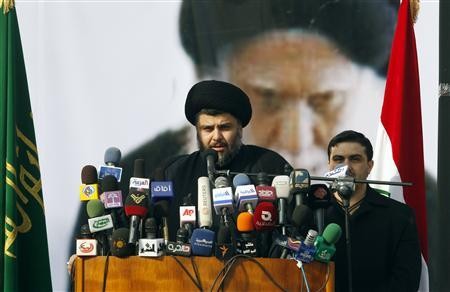
“Dissolve parliament and hold early elections,” al-Sadr said.
Al-Sadr, who once led an anti-US militia and who has millions of devoted followers, noted in his speech that he also had “no interest” in negotiating with his rivals.
“But we have already tried and experienced dialogue with them,” he added. “It has brought nothing to us and to the nation – only ruin and corruption.”
Al Jazeera’s Dorsa Jabbari, reporting from Baghdad, said al-Sadr appeared eager to show that he was “not seeking any personal gains from this process”.
“He was adamant that, of course, corruption exists in all various levels of government, he said one of the ways we can get rid of it is by having another round of elections to bring in a new slew of people,” she said.
The deadlock between al-Sadr and his rivals has left Iraq without a government for a record time in the post-Saddam Hussein era.
Outgoing Prime Minister Mustafa al-Kadhimi has called for a “national dialogue” in a bid to bring all sides together to talk, and on Wednesday he spoke with President Barham Saleh.
Both men stressed the importance of “guaranteeing security and stability” in the country, according to the official Iraqi News Agency.
But Jabbari said it is now clear that al-Sadr, as well as his representatives, are not going to be taking part “in any form of national dialogue at this stage”.

Nearly 10 months after its last election, Iraq’s stability is at stake. Its leaders and the international community should take it seriously.
Thursday, August 4, 2022 / BY: Sarhang Hamasaeed
Over the weekend, followers of the powerful Iraqi Shia cleric Moqtada al-Sadr stormed and occupied Iraq’s parliament in protest over a rival bloc attempting to form a government. The move comes less than two months after al-Sadr’s bloc in parliament resigned after its failure to form a majoritarian government following its victory in the October 2021 elections. Nearly 10 months after those elections, there is still no new government and the stability of the country is at stake as this showdown between al-Sadr’s supporters and his political rivals continues to play out.
There are mixed views among Iraqis on what al-Sadr’s objectives are and the tactics he employs. Still a large swathe of the public views him as a needed agent of change amid the failures of Iraq’s political system.
Before Iraq’s October 2021 national parliamentary vote, many questioned what change the elections could bring. Could the election break the political stalemate that had crippled the national political process since 2018? Would it lead to a government that could deliver on the demands of the 2019 protest movement for better services, jobs and reforms? Clearly neither change occurred.
Like the 2018 elections, the 2021 vote produced two broad coalitions. The Tripartite Coalition (or Saving of the Homeland) first tried to form a government. The coalition included al-Sadr’s bloc, who won the largest number of seats (73); most of the elected Sunni Arabs, led by parliament Speaker Mohammed al-Halbousi and Khamis al-Khanjar, with 63 seats; and the Kurdistan Democratic Party (KDP), led by former Kurdistan Region President Massoud Barzani, with 31 seats. The other coalition is the Coordination Framework — considered to be Iran-backed — which includes the State of Law alliance of former Prime Minister Nouri al-Maliki, the Fatah Coalition and others.
While al-Sadr and his coalition had enough votes to form the government, they never got to that point because the constitution requires parliament to elect a president who would then ask a nominee for prime minister from the biggest parliamentary bloc to form the government. Al-Sadr wanted a majoritarian government rather than the broad consensus — known in Iraq as “tawafuq” — government that has typically defined post-2003 Iraqi governments, but also been a source of ineffectual governance.
Iraq’s Supreme Federal Court gave al-Sadr’s rivals a win when it interpreted article 70 of the constitution as requiring a two-third majority of parliament to be in session when electing the president, which al-Sadr’s coalition could not secure. Interestingly, that constitutional requirement was primarily intended to ensure the Kurds that the majority Arab population would not marginalize them in the government formation process. For the Sunni Arabs, it was meant to ensure that the Kurds and Shia Arabs would not marginalize them. This very guarantee came to serve the Coordination Framework, instead of the political objective of the Sunni Arabs and the Kurds who allied with al-Sadr. Ultimately, the constitutional clause did the job of preventing a political process from moving forward without broad consensus; it just served a different group than originally intended.
In early June, Sadr shockingly announced that his bloc of 73 MPs would resign, which they did days later. Speculation abounded on exactly what al-Sadr’s motives were: Was he frustrated by the protracted stalemate and preparing to resign from politics? Or had he given up on the political system and planned to take on the political class from outside? Had his life been threatened by Iran because he was aiming to exclude their allies from being part of the government?
Al-Sadr’s rivals thought they succeeded in frustrating him to the point of quitting the political process and swiftly replaced his MPs, mostly with members of their own. The Coordination Framework and others thought the road to government formation had cleared and al-Maliki looked to position himself for a third term in the premiership or have a prime minister selected from his inner circle. However, a minority believed al-Sadr and his constituency should not be left out of the government.
Al-Sadr’s withdrawal from parliament put current Prime Minister Mustafa al-Kadhimi and his government along with al-Sadr’s political and parliamentary partners in a very tough spot and reinforced the idea that al-Sadr could not be relied on. Many of his rivals also thought al-Sadr had lost a considerable amount of his constituents, frustrated because he did not form a government and deliver for them. They would not support al-Sadr taking down the system and igniting an intra-Shia civil war. Neither Iraq’s Shia religious establishment in Najaf nor the international community would support such a move. Iran, of course, would oppose their allies being excluded from power and Shia infighting.
In the thinking of al-Sadr’s rivals, Russia’s war on Ukraine changed things. The United States and Europe need Iraq’s energy. With Gulf states’ production capacity maxed out, Iraq could compensate and produce more. So, they thought that Washington and Brussels would accept a Coordination Framework government, hoping it would prioritize energy production over reform and other governance matters.
Some stakeholders in the political process, who thought al-Sadr might make a move outside the government and parliamentary system, believed he would need to do so before a new government is formed. Otherwise, his rivals could use power of the state and its armed forces against him, as they suspected he would have done had he formed a government.
Obviously, this turn of events has already shown that much of the thinking of al-Sadr’s rivals did not pan out. His call for Friday prayers on July 15, in the middle of the scorching heat of Baghdad’s summer, with tens of thousands of people answering the call and praying in the street, showed that al-Sadr’s support is still strong. Taking over the parliament building and other facilities in the green zone in the past few days, and calling on other political actors, tribal leaders and the Iraqi public to join what he called “a spontaneous peaceful revolution,” clearly indicate al-Sadr is keen on achieving his stated political objectives to change the political system and fight corruption, among other things. His opponents think he is really just moving toward an ultimate objective of holding political, economic, religious and social power above everyone else. Calls for replacing or changing the system makes the Kurds and others nervous, because there is no guarantee that what would follow would be better for them.
There are contradicting perceptions in Iraq about the role of the United States. There is a general belief that no prime minister would be appointed or could succeed if the United States, and Iran, do not approve. At the same time, many political actors think the United States’ role and influence has significantly diminished. Despite the difficult history between al-Sadr and the United States, some believe Washington favored al-Sadr forming a government in order to strengthen Iraq vis-a-vis Iran and its armed allies in Iraq. While there may be pragmatists who think this is the best path to limit Iran’s influence in Iraq, others in Iraq are surprised that al-Sadr is seen as anti-Iran when the cleric shares similar values with the theocracy in Tehran.
The United States has an interest in a democratic, stable, peaceful and sovereign Iraq, and could work with its allies across Iraq’s political spectrum, along with its European allies and the United Nations, to encourage and support dialogue among the different actors to prevent violence, break the political stalemate and enable effective governance.
Taking a broader look at the situation in Iraq, there have been numerous developments in recent months that could have triggered violent conflict, including an assassination attempt on al-Kadhimi and attacks on the offices of the KDP and Speaker al-Halbousi, just to name a few. Yet, Iraq’s political system, and key political actors, demonstrated the ability to absorb these shocks, indicating increased resilience against wide-scale violence. Tribal sheikhs, civil society leaders, media commentators and the Iraqi public have been calling on political leaders to resolve their differences through dialogue and get to the business of serving the people, instead of their own interests. Yet, that resilience should not be taken for granted and the risk of violence should not be underestimated, as al-Sadr and his rivals both have armed forces and young followers on the street.
In my meetings this June with a wide spectrum of Iraqi leaders, “lack of trust” was cited as the key problem in the political space. But, I believe, it goes deeper than that because this mistrust could be addressed through dialogue, confidence-building measures and effective monitoring of agreements. Iraqi political actors’ unwillingness to accept the “other” or their views is the real issue. Furthermore, even when ostensible agreement is reached, implementation is often held up as another way to stymie rivals’ goals.
Iraq’s constitution, the country’s social contract, is key among agreements that are not being implemented as needed. Despite its flaws, the constitution includes key principles, institutions and guarantees for a democratic, pluralistic, inclusive, stable and peaceful country. However, different actors do not implement different parts of it because they don’t accept them or their interpretation by others. Some argue the constitution was written under unhealthy circumstances amid an imbalance of power, and therefore since 2005 there has been several calls and attempts to amend it. But these have not been successful and will likely not be in the future. Despite many changes in Iraq, the fundamentals are the same: there is imbalance of power, a continued unwillingness to accept the other, and limited effort to implement what’s already agreed on. The political class is detached from the public’s suffering and they largely act indifferent, despite their rhetoric. While Iran, Turkey and others have strong competing influence in Iraq and the current crisis gives more opportunity to expand that influence, it is Iraq’s internal dysfunction that provides space to others to exert their sway. Iraq’s issues could be resolved or mitigated if Iraqis work with each other better.
Iraq remains important for the region’s stability and for the national security interests of regional and global powers. The country has many of the elements necessary for positive change — increasingly active youth and civil society, governance-minded tribal leaders, a dynamic media landscape representing many points of view, younger and more moderate members of traditional parties, and the clout of Grand Ayatollah Ali al-Sistani, who has often sided with Iraqis’ demands for change. But the country still lacks a catalyst to harness these elements. Al-Sadr is trying to mobilize as many of them as possible, especially the people, a key game changer in 2018 and 2019. There are efforts to break the current political standoff, but Iraq’s deep political stalemate will not be broken anytime soon. Real change could happen if the political process becomes more reflective of the will of the Iraqis, more than 60 percent of whom did not vote in October 2021 and do not approve of the political class.

Updated 03 August 2022
AFP
August 03, 202222:52
BAGHDAD: Powerful Shiite leader Moqtada Sadr, whose bloc won the most seats in Iraq’s elections last year, demanded Wednesday that parliament be dissolved and new national polls be called.
Nearly 10 months on from the last elections, the country still has no government, new prime minister or new president, due to repeated squabbles between factions over forming a coalition.
In the latest political turmoil to strike the oil-rich but war-scarred nation, Sadr called for a “revolutionary and peaceful process, then early democratic elections after a dissolution of parliament.”
His televised speech came as calls for dialogue intensify after his supporters occupied parliament for a fifth consecutive day, in protest at a nomination for prime minister by a rival Shiite faction, the Iran-backed Coordination Framework.
However, parliament can only be dissolved by a majority vote, according to the constitution. Such a vote can take place at the request of a third of lawmakers, or by the prime minster with the president’s agreement.
“I am certain that the majority of the population is exasperated by the ruling class in its entirety, including some (politicians) belonging to my movement,” Sadr said.
“From now on there will be no more old-guard politicians, whatever their affiliation,” he added.
Sadr’s bloc emerged from elections in October as the biggest faction, but it was still far short of a majority.
In June, his 73 lawmakers quit, ostensibly in a bid to break the political logjam.
Sadr, who once led an anti-US militia and who has millions of devoted followers, noted also that he had “no interest” in negotiating with his rivals.
Along with their sit-in, the cleric’s supporters have set up an encampment outside parliament with tents and food stalls, and Sadr on Wednesday called on them to continue.
“The revolutionaries and protesters participating in the sit-in must stay and continue their camp until the demands are realized,” he said.
In multi-confessional and multi-ethnic Iraq, government formation has involved complex negotiations since a 2003 US-led invasion toppled dictator Saddam Hussein.
The resignation of Sadr’s lawmakers led to the pro-Iran bloc becoming the largest in parliament, but still there was no agreement on new top posts.
The Sadrist camp was outraged by the Coordination Framework last week nominating former minister Mohammed Shia Al-Sudani as prime minister.
The Coordination Framework is a grouping that includes former prime minister Nuri Al-Maliki, a long-standing foe of Sadr, and the Hashed Al-Shaabi, a former paramilitary network now integrated into the security forces.
Outgoing prime minister Mustafa Al-Kadhemi has called for a “national dialogue” in a bid to bring all sides together to talk, and on Wednesday he spoke with President Barham Saleh.
Both men stressed the importance of “guaranteeing security and stability” in the country, according to the Iraqi News Agency.
Sadr’s foe Al-Maliki said late Wednesday “serious dialogue giving hope for resolving differences… begins with respect for constitutional institutions.”
Thousands of Coordination Framework supporters have held counter-protests in Baghdad against the occupation of parliament.
“Don’t believe the rumors that I don’t want dialogue,” Sadr said on Wednesday.
“But we have already tried and experienced dialogue with them,” he added. “It has brought nothing to us and to the nation — only ruin and corruption.”
Earlier on Wednesday, the United Nations mission in Iraq called on leaders to “prioritize (the) national interest” and end the long-running power struggle.
“Meaningful dialogue among all Iraqi parties is now more urgent than ever, as recent events have demonstrated the rapid risk of escalation in this tense political climate,” the UN mission warned.
French President Emmanuel Macron also spoke with political leaders on Wednesday, saying that “dialogue and consultation” was the only way out of the crisis.