Showing posts with label communist. Show all posts

Monday, October 23, 2023

Quakeland: On the Road to America’s Next Devastating Earthquake: Revelation 6


Quakeland: On the Road to America’s Next Devastating Earthquake
Roger BilhamQuakeland: New York and the Sixth Seal (Revelation 6:12)
Given recent seismic activity — political as well as geological — it’s perhaps unsurprising that two books on earthquakes have arrived this season. One is as elegant as the score of a Beethoven symphony; the other resembles a diary of conversations overheard during a rock concert. Both are interesting, and both relate recent history to a shaky future.
Journalist Kathryn Miles’s Quakeland is a litany of bad things that happen when you provoke Earth to release its invisible but ubiquitous store of seismic-strain energy, either by removing fluids (oil, water, gas) or by adding them in copious quantities (when extracting shale gas in hydraulic fracturing, also known as fracking, or when injecting contaminated water or building reservoirs). To complete the picture, she describes at length the bad things that happen during unprovoked natural earthquakes. As its subtitle hints, the book takes the form of a road trip to visit seismic disasters both past and potential, and seismologists and earthquake engineers who have first-hand knowledge of them. Their colourful personalities, opinions and prejudices tell a story of scientific discovery and engineering remedy.
Miles poses some important societal questions. Aside from human intervention potentially triggering a really damaging earthquake, what is it actually like to live in neighbourhoods jolted daily by magnitude 1–3 earthquakes, or the occasional magnitude 5? Are these bumps in the night acceptable? And how can industries that perturb the highly stressed rocks beneath our feet deny obvious cause and effect? In 2015, the Oklahoma Geological Survey conceded that a quadrupling of the rate of magnitude-3 or more earthquakes in recent years, coinciding with a rise in fracking, was unlikely to represent a natural process. Miles does not take sides, but it’s difficult for the reader not to.
She visits New York City, marvelling at subway tunnels and unreinforced masonry almost certainly scheduled for destruction by the next moderate earthquake in the vicinity. She considers the perils of nuclear-waste storage in Nevada and Texas, and ponders the risks to Idaho miners of rock bursts — spontaneous fracture of the working face when the restraints of many million years of confinement are mined away. She contemplates the ups and downs of the Yellowstone Caldera — North America’s very own mid-continent supervolcano — and its magnificently uncertain future. Miles also touches on geothermal power plants in southern California’s Salton Sea and elsewhere; the vast US network of crumbling bridges, dams and oil-storage farms; and the magnitude 7–9 earthquakes that could hit California and the Cascadia coastline of Oregon and Washington state this century. Amid all this doom, a new elementary school on the coast near Westport, Washington, vulnerable to inbound tsunamis, is offered as a note of optimism. With foresight and much persuasion from its head teacher, it was engineered to become an elevated safe haven.
Miles briefly discusses earthquake prediction and the perils of getting it wrong (embarrassment in New Madrid, Missouri, where a quake was predicted but never materialized; prison in L’Aquila, Italy, where scientists failed to foresee a devastating seismic event) and the successes of early-warning systems, with which electronic alerts can be issued ahead of damaging seismic waves. Yes, it’s a lot to digest, but most of the book obeys the laws of physics, and it is a engaging read. One just can’t help wishing that Miles’s road trips had taken her somewhere that wasn’t a disaster waiting to happen.
Catastrophic damage in Anchorage, Alaska, in 1964, caused by the second-largest earthquake in the global instrumental record.
In The Great Quake, journalist Henry Fountain provides us with a forthright and timely reminder of the startling historical consequences of North America’s largest known earthquake, which more than half a century ago devastated southern Alaska. With its epicentre in Prince William Sound, the 1964 quake reached magnitude 9.2, the second largest in the global instrumental record. It released more energy than either the 2004 Sumatra–Andaman earthquake or the 2011 Tohoku earthquake off Japan; and it generated almost as many pages of scientific commentary and description as aftershocks. Yet it has been forgotten by many.
The quake was scientifically important because it occurred at a time when plate tectonics was in transition from hypothesis to theory. Fountain expertly traces the theory’s historical development, and how the Alaska earthquake was pivotal in nailing down one of the most important predictions. The earthquake caused a fjordland region larger than England to subside, and a similarly huge region of islands offshore to rise by many metres; but its scientific implications were not obvious at the time. Eminent seismologists thought that a vertical fault had slipped, drowning forests and coastlines to its north and raising beaches and islands to its south. But this kind of fault should have reached the surface, and extended deep into Earth’s mantle. There was no geological evidence of a monster surface fault separating these two regions, nor any evidence for excessively deep aftershocks. The landslides and liquefied soils that collapsed houses, and the tsunami that severely damaged ports and infrastructure, offered no clues to the cause.
“Previous earthquakes provide clear guidance about present-day vulnerability.” The hero of The Great Quake is the geologist George Plafker, who painstakingly mapped the height reached by barnacles lifted out of the intertidal zone along shorelines raised by the earthquake, and documented the depths of drowned forests. He deduced that the region of subsidence was the surface manifestation of previously compressed rocks springing apart, driving parts of Alaska up and southwards over the Pacific Plate. His finding confirmed a prediction of plate tectonics, that the leading edge of the Pacific Plate plunged beneath the southern edge of Alaska along a gently dipping thrust fault. That observation, once fully appreciated, was applauded by the geophysics community.
Fountain tells this story through the testimony of survivors, engineers and scientists, interweaving it with the fascinating history of Alaska, from early discovery by Europeans to purchase from Russia by the United States in 1867, and its recent development. Were the quake to occur now, it is not difficult to envisage that with increased infrastructure and larger populations, the death toll and price tag would be two orders of magnitude larger than the 139 fatalities and US$300-million economic cost recorded in 1964.
What is clear from these two books is that seismicity on the North American continent is guaranteed to deliver surprises, along with unprecedented economic and human losses. Previous earthquakes provide clear guidance about the present-day vulnerability of US infrastructure and populations. Engineers and seismologists know how to mitigate the effects of future earthquakes (and, in mid-continent, would advise against the reckless injection of waste fluids known to trigger earthquakes). It is merely a matter of persuading city planners and politicians that if they are tempted to ignore the certainty of the continent’s seismic past, they should err on the side of caution when considering its seismic future.

Sunday, August 20, 2023

Quakeland: On the Road to America’s Next Devastating Earthquake: Revelation 6


Quakeland: On the Road to America’s Next Devastating Earthquake
Roger BilhamQuakeland: New York and the Sixth Seal (Revelation 6:12)
Given recent seismic activity — political as well as geological — it’s perhaps unsurprising that two books on earthquakes have arrived this season. One is as elegant as the score of a Beethoven symphony; the other resembles a diary of conversations overheard during a rock concert. Both are interesting, and both relate recent history to a shaky future.
Journalist Kathryn Miles’s Quakeland is a litany of bad things that happen when you provoke Earth to release its invisible but ubiquitous store of seismic-strain energy, either by removing fluids (oil, water, gas) or by adding them in copious quantities (when extracting shale gas in hydraulic fracturing, also known as fracking, or when injecting contaminated water or building reservoirs). To complete the picture, she describes at length the bad things that happen during unprovoked natural earthquakes. As its subtitle hints, the book takes the form of a road trip to visit seismic disasters both past and potential, and seismologists and earthquake engineers who have first-hand knowledge of them. Their colourful personalities, opinions and prejudices tell a story of scientific discovery and engineering remedy.
Miles poses some important societal questions. Aside from human intervention potentially triggering a really damaging earthquake, what is it actually like to live in neighbourhoods jolted daily by magnitude 1–3 earthquakes, or the occasional magnitude 5? Are these bumps in the night acceptable? And how can industries that perturb the highly stressed rocks beneath our feet deny obvious cause and effect? In 2015, the Oklahoma Geological Survey conceded that a quadrupling of the rate of magnitude-3 or more earthquakes in recent years, coinciding with a rise in fracking, was unlikely to represent a natural process. Miles does not take sides, but it’s difficult for the reader not to.
She visits New York City, marvelling at subway tunnels and unreinforced masonry almost certainly scheduled for destruction by the next moderate earthquake in the vicinity. She considers the perils of nuclear-waste storage in Nevada and Texas, and ponders the risks to Idaho miners of rock bursts — spontaneous fracture of the working face when the restraints of many million years of confinement are mined away. She contemplates the ups and downs of the Yellowstone Caldera — North America’s very own mid-continent supervolcano — and its magnificently uncertain future. Miles also touches on geothermal power plants in southern California’s Salton Sea and elsewhere; the vast US network of crumbling bridges, dams and oil-storage farms; and the magnitude 7–9 earthquakes that could hit California and the Cascadia coastline of Oregon and Washington state this century. Amid all this doom, a new elementary school on the coast near Westport, Washington, vulnerable to inbound tsunamis, is offered as a note of optimism. With foresight and much persuasion from its head teacher, it was engineered to become an elevated safe haven.
Miles briefly discusses earthquake prediction and the perils of getting it wrong (embarrassment in New Madrid, Missouri, where a quake was predicted but never materialized; prison in L’Aquila, Italy, where scientists failed to foresee a devastating seismic event) and the successes of early-warning systems, with which electronic alerts can be issued ahead of damaging seismic waves. Yes, it’s a lot to digest, but most of the book obeys the laws of physics, and it is a engaging read. One just can’t help wishing that Miles’s road trips had taken her somewhere that wasn’t a disaster waiting to happen.
Catastrophic damage in Anchorage, Alaska, in 1964, caused by the second-largest earthquake in the global instrumental record.
In The Great Quake, journalist Henry Fountain provides us with a forthright and timely reminder of the startling historical consequences of North America’s largest known earthquake, which more than half a century ago devastated southern Alaska. With its epicentre in Prince William Sound, the 1964 quake reached magnitude 9.2, the second largest in the global instrumental record. It released more energy than either the 2004 Sumatra–Andaman earthquake or the 2011 Tohoku earthquake off Japan; and it generated almost as many pages of scientific commentary and description as aftershocks. Yet it has been forgotten by many.
The quake was scientifically important because it occurred at a time when plate tectonics was in transition from hypothesis to theory. Fountain expertly traces the theory’s historical development, and how the Alaska earthquake was pivotal in nailing down one of the most important predictions. The earthquake caused a fjordland region larger than England to subside, and a similarly huge region of islands offshore to rise by many metres; but its scientific implications were not obvious at the time. Eminent seismologists thought that a vertical fault had slipped, drowning forests and coastlines to its north and raising beaches and islands to its south. But this kind of fault should have reached the surface, and extended deep into Earth’s mantle. There was no geological evidence of a monster surface fault separating these two regions, nor any evidence for excessively deep aftershocks. The landslides and liquefied soils that collapsed houses, and the tsunami that severely damaged ports and infrastructure, offered no clues to the cause.
“Previous earthquakes provide clear guidance about present-day vulnerability.” The hero of The Great Quake is the geologist George Plafker, who painstakingly mapped the height reached by barnacles lifted out of the intertidal zone along shorelines raised by the earthquake, and documented the depths of drowned forests. He deduced that the region of subsidence was the surface manifestation of previously compressed rocks springing apart, driving parts of Alaska up and southwards over the Pacific Plate. His finding confirmed a prediction of plate tectonics, that the leading edge of the Pacific Plate plunged beneath the southern edge of Alaska along a gently dipping thrust fault. That observation, once fully appreciated, was applauded by the geophysics community.
Fountain tells this story through the testimony of survivors, engineers and scientists, interweaving it with the fascinating history of Alaska, from early discovery by Europeans to purchase from Russia by the United States in 1867, and its recent development. Were the quake to occur now, it is not difficult to envisage that with increased infrastructure and larger populations, the death toll and price tag would be two orders of magnitude larger than the 139 fatalities and US$300-million economic cost recorded in 1964.
What is clear from these two books is that seismicity on the North American continent is guaranteed to deliver surprises, along with unprecedented economic and human losses. Previous earthquakes provide clear guidance about the present-day vulnerability of US infrastructure and populations. Engineers and seismologists know how to mitigate the effects of future earthquakes (and, in mid-continent, would advise against the reckless injection of waste fluids known to trigger earthquakes). It is merely a matter of persuading city planners and politicians that if they are tempted to ignore the certainty of the continent’s seismic past, they should err on the side of caution when considering its seismic future.

Sunday, July 30, 2023

Quakeland: On the Road to America’s Next Devastating Earthquake: Revelation 6


Quakeland: On the Road to America’s Next Devastating Earthquake
Roger BilhamQuakeland: New York and the Sixth Seal (Revelation 6:12)
Given recent seismic activity — political as well as geological — it’s perhaps unsurprising that two books on earthquakes have arrived this season. One is as elegant as the score of a Beethoven symphony; the other resembles a diary of conversations overheard during a rock concert. Both are interesting, and both relate recent history to a shaky future.
Journalist Kathryn Miles’s Quakeland is a litany of bad things that happen when you provoke Earth to release its invisible but ubiquitous store of seismic-strain energy, either by removing fluids (oil, water, gas) or by adding them in copious quantities (when extracting shale gas in hydraulic fracturing, also known as fracking, or when injecting contaminated water or building reservoirs). To complete the picture, she describes at length the bad things that happen during unprovoked natural earthquakes. As its subtitle hints, the book takes the form of a road trip to visit seismic disasters both past and potential, and seismologists and earthquake engineers who have first-hand knowledge of them. Their colourful personalities, opinions and prejudices tell a story of scientific discovery and engineering remedy.
Miles poses some important societal questions. Aside from human intervention potentially triggering a really damaging earthquake, what is it actually like to live in neighbourhoods jolted daily by magnitude 1–3 earthquakes, or the occasional magnitude 5? Are these bumps in the night acceptable? And how can industries that perturb the highly stressed rocks beneath our feet deny obvious cause and effect? In 2015, the Oklahoma Geological Survey conceded that a quadrupling of the rate of magnitude-3 or more earthquakes in recent years, coinciding with a rise in fracking, was unlikely to represent a natural process. Miles does not take sides, but it’s difficult for the reader not to.
She visits New York City, marvelling at subway tunnels and unreinforced masonry almost certainly scheduled for destruction by the next moderate earthquake in the vicinity. She considers the perils of nuclear-waste storage in Nevada and Texas, and ponders the risks to Idaho miners of rock bursts — spontaneous fracture of the working face when the restraints of many million years of confinement are mined away. She contemplates the ups and downs of the Yellowstone Caldera — North America’s very own mid-continent supervolcano — and its magnificently uncertain future. Miles also touches on geothermal power plants in southern California’s Salton Sea and elsewhere; the vast US network of crumbling bridges, dams and oil-storage farms; and the magnitude 7–9 earthquakes that could hit California and the Cascadia coastline of Oregon and Washington state this century. Amid all this doom, a new elementary school on the coast near Westport, Washington, vulnerable to inbound tsunamis, is offered as a note of optimism. With foresight and much persuasion from its head teacher, it was engineered to become an elevated safe haven.
Miles briefly discusses earthquake prediction and the perils of getting it wrong (embarrassment in New Madrid, Missouri, where a quake was predicted but never materialized; prison in L’Aquila, Italy, where scientists failed to foresee a devastating seismic event) and the successes of early-warning systems, with which electronic alerts can be issued ahead of damaging seismic waves. Yes, it’s a lot to digest, but most of the book obeys the laws of physics, and it is a engaging read. One just can’t help wishing that Miles’s road trips had taken her somewhere that wasn’t a disaster waiting to happen.
Catastrophic damage in Anchorage, Alaska, in 1964, caused by the second-largest earthquake in the global instrumental record.
In The Great Quake, journalist Henry Fountain provides us with a forthright and timely reminder of the startling historical consequences of North America’s largest known earthquake, which more than half a century ago devastated southern Alaska. With its epicentre in Prince William Sound, the 1964 quake reached magnitude 9.2, the second largest in the global instrumental record. It released more energy than either the 2004 Sumatra–Andaman earthquake or the 2011 Tohoku earthquake off Japan; and it generated almost as many pages of scientific commentary and description as aftershocks. Yet it has been forgotten by many.
The quake was scientifically important because it occurred at a time when plate tectonics was in transition from hypothesis to theory. Fountain expertly traces the theory’s historical development, and how the Alaska earthquake was pivotal in nailing down one of the most important predictions. The earthquake caused a fjordland region larger than England to subside, and a similarly huge region of islands offshore to rise by many metres; but its scientific implications were not obvious at the time. Eminent seismologists thought that a vertical fault had slipped, drowning forests and coastlines to its north and raising beaches and islands to its south. But this kind of fault should have reached the surface, and extended deep into Earth’s mantle. There was no geological evidence of a monster surface fault separating these two regions, nor any evidence for excessively deep aftershocks. The landslides and liquefied soils that collapsed houses, and the tsunami that severely damaged ports and infrastructure, offered no clues to the cause.
“Previous earthquakes provide clear guidance about present-day vulnerability.” The hero of The Great Quake is the geologist George Plafker, who painstakingly mapped the height reached by barnacles lifted out of the intertidal zone along shorelines raised by the earthquake, and documented the depths of drowned forests. He deduced that the region of subsidence was the surface manifestation of previously compressed rocks springing apart, driving parts of Alaska up and southwards over the Pacific Plate. His finding confirmed a prediction of plate tectonics, that the leading edge of the Pacific Plate plunged beneath the southern edge of Alaska along a gently dipping thrust fault. That observation, once fully appreciated, was applauded by the geophysics community.
Fountain tells this story through the testimony of survivors, engineers and scientists, interweaving it with the fascinating history of Alaska, from early discovery by Europeans to purchase from Russia by the United States in 1867, and its recent development. Were the quake to occur now, it is not difficult to envisage that with increased infrastructure and larger populations, the death toll and price tag would be two orders of magnitude larger than the 139 fatalities and US$300-million economic cost recorded in 1964.
What is clear from these two books is that seismicity on the North American continent is guaranteed to deliver surprises, along with unprecedented economic and human losses. Previous earthquakes provide clear guidance about the present-day vulnerability of US infrastructure and populations. Engineers and seismologists know how to mitigate the effects of future earthquakes (and, in mid-continent, would advise against the reckless injection of waste fluids known to trigger earthquakes). It is merely a matter of persuading city planners and politicians that if they are tempted to ignore the certainty of the continent’s seismic past, they should err on the side of caution when considering its seismic future.

Monday, February 24, 2020

The WORD Grows in Iran

Iranian Christian cells are growing faster than in any other country, in spite of persecution by the Islamic republic under its supreme leader, Ayatollah Ali Khamenei, and the crackdowns of the Revolutionary Guard.
In my missionary travels I have been privileged to meet several Iranian Christians whom I’ve grown to love and admire for their steadfastness while facing threats and intimidation. Afraid to be seen, they meet secretly in homes and on the internet. The Iranian wakening — those seeing visions and hearing about Jesus and wanting to follow him — have crossed the border to be baptized in mass baptisms.
This massive conversion from Islam to Christianity is reminiscent of the early church conversions in the waning days of the Roman Empire. American Christians need to take heed and pray that these new Christians will be part of the democratic movement to remake the nation of Iran, formerly Persia, into a full, prosperous democracy.
Iran’s elected president, parliament and judiciary are still under control of the theocratic dictates of its supreme leader. Send a message today to your elected representatives to uphold the War Powers Resolution, so that the Trump administration doesn’t continue foolishly imposing sanctions, conducting more assassinations, and continuing warmongering that only disturbs and hinders this mighty movement for the heart and soul of the Iranian people under the leadership of the Holy Spirit of God.
Mary Theresa Webb
West Lampeter Township

Monday, February 17, 2020

Iran Helps the Iraqi Horn (Daniel 8:3)


Fighters from the Lebanese Resistance Brigades, a paramilitary group affiliated with Hezbollah, march in a southern suburb of Beirut to commemorate killed Hezbollah leaders on Friday. | AFP-JIJI
Feb 16, 2020
Shortly after Iranian Maj. Gen. Qassem Soleimani was killed in a U.S. drone strike in Iraq, the Tehran-backed Lebanese organization Hezbollah urgently met with Iraqi militia leaders, seeking to unite them in the face of a huge void left by their powerful mentor’s death, two sources with knowledge of the meetings said.
The meetings were meant to coordinate the political efforts of Iraq’s often-fractious militias, which lost not only Soleimani but also Abu Mahdi al-Muhandis, a unifying Iraqi paramilitary commander, in the Jan. 3 attack at Baghdad airport, the sources said.
While offering few details, two additional sources in a pro-Iran regional alliance confirmed that Hezbollah, which is sanctioned as a terrorist group by the United States, has stepped in to help fill the void left by Soleimani in guiding the militias. All sources in this article spoke on condition of anonymity to address sensitive political activities rarely addressed in public. Officials with the governments of Iraq and Iran did not respond to requests for comment, nor did a spokesperson for the militia groups.
The discussions shed light on how Iran and its allied groups are trying to cement control in the unstable Middle East, especially in the wake of the devastating U.S. attack on a revered Iranian military leader.
The Tehran-backed militias are critical to Iran’s efforts to maintain control over Iraq, where the U.S. still maintains some 5,000 troops. The country has experienced years of civil war since U.S. forces toppled President Saddam Hussein and more recently, the government — and the militias — have faced growing protests against Iran’s influence in the country. Iran helped found some Iraqi militia groups.
In the months ahead of his death, Soleimani had waded ever deeper into the Iraq crisis, holding meetings with the Iraqi militias in Baghdad as Tehran sought to defend its allies and interests in its power struggle with the United States, one of the two Iraqi sources said.
Hezbollah’s involvement marks an expansion of its role in the region. The Shiite group, founded by Iran’s Revolutionary Guard in 1982, has been at the heart of Iran’s regional strategy for years, helping Soleimani to train paramilitary groups in both Iraq and Syria.
One pro-Iran regional official said Hezbollah’s guidance of the militias will continue until the new leadership in the Quds Force — a unit of the Revolutionary Guard led by Soleimani since 1998 — gets a handle on the political crisis in Iraq.
The meetings between Hezbollah and Iraqi militia leaders began in January, just days after Soleimani’s assassination, the two Iraqi sources said. One source said they were in Beirut and the other said they were either in Lebanon or Iran.
Sheikh Mohammad al-Kawtharani, the Hezbollah representative in Iraq who worked closely with Soleimani for years to guide the Iraqi militias, hosted the meetings, the Iraqi sources said.
Kawtharani picked up where Soleimani left off, the Iraqi sources said. The sources said al-Kawtharani berated the groups, as Soleimani had done in one of his final meetings with them, for failing to come up with a unified plan to contain popular protests against the Baghdad government and the paramilitary groups that dominate it. The government and militia groups have killed hundreds of protesters but not managed to contain the rebellion.
Kawatharani also urged a united front in picking a new Iraqi prime minister, the Iraqi sources said. Since then, former Iraqi Communications Minister Mohammed Tawfiq Allawi has been named — a development welcomed by Iran and accepted by the militia-linked parties it backs but opposed by protesters.
For now, Kawtharani is seen as the most suitable figure to direct Iraqi militias until a permanent Iranian successor can be chosen, although he possesses nowhere near Soleimani’s clout and charisma, according to the two Iraqi sources and a senior Iraqi Shiite Muslim leader.
“Kawtharani has connections with the militia groups,” the Shiite leader said, noting that he was born in Najaf, lived in Iraq for decades and speaks Iraqi dialect. “He was trusted by Soleimani, who used to depend and call on him to help him in crises and in meetings in Baghdad.”
One of the Iraqi sources close to the militias said that Kawtharani also met with the Iraqi populist cleric Muqtada al-Sadr, a powerful but unpredictable figure, to convince him to support the new Iraqi prime minister. Al-Sadr has given Allawi his support.
Kawtharani will face serious — perhaps insurmountable — challenges in filling the shoes of the leaders killed in the drone attack, the Iraqi sources close to the militias said.
“A lot of faction leaders see themselves as too big and important to take orders from” one Iraqi source said. “For now, because of pressure from Iran, they’re cooperating with him, but I doubt that will continue and the Iranians know that.”
One of the pro-Iran sources, a military commander, said Hezbollah’s involvement would consist of political guidance but stop short of providing manpower and materiel to retaliate for the Solemani killing. The militias “do not need Hezbollah’s intervention because they have the strength in numbers, combat experience and firepower,” the commander said.
Those groups are difficult to control, while Hezbollah is seen as more disciplined. But like the rest of Iran’s network, Hezbollah risks stretching itself thin, a senior U.S. official in the region and an Iraqi political leader said.
In recent years, Hezbollah’s role has grown considerably. It has fought in support of President Bashar Assad in Syria and extended political support to the Iran-allied Houthis of Yemen in their war with a Saudi-led military alliance.At least 31 civilians were killed in strikes on Yemen on Saturday, the United Nations said, following a Saudi-led operation in response to one of its fighter jet crashing, with Houthis claiming to have shot it down.
The Tornado aircraft came down Friday in northern Al-Jawf province during an operation to support government forces, a rare crash that prompted operations in the area by a Saudi-led military coalition fighting the rebels.
The deadly violence follows an upsurge in fighting in northern Yemen between the warring parties that threatens to worsen the war-battered country’s humanitarian crisis.
The downing of a coalition warplane marks a setback for a military alliance known for its air supremacy and signals the rebels’ increasingly potent military arsenal.
“At the start of the conflict the Houthis were a ragtag militia,” said Fatima Abo Alasrar, a scholar at the Middle East Institute. “Today they have massively expanded their arsenal with the help of Iran and its proxy Hezbollah.”
Houthi rebels now possess weapons bearing signs of Iranian origin, according to a U.N. report earlier this month, in potential violation of a U.N. arms embargo.On Thursday, Iranian state TV aired an interview with Hezbollah leader Sayyed Hassan Nasrallah in which he described a close relationship with Soleimani, highlighting the key role Soleimani played in helping build up Hezbollah’s rocket arsenal as well as his role in military operations during Hezbollah’s war with Israel in 2006.
Iran is likely to rely partly on the clout of Nasrallah, a figure who commands deep respect among Iran’s allies across the region, the U.S. official said. Nasrallah is seen as overseeing Kawtharani’s efforts, according to a senior Shiite Iraqi leader.
“I think ideologically, religiously, he’s seen as a charismatic figure to many of the Iraqi Shia militias,” the U.S. official said, requesting anonymity because he was not authorized to speak on the record.
In two lengthy televised addresses, Nasrallah has paid homage to Soleimani and vowed to avenge his death.
He has also declared it a goal of Hezbollah and its allies to eject U.S. forces from the region once and for all . U.S. forces have been in Iraq since 2014 as part of a coalition fighting against Islamic State.
If the Iraqi militias have their way, sources close to them say, these troops will be the first to depart.

Friday, February 7, 2020

Iran Trains the Iraqi Horn for War (Daniel 8:3)

By SETH J. FRANTZMAN
Iranian proxies in Iraq are training  for war against the US and will continue to fire rockets at US forces in Iraq until the US leaves, a new report says. Iranian-backed militias such as Asaib Ah al-Haq, Kataib Hezbollah and the Badr Organization have also been using “extreme measures to quell protesters, including opening fire on demonstrators,” the US said in a new report. The quarterly Lead Inspector General report for Operation Inherent Resolve pivoted in the last months to focus on Iran as the US is increasingly concerned about Iran’s threats to US forces in Iraq.
The unusual focus on Iran’s role in Iraq has been building over the last two years in these reports. The report draws on information from US Central Command, the Defense Intelligence  Agency, State Department and other reports.  The new report is unprecedented in focusing on Iran’s role. A special diagram shows the main aspects of Iran’s network of influence in Iraq through Qasem Soleimani. Soleimani was the IRGC Quds Force leader killed in a US airstrike on January 3. The US says that an Iraqi named Jamal Jaafar Ibrahimi was also killed by US forces travelling with Soleimani in the same strike that killed Kataib Hezbollah leader Abu Mahdi al-Muhandis.
Who was Ibrahimi? He was a member of the Badr Corps which fought against Saddam Hussein alongside Iran in the 1980s. He returned to Iraq in 2005, was elected to parliament and advised prime ministers. He became a Kataib Hezbollah commander. Then he was killed by the US.
Who else is on the list of Soleimani’s cohorts in Iraq? Hadi al-Amiri, leader of the BAdr Organization and Fatah Alliance party. The US sees the Fatah Alliance as a union of pro-Iran supporters. It is also home to militia members from the pro-Iranian Shi’ite militias or Popular Mobilization Units. Akram al-Kabi, leader of the Harakat Hezbollah al-Nujaba group. He broke off from Asab Ahl al-haq in 2012 to form the group and has said he would overthrow Iraq’s government if Iran gives him the order. He is a designated terrorist and has threatened US forces. Qais Khazali, leader of Asaib, is another part of the Iranian nexus. He visited Lebanon in 2017 and threatened Israel.
The US designated him a terrorist in December. Mohammed Al-Hashemi, also known as Abu Jihad, is another man the US points to. A member of the Fatah Alliance party, which is led by Badr’s Hadi al-Amiri, he is  a “key leader in the pro-Iran Bina Alliance,” the US says. The Us says he was linked to bringing former Prime Minister Adel Abdel-Mahdi to power in 2018. “He was a key ally of al-Muhandis and a conduit for the PMU influence in the prime minister’s office [in Baghdad].” Lastly there is Shibli al-Zayddi, a friend of Muqtada al-Sadr. He worked with Muhandis and the IRGC to form the Kataib Imam Ali units. The US has sanctioned him.
The US says Iran’s activity has hindered the US ability to fight Islamic State in Iraq. US forces are in Iraq at the invitation of the Iraqi government to fight ISIS. The recent US-Iran tensions were not  envisioned as part of this mission. There was controversy in December 2018 when US President Donald Trump said the US might us Iraq to “watch” Iran. Iraqi politicians linked to pro-Iran groups opposed the comments and have threatened to order the US to leave Iraq.
The picture the US report paints is one in which Iranian-backed groups have gunned down hundreds of protesters and are loyal to Tehran more than Baghdad. They worked with Soleimani and swear allegiance to Ayatollah Khamenei. They are willing to overthrow the Iraqi government or hijack it for their needs, as they have increasingly done. They target US forces and demand only those they choose can become Prime Minister.
The US says that from October to December “Iraqi militias aligned with  Iran carried out multiple attacks on US forces in Iraq.” This included the killing of a US contractor on December 27. According to the report CENTCOM thought the strike on Soleimani and Muhandis had weakened Iran’s role and the PMU. But the report says that rockets continue to be launched at US forces and the US embassy, including a January 26 attack.
Iran wants to use Iraq as part of its “land bridge” to Syria and Lebanon. The US doesn’t have much options to reduce the Iranian-backed  militia presence. The report says that the PMU partners with Iraqi armed forces on operations, “despite concerns about Iran’s influence over Iranian-aligned militias.” The US begrudgingly admits the PMU presence is a “net positive” in fighting ISIS.
Iran sends rockets and other munitions to the militias  and the US DIA says that these are meant to achieve an objective of disrupting and harassing US forces and to pressure the US to leave Iraq. “Iran sought to solidify Iranian influence within Iraq’s security infrastructure as a way to pressure the US to withdraw.”  CENTCOM now believes that as long  as the US maintains a presence in Iraq, Iran will seek to carry out harassing  attacks against US forces. Not only that, Iran will use the militias, who are also official paramilitaries of the government, to suppress  protests.
There are so many US concerns about Iran’s role in Iraq and Syria that the number of mentions of Iran run to almost 150 and an entire classified appendix is devoted to “Iranian activity in Iraq.” Iran’s role in Syria is not highlighted as much by the new report but the US  says it is protecting oil fields in Syria to prevent oil proceeds  going to Iran or the Syrian regime. The US is seeking the “removal of all Iranian-led forces and proxies in Syria.”

Monday, December 9, 2019

Why Israel fears Iran’s ‘Shi’ite Crescent’ (Daniel 8:8)

At the start of the weekly cabinet meeting in Jerusalem Israeli Prime Minister Binyamin Netanyahu again addressed the issue of the growing Iranian threat to Israel and the region as a whole.
After mentioning his recent conversations with Russian President Vladimir Putin and US Secretary of State Mike Pompeo, the PM spoke about the situation in Iraq where Iran’s proxy al-Hashd al-Shaabi this weekend killed up to 25 unarmed demonstrators in Baghdad after creating an electricity black-out.
Netanyahu again called upon the European countries to increase, not decrease as six European countries did last week, the pressure on the Islamic Republic.
Apparently, the Israeli caretaker premier mentioned the situation in Iraq on purpose to show that Israel sees Iran’s activities in that country, as well as Lebanon, Syria, Gaza, and Yemen as one huge Iranian plot to create the Shiite Crescent.
Netanyahu also threatened again to launch a wide-scale military operation in Gaza after four rockets fired from the enclave caused thousands of Israelis to run for their life on Shabbat the Jewish day of rest.
If we take a look at the larger picture Netanyahu has in mind the conclusion should be that the Israeli leader is rightly concerned about Iran’s increasing belligerent activities and about the possibility Iran could launch an attack on Israel.
To start with the latter, the Israeli government is sending signals to Iran it better not crosses “red lines” as the new Defense Minister Naftali Bennett put it.
Bennett indicated he intends to change the equation in the conflict with Iran and its many proxies.
While cautioning it will take time he warned Israel’s enemies “will realize that they cannot shoot at Jews anymore.”
Foreign Minister Yisrael Katz sent another message to Iran when he bluntly said that the Israeli government could retort to military action to stop Iran’s nuclear weapons program after news broke that Iran announced it would introduce a new type of centrifuge to enrich uranium.
Another Israeli message was sent to Iran last Friday when the Israeli air force test-launched a, what seemed to be, a long-range ballistic Jericho 3 missile which is capable of carrying a nuclear warhead.
Contrary to usual protocol when the Israeli military tests missiles, the Defense Ministry in Tel Aviv was deliberately vague about the test launch from the IAF base Palmachim.
“The defense establishment conducted a launch test a few minutes ago of a rocket motor system from a base in the center of the country,” a statement read adding that the test was planned in advance and had been successful.
The IAF also used a telemetry plane and at least two Israeli AF G550 AEWC Shavit spy planes which flew to all the way to Crete to monitor and handle the test with the Jericho missile.
Iran got the message, which apparently touched a raw nerve.
Foreign Minister Javad Zarif fired off a Tweet in which he claimed the “nuke-missile” was “aimed at Iran” and castigated four Western world powers for not complaining “about the only nuclear arsenal in west Asia.”
If we now take a look at developments on the ground in Iran’s Shiite Crescent we will understand the concerns of the Israeli government.
In Iraq, Iran tries with all its might to quell the continuing popular unrest and to install yet another pro-Iranian government after the resignation of PM Adil Abdul Mahdi while it continues to turn northeast Iraq into a missile base.
Iraqi protesters now report that al-Hashd al-Shaabi has resorted to an old tactic which is based on the proverb: if you can’t beat them join them.
Members of the predominantly Shiite organization are infiltrating the demonstrations and try to kill them from within by sowing discord or by sudden arrests.
On Saturday night, furthermore, an unidentified attack drone bombed the house of Muqtada al-Sadr, the winner of the last Iraqi election, who supports the demonstrations and is also known for his resistance against Iran’s attempt to turn Iraq into a second Lebanon.
Iran’s Supreme Leader Ali Khamenei also dispatched his close confident Qassem Soleimani, the commander of the IRGC’s Quds Force, to Baghdad in order to secure that a pro-Iranian politician becomes the successor of Mahdi.
In Syria, meanwhile, Israel allegedly carried out two new airstrikes on the Quds Force and its allies in the vicinity of the border town al-Bukamal the site of earlier IAF attacks against Iranian targets.
Arab media reported that five members of Iranian militias were killed in the second strike while the first destroyed an ammunition depot of the Quds Force.
Then there is Lebanon where Hezbollah is building-up forces along the border with Israel, the IDF reported last week.
“We have a very serious enemy” said Col. Roy Levy of the IDF’s Northern Command adding that “they have a lot of cameras, a lot of forces along the border, camouflaged.”
Yemen, a new player in Iran’s proxy war against Israel is now also threatening war against Israel.
Maj. General Mohammed al-Atefi, Yemen’s Defense Minister claimed this weekend that Israel has been involved in the Yemenite war since from the first day of “the invasion” an apparent reference to the Saudi-led intervention in the war.
Al-Atefi said that the “Yemeni Army now has a bank of naval and ground military targets of the Zionist enemy, and we will not hesitate to hit it whenever the leadership decides.”
He then added that his army “has completed all aspects of the construction that qualify it for a comprehensive strategic attack that cripples the enemy’s capabilities,” an apparent reference to the anticipated multi-front attack against Israel.
Iran, meanwhile, claims it has succeeded to pass a budget that will offset the effects of the Israeli-US campaign of maximum pressure and aims to ease the hardships of the Iranian population.
President Hassan Rouhani acknowledged that Iran is facing “a lot of problems” but that his government is on the “correct path” thanks to Allah.
If it will be enough to quell the current popular uprising in Iran remains to be seen.
Israeli Iran observer Ya’acov Yashar, the son of Iranian immigrants, reported to Arutz Sheva that the protests continue unabated despite over 1,000 deaths and more than 7,000 injured protesters.
A video posted on Facebook on Saturday showed large students protests in Tehran while another one showed how the Basij militia of the IRGC shot down all protesters of another demonstration in the city of Mahshar.
The National Council of Resistance of Iran later confirmed the student protests in Tehran where demonstrators vowed to continue the path of their martyred brothers.

Monday, December 2, 2019

The Shi’a Hub of Muslim World Power

TEHRAN (Tasnim) – A senior Iranian general said the Islamic Revolution would form the centerpiece of the Muslim world’s power by shaping a modern Islamic civilization.
Tasnim News Agency
Addressing a cultural ceremony in Tehran on Saturday, Major General Yahya Rahim Safavi, a top military aide to the Leader of the Islamic Revolution and the incoming president of the “Research Institute of Sacred Defense Sciences and Hierology”, said the Islamic Revolution in Iran would create a modern Islamic civilization, which would in turn shape the hub of power in the Islamic world in the current century.
Major General Yahya Rahim Safavi highlighted a decline in the power of the arrogant countries, saying the oppressed nations are going to defeat the tyrants and arrogant powers.
Highlighting Leader of the Islamic Revolution Ayatollah Seyed Ali Khamenei’s remarks about the defeat of the US and Israeli policies, the general said Iran, Iraq, and Syria have succeeded in combatting Takfiri terrorists and the wicked policies of the US, the Israeli regime, and their regional servants under the Leader’s expert guidance.
The Sacred Defense –Iraqi imposed war on Iran in the 1980s- shaped the ideology of resistance, which later shaped the axis of resistance and brought victories for the nations of Iraq, Syria, Lebanon and Yemen, he added.
In a speech in March 2018, Ayatollah Khamenei highlighted Iran’s influential role in the region, saying that the Islamic Republic has made an essential contribution to defeating Takfiri terrorists.
“The Islamic Republic managed to liberate the people from these Takfiris in an important part of this region,” Ayatollah Khamenei said at the time.
In recent years, the Middle East has been plagued with Takfiri terrorist groups like Daesh (also known as ISIS or ISIL), which are believed to have been created and supported by the West and some regional Arab countries.
The terrorist groups, which claim to be Islamic but whose actions are anything but, have been committing heinous crimes not only against non-Muslims, but mostly against Muslims in the region.
In November 2017, the self-proclaimed caliphate of Daesh collapsed after Syrian and Iraqi armed forces and their allies, including Iran, managed to recapture the terror group’s last strongholds in the two Arab countries.

Sunday, November 24, 2019

The Pakistani and Iranian Horns Align (Daniel 8:8)

During a meeting with Mehdi Honardoost, the outgoing Iranian ambassador to Pakistan, Alvi said that Pakistan greatly values Iran’s consistent support on various regional issues, Associated Press of Pakistan reported.
Honardoost said that Pakistan and Iran are brotherly countries and regional peace and stability was their high priority.
Kashmir has been divided between India and Pakistan since their partition and independence from Britain in 1947. The disputed region is claimed in full by both sides, which have fought three wars over it.
Kashmir was the scene of fresh protests and placed under a lockdown ever since Prime Minister Narendra Modi’s government revoked the Indian-administered region’s special status in August.
India has claimed the decision to strip the Muslim-majority region of its semi-autonomy was necessary for economic development in Kashmir and to stop “terrorism.”
Ayatollah Khamenei has urged India to follow a “fair policy” toward the Kashmiri people.
“We maintain good relations with the Indian government, but the Indian government is expected to adopt a fair policy toward the decent people of Kashmir so that the Muslim people of the region are not put under pressure,” he said in August.
NA/PA

Friday, November 22, 2019

Iranian Hegemony in Iraq (Daniel 8:3)

Lizzie Porter
November 20, 2019
Carrot and stick: how one Iran-backed group is wielding power in Iraq with free housing and violence
Supporters of Asaib Ahl Al Haq reap the benefits, but detractors face serious threats
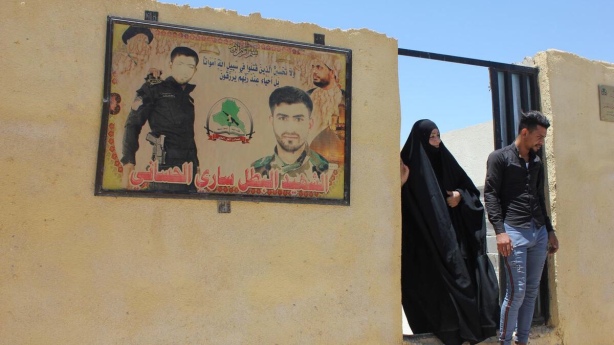
Every night, Sahla Al Hasani goes to sleep in a room lined with pictures of her dead son, coloured fairy lights draped around their frames.
“He visits me in my dreams a lot,” she says. “I feel proud of him and all Iraqi martyrs.
“I consider all of them my sons. But I miss him a lot. It is so difficult.”
Her son Sari was 25 when he was killed in June 2015 in Iraq’s Saladin province, during the campaign to remove ISIS.
He belonged to Asaib Ahl Al Haq – the League of the Righteous.
It is one of about 60 units in the Popular Mobilisation Forces, an umbrella group of mostly Shiite paramilitaries.
Since Sari’s death, Asaib has paid for a new house for his family, a $10,000 (Dh36,700) pilgrimage to Makkah for Sahla, and has promised to cover his relatives’ healthcare costs.
It also covered the 5 million Iraqi dinar (Dh15,500) cost of his three-day funeral wake, after which he was buried in a plot owned by the unit in Wadi Al Salam, the cemetery for Shiites in Najaf.
It is all part of the benefits package the Iran-aligned militant group offers the families of dead fighters. It lost scores of men in anti-ISIS operations, in which the PMF as a whole played a major role.
Sahla Al Hasani keeps photographs of her son Sari, who was killed during the military campaign to oust ISIS in 2015. Lizzie Porter/ The National
The Al Hasanis are from Abu Al Khaseeb, a poor town south of Basra city of rough breezeblock buildings, where provision of state services like electricity and paved roads is patchy at best.
Inside their new Asaib-provided home, clean blue and brown tiles line the walls, plastic reed carpets cover the floor and a ceiling fan beats back the sticky heat.
A plaque on the outside wall has Asaib’s logo next to Sari’s death date.
“Our old house was in a poor state – this one is much better.
“There is water and electricity,” said Sari’s brother Zulfiqar, 23.
The housing campaign was officially launched in January, with a promise from Asaib’s leader Qais Al Khazali to build or repair “a house for the family of every martyr”.
Including the Al Hasanis, the group has so far provided new homes to five Basrawi families, at a cost of 30 million to 40 million dinars each.
It intends to provide for five more still living in rented accommodation.
Funding comes from Asaib’s budget as well as private donations, according to a member of the group’s martyrs’ committee in Basra.
“Our role is to build houses, provide social support and health care, as well as provide jobs to the martyrs’ relatives,” said the committee member, Abu Maryam.
Sari’s unemployed brother Zulfiqar said Asaib was helping him to secure work at Iraq’s state oil company.
Backed by Iran, Asaib formed in 2006 as a splinter group from cleric Moqtada Al Sadr’s Mahdi Army.
It claimed thousands of attacks on US troops in Iraq, and kidnapped and killed Iraqis, Britons and Americans.
It also sent fighters to back the Assad regime in Syria.
READ MORE
Israel strikes Iranian targets in Syria after rocket attack
UN alarmed at reports that more than 100 have been killed in Iran protests
Iraq: threats, violence and kidnap taking a psychological toll on protesters
It has since tried to rebrand itself as a nationalist political party: it controls two ministries and has 15 MPs in the Iraqi parliament.
It has developed a wide network of youth associations, social services and women’s representatives.
That welfare system mirrors those of other Iran-aligned groups in the Middle East.
In Lebanon, despite a failing economy and US sanctions, the Iranian proxy Hezbollah provides housing, health care and education for the families of its dead and injured fighters.
In Iraq, not all PMF units are aligned with Iran. But as the fight against ISIS has wound down, analysts say those who do side with Tehran have been using service provision to push for incremental social change.
“This is another way of them saying, stability also comes from us – we are always fighting … but you’re living a better life, a more just life, and you’re getting services and other fun stuff that you need,” said Phillip Smyth, a researcher on Shiite militant groups at The Washington Institute for Near East Policy.
“That’s a big facet to it.”
Yet not everyone is happy with Asaib and similar groups’ activities, especially their responses to the anti-government protests that have swept across southern Iraq for the past two months.
An activist from Basra fled Iraq last week after discovering that his name was on a wanted list drawn up by local political parties and the intelligence services.
“I fled in secret to the airport and I booked the next plane I could,” he told The National from a nearby country.
The activist’s family escaped from Iraq years ago after receiving threats from Asaib over business links with American contractors. He returned to Basra, but last year started receiving direct threats again on social media, through telephone calls and in person.
“We have been subjected to a lot of harassment, plus direct and indirect threats because of activities that they don’t like, like charitable activities and cultural festivals,” the activist said. “An example of a threat is, ‘Shut up, otherwise we’ll make you shut up in our own special way’.”
It is difficult to pinpoint exactly which party was sending the threats, he said, as all use similar intimidation techniques. But along with another Shiite group, Asaib “is the most active” in threatening people in Basra who oppose its activities, he said.
His account was supported by four other activists and analysts interviewed by The National.
Although protesters have publicly beaten pictures of top Iranian leaders, they appear reluctant to speak out against their Iraqi partners.
“Everyone is scared because of Asaib Ahl Al Haq,” said another Iraqi activist.
“They are highly trained killers. They had lots of equipment, even before they went into politics, and they are more powerful now. Whenever I asked in our networks to speak to a journalist about them, they replied: ‘Are you crazy? We don’t want our voice to be heard.’ They get scared.”
Asaib’s offices have been attacked by protesters who blame them – and other political parties – for rampant corruption. Last month, a group attacked and killed a local leader, Wissam Al Allawi, although it is not known if he was singled out specifically.
Like the Iraqi army and anti-­riot police, Asaib responded to protesters with force.
Seven protesters were killed last month when a gunman shot at them in Nasiriyah, a city between Basra and Baghdad, according to a witness.
Another estimate put the death toll at five.
“There were a number of people who were going out to protest and someone opened fire on them from the Asaib Ahl Al Haq headquarters,” the witness said. “The party members then drove around the streets, opening fire. The authorities didn’t intervene until the protesters started to set fire to the Asaib HQ.”
A verified video clip from the city of Amara, 70 kilometres from the Iranian border, showed another gunman shooting at protesters from a building bearing Asaib’s logo.
Al Khazali has said that he supports protesters’ demands for better government, but claimed demonstrations have been infiltrated by “foreign parties”, including Israel and the US.
They want to cause “chaos and internal disorder” in Iraq, he said.
Relatives celebrate the marriage of Saif Ali, a protester who decided to celebrate marriage in Tahrir Square during ongoing anti-government protests. AP
<img src=”/image/policy:1.939571:1574160024/image/d63a84c339a24065b4a3d5965196da5a-d63a84c339a24065b4a3d5965196da5a-5c1662d7d781414bab1d8aae8d1382de-edb3a.jpg?f=1×1&amp;w=480&amp;$p$f$w=bde3876″ />
Asaib’s spokesman denied the group had threatened people.
He told The National that any retaliation for the death of Al Allawi, the local leader, would be through legal means.
Analysts say the militant group and other Iran-aligned PMF brigades may take after Tehran when it comes to cracking down on dissent, using strategies of plausible deniability.
They will probably use a combination of “discreet violence and media manipulation” to “absorb some public anger and undermine the protest movement”, said Nathaniel Rabkin, managing editor of Inside Iraqi Politics, a political risk newsletter.
“I suspect that’s in part because they know that’s how Iran deals with these things.
“When there are protests in Iran, the government is able to figure out: who are the people we need to isolate; who are the people we need to target; who can be intimidated; who cannot; and how long should we let it go on? I think that’s probably how they’re looking at this.”
Another Iraqi with knowledge of Asaib said that the group threatened people who disagreed with their vision of ruling Iraq.
“They are against a civil state in Iraq – they want a Wilayat Al Faqih,” the source said, referring to the system of government applied in Iran under supreme leader Ayatollah Ali Khamenei.
Many Shiites do not believe in this form of leadership.
The activist who fled Basra is determined to return home, but does not know when it will be safe to do so.
“I am not the type to be scared,” he said. “I will disappear until the arrest warrant is dropped.
“I don’t know how long that will be. It could be two weeks or two months. I don’t know.”
Updated: November 20, 2019 08:17 PM