Showing posts with label fraud. Show all posts

Monday, October 23, 2023

Quakeland: On the Road to America’s Next Devastating Earthquake: Revelation 6


Quakeland: On the Road to America’s Next Devastating Earthquake
Roger BilhamQuakeland: New York and the Sixth Seal (Revelation 6:12)
Given recent seismic activity — political as well as geological — it’s perhaps unsurprising that two books on earthquakes have arrived this season. One is as elegant as the score of a Beethoven symphony; the other resembles a diary of conversations overheard during a rock concert. Both are interesting, and both relate recent history to a shaky future.
Journalist Kathryn Miles’s Quakeland is a litany of bad things that happen when you provoke Earth to release its invisible but ubiquitous store of seismic-strain energy, either by removing fluids (oil, water, gas) or by adding them in copious quantities (when extracting shale gas in hydraulic fracturing, also known as fracking, or when injecting contaminated water or building reservoirs). To complete the picture, she describes at length the bad things that happen during unprovoked natural earthquakes. As its subtitle hints, the book takes the form of a road trip to visit seismic disasters both past and potential, and seismologists and earthquake engineers who have first-hand knowledge of them. Their colourful personalities, opinions and prejudices tell a story of scientific discovery and engineering remedy.
Miles poses some important societal questions. Aside from human intervention potentially triggering a really damaging earthquake, what is it actually like to live in neighbourhoods jolted daily by magnitude 1–3 earthquakes, or the occasional magnitude 5? Are these bumps in the night acceptable? And how can industries that perturb the highly stressed rocks beneath our feet deny obvious cause and effect? In 2015, the Oklahoma Geological Survey conceded that a quadrupling of the rate of magnitude-3 or more earthquakes in recent years, coinciding with a rise in fracking, was unlikely to represent a natural process. Miles does not take sides, but it’s difficult for the reader not to.
She visits New York City, marvelling at subway tunnels and unreinforced masonry almost certainly scheduled for destruction by the next moderate earthquake in the vicinity. She considers the perils of nuclear-waste storage in Nevada and Texas, and ponders the risks to Idaho miners of rock bursts — spontaneous fracture of the working face when the restraints of many million years of confinement are mined away. She contemplates the ups and downs of the Yellowstone Caldera — North America’s very own mid-continent supervolcano — and its magnificently uncertain future. Miles also touches on geothermal power plants in southern California’s Salton Sea and elsewhere; the vast US network of crumbling bridges, dams and oil-storage farms; and the magnitude 7–9 earthquakes that could hit California and the Cascadia coastline of Oregon and Washington state this century. Amid all this doom, a new elementary school on the coast near Westport, Washington, vulnerable to inbound tsunamis, is offered as a note of optimism. With foresight and much persuasion from its head teacher, it was engineered to become an elevated safe haven.
Miles briefly discusses earthquake prediction and the perils of getting it wrong (embarrassment in New Madrid, Missouri, where a quake was predicted but never materialized; prison in L’Aquila, Italy, where scientists failed to foresee a devastating seismic event) and the successes of early-warning systems, with which electronic alerts can be issued ahead of damaging seismic waves. Yes, it’s a lot to digest, but most of the book obeys the laws of physics, and it is a engaging read. One just can’t help wishing that Miles’s road trips had taken her somewhere that wasn’t a disaster waiting to happen.
Catastrophic damage in Anchorage, Alaska, in 1964, caused by the second-largest earthquake in the global instrumental record.
In The Great Quake, journalist Henry Fountain provides us with a forthright and timely reminder of the startling historical consequences of North America’s largest known earthquake, which more than half a century ago devastated southern Alaska. With its epicentre in Prince William Sound, the 1964 quake reached magnitude 9.2, the second largest in the global instrumental record. It released more energy than either the 2004 Sumatra–Andaman earthquake or the 2011 Tohoku earthquake off Japan; and it generated almost as many pages of scientific commentary and description as aftershocks. Yet it has been forgotten by many.
The quake was scientifically important because it occurred at a time when plate tectonics was in transition from hypothesis to theory. Fountain expertly traces the theory’s historical development, and how the Alaska earthquake was pivotal in nailing down one of the most important predictions. The earthquake caused a fjordland region larger than England to subside, and a similarly huge region of islands offshore to rise by many metres; but its scientific implications were not obvious at the time. Eminent seismologists thought that a vertical fault had slipped, drowning forests and coastlines to its north and raising beaches and islands to its south. But this kind of fault should have reached the surface, and extended deep into Earth’s mantle. There was no geological evidence of a monster surface fault separating these two regions, nor any evidence for excessively deep aftershocks. The landslides and liquefied soils that collapsed houses, and the tsunami that severely damaged ports and infrastructure, offered no clues to the cause.
“Previous earthquakes provide clear guidance about present-day vulnerability.” The hero of The Great Quake is the geologist George Plafker, who painstakingly mapped the height reached by barnacles lifted out of the intertidal zone along shorelines raised by the earthquake, and documented the depths of drowned forests. He deduced that the region of subsidence was the surface manifestation of previously compressed rocks springing apart, driving parts of Alaska up and southwards over the Pacific Plate. His finding confirmed a prediction of plate tectonics, that the leading edge of the Pacific Plate plunged beneath the southern edge of Alaska along a gently dipping thrust fault. That observation, once fully appreciated, was applauded by the geophysics community.
Fountain tells this story through the testimony of survivors, engineers and scientists, interweaving it with the fascinating history of Alaska, from early discovery by Europeans to purchase from Russia by the United States in 1867, and its recent development. Were the quake to occur now, it is not difficult to envisage that with increased infrastructure and larger populations, the death toll and price tag would be two orders of magnitude larger than the 139 fatalities and US$300-million economic cost recorded in 1964.
What is clear from these two books is that seismicity on the North American continent is guaranteed to deliver surprises, along with unprecedented economic and human losses. Previous earthquakes provide clear guidance about the present-day vulnerability of US infrastructure and populations. Engineers and seismologists know how to mitigate the effects of future earthquakes (and, in mid-continent, would advise against the reckless injection of waste fluids known to trigger earthquakes). It is merely a matter of persuading city planners and politicians that if they are tempted to ignore the certainty of the continent’s seismic past, they should err on the side of caution when considering its seismic future.

Sunday, August 20, 2023

Quakeland: On the Road to America’s Next Devastating Earthquake: Revelation 6


Quakeland: On the Road to America’s Next Devastating Earthquake
Roger BilhamQuakeland: New York and the Sixth Seal (Revelation 6:12)
Given recent seismic activity — political as well as geological — it’s perhaps unsurprising that two books on earthquakes have arrived this season. One is as elegant as the score of a Beethoven symphony; the other resembles a diary of conversations overheard during a rock concert. Both are interesting, and both relate recent history to a shaky future.
Journalist Kathryn Miles’s Quakeland is a litany of bad things that happen when you provoke Earth to release its invisible but ubiquitous store of seismic-strain energy, either by removing fluids (oil, water, gas) or by adding them in copious quantities (when extracting shale gas in hydraulic fracturing, also known as fracking, or when injecting contaminated water or building reservoirs). To complete the picture, she describes at length the bad things that happen during unprovoked natural earthquakes. As its subtitle hints, the book takes the form of a road trip to visit seismic disasters both past and potential, and seismologists and earthquake engineers who have first-hand knowledge of them. Their colourful personalities, opinions and prejudices tell a story of scientific discovery and engineering remedy.
Miles poses some important societal questions. Aside from human intervention potentially triggering a really damaging earthquake, what is it actually like to live in neighbourhoods jolted daily by magnitude 1–3 earthquakes, or the occasional magnitude 5? Are these bumps in the night acceptable? And how can industries that perturb the highly stressed rocks beneath our feet deny obvious cause and effect? In 2015, the Oklahoma Geological Survey conceded that a quadrupling of the rate of magnitude-3 or more earthquakes in recent years, coinciding with a rise in fracking, was unlikely to represent a natural process. Miles does not take sides, but it’s difficult for the reader not to.
She visits New York City, marvelling at subway tunnels and unreinforced masonry almost certainly scheduled for destruction by the next moderate earthquake in the vicinity. She considers the perils of nuclear-waste storage in Nevada and Texas, and ponders the risks to Idaho miners of rock bursts — spontaneous fracture of the working face when the restraints of many million years of confinement are mined away. She contemplates the ups and downs of the Yellowstone Caldera — North America’s very own mid-continent supervolcano — and its magnificently uncertain future. Miles also touches on geothermal power plants in southern California’s Salton Sea and elsewhere; the vast US network of crumbling bridges, dams and oil-storage farms; and the magnitude 7–9 earthquakes that could hit California and the Cascadia coastline of Oregon and Washington state this century. Amid all this doom, a new elementary school on the coast near Westport, Washington, vulnerable to inbound tsunamis, is offered as a note of optimism. With foresight and much persuasion from its head teacher, it was engineered to become an elevated safe haven.
Miles briefly discusses earthquake prediction and the perils of getting it wrong (embarrassment in New Madrid, Missouri, where a quake was predicted but never materialized; prison in L’Aquila, Italy, where scientists failed to foresee a devastating seismic event) and the successes of early-warning systems, with which electronic alerts can be issued ahead of damaging seismic waves. Yes, it’s a lot to digest, but most of the book obeys the laws of physics, and it is a engaging read. One just can’t help wishing that Miles’s road trips had taken her somewhere that wasn’t a disaster waiting to happen.
Catastrophic damage in Anchorage, Alaska, in 1964, caused by the second-largest earthquake in the global instrumental record.
In The Great Quake, journalist Henry Fountain provides us with a forthright and timely reminder of the startling historical consequences of North America’s largest known earthquake, which more than half a century ago devastated southern Alaska. With its epicentre in Prince William Sound, the 1964 quake reached magnitude 9.2, the second largest in the global instrumental record. It released more energy than either the 2004 Sumatra–Andaman earthquake or the 2011 Tohoku earthquake off Japan; and it generated almost as many pages of scientific commentary and description as aftershocks. Yet it has been forgotten by many.
The quake was scientifically important because it occurred at a time when plate tectonics was in transition from hypothesis to theory. Fountain expertly traces the theory’s historical development, and how the Alaska earthquake was pivotal in nailing down one of the most important predictions. The earthquake caused a fjordland region larger than England to subside, and a similarly huge region of islands offshore to rise by many metres; but its scientific implications were not obvious at the time. Eminent seismologists thought that a vertical fault had slipped, drowning forests and coastlines to its north and raising beaches and islands to its south. But this kind of fault should have reached the surface, and extended deep into Earth’s mantle. There was no geological evidence of a monster surface fault separating these two regions, nor any evidence for excessively deep aftershocks. The landslides and liquefied soils that collapsed houses, and the tsunami that severely damaged ports and infrastructure, offered no clues to the cause.
“Previous earthquakes provide clear guidance about present-day vulnerability.” The hero of The Great Quake is the geologist George Plafker, who painstakingly mapped the height reached by barnacles lifted out of the intertidal zone along shorelines raised by the earthquake, and documented the depths of drowned forests. He deduced that the region of subsidence was the surface manifestation of previously compressed rocks springing apart, driving parts of Alaska up and southwards over the Pacific Plate. His finding confirmed a prediction of plate tectonics, that the leading edge of the Pacific Plate plunged beneath the southern edge of Alaska along a gently dipping thrust fault. That observation, once fully appreciated, was applauded by the geophysics community.
Fountain tells this story through the testimony of survivors, engineers and scientists, interweaving it with the fascinating history of Alaska, from early discovery by Europeans to purchase from Russia by the United States in 1867, and its recent development. Were the quake to occur now, it is not difficult to envisage that with increased infrastructure and larger populations, the death toll and price tag would be two orders of magnitude larger than the 139 fatalities and US$300-million economic cost recorded in 1964.
What is clear from these two books is that seismicity on the North American continent is guaranteed to deliver surprises, along with unprecedented economic and human losses. Previous earthquakes provide clear guidance about the present-day vulnerability of US infrastructure and populations. Engineers and seismologists know how to mitigate the effects of future earthquakes (and, in mid-continent, would advise against the reckless injection of waste fluids known to trigger earthquakes). It is merely a matter of persuading city planners and politicians that if they are tempted to ignore the certainty of the continent’s seismic past, they should err on the side of caution when considering its seismic future.

Sunday, July 30, 2023

Quakeland: On the Road to America’s Next Devastating Earthquake: Revelation 6


Quakeland: On the Road to America’s Next Devastating Earthquake
Roger BilhamQuakeland: New York and the Sixth Seal (Revelation 6:12)
Given recent seismic activity — political as well as geological — it’s perhaps unsurprising that two books on earthquakes have arrived this season. One is as elegant as the score of a Beethoven symphony; the other resembles a diary of conversations overheard during a rock concert. Both are interesting, and both relate recent history to a shaky future.
Journalist Kathryn Miles’s Quakeland is a litany of bad things that happen when you provoke Earth to release its invisible but ubiquitous store of seismic-strain energy, either by removing fluids (oil, water, gas) or by adding them in copious quantities (when extracting shale gas in hydraulic fracturing, also known as fracking, or when injecting contaminated water or building reservoirs). To complete the picture, she describes at length the bad things that happen during unprovoked natural earthquakes. As its subtitle hints, the book takes the form of a road trip to visit seismic disasters both past and potential, and seismologists and earthquake engineers who have first-hand knowledge of them. Their colourful personalities, opinions and prejudices tell a story of scientific discovery and engineering remedy.
Miles poses some important societal questions. Aside from human intervention potentially triggering a really damaging earthquake, what is it actually like to live in neighbourhoods jolted daily by magnitude 1–3 earthquakes, or the occasional magnitude 5? Are these bumps in the night acceptable? And how can industries that perturb the highly stressed rocks beneath our feet deny obvious cause and effect? In 2015, the Oklahoma Geological Survey conceded that a quadrupling of the rate of magnitude-3 or more earthquakes in recent years, coinciding with a rise in fracking, was unlikely to represent a natural process. Miles does not take sides, but it’s difficult for the reader not to.
She visits New York City, marvelling at subway tunnels and unreinforced masonry almost certainly scheduled for destruction by the next moderate earthquake in the vicinity. She considers the perils of nuclear-waste storage in Nevada and Texas, and ponders the risks to Idaho miners of rock bursts — spontaneous fracture of the working face when the restraints of many million years of confinement are mined away. She contemplates the ups and downs of the Yellowstone Caldera — North America’s very own mid-continent supervolcano — and its magnificently uncertain future. Miles also touches on geothermal power plants in southern California’s Salton Sea and elsewhere; the vast US network of crumbling bridges, dams and oil-storage farms; and the magnitude 7–9 earthquakes that could hit California and the Cascadia coastline of Oregon and Washington state this century. Amid all this doom, a new elementary school on the coast near Westport, Washington, vulnerable to inbound tsunamis, is offered as a note of optimism. With foresight and much persuasion from its head teacher, it was engineered to become an elevated safe haven.
Miles briefly discusses earthquake prediction and the perils of getting it wrong (embarrassment in New Madrid, Missouri, where a quake was predicted but never materialized; prison in L’Aquila, Italy, where scientists failed to foresee a devastating seismic event) and the successes of early-warning systems, with which electronic alerts can be issued ahead of damaging seismic waves. Yes, it’s a lot to digest, but most of the book obeys the laws of physics, and it is a engaging read. One just can’t help wishing that Miles’s road trips had taken her somewhere that wasn’t a disaster waiting to happen.
Catastrophic damage in Anchorage, Alaska, in 1964, caused by the second-largest earthquake in the global instrumental record.
In The Great Quake, journalist Henry Fountain provides us with a forthright and timely reminder of the startling historical consequences of North America’s largest known earthquake, which more than half a century ago devastated southern Alaska. With its epicentre in Prince William Sound, the 1964 quake reached magnitude 9.2, the second largest in the global instrumental record. It released more energy than either the 2004 Sumatra–Andaman earthquake or the 2011 Tohoku earthquake off Japan; and it generated almost as many pages of scientific commentary and description as aftershocks. Yet it has been forgotten by many.
The quake was scientifically important because it occurred at a time when plate tectonics was in transition from hypothesis to theory. Fountain expertly traces the theory’s historical development, and how the Alaska earthquake was pivotal in nailing down one of the most important predictions. The earthquake caused a fjordland region larger than England to subside, and a similarly huge region of islands offshore to rise by many metres; but its scientific implications were not obvious at the time. Eminent seismologists thought that a vertical fault had slipped, drowning forests and coastlines to its north and raising beaches and islands to its south. But this kind of fault should have reached the surface, and extended deep into Earth’s mantle. There was no geological evidence of a monster surface fault separating these two regions, nor any evidence for excessively deep aftershocks. The landslides and liquefied soils that collapsed houses, and the tsunami that severely damaged ports and infrastructure, offered no clues to the cause.
“Previous earthquakes provide clear guidance about present-day vulnerability.” The hero of The Great Quake is the geologist George Plafker, who painstakingly mapped the height reached by barnacles lifted out of the intertidal zone along shorelines raised by the earthquake, and documented the depths of drowned forests. He deduced that the region of subsidence was the surface manifestation of previously compressed rocks springing apart, driving parts of Alaska up and southwards over the Pacific Plate. His finding confirmed a prediction of plate tectonics, that the leading edge of the Pacific Plate plunged beneath the southern edge of Alaska along a gently dipping thrust fault. That observation, once fully appreciated, was applauded by the geophysics community.
Fountain tells this story through the testimony of survivors, engineers and scientists, interweaving it with the fascinating history of Alaska, from early discovery by Europeans to purchase from Russia by the United States in 1867, and its recent development. Were the quake to occur now, it is not difficult to envisage that with increased infrastructure and larger populations, the death toll and price tag would be two orders of magnitude larger than the 139 fatalities and US$300-million economic cost recorded in 1964.
What is clear from these two books is that seismicity on the North American continent is guaranteed to deliver surprises, along with unprecedented economic and human losses. Previous earthquakes provide clear guidance about the present-day vulnerability of US infrastructure and populations. Engineers and seismologists know how to mitigate the effects of future earthquakes (and, in mid-continent, would advise against the reckless injection of waste fluids known to trigger earthquakes). It is merely a matter of persuading city planners and politicians that if they are tempted to ignore the certainty of the continent’s seismic past, they should err on the side of caution when considering its seismic future.

Sunday, October 6, 2019

Iraq protests: Antichrist demands government resign

Anti-government protesters set fires and close a street during a demonstration in Baghdad Credit: AP
Reuters News Agency
One of Iraq’s most influential clerics called on Friday for the government to resign as the death toll rose to 93 in the violent national protests against official corruption that have now entered their fifth day.
Moqtada al-Sadr, a populist political leader who has a huge following on the Iraqi street, said new elections should be held soon.
“Respect the blood of Iraq through the resignation of the government and prepare for early elections overseen by international monitors,” a statement from his office said.
Nearly 4,000 people have been injured since the protests against chronic unemployment, poor public services and widespread corruption erupted in the capital on Tuesday, the Iraq parliament’s human rights commission said.
It was not immediately clear whether the latest deaths were from Friday’s huge protests or fresh demonstrations on Saturday.
The authorities have imposed a virtual blackout of the internet and confirmation of protest casualties in the provinces has trickled in slowly.
Prime Minister Adel Abdul Mahdi called for calm as more than 190 people were wounded in the capital on Friday, but protesters scorned his promises of political reform.
Sadr’s intervention appeared likely to encourage them to continue their uprising until the government backs down.
Anti-government protesters take cover while Iraq security forces fire during a demonstration in Baghdad Credit: AP
On the streets of Baghdad, police appeared to be targeting individual protesters. Reuters reporters saw one fall to the ground after being shot in the head. He was pronounced dead in hospital.
Elsewhere, a Reuters television crew saw a man critically wounded by a gunshot to the neck after snipers on rooftops opened fire at a crowd. Sporadic shooting could be heard in Baghdad into the late evening.
Police shot dead three people trying to storm the provincial government headquarters in the southern city of Diwaniya, police and medics said.
The violence is the worst since Iraq put down an insurgency by Islamic State two years ago. The protests arose in the south, heartland of the Shi’ite majority, but quickly spread, with no formal leadership.
“It is sorrowful that there have been so many deaths, casualties and destruction,” Iraq’s most influential cleric, Grand Ayatollah Ali al-Sistani, said in a letter read out by his representative during a sermon.
Iraqi security forces stand guard outside the interior ministry during a demonstration  Credit: AFP
“The government and political sides have not answered the demands of the people to fight corruption or achieved anything on the ground,” said Sistani, who stays out of day-to-day politics but whose word is law for Iraq’s Shi’ites. “Parliament holds the biggest responsibility for what is happening.”
Sadr, who leads the largest opposition bloc in parliament, ordered his lawmakers to suspend participation in the legislature until the government introduces a programme that would serve all Iraqis.
Parliament is to convene Saturday to discuss protesters’ demands. A curfew was lifted at 5am local time (7am UK time) on Saturday morning,  two days after imposing the measure in an attempt to quell the protests.
Security remains heavily deployed but streets and main squares are now open to traffic. Municipal workers were on Saturday morning clearing the streets of the bullets and debris left behind by the latest confrontations.
The speaker of Iraq’s parliament has called the protests a “revolution” against corruption but urged calm and proposed reforms such as better state housing support for poor people and ensuring Iraqi graduates are included on lucrative foreign projects for energy sector development.
Many government officials and lawmakers are widely accused of siphoning off public money, unfairly awarding contracts in state institutions and other forms of corruption.
The violence is an unprecedented test for Adel Abdul Mahdi, a mild-mannered veteran politician who came to power last year as a compromise candidate backed by powerful Shi’ite groups that have dominated Iraq since the downfall of Saddam Hussein in 2003.
In his overnight address, Abdul Mahdi pledged reforms but said there was no “magic solution” to Iraq’s problems. He insisted politicians were aware of the suffering of the masses: “We do not live in ivory towers – we walk among you in the streets of Baghdad,” he said.
A young man in a crowd fleeing sniper shots at a central Baghdad square was scornful. “The promises by Adel Abdul Mahdi are to fool the people, and today they are firing live gunshots at us,” he said.
“Today this was a peaceful protest. They set up these barricades, and the sniper is sitting right there since last night.”
Iraqi Prime Minister Adel Abdel Mahdi gives his first televised speech following the outbreak of deadly protests in Baghdad  Credit: AFP
The unrest occurs on the eve of Arbaeen, a Shi’ite pilgrimage which in recent years has drawn 20 million worshippers, trekking for days on foot across southern Iraq in the world’s biggest annual gathering, 10 times the size of the Mecca Hajj.
Some pilgrims were already taking to the roads on Friday, although in smaller numbers than in recent years. Iran has closed one of the border crossings used by millions of pilgrims. Qatar has told its citizens to stay away.
A senior Iranian cleric blamed the unrest on the United States and Israel, saying they aimed to thwart the pilgrimage.
The protests could grow if they receive formal backing from Sadr, who has long denounced corruption and the political elite. Parliament was set to hold a session dedicated to finding a solution, but Sadr’s faction was staying away.
Sadr has not called on his followers to join the protests, but his faction has expressed sympathy with their aims. One senior Sadrist politician, Awad Awadi, described the protests to Reuters as “a revolution of hunger”.

Saturday, October 5, 2019

Political Unrest Before the Antichrist Takes Control


Protesters shun politicians they blame for Iraq woes
October 3, 2019, 2:47 AM MDT
Baghdad (AFP) – The mainly young protesters who have flooded Iraqi streets this week say their movement is spontaneous with no space for the clerics and politicians they accuse of hijacking previous protests for jobs and better services.
“This movement doesn’t look like any of the previous ones — it’s a popular, apolitical movement that isn’t linked to a party or a tribe,” said Majid Saher, 34, while protesting in Baghdad.
In Iraq’s politicised society, large-scale protests are usually called by politicians or religious figures, chief among them Shiite spiritual leader Grand Ayatollah Ali Sistani and firebrand cleric Moqtada al-Sadr.
This time, protesters claimed, is different.
“There is no leader. Look how many we are here. We’re all young and unemployed,” said Hussein Mohammad at a demonstration in the capital.
Thousands have packed the squares and thoroughfares of Baghdad and cities across the south since Tuesday, burning tyres and waving the national flag.
Many make do with swimming goggles or sunglasses to protect them from the volleys of tear gas fired by police.
Chief among their many grievances is high youth unemployment, with many posters and chants referring to a “right” to work.
The state remains Iraq’s biggest employer and has typically provided jobs for most university graduates, but recruitment appears to have slowed this year.
Youth unemployment now stands at 25 percent, twice the overall rate, according to the World Bank.
– ‘Parties robbed us’ –
Other grievances include Iraq’s chronic power cuts and water shortages, and state corruption.
Iraqi is listed as the world’s 12th most corrupt country by Transparency International.
“Our number one problem is corruption. It has killed us,” said Walid Ahmad, a former soldier protesting in Baghdad.
He barely got out his words between coughing fits as those around him lit tyres at a road junction in the city centre.
“Today, we just want our people and country. We don’t want political parties, dignitaries or religious chiefs. We don’t want them to join our movement,” Ahmad said.
Nesrine Mohammed, one of the few women among the protesters, said she wanted to dispense with the whole of Iraq’s political class.
“We haven’t heard anything but lies and unfulfilled promises from the government and politicians,” she said.
“The parties have robbed us of all our dreams. There’s no place for the poor in this country,” the 46-year-old added.
For Fanar Haddad, an Iraq expert at the National University of Singapore, the most significant absentee from this week’s protests is Sadr.
Supporters of the former militia leader turned nationalist politician have been at the forefront of most of the larger protests in recent years, including in 2016 when he urged them to storm Baghdad’s then-still-sealed Green Zone administrative and diplomatic compound.
“This is the first time that there are mass, significant and violent protests without Sadrist involvement,” he said.
– ‘Double-edged sword’ –
“One of the myths being burst is that only Sadrists can bring people out to the streets — it seems people can bring themselves out to the streets,” said Haddad.
But this apparent independence “is a double-edged sword for both the government and protesters themselves,” he warned.
On the one hand, the broad-based nature of the protests will make it difficult for a political party to hijack them or for the central government to appease them.
“But it’s also a weakness for protesters -– where can this go? I can’t see it going anywhere definitive,” Haddad said.
Some demonstrators in recent days chanted for “the downfall of the regime,” a refrain popularised during the Arab Spring uprisings that targeted dictatorships across the Arab world in 2011.
But while the protests may bring down Prime Minister Adel Abdel Mahdi just short of a year in office, few had expected his government to last this long anyway.
And Iraq has such a diffuse power structure, there are no other obvious targets for the protesters’ anger.
“There’s no king to take to the guillotine,” Haddad said.

Friday, October 4, 2019

Antichrist Muqtada al Sadr Suspends Parliament Activities


Iraqi cleric Muqtada al Sadr suspends parliament activities
The latest on developments in Iraq, amid deadly violence over anti-government protests (all times local):
04.10.2019
3:45 p.m. An influential Iraqi Shia cleric whose political coalition came in first in last year’s national elections says he’s suspending participation in parliament activities until the government introduces a programme that serves Iraqi aspirations. Muqtada al-Sadr has asked members of his parliament bloc to boycott sessions until the government issues a programme acceptable to the people. Al-Sadr’s Sairoon electoral list won the largest single bloc of seats in parliament elections last year. The bloc has 54 seats in the 329-member parliament. The move comes after Iraq’s top Shia authority, Grand Ayatollah Ali al-Sistani, blamed lawmakers for failing to enact reforms and eradicate corruption.
3:30 p.m. Three Gulf Arab nations have advised their citizens to avoid traveling to Iraq and those who are there to leave the country immediately. Friday’s call by Kuwait, Qatar and Bahrain comes after three days of protests in Iraq that have left 42 people dead. The Kuwaiti news agency Kuna cited a Foreign Ministry official as urging Kuwaiti nationals to avoid traveling to Iraq due to the demonstrations and for those already there to leave as soon as possible and to avoid areas where protests are held. Qatar’s Foreign Ministry issued a similar request. Bahrain’s Foreign Ministry also called on its country’s citizens not to travel to Iraq and urged those already in Iraq to “leave immediately”.
3:15 p.m. Iraqi security forces have again opened fire on protesters gathered in central Baghdad, wounding one person on the fourth day of violence amid anti-government rallies. The protesters were gathered in a street behind Tayaran Square on Friday, chanting slogans when security forces opened fire. A young man was shot in the leg. It was the first shooting after Iraq’s top Shia cleric, Grand Ayatollah Ali al-Sistani, earlier in the day called on both sides to cease violence, which has gripped Iraq since Tuesday. Many across Iraq’s predominantly Shia south had looked to the influential cleric for guidance.
1:15 p.m. Iraq’s most influential Shia cleric has called for an end to the violence gripping the country, urging both sides to pull back “before it is too late.” The comments by Grand Ayatollah Ali al-Sistani were his first since anti-government protests began earlier this week. The violence has killed 42 people so far. He also criticised the government, as well as the leaders of the two biggest parliament blocs, saying they failed to fulfil their promises to the people. Al-Sistani called on political leaders to take “practical and clear steps” toward combatting corruption and on the government to “carry out its duty” to diminish people’s suffering. He reiterated his suggestion for a committee of technocrats tasked with making recommendations on fighting corruption, as a way out of the current crisis. Al-Sistani’s message was delivered on Friday by his representative Ahmed al-Safi in the Shia holy city of Karbala.
12:30 p.m. Iraqi officials are reporting nine more deaths in anti-government protests in a southern city, bringing this week’s overall death toll to 42. Hospital officials say the deaths occurred late Thursday in Nasiriyah, which has witnessed the most violence in the protests, with at least 25 people, including a policeman, killed. The city is about 320 kilometres southeast of Baghdad. The officials spoke to journalists on condition of anonymity in line with regulations. Since Tuesday, security forces have fired live rounds and tear gas every day to disperse protesters demanding job opportunities, improved services and an end to corruption. Iraq’s Prime Minister Adel Abdul-Mahdi who hails from Nasiriyah, has urged calm, saying he’s working to meet protesters legitimate demands but adding that there’s no magic solution for Iraq’s problems.
8:35 a.m. Iraq’s prime minister has addressed the nation over the turmoil gripping the country, calling on protesters to go home and saying their demands have been heard. Prime Minister Adel Abdul-Mahdi says that the security measures imposed in the wake of this week’s violence, including the temporary curfew, are “difficult choices” but are needed like “bitter medicine” that has to be swallowed. Iraqi security forces have imposed a round-the-clock curfew in Baghdad. Since Tuesday, they fired live rounds and tear gas every day to disperse anti-government protests, leaving 33 people dead and wounding hundreds. The prime minister’s speech was televised early on Friday. He told protesters their “legitimate” demands in countering corruption and providing jobs have been heard and that it’s “important to help the government perform its duty toward you.”    (AP)

Tuesday, October 1, 2019

The War With Iran Begins in Iraq


Iraq Is Once Again The Battleground For An American Proxy War
Patrick Cockburn
People in Baghdad are fearful that the next war between the US and Iran will take place in Iraq, which is only just returning to peace after the defeat of Isis. Alarm that Iraq will be sucked into such a conflict has increased here because of recent Israeli drone attacks on the bases of the Iraqi paramilitary group known as the Hashd al-Shaabi, which is accused by the US and Israel of acting as a proxy of Iran.
The new development is that Israel has entered the conflict in Iraq,” says Abu Alaa al-Walai, the leader of Kataib Sayyid al-Shuhada, a militant Shia paramilitary movement with ties to Iran, speaking in an exclusive interview with The Independent in Baghdad. He says that three Israeli drones attacked one of his bases in the Iraqi capital, called al-Saqr, on 12 August, leading to the explosion of 50 tons of weaponry. The Israelis confirm that they carried out the raid, which was preceded by several others, claiming that they hit Iranian missiles on their way to Syria and Lebanon.
It is the likelihood of US complicity in the Israeli action which could provoke a political crisis in Iraq. Abu Alaa says that an unpublished Iraqi government report on the attack reveals that the Israeli drones were launched from a US base called Kassad in Kurdish-controlled northeast Syria. “Iraqi radar tracked one out of three of the drones travelling at 140km before, during and after the attack,” he says.
US policy in the Middle East is notoriously incoherent and contradictory under President Trump, but allowing Israel to make pin-prick attacks from a US base against the Hashd looks peculiarly like self-destruction from an American point of view. It has already led to a bill passing through the Iraqi parliament demanding the withdrawal of US forces from the country.
Asked if Kataib Sayyid al-Shuhada would attack US forces, if there is a war between the US and Iran, Abu Alaa replies: “Absolutely, yes”. He expresses enthusiasm for drone warfare, saying that the successful drone assault on the Saudi oil facilities on 14 September makes battlefields more equal for groups like his own. “We are working day and night to develop drones that can be put together in a living room,” he says.
Drone attacks on US bases in Iraq would not enjoy the same element of surprise as those on the Abqaiq and Khurais oil facilities in Saudi Arabia, but the bases are certainly vulnerable. In many respects, they do not add to US strength in Iraq but they could become American “hostages” in Iraq in the event of an Iran-US conflict.
The future of the Hashd al-Shaabi as an Iranian-influenced state-within-a-state is the crucial issue in the struggle for influence between Iran and the US. Washington is pushing for the role of the Hashd to be reduced or even eliminated, but these efforts are likely to prove ineffective and even counterproductive.
The Hashd is a political as well as a military organisation and is so well established in Iraq that there is not much the US can do to reduce its influence. Its parliamentary representatives did well in the last general election in 2018 and its support is essential for any stable Iraqi government.
A similar pattern has held true in Iraq since the US invasion of 2003. The US wanted to get rid of Saddam Hussein, though without benefiting Iran. But the downfall of Saddam’s Sunni Arab regime was inevitably followed by a political revolution in which it was replaced by the Shia majority and, to a lesser degree, by the Kurds. Try as they might, US diplomats and generals in Baghdad could not avoid cooperating, often covertly, with Iran.
Not much has really changed in the years that followed. The ruling Shia majority has an Iraqi national identity, but this is matched, and usually overmatched, by a strong religious Shia identity. Given that Iraq and Iran are among the few Shia-led states in the world it is scarcely surprising that they feel that they have much in common. Post-Saddam Iraq saw the first Shia Arab government take power in the region since Saladin overthrew the Fatimids in 12th century Egypt. “Religiously speaking, Iran gives Iraq strategic depth,” says Dhiaa al-Asadi, a leading figure in the populist religious movement of the Shia leader, Muqtada al-Sadr.
President Trump and previous US administrations have repeatedly made the mistake of denouncing Hezbollah in Lebanon, the Houthis in Yemen and the Hashd in Iraq as Iranian proxies pure and simple. This is a mistake because these powerful paramilitary movements are rooted, above all else, in the local Shia communities. Iran may have fostered these groups but it does not have command and control over them.
Another reason why Mr Trump’s bid to roll back Iranian influence is unlikely to get anywhere, is that Iran’s paramilitary allies have been victorious, or at least held their own, in the wars in Lebanon, Syria, Iraq and Yemen over the last two decades. Many Iraqis resent this fragmentation of power, complaining that “the Hashd is strong and our government is weak” – but there is not a lot they can do about it. Iran is adept at playing Iraqi political chess games and acting as the broker between different factions and centres of power.
The US is not strong enough to oust the Hashd in Iraq, but that does not mean it will not try. The US must have known that Israel was firing drones into Iraq since it controls Iraqi airspace, but using Israel as its proxy in Iraq is a risky game.
There are good reasons for them to be worried: US and Saudi authority in the Middle East has been damaged by Iranian-inspired attacks – the Iranian modus operandi is normally to act through others – on oil tankers in the Gulf, a high-flying US drone, and the Saudi oil industry. So far, Mr Trump has not thought it is in the US’s interest to hit back, but he cannot indefinitely absorb this kind of punishment without looking weak.Iraq has enjoyed a couple of years of relative peace since the defeat of Isis with the recapture of Mosul in 2017. The hundreds of security checkpoints and concrete anti-bomb blast walls in Baghdad have largely disappeared. The city is full of new restaurants and shops and the streets are thronged with people until late at night. But many Iraqis wonder how long this will last, if the US-Iran confrontation escalates into a shooting war. “Many of my friends are so nervous about a US-Iran war that they are using their severance pay on leaving government service to buy houses in Turkey,” said one civil servant.
Iraq is one place where the US and its allies could try to retaliate and their main target is likely to be the Hashd. This could in turn provoke attacks on US bases which look vulnerable in the age of the drone. Iraqis dread the idea of another military conflict, but they fear it may in any case be heading in their direction.

Tuesday, September 24, 2019

The Antichrist Pays Homage to Iran (Daniel 8:3)


Iraq’s Muqtada Al-Sadr Pays Homage to Iran
Jerusalem Center – Iran Desk,   September 22, 2019
Muqtada al-Sadr, leader of Iraq’s Sadrist movement, paid a visit to Supreme Leader Ali Khamenei’s home in Iran for the Ashura ceremonies as part of his attempts to maneuver between Washington and Iraq’s complex and problematic relationship with Iran.
• Over the past year, and especially in the wake of recent attacks on Popular Mobilization Forces (al-Hashd al-Shaabi) military targets in Iraq that were attributed to Israel, al-Sadr has sharply criticized Iran’s expansionist regional policy and its support for the Iraqi Shiite militias allied with Iran.
• Since the election of Iraq’s former Prime Minister Nouri al-Maliki to his second term of office in 2010, al-Sadr has tried to lead a policy of distancing Iraq from Iran and bringing it closer to the Arab world. Al-Sadr’s visit to Saudi Arabia in 2017 and his meeting with Crown Prince Mohammed bin Salman caused a severe breach of relations with Iran.
Al-Sadr’s visit to Tehran was perceived as unusual and has even created differences of opinion among the Shiite communities in Iraq.
• It is possible that during his visit to Iran al-Sadr is signaling that at the present time, when Iraq is facing many dangers threatening its security, he is the central personality of the Shiite community in Iraq.
• Tensions grow over the continued operation of various Shiite militias and primarily al-Hashd al-Shaabi within Iraq, which is much to al-Sadr’s distaste as he foresees that this Iranian policy will eventually lead to a conflict with Israel on Iraqi territory and will sow destruction and disaster.
After a long period of separation and a crisis in relations, Muqtada al-Sadr, leader of Iraq’s Sadrist movement, paid a visit to Iran for the Ashura ceremonies as part of his attempts to maneuver between Washington and Iraq’s complex and problematic relationship with Iran. At the same time, back home in Iraq, there are growing disputes among elements of the Shiite community, some of which have been stirred up by Tehran.
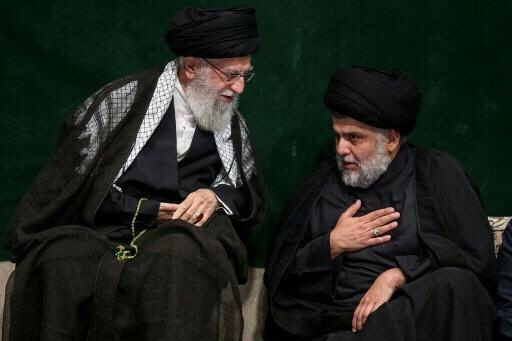
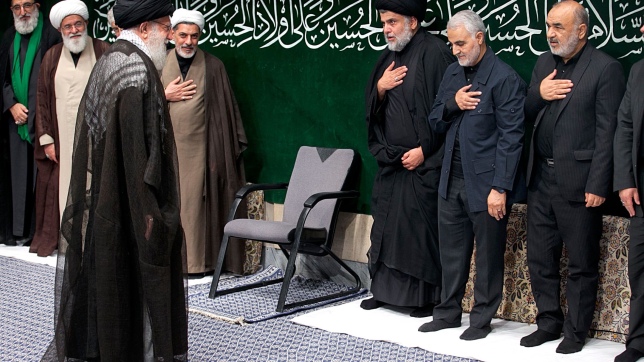
During the ceremonies, al-Sadr was seen sitting next to Iranian Supreme Leader Ali Khamenei, who was also flanked by IRGC and Quds Force Commander Qasem Soleimani and the head of the judicial authority Chief Justice Ebrahim Raisi (one of the candidates to replace the Supreme Leader). In addition to al-Sadr, other Shiite senior officials have also visited Iran, including Falih Alfayyadh, commander of the Iranian-affiliated al-Hashd al-Shaabi militia; his deputy Abu Mahdi al-Muhandis; and Qais Khazali, leader of the Shiite militia Asa’ib Ahl al-Haq (which is one of the forces of Hashd al-Shaabi), whose troops were attacked in one of the most recent strikes attributed to Israel.
Soleimani: The Attack on Saudi Arabia – the Houthis Follow in the Footsteps of Imam Hussein
Over the past year, and especially in the wake of recent attacks on al-Hashd al-Shaabi military targets in Iraq that were attributed to Israel, al-Sadr has sharply criticized Iran’s expansionist regional policy and its support for the Iraqi Shiite militias allied with Iran. He called for their return from Syria to Iraq because the Iraqi people are paying the price with their own blood for these wars that Iran has been waging through them, including within Iraqi territory. In this regard, al-Sadr also emphasized the importance of the need for these Iraqi militias to operate under the single command of the Iraqi army and the supervision of the government.
Quds Force commander: Words of praise for the Houthi (sic) attack on oil installations in Saudi Arabia
These remarks follow reports on the strengthening of the operations of the Iranian Quds Force in Iraq through the cooperation between the commander of the force, Qasem Soleimani, and Abu Mahdi al-Muhandis, second-in-command of al-Hashd al-Shaabi. The al-Hashd al-Shaabi militia has recently been operating independently, outside the framework of the Iraqi security forces, including establishing a military air wing. Other Shiite militias, which worked against the Islamic State (ISIS) and were faithful to Iran, remained in Iraqi territory and the Kurdish territories in the north and refused to be subjected to the central government.
Falluja operations room with Qasem Soleimani (left) and Abu Mahdi al Muhandis (right) in Falluja, Iraq on May 24, 2016.
Due to reports that the massive attack on oil installations in Saudi Arabia (September 14, 2019) came from Iraq or Iran, Iraq may pay the price for Iran’s battles in the region. In the spirit of the Shiite Ashura holy day, Qasem Soleimani, commander of the Quds Force, was quick to praise the strike on the Saudi oil installations in Abqaiq and Khurais, which seriously harmed Saudi oil exports and world supply: “Today, Ansarullah in Yemen (the Houthis) are continuing the path of Imam Husayn.” The end of Soleimani’s Tweet of praise for Ansarullah’s attack includes pictures of mosques in Jerusalem.2
Message from al-Sadr: See you later in my land (Iraq).
Because of the growing independence of the Shiite militias, al-Sadr left for Iran on September 5, 2019, after criticizing the announcement of Abu Mahdi al-Muhandis, vice-commander of al-Hashd al-Shaabi, that the militia was forming its own air force.3 Al-Sadr posted on his Twitter account “see you later my land.” He also alluded to the announcement about the establishment of this air force: “This is the end of the government in Iraq….This is the passage of a state of law and order to a state of rebellion….If the government does not take a firm stand (by dismantling the air force), I will repudiate it.”
During the escalation of tension between Iran and the United States and Israel over the past few months, al-Sadr has been working on a regional and international level to distance Iraq from this dispute while expressing concern that a war between all sides will lead to “catastrophic consequences for Iraq.”
al-Sadr’s criticism of Iranian involvement in Iraq’s internal affairs is not new. Since the election of Iraq’s former Prime Minister Nouri al-Maliki to his second term of office in 2010, al-Sadr has tried to lead a policy of distancing Iraq from Iran and bringing it closer to the Arab world. Al-Sadr’s visit to Saudi Arabia in 2017 and his meeting with Crown Prince Mohammed bin Salman – at the height of increased tension between Iran and Saudi Arabia over the nuclear deal and Iran’s involvement in Yemen – caused a severe breach of relations with Iran. At the same time, al-Sadr was warmly embraced by the Arab world and given support for his independent positions in the shadow cast by Iran over Iraq.
In February 2019, Asharq al-Awsat (a pro-Saudi Arabian newspaper published in London) reported that Muqtada al-Sadr visited Beirut, where he spent five hours with the secretary-general of Hizbullah, Hassan Nasrallah, in the presence of Qasem Soleimani, to discuss the position of the interior minister of the government of Iraq. The report was later denied by Iraqi Member of Parliament Sabah El-Aqili, who claimed that it “was intended to harm political personalities and damage the political process.”
Rebuke of the Commander of Quds Force – Don’t Follow Ideological and Political Illusions
In light of al-Sadr’s aggressive stance against Iran and his recurring calls upon Tehran to respect the sovereignty of Iraq and its citizens and to remove the al-Hashd al-Shaabi militias from Syria, his visit to Tehran was perceived as unusual and has even created differences of opinion among the Shiite communities in Iraq. Some of them have welcomed this visit as honoring the memory of Imam Husayn ibn Ali and being part of a “good neighbors” policy and a solution to Iraq’s disputes with its neighbors. Others, including former Sadrist Ghaith al-Tamimi, who is well-known for his public criticism of Iran, expressed sorrow for Sadr’s recent appearance with Soleimani: “Even though you don’t feel comfortable, as it appears, your value and your fate have depreciated among the Iraqis.” In response to Soleimani’s Tweet,4 which included the picture with Sadr, Ghaith jibed, “Honored General (Soleimani): Iraq will remain greater than what you desire, even if this encounter (the meeting with al-Sadr) was attended by everyone who was in the current government. Iraq is a hard nut to crack. You need to come to terms with the truth and build bridges of unity with the Iraqi state and not commit an error by following the ideological and political illusions that brought down your predecessors.”
Al-Tamimi: General Soleimani, Iraq is a hard nut to crack.
al-Sadr – the Agenda of a Sovereignty Iraq
Since the U.S. invasion of Iraq in 2003, Muqtada al-Sadr has been considered as one of the most prominent and influential Shiite religious and political figures in Iraq. Al-Sadr enjoys broad support among the Shiite middle classes in Iraq. al-Sadr (aged 46) was born in Najaf, Iraq, and he comes from a respected family from the Shiite community in Iraq.5 His family also has roots in Jabel Amal in Lebanon, from where the family arrived in Iraq, where it experienced many hardships under the cruel regime of Saddam Hussein, who worked ceaselessly to suppress their influence.
Muqtada al-Sadr established the Al-Mahdi army, which was involved in clashes with Western coalition forces in Iraq. In 2007, al-Sadr left Iraq for Iran, where he was exiled until January 2011. In spite of his education and prolonged stay in Iran, he is considered to be a prominent opponent of Iranian influence in the region, in general, and in Iraq and Syria, in particular. In January 2012, Al-Sadr called upon Iran to be the “friend’ rather than the “conqueror” of Iraq – after Soleimani defined Iraq and southern Lebanon as areas under Iranian influence. In a message of congratulations sent to Hassan Rouhani in 2014 on his election as president of Iran, al-Sadr called upon the Iranian regime to show openness toward regional policy and to abandon the factional and political policy that has brought evil and destruction to Iran and the entire region.
On July 30, 2017, in a step that caused opposition with Iran, Muqtada al-Sadr responded to an official invitation and visited Saudi Arabia. There, he met with Crown Prince Mohammed bin Salman. In May 2018, al-Sadr expressed his firm opposition to Iranian or U.S. intervention in the establishment of the new Iraqi government. He stated: “With regard to Iran…this is a country that looks after its interests and we hope that it will not be involved in Iraq’s internal issues.” When floods hit Iran and Iraq in April 2019, al-Sadr criticized the Popular Mobilization (al-Hashd al-Shaabi) Forces, the pro-Iranian militia in Iraq, for assisting flood victims in Iran. “Our obligation is to help our Iraqi brothers,” he declared.
Al-Sadr’s Manifesto: Keep Iraq Out of the Game
In the wake of growing tension between the United States and Israel with Iran, al-Sadr published a special declaration (in April 2019) that was his personal statement of belief regarding Iraq’s relationship with Iran and Iran’s negative involvement in regional issues. In the announcement, which forecast the air attacks on Iraq several months later, al-Sadr stated:
All I care about is Iraq’s security and the welfare of its citizens. Therefore, I am currently concerned that due to tension between Iran and the liberal union (Trump and Netanyahu6)…(and) I am not coming to choose between support for our neighbor Iran or support for the liberal union….I don’t want Iraq to be involved in ideological or political support for either side due to my increasing concern every day over the involvement of both sides in Iraqi internal affairs. At the moment, I am interested in guaranteeing Iraq’s independence and sovereignty and the non-intervention of either side in its internal affairs…. At the same time, I am interested in maintaining good relations with our neighbor Iran because I want Iraq not to become the departure point for attacks or that Iraq’s policy should be used as a reason to attack it or its inhabitants….The situation requires that all of the forces in Iraq…including al-Hashd al-Shaabi, should keep their distance from this dispute because Iraq can no longer endure the results of suffering and the price of such involvement.7
On May 19, 2019, a rocket was fired into Baghdad’s fortified “Green Zone,” the location of Iraq’s government and American facilities.
In a Tweet from May 2019, al-Sadr reiterated that if Iraq is not united, the war between the United States and Iran “will herald the end of Iraq….Serious action is required to keep Iraq out of this cruel war, which destroy everything.” al-Sadr also organized large demonstrations in Baghdad against any Iraqi involvement in this war, and he even called upon Turkey to stop its bombing raids inside Iraqi territory.
In his message, al-Sadr detailed a range of measures to prevent Iraqi involvement in the dispute and a solution to regional conflicts:
A solution for disputes in Syria, Yemen, and Bahrain would be the return of Iraqi militias, and primarily al-Hashd al-Shaabi, from Syria to Iraq immediately. Their presence in Syria is a guarantee for Iraq’s involvement in the conflict. In this regard, he added, “In the event that Israel and the United States continue to harm Iraq’s security and its people, the Iraqi government should react as it can and defend itself against American-Zionist occupation of Iraq’s territory in order to maintain its honor and the honor of its citizens.” al-Sadr also recommended the closure of the U.S. embassy in Baghdad in case Iraq would get caught up in the conflict in order to prevent it being harmed by it.” He called for the signing of a bilateral agreement with Iran that would respect the sovereignty of both sides or a three-way agreement with Saudi Arabia that would prepare the atmosphere for bringing about peace, even partially.” The message also contains a recommendation to send delegations to organize an Islamic conference to Saudi Arabia (which is interested in growing closer to Iraq and to resolve its conflict with Iran), to the European Union (which would work with the United States and Israel to keep Iraq out of the equation), and also to the Vatican and to the (Islamic theologian) Grand Sheikh of al-Azhar in Cairo.
Iraq Pays in Blood for Iranian Recklessness
al-Sadr has reiterated his call for the withdrawal of Iraqi Shiite militias from Syria several times, primarily with reference to Al-Hashd al-Shaabi, because “Iraq pays with the blood of its people.”8 His declaration comes after charges that the attacks on Iraq were attributed to Israel seeking to destroy ammunition and missile depots belonging to militias that support Iran. Al-Sadr believed that Israel was not behind the strikes on Iraq because it “is aware of our possible response, which would cause an earthquake.” At the same time, the Iraqi government must investigate the attacks on al-Hashd al-Shaabi without Iranian or Syrian intervention.9 If it indeed becomes apparent that the attacks on the oil installations in Saudi Arabia were carried out by Shiite militias or Iranian sources, which have stepped up their operations in Iraq, Iraq may get caught up in the eye of the storm of a possible reaction to the strikes and the Iranian activities going on within its territory.
Muqtada al-Sadr – On the Way toward New Shiite Leadership in Iraq?
It appears that al-Sadr‘s visit to Iran occurred because Iran has gotten caught up in regional conflicts caused by attacks attributed to Israel on Iraq and the increase in independent operations of al-Hashd al-Shaabi and other Shiite militias connected with Iran on Iraqi soil. The development comes amid the total inaction of the Iraqi government and its military structures. al-Sadr has been warning against this dangerous development, particularly in recent times, in his statements to the public and on social media networks.
For now, al-Sadr has not spoken about the background of the surprise visit to Iran. According to reports from sources in his office, he is trying to convince the Iranian regime to replace Iraqi Prime Minister Adil Abdul-Mahdi, who was elected following the blunt intervention of Iran, with a stronger personality. Al-Sadr feels that Abdul-Mahdi cannot successfully deal with the negative fall-out from the continuing independent operations of the Shiite militia on Iraqi soil, the crisis between Iran and the United States, and the possible “disastrous” ramifications on Iraq and its citizens.
At home, it is possible that the visit is also intended to reinforce his position in terms of Ammar al-Hakim, leader of the “National Wisdom Movement.” The al-Sadr and al-Hakim families have a long history of rivalry over the leadership of the Shiite community in Iraq from the religious, political, and military points of view. During the reign of Saddam Hussein, they even led various militias, some of which were supported by Iran. After the attacks on ammunition stores inside Iraq, Ammar al-Hakim stated that the skies above the country were not a stage for attacks from the outside, but they were also not a storage place for any kind of weapon that does not originate from Iraq (meaning Iranian weapons). Al-Hakkim expressed concern that al-Hashd al-Shaabi, which is a part of the Iraqi security establishment, would operate outside the law. He added that there are those who are attempting to turn Iraq into a battlefield (meaning Iran) and into a place where conflict is waged by proxy and into an unstable location. “Iraq will not allow this. A lot of Iraqi blood has been spilled in these absurd wars.”10 Al-Hakim also organized several demonstrations against Abdul-Mahdi’s government.
A Challenge to Iraq’s Shiite Leaders?
It is possible that during his visit to Iran and his well-photographed meetings with Khamenei, commander of the Iranian Revolutionary Guard Salami, and Soleimani, commander of the Iranian Revolutionary Guard, that al-Sadr is signaling that at the present time, when Iraq is facing many dangers threatening its security, he is the central personality of the Shiite community in Iraq. As such, he is the ideal candidate to inherit or at least challenge the authority of the senior Ayatollah Ali Hosseini Sistani, a major religious figure for the Shiite community in Iraq today. In the past, Mohammed Sadeq al-Sadr, father of Muqtada al-Sadr, criticized Sistani’s silence, referring to him as “the silent Marji Taqlid (source of religious legal authority),” and the passivity he displayed toward anything connected to political matters. It is possible that the younger al-Sadr is signaling that he intends to lead the Shiite community in a more dynamic manner, with more intervention from members of the religious establishment in political life. This is directly opposed to the approach of Sistani, who has until now distanced the religious establishment from deep and direct involvement in politics.
The issue of the source and place for religious authority has become more pressing since the fall of Saddam Hussein, alongside strained relations between Iraq and Iran. This issue has arisen behind the scenes of religious seminars in Najaf and Karbala, Iraq, which are becoming more successful (in terms of students and revenues) at the expense of seminars in the holy city of Qom in Iran. Many pilgrims (to the mosque of Imam Ali) come to Najaf and Karbala (including from Iran) due to the comparative calm and stability in Iraq, creating a source of considerable income to Shiite clerics in the area. This is in contrast to the deterioration in Iran’s economic situation as a result of severe sanctions, making it difficult for the religious establishment in Iran to support clerics, pilgrims, and students due to diminished sources of income and government support. Some religious figures even accuse the Iranian government of corruption.
Furthermore, Ayatollah Ali Hosseini Sistani resides in Najaf. (Sistani is even more senior than Khamenei and sees himself as the leader of the Shiites.) Sistani has called for a separation between mosque and state, a policy that troubles Tehran, which supports an activist approach toward promoting the Shiite creed and vision with regard to the coming of the Mahdi (the Messiah) and the continued rule by a religious figure (a system of governance known as Velayat-e Falih.)
The Iranian regime is bothered by Sistani’s influence, which has spread beyond his home in Najaf as far as the seminaries in Qom (where his son-in-law serves as his representative) and it may influence the clerics there. This may, from the perspective of the regime, affect its stability. Furthermore, many Iran religious figures (including Ali Khomeini, a grandson of the originator of the Iranian Revolution) moved to Najaf in Iraq about a year ago, where the atmosphere of learning is healthier and less pressurizing for the students. The president of Iran, Hassan Rouhani, visited Najaf in March 2019, where he met with Sistani and other authority figures, including Said Mohammed al-Hakim, Bashir al-Najafi, and Ishaq al-Fiadh, in the hope that maybe they will help him in his conflict with the conservatives in Iran, and with the support of the leader and the foreign minister, he welcomed the establishment of civilian society in Iran.
In the past, the Iranian regime worked against moderate religious figures who supported the separation of mosque and state, such as Ayatollah Montazeri, who was supposed to replace Khomeini but was pushed to the sidelines and served, until his death, as a kind of mentor for the reformist camp. Today, the regime has promoted conservative personalities such as Ebrahim Raisi, Chief Justice of Iran, who supports a clerical government. Raisi, who lost in the 2017 elections to Rouhani, is known as one of the “possible and preferred candidates” to replace Khamenei as supreme leader.
It is possible that this issue, which bothers the Iranian regime immensely, arose during al-Sadr’s visit to Iran. Al-Sadr has not challenged the leadership of Sistani (88). However, his interpretation of separating religion and state is less rigid than that of the senior cleric. While this issue is not in the headlines in Iraq and Iran, it has a decisive influence upon the Shiite leadership around the world in general and on the future of Iran in particular. In light of this, the Leader of Iran and his office continue to interfere with the Shiite leadership in Iraq for these motives, and they are trying to bring al-Sadr closer. At the same time, tensions grow over the continued operation of various Shiite militias and primarily al-Hashd al-Shaabi within Iraq, which is much to al-Sadr’s distaste as he foresees that this Iranian policy will eventually lead to a conflict with Israel on Iraqi territory and will sow destruction and disaster. Al-Sadr will try to convince Iran to put a stop to these activities, but it is very doubtful whether he will succeed. The question that needs to be asked is whether al-Sadr will succeed and at what price.

Thursday, September 19, 2019

The Balance of Power Remains in the Antichrist’s Hands


New spats shake Iraq’s teetering stability — and its PM
17/09/2019 – 12:20
Baghdad (AFP)
As fissures within a powerful paramilitary force go public for the first time and a revolving door of top politicians consults Tehran, Iraq’s fragile political balance is crumbling, analysts say, with worrying consequences for its premier.
It has been a shaky 11 months for Prime Minister Adel Abdel Mahdi’s government since it was painstakingly stitched together in the prolonged wake of May 2018 elections.
The administration’s power rests on the curious coupling of firebrand cleric Moqtada al-Sadr with Fatah, the political arm of the Hashed al-Shaabi armed network.
But a cocktail of new pressure points — from Sadr’s frustration with the Hashed to purported Israeli strikes targeting the force — are fraying this tenuous deal, said Ihsan al-Shammari, head of the Iraqi Center for Political Thought.
“The situation is messy. The political parties are repositioning themselves and the major alliances have broken apart,” Shammari told AFP.
He predicted the “tactical partnership” between Sadr and Fatah will collapse amid the cleric’s escalating criticism of the Hashed’s possession of arms and moves to create its own air force.
Sadr even dramatically tweeted last week that Iraq was turning into a “rogue” state.
Days later, he appeared in an unannounced visit to Iran, the influential powerbroker consulted during times of crisis in Iraq’s political scene.
Sadr was likely there to complain about the Hashed or lobby for more support, including having a say in selecting Iraq’s next premier in case the government falls, said Shammari.
Sadr would also probably use the spectre of popular protests to secure his political goals.
Sadr remains the government’s biggest sponsor, but if it doesn’t make progress, he’ll put the possibility of protests forward -? and we’re starting to see him hint at that,” Shammari said.
In a sign of what may be to come, Iraq’s Sadr-backed health minister Alaa Alwan resigned on Sunday out of frustration with what he said was a corrupt administration.
– ‘Murky, fragile’ –
Since Saddam Hussein’s Sunni-dominated regime was toppled by the US-led invasion of 2003, Iraq’s Shiite parties have revived and thrived.
For years, they were broadly split between those loyal to Iran and its supreme leader Ayatollah Ali Khamenei against those supporting Iraq’s own Grand Ayatollah Ali Sistani, said Renad Mansour, a researcher at the Chatham House think-tank.
“Now, it’s murky and much more fragile. The biggest credit for that goes to the challenge facing the Hashed in becoming a post-Islamic State Iraqi institution,” he said.
The Hashed was established in 2014 from mostly-Shiite armed groups and volunteers to fight IS jihadists, who had swept across a third of Iraq. But that common enemy was defeated in 2017.
“Because the front has dried up, the groups are no longer able to profit and are now competing with each other for profits and political positions,” Mansour said.
And this summer, purported Israeli strikes on Hashed bases exposed another rift, this time between the force’s official leader Faleh Fayyadh and his deputy Abu Mehdi al-Muhandis, who is much closer to Iran and is said to hold the real power.
Muhandis was quick to blame Washington and Israel for the strikes, but Fayyadh publicly walked back his statement and said the accusation didn’t reflect the Hashed’s position.
Weeks later, a decree signed by Muhandis appeared to authorise the Hashed to create its own air force, later denied by the force.
It was “the first time” the leaders had publicly clashed like this, said Mansour.
“The divide was not a big deal until Muhandis decided that Fayyadh needed to do a better job in protecting Hashed from these strikes,” he told AFP.
“That’s the most important thing — because if Muhandis determines that the leadership is not protecting him, he’ll make moves to remove them,” he said.
– Pax Persiana? –
To push his government past its first birthday in late October, Abdel Mahdi will grapple with a host of challenges.
Lawmakers are threatening to summon ministers to parliament over a lack of progress in services, job creation and combatting corruption.
The widening fissure between Fayyadh and Muhandis could weaken the premier further, said Mansour.
“The precedent of removing a prime minister would be destabilising, if it comes to that. That’s never happened,” he said.
And more strikes on the Hashed would complicate Baghdad’s efforts to maintain its precarious balance between its two allies Tehran and Washington, said Randa Slim of the Washington-based Middle East Institute.
Ultimately, Abdel Mahdi may have Iran to thank if he stays in his post, Slim told AFP.
“Iran wants to keep what exists today in Baghdad, and wants to convince Sadr to live with Abdel Mahdi for now,” she said.
© 2019 AFP