Showing posts with label Uranium. Show all posts

Friday, December 13, 2019

The Deception of the Iranian Nuclear Horn (Daniel 8:4)

The gate of Iran’s Fordow nuclear facility, in Qom province. Photo: EPA
The particles are understood to be the product of uranium which has been mined and undergone initial processing, but not enriched.
The IAEA added that it was “essential for Iran to continue interactions with the agency to resolve the matter as soon as possible”.
While the IAEA itself has not named the site in question, diplomatic sources have previously said the agency has been posing questions to Iran relating to a site where Israel has alleged secret atomic activity in the past.
Sources say the IAEA took samples from the site in the Turquzabad district of Tehran in the spring and that Iran has been slow in providing answers to explain the test results.
On Iran’s uranium enrichment activities, the IAEA report said Tehran’s stockpile had now reached the equivalent of 551kg, as opposed to the 300kg limit laid down in the 2015 Joint Comprehensive Plan of Action.
Under that deal, Tehran agreed to curb some of its nuclear activities in return for a lifting of economic sanctions.
But the Islamic republic has said it no longer feels bound by the JCPoA after the US unilaterally pulled out of the accord last year and has reimposed sanctions.
A Vienna-based diplomat said the rate of production of enriched uranium had gone up substantially to more than 100kg a month, and could increase further.
Inside Iran’s Fordow Uranium Conversion Facility in Qom, in the north of the country. Photo: AFP
According to the IAEA, Iran is now enriching uranium at its Fordow facility, a development which “the Foreign Ministers of France, Germany and the United Kingdom and the High Representative of the European Union are extremely concerned” about, the western powers said.
The development “represents a regrettable acceleration of Iran’s disengagement from commitments under the JCPoA, including exceeding the maximum allowed low enriched uranium stockpile and the maximum allowed enrichment limits,” they said in a joint statement.
The IAEA report made no mention of an incident involving one of the IAEA’s inspectors two weeks ago which led to Iran cancelling her accreditation.
Iran said that the inspector triggered a security check at the entrance gate to the Natanz enrichment plant.
Without going into specifics, the IAEA has disputed the Iranian account of the incident and said last week that the inspector was briefly prevented from leaving the country, adding that her treatment was “not acceptable”.
However, a diplomat described the incident as an “isolated case” and there is no indication that the IAEA’s access for inspections has been restricted more broadly.
The JCPoA has been in increasing danger of falling apart since US President Donald Trump decided to pull out of the deal.
Since May, Iran has progressively breached limits under the agreement, while insisting the steps are reversible if the other parties to the deal provide relief to mitigate the effect of US sanctions.
However, despite Iran saying last week that it was now enriching uranium to five per cent, the report said the highest level observed was 4.5 per cent, still higher than the 3.67 laid down in the 2015 deal.
Ahead of the meeting in Paris on Monday of the British, French, German and EU officials, one European source had said that “the window of opportunity for de-escalation is narrowing very seriously”.
The source expressed concern that the so-called “breakout time” needed for Iran to gain the fissile material had been kept to at least 12 months while the Iranians were abiding by the terms of the JCPoA, but that it was not starting to “come down seriously”.
Iran has always insisted that its nuclear programme is exclusively peaceful and that acquiring nuclear weapons would be contrary to Islamic principles.

Thursday, December 12, 2019

Iranian Nuclear Revelations are Simply Prophecy (Daniel 8)


Undisclosed location in Iran Photo: Anonymous A report by the Jerusalem Post points out that David Albright, with the Institute for Science and International Security, has said that Iran’s lack of ability to focus on one particular type of centrifuge has led to inefficiency. And as he puts it, it lends credence to the image of their nuclear program being incoherent. That doesn’t mean it can be ignored, though, because the Iranians have managed to move forward in leaps and bounds, including developing underground testing facilities and an undisclosed number of new nuclear sites, which were mentioned by Israeli Prime Minister Benjamin Netanyahu in September.
By Benjamin Minick @TimberwolfP
12/08/19 AT 9:59 PM
Iran announced that it will unveil 50 new achievements on April 9, which is its nuclear technology day. The question then becomes, are they honestly revealing new technology, or is this just another burst of rhetoric from the regime that has a history of talking up their advancements and not following through. Before this can be written off as false, there is a genuine possibility that there could be some truth to it.
As the 2015 nuclear deal continues to fall apart, Iran has made it known, they will be moving toward a nuclear weapon at some time very soon. This is evidenced by the failure rates of their normal centrifuges. There was a long stretch where continuous failures caused them to backslide. More recent developments are cause for concern though, as they have managed to prove over the last few years that they’ve been able to make the jump from 3.5-5% uranium enrichment to 20%.
A nuclear-armed Iran is not something that very many people in this world want to see unless, of course, you’re Russia. Publicly, Russia will lash back at anyone that points out that they have been helping the Iranians with their nuclear program, when the intelligence community is well aware of the fact that Russian scientists have been helping the Iranians behind the scenes.
While it was once thought that Iran was many many years away from a successful nuclear weapon, the tide has changed, and it is now widely agreed upon in the military and intelligence communities that they are just 6 to 10 months out from a functioning nuclear weapon as they stockpile enriched uranium. This gives the rest of the world a cause for concern.
Most governments want to remain neutral in the public eye, and do not want to cause any fear or panic. But the time has come when the world is most likely going to have to face a nuclear-armed Iran. Agencies and defensive plans are already in place; however, these are not public knowledge.

Tuesday, December 10, 2019

The Iranian Nuclear Horn Upgrades Her Centrifuges (Daniel 8:4)

Iran will unveil a new generation of uranium enrichment centrifugesthe deputy head of Iran’s nuclear agency Ali Asghar Zarean told state TV on Saturday.
“In the near future we will unveil a new generation of centrifuges that are domestically made,” said Zarean, without elaborating.
In September, Iran said it had started developing centrifuges to speed up the enrichment of uranium as part of steps to reduce compliance with the 2015 nuclear deal following the withdrawal of the United States.
In neighboring Iraq, meanwhile, anti-government protesters returned to Baghdad’s central plaza on Saturday after a night of bloody attacks that left 25 people dead and more than 130 wounded.
Storm clouds gathered over Khilani Square as the protesters surveyed the blackened facade of a parking garage that had served as their de facto command post before unknown assailants torched it Friday night.
The attack, which took place in darkness moments after the power was cut, marked a major escalation in assaults against protesters that have been taking place in recent weeks.
It was among the deadliest since Oct. 1, when thousands of Iraqis first took to the streets calling for sweeping political reforms and the end of Iran’s influence in Iraqi affairs. At least 400 have died at the hands of security forces firing live ammunition and tear gas to disperse the demonstrations.
A protester holds a bloodstained flag at the site of a gunmen attack in Baghdad, Saturday
Friday’s attacks also came hours after Washington slapped sanctions on the leader of Asaib Ahl al-Haq, a powerful Iran-backed militia accused of being behind deadly sniping attacks on protesters. The US Treasury sanctioned leader Qais al-Khazali, his brother Laith al-Khazali, a commander in the group, and Husain Falih Aziz al-Lami.
Demonstrators feared the attacks would be followed by armed street fighting and more violence that would undermine the peaceful tone of their mass rallies.
“Everyone is terrified,” said Noor, a protester who provided only her first name for fear of reprisal. “We don’t want this to become a street war. That is why we are trying to stay peaceful. But day after day we find that we are alone.”
Anti-government activists blame the attacks on Iran-backed militias, which have staged similar assaults against protester sit-ins in the capital and the country’s southern cities. On Thursday, the militias attempted to hold their own demonstration in the square to counter anti-government protesters, many of whom were attacked with knives by unknown assailants. They later withdrew.
Two Iraqi officials, who requested anonymity in line with regulations, said it was widely suspected that militiamen were involved in Friday night’s attacks.
Members of the Popular Mobilization Units, an official umbrella organization comprising an array of militia groups, have said the attacks during the protests have been aimed at infiltrators of the anti-government movement who were looking to cause disturbances.
Policemen use slingshots to fire stones towards anti-government protesters during clashes on Rasheed Street in Baghdad, Iraq, Friday
Falah Fayadh, chairman of the paramilitary PMUs, the program that oversees an array of Shiite militia groups, directed the PMU forces to stay away from squares occupied by protesters, according to an internal statement issued Saturday and seen by The Associated Press. Those who disobeyed the order would be fired, Fayadh said in the statement.
Protesters said the government’s failure to protect them at the height of the hostilities on Friday forced them to rely on a militia linked to influential cleric Muqtada al-Sadr, also the leader of the Sairoon bloc, which holds the most seats in Parliament.
Iraqi officials said they believed al-Sadr would use his popularity on the street as political leverage in talks over the selection of a new premier. Prime Minister Adil Abdul-Mahdi resigned last week in response to the protests.
Abdul-Mahdi’s ascension to prime minister was the result of an uneasy alliance between the Sairoon bloc and parliament’s other main bloc, the Fatah, which includes leaders associated with the paramilitary Popular Mobilization Units headed by Hadi al-Amiri.
Even protesters who are wary of al-Sadr’s politics – they consider him part of the establishment they are protesting – said the presence of Saraya Al Salam members, who were unarmed, was key to their safety.
“I wish the … army had come and fought for us so that other people don’t feel that Sadr is protecting the protesters – because they are also a militia at the end of the day,” Noor said.
For Iraqi officials inside the fortified Green Zone, the seat of Iraq’s government, the presence of al-Sadr’s militia on the street serves only to reinforce perceptions that the majority of anti-government protesters are in fact supporters of al-Sadr.
Al-Sadr, meanwhile, said his home in the holy city of Najaf was hit by a drone strike on Saturday. He did not elaborate. Nassar al-Rubaie, head of Sairoon’s political committee, decried the attack in televised remarks and called for an emergency parliamentary session to discuss the violence in Khilani Square.
Friday’s attacks had many protesters on edge.
Mohamed, a protester who only provided his first name for fear of reprisal, said when he arrived at the square Friday night after receiving a call from distressed protesters, he saw groups of masked men wielding knives near the protesters’ command post at the parking garage.
Twenty minutes later, he said, four white pickup trucks arrived from the direction of Abdul-Qadir Gilani mosque, adjacent to Khilani square, without license plates and carrying armed men wearing ski masks.
“They fired at us, and we ran,” he said, noting that the electricity went off moments before. The armed men positioned themselves on the top floor of the parking garage and started shooting at the demonstrators below, said Mohamed, whose version of events was corroborated by a half-dozen other protesters. The shooting lasted for at least three hours, he said.
The attacks claimed the lives of 22 protesters and three policemen, officials said. Iraqi security forces were deployed to streets leading to the square early Saturday.
Some protesters accused the government of colluding with the masked gunmen, pointing to the power outage that happened around the same time as the attacks.
But a senior Electricity Ministry official, who requested anonymity in line with regulations, denied the allegation. The official said it would have been easy for anyone to cut the power lines.

Friday, December 6, 2019

The END Happens When Everyone’s Trying to Get Nukes (Revelation 16)

For more than 50 years, Israel’s national security has been guided by the Begin Doctrine, named after the country’s sixth prime minister. It holds that no regional enemy committed to destroying the Jewish state can be allowed to obtain weapons of mass destruction. To that end, Israel’s air force destroyed Iraq’s Osirak nuclear reactor in 1981 and Syria’s al Kibar plutonium-producing facility in 2007.
Today’s cascade of nuclear technologies across the Middle East, however, is raising serious questions about Israel’s ability to enforce this mandate going forward. The debate over the Begin Doctrine’s viability will not only have a profound impact on Israel, but also on security in the broader Middle East. Israel has proven more than once to be the only regional player willing to curtail by force the spread of nuclear weapons to rogue states, despite the international opprobrium the Jewish state has reaped for its actions. But current concerns inside Israel reflect just how much the threat of nuclear proliferation has increased in recent years as the countries of the Middle East have changed and transformed the region.
Israel views Iran as by far the most likely regional power to acquire nuclear weapons in the near term and has openly vowed to use military force to stop it. But a slew of other Mideast countries, some nominally Israel’s allies or strategic partners, have also made significant advances in their nuclear programs. Turkish President Recep Tayyip Erdogan openly warned in September that Ankara could seek to develop atomic weapons in response to its changing relationship with the U.S. and the North Atlantic Treaty Organization. Saudi Arabia’s crown prince and de facto leader, Mohammed bin Salman, has said his country would match any nuclear technologies that Iran, Riyadh’s arch rival, acquires.
Israeli officials and analysts say that, as a result of these evolving threats, the tools required to enforce the Begin Doctrine will need to change. Israel deployed cyber weapons, in collaboration with the U.S., to attack Iran’s uranium-enrichment facilities in the late 2000s. The operation destroyed thousands of centrifuge machines, but Tehran’s overall nuclear-fuel production quickly returned to pace. Israel also signed on to the U.S. sanctions campaign that has used financial warfare to pressure Iran into giving up or constraining its nuclear activities. The strategy helped birth the 2015 Joint Comprehensive Plan of Action—the Obama-helmed Iran nuclear agreement between Tehran and world powers, which President Donald Trump pulled out of last year with the backing of Israeli Prime Minister Benjamin Netanyahu. Both leaders believed the deal offered, at best, only a short-term solution to the Iranian nuclear threat while forfeiting the sources of economic leverage that may have forced Iran to accept more permanent restraints.
But the standard tools of economic and military coercion, even including the high tech instruments of cyberwar, might not be enough any longer to prevent nuclear proliferation in the Middle East as countries like Turkey and Saudi Arabia—both official U.S. strategic allies—grow their own nuclear programs. Israel has diplomatic relations with Turkey, which remains an active member of NATO and houses 50 American nuclear weapons at the U.S. military base in Incirlik. But the Israeli-Turkish relationship has been strained under Erdogan’s Islamist government and by conflicting approaches to the Syrian civil war on their respective borders. Israel has also developed a strategic partnership with Saudi Arabia, with the on-and-off foes, united by a common enemy, now sharing intelligence and technology to try and constrain Iran’s regional activities.
The Trump administration is currently negotiating a nuclear-cooperation agreement with Mohammed bin Salman’s government that could allow the Saudis to develop sensitive nuclear technologies, such as uranium-enrichment and plutonium reprocessing, in exchange for Riyadh accepting expansive international oversight of its program to prevent the nuclear program from being weaponized. But whatever the technical terms are in a prospective agreement, there’s still no guarantee Saudi Arabia won’t seek to develop weapons at some stage or that the ruling Saud family will remain in power.
“The Begin Doctrine has to be somewhat rephrased: ‘Israel will do its utmost to prevent, or at least delay, any hostile Middle East country from obtaining a military nuclear capability,’” says Ephraim Asculai, a 40-year veteran of the Israel Atomic Energy Commission. “The means of prevention would vary from diplomatic and treaty diplomacy to covert, low-key sabotage, to open overt military action, if possible, depending on the regional politics at the time. Success cannot be really assured, but the effort should be made.”
***
Iran’s announcement in November that it’s resuming uranium enrichment at its Fordow underground nuclear facility has alarmed the Israeli security establishment. The Netanyahu government vehemently opposed the nuclear deal, known as the JCPOA, stressing that it was only a temporary obstacle to Tehran’s nuclear ambitions. But some Israeli officials had hoped the accord could keep the Iranian nuclear program in check long enough for U.S. and European diplomats to strengthen the deal’s core elements through a renegotiation with Iran.
One of the JCPOA’s core tenets was that Iran’s stockpile of nuclear fuel would be kept below the levels required for the country to build a single atomic bomb within a year. But with the resumption of enrichment at Fordow, Israeli and American nuclear analysts believe this timeline has already shrunk to between six and 10 months. Meanwhile, Iran has also begun enriching uranium at levels closer to weapons grade.
This heightened nuclear threat comes after Iran has spent years developing Syria as a base of operations to launch drone and missile strikes against Israel. Israeli officials believe Tehran is consolidating a “ring of fire” around the Jewish state’s borders by arming and funding militias in Syria, Lebanon, the Palestinian territories, Iraq, and Yemen. In response, Israel has repeatedly bombed Iranian proxies in recent months in Syria and as far away as Iraq, and is hoping the Trump administration’s financial campaign of “maximum pressure” will force more far-reaching nuclear concessions from Tehran down the road. There’s some hope as well that Iran is weakening from within after weeks of nationwide protests driven by the government’s slashing of energy subsidies.These are happening at the same time that political uprisings have erupted in Iraq and Lebanon driven, in part, by opposition to Iran’s overweening political and military influence in those Arab countries.
Still, current and former Israeli officials are skeptical Iran can be brought back to the negotiating table. And they voice concern that Tehran is sequencing the renewed growth of its nuclear program with the extension of its proxy network to Israel’s borders. This in turn is prompting warnings from Israel’s national security establishment that it’s prepared to strike Iran directly to enforce the Begin Doctrine. “If we have to do it again, we’ll do it again,” Yaakov Amidror, a retired general and Netanyahu’s former national security adviser, said at a recent security conference in Tel Aviv, referring to Israel’s earlier attacks on Iraq’s and Syria’s nuclear installations.
***
Nuclear threats from Turkey’s President Erdogan have also caught Israel’s attention in recent months. Speaking to members of the ruling AK Party in September, he warned that it was unacceptable that Turkey couldn’t develop nuclear weapons when so many of the world’s great powers had them or possessed the technologies to build them. Israel is believed to have a large atomic weapons arsenal, but has never confirmed or denied its existence. “Some countries have missiles with nuclear warheads, not one or two. But [they tell us] we can’t have them. This, I cannot accept,” Erdogan told a conference in eastern Turkey, Reuters reported. He added: “We have Israel nearby, as almost neighbors. They scare [other nations] by possessing these. No one can touch them.”
Turkey has been pursuing civilian nuclear power for decades, and broke ground on its first reactor, which is being built by Russian companies, last year. Israel hasn’t publicly voiced alarm about Turkey’s nuclear ambitions to date, because the country has historically been an ally and has pledged its adherence to the Nuclear Nonproliferation Treaty, or NPT, the United Nations covenant that bans the development of atomic bombs by countries others than the five original nuclear weapons states. Ankara, as a NATO member, also is protected by the nuclear umbrella provided by the U.S.
But Turkey’s future NATO membership, and its alliance with the U.S., has grown increasingly unstable in recent years as Erdogan has shown a greater willingness to challenge, if not break, from the West’s foreign policy objectives. Erdogan’s decision in September to invade northern Syria, and assault the Kurdish forces there, was staunchly opposed by the U.S. Defense Department and ran the risk of sparking a direct confrontation between Turkish and American troops. Some members of Congress are now calling for economic sanctions on Ankara and the removal of the American nuclear weapons deployed at Incirlik. Relations between Israel and Turkey have also sharply deteriorated in recent years, as Erdogan has positioned himself as a champion of the Palestinian cause and an ally of Iran.
In this environment, Israeli officials and analysts are concerned that Erdogan might make good on his rumblings to develop nuclear bombs as he continues to lead his country away from the West. Even before his September nuclear pronouncements, Turkey had repeatedly rebuffed Western calls for it to rule out developing the capability to enrich uranium or reprocess plutonium, the key technologies for weapons development. Ankara’s nuclear cooperation with Moscow also limits the West’s ability to use diplomatic or economic pressure to constrain Turkey’s nuclear ambitions. Military threats or sabotage to enforce the Begin Doctrine, Israeli analysts acknowledge, are less effective against a country as developed as Turkey and as integrated into the global economy. Turkey’s not isolated, or viewed as a rogue state, like Saddam Hussein’s Iraq, the Assad family’s Syria, or the Islamic Republic of Iran. Which leaves the question, if the old policy no longer works, what exactly can be done?
***
Saudi Arabia’s nuclear advancements pose perhaps the most delicate proliferation challenge for Israel and the Begin Doctrine. For most of the Jewish state’s history, Riyadh was viewed as a foe due to its support for the Palestinian cause and exporting of its fundamentalist brand of Islam, known as Wahhabism. Saudi Arabia sent troops to fight Israeli forces during the 1973 Yom Kippur war and used oil as a weapon against those countries that supported the Jewish state during the conflict.
But relations between Israel and Saudi Arabia have improved dramatically over the past five years, driven, in large part, by their shared focus on the Iranian threat. The two countries have yet to formally normalize diplomatic relations. But they’re sharing intelligence and technology to try and constrain Tehran, according to Israeli and Arab officials, including by tracking Iranian activities in Yemen and the Red Sea. Israeli diplomats are now openly visiting Saudi Arabia’s allies in the Persian Gulf, Bahrain and the United Arab Emirates, in what’s widely viewed as a precursor for more overt Israeli-Saudi contacts.
Saudi Arabia, with an eye on Iran’s nuclear ambitions, has been developing its own program. Crown Prince Mohammed bin Salman last year bluntly proclaimed his country was committed to acquiring whatever nuclear technologies Tehran does. The Saudi government has embarked on an ambitious effort to construct 16 nuclear power reactors over the next 20 years, and is currently finishing the construction of a research reactor with Argentine help. “Saudi does not want to acquire any nuclear bomb, but without a doubt, if Iran develops a nuclear bomb, we will follow suit as soon as possible,” Crown Prince Mohammed told CBS News last year.
Despite the improving relations between the two countries, Israeli officials are still worried about Saudi Arabia acquiring nuclear capabilities—as they are with all of the regional powers. But as in the case with Turkey, the tools to deter the House of Saud are seen as limited. Few in Israel believe military action or sabotage can be used against Riyadh. And Israel hasn’t sought to rally congressional opposition in Washington against the Saudi program, mindful of the close U.S. alliance and its own improving relations with the kingdom.
The Netanyahu government, instead, has been backing a Trump administration proposal to overtly share nuclear technology with Riyadh in exchange for Saudi Arabia backing away from plans to acquire uranium-enrichment and plutonium-separation technologies. Outgoing U.S. Energy Secretary Rick Perry has been holding negotiations with Saudi officials to forge a formal nuclear-cooperation agreement based on this “gold standard.” But it’s unclear if the Saudis will accept the terms, and Riyadh has concurrently been discussing purchasing reactors from Russia, China, and South Korea as a way to work around American pressure.
U.S. and Israeli officials are also concerned that Saudi Arabia could simply buy nuclear weapons from Pakistan should the conflict with Iran intensify. Riyadh is believed to be the primary financier of Islamabad’s so-called Sunni Bomb and also provides substantial energy support to the South Asian country. Pakistani troops, in turn, have been deployed to Saudi Arabia to help enforce security. “In a scenario of an Iranian breakout to a nuclear weapon, the Pakistani commitment to maintain the Kingdom’s security could be expressed through the transfer of nuclear warheads…or the stationing of nuclear weapons,” writes Israeli security analyst Yoel Guzansky of the Institute for National Security Studies in Tel Aviv.
Israel’s national security establishment, though, views Iran as the fulcrum through which to try and stanch the cascading spread of nuclear weapons across the Mideast. Permanently constraining Tehran’s capability, they argue, will drastically reduce the desire of Turkey, Saudi Arabia, and even Egypt, to militarize their nuclear power programs. If Iran, however, becomes a threshold weapons state, which it was on track to do even under the JPCOA, Israel and the West will have diminishing tools to reverse this course. A campaign of cyber warfare, supply-chain sabotage and economic sanctions may be in the works. But there’s no guarantee they’ll work, and the Begin Doctrine could be rolled back.

Thursday, December 5, 2019

The Iranian people struggle against the Iranian Horn

03 December 2019
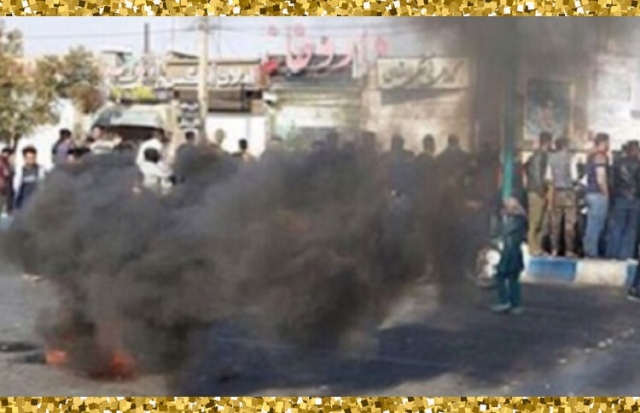
Despite the Iranian regime’s bloody crackdown on the people, the rebellious youths, organized as resistance units, continue the uprising.
Protests
On December 3, 2019, the Secretariat of the National Council of Resistance of Iran released a statement in regards to these activities.
“On Sunday, December 1, 2019, despite the state of full alert on the part of the regime’s suppressive forces, the Resistance Units posted large portraits carrying the messages of Mrs. Maryam Rajavi, the President-elect of the National Council of Resistance of Iran (NCRI), and Mr. Massoud Rajavi, the Leader of the Iranian Resistance, in different parts of Tehran, including Saeedi, Azadegan and Imam Ali expressways, Pirouzi, Shariati and Sabalan streets and Sohrevardi Park.” The NCRI’s statement reads adding:
“The banners read, ‘More flames on the way. Uprising for freedom is ablaze,’ ‘Regime cannot stop the uprising with killings and arrests,’ ‘Rebellious youth have made life like hell for you,’ ‘Tremors of overthrow shake the ruling theocracy to its foundations,’ ‘Victorious strategy of Liberation Army was tested in rebellious units, districts, and cities,’ ‘The overthrow of the anti-human enemy is certain,’ ‘Rebellion continues. The only response to the Sheikh is fire. Ignite the flames,’ and ‘Death to Khamenei, hail to Rajavi. Khamenei must know, he will be overthrown very soon.”
The mullahs’ regime reacted to the uprising very bloody and it is reported that over 750 protesters have been killed by the regime’s security forces. On December 2, 2019, London based Amnesty International reported that the “death toll from a bloody crackdown on protests rises to 208.”
“The number of people believed to have been killed during demonstrations in Iran that broke out on 15 November has risen to at least 208, said Amnesty International, based on credible reports received by the organization. The real figure is likely to be higher.” Amnesty International said in a report.
“This alarming death toll is further evidence that Iran’s security forces went on a horrific killing spree that left at least 208 people dead in less than a week. This shocking death toll displays the Iranian authorities’ shameful disregard for human life,” said Philip Luther, Research and Advocacy Director for the Middle East and North Africa at Amnesty International.
“Those responsible for this bloody clampdown on demonstrations must be held accountable for their actions. Since the Iranian authorities have previously shown they are unwilling to carry out independent, impartial and effective investigations into unlawful killings and other arbitrary use of force against protesters, we are calling on the international community to help ensure accountability.”
In a related issue, on December 2, 2019, Italy’s foreign ministry announced that the visit of the Iranian regime’s foreign minister to Italy is canceled. Javad Zarif, the regime’s foreign minister was scheduled to visit Italy on December 5. Earlier Italian human rights organizations denounced this visit and asked the Italian government to cancel the visit, and condemned Iranian regimes crackdown on the protesters.

Babylon the Great runs dangerous and chaotic approach toward nuclear weapons

By Laura Kennedy, opinion contributor
December 03, 2019 – 06:00 PM EST
The views expressed by contributors are their own and not the view of The Hill
The decision to abruptly withdraw United States forces from Syria is one of the most recent dangerous illustrations of the flawed foreign policy of President Trump and the chaos it has generated abroad. As a diplomat who served for nearly 40 years and under seven presidents, I am aware of how these impulsive and undisciplined actions have left allies reeling with American interests hobbled. His approach toward nuclear weapons and arms control is similar, but with even graver possible consequences.
His nuclear agenda reflects the same pattern of alliance mismanagement, American unreliability, and chaotic decision making. Instead of bailing on bilateral and multilateral arms control efforts, the United States should preserve remaining treaties like the New Strategic Arms Reduction Treaty and the observation regime offered by the Open Skies Treaty, which promote our interests abroad and avoid introducing destabilizing and unnecessary nuclear weapons in a heated international competition.
The Iran nuclear deal was the first nonproliferation agreement to be axed by Trump, followed by the Intermediate Range Nuclear Forces Treaty. By recklessly withdrawing from the successful limits imposed on the Iranian nuclear program, Trump undercut our reliability with some of our closest allies and raised global tensions. Withdrawing from the latter agreement rather than continuing efforts to resolve violations by Moscow has shifted the onus away from Russia while removing constraints. The insecurity from withdrawal of these agreements is exacerbated by the prospect of blowing up the other key foundations of our arms control architecture.
Next may be the Open Skies Treaty. It is a useful transparency regime which was instituted by the United States and 33 other nations. The agreement allows these nations to conduct observation flyovers of the territories of each of the signatories, providing critical insight into military deployments and possible military buildups. While some might argue that new technology makes such flyovers unnecessary, that overlooks the advantage offered by the framework. It is difficult to ignore evidence when all states have access to the same intelligence. Leaving this deal would end those benefits, poorly serve Ukraine, and send yet another message to our allies and adversaries of our diplomatic unsteadiness.
Such a counterproductive step would be massively compounded if the United States does not extend the New Strategic Arms Reduction Treaty, which caps American and Russian deployed strategic nuclear weapons and is set to expire in early 2021. The predictability, transparency, and access it provides is unparalleled. Its regime of notifications, information exchange, and onsite inspections has been lauded on both sides of the aisle and by numerous military and civilian officials. In addition to losing this level of certainty on Russian strategic nuclear weapons, the United States could face an expensive and destabilizing arms race, beyond the major $1 trillion nuclear program already authorized by President Obama.
In fact, the Trump administration has called for the development of a new “low yield” submarine launched ballistic missile deemed more “usable” for the military. Critics argue it would be difficult to distinguish from existing high yield variants and would increase the risk of nuclear miscalculation. The House has included a provision in the annual defense authorization bill earlier this year that prohibits the deployment of such a submarine weapon. As the conference negotiations continue, the Senate ought to recognize the risks of this unnecessary and destabilizing addition to our already massive nuclear arsenal and ensure it remains in the final bill.
Russia and China indeed pose risks, and we must seek to have serious strategic dialogues with both. But as we pursue such talks, we should use them to build on existing agreements, most notably the New Strategic Arms Reduction Treaty, and not scrap historical agreements in favor of a complex new effort to include additional weapons and actors such as China. Such a comprehensive deal, which the Trump administration says it is pursuing, would take years to negotiate. Russia does not believe there is time to negotiate a new arms control agreement prior to the expiration of the New Strategic Arms Reduction Treaty, and China has emphatically rejected joining such a trilateral endeavor. Any potential negotiations are further complicated by the fact that the State Department has dumped its under secretary and assistant secretary in charge of arms control policy.
When it comes to international agreements, ignoring legislative, military, and civilian expert advice and picking fights with American allies leads to chaos, frayed alliances, and increased instability, as we have witnessed in Syria, Ukraine, Turkey, and across the world. The United States simply cannot afford to let that happen when it comes to nuclear weapons.
Laura Kennedy is a member of the board of directors of Foreign Policy for America. She served as United States permanent representative to the Conference on Disarmament in Geneva, was a diplomat for the United States Mission to International Organizations, and served as the deputy assistant secretary for European Affairs with the Department of State.

Wednesday, December 4, 2019

The Nuclear Lies and Coverups (Revelation 16)

© UMB-O
The Non-Proliferation Treaty was supposed to lead to disarmament. Instead, it’s led to nuclear apartheid — and sooner or later, someone’s going set one off.
When Turkish President Recep Tayyip Erdogan told an economic meeting in the city of Sivas this September that Turkey was considering building nuclear weapons, he was responding to a broken promise. When Israeli Prime Minister Benjamin Netanyahu accused the government of Iran of lying about its nuclear program, he was concealing one of the greatest subterfuges in the history of nuclear weapons. And the vast majority of Americans haven’t a clue about either.
US Cover for Israel
Early in the morning of September 22, 1979, a US satellite recorded a double flash near the Prince Edward Islands in the South Atlantic. The satellite, a Vela 5B, carries a device called a “bhangmeter” whose purpose is to detect nuclear explosions. Sent into orbit following the signing of the Partial Test Ban Treaty in 1963, its job was to monitor any violations of the agreement. The treaty banned nuclear explosions in the atmosphere, underwater, and in space.
Nuclear explosions have a unique footprint. When the weapon detonates, it sends out an initial pulse of light. But as the fireball expands, it cools down for a few milliseconds, then spikes again.
“Nothing in nature produces such a double-humped light flash,” says Victor Gilinsky. “The spacing of the hump gives an indication of the amount of energy, or yield, released by the explosion.” Gilinsky was a member of the US Nuclear Regulatory Commission and a former Rand Corporation physicist.
There was little question who had conducted the test. The Prince Edward islands were owned by South Africa, and US intelligence knew the apartheid government was conducting research into nuclear weapons. But while South Africa had yet to produce a nuclear weapon, Israel had nukes — and the two countries had close military ties. In short, it was almost certainly an Israeli weapon, though Israel denied it.
In the weeks that followed, clear evidence for a nuclear test emerged from hydrophones near Ascension Island and a jump in radioactive iodine-131 in Australian sheep. Only nuclear explosions produce iodine-131.
But the test came at a bad time for US President Jimmy Carter, who was gearing up his reelection campaign, a cornerstone of which was a peace agreement between Israel and Egypt. If the Israelis were seen to have violated the Partial Test Ban, as well as the 1977 Glenn Amendment to the Arms Export Control Act, the US would have been required to cut off all arms sales to Israel and apply heavy sanctions. Carter was nervous about what such a finding would have on the election, since a major part of his platform was arms control and non-proliferation.
So Carter threw together a panel of experts whose job was not to examine the incident but to cover it up. The Ruina Panel cooked up a tortured explanation involving mini-meteors that the media accepted and, as a result, so did the American public.
But nuclear physicists knew the panel was blowing smoke and that the evidence was unarguable. The device was set off on a barge between Prince Edward Island (South Africa’s, not Canada’s) and Marion Island with a yield of between 3 and 4 kilotons. A secret CIA panel concurred but put the yield at 1.5 to 2 kilotons. For comparison, the Hiroshima bomb in 1945 was 15 kilotons.
It was also clear why the Israelis took the risk. Israel had a number of Hiroshima-style fission bombs but was working on producing a thermonuclear weapon — a hydrogen bomb. Fission bombs are easy to use, but fusion weapons are tricky and require a test. That the Vela picked it up was pure chance, since the satellite had been retired. But its bhangmeters were still working.
From Carter onward, every US president has covered up the Israeli violation of the 1963 Partial Test Ban Treaty, as well as the 1968 Nuclear Non-Proliferation Treaty (NPT). So when Netanyahu says Iran is lying about its nuclear program, much of the rest of the world —  including the US nuclear establishment — roll their eyes.
Nuclear Apartheid
As for President Erdogan, he is perfectly correct that the nuclear powers have broken the promise they made back in 1968 when the signed the NPT. Article VI of that agreement calls for an end to the nuclear arms race and the abolition of nuclear weapons. Indeed, in many ways, Article VI is the heart of the NPT. Non-nuclear armed countries signed the agreement, only to find themselves locked into a system of “nuclear apartheid” — where they agreed not to acquire such weapons of mass destruction, while China, Russia, the United Kingdom, France and the US get to keep theirs.
The “big five” not only kept their weapons, but they are also all in the process of upgrading and expanding them. The US is meanwhile shedding other agreements, like the Anti-Ballistic Missile Treaty and the Intermediate-Range Nuclear Force Agreement. Washington is also getting ready to abandon the START treaty that limits the US and Russia to a set number of warheads and long-range strategic launchers.
What is amazing is that only four other countries have abandoned the NPT: Israel, North Korea, Pakistan and India (only the latter three have been sanctioned by the US). But that situation cannot hold forever, especially since part of Article VI calls for general disarmament, a pledge that has been honored in the breach. The US currently has nearly the largest defense budget in its history and spends as much on its military as 144 other countries combined.
While the US doesn’t seem able to win wars with that huge military — Afghanistan and Iraq remain disasters — it can inflict a stunning amount of damage that few countries are willing to absorb. Even when Washington doesn’t resort to its military, its sanctions can decimate a country’s economy and impoverish its citizens. North Korea and Iran are cases in point.
If the US were willing to cover up the 1979 Israeli test while sanctioning other countries that acquire nuclear weapons, why would anyone think that this is nothing more than hypocrisy on the subject of proliferation? And if the NPT is simply a device to ensure that other countries cannot defend themselves from other nations’ conventional and/or nuclear forces, why would anyone sign on or stay in the treaty?
Erdogan may be bluffing. He loves bombast and uses it effectively to keep his foes off balance. The threat may be a strategy for getting the US to back off on its support for Israel and Greece in their joint efforts to develop energy sources in the eastern Mediterranean Sea.
But Turkey also has security concerns. In his speech, Erdogan pointed out, “There is Israel just beside us. Do they have [nuclear weapons]? They do.” He went on to say that if Turkey did not respond to Israeli “bullying,” in the region, “we will face the prospect of losing our strategic superiority in the region.”
Iran may be lying about the scope of its nuclear ambitions — although there is no evidence that Tehran is making a serious run at producing a nuclear weapon — but if they are, they’re in good company with the Americans and the Israelis.
The Path to Sanity
Sooner or later, someone is going to set off one of those nukes. The likeliest candidates are India and Pakistan, although use by the US and China in the South China Sea is not out of the question. Neither is a dustup between NATO and Russia in the Baltic.
It is easy to blame the current resident of the White House for world tensions, except that the major nuclear powers have been ignoring their commitments on nuclear weapons and disarmament for over 50 years.
The path back to sanity is thorny but not impossible. First, the US should rejoin the Anti-Ballistic Missile Treaty, thus making Russia’s medium-range missiles unnecessary, and reduce tensions between the US and China by withdrawing ABM systems from Japan and South Korea.
Second, the US should reinstate the Intermediate-Range Nuclear Forces Agreement and find a way to bring China, India and Pakistan into it. That will require a general reduction of US military forces in Asia, coupled with an agreement with China to back off on its claims over most of the South China Sea. Tensions between India and Pakistan would be greatly reduced by simply fulfilling the UN pledge to hold a referendum in Kashmir. The latter would almost certainly vote for independence.
Third, the US must continue its adherence to the START agreement, while the “big five” countries need to halt the modernization of their existing arsenals — and begin, at long last, to implement Article VI of the NPT in regards to both nuclear and conventional forces.
Pie in the sky? Well, it beats a mushroom cloud.
*[This article was originally published by FPIF.]
The views expressed in this article are the author’s own and do not necessarily reflect Fair Observer’s editorial policy.

NO the US Cannot Get Out of Its End Wars

Photograph Source: The U.S. Army – CC BY 2.0
Donald Trump in 2016 ran in opposition to the Iraq war and more generally to massive US commitments around the world. His denunciations of “endless wars” resonated enough that many voters ignored his documented early support for the Afghan and Iraq wars. Indeed, areas where casualties in those wars were highest voted more heavily for Trump than other demographic and economic factors would have predicted. Voters, with plenty of justification from her record as Secretary of State, thus pegged Hillary Clinton as a warmonger.
Trump, at least so far, is a militarist too. He has yet to withdraw the remaining troops from Afghanistan or Iraq. In Syria, he ended up merely redeploying soldiers from the border with Turkey to further within the country, if anything deepening American involvement. In the rest of the world, Trump has yet to close a single base or return home any troops stationed abroad.
Democrats, except for a few principled anti-interventionists like Bernie Sanders, are not clearly committed to reducing, let alone eliminating, the more than 800 bases the US maintains around the world and that cost over $100 billion a year to staff and maintain. For the past year, Democrats, when they bother to mention foreign policy, have largely focused on Russia. In hopes of using Trump’s Russian ties to push impeachment or weaken his reelection prospects, Democrats have ended up painting Russia as a strategic threat to the US on par with the former Soviet Union or present-day China. This dubious electoral strategy has the effect of bolstering military spending and justifying US intervention in countries around the world to counter supposed Russian subversion.
It seems clear that unless and until the Democratic Party is fundamentally transformed we will not find our way out of endless wars through the electoral process. Just as both political parties supported the Vietnam War half a century ago, so today there is mainstream consensus behind the belief that the US is the indispensable nation, and therefore from a mix of self-interest and idealism should spend whatever is needed to maintain full spectrum dominance and command of the commons. However, just as the Vietnam War finally was ended through a combination of non-electoral mobilization in the US and defeat on battlefields in Vietnam, so too can America’s twenty-first century wars be ended through our efforts within the US and by America’s ever more obvious economic and geopolitical weakness. To understand what can make our opposition most effective we need to understand the forces that support the US’s massive presence around the world and the deepening divisions among US elites.
Who Benefits From US Military Power
American capitalists, like those of previous great powers such as nineteenth century Britain and France and the Netherlands of the seventeenth century, rely on their government to control foreign territories and peoples that those capitalists can exploit. Of course, how capitalists make money abroad has changed. Today formal colonies no longer exist. Instead, American capitalists look to their government to negotiate and enforce so-called free trade agreements that give American companies access to foreign markets. At the same time, the U.S. has used military and non-military means to remove governments that tried to restrict capitalists’ ability to exploit resources and workers in other countries or to create social protections for their citizens. Obviously, the U.S. is less able to intervene in other wealthy countries, like those of Western Europe, even as America’s ability to mold other nations to its will increased after the end of the Soviet Union.
U.S. goals in trade treaties have changed over time. Up to the 1960s, the government pushed to open foreign markets to American manufactured goods. But as America’s industrial edge disappeared, the U.S. instead has sought to win access above all for financial firms and also to protect American pharmaceutical, software and entertainment firms’ patents and copyrights. In essence, American trade negotiators since the 1970s have sacrificed industrial workers to protect the profits of Wall Street, Big Pharma, Silicon Valley and Hollywood.
What the Military Elite Wants and Gets
US global power is enormously expensive to build and maintain and requires a vast, permanent military establishment. Any organization, like the Pentagon, which commands millions of soldiers and other employees and controls a budget approaching $1 trillion a year, amasses great political power and autonomy as well.
The U.S. is unusual among nations in that from its beginning it relied upon private companies to develop and build weaponry. Weapons contracts generate greater profit margins than most other businesses, creating a unity of interest between military officers and capitalists, who otherwise oppose expensive government programs that ultimately must be funded through taxes.
Generals’ views of how to fight wars and what weaponry they need are shaped, indeed determined, by the ways in which their careers, and those of lesser officers, are structured. Officers spend their careers assigned to units that man and deploy specific weapons systems. They advance by commanding expensive and technically complex weapons. Success in winning appropriations for those weapons systems ensures long careers for the ever-expanding corps of generals. Budget cuts or more drastically a decision to cancel a weapons system would stymie or end the careers of officers in that division of the military. Weapons systems also reward officers in their retirement. Defense firms often hire military officers after their retirement, and the promise of high corporate salaries to supplement their pensions gives officers a powerful incentive not to question the worth of expensive weapons systems, or to dispute contractors’ bills and pricing decisions.
These career and organizational imperatives mesh perfectly with defense firms’ interests in selling advanced weapons systems, which consistently yield the largest profits. Thus, advanced weapons continue to absorb the lion’s share of the Pentagon budget even though those weapons are fundamentally ill suited for the actual wars the U.S. fights in the twenty-first century.
The U.S.’s overwhelming military power is complemented by a system of alliances spanning much of the globe. However, relations with other countries increasingly are managed by the military rather than the State Department, a process that has drastically accelerated under Trump as he and his Secretaries of State have reduced and undermined civilian diplomats. The Defense Department since World War II has cultivated direct ties with their military counterparts elsewhere in the world, as has the Central Intelligence Agency. In addition, the military and CIA sustain independent relations with civilian officials of many foreign governments. The Pentagon has created “commands” for each region of the world, headed by senior generals or admirals, who negotiate directly with both military and civilian officials in the countries of those regions about policy matters that extend far beyond military cooperation. These commands endure across presidential administrations and thus provide more continuity in US strategic policies and in relations with foreign governments than do the civilian side of the U.S. government.
Ties between the U.S. and foreign militaries are further cemented through arms sales since purchasers remain dependent on the U.S. for training and intelligence. Arms sales abroad also bolster manufacturers’ profits, providing a powerful incentive for American capitalists to support their government’s ties to even the most brutal regimes in the world, as we see now with Saudi Arabia. In addition, a third of America’s measly foreign aid budget, which comes to less than 1% of the total Federal budget, is devoted to subsidizing weapons purchases by other countries.
Elite Conflicts and Autarky
The Pentagon’s common interests with capitalists and their increasingly independent links to other governments makes it difficult for civilian officials, including presidents, to challenge the military’s war plans. The Vietnam, Afghanistan and Iraq wars continued for years after it became clear the commanding generals were delusional about the prospects for victory, and as the death toll of both U.S. soldiers and civilians in the countries the U.S. had invaded mounted. The ongoing Afghan and Iraq wars have been limited, and most US troops withdrawn, only because insurgents in those countries have inflicted US casualties that the American public finds too high.
The military and civilian elites disagree with each other, and among themselves, on how to deal with the growing intensity of insurgent resistance to American domination and invasions. Following the historical example of the British empire, US military officers and civilian officials offer support to indigenous militaries, hoping they can take on the dirty work of suppressing insurgencies and enforcing acquiesce in countries dominated by the US. However, as we have seen in Iraq, local allies make increasing demands on the US. The Status of Forces agreement, signed by the Bush Administration and the Iraqi government right after Obama’s election as president in November 2008, was in substance a document of unconditional surrender by the U.S. to Iraqi nationalist demands. It set a hard date of December 31, 2011 for the withdrawal of all U.S. troops. More significantly, it stated that the bases the U.S. had built in Iraq at a cost of many billions of dollars, and which the Bush Administration planned to use to station planes and troops at the center of the Middle East and thereby intimidate neighboring countries, could not be used to attack any other country without permission of the Iraqi parliament, permission that in light of domestic Iraqi and regional political realities would never be granted.
Elsewhere in the world, once supine governments are able to play off the US against China and Russia. As the US becomes ever less willing to risk its soldiers’ lives or to spend the money needed to sustain extended occupations, and as anti-immigrant fervor stocked by Trump blocks the lure of eventual exile in America to foreign collaborators, it will become ever harder for the US to find foreign allies to fight for it.
We see in the disagreements between Trump and the military high command backed by career diplomats lines of conflict that will continue even after Trump and his particular and extreme sort of corruption and self-dealing have left Washington. At the same time, conflicts among capitalists and with the 99% that have been harmed by neoliberal trade agreements and financialization will further paralyze the American government’s ability to pursue a coherent economic and military policy.
U.S. choices in trade treaties and decisions to overthrow or isolate governments elsewhere in the world reflect the power of American capitalists as a class, and how a shifting set of the most privileged corporations exert that power over the U.S. government. However, financial firms’ interests are increasingly at odds with those of other American corporations that actually need to sell real goods and services if they want to make profits and if their employees hope to keep their jobs. While finance capital has set policy for the last thirty years, opposition led both Trump and Hillary Clinton in 2016 to denounce the Trans Pacific Partnership. Intra- capitalist conflicts, combined with mass opposition, mean that it is unlikely that the main method the US has used to dominate other countries— new trade deals—will be enacted in the future.
Some elites, through campaign contributions, lobbying, and corrupt ties to elected officials, still are able to win special protections for their foreign investments. Similarly, even if the US has to abandon intervention in the most resistant and contested parts of the globe, Pentagon generals and admirals still can establish alliances and station troops and weapons in much of the world, locking the US into commitments that could (as they have in the past) lead to war. Elite privilege and command over the resources and lives of the rest of us continues even as its scope narrows when elites challenge one another and where other nations and their elites are able to pursue their own interests against the US.
A Way Forward
What can we in the US do? Do we need to wait passively as the US weakens in relation to other countries and as elites battle one another over a shrinking pie? We need to look at past successes and be strategic in identifying the points at which opposition can be most successful. Support for trade agreements has already disappeared as more and more Americans find their incomes declining, and as their jobs disappear or become ever more precarious. Americans’ ability to see trade agreements and expanding freedoms for banks and financial firms as destructive to their interests can become a template for talking about domestic economic policies.
While the Afghan and Iraq wars have been going on for eighteen and sixteen years respectively, opposition in those countries and within the US made them less bloody than the Vietnam War. A majority in the US turned against the Vietnam War only after 20,000 Americans died. In Iraq the turning point came after 2000 deaths. Unfortunately, in none of those wars have civilian casualties in the countries the US invaded been decisive in building American antiwar sentiment.
While drawing attention to American deaths is chauvinistic and morally compromised, it remains the best way to undermine support for continuing and new wars, and ultimately will save the lives of non-Americans the US would otherwise bomb or invade. Military and economic defeats, and the ever more brazen self-dealing by increasingly small elites, is undermining support for endless and new wars, and for the economic war capitalists are waging against workers in the US and the rest of the world. We need to combine repeated efforts to show the 99% how these elite projects cost them, and also to be alert to divisions among elites so that we can target the most brazen and vulnerable elites for denunciations, boycotts, demonstrations, and strikes.