The prophecy is more than seeing into the future. For the prophecy sees without the element of time. For the prophecy sees things as they were, as they are, and as they always shall be.
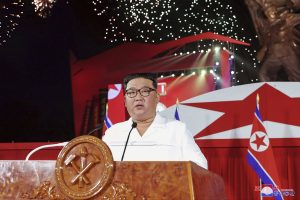
In this photo provided by the North Korean government, North Korean leader Kim Jong Un delivers his speech during a ceremony to mark the 69th anniversary of the signing of the ceasefire armistice that ends the fighting in the Korean War, in Pyongyang, North Korea Wednesday, July 27, 2022. Credit: Korean Central News Agency/Korea News Service via AP
“If the south Korean regime and military ruffians think about confronting us militarily and that they can neutralize or destroy some parts of our military forces preemptively by resorting to some special military means and methods, they are grossly mistaken!” the North’s state-controlled media Korea Central News Agency (KCNA) quoted Kim as saying in his speech at the 69th anniversary of the armistice for the 1950-53 Korean War.
Since he took office in May, Yoon has reiterated the importance of strengthening military ties with the United States and its allies to cope with North Korea’s nuclear and missile threats. During his presidential campaign, Yoon brought up the possibility of striking North Korea preemptively when there is an explicit sign of Pyongyang launching missiles toward the South’s soil. Also, he once said that he would ask the U.S. to redeploy tactical nuclear weapons to South Korea or sign a nuclear-sharing agreement. However, Washington killed this initiative right away and Yoon has not spoken about tactical nuclear weapons or nuclear sharing again.
Such remarks were interpreted as political rhetoric to garner support from South Korean conservatives as the U.S. has not supported such moves on the basis of its extended deterrence policy. Also, it is impossible for South Korea to redeploy tactical nuclear weapons or develop its own indigenous nuclear programs as it is a member state of the Non-Proliferation Treaty.
However, Yoon’s military has been working to readopt the “three-axis” defense system, which includes preemptive strike scenarios against North Korea. Kim directly called this a “very dangerous self-destructive action.”
“Such a dangerous attempt will be punished at once by a powerful force and Yoon Suk Yeol regime and its army will be annihilated,” Kim said.
Hours after KCNA published the transcript of Kim’s speech, the South Korean Presidential Office of National Security expressed “deep regret” over Kim’s direct criticism of Yoon, saying that the government is holding a strong and effective readiness posture against any provocation from North Korea. While reiterating its stance to strengthen its self-defense under the ironclad military alliance with the United States, Seoul urged Pyongyang to return to dialogue for denuclearization and peace construction.
Washington and Seoul have not ruled out diplomatic overtures on North Korea issues. However, since then-U.S. President Donald Trump walked out of his 2019 summit with Kim in Hanoi, North Korea has been crystal clear that it will only consider returning to the negotiating table once Washington makes concessions first.
However, Kim likely views denuclearization as a suicidal move, as there is no reason to fear a Pyongyang with no nuclear weapons. Kim has never expressed interest in Yoon’s “audacious plan” but ignored it by continuing the power game.
American and South Korean negotiators urged Pyongyang to return to the table without any conditions, but the leaders of the two countries have implied that the dovish overtures could be made when North Korea gives up its nuclear weapons – which is the old school policy that has long failed to entice North Korean leaders to denuclearize the country.
Kim pointed to the South Korea-U.S. joint military exercises as proof of the so-called “double standard” of the United States. He also accused the U.S. of demonizing his country to justify its “hostile” policies toward his country.
The South Korea-U.S. joint military drills, one of the “hostile” policies that North Korea has demanded Washington withdraw, are expected to be held in late August. Compared with the previous military drills for the past few years, the upcoming military drills are going to be conducted on a larger scale. Both Seoul and Washington have raised the necessity of reinvigorating the drills in a bid to respond to the unprecedented spate of the North’s missile tests this year.
Months ago, U.S. F-35 stealth fighter jets were deployed in the region and conducted drills with the South Korean military. As more and more powerful U.S. weapons are expected to be deployed for the joint military drills, even while North Korea is preparing to conduct its seventh nuclear test, the arms race on the Korean Peninsula will intensify in the coming months.Authors
Mitch Shin
Mitch Shin is Chief Koreas Correspondent for The Diplomat and a non-resident Research Fellow of the Institute for Security & Development Policy (ISDP), Stockholm Korea Center.
Off-peninsula developments are equally sobering. Russia has successfully ring-fenced its February invasion of Ukraine by threatening nuclear use against any nation that dares to cross its red lines. As a result, while Kiev receives moral, financial and arms support from Western partners, it stands alone on the battlefield.
South Korea, unlike Ukraine, has a national insurance policy: The US is treaty-bound to defend it. However, there is the question of US resolution: The credibility of that insurance is untested in the face of real-world nuclear aggression.
Some fret that – if push came to shove – Washington would be unwilling to risk losing one or more of its cities to a North Korean reprisal, leaving South Korea exposed to potential perdition.
One of the highest-profile proponents of that possibility put a stark question to Asia Times on the sidelines of a recent conference. “How can we sleep at night?” asked political heavyweight and Hyundai Heavy Chairman Chung Mong-joon.
Currently, institutes are churning out research showing that the public overwhelmingly supports the national acquisition of nuclear arms. It is increasingly a hot topic at conferences and in media.
But with the Yoon Suk-yeol administration cleaving tightly to a US that is still strongly attached to non-proliferation, there is no tangible momentum. And any South Korean leader who decided to go critical would need to first answer the multiple questions that hang over the issue.
Technically: Is South Korea capable of creating both nuclear arms and their delivery systems? And if it built a nuclear weapon, where would it test it?Intercontinental ballistic missiles at a military parade celebrating the 70th founding anniversary of the Korean People’s Army in Pyongyang. North Korea’s nuclear arsenal is a key – but not the only – issue prodding South Korea to follow suit. Photo: KCNA via Reuters
The case for going nuclear
That the Korean public is in favor of a domestic nuclear deterrent is clear.
The matter was in the open at this month’s Asian Leadership Conference 2022 in Seoul, with a dedicated discussion panel.
“People are talking about this now,” said panelist Robert Kelly, an American professor of political science at Pusan National University. “It is more blunt and open than ever before.”
A key reason to proceed would be to directly deter North Korea, which has defied all efforts by all parties to halt its nuclear arms programs.
“So that begs the question: ‘If North Korea does go ahead, what are we to do? More condemnation, more UNSC resolutions, more sanctions?” Lee continued. “That has not worked for two decades.”
America is strongly attached to the Nuclear Non-proliferation Treaty, or NPT, raising worries that Washington would crack down if Seoul decided to go nuclear. But other friendly power players would not be likely to sanction Seoul beyond lip service.
Moreover, Article 10 of the treaty would allow South Korea to exit the NPT in good faith.
“Acquiring nuclear weapons is not a violation of international law – only for those countries who are members of the NPT,” said Daryl Press, an associate professor at Dartmouth College. “South Korea could do it in a legal fashion by exercising its Article 10 legal rights to withdraw…there is no need to be a pariah.”
For a South Korean diplomat, explaining the necessity of the step would be “an easy day on the job,” Press suggested.
In fact, signaling an NPT withdrawal could be a legitimate step on Seoul’s response ladder, Lee proposed. “If [North Korea] conducts a seventh nuclear test, the least we can do is withdraw from the NPT,” he said. “That would put a lot of pressure on the international community to do more.”
Experts are divided regarding how much or little pressure Beijing has exerted over the years on Pyongyang to denuclearize – and how much leverage it realistically possesses. But any proposed Seoul withdrawal from the NPT – and the additional possibility that Tokyo would follow Seoul’s lead and tip over the nuclear threshold – would certainly trigger alarm bells in Beijing.
“China will strongly oppose this step,” Press said. “But the South Korean position is eminently reasonable: South Korea should hold open other options and say, ‘If there is some way the international community, perhaps led by China, [could] get North Korea to denuclearize, we would happily rejoin the NPT.’”
He added, “I would not phrase this as a threat to the Chinese, but a reach out of the hand.”
Others say that not even Beijing – a key source of fuel, food and medicine for North Korea – can reign in Pyongyang.
“North Korea has already demonstrated that they don’t give a damn about the US, the UN and China,” Chun In-bum, a retired South Korean general told Asia Times. “The North Koreans will eat each other before they give up nuclear weapons.”
A key argument for Seoul’s nuking up is the possibility of the US backing down if faced with a truly locked-and-loaded North Korea.
“The core issue is that North can strike US with an ICBM and in doing so you introduce the classic dilemma: [French President Charles] De Gaulle asked [US President John] Kennedy if he would exchange New York for Paris,” Kelly said of the 1961 discussion between the two leaders. “Kennedy waffled. I think the answer is probably ‘no.’” I don’t believe the US would fight a nuke war solely for non-Americans.”
In this sense, South Korean nuclearization would not just aim a close-to-home deterrent at North Korea but could also lower risks for the US. And the nuclearization of US allies France and UK during the Cold War provides a European benchmark that could be applied to Asian allies South Korea and Japan, Kelly said – warning the US not to act in “hegemonic” fashion.
America’s public, he guessed, would be supportive. “My sense is that the issue of North Korea is so obvious it will move US public opinion, and the US foreign policy community will come around,” he said.
Policy cleavages between Seoul and Washington provide another rationale for independent nukes, according to Press. The rise of China and the “wedge” being driven “between South Korean and US priorities” is not yet “catastrophic” but is a “growing strain,” the American scholar said.
Rising fears are also hovering over not American strengths but rather its weaknesses.
In war, Washington is acutely casualty-sensitive and in recent conflicts has arguably lacked the political will to win. Moreover, US society and politics are deeply – some say dangerously – polarized. These chinks in America’s armor may be leveraged by a wily foe.
“[South] Korea needs a very stable US, but right now the US is trying to find itself or to be reborn,” Chun said. “As they do this, enemies will see an opportunity.”
Cheong Seong-chang, who directs the Center for North Korean Studies at the Sejong Institute think tank, argued that the nuclearization of South Korea and/or Japan would rebalance Northeast Asia’s off-center strategic geography.
“There is tilted ground that will be more and more tilted…Russia, China and North Korea all have nuclear weapons,” he told the ALC. Conversely, among Japan, South Korea and the US, only the latter possesses a nuclear deterrent.
Chun agreed. “The US faces such a variety of challenges now,” he said. “It is only natural that Korea should have the ability to help the US in whatever situation.”
So could South Korea pull it off?President Yoon Suk-yeol gives a speech at the construction site of a nuclear power plant. Yoon is upping atomic power production, but has made any move on nuclear arms. Image: Twitter
Nuclear feasibility
There is no question about the “what” of the issue. South Korea, a highly-educated G10 economy that is home to a competitive nuclear power sector that exports reactors, could independently create atomic arms.
While Cheong did not specify kilotonnage, that would be a massive armory: World leader Russia is believed to field fewer than 6,000 nuclear warheads. The six-reactor Wolseong, in the country’s southeast, started operations in 1983.
It is not just plutonium South Korea could leverage. “Korea also has uranium enrichment technologies held by only a handful of countries in the world,” Cheong said.
In 2000, the Korea Atomic Energy Research Institute tested laser enrichment technology, according to a 2016 article in the Chosun Ilbo, that was reproduced by the Non-Proliferation Policy Education Center. Using that, 1 kilogram of highly enriched U-235 could be produced in around four hours. The article also reported that the country already produces the kind of industrial alloys needed to encase fissile materials.
The question then is “when” – how long would the process take if the political will was mustered? Experts differ on the question.
The 2016 article estimated it would take six months to produce fissile materials and six-nine months to develop a detonation device – an overall timeline of approximately 18 months.
Others believe it could be done more quickly. In a widely quoted comment, Suh Kune-yull, a professor of nuclear engineering at the elite Seoul National University told the New York Times in 2017, “If we decide to stand on our own feet and put our resources together, we can build nuclear weapons in six months…the question is whether the president has the political will.”
A more recent June 2022 commentary in the military website War on the Rocks by Lami Kim, who directs the Asian Studies Program at the US Army War College, found, “Although South Korea has advanced nuclear technologies…Seoul would still need three to five years to acquire a workable nuclear arsenal.”
It was unclear if Kim was discussing device production or a full nose-to-tail system. The latter would include the development of nuclear doctrine and leadership protocols; the creation of a dedicated command-and-control net; and the marriage of atomic devices with delivery systems.
Addressing a full-program scenario, Cheong was more optimistic. “If we pursued it at very high speed, we could have fully usable and deployable weapons within two years,” he said. “At slow speed, three years would be enough.”
In terms of delivery systems, South Korea looks to be good to go. Given that North Korea borders the country, tactical nuclear devices could be fired via tube or rocket artillery. But Seoul has ex-peninsular reach, too.
There is one hole in this otherwise impressive armory of capabilities. To be a credible deterrent, any nuclear device must be physically tested. So where could South Korea potentially conduct one?
North Korea has tested devices in underground tunnels in a remote, mountainous area. That is near-impossible for South Korea for reasons of population densities and politics.
The South has nearly double the population of its northern rival – 52 million versus the North’s 26 million – all compressed into a smaller land area – 100,210 square kilometers versus the North’s 120,540 square kilometers.
And authoritarian Pyongyang does not have to consider popular push back against its policies, while democratic Seoul must contend with street politics and NIMBYism related to defense, energy and other issues.
In recent years, there have been high-profile protests against a naval base on Jeju Island, nuclear reactors and the placement of a US anti-missile battery.
Still, Cheong hinted – tantalizingly – that the issue has been discussed.
“Where a nuclear test would be done is a very sensitive question – there are few candidate [locations] where tests are possible,” he said. “If this was tabled, the residents would protest, so I cannot disclose.”
One possibility could be a Bikini Atoll-style seafloor test off of one of the uninhabited islands that ring South Korea’s coast.
It has long been rumored – but never proven – that Imperial Japan test-detonated a nuclear device on an island off the coast of northeastern Korea in the waning days of World War II.South Korea’s Nuri space rocket blasts into the sky. The boosters sending this peaceful projectile into the heavens could feasibly be converted to an intermediate-range ballistic missile. Photo: South Korean Ministry of Science and ICT
The case against
Despite energetic discussion in specialist circles, the acquisition of a nuclear deterrent is currently not on the national political agenda.
One reason – counter-intuitively – is that it has customarily been liberal Seoul governments that have pursued independent defense capabilities.
The process of moving wartime operational control (“OPCON Transfer”) of the South Korean military from Washington’s grip to Seoul’s was initiated by the leftist Roh Moo-hyun government that was in office from 2003-2008.
Subsequently, the Moon Jae-in administration (2017-2022) oversaw the lifting of US-set range caps on South Korean missiles and tested submarine-launched ballistic missiles. It also tabled the acquisition of an aircraft carrier, while pressing ahead with (still incomplete) OPCON transfer.
The latter program is costing the Korean taxpayer billions – and adding a nuclear capability would add to the burden.
“An indigenous nuclear program would consume and divert enormous funding from South Korea’s defense budget,” Bruce Klinger, senior fellow for Northeast Asia at US think tank The Heritage Foundation told Asia Times. “South Korea’s defense funding would be better spent augmenting conventional force requirements as stipulated in South Korea’s Defense Reform Plan 2.0 and the bilateral plan” for OPCON transfer.
Conservative administrations, such as Yoon’s, have historically been unadventurous on defense, preferring to place maximum trust in the US. Hence, Seoul is not courting Washington’s displeasure by initiating a nuclear deterrent.
“The Yoon administration, like its predecessors, has declared it will not pursue an indigenous nuclear weapons program,” Klinger said.
This ambiance is reflected in the caution some feel. “We would lose more than we gain,” a person familiar with the topic told Asia Times.
It is sensitive: The moderator of this month’s ALC discussion, Lee, noted that the topic was “…politically controversial and, perhaps, not politically correct.”
Doubly so given that movement on the issue could so alarm Washington that it could spark the risk that has stalked South Korean politics since the Donald Trump administration: A withdrawal of US troops.
“An attempt by Seoul to keep a major military capability separate from the combined and integrated command structure would be antithetical to the foundation of the bilateral alliance as well as long-standing US counter-proliferation policy,” Klinger warned.
“Such a step could lead to calls for reduction or withdrawal of US forces either due to concerns of possible independent South Korean actions or isolationist perceptions that Seoul could now go it alone.”
A further risk is likely sanctions damage – such as the heavy hit Korea Inc suffered from Chinese retaliation after Seoul established a US THAAD anti-missile system on South Korean soil in 2017.
And there is one other issue – one that lurks deep below the surface.
“Advocacy for developing an indigenous South Korean nuclear capability seems grounded more on national prestige rather than strategic considerations,” Klinger said.
Pollsters admit it. “Public attitudes on nuclear weapons do not strongly align with rationales for armament offered by some South Korean politicians and analysts,” the Chicago Council conceded.
The Council found that acquisition of home-grown nuclear muscle in the Korean public mind is not aimed exclusively at North Korea.
“Threats other than North Korea” are a “main driver of support” the Chicago Council found – with 55% of respondents saying China will be the biggest threat to South Korea in ten years.
Meanwhile, 26% of South Koreans considered national prestige as the key reason for their support for nuclear arms, higher than those who see the aim being to counter North Korea, who came in at just 23%.
These findings may reflect deep-seated public emotion.
A 1993 South Korean novel, “The Rose of Sharon is Blooming Again” – the reference is to the national flower – became a best-seller and was turned into a movie in 1995. It depicts North and South Korea joint-developing nuclear arms to take on national bete noire, Japan.
Be that as it may, Chun puts forward a final rationale for going nuclear.
“It’s a volatile world with multiple challenges and we need multiple capabilities and flexibilities,” he said. “There is so much we can prepare for.”
The war in Ukraine called into question many of the fundamental pillars of the international order. The European security system that has developed since the dissolution of the Soviet Union and the Warsaw Pact has received a shattering blow. A war of aggression by a major power intent to destroy a neighboring state and annex significant territories has broken with major taboos, not to mention international law.
Apart from the obvious tragedy for the people of Ukraine, another potential casualty is the nuclear nonproliferation system which has existed since 1970. Putin’s blatant breach of the Budapest Memorandum, signed in 1994 by Russia, the UK and US relating to the accession of Belarus, Kazakhstan and Ukraine to the Nuclear Nonproliferation Treaty (NPT), has upended security guarantees in Europe.
The memorandum was an assurance of territorial integrity for Ukraine after it agreed to dismantle the large nuclear arsenal that remained on its territory after the break up of the Soviet Union. By signing the memorandum, Russia – along with the US and the UK – agreed not to threaten Ukraine, Belarus and Kazakhstan with military force or economic coercion. This has proved to be worthless.
And there’s the danger. If we now live in a world where major powers are fully prepared to embark on a full-scale war to achieve their territorial ambitions, then the assumptions of the NPT, according to which non-nuclear states can rely on the security assurances from the major powers, may no longer be valid. Many countries may think it prudent to go nuclear to avoid Ukraine’s fate.
Anxiety in Asia
This doesn’t stop in Europe. Allies of the US in Asia are wondering the extent to which the principle of “extended deterrence” (the protection afforded by America’s nuclear umbrella) is still viable. China’s increasingly aggressive pursuit of its foreign policy aims in recent years has been a major concern for Taiwan, where many question Washington’s policy of “strategic ambiguity” about how and to what extent the US would support the country.
China’s activities in the South China Sea, where it pursues its claims on maritime territories not accepted in international law, have also raised major concerns throughout the region. Japan and China have been at loggerheads for some years over a number of disputed territories including the Senkaku/Diaoyu islands.
Another concern is obviously North Korea’s nuclear program and its regular testing of ballistic missiles which could carry nuclear warheads and have a range which could easily threaten Japan and South Korea. If and when Pyongyang develops the capacity to hit targets in the continental US, this could well test America’s nuclear guarantee in Asia.
A nuclear South Korea?
There is increasing support within South Korea for the development of its own nuclear deterrent. A survey taken earlier this year found that 71% approved of South Korea going nuclear. This was in line with similar polls over recent years.
While the new South Korean government led by Yoon Suk-yeoul does not endorse such a policy and remains committed to the US-ROK alliance, there have been persistent voices in South Korea supporting a shift towards nuclear self-reliance.President-elect Yoon Suk-yeol gives a speech at the construction site of a nuclear power plant. Image: Twitter
There is also considerable pressure in Japan to abandon the post-war “Peace Constitution” which banned the country from maintaining anything stronger than a self-defense force – and the country recently doubled its military budget.
Japan has the technological capacity to develop nuclear weapons quickly – but the experience of US atomic attacks during the second world war remains a powerful restraint.
In March 2022 the late prime minister, Shinzo Abe, called for US nuclear weapons to be based on Japanese territory, presumably to deter both China and North Korea. This – predictably enough – provoked an angry reaction from Beijing, which asked Japan to “reflect on its history.”
Fragile security
For now, the US nuclear guarantee remains credible in the eyes of its Asian partners and the strategic situation on the Korean peninsula remains stable – despite the wrangling already described. It’s a very different situation from what is happening in Ukraine. The US already has forces on the Korean peninsula and is committed to South Korea’s defense.
North Korea is much more vulnerable than the US under any nuclear war scenario. If Pyongyang ever launched a nuclear strike, it would risk rapid and complete obliteration.
An obvious way to address the extended deterrence problem would be to redeploy US nuclear forces in South Korea, similar to Abe’s suggestion for Japan.
That would considerably enhance the credibility of a US security guarantee and would complicate China’s calculations, even with respect to Taiwan – despite all the noises from Beijing about reunification.
But South Korea faces the European dilemma – which is that the more credible its own capabilities become, the less the US will feel the need to commit its resources. While South Korea’s conventional capabilities are more than a match for the North Korean army and its obsolete equipment, it has no answer to the North’s weapons of mass destruction.
So far South Korea seems to have struck a sensible balance – going nuclear could upend all of that as it may cause Washington to withdraw entirely.People at a railway station in Seoul on September 28 watch a television news broadcast showing file footage of a North Korean missile test. Photo: AFP / Jung Yeon-je
It seems that despite the flagrant violations of the security assurances by Russia and the increasing capabilities of the North Korean nuclear arsenal, the commitment to the NPT remains firm.
But this could change if the security environment in Europe and Asia continues to deteriorate and Russia and China become increasingly perceived as serious and realistic military threats.
If the reliability of the US as a security guarantor is weakened it could result in a fatal erosion of the assumptions of the NPT. This would make the pressure for indigenous nuclear arsenals – both in Asia and the Middle East – irresistible. This is something the “Great Powers” have taken pains to prevent since 1945.
As the United States’ rivalry with China and Russia simmers across the globe, an old flashpoint threatens to erupt on the Korean peninsula, where unresolved tensions have re-emerged and the specter of nuclear war remains ever-present.
Since North Korea’s first nuclear test in 2006, the United Nations Security Council, including permanent members China, Russia and the U.S., has unanimously adopted 10 resolutions condemning such military activities and supporting international sanctions against the country officially known as the Democratic People’s Republic of Korea (DPRK). This unity was shattered for the first time on May 26 when Beijing and Moscow vetoed Washington’s proposal to punish Pyongyang for recent missile tests.
The stalemate mirrored the recent failed attempts by the U.S. and its allies at the U.N. to condemn Russia for the war it launched on Ukraine three months earlier. President Joe Biden’s administration has attempted to sway China away from Russia, but an even bigger geopolitical competition between Beijing and Washington has only served to reinforce the comprehensive strategic partnership between the two top rivals of the U.S.
The result has been a breakdown of decades of diplomacy seeking to bring peace to one of the first, deadliest conflicts of the Cold War, with factions forming along familiar lines — a “Northern Triangle” consisting of China, North Korea and Russia on the one hand, and a “Southern Triangle” made up of Japan, South Korea and the United States on the other.
A South Korean official, speaking to Newsweekon the condition of anonymity, said strained ties between the U.S. and China “always have a negative impact on inter-Korean rapprochement and also the denuclearization issue,” but that recent events reveal that an even deeper crisis has arisen.
“Very clearly, we see the U.N. Security Council doesn’t work after Ukraine, and China doesn’t support any more sanctions against the DPRK,” the South Korean official said. “That’s a huge disaster for the DPRK nuclear issue and even inter-Korean relations.”
And while ridding North Korea of its prized nuclear weapons remains the official aim of the U.S. and South Korea, the South Korean official worried that war in Europe and a worsening geopolitical struggle for influence in Asia may have set this goal back irreversibly, especially as Russia’s incursion came nearly three decades after Kyiv agreed to return Soviet-era nuclear weapons deployed on Ukrainian soil in exchange for security assurances from Moscow.
“Definitely, from the Ukraine situation, we fear North Korea will never give up their nuclear weapons,” the official said. “And then also it caused some Chinese calculations when the U.S. put more pressure on China on economic, security and national sovereignty issues.”
While much attention has been given to the question of Taiwan, the South Korean official argued that when it comes to security concerns, Beijing may view the neighboring Korean peninsula in a similar fashion as Moscow does its western flank in Eastern Europe, saying that there is “some kind of situation like Ukraine and Russia” as the U.S. gets more involved.
North Korea has always maintained unique relationships with China and Russia, the two nations who supported it during the 1950s Korean War against South Korea, which received support from the U.S. and the U.N. The conflict was among the first to test the viability of the U.N. less than two years after it came into existence, and saw the first direct fighting between U.S. troops and those of the newly-established People’s Republic of China (PRC) in a three-year war that ended without peace for the two Koreas.
Washington and Beijing would overcome tensions to establish diplomatic relations in 1979, and with the fall of the Soviet Union in the 1990s, the conflict became seen as frozen to observers across the globe, even if it remained vivid to residents of the peninsula.
“We’ve tried to knock on North Korea’s door. We don’t have any hidden agenda, just saying, ‘Let’s talk,'” another South Korean official, who also asked not to be named, told Newsweek. “Even after the recent missile fire, which of course we condemn in the strongest terms, we have never shut the door for diplomacy and dialogue.”
“North Korea should really think this through and take up our offer for dialogue,” the second South Korean official said. “War is not an option; the only way forward is diplomacy.”
But in the absence of any breakthrough, Seoul is investing in its own national defense capabilities like never before. These include new missile systems that South Korean troops have showcased, sometimes in joint maneuvers with the U.S., in response to North Korea’s recent uptick in missile activity that both U.S. and South Korean officials suspect to be the prelude to a seventh nuclear test.
There has even been discussion in South Korea about the country obtaining its own nuclear weapons, or at least deploying those of the U.S., as was the case throughout much of the Cold War. Popular support for obtaining such weapons of mass destruction has steadily increased in recent years, hitting some 71% in a poll published by the Chicago Council on February 21, three days before Russia’s attack on Ukraine.
“The North Korea nuclear threat is imminent; it’s there at our doorstep,” the second South Korean official said. “We really want to deal with this.”
And while that official said it may be South Koreans who are most “directly affected” by the issue, the official argued that, “at the same time, it is also everyone’s problem.”
“It’s China’s problem, it’s Russia’s problem,” the second official added. “That’s what we try to convey to our neighbors, to the international community.”
Should Beijing and Moscow continue this trend of blocking the U.S.-led push for even more stringent measures against Pyongyang, the second South Korean official said he felt that they “will feel the pressure from other countries involved with the issue.”North Korean Supreme Leader Kim Jong Un walks flanked by top officials in front of the Hwasong-17 intercontinental ballistic missile ahead of his country’s fourth and latest ICBM test on March 24.Korean Central News Agency
But China and Russia have long resisted outside pressure to change their stance, and the divisive state of international affairs that has emerged since the war in Ukraine began has only forced Western and Eastern blocs further apart. Both two countries see an impending end of an era in which the U.S. could impose its dominance over the international security order.
This schism, however, has not stopped the U.S. from appealing to China for support in attempting to denuclearize North Korea.
“We have repeatedly made clear that we will cooperate with the PRC where we can,” a State Department spokesperson told Newsweek, “and we remain committed to seeking cooperation with the PRC on DPRK issues.”
Amid a flurry of engagements between top officials from Beijing and Washington this year, Chinese special representative on Korean peninsula affairs Liu Xiaoming met with U.S. special representative for North Korea Sung Kim on April 5 in Washington. In this meeting, the State Department spokesperson said that the U.S. side “emphasized that the United States and the PRC have a very important shared interest in maintaining stability on the Korean Peninsula.”
“Beijing shares the goal of the complete denuclearization of the Korean Peninsula,” the spokesperson added, “and S/R Kim looks forward to working with Liu and his colleagues in Beijing to make progress toward that goal.”
Hopes for cooperation between the two leading world powers in this area were also conveyed by White House national security adviser Jake Sullivan during his meeting last month in Geneva with Chinese Central Foreign Affairs Commission Director Yang Jiechi. A Biden administration official told reporters at the time that Sullivan “made very clear that we believe this is an area where the United States and China should be able to work together.”
But the senior administration official also said the U.S. side “raised concerns” regarding China’s recent voting record on the issue at the U.N., and these concerns were echoed by the State Department spokesperson with whom Newsweek spoke.
“The DPRK’s ballistic missile launches are a clear violation of UNSCRs prohibiting the DPRK’s ballistic missile development,” the spokesperson said. “The unprecedented number of DPRK ballistic missile launches this year and the instability they bring to the Korean Peninsula are in no one’s interest.”
“We continue to urge the PRC and Russia to fully and completely fulfill their obligations under the DPRK UN Security Council resolutions that the UN Security Council unanimously adopted,” the spokesperson added.
The Biden administration was also pushing for China to crack down on other areas of its relationship with North Korea.
“Beijing can also do more to combat the DPRK’s sanctions evasion efforts in PRC coastal waters, to repatriate North Korean laborers earning income in its territory, and to shut down procurement networks,” the spokesperson said.
For China, it remains paramount to maintain security along the border across which the People’s Liberation Army fought the largest war in the country’s history under Communist Party rule.
And Chinese officials see this as a mutual goal among nations.
“China always believes that to maintain peace and stability on the Korean Peninsula and achieve denuclearization on the Peninsula is in the shared interest of all parties and the international community,” Liu Pengyu, spokesperson for the Chinese embassy in Washington, told Newsweek.
“We hope all parties concerned will stay calm, work in the same direction, refrain from moves or rhetoric that may be perceived as provocative, and jointly advance the process of political settlement of the issues on the Korean Peninsula,” Liu Pengyu added.Chinese Type 055-class destroyer Nanchang is seen bearing the flags of the People’s Republic of China and the People’s Liberation Army Navy on its port side and the flag of the Russian Federation on its starboard side, as Type 052D-class destroyer Kunming and Type 054A-class frigate Binzhou follow during a joint patrol with the Russian Navy in the western Pacific Ocean in a photo published October 26.Russian Ministry of Defense
Both China and Russia have called on the U.S. to ease sanctions on North Korea, rather than tighten them. Since 2019, as U.S.-North Korea peace talks began to fall apart, the two powers have put forth a draft resolution of their own, one would that would remove bans preventing North Korea from exporting goods such as statues, seafood and textiles, and would raise a cap on importing refined petroleum.
These measures were billed as necessary to ease the burden on North Korean civilians at a time when the country was going through severe economic hardships that have been noted by Kim in high-profile speeches and meetings.
With the U.N. at a standstill, however, Beijing and Moscow have also shored up their military cooperation, including most recently a series of joint drills in the Pacific, just two days before their Security Council veto in May, and just as Biden was in the region on a visit to meet the leaders of South Korea and Japan.
In a statement issued last week, the North Korean Foreign Ministry dismissed the display as an “anti-DPRK row of the hostile forces” that coincided “with the start of the RIMPAC joint military exercises, the U.S.-led multinational naval combined exercises, and south Korea’s military lunacy to destroy peace and stability in the Korean peninsula as well as the Asia-Pacific region through the largest-ever scale dispatch of its naval force.”
The statement also detailed an alleged plot to open two fronts against China and Russia, echoing language used by the two countries, who regularly accuse the U.S. of destabilizing the international order through military expansion and the formation of powerful alliances.
“The recent NATO summit more clearly proves that the U.S. pursues a plan to contain Russia and China at the same time by realizing the ‘militarization’ of Europe and forming a military alliance like NATO in the Asia-Pacific region,” the statement said, “and keeps the U.S.-Japan-south Korea tripartite military alliance as an important means for materializing the plan.”
The ministry also warned that the “reckless actions of the U.S. and its vassal forces” had created a “dangerous situation, in which a nuclear war might break out simultaneously in Europe and the Asia-Pacific region.”
“World peace and security came to be placed in the most critical condition after the end of the Cold War,” the statement added.
A more recent article published Monday by the North Korean Foreign Ministry tied the threat directly to trilateral security cooperation between the U.S., South Korea and Japan, who agreed last month to resume joint exercises, and held another session of talks Sunday, just as South Korea’s military reported a new salvo of artillery fire from North Korea.
Ri Ji Song, a researcher at North Korea’s Society for International Politics Study, warned in the article that, “if the large-scale joint military exercises are to be conducted defiantly on the Korean peninsula and in its vicinity with nuclear strategic assets of the U.S. being involved, it will trigger off due countermeasures of ours.”
“And this will, in turn,” Ri added, “create a touch-and-go situation in which even a small conflict can [lead] to a nuclear war easily.”
The peaceful reunification of the peninsula is imperative
By Joseph R. DeTrani
OPINION:
The crucible of the Korean War forged the close allied relationship between the United States and South Korea. North Korea’s invasion of the South on June 25, 1950, and the United States’ entry into the war on June 27, 1950, were three years of living hell, with South Korean casualties of approximately 139,000 dead and 500,000 wounded and United States casualties of 37,000 dead and 103,000 wounded. The Armistice on July 27, 1953, ended this bloody war, but that’s all it did — it stopped the fighting but technically, until there is a peace treaty, the war with North Korea continues.
Presently, North Korea has a reported arsenal of 40 to 60 Plutonium and Highly Enriched Uranian-based nuclear weapons, with a very sophisticated arsenal of ballistic missiles, including short, medium and intercontinental ballistic missiles. The North’s recent launch of a gigantic Hwasong-17 ICBM was assessed as capable of reaching the whole of the United States. Indeed, the North’s work on submarine-launched and hypersonic missiles is of concern, as are the recent tests of cruise missiles and sophisticated short-range ballistic missiles reportedly capable of delivering a nuclear warhead.
To secure peace and prosperity in the Indo-Pacific region, the peaceful reunification of the Korean Peninsula is imperative. Also important, however, is to ensure that it is a free and open Indo-Pacific region. The East and South China seas and China’s militarization of the islands and reefs in the South China sea is indeed a potential flash point. And the Shanghai Communique of 1972 and the Taiwan Relations Act of 1979 are clear in stating that the future of Taiwan should be resolved by peaceful means. These and other issues will require greater attention.
This is the 50th anniversary of President Richard Nixon’s visit to China and meeting with Chair Mao Zedong, which arranged for the normalization of relations in 1979. Currently, there’s over $600 billion of annual trade between the United States and China, with over 300 U.S. companies doing business in China and over 350,000 Chinese students studying in U.S. colleges and universities. Economic decoupling would harm both countries and a new cold war could devastate the region and the world.
Russia’s invasion of Ukraine and the tragic war that continues, with the carnage we see each day on the news, should be a wake-up call that alliances to confront aggressors are important and military preparedness for defensive purposes is imperative. The security assurances Russia — and the United States and Great Britain — provided to Ukraine in 1994, with the Budapest Memorandum, in return for Ukraine turning over approximately 1,900 nuclear warheads to Russia, did not prevent Russia from invading Ukraine on Feb. 24, 2022. Russia’s surprise, however, was that NATO and other countries, including South Korea, came together to support Ukraine, sanctioning Russia and providing Ukraine with the weapons and training necessary for their own defense, which has frustrated Russia’s military onslaught.
• Joseph R. DeTrani is the former director of the National Counterproliferation Center and the special envoy for negotiations with North Korea. The views are the author’s and not any government agency or department.
U.S., South Korea launch warning missiles as North Korean nuclear threat looms
A timeline of the escalating tension between North Korea and surrounding countries
Early this morning, South Korea and the U.S. launched eight missiles into the East Sea in their first combined move since 2017, reports the South Korean Yonhap News.
This demonstration lasted around 10 minutes and was conducted in response to weapons tests carried out by North Korea. Tension in the region has been escalating rapidly; here is a brief timeline of events leading up to the latest show of firepower.
September 2017 — North Korea’s sixth and largest nuclear test at the Punggye-ri facility registers as a 6.3 on the Richter scale. The bomb tested was likely a two-stage thermonuclear device, reports the Nuclear Threat Initiative.
April 2018 — Kim Jong-un announces an end to nuclear tests. According to the BBC, the Korean Central News Agency claimed the tests were unnecessary because “nuclear weaponization” has been accomplished.
May 2019 — The New York Timesreports short-range ballistic missiles launched for the first time since 2017.
October 2020 — In a parade celebrating the 75th anniversary of the Workers’ Party, North Korea shows off one of the largest ballistic missiles in the world, per CNN.
August 2021 — The International Atomic Energy Agency releases an annual reportstating North Korea has restarted its Yongbyon reactor, a violation of United Nations Security Council resolutions.
2022
Jan 11 — 38North reports a hypersonic missile test reached a velocity 10 times the speed of sound.
Jan 30 — North Korea conducts the largest missile test launch since 2017, per the BBC.
March 24 — An intercontinental ballistic missile is tested, landing in Japanese waters though questions about the accuracy of reports remain, according to The New York Times.
May 24 — Russia and China fly warplanes near Japanese airspace as Tokyo hosts U.S. President Joe Biden. Eight warplanes from the two countries also enter South Korean airspace, according to Reuters.
May 25 — North Korea launches three missiles into the sea hours after Biden leaves Tokyo. One is suspected to be an ICBM, per NPR.
May 26 — The Associated Press reports the U.S. proposed increased sanctions on North Korea at a U.N. Security Council but was vetoed by China and Russia.
May 27 — The U.S. treasury releases a press statement announcing sanctions on an individual, two Russian financial institutions, and a trading company for “their support to the Democratic People’s Republic of Korea’s (DPRK) development of weapons of mass destruction.”
June 3 — North Korea gains presidency of the U.N. Conference on Disarmament, as it alphabetically rotates between 65 members. Marc Finaud, from the Geneva Centre for Security Policy said “this can only highlight the irrelevance of the (Conference on Disarmament) in the current context,” according to Reuters.
June 4 — The U.S. ends a three-day naval exercise with South Korea off the Japanese island of Okinawa, per PBS.
June 5 — North Korea fires short-range missiles into the sea as a response to U.S. naval exercise, in what The Associated Press calls a “provocative streak in weapons demonstrations.”
June 6 — South Korea and the U.S. fire eight surface-to-surface missiles into the sea, though allies have called this a violation of U.N. Security Council resolutions according to CNBC.