The prophecy is more than seeing into the future. For the prophecy sees without the element of time. For the prophecy sees things as they were, as they are, and as they always shall be.
Khamenei’s representative says Islamic state’s Baghdadi ‘definitely dead’: IRNA
A man purported to be the reclusive leader of the militant Islamic
State Abu Bakr al-Baghdadi has made what would be his first public
appearance at a mosque in the centre of Iraq’s second city, Mosul,
according to a video recording posted on the Internet on July 5, 2014,
in this still image taken from video. REUTERS/Social Meda Website via
Reuters TV Iran’s state news agency quoted a
representative of Iranian Supreme Leader Ayatollah Ali Khamenei on
Thursday as saying Islamic State’s leader Abu Bakr al-Baghdadi was
“definitely dead”.
“Terrorist Baghdadi is definitely dead,” IRNA quoted cleric Ali
Shirazi, representative to the Quds Force, as saying, without
elaborating. IRNA later updated the news item, omitting the quote on
Baghdadi’s death.
The Quds Force is in charge of operations outside Iran’s borders by
the country’s elite Revolutionary Guard Corps. Iranian Foreign Ministry
officials were not available to comment on the report of Baghdadi’s
death.
The secretive Islamic State leader has frequently been reported
killed or wounded since he declared a caliphate to rule over all Muslims
from a mosque in Mosul in 2014, after his fighters seized large areas
of northern Iraq.
Russia said on June 17 its forces might have killed Baghdadi in an
air strike in Syria. Washington said on Thursday it had no information
to corroborate such reports. Iraqi officials have also been skeptical in
recent weeks.
(Writing by Parisa Hafezi; editing by Andrew Roche)
Khamenei’s comments come as tensions in the Middle East are among their highest in years,
following the cutting of ties between major regional powers led by
Saudi Arabia, and Qatar, which has been accused of supporting terrorism
in the region.
Qatar has been ejected from the
Saudi-led coalition fighting Houthis in Yemen, and transport links
between it and three other Gulf countries have been severed, with
Qataris living in Saudi Arabia, Bahrain and the UAE ordered to leave.
Turkey and Iran have stepped into the gap, raising the specter of a reshuffling of alliances in the Gulf region.
Qatar’s Foreign Minister Mohammed bin
Abdulrahman Al Thani said Monday that the country’s government still has
“no clue what are the main reasons behind all these measures.”
Saudi Arabia, the UAE and Bahrain accuse
Qatar of supporting terrorism networks in the region. UAE Foreign
Minister Anwar Gargash, and key architect of the blockade on Qatar told
CNN’s John Defterios that Qatar offers “very, very huge logistical,
financial support for extremist groups.“
“There is no more trust,” he said, adding, “it is time for cooler heads to restructure Qatar’s approach on foreign policy.”
Gulf leaders have also been critical of
Qatar’s relatively neutral stance on Iran, which they view as a prime
destabilizing force in the region.
The diplomatic rift came two weeks after
Saudi Arabia, the UAE, Bahrain and Egypt blocked several Qatari media
outlets, including Al Jazeera, over comments allegedly made by Qatari
Emir Sheikh Tamim bin Hamad Al Thani.
Al Thani reportedly hailed Iran as an
“Islamic power” and criticized US President Donald Trump’s policy
towards Tehran. Qatar said the official news agency which reported the
comments was hacked — and on June 6, US officials told CNN that US
investigators believe Russian hackers were behind it.
Two large regional powers on either side
of the Sunni-Shiite Islamic sectarian divide, Saudi Arabia and Iran
have been engaged in a longstanding cold war, tussling for influence in
countries in their sphere of influence, especially Syria, Lebanon and
Yemen, where Saudi-led bombing has left thousands of civilians dead.
Qatar and Iran share the largest underwater natural gas field in the world. But recent Gulf reports have charged the
relationship goes beyond resource management, accusing Qatari officials
of meeting with the head of Iran’s Revolutionary Guard Corps.
But al Thani disputed that Monday,
saying that “if the problem is Iran, why have those measures been taken
against Qatar, why not taken against Iran?”
Seeking a solution
Both Qatar and Saudi Arabia are major US allies, and have close ties to European powers. But while Trump has signaled support for Riyadh
despite efforts by the Pentagon and State Department to remain neutral,
his European counterparts have been active in trying to tamp down
tensions.
Al Thani praised French President
Emmanuel Macron Monday for being “very active” in attempting to find a
“solution to the problem.”
British Foreign Secretary Boris Johnson,
who is currently in the Gulf for a series of meetings, on Monday “urged
all sides (to) refrain from any further escalation and to engage in
mediation efforts.”
Johnson encouraged Qatar to “take
seriously their neighbors’ concerns” but also expressed alarm at the
blockading of the country and called for it to be eased.
“Qatar is a partner of the UK in the
fight against terrorism but they urgently need to do more to address
support for extremist groups, building on the steps they have already
taken,” Johnson said.
FEATURING DR. ZIA MIAN – It
has been 71 years since the United States dropped atomic bombs on the
Japanese cities of Hiroshima and Nagasaki, obliterating them and
massacring hundreds of thousands of people. While Barack Obama
earlier this year became the first sitting US president to ever visit
the site, the fact is that he was unable to keep his promise of
significantly reducing the nation’s nuclear arsenal.Now, as we head into
the general election in November, much is being made of the GOP nominee
Donald Trump and whether he has the “temperament” to handle having his
finger on the nuclear button. In recent days Trump has made troubling
comments in the media about not ruling out nuclear weapons use. Of course, Clinton herself has made such comments in the past. Dr. Zia Mian, Director of the Project on Peace
and Security in South Asia of Princeton University’s Program on Science
and Global Security (PSGS). Dr. Mian is also Co-Director of PSGS and
Co-Chair of the International Panel on Fissile Materials. His most
recent book is Unmaking the Bomb: A Fissile Material Approach to Nuclear
Disarmament and Nonproliferation.
Nuclear-free aspirations of Obama, Abe conflict with reality
Originally published May 25, 2016 at 11:31 pm Updated May 26, 2016 at 7:26 am
U.S. President Barack Obama, left, talks with Japan’s Prime Minister
Shinzo Abe on the Ujibashi bridge as they visit the Ise Jingu shrine in
Ise, Mie prefecture, Japan Thursday, May 26, 2016 , ahead of the first
session of the G-7 summit meetings. (Toru Hanai/Pool Photo via AP)
By FOSTER KLUG
The Associated Press
TOBA, Japan (AP) — There is the soaring rhetoric. And then there’s the messy reality. When U.S. President Barack
Obama and Japanese Prime Minister Shinzo Abe make a historic visit to
Hiroshima on Friday — the first time a sitting U.S. president has
visited the site of the first atomic bomb attack — their words
advocating nuclear disarmament will clash with real-world security
necessities.
Far from backing up the vision of a world without nuclear bombs that
Obama laid out in a 2009 speech that helped secure a Nobel Peace Prize, his near-finished presidency has seen a multibillion-dollar modernization of the U.S. nuclear force.
Japan’s long postwar commitment to disarmament, meanwhile, is only
possible because of its reliance on the so-called American “nuclear
umbrella” that protects it from antagonistic North Korea and China.
Tokyo, should it choose, could probably easily convert its advanced
civilian nuclear program into a weapons program, and some conservatives
in Abe’s ruling party have argued that the country’s pacifist
constitution technically allows nuclear weapons.
In advance of flying to Hiroshima, Obama said Thursday that the
dropping of the atomic bomb was an inflection point in modern history
and something everybody must deal with.
“I do think that part of the reason I’m going is because I want to
once again underscore the very real risks that are out there, and the
sense of urgency that we all should have,” Obama told reporters in
Shima, Japan, after meeting with leaders of major advanced economies.
“It’s not only a reminder of the terrible toll of World War II and the
death of innocents across continents, but it’s also to remind ourselves
that the job’s not done.”
Despite his own mixed record on nukes, Obama likely sees his
Hiroshima visit as a worthwhile expenditure of political capital in
order to shore up a global nonproliferation effort that seems at times
to be crumbling.
Before the most recent of a series of nuclear security summits meant
to reduce and protect nuclear material, Obama wrote in March that
eliminating all nuclear weapons may not happen in his lifetime. “But we
have begun. As the only nation ever to use nuclear weapons, the United
States has a moral obligation to continue to lead the way in eliminating
them. Still, no one nation can realize this vision alone. It must be
the work of the world.” Obama’s vision of a world without nuclear weapons was challenged almost immediately.
His April 2009 speech in Prague happened within hours of North
Korea’s launch of a long-range rocket that outsiders, including the
United Nations, called a cover for a test of banned missile technology.
Pyongyang is still barreling ahead in its push for nuclear-armed
missiles that could reach the U.S. mainland.
Obama secured a deal meant to limit Iran’s nuclear program, if it can
be implemented amid mistrust on both sides. But Pakistan and India are
still locked in a nuclear standoff. The United States and Russia, which
have most of the world’s nuclear weapons, often see their geopolitical
jockeying for position interfere with disarmament efforts. And there are
growing worries about the security of nuclear fuel sites around the
world. Obama’s trip to Hiroshima also
comes amid anxiety that North Korea’s growing nuclear and missile
capabilities could lead to the top U.S. allies in Asia, Japan and South
Korea, starting their own nuclear weapons programs.
It is highly unlikely either country will go nuclear. It could cause
huge political and economic damage — crippling sanctions, global
condemnation — and jeopardize their alliances with the United States.
But a small group in South Korea, including some conservative members
of the ruling party, and some in Japan see the North Korean danger as
too grave to rely only on the protection of another country. They also
question whether, despite rhetoric from U.S. officials about an
“ironclad” alliance, Washington would really use nuclear weapons and
risk the lives of thousands of American troops should a belligerent
North Korea attack.
The Chosun Ilbo, South Korea’s top newspaper by circulation, said in
an editorial weeks after North Korea’s nuclear test in January that
discussions in Seoul on acquiring nuclear weapons were inevitable.
Judging by the level of American involvement in crises in Ukraine and
Syria, for example, the newspaper said any U.S. help would come only
after Seoul is turned into a “pile of ashes” by a North Korean nuclear
attack.
This fear has been highlighted by Donald Trump, the presumptive
presidential nominee for the Republican party in the United States. He
has questioned the amount of money the U.S. military is forced to spend
to protect its allies, and has suggested that Japan and South Korea
should be allowed to develop their own nuclear weapons.
Japan prides itself on its pacifism and disarmament, but it is only
through U.S. nuclear deterrence that the country can live alongside
nuclear-armed North Korea, China and Russia, without going nuclear
itself.
“Some say this is hypocritical,” said Ralph Cossa, president of the
Pacific Forum CSIS think tank, “but I think it is just common sense and
good national security policy. The Japanese would certainly be happier
if no one had nuclear weapons, but as long as several of its neighbors
have them, they welcome being under America’s nuclear umbrella.”
Yukio Okamoto, a former Japanese diplomat, said Tokyo “is in the most
difficult position” because it is a nuclear bomb victim, surrounded by
potentially hostile nuclear-armed states and dependent for its survival
on U.S. nuclear deterrence.
“We have to walk through a very narrow passage of trying our sincere
efforts toward total elimination in the long term, but at the same time
trying to preserve the alliance with the United States and not to
tarnish the security relationship, especially the nuclear deterrence,”
Okamoto said.
Obama finds himself divided between his anti-nuclear vision and the realities of leading a global power.
Worries about Japan and South Korea producing nuclear weapons mean
the United States must offer them nuclear protection, thereby “going
against Obama’s own call for global denuclearization,” Charles
Armstrong, an Asia expert at Columbia University, said. “At the same
time, the U.S. is modernizing its own nuclear arsenal. Thus, U.S.
actions and goals are not entirely consistent.”
Obama’s trip to Hiroshima will be filled with images of the horrors
of nuclear war, and lofty statements about the need to eliminate those
weapons. But some argue that for the visit to be successful, it must
highlight Asia’s real nuclear dangers.
Michael Auslin, an analyst with the American Enterprise Institute
think tank in Washington, told The Japan Times: “Asia is concerned about
how Washington will deal with a more assertive China and a nuclear
North Korea, not with an unrealistic aspiration to rid the world of
nuclear weapons.”
Obama may not be able to escape criticism from all sides. Many conservatives in the
United States believe a Hiroshima visit will be a failure because it
will be seen as an apology. Nonproliferation activists believe he has
not gone far enough in efforts to “earn” his Nobel Prize.
“I did think Obama was serious about his nuclear-free world, but that
was six or seven years ago. We are no closer today than we were when he
took office to achieving that end,” said Bruce Cumings, an Asia expert
at the University of Chicago. “I’m sure he will bring up getting rid of
nukes in his speech, but he’s in a much weaker position today, because
of the ongoing upgrading of American nuclear weapons.”
___
AP writer Ken Moritsugu contributed to this report from Tokyo.
William Lambers is the author of Nuclear Weapons and The Road to
Peace. His writings have been published by History News Network,
Huffington Post and Spectrum, the official magazine of the Comprehensive
Nuclear Test Ban Treaty Organization.
History is being made this week
with President Obama’s visit to Hiroshima. He is the only sitting U.S.
president to make the trip to the site of the first atomic bombing on
Japan during World War II.
Mary Popeo, of the nuclear disarmament group Global Zero, exclaims,
“Having spent three summers in Hiroshima and Nagasaki working with the
Japanese bomb victims and the Japanese peace movement, I can tell you
that Obama’s trip is a huge deal!” The President should use this
historic opportunity to build support for the global treaty ending
nuclear weapons testing. The Comprehensive Nuclear Test Ban Treaty
(CTBT) is the key to unlocking the door to a future without the crushing
burden and fear of nuclear weapons. But the United States, Israel,
China, Egypt, India, Pakistan, Iran and North Korea have yet to ratify
the treaty. So it has not taken effect worldwide. It just sits waiting
for leadership to act. Most notably is the absence of the United States,
the leading nuclear power.
Now Japan has acted. They have ratified the treaty and been outspoken
in its support. Japan is taking a leadership role with the
Comprehensive Nuclear Test Ban Treaty Organization, trying to get every
nation to join. We should listen to them. The
atomic bombs dropped on Hiroshima and Nagasaki ended World War II, a
conflict which caused so much suffering for Americans, Japanese and many
other peoples. Ever since we have lived with the risk that these
weapons could be used again. Only they would be even more powerful.
Fumio Kishida, Minister for Foreign Affairs of Japan, quotes a Hiroshima
survivor: “the threat of nuclear weapons, created by the wisdom of
mankind, is a serious issue of human survival that cannot be ignored
even for a day.” In 1946, the United States Strategic Bombing Survey
studied the effects of the atomic bomb. Their report concluded: “No
more forceful arguments for peace and for the international machinery
of peace than the sight of the devastation of Hiroshima and Nagasaki
have ever been devised. As the developer and exploiter of this
ominous weapon, our nation has a responsibility, which no American
should shirk, to lead in establishing and implementing the international
guarantees and controls which will prevent its future use.”
During the Cold War nuclear weapons testing by both the United States
and the Soviet Union proliferated, causing major international tension.
President Dwight Eisenhower, in his second term, was influenced greatly
by his science advisors that a ban on nuclear testing was possible and
essential for national security. Eisenhower, in a 1961 interview with
Walter Cronkite, said that not achieving a ban on nuclear testing would
“have to be classed as the greatest disappointment of any administration
— of any decade — of any time and of any party.” He thought it was
vital to take the expensive burden of nukes off the backs of mankind.
Ike’s efforts helped lead to a limited treaty signed by President
Kennedy in 1963 banning nuke explosions in the atmosphere, underwater
and outer space. It had the support of both Republicans and Democrats.
In fact, Eisenhower administration members worked to help Kennedy
achieve passage of the treaty in the Senate. But with underground
tests allowed to continue the treaty was only a stepping stone. We have
not yet taken that crucial next step.
The United States had a chance to ratify the Comprehensive Nuclear
Test Ban Treaty in 1999 when Bill Clinton was president. They could have
slammed the door on nuclear testing for good. Former Eisenhower aide
and leading national security advisor, General Andrew Goodpaster, wrote
to the Senate urging them to vote in favor of the treaty. The CTBT was rejected by the Senate in late 1999 much to disappointment of the world.
Then there is the cost. Global Zero estimates that nations will spend
a trillion dollars on nuclear weapons over the next decade. How can
we justify pouring money into these weapons when there is so much
hunger, disease, and poverty? These issues threaten stability more than
anything. Look at the massive number of refugees around the world. We
can’t ignore their plight. So all nations share a common interest in
getting the burden of nukes off their backs. But reducing nuclear
weapons is not something you achieve overnight. You have to build
confidence in the process. The Comprehensive Nuclear Test Ban Treaty
is a step that the United States can take now. The Republican led Senate
could show leadership for peace and ratify the treaty. President Obama
would sign it.
We have no need to test nuclear weapons because computer technology
under the Stockpile Stewardship program monitors their safety and
reliability. Vice President Joe Biden says “our labs know more about our
arsenal today than when we used to explode our weapons on a regular
basis.” The International Monitoring system of the treaty has detected
all of North Korea’s nuclear tests. There are stations all over the
globe, so it becomes extremely difficult, if not impossible, for a
nation to cheat.
Japan wants to work with the United States on ending nuclear testing
and building a world with no nukes. The visit by President Obama to
Hiroshima this week is a fantastic opportunity to invigorate this peace
movement. Japan and the United States, once at war, can now walk
together in peace. What more fitting than for the two nations to lead a
global movement to eliminate nuclear weapons. The right place to start
would be to end nuclear testing by ratifying the Comprehensive Nuclear
Test Ban Treaty.
August 1945, the United States destroyed Hiroshima in the world’s
first nuclear strike. Afterward, President Harry S. Truman addressed
the nation.
Truman stated: I realized the tragic significance of the atomic
bomb. Our enemies were searching for it and we knew the disaster which
would come if they found it first. We won the race of discovery and
used it against those who attacked Pearl Harbor, executed American POWs,
and abandoned international laws of warfare.
Truman’s decision has been debated for half a century because his
national address wasn’t just an explanation for a single event; it
shoved an unready world into the atomic age. This led to the
counter-destruction philosophy of nuclear deterrence to deal with
America’s nuclear capacity, and America reacted with guilt-driven
paranoia that led to the preemptive policing of the world in the name of
rationality.
The 2003 American invasion of Iraq is considered an example of this
paranoid rationale to prevent an irrational actor from obtaining a
nuclear arsenal, and since no weapons of mass destruction were found
many have called the invasion of Iraq the biggest blunder of American
foreign policy.
Gaddafi was criticized in the Arab world. Critics believed his
decision was unreasonable because it legitimized the Bush
administrations preemptive war doctrine, but western leaders hoped Libya
would be a model for disarmament for other nations possessed by nuclear
deterrence to follow.
Let’s fast forward to January 2016.
North Korea conducted a nuclear test underground. The detonation was
a success. When North Korea’s test was denounced by the international
community as “a serious threat to international peace and security” the
North Koreans referred to Libya for their reasoning to demonstrate their
resolve to maintain their nuclear deterrent.
What happened to the Libyan model for disarmament?
During President Barack Obama’s administration a civil war erupted in Libya.
According to one expert, “NATO powers violated the UN resolution,
radically, and became the air force for the rebels.” Gaddafi tried
using Libya’s voluntary disarmament to convince the Obama administration
and other western leaders to stop their operations in Libya but Gaddafi
had no security guarantees with them. After that Gaddafi’s son and other Libyan officials regretted their decision to disarm.
Two weeks from now, President Barack Obama will become the first
sitting President of the United States to visit Hiroshima. The White
house emphatically stressed the president will not apologize for the
1945 attack nor revisit Truman’s decision.
The Japanese Prime Minister stated no apology is expected or is necessary.
President Obama plans to offer a “forward-looking vision” of a peaceful and safe world without nuclear weapons.
This will be the most important speech of Barack Obama’s political
career. He has to convince leaders to change their philosophy of
nuclear deterrence to nuclear disarmament, but after Libya, why would
any nation volunteer for a peace?
(J. Pharoah Doss is a contributor to the New Pittsburgh Courier. He blogs at jpharoahdoss@blogspot.com)
“He will not revisit the decision to use the atomic bomb at the end
of World War II,” Ben Rhodes, Obama’s deputy national security adviser,
wrote on Medium Tuesday. “Instead, he will offer a forward-looking
vision focused on our shared future.”
Rhodes said Obama would deliver remarks on nuclear non-proliferation –
a central tenet of the President’s foreign policy – during the stop in
Hiroshima, which is scheduled for May 27.
Japanese Prime Minister Shinzo Abe would accompany Obama on the stop,
which comes after a meeting of the Group of 7 in Ise-Shima.
Earlier this year, Secretary of State John Kerry became the
highest-ranking US official to pay respects at the site, and hinted that
Obama would soon make his own visit.
Obama and his aides have long debated making a presidential stop in
either Hiroshima or Nagasaki, where the US dropped a second atomic bomb
three days after the Hiroshima attack.
On his first visit to Japan in 2009, Obama expressed a desire to stop
in one of the cities before leaving office. “The memories of Hiroshima
and Nagasaki are etched in the minds of the world, and I would be
honored to have the opportunity to visit those cities at some point
during my presidency,” he said.
Hiroshi Harada, a 75-year-old atomic bomb
survivor and former head of the Hiroshima Peace Memorial Museum, in the
Peace Memorial Park in Hiroshima, western Japan.–File photo
But even in Tokyo, a visit by a US president to the site of the
nuclear destruction hasn’t always been welcome. Ahead of Obama’s first
trip to Japan in 2009, a Japanese government official said “it would be
premature to include a visit to Hiroshima,” recommending instead that
Obama remain near the capital.
But as the United States and Japan have worked through other World
War II-era grievances, a visit to the location became more tenable.
The first US secretary of state to visit Hiroshima, Kerry said
President Barack Obama also wanted to travel to the city in southern
Japan but he did not know whether the leader’s complex schedule would
allow him to do so when he visits the country for a Group of Seven (G7)
summit in May.
“It is a stunning display. It is a gut-wrenching display,” he said.
“It is a reminder of the depth of the obligation everyone of us in
public life carries…to create and pursue a world free from nuclear
weapons,” he told a news conference.
After the tour by Kerry and his fellow G7 foreign ministers, the
group issued a statement reaffirming their commitment to building a
world without nuclear arms but said the push had been made more complex
by North Korea’s repeated “provocations” and by worsening security in
Syria and Ukraine.
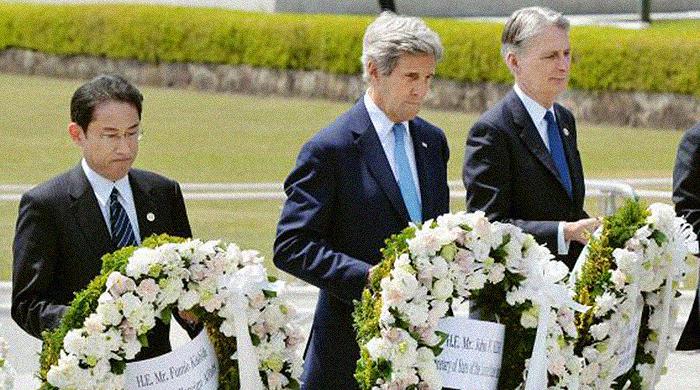
The ministers from Britain, Canada, France, Germany, Italy, Japan and
the United States laid white wreaths at a cenotaph to the victims of
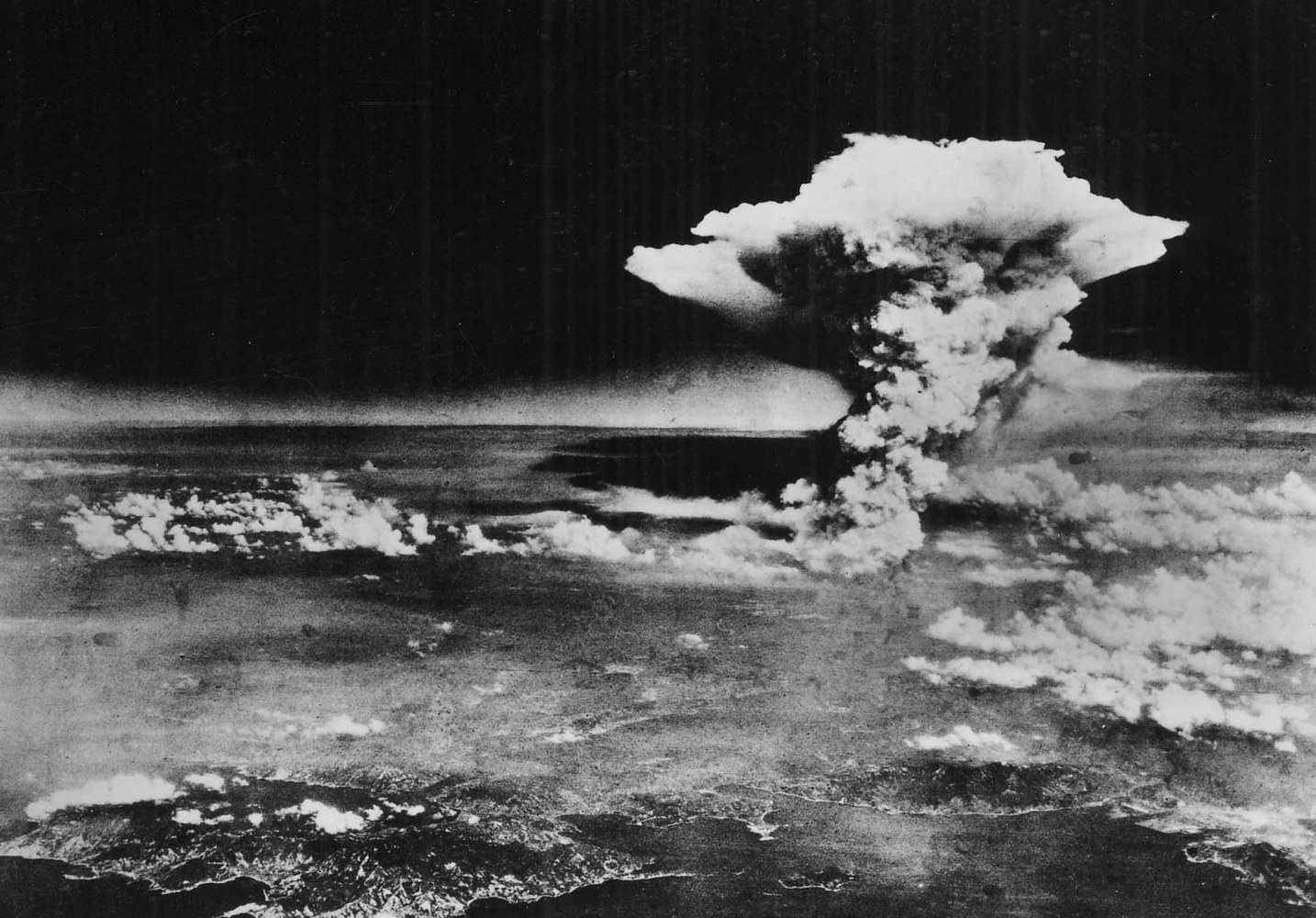
the August 6, 1945, bombing, which reduced the city to ashes and killed some 140,000 people by the end of that year.
While he is not the highest-ranking US official to have toured the
museum and memorial park, a distinction that belongs to then-US Speaker
of the House of Representatives Nancy Pelosi in 2008, Kerry is the most
senior executive branch official to visit.
“Everyone in the world should see and feel the power of this
memorial. It is a stark, harsh, compelling reminder not only of our
obligation to end the threat of nuclear weapons, but to rededicate all
our effort to avoid war itself,” the chief US diplomat wrote in a guest
book.
Asked later if this meant Obama should come, Kerry said: “Everyone
means everyone. So I hope one day the president of the United States
will be among the everyone who is able to come here. Whether or not he
can come as president, I don’t know.”
‘First step’
At Kerry’s suggestion, the ministers also made an impromptu visit to
the Atomic Bomb Dome, the skeletal remains of the only structure left
standing near the hypocentre of the bomb explosion and now a UNESCO
World Heritage site.
Three days after a US warplane dropped a nuclear bomb on Hiroshima,
another atomic bomb was dropped on Nagasaki, on August 9, 1945. Japan
surrendered six days later.
A visit by Obama could be controversial in America if it were viewed as an apology.
Hopes for Obama’s visit to Hiroshima were raised after an April 2009
speech in Prague when he called for a world without nuclear weapons.
He later said that he would be honoured to visit the two nuclear-attacked cities.
The G7 foreign ministers’ trip to the museum and memorial is part of
Japan’s effort to send a strong nuclear disarmament message from
Hiroshima, the world’s first city to suffer atomic bombing.
“I think this first-ever visit by G7 foreign ministers to the peace
memorial park is a historic first step towards reviving momentum toward a
world without nuclear weapons,” Japanese Foreign Minister Fumio Kishida
said in a statement.
He later told a news conference that it was “inconceivable” that Japan would ever decide to have nuclear weapons.
Last month, US Republican presidential candidate Donald Trump said
Japan and South Korea should build such weapons to deter enemies.
In a separate, detailed statement, the G7 ministers singled out North
Korea for sharp criticism, condemning its recent nuclear test and
launches using ballistic missile technology.
And in a statement on maritime security, they voiced their strong
opposition to provocative attempts to change the status quo in the East
and South China Seas, an apparent reference to China, which is locked in
territorial disputes with other nations including the Philippines,
Vietnam and Japan.
Kerry is visiting the city, which was obliterated by a U.S. atomic
bomb on Aug. 6, 1945, to attend gathering of foreign ministers from the
Group of Seven (G7) advanced economies that Japan opened on Sunday with a
call to end nuclear weapons.
The U.S. diplomat is to join his counterparts from Britain, Canada,
France, Germany, Italy and Japan on Monday to tour the city’s atomic
bomb museum and to lay flowers at a cenotaph for its victims, becoming
the first in his post to do so.
“If you are asking whether the secretary and I think all Americans
and all Japanese are filled with sorrow at the tragedies that befell so
many of our countrymen, the answer is yes,” the official, who spoke on
condition of anonymity, added.
Kerry’s trip could pave the way for an unprecedented visit to
Hiroshima by a sitting U.S. president when Barack Obama attends the
annual G7 summit to be held in Japan next month.
While saying the White House has yet to make a decision, the senior
U.S. official said Obama has shown he is willing to do controversial
things such as visiting Havana last month.
The official suggested there was no “great or insurmountable angst about the optics or the politics of a visit to Hiroshima.”
He also said there was no Japanese effort to seek a U.S. apology,
“nor is there any interest in reopening the question of blame for the
sequence of events that culminated in the use of the atomic bomb.”
Japanese Foreign Minister Fumio Kishida, who presides over the
two-day meeting, on Sunday said ministers will discuss anti-terrorism
steps, maritime security and issues related to North Korea, Ukraine and
the Middle East.
America’s “Love Affair” With Nuclear and Radioactive Weapons
By Ulson Gunnar
Global Research, February 13, 2016
The United States would have the world believe that it is in mortal
danger should nations like Iran or North Korea obtain operationally
effective nuclear weapons. We are told that there is a grave risk of
these weapons being used against another nation and that the US (with
the support of the “international community”) must confront these
government, and if possible undermine and overthrow them. Why?
Since a nation has already used nuclear weapons against another
state, ironically enough that nation being the United States itself, we already know the devastating effects of nuclear weapons.
Besides the immense, indiscriminate initial blast, nuclear weapons also
produce a persistent radioactive threat amid the fallout afterwards.
The fallout and the catastrophic effects it has on human health for
years afterward make nuclear weapons particularly horrifying and
abhorrent. The United States didn’t drop only one nuclear bomb on another nation, Japan, it dropped two. The data collected in the aftermath of these attacks have helped form our collective fear of these weapons.
Ironically the US is using the fear its own nuclear warfare has created as leverage to wage still more war. Depleted Uranium – All the Fallout, None of the Bang
But what if the catastrophic human health effects of fallout could be
achieved without the immense, city-flattening initial explosion? What
if you could use a weapon to induce long-term spikes in cancer and birth
defects without the political ramifications of dropping a nuclear bomb
on a population? Some readers may be tempted to cite “dirty bombs,” and
they would be partially correct. But there is another correct answer.
Depleted uranium or DU ammunition.
Depleted uranium is one of the densest materials munitions can be made out of. Because of their density, they are able to penetrate armor other rounds cannot.
DU was initially conceived as an additional deterrence, a weapon of
last resort in the event of a full-scale Soviet invasion of Western
Europe during the Cold War.
Because of the overwhelming number of tanks the Soviet Union
possessed, it was believed extraordinary measures would be needed to
even the odds, even at the cost of radioactive contamination of the
battlefield.
The catastrophic effects of littering the battlefield with
contaminated ammunition possessing a half-life of several billion years
was a risk NATO was willing to take to ensure the survival of Western
Europe. How then, did this weapon of last resort become a weapon
commonly used? The first Gulf War in 1990, Operation Desert Storm, included the heavy use of this doomsday contingency.
The International Coalition to Ban Uranium Weapons (ICBUW) in their
recent piece titled, ““The most toxic war in history” – 25 years later,”
would note:
This month marks the 25th anniversary of the start of Operation
Desert Storm, the combat phase of the Gulf War. Precipitated by Iraq’s
invasion and annexation of Kuwait in August 1990, the conflict was the
first to see the widespread use of depleted uranium (DU) ammunition. US and UK forces subsequently acknowledged firing a combined 286,000kg of DU – the vast majority of which was fired by US Abrams and M60 tanks, and A10 and Harrier aircraft.
ICBUW would also note that the use of DU has impacted both soldiers who used the weapons as well as civilians trapped on or near battlefields they were used on.
Latinos Health included in one of their recent articles the following caption:
The Czech military is testing all of its soldiers that served in the
Balkans for possible signs of Balkan Syndrome, an unexplained condition
that is thought to be caused by depleted uranium used in NATO
ammunition. Recent media reports claim that scientists have found evidence of Uranium 236 in blood samples from soldiers who served in the Gulf War, where depleted uranium ammunition was also used.
It should strike people as disturbing that the United States poses as
the greatest advocate against weapons of mass destruction and a
champion for preserving the lives and wellbeing of innocent people
affected by war, all while using weapons of mass destruction,
repeatedly, at the expense of innocent lives affected by their various
wars. DU has turned up in both Iraq wars, NATO’s intervention in the Balkans and in Afghanistan. Courts
around the world have ruled in favor on several cases regarding the
effects of DU, including a British Gulf War veteran who became ill
because of the radioactive weapons.
The BBC would report in their story, “Gulf soldier wins pension fight,” that:
A former soldier is believed to be the first veteran to win a war
pension appeal after suffering depleted uranium poisoning during the
first Gulf War.
A tribunal in Edinburgh found in favour of Kenny Duncan from
Clackmannanshire who became ill after his service in the Middle East.
He had helped move tanks destroyed by shells containing depleted uranium.
One can only wonder how many nameless, faceless and voiceless
civilians living on or near former battlefields have also been affected
like Mr. Duncan from Clackmannanshire, who will never receive the
assistance needed to recover from what America’s indiscriminate and
unnecessary use of radiological weapons has done to them and their
communities.
While it is hopeful seeing mounting awareness and subsequent pressure
being applied to the United States and other governments around the
world who might also consider using this weapon and others like it, we
are still faced with the problem that the US, essentially the worst
violator when it comes to nuclear and radiological weapons, poses as the
primary advocate policing the world against them.
Not only is the US guilty of immense hypocrisy, it has managed to
hijack what are supposed to be “international institutions” to help
perpetrate this hypocrisy. This is yet another example of just how
important it is to establish a true balance of global power through a
multipolar system of sovereign nations, in place of the “international
order” that currently exists, which sidesteps nation sovereignty and
empowers global criminality rather than stopping it.
Ulson Gunnar, a New York-based geopolitical analyst and writer especially for the online magazine “New Eastern Outlook”.
Commemorating U.S. Violence from Hiroshima to Iraq
by SAM HUSSEINI
A new political mural has gone up in Washington, D.C.
Well, sort of new.
The mural has been there for a few years, but it’s been transformed just recently. Some might say, made more whole, reborn.
It’s a mural on the side of a restaurant formerly known as the
Calvert Cafe. It features U.S. presidents from Eisenhower to Obama with
Mama Ayesha, who founded the restaurant that is now named for her: Mama
Ayesha’s, just near the Duke Ellington Bridge in Adams Morgan. It was
originally labored over by Karlisima Rodas.
This is an apparent reference to Obama’s comments in April calling
protesters against police killings who resort to property destruction
“thugs.”
As USA Today reported: “President Obama doesn’t regret using the term
‘thug’ in describing the violent rioters in Baltimore this week,
spokesman Josh Earnest said Wednesday.
“‘Whether it’s arson or, you know, the looting of a liquor store … those were thuggish acts,’ Earnest said.
“In discussing the riots Tuesday, Obama assailed the ‘criminals and
thugs who tore up the place,’ and described them as a distraction from
the real issues of police brutality.”
The date of the atomic bomb being dropped on Hiroshima — August 6 —
is also the date of the imposition of the sanctions being imposed on
Iraq in 1990, exactly 25 years ago, that would ultimately take the lives of hundreds of thousands of Iraqi civilians, many of them children. The
1991 U.S. bombing of Iraq and subsequent sanctions set the stage for
the killing fields we now see — or rather, don’t see and manage to
ignore in Iraq and beyond. Yet, the administration of Bush I is regarded
by some so-called critics of Bush II as enlightened.
From Hiroshima to Iraq, all these presidents have used violence.
Massive violence. An augmented mural could include mushroom clouds in
the background, and perhaps jet fighters, bombers and killer drones
flying overhead.
As Daniel Ellsberg has noted, the U.S. uses nuclear weapons
constantly, like a thief robbing people by waving a gun around. You
don’t need to pull the trigger to “use” the gun.
So, take a look at “From Wounded Knee to Syria: a Century of US
Military Interventions” by Zoltan Grossman. Among the U.S. aggression
most have forgotten is Eisenhower administration issued a nuclear threat
against Iraq in 1958 against invading Kuwait. Or that Johnson invaded
the Dominican Republic in 1965; how many remember that? Or that the
Carter administration began the Rapid Deployment Force, paving the way
for future U.S. Mideast wars and began the backing of the Mujahadeen to
undermine the Soviets in Afghanistan.
The paintballing — a sort of art work thar is literally paint as
paint — recalls the Edward Sorel piece that adorns Robert Scheer’s book
“Thinking Tuna Fish, Talking Death” — which features “world leaders”
dancing the can-can with missiles as genitalia.
There’s typically a taboo against graffiti artists “tagging” over
each other’s work and this would seem to violate it, but there’s a case
to be made that this more competes the piece than defaces it. Some
people, including Karlisima, now seem upset by the addition of the
paintballs, but murals are not typically done to glorify the high and
mighty, and do so for the Great Leaders in traditions that shouldn’t be
emulated. The labor of putting together the original mural is not
destroyed, it’s not painted over, but used to make a perhaps unexpected
point. Further, the original mural it seems was not so much done to
convey a vision the artist as much as commissioned by the DC Arts
Commission and various other governmental bureaucratic entities. The
mural that used to adorn that wall was of the Mount of Olives in
Jerusalem, where Mama Ayesha was born. But it was replaced and the
collective wisdom had it that the environs of Washington, D.C. were
lacking in sufficiently honoring our war presidents, pretending all is
smilingly well as they are brutal.
The new mural now features Mama Ayesha in her beautiful Palestinian
dress bring the war makers together, their vulnerability, what they
likely had thought of as a source of their dominating power, made
evident. And they’re smiling, accepting, perhaps gaining in empathy.
As it is, there continue to be sprawling U.S. military bases the
world over — and it’s not as if things are getting better by any
objective measure — the U.S. just reopened its military base in the
Philippines to little notice. All these presidents have continued the
U.S.’s backing of Israeli atrocities against the Palestinians as Israel
has effectively destroyed a people over their collective tenure.
The paintball artist perhaps admirably exercised restraint from
engaging in figurative head shots. After all, virtually every president
has killed, not least of all the current inhabitant of the White House, who has commented he’s “really good at killing people.”
The U.S. is killing people using drones in Somalia, Yemen, Syria,
Libya, Iraq, Afghanistan, Pakistan. Obama is often depicted as something
approaching a pacifist by some for not having bombed Iran already.
Never mind that he escalated the war in Afghanistan, has now stepped up
U.S. bombings of Iraq and Syria, bombed Libya along with NATO, and so on
and so on.
But our society, media and art largely ignore all this. They focus on
celebrity silliness or, worse yet, treat presidents like revered
celebrities when their hands are covered in blood that is all too real.
Hiroshima 70th Anniversary: What to Know About Nuclear Weapons in 2015
byAlexander Smith
Hiroshima Marks 70th Anniversary of Atomic Bomb With Solemn Ceremony0:48
Seventy years after the U.S. dropped the first wartime atomic bomb on
Japan, nine nations are estimated to possess a total of around 16,000
nuclear weapons.
This may seem like a lot, but it’s far fewer than the peak Cold War
stockpile in 1986, when the global arsenal exceeded 60,000, according to
the Stockholm International Peace Research Institute (Sipri).
That’s not to say the world is turning its back on nukes.
President Barack Obama optimistically declared in April 2009 that he
would lead the way toward “a world without nuclear weapons.” But the government is projected to spend $348 billion on its nuclear arsenal over the next 10 years, according to a Congressional Budget Office estimate released in January. The
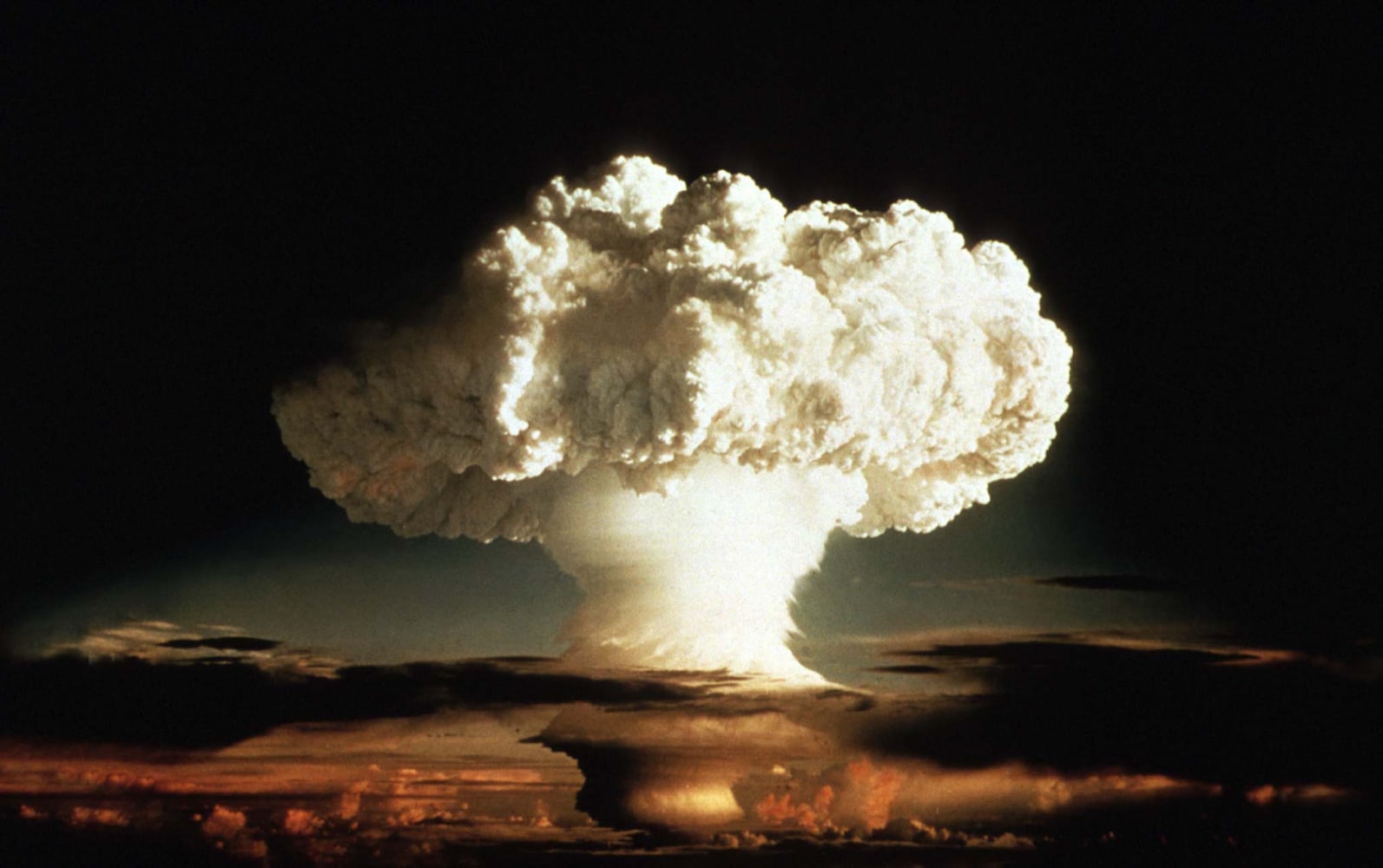
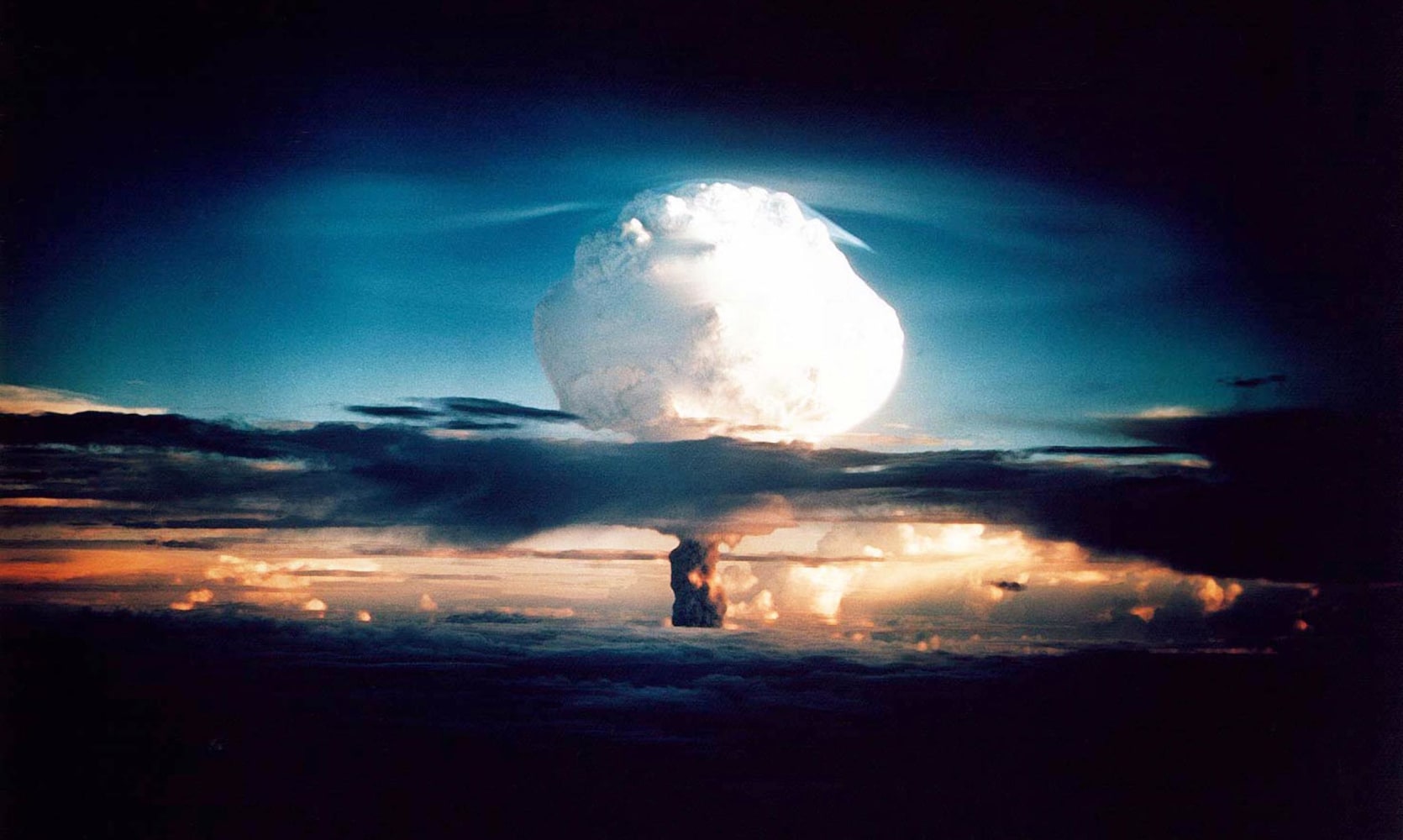
mushroom cloud of the first test of a hydrogen bomb known as “Ivy Mike”
as photographed from the Pacific Ocean atoll of Enewetak in 1952. U.S. Air Force via Reuters, file
Although the raw numbers are decreasing, this continued investment
has built bombs many times more powerful than those used in 1945.
Rauf added: “The dangers of the Cold War are still with us. The
total numbers have gone down, but the number of warheads that could
reach their target in 20 minutes has not changed so much.”
Who else has nuclear weapons besides the U.S. and Russia?
Rivals India and Pakistan have been involved in four wars and
countless border scuffles since their partition in 1947. They have
around 100 nuclear weapons each, according to Sipri. One
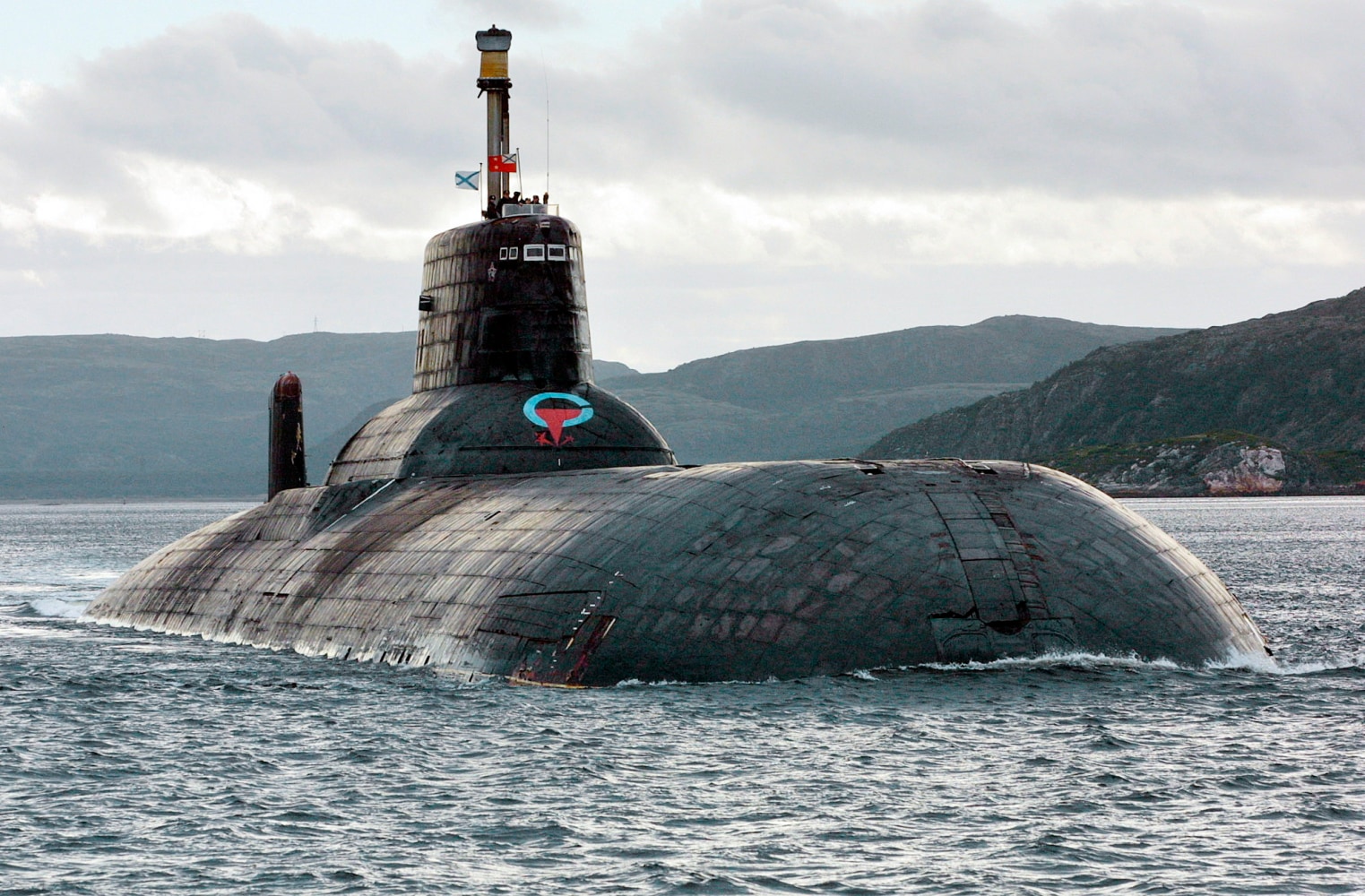
of Russia’s largest Soviet-built nuclear submarines, the Typhoon
(Akula) class, heaves ahead in the Barents Sea at Russia’s Arctic Coast
in September 2001. Dmitry Lovetsky / AP, file
Christopher A. Bidwell, a senior fellow at the Federation of American
Scientists, believes that far from escalating their conflict, the
acquisition of nukes by these tense neighbors meant that they were no
longer able to engage in full-blown warfare.
Aware of what an actual war might risk, he said, India and Pakistan
now seem reluctant to escalate hostilities beyond the low-level border
fighting we see today.
Israel has a policy of not commenting on its nukes. However “it is
generally accepted by friend and foe alike” that they have around 80
warheads, according to the Bulletin of the Atomic Scientists.
Experts say North Korea has fewer than 10 warheads. But despite its
regular stream of truculent rhetoric on the subject, the reclusive
nation has so far failed to successfully develop a long-range method of
delivery.
Are world powers trying to get rid of their nuclear weapons?
In principle, yes.
Almost every country on the planet has now signed the Nuclear
Non-Proliferation Treaty. This accord, known as the NPT, first came into
force in 1970 with the aim of preventing the spread of nuclear weapons
around the world.
The treaty gave special status to the earliest nations to test
nuclear weapons — the U.S., Russia, China, the U.K. and France — meaning
they were allowed to keep their bombs while working toward getting rid
of them. All the other signatories promised not to build or buy their
own weapons. However, India, Pakistan, Israel, and North Korea have refused to sign the NPT. These
countries were relative latecomers to the world of nuclear testing and
as such would not enjoy the special status of their nuclear
predecessors. Signing the treaty would in theory mean giving up their
stockpiles.
Critics of the NPT point to these countries’ apparent impunity, as
well as the billions of dollars still being spent on existing nuclear
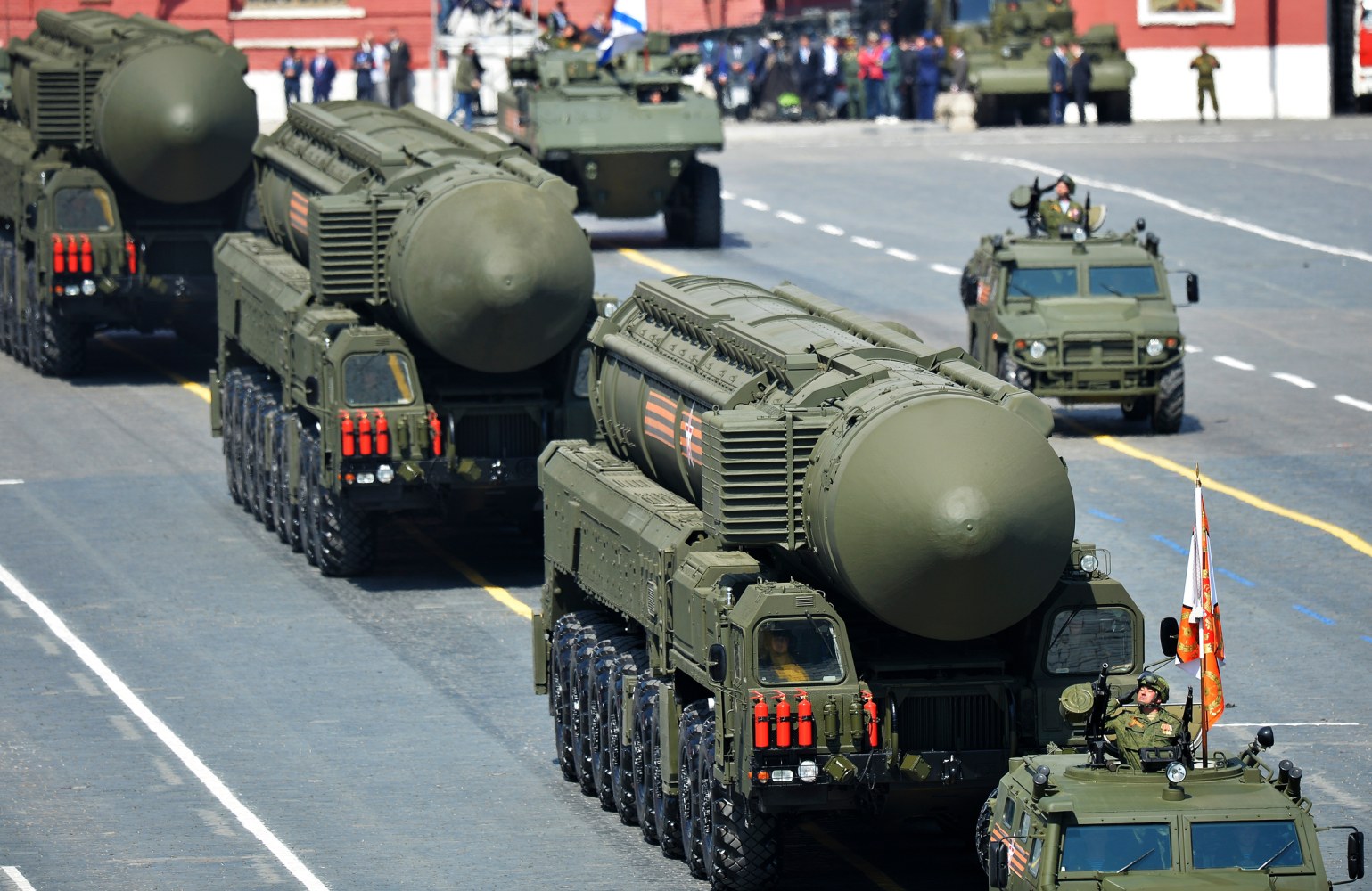
programs. Russian
RS-24 Yars/SS-27 Mod 2 intercontinental ballistic missiles drive during
the Victory Day parade at Red Square in Moscow in May. RIA Novosti via Reuters
Others, like Dr. Page Stoutland, at the the nonpartisan, non-profit
Nuclear Threat Initiative, say the treaty is “very imperfect, yet its
the best thing going.”
In the 1960s, many analysts believed that the number of states with
nuclear weapons would increase to around two dozen. That prediction has
fallen well short, owing largely to the treaty, according to Stoutland,
who is vice president for scientific and technical affairs at the NTI.
“It has created a barrier to many states who might be thinking about their own weapons program,” he said.
Are we safer than we were in the Cold War?
Experts and campaigners are still divided on the safety and necessity of modern-day nuclear weapons.
Some, like Bidwell, say that the technology is beneficial as it has
stopped world powers entering into full-blown wars with each other.
Others, such as Rauf, say that instead we have merely fought proxy wars
in places such as Vietnam and Afghanistan.
“This increases the risk of an accidental or mistaken launch with
potentially catastrophic outcomes,” according to the Union of Concerned
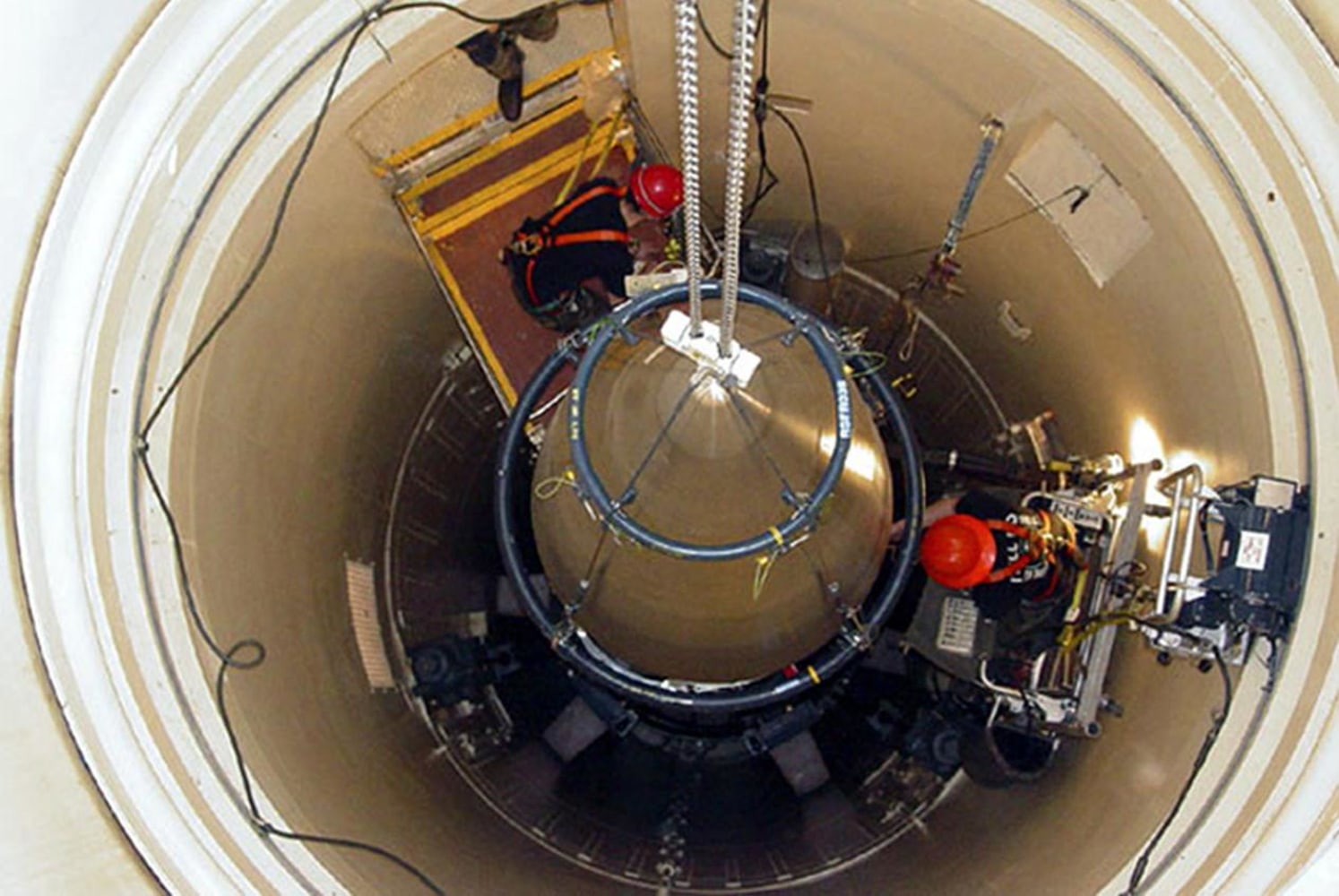
Scientists, a Massachusetts-based nonprofit organization. A Malmstrom Air Force Base missile maintenance team removes the upper section of an ICBM at a Montana missile site. John Parie / U.S. Air Force via AP file
Most agree, however, the threat of Washington and Moscow willfully
engaging in mutually-assured destruction has dipped significantly since
the early 1990s.
“Despite the situation in Crimea and Eastern Ukraine, it’s not really
conceivable that U.S. and Russia would use nuclear weapons against each
other in that scenario,” said Stoutland at the NTI.
While the bomb was first used as a weapon of war in 1945, Bidwell
said its main use is now as a “political weapon,” shaping geopolitics
while remaining safely in its launcher.
“No one intends to use it until they absolutely have to,” said Bidwell, who also served as a naval officer in the 1980s.
What about a nuclear bomb being detonated by accident?
Many analysts believe this threat has not diminished entirely.
Creaking Cold War technology still underpins the nuclear arsenal of the
U.S. and Russia, hence the eagerness to upgrade their infrastructure.
“People do things they don’t mean to do, and nuclear weapons systems
are very complex,” Stoutland added, spelling out the recipe for what he
says is the minimal but existential threat of an accident. “It’s
difficult to have complete assurance that something cannot go wrong.”
What about terrorists and other non-state actors?
After the post-Cold War entente, and particularly after 9/11, the
global focus shifted to stopping militant organizations getting hold a
nuclear bomb.
The U.S. was especially keen to stamp out the potential nightmare
scenario of someone detonating a small nuclear device in the center of
one of its major cities.
Organizations such as the International Atomic Energy Agency (IAEA)
have been central in “the global effort to lock up the materials that
could be used to make a nuclear weapon,” Stoutland said. “This still
remains a concern but a lot of progress has been made in the past few
decades,” he added.
Here Was Once a City: How British Newsreels Reported Hiroshima0:31
However, as that threat has decreased, a new one has sprung up in its place: cyber security.
“One of the key issues is that command and control systems are so
complex that one cannot be 100 percent confident that the system is
secure,” Stoutland added.
Cyber attacks could interrupt a nation’s ability to communicate
launch orders, trick a radar system into believing there was an imminent
attack, or take direct control of a weapon.
“This is certainly an emerging problem,” Stoutland added. “But I’m
confident there are plenty of people within the American and Russian
governments who are focused on this exact issue.”
70 Years After Hiroshima and Nagasaki: The Urgency of Banning Nuclear Weapons
15 hours ago | Updated 14 hours ago
Catherine Maia Professor at the Faculty of Law of the University
Lusófona of Porto (Portugal), visiting professor at Sciences Po Paris
and the Catholic University of Lille (France)
Jean-Marie Collin Vice president of the organization Arrêtez La Bombe
and France Director of the Parliamentarians for Nuclear
Non-Proliferation and Disarmament (France)
The typology of weapons is divided into two camps: on the one hand,
conventional weapons, which have a limited impact and scope; on the
other hand, weapons of mass destruction (WMD), intended to kill
indiscriminately both soldiers and civilians, and more widely all living
organisms, with devastating and lasting effects on the environment.
Within this second category, are gathered chemical, biological and
nuclear weapons.
Due to their non-selective action and long-term consequences, the
international community has endeavored to adopt conventions aimed at the
prohibition of the development, the production, the storage and the use
of chemical and biological weapons.
Paradoxically, if these weapons are relatively easy and inexpensive
to produce, their use remains complex, because subject to numerous
uncertainties, in particular meteorological ones.
Nuclear weapons, for their part, have much more destructive effects,
as illustrated by the case of the Republic of the Marshall Islands. As
the environmental, health and human impact of the 67 tests conducted on
this small territory in the 1950s and 1960s continue to persist today,
this David of the Pacific decided in 2014 to refer the matter to the
International Court of Justice (ICJ), in order to gain recognition of
the violation, by the nuclear Goliaths, of their obligations in the
field of nuclear disarmament.
Surprisingly, while the
proliferation of nuclear weapons is combated legally and diplomatically,
with the support of the International Atomic Energy Agency (IAEA), for
now, there is no universal consensus to promote their ban.
Certainly, efforts have been made on this path. Thus, the 1968 Treaty on
the Non-Proliferation of Nuclear Weapons (NPT) came to restrict the
right to own such weapons to the five states that detonated a nuclear
device before January 1st, 1967 (United States, Russia, United Kingdom,
France and China). In return, they committed themselves to negotiate in
good faith in order to reach a general and complete nuclear disarmament.
Furthermore, as recognized by the ICJ in an advisory opinion of 1966,
“the threat or use of nuclear weapons would generally be contrary to the
rules of international law applicable in armed conflict, and in
particular the principles and rules of humanitarian law”, in particular
because they operate indiscriminately and cause unnecessary harm.
It is certainly to protect itself against potential convictions that
France was careful to join to its ratification of the Statute of the
International Criminal Court (ICC) of 1998 an interpretative declaration
– the validity of which is questionable – that provisions on war crimes
would concern exclusively conventional weapons and could not prohibit
the use of nuclear weapons. France is, moreover, the only country in the
“nuclear club”, with Britain, to have ratified this treaty. Sign,
however, that this approach is far from consensual, its interpretation
remained isolated, while other countries (Egypt, New Zealand, Sweden),
on the contrary, declared in the occasion of their signature or
ratification of the ICC Statute that the provisions concerning war
crimes apply whatever the means and the types of weapons used, including
nuclear weapons. In May 2015, the NPT Review Conference highlighted
this categorical opposition between the minority of nuclear states and
the majority of non-nuclear states.
Despite this opposition, nowadays, the request to prohibit nuclear
weapons is always more significant. There are many resolutions,
including those of the International Committee of the Red Cross, the
World Health Organization and the General Assembly of the UN, which
emphasize that nuclear weapons represent a real threat to the very
existence of humankind and, therefore, that the only path to follow is
their legal prohibition.
Since 2010, the humanitarian imperative that prevailed in the various
international forums consisted in stressing the dangers caused by a
detonation, whether it is voluntary, accidental or malicious. This
approach has allowed the emergence of awareness of states about the
urgency to fill the legal vacuum surrounding these weapons, which, as
noted by the ICJ in 1996, are neither authorized nor completely and
universally prohibited by international law. Thus, following the 3rd
Intergovernmental Conference on the humanitarian impact of nuclear
weapons, held in Vienna (Austria) in 2014, a “Humanitarian Pledge”,
inviting the parties to the NPT to take effective measures to prohibit
and then to eliminate nuclear weapons, has been joined by a growing
number of signatories, now amounting to 113 states.
Promoting the prohibition of nuclear weapons is not an easy task in
front of the determination of the nuclear powers and states under the
NATO umbrella to defend the deterrent value of nuclear weapons for their
security. However, it is a priority for many states and civil society
organizations for which a multilateral agreement of banning is
essential. The goal is to create the legal basis that will open the door
to the second stage, that of the total abolition of nuclear weapons. It
is, in fact, impossible to implement a process of elimination, probably
lengthy and complex, if the possession of a nuclear arsenal is not
previously prohibited.
Japan’s atomic bomb survivors continue in fight against nuclear weapons
As Japan prepares to mark the 70th anniversary of the world’s first
nuclear attack, survivors ponder how to continue warning of the horrors
of nuclear war
Justin McCurry in Hiroshima
Friday 31 July 2015 09.15 EDT
It is not as if Sunao Tsuboi needs another reminder of his violent
encounter, as a 20-year-old university student, with a “living hell on
earth”. The facial scars he has carried for seven decades are proof
enough. But, as if to remind himself of the day he became a witness to
the horrors of nuclear warfare, he removes a a black-and-white
photograph and points to the shaved head of a young man looking away
from the lens.
“That’s me,” he says. “We were hoping we would find some sort of
medical help, but there was no treatment available, and no food or
water. I thought I had reached the end.”
The location is Miyuki Bridge, Hiroshima, three hours after the Enola
Gay, a US B-29 bomber, dropped a 15-kiloton nuclear bomb on the city on
the morning of 6 August 1945. Between 60,000 and 80,000 people were killed instantly; in the months that followed the death toll rose to 140,000.
In the photo, one of only a handful of surviving images taken in
Hiroshima that day, Tsuboi is sitting on the road with several other
people, their gaze directed at the gutted buildings around them. To one
side, police officers douse schoolchildren with cooking oil to help
soothe the pain of their burns.
The average age of the 183,000 registered survivors of the Hiroshima
and Nagasaki attacks rose just above 80 for the first time last month.
While each has a unique recollection of the morning of 6 August and
its aftermath, near disbelief at the scale of destruction is a theme
that runs through hibakusha testimony.
Tsuboi remembers hearing a loud bang, then being blown into the air
and landing 10 metres away. He regained consciousness to find he had
been burned over most of his body, his shirtsleeves and trouser legs
ripped off by the force of the blast.
“My arms were badly burned and there seemed to be something dripping
from my fingertips,” said Tsuboi, who is co-chair of Nihon Hidankyo, a
nationwide organisation of atomic and hydrogen bomb sufferers.
“My back was incredibly painful, but I had no idea what had just
happened. I assumed I had been close to a very large conventional bomb. I
had no idea it was a nuclear bomb and that I’d been exposed to
radiation. There was so much smoke in the air that you could barely see
100 metres ahead, but what I did see convinced me that I had entered a
living hell on earth.
He was taken to a hospital, where he remained unconscious for over a
month. By the time he came to, a defeated Japan was under the control of
the US-led allied occupation. “I had no idea that the war had ended,”
he said. “It was difficult to take in.”
Since then Tsuboi has been hospitalised 11 times, including three
occasions when doctors told him he was about to die. He takes drugs for
several illnesses, including two cancer diagnoses, which he says are
connected to his exposure to radiation.
While the A-bomb survivors’ testimony is now a matter of historical
record, the hibakusha are trying to ensure that their experiences don’t
die with them, at a time when the world is facing nuclear threats from
North Korea and Russia.
Earlier this year one of the most active branches of Hidankyo
announced it would disband after its members, most of whom are in their
80s and 90s, conceded they were too old to continue their activities.
“In 10 years, I’d be surprised if there are many of us left,” says
Hiroshi Shimizu, a Hidankyo official who was three years old when the
Hiroshima bomb exploded a mile (1.6km) from his home.
“If the hibakusha continue to speak out against nuclear weapons, then
other people will follow suit. That’s why we have to continue our
campaign for as long as we are physically able.”
Hiroshima and Kunitachi, a small city in western Tokyo with a small
population of A-bomb survivors, have tried to preserve the hibakusha
legacy by setting up “storyteller” courses open to people who have no
direct experience of the attacks and no A-bomb survivors among their
relatives. Hidankyo, meanwhile, has started reaching out to the children
and grandchildren of hibakusha.
Last month, Yoshiko Kajimoto, an 84-year-old survivor, recounted her
experiences via Skype to dozens of members of the British parliament,
and a delegation of hibakusha recently took part in a 24-country “voyage
for peace” with the Japanese NGO Peace Boat.
“I won’t be here in 10 or 15 years’ time, so the question we’re all
asking is how to continue sending our message,” said Hiroko Hatakeyama,
who was six in 1945.
“I barely have the energy to campaign these days, and I’m no longer
scared of dying. But at the same time I realise that it’s our duty as
survivors to carry on for as long as possible, to honour the memory of
those who are no longer with us.”
Tsuboi, who went on to have three children and seven grandchildren,
will make his annual pilgrimage to Hiroshima Peace Park on 6 August.
That evening, he will release a lantern along the Motoyasu river – where
thousands fled to escape the heat of the nuclear blast – to “guide” the
spirits of the dead.
In his role as one of the world’s most active A-bomb survivors,
Tsuboi will have a brief conversation with Japan’s prime minister,
Shinzo Abe, whom he has criticised for attacking the country’s postwar
commitment to pacifism.
“On behalf of all A-bomb victims, I will ask him to do everything in
his power to rid the world of nuclear weapons,” Tsuboi said. “I will
continue to repeat that demand until my last breath.”