Showing posts with label U.S.. Show all posts

Friday, March 2, 2018

Back to the Nuclear Olympic Games

952bf0a5-37b4-427d-aa70-264176b9c6a1
The Olympics are over, and the high-stakes Trump-Kim showdown is no closer to resolution.
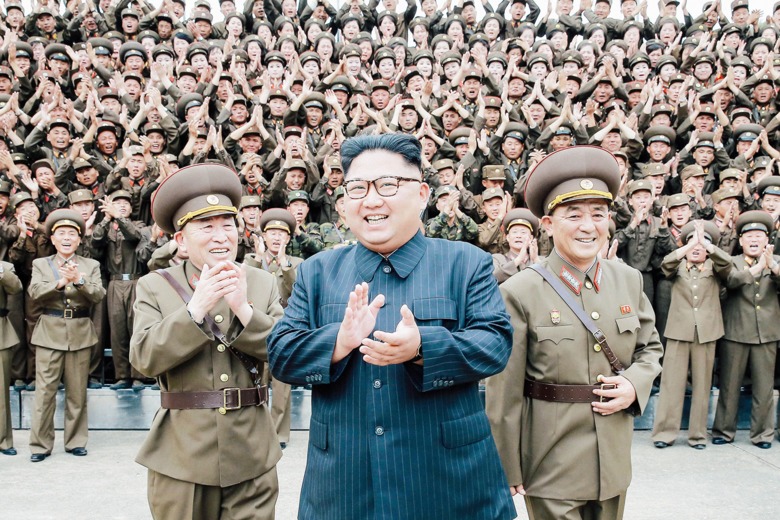
The Winter Games in South Korea are over, so the winter-is-coming games now resume. I refer, of course, to the storm clouds of bluff, brawn, and blind global terror swirling around the faceoff between Donald Trump and Kim Jong-un and the stupefyingly real chance that it could spark a nuclear war.
Trump’s latest maneuver came late last week, after he imposed new sanctions on North Korea and on companies that do business with the regime. “If the sanctions don’t work,” he said at a joint news conference with the Australian prime minister on Friday, “we’ll have to go to phase two. Phase two may be a very rough thing. Maybe very, very unfortunate for the world. But hopefully the sanctions will work.”
It might have been useful if Trump had spelled out what it means for the sanctions to “work”—that is, what the North Koreans need to do to avoid the dreaded phase two. Strategic ambiguity is one thing, and sometimes has its place in international discourse; vague threats rarely bear fruit and usually just spawn confusion and aggravate tensions.
One job of diplomats is to clean up such messes and to clarify, in backroom whispers, a president’s—particularly this president’s—random eruptions. But our nation is shedding its diplomats by the week, especially those with expertise in Asia, which Trump’s foreign policy triumvirate—Defense Secretary James Mattis, Secretary of State Rex Tillerson, and national security adviser H.R. McMaster—utterly lacks.
The latest casualty is Joseph Yun, a 30-year veteran of the foreign service and the State Department’s point of contact for back-channel talks with North Korea. Yun has been the main advocate for solving the problem through diplomacy, not military action.
His departure follows, by just one month, the scuttling of Victor Cha as the prospective ambassador to South Korea. Cha, who was President George W. Bush’s top adviser on North Korea, had raised objections to the growing support within Trump’s White House for pre-emptive military strikes against Kim’s regime.
In other words, Trump is courting a major crisis with North Korea with no advisers who’ve had experience at dealing with North Koreans. Old hands like Yun and Cha have acquired years of familiarity with the Kim dynasty’s negotiating style; they know what to take seriously and what to dismiss as gruff. They’ve also long thought through the military options, which Trump and his White House staff are now mulling, and concluded that those roads lead to likely catastrophe. (Colonels and generals in the Pentagon long ago reached the same verdict; the “bloody nose” option—the idea of socking Kim’s regime with a punch that stuns him into submission without destroying very much—isn’t one that many officers take seriously.)
Now come reports that North Korea might be willing to hold talks with the United States and South Korea. On the one hand, such overtures should be received with a cocked eyebrow; even South Korean President Moon Jae-in, who is desperate for a peaceful way out of the crisis, realizes that Kim’s main motive is to drive a wedge between Seoul, South Korea, and Washington, splintering their military alliance. For that reason, Moon politely declined an invitation, offered in person by Kim’s sister during the Olympics, for him to travel to Pyongyang, North Korea, for talks. On the other hand, given that there are no good military options, there can’t be much harm in talking, as long as all eyes are wide open.
“There are many reasons to have talks,” Kurt Campbell, CEO of the Asia Group and a former assistant secretary of state for East Asian and Pacific Affairs, said in a phone conversation. “Everybody in Asia expects these talks to happen, so it’s important for us to try to make them happen. Whether or not they accomplish anything as far as North Korean nuclear weapons are concerned, they’ll help cement our alliances, help weave the U.S. into the geopolitical fabric of Asia.”
But who’s going to do the talking on our side? There’s no one left who’s been there before. Meanwhile, the Trump administration is so divided on the main issues that those officials who do show up at the table will arrive with uncertain guidance, unless someone hammers together a basic strategy in the meantime—and there’s no sign of that happening any time soon.
The games of war whooping began in August, when Trump warned that “North Korea best not make any more threats to the United States” or it would “be met with fire and fury like the world has never seen.” It is standard practice for presidents to tell foes that they’ll meet fire and fury (though not in such colorful language) if they dare attack the United States or its homeland. But it is something else to promise the unleashing of cataclysmic powers if a foe merely makes threats against us—whether through belligerent statements or, say, the testing of a long-range missile.
The Kim dynasty—Pyongyang’s current leader as well as his father and grandfather, Kim Jong-il and Kim Il-Sung—have long indulged in vituperative verbiage. It’s an essential ingredient in their strategy of dealing with the fact that North Korea (as the country’s first president, Kim Il-sung, put it) is a “shrimp among whales”—a small, poor country in a region of rich giants. Act crazy, brandish a few weapons, play the larger powers off one another—and sometimes you’ll get what you need: food aid, trade, energy assistance, deterrence against an enemy invasion. Now that the current Kim actually has some nuclear weapons, he can play this card with more potency.
But no one has ever seen an American president—who shouldn’t need to talk loudly about the size of his missiles—matching this brand of rhetoric. What to make of it? Trump may be trying out Richard Nixon’s “madman theory.” When Nixon first came to office, he told his national security adviser, Henry Kissinger, to go to the Paris peace talks and tell the North Vietnamese negotiators that Nixon’s crazy, he’s particularly insane about communism, and he has his finger on the nuclear button. Ho Chi Minh, he assured Kissinger, will sign a peace deal in a matter of days. The trick didn’t work, perhaps because the North Vietnamese didn’t believe Nixon was that crazy; they knew he was bluffing.
But how does the madman theory work if the president really is a madman, or seems to be? It might have some effect. But to the extent it does, the outcome depends on what the madman puts on the table as an alternative to crazy war—it depends on the rewards as well as the punishments. If Trump won’t hold talks unless North Korea dismantles its nuclear machine as a precondition, then the talks aren’t going to happen. The nukes are Kim’s only asset, his only bargaining chip. Why should he give them up at the start—or at any point in the talks, unless he’s given something amazingly tempting in exchange?
In fact, Trump’s reckless talk about “fire and fury” probably makes Kim more determined to hang on to his nukes. He’s not an idiot. He looks around the world. Saddam Hussein dismantled his nascent WMD program after the first Gulf War; he’s dead. Muammar Qaddafi gave up his nuclear program; he’s dead. The Iranians agreed to give up their nukes, international inspectors affirm that they’re in compliance with the deal—and yet Trump wants to scuttle it. Under the circumstances, if the most rational person in the world were leader of North Korea, he or she would assemble a decent-size nuclear arsenal as quickly as possible.
If Trump is bluffing about war, it’s quite the gamble. What if Kim calls the bluff—doesn’t agree to dismantle his nukes, maybe test launch an intercontinental ballistic missile  or two? Will Trump really unleash fire and fury? Will he back down and thus risk appearing weak (his deepest fear)? We are all teetering on a tightrope, and the managers of the circus are clowns.

Saturday, February 24, 2018

North Korea Prepares for Nuclear War

North Korea says it's deploying nuclear missiles
Asia
23 hours ago
North Korea's ruling party newspaper says the country's military is pushing forward with its deployment of nuclear warheads and ballistic missiles.
The Rodong Sinmun made the comment in an editorial on Friday.
The article says the country possesses intercontinental ballistic missiles, submarine-launched ballistic missiles, and hydrogen bombs. It insists that it has made all preparations for a possible nuclear attack on the United States.
The editorial also says that wishing for the denuclearization of North Korea is more foolish than waiting for the ocean to dry up.
North Korea has been fostering a reconciliatory mood with South Korea during the ongoing PyeongChang Winter Olympics.
But the North staged a military parade on February 8th, the eve of the Games' opening ceremony, displaying the new ICBM-class missile known as the Hwasong-15.

Wednesday, February 7, 2018

North Korea soon ready to strike Babylon the Great

North Korea 'months away' from ability to hit U.S. with nuclear weapon: U.S. envoy
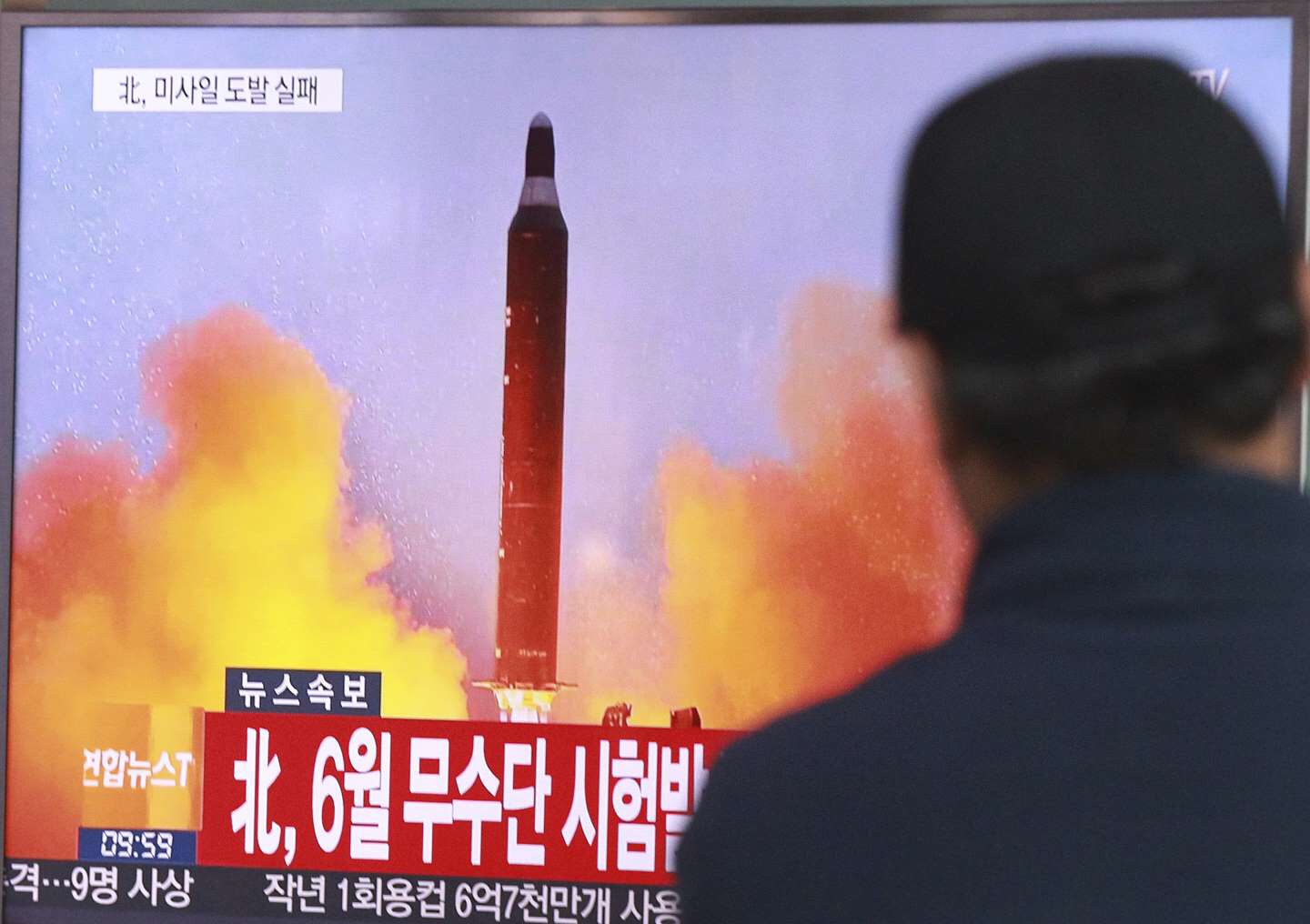
Stephanie Nebehay In this 2016 photo, a man in Seoul, South Korea, watches a TV news program showing a file image of a missile launch conducted by North Korea.
GENEVA — North Korea is only months away from obtaining the capability to hit U.S. territory with a nuclear weapon and must be disarmed, a U.S. envoy said on Tuesday, dismissing Pyonyang’s diplomatic thaw with South Korea as a “charm offensive” that fooled no one.
In a diplomatic showdown at a U.N.-sponsored Conference on Disarmament, North Korea responded by blaming Washington for escalating confrontation, saying it was deploying nuclear assets including aircraft carriers near the divided peninsula and was considering a pre-emptive strike against Pyongyang.
North Korea has accelerated its provocative pursuit of nuclear weapons and missile capabilities, and expressed explicit threats to use nuclear weapons against the United States and its allies in the region,” U.S. disarmament ambassador Robert Wood told the Geneva forum.
“North Korean officials insist that they will not give up nuclear weapons, and North Korea may now be only months away from the capability to strike the United States with nuclear-armed ballistic missiles,” he said.
A new U.S. nuclear policy review outlined last week “reaffirms that North Korea’s illicit nuclear program must be completely, verifiably, and irreversibly eliminated, resulting in a Korean Peninsula free of nuclear weapons,” he said.
Asked later what the basis was for the assessment that North Korea would soon be able to hit the United States with a nuclear weapon, he said he had “no new information to share.”
North Korea tested its first intercontinental ballistic missile, the Hwasong-14, twice last July. In November it tested the Hwasong-15, believed to be capable of reaching the continental United States. It is not yet believed to have the capability to mount a nuclear warhead on a ballistic missile.
North Korea is under tightening U.N. Security Council sanctions for its banned nuclear and ballistic missile programs. But recent weeks have seen a thaw with South Korea, after Pyongyang agreed to send athletes to compete in the Olympic Games opening on Friday in the South.
“CHARM OFFENSIVE”
“What I would call ‘the charm offensive’ frankly is fooling no one,” Wood told the talks.
He also said arsenals in China and Russia were expanding, drawing rebukes from their respective delegations.
Russia, China and North Korea are growing their stockpiles, increasing the prominence of nuclear weapons in their security strategies, and — in some cases — pursuing the development of new nuclear capabilities to threaten other peaceful nations,” Wood said.
“We are not going to stick our head in the sand, we are going to respond to these growing challenges,” he later told reporters.
North Korea accused the United States of seeking to aggravate the situation on the divided peninsula by “deploying large nuclear assets” nearby, laying the ground for a possible pre-emptive strike against it.
“In view of the nature and scale of U.S. military reinforcements, they are designed to make a pre-emptive strike against the DPRK,” North Korean diplomat Ju Yong Chol told the talks, referring to his country’s official name, the Democratic People’s Republic of Korea.
“U.S. officials including the defense secretary and the CIA director repeatedly talked about DPRK nuclear and missile threat to justify their argument for a military option and a new concept of a so-called ‘bloody nose,’ a limited pre-emptive strike on the DPRK is under consideration within the U.S. administration,” Ju said.
He said President Donald Trump’s "America First" doctrine and U.S. nuclear superiority would endanger global peace and security and “trigger off a new nuclear arms race and could bring the whole world close to a horrible catastrophe."
Reporting by Stephanie Nebehay; editing by Matthew Mpoke Bigg and Peter Graff

Tuesday, October 27, 2015

The Inevitable War With Iran (Ezekiel 17)

 
Why the U.S. may still have to go to war against Iran

By Bennett Ramberg October 26, 2015

Effective enforcement of the Iranian nuclear deal remains a conundrum. Enshrined in the agreement is “snapback” – the restoration of international economic sanctions against Tehran should it violate the deal’s terms. Yet the expected rush of European, Russian and Chinese businesses into Iran would make such unified action questionable.

Aware that economic pressure might not be enough, U.S. officials have repeatedly declared “all options” are on the table. Though most have been reluctant to offer details, recent Pentagon talk has focused on a new bunker-buster bomb. Such talk feeds into the growing presumption that Washington would rely on air strikes if Iran violated the agreement.

Yet history shows that forceful alternatives either don’t work or are too dangerous and costly. In addition, past air strikes have proved to be unreliable. So policymakers should indeed consider all options. Previous tactics — including assassination, special-forces sabotage, technology disruption, armed forces mobiliztion, massive bombing and war — deserve another look.
Some tacks have worked better than others. Determining the best course, however, can be complicated. Here’s a list:

1) Assassination marks the nadir on the violence spectrum. It has reportedly been applied by Israel against Iraqi and Iranian scientists — for example, the bomb, delivered by motor cycle, that struck the car in Tehran in which Majid Shahriari, a senior nuclear engineer, was riding in 2010. But the tactic has failed to seriously hinder nuclear development.

2) Sabotage by special forces of nuclear installations has had more impact but is not enduring. One early application was during World War Two, when British commandos attempted to destroy a plant in Nazi-occupied Norway that produced heavy water, a vital substance Germany required for the nuclear weapons effort. Israel’s 1979 commando detonation of the Osirak reactor core as it sat in a French warehouse awaiting shipment to Iraq marks a second case. In both instances, engineers repaired the damaged equipment within months.

3) Sabotage of a different sort, including cyberattacks on Iran’s uranium- enrichment plants, as well as the adulteration of material imported to fabricate centrifuges, set back Tehran’s nuclear program by months. But that was it.

4) Air strikes. Without the precise delivery systems of current air forces, the United States tried a massive bombing campaign during World War Two to destroy the Norwegian heavy-water plant after Britain’s attempted sabotage failed. Even with that, the allies needed a follow-up commando operation to eliminate the surviving heavy-water stocks. But the success in Norway failed to halt Nazi Germany’s program back in Germany. Scientific barriers proved far more important in undermining the Nazi effort.

With more advanced aircraft, Israel’s bombardment of Iraq’s Osirak reactor in 1981, and Syria’s Al Kibar reactor in 2007, succeeded far more efficiently. The destruction of Syria’s reactor may be the most effective use of force in history. With few resources to rebuild the North Korean-engineered plant, Damascus abandoned its nuclear effort.

The attack on Iraq’s Osirak reactor told another story. Here, destruction prompted Baghdad to undertake a 10-year covert effort to enrich uranium. By some estimates, Iraq was within a year of succeeding when the 1991 Persian Gulf War broke out.

But bombing will not prevent efforts at covert reconstruction by countries with the personnel, drive, resources and effective stealth to do the job. Iran, unlike Syria, falls into this category.

5) War or the threat of war. In the end, the only forceful policy that eliminated emerging nuclear weapons programs with certainty — putting aside voluntary monitored relinquishment by former Soviet states, South Africa and Libya — was the successful wars waged against Nazi Germany in World War Two and Iraq in 1991. Occupying military forces in the first case, and international inspectors in the second, were able to eliminate all nuclear contraband.

War, however, remains the most costly option, in both blood and treasure.

It also adds a wrinkle, not in its application, but in its gestation. The Cuban missile crisis demonstrated that threat manipulation — preparations for the use of overwhelming military force to invade the island, coupled with the naval quarantine and the ramping up of the alert status of the nuclear arsenal — intimidated Moscow to abandon its Cuba gambit.

But coercive diplomacy is never a sure thing. Think about the massive buildups undertaken by U.S. and allied forces against Iraq in 1991 and 2003. Both failed to intimidate, and war ensued.
6) There is one last option of the “all options” alternative that policymakers appear loath to talk about: acceptance of Iran as a nuclear armed state. Farfetched? Even the Israelis apparently gave a nod to that possibility when Ehud Barak, former prime minister and defense minister, recently revealed that, between 2010 and 2012, Jerusalem seriously contemplated military action against Iran but then got cold feet.

For Washington to take this course would actually be consistent with historic behavior. When faced with a nuclear buildup in China during the early 1960s, North Korea in recent years and the Soviet Union at the beginning of the Cold War, the United States decided that managing an adversary with an emerging nuclear arsenal was a better course than using force to stop it. Of course, acceptance of Iran into the nuclear club banks that it will be a responsible steward of the bomb.

History’s lessons for halting Iran’s nuclear temptation are sobering. “All options are on the table” may be a nice catch phrase — but if the mullahs attempt a nuclear breakout, only a winning war would guarantee full success.

Half measures, notably air strikes, may buy time to sway Tehran to rethink its nuclear course. But the past’s inconvenient truth remains: Unless Iran complies with the recent agreement and the underlying nuclear Non-Proliferation Treaty, Washington faces a daunting choice should snapback fail. It can go to war or bet that deterrence applied against nuclear adversaries in the past will work again against Iran’s revolutionary regime.

Friday, October 16, 2015

Obama To Make Nuclear Deal With The Third Horn (Daniel 8)


U.S. Looking Into Nuclear Deal With Pakistan, Report Says

Tessa Berenson @tcberenson
10:34 AM ET

Pakistan may be on the verge of developing a small nuclear weapon

The United States is in the early stages of exploring a nuclear deal with Pakistan to limit the country’s nuclear arsenal, according to a report.

The New York Times, citing anonymous officials and outside experts familiar with the talks, reports that the U.S. is exploring a deal with Pakistan, whose nuclear program is the fastest-growing on earth. The Times notes there is particular concern that the nation may be close to deploying a small nuclear weapon.

“If Pakistan would take the actions requested by the United States, it would essentially amount to recognition of rehabilitation and would essentially amount to parole,” George Perkovich, vice president for studies at the Carnegie Endowment for International Peace, told the Times of the potential agreement, which would loosen controls imposed on Pakistan by the Nuclear Suppliers Group, a group of nuclear supplier countries trying to curb nuclear proliferation.

Pakistan’s prime minister Nawaz Sharif will be in Washington, D.C., next week, but the Times reports government officials aren’t optimistic that Pakistan would agree to a deal, especially since it sees the nuclear program as its main defense against India.
[NYT]

Thursday, October 15, 2015

The Korea Nuclear Horn Can Hit Babylon (Daniel 7)


N. Korea can strike U.S. with nuclear ICBMs
Obama relies on Star Wars to defend California

By L. Todd Wood –
Tuesday, October 13, 2015

Since the last nuclear deal, when then-Democratic President Bill Clinton channeled future President Barack Obama and told the world how great the “deal” was for peace and security on the Korean Peninsula and how North Korea would not achieve nuclear weapon status, much has changed. Now, North Korea can play the mutually assured destruction game just like the United States and other nuclear powers.

The Washington Free Beacon reported Monday that U.S. Adm. William Gortney, Northcom commander, stated that North Korea currently has the means to hit the United States with a long-range missile tipped with a miniaturized nuclear warhead. This is not maybe, in the future, or if; it is now a reality.

“I agree with the intel community that we assess that they have the ability, they have the weapons, and they have the ability to miniaturize those weapons, and they have the ability to put them on a rocket that can range the homelands. And as the defender of North America, the United States officially, in the ballistic missile defense, I think the American people expect me to take the threat seriously,” he said Wednesday at the Atlantic Council.

During a recent North Korean military parade in Pyongyang, a North Korean commentator said, “With the vengeful desire to turn the citadel of our enemies into a sea of fire, our powerful tactical rockets loaded with diversified and miniaturized nuclear warheads are on the move.” The missiles were shown loaded onto a Chinese transporter, erector, launcher. Mobile missiles pose an especially serious threat as they are hard to target by Western forces.

“But three years after these Chinese TELs appeared, and now with their third appearance in a North Korean military parade, the administration has yet to provide a substantive public explanation to the American people about China’s assistance for North Korean ICBMs that can now devastate American cities,” said Rick Fisher, a senior research fellow with the International Assessment and Strategy Center.

“I agree with the intel community that we assess that they have the ability, they have the weapons, and they have the ability to miniaturize those weapons, and they have the ability to put them on a rocket that can range the homelands. And as the defender of North America, the United States officially, in the ballistic missile defense, I think the American people expect me to take the threat seriously,” he said Wednesday at the Atlantic Council.

What is especially ironic is that the administration is relying on missile defense technology to defend the United States against a North Korean missile strike. This “Star Wars” program championed by Ronald Reagan in the 1980s was vilified by the Left as lunacy and a waste of money. After significant reductions by the Obama administration, U.S. missile defense is left wanting, even though it is desperately needed to counteract disastrous foreign policy decisions such as the Iran nuclear deal. Today, to face the North Korean threat, the United States has Aegis warships off the Korean Peninsula as well as a limited system of radar/interceptors in California and Alaska. Satellite systems are also involved.

America needs a new leader to complete the vision of Reagan and not rely on mutually assured destruction but American know-how and technology to defend the homeland. The Russians and Chinese would not be so vocally against such a program if they were not afraid of it.

Wednesday, October 7, 2015

Babylon Has Forgotten The Third Horn Of Pakistan (Daniel 8)


The U.S. cannot afford to forget Afghanistan and Pakistan

By David Ignatius Opinion writer October 6 at 8:14 PM
Follow @ignatiuspost

Last weekend’s deadly attack on an international hospital in Afghanistan was a reminder of the terrible war that grinds on there, with Afghan civilians caught in the crossfire.

Doctors Without Borders, a globally respected group, has charged that the deaths of 22 patients and staff members at its hospital in Kunduz was a “war crime.” The United States has promised to investigate what Gen. John Campbell, the NATO commander in Kabul, says was a mistake.

The hospital bombing comes as the United States is quietly exploring some diplomatic options that could reduce the violence in Afghanistan — and perhaps even curb the danger of a nuclear Pakistan next door. As with most diplomacy in South Asia, these prospects are “iffy,” at best. But they open a window on what’s happening in a part of the world that, except for disasters such as the Kunduz incident, gets little attention these days.

The United States recognized more than four years ago that the best way out of the Afghanistan conflict would be a diplomatic settlement that involved the Taliban and its sometime sponsors in Pakistan. State Department officials have been conducting secret peace talks, on and off, since 2011. That effort hasn’t borne fruit yet, as the Taliban’s recent offensive in Kunduz shows.

But the pace of negotiations has quickened this year, thanks to an unlikely U.S. diplomatic partnership with China. A senior administration official said Monday that “we’re hopeful that there will be a willingness on the part of the Taliban to resume negotiations,” despite the intense fighting in Kunduz and elsewhere. Beijing’s involvement is a “new dynamic” and shows an instance where “U.S. interests overlap with those of China.”

The first round of talks took place in late May in Urumqi, the capital of Xinjiang province in western China. The United States and Pakistan were observers to discussions there between Afghan government and Taliban representatives. A second round took place in early July at Murree, a Pakistani resort town near Islamabad. According to a New York Times account, “the two sides agreed to seek a peaceful end to the conflict by attending regular meetings.”

A third round was scheduled for early August in Murree. But it was torpedoed by the leak from Afghanistan that Mohammed Omar, the Taliban’s supposed leader, had actually been dead for two years. After a brief interlude, Akhtar Mohammed Mansour became leader of the Taliban. U.S. officials believe he launched the recent offensive in Afghanistan to consolidate his control of the group, and they’re wary of resuming the talks until the violence ebbs.

The White House is also exploring what could be a diplomatic blockbuster: possible new limits and controls on Pakistan’s nuclear weapons and delivery systems. Such an accord might eventually open a path toward a Pakistani version of the civil nuclear deal that was launched with India in 2005.
The nuclear dialogue is especially important because it would begin to address what U.S. officials for two decades have viewed as one of the world’s most dangerous security problems. A source familiar with the talks said Pakistan has been asked to consider what are described as “brackets.” Pakistan would agree to restrict its nuclear program to weapons and delivery systems that are appropriate to its actual defense needs against India’s nuclear threat. Pakistan might agree not to deploy missiles capable of reaching beyond a certain range, for example.

In return for such an agreement, the source said, the United States might support an eventual waiver for Pakistan by the 48-nation Nuclear Suppliers Group, of which the United States is a member. At U.S. urging, that group agreed to exempt India from rules that banned nuclear trade with countries that evaded the Non-Proliferation Treaty. This so-called “civil nuclear agreement” allowed India partial entry into the club of nuclear powers, in exchange for its willingness to apply International Atomic Energy Agency safeguards to its civilian program.

Pakistan prizes its nuclear program, so negotiations would be slow and difficult, and it’s not clear that Islamabad would be willing to accept the limitations that would be required. But the issue is being discussed quietly in the run-up to Prime Minister Nawaz Sharif’s visit to Washington Oct. 22. Any progress would break a stalemate that has existed since the United States detected Pakistan’s nuclear program in the mid-1980s, and especially after Pakistan exploded its first weapon in 1998.

The United States may have forgotten Afghanistan and Pakistan, but those volatile countries haven’t forgotten about the United States. The dangers are as real as ever, and so is the need for aggressive diplomacy to reduce the threat.

Tuesday, October 6, 2015

Obama And Babylon Bedfellows With Iran (Ezekiel 17)


Iran and U.S. to Intensify Tactical Cooperation

Dr. Majid Rafizadeh President of the International American Council

President Hassan Rouhani contradicted Iran’s Supreme Leader, Ayatollah Ali Khamenei’s remarks about the potential rapprochement between the US and the Islamic republic.

Although, Mr. Khamenei continues to reject the idea that there would be any additional detente between Tehran and Washington, Iran’s latest tactical shift in its foreign policies and priorities, as well as, Rouhani’s message at the United Nations general assembly suggested a different landscape.
Although Iranian leaders’ speeches are just a collection of words rather than actions, if we analyze Rouhani’s speech meticulously, the broader tone of his remarks suggested two major and intriguing issues. First of all, the general tone was of Tehran’s willingness to further engage with the West and the United States.

The engagement appears to be on two levels: economic and geopolitical. Rouhani suggested that his country is prepared to make Iran a business hub in the region by increasing economic deals between Iran, the West and other nations. This shows that Rouhani, under the supervision of the Supreme Leader, is putting economic and national interests ahead of ideological interests.

Secondly, Rouhani depicted Iran as a country which is fighting terrorism and is willing to cooperate with the international community to resolve conflicts in the region and defeat terrorism. In other words, Rouhani is attempting to ratchet up the Islamic Republic’s global and regional legitimacy without mentioning Iran’s role in Syria, Lebanon, Iraq, Yemen, and without attracting attention on the function of Quds influence ( a foreign branch of Iran’s Revolutionary Guard Corps which operates in foreign countries) in fueling conflicts in the region through military operations, fundings or sectarian agendas.

Prioritizing Economy Over Ideology?

Tehran’s increased geopolitical legitimacy on the global stage — which is projected and orchestrated by Iranian leaders and indirectly facilitated by the Obama administration’s foreign policy towards Tehran — can have significant impacts on Iran’s embattled economy, causing it to revive in a faster time

Western countries are more willing to conduct business deals with Iran when Tehran’s legitimacy is viewed as being restored. This legitimacy is validated by the Obama administration view of Iran as a significant player as well as having a constructive role in resolving conflicts and fighting terrorism. As President Obama pointed out to the world leaders gathered at the United Nations General Assembly, “The United States is prepared to work with any nation, including Russia and Iran, to resolve the conflict.”

On the other hand, since the U.S does not have clear and detailed policy towards the conflicts in the Middle East, and since the U.S policy is currently anchored in the wait-and-see foreign policy, Washington is more willing to delegate the task of fighting the Islamic State or resolving the crisis in Syria and Yemen, to Tehran and Moscow or other nations. This suggests that the Obama administration will continue to indirectly ratchet up the Islamic Republic’s global legitimacy and projection of power in order to fulfill Washington’s unwillingness to take decisive actions.

Why Iran Does Iran Still Slam U.S.?

Some politicians, scholars and policy analysts might make the argument that Rouhani is not sending signs of further cooperation between Tehran and Washington since he slammed the US over the conflicts in the region. The argument goes that the Supreme Leaders speeches clearly indicate that there would be no further rapprochement.

We need to remember that Iran’s Supreme Leader previously drew several red lines regarding the nuclear deal — before it was reached between the six world powers and the Islamic Republic — but most of those red lines were crossed.

Mr. Khamenei’s public statements do not genuinely reflect the way he instructs his president and senior cadre of IRGC in private. In public, Khamenei has to reiterate the Islamic Republic’s anti-American policies due to the fact that he needs to satisfy and fulfill his social base’s revolutionary principles. In addition, Rouani needs to satisfy the critics at home by criticizing the U.S. and other countries in the region.

It is accurate to observe that Khamenei is instructing the president’s team to prioritize national and economic interests over the revolutionary ones. This is due to the fact that the nuclear deal and Iran’s change of tone on the global stage would not have been possible without a green light from Mr. Khamenei. Every crucial foreign policy issue enacted by the President has to be approved by the Supreme Leader.

Finally, although Iran is prioritizing its economic and national interests over its ideological principles, this does not necessarily mean that Tehran is fundamentally abandoning its revolutionary norms. The Islamic Republic can not afford to leave its revolutionary principles behind because they are the deep-established character of the government, and how it gains its legitimacy.

This revolutionary establishment is even out of the control of the individual, Mr. Khamenei. Putting economic and national interests ahead of the revolutionary ones is a short term tactical shift in order to save the Islamic Republic.

In conclusion, Iran’s prioritization of national and economic interests, the US role in indirectly facilitating and ratcheting up Iran’s global legitimacy, and the US wait and see foreign policy in the Middle East, suggest that tactical cooperation between Tehran and Washington, and Tehran and West is likely to increase. This increased cooperation will not resolve the crisis in the region since Tehran will not alter its foreign policy objectives and revolutionary norms fundamentally, but the Iran-U.S. cooperation will indeed enhance Iran’s global legitimacy.

Saturday, September 26, 2015

Preparing For Nuclear War Against Russia (Daniel 7)


US Vs Russia Nuclear War: Tensions Ripe Over Germany, Norway Borders

BY ATHENA YENKO ON EMAIL @MORNINGNEWSUSA
PUBLISHED: 1:19 PM, SEP 24, 2015 UPDATED: 1:19 PM, SEP 24, 2015

Russia threatens counter nuclear measures if U.S. goes ahead with its plan of stationing nuclear weapons in Germany. Moscow viewed the move as provocation and disruption of the supposed security balance in Europe. Spokesman for Russian Vladimir Putin, Dmitry Peskov, described Pentagon plan of deploying new nuclear weapons in Germany “a very serious step towards exacerbating tensions on the European continent.”

“Unfortunately, if this step is implemented — and we can say they are confidently advancing towards its implementation, it may disrupt the strategic balance in Europe and therefore will clearly make Russia take corresponding countermeasures to re-establish the balance,” Peskov said in a press briefing as reported by TASS. “It’s not a step towards strengthening stability, towards confidence building and enhancement of security in Europe,” he added. The counter measures to be taken by Russia will assure “national security and re-establishment of the strategic balance,” the official said.
According to a separate report from The Telegraph, Russia’s threat was made after Germany’s television broadcaster, ZDF, reported that U.S. has plans of replacing B61 bombs with the more advanced B61-12s. The latter can be fired as missiles unlike with the old variant which are dropped from aircraft. Russia’s biggest concern is that these advance versions are more of tactical than strategic in nature.

Tactical nuclear weapons are designed to be based on a battlefield in military situations. Many of the weapons during the Cold War era are tactical in nature. Strategic nuclear weapons, on the other hand, are designed to be use as a part of an overall military strategy aimed at weakening an enemy’s ability to attack.

An unnamed military source said that Moscow is now in the process of investigating whether such U.S. weapons deployed in Germany are tactical in nature. “The question is being considered. A final decision will be taken after detailed analysis of the potential threat from German Tornado fighter-bombers carrying new B-61-12 atomic bombs,” the source was quoted as saying by The Telegraph, citing Interfax, a Russian news website.

A related report from the Express said that Russia is also concern that U.S. is a NATO member. “These states actually have nuclear weapons as part of the framework of NATO’s nuclear sharing program,” Russian Foreign Ministry spokeswoman, Maria Zakharova, was quoted as saying.
Peskov has also expressed Russia’s concern over NATO’s advancement toward the Russian borders. Russia too threatens counter-measure if the West alliance proceed with its military activities near its borders.

“We must not forget that NATO is an organization that has been created during the time of confrontation and for confrontation, that’s why it cannot change its nature. That is why any advancement by such an organization toward our borders will force us to take adequate counter-measures to safeguard own security, our national security,” Peskov was quoted as saying by Sputnik International.

Meanwhile, Defense Secretary Ash Carter and Norwegian Defense Minister, Ine Eriksen Søreide, reaffirmed the defense relationship between the two nations. Norway is bordered by Finland and Russia to the north-east.

According to Pentagon Press Secretary Peter Cook, the two leaders fortified the very close working relationship that the United States and Norway share within NATO. The two discussed increasing security challenges along NATO’s northern flank.

Khamenei Vows To Destroy Babylon (Daniel 8:4)

 
AYATOLLAH SAYS MUSLIM RESPONSIBILITY IS TO SHATTER U.S., THE ‘IDOL OF TYRANNY’

by Gregory Tomlin | 24 September, 2015
Middle East Media Research Institute/MEMRI

The graphic displayed in a letter to Muslims from Iran’s supreme leader, Ayatollah Ali Khamenei. The letter instructs Muslims to take up their duty of smashing the “idol of tyranny,” the United States, and its “Zionist” ally, Israel.

TEHRAN (Christian Examiner) – Iran’s supreme leader Ayatollah Ali Khamenei, with the ink barely dry on the nuclear deal between his country, the United States and its allies, has issued a “call” for Muslims to help destroy the “idol of tyranny” – America.

In a letter celebrating the annual pilgrimage of Muslims to Mecca, known as the Hajj, Khamenei said the Hajj was a source of renewal for Muslims and it will help them shatter the idols in their lives – “the idol of the soul, the idol of pride, the idol of sexual lust; the idol of tyranny and subservience; the idol of global tyranny [i.e., the U.S.]’ the idol of sloth and irresponsibility; and the other idols that shame the precious human soul – a plan that will spring forth from the depths of the heart will shatter them. Then, liberty, honor, and health will replace dependence, hardship, and humiliation.”
Khamenei wrote in the letter, translated by the Middle East Media Research Institute (MEMRI), that American foreign policy, always “evil,” was causing war and bloodshed in the region. He also held the U.S. responsible for “displacement, poverty, backwardness, and religious and sectarian division.”
The letter contains a graphic of a smashed Statue of Liberty.

“Instead of dealing with sparking religious schism, instead of remaining passive in the face of the enemy, and instead of engaging in trivial matters, the clerics, politicians, and cultural figures [respectively] must all identify the great pain of the Islamic world, and must accept and implement the mission with which God has charged them. ”

– Ayatollah Ali Khamenei

Lest the U.S. alone receive the blame, however, he also pointed a finger and Israel, charging the “Zionist regime in Palestine” with crimes against humanity.

“[The Zionist regime] continually disrespects the Al-Aqsa Mosque and tramples the blood and money of the oppressed Palestinian people,” Khamenei wrote.

“You Muslim [pilgrims] – this issue is your top priority. You must ponder it, and know that with which you are charged under [the law of] Islam. The senior clerics, politicians, and cultural figures have a weightier mission, in the fulfillment of which, unfortunately, they are remiss. Instead of dealing with sparking religious schism, instead of remaining passive in the face of the enemy, and instead of engaging in trivial matters, the clerics, politicians, and cultural figures [respectively] must all identify the great pain of the Islamic world, and must accept and implement the mission with which God has charged them.

Khamenei said conflicts in Iraq, the West Bank, Gaza and other places are the “greatest woes of the Islamic ummah.” Ummah is the Arabic word “community” or “nation.”

“The plots of the global tyranny [i.e. the U.S.] in this matter must be identified, and ways to resolve [this matter] must be considered. The nations must demand this of their governments, and the governments must be true to their responsibilities,” Khamenei wrote.

On Sept. 23, Khamenei also said via Twitter the U.S. was a purveyor of “vicious policies” in the region. Those polices, and Israel’s “sacrilege of the al-Aqsa mosque,” he said, are the “primary issue of all Muslims.”

said Muslims should “deliberate on it and know your Islamic responsibilities towards it.”
The ayatollah is the leader of Shi’ite Muslims, but not Sunnis. He has also lashed out at “Takfiri” Muslims, or Sunnis who accuse Shi’ite Muslims and other Sunnis of apostasy.

Thursday, September 24, 2015

China Can Soon Nuke Babylon (Daniel 7)


Pentagon Says Chinese Sub That Can Hit U.S. to Go on Patrol Soon

Anthony Capaccio David Tweed

First Jin-class sub to deploy by year’s end, U.S. Says

JL-2 missile could hit all 50 U.S. states from east of Hawaii

A new Chinese nuclear submarine designed to carry missiles that can hit the U.S. will likely deploy before year’s end, the Pentagon said, adding to Obama administration concerns over China’s muscle-flexing in Asia.

China’s navy is expected this year to conduct the first patrol of its Jin-class nuclear-powered submarine armed with JL-2 submarine-launched ballistic missiles, the Pentagon’s Defense Intelligence Agency said in a statement. It declined to give its level of confidence on when the new boat will be deployed or the status of the missile.

“The capability to maintain continuous deterrent patrols is a big milestone for a nuclear power,” Larry Wortzel, a member of the congressionally created U.S.-China Economic and Security Review Commission, said in an e-mail. “I think the Chinese would announce this capability as a show of strength and for prestige.”

The submarines are part of an effort to modernize China’s military under President Xi Jinping, who will be in Washington Thursday and Friday for a state visit with U.S. President Barack Obama. U.S.-China defense cooperation and competition will be among the topics discussed by the two leaders. The Pentagon and DIA had previously predicted the patrols would start last year.


‘Threat Inflation’


“Don’t discount the likelihood of threat inflation by the Pentagon because of the shift toward the Asia-Pacific in the revised maritime strategy,” said Collin Koh Swee Lean, an associate research fellow at the S. Rajaratnam School of International Studies in Singapore.

China set out its ambitions for a bigger naval presence far from its coasts in its 2015 defense white paper released in May this year, saying it would add “open seas protection” to “offshore waters defense” to a list of core naval missions.

Wortzel said his commission’s 2015 report probably will include a comment from PLA Navy Commander Admiral Wu Shengli, who said the submarine-missile combination is “a tru
mp card that makes our motherland proud and our adversaries terrified.”

China’s increased naval might, as well as its assertion to territory in the contested South China Sea and East China Sea, has helped spur the region’s largest military buildup in decades and caused disquiet in the U.S. about its role as the region’s peace keeper.

Missile Range

“The United States is a Pacific power,” U.S. National Security Adviser Susan Rice said in a speech on Sept. 21. “We’ve been the guarantor of stability in the region for the past 70 years. President Obama has made it clear that we have vital interests in Asia and the Pacific, and a good part of our foreign policy has been focused on our rebalance to Asia.”

China currently has at least four Jin-class submarines. Fifty-one years after the country carried out its first nuclear test, patrols by the new submarines will give Xi greater agility to respond to a nuclear attack, according to analysts.


“Of all the PLA strategic deterrence capabilities, the sea-based link is the most closely guarded secret because it is meant to be the most secure of the deterrents for China,” said Koh, who studies China’s naval modernization.
Sending the submarines on patrol is a significant step because JL-2 missiles have a range of about 4,598 miles (7,398 kilometers.) The U.S.-China Economic and Security Review Commission has said the missiles could reach Alaska if launched from waters near Japan and all 50 U.S. states from waters east of Hawaii.

Troop Cuts

“The chances of getting a submarine east of Hawaii at a time when tensions are high, would be relatively low,” said Felix Chang, a senior fellow at the Foreign Policy Research Institute in Philadelphia. “But it’s not a possibility you can completely discount.”

Xi earlier this month announced plans to cut 300,000 troops and vowed never to seek “hegemony or expansion.” While the move represents the largest cut to the People’s Liberation Army in almost two decades, it may only accelerate the arms buildup in the Asia-Pacific region.

The move will speed the PLA’s transition from a large, land-based army built over decades of invasions, civil war and border conflicts to a modern, mechanized force able to defend China’s territorial integrity and growing interests abroad.


“The more modern their weapons, the fewer personnel needed,” said June Teufel Dreyer, a University of Miami political science professor, who served as a commissioner on the United States-China Economic and Security Review Commission. “Less money spent on personnel means more money for airplanes, submarines, frigates, missiles.”

Still Testing

The JL-2 “has nearly three times the range” of China’s current sea-launched ballistic missile “which was only able to range targets in the immediate vicinity of China,” the U.S. Office of Naval Intelligence said in an April report on China’s Navy. The JL-2 “underwent successful testing in 2012 and is likely ready to enter the force,” it said. “Once deployed it will provide China with a capability to strike targets” in the continental U.S., it said.

Koh said reports indicate the PLA may still be conducting JL-2 tests. “If the missiles aren’t operational yet, there is no reason to send them out on patrol,” he said.

There is speculation that China is developing a new 096 Tang class nuclear-powered submarine that may be able to carry as many as 24 ballistic missiles, twice as many as the Jin-class 094 submarines, Koh said.

“So the most likely scenario is that the JL-2 is likely to be in the final stages of testing, and has been deemed successful, otherwise they wouldn’t be going ahead with the development of the 096,” said Koh.

Russia Ups The Nuclear Ante (Daniel 7)

  
Russia to counteract deployment of new U.S. nuclear weapons in Germany

3:05 September 23, 2015 Interfax

Russia will counteract U.S. plans to deploy new tactical nuclear bombs in Germany, Kremlin press secretary Dmitry Peskov has said.

“This may upset the strategic balance in Europe. Hence, Russia will naturally have to take countermoves, countermeasures for restoring this strategic balance and parity,” Peskov said on Sept.23.

“Indeed, this is not a step towards bolstering stability, confidence and security in Europe,” he said.
“This is definitely another step, unfortunately a very serious one, towards the escalation of tensions on the European continent,” Peskov said.

Considering the decision of the German parliament, the United States “is making steady progress” in the deployment of new types of nuclear weapons, the presidential press secretary said.

As to what countermeasures Russia may take, Peskov said, “these are the steps required for the provision of the national security of the Russian Federation and strategic parity in Europe.”

The Deutsche Welle radio said on Sept.22 with reference to the German channel ZDF that the United States was about to start the deployment of a new type of nuclear weapons at the German Armed Forces’ Buchel airbase in the Rheinland-Pfalz land. The television channel supported its claim with U.S. budget plans envisaging the possibility of arming German Tornado attack aircraft with new nuclear bombs B61-12 already in the third quarter of 2015.

Experts told ZDF that tactical nuclear bombs B61-12 were much more precise than the bombs the airbase had at its disposal earlier.

Russian Foreign Ministry spokesperson Maria Zakharova said on Sept.22 that Moscow was concerned about the pending modernization of U.S. nuclear weapons in Germany.

Thursday, September 17, 2015

Babylon Tried To Deter Pakistan Nuclear Horn (Dan 7:7)


PAKISTAN PM: U.S. OFFERED PAKISTAN $5 BILLION TO STOP NUCLEAR TESTS

by EDWIN MORA

16 Sep 2015

Pakistani Prime Minister Nawaz Sharif said that he rejected $5 billion offered by then-U.S. president Bill Clinton at the time to prevent Pakistan from conducting nuclear tests.

PM Sharif said the U.S., on numerous times, attempted to persuade him to stop nuclear tests, but he refused the offer for “the honor and interest” of Pakistan, reports Daily Sabah.

Pakistan announced on May 28, 1998, that it had successfully conducted five nuclear tests, right after India carried out a set of similar tests earlier that month. Bill Clinton was the U.S. president at the time.

PM Sharif’s comments come as the U.S. Congress debates a nuclear agreement reached between Iran and six world powers, including the United States. The deal is aimed at preventing Iran from building a nuclear weapon. Critics of the deal say it will fail.

The prime minister pointed out that terrorist acts in his country have dropped. Pakistan remains a nuclear power. It is one of the four nuclear armed countries, along with India, North Korea, and Israel, not recognized as a Nuclear Weapons State by the Nuclear Non-Proliferation Treaty (NPT).
Nevertheless, Pakistan is considered a member in good standing by the the International Atomic Energy Agency. Pakistan operates civil nuclear power plants.

The prime minister is expected to attend the United Nations General Assembly sessions next week.
PM Sharif noted that his country has seen “rapid” economic progress, reports Daily Sabah, adding, that “he announced a relief package of 341 billion rupees for farmers at the Kissan Convention in Islamabad on Tuesday.”

“Highlighting the government’s sincerity with this new agricultural relief, the PM said that the federal cabinet-approved package foresees interest-free loans, simplifying loan and funding procedures, cash assistance and reduced rates in agriculture inputs,” notes the report.

Wednesday, September 16, 2015

Korean Nuclear Horn Threatens U.S. (Daniel 7:7)

 
North Korea warns U.S. it’s ready to use nuclear weapons ‘any time’

By Jethro Mullen, CNN
Updated 9:42 PM ET, Tue September 15, 2015

(CNN)In its latest bout of saber rattling, North Korea says it is ready to use nuclear weapons against the United States and other foes if they pursue “their reckless hostile policy” toward Kim Jong Un’s regime.

In a statement carried by the North’s state-run Korean Central News Agency on Tuesday, an atomic energy official said Pyongyang is improving its nuclear weapons arsenal “in quality and quantity.”
If the U.S. and other hostile forces persistently seek their reckless hostile policy towards the DPRK and behave mischievously, the DPRK is fully ready to cope with them with nuclear weapons any time,” the director of the North Korean Atomic Energy Institute said, using an abbreviation of the country’s official name, the Democratic People’s Republic of Korea.

North Korea’s main nuclear complex at Yongbyon, which includes a uranium enrichment plant and a plutonium production reactor, is operating normally, the official told the news agency.

North says weapons are for self-defense

Notorious for issuing alarming and attention-grabbing statements, Pyongyang has repeatedly threatened to use nuclear weapons against the United States. But strong doubts remain over whether it has the missile technology to target the U.S. mainland.

An indication it wants to advance its missile capabilities, North Korea said Monday it was planning more satellite launches. Prohibited by U.N. Security Council resolutions, such launches are widely seen as a way of testing ballistic missile technology.


Kim’s regime didn’t say when the next launch would take place, but observers have speculated that it could launch a long-range rocket carrying a satellite in October around the 70th anniversary of North Korea’s ruling party.

The atomic energy official on Tuesday reiterated the North Korean stance that its nuclear weapons program is a self-defense measure “in the face of the U.S. extreme hostile policy and nuclear threats towards it.”

U.S. stresses missile defense measures

In an interview with CNN earlier Tuesday, U.S. Ambassador to South Korea Mark Lippert said Washington is constantly working with Seoul “to ensure that other allies in the region as well as the U.S. homeland are protected from threats posed by North Korea.”

“We’ve moved, over time, a good deal of missile defense capability to the region,” Lippert said before North Korea issued the statement about its nuclear program. “Ground-based interceptors to Alaska, surface combatants to the Western Pacific, a THAAD battery on Guam, another radar in Japan in order to be ready and vigilant for anything the North Koreans may or may not do.”
THAAD, which stands for Terminal High Altitude Area Defense, is a ballistic missile defense system.

After the North Korean statement, U.S. State Department spokesman John Kirby told a regular news briefing that the United States continues “to call on North Korea to refrain from irresponsible provocations that aggravate regional tensions, and instead focus on fulfilling its international obligations and commitments.”

Nuclear complex revamped

The North’s announcement that the Yongbyon nuclear complex is up and running comes as little surprise.

During a period of heightened tensions in the region in spring 2013, Pyongyang announced it would revamp and restart the facilities at the site.

In February of this year, U.S. Director of National Intelligence James Clapper said he believed that “North Korea has followed through on its announcement by expanding its Yongbyon enrichment facility and restarting the reactor.

But some North Korea watchers have questioned whether the reactor is operating at full power.
A July article on 38 North, a website that specializes in analysis of North Korea, said satellite imagery suggested the reactor may not have been operating or was only functioning at low power levels.

The report’s authors also identified rapid construction at the uranium enrichment plant of a building they theorized could be used “to assemble or store conventional high explosive components of a nuclear weapon.”

The North Korean atomic energy official said Tuesday that the Yongbyon facilities were being employed for both economic development and “the building of a nuclear force.”

Expert says nuclear arsenal is growing

Kim Jong Un’s regime may already have 10 to 15 nuclear weapons, according to David Albright, a former U.N. weapons inspector who now heads the nonprofit Institute for Science and International Security.

In a report in February, Albright predicted that Pyongyang could increase its stockpile to anywhere between 20 and roughly 100 nuclear weapons by 2020.

The growing nuclear arsenal poses a serious strategic challenge for the United States.

The U.S. government has repeatedly called on North Korea to commit to denuclearization as a condition of any future negotiations, but Kim’s regime has repeatedly dismissed such an idea, demanding to be recognized as a nuclear power.

Pyongyang’s statement Tuesday provided few details about its specific grievances with U.S. policy, which it accused of “openly seeking the downfall” of North Korea’s “social system.”

The combative rhetoric comes just three weeks after North and South Korea reached a deal to dial down tensions in the region that were inflamed by landmine blasts and artillery fire in the Demilitarized Zone that separates the two countries.

South Korean President Park Geun-hye issued a joint statement with EU leaders after a summit in Seoul on Tuesday in which they strongly condemned the North’s “continued development of its nuclear and ballistic missile programs.”

The leaders urged North Korea to abandon all its nuclear weapons and existing nuclear program in a “complete, verifiable, and irreversible manner,” and to “refrain from any further provocation.”
CNN’s Kathy Novak and journalist HyoungJoo Choi contributed to this report.

Sunday, September 6, 2015

Iran Makes More Stipulations (Daniel 8:4)


IRAN’S KHAMENEI: NO DEAL UNLESS U.S. LIFTS SANCTIONS IMMEDIATELY

ReutersReuters
by JORDAN SCHACHTEL

4 Sep 2015
Washington, DC

Iranian dictator Ali Khamenei said Thursday that there will be no nuclear deal with the United States unless the Obama administration lifts sanctions from the Islamic Republic immediately once the accord goes into effect.

“If the sanctions are not going to be removed, then there will be no deal,” the “Supreme Leader” told Iran’s Assembly of Experts, in remarks broadcast on state-television.

 
 Khamenei added:

If on certain matters we compromised and gave concessions on certain issues, it was primarily to remove sanctions. Otherwise what need was there to negotiate? We would have continued our work and the 19,000 centrifuges that we have. In a short time we could have reached 50,000 or 60,000 centrifuges, and continue 20% enrichment and speed up development and research.

Iran’s theocratic ruler went on to cast doubt about the Americans’ ability to following the deal properly.

“Don’t say that the Americans make these speeches to satisfy domestic opponents. Of course, I believe the domestic fight in America is real and they have differences and the reason for this difference is clear to us. But what is officialy said needs a response, and if it is not answered the words of the opposing side will take hold,” he said.

Khamenei said that he believes Iran’s parliament should vote on whether to approve the deal.
“I have told the president (Hassan Rouhani) that it is not in our interest to let our lawmakers review the deal,” he concluded.

However, it remains unclear if the parliamentary vote would have any legal binding, because the Supreme Leader, who has ultimate authority over the country, could simply overrule the vote.

Monday, August 24, 2015

What will happen when the Senate rejects the Iran deal

ship-of-fools-politics-congress-idiot-politician-politics-1321935726
What happens if the Senate rejects the Iran deal?

By JOSEPH CIRINCIONE

The nuclear agreement with Iran is supported by almost every nation in the world. It has the backing of nearly the entire American security establishment, current and retired. It enjoys the overwhelming support of nuclear scientists and policy experts. There is no credible alternative.

And yet, with almost a month to go before the vote, lobbying against the deal is intense. No Republican senator supports the agreement. Two prominent Democratic senators, Charles Schumer and Robert Menendez, have denounced it.

Are there really only two options on Iran?

If the Senate follows their lead and kills the deal, it will spell humiliation for the United States, an unconstrained Iranian nuclear program and the increased risk of a new war in the Middle East.
Here is how rejection would play out.

First, our allies would desert us. This is not just an agreement struck between the United States and Iran. It is a deal negotiated over two years by the world powers. America led the way, but Russia, China, the conservative governments of Britain, France and Germany, and the entire European Union were equal partners. Everyone had to agree on every term or there would have been no deal.

Opponents spin fanciful notions of a “better deal” with tougher terms, bigger sticks. This is nonsense. Our European partners have already told us that it is this option or nothing. If Congress blocks the deal, no nation, least of all Iran, will believe that the United States is capable of making and keeping a new agreement. U.S. credibility would collapse faster than the Chinese stock market.

The sanctions regime would then unravel. The U.S. persuaded most of the world to curtail their trade and financing with Iran because we presented a feasible path to a diplomatic solution. Take away diplomacy and the sanctions cannot hold. Any new ones passed by Congress would be feckless.
With diplomacy over, sanctions withering and the hard-liners in ascendancy, Iran’s nuclear program would come back with a vengeance.

“The idea that you can put sanctions on the whole world, including our allies, is not promising,” former head of the Federal Reserve Paul Volcker said last week. Expecting the world to go along with new sanctions “when the U.S. is the one that backs out is not a strong negotiating position, to say the least.” Even our closest allies would steadily resume oil trade, investments and banking with Iran.
Hard-liners in Iran would also reassert their dominance. If you liked the Iranian government led by Mahmoud Ahmadinejad, you are going to love the new one that would sweep into office once the centrist government of Hassan Rouhani is thrown out in disgrace. Iran’s supreme leader, Ayatollah Ali Khamenei, would announce that he was right not to trust the Americans. The hopes of the young, educated population for a new chance at reform would be crushed.

These conditions almost certainly would lead to a renewed Iranian nuclear program. For 10 years, as sanctions and the threat of military force grew, so did the number of Iranian centrifuges. It was only diplomacy that halted and then rolled back the program. With diplomacy over, sanctions withering and the hard-liners in ascendancy, Iran’s nuclear program would come back with a vengeance. In short order, the Iranians could have tens of thousands of centrifuges enriching tons of uranium. They would be able to make enough for multiple bombs within days, not the full year the deal provides before they could make enough material for just one bomb.

Could Israel live with that threshold capability? Its political leaders have repeatedly said they couldn’t and threatened attacks if Iran gets this close to a bomb. U.S. hawks are eager to back them. Sen. Tom Cotton (R-Ark.) says U.S. military strikes would be quick, cheap and effective.
U.S. military leaders are more sober about how difficult war would be. Draft U.S. plans call for weeks of airstrikes. Thousands of Iranians would die. Retaliation would be certain, including elite Quds Force attacks on U.S. and Israeli targets around the world. Iranian militias and the Revolutionary Guard would strike U.S. forces in the region. Iran would close the Strait of Hormuz, through which one-fifth of the world’s oil flows.

And war would not stop an Iranian bomb; it would accelerate it. U.S. military leaders estimate bombing would set back the Iranian program by only one to three years. Tehran would put the pedal to the metal. There would be no debate on whether to build a bomb. The population would rally around an otherwise unpopular regime, and the people would see a nuclear weapon as their only protection from a belligerent United States and Israel.

All of this is preventable. The deal in hand would stop an Iranian bomb and prevent a potential war. Congress would be foolish to reject this historic opportunity.

Joseph Cirincione is president of Ploughshares Fund, a global security foundation.

Friday, August 14, 2015

The Korean Horn A Clear Threat To Babylon (Daniel 7:7)

Expert: Satellite images show nuclear N. Korea a “clear threat” to U.S.

WASHINGTON North Korea is expanding its capacity to mine and mill uranium ore which could supply its nuclear weapons program or fuel nuclear reactors, according to new U.S. research.
The findings shed some light on how Pyongyang gets the raw material to fuel its nuclear ambitions that are raising international alarm.

The analysis is by Jeffrey Lewis, an arms control expert at the Monterey Institute of International Studies. It is being published Wednesday by the website 38 North, which specializes in North Korea.
Lewis writes that recent commercial satellite imagery, the latest from this May, shows that over the past year, North Korea has been modernizing a key facility next to its main uranium mine at the southern site of Pyongsan, not far from the frontier with rival South Korea.

That suggests North Korea is expecting to process significant amounts of uranium, although what it will do with the product remains unclear. A uranium mill is where uranium ore is turned into yellowcake, a key step before it is fabricated as reactor fuel or for enrichment in centrifuges.
Lewis says one possibility is that North Korea will enrich the uranium to expand its stockpile of nuclear weapons.

The North revealed nearly five years ago it has a uranium enrichment facility at its main nuclear complex at Nyongbyon, and there are signs the facility has since been expanded.

Another possibility, Lewis says, is that the North plans to produce fuel for an experimental light-water reactor under construction at its main nuclear complex at Nyongbyon and possible future reactors based on that model.

North Korea has conducted three nuclear test explosions since 2006 and its weapons stockpile could grow sharply in the coming years, analysts warn.

“The expansion of North Korea’s uranium mine and milling operation is one more piece of evidence pointing to Pyongyang’s nuclear ambitions, particularly a growing nuclear weapons stockpile that poses a clear threat to the United States, Northeast Asia and the international community,” said Joel Wit, a former State Department official and editor of 38 North.

International nuclear monitors were expelled from North Korea in 2009, so there’s scant independent information on its activities. But in 1992, North Korea declared to the International Atomic Energy Agency that it had two uranium mines and mills, including Pyongsan.
 
Lewis says Pyongsan appears to have operated intermittently over the past decade. Satellite images show spoil and residue from the mill has been dumped into a nearby pond that is unprotected and surrounded by farms, which would pose a health risk, he says.

Photos also show the mill has undergone significant refurbishment since 2014, with buildings being renovated and a terminus of a conveyor belt demolished and rebuilt.

Saturday, August 8, 2015

The Legacy Of Babylon The Great (Ezekiel 17)


Commemorating U.S. Violence from Hiroshima to Iraq

by SAM HUSSEINI

A new political mural has gone up in Washington, D.C.

Well, sort of new.

The mural has been there for a few years, but it’s been transformed just recently. Some might say, made more whole, reborn.

It’s a mural on the side of a restaurant formerly known as the Calvert Cafe. It features U.S. presidents from Eisenhower to Obama with Mama Ayesha, who founded the restaurant that is now named for her: Mama Ayesha’s, just near the Duke Ellington Bridge in Adams Morgan. It was originally labored over by Karlisima Rodas.

The recent transformation involves someone having apparently paintballed all the presidents, shooting them in the balls with red paint. Or trying to. Who ever did this seems to have been richer in inspiration than in sniper skills, which may on balance be a good thing. It’s a bit messy, but the intent is fairly clear: Eisenhower, Kennedy, Johnson, Nixon, Ford, Carter, Reagan, Bush I, Clinton I, Bush II and Obama — all shot in the balls. Scrawled on the side is “The War Thugs.”

This is an apparent reference to Obama’s comments in April calling protesters against police killings who resort to property destruction “thugs.”

As USA Today reported: “President Obama doesn’t regret using the term ‘thug’ in describing the violent rioters in Baltimore this week, spokesman Josh Earnest said Wednesday.

“‘Whether it’s arson or, you know, the looting of a liquor store … those were thuggish acts,’ Earnest said.

“In discussing the riots Tuesday, Obama assailed the ‘criminals and thugs who tore up the place,’ and described them as a distraction from the real issues of police brutality.”

An examination of U.S. foreign policy puts the “thugishness” of someone looting a liquor store to shame. From using nuclear weapons, to bombing Vietnam and invading Iraq to deploying killer drones in county after country, the thugishness of these presidents is hard to compete with.

One could imagine the augmented muralist going a bit further, perhaps giving us a lingering blot where Truman’s crotch would be were he in the picture. That would be all too appropriate given that Truman gave rise to our “National Security State” and nuked Hiroshima and Nagasaki exactly 70 years ago this week.

The date of the atomic bomb being dropped on Hiroshima — August 6 — is also the date of the imposition of the sanctions being imposed on Iraq in 1990, exactly 25 years ago, that would ultimately take the lives of hundreds of thousands of Iraqi civilians, many of them children. The 1991 U.S. bombing of Iraq and subsequent sanctions set the stage for the killing fields we now see — or rather, don’t see and manage to ignore in Iraq and beyond. Yet, the administration of Bush I is regarded by some so-called critics of Bush II as enlightened.

From Hiroshima to Iraq, all these presidents have used violence. Massive violence. An augmented mural could include mushroom clouds in the background, and perhaps jet fighters, bombers and killer drones flying overhead.

Perhaps the greatest violence they’ve all used is to threaten the world with nuclear weapons. It’s not as though the U.S. only used atomic weapons against Japan at the end of World War II.

As Daniel Ellsberg has noted, the U.S. uses nuclear weapons constantly, like a thief robbing people by waving a gun around. You don’t need to pull the trigger to “use” the gun.

So, take a look at “From Wounded Knee to Syria: a Century of US Military Interventions” by Zoltan Grossman. Among the U.S. aggression most have forgotten is Eisenhower administration issued a nuclear threat against Iraq in 1958 against invading Kuwait. Or that Johnson invaded the Dominican Republic in 1965; how many remember that? Or that the Carter administration began the Rapid Deployment Force, paving the way for future U.S. Mideast wars and began the backing of the Mujahadeen to undermine the Soviets in Afghanistan.

The paintballing — a sort of art work thar is literally paint as paint — recalls the Edward Sorel piece that adorns Robert Scheer’s book “Thinking Tuna Fish, Talking Death” — which features “world leaders” dancing the can-can with missiles as genitalia.

There’s typically a taboo against graffiti artists “tagging” over each other’s work and this would seem to violate it, but there’s a case to be made that this more competes the piece than defaces it. Some people, including Karlisima, now seem upset by the addition of the paintballs, but murals are not typically done to glorify the high and mighty, and do so for the Great Leaders in traditions that shouldn’t be emulated. The labor of putting together the original mural is not destroyed, it’s not painted over, but used to make a perhaps unexpected point. Further, the original mural it seems was not so much done to convey a vision the artist as much as commissioned by the DC Arts Commission and various other governmental bureaucratic entities. The mural that used to adorn that wall was of the Mount of Olives in Jerusalem, where Mama Ayesha was born. But it was replaced and the collective wisdom had it that the environs of Washington, D.C. were lacking in sufficiently honoring our war presidents, pretending all is smilingly well as they are brutal.

The new mural now features Mama Ayesha in her beautiful Palestinian dress bring the war makers together, their vulnerability, what they likely had thought of as a source of their dominating power, made evident. And they’re smiling, accepting, perhaps gaining in empathy.

As it is, there continue to be sprawling U.S. military bases the world over — and it’s not as if things are getting better by any objective measure — the U.S. just reopened its military base in the Philippines to little notice. All these presidents have continued the U.S.’s backing of Israeli atrocities against the Palestinians as Israel has effectively destroyed a people over their collective tenure.
The paintball artist perhaps admirably exercised restraint from engaging in figurative head shots. After all, virtually every president has killed, not least of all the current inhabitant of the White House, who has commented he’s “really good at killing people.”

The U.S. is killing people using drones in Somalia, Yemen, Syria, Libya, Iraq, Afghanistan, Pakistan. Obama is often depicted as something approaching a pacifist by some for not having bombed Iran already. Never mind that he escalated the war in Afghanistan, has now stepped up U.S. bombings of Iraq and Syria, bombed Libya along with NATO, and so on and so on.

But our society, media and art largely ignore all this. They focus on celebrity silliness or, worse yet, treat presidents like revered celebrities when their hands are covered in blood that is all too real.