Showing posts with label ready. Show all posts

Friday, March 2, 2018

Back to the Nuclear Olympic Games

952bf0a5-37b4-427d-aa70-264176b9c6a1
The Olympics are over, and the high-stakes Trump-Kim showdown is no closer to resolution.
The Winter Games in South Korea are over, so the winter-is-coming games now resume. I refer, of course, to the storm clouds of bluff, brawn, and blind global terror swirling around the faceoff between Donald Trump and Kim Jong-un and the stupefyingly real chance that it could spark a nuclear war.
Trump’s latest maneuver came late last week, after he imposed new sanctions on North Korea and on companies that do business with the regime. “If the sanctions don’t work,” he said at a joint news conference with the Australian prime minister on Friday, “we’ll have to go to phase two. Phase two may be a very rough thing. Maybe very, very unfortunate for the world. But hopefully the sanctions will work.”
It might have been useful if Trump had spelled out what it means for the sanctions to “work”—that is, what the North Koreans need to do to avoid the dreaded phase two. Strategic ambiguity is one thing, and sometimes has its place in international discourse; vague threats rarely bear fruit and usually just spawn confusion and aggravate tensions.
One job of diplomats is to clean up such messes and to clarify, in backroom whispers, a president’s—particularly this president’s—random eruptions. But our nation is shedding its diplomats by the week, especially those with expertise in Asia, which Trump’s foreign policy triumvirate—Defense Secretary James Mattis, Secretary of State Rex Tillerson, and national security adviser H.R. McMaster—utterly lacks.
The latest casualty is Joseph Yun, a 30-year veteran of the foreign service and the State Department’s point of contact for back-channel talks with North Korea. Yun has been the main advocate for solving the problem through diplomacy, not military action.
His departure follows, by just one month, the scuttling of Victor Cha as the prospective ambassador to South Korea. Cha, who was President George W. Bush’s top adviser on North Korea, had raised objections to the growing support within Trump’s White House for pre-emptive military strikes against Kim’s regime.
In other words, Trump is courting a major crisis with North Korea with no advisers who’ve had experience at dealing with North Koreans. Old hands like Yun and Cha have acquired years of familiarity with the Kim dynasty’s negotiating style; they know what to take seriously and what to dismiss as gruff. They’ve also long thought through the military options, which Trump and his White House staff are now mulling, and concluded that those roads lead to likely catastrophe. (Colonels and generals in the Pentagon long ago reached the same verdict; the “bloody nose” option—the idea of socking Kim’s regime with a punch that stuns him into submission without destroying very much—isn’t one that many officers take seriously.)
Now come reports that North Korea might be willing to hold talks with the United States and South Korea. On the one hand, such overtures should be received with a cocked eyebrow; even South Korean President Moon Jae-in, who is desperate for a peaceful way out of the crisis, realizes that Kim’s main motive is to drive a wedge between Seoul, South Korea, and Washington, splintering their military alliance. For that reason, Moon politely declined an invitation, offered in person by Kim’s sister during the Olympics, for him to travel to Pyongyang, North Korea, for talks. On the other hand, given that there are no good military options, there can’t be much harm in talking, as long as all eyes are wide open.
“There are many reasons to have talks,” Kurt Campbell, CEO of the Asia Group and a former assistant secretary of state for East Asian and Pacific Affairs, said in a phone conversation. “Everybody in Asia expects these talks to happen, so it’s important for us to try to make them happen. Whether or not they accomplish anything as far as North Korean nuclear weapons are concerned, they’ll help cement our alliances, help weave the U.S. into the geopolitical fabric of Asia.”
But who’s going to do the talking on our side? There’s no one left who’s been there before. Meanwhile, the Trump administration is so divided on the main issues that those officials who do show up at the table will arrive with uncertain guidance, unless someone hammers together a basic strategy in the meantime—and there’s no sign of that happening any time soon.
The games of war whooping began in August, when Trump warned that “North Korea best not make any more threats to the United States” or it would “be met with fire and fury like the world has never seen.” It is standard practice for presidents to tell foes that they’ll meet fire and fury (though not in such colorful language) if they dare attack the United States or its homeland. But it is something else to promise the unleashing of cataclysmic powers if a foe merely makes threats against us—whether through belligerent statements or, say, the testing of a long-range missile.
The Kim dynasty—Pyongyang’s current leader as well as his father and grandfather, Kim Jong-il and Kim Il-Sung—have long indulged in vituperative verbiage. It’s an essential ingredient in their strategy of dealing with the fact that North Korea (as the country’s first president, Kim Il-sung, put it) is a “shrimp among whales”—a small, poor country in a region of rich giants. Act crazy, brandish a few weapons, play the larger powers off one another—and sometimes you’ll get what you need: food aid, trade, energy assistance, deterrence against an enemy invasion. Now that the current Kim actually has some nuclear weapons, he can play this card with more potency.
But no one has ever seen an American president—who shouldn’t need to talk loudly about the size of his missiles—matching this brand of rhetoric. What to make of it? Trump may be trying out Richard Nixon’s “madman theory.” When Nixon first came to office, he told his national security adviser, Henry Kissinger, to go to the Paris peace talks and tell the North Vietnamese negotiators that Nixon’s crazy, he’s particularly insane about communism, and he has his finger on the nuclear button. Ho Chi Minh, he assured Kissinger, will sign a peace deal in a matter of days. The trick didn’t work, perhaps because the North Vietnamese didn’t believe Nixon was that crazy; they knew he was bluffing.
But how does the madman theory work if the president really is a madman, or seems to be? It might have some effect. But to the extent it does, the outcome depends on what the madman puts on the table as an alternative to crazy war—it depends on the rewards as well as the punishments. If Trump won’t hold talks unless North Korea dismantles its nuclear machine as a precondition, then the talks aren’t going to happen. The nukes are Kim’s only asset, his only bargaining chip. Why should he give them up at the start—or at any point in the talks, unless he’s given something amazingly tempting in exchange?
In fact, Trump’s reckless talk about “fire and fury” probably makes Kim more determined to hang on to his nukes. He’s not an idiot. He looks around the world. Saddam Hussein dismantled his nascent WMD program after the first Gulf War; he’s dead. Muammar Qaddafi gave up his nuclear program; he’s dead. The Iranians agreed to give up their nukes, international inspectors affirm that they’re in compliance with the deal—and yet Trump wants to scuttle it. Under the circumstances, if the most rational person in the world were leader of North Korea, he or she would assemble a decent-size nuclear arsenal as quickly as possible.
If Trump is bluffing about war, it’s quite the gamble. What if Kim calls the bluff—doesn’t agree to dismantle his nukes, maybe test launch an intercontinental ballistic missile  or two? Will Trump really unleash fire and fury? Will he back down and thus risk appearing weak (his deepest fear)? We are all teetering on a tightrope, and the managers of the circus are clowns.

Saturday, February 24, 2018

North Korea Prepares for Nuclear War

North Korea says it's deploying nuclear missiles
Asia
23 hours ago
North Korea's ruling party newspaper says the country's military is pushing forward with its deployment of nuclear warheads and ballistic missiles.
The Rodong Sinmun made the comment in an editorial on Friday.
The article says the country possesses intercontinental ballistic missiles, submarine-launched ballistic missiles, and hydrogen bombs. It insists that it has made all preparations for a possible nuclear attack on the United States.
The editorial also says that wishing for the denuclearization of North Korea is more foolish than waiting for the ocean to dry up.
North Korea has been fostering a reconciliatory mood with South Korea during the ongoing PyeongChang Winter Olympics.
But the North staged a military parade on February 8th, the eve of the Games' opening ceremony, displaying the new ICBM-class missile known as the Hwasong-15.

Wednesday, February 7, 2018

North Korea soon ready to strike Babylon the Great

North Korea 'months away' from ability to hit U.S. with nuclear weapon: U.S. envoy
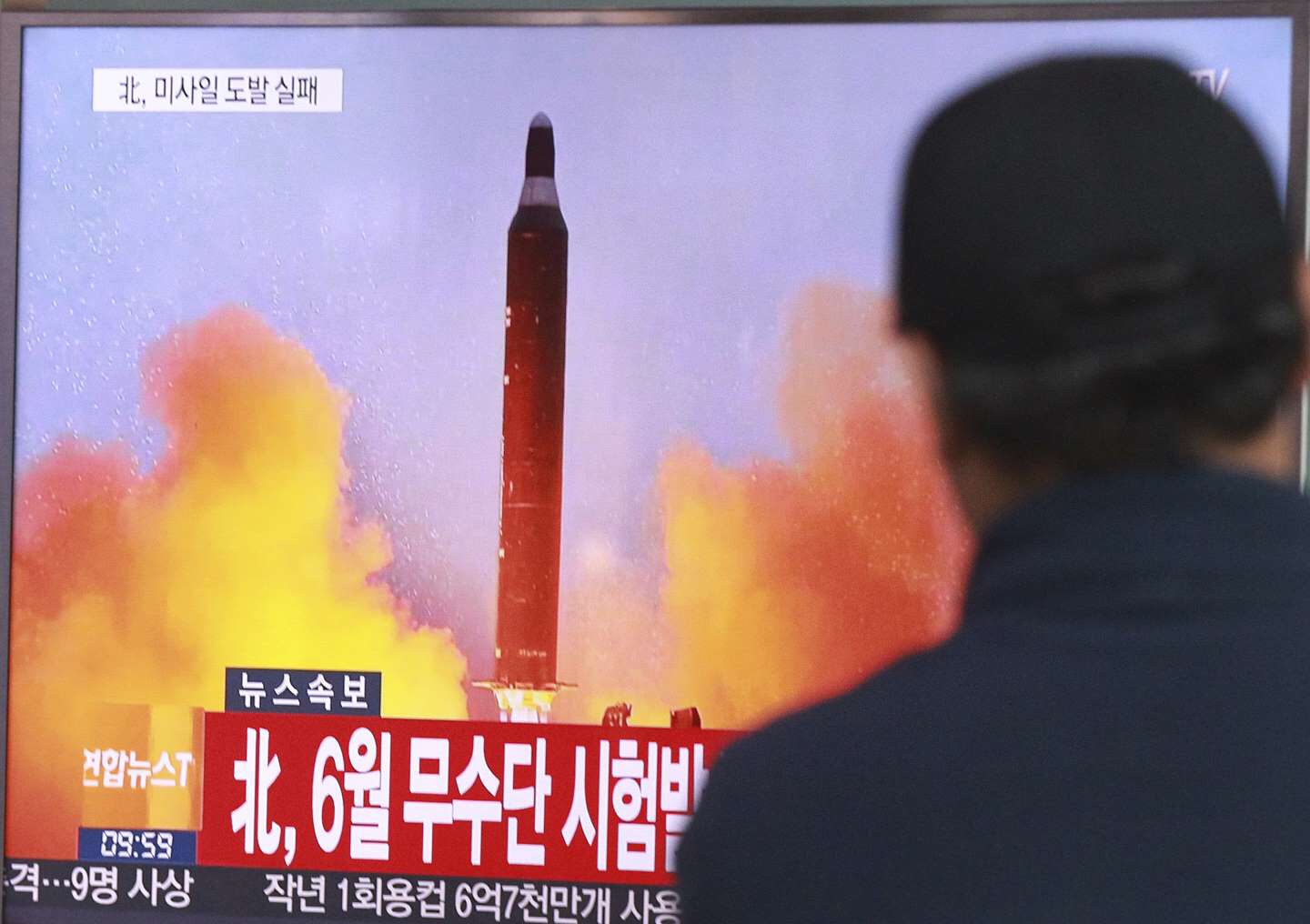
Stephanie Nebehay In this 2016 photo, a man in Seoul, South Korea, watches a TV news program showing a file image of a missile launch conducted by North Korea.
GENEVA — North Korea is only months away from obtaining the capability to hit U.S. territory with a nuclear weapon and must be disarmed, a U.S. envoy said on Tuesday, dismissing Pyonyang’s diplomatic thaw with South Korea as a “charm offensive” that fooled no one.
In a diplomatic showdown at a U.N.-sponsored Conference on Disarmament, North Korea responded by blaming Washington for escalating confrontation, saying it was deploying nuclear assets including aircraft carriers near the divided peninsula and was considering a pre-emptive strike against Pyongyang.
North Korea has accelerated its provocative pursuit of nuclear weapons and missile capabilities, and expressed explicit threats to use nuclear weapons against the United States and its allies in the region,” U.S. disarmament ambassador Robert Wood told the Geneva forum.
“North Korean officials insist that they will not give up nuclear weapons, and North Korea may now be only months away from the capability to strike the United States with nuclear-armed ballistic missiles,” he said.
A new U.S. nuclear policy review outlined last week “reaffirms that North Korea’s illicit nuclear program must be completely, verifiably, and irreversibly eliminated, resulting in a Korean Peninsula free of nuclear weapons,” he said.
Asked later what the basis was for the assessment that North Korea would soon be able to hit the United States with a nuclear weapon, he said he had “no new information to share.”
North Korea tested its first intercontinental ballistic missile, the Hwasong-14, twice last July. In November it tested the Hwasong-15, believed to be capable of reaching the continental United States. It is not yet believed to have the capability to mount a nuclear warhead on a ballistic missile.
North Korea is under tightening U.N. Security Council sanctions for its banned nuclear and ballistic missile programs. But recent weeks have seen a thaw with South Korea, after Pyongyang agreed to send athletes to compete in the Olympic Games opening on Friday in the South.
“CHARM OFFENSIVE”
“What I would call ‘the charm offensive’ frankly is fooling no one,” Wood told the talks.
He also said arsenals in China and Russia were expanding, drawing rebukes from their respective delegations.
Russia, China and North Korea are growing their stockpiles, increasing the prominence of nuclear weapons in their security strategies, and — in some cases — pursuing the development of new nuclear capabilities to threaten other peaceful nations,” Wood said.
“We are not going to stick our head in the sand, we are going to respond to these growing challenges,” he later told reporters.
North Korea accused the United States of seeking to aggravate the situation on the divided peninsula by “deploying large nuclear assets” nearby, laying the ground for a possible pre-emptive strike against it.
“In view of the nature and scale of U.S. military reinforcements, they are designed to make a pre-emptive strike against the DPRK,” North Korean diplomat Ju Yong Chol told the talks, referring to his country’s official name, the Democratic People’s Republic of Korea.
“U.S. officials including the defense secretary and the CIA director repeatedly talked about DPRK nuclear and missile threat to justify their argument for a military option and a new concept of a so-called ‘bloody nose,’ a limited pre-emptive strike on the DPRK is under consideration within the U.S. administration,” Ju said.
He said President Donald Trump’s "America First" doctrine and U.S. nuclear superiority would endanger global peace and security and “trigger off a new nuclear arms race and could bring the whole world close to a horrible catastrophe."
Reporting by Stephanie Nebehay; editing by Matthew Mpoke Bigg and Peter Graff

Wednesday, September 16, 2015

Korean Nuclear Horn Threatens U.S. (Daniel 7:7)

 
North Korea warns U.S. it’s ready to use nuclear weapons ‘any time’

By Jethro Mullen, CNN
Updated 9:42 PM ET, Tue September 15, 2015

(CNN)In its latest bout of saber rattling, North Korea says it is ready to use nuclear weapons against the United States and other foes if they pursue “their reckless hostile policy” toward Kim Jong Un’s regime.

In a statement carried by the North’s state-run Korean Central News Agency on Tuesday, an atomic energy official said Pyongyang is improving its nuclear weapons arsenal “in quality and quantity.”
If the U.S. and other hostile forces persistently seek their reckless hostile policy towards the DPRK and behave mischievously, the DPRK is fully ready to cope with them with nuclear weapons any time,” the director of the North Korean Atomic Energy Institute said, using an abbreviation of the country’s official name, the Democratic People’s Republic of Korea.

North Korea’s main nuclear complex at Yongbyon, which includes a uranium enrichment plant and a plutonium production reactor, is operating normally, the official told the news agency.

North says weapons are for self-defense

Notorious for issuing alarming and attention-grabbing statements, Pyongyang has repeatedly threatened to use nuclear weapons against the United States. But strong doubts remain over whether it has the missile technology to target the U.S. mainland.

An indication it wants to advance its missile capabilities, North Korea said Monday it was planning more satellite launches. Prohibited by U.N. Security Council resolutions, such launches are widely seen as a way of testing ballistic missile technology.


Kim’s regime didn’t say when the next launch would take place, but observers have speculated that it could launch a long-range rocket carrying a satellite in October around the 70th anniversary of North Korea’s ruling party.

The atomic energy official on Tuesday reiterated the North Korean stance that its nuclear weapons program is a self-defense measure “in the face of the U.S. extreme hostile policy and nuclear threats towards it.”

U.S. stresses missile defense measures

In an interview with CNN earlier Tuesday, U.S. Ambassador to South Korea Mark Lippert said Washington is constantly working with Seoul “to ensure that other allies in the region as well as the U.S. homeland are protected from threats posed by North Korea.”

“We’ve moved, over time, a good deal of missile defense capability to the region,” Lippert said before North Korea issued the statement about its nuclear program. “Ground-based interceptors to Alaska, surface combatants to the Western Pacific, a THAAD battery on Guam, another radar in Japan in order to be ready and vigilant for anything the North Koreans may or may not do.”
THAAD, which stands for Terminal High Altitude Area Defense, is a ballistic missile defense system.

After the North Korean statement, U.S. State Department spokesman John Kirby told a regular news briefing that the United States continues “to call on North Korea to refrain from irresponsible provocations that aggravate regional tensions, and instead focus on fulfilling its international obligations and commitments.”

Nuclear complex revamped

The North’s announcement that the Yongbyon nuclear complex is up and running comes as little surprise.

During a period of heightened tensions in the region in spring 2013, Pyongyang announced it would revamp and restart the facilities at the site.

In February of this year, U.S. Director of National Intelligence James Clapper said he believed that “North Korea has followed through on its announcement by expanding its Yongbyon enrichment facility and restarting the reactor.

But some North Korea watchers have questioned whether the reactor is operating at full power.
A July article on 38 North, a website that specializes in analysis of North Korea, said satellite imagery suggested the reactor may not have been operating or was only functioning at low power levels.

The report’s authors also identified rapid construction at the uranium enrichment plant of a building they theorized could be used “to assemble or store conventional high explosive components of a nuclear weapon.”

The North Korean atomic energy official said Tuesday that the Yongbyon facilities were being employed for both economic development and “the building of a nuclear force.”

Expert says nuclear arsenal is growing

Kim Jong Un’s regime may already have 10 to 15 nuclear weapons, according to David Albright, a former U.N. weapons inspector who now heads the nonprofit Institute for Science and International Security.

In a report in February, Albright predicted that Pyongyang could increase its stockpile to anywhere between 20 and roughly 100 nuclear weapons by 2020.

The growing nuclear arsenal poses a serious strategic challenge for the United States.

The U.S. government has repeatedly called on North Korea to commit to denuclearization as a condition of any future negotiations, but Kim’s regime has repeatedly dismissed such an idea, demanding to be recognized as a nuclear power.

Pyongyang’s statement Tuesday provided few details about its specific grievances with U.S. policy, which it accused of “openly seeking the downfall” of North Korea’s “social system.”

The combative rhetoric comes just three weeks after North and South Korea reached a deal to dial down tensions in the region that were inflamed by landmine blasts and artillery fire in the Demilitarized Zone that separates the two countries.

South Korean President Park Geun-hye issued a joint statement with EU leaders after a summit in Seoul on Tuesday in which they strongly condemned the North’s “continued development of its nuclear and ballistic missile programs.”

The leaders urged North Korea to abandon all its nuclear weapons and existing nuclear program in a “complete, verifiable, and irreversible manner,” and to “refrain from any further provocation.”
CNN’s Kathy Novak and journalist HyoungJoo Choi contributed to this report.

Monday, March 16, 2015

The End Is Much Closer Than People Realize (Revelation 16)

Russia was ready for nuclear alert over Crimea, Putin says in documentary

Putin Threatens Nuclear War

MOSCOW — Reuters
Published

Mr. Putin also expanded on a previous admission that the well-armed forces in unmarked uniforms who took control of Ukrainian military facilities in Crimea were Russian soldiers.

Mr. Putin also said that Russia had saved the life of Ukraine’s former pro-Moscow president, Viktor Yanukovich, who he said had been in danger after “revolutionaries” seized power following weeks of violent street protests in Kiev last year.

“For us it became clear and we received information that there were plans not only for his capture, but, preferably for those who carried out the coup, but also for his physical elimination. As one famous historical figure said: ‘No person, no problem,’” Mr. Putin said.

Protests over Mr. Yanukovich’s decision to back away from a trade agreement with the European Union in favour of closer ties with Moscow forced him from power in February last year. Mr. Yanukovich’s overthrow ultimately prompted Russia to seize and annex the Black Sea peninsula of Crimea.

“Of course it wasn’t immediately understandable [what the reaction would be to Crimea’s annexation],” Mr. Putin said. “Therefore, in the first stages, I had to orient our armed forces. Not just orient, but give direct orders.”


Russia initially denied that the unmarked forces who took control in Crimea were Russian, but Mr. Putin later admitted they were. In the Sunday documentary, he said he ordered the defence ministry to deploy military intelligence special forces, marines and paratroopers “under the cover of strengthening the protection of our military facilities.” (Russia’s Black Sea Fleet is based in Crimea; it retained the bases after the collapse of the Soviet Union under an agreement with Ukraine.)
Mr. Putin claimed in the documentary that the number of Russian forces in Crimea never exceeded the 20,000 authorized under the agreement on basing the Black Sea Fleet there.

The documentary comes as speculation swirls about Mr. Putin’s 10-day absence from public view. He has not been seen in public or on live television since March 5, prompting a wave of savage mockery across the Internet, despite official insistence that it was business as usual in the Kremlin. On Monday, he will meet with the president of Kyrgyzstan in an event covered by the news media, which would be his first appearance before journalists since March 5.

The independent news broadcaster Dozhd said on Sunday the Kremlin had declined to comment on its report that Mr. Putin had not been in Moscow but in Novgorod province, at his Lake Valdai residence, for the past several days. An Austrian newspaper reported that Mr. Putin was suffering from back problems and that a Viennese orthopedic expert had travelled to Russia to treat him.
The film, shown across Russia ahead of the first anniversary of Russia’s annexation of Crimea, documented the seizure of the peninsula and provided details of Mr. Yanukovich’s last hours in Ukraine before he fled to Rostov-on-Don, in southern Russia.

Mr. Putin said Mr. Yanukovich had called on Feb. 21 last year to lay out plans to leave the capital, where violent street protests had been raging for weeks.

“I told him my point of view that, in such a situation, it’s best not to leave the capital,” said Mr. Putin.
From Kiev, Mr. Yanukovich travelled to Kharkiv, then on to Donetsk, where he called Mr. Putin to ask for help.

Mr. Putin suggested meeting him personally in Rostov-on-Don, but Mr. Yanukovich’s plane was not given permission to leave. He then travelled to Crimea, from where he was spirited to Russia.

Saturday, March 7, 2015

Like Their Nukes, Iran Prepared To Move (Daniel 8:3)

March 6, 2015
 
Last week we reported a potential Iranian armored blitzkrieg through Syria to the Golan Heights, on the northern border of Israel. Today’s news may confirm that report.

Israeli General Israel Ziv (res.) reported in Jerusalem that Iranian general officers have taken command of the Syrian front within six miles of the north-east border of Israel, along with 10,000 “volunteers” from Iran, Iraq and Afganistan.

From the Israel newspaper Yedioth Achronoth, as translated by the Washington Free Beacon:
“Iran is taking over the reins in Syria,” said Ziv … “In fact, no military decision [in Syria] is made without [the Iranianian Revolutionary Guard].” He described (Syrian President) Assad as “a puppet looking out at his lost land.”
This dangerous development may lead to a fast-spreading regional war in the Middle East. An Iranian blitzkrieg against the Golan Heights would trigger Israeli defenses in depth in Syria. Iran could potentially bring more than 100,000 Basiji into the battle, as well as IRGC troops. If Israel is directly threatened, it may well resort to unconventional weapons, and even launch a counter-attack against Iran itself. In previous wars Israel has counter-attacked into Syria and Egypt.

This news comes amid signs of further American concessions in nuclear negotiations with Iran. However, Iran’s aggression in Syria may torpedo the nuclear talks. Nobody could possibly believe in Iranian good faith in the face of an attack against Israel, more than 1,000 miles from the Iranian border.

In a separate report, Grand Ayatollah Khamenei published a February 8 statement on his website that “Iran has enriched uranium to the 20-percent level” — after promising the United States that it would not do so.

Iranian Air Force officers in Khamenei’s audience were reported to have responded to his statement with a chant,
“Allah Akbar [God is great]” … “Khamenei is the leader. Death to the enemies of the leadership. Death to America. Death to England. Death to hypocrites. Death to Israel.”
Iranians have been made to chant those words every day since 1979, when Jimmy Carter permitted the modernizing Shah of Iran to be overthrown by martyrdom-preacher Ayatollah Khomeini, leading to more than a million dead in the following Iran-Iraq War.

Friday, February 13, 2015

Babylon Preparing For Armageddon (Revelation 16:16)

After neglect, U.S. nuclear force seeing improvement: officials
Air Force Stealth Nuclear Bomber

MINOT AIR FORCE BASE, N.D.

(Reuters) – Renewed focus on the U.S. nuclear force after several scandals last year is improving conditions for airmen, but more work must be done, Deputy Defense Secretary Robert Work said on Wednesday after an icy tour of the only U.S. missile and bomber base.

Work said missile launch officers and maintenance workers he met at Minot Air Force Base in North Dakota were seeing the result of improvement efforts, including a deep cleaning of underground missile launch capsules and the purchase of new equipment.

But some parts of the nuclear force were still using floppy computer disks and 25-year-old computer technology, Work said after a tour of the base, where temperatures around 2 degrees Fahrenheit (-16 Celsius) were accompanied by blistering winds.

“Nothing is better than being able to look the troops in the eye, and the officers, and hear what they’re saying,” Work said. “It was really good to put eyes on target. We still have work to do.”

He said the morale of the troops he spoke to was good and they were seeing the impact of increased spending, including a rise in staffing levels. But he said they wanted to know whether the investments would continue.

Work’s visit to the base, the only U.S. facility housing both nuclear missiles and bombers, came a week after the Pentagon rolled out a 2016 budget that calls for $8 billion in new spending on the nuclear force over the next five years, including about $1 billion for the 2016 fiscal year.

Arms control groups have criticized the Obama administration for proposing a $534 billion Pentagon base budget that includes new spending on the nuclear arms.

“The administration’s budget request is deeply disappointing and a lost opportunity to make common sense adjustments to the current nuclear weapons spending trajectory,” said Kingston Reif, an analyst with the Arms Control Association.

But two reviews ordered by Defense Secretary Chuck Hagel last year concluded the force was plagued by a culture of over-inspection and micro-management, as well as a “consistent lack of investment.”

Hagel ordered reviews after a spate of incidents, including cheating on proficiency exams by missile launch officers and the sacking of the head of the force for drunkenness and bad behavior during an official visit to Moscow.

Hagel said he would seek a 10 percent increase in funding for the nuclear force, which cost about $15 billion annually. The funding request for 2016 fell slightly short of that figure, but the five-year amount was higher.

(Reporting by David Alexander; Editing by Jeremy Laurence)

Saturday, December 13, 2014

Antichrist Ready To Fight ISIS

Powerful Iraqi Shiite cleric Moqtada al-Sadr: Militia ready to fight IS

US President Barack Obama granted war powers in the fight against Islamic State militants
Antichrist Moqtada al Sadr
AFP/Haidar Hamdani“Iraqi Shiite cleric Moqtada al-Sadr delivers a speech from the southern city of Najaf on February 18, 2014″

Moqtada al-Sadr, Iraq’s most powerful Shiite cleric has said that his militia has been put on alert to battle Islamic State (IS) militants for the city of Samarra.

Sadr’s “Peace Brigades” left the city two months ago but are “fully prepared to answer the call of jihad within 48 hours” and are awaiting further instruction, said a statement released on December 10.

His office said the announcement was due to “exceptional conditions and imminent danger to the sacred city of Samarra from the legions of terrorists.”

Samarra was home to the ninth century Imam Askari shrine which was blown up by Sunni militants eight years ago.

In June Sadr said in a televised speech from the Shiite holy cite of Najaf that “we will shake the ground under the feet of ignorance and extremism,” referring to Sunni insurgents who have overrun a swathe of territory in Iraq.

Sadr’s Mahdi Army militia, which battled US forces for years when American troops were stationed in Iraq during their country’s nearly nine-year war, remains officially inactive, but fighters loyal to the cleric have nevertheless vowed to combat the militant advance.

 Kerry calls for new three-year war powers to fight IS

S.Ramis, J.Jacobsen (AFP)
S.Ramis, J.Jacobsen (AFP)“The Islamic State in Syria, Iraq”

The US Senate Foreign Relations Committee voted Thursday to authorize President Barack Obama’s war against the Islamic State. This is the first Congressional vote which will grant Obama war powers in the fight against the Islamic militants.

US Secretary of State John Kerry Tuesday urged lawmakers to adopt this authorization to underpin military action against Islamic State militants for at least three years, and passed by a vote of 10-8.

But during a heated debate, the top US diplomat came under fire from Republicans and Democrats who argued that if President Barack Obama wanted new powers to combat the jihadists, he should have drawn up a draft text to propose to the Senate.

So far, the Obama administration has used the existing authorization for use of military force against Al-Qaeda, the Taliban and their branches approved in the days after the September 11, 2001 attacks as the legal justification for going after IS.

Kerry told the Senate Foreign Relations committee: “I think we all agree that this discussion must conclude with a bipartisan vote that makes clear that this is not one party’s fight against ISIL (IS), but rather that it reflects our unified determination to degrade and ultimately defeat ISIL.”

Our coalition partners need to know it. The men and women of our armed forces need to know it. And ISIL’s cadres of killers, rapists, and bigots need to understand it.”

The authorization would allow ground combat operations, except as necessary to protect or rescue US soldiers or citizens, conduct intelligence operations, spotters to help with airstrikes, operational planning or other forms of advice and assistance.

Kerry argued the new legal authority should “not constrain our ability” to act in other places if needed.

Obama has insisted he will not send US ground troops into combat operations against IS, saying that “will be the responsibility of local forces.”

That does not mean we should preemptively bind the hands of the commander-in-chief — or our commanders in the field — in responding to scenarios and contingencies that are impossible to foresee,” Kerry said.

The authorization will be valid for three years with room for a possible extension, the administration must also report every 60 days on the fight against IS. Kerry also urged that the text should not limit US actions geographically to just Syria and Iraq.
(with AFP)

Tuesday, August 5, 2014

Our Sketchy Nuclear Program (Daniel 7:7)

America: Nuclear Missiles Battle-Ready?
Our "Launch Ready" Nuclear Silos
Our “Launch Ready” Nuclear Silos

Much has been made of the United States government’s planned downsize of the U.S. Army. It plans to scale the military back from the current 520,000 active troops to 440,000 by 2019. This cutback will make it the smallest U.S. Army since before World War II.

But there are bigger problems you should be aware of.

The United States currently has 4,804 nuclear warheads, 450 of which are located on Air Force bases in Wyoming, Montana and North Dakota. These 450 Minuteman 3 Intercontinental Ballistic Missiles (ICBMs) are supposedly in constant battle-ready mode.

The equipment used to secure these missiles was built in the 1960s. The bases are still using computers that require eight-inch floppy disks.Worryingly, the equipment used to secure these missiles was built in the 1960s. The bases are still using computers that require eight-inch floppy disks. As one missileer stated, she had not seen such “technology” until she started working in the command center. One would think the world’s superpower would use the latest state-of-the-art technology to safeguard its deadliest weapons.

However, it is not the shrinking army and its lack of up-to-date technology that should worry the American public the most, but the sketchy personnel in charge.

In 2013, the Air Force relieved the two-star general in command of the 450 ICBMs. The general was suspended for “exceeding the limits of accepted standards of good conduct and proper behavior” while on an official trip to Moscow. He reportedly drunk during the four-day trip. Earlier in the week, a vice admiral who oversaw the military’s nuclear forces, missile defense and cyber warfare operations was also relieved of his duties because of a probe into his possible use of counterfeit chips at an Iowa casino.

The irresponsibility of our nuclear launch officers does not stop with these two high-ranking men. It has seeped down the chain of command. Earlier in 2013, two of the three missile bases under the general’s command received unsatisfactory ratings in regular annual inspections. In August, the officers at the Montana Air Force Base failed their third inspection in five years. Seventeen nuclear-launch officers in North Dakota were sidelined after they received a D in their missile launch skills inspection.

“We are, in fact, in a crisis right now,” Lt. Col. Jay Folds wrote in an email to his subordinates after receiving the results of the inspection. He said there was “rot” amongst the ranks.

In 2013, 17 nuclear-launch officers were sidelined after they received a D in their missile launch skills inspection.The firing of these missileers was not an isolated incident. Missileers take regular tests to ensure they understand the systems they have been entrusted with operating. To pass these tests, an individual must score higher than 90 percent. In January, BBC reported that 34 officers at the Montana Air Force Base either cheated on their tests or knew others who did and did not report it. Some members were caught texting answers to fellow officers.

How safe do you feel knowing your country’s nuclear missile operators cannot get 90 percent on their tests without cheating?

Missileers were also caught violating safety guidelines. A maintenance member reported a blast door was left open while one of the crew members was sleeping. According to procedure, if a member is resting, the blast door must be closed. If the door is left open, the security of the missile and the crew is compromised. This can lead to the potential capturing of security codes by outsiders.

If the missiles here in the U.S. are vulnerable, how secure is its nuclear weaponry in Europe?

“According to a Blue Ribbon Review set up by the U.S. Air Force in 2008, most U.S. nuclear weapons storage sites in Europe do not meet U.S. Defense Department security standards,” Tom Sauer and Bob van der Zwaan wrote in a May 2011 reportfor the Harvard Kennedy School.

The Kleine Brogel Air Base in Belgium is one of the bases that hosts America’s tactical nuclear weapons. In 2010, the base was penetrated by peace activists. The activists climbed the perimeter fence and wandered around the base for more than an hour, videotaping their escapade. When they were finally caught, base security didn’t even confiscate the videotape. This lax security and poor training will have terrible real-world consequences.

Do you think that the European nations that host these weapons are as indifferent about them as America is?

America is developing the attitude that these weapons will never be used. But this false sense of security is going to cause its downfall. To understand how these nuclear weapons are going to play a big part in America’s future, watch Trumpeteditor in chief Gerald Flurry’s Key of David “Europe’s Dirty Secret.” 

Friday, June 6, 2014

United States Nuclear Missiles Ready For First Strike

Nuclear War? US Nuclear Missiles Elevated to Offensive First Strike Role!

June 5th, 2014
Nuclear Missile Shield

The plan is far advanced, and the implementation of the plan is underway. As I have reported previously, US strategic doctrine was changed and the role of nuclear missiles was elevated from a retaliatory role to an offensive first strike role. US anti-ballistic missile (ABM) bases have been established in Poland on Russia’s frontier, and other bases are planned. When completed Russia will be ringed with US missile bases.

Anti-ballistic missiles, known as “star wars,” are weapons designed to intercept and destroy ICBMs. In Washington’s war doctrine, the US hits Russia with a first strike, and whatever retaliatory force Russia might have remaining is prevented from reaching the US by the shield of ABMs.

The reason Washington gave for the change in war doctrine is the possibility that terrorists might obtain a nuclear weapon with which to destroy an American city. This explanation is nonsensical. Terrorists are individuals or a group of individuals, not a country with a threatening military. To use nuclear weapons against terrorists would destroy far more than the terrorists and be pointless as a drone with a conventional missile would suffice.

The reason Washington gave for the ABM base in Poland is to protect Europe from Iranian ICBMs. Washington and every European government knows that Iran has no ICBMs and that Iran has not indicated any intent to attack Europe.

No government believes Washington’s reasons. Every government realizes that Washington’s reasons are feeble attempts to hide the fact that it is creating the capability on the ground to win a nuclear war.

The Russian government understands that the change in US war doctrine and the US ABM bases on its borders are directed at Russia and are indications that Washington plans a first strike with nuclear weapons on Russia.

China has also understood that Washington has similar intentions toward China. As I reported several months ago, in response to Washington’s threat China called the world’s attention to China’s ability to destroy the US should Washington initiate such a conflict.

However, Washington believes that it can win a nuclear war with little or no damage to the US. This belief makes nuclear war likely.

As Steven Starr makes clear, this belief is based in ignorance. Nuclear war has no winner. Even if US cities were saved from retaliation by ABMs, the radiation and nuclear winter effects of the weapons that hit Russia and China would destroy the US as well.

The media, conveniently concentrated into a few hands during the corrupt Clinton regime, is complicit by ignoring the issue. The governments of Washington’s vassal states in Western and Eastern Europe, Canada, Australia, and Japan are also complicit, because they accept Washington’s plan and provide the bases for implementing it. The demented Polish government has probably signed the death warrant for humanity. The US Congress is complicit, because no hearings are held about the executive branch’s plans for initiating nuclear war.

Washington has created a dangerous situation. As Russia and China are clearly threatened with a first strike, they might decide to strike first themselves. Why should Russia and China sit and await the inevitable while their adversary creates the ability to protect itself by developing its ABM shield? Once Washington completes the shield, Russia and China are certain to be attacked, unless they surrender in advance.

The 10 minute report below from Russia Today makes it clear that Washington’s secret plan for a first strike on Russia is not secret. The report also makes it clear that Washington is prepared to eliminate any European leaders who do not align with Washington.

Readers will ask me, “What can we do?” This is what you can do. You can shut down the Ministry of Propaganda by turning off Fox News, CNN, the BBC, ABC, NBC, CBS, by ceasing to read the New York Times, the Washington Post, the LA Times. Simply exit the official media. Do not believe one word that the government says. Do not vote. Realize that evil is concentrated in Washington. In the 21st century Washington has destroyed in whole or part seven countries. Millions of peoples murdered, maimed, displaced, and Washington has shown no remorse whatsoever. Neither have the “Christian” churches. The devastation that Washington has inflicted is portrayed as a great success. Washington prevailed.

Washington is determined to prevail, and the evil that Washington represents is leading the world to destruction.

Friday, April 25, 2014

North Korean Missiles Are Nuclear Ready

Analyst: North Korea May Already Have Militarized Warhead

North Korea's Missiles Are Nuclear Ready
North Korea’s Missiles Are Nuclear Ready

Baik Sungwon

April 24, 2014 2:51 PM

As concern grows that North Korea may be preparing for another underground nuclear weapons test, a leading nuclear scientist says Pyongyang already may have acquired a device small enough to fit atop a missile.

David Albright, president of the Institute for Science and International Security, explained that the North does not need another nuclear test to acquire a militarized warhead.

“I think it is a mistake to think that they require this testing in order to design a militarized warhead. I think they may have gotten one from Pakistan or China,” said Albright.

But Albright, who also worked as an inspector for the International Atomic Energy Agency, the U.N.’s nuclear watchdog, said that doesn’t rule out another North Korea test.

“But what they can’t get without testing is reliability. So the testing is invaluable to make sure everything works,” he said.

The assessment came amid wide speculation about the North’s nuclear capability, triggered by the North’s warning that it could conduct a “new form” of nuclear test.

Nick Hansen, an analyst at the Center for International Security and Cooperation at Stanford University and 38 North, says the point of future tests will be focused on increasing Pyongyang’s ability to weaponize its warheads.

“The only reason they are doing this in developing a warhead or a nuclear bomb is to put it on a missile,” said Hansen.

He added that he thinks North Korea may be preparing for multiple, simultaneous tests.
“So one of the things you could think of is a new form of testing, is to test two bombs simultaneously or as close as they can get it. Pakistan did that by the way. And if you do that, you don’t catch as much flack from the international community as you would if you test one off and then two months later test another one off,” he said.

Despite growing concern in Seoul, a U.S. research group this week said there is “little evidence” North Korea will conduct a nuclear test during President Barack Obama’s upcoming visit to Seoul.
South Korea said this week it detected increased activity at the North’s Punggye-ri nuclear test site, suggesting an underground test could be imminent.

This report was produced in collaboration with the VOA Korean service.

Wednesday, April 23, 2014

Pakistan Fires Nuclear Capable Missile

Pakistan test-fires nuke-capable missile
 
This handout photograph released by Pakistan
This handout photograph released by Pakistan’s Inter Services Public Relations (ISPR) office, shows a Hatf III, (Ghaznavi) short range ballistic missile launched from an undisclosed location in Pakistan on May 10, 2012.
 
Tue Apr 22, 2014 1:12PM

The military said in a statement that the missile codenamed ‘Ghaznavi’ was launched from an undisclosed location on Tuesday and has a range of 290 kilometers.

Army spokesman Major General Asim Saleem Bajwa also said the test was conducted during a field training exercise supervised by top military commanders.
“The test-firing was another milestone which has further strengthened the defense potential of Pakistan,” media outlets quoted the chairman of the joint chiefs of staff, General Rashad Mahmood as saying.
Pakistani military routinely test various missiles to match those of India.

Pakistani authorities have frequently reiterated that nuclear deterrence is the basis of the country’s security policy and that they have no intention of using the missiles aggressively.

India and Pakistan have routinely carried out missile tests since both demonstrated nuclear weapons capability in 1998. The two neighbors have engaged in an arms race since the partition of Pakistan from India in 1947.

Both neighbors have refused to sign the nuclear Non-Proliferation Treaty (NPT) and other international regulatory pacts that restrict developing or testing nuclear weapons.

India considers the NPT as discriminatory, while Pakistan has indicated that it will not join the international treaty until its neighbor does so.

India and Pakistan have fought three wars with its nuclear-armed neighbor India since their independence from Britain in 1947.

JR/PR/SL

Sunday, April 6, 2014

Antichrist's Men Set For Battle

Sadrists set for poll battle

Last updated: Saturday, April 05, 2014 12:02 AM
Sadrists Ready For Battle

Dina Al-Shibeeb

Powerful Iraqi figure Muqtada Al-Sadr
quitting politics will not hinder his movement’s performance in parliamentary elections scheduled for late April, analysts say.
Sadr, who comes from a prominent Shiite family and is the fourth son of the late Grand Ayatollah Mohammed Sadeq Al-Sadr, made headlines in February when he said he was quitting politics and there was no longer a political entity representing him or his family.
The Sadrist movement is represented by the Ahrar Coalition, which has 40 seats in the 325-member parliament.
Amer Fayadh, dean of the political science department at Al-Nahrain University in Baghdad, says Ahrar will be unaffected as Sadr’s leadership has long been “symbolic.”
His presence “was never official. He wasn’t even a member of Ahrar’s political committee.”
Editor-in-chief of Al-Mada newspaper, Adnan Hussain, told Al Arabiya News that Ahrar “is entering the upcoming elections with strength.” He expects the Sadrists to keep their 40 parliament seats, particularly since Prime Minister Nouri Al-Maliki, whom Sadr has described as a “dictator,” is in a shaky position.
“Maliki didn’t achieve anything in the past four years. On the contrary, the situation in Iraq has deteriorated,” said Hussain.
Baghdad-based TV commentator Ahmad Al-Abyadh said he expects Ahrar to at least consolidate its position or win about 45 seats in the upcoming elections.
Abyadh, who is also a spokesman for the more secular Coalition of Iraq, said Ahrar attracts the poor, and its campaigning methods in the 2013 provincial elections proved to be successful as it garnered more than 60 seats.
During those elections, “it sought one candidate per constituency,” while other parties fielded more than one, which split their voters, Abyadh said.
Ahrar is “following the same organized method” for the upcoming elections, he added.
Abyadh described the mayors of Baghdad and the southern province of Maysan, both from Ahrar, as “successful,” as opposed to the “mediocre” achievements of Maliki’s State of Law bloc.

“Sadr’s latest rhetoric
against Maliki, corruption, and sectarianism all stir people’s emotions in favor of Ahrar and the Sadrists,” Abyadh said. — Al Arabiya News

Monday, January 20, 2014

Iran Already Nuclear Ready

Iran '2 to 3 weeks' from nuclear bomb

Former IAEA director warns Tehran could nix deal, arm itself quickly

Published: 18 hours ago
nuclear-bomb
If Iran breaks its deal with the West tomorrow, the country would be only two to three weeks away from producing enough highly enriched uranium to assemble a nuclear weapon, according to Olli Heinonen, former deputy director of the International Atomic Energy Agency.
Heinonen directed the safeguards division of the United Nations body charged with enforcing the Non-Proliferation Treaty.
The TRUTH behind Iran’s nuclear program is not being told by the national media. Get your autographed copy of “Atomic Iran.”
He was asked Sunday on Aaron Klein’s WABC Radio show about the timeframe in response to statements from Iran’s top nuclear negotiator, who boasted last week that Tehran can nix its deal with the West and resume enriching uranium to 20-percent levels within one day if it so desires.
Heinonen responded that if Iran wanted it would currently take the country “two, three weeks to have enough uranium hexafluoride high-enriched for one single weapon.”
He told Klein: “If [Iran] in reality [abrogates the deal] tomorrow, they still have quite a substantial stock of uranium hexafluoride, which is enriched to 20 percent. … And then technically, when Iran has committed to this month to certain parts of the processes in such a way these tandem cascades are not anymore connected with each other, you can indeed put them back in one day’s time.
“So if this all happens in the next, let’s say, weeks, this is really true. They can start to produce 20-percent enriched uranium,” he said. “Now, in order to go fast for Iran, it actually needs to make several such tandem cascades. Not just those in Natanz and Fordow [nuclear plants]. They have to put perhaps some 6,000 centrifuges to work in this kind of a mode.”
Continued the former IAEA director: “If they do that, which they can technically do, it will take certainly a little bit more than one night to do. But then once they have sorted it out, it would take about two, three weeks to have enough uranium hexafluoride high-enriched for one single weapon.”
Heinonen explained that as time elapses and Iran converts more of its 20-percent enriched uranium to five percent, as is required by the U.S.-backed deal, the two to three week timeframe to produce a nuclear weapon will expand.
He said that if Iran keeps its side of the deal then in six months from now “it will take at least three months” more to enrich enough uranium to assemble a nuclear weapon.
Read more at http://mobile.wnd.com/2014/01/iran-2-to-3-weeks-from-nuclear-bomb/#sSGQfmWxibFpx4RV.99