Showing posts with label usa. Show all posts

Sunday, April 24, 2022

Babylon the Great’s Nuclear Posture: Daniel 7

The Biden Administration’s Nuclear Posture Review: Assured Survival for Vladimir Putin

By Mark B. Schneider

In late March, the Biden administration sent the results of its 2022 Nuclear Posture Review to Congress in the form of a classified document and with no press briefing. This is unprecedented. All that was released to the public was a less than one page “Fact Sheet,” which spoke almost entirely about the “no first use” issue. Why? Is the Biden administration afraid of offending the tender sensibilities of President Putin, the “butcher” of Moscow and war criminal who must be removed from power? Or is it concerned about the public’s reaction to weakening our nuclear deterrent in the context of the Russian invasion of Ukraine and the threat of Russian WMD use?

There has never been a larger disconnect between an administration’s perception of the nature of Vladimir Putin, the heavily nuclear-armed Russian dictator, and the requirements for nuclear deterrence. Furthermore, the Nuclear Posture Review decisions could negatively impact our credibility with our allies. With the Russians constantly making threats of nuclear war, the Biden administration has cut an already marginal nuclear modernization program. Additionally, movement toward no-first-use of nuclear weapons is difficult to understand when the Biden administration and the United Kingdom are warning that Russia may use chemical and biological weapons in the current war with Ukraine. This policy change seems driven more by ideological considerations than the requirement for a credible, effective deterrent.

The 2018 Trump administration’s Nuclear Posture Review report made it very clear that we reserve the right to retaliate with nuclear weapons against a chemical or biological attack. President Biden’s comments about “in-kind” retaliation against Russian chemical weapons use (immediately repudiated by the White House) suggests that he does not know that we do not have chemical and biological weapons because they are banned by two arms control conventions. The administration’s “Fact Sheet” on the 2022 Nuclear Posture Review walks this back, stating only that “…the fundamental role of U.S. nuclear weapons is to deter nuclear attack on the United States, our allies, and partners. The United States would only consider the use of nuclear weapons in extreme circumstances to defend the vital interests of the United States or its allies and partners.”

U.S. Senator Jim Inhofe (R-OK.) and U.S. Representative Mike Rogers (R-AL.), ranking members of the Senate and House Armed Services Committees, respectively, wrote, “…this revised policy seems to be little more than a rehash of the Obama administration’s approach.” (Emphasis in the original). The 2010 Obama administration Nuclear Posture Review report ruled out nuclear retaliation against chemical attack, saying that we would respond with conventional weapons. In light of the vast disparity in lethality between chemical and conventional weapons, this is essentially saying that we would not respond at all other than doing what we were doing before the chemical and/or biological weapons were used.

The Biden budget documents for FY 2023 indicate that the Biden administration is funding a replacement for three legs of the nuclear Triad, including the new long-range nuclear air-launched cruise missile. This is a very good decision. However, they have not sped anything up or increased anything in response to the barrage of nuclear threats emanating from Putin’s Russia or his invasion of Ukraine. Moreover, according to STRATCOM commander Admiral Charles Richard, “…two-thirds of those [U.S. nuclear] weapons are ‘operationally unavailable’ because of treaty constraints, such as provisions of the New START treaty with Russia.” Thus, the Biden administration’s ill-advised reversal of the Trump administration’s policy by extending the seriously flawed New START Treaty without changes (its extension one week after the inauguration precluded any real analysis) reduced the benefits of the modernization program in terms of nuclear weapons available by two-thirds. The 6 month withdrawal provision in the New START Treaty prevents any rapid augmentation of our nuclear ballistic missile deterrent capability in a crisis. Moreover, Admiral Richard has stated, “Today’s nuclear force is the minimum required to achieve our national strategy.”

The “Fact Sheet” contained no programmatic data, but the strategic modernization program is going so slowly that there will be no benefits from it this decade other than a small number of B-21 bombers carrying nuclear bombs and the first of the new Sentinel ICBMs in 2029. The Government Accountability Office has reported that the new Columbia class ballistic missile submarine may be delayed. Until the new systems become operational in significant numbers, the U.S. nuclear deterrent will continue to decline due to system aging and the deployment of advanced Russian strategic defenses such as the S-500 and the newly revealed S-550.

In June 2017, General John Hyten, then-commander of the U.S. Strategic Command, said replacing the existing AGM-86B Air Launched Cruise Missile (nuclear ALCM) is particularly needed because it is so old, “It’s a miracle that it can even fly,” and its reliability was “already unacceptable” and would get worse every year. This is the technical context in which the Biden administration made the decision to kill the nuclear SLCM.

The only significant improvement in our nuclear deterrent until late in this decade will be the introduction of F-35s with B61-Mod 12 bombs. However, the Air Force is not saying exactly when this will happen.

A defense official, in a background briefing on the budget, confirmed the cancellation of the nuclear sea-launched cruise missile program. This is a terrible decision. In fact, the Chairman of the Joint Chiefs of Staff General Mark Milley told Congress that he supports the missile. Admiral Richard commented that the “…current situation in Ukraine and China’s nuclear trajectory convinces me a deterrence and assurance gap exists.” He went on, “To address this gap, a low-yield, non-ballistic capability to deter and respond without visible generation is necessary to provide a persistent, survivable, regional capability to deter adversaries, assure allies, provide flexible options, as well as complement existing capabilities. I believe a capability with these attributes should be re-examined in the near future.” The Commander of the U.S. European Command General Tod Wolters, in Congressional testimony, also told the lawmakers that he supports the nuclear SLCM. To have the nation’s top military leadership break with the White House on a nuclear deterrence issue is unprecedented and clear evidence of how irresponsible the decision is.

Right now, our only non-strategic nuclear capability are old B-61 bombs delivered by old pre-stealth F-15 and F-16 fighters, with the only operational capability being in NATO Europe. Representative Doug Lamborn, (R-CO.), the ranking member of the House Armed Services strategic forces subcommittee, has recently written that we have “only 200” non-strategic nuclear weapons while Russia has 2,000. A ten-to-one Russian advantage is probably the best case situation because there is a real possibility that the Russian non-strategic nuclear arsenal is 5,000 or more weapons. In February 2021, then-Vice Chairman of the Joint Chiefs of Staff General John Hyten said Russia had “thousands low-yield … and tactical nuclear weapons that Russia is building and deploying…” Russian expert Sergei Rogov has noted that assessments of Russian non-strategic nuclear weapons range between several thousand to over 10,000. The Secretary General of NATO Jen Stoltenberg, in his just released 2021 report, stated that Russia is “…increasing the quality and quantity of its non-strategic nuclear weapons.” This does not only include many types of nuclear sea-launched cruise missiles similar to our only development program, which the Biden administration has just canceled but also their new hypersonic missiles, which are nuclear-capable. On March 17th, the Director of the Defense Intelligence Agency Lieutenant General Scott Berrier wrote, “As this war and its consequences slowly weaken Russian conventional strength, Russia likely will increasingly rely on its nuclear deterrent to signal the West and project strength to its internal and external audiences.”

The Trump administration’s program for a low-yield Trident warhead program survived the Biden administration’s budget cuts, but according to Hans M. Kristensen and Matt Korda of the Federation of American Scientists, we have fewer than 25 of them.

Getting back to the title of this article, one of the worst decisions in the 2022 Nuclear Posture Review is the termination of funding for the B83 bomb, our highest yield nuclear weapon and the best weapon against many types of very hard and deeply buried targets (HDBTs). Since Congress killed the Robust Nuclear Earth Penetrator program during the George W. Bush administration, the B83 is apparently the best weapon against HDBTs built-in hard rock areas. Significantly, this decision was also opposed by Admiral Richard and General Wolters. For decades there has been an increasing disconnect between our targeting strategy for deterrence and the nuclear capabilities we actually maintain. In 2002 Admiral (ret.) Richard Mies, the just-retired Commander of the U.S. Strategic Command, wrote that the “…longstanding [U.S.] targeting doctrine of flexible response — [was] a doctrine designed to hold at risk our potential adversaries’ military forces, war-supporting industry, command and control capabilities, and military and national civilian leadership while minimizing to the maximum extent collateral damage to population and civilian infrastructure.” In 2013, the Obama administration adopted a nuclear weapons employment strategy that stated, “The new guidance requires the United States to maintain significant counterforce capabilities against potential adversaries. The new guidance does not rely on a ‘counter-value’ or ‘minimum deterrence’ strategy.”

The United States’ capability to engage hard targets was not even adequate during the Reagan administration. In 1985, then-Chairman of the Joint Chiefs of Staff General John Vessey briefed President Ronald Reagan about the need for improved hard-target kill capability, including the need for 100 MX (Peacekeeper) ICBMs. We actually got 50. Since that time, we have seen successive decisions to reduce our ability to threaten hard targets. Of the three U.S. hard target capable systems created by the Reagan administration, two, the Peacekeeper ICBM and the Advanced Cruise Missile, were eliminated without replacement by the George W. Bush administration. This left us only with the high-yield WW-88 Trident warheads. Reportedly, the U.S. produced only 400 of the high-yield WW-88 warheads for the Trident II missile.

The U.S.’ ability to threaten hard and deeply buried targets is much more limited than our ability against hard targets. Moreover, Putin reportedly is “modernizing [Russia’s] deep underground bunkers…” Destroying such targets requires very high yield and/or earth penetration capabilities. The Biden administration’s modernization program will give us neither. Against the hard and very deeply buried targets, there is essentially zero chance that they can be destroyed with a single U.S. nuclear warhead. With the 83% reduction in the U.S. nuclear stockpile since the end of the Cold War (illustrated in the chart below), this deficiency has become important. The 2018 U.S. Nuclear Posture Review partially reversed the Obama administration’s decision to eliminate the two most effective U.S. bombs against HDBTs, the B61 Mod 11 and B83. Now, the Biden administration, in a threat environment vastly more serious than that assumed during the 2010 Nuclear Posture Review, has apparently decided to go back to the Obama administration’s ill-conceived decisions.

Mark B. Schneider

Noted journalist Bill Gertz writes, “A congressional defense aide said the administration ‘does not have a plan to replace’ the B83. Instead, a study will be conducted at some point in the future to determine how best to get at deeply buried targets, the main mission of the B83….” I am sure President Putin is quite pleased. Reportedly, President Putin has sent his own family to a deep underground bunker in Siberia. Dictators tend to put a high value on their own skins. President Putin has reportedly been isolating himself due to fear of Covid-19. This very bad Biden administration decision has the potential to influence a decision by President Putin to escalate to nuclear weapons’ use.

This is only a preliminary analysis of the Biden NPR. If the administration makes an unclassified version available or stages a major press event, it should be carefully studied. Unfortunately, there are not likely to be any pleasant surprises. One thing is completely clear. Russian and Chinese nuclear capabilities, both strategic and non-strategic, are growing. We now face two peer competitors in nuclear weapons, something that was clearly not assumed during the Obama administration’s 2010 Nuclear Posture Review or even the Trump 2018 review. Moreover, the 2018 Nuclear Posture Review apparently made no change in the planned number of U.S. strategic nuclear weapons to be maintained.

Our nuclear forces are not being improved on a timely basis and deterrence gaps will grow. In the midst of the most serious challenge we have faced since the Cuban missile crisis, the Biden administration obviously thinks it is a good idea to cut our nuclear modernization program and allow inflation to erode our defense capability. One thing is clear about nuclear deterrence: you may not get a second chance to correct your errors.


Dr. Mark B. Schneider is a Senior Analyst with the National Institute for Public Policy. Before his retirement from the Department of Defense Senior Executive Service, Dr. Schneider served in a number of senior positions within the Office of Secretary of Defense for Policy including Principal Director for Forces Policy, Principal Director for Strategic Defense, Space and Verification Policy, Director for Strategic Arms Control Policy and Representative of the Secretary of Defense to the Nuclear Arms Control Implementation Commissions.  He also served in the senior Foreign Service as a Member of the State Department Policy Planning Staff.

Friday, April 1, 2022

Babylon the Great’s new defense budget lavishes money on America’s nuclear weapons: Daniel 7

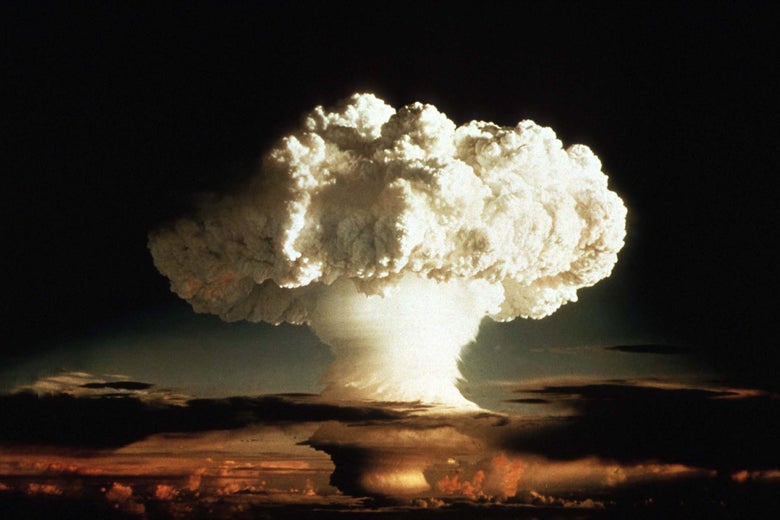
A mushroom cloud

We’re about to incinerate a lot of money. Reuters

The White House’s new defense budget lavishes money on America’s nuclear weapons program in the name of competing with China and Russia. It’s totally unnecessary.

BY FRED KAPLAN

MARCH 30, 20221:54 PM

President Joe Biden’s defense budget for 2023 is gargantuan. It comes to $813.3 billion, nearly $60 billion higher than the budget he requested a year ago for 2022. Just a few weeks ago, Congress passed a bill adding $25 billion to that earlier budget. Biden’s new budget, which he submitted on Monday, accepts the congressional hike as a baseline and raises the pot by another $32 billion.

To put this in perspective, Biden’s $813 billion exceeds President Donald Trump’s final defense budget by $75 billion—which, for a sense of proportion, is about 2.5 times what the government spends on Pell grants for low-income college students. It tops the amount that the Trump administration figured it would spend in 2023 by $40 billion.

And yet congressional Republicans say that, given Russia’s invasion of Ukraine and its threats to expand further, Biden’s new budget is much too small, and they’re set to throw in tens of billions of dollars more.

Does this make any sense? The world may be more dangerous than it seemed a few months, much less a few years, ago. But have its dangers grown so much in the past year that they warrant spending an extra $60 billion—and so much in the past few weeks that they demand $30 billion or $40 billion more? (For anyone wondering, these increases go beyond what’s necessary for the military budget to keep up with inflation.) Finally, does Biden’s budget spend this extra money in a way that actually deals with the growing threats from Russia or anyplace else?

In other words, it is time to ask the vital question: How much do we really need to spend on defense?

It’s a question that remarkably few in official or congressional circles ask. Or, to the extent they do, their answer is always one word: more. They think that a dollar sign backed by a very high number sends a signal of our serious intent to our friends and foes. They focus on how much to spend—not on what to buy.

Some of Biden’s budget hikes do go to counter the new Russian threat. For instance, it increases funding for the European Deterrence Initiative—a program that enables the movement of U.S. troops and equipment into NATO’s eastern nations, such as Poland, Romania, and the Baltics—from $3.7 billion to $6.9 billion.

But that only accounts for about 5 percent of Biden’s $60 billion increase. What about the rest? Much of it will fund more combat planes and warships; research and development into 5G, A.I., and hypersonic missiles; and improvements in the communications tools that link commanders and their weapons. There are legitimate cases to be made for these upgrades, quite aside from Russia’s invasion and the subsequent anxieties of NATO allies on the western border of Ukraine.

But the most visible, and surprising, share of Biden’s defense budget is the enormous sum for nuclear weapons—$50.9 billion, a 17 percent increase over this year’s (already considerable) $43.2 billion. About a third of this outlay is for the Energy Department’s nuclear complex—including its weapons labs, plutonium pits, and the production and testing of warheads and bombs. The other two-thirds, controlled by the Defense Department, goes to the major defense contractors.

A debate has raged for years among defense analysts over whether to revamp all three “legs” of America’s “strategic nuclear triad”—the land-based intercontinental ballistic missiles, nuclear-missile-carrying submarines, and long-range bomber aircraft. Some argue that all three elements of the arsenal are on the verge of obsolescence and need to be replaced. Others contend that, while this will be true for the submarines in the next decade or so, the missiles and bombers can be merely modified (as they have been a few times already); still others add that the land-based missiles should be eliminated or drastically reduced in number (say, from their current 400 to maybe 40). I’m among this last group.

The Pentagon’s fact sheet on the budget makes clear that Biden has decided to replace all legs and build a new long-range air-launched cruise missile, to boot. These new weapons, and their associated gear, consume $34.3 billion of his proposal—a 24 percent increase over what the administration devoted to them in this year’s budget. All of these new missiles, bombers, and submarines are in the research-and-development phase, meaning that, as they move into production, their costs will grow. In other words, starting in a few years, the budget for nuclear weapons will skyrocket.

This decision is surprising because, in his years as senator and vice president, Biden was never enamored of the “nuclear priesthood.” As president, some of his appointments to key positions in the Pentagon, the State Department, and the National Security Council staff were equally skeptical specialists. Two things happened between Inauguration Day and now.

First, Russia and China kept building new nuclear weapons (not more nuclear weapons, but upgrades to existing models). Some analysts argue that, objectively, this shouldn’t affect our decisions; as long as we’re able to carry out our nuclear war plans—as long as we can deter Russia and China from attacking us and, to some extent, limit damage if nuclear war breaks out anyway—no need for us to follow Russia’s or China’s wasteful practices. But politically, this is a hard argument to make, especially given the influence of a bipartisan group of legislators whose home districts manufacture missiles, bombers, or submarines.

Second, back when Biden was vice president, he and President Barack Obama got snookered by a particularly agile group of these legislators. In 2010, Obama needed two-thirds of the Senate to ratify the New START arms reduction treaty, which he had signed with Russia’s then-president, Dmitry Medvedev. Several senators threatened not to ratify unless Obama spent more on the nuclear stockpile and agreed to build new missiles, bombers, and submarines. Hawks have pulled this ploy ever since the first U.S.-Soviet arms control treaty back in 1972. Almost every new American nuclear weapon since then has been funded as a bribe for ratification or as a “bargaining chip” for future arms negotiations—except that, once nuclear weapons enter production, they’re almost never bargained away.

Obama tried to be clever under this pressure, pledging to “modernize or replace” all three legs of the triad. He did not regard this as a promise to buy any new weapons. To “modernize” a missile could mean upgrading its software or installing new communications gear.

But in response, the congressional critics rolled out a grand list of new weapons, which carried a 30-year price tag of $1.3 trillion (it has since grown), and claimed that Obama had signed on to the whole package as part of the deal to ratify New START. When Trump was elected, key Pentagon officials—some of whom had worked for Senate Republicans—labeled this package as “the Obama plan of record.” The message was clear: Obama (who was viewed by Republicans and several centrist Democrats as a weak-on-defense dove) approved these weapons; therefore, you’re an even weaker-on-defense dove if you try to cancel them.

And so from that point on, these weapons—which won’t be fielded for several years—have been presented as part of the U.S. arsenal’s status quo. To oppose their funding is seen as an act not of restraint but of unilateral disarmament.

Last year, Biden raised defense spending and retained the plan to build new nukes, in part because he needed a few moderates to support his extravagant domestic spending plan—and he wouldn’t get them unless he supported extravagant Pentagon spending. Now this year, as the political mood has shifted and as midterms loom ahead, Biden has scaled back his domestic ambitions even while pushing the defense budget upward and onward.

And what will we get for this massive military spending binge? Mostly theater. Nobody has come up with a persuasive scenario in which the U.S., armed with its current nuclear arsenal, is unable to deter Russia or China (or North Korea or some other foe) from aggression, but would be able to deter them, if we only had all these new missiles, bombers, and submarines now.

The war in Ukraine illustrates the point. Biden (properly) refuses to send U.S. troops or pilots into the battle directly, for fear that Russia would see such intervention as an existential threat and respond with nuclear weapons. Some think Biden is excessively cautious. But none of his critics has claimed that we could gain the upper hand over Russia—that we could intervene and stare down Putin’s threat to respond with nukes—if only we had all these new missiles and bombers and submarines today.

The course of the war in Ukraine calls into question the broader claim that we need to spend a lot more money on defense in order to counter Russia’s new threat in Europe. Russia’s military is doing poorly against Ukraine’s army and civilian resistance forces. Russian tanks are running out of fuel and food as Ukrainians cut their supply lines; these same tanks and other vehicles are getting blown up by easy-to-operate anti-tank missiles that cost not millions but thousands of dollars apiece; Russian planes and helicopters are getting shot out of the sky by similarly inexpensive, shoulder-fired Stinger missiles.

Yes, NATO’s new Eastern European front lines need to be strengthened, because they were barely manned at all before Putin’s move against Ukraine. But do they need to be strengthened so much? It may be smarter—and would certainly be cheaper—to rethink what we need for defense before we start spending a lot more money in the same old ways. We’ve overrated Russia’s military power; let’s not underrate our own.

Thursday, November 8, 2018

Russia Tries to Educate the Donald


Russia has urged the United States to issue a joint statement expressing that both parties recognize how a nuclear exchange between them would end in mutually ensured destruction.
During an interview released Thursday by French publications Le Figaro, Paris Match and the French-language affiliate of Russia's state-run RT channel, Russian Foreign Minister Sergey Lavrov said he was concerned about what he felt was a lower threshold for the use of weapons of mass destruction under President Donald Trump's latest nuclear doctrine. Recalling the two countries' Cold War history, the diplomat hoped the current administration in Washington would offer a similar vow of restraint.
"The Americans and we have made two fundamental statements since the Soviet era to the effect nobody can win a nuclear war and, for that reason, it cannot happen," Lavrov said, according to Russia's state-run Tass Russian News Agency.
"It might be a good idea to reaffirm this postulate in the current context," he added.
An unarmed U.S. Air Force Minuteman III intercontinental ballistic missile launches during an operational test at Vandenberg Air Force Base, in California, at 1:23 a.m. PDT on May 14. The Minuteman is the land-based component of the U.S. nuclear triad. Airman Aubree Milks/U.S Air Force/Department of Defense
Shortly after Trump assumed office early last year, he and Russian President Vladimir Putin both appeared to express a desire to expand their nuclear arsenals, reversing a decades-long trend of denuclearization between their countries. Though Trump entered the White House showing deep admiration for his Russian counterpart, the U.S. leader soon inherited a sharp uptick in tensions that began between the two powers under his predecessor. In the months following Trump’s swearing-in, the U.S. continued to sanction Russia due to accusations it interfered in the 2016 election and pursued other malign activities abroad.
A month after Trump was sworn in, he told Reuters that the U.S. has "fallen behind on nuclear weapon capacity" and was "going to be at the top of the pack" under his administration. Last October, NBC reported that Trump had petitioned the military to increase its nuclear weapons by up to eight times, citing two officials said to be present at a Pentagon meeting that July.
The Trump administration released its debut nuclear doctrine earlier this year with certain sections referring to low-yield nuclear weapons, something that experts have warned could make powers more willing to resort to a nuclear option. General John Hyten, head of the U.S. Strategic Command, said in March that such low-yield devices would serve as "a deterrence weapon to respond to the threat that Russia, in particular, is portraying."
According to Tass, Lavrov said Thursday that "low-yield nuclear warheads are being made with the obvious intention to use them as a possible means of warfare, which would conceptually undermine all existing agreements stipulating that it is a weapon of mutual deterrence and by no means a weapon of conducting war. In the meantime, this is precisely the role of low yield warheads that was described in the new nuclear doctrine."
RussiaNuclearForcesTest The Russian Strategic Nuclear Forces carry out drills in the country’s northeast, on October 11. Russian President Vladimir Putin has sought to modernize and enhance his country’s nuclear arsenal. Russian Ministry of Defense
Russia is believed to have the world's largest nuclear weapons stockpile while the U.S. comes in close second, and both powers have continued to reduce their arsenals. At the same time, Putin has set out to improve his country's nuclear triad—the deployment of nuclear weapons on land, at sea and by aircraft—an unveiled an ambitious array of new, nuclear-capable weapons in March. He has accused the U.S. and its allies in Europe and Asia of trying to disarm Russia's capabilities with a global missile shield.
Last week, Putin ordered strategic nuclear drills comprising air, land and sea at the Kura, Chizha, Pemboi and Terekta test sites. On the same day that Lavrov's interview was released, Putin discussed the prospect of nuclear war at the Valdai Discussion Club in Moscow.
"The aggressor must know that retribution is inevitable, that it will be destroyed. We are victims of aggression, as martyrs, we will go to heaven," Putin told the crowd. "And they will just die."

Tuesday, November 6, 2018

Russia Threatens Babylon the Great


© FoxNews.com Raw video: U.S. Navy shares footage of incident where a Russian SU-27 jet conducts a high-speed pass directly in front of the American EP-3 aircraft in international airspace over the Black Sea.
A Russian jet's "unsafe" intercept of a U.S. aircraft and a Kremlin spy plane's conspicuous presence during the largest post-Cold War NATO military exercise highlighted the continuing tensions between many alliance nations and Vladimir Putin's government.NATO's Trident Juncture war games were launched last month in central and eastern Norway, the North Atlantic and the Baltic Sea, and are set to continue until Nov. 7.
“This is not a Cold War situation,” NATO Secretary General Jens Stoltenberg said last week, adding the exercises were “purely to prevent, not to provoke.”
But Russia views the exercises through a different lens, and the country sent military planes to two Trident Juncture locations in the past few days.
U.S. Navy Forces in Europe and Africa tweeted harrowing video Monday of a U.S. EP-3 Aries aircraft being intercepted by a Russian SU-27 at high speeds. The EP-3 was in international airspace over the Black Sea at the time.
“This interaction was determined to be unsafe due to the SU-27 conducting a high speed pass directly in front of the mission aircraft, which put our pilots and crew at risk,” U.S. officials said in a statement. “The intercepting SU-27 made an additional pass, closing with the EP-3 and applying its afterburner while conducting a banking turn away.”
Meanwhile, a Tupolov TU-142 Russian spy plane made an unexpected appearance over NATO operations off the Norwegian coast Saturday. The Soviet-era plane was seen flying over the USS Mount Whitey while U.S. Marines watched.
Russia said prior to the start of the war games that it might test missiles in the area as well, though so far Putin has not followed through on the threat. Moscow had been angered by the notion of the war games being conducted and accuses the West of acting provocatively around its borders.
There are 65 ships, 250 aircraft, 10,000 vehicles and 50,000 personnel taking part in the exercises. The war games' storyline revolves around NATO restoring Norway’s sovereignty after an attack by a “fictitious aggressor.”
Saturday’s Russia flyover elicited shouts from the Marines aboard the USS Mount Whitey, according to Military.com.
“We are at sea, everyone's got the right to be here. It's international waters, it's international airspace,” British Adm. Guy Robinson told Military.com. “So clearly, we monitor closely. But everything we see in this exercise is that they've been safe and professional.”
The Associated Press contributed to this report.

Thursday, November 1, 2018

Nuclear Horns Refuse to Give Up Nuclear Weapons


Russia, UK, China, US, France won’t sign Treaty on the Prohibition of Nuclear Weapons
World
October 29, 14:14
Russia, China, France, the United Kingdom and the United States believe that the treaty runs counter to the Treaty on the Non-Proliferation of Nuclear Weapons
MOSCOW, October 29. /TASS/. Moscow, London, Beijing, Washington and Paris won’t sign the Treaty on the Prohibition of Nuclear Weapons (TPNW), a joint statement made at the First Committee of the 73rd session of the UN General Assembly said.
"We will not support, sign or ratify this Treaty. The TPNW will not be binding on our countries, and we do not accept any claim that it contributes to the development of customary international law; nor does it set any new standards or norms. We call on all countries that are considering supporting the TPNW to reflect seriously on its implications for international peace and security," the statement published on the Russian Foreign Ministry’s website said.
The sides firmly believe that the best way to "achieve a world without nuclear weapons is through a gradual process that takes into account the international security environment." "This proven approach to nuclear disarmament has produced tangible results, including deep reductions in the global stockpiles of nuclear weapons," the statement said.
Russia, China, France, the United Kingdom and the United States believe that the TPNW runs counter to the Treaty on the Non-Proliferation of Nuclear Weapons and bears the risks of undermining it. The five nuclear weapon states say the document ignores the international security context and regional challenges, does nothing to increase trust and transparency between States and will not result in the elimination of a single weapon.
"It is creating divisions across the international non-proliferation and disarmament machinery, which could make further progress on disarmament even more difficult," the statement said.
Russia, the UK, China, the US and France are committed to the Treaty on the Non-Proliferation of Nuclear Weapons and the organization of negotiations on nuclear disarmament.
"We, the nuclear weapon States recognized by the Treaty on the Non-Proliferation of Nuclear Weapons, reaffirm our commitment to the Treaty, in all its aspects, fifty years since its signature," the document says. "We remain committed under the Treaty to the pursuit of good faith negotiations on effective measures related to nuclear disarmament, and on a treaty on general and complete disarmament under strict and effective international control."
The sides support the ultimate goal of a world without nuclear weapons with undiminished security for all. "We are committed to working to make the international environment more conducive to further progress on nuclear disarmament," the statement says.
Russia, the UK, China, the US and France call on all states to commit to the continued success of the Non-Proliferation Treaty: "to ensure compliance, to promote universalisation, to ensure the highest standards of non-proliferation, and to respond to ongoing and emerging proliferation challenges, wherever they occur. In this context our five countries reiterate our commitment to continue our individual and collective efforts within the NPT framework to advance nuclear disarmament goals and objectives," the document says.
The Treaty on the Prohibition of Nuclear Weapons (TPNW) was adopted in July 2017. The document can only enter into force when 50 states ratify it. A total of 69 countries have signed the treaty and 19 of them have ratified it

Tuesday, October 30, 2018

Russia Threatens the Other Nuclear Horns


Putin says Russia will target nations who host US nuclear weapons
'European countries... must understand that they are putting their own territory at risk of a possible counterstrike,' says Russian
Russia would immediately target any European nation that agreed to deploy US missiles on their soil, Vladimir Putin has said, following the announcement from Washington that it would withdraw from a landmark arms control treaty..
It would be “quick and effective.” Mr Putin said. The Russian president added that if the US "delivers" any new weapons to Europe after they pull out of the deal, Moscow would have no choice but to defend itself.
"European countries that agree to host them, if things go that far, must understand that they are putting their own territory at risk of a possible counterstrike,” he said.
The comments, delivered during a news conference following talks with Italian Prime Minster Conte, came a day after meeting US National Security Advisor John Bolton in Moscow.
That visit made it clear that the United States intended to issue formal notice on the Intermediate-range Nuclear Forces (INF) treaty, and brought forward the prospect of nuclear weapons returning to European soil.
Mr Putin said he understood there were “problems” with the treaty that began not “yesterday, or three days ago.” But he rejected American accusations that Russia had been in violation of the treaty.
Mr Putin instead claimed that the US MK41 “missile shield” systems and their use of drones represented a “direct violation” of the treaty.
The Intermediate-range Nuclear Forces treaty, which was signed in Washington in 1987 by Presidents Ronald Reagan and Mikhail Gorbachev, committed the two Cold War superpowers to destroy short range and intermediate range missiles (500-5,000km), and not to develop them in the future.
Many expect the imminent US withdrawal from this treaty to be followed by the non-renewal of another major arms control deal the strategic arms reduction treaty, the New START, which runs out in 2021.
Mr Putin said that prospect “worried him.”
“It is a very dangerous situation, which leaves nothing else but an arms race,” he said

Saturday, October 27, 2018

Trump Risks World War 3


Mr Gorbachev, the last Soviet leader, has denounced the US decision to leave an arms control treaty that helped end the Cold War.
US President Donald Trump, last week, said Washington plans to quit the Intermediate-Range Nuclear Forces (INF) treaty.
Mr Gorbachev and then-US President Ronald Reagan signed the pact, to eliminate all short and intermediate-range land-based nuclear and conventional missiles held by both countries in Europe, in 1987.
But Mr Trump’s announcement to scrap the treaty has been branded a “dire threat to peace” by Mr Gorbachev.

Writing in a column for the New York Times, Mr Gorbachev wrote: "I am being asked whether I feel bitter watching the demise of what I worked so hard to achieve.
“But this is not a personal matter. Much more is at stake.
“A new arms race has been announced."
The US stationed land-based nuclear missiles in western Europe in the 1980s - triggering mass protests.
Now some US allies fear Washington might deploy a new generation of missiles in Europe, with Russia doing the same in its exclave of Kaliningrad, once again turning the continent into a potential nuclear battlefield.
Washington has blamed Russia’s alleged violation of the Intermediate-Range Nuclear Forces treaty (Image: GETTY)
There will be no winner in a 'war of all against all' - particularly if it ends in a nuclear war
If the US made good on its pledge to leave the treaty, Mr Gorbachev said he hoped US allies would refuse to be launchpads for American missiles which Mr Trump has spoken of developing.
Russian President said Russia would be forced to target any European countries that agreed to host US missiles.
Mr Gorbachev, 87, said that any disputes about compliance could be solved if there were sufficient political will.
It was clear, however, that Mr Trump's aim was to release the US from global constraints, he said, accusing Washington of destroying the "system of international treaties and accords" that underpinned peace and security after World War Two.
Mr Gorbachev wrote: "Yet I am convinced that those who hope to benefit from a global free-for-all are deeply mistaken.
“There will be no winner in a 'war of all against all' - particularly if it ends in a nuclear war.
And that is a possibility that cannot be ruled out. An unrelenting arms race, international tensions, hostility and universal mistrust will only increase the risk."
Washington has blamed Russia’s alleged violation of the pact as a reason to leave the treaty - an allegation denies.
Moscow has now accused the US of breaking the pact.

Monday, October 22, 2018

Russia Tries to Stop Trump's Nuclear Blunder

ELKO, Nevada (AP) — President Donald Trump says his intention to scrap a landmark arms control agreement Russia follows years of violations by Moscow in developing prohibited weapons, and "we're not going to be the only one to adhere to it." The Kremlin said the pullout "would be a very dangerous step."
Britain said it stood "absolutely resolute" with the U.S., while Germany called Trump's move "regrettable."
Heiko Maas said in a statement Sunday that the three-decades-old Intermediate-Range Nuclear Forces Treaty is "an important pillar of our European security architecture" and Trump's announcement "raises difficult questions for us and Europe."
The 1987 pact prohibits the United States and Russia from possessing, producing or test-flying a ground-launched cruise missile with a range of 300 miles to 3,400 miles.
Maas says Germany has repeatedly urged Moscow to "clear up the serious allegations of breaching the INF treaty, which Russia has so far not done."
He says Germany is urging Washington to "consider the possible consequences" of its decision, including for a US-Russian nuclear disarmament treaty beyond 2021.
The 1987 Intermediate-range Nuclear Forces Treaty helps protect the security of the U.S. and its allies in Europe and the Far East. It bars the United States and Russia from possessing, producing or test-flying a ground-launched cruise missile with a range of 300 miles to 3,400 miles.
"Russia has violated the agreement. They have been violating it for many years," Trump said Saturday after a rally in Elko, Nevada. "And we're not going to let them violate a nuclear agreement and go out and do weapons and we're not allowed to."
The agreement has constrained the U.S. from developing new weapons, but America will begin developing them unless Russia and China agree not to possess or develop the weapons, Trump said. China is not a party to the pact.
"We'll have to develop those weapons, unless Russia comes to us and China comes to us and they all come to us and say let's really get smart and let's none of us develop those weapons, but if Russia's doing it and if China's doing it, and we're adhering to the agreement, that's unacceptable," he said.
Trump is sending his national security adviser, John Bolton, to Moscow for meetings with Russian leaders, including Foreign Minister Sergei Lavrov and Security Council Secretary Nikolai Patrushev, and was expected to relay the news about Trump's decision.
"This would be a very dangerous step," Russia's deputy foreign minister, Sergei Ryabkov, was quoted as telling state news agency Tass on Sunday. He said a U.S. withdrawal "will cause the most serious condemnation from all members of the international community who are committed to security and stability."
Germany's foreign minister, Heiko Maas, said Trump's move was "regrettable," the treaty was "an important pillar of our European security architecture" and a pullout "raises difficult questions for us and Europe." Maas also said Germany has repeatedly urged Moscow to "clear up the serious allegations of breaching the INF treaty, which Russia has so far not done."
But Britain's defense secretary, Gavin Williamson, said his country stands "absolutely resolute" with the United States on the treaty dispute. Williamson blamed Russia for endangering the arms control pact and he called on the Kremlin to "get its house in order."
Williamson told the Financial Times on Sunday that Moscow had made a "mockery" of the Intermediate-Range Nuclear Forces Treaty.
U.S.-Russia relations already are strained as a result of the Ukrainian crisis, the war in Syria and allegations of Russian meddling in the 2016 presidential race and upcoming U.S. midterm elections.
Trump did not provide details about violations. But in 2017, White House national security officials said Russia had deployed a cruise missile in violation of the treaty. Earlier, the Obama administration accused the Russians of violating the pact by developing and testing a prohibited cruise missile.
Russia has repeatedly denied that it has violated the treaty and has accused the United States of not being in compliance.
Defense Secretary James Mattis has previously suggested that a Trump administration proposal to add a sea-launched cruise missile to America's nuclear arsenal could provide the U.S. with leverage to try to persuade Russia to come back in line on the arms treaty.
Russia's Foreign Ministry said in February that the country would only consider using nuclear weapons in response to an attack involving nuclear or other weapons of mass destruction, or in response to a non-nuclear assault that endangered the survival of the Russian nation.
An independent Russian political analyst, Dmitry Oreshkin, said, "We are slowly slipping back to the situation of cold war as it was at the end of the Soviet Union, with quite similar consequences, but now it could be worse because (Russian President Vladimir) Putin belongs to a generation that had no war under its belt."
Trump's decision could prove controversial with European allies and others who see value in the treaty, said Steven Pifer, a former U.S. ambassador to Ukraine and now a senior fellow at the Brookings Institution who focuses on nuclear arms control.
"Once the United States withdraws from the treaty, there is no reason for Russia to even pretend it is observing the limits," he wrote in a post on the organization's website. "Moscow will be free to deploy the 9M729 cruise missile, and an intermediate-range ballistic missile if it wants, without any restraint."
U.S. officials have previously alleged that Russia violated the treaty by deliberately deploying a land-based cruise missile in order to pose a threat to NATO. Russia has claimed that U.S. missile defenses violate the pact.
In the past, the Obama administration worked to convince Moscow to respect the INF treaty but made little progress.
"If they get smart and if others get smart and they say let's not develop these horrible nuclear weapons, I would be extremely happy with that, but as long as somebody's violating the agreement, we're not going to be the only ones to adhere to it," Trump said.
___
Balsamo reported from Washington. Associated Press writers Deb Riechmann in Washington and Tanya Titova and James Heintz in Moscow contributed to this report.
Copyright 2018 The Associated Press. All rights reserved. This material may not be published, broadcast, rewritten or redistributed.

Thursday, October 18, 2018

Russia Prepares for Nuclear War


New satellite images suggest military buildup in Russia's strategic Baltic enclave
By Oren Liebermann, Frederik Pleitgen and Vasco Cotovio, CNN
Updated 6:24 PM EDT, Wed October 17, 2018)
Reykjavik, Iceland (CNN) New satellite imagery shared exclusively with CNN shows Russia appearing to upgrade four of its military installations in Kaliningrad, Russia's strategic outpost on NATO's doorstep.
Kaliningrad -- Russian territory that's sandwiched between Poland and the Baltics but disconnected from the rest of Russia, known as an exclave -- has been a focal point in tensions between Russia and the West.


Kaliningrad
Earlier this year, aerial images came to light that suggested the Russians had significantly modernized a nuclear weapons storage bunker in Kaliningrad. Now, satellite imagery and analysis from ImageSat International, a commercial satellite firm, appear to confirm that a major modernization is underway in at least four locations throughout the region.
Those upgrades include fresh work at what analysts have identified as the Kaliningrad nuclear weapons storage site. Images captured between July 19 and October 1 indicate work on an exposed bunker under renovation that appears to conceal activity underneath.

Another set of images shows 40 new bunkers under construction, increasing capacity at a military storage area near Primorsk, Russia's second-largest port on the Baltic Sea. The new bunkers surround older, smaller bunkers at the center of the site. Images from July 18 show the bunkers under construction; 10 weeks later, the bunkers appear complete.

A short distance north of Kaliningrad, images appear to show upgrades to the Chkalovsk air base, including a new railway and the installation of an instrument landing system that would allow aircraft to land in inclement weather.

A final set of images shows the upgrades in Chernyakhovsk, a base that houses the 152nd Missile Brigade of the Russian military. In February, the base received nuclear-capable Iskander missiles, prompting a US defense official to call it "the biggest move we've seen" in terms of Russian militarization of the Baltics.

The Russian military did not immediately respond to CNN's request for comment on new evidence of military modernization in Kaliningrad. But the Russian government has consistently defended its right to deploy weapons there.
'We're not going to be intimidated'
Kaliningrad matters because of its strategic location.
"It's very important for them [the Russians] because that is their port on the Baltic sea," said Adm. James G. Foggo III, the commander of US Naval Forces Europe-Africa and commander of the Allied Joint Force Command in Naples, Italy.
"They don't have a land bridge that extends to that area ... and so they've built it up over time."
Foggo, who did not comment directly on the new images, said Russia's presence in the exclave does not deter NATO from operating in the region.
"If they want to challenge us, we will challenge them," he said. "We're not going to be intimidated by those systems that are out there."
But US military officials say they are concerned by what they call Russia's ability to establish "anti-access/area denial" capabilities, or, weaponry that reduces NATO's potential freedom to maneuver in the region. Those include some of the modern weapons systems stationed in Kaliningrad, including anti-ship missiles, radar systems and surface-to-air missiles.
The ImageSat International report bolsters findings from a June 2018 Federation of American Scientists (FAS) conclusion that Russia may have significantly modernized the nuclear weapons storage site since 2016. The FAS report pointed to an underground bunker that was excavated and deepened before it was covered over again, "presumably to return (to) operational status soon."
The new ImageSat report points to upgrades at the same bunker. Hans M. Kristensen, the director of nuclear information at FAS, previously said it was unclear if nuclear weapons are or were stored at the site, but suggested the weapons could be moved there quickly in a crisis.
Tensions running high
Kaliningrad sits about 482 kilometers (300 miles) west of mainland Russia, and as tensions between NATO and Russia have escalated, Kaliningrad has become a major fault line in relations between Russia and the West. NATO has stepped up its military presence in the Baltic region; in addition, US President Donald Trump has demanded that fellow NATO members invest more in defense spending.
But Kaliningrad isn't Russia's only frontier with NATO. Russia also shares a small border with Norway, where US Marines will be training later this month as part of Trident Juncture, a major NATO military exercise involving 50,000 troops, 10,000 vehicles, 150 aircraft and 65 vessels.
Trident Juncture is meant to send a message. It is a so-called Article 5 exercise that tests the readiness of NATO allies to come in to restore the sovereignty of one of its members -- in this case, Norway -- after an act of aggression.
US Marines conduct military drills on Wednesday in Iceland, ahead of the Trident Juncture exercise in Norway, NATO's largest since the end of the Cold War.
Tensions between Russia and the West have been at highs not seen since the Cold War, amid the poisonings in England, allegations of Russian election meddling and Western sanctions on Moscow.
But Foggo, who is overseeing Trident Juncture, said the exercise wasn't a threat to Russia, noting that NATO and Russian troops would be more than 700 kilometers (approximately 435 miles) apart from each other during the maneuvers. NATO, he added, had invited Russian and Belarusian observers to monitor the exercise.
"I want them to be there because that conveys the strength of the alliance," Foggo said.
This story has been updated to correctly identify the instrument landing system in a satellite image provided by ImageSat International.

Sunday, October 14, 2018

Russia Has More Nuclear Exercises

Russia Conducts Large-Scale Exercise With its Nuclear Forces

Russia Conducts Large-Scale Exercise With its Nuclear Forces

Franz-Stefan Gady, The Diplomat

Unlike in 2017, this year’s strategic forces exercise did not involve the launch of ICBMs.
Russia’s Strategic Forces conducted their annual readiness exercise that involved the test firing of air-launched cruise missiles, aero-ballistic missiles, and submarine-launched ballistic missiles on October 11.
“The exercises involved ground, naval and aviation strategic nuclear forces along with nuclear early-warning systems,” the Russian Ministry of Defense said in an October 11 statement. “Shifts on combat duty at command posts, combat crews of missile regiments, crews of nuclear-powered submarines of Northern and Pacific Fleets as well as pilots of strategic missile carriers and bombers practiced training actions.”
The ministry did not specify the types of aircraft, missiles, and submarines involved. However, based on videos released on the ministry’s website, it appears that the exercise involved Soviet-era Project 667BDR Kal’mar (Squid) Delta-III or Project 667 BDRM Delta IV-class nuclear-powered ballistic missile submarines (SSBN) armed with the R-29R/R-2S (NATO reporting name: SS-N-18 Stingray) submarine-launched ballistic missile (SLBM).
Interestingly, the routine exercise did not involve Russia’s most advanced SSBN armed with its latest SLBM, the Project 955 Borei-class (“North Wind”) aka Dolgoruky-class carrying the Bulava (RSM-56) ICBM — a sea-based variant of the Topol-M — capable of carrying up to ten warheads. (The Borei-class was also not part of last year’s exercise.)
All SLBM launches were purportedly detected by the EKS space-based early-warning system and early warning radars. “Single space system and ground-based radar stations promptly detected all ballistic missiles launched by submarines,” the statement reads. “Information on them was issued to the command posts of government and the Armed Forces in accordance with established procedure.”
The recently released videos also show a Tupolev Tu-22M3 bomber armed with a Rhaduga Kh-15 aero-ballistic missile, a Tupolev Tu-95MS bomber armed with the Kh-101/Kh-102 (nuclear variant) air-launched cruise missile (ALCM), and a supersonic Tupolev Tu-160 most likely also armed with a Kh-101/Kh-102 ALCM.
“Troops carried out combat training launches of submarine-launched ballistic missiles, air-based cruise missiles and aircraft-guided missiles from the waters of the Barents and Okhotsk seas, as well as long-range aircraft operating from Engels, Ukrainka and Shaykovka airfields,” according to the press release. “Objectives of the exercises were fulfilled. All training targets at the Kura, Chizha, Pemboi and Terekta test sites have been successfully engaged.”
Notably, the exercise did not involve the launch of ground-based intercontinental-range ballistic missiles (ICBM). Last year, the Strategic Forces fired four Topol-M ICBMs from the Plesetsk space center is located in Arkhangelsk Oblast. The Topol-M (aka RS12M2/NATO reporting name: SS-27), a three-stage solid fueled ICBM with a reported maximum range of 11,000 kilometers (6,835 miles).
The absence of any mention of an ICBM launch could point to a failed missile launch. The test firing could also have been cancelled for a number of technical reasons. Given the critical role that Russia’s ground-based ICBMs play in the country’s nuclear triad, it appears highly unlikely that the ICBMs were deliberately excluded from this year’s exercise. It is also possible that a launch did take place and the ministry of defense has chosen not reveal it to the public.
Notably, the exercise also tested Russian nuclear command and control systems. “The exercise tested the control system of the Armed Forces, as well as the reliability of combat training orders and signals through the whole chain of command from the National Centre for State Defense Control of the Russian Federation to the command posts of formations and military units,” the ministry notes.

Saturday, October 6, 2018

How Russia could spark WORLD WAR 3


Putin's threats to the West could quickly spiral out of control and unleash a catastrophic world war (Image: GETTY)
GLOBAL WAR threat: 'Genuine danger' Russia could spark WORLD WAR 3 - ambassador warning
THERE is a "genuine danger" of Russia instigating a global war, according to the former UK ambassador to Russia, with Vladimir Putin on the edge of a "major confrontation".
By OLI SMITH
PUBLISHED: 14:55, Sat, Oct 6, 2018
UPDATED: 20:14, Sat, Oct 6, 2018
Vladimir Putin's threats to the West could quickly spiral out of control and unleash a catastrophic world war, according to the former UK ambassador to Russia.
Sir Tony Brenton, who served as ambassador between 2004 to 2008, said that there was a "genuine danger" of the world falling into a world war crisis 
Speaking to John Humphrys on Radio 4's Today programme, Sir Tony warned that Russia could shut down the entire power system of Britain.
The shock remark comes as diplomatic tensions over European claims of Russian espionage continue to mount.
Russia has been accused of behaving like a “pariah state” after allegations the Kremlin tried to hack the UK Government and the international body that headed the Salisbury Novichok probe.
Dutch authorities said they thwarted a Russian attack on the Organisation for the Prohibition of Chemical Weapons (OPCW) in The Hague, with assistance from UK intelligence.
Moscow has blasted the accusations as “another orchestrated act of propaganda” as part of an “anti-Russian campaign of spy mania”.
Sir Tony insisted that the Russian spying was not the most worrying aspect about Vladimir Putin's approach to the West.
He said: "The espionage and covert propaganda side of this has been going on forever.
"We can express outrage but I suspect they will be enjoying our outrage and they will carry on with it, regardless.
"The bit that does matter and is genuinely dangerous are the Russian cyberattacks on infrastructure like the Ukranian power attack.
"There is a quiet war of that sort going on with the Russians taking a lead.
"The danger is that someone will do something that will escalate out of control, like close down a country’s entire power system.
"If that happens, we are into a major confrontation and we have no ways of controlling that.
"This is similar to how the threat of nuclear weapons played out."
Amid growing concern over the Russian threat, America's most senior naval officer in Europe, Admiral James Foggo raised the alarm over Russia's newest fleet of submarines.
He told reporters at the Pentagon: "We've seen creation of new classes of all sorts of submarines and ships. I'm more concerned with submarine warfare."
Admiral Foggo claimed that Russian cruise missiles on the submarines were capable of reaching "any capital of Europe".

Thursday, October 4, 2018

NATO and US Threaten Russian Nuclear Horn

The US would look into ways of "taking out" new Russian missiles if they become operational, the US envoy to NATO said, accusing Moscow of developing a weapon that “violates” the Soviet-US nuclear arms treaty.
US Ambassador to NATO Kay Bailey Hutchison didn’t miss an opportunity to fire a warning shot in the direction of Russia when accusing it of building new nuclear missiles that would allegedly be pointed at Europe. Should such missiles be completed, she said at the Tuesday briefing, “at that point, we would be looking at the capability to take out a [Russian] missile that could hit any of our countries.”
Hutchison then doubled down on the threat, saying: “Counter measures [by the United States] would be to take out the missiles that are in development by Russia in violation of the treaty.” She added: “They are on notice.”
Hutchison was referring to the Intermediate-Range Nuclear Forces Treaty (INF), which bans the use of all nuclear and conventional missiles, as well as their launchers, that have ranges of between 500km and 5,500km. The US has claimed that Moscow is not complying with the INF treaty, an accusation that Russia has repeatedly rejected.
“We have been trying to send a message to Russia for several years that we know they are violating the treaty, we have shown Russia the evidence that we have that they are violating the treaty,” Hutchison maintained.
The Russian Foreign Ministry blasted the statements made by the US envoy as “aggressive and destructive,” adding that they will get a detailed response from Russian military experts. NATO doesn’t understand the degree of its responsibility and the danger posed by such aggressive rhetoric, the ministry said.
Later, though, Hutchison backed down on her statement as she said she did not actually intend to threaten Russia with a pre-emptive strike. She only wanted to point out that Moscow “needs to return to the INF Treaty compliance” or the US would be forced to “match its capabilities to protect the US and NATO,” the ambassador said in a Twitter post.
Her comment still provoked a wave of criticism on Twitter as people said that she was not fit for her job if she could not formulate her thoughts clearly. Others accused her of carelessly risking World War III.
Hutchison's comments came several weeks after President Donald Trump signed the US National Defense Authorization Act (NDAA) for 2019. The document contains, among other things, allegations that Moscow violated the INF Treaty.
Moscow, in turn, accuses the US and “some of its allies” of knowingly violating the INF by deploying Mk-41 launching systems close to Russian borders. These can be easily repurposed for firing banned ground-based cruise missiles, it says, while Washington denies the accusations.
Under the 2019 NDAA, US legislators allocated $58 million to counter Russia’s alleged non-compliance with the INF Treaty. The measures to counter the alleged activities include a “research and development program on a ground-launched intermediate-range missile,” which, somehow, should not itself violate the treaty.
Russian lawmakers have also promised countermeasures. “If the missile announced by Congress indeed makes it into the American arsenal, we will have to develop and adopt the same thing. Russia has the military and technical capacities for that,” Viktor Bondarev, the head of the defense committee of Russia’s Federal Council, has said.

Monday, October 1, 2018

The Advanced Russian Nuclear Horn (Daniel 7)

Russia's Most Advanced (And Stealthly) Nuclear Submarine Ever Just Went to Sea
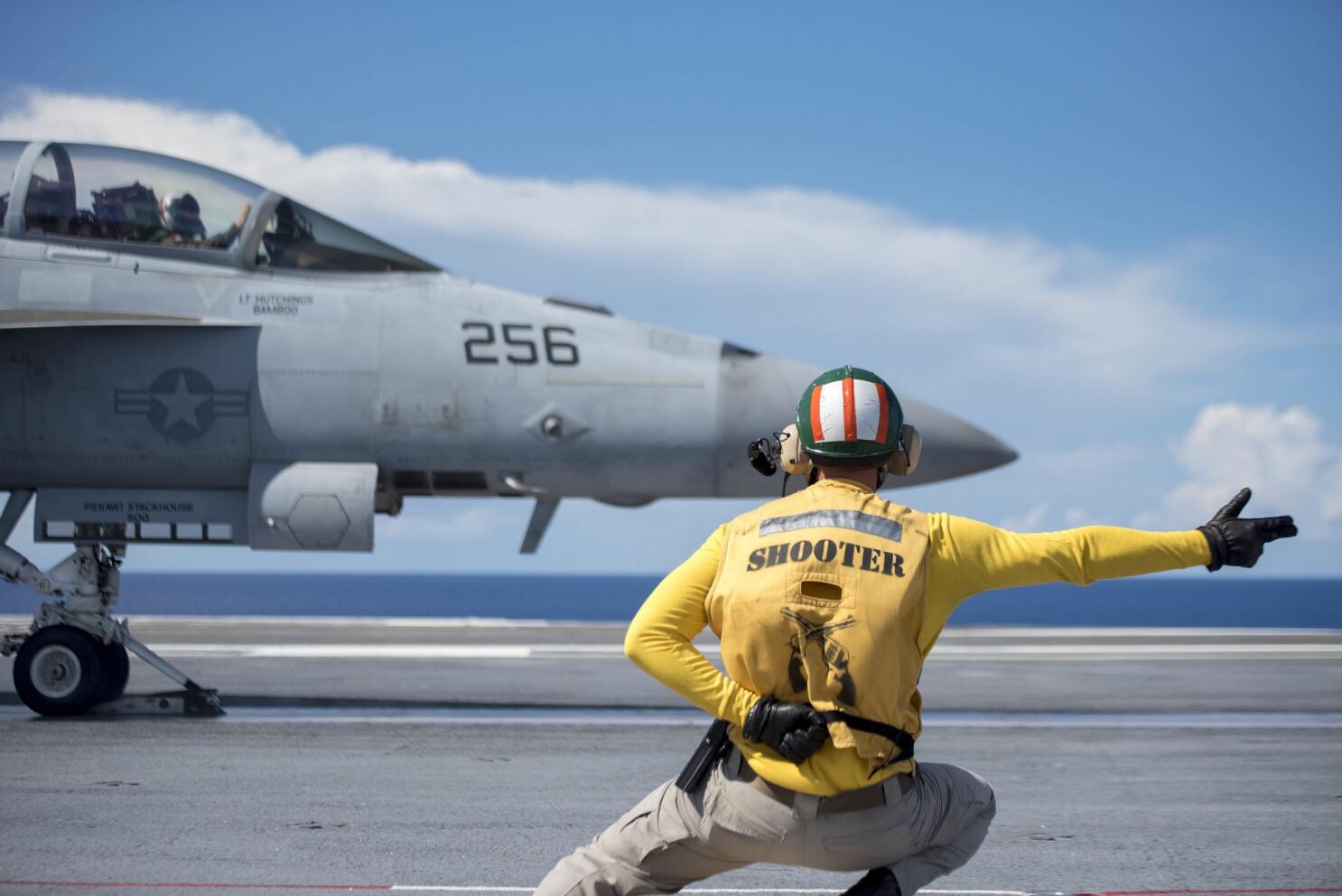
And the navy is worried, and for good reason.
Russia’s second Severodvinsk-class submarine K-561 Kazan , which is a modified Project 08851 Yasen-M design, went to sea for the first time for builder’s trials on September 24.
The massive nuclear-powered guided missile submarine (SSGN) was designed by the Malachite design bureau in St. Petersburg and was built in the northern Russian city of Severodvinsk. Kazan was launched on April 8, 2027, and was originally expected to be delivered to the Russian Navy this December, but construction work on the vessel was delayed. At present, Kazan is not expected to be delivered to the Russian Northern Fleet until at least 2019. Nonetheless, the Russian vessel is expected to be the most formidable enemy submarine the United States Navy has ever faced.
The United States Navy was already impressed with the original Severodvinsk, which is an older design that had been under construction since 1993 before eventually being commissioned into service in December 2013. Shortly thereafter in 2014, Rear Adm. Dave Johnson, who was then Naval Sea Systems Command’s (NAVSEA) program executive officer (PEO), told me he was so impressed with the Russian submarine that he had a model of Severodvinsk built for display outside of his office.
“We’ll be facing tough potential opponents. One only has to look at the Severodvinsk, Russia’s version of a [nuclear guided missile submarine] (SSGN). I am so impressed with this ship that I had Carderock build a model from unclassified data.” Johnson said during the Naval Submarine League’s 2014 symposium in Falls Church, Va . “The rest of the world’s undersea capability never stands still.”
Later in 2016, Rear Adm. Michael Jabaley, who was then the Navy’s program executive officer for submarines—speaking at the Center for Strategic and International Studies— said on July 8, 2016,  that the Navy launched its Acoustic Superiority Program to improve the performance of Virginia-class attack submarine as a response to the advent of the Severodvinsk-class.
“This is our response to the continued improvement in our peer competitors’ submarine quality,” Jabaley said. “The Russians with the production of the Severodvinsk SSGN took a significant step forward in their acoustic ability. We want to maintain pace ahead of that. We never want to reach acoustic parity, we always want to be better than anything any other country is putting out there in the submarine domain.”
Adm. James Foggo—now the commander of U.S. Naval Forces Europe—had also expressed how impressed he was with the Severodvinsk design. “It’s a very impressive submarine,” Foggo had told The National Interest in 2016 . “If you look across the design of the Russian Federation Navy, where they have put their resources and their research and development efforts has primarily been in the undersea domain and in the submarine force.”
Though Severodvinsk—and her more modern sister ships like Kazan—are very capable submarines, Foggo had said, the U.S. Navy still retains an edge. But Russia will continue to invest in submarine research and development and it will continue to build an evermore-capable undersea fleet. “I believe that we—the West—still have an asymmetric advantage,” Foggo said. “I believe they will continue to refine their submarine capabilities with the intent of achieving parity with the West—ourselves included.”
Kazan is an example of Russia’s efforts to refine their submarine technology. Kazan is believed to be roughly 10 meters shorter than her predecessor, but appears to pack a larger punch. According to some reports, the refined Yasen-M design is thought to have eight torpedo tubes, which is two less than the original Severodvinsk. However, the new vessel is thought to incorporate two additional missile tubes for a total of ten silos. Each of those silos is thought to be able to carry four missiles—thus Kazan and the subsequent Yasen-Ms will pack an enormous offensive punch.
Dave Majumdar is the defense editor for the National Interest. You can follow him on Twitter: @davemajumdar.

Friday, September 28, 2018

100-Megaton Nuclear Monster Is Not Part of Prophecy

100-Megaton Nuclear Monster: How to Stop Russia's City-Killer Torpedo
Russia's Status-6 "Poseidon" torpedo has excited the fears -- or the overactive imaginations -- of Russia's enemies.
How do you stop a nuclear-powered torpedo designed to bury enemy cities under a tsunami?
Russia's Status-6 "Poseidon" torpedo has excited the fears -- or the overactive imaginations -- of Russia's enemies. Calling it is a torpedo is a misnomer. While the precise capabilities of the weapon are mysterious, it appears to be about 80 feet long -- which makes it more like a mini-submarine or an underwater ballistic missile. Poseidon is propelled by a nuclear reactor to a speed of 115 miles per hour and operates at deep depths up to 3,300 feet. It is armed with a massive 100-megaton warhead powerful enough to generate a giant tidal wave to destroy coastal cities.
How useful such a weapon would be is debatable. Poseidon is too slow, compared to ICBMs and bombers, to be useful in a first strike or an immediate retaliatory strike. Moving at high speeds may make it so noisy that anti-submarine can detect it, and its autonomous nature brings up all the questions about armed robots (especially ones carrying mega-bombs).
Nonetheless, as a psychological weapon, it's brilliant. There is something frightening, like a Hollywood monster movie, about the thought of a robot tsunami-bomb creeping along the sea floor.
But for every vampire, there is a stake waiting to slay it through the heart. H I Sutton, a naval analyst who runs the Covert Shores blog on naval affairs, offers some ideas on technology that NATO can employ to halt Poseidon.
Sutton assumes that Poseidon's "operating modes and route planning will likely be simple (read reliable) and relatively direct, relying on speed and depth for survival." That being the case, one countermeasure would be to seed the seabed with networks of sensor-mines to detect and destroy Poseidons. "Ideally the sensor networks would include their own effectors (e.g. torpedo armed mines) to minimize the delay from detection to neutralization, since the targets will be moving much faster than traditional submarine targets," Sutton writes.
Sutton also wonders whether Poseidons could be killed by long-range hypersonic glide vehicles launched by U.S. Navy submarines. "The payload could be next-generation lightweight torpedo or nuclear depth charge similar to the retired Subroc [rocket-launched anti-submarine torpedo] weapon," he writes. "The short flight time and long range of this type of system would allow kills far outside realistic ranges for torpedoes and allow submarines operating in the North Atlantic to react to Poseidon launches detected in the Arctic region, hitting the target while it is still reasonably near to the sensor which detected it."
Stopping weapons like Poseidon will likely require Western navies to develop a new generation of torpedoes. "The current families of US Navy and Royal Navy torpedoes were developed to counter fast deep-diving Russian submarines," writes Sutton. "While they are highly capable, the even greater combination of speed and depth of Poseidon means that new weapons will need to be developed. These are likely to be characterized by increases in range and autonomy, blurring the distinction with Unmanned Underwater Vehicles (UUVs)."
Michael Peck is a contributing writer for the National Interest. He can be found on Twitter and Facebook .

Monday, September 24, 2018

Russia's Superior Nuclear Weapons (Daniel 7)

Russian submarine fleet capable of launching missiles armed with hypersonics and nukes will be ready for war by 2024
Amanda Macias | @amanda_m_macias
Published 1:38 PM ET Fri, 21 Sept 2018 Updated 3:26 PM ET Fri, 21 Sept 2018
CNBC.com
• A new Russian nuclear-powered submarine fleet, capable of launching ICBMs armed with hypersonic weapons, will be ready for war by 2024, according to a person with firsthand knowledge of a U.S. intelligence report.
• In order to finance eight of the submarines, Moscow cut funding for other military modernization programs, such as the nation's surface vessel fleet, according to the person, who spoke to CNBC on the condition of anonymity.
• The Borei II, also designated Borei-A, is a fourth-generation nuclear-powered ballistic missile submarine that has the potential to launch 200 nuclear or hypersonic weapons at one time.

WASHINGTON — A new Russian nuclear-powered submarine fleet, capable of launching intercontinental ballistic missiles outfitted with hypersonic weapons, will be ready for war by 2024, according to a person with firsthand knowledge of a U.S. intelligence report.
In order to finance eight of the submarines, Moscow cut funding for other military modernization programs, such as the nation's surface vessel fleet, according to the person, who spoke to CNBC on the condition of anonymity.
The Borei II submarine, also designated Borei-A, is a fourth-generation nuclear-powered ballistic missile submarine that is slated to join the Russian Navy's Northern and Pacific Fleets. The U.S. Navy, by comparison, boasts one of the largest submarine fleets in the world, with 14 Ohio-class vessels tasked with the nuclear deterrence mission.
The Borei II, which is the first class of submarines developed by Russia since the Cold War, can launch 20 Bulava intercontinental ballistic missiles. Each Bulava can carry a bomb yielding 100 to 150 kilotons, which is approximately 10 times more powerful than the Little Boy atomic bomb dropped on Hiroshima.
What's more, unlike a traditional missile, which carries one warhead, the Bulava missile is capable of carrying up to 10 nuclear and hypersonic weapons on its tip. That means one Borei II submarine could potentially launch 200 hypersonic weapons, a threat the U.S. is currently unable to defend against.
A hypersonic weapon can travel at Mach 5 or higher, which is at least five times faster than the speed of sound. This means that a hypersonic threat can travel about one mile per second.
The latest revelations come a little more than six months after Russian President Vladimir Putin touted his nation's growing hypersonic arsenal as "invincible." Inevitably, Moscow's sprint to field this new breed of weapon has sparked fears over a budding arms race.
"I want to tell all those who have fueled the arms race over the last 15 years, sought to win unilateral advantages over Russia, introduced unlawful sanctions aimed to contain our country's development: You have failed to contain Russia," Putin said during his March national address.

Alexei Lipnitsky |TASS | via Getty
Russian Navy officers at the launching ceremony of the nuclear powered missile submarine Knyaz Vladimir of Project 955A at the Sevmash military shipyard.
Of the six weapons Putin debuted in March, CNBC has learned that two of them will be ready for war by 2020, according to sources with direct knowledge of U.S. intelligence reports.
At the moment, the U.S. must rely on deterrence against hypersonic weapons, according to the top nuclear commander in the American military.
"We don't have any defense that could deny the employment of such a weapon against us," Air Force Gen. John Hyten, commander of U.S. Strategic Command, told the Senate Armed Services Committee in March, following Putin's comments.