Showing posts with label india. Show all posts

Wednesday, August 10, 2022

China upgrades her nuclear horn with an eye on Taiwan: Daniel 7

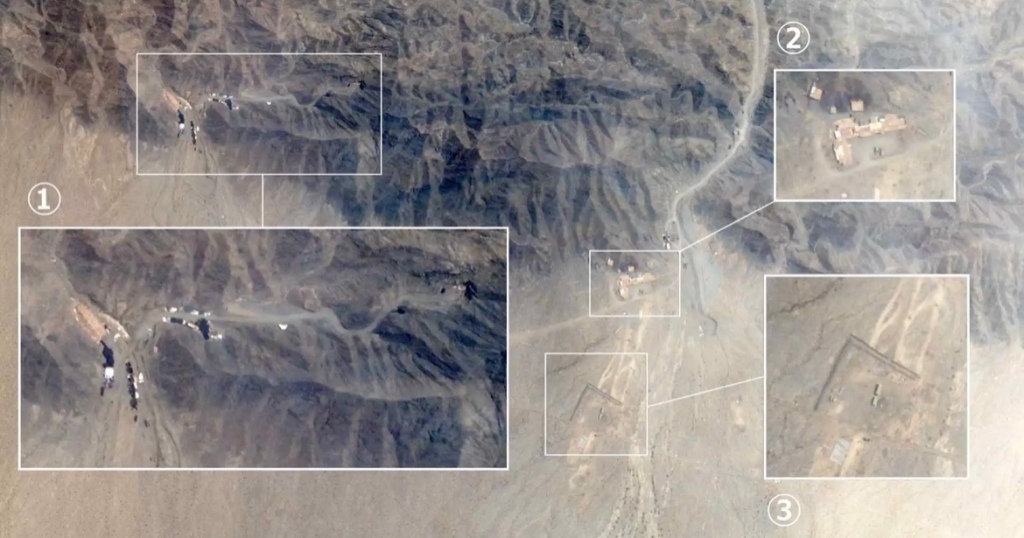
New satellite photos show China is upgrading its nuclear test site in Xinjiang. Image: Twitter

China upgrades nuke test site with an eye on Taiwan

Construction at Lop Nur test site could signal resumption of Chinese nuclear tests as tensions over Taiwan reach new boiling point

by Gabriel Honrada August 9, 2022

Satellite photos obtained by Nikkei last week show that China is rapidly expanding its nuclear test facilities in western Xinjiang, sparking fears of a renewed nuclear arms race with the US as tensions boil over Taiwan.

The Nikkei report states that a satellite hovering at 450 kilometers detected extensive construction at the Lop Nur test site, a dried salt lakebed in the arid and restive Xinjiang region that borders Kazakhstan, Kyrgyzstan, Tajikistan, Afghanistan, and Pakistan.

The report said that China may be building a sixth tunnel for underground testing, evidenced by broken rocks piled nearby and extensive coverings erected on a nearby mountainside. The satellite photos also show power cables, possible storage facilities for high explosives and unpaved roads from command centers.

An unnamed expert from US private geospatial analysis company AllSource Analysis told Nikkei that these developments enable China to conduct nuclear-related tests anytime. The power lines and road system now connect Lop Nur’s western military nuclear test facilities to new possible test areas in the east.

Nikkei suggested that evidence of a sixth test tunnel points to China’s planned resumption of nuclear tests, the last of which was conducted in 1996.

Nobumasa Akiyama, a professor of East Asian security at Hitotsubashi University, told Nikkei that China’s accelerated development of the Lop Nur test site means it intends to deter US intervention in an invasion of Taiwan by threatening the use of small nuclear weapons.

Nikkei also notes that maritime control will be the primary military issue in any invasion of Taiwan. Small nuclear weapons with limited strike capabilities would be sufficient for China to ward off US aircraft carriers. This strategy mirrors that of Russia in Ukraine, with its threat of nuclear escalation used as strategic cover to pursue conventional military operations.While still trailing the US in nuclear weapons strength, experts say China is increasing its capability across the board. Credit: Handout.

The development may be part of China’s more extensive efforts to modernize its nuclear arsenal for a Taiwan scenario. Asia Times has previously reported on other stories regarding China’s nuclear arsenal, including its building of land-based nuclear silos, rail-based nukes, ballistic missile submarines and nuclear-armed stealth bombers at a rapid-fire pace.

Taiwanese and US officials have opined that China may invade Taiwan sooner than anticipated, suggesting dates as soon as 2025, 2027 and 2030.

“By 2025, China will bring the cost and attrition to its lowest. It has the capacity now, but it will not start a war easily, having to take many other things into consideration,” said Taiwan’s Defense Minister Chiu Kuo-cheng in a 2021 article in The Guardian.

General Mark Milley, US chairman of the Joint Chiefs of Staff, noted in a 2021 US Naval Institute (USNI) article that China wants to acquire the military capabilities to invade and hold Taiwan by 2027. His assessment was based in part by Chinese President Xi Jinping’s speech calling for an acceleration of China’s military modernization and capabilities to seize Taiwan.

Moreover, US Director of National Intelligence Avril Haines mentioned in a 2022 CNN articlethat Taiwan faces an acute China threat between the present and 2030, noting that China is working hard to put itself in a military position to take Taiwan over a US military intervention. However, Haines declined to comment on China’s planned timeline for its move against Taiwan.

Internal factors such as flaws in China’s political system, slowing economic growth, and a shirking population may give China an added sense of urgency to strike a decisive blow against Taiwan within an accelerated timeframe.

In a 2022 Taipei Times article, Jerome Keating notes that one-party authoritarian states such as China and Russia are vulnerable to power struggles as their leaders often lack graceful exit strategies as institutionalized in democratic states.

Moreover, he notes that as strongmen leaders get to the top, they make numerous enemies in the process, which gives them a sense of urgency to stay in power for their safety.

Keating mentions Xi had made many enemies during his rise to power and that there had at least been seven attempts on his life. However, he also notes that with no clear successor in sight, settling the Taiwan issue before 2027 would cement his legitimacy and extend his hold on power.

In that connection, China’s slowing economy may give it further incentive to act on Taiwan sooner rather than later. In a 2022 Axios article, Matt Philips notes that economic analysts doubt that China will regain its breakneck economic development as seen in the 1990s and 2000s, which lifted millions of Chinese out of poverty.Chinese President Xi Jinping inspects a joint military exercise in the South China Sea in April 2018. Photo: Xinhua

With limited options to restart economic growth, Philips notes that Xi may have shifted his source of legitimacy from boosting economic growth to a broader sense of national prestige by retaking Taiwan and projecting China’s power on the world stage. 

However, he also cautions that China’s escalation in the Taiwan Strait is not to provide a distraction from its present economic woes, as since 1949 China has always been very sensitive about Taiwan’s international status.

China’s slowing population growth may also weaken its military in the long run, adding another reason for resolving the Taiwan issue before the debilitating effects of demographic decline hit its military. A 2021 Taiwan News article reports that 18% of China’s population is over 60 years old, and there were only 8.5 live births per 1000 in 2020, a massive drop from 18 per 1000 in 1978.

In addition, high living costs and a hyper-competitive education system have forced many Chinese to put off having children, resulting in a significant population decline.

The same source notes that a shrinking manpower pool and Chinese youth’s preference to enter technology rather than military fields has motivated projects to bring aging veterans back to active duty.

In the last analysis, China’s push to accelerate its nuclear weapons program to deter a US intervention in a Taiwan scenario may be driven equally by military and internal factors.

Saturday, August 6, 2022

One miscalculation away from the first nuclear war: Revelation 8

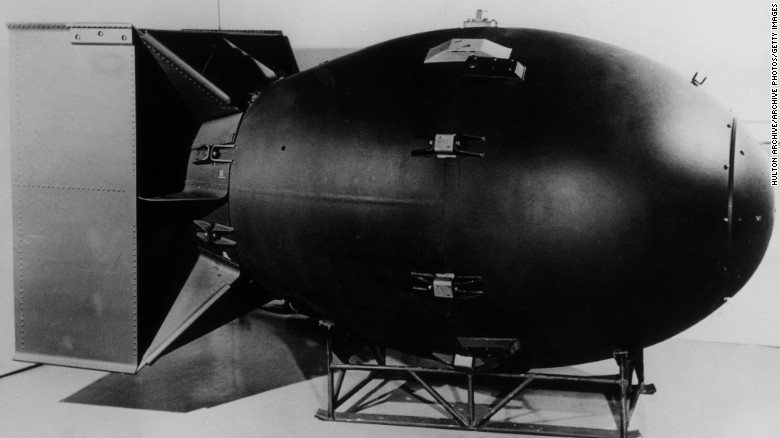
 Side view of the 'Fat Man' atomic bomb, the kind that the US dropped on Nagasaki, Japan, on August 9, 1945, killing thousands of people during the Second World War.

Opinion: One miscalculation away from nuclear holocaust

Opinion by David A. Andelman

Updated 4:17 AM ET, Thu August 4, 2022

David A. Andelman, a contributor to CNN, twice winner of the Deadline Club Award, is a chevalier of the French Legion of Honor, author of “A Red Line in the Sand: Diplomacy, Strategy, and the History of Wars That Might Still Happen” and blogs at Andelman Unleashed. He formerly was a correspondent for The New York Times and CBS News in Europe and Asia. The views expressed in this commentary are his own. View more opinion at CNN.

(CNN)United Nations Secretary-General Antonio Gutteres is hardly a global figure given to panic, or hyperbole for that matter. But rarely has he seemed quite so afraid.

“Humanity is just one misunderstanding, one miscalculation away from nuclear annihilation,” Gutteres said this week. The way he and a growing number of those who think deeply about nuclear issues and their consequences see it, the world is plunging headlong towards potential Armageddon, with little regard to the consequences of their actions, or inaction.

House Speaker Nancy Pelosi seems to have paid little heed to such fears as she moved blithely ahead with her visit to Taiwan in the face of dire warnings from the leadership of mainland China, whose arsenal of 350 nuclear weapons lies just across a narrow strait. And this in the context of bellicose words and actions from Russian President Vladimir Putin on Ukraine and Kim Jong Un’s ongoing nuclear rhetoric and actions in nearby North Korea.

Gutteres’s fears, of course, were broader and deeper than this single Asian flashpoint. He was addressing a world conference of the nations that have signed the Treaty on the Non-Proliferation of Nuclear Weapons — a gathering delayed by two years due to the Covid-19 pandemic.

Side view of the ‘Fat Man’ atomic bomb, the kind that the US dropped on Nagasaki, Japan, on August 9, 1945, killing thousands of people during the Second World War.

Signed on July 1, 1968, by 93 nations, and in force two years later, the treaty now has 191 adherents. Yet never has it seemed more vulnerable, if not more relevant, than today.

The context, as Gutteres observed, was that this year’s conference — the 10th since its signing — “occurs at a time of nuclear danger not seen since the height of the Cold War.”

Indeed, the very foundations of global security that have effectively guaranteed the peace since the explosion of the “Fat Man” plutonium device — the last ever detonated in battle over Nagasaki on August 9, 1945 — have been deeply eroded.

The United States was, and remains, the only nation ever to have detonated a nuclear weapon in a war. The Soviet Union tested its first device four years later.

In July 1959, then-French President Charles de Gaulle sent the Count Alexandre de Marenches, the co-author of our book, “The Fourth World War” to Washington, to ask US President Dwight Eisenhower to give France the secrets that would allow the French to join the nuclear club. Ike politely but firmly declined.

Still, in less than a year, France had exploded its first nuclear device, eight years after the British.

Russia was already en route to equalizing this balance. By the early 1960s, the Kremlin had deployed the first of what would be an arsenal of more than 3,000 nuclear weapons to Ukraine, where some of the first steps toward a Soviet bomb had been taken in Ukrainian institutes located in the now deeply contested cities of Kharkiv and Donetsk. More Soviet weapons then found their way to Belarus and Kazakhstan.

By the mid-1960s, on the western side of the Iron Curtain there were three nuclear powers (the US, Britain and France), on the eastern side, four ostensibily nuclear-armed states, though utterly controlled by the Kremlin. Effectively, there were just two nuclear blocs.

There are many who look back on that era as the good old days of nuclear confrontation — and with good reason. Each side, for decades, possessed enough nuclear weapons — as many as 41,000 for the USSR and 31,000 for the US at their respective peaks — to have utterly obliterated the other side, not to mention all life on earth. This led to the concept of Mutually Assured Destruction (MAD).

Since then, arms control agreements have reduced the size of these arsenals dramatically — to levels still able to incinerate the earth, but without reducing much of the tension. While arsenals have shrunk since the Cold War, the number of countries with nuclear weapons has proliferated.

How is it at all possible to have MAD when you have nuclear weapons in the hands of nine powers? (The countries in question are the US, Britain, France, Israel, Pakistan, India, Russia, China, and North Korea.) Within this group of nations, there are pockets of mutually assured destruction. Some 93% of all the world’s 13,900 nuclear weapons are still controlled by Washington and Moscow.

To a degree, MAD prevails there, and indeed the prospect of mutually assured destruction comprises a good part of what has deterred Pakistan and India from launching their arsenals at each other during any of three Indo-Pakistani wars or other regular confrontations across their contested borders.

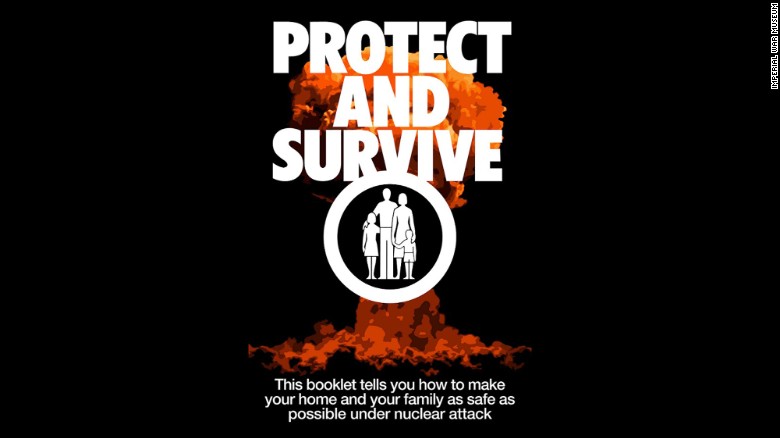
The original cover of the UK government's 1980 guide to surviving a nuclear attack.

The original cover of the UK government’s 1980 guide to surviving a nuclear attack.

A broader threat, though, has only expanded. How likely is it that given some existential challenge, Russia or even China, which arrived in the nuclear club in 1964, might not deploy a weapon of their own? Certainly, Russia has issued such a threat in Ukraine. Just weeks before its invasion of Ukraine, Russia conducted maneuvers with nuclear units, while Putin announced that his nuclear deterrent forces were being placed on a “special regime of alert.”

And then there are the peripheral nuclear powers. While most of the world has been preoccupied with Ukraine, Taiwan, and terrorist leaders in Afghanistan, North Korea has continued to launch missiles and threaten new rounds of nuclear tests. On Victory Day last month, Kim Jong Un warned he was “ready to mobilize” his nuclear deterrent.

Finally, we are potentially within weeks of a new round of escalations, this time involving Iran. Though Secretary of State Antony Blinken has embraced a return to the conference table to restore the nuclear accord that was restraining Iran’s headlong dash toward a nuclear weapon, there is little real evidence Iran is prepared to agree.

Indeed, on Monday the Biden administration unveiled a new round of sanctions targeting “illicit” support of the Iranian oil industry, which is already under crushing sanctions. And there are indications that the “breakout time” — the time needed for Iran to produce enough fissile material for a nuclear weapon — has shrunk to near-zero.

Should Iran test or even exhibit the capacity to test a nuclear weapon, its arch enemy Saudi Arabia has already indicated it will do all within its power to deploy its own. Indeed, it has fostered close relations with the nuclear programs of Pakistan and with China, whose appetite for foreign sources of oil knows few bounds.

It is hardly surprising that the UN Secretary-General has waxed so pessimistic. The speeches that followed his opening of the non-proliferation conference seemed scarcely calculated to return the genie to its nuclear bottle.

Blinken charged in his speech at the same conference that Russia is “engaged in reckless, dangerous nuclear saber-rattling” in Ukraine, while North Korea “is preparing to conduct its 7th nuclear test.” And as for Iran, it “remains on a path of nuclear escalation.”

“To escape the logic of fear,” Blinken concluded, should be the most immediate mission of all nations who’ve agreed to restrain the proliferation of nuclear arms.

Somehow, though, an even more worthwhile objective might just be for the world to find a way to turn back the clock from 2022 to 1962 or even 1982. These were terrifying years when, innocently, we practiced weekly duck-and-cover exercises under our little wooden desks in kindergarten, dug home fallout shelters in our backyards against an imminent nuclear attack.

But those very real and immediate threats led the nightly news, consumed the global dialogue, motivated every action by every world leader who understood that nuclear arms were, and should be, at the very top of priorities. They no longer are.

It is this fear that is at the heart of the Secretary-General’s pessimism — and should be at the heart of all of us

Thursday, August 4, 2022

Threats of the First Nuclear War: Revelation 8

Threat of nuclear war

The rising tensions among nuclear-armed states could lead to a nuclear war

Any misunderstanding amid rising tensions among nuclear-armed states could lead to a nuclear war, and several prominent figures around the world, including UN Secretary General Antonio Guterres, are warning that rhetoric and aggression needs to be brought in check to prevent such an eventuality.

He was speaking at the 10th review conference of the Non-Proliferation Treaty (NPT), which has largely failed to meet its objectives since India, Pakistan, North Korea, and allegedly Israel managed to go nuclear since it was signed, while South Africa built and willfully dismantled a nuclear weapons programme since the NPT first came into being. Guterres singled out Russia for “its dangerous nuclear rhetoric and behaviour” as he noted that the world faced “a nuclear danger not seen since the height of the Cold War.” He also noted how “extraordinarily lucky” humanity has been that such a misunderstanding or miscalculation has not already happened, before going on to say that luck should not be a strategy and arguing that a world free of nuclear weapons would be safer than a world which uses them as “a shield from geopolitical tensions.”

There is evidence to back up the statement including the events around the Cuban Missile Crisis, several false alarms that were resolved only due to cool-headed political figures and military officers, or the dozens of ‘missing’ nuclear weapons around the world. The US, for example, has at least six nuclear weapons unaccounted for, and some Soviet-era sources have claimed that about 100 nuclear weapons of varying yields may have gone missing during the fall of the Soviet Union.

However, the last NPT moot in 2015 yielded no substantive agreements on how to restrict the proliferation of nuclear weapons or expanding recognition as nuclear weapons states to Pakistan and India, which have been responsible actors since making their nuclear capabilities known.

Without fully involving the known players, any efforts to eventually move towards denuclearisation will remain futile — the five permanent UN Security Council members, who are all military powerhouses and also the only ‘recognised’ nuclear powers, cannot expect the rest of the world to blindly accept their open hypocrisy as they continue to hold enough weapons to destroy the world many times over, while punishing smaller nations that believe nuclear weapons are the key to a secure existence.

Published in The Express Tribune, August 3rd, 2022.

Like Opinion & Editorial on Facebook, follow @ETOpEd on Twitter to receive all updates on all our daily pieces.

Wednesday, August 3, 2022

China Is Expanding Her Nuclear Horn: Daniel 7

China Is Expanding Nuclear Test Facilities; New Satellite Images Reveal Dragon’s Dangerous Plans

August 2, 2022

The latest satellite images reveal that China is expanding its nuclear test sites in the Xinjiang Uyghur Autonomous Region, including erecting a facility that could be used to store explosives.

In its latest report, the Nikkei has reviewed the latest satellite images with several experts that seem to affirm China is enhancing its nuclear testing capability. The satellite images show new development and expansion of China’s nuclear test facilities in the Xinjiang Uyghur Autonomous Region.

The new evidence was discovered by the satellite at China’s Lop Nur nuclear test site southeast of Western China’s Xinjiang Uyghur Autonomous Region. Many experts think the People’s Liberation Army is responsible for protecting the covert nuclear testing site.

According to the report, extensive coverings have been constructed on a mountainside in this arid region and the broken rocks piled nearby are thought to prove that a new “sixth tunnel” for testing has been dug out nearby.

Recent construction includes power transmission cables and a facility that could be used to store high explosives. The images also showed that several unpaved white roads branch off a command post.

An expert at AllSource Analysis, a US private geospatial company, said that China could undertake nuclear-related tests anytime, especially considering the electricity line and road network that now joins Lop Nor’s western military nuclear test facilities to new prospective test sites in the east.

China is expanding its nuclear arsenal to establish itself as the world’s dominant power. In 2021, a pentagon report outlined many developments, including Beijing’s “large-scale expansion of its nuclear forces,” which could seriously threaten the US. 

The Pentagon has previously issued similar warnings. The Pentagon’s 2020 report on China’s military revealed that Beijing’s arsenal of nuclear warheads would have at least doubled by the decade’s end.

However, the recent report contains a more urgent warning: according to the Pentagon, China “has accelerated its nuclear expansion” and is “exceeding the pace and size the DoD projected in 2020.” Military vehicles carrying the DF-17 hypersonic ballistic missile roll past Tiananmen Square during a parade in Beijing in October 2019.

The communist country, however, faces many difficulties in its quest to catch up to the US. The Chinese Communist Party, according to President Xi Jinping, “rules east, west, north, and south,” which implies that it has control over the PLA. 

The latest report highlighted that China’s military leadership is still corrupt and nepotistic. The Sino-Vietnamese War of 1979 was the PLA’s previous significant experience in actual combat.

The Xi administration may be thinking about forcibly annexing Taiwan. Even the possibility of Nancy Pelosi, the speaker of the US House of Representatives, visiting Taiwan has drawn a grave threat from Beijing. Chinese officials might consider this potential visit an invasion and take drastic military action.

But given the severe flaws in the quality of Russian military hardware, the Russian invasion of Ukraine has served as a stark reminder of the dangers of military actions. Over 66% of China’s imported military hardware comes from Russia.Courtesy: Nikkei

Sixth Tunnel On Its Way?

Beijing stopped conducting explosive tests in the area a quarter century ago. The country has conducted five underground nuclear tests at Lop Nur, the last being in 1996. The latest report highlighted the evidence of a planned resumption, including excavating the sixth tunnel.

Tenders requested from the area contain some convincing evidence as well. An official Chinese procurement website issued a request for proposals in April for “10 radiation dose alarms,” “12 protective suits,” and “one wound site taints detector,” the report revealed. 

The Xinjiang Uyghur Autonomous Region has no nuclear power plants, but the XPCC stated that it will “start strengthening the capacity to monitor radioactivity in 2022.” In the area, there has been a rise in the purchase of related equipment.

In October 2020, satellites found fresh evidence of Lop Nur’s terrain leveling work. The report noted, “Big trucks came and went in 2021, and the power infrastructure for the sixth tunnel was built in the first half of 2022.” The construction work of the explosive storage facility was completed in June 2022. 

Alongside these developments, excessive radiation levels were seen in the area. Nearby, a new underground facility was discovered that could be employed to launch nuclear missiles, the report added. File Image; China’s YJ-18 anti-ship cruise missile.

Why Is China Expanding Its Nuclear Facility?

China worries that the US, which has a more powerful triad and more nuclear weapons, could launch a preemptive attack on its nuclear arsenal and launch capabilities, leaving China without sufficient defenses. 

This has driven Beijing to seek out more weapons and delivery systems to have enough to withstand an attack and get past US missile defenses.

Also, maritime control will be the primary concern in a Taiwan Strait emergency. China may be able to keep US aircraft carriers at bay with the help of small nuclear weapons with limited strike power.

Although the US has not yet taken a direct part in the conflict in Ukraine, some analysts contend that the potential use of nuclear weapons has made Washington even more cautious about getting involved. China is undoubtedly aware of this line of thinking.

The expansion of China’s nuclear arsenal may be the most obvious sign of the country’s combat readiness. Still, it’s only one part of a more extensive buildup that worries military leaders and decision-makers worldwide.

Trouble Before the First Nuclear War: Revelation 8

New Nuclear Troubles in Southern Asia?

While China, India, and Pakistan have long had competitive and often antagonistic relationships, the significant transformation of each nation’s nuclear capabilities over the past decades now complicates—and in some ways mitigates—their geopolitical rivalries. How have the nuclear transformations in the region fostered stability amid heightened risk? And what do these ongoing changes mean for the ever-intricate web of global competition and alliances?

Join Carnegie for the launch of Ashley J. Tellis’ new report “Striking Asymmetries: Nuclear Transitions in Southern Asia” which studies the implications of China’s dramatic nuclear expansion, Pakistan’s striking diversification of its nuclear arsenal, and India’s slow nuclear modernization. Featuring Ashley J. Tellis, Rabia Akhtar, Rakesh Sood, and Tong Zhao, moderated by Evan A. Feigenbaum.

Sunday, July 31, 2022

Hybrid Warfare: A New Face Of Conflict before the First Nuclear War

 Flags of India and Pakistan

Hybrid Warfare: A New Face Of Conflict In South Asia – OpEd

July 29, 2022

Flags of India and Pakistan

Hybrid warfare or hybrid threat seems to be the emerging modality in the changing nature of warfare. In the nuclear era, more attention has been given to the sub-conventional conflicts, because of the lethality of the nuclear weapons; the deterrence being created by the nuclear-weapon states prevents other nuclear-weapon states to wage a total war. Furthermore, international legal bindings of prohibiting the use of nuclear weapons against non-nuclear-weapon states eliminate the probability of an all-out war. Thus, the thrust of war has been envisioned by revisionist actors in the form of a new kind of warfare, predominantly through cyber-attacks and subversion, fake news campaigns, sponsoring of proxy forces, or even through economic blackmail. Hybrid warfare is a challenge, which brings into play an array of tactics and strategies thereby inflicting harm to the adversary, whilst exploiting the revolution in technological affairs. It targets the vulnerabilities of any society, with the aim to divide and dissuade the population, undermines the key institutions, and even deteriorates the bond between the states and international organizations. In a nutshell, hybrid warfare is a full-spectrum of war, which encompasses both physical and psychological aspects of the adversary.

Pakistan has also been the victim of hybrid warfare. Since its inception, India has been trying to wage a war or indulge in a conflict with Pakistan, in one way or the other. India is sparing no effort to target Pakistan at the domestic level which encompasses all the political, social, economic, and religious factors. In this regard, it has been leaving no stone unturned in defaming and maligning Pakistan in the international arena through its fake propaganda. Pakistani society is an amalgam of ethnic groups, sectarian faction, and cultural blocs, that are being exploited by India and used as a fault line as a grey-zone in conflict. India is operating a radicalized militant group in Pakistan and is fueling the unrest in Baluchistan. In pursuit of this, Afghanistan’s land is being exercised by India in its endeavor to destabilize Pakistan by operating terrorist organizations for launching sub-conventional warfare inside Pakistan.

Considering the spillover of untrue and fallacious information, the complexity of warfare has tremendously being increased. India is involved in various operations against Pakistan in order to defame and discredit the country, in its pursuit to isolate it internationally as well. Its conspiracy of defaming and maligning Pakistan has also been put out in the EU DisinfoLab Report of 2020. According to that report, India is operating the largest ever fake media network, with 750+ fake media websites, and resurrecting the dead scholars, and propagating the false news in the international media. Moreover, it misused the politicians who genuinely want to defend human rights, and provided platform to far-right politicians when convergent objectives were pursued.

Moreover, India is also keenly involved in terrorists and separatist activities, and trying its level best to sabotage the economic project of Pakistan- the China-Pakistan Economic Corridor (CPEC), which certainly is a headache to the adversary. India is using a variety of subversive tactics of hybrid warfare, in order to destabilize Pakistan both externally and internally. Pakistan has encountered many security challenges successfully but has been prone to the non-traditional security challenge-the hybrid warfare, waged by India. Therefore, in the contemporary state of affairs, Pakistan must identify and efficiently counter the gradually escalating non-traditional threats such as the hybrid threats.

There is a need to pen down a grand strategy for countering all the traditional and non-traditional threats posed by the adversary. Pakistan needs to devise a comprehensive strategy to counter the aggression of hybrid warfare. It is appropriate for Pakistan to develop Hybrid Warfare and Stratagem Centre, with its aim to address policymakers of the threats posed by the hybrid warfare, develop metrics to get a grip on events, and to make them susceptible of the threats and cognizance for curbing them in the future. Media, on the other hand, is seen as one of the lethal and a sophisticated weapon to target the enemy’s will and exploit its weaknesses. It is used to target the opponent population by changing their perception regarding their government. Therefore, media has to play a pivotal role in curbing the fake news propaganda and misinformation, as it is the most significant tool used in propagating bogus information; besides, media should strictly promote Pakistan’s narrative in fighting against this ubiquitous threat. 

Furthermore, the law enforcement agencies should work in coordination with each other and should be properly trained and equipped to fight against this abstract threat, additionally, they should be able enough to smartly utilize Artificial Intelligence as well. The government must provide adequate awareness and vigilance to the local population of the country, in order to make them aware of the actions and ill-will of the adversary in its attempt to dissect the society, as the objective is to target the common people. Hence, the cautious and observant society is the first and foremost step in the line of defense against this new challenge, and the entire country needs to play the crucial role in curbing the spiteful act of the foe.

Thursday, July 28, 2022

Pakistan: The Nuclear Horn without a Stable Economy

Pakistan: The Nuclear Power without a Stable Economy

Pakistan: The Nuclear Power without a Stable Economy

Islamabad [Pakistan], July 24 (ANI): Pakistan may have nuclear capabilities however the country is fighting with its fast exhausting foreign currency reserves, a declining rupee, and widening fiscal and current account deficits, along with a rupee that has lost almost 20 per cent of its value in just 7 months since January 2022.

State Bank of Pakistan’s reserves has fallen to as low as USD 9.32 billion, hardly enough to pay for 45 days of imports. The red line for SBP foreign currency reserves is USD 7.5 Billion to avoid “default”.

Pakistan’s political instability threatens to derail efforts to regain the confidence of key lenders. The country’s currency endured its worst week in more than two decades, reflecting investors’ worries that the country risks following Sri Lanka to become the next emerging economy to default on foreign repayments.

The emerging-market currencies are feeling the heat as the hawkish Federal Reserve lures capital toward the United States. Nope The panic in Pakistan’s stock and money market also comes from escalating risks after former prime minister Imran Khan’s by-polls win added to concern over the country’s bailout deal with the IMF, which it needs to avoid a default.

As per reports and trends the dollar is going out of control in Pakistan and the traders are in panic in the market that the rupee may go down further.

In a desperate move to avert default, the federal cabinet approves an ordinance to sell state resources. The government has approved an ordinance to bypass all procedures involved in the sale of state assets and abolished the regulatory checks through the ‘Inter-Governmental Commercial Transactions Ordinance 2022’.

The move is being seen as a desperate attempt to save the country from default through the emergency sale of the state’s assets to foreign countries. However, President Arif Alvi has not signed the ordinance yet.

The federal cabinet approved the ordinance on Thursday to sell stakes in oil and gas companies and government-owned power plants to the UAE to raise USD 2 billion to USD 2.5 billion to avoid the looming default. The UAE had in May refused to give cash deposits due to Pakistan’s failure to return previous loans and instead asked to open its companies for investment.

Top Economics and Commerce experts say that the IMF agreement is a critical step toward unlocking external financing that Pakistan needs to avoid a default.

The Red Line For SBP Foreign Currency Reserves is USD 7.5 Billion to avoid ‘default’. If UAE and Saudia or even Chinese withdraw its USD 2.3 billion; Pakistan’s Economy will be collapsed.

On July 15, the foreign currency reserves held by the State Bank of Pakistan were recorded at USD 9.32 billion, down USD 389 million compared with USD 9.71 billion on July 7, 2022.

State Bank of Pakistan’s foreign exchange reserves fell to single digits despite a USD 2.3 billion inflow from China late last month. Central bank’s foreign exchange reserves are expected to improve after the receipt of USD 1.17 billion from the global lender.

In the week ended August 27, 2021, the foreign exchange reserves held by the central bank soared to an all-time high of USD 20.15 billion after Pakistan received a general allocation of Special Drawing Rights (SDRs) worth USD 2,751.8 million from the IMF. (ANI)On Friday morning, the rupee was trading at 232 per dollar, having closed Friday at 228.37 in interbank; after Fitch Ratings revised its outlook for Pakistan’s sovereign debt from stable to negative – though it affirmed the Long-Term Foreign-Currency (LTFC) and Issuer Default Rating (IDR) at “B-“.

Country’s Finance Minister Miftah Ismail said the panic was due to political turmoil and not over economic fundamentals. Pakistani economist Atif Mian analyses how the Pakistani rupee has lost 20 per cent of its value and that the key issue will be “rationing”, in the short run.

“The dollar is going out of control and the traders are in panic in the market, I fear the rupee will go down further,” said Secretary-General of the Exchange Companies of Pakistan Zafar Paracha expressing concerns.

Pakistan’s central bank has hiked its key interest rate to 15% to curb inflation, which hit 21.3% in June.

Ismail, told a news conference in Islamabad, referring to the shortfall in foreign reserves, “we think that we will get USD 1.2 billion in deferred oil payment from a friendly country; we think that a foreign country will invest between USD 1.5 to USD 2 billion in stocks on a G2G (government-to-government) basis, and another friendly country will perhaps give us gas on deferred payment and another friendly country will make some deposits.”Finance Minister said the country will also get around USD 6 billion from the World Bank and the Asian Development Bank in FY 2022-2023.

He said that the country needs USD 41 billion in foreign exchange over the next 12 months. “We have to repay USD 21 billion loans, need USD 12 billion current-account deficit financing and another USD 8-09 billion to maintain foreign exchange reservesavoid a default.” (ANI)

Sunday, July 17, 2022

The Pakistan Horn’s Coming Collapse Should Worry the World: Revelation 8

Pakistan’s Coming Collapse Should Worry the World

Russia’s invasion of Ukraine sent economic shockwaves across not only Europe but also the broader Middle East. Pakistan, whose economy is already weak because of decades of corruption, mismanagement, and unstable governance, has been particularly vulnerable. While many countries are dependent upon Ukrainian or Russian wheat or foreign energy imports, Pakistan requires both. Between July 2020 and January 2021, for example, Pakistan was the third-largest consumer of Ukrainian wheat exports after Indonesia and Egypt. The price spike in oil prices has hit Pakistan hard, driving up the cost of its imports by more than 85 percent, to almost $5 billion, just between 2020 and 2021.

For Pakistan, it is a perfect storm. At the end of Pakistan’s fiscal year on June 30, 2022, its trade deficit neared $50 billion, a 57 percent increase over the previous year. Had the Shehbaz Sharif government not banned the import of more than 800 non-essential luxury items in May 2022, the figure might have been even higher.

Even the middle class is unable to keep up with inflation. In June, inflation soared to over 20 percent, the highest in the recent past. An International Monetary Fund-directed end to subsidies has caused both the price of electricity and gas to soar, even beyond the hike caused by the rise in oil prices worldwide. Food insecurity is rife. According to the State Bank of Pakistan, “reliance on imports for edible oil and oilseed meals to meet domestic demand consumption has been increasing over the past two decades: 86 percent of domestic edible oil consumption in 2020 came from imports up from 77 percent in 2000.” Population growth is only increasing the need for imports as domestic projects to produce soybean and palm oil falter.

Meanwhile, the Pakistani rupee continues to hemorrhage value when compared to the U.S. dollar, off more than 30 percent over the past year. In contrast, the Indian rupee has slid just over six percent. The decline in the Pakistani rupee hurts the middle class especially and all those unable to dollarize their saving. Wealthier households and the affluent invest in lucrative real estate dealings instead of activity that could generate not only rent-seeking income but also employment.

Yusuf Nazar, a former chief strategist at Citigroup’s emerging markets division, estimatesthat Pakistan’s foreign exchange reserves have dropped by half since February to just $6.3 billion, akin to what Iran suffered under the so-called “maximum pressure” campaign. For Pakistan, however, the dramatic decline is of its own making: According to Nazar, Pakistan has received more International Monetary Fund (IMF) bailouts than any other country. This shows the unwillingness or inability of the Sharifs, Bhuttos, and Khans to implement serious reform.

International patience has worn out. The IMF no longer trusts Pakistani promises to reform, and is unwilling to throw good money after bad. Islamabad’s unwillingness to conduct reforms demanded by the Financial Action Task Force (FATF) underlines how intertwined the Inter-Services Intelligence agency is with the murkier aspects of Pakistani finance.

Efforts by some Pakistani liberals to relaunch the stalled Trade and Investment Framework Agreement with the United States have gone nowhere, especially given Washington’s concerns with poor Pakistani regulatory practices, supply chain management, data protection, and intellectual property rights.

One of the reasons successive Pakistani leaders avoided reform was that they believed it easier to accept the fairytales spun by China. Far from being an economic savior for Pakistan, however, it is now clear that Beijing used the China-Pakistan Economic Corridor (CPEC), foolishly acceded to by Sharif’s brother Nawaz, as a mechanism to enslave Pakistan. “Our friendship is higher than the Himalayas and deeper than the deepest sea in the world and sweeter than honey,” he said in words that most Pakistanis today rue. Instead of promoting growth in Pakistan, the CPEC has become a liability for Islamabad. Sovereign counter guarantees to Chinese independent power producers eat up the Pakistani government’s revenue, even as Pakistan continues to face lengthy power outages. CPEC project implementation is sporadic even though, for the last four years, Pakistan is the world’s largest recipient of Chinese grants and assistance.

The World Bank has warned that Pakistan could soon face “macroeconomic instability.” Societal instability would soon follow. Pakistan’s private sector has not created enough jobs to absorb the labor pool. Anger is reaching the boiling point, and growing criminality hints at societal breakdown.

Sri Lanka’s collapse worries the region, but Pakistan’s collapse should worry the world. For decades, state failure in Pakistan has been a nightmare scenario. Both Pakistan and the broader world have had a taste of that scenario as violence, extremism, and poverty engulf the former capital and commercial hub of Karachi and as Pakistani authorities lose control over many regions alongside the Afghanistan border. The United States, India, and Iran are right to worry about the security of Pakistan’s nuclear arsenal, as military officers also begin to struggle to get by. Pakistani elite live in a state of denial believing that the status quo in which they live an affluent life insulated from broader society is permanent. It is not. The bubble is collapsing, and the result will not be pretty.

Michael Rubin is a senior fellow at the American Enterprise Institute.

Image: Reuters.

Saturday, July 16, 2022

India’s ‘Accidental’ Firing of a Missile Into Pakistan Will Trigger the First Nuclear War: Revelation 8

india fires missile attack pakistan

India’s ‘Accidental’ Firing of a Missile Into Pakistan Is Serious Cause for Alarm

The Indian government acknowledged on Friday that it fired a missile into neighboring Pakistan earlier this week, attributing the incident to “a technical malfunction.”

Russia’s invasion of Ukraine is consuming the bandwidth of world leaders. But the potential for rapid escalation between India and Pakistan — two nuclear-armed neighbors that have fought three wars — is a serious cause for concern. 

India Fires ‘World’s Fastest’ BrahMos Missile Into Pakistan

On Thursday, Pakistan’s military spokesman Major General Babar Iftikhar said that a “high-speed flying object” originating from India fell approximately 80 miles inside Pakistani territory the previous evening. Iftikhar described the projectile as “a supersonic flying object, most probably a missile” that “was certainly unarmed.”

The missile destroyed a home in the Pakistani city of Mian Channu, but does not appear to have caused any loss of life.

india fires missile into pakistan brahmos
On Wednesday, March 9, 2022, India reportedly fired the BrahMos supersonic cruise missile into neighboring Pakistan. New Delhi claims the incident was an accident. (Image Credit: Government of India)

Indian news outlets, citing unnamed government sources, report that the object was a BrahMos supersonic cruise missile, which is co-developed by New Delhi and Moscow. Russia is India’s largest foreign supplier of arms and India is one of Russia’s closest allies. India’s Defense Research and Development Organization (DRDO) partnered with Russia’s rocket design firm NPO Mashinostroyeniya, which was sanctioned by the Obama administration in 2014 and hit with additional sanctions earlier this month.

BrahMos is a medium-range, supersonic cruise missile that can be launched by air, land, or sea — including submarine and warship platforms. The missile that entered Pakistan may have been launched from a specialized truck. It can travel faster than the speed of sound and, by some accounts, is the world’s fastest cruise missile.

The BrahMos missile is not publicly acknowledged to be a nuclear-capable missile, though whether it remains capable of carrying just conventional payloads has become more ambiguous in recent years.

Four Reasons Why the Indian Missile Fired at Pakistan is a Big Deal

1) India and Pakistan Are Nuclear-Armed Adversaries

India and Pakistan are nuclear powers. Both have fought three (some say, four) wars against one another.

The two countries have come close to war numerous times after becoming declared nuclear powers in 1998. 

The most recent crisis Indo-Pak crisis was in February 2019 after India — claiming to respond to a suicide attack on its forces in Pulwama, Kashmir — conducted airstrikes hitting an unpopulated area in Balakot, located in northern Pakistan. The next day, the Pakistan Air Force shot down an Indian fighter jet, capturing a pilot, Wing Commander Abhinandan Varthaman.

India and Pakistan have established channels of communication to prevent and manage crises. These include a hotline used to inform one another of nuclear missile tests. 

But this incident could indicate deficiencies in India’s military command — deficiencies that could have catastrophic effects in an actual crisis.

On Friday, an unnamed senior Pakistani security official said that this week’s missile firing raises concerns that India had “missiles in ready-to-launch positions and pointed at Pakistan, and that too without any safeguard of a command and control system.” Others in Pakistan are speculating that the missile launch was no accident — that India was probing for weaknesses in Pakistan’s air defense, exploiting the world’s focus on Ukraine.

2) Potential for Mass Civilian Deaths

The Indian missile reportedly damaged or destroyed a home in the small city of Mian Channu, though it does not appear to have caused any casualties. While the missile was not deployed with a warhead, it could have caused catastrophic damage if it struck an airplane or a more densely populated area. 

According to the Pakistani Air Force’s Air Vice Marshall Tariq Zia, the missile traveled in the vicinity of a civilian air route that was actively being used by two commercial airlines and at roughly the same elevation.

3) India Didn’t Acknowledge the Missile Firing For Two Days

The “accidental” missile launch took place on Wednesday, but the Indian government only acknowledged it publicly on Friday — a brazen lack of seriousness given the potential for nuclear escalation with neighbor Pakistan.

India’s News 9 reports that officials in New Delhi contacted their Pakistani counterparts “immediately” after the firing of the missile, though these claims have not been corroborated by the Pakistani media or government officials.

Sushant Singh, a former Indian army officer, writes that Pakistani officials have said that the bilateral hotline at the director-general of military operations level was not utilized by India to inform the other side of the missile launch. And he notes that Indian officials have yet to dispute this Pakistani claim.

4) Hindu Nationalists Promote Disinformation During Potential Crisis

Not only did India not publicly acknowledge the Pakistan missile strike, but Hindu nationalist or Hindutva elements linked or sympathetic to the Indian government actively promoted disinformation on the incident. 

On Thursday, OpIndia, a right-wing website linked to India’s Hindu nationalist Bharatiya Janata Party, claimed that the Pakistani allegations were conjured to deflect attention from political turmoil at home. India is the world’s largest disseminator of fake news

Its fake news ecosystem went into overdrive during the 2019 Balakot crisis, falsely claiming that it shot down a Pakistani F-16. This disinformation was propagated not just by right-wing media outlets in India, but also by its mainstream news channels. New Delhi could leverage its fake news ecosystem to mobilize public support for a war fought on a false premise.

Thursday, July 14, 2022

The Pakistani Horn Will Modernize Nuclear Arsenals In Worrying Trend: Revelation 8

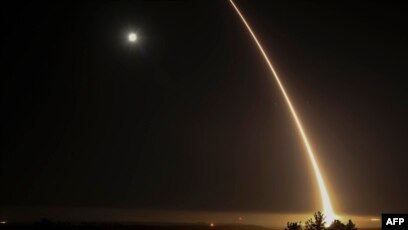
A streak of light trails off into the night sky as the U.S. military test-fires an unarmed intercontinental ballistic missile at Vandenberg Air Force Base, northwest of Los Angeles, California, in 2017.

A streak of light trails off into the night sky as the U.S. military test-fires an unarmed intercontinental ballistic missile at Vandenberg Air Force Base, northwest of Los Angeles, California, in 2017.

June 12, 2022

Global Powers Likely To Bolster, Modernize Nuclear Arsenals In ‘Worrying Trend,’ Report Says

The nine nuclear-armed states, including the United States and Russia, are likely to grow and modernize their arsenal of warheads and to be more vocal about it in the coming decade in what is seen as a “worrying trend,” an influential think tank says in its latest annual study.

The Stockholm International Peace Research Institute (SIPRI) said on June 13 in its annual report for 2022 that despite a marginal decline in the number of nuclear warheads last year, arsenals are expected to grow over the next 10 years.

“The nine nuclear-armed states — the United States, Russia, the United Kingdom, France, China, India, Pakistan, Israel, and (North Korea) — continue to modernize their nuclear arsenals and although the total number of nuclear weapons declined slightly between January 2021 and January 2022, the number will probably increase in the next decade,” SIPRI said.

“There are clear indications that the reductions that have characterized global nuclear arsenals since the end of the Cold War have ended,” said Hans Kristensen, associate senior fellow with SIPRI’s Weapons of Mass Destruction Program and director of the Nuclear Information Project at the Federation of American Scientists (FAS).

Wilfred Wan, director of SIPRI’s Weapons of Mass Destruction Program, said that “all of the nuclear-armed states are increasing or upgrading their arsenals and most are sharpening nuclear rhetoric and the role nuclear weapons play in their military strategies.”

“This is a very worrying trend,” he added.

SIPRI estimated that nuclear states had a total inventory of 12,705 warheads at the start of 2022, of which about 9,440 were in military stockpiles ready for potential use.

It said an estimated 3,732 warheads were deployed on missiles and aircraft, with about 2,000 being kept in a state of high operational alert — almost all of them belonging to Russia or the United States.

Total U.S. and Russian warhead inventories continued to decline in 2021, but SIPRI added that this was mainly due to the dismantling of warheads that had been retired from military service in past years.

The two powers hold an estimated 90 percent of all nuclear weapons, SIPRI said.

It said that as of January 2022, the United States had 1,744 deployed warheads out of a total inventory of 5,428.

Russia had 1,588 deployed warheads out of a total inventory of 5,977.

The other seven nuclear-armed states are either developing or deploying new weapon systems or have announced intentions to do so, with China specifically in the middle of a substantial expansion of its nuclear arsenal.

Neighbors and bitter rivals Pakistan (165 total inventory) and India (160) have similarly sized arsenals, according to SIPRI.

Wednesday, July 13, 2022

What will happen with the First Nuclear War: Revelation 8


Nuclear explosion created by American atomic bomb.
Researchers have simulated what would happen in a nuclear war. (Getty Images)

‘Temperatures drop, crops die, oceans freeze’: What would happen in a nuclear war

Mon, July 11, 2022, 7:18 AM

Temperatures would plunge in a bigger shift than the last Ice Age and crops would fail around the world after nuclear war erupted, a study has shown.

The after-effects would be long-lasting with oceans taking hundreds of years to recover, and fishing devastated, the researchers warn.

Professor Cheryl Harrison, of Louisiana State University, said: “It doesn’t matter who is bombing whom. It can be India and Pakistan or NATO and Russia. Once the smoke is released into the upper atmosphere, it spreads globally and affects everyone.”

In all the simulated scenarios, nuclear firestorms would release soot and smoke into the upper atmosphere that would block out the Sun, resulting in crop failure around the world.

In the first month following a nuclear exchange, average global temperatures would plunge by about seven degrees Celsius, a larger temperature change than in the last Ice Age.

Ocean temperatures would drop quickly and would not return to their pre-war state even after the smoke clears.

As the planet gets colder, sea ice expands by more than six million square miles and six feet deep in some basins, blocking major ports including Beijing’s Port of Tianjin, Copenhagen and St. Petersburg.

The sudden drop in light and ocean temperatures, especially from the Arctic to the North Atlantic and North Pacific oceans, would kill the marine algae, which is the foundation of the marine food web, essentially creating a famine in the ocean.

This would halt most fishing and aquaculture.

The researchers simulated what would happen to the Earth’s systems if the US and Russia used 4,400 100-kiloton nuclear weapons to bomb cities and industrial areas, which resulted in fires ejecting more than 330 billion pounds of smoke and sunlight-absorbing black carbon into the upper atmosphere.

They also simulated what would happen if India and Pakistan detonated about 500 100-kiloton nuclear weapons resulting in 11 billion to 103 billion pounds of smoke and soot into the upper atmosphere.

Co-author Alan Robock, distinguished professor in the Department of Environmental Sciences at Rutgers University in New Jersey, said: “Nuclear warfare results in dire consequences for everyone.

“World leaders have used our studies previously as an impetus to end the nuclear arms race in the 1980s, and five years ago to pass a treaty in the United Nations to ban nuclear weapons.

“We hope that this new study will encourage more nations to ratify the ban treaty.”

The study shows the global interconnectedness of Earth’s systems, especially in the face of perturbations, whether they are caused by volcanic eruptions, massive wildfires or war.

Harrison said: “The current war in Ukraine with Russia and how it has affected gas prices, really shows us how fragile our global economy and our supply chains are to what may seem like regional conflicts and perturbations.”

Volcanic eruptions also produce clouds of particles in the upper atmosphere and have induced sudden changes in climate at various points throughout history.

Harrison said: “We can avoid nuclear war, but volcanic eruptions are definitely going to happen again. There’s nothing we can do about it, so it’s important when we’re talking about resilience and how to design our society, that we consider what we need to do to prepare for unavoidable climate shocks.

“We can and must, however, do everything we can to avoid nuclear war. The effects are too likely to be globally catastrophic.”

Tuesday, July 12, 2022

What would happen to us at the first nuclear war? Study responds Revelation 8


What would happen to us if a nuclear war breaks out? Study responds – Science – Life

Zach1 day ago

Even though the world has been ravaged by two world wars, a cold war and a hundred-year war, Nuclear weapons have not been fired at civilians since 1945.

Ever since the United States was globally condemned for the atomic bombs dropped on Hiroshima and Nagasaki, the world has remained relatively peaceful regarding nuclear wars, despite major threats between the Western and Eastern blocs. 

It doesn’t matter who bombs who. It can be India and Pakistan or NATO and Russia.

But, What would happen if one of these days one breaks out? The study ‘A new oceanic state after nuclear war’, made by Louisiana State University (LSU, for its acronym in English), wanted to answer the question once and for all. We tell you what they discovered.

(Also read: This is the extinct sea monster recently discovered in Villa de Leyva).

How was the study carried out?

To perform the analysis, LSU Department of Oceanography and Coastal Sciences Assistant Professor Cheryl Harrison and co-authorsconducted multiple computer simulations to study the impacts of nuclear war in different regions. 

It should be noted that, according to the Stockholm International Peace Research Institute, nine nations currently control more than 13,000 nuclear weapons in the world, a very high number compared to the two countries that stood out in the Cold War. 

Cold War

In the Cold War, the United States and the Soviet Union faced each other for several decades with the threat of using nuclear weapons.

This research was carried out simulating a hypothetical war between the United States and Russia, in which these powers used 4,400 100-kiloton nuclear weapons, and a conflict between India and Pakistan in which 500 100-kiloton weapons were used.

(Read also: Surprising: scientists achieve that an animal can live without breathing).

movie storms

In all simulated cases multiple nuclear firestorms expected to release soot and smoke, substances that would block sunlight and cause the imminent loss of all crops in the world. As if this were not enough, temperatures would drop to minus 10 degrees Celsius. 

Nuclear war

The researchers simulated how destroyed the world would be if two powers clashed. 

It doesn’t matter who bombs who. It can be India and Pakistan or NATO and Russia. Once the smoke is released into the upper atmosphere, it spreads globally and affects everyone,” said Cheryl Harrison at the Nuclear Threats Initiative Conference, where the study results were presented.

(Also read: Vulture Bees: a study found that this species eats meat). 

Goodbye to the sea as we know it

nuclear sea

Seaweed is the main sustenance of many fish.

The temperature of the oceans would also drop drastically. would generate an increase in sea ice that would block seaports and the navigation of ships with supplies to other areas of the world. 

“But we can still fish and feed ourselves this way”, some would say, however, this would not be the case either. Without sunlight and with increasing ice, seaweed would die, which would be the beginning of a famine in the species that live in the ocean. No more in the first month there would be no harvests, fishing or sunlight.

(Also read: They find an ancient cemetery from the time of Alexander the Great in Turkey).

“The current war in Ukraine with Russia, and how it has affected gasoline prices, really shows us how fragile our global economy and supply chains are in the face of what may appear to be regional conflicts and disturbances”, stated the author of the study. 

A call to conscience 

In all scenarios in which there is a nuclear war, the effects caused would last for decades and some could even remain on Earth for hundreds of years due to the “long time scales” of recovery in the depths of bodies of water. 

The researchers did this study to invite the leaders of the countries and the citizens of the world to do everything possible to avoid a nuclear war, since the results would be “globally catastrophic”. 

Volcano

Volcanoes are inevitable, which is why scientists warn that smarter cities must be made.

(Also read: The rare vampire cemetery where innocents were buried with stakes).

In addition, during the conference they emphasized design cities that are fit to deal with climate impacts that are unavoidablesuch as tsunamis and volcanic eruptions, since the latter produce clouds of particles in the upper atmosphere