Showing posts with label North Korea. Show all posts

Monday, December 9, 2019

According to Prophecy Nuclear War With North Korea Will NOT Happen

Key point: Pyongyang might not be subject to the same constraints as other nuclear regimes.
Many believe that North Korea’s possession of nuclear weapons, along with its conventional arsenal, rules out war.
A conflict would indeed prove more horrific than many apprehend, and being enthused by the prospect of another Korean war would truly be insane. However, what is even more insane is telling the President of the United States that the greatest nation in history, and all its 300 million+ citizens, must live in the shadow of annihilation at the whims of a sadistic cult. This is simply not going to happen, and observers insisting that there is no military option ignore reality and all senior members of this administration and the president himself. The United States will not live with a North Korea that can destroy American cities with a nuclear-tipped ICBM, end of story.
Those arguing against war insist that traditional nuclear deterrence with North Korea can work, just like with the Soviet Union during the Cold War. Before proceeding everyone should re-read the last paragraph and understand fully that their argument is an academic exercise and not a realistic course of action. They are also totally wrong, for these reasons:
1. Deterrence has already failed
North Korea’s nuclear weapons are not merely about regime survival, for all would agree that its existing capabilities are more than sufficient for dissuading unprovoked regime change. Rather, it seeks mutual nuclear vulnerability with the United States to prevent military responses to North Korea’s current and future aggression towards U.S. allies in the region.
This is already being demonstrated. On September 14, North Korea stated that:
“The four islands of the [Japanese] archipelago should be sunken into the sea by the nuclear bomb of Juche. Japan is no longer needed to exist near us.”
Hardly a declaration that nuclear weapons are for deterrence! The very next day residents on Hokkaido island received a text – ‘a missile from North Korea has been detected, take cover.’
Any suggestion that there is a ‘lock step’ allied response to these provocations is absurd. Imagine it was Hawaii that North Korea proclaimed would be ‘sunk’ and American citizens receiving texts with missiles flying overhead. Washington’s response would be starkly different.
Maybe North Korea could be deterred from launching a nuclear weapon directly against the United States (and none can be certain of that). Once North Korea possesses dozens of nuclear-tipped ICBMs, however, it can attack U.S. allies and even embark on a second Korean war knowing there isn’t a thing the United States can do about it without inviting a massive and unacceptable nuclear retaliation. This fact is not lost on Japan, Korea, or even Australia. Consequently, U.S. alliances in Asia will fast unravel.
2. North Korea is not the Soviet Union or China
This seemed so obvious that when the comparison was first made I regrettably ignored it. Since then there has been an increasing number of deterrence advocates who use the Soviet Union or China as examples to support their case.
(NOTE: This first appeared in 2017.)
Starting with the basics, deterrence can only exist when an adversary would have undertaken the action if not for the deterrent. In the case of China, there was never a prospect of Mao launching a nuclear strike against the United States, regardless of America’s own nuclear arsenal. Nor did America’s nuclear weapons deter China in any way – China fought the Korean war decades before the taboo against nuclear use had been established, and at a time when China did not even possess nuclear weapons!
Moreover, the capabilities and doctrine between Mao’s China and North Korea could not be more different. China did not possess any means of delivering a nuclear weapon to the United States until long after bilateral relations had been normalized. China also instituted a minimum-deterrent and no-first-use policy (maintained to this day), targeted at no specific country. Meanwhile, North Korea pursues nuclear ICBMs with gusto and constantly threatens the United States with nuclear destruction. Certainly, those in the 1960s who insisted that America could not live with a nuclear-armed China were fools, but to draw that comparison with North Korea today is spurious.
The Soviet case is equally broken. For most of the Cold War, the United States believed itself the conventionally inferior party that had to compensate with nuclear weapons. America’s objective was not to deter a Soviet nuclear attack but rather an invasion of Western Europe. Soviet domination of Western Europe would have posed such an existential threat to the United States that it was credible for America to initiate a nuclear war to prevent it. This credibility was underscored by the fact that two European NATO allies possessed their own nuclear deterrents and could retaliate to an attack on behalf of themselves.
By contrast, it is not credible that the United States will incur large-scale nuclear attack from North Korea on behalf of South Korea or even Japan. Unification of the peninsula under Pyongyang would not threaten America’s existence. The North Koreans know this and will therefore not be deterred.
Others say that Ballistic Missile Defense (BMD) is the answer. The reason being that deterrence by punishment (nuclear retaliation) can be combined with deterrence by denial (thwarting an attack) to effectively deter hostile aggression. After all, if North Korea believes that America can shoot down its ICBMs, it is less likely to engage in hostile acts in the first place.
Again, this is wrong. The hostile reaction of China and Russia to BMD aside, missile defense is more like a Kevlar vest than an impregnable bank vault – the bad guy will still shoot at you, you are hoping to reduce some of the damage. It will take decades of proven efficacy before long-range BMD systems have any deterrent effect at all. In the interim, BMD systems must be assessed as an operational capability, not a strategic one.
However, the most significant issue is that nuclear deterrence simply doesn’t work the same way in the context of a major power-weak state dyad. Nuclear deterrence was effective with Russia and China because both saw themselves as massive and great civilizations in which nuclear weapons were guarantors of ultimate security, not instruments of first response. The risk of uncontrolled escalation created a disincentive against threatening the core interests of rival nuclear powers, and reduced (but hardly eliminated) the threat of major power war.
The incentive for North Korea is exactly opposite. Far from avoiding threatening America’s core interests, doing so directly advances Pyongyang’s own strategic goals. This is because the costs to the United States of intervening will greatly outweigh those of acquiescing to what are, relative to major power competitors, modest North Korean objectives (even though the long-term consequences for the United States’ position in Asia is profound). Moreover, unlike with America’s major power rivals, any level of American military intervention taken against North Korea would necessarily be interpreted by Pyongyang as an existential threat to regime survival, meaning that dramatic escalation is assured and not merely a risk. In short, North Korea will increasingly engage in hostile aggression below the nuclear threshold, without fear of conflict. The bottom line is that the United States will be deterred, not North Korea, despite the wide gap between their respective nuclear capabilities.
A better example than China or Russia would be India and Pakistan, were Pakistan only aggressive toward distant Indian allies and not India itself. It is inconceivable that India would incur a major nuclear exchange on behalf of these allies, and therefore Pakistan’s nuclear arsenal would serve as a deterrent for India, but not the other way around, thereby encouraging Pakistani hostility.
The differing nature of each country’s political system should not be ignored either. In the case of both Russia and China, there is an advanced political structure in which the leaders who emerge have risen during a long career. These individuals must possess a degree of reason, patience, and resilience as pre-requisite of their station. In the case of North Korea, however, the requisite qualities are dynastic pedigree, personality worship, and absolute brutality – hardly a dependable catalog for nuclear restraint. Deterrence advocates rely heavily on Kim Jong-Un’s rationality to support their case. Leaving aside the fact that nuclear first use by North Korea could be rational, given the nature of the regime it is irrational for a U.S. president to stake millions of American lives on this assumption.
In timeless wisdom, the Ancient Greek historian Thucydides outlined the three causes of war: fear, honor, and interest. All three are at play on the Korean peninsula. The United States fears a North Korean nuclear weapon could detonate over an American city. Its status as a major power in Asia and credibility as an ally is on the line. And it has profound interests in North Korea not becoming an established nuclear power.
At present, only two nations can credibly threaten the United States with nuclear destruction, Russia, and China. A North Korean nuclear ICBM is entry to a very exclusive club. If this picture seems wrong instinctively, it is. Some with impressive nuclear resumes believe traditional nuclear deterrence strategies are adaptable to North Korea. They are totally wrong about this, and no-one should be seduced by this fantasy.

Monday, November 18, 2019

Did North Korea Get Its Missiles From Iran?


Key Point: There are multiple possabilities, some more likely than others.
In the quarter century since the end of the Cold War, much of North Korea’s conventional-weapons capability has quietly aged into obsolescence. Abandoned by the now-defunct Soviet Union and China, Pyongyang’s arsenal of tanks, ships, planes and artillery appears trapped in the 1980s—or earlier. A few weapons, however, including a new antiship missile fired just last week, are fairly new, prompting questions as to exactly where they came from.
After the Korean War, the Korean People’s Army was rebuilt with Soviet and Chinese weapons. Wartime T-34 tanks were replaced with Soviet-built T-62 and T-55 tanks in the late 1960s and early 1970s, and a large fleet of seventy-seven Romeo-class submarines was purchased from China. Pyongyang bought from both countries, favoring one over the other as the political winds blew. One of the country’s last major purchases was a fleet of seventeen MiG-29 “Fulcrum” multirole fighters and thirty-six Su-25 Frogfoot attack jets.
The breakup of the Soviet Union in 1991 left the East Asian dictatorship without a patron that dispensed weapons on easy credit terms, and the lack of modern gear is telling. North Korea’s latest tanks are still based on the T-62, and Romeo-class submarines, one of which Kim Jong-un famously took for a ride in 2014, are still in active service. Occasional upgrades, such as the addition of Bulsae (“Firebird”) antitank missiles to the Chonma-ho main battle tank, do little to upgrade the combat effectiveness of what is in reality an obsolete tank.
Certain weapons, however, stand in stark contrast to the rest of North Korea’s aging weapons collection. One is what appears to be a copy of the Russian Kh-35 antiship cruise missile. Known in Russia as the Kh-35 Uran and to NATO as the SS-N-25 “Switchblade,” the Kh-35 has a range of seventy nautical miles and a 320-pound high-explosive warhead, flying above the wavetops to stay undetected as long as possible. Guided by active radar, the subsonic missile is roughly comparable to the American Harpoon antiship missile, earning it the nickname “Harpoonski.”
Although the Uran’s development predated the end of the Cold War, the missile never entered Soviet service, joining the Russian Navy only in 2003. The missile first surfaced in North Korea in June 2014, when it briefly appeared in a North Korean propaganda video. The missile, which appeared to be launched from a ship, was identical to the Uran, although the shipboard mounting hardware appeared different from Russian hardware. North Korea launched a volley of four Kh-35s on June 7 from the vicinity of Wonsan into the Sea of Japan.
Another weapon that has shown up in North Korean hands, seemingly out of thin air, is Pon’gae-5 long-range surface-to-air missile system. Designated KN-06 by the U.S. intelligence community, the Pon’gae-5 appears be be a clone of the Russian S-300 missile or the Chinese Chinese HQ-9 surface-to-air missile, which itself is likely a S-300 clone.
The Pon’gae-5’s uncertain provenance makes determining its capabilities tricky. The S-300 is a long-range missile system capable of intercepting targets at all altitudes and is roughly similar to earlier models of the American Patriot missile. It also appears to have a phased-array radar similar to the FLAP LID radar used by the S-300. A test launch was conducted the weekend of May 24, during which North Korea’s KCNA state news agency reported “defects” uncovered in previous testing were “perfectly overcome.” According to the news agency, the Pon’gae-5 is now considered operational.
Finally, a new rocket artillery system recently emerged in North Korea. Known as the KN-09 multiple-rocket launcher, the system consists of eight three-hundred-millimeter rocket-launcher tubes on a 6×6 HOWO 6×6 All-wheel Drive Cargo Truck chassis. The presence of fins on the rocket’s nose suggests each rocket is precision-guided, using either China’s Baidu or Russia’s GLONASS satellite-based global positioning systems.
Where did these mystery weapons come from? There are several theories, and there are almost certainly different origins for different weapons.
In the case of Uran and the Pon’gae-5, one theory is espionage. North Korean agents were known to have contacted ex-Soviet military scientists and engineers after the breakup of the USSR, and may have traded cash for expertise. North Korea may have been unable to act on this information in the 1990s, when the economy crashed, but the country’s slow rebound may have freed up the resources to pursue a precision-guided tactical-rocket program.
Another possibility is that these weapons are the result of indirect technology transfers from third parties. Uran missiles could have come from Myanmar’s former military government, which had strong ties to North Korea. Myanmar was known to have purchased Uran missiles from Russia, and could have transferred them to North Korea. Another possibility is Iran. Pon’gae-5 could have come from Syria, a S-300 missile operator, and KN-09 multiple rocket launchers could be based on Chinese A-100 systems provided to Pakistan.
In each case, the North Korean version of the weapon is likely a homebrewed version. North Korea has an unknown number of Uran knockoffs, but it does apparently have enough to place on surface ships and shore batteries—including the four launched last week. This lack of concern about running out of Urans suggests the missiles are domestically manufactured. Another curious detail: South Korea’s Joint Chiefs of Staff reported the missiles flew for 124 miles, which is forty-four miles longer than the reported range of the Kh-35. This suggests the North Koreans increased the missile’s liquid fuel supply, something they have experience in with the much larger Scud platform.
A third and final theory is that the weapons indeed came from China or Russia, with a blind eye turned to their export. Like all conspiracy theories, it’s impossible to prove or disprove. Both countries ceased selling arms to North Korea a long time ago, and the political dangers of selling arms to a country that will promptly point them at the United States outweighs the risks. While the reclusive state is a useful diversion for both, Pyongyang already has nuclear weapons to attract Washington’s attention.
North Korea has shown itself to be a canny state that can get what it wants, whether by pressing its citizens to the maximum or by utilizing a carefully cultivated network of overseas contacts to surreptitiously import banned weapons—all with the goal, of course, of ensuring the regime’s survival. The presence of advanced weapons in the Korean People’s Army’s arsenal is proof the country is not without resources of its own, and will do what it can to survive.
Kyle Mizokami is a defense and national-security writer based in San Francisco who has appeared in the Diplomat, Foreign Policy, War is Boring and the Daily Beast. In 2009 he cofounded the defense and security blog Japan Security Watch. You can follow him on Twitter: @KyleMizokami. This piece was originally featured in June 2017 and is being republished due to reader’s interest.
Image: Reuters

Saturday, October 12, 2019

North Korea Prepares to Nuke Up


North Korea is threatening new nuclear weapons tests
North Korea is once again eyeing nuclear weapons development, as denuclearization talks with the United States appear to have reached an impasse.
In its latest threatening remarks following a reported submarine launched ballistic missile (SLBM) test, North Korean officials called a European rebuke of their missile tests a “serious provocation,” according to the South Korean Yonhap News Agency.
“There is a limit to the patience of the DPRK, and there is no guarantee that all our patience would continue indefinitely,” a spokesperson for the North Korean foreign ministry said in a statement published by the state-run Korean Central News Agency.
The North Korean spokesperson accused the U.S. of pressuring European countries to support a statement warning Pyongyang against its missile tests and urging North Korea to make efforts to build trust with officials in Washington.
The recent SLBM test raises the threat of North Korea’s ability to strike the U.S. and its allies. A submarine-borne ballistic missile could extend North Korea’s nuclear strike range, by carrying such a ballistic missile much closer to the U.S. mainland.
The missile test also comes on the heels of a round of denuclearization talks over the weekend in Stockholm, Sweden between U.S. officials and North Korean envoys, signaling little faith in the ongoing negotiations.
The North Korean side left the peace talks on Saturday, amid claims that negotiations had “broke down.”
North Korea’s top negotiator Kim Miyong Gil said the U.S. had not met North Korea’s expectations for talks and has not “discarded its old stance” towards denuclearization of the Korean peninsula.
Despite the claims of North Korean negotiators, U.S. officials signaled optimism on Saturday, vowing to return to Sweden for an additional round of talks in the next two weeks. North Korea has not yet appeared to accept the invitation to return to talks in Sweden.
Kim also reportedly said Pyongyang’s moratorium on nuclear and ICBM tests are now dependent Washington.
In North Korea’s latest statements, the ministry spokesperson said the DPRK is considering leaving negotiations altogether, and accused the U.S. of coming to denuclearization talks with an “empty hand.”
“The UNSC … picks fault with the just measure belonging to our right to self-defense, while keeping mum about the test-fire of Minuteman 3 ICBM recently conducted by the U.S,” the North Korean criticism continued, appearing to reference a recent U.S. ballistic missile test in the South Pacific.

Saturday, October 5, 2019

North Korea Completes the Nuclear Triad


North Korea has confirmed it successfully launched a new ballistic missile from a submarine, in a move intended to raise pressure on the US as the two countries prepare to resume nuclear talks at the weekend.
Wednesday’s launch, the first involving a submarine-launched ballistic missile (SLBM) for three years, was Pyongyang’s most provocative weapons test since it began denuclearisation talks with Washington early last year.
Perfecting SLBM technology would significantly expand North Korea’s military options, enabling it to deploy missiles far beyond the Korean peninsula and giving it a “second-strike” capability in the event of an attack on its military bases. Missiles fired from underwater are also harder to detect before liftoff than ground-based missiles.
The KCNA state news agency said the test, in waters off its east coast, marked a “new phase” in containing the threat from “outside forces” – although it did specify the nature of that threat.
“The new-type ballistic missile was fired in vertical mode” in waters off Wonsan Bay on Wednesday, KCNA said, adding: “The successful new-type SLBM test-firing comes to be of great significance as it ushered in a new phase in containing the outside forces’ threat to the DPRK [Democratic People’s Republic of Korea] and further bolstering its military muscle for self-defence.”
Ankit Panda of the Federation of American Scientists described the missile, the Pukguksong-3, as Pyongyang’s longest-range-capable solid-fuel missile, adding that Wednesday’s launch was “unambiguously the first nuclear-capable missile test since November 2017”.
“Kim Jong Un’s ‘rocket men’ kept busy during the diplomatic charm offensives of 2018-2019,” Panda added.
It isn’t clear if the missile was launched from a submarine, barge or some form of underwater platform.
Kim Dong-yub, an analyst from Seoul’s Institute for Far Eastern Studies, wrote on Facebook that the missile was probably fired from a specially built underwater barge. He said the missile is under development and that North Korea must test-fire it from a submarine before it can be deployed.
North Korea began testing SLBMs in 2015 and conducted four submarine launches by August 2016, when a two-stage solid-fuel Pukguksong missile flew about 500 km (310 miles) on a lofted trajectory. That test was considered a success.
The launch may be used as leverage in talks with the US due to resume at the weekend after months of stalemate, and with Pyongyang warning recently that engagement with Washington could unravel unless it comes up with new proposals by the end of the year.
Pyongyang has said that denuclearisation measures are contingent on the US making reciprocal actions, including the lifting of sanctions.
Kim Myong-gil, a former North Korean ambassador to Vietnam who will lead the North Korean delegation, arrived in Beijing on Thursday before flying to Stockholm, where the talks will take place, Kyodo news agency said, citing diplomatic sources.
South Korea’s joint chiefs of staff said the missile travelled about 450km (280 miles) in an easterly direction at a maximum altitude of 910km.
Photos of the launch in the official newspaper Rodong Sinmun showed a black-and-white painted missile emerging from the water and flying into the grey sky.
The North Korean leader, Kim Jong-un, “sent warm congratulations” to those who had carried out the successful test-firing, KCNA said, indicating that Kim was not at the site.
A State Department spokeswoman called on Pyongyang to “refrain from provocations” and to remain committed to the nuclear negotiations.
South Korea expressed strong concern and the Japanese prime minister, Shinzo Abe, condemned the launch, saying it was a violation of UN security council resolutions.
North Korea rejects those resolutions that ban Pyongyang from using ballistic missile technology, saying they are an infringement of its right to self-defence.
The launch was the ninth since Donald Trump and the North Korean leader, Kim Jong-un, met at the heavily guarded demilitarised zone (DMZ) between the two Koreas in June, and came soon after Pyongyang announced it would hold working-level talks with the US on Saturday – a development that could potentially break months of stalemate over North Korea’s nuclear weapons programme.
Talks aimed at dismantling North Korea’s nuclear and missile programmes have been stalled since the second summit between Trump and Kim in Vietnam in February ended without a deal.

Saturday, September 28, 2019

The Iran-North Korean Nuclear Horn (Daniel 8:8)


Iranian Foreign Minister Mohammed Javad Zarif (right) and North Korean Foreign Minister Ri Yong Ho during their meeting in Tehran on Aug. 7, 2018
ATTA KENARE/AFP/Getty Images
Iran-North Korea: A Nuclear Partnership
What began with shared anti-American and anti-Israel ideologies continues with shared missile and nuclear development programs.
By Warren Reinsch • September 26
“A nuclear Iran would be transformative, a country not easily gone to war against, and one that will have considerably more power on the regional stage,” writes Hirsh Goodman in The Anatomy of Israel’s Survival.
Iran’s frequent announcements about the advancements of its nuclear program have been widely reported in the news. As it pushes Europe to consent to its demand for sanctions relief, Iran has repeatedly broken the terms of the 2016 Joint Comprehensive Plan of Action nuclear agreement. Although its recent nuclear developments have been in the spotlight, a very important aspect of its sinister program remains dangerously underreported: Its shared nuclear cooperation with North Korea.
The two nations have a historically close relationship in the field of nuclear development, which began after the Islamic Revolution. When the whole world isolated Iran, North Korea came to the rescue. Ever since, the two radical regimes have been pushing the world closer to nuclear war.
A Prelude to Partnership
The 1979 Islamic Revolution of Iran saw the overthrow of the Western-backed Shah Mohammed Reza Palahvi by a theocratic republic led by Grand Ayatollah Ruhollah Khomeini. In response, the United States led an embargo on the new Iranian Republic. As a result, Iran sunk into a deep mire of economic instability.
Fearing the Islamic Revolution would spread to Iraq and topple his dictatorship, then Iraqi President Saddam Hussein led an invasion of Iran in 1980. It was in this desperate time of need—a time of devastating war and economic trouble—that Iran found an ally.
Attracted by their mutual anti-American and anti-Israel ideologies, the first premier of North Korea, Kim Il-sung, sought to increase diplomatic and economic ties between the two fledgling nations. The American-led embargo made it extremely difficult for Iran to acquire military armaments to use in its war against Iraq. Throughout the 1980s, the North Korean leader sent military aid to Iran.
A senior North Korean defector who worked in the munitions industries relayed his story to a journalist in South Korea. In cooperation with Iran’s Islamic Revolutionary Guard Corps, he said that he was tasked with the construction of several missile batteries on Iran’s island of Kish to enhance the Islamic Republic’s ability to control enemy ships traveling through the Strait of Hormuz. The former mechanic said, “The Iranians always remember that it was us who came to their defenses when the rest of the world isolated them.”
With North Korea’s support, Iran managed to withstand the Iraqi invasion. After the Iran-Iraq War ended in a ceasefire, the diplomatic ties between Iran and North Korea strengthened as the two nations developed even closer research and military cooperation.
Joint Research
In August 2012, North Korean former Vice Head-of-state Kim Yong-nam visited Tehran. During his visit, Iran and North Korea signed a formal scientific cooperation agreement calling for the establishment of joint laboratories, an exchange of Iranian and North Korean scientists, and the transfer of energy and information technology.
Iranian Supreme Leader Ayatollah Seyyed Ali Khamenei told Kim during the visit that “Iran and North Korea have common enemies since the arrogant powers can’t bear independent governments.”
Israeli analysts say that Iran’s and North Korea’s missile programs actually complement each other. According to Tablet Magazine, “Pyongyang has a better mastery of the electronics used in the navigation systems of the projectiles, while Tehran is seen as having a better grasp of the solid-fuel propellants used to ignite them.” By sharing these technologies, they have increased the effectiveness of their missile arsenals.
In some cases, it seems like Iran and North Korea have been synchronizing their tests. On July 4, 2017, North Korea tested its Hwasong-14 intercontinental ballistic missile. A few weeks later, on July 27, Iran tested its Simorgh space-launch vehicle. Both rockets are said to share many significant properties.
“Is it coincidental? Maybe. But it seems like they’re learning from each other,” said an Israeli intelligence analyst in Jerusalem. “It seems to be a two-way street.”
Missile Development
According to U.S. and Israeli officials, no nation has as close of a relationship with North Korea in the field of missile development as Iran. According to the National Interest, Iran has the largest stockpile of ballistic missiles in the Middle East, many of which are derivatives of North Korean models.
Iran’s Shahab-3 medium-range ballistic missile, which is capable of carrying a nuclear warhead, is a variant of North Korea’s Nodong-1 missile. The Center for Strategic and International Studies claims the Nodong-1 only had a range of 930 miles, while the Iranian Shahab-3 was upgraded to a range of about 1,200 miles. Whether North Korea sold Iran a complete Nudong-1 assembly line or received approximately 150 missiles from North Korea, the two nations helped each other upgrade their missile development. The missile’s major issue was its inaccuracy, which could land up to 1.2 miles away from its target. A later variant, called the Ghadr-1, has a shorter range but is reportedly more accurate. In the early 2000s, Iran, likely with North Korea’s navigation expertise, developed the Emad warhead, which made the two ballistic missiles much more accurate, maneuverable and stable.
When Iran announced its new Khorramshahr medium-range ballistic missile in September 2017, American and Israeli intelligence officials quickly recognized similarities with the North Korean Hwasong-10. North Korea is believed to have sold the technology to Iran.
According to Uzi Rabin, a missile expert at the Begin-Sadat Center of Strategic Studies in Tel Aviv, the Khorramshahr, which has a range of 1,200 miles to 2,100 miles, “constitutes a potential threat to Europe” because if it were equipped with a “lighter weight nuclear warhead,” the missile could “thereby threaten Berlin, Brussels, Paris and Rome.”
Additionally, the Iran-backed Houthi rebels in Yemen seem to have benefited from the North Korea connection. The Houthi Scud-type Borkan-3 missile, which proved accurate within at least 800 miles in an attack against a Saudi military site on August 1, is an upgraded version of the North Korean Hwasong-6.
As Iran and North Korea continue to work together, their military cooperation has expanded from solely missile development to sharing nuclear technology.
Iran’s Testing Ground
Since 2006, Iranian officials have attended at least six North Korean nuclear tests and several North Korean parades and missile tests. According to U.S. and Israeli intelligence from Iranian opposition groups, Islamic Revolutionary Guard Corps Gen. Mohsen Fakhrizadeh, the father of Iran’s nuclear program, attended a very important nuclear test in 2013 in North Korea. According to reports, it is likely that the test was focused around the detonation of a uranium bomb. This joint research cooperation between Iran and North Korea was all in the lead-up to the Jan. 16, 2016, implementation of the Iranian nuclear agreement, even while negotiations were underway.
Once Iran was forced to sign the Joint Comprehensive Plan of Action, it was subject to a number of regulations curbing its nuclear development. Iran was also required to consent to periodic inspections from the International Atomic Energy Agency. It was at this moment that Iran’s focus shifted. The nation, which previously pushed to develop the nuclear bomb, was suddenly desiring a “peaceful” nuclear program. It went from pushing to develop an intercontinental ballistic missile to developing the technology to launch a satellite into orbit—a similar yet more advanced technology—as an attempt to cover up its sinister schemes.
After the nuclear agreement, Iran shifted its focus: North Korea became Iran’s testing ground for nuclear development.
Trumpet editor in chief Gerald Flurry describes Iran’s nuclear program, its desire to develop the nuclear bomb, and the flaws of the Joint Comprehensive Plan of Action in his booklet The King of the South. After the agreement was signed by Iran, he asked: “Will Iran cheat? History says yes. When has it not cheated after making a significant agreement with the West?”
A few days after the nuclear deal was implemented, Melanie Phillips explained in an article for the Jerusalem Post that Iran had “outsourced the testing of the bomb to North Korea.” North Korea’s July 4, 2017, test of the Hwasong-14 intercontinental ballistic missile and Iran’s July 27, 2017, test of a space-launch vehicle add significant weight to the argument that the relationship between these radical regimes did not end, but rather strengthened.
“[M]aybe the Iranian nuclear negotiation was a blind from start to finish,” Phillips wrote. “The real action was going on in North Korea ….” She wrote that it’s likely that if North Korea has a certain technology, Iran either has the same technology, or at the very least has access to it.
In Nuclear Armageddon Is ‘At the Door,’ Mr. Flurry writes, “It gets even worse. B Jong-un shares his nuclear power with Iran, the number one terrorist-sponsoring nation in the world by far!”
In The King of the South, Mr. Flurry writes:
One of the most worrying aspects of Iran’s growing power is its flirtation with nuclear weaponry. Iran has had a nuclear program of its own for many years. Information leaks have shown that Iran, while publicly stating that its program is purely for energy use, actually want other nations to know it could be a nuclear threat. … Nuclear bombs and weapons are about to be put to use on a scale this world has never seen!
Several biblical passages indicate that nuclear war is coming. Isaiah 1:7 says the nations will become “desolate” and the cities will be “burned with fire.” Not even modern-day Israel—referring primarily to the United States, Britain and the State of Israel—will escape this warfare. (Request your free copy of The United States and Britain in Prophecy, by Herbert W. Armstrong, to understand the modern identity of ancient Israel.) Ezekiel 5:4 says, “[T]hereof shall a fire come forth into all the house of Israel.”
The book of Joel says the nuclear fallout will worsen to the point that “the sun and the moon shall be dark, and the stars shall withdraw their shining” (Joel 2:10). This horrific war is part of “the great and the terrible day of the Lord” (verse 31).
If mankind was left to himself, “there should no flesh be saved” (Matthew 24:22). This is where Iran’s push for nuclear proliferation is leading. Whether or not Iran acquires the nuclear bomb, it will galvanize a nuclear war.
Thankfully, there is hope. In the midst of this terrible destruction, Jesus Christ will return to this Earth. He will put an end to all war (Isaiah 2:4; Micah 4:3), heal the land (Hosea 6:1), and establish an everlasting kingdom of peace and prosperity (Daniel 2:44-45; Isaiah 9:6-7).
For more about Iran’s connection to North Korea and its deception around the nuclear agreement, read The King of the South, by Gerald Flurry.

Wednesday, May 29, 2019

No Iran Nuclear Deal For Trump

Iran sees no prospect of negotiations with U.S.: foreign ministry

LONDON (Reuters) – Iran sees no prospect of negotiations with the United States, a foreign ministry spokesman said on Tuesday, a day after U.S. President Donald Trump said a deal with Tehran on its nuclear program was possible. 
Washington withdrew last year from a 2015 international nuclear deal with Tehran, and is ratcheting up sanctions in efforts to strangle Iran’s economy by ending its international sales of crude oil. 
Trump said on Monday: “I really believe that Iran would like to make a deal, and I think that’s very smart of them, and I think that’s a possibility to happen.” 
Asked about Trump’s comments in a news conference in Tehran, Iranian Foreign Ministry spokesman Abbas Mousavi was quoted as saying by the semi-official Fars news agency: “We currently see no prospect of negotiations with America.” 
“Iran pays no attention to words; What matters to us is a change of approach and behavior.” 
Trump also said that United States was not looking for regime change in Iran, adding that “we are looking for no nuclear weapons.” 
Iranian Vice President Eshaq Jahangiri said on Tuesday the country was not allowed to pursue the development of nuclear weapon as this was banned by Supreme Leader Ayatollah Ali Khamenei, Iran’s highest authority. 
Tensions have risen between Iran and the United States since Washington deployed a carrier strike group and bombers and announced plans to deploy 1,500 troops to the Middle East, prompting fears of a conflict. 
Reporting by Bozorgmehr Sharafedin; Editing by Andrew Heavens and John Stonestreet

Tuesday, May 28, 2019

Trump Tries to Save Nuclear Face

Trump strikes dovish tone on North Korea, Iran

WASHINGTON D.C.: President Donald Trump Monday hailed a “great respect” between the US and nuclear-armed North Korea, as he also held out the possibility of talks with Iran, stressing he did not want “terrible things” to happen.
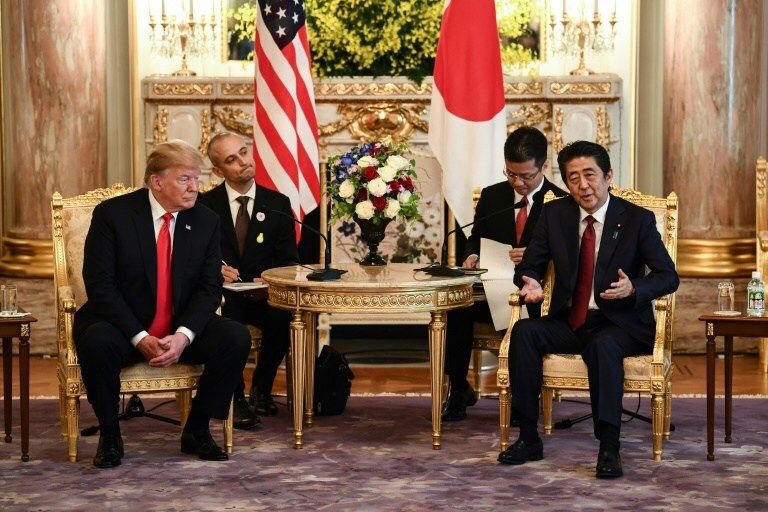
Ahead of summit talks with Japanese Prime Minister Shinzo Abe, Trump played down recent belligerence from Pyongyang, which last month fired short-range missiles that raised tensions in the region.
“I personally think that lots of good things will come with North Korea, I feel that. I may be right, I may be wrong, but I feel that” Trump told reporters at Abe’s office.
“There’s good respect built, maybe great respect built between… the United States and North Korea, but we will see what happens,” added the president, whose failed Hanoi talks in February with the North’s leader Kim Jong Un sparked a fresh spike in tensions.
He noted that when he came to office, there was “testing all the time, nuclear testing at the highest level, and that seems to have stopped”.
On Sunday, Trump dismissed the recent missile tests from the North as “some small weapons” and appeared to undercut his National Security Advisor John Bolton, who had said the day before that the launches contravened UN Security Council resolutions.
Trump said the recent tests had “disturbed some of my people, and others, but not me”, which was widely seen as a reference to his hawkish advisor.
Bolton also took fire from a North Korean foreign ministry spokesman who described him as “structurally faulty” and a “human defect” that “must go away as soon as possible”.
‘Terrible things’
Trump also struck a relatively dovish tone on Iran, amid mounting tensions with the historic American foe.
I do believe that Iran would like to talk, and if they’d like to talk, we’d like to talk also,” Trump said.
“We’ll see what happens, but I know for a fact that the prime minister (Abe) is very close with the leadership of Iran… nobody wants to see terrible things happen, especially me.”
Abe is reportedly weighing a trip to Tehran in a bid to mediate in the Middle East crisis and Trump appeared to give the green light, saying “we’ll see what happens, that would be fine”.
Trump is in Japan as the first foreign leader to visit the country’s newly enthroned Emperor Naruhito — an honour Abe hopes will help charm the US president when it comes to thorny trade talks.
And while the US president again lashed out at what he called a “tremendous imbalance” in the trade relationship between the world’s top and number-three economies, he said: “I’m sure that will work out over a period of time.”
“I think we will be announcing some things, probably in August, that will be very good for both countries.”
On Sunday, Trump had already taken a softer note, saying that “much” of that deal would wait until Abe faces upper house elections likely in July — as rumours swirl that the popular prime minister will combine that vote with a snap general election.
Top Japanese and American trade negotiators spent more than two hours locked in talks on Saturday night but failed to achieve a breakthrough, although the Japanese side said there was more “understanding” between the two.
‘Great honour’
Monday marked the start of the official programme for the two leaders after a fun-filled weekend of sumo, golf and meals out. Trump said on Sunday he was having a “great time” with his friend and close ally Abe.
Trump said it was a “great honour” to be the first to meet Naruhito, who took the Chrysanthemum Throne only three weeks ago after his father stepped down in the first abdication in two centuries.
In the morning, Trump, dressed in a dark suit and red tie, reviewed the Japanese honour guard and greeted dozens of Japanese and visiting US officials as a military band played.
Naruhito, wearing a light blue tie, and his wife Empress Masako, who was in a white hat and jacket, accompanied Trump and his wife Melania, who wore a summery white dress and tall red high heels.
Walking together through the palace, notable for its elegant, restrained decor, the two couples then sat down for a further chat where official translators found themselves with little to do — Naruhito having gone to Oxford and Masako graduating from Harvard.
In the evening, Trump and Melania will be back at the palace for a banquet.
That will mark the lavish high point in a Japan visit laden with feel-good moments aimed at celebrating US-Japanese ties at a time of growing regional uncertainty due to US trade policies, a rising China and nuclear-armed North Korea.

Monday, November 5, 2018

US Will Lift Korean Sanctions


North Korea warns it could restart nuclear weapons development if sanctions aren’t lifted
Nov 3, 2018
North Korean leader Kim Jong Un guides the launch of a Hwasong-12 missile in this undated photo released last September. | REUTERS
North Korea has warned that it could revive its scrapped policy of building up its nuclear arsenal if the U.S. does not remove harsh economic sanctions as part of reciprocal measures Pyongyang has demanded in ongoing denuclearization talks.
In a statement released Friday, North Korea’s Foreign Ministry said Pyongyang could revert to leader Kim Jong Un’s signature policy of pyongjin, or “parallel advance,” in which the country simultaneously pursues economic and nuclear development.
“If the U.S. keeps behaving arrogant without showing any change in its stand … the DPRK may add one thing to the state line for directing all efforts to the economic construction adopted in April and as a result, the word ‘pyongjin’ (simultaneously conducting economic construction and building up nuclear forces) may appear again and the change of the line could be seriously reconsidered,” the statement said.
In April, Kim abruptly announced he was retiring the policy of pyongjin, which is also known as byungjin. That strategy had been at the center of regime propaganda and is enshrined in the charter of the ruling Workers’ Party. In his April announcement, he also said the North was adopting a “new strategic line” that focuses on rebuilding the country’s tattered economy.
By alluding to a return to its dual-track policy, Pyongyang may be attempting to throw Washington off balance ahead of key talks next week between U.S. Secretary of State Mike Pompeo and a top North Korean official in the United States.
North Korea has repeatedly demanded that the U.S. roll back punishing sanctions and issue a political declaration ending the 1950-53 Korean War, which was halted in an armistice, as “corresponding measures” for what it claims are credible steps toward denuclearization. These steps have included a halt to all nuclear and missile tests as well as the dismantlement of its sole known nuclear site and a key missile-testing facility.
“The U.S. thinks that its oft-repeated ‘sanctions and pressure’ lead to ‘denuclearization.’ We cannot help laughing at such a foolish idea,” said the statement, released under the name of Kwon Jong Gun, director of the Foreign Ministry’s Institute for American Studies.
At a landmark June summit in Singapore, Kim agreed to a vaguely worded 1½-page joint statement to “work towards the complete denuclearization of the Korean Peninsula,” while Trump committed to “provide security guarantees” to the regime.
But negotiations have hit a wall in the wake of that summit.
Media reports after that meeting citing anonymous U.S. intelligence officials have said that the North continues to develop its nuclear program despite its vow to work toward relinquishing its nukes.
Friday’s statement marked the first time that Pyongyang had alluded to potentially resuming weapons tests since the April policy shift. Last year, the North conducted a raft of missile launches — including two over Japan and one of a missile believed capable of striking most of the continental United States. It also conducted its most powerful nuclear test to date.
In the talks, Washington has reportedly demanded that Pyongyang disclose a full inventory of nuclear weapons and fissile materials before any U.S concessions. The North, however, has insisted that the U.S. move first on the war-ending declaration and easing of sanctions as a way of “trust-building” after years of the United States’ “hostile policy” toward it.
“Now that we gave all things possible to the U.S., things it hardly deserves, by taking proactive and good-will measures, what remains to be done is the U.S. corresponding reply,” Friday’s statement said.
“Unless there is any reply, the DPRK will not move even 1 mm, how costly it may be,” it added.

Monday, July 9, 2018

How Trump Will Sell US Out Like Obama


How Trump Went From ‘Fire and Fury’ to Dismissing North Korean Nuclear Advances
By Neeti Upadhye
Trump on North Korea: From Foe to Friend
President Trump used to call the North Korean leader, Kim Jong-un, “rocket man.” But over time, Mr. Trump has changed his tune.Jung Yeon-Je/Agence France-Presse — Getty Images
By David E. Sanger
• July 4, 2018
WASHINGTON — When the North Koreans were shooting off missile tests and detonating new, more powerful atomic bombs last year, President Trump responded with threats of “fire and fury” and ordered the military to come up with new, if highly risky, pre-emptive strike options.
But since the one-day summit meeting last month in Singapore, Mr. Trump has done an about-face, while the North’s nuclear program has continued. “Many good conversations with North Korea-it is going well!” he wrote Tuesday morning on Twitter.
Even the recent revelations of seemingly modest North Korean progress on missile technology and the production of nuclear fuel — including continued work on a new nuclear reactor that can produce plutonium — have not dimmed Mr. Trump’s enthusiasm. He argues that they mean little compared to the new tone of conversations, and that even though North Korea has not disassembled a single weapon, his mission should be judged a success.
It is that jarring reversal of tone that has led Mr. Trump’s critics to argue that he was taken in by Kim Jong-un, the North’s 34-year-old leader.
Turning the enthusiasm of the meeting in Singapore into a concrete, verifiable agreement is now the job of Secretary of State Mike Pompeo, who is leaving Washington early Thursday for North Korea. It will be his third trip there, but the first to flesh out a timetable and a common understanding of what the Singapore commitment to “work toward denuclearization of the Korean Peninsula” really means.
Complicating the task is this: Mr. Pompeo, a former C.I.A. chief who knows the details of the North Korean program intimately and has solicited plans for how to accomplish his goals, must show that he can get the North Koreans to go far beyond the agreement his predecessor once-removed, John Kerry, achieved in negotiations with Iran. Mr. Trump has called that deal a “disaster” for years and pulled out of it two months ago.
Now, it looms over Mr. Pompeo’s talks.
By engaging Mr. Trump in the process of “denuclearizing” the Korean Peninsula, Mr. Kim may be calculating that the president would not dare walk away — especially after Mr. Trump noted before the summit meeting that “everyone thinks” he should win a Nobel Peace Prize, before modestly adding, “but I would never say it.”
Still, the test missile engine site that Mr. Trump told reporters was being dismantled still stands, satellite pictures show. And the C.I.A., among other agencies, has warned that the North’s strategy may now be to build up abilities that can be traded away later, hoping to maneuver Mr. Trump into accepting the country as a de facto nuclear power, and settle for concessions on the size and reach of Mr. Kim’s nuclear force.
Mr. Trump and his allies say that is nonsense; sanctions remain and Mr. Trump has not flinched from the goal of “complete, verifiable, irreversible denuclearization.”
“There’s not any starry-eyed feeling among the group doing this,” John R. Bolton, the national security adviser, insisted Sunday on CBS’s “Face the Nation,” saying that most of the major steps toward denuclearization could be taken in a year. In private, Trump administration officials say, Mr. Bolton’s view is the same as it was before he joined the administration: that the North Koreans will never entirely give up their program.
The big question is whether Mr. Kim is truly ready to change course or playing for time with Mr. Trump — as his father and grandfather did with the past four presidents.
Meanwhile, Mr. Trump is in sales mode.
Frustrated by the series of reports that the North is chugging forward, despite its “denuclearization” pledge, Mr. Trump boasted in a tweet on Tuesday that there had been “no Rocket Launches or Nuclear Testing in 8 months. All of Asia is thrilled. Only the Opposition Party, which includes the Fake News, is complaining.”
Then, with a Trumpian flair, he added, “If not for me, we would now be at War with North Korea!”
Mr. Trump is at least partly right: There have been no missile or nuclear tests since November, a freeze that many, including some Democrats, said was a necessary first step. But a freeze and denuclearization are completely different things.
Mr. Kim retains all of his nuclear abilities, and thus his leverage. He can resume testing any time. Just a year ago, Rex W. Tillerson, then the secretary of state, called that position insufficient because it merely perpetuated an ability to strike that Mr. Trump had, until recently, characterized as intolerable.
But it also reveals, in perhaps the most critical national security crisis Mr. Trump faces, his tendency to conflate a good meeting with a good outcome. It is as if President John F. Kennedy, meeting with the Soviet Union’s Nikita Khrushchev for the first time in Vienna in 1961, had declared the Cold War solved. The Cuban missile crisis broke open 16 months later.
Mr. Kim has already accomplished something, too. The heat has been turned down drastically, and the United States has, unilaterally, suspended military exercises with South Korea.
The Obama administration’s Iran agreement shadows Mr. Trump’s talks with the North.
The president regularly calls Iran a major nuclear threat, even though it no longer has enough fuel to make a single nuclear weapon. Under the 2015 agreement, it shipped 97 percent of its nuclear material out of the country. And it never possessed nuclear weapons.
Yet Mr. Trump pulled out after concluding that the United States gave away too much in return for an agreement that would gradually allow the Iranians to resume production around 2030.
The stark contrast between how Mr. Trump talks about Tehran, while insisting that the North is “no longer a nuclear threat,” will become harder and harder to sustain if Mr. Pompeo cannot get Mr. Kim on a rapid denuclearization schedule.
And Mr. Pompeo will need to achieve an inspection regime that provides assurance — not only to intelligence agencies but also to the public in South Korea, Japan and the United States — that the North is not hiding weapons, missiles or production facilities. The C.I.A. and the Defense Intelligence Agency believe that, today, it is hiding all three. So far, Mr. Pompeo has said nothing about the details he intends to present, and Mr. Bolton suggested that stories about new intelligence on the North’s improving its nuclear abilities only imperiled the diplomatic process. As a television commentator and columnist, Mr. Bolton often repeated similar reports when it came to building his case about how to deal with Pyongyang and Tehran.
One thing is clear, however: The Trump administration has not uttered the phrase “complete, verifiable, irreversible denuclearization” in weeks, and Mr. Pompeo has also softened his tone. Some administration officials say that South Korea urged getting rid of the everything-must-be-dismantled-immediately approach. And South Korean officials say that while Mr. Kim might not surrender his entire program anytime soon, he might dismantle parts of it, reducing his readiness to go to war.
“Perhaps the biggest diplomatic problem the U.S. will face, if we can get North Korea to agree to fully denuclearize, will be the timing of that denuclearization and how we verify the component steps,” William Perry, the former defense secretary under President Bill Clinton, wrote this week in Politico Magazine.
Mr. Perry, who negotiated repeatedly with the North, cautioned that “these steps will be complex, will take many months, if not years, and will require intrusive verification procedures.”
“But the U.S. has negotiated agreements equally difficult with the Soviet Union, so we do have a positive precedent,” he wrote.

Thursday, July 5, 2018

North Korea Nuclear Program Done In One Year


White House national security adviser John Bolton said on Sunday he believed the bulk of North Korea’s nuclear, chemical and biological weapons programmes could be dismantled within a year.
Bolton told CBS’s Face the Nation that Washington has devised a programme to dismantle North Korea’s weapons of mass destruction and ballistic missile programmes in a year.
“If they have the strategic decision already made to do that and they’re cooperative, we can move very quickly,” he said. “Physically we would be able to dismantle the overwhelming bulk of their programmes within a year.”
He said Secretary of State Mike Pompeo will likely discuss that proposal with the North Koreans soon. The Financial Times reported that Pompeo was due to visit North Korea this week but Reuters has not been able to confirm his travel plans.
North Korea agreed at the summit to “work toward denuclearisation of the Korean Peninsula,” but the joint statement signed by North Korean leader Kim Jong-un and US, President Donald Trump gave no details on how or when Pyongyang might surrender its nuclear weapons.
Pompeo told reporters the day after the Singapore summit on June 12 that Washington hoped to achieve “major disarmament” by North Korea within Trump’s current term, which ends on January 20, 2021.
Bolton said the United States was going into nuclear negotiations aware of Pyongyang’s failure to live up to its promises in the past.
“We know exactly what the risks are – them using negotiations to drag out the length of time they have to continue their nuclear, chemical, biological weapons programmes and ballistic missiles,” he said.
“There’s not any starry-eyed feeling among the group doing this,” he said. “We’re well aware of what the North Koreans have done in the past.”

Later, appearing on Fox News, Bolton defended Trump’s decision to hold a summit with Russian President Vladimir Putin in Helsinki this month as a way to get beyond the “political noise” that has consumed Washington over the ongoing investigation of Russian election interference.
Bolton said the summit would be “somewhat unstructured” especially during the leaders’ one-on-one time, to avoid “the pressure of immediate deadlines or crises”.
“He wants to understand the Russian position, but, more importantly, he wants Putin to understand our position,” Bolton said. “Let them discuss these issues and see exactly where there might be room for progress or where we find there is no room at all.”
Trump is scheduled to meet with Putin on July 16, several days after he stops in Brussels for a Nato summit. The president has been critical of Nato, suggesting that other member nations do not contribute enough to the alliance and that the United States carries too much of the burden.
Bolton dismissed a question about whether Trump has been more willing to criticise US allies than authoritarian leaders of rival nations, including Putin and North Korea’s Kim Jong-un. Trump feuded with G7 leaders during a summit in Canada last month over trade, abruptly dropping support for a routine joint statement. The president also suggested that Russia, which was kicked out of the group after it annexed Crimea in 2014, be invited back into the organisation.
“I don’t read the way he conducted these meetings the same way,” Bolton told Fox News Sunday host Chris Wallace. “I don’t think anybody ought to have a case of the vapours over discussions we have in Nato or the G7 versus discussions we have with Putin or Kim Jong-un. They’re very, very different; the president treats them differently. He understands what the strategic interests are, and that’s what he’s trying to pursue.”
Although US intelligence officials have stated unequivocally that Russian agents sought to influence the 2016 presidential election, Trump has continued to cast doubt on those conclusions. Last summer, during his first one-on-one meeting with Putin, in Hamburg, Trump said that he questioned him about the interference accusations and that the Russian leader denied it.

Tuesday, June 26, 2018

How Korea Will Aid the Iranian Nuclear Horn (Daniel 8:4)


While the Trump administration is still touting its supposedly successful summit with North Korea — even claiming that Pyongyang is “no longer a nuclear threat” — senior U.S. intelligence officials worry that a new security challenge is emerging: that the Kim regime could sell advanced, long-range ICBM missile technology to rogue states like Iran.
According to two intelligence officials, speaking to me on background, there is a growing concern that while the immediate threat of armed conflict with North Korea has diminished, Pyongyang could utilize the lull in tensions to its advantage, selling the know-how behind its most advanced weapons systems to Tehran. The officials, unauthorized to speak on the matter, asked for their identities to be protected.
“We know for a fact that North Korea will sell almost any of its military hardware if the price is right — and Iran has paid that price time and time again. In the past, there is ample evidence — even in the public domain — that proves North Korea will sell conventional weapons, all different types of missile technology, and even nuclear tech and expertise if you have the funds to pay for it,” explained a senior U.S. intelligence official.
The official continued:
“What terrifies many of us is that we might not even know that Pyongyang has even sold such technology until it's too late to do anything about it. Think about how much information you can store on just a flash drive today. All it would take is one North Korean agent, selling a 256-gig USB stick to an Iranian operative filled with blueprints, design specs and advanced warhead shielding technology to make a massive difference.
"Just that amount of information on ICBM technology alone would be a game changer for Tehran — and we would not even know about it until the new designs were included in their missile tests.”
History shows the intelligence officials' fears could very well be realized — and soon. North Korea has sold arms to some of the world’s most anti-U.S. regimes and fueled conflicts around the world.
For example, Pyongyang has reportedly helped Syria with its chemical weapons and missile programs. North Korea even started building a nuclear reactor for the Assad regime, only to see it be destroyed by an Israeli air strike in 2007. There is strong evidence to suggest North Korea is selling conventional arms to the regime now and possibly even fighting alongside Assad’s forces, fueling a civil war that has claimed countless lives to this day.
It gets worse. The Kim family has sold multiple classes of missile platforms to Iran. And, now that the Kim family has missiles that can at least range the U.S. homeland, combined with biting sanctions that are damaging the regime's ability to raise vital revenue, Pyongyang might just be desperate enough to sell its best weaponry, even if it were to damage its budding détente with Washington.
Another senior intelligence official, also speaking on background, had another assessment: “It will be just a matter of time before North Korea sells this stuff (ICBM technology) to Iran. We need to prepare for this as it might even already have happened. I want to stress I have no proof of that, but what would you do if your nation was being hurt by sanctions and you can cause America and its allies some pain?”
There is ample reason to think Iran would indeed love to acquire such technology. If the Iran Nuclear Deal does completely fall apart, or even if Tehran abides by its provisions with willing non-U.S. partners, acquiring such advanced missile technology — which is not prohibited under the terms of the deal — would be a smart strategic move.
Iran would be able to spend the next several years designing, testing and perfecting such missile technology. Knowing that it could take an expensive, long-term effort, Tehran could honor its nuclear agreement with Europe, Russia and China until 2025 — when Iran could legally leave the agreement — and use those years to perfect a working ICBM that it could then use as the delivery system for a nuclear weapon.
Considering even the sheer possibility of such a nightmare scenario, the Trump administration, in whatever deal it is trying to craft with North Korea to give up its nuclear weapons, should include a provision that Pyongyang would not be able to sell any missile technology, know-how or allow its scientists to work on other nations' missile programs — at a bare minimum. Washington also should demand a full accounting of any missile sales to foreign powers like Iran, so we can gain a better understanding of what other problems Pyongyang might have created.
But such thoughts might be just wishful thinking. Considering that U.S. intelligence officials believe North Korea will never give up its nuclear weapons anyway, we might very well face the Kim regime’s most terrifying weapons of war in a future conflict — but they might be fired by someone else.
Harry J. Kazianis (@grecianformula) is director of Defense Studies at the Center for the National Interest, founded in 1994 by President Richard M. Nixon, and executive editor of its publishing arm, The National Interest. Kazianis previously served on the foreign policy team of the 2016 Ted Cruz presidential campaign. He has held positions as foreign policy communications manager at the Heritage Foundation, editor-in-chief of The Diplomat, as well as a fellow at the Center for Strategic and International Studies. The views voiced in this article are his own.

Monday, June 25, 2018

Why North Korea is Willing to Negotiate with Trump

Iran's Revolutionary Guards fire a Saegheh missile (illustrationUS Admits N. Korea, Maybe Iran, Can Now Target it with EMP-Nukes
Contact Editor Mark Langfan, 12/04/15 13:19 Share
Iran's Revolutionary Guards fire a Saegheh missile - Reuters
In a blockbuster admission, Admiral Bill Gortney, Commander of North American Aerospace Defense Command (NORAD) and US Northern Command (USNORTHCOM) disclosed that the Pentagon now believes North Korea has mastered the ability to miniaturize its nuclear bombs so they can be fitted onto their latest mobile KN-08 intercontinental ballistic missiles (ICBMs), which are capable of reaching the continental United States.
At the news conference, Adm. Gortney flatly stated, Pyongyang has “the ability to put a nuclear weapon on a KN-08 and shoot it at the homeland [the continental United States].” He expressed confidence that the US could knock down such a missile if launched by North Korea or its ally, Iran.
He also admitted, however, that it is “very difficult” for the US to counter the threat, because its intelligence is unable to follow the mobile ICBMs and give an efficient warning before they are launched.
The admission was accompanied by the announcement that NORAD is reopening its nuclear-EMP-proof Cheyenne Mountain bunker.
The KN-08 is a road-capable, highly mobile ICBM, which can be hidden anywhere throughout the North Korea and could be fired on a short-countdown virtually undetectable by American intelligence. As Adm. Gortney further explained about the North’s KN-08 ICBM, “It’s the relocatable [highly-mobile, can go anywhere – ML] target set that really impedes our ability to find, fix, and finish the [KN-08] threat. And as the [KN-08] targets move around and if we don’t have a persistent stare [i.e., the ability to monitor its location at all times - ML] and persistent [intelligence, surveillance, and reconnaissance] that we do not have over North Korea at this time, that relocatable nature makes it very difficult for us to be able to counter it.”
Despite Adm. Gortney’s concerns, he still believes that if a KN-08 was fired at the US homeland, in the Admiral’s words – “Should one get airborne and come at us [the US homeland], I’m confident we would be able to knock it down.”
Even if this is true, it is not clear if the US ballistic defense could knock down an incoming North Korean ICBM in time, if the nuke is intended as an EMP weapon, which explodes soon after re-entering the atmosphere.
System can defend against Iran strike, too 
In another dramatic revelation, Adm. Gortney revealed that America’s anti-missile missile shield is not only configured to repulse a North Korean missile, but an Iranian ICBM as well. The Admiral explained that the current assessment is that the threat of an ICBM EMP strike comes from North Korea and not from Iran, but that the system could handle both scenarios. “Our system is designed for North Korea, and if we get our assessment wrong, for Iran. Its [the US homeland missile shield] is designed to defend the nation [the homeland] against both those particular threats today,” he said.
Experts have estimated that the KN-08 has a range of 5,600 miles and would be capable of hitting the US’s west coast if launched from North Korea. Experts also believe the missile is not accurate.
However, Adm. Gortney’s statement about North Korea’s nuke-capable KN-08 ICBM must be taken in the context of his simultaneous announcement of the Pentagon’s concern about an EMP-missile strike on the United States homeland.
South Korean intelligence has long believed that North Korea has been developing an EMP-nuclear device. As early as June 2009, Kim Myong Chol, who was an “unofficial” spokesperson of the then-Supreme Leader Kim Jong-il, openly threatened use of a “high-altitude detonation of hydrogen bombs that would create a powerful electromagnetic pulse” bomb.” And, in November of 2013, South Korea’s intelligence service (NIS) issued a report to the South Korean parliament that North Korea had “purchased Russian electromagnetic pulse (EMP) weaponry to develop its own version” of a nuclear EMP device.
EMP strike on South Korea?
In 2005, then-USAF Major Colin Miller posited, in a public-domain US Air Force University thesis, that the North Koreans could tactically use a nuclear-EMP weapon on the Korean Peninsula to “level-the playing field” against the electronic dependent forces of the United States and South Korea.
The tactical North Korean EMP “decapitation” attack would likely bag as POWs the 40,000 living US marines now guarding South Korea because an EMP doesn’t kill human beings, only electronics.
A tactical nuclear-EMP aimed at South Korea would not need an ICBM to reach the 30-50 km level above the earth to explode. Rather, it would only need a much smaller short-range missile to achieve its suitable EMP-location above the Korean peninsula for an effective EMP detonation.
Given the degree of cooperation between the Islamic Republic of Iran and North Korea, it is highly likely that any nuclear-EMP-technology mastered by North Korea has already been shared with Iran. Therefore, the EMP-proliferation danger from North Korea to Iran is a catastrophic danger.
North Korea has been threatening a pre-emptive nuclear strike on the US for two years, as explained in this ABC News report from 2013. At the time of the report, North Korea was said to be "years away" from a developing a missile that could hit the US: These "years" have apparently passed.
And yet, inexplicably, US President Barack Obama is currently negotiating a deal with Iran that he himself has admitted would enable it to manufacture its own nuclear weapons, 12-13 years after it is signed. 
Gil Ronen contributed to this report.

Friday, June 15, 2018

Trump declares victory over North Korea


Trump declares North Korea'no longer a nuclear threat'

By Veronica Stracqualursi and Stephen Collinson, CNN
Updated 4:48 PM EDT, Wed June 13, 2018
Washington (CNN) President Donald Trump declared Wednesday that the North Korean regime no longer poses a nuclear threat following his summit with Kim Jong Un, even though the meeting produced no verifiable proof that the rogue regime will discontinue its nuclear program.
In a series of tweets, Trump sought to take political credit for the summit but risked undermining the US strategy in the region.
"Just landed - a long trip, but everybody can now feel much safer than the day I took office," Trump tweeted as he arrived back in Washington. "There is no longer a Nuclear Threat from North Korea."
Trump also said that his meeting with Kim was an "interesting and very positive experience" and that "North Korea has great potential for the future!"
Trump also said in a separate tweet that North Korea is "no longer" the US' "biggest and most dangerous problem," telling Americans and the rest of the world they can "sleep well tonight!"
After returning to the White House Wednesday, Trump also defended his decision to halt the joint military exercises with South Korea, which he called "war games" -- a term used by Pyongyang -- arguing on Twitter that the US will "save a fortune."
Before taking office people were assuming that we were going to War with North Korea. President Obama said that North Korea was our biggest and most dangerous problem. No longer - sleep well tonight!
Trump's tweets pointed to one of the chief gains at the summit from the US point of view -- that its scheduling and the establishing of a relationship between the President and Kim have eased fears that the two sides are on a slide toward a disastrous war.
The argument also allows Trump's political allies and supporters in conservative media to claim ahead of the midterm elections that the President has engineered a triumph overseas that was beyond all his predecessors and has made America and the world much safer.
But much of the fear over imminent war last year was stoked in the first place by Trump's "fire and fury" rhetoric and boasts about the size of the US nuclear button.

No guarantees from summit

After nearly five hours of unprecedented talks between Trump and Kim on Tuesday, the two leaders signed a document in which Kim "reaffirmed his firm and unwavering commitment to complete denuclearization of the Korean Peninsula" and the US agreed to "provide security guarantees."
However, there was no mention of the previous US aim of "complete, verifiable and irreversible denuclearization" from Pyongyang. Kim's commitments did not appear to go beyond what he already pledged to do in April when he met with South Korean President Moon Jae-in along their countries' border.
Following the summit, Trump told reporters during a news conference in Singapore that Kim agreed to "destroying a major missile engine testing site" and that it would be done "very soon," without elaborating further on which testing site or timing.
The President also added that North Korea's promise to complete denuclearization "will be verified," though the document the two leaders signed did not lay out details of that process.
Trump left the discussions assured that Kim would begin dismantling his country's missile sites in the immediate future, telling ABC News that Kim "trusts me, and I trust him."

Risk of weakening US position

Any lessening of tensions is positive but an assurance that the threat of war is removed based simply on a relationship between a President who is term-limited and a volatile dictator who leads a criminal regime lacks the certainty and permanence of verifiable disarmament that the administration says is its goal.
By claiming that the North Korean nuclear threat has disappeared, Trump also risks weakening the US negotiating position in talks on denuclearization that were mandated by the summit and will be led from the US side by Secretary of State Mike Pompeo. After all, if there is no threat, why would the North Koreans need to give up their arsenal?
Trump's rush to claim credit for the supposed disappearance of the North Korean nuclear threat may also give nations like China and Russia an incentive to ease stringent implementation of the "maximum pressure" sanctions that helped bring Pyongyang to the table.
Some analysts are likely to see the comments as part of a worrying trend since North Korea showed no public sign at the summit or since that it is now willing to implement the complete, irreversible and verifiable destruction of its nuclear programs. Ultimately, in the short term, at least while diplomacy continues, Trump's tweets seem to indicate he is ready to live with the fact that North Korea has nuclear weapons and potentially the capacity to fire them at the United States, in an implicit erosion of the US strategic position.
Ultimately, that may end up being the only option that the US has short of war. But Trump's triumphalism is not based on concrete commitments by Kim that were established by his own administration's expectations setting before the talks.
CNN's Kevin Liptak contributed to this report.