Showing posts with label production. Show all posts

Monday, November 5, 2018

US Will Lift Korean Sanctions


North Korea warns it could restart nuclear weapons development if sanctions aren’t lifted
Nov 3, 2018
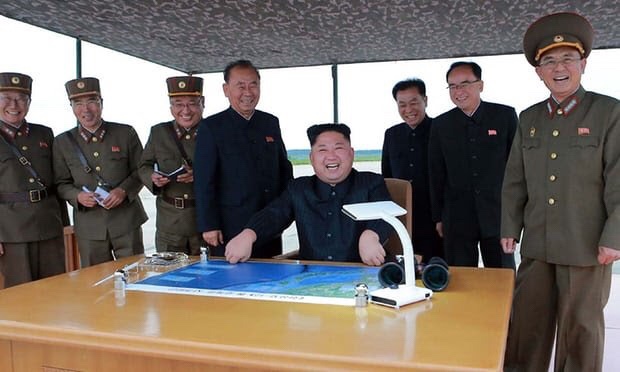
North Korean leader Kim Jong Un guides the launch of a Hwasong-12 missile in this undated photo released last September. | REUTERS
North Korea has warned that it could revive its scrapped policy of building up its nuclear arsenal if the U.S. does not remove harsh economic sanctions as part of reciprocal measures Pyongyang has demanded in ongoing denuclearization talks.
In a statement released Friday, North Korea’s Foreign Ministry said Pyongyang could revert to leader Kim Jong Un’s signature policy of pyongjin, or “parallel advance,” in which the country simultaneously pursues economic and nuclear development.
“If the U.S. keeps behaving arrogant without showing any change in its stand … the DPRK may add one thing to the state line for directing all efforts to the economic construction adopted in April and as a result, the word ‘pyongjin’ (simultaneously conducting economic construction and building up nuclear forces) may appear again and the change of the line could be seriously reconsidered,” the statement said.
In April, Kim abruptly announced he was retiring the policy of pyongjin, which is also known as byungjin. That strategy had been at the center of regime propaganda and is enshrined in the charter of the ruling Workers’ Party. In his April announcement, he also said the North was adopting a “new strategic line” that focuses on rebuilding the country’s tattered economy.
By alluding to a return to its dual-track policy, Pyongyang may be attempting to throw Washington off balance ahead of key talks next week between U.S. Secretary of State Mike Pompeo and a top North Korean official in the United States.
North Korea has repeatedly demanded that the U.S. roll back punishing sanctions and issue a political declaration ending the 1950-53 Korean War, which was halted in an armistice, as “corresponding measures” for what it claims are credible steps toward denuclearization. These steps have included a halt to all nuclear and missile tests as well as the dismantlement of its sole known nuclear site and a key missile-testing facility.
“The U.S. thinks that its oft-repeated ‘sanctions and pressure’ lead to ‘denuclearization.’ We cannot help laughing at such a foolish idea,” said the statement, released under the name of Kwon Jong Gun, director of the Foreign Ministry’s Institute for American Studies.
At a landmark June summit in Singapore, Kim agreed to a vaguely worded 1½-page joint statement to “work towards the complete denuclearization of the Korean Peninsula,” while Trump committed to “provide security guarantees” to the regime.
But negotiations have hit a wall in the wake of that summit.
Media reports after that meeting citing anonymous U.S. intelligence officials have said that the North continues to develop its nuclear program despite its vow to work toward relinquishing its nukes.
Friday’s statement marked the first time that Pyongyang had alluded to potentially resuming weapons tests since the April policy shift. Last year, the North conducted a raft of missile launches — including two over Japan and one of a missile believed capable of striking most of the continental United States. It also conducted its most powerful nuclear test to date.
In the talks, Washington has reportedly demanded that Pyongyang disclose a full inventory of nuclear weapons and fissile materials before any U.S concessions. The North, however, has insisted that the U.S. move first on the war-ending declaration and easing of sanctions as a way of “trust-building” after years of the United States’ “hostile policy” toward it.
“Now that we gave all things possible to the U.S., things it hardly deserves, by taking proactive and good-will measures, what remains to be done is the U.S. corresponding reply,” Friday’s statement said.
“Unless there is any reply, the DPRK will not move even 1 mm, how costly it may be,” it added.

Monday, August 27, 2018

Iran Will Finish Their Nuclear Triad

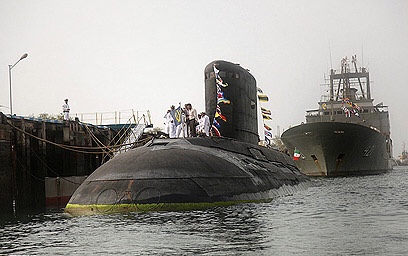
Iran to launch indigenous submarine by 2019: commander
Source:Xinhua Published: 2018/8/25 19:23:31
Iran's navy commander said that the country's homegrown submarine will come on stream by March 2019, Tasnim news agency reported on Saturday.
The manufacturing process of Fateh (Conqueror) has already finished and the submarine is now undergoing laboratory and field tests, Navy Commander Hossein Khanzadi told Tasnim.
Iran is also planning to manufacture the second upgraded version of the military watercraft, said Khanzadi.
The second version of Fateh will be much better, he said, adding that the Iranian submarines will serve as the "powerful subsurface fleet" in Iran's southern waters for effective deterrence purposes.
The fact that Iran has the technical know-how to manufacture submarines indicates that the country has no limitations in producing other military equipment, he stressed.
On Thursday, Iran's Supreme Leader Ayatollah Ali Khamenei appointed Ali Reza Tangsiri as the new commander of the Islamic Revolution Guards Corps' (IRGC) navy.
Khamenei said the decision for the appointment has been made with regard to the new commander's "commitment, competency and valuable experiences."
He also called on Tangsiri to push for promoting the training skills and upgrade the maritime equipment.
Khamenei has underlined to promote security of the region through the cooperation with other regional countries, refuting the presence of non-regional forces.
Khamenei has also called for the enhancement of the Iranian naval forces' presence in international waters and expanding the navy's power in balance with the merit of the Islamic establishment.
Posted in: MID-EAST

Saturday, June 16, 2018

US Plans Fail, But God's Plan Rules (Proverbs 16:9)


Imam Khamenei: US Plans in Middle East Have Failed
Leader of Iran’s Islamic Revolution Ayatollah Sayyed Ali Khamenei says the United States has evidently failed in achieving its intended policies in the region, stressing that Muslim nations worldwide are now more united than ever before in pursuing their common goals despite enemies’ plots.
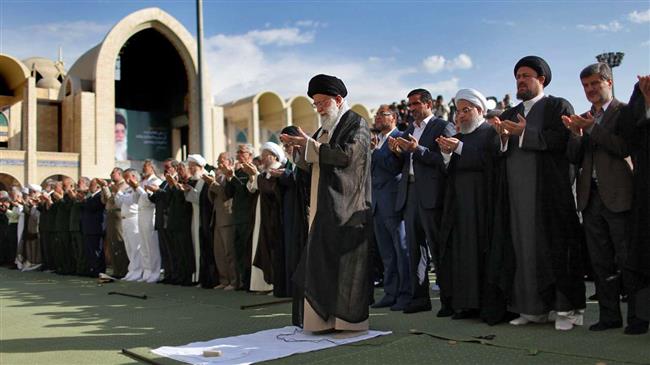
Ayatollah Khamenei made the remarks during a sermon after leading the Eid al-Fitr prayers — an Islamic holiday which marks the end of the fasting month of Ramadan.
Ayatollah Khamenei stated that the United States has wasted trillions of dollars in its pursuance of certain policies in the Middle East but has achieved nothing instead as openly acknowledged by US President Donald Trump.
“The US president said that ‘we spent $7 trillion in this region, and gained nothing in return.’ This means defeat. The US has suffered defeat in the region. The Great Satan has fallen short of achieving its goals, despite all its efforts, evil dispositions, and hot-air rhetoric. It has just wasted its resources,” Ayatollah Khamenei said.
Tweeting in February, Trump had said that his country had “so stupidly” spent the sum in the Middle East.
Muslim nations closer to Iran’
Elsewhere in his remarks, Ayatollah Khamenei said that unity among Muslim nations had grown stronger, stressing that this was clearly evident in the powerful participation of Muslims in last Friday’s rallies to mark the International Quds Day.
Each year, Muslims worldwide rally on the last Friday of Ramadan in solidarity with Palestinians in response to an initiative started by the late founder of the Islamic Republic Imam Khomeini.
“This means that, despite the enemies’ propaganda, Muslim nations and the great nation of Iran have grown closer and more aligned with one another,” Ayatollah Khamenei noted.
Nevertheless, he emphasized, the enemies are constantly plotting against the Iranian nation. This, the Leader added, is because they are afraid of the Iranian nation’s might, steadfastness as well as their ambitions to forge stronger bonds with other nations.
“The enemies will obviously continue their struggles but will fail,” Ayatollah Khamenei noted.
‘Economic plot’
Iran’s Leader further urged the nation to be vigilant in the face of enemy plots specifically manifested in efforts to mount economic pressure on the country and disappoint the Iranian people.
Towards preserving the country’s economic interests, Ayatollah Khamenei advised importers to refuse to bring in commodities which are being already produced at home.
The Leader also advised members of the public against going on “unnecessary and expensive foreign vacations,” and called for a serious fight against corruption.
Source: Press TV

Friday, June 15, 2018

Trump declares victory over North Korea


Trump declares North Korea'no longer a nuclear threat'

By Veronica Stracqualursi and Stephen Collinson, CNN
Updated 4:48 PM EDT, Wed June 13, 2018
Washington (CNN) President Donald Trump declared Wednesday that the North Korean regime no longer poses a nuclear threat following his summit with Kim Jong Un, even though the meeting produced no verifiable proof that the rogue regime will discontinue its nuclear program.
In a series of tweets, Trump sought to take political credit for the summit but risked undermining the US strategy in the region.
"Just landed - a long trip, but everybody can now feel much safer than the day I took office," Trump tweeted as he arrived back in Washington. "There is no longer a Nuclear Threat from North Korea."
Trump also said that his meeting with Kim was an "interesting and very positive experience" and that "North Korea has great potential for the future!"
Trump also said in a separate tweet that North Korea is "no longer" the US' "biggest and most dangerous problem," telling Americans and the rest of the world they can "sleep well tonight!"
After returning to the White House Wednesday, Trump also defended his decision to halt the joint military exercises with South Korea, which he called "war games" -- a term used by Pyongyang -- arguing on Twitter that the US will "save a fortune."
Before taking office people were assuming that we were going to War with North Korea. President Obama said that North Korea was our biggest and most dangerous problem. No longer - sleep well tonight!
Trump's tweets pointed to one of the chief gains at the summit from the US point of view -- that its scheduling and the establishing of a relationship between the President and Kim have eased fears that the two sides are on a slide toward a disastrous war.
The argument also allows Trump's political allies and supporters in conservative media to claim ahead of the midterm elections that the President has engineered a triumph overseas that was beyond all his predecessors and has made America and the world much safer.
But much of the fear over imminent war last year was stoked in the first place by Trump's "fire and fury" rhetoric and boasts about the size of the US nuclear button.

No guarantees from summit

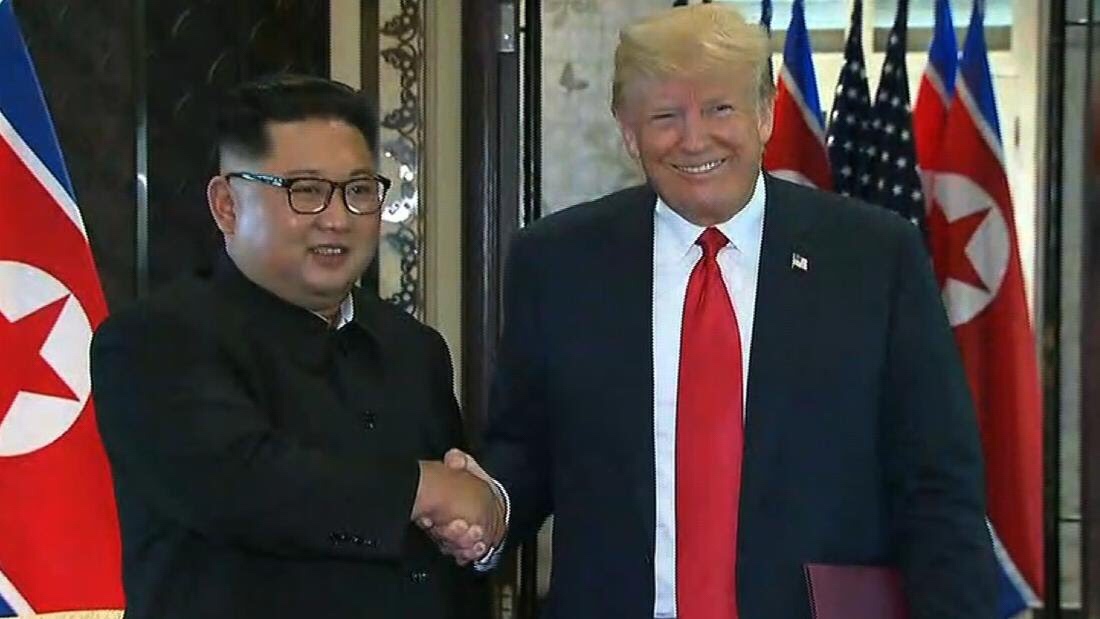
After nearly five hours of unprecedented talks between Trump and Kim on Tuesday, the two leaders signed a document in which Kim "reaffirmed his firm and unwavering commitment to complete denuclearization of the Korean Peninsula" and the US agreed to "provide security guarantees."
However, there was no mention of the previous US aim of "complete, verifiable and irreversible denuclearization" from Pyongyang. Kim's commitments did not appear to go beyond what he already pledged to do in April when he met with South Korean President Moon Jae-in along their countries' border.
Following the summit, Trump told reporters during a news conference in Singapore that Kim agreed to "destroying a major missile engine testing site" and that it would be done "very soon," without elaborating further on which testing site or timing.
The President also added that North Korea's promise to complete denuclearization "will be verified," though the document the two leaders signed did not lay out details of that process.
Trump left the discussions assured that Kim would begin dismantling his country's missile sites in the immediate future, telling ABC News that Kim "trusts me, and I trust him."

Risk of weakening US position

Any lessening of tensions is positive but an assurance that the threat of war is removed based simply on a relationship between a President who is term-limited and a volatile dictator who leads a criminal regime lacks the certainty and permanence of verifiable disarmament that the administration says is its goal.
By claiming that the North Korean nuclear threat has disappeared, Trump also risks weakening the US negotiating position in talks on denuclearization that were mandated by the summit and will be led from the US side by Secretary of State Mike Pompeo. After all, if there is no threat, why would the North Koreans need to give up their arsenal?
Trump's rush to claim credit for the supposed disappearance of the North Korean nuclear threat may also give nations like China and Russia an incentive to ease stringent implementation of the "maximum pressure" sanctions that helped bring Pyongyang to the table.
Some analysts are likely to see the comments as part of a worrying trend since North Korea showed no public sign at the summit or since that it is now willing to implement the complete, irreversible and verifiable destruction of its nuclear programs. Ultimately, in the short term, at least while diplomacy continues, Trump's tweets seem to indicate he is ready to live with the fact that North Korea has nuclear weapons and potentially the capacity to fire them at the United States, in an implicit erosion of the US strategic position.
Ultimately, that may end up being the only option that the US has short of war. But Trump's triumphalism is not based on concrete commitments by Kim that were established by his own administration's expectations setting before the talks.
CNN's Kevin Liptak contributed to this report.

Wednesday, June 13, 2018

Iran Prepares to Enrich Uranium (Daniel 8:4)


Iran says will begin uranium enrichment at Fordow if nuclear deal unravels
Jun 13, 2018 - 13:26
Reuters International
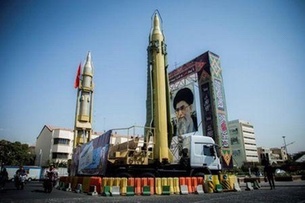
FILE PHOTO: FILE PHOTO: A display featuring missiles and a portrait of Iran's Supreme Leader Ayatollah Ali Khamenei is seen at Baharestan Square in Tehran, Iran September 27, 2017. Picture taken September 27, 2017. Nazanin Tabatabaee Yazdi//File Photo
BEIRUT (Reuters) - Iran will begin uranium enrichment at its Fordow plant and will install new nuclear equipment at its Natanz facility if it withdraws from a nuclear deal with major powers, said the spokesman for the Atomic Energy Organisation of Iran (AEOI).
The fate of the 2015 nuclear deal is unclear after the United States withdrew from it. The other signatory nations - Russia, China, Germany, Britain and France - are trying to salvage the accord, which imposed curbs on Iran's nuclear programme in return for a lifting of some economic sanctions.
Iran has two vast enrichment sites, at Natanz and Fordow. Much of Natanz is deep underground and Fordow is buried inside a mountain, which is widely believed to protect them from aerial bombardment.
AEOI spokesman Behrouz Kamalvandi said in an interview published on Wednesday that new work would begin on the nuclear programme on the orders of Supreme Leader Ayatollah Ali Khamenei. He did not specify what kind of new equipment might be installed at Natanz.
"Currently the Supreme Leader has ordered that the programmes be carried out within the parameters of the nuclear deal," Kamalvandi told the Young Journalists' Club (YJC) in an interview.
"And when he gives the order we will announce the programmes for operating outside of the nuclear deal for reviving Fordow," he added.
Ali Akbar Salehi, the head of the AEOI, announced last week that Iran had begun work on a facility to construct advanced centrifuges at Natanz.
The announcement appeared at least in part to be an effort to pressure the remaining signatories to preserve the 2015 deal.
Kamalvandi accused the United States and other Western countries of applying double standards by opposing Iran's nuclear programme, which he said was purely peaceful, while accepting the nuclear arms programme of Tehran's foe Israel.
"The West doesn’t criticise the Zionist regime and have even helped them," the YJC quoted Kamalvandi as saying. "Without the help of the West and America this regime could never have obtained nuclear weapons."
Israel is widely believed to be the Middle East's only nuclear power. Israel has never confirmed or denied that it has a nuclear arsenal.
(Reporting By Babak Dehghanpisheh; Editing by Gareth Jones)

Monday, June 11, 2018

Israel is Truly Delirious About Iran

See the source imageLiberman hopes Iran will follow North Korea's lead on denuclearization

By JERUSALEM POST STAFF
Defense Minister Avigdor Liberman hopes the framework for North Korean denuclearization being set by US President Donald Trump will also be applied to Iran's nuclear program, he said Sunday.
"I wish that the model of total [North] Korean abandonment of its nuclear program could be realized in the case of Iran as well," Liberman said in an interview with Army Radio. "We saw the opposite - Ayatollah Khamenei's announcement that he has ordered the acceleration his country's nuclear program."
North Korean leader Kim Jong Un arrived in Singapore Sunday morning, the country's foreign minister, Vivian Balakrishnan, said on Twitter. Kim is slated to meet with Trump in Singapore Tuesday for a much-anticipated summit aimed at bringing North and South Korea closer to peace, and, perhaps more importantly, reigning in the North's nuclear weapons program.
Meanwhile, US Secretary of State Mike Pompeo tweeted last week that he was "following reports that Iran is planning to expand its uranium enrichment capabilities," adding that "the United States will not allow Iran to develop nuclear weapons."
Pompeo's comments came after Iran's nuclear chief Ali Akbar Salehi threatened that next month a nuclear plant for the construction of advanced centrifuges in Natanz, Iran, would be completed. Salhi said on local television that "Following the order from Supreme Leader Ayatollah Khamenei, we prepared the place within 48 hours."
Pompeo said US policy isn't new to Iran.
"Iran is aware of our determination," he said.

Sunday, June 10, 2018

The Truth About Iran’s “Peaceful” Nuclear Program

By Callum Wood • June 8

Iran confronting Israel directly

For years, Iran has indirectly targeted Israel through terrorist proxies including Hamas and Hezbollah. The first direct confrontation between the two nations occurred on February 10. That’s when an Iranian drone penetrated Israeli airspace from Syria and was shot down by an Israel Defense Forces attack helicopter. Israel Defense Forces (IDF) spokesman Brig. Gen. Ronen Manelis said on April 13 that “the aircraft was carrying explosives” to conduct “an act of sabotage in Israeli territory.”
“This is the first time we saw Iran do something against Israel—not by proxy,” a senior Israeli military official told New York Times columnist Thomas Friedman. “This opened a new period” (April 15). David Horovitz wrote in the Times of Israel that the event shows that the Iranian regime is “now sufficiently emboldened as to directly attack Israel” (April 14).
Four days before Manelis’s announcement, the IDF bombed the T4 military base, striking the drone operations center that had launched the February 10 drone and killing seven Iranians. According to Israeli military sources, Iran had been building it into a fully functional air base with the ability to launch surface-to-air missiles at Israeli targets.
“We are facing a new reality,” said Israeli Defense Minister Avigdor Lieberman. “[T]he Lebanese Army, in cooperation with Hezbollah, the Syrian Army, the Shiite militias in Syria and above them Iran—are all becoming a single front against the State of Israel.”
The Bible indicates that Iran, the end-time “king of the south” of Daniel 11:40, will soon trigger a severe crisis in Israel—indirectly via the Palestinians and possibly directly. Read about it in Jerusalem in Prophecy.

March of Return

For six weeks, thousands of Palestinians protested on the border between the Gaza Strip and Israel during what Hamas called the “Great March of Return.”
The protests began March 30 and ended on May 15, which is known by Arabs as Nakba Day (“Catastrophe Day”). It is the anniversary of the day following the founding of the State of Israel in 1948. During their demonstrations, Palestinian rioters flung stones, rolled burning tires and flew kites with incendiary attachments and tried to cross the border into Israeli territory.
Israeli security forces killed more than 100 protesters and injured more than 7,000 others. Most of these protesters were not defenseless or innocent; they were terrorists or Hamas operatives and Palestinians who agreed with the goals of Hamas or were coerced by Hamas to the front lines of the riots.
May 14 was the day that the United States moved its embassy from Tel Aviv to Jerusalem.
“World events from today to the end of this age are going to revolve around Jerusalem,” wrote Trumpet editor in chief Gerald Flurry in his August 2012 article “Watch Jerusalem!” “This city is going to be the very epicenter of all major events in the future.” The Bible prophesies that half of Jerusalem will fall to the Arabs. When that happens, Mr. Flurry wrote, “it will be like dominoes falling one after the other: one biblically prophesied event after another. This is all going to happen very fast and very violently, so you need to watch Jerusalem.”
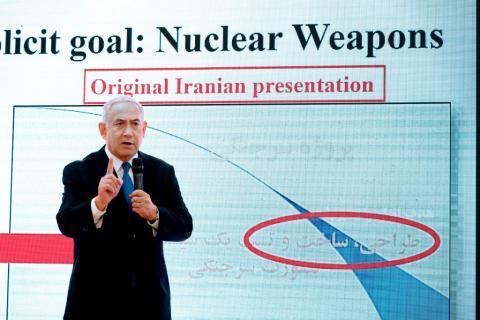
During a televised address from Israel Defense Forces headquarters on April 30, Prime Minister Benjamin Netanyahu revealed a captured Iranian “atomic archive” of nuclear weapons information showing just how close Iran is to creating weapons of mass destruction.
According to Netanyahu, Israeli intelligence captured the stash of 100,000 files from a hidden warehouse in Tehran. He said the archive proved the following: “First, Iran lied about never having a nuclear weapons program. … Second, even after the deal, Iran continued to preserve and expand its nuclear weapons know-how for future use. Why would a terrorist regime hide and meticulously catalogue its secret nuclear files, if not to use them at a later date? Third, Iran lied again in 2015 when it didn’t come clean to the [International Atomic Energy Agency], as required by the nuclear deal. And finally, the JCPOA [Joint Comprehensive Plan of Action] nuclear deal, is based on lies … Iranian lies and Iranian deception.”
Netanyahu also warned about Iran’s ballistic missiles and secret nuclear weapons programs, which the JCPOA did not address.
Netanyahu’s exposé was not entirely surprising: Negotiators of the deal obliquely acknowledged that Iran constantly lies about its nuclear ambitions when they conceded that the JCPOA was “not based on trust.” What most of them fail to acknowledge is how devoted Iran’s top leaders are to a clash of civilizations.
In his September 2015 article “Negotiating Human Survival,” Trumpet editor in chief Gerald Flurry wrote: “Though many don’t realize it yet, the Western world—and especially America—has been humiliated through this deal. … Instead of trusting people based on what they say, the Bible says we should ‘know them by their fruits’ (Matthew 7:16). Iran’s fruits show it will violate this next agreement. But this time, the stakes are much higher. … No words will stop this king of terror [Iran] because he believes he has a religious duty to bring upon the world a nuclear cataclysm so his messiah can return.”

Saturday, June 9, 2018

Iran Nuclear Horn Shows off Centrifuges (Daniel 8:4)


With nuclear deal under threat, Iran shows off centrifuges
The Associated Press
The star of a live television interview in Iran's new nuclear workshop wasn't the head of the country's atomic agency, but three centrifuges labeled in English in the background, advanced devices Tehran is prohibited from using by the nuclear deal with world powers.
The placement of the centrifuges, identified as IR-2M, IR-4 and IR-6, may have served as a subtle warning to Europe as it tries to salvage the atomic accord after President Donald Trump's decision to withdraw from it and restore U.S. sanctions.
In recent days Iranian officials from Supreme Leader Ayatollah Ali Khamenei on down have vowed to boost the country's uranium enrichment capacity. The moves they have outlined would not violate the 2015 nuclear accord, but would allow Iran to quickly ramp up enrichment if the agreement unravels.
"I think they've been quite clear in saying that if the U.S. pulls out and the EU doesn't live up to its side of the deal, it will rapidly increase its enrichment capacity," said Ian Stewart, the head of a nuclear proliferation study called Project Alpha at King's College London. "It doesn't mean that it would go for nuclear weapons, but it does mean they could rapidly do that if they chose to do so."
Under the nuclear deal with world powers, Iran accepted limits to its uranium enrichment and gave up its stockpiles in exchange for the lifting of crippling international sanctions. Western nations and Israel have long suspected Iran of covertly seeking a nuclear weapons capability alongside its civilian program. Iran has always insisted its nuclear program is for purely peaceful purposes like electricity and the production of medical isotopes.
In the 2015 agreement, Iran agreed only to enrich uranium up to 3.67 percent, enough to use in a nuclear power plant but far lower than the 90 percent needed for an atomic weapon.
Iran also mothballed much of its centrifuges, the devices it uses to enrich uranium by rapidly spinning uranium hexafluoride gas. Today at Natanz, its main enrichment facility, Iran can run only 5,060 of them. Those centrifuges are models known as IR-1s, based on a 1970s Dutch design that Pakistani scientist A.Q. Khan used to build Islamabad's nuclear weapons program and later sold to Iran, Libya and North Korea.
The IR-2M, IR-4 and IR-6 models are all believed to produce three to five times more enriched uranium in a year than the IR-1s, according to Western anti-proliferation experts.
Ali Akbar Salehi, the head of Iran's nuclear agency, said Wednesday night that the IR-6 is 10 times more effective than the IR-1.
During the live state television interview at Natanz, a nuclear facility with underground bunkers protected from airstrikes, Salehi said a new workshop there that was nearly ready to open could build 60 centrifuges a day. He said it could build all three of the displayed models.
It wasn't clear whether the centrifuges displayed were working models of the IR-2M, IR-4 and IR-6, though they resembled pictures of the three previously circulated by Iranian media.
"The IR-2M and the IR-4 have passed the research and development period and we can mass produce them, but due to the (nuclear deal), we don't do it yet," Salehi said. He said the IR-6 had some faults but could be mass produced after solving them.
Not on display was the IR-8, one of Iran's most advanced prototypes, which Western experts believe is at least 16 times more effective than the IR-1. A 2016 report by Iran's pro-reformist Arman newspaper described the IR-8 as 24 times more effective.
Salehi said the IR-8 was too big to be produced in the new workshop, though another workshop could be built nearby for it. He said that model remained years from mass production.
For now, Iran remains within the terms of the nuclear deal. But if it falls apart, nothing would prevent Iran from immediately using these advanced centrifuges — and potentially raising the risks of a confrontation with the West.
"If you have a smaller number of very advanced centrifuges, it's easier for you to enrich in a secret location," Stewart said.
———
Associated Press writer Mehdi Fattahi in Tehran, Iran, contributed to this report.

Thursday, June 7, 2018

North Korea Makes Good on Nuclear Promise


This picture from North Korea's official Korean Central News Agency (KCNA) taken on August 29, 2017, and released on August 30, 2017, shows North Korea's intermediate-range strategic ballistic rocket Hwasong-12 lifting off from the launching pad at an undisclosed location near Pyongyang. In April, Kim announced that North Korea would unilaterally halt ballistic missile and nuclear testing.
PHOTO: STR/AFP/GETTY IMAGES
NORTH KOREA DESTROYED KEY MISSILE TEST FACILITY IT COULD USE TO ATTACK THE U.S., SATELLITE IMAGERY REVEALS
By Cristina Maza On Wednesday, June 6, 2018 - 13:41
North Korea destroyed a missile test stand at one of its main testing facilities, new satellite imagery reveals.
A new analysis by 38 North, a North Korea monitoring group affiliated with the Washington, D.C.-based Stimson Center, shows that a missile test stand north of the city of Kusong was razed to the ground after North Korean leader Kim Jong Un pledged to halt the country’s weapons testing.
In April, Kim announced that North Korea would unilaterally halt ballistic missile and nuclear testing. The announcement came after nearly a year of frequent tests. In 2017, experts said North Korea launched 23 missiles, including intercontinental ballistic missiles capable of hitting targets in the United States. The country’s nuclear program also appeared to be developing swiftly, and some experts began speculating whether the country would soon have the ability to fit a nuclear weapon onto a ballistic missile.
Since then, however, the situation appears to have calmed substantially. Both North and South Korea have expressed an interest in pursuing peace, and President Donald Trump is expected to meet with North Korea’s Kim for the first time in Singapore next week to discuss the complete denuclearization of the Korean peninsula. Pyongyang also recently invited foreign journalists to witness the demolition of one of its nuclear sites, although international inspectors were not there to verify whether the site had been completely decommissioned by the blast.
But regardless of whether the nuclear testing site and the missile test stand are completely destroyed, experts argue that the moves show Pyongyang is taking the peace process seriously.
“Like the demolition of North Korea's nuclear testing site, this move isn't irreversible, but it does demonstrate seriousness about North Korea's stated commitment to suspend nuclear and long-range missile tests for the time being,” Daniel Wertz, associate director of the National Committee on North Korea, told Newsweek.
“All of the long-range missiles that North Korea has tested thus far have been liquid-fueled. North Korea's development of a solid-fueled ICBM [intercontinental ballistic missile] would represent a significant new challenge to U.S. military planners, as solid-fueled missiles are more easily transported and can be launched with shorter preparation times than liquid-fueled missiles," he said.
Wertz added: "If North Korea has decided not to move ahead with the development of these next-generation ICBMs, it would be a positive development.”
Others, however, argued that the destruction of a testing stand does not signify that North Korea is suddenly dismantling its weapons program. The real test will be whether North Korea gives up its nuclear capabilities.
“While any destruction of any materials in North Korea's missile program is a great thing, we should not get too excited. It’s a missile stand, not eliminating a whole class of weapons systems or missile platforms,” Harry Kazianis, director of defense studies at the Center for the National Interest, a public policy think tank in Washington, D.C., told Newsweek. “It might just be that Pyongyang does not need it anymore, [or] is moving to another type of testing.”

Iran Moves Forward with Nukes (Daniel 8:4)


Iranian Supreme Leader Ayatollah Ali Khamenei on June 4 ordered the country’s Atomic Energy Organization to make preparations for boosting uranium enrichment capacity within the requirements of the Joint Comprehensive Plan of Action (JCPOA).
In remarks on the occasion of the anniversary of the death of the Islamic Republic’s founder, Ayatollah Ruhollah Khomeini, the Iranian leader warned Europe, saying, "Some European governments are acting as if the Iranian nation has to endure these sanctions and their effects, while at the same time [Iran] must cease nuclear activities — which we will certainly need in the future — and curb the nuclear program."
He added, "The West's dream regarding the JCPOA will not come true. … The Atomic Energy Organization of Iran must make the necessary arrangements to reach 190,000 SWU [separative work units] in the framework provided by the JCPOA, and it must begin some other preparations that Mr. President has ordered [previously] effective tomorrow." SWU is a unit that measures uranium isotope separation, i.e., uranium enrichment capacity.
This is not the first time that the Iranian leader has spoken of the necessity of achieving 190,000 SWU enrichment capacity; he also did so during the 2013-15 negotiations, which led to the nuclear deal, then calling it an “absolute need” though without specifying the timeline for achieving such a capability.
One day after Khamenei's speech, Ali Akbar Salehi, a vice president of Iran and the head of its Atomic Energy Organization, said that the current nuclear infrastructure of the country can rapidly be ramped up if given the order to do so.
"If we withdraw from the JCPOA, we can urgently add centrifuges and increase the capacity of our enrichment, and [we can achieve 190,000 SWU capacity] in a maximum of two years," Salehi said June 5. He said, "We currently work within the framework of the JCPOA, and we won't do anything in violation of the JCPOA as this is the order of the supreme leader."
Hassan Abedini, a political analyst of the state broadcaster, appeared on Iran's Channel 1, saying June 4, "The need for 190,000 SWU is necessary to [fuel the reactors at] the Bushehr and Tehran nuclear plants." He continued, "To achieve 190,000 SWU in enrichment of uranium, we [should] produce hydrofluoric gas which, of course, is not considered as a violation of the JCPOA."
Meanwhile, pro-reform academic Sadegh Zibakalam believes that Iran's nuclear policy is returning to the era of former hard-line President Mahmoud Ahmadinejad.
"The new nuclear approach announced by the supreme leader is the last shot at Europe's efforts to reach a compromise with the US, and on the other hand, is the end of the [moderate] policy of the government of Mr. Rouhani in the past five years," Zibakalam tweeted June 5.
He concluded, "It is not important if Rouhani stays or leaves; what is important is that we returned to the era of Mr. Ahmadinejad."
In reply to Zibakalam's tweet, outspoken Reformist member of parliament Mahmoud Sadeghi argued that Khamenei's order is not in violation of the JCPOA. Sadeghi tweeted June 5, “The Leader's approach isn’t inconsistent with the JCPOA; He explicitly emphasized on ‘Within the framework of the JCPOA for now.’ Based on JCPOA, European sides, like the US, are required to lift the sanctions. The ‘for now’ term indicates that if Europe does not fulfill its obligations, Iran will have the right, based on the JCPOA, to withdraw from the JCPOA."
Meanwhile, the conservative ANA news agency argued that Khamenei's order has put the onus on Europe to uphold the nuclear deal.
"The order [to eventually achieve enrichment capacity] of 190,000 SWU was issued by the Leader while the US government tore up the JCPOA and the residents of the green continent are seeking [to achieve another] Joint Comprehensive Plan of Action or improving the JCPOA," the Ana news agency wrote June 5. The news agency added, "[Khamenei’s order] has frustrated the West and has thrown the ball in the Europeans' court."
Describing Khamenei’s order as "strategic," conservative member of parliament Hossein Naghavi Hosseini, the spokesman of parliament’s national security and foreign policy commission, on June 5 was not positive about the prospects of Europe to provide Iran with the economic dividends promised by the JCPOA. He said, "Therefore, we shouldn’t waste the time of the Iranian nation and the establishment, and [we shouldn’t] wait for [European] governments, which don’t honor their commitments."

Wednesday, June 6, 2018

Getting Closer to Nuclear War (Revelation 15)

image-389 
World War 3 WARNING: Iran WILL increase uranium enrichment as NUCLEAR threat RISES
Latifa Yedroudj
| UPDATED: 19:57, Tue, Jun 5, 2018
IRAN's supreme leader Ali Khamenei has declared to openly re-start its nuclear programme - enriching uranium which could potentially produce weapons grade fissile material.
Trump demands changes to 'disastrous' Iran nuclear deal
The Iranian government has lashed out at the 2015 Iran nuclear agreement, threatening to develop its nuclear arsenal if the deal falls apart, with tensions escalating across member states.
The government in Tehran told the UN nuclear watchdog its plans to produce feedstock for centrifuges - the machines used to enrich uranium.
A spokesman for the International Atomic Energy Agency (IAEA) confirmed Tehran's move, saying: "The Agency received a letter from Iran on 4 June informing the Agency that there is a tentative schedule to start production of UF6."
Uranium hexafluoride, also known as UF6, is the feedstock for centrifuges and a key ingredient in the uranium enrichment process.
Iran made the announcement in Vienna on Tuesday, following the country's outrage at newly imposed US economic sanctions.
On Monday, Iranian Supreme Leader Ali Khamenei threatened to increase the country's uranium enrichment capacity if the nuclear deal fell apart, following US withdrawal from the agreement last month.
However, European members are trying to salvage the 2015 Iran nuclear deal as Tehran is set to increase its uranium enrichment capacity.
The 2015 Iran agreed to a long-term nuclear deal with the US, UK, France, China, Russia and Germany, imposing restrictions on their nuclear activity in exchange for lifting crippling economic sanctions.
France, Britain and Germany are attempting to rescue the agreement, which has been left in turmoil since the US re-imposed sanctions on Tehran, claiming that Iran posed a serious security threat.

Iran has declared to increase its uranium enrichment capacity, which is used to make nuclear weapons
The head of Iran's Atomic Energy Organisation, Ali Akbar Salehi said: "If we were progressing normally, it would have taken six or seven years, but this will now be ready in the coming weeks and months."
According to Mr Salehi, Iran has been developing its nuclear infrastructure for building advanced centrifuges at its Natanz facility, Iran's largest uranium enrichment site.
Mr Salehi said the announcement came as instructions from Mr Khamenei, who strictly ordered officials to be prepared to increase enrichment if the Iran nuclear agreement, also known as JCPOA, breaks down.
Mr Salehi added: "If the JCPOA collapses - please pay attention, if the JCPOA collapses - and if we decide to assemble new centrifuges, we will assemble new-generation of centrifuges.
"However, for the time being, we move within the framework of the JCPO."
The deal currently only allows Iran to enrich uranium to 3.7 percent - far below 90% threshold of weapons-grade material - limiting its stock of enriched uranium hexafluoride at 300kg.
Mr Khamenei had previously warned European countries that they would increase uranium enrichment capacity, citing his disapproval of imposed sanctions.
He said: “Some European countries appear to expect the Iranian people to both tolerate and deal with the sanctions, to go along with them, and give up [the country’s] nuclear energy activities while continuing to observe the restrictions set by the deal.
“I am telling these countries that they need to be conscious of the fact that this is a dream that will never come true. The people of Iran and the government of Iran will never tolerate both suffering from sanctions and nuclear restrictions. This will never happen.”

The Two Horns of Prophecy

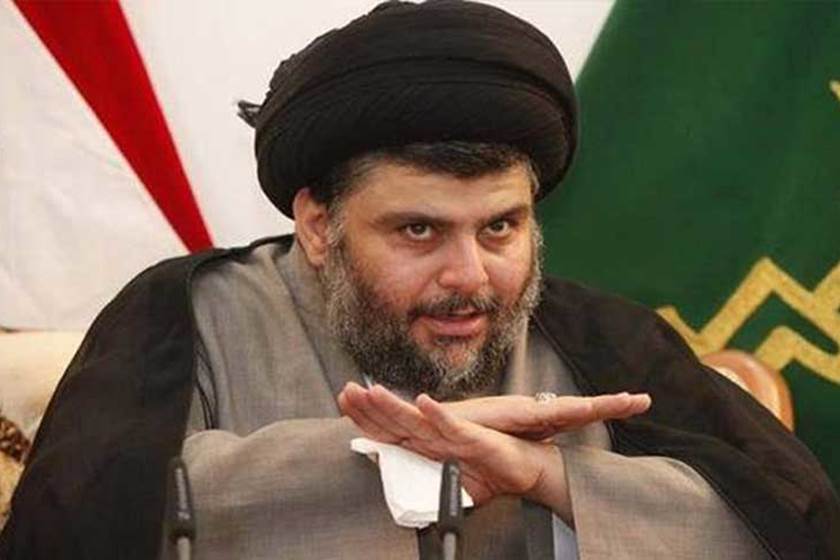
Moqtada al-SadrSadr Won But Iran Did Not Lose

Moqtada al-Sadr
by Neda Bolourchi
Moqtada al-Sadr’s Sairoon (On the Move) Alliance party narrowly won the majority of parliamentary seats in Iraq’s recent elections. Sadr’s more recent history, the language of the campaign, and statements by Sairoon representatives indicate to many that Sadr will work with nearly anyone who disavows or rejects help from Iran, its partners, proxies, or militias. This led to some reserved jubilation as well as premature suggestions of an Iranian loss of regional influence. Sadr’s Sairoon Alliance won, but Iran has not lost either in Iraq or in the region.
Tehran does not see these elections as a zero-sum game. Sairoon narrowly won and must work to build a coalition in order to form a working government. Sadr and Sairoon campaigned on an “Iraq First” platform that relied on deeply nationalistic rhetoric, which has led to an assumption that Sairoon will build a coalition with everyone and anyone not affiliated with Iran. In practice, this means isolating Hadi al-Amiri of the al-Fatah Coalition, which won the second most seats in the election. But such an assumption ignores the on-the-ground realities of politicking. In addition, it also largely ignores what the campaign means for the United States, its presence, and its interests in Iraq.
To be clear, Tehran sees the recent Iraqi election as a potential and momentary setback at worst. The politics of coalition-building is ongoing, and Tehran does not believe that its partners, parties, or proxies will be eliminated from functional and substantives roles in the government, particularly the interior ministry. Tehran’s expectation comes from viewing itself as the most powerful outside actor in Iraq and one that is still needed. Finally, when push comes to shove, Tehran will not allow one election to nullify a decade’s worth of investment.
Reasons for Iranian Optimism
Tehran does not see the Sairoon win as a loss or even a blow for at least four reasons.
First, Tehran is not sure Sadr is now anti-Iran per se as opposed to simply playing to his base as well as his coalition. Iraqi nationalism has been rising over the past several years. Sadr seeks power and, according to Tehran, will adopt positions that garner him more. Advancing anti-Iran rhetoric builds his nationalist credentials so that he is both (allegedly) anti-Iran and anti-U.S, as both countries remain a focus. Yet, both Iran and Sadr want the removal of U.S. forces from Iraq. Sadr and Iran may come to a negotiated agreement on how to achieve such a result and produce a stable Iraq.
Also, Tehran sees Sadr, at his worst, as unpredictable, undependable, and uncontrollable. Sadr has always wanted power and on his terms. He is, as Middle East experts James Muldoon and Yasamin Alttahir have put it less diplomatically in Time, an “impulsive, narcissistic, egoist” who is nothing short of an “opportunist.” Personality differences may play a role as to why Tehran and Sadr may be slightly at odds. Sadr might argue otherwise. He definitely has complaints about how Iranians treated him, both at home in Baghdad and in Iran where he lived in exile from 2008-2011. In particular, he blames Tehran for pressuring Nouri al-Maliki (prime minister from 2006-2014) to limit Sadr’s power and to disband his Mahdi Army. Tehran thinks, even if Sadr turns out to be anti-Iran, he can crumble on his own.
Third, Tehran believes that the Sairoon Alliance will splinter. Running on an “outsider” platform that takes aim at corruption and the lack of public services is not difficult. Transitioning from a campaign to form a functioning government is another issue. Even in a stable and secure country transitions can be problematic. The transition issue is compounded by the composition of Sairoon. Such a disparate grouping of atheists and religiously minded naturally have issues about how to govern and who should fill which government positions. Even a homogenous political party has these issues. Tehran therefore sees this coalition as not only having to maintain itself despite Sadr but also despite its core membership and its fissiparous constitution.
Finally, Sairoon did not win anywhere near a majority. It won 54 of 329 seats and the chance to put forward a new prime minister. Sadr did not run, so he cannot be that premier. The election results require the formation of a coalition government. Because of years invested in Iraq, Tehran believes that it will be part of the new government in some shape or form, regardless of US sanctions against Iraqi politicians affiliated with Tehran. With the outcome of the coalition-building politics unresolved, the Iranian foreign-policy establishment insists that the final outcome will not run counter to Iranian interests.
Tehran holds that Sadr and the Sairoon Alliance, should they want, cannot completely isolate or marginalize Iranian-supported politicians and parties. Tehran spent more than 15 years building networks, providing social services, and helping Iraqis fight the Islamic State and others. Tehran is neither panicking nor scrambling. Naturally, Tehran prefers a government led by a reliable coalition of Ammar al-Hakim (Hikma), former prime minister Nouri al-Maliki (State of Law Coalition), Hadi al-Amiri (al-Fatah Coalition and the Popular Mobilization Units), and Prime Minister Haider al-Abadi (al-Nasr Alliance). Quds Force Commander Qasem Soleimani is by all accounts negotiating that possibility. Sadr too expressed a desire to work with Abadi and al-Hakim as well as former Prime Minister Ayad Allawi. All sides understand that no party won by a large enough margin to dominate the government-formation process. This is all part of the nature of politics. And, this possibility does not even include the Iraqi Kurds and Sunnis that Iran has won over.
Tehran expects its soft power politics to hold sway. Tehran affiliates will not be eliminated from the political and security processes, in either the short or long term. This is why—should Soleimani and his cadres fail to influence Sairoon’s choice for the premiership and the interior ministry—Tehran is not extremely concerned.
Tehran’s Calculations
Tehran understands that it cannot push or advance its cause in Iraq too much. Iran is involved in Iraq to assure itself of a stable neighbor and a possible bulwark. Iraq is, potentially, more important to Iran than Syria. Growing Iraqi nationalism that insists upon a secure, prosperous country as well as an anti-Iran bias must be allowed…to an extent. Given the on-the-ground reality of this election, Iran might have to acquiesce to a smaller role in the country. Should diplomatic negotiations over the formation of the Iraqi government fail to produce a majority for Iranian allies, Tehran knows that its partners, parties, and proxies constitute a strong minority, at worst. Trying to force a different outcome by insisting on a more Iran-friendly government—or sabotaging the one that Sairoon puts together—might only increase anti-Iranian sentiment in Iraq and undermine the political investments Tehran has made over time in the country.
None of this is to say that Tehran does not have concerns about its long-term objective to be friendly with and hold sway over a unified, stable Iraq. Like any other state, Iran would like to deny access by other states-competitors or enemies. Most pressing is the extent of relations between Sadr, Saudi Arabia, and the UAE. Sadr’s rare and public visits to Saudi Arabia and UAE testify to the growing relationship among the three.
Specifically, Tehran is concerned that the Saudis have finally taken Washington’s advice. Riyadh is now copying Tehran by building political support and influence through economic and social incentives. Riyadh is admittedly at least a decade behind and must do the hard work of creating a network of contacts and courting public opinion, which it has been doing by lavishing money on Sadr and the election as well as projects in Basra. In fact, Saudi Arabia’s financial power gives it political leverage at a time when Tehran may, if not should, scale back its presence. Because Iraq is so important to Iranian long-term security strategies, Tehran will fight in one form or another to retain its influence.
Ultimately, Tehran sees the Iraqi election as a setback, at worst. It expects to retain years of investment so that in the long term Tehran has a unified, stable, and friendly neighbor. The Islamic Republic will seek to counter any other foreign competition. Tehran is not scrambling but remains actively engaged in the politics of Iraq to ensure that likelihood. Sadr won the election, but that does not simultaneously mean that Iran has lost.
Neda Bolourchi is currently at the Interdisciplinary Center for Innovative Theory and Empirics at Columbia University. Her work has appeared in the Journal of the American Academy of Religion, The Islamic Monthly, Encyclopaedia Iranica, and the Iranian Studies Journal.

Iran Prepares to go Nuclear

Iran to restart uranium capacity building process, says country's nuclear agency
Middle East Eye
Tehran will inform the UN nuclear watchdog IAEA on Tuesday that the country will start a process to increase its uranium enrichment capacity, Iran's Atomic Energy Organisation spokesman Behrouz Kamalvandi told ISNA news agency.
"In a letter that will be handed over to the International Atomic Energy Organisation ... Iran will announce that the process of increasing the capacity to produce ... UF6 (uranium hexafluoride) ... will start on Tuesday," Kamalvandi said.
He said Iran had the capacity to accelerate production of centrifuges, which are used to enrich uranium. The UF6 is a feedstock for centrifuges.
Earlier on Monday, Iran's Supreme Leader Ayatollah Ali Khamenei hinted at the move by warning European leaders against their "dream" of Tehran continuing to curb its nuclear programme while finding itself under new economic sanctions.
"From some European countries we get the message that they expect the Iranian people to both tolerate the sanctions, deal with the sanctions, and go along with them and give up our nuclear energy activities and continue with the restrictions," he told an audience in a Tehran suburb.
"I would tell these countries that they should be aware that this is a dream that will never come true."
Khamenei spoke nearly a month after President Donald Trump announced the United States was pulling out of the landmark Iran nuclear deal.
The remaining partners - Britain, China, France, Germany and Russia - have scrambled to save the 2015 accord as the US readies to reimpose sanctions on Tehran.
"The people of Iran and the government of Iran will never tolerate both suffering from sanctions and nuclear restrictions," said Khamenei.
"This will never happen," he said during a ceremony to mark the 29th anniversary of the death of revolutionary leader Ayatollah Ruhollah Khomeini.
The Iran deal paved the way for the partial lifting of international sanctions against the country, in exchange for Tehran curbing its nuclear programme for a number of years.
Khamenei and various Iranian political figures have already warned that Iran could leave the agreement if it no longer receives the economic benefits it signed up for.
Late last month, the supreme leader outlined Iran's demands for it to stay in the nuclear deal.
But the remaining backers of the accord have limited power to protect Iran's economic interests in the face of US sanctions, with Trump showing little inclination to spare EU companies.
Shortly after Khamenei's speech, French automaker PSA announced it was pulling out of two joint ventures to sell its cars in Iran owing to the US sanctions.
Last week, the chief executive of French oil giant Total - a symbol of foreign companies' return to Iran after 2015 - said the chances of winning sanctions exemptions were "very slim".

Tuesday, June 5, 2018

Korea Prepares to Make a Nuclear Deal


North Korea sacks top three military officials, as nuclear summit nears
US officials believe there was dissent over Kim Jong-un’s approach to foreign diplomacy
Benjamin Haas in Seoul, and agencies
@haasbenjamin
Mon 4 Jun 2018 02.22 EDT
First published on Sun 3 Jun 2018 19.27 EDT
North Korea’s top three military officials have been removed from their posts, a senior US official said on Sunday, a shakeup that could signal the North’s leader, Kim Jong-un, is working to silence dissent ahead of a summit with Donald Trump in Singapore next week.
The US official, who spoke to Reuters on condition of anonymity, was commenting on a report by South Korea’s Yonhap news agency that all three of the North’s top military officials were believed to have been replaced.
Trump on Friday revived the proposed 12 June summit after cancelling it a week earlier. The US is seeking a negotiated end to North Korea’s nuclear weapons program.
US officials believe there was some dissent in the military about Kim’s approaches to South Korea and the US. Kim likely wants to ensure any deal struck in his meeting with Trump will not face opposition at home.
Since coming to power in 2011, Kim has conducted several purges in an effort to consolidate power. The young leader was just 27 years old when he took power in a society that reveres older cadres.
Mintaro Oba, a former US diplomat who focused on North Korea policy, said Kim might be using the upcoming summit “as leverage to get rid of internal hardliners”. It was also possible the “summit created such a risk to his internal power he felt he had to protect himself by moving people around”.
“It’s worth considering whether this round of summit diplomacy has given Kim Jong-un an opportunity to get a more favourable group of people at the top,” Oba said.
Kim had his uncle and potential rival for control, Jang Song-thaek, tried and executed in 2013. Kim’s older half-brother, Kim Jong-nam, was assassinated last year in an operation widely believed to have been directed from Pyongyang.
The US official did not identify the three military officials. Yonhap identified them as defence chief Pak Yong-sik; chief of the Korean People’s Army’s (KPA) general staff, Ri Myong-su and Kim Jong-gak, the director of the KPA’s General Political Bureau.
Trump wants North Korea to “denuclearise,” meaning to get rid of its nuclear arsenal, in return for relief from economic sanctions. North Korea’s leadership is believed to regard nuclear weapons as crucial to its survival.
Citing an unnamed intelligence official, Yonhap said No Kwang-chol, first vice minister of the Ministry of People’s armed forces, had replaced Pak Yong-sik, while Ri Myong-su was replaced by his deputy, Ri Yong-gil. It said army general Kim Su-gil’s replacement of Kim Jong-gak was confirmed in a North Korean state media report last month.
The White House, State Department, CIA and Office of the Director of National Intelligence did not immediately respond to requests for official comment.
Lower-level US-North Korean talks to prepare for the summit are continuing but have made only “halting progress,” according to a second US official briefed on the discussions.
In a remarkable shift in tone eight days after cancelling the summit, citing Pyongyang’s “open hostility,” Trump welcomed North Korea’s former intelligence chief Kim Yong-chol to the White House on Friday, afterward exchanging smiles and handshakes

The Not-So-Secret Truth About Iran

Secret Files Prove Iran Tried to Build a Nuclear Bomb, Israeli Spy Agency Claims
By Jason Lemon On 6/4/18 at 11:33 AM
Israel’s intelligence agency Mossad shared top secret files with European governments on Sunday night, purporting to prove Iran’s efforts to build a nuclear weapon, claims which the regime in Tehran has always denied.
The Israeli agents managed to snatch a trove of 100,000 documents from a Tehran warehouse in January. One of the files reportedly reveals that Iran’s defense ministry was given responsibility to produce weapons-grade enriched uranium, according to The Times.
Israeli Prime Minister Benjamin Netanyahu, who has just embarked on a three-day tour to meet with European leaders, hopes the files will help convince Germany, France and the United Kingdom to follow the United States and step back from the nuclear agreement with Iran.
Netanyahu will argue that the secret files make the deal invalid, as it was based on the understanding that Iran’s nuclear program was only for peaceful purposes, not weapons.

Israeli Prime Minister Benjamin Netanyahu delivers a speech at the defense ministry in Tel Aviv on April 30. JACK GUEZ/AFP/Getty Images
“I will stress the unchanging truth: Israel will not let Iran acquire nuclear weapons,” Netanyahu told reporters ahead of his tour, The Jerusalem Post reported.
The prime minister has long been a harsh critic of the Iran deal, arguing that it will embolden Israel’s major regional rival and won’t halt the country’s nuclear ambitions. At the same time, several Israeli military and intelligence leaders have said the deal appears to be working and will keep Iran from creating a nuclear weapon.
General Gadi Eisenkot of the Israel Defense Forces said in March that “with all its faults [the deal] is working.” Efraim Halevy, the former director of Mossad, argued following the pact’s signing in 2015 that it is a “credible answer to the Iranian military threat, at least for a decade, if not longer.”
Although the administration of President Donald Trump has chosen to side with Netanyahu, European leaders, as well as China and Russia, have remained firm in their stated commitment to support the agreement. Meeting in Brussels on Friday, China’s foreign minister and the EU’s foreign policy chief said they would continue to work toward fully implementing the pact.
“We will be unswerving in upholding it,” China’s Wang Yi said. Wang explained that the United Nations supported the agreement, arguing that “every party has the duty to implement it.”

President Donald Trump holds up a memorandum that reinstates sanctions on Iran after he announced his decision to withdraw the United States from the 2015 Iran nuclear deal in the Diplomatic Room at the White House May 8 in Washington, D.C. Chip Somodevilla/Getty Images
While Europe currently aims to ease economic sanctions and encourage investment in Iran, the U.S. has decided to implement even stricter regulations and sanctions, while calling for stringent investigations of Iran’s nuclear facilities.
Whether the Mossad files and Netanyahu’s diplomatic efforts change the minds of European leaders remains to be seen. However, David Albright, a former nuclear inspector in Iraq, said the documents corroborate his understanding of Iran’s efforts.
“They would parallel my understanding of the decision to build the Fordow underground enrichment plant that I have assessed a few years ago was likely designed to make weapon-grade uranium, based in part on inspector findings when they first visited the plant,” Albright said, according to Express, calling for international inspectors to closely monitor Iran’s nuclear facilities.

Monday, June 4, 2018

Iraq Helps the Iranian Horn (Daniel 8)

Middle East
The oil from Kirkuk province hasn't been flowing to Iran for some time after Tehran helped Baghdad reclaim the territory from the Kurdish forces. It's unclear how long the deal is going to be afloat since a political bloc led by Shi'ite cleric Moqtada al-Sadr secured a large number of seats in the Iraqi parliament.
Iraq has resumed its exchange of oil with Iran, sending first trucks with black gold from Kirkuk province to Tehran's refineries, the Iranian oil ministry's news agency SHANA reported. Tehran will be sending the same amount of its oil to Iraq's ports on the Persian Gulf. Reuters news agency points out that the swap deal might be Baghdad's way of repaying for Tehran's help in reclaiming the province from the Kurds.
The whole move could strengthen Iran's positions in Iraq ahead of a looming re-imposition of the sanctions by the US. Reuters has suggested that the swap deal might also cause Riyadh dissatisfaction, which accuses Tehran of destabilizing the situation in the Middle East and is opposed to its strengthening in the region. It is unclear though how this deal will work after the victory of a Shi'ite block led by cleric Moqtada al-Sadr in general elections, considering the fact that the latter has positioned himself as an opponent to Iran's influence in Iraq.

The Saudi Horn Approves of US Withdrawal from the Iran Deal

The US withdrawal from Iran nuclear deal has been well received in many capitals.
By INU Staff
INU - The US withdrawal from Iran nuclear deal has been well received in many capitals. The signatories of the Iran nuclear deal do not live in the region, so the positive reception to the US withdrawal by countries in the Middle East is not surprising. Their perception of Tehran is that it is most immediate security threat to the stability of the region.
The consensus in the region if that the regime should under no circumstances possess or acquire material required for the production of nuclear weapons. Countries in the Middle East very concerned over the prospect of the regime building a nuclear arsenal.
The regime’s destabilizing behavior affects global order more at this time than at any other point since 1979, especially regarding rights of navigation and ballistic missile proliferation.
Tehran now threatens the rights of navigation in Bab Al Mandeb and Hormuz. Not only do the nations of the GCC use these channels, but the rest of the world’s commercial fleets do as well. US-led coalition ships have been targeted in Yemen. Bab Al Mandeb links the Mediterranean and The Red Sea to The Arabian Ocean, the Bay of Bengal, and the Malacca Straits transit which stretches to Indonesia, Australia, Asia and the Western Pacific.
Another concern is Iran’s ballistic missile program. In fact, the Kingdom of Saudi Arabia was never targeted by ballistic missiles from Yemen before Iran became involved in the country. It has been proven that missiles used by Houthis were smuggled as disassembled parts into Yemen, where operatives of the IRGC then reassembled and fired them into The Kingdom of Saudi Arabia.
The way forward, should Tehran continue with its current behavior in Yemen, Lebanon, Syria, and Iraq should predicate any trade or commercial activities by multinational corporations with the regime, on an end to missiles proliferation, and Iran’s behavior in Iraq, the in Damascus, and the in Lebanon.
Casual indifference to Iran’s behavior will not last. There must be immediate suspension of all nuclear related activities, which must be verified by inspection teams, and a complete cessation of all ballistic missile proliferation. As well, the removal of all sectarian and proxy assets from Yemen, Lebanon, Syria, and Iraq, the severing of all ties to terrorist groups is necessary.
The people of Iran continue protesting against the clerical regime, and deserve to live as free people.

Saturday, June 2, 2018

Iran Ready to Restart Nuclear Program (Daniel 8)

Ali Khamenei, has outlined a number of steps Iran can take to strengthen its nuclear program in the face of the US exit from the three-year-old deal in which Iran reduced its nuclear activities in exchange for sanctions relief.
Velayati's first recommendation was to make operational UF6 (uranium hexafluoride), which is a compound used in uranium enrichment. Asghar Zarean, the deputy head of the Atomic Energy Organization of Iran, had previously discussed testing the use of UF6 into more modern IR8 centrifuge machines under the supervision of the International Atomic Energy Agency (IAEA). UF6 is a feedstock for centrifuges. After uranium is mined and processed into yellowcake, it is turned into gas and injected into centrifuges in the form of UF6.
Velayati also discussed the possibility producing nuclear propulsion systems, in order to build nuclear-powered ships and submarines. Velayati said a nuclear-powered submarine has the advantage of staying under water for two years. As Donald Trump had previously threatened to break the nuclear deal between Iran and five permanent members of the United Nations Security Council plus Germany, Iran had previously addressed the possibility of building a nuclear-powered submarine. While the construction of the submarine would require proposals to be sent to the IAEA to still fall within the framework of the nuclear deal, which Iran and Europe are trying to keep alive, the discussion of the subject seemed to be a response and an escalation to Trump’s threats.
The use of carbon fiber composites for more advanced IR6 and IR8 centrifuges was another recommendation by Velayati. He said using the more advanced centrifuges would bring Iran closer to the 190,000 SWU (separative work units) enrichment capacity Khamenei had previously outlined as the country’s goal.
Velayati’s recommendations, which were made May 30 at a meeting of the Research-Cultural Institute of the Islamic Revolution to review Khamenei’s positions and statements on the nuclear deal, all seemed to suggest that Iran would look to aggressively advance and increase its nuclear capabilities while still abiding by the 2015 nuclear deal and cooperating with the IAEA.
Reiterating previous points made, Velayati also said that Iran needs to look East, instead of West, to pursue its national interests, in particular toward Russia and China. While Velayati conceded that Russia had in its past broken its oaths, he said that Europe and Western countries have also proven to be unreliable. However, he said that at this time, Iran has more mutual interests with Russia and China and that Iran should pursue these interests.
Velayati added that it was Russia who vetoed a British-sponsored resolution against Iran on Yemen and that it was Putin who rejected French President Emmanuel Macron’s comments involving a move to attach Iran’s missile program to the nuclear deal. Velayati compared those inside the country who felt that negotiating with the United States would solve the country’s problems to Prime Minister Mohammad Mossadegh, who thought that the United States would help Iran in its fight against Great Britain when Iran was facing a boycott for nationalizing its oil in the early 1950s. Instead, the United States helped overthrow Mossadegh.
Velayati, who is a member of the Supreme Supervisory Board of the nuclear deal, also criticized Iran’s parliament for approving the nuclear deal after only having discussed it for 20 minutes. Velayati applauded chief nuclear negotiator and Foreign Minister Mohammad Javad Zarif for his efforts but said that it is not possible for one person to be an expert on everything and that parliament should have reviewed the nuclear deal more carefully.

Friday, June 1, 2018

Trump is helping the Islamic State


Trump’s pullout is a gift for the Iranian hardliners. And Eruope isn’t having any of it

The Joint Comprehensive Plan of Action (JCPOA) was signed in 2015 between P5+1 (US, UK, France, China, Russia and Germany) and Iran to stop Iran from getting nuclear weapons. It helped preventing Iran from production of fissile material for at least 10 to 15 years. However, the US President pulled out of the nuclear deal, which is possibly the greatest blunder ever by the US that not only damages the ability of the West to prevent Iran from getting nuclear weapons but also undermines the credibility of nonproliferation regime which works for the nonproliferation of nuclear technology on global level. This unilateral decision by the US would necessarily draw Iran closer to China and Russia. In fact, the move by the US has somewhat already pushed these three states closer to each other.
Iran is already helping Russia in favour of Bashar al-Assad in Syria. The head of the Iran economic affairs Mohammad Reza Pour Ebrahimi stated that “our ties with Russia would be strengthened and not only will the previous agreements remain in force, but, there will be new ones, there will be new contracts”.
Iran nuclear deal had not only managed to roll back the Iranian nuclear program, but also set in place strict monitoring measures to prevent Iran from ever acquiring nuclear weapons. This deal and strict security measures played an important role in preventing Iran from developing highly enriched Uranium and Plutonium needed to make a nuclear bomb. President Trump withdrew from this deal without offering suitable substitute. It is interesting to note that that this move by the US has in fact isolated the US by separating it from its European friends; they are not happy with the US over this step. Iran’s President Hassan Rouhani said that Iran would remain committed to the deal and would achieve the goals of the deal in cooperation with the other members. According to the statement of President of the European Commission, Jean Claude Juncker, “European companies would not comply with American laws against Iran and it will launch laws that ban European companies and courts from obeying US sanctions against Iran”.
The US would be disappointed if it expects that Iran would give up its regional activities in Syria and Iraq. Iranian military officials said that Iran would not come under the US pressure to limit its military activities in the region.
According to the international nuclear experts President Trump has handed a huge gift to Iran by freeing it to build up nuclear weapons and containing international inspections. Trump’s decision has increased the probabilities of war as Iran can now build nuclear weapons. It also undermines the US’ influence around the globe. It proves that the US cannot be trusted with its promises. It would also increase Iran’s hostility towards the US and its presence in Syria and Iraq. The US withdrawal from the deal also puts a serious question mark on the diplomatic efforts of Obama and the EU. If Trump is thinking about a better deal to renegotiate he would find it very difficult because Iran would no more trust the US which just unilaterally withdrew from the deal that was successfully being followed by Iran through regular IAEA inspections of its nuclear sites. The US would be disappointed if it expects that Iran would give up its regional activities in Syria and Iraq. Iranian military officials said that Iran would not come under the US pressure to limit its military activities in the region.
There is also a possibility that Iran might move to another extreme to enhance its security. Russia and China would also increase their cooperation with Iran as Russian interests already match with that of Iran and Iran-Russia partnership would limit the US influence in the region. It would also increase Iran’s dependence on Russia and trade between both states. This move by the US has intensified the Iranian nationalism. When Iranian public will face the re-imposed sanctions again, their hatred would be increased against the US. Hence, one can rightly say that it is the US gift for the hardliners in Iran which challenges the podium of moderate elites like Hassan Rouhani. It not only justifies the hardliners’ arguments but has also managed to considerably increase the dominance of Iranian hardliners, hence closing the doors of diplomatic interaction with Iran in the future.
The author is a Research Associate at Strategic Vision Institute Islamabad.

Pushing for the Iranian Nuclear Horn (Daniel 8)

Adviser to Iran's top leader pushes uranium enrichment
Associated press
TEHRAN, Iran — A top adviser to Iran's Supreme Leader Ayatollah Ali Khamenei, is proposing Iran resume its uranium enrichment in the wake of the U.S. withdrawal from the nuclear deal between world powers and Tehran.
Ali Akbar Velayati was quoted Wednesday by the semi-official Tasnim news agency as saying Iran is "capable to spin centrifuges for enrichment" to higher levels should it choose to do so.
Velayati says Iran should also accelerate production of nuclear propulsions and also research on advanced centrifuges. He claimed this wouldn't violate the nuclear deal which put limits on Iran's atomic program in exchange for lifting economic sanctions.
In the wake of President Donald Trump's decision to pull the United States out of the deal, several Iranian officials have indicated Tehran could resume its nuclear program.