Showing posts with label emp. Show all posts

Tuesday, November 12, 2019

Why the Bowls of Wrath Are Much More Than an EMP (Revelation 16)

Few weapons are as scary as those that exist only in our minds.
A few years ago when the Republican Party released its platform to the public in the run-up to its national convention at the tail end of a section titled “America Resurgent,” GOP leaders detailed what they felt is a looming threat of America — electromagnetic pulses.
“A single nuclear weapon detonated at high altitude over this country would collapse our electrical grid and other critical infrastructures and endanger the lives of millions,” the platform stated. “With North Korea in possession of nuclear missiles and Iran close to having them, an EMP is no longer a theoretical concern — it is a real threat.”
“EMP is the new test case of seriousness in national security,” cyber security expert Peter W. Singer tweeted after reading the platform. “But not in the way advocates not in on the joke think.”
I reached out to Singer and, after a brief pause to make sure I was serious, he pounced. “There’s this irony of the people who think it’s serious not realizing that they’re the joke,” he explained. “When you walk through the actual scenarios of use, it doesn’t pass the logic test.”
For that, we can’t recommend enough a 2010 series of articles in The Space Review by Yousaf M. Butt, a physicist currently serving as a foreign affairs officer in the State Department’s Space and Advanced Technology office.
“For a large device (greater than 100 kilotons) …. the whole region on the Earth’s surface which is within line-of-sight to the high-altitude explosion will experience the EMP pulse,” he wrote.
Which sounds scary, but there are several important caveats. The higher you detonate a nuclear device, the greater the blast radius. However, the effect of the EMP will be less. Likewise, the smaller the explosive yield, the smaller the EMP and the closer the blast will need to be to the ground to be effective.
Finding that detonation sweet-spot in the Earth’s atmosphere will take countless tests … which no one has done.
The blast Butt described above, one that knocks out the entire electrical system on roughly half the Earth’s surface, could only come from a high-yield thermonuclear warhead attached to an ICBM. So, engaging in the fantasist view, a nuke from Russia or China.
Setting aside the geopolitical gymnastics that must occur to lead to that kind of exchange, if a foreign power detonated a 100 or more kiloton in an electromagnetic attack on America, then the world is at war and there’s little strategic benefit for the aggressor to not just go ahead and nuke a city.
“It doesn’t mean it can’t happen,” Singer told me. “But if the other side is using EMPs we’re moving into thermonuclear war.”
“A weapon of mass destruction is preferable to a weapon of mass disruption,” Butt explained. “A state would be highly unlikely to launch an EMP strike from their own territory because the rocket could be traced to the country of origin and would probably result in nuclear or massive conventional retaliation by the U.S.”
Let’s say the EMP does go off in space above North America. According to the worst case scenario, the attack would fry the Pentagon’s electronics, leaving the U.S. military unable to retaliate.
However, we don’t know what the effects of an EMP might be. Studies conducted by both the Soviet Union and the United States during the Cold War produced dramatically different results every time.
An electromagnetic pulse is a highly unpredictable side effect of a predictably horrifying weapon. “It’s not a weapon we’ve seen past use of. Ever. Literally ever. Nor tests of,” Singer said.
Some countries have attempted to weaponize EMPs in fits and starts, but it remains a byproduct of other weapons systems, including cruise missiles as well as nukes. The idea of North Korea or Iran using a small-yield nuclear device in low atmosphere fails for the same reasons. North Korea can barely manage to cobble together a crude one-kiloton bomb, let alone a device large enough to do significant damage to U.S. infrastructure.
“Serious long-lasting consequences of a one-kiloton EMP strike would likely be limited to a state-sized region of the country,” Butt explained.
“Although grid outages in this region may have cascading knock-on effects in more distant parts of the country, the electronic devices in those further regions would not have suffered direct damage, and the associated power systems far from the EMP exposed region could be re-started.”
So nuclear state actors, both mighty and minor, are out. But what about terrorists? Isn’t it possible for the bad guys to get enough fissile material and construct a bomb?
“Any weapon produced by a terrorist cell would likely be a one of a kind and would have to remain untested. For a terrorist group to then mate this weapon to a ballistic missile and successfully carry out an EMP strike beggars belief,” Butt wrote.
Singer agrees. “But let’s just imagine terrorists somehow get them,” he said. “So, they’re sitting in their cave deciding on their attack. ‘We can either use our nuclear weapon in a completely untested manner, that we don’t know if it will even work, nor the exact damage it will cause, or we can just turn Washington D.C. into a molten mess.’”
“They finally get their dream of dreams, and that’s when they decide to use it in an untested manner that would kill less people … what?”
EMPs are laughable, but the threat of nuclear annihilation is not. It’s strange then that the Republican Party’s platform would pay such special attention to a looming threat of electromagnetic Armageddon.
But it’s not so surprising. In Washington, there is a constellation of right-leaning think tanks, political lobby groups and conferences that have — for a variety of reasons — promoted the EMP threat, often emphasizing the possibility that North Korea or Iran could wipe out America in a single blow.
“You have this strange cottage industry that’s been trying to profit off of it,” Singer said. “The reason it has this cult around it is that it brings together these attractive scenarios that then they get to talk about,” Singer told me.
“It’s post war, the electronics are down — but the guns still work.”
The influence of the Beltway-oriented conferences has extended to popular culture. In 2011, video game publisher THQ released Homefront, a game where North Korea uses an EMP to weaken America and invade it. Players work with the resistance to drive out the invaders.
Novelist William Forstchen, described as a noted EMP expert, showed up at an event to help promote the game and talked to a reporter from The Escapist.
“Most Americans don’t realize EMP is real,” Forstchen began. “Ninety percent of all Americans would die a year after an EMP event. Because it blows out the power structure of the entire United States leaving us wide open for a reality like in the game Homefront.”
Frank Gaffney of the Center for Security Policy, who advised Texas Sen. Ted Cruz’s presidential campaign, made similar claims at the 2009 EMPACT America conference that 90 percent of Americans would die in an EMP attack
“That would be a world without America, as a practical matter,” Gaffney said. “And that is exactly what I believe the Iranians are working towards.”
Forstchen has also produced video game novelizations and the historical fiction novel Days of Infamy, co-authored with Newt Gingrich — the most prominent advocate of EMP awareness. “This could be the kind of catastrophe that ends civilization — and that’s not an exaggeration,” Gingrich said in 2013.
This is not to reject every concern about EMPs. It’s still a good idea to harden the electrical grid and stockpile transformers … because of the sun. In The Space Review, Butt noted that “it is virtually guaranteed that a powerful geomagnetic storm, capable of knocking out a significant section of the U.S. electrical grid, will occur within the next few decades.”
“Historically large storms have a potential to cause power grid blackouts and transformer damage of unprecedented proportions, long-term blackouts, and lengthy restoration times, and chronic shortages for multiple years are possible.”
But fretting about terrorists plunging America into a wasteland with a single doomsday weapon is best left to video games and potboiler novels. Here it’s most appealing as a fantasy. An EMP blast knocks out the electronic infrastructure that makes the modern world modern. Survivors fend for themselves, work the land and rebuild their communities as they see fit.
Monday, July 9, 2018

How Trump Will Sell US Out Like Obama


How Trump Went From ‘Fire and Fury’ to Dismissing North Korean Nuclear Advances
By Neeti Upadhye
Trump on North Korea: From Foe to Friend
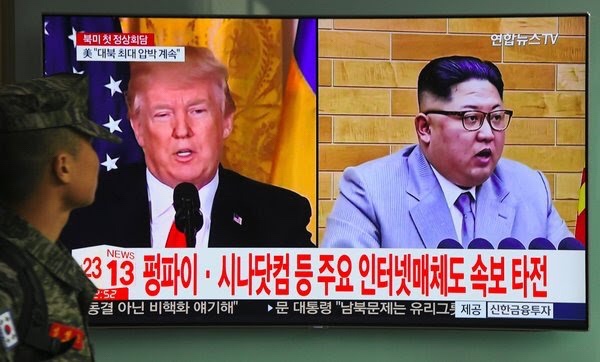
President Trump used to call the North Korean leader, Kim Jong-un, “rocket man.” But over time, Mr. Trump has changed his tune.Jung Yeon-Je/Agence France-Presse — Getty Images
By David E. Sanger
• July 4, 2018
WASHINGTON — When the North Koreans were shooting off missile tests and detonating new, more powerful atomic bombs last year, President Trump responded with threats of “fire and fury” and ordered the military to come up with new, if highly risky, pre-emptive strike options.
But since the one-day summit meeting last month in Singapore, Mr. Trump has done an about-face, while the North’s nuclear program has continued. “Many good conversations with North Korea-it is going well!” he wrote Tuesday morning on Twitter.
Even the recent revelations of seemingly modest North Korean progress on missile technology and the production of nuclear fuel — including continued work on a new nuclear reactor that can produce plutonium — have not dimmed Mr. Trump’s enthusiasm. He argues that they mean little compared to the new tone of conversations, and that even though North Korea has not disassembled a single weapon, his mission should be judged a success.
It is that jarring reversal of tone that has led Mr. Trump’s critics to argue that he was taken in by Kim Jong-un, the North’s 34-year-old leader.
Turning the enthusiasm of the meeting in Singapore into a concrete, verifiable agreement is now the job of Secretary of State Mike Pompeo, who is leaving Washington early Thursday for North Korea. It will be his third trip there, but the first to flesh out a timetable and a common understanding of what the Singapore commitment to “work toward denuclearization of the Korean Peninsula” really means.
Complicating the task is this: Mr. Pompeo, a former C.I.A. chief who knows the details of the North Korean program intimately and has solicited plans for how to accomplish his goals, must show that he can get the North Koreans to go far beyond the agreement his predecessor once-removed, John Kerry, achieved in negotiations with Iran. Mr. Trump has called that deal a “disaster” for years and pulled out of it two months ago.
Now, it looms over Mr. Pompeo’s talks.
By engaging Mr. Trump in the process of “denuclearizing” the Korean Peninsula, Mr. Kim may be calculating that the president would not dare walk away — especially after Mr. Trump noted before the summit meeting that “everyone thinks” he should win a Nobel Peace Prize, before modestly adding, “but I would never say it.”
Still, the test missile engine site that Mr. Trump told reporters was being dismantled still stands, satellite pictures show. And the C.I.A., among other agencies, has warned that the North’s strategy may now be to build up abilities that can be traded away later, hoping to maneuver Mr. Trump into accepting the country as a de facto nuclear power, and settle for concessions on the size and reach of Mr. Kim’s nuclear force.
Mr. Trump and his allies say that is nonsense; sanctions remain and Mr. Trump has not flinched from the goal of “complete, verifiable, irreversible denuclearization.”
“There’s not any starry-eyed feeling among the group doing this,” John R. Bolton, the national security adviser, insisted Sunday on CBS’s “Face the Nation,” saying that most of the major steps toward denuclearization could be taken in a year. In private, Trump administration officials say, Mr. Bolton’s view is the same as it was before he joined the administration: that the North Koreans will never entirely give up their program.
The big question is whether Mr. Kim is truly ready to change course or playing for time with Mr. Trump — as his father and grandfather did with the past four presidents.
Meanwhile, Mr. Trump is in sales mode.
Frustrated by the series of reports that the North is chugging forward, despite its “denuclearization” pledge, Mr. Trump boasted in a tweet on Tuesday that there had been “no Rocket Launches or Nuclear Testing in 8 months. All of Asia is thrilled. Only the Opposition Party, which includes the Fake News, is complaining.”
Then, with a Trumpian flair, he added, “If not for me, we would now be at War with North Korea!”
Mr. Trump is at least partly right: There have been no missile or nuclear tests since November, a freeze that many, including some Democrats, said was a necessary first step. But a freeze and denuclearization are completely different things.
Mr. Kim retains all of his nuclear abilities, and thus his leverage. He can resume testing any time. Just a year ago, Rex W. Tillerson, then the secretary of state, called that position insufficient because it merely perpetuated an ability to strike that Mr. Trump had, until recently, characterized as intolerable.
But it also reveals, in perhaps the most critical national security crisis Mr. Trump faces, his tendency to conflate a good meeting with a good outcome. It is as if President John F. Kennedy, meeting with the Soviet Union’s Nikita Khrushchev for the first time in Vienna in 1961, had declared the Cold War solved. The Cuban missile crisis broke open 16 months later.
Mr. Kim has already accomplished something, too. The heat has been turned down drastically, and the United States has, unilaterally, suspended military exercises with South Korea.
The Obama administration’s Iran agreement shadows Mr. Trump’s talks with the North.
The president regularly calls Iran a major nuclear threat, even though it no longer has enough fuel to make a single nuclear weapon. Under the 2015 agreement, it shipped 97 percent of its nuclear material out of the country. And it never possessed nuclear weapons.
Yet Mr. Trump pulled out after concluding that the United States gave away too much in return for an agreement that would gradually allow the Iranians to resume production around 2030.
The stark contrast between how Mr. Trump talks about Tehran, while insisting that the North is “no longer a nuclear threat,” will become harder and harder to sustain if Mr. Pompeo cannot get Mr. Kim on a rapid denuclearization schedule.
And Mr. Pompeo will need to achieve an inspection regime that provides assurance — not only to intelligence agencies but also to the public in South Korea, Japan and the United States — that the North is not hiding weapons, missiles or production facilities. The C.I.A. and the Defense Intelligence Agency believe that, today, it is hiding all three. So far, Mr. Pompeo has said nothing about the details he intends to present, and Mr. Bolton suggested that stories about new intelligence on the North’s improving its nuclear abilities only imperiled the diplomatic process. As a television commentator and columnist, Mr. Bolton often repeated similar reports when it came to building his case about how to deal with Pyongyang and Tehran.
One thing is clear, however: The Trump administration has not uttered the phrase “complete, verifiable, irreversible denuclearization” in weeks, and Mr. Pompeo has also softened his tone. Some administration officials say that South Korea urged getting rid of the everything-must-be-dismantled-immediately approach. And South Korean officials say that while Mr. Kim might not surrender his entire program anytime soon, he might dismantle parts of it, reducing his readiness to go to war.
“Perhaps the biggest diplomatic problem the U.S. will face, if we can get North Korea to agree to fully denuclearize, will be the timing of that denuclearization and how we verify the component steps,” William Perry, the former defense secretary under President Bill Clinton, wrote this week in Politico Magazine.
Mr. Perry, who negotiated repeatedly with the North, cautioned that “these steps will be complex, will take many months, if not years, and will require intrusive verification procedures.”
“But the U.S. has negotiated agreements equally difficult with the Soviet Union, so we do have a positive precedent,” he wrote.

Thursday, July 5, 2018

North Korea Nuclear Program Done In One Year


White House national security adviser John Bolton said on Sunday he believed the bulk of North Korea’s nuclear, chemical and biological weapons programmes could be dismantled within a year.
Bolton told CBS’s Face the Nation that Washington has devised a programme to dismantle North Korea’s weapons of mass destruction and ballistic missile programmes in a year.
“If they have the strategic decision already made to do that and they’re cooperative, we can move very quickly,” he said. “Physically we would be able to dismantle the overwhelming bulk of their programmes within a year.”
He said Secretary of State Mike Pompeo will likely discuss that proposal with the North Koreans soon. The Financial Times reported that Pompeo was due to visit North Korea this week but Reuters has not been able to confirm his travel plans.
North Korea agreed at the summit to “work toward denuclearisation of the Korean Peninsula,” but the joint statement signed by North Korean leader Kim Jong-un and US, President Donald Trump gave no details on how or when Pyongyang might surrender its nuclear weapons.
Pompeo told reporters the day after the Singapore summit on June 12 that Washington hoped to achieve “major disarmament” by North Korea within Trump’s current term, which ends on January 20, 2021.
Bolton said the United States was going into nuclear negotiations aware of Pyongyang’s failure to live up to its promises in the past.
“We know exactly what the risks are – them using negotiations to drag out the length of time they have to continue their nuclear, chemical, biological weapons programmes and ballistic missiles,” he said.
“There’s not any starry-eyed feeling among the group doing this,” he said. “We’re well aware of what the North Koreans have done in the past.”

Later, appearing on Fox News, Bolton defended Trump’s decision to hold a summit with Russian President Vladimir Putin in Helsinki this month as a way to get beyond the “political noise” that has consumed Washington over the ongoing investigation of Russian election interference.
Bolton said the summit would be “somewhat unstructured” especially during the leaders’ one-on-one time, to avoid “the pressure of immediate deadlines or crises”.
“He wants to understand the Russian position, but, more importantly, he wants Putin to understand our position,” Bolton said. “Let them discuss these issues and see exactly where there might be room for progress or where we find there is no room at all.”
Trump is scheduled to meet with Putin on July 16, several days after he stops in Brussels for a Nato summit. The president has been critical of Nato, suggesting that other member nations do not contribute enough to the alliance and that the United States carries too much of the burden.
Bolton dismissed a question about whether Trump has been more willing to criticise US allies than authoritarian leaders of rival nations, including Putin and North Korea’s Kim Jong-un. Trump feuded with G7 leaders during a summit in Canada last month over trade, abruptly dropping support for a routine joint statement. The president also suggested that Russia, which was kicked out of the group after it annexed Crimea in 2014, be invited back into the organisation.
“I don’t read the way he conducted these meetings the same way,” Bolton told Fox News Sunday host Chris Wallace. “I don’t think anybody ought to have a case of the vapours over discussions we have in Nato or the G7 versus discussions we have with Putin or Kim Jong-un. They’re very, very different; the president treats them differently. He understands what the strategic interests are, and that’s what he’s trying to pursue.”
Although US intelligence officials have stated unequivocally that Russian agents sought to influence the 2016 presidential election, Trump has continued to cast doubt on those conclusions. Last summer, during his first one-on-one meeting with Putin, in Hamburg, Trump said that he questioned him about the interference accusations and that the Russian leader denied it.

Monday, June 25, 2018

Why North Korea is Willing to Negotiate with Trump

Iran's Revolutionary Guards fire a Saegheh missile (illustrationUS Admits N. Korea, Maybe Iran, Can Now Target it with EMP-Nukes

Contact Editor Mark Langfan, 12/04/15 13:19 Share
Iran's Revolutionary Guards fire a Saegheh missile - Reuters
In a blockbuster admission, Admiral Bill Gortney, Commander of North American Aerospace Defense Command (NORAD) and US Northern Command (USNORTHCOM) disclosed that the Pentagon now believes North Korea has mastered the ability to miniaturize its nuclear bombs so they can be fitted onto their latest mobile KN-08 intercontinental ballistic missiles (ICBMs), which are capable of reaching the continental United States.
At the news conference, Adm. Gortney flatly stated, Pyongyang has “the ability to put a nuclear weapon on a KN-08 and shoot it at the homeland [the continental United States].” He expressed confidence that the US could knock down such a missile if launched by North Korea or its ally, Iran.
He also admitted, however, that it is “very difficult” for the US to counter the threat, because its intelligence is unable to follow the mobile ICBMs and give an efficient warning before they are launched.
The admission was accompanied by the announcement that NORAD is reopening its nuclear-EMP-proof Cheyenne Mountain bunker.
The KN-08 is a road-capable, highly mobile ICBM, which can be hidden anywhere throughout the North Korea and could be fired on a short-countdown virtually undetectable by American intelligence. As Adm. Gortney further explained about the North’s KN-08 ICBM, “It’s the relocatable [highly-mobile, can go anywhere – ML] target set that really impedes our ability to find, fix, and finish the [KN-08] threat. And as the [KN-08] targets move around and if we don’t have a persistent stare [i.e., the ability to monitor its location at all times - ML] and persistent [intelligence, surveillance, and reconnaissance] that we do not have over North Korea at this time, that relocatable nature makes it very difficult for us to be able to counter it.”
Despite Adm. Gortney’s concerns, he still believes that if a KN-08 was fired at the US homeland, in the Admiral’s words – “Should one get airborne and come at us [the US homeland], I’m confident we would be able to knock it down.”
Even if this is true, it is not clear if the US ballistic defense could knock down an incoming North Korean ICBM in time, if the nuke is intended as an EMP weapon, which explodes soon after re-entering the atmosphere.
System can defend against Iran strike, too 
In another dramatic revelation, Adm. Gortney revealed that America’s anti-missile missile shield is not only configured to repulse a North Korean missile, but an Iranian ICBM as well. The Admiral explained that the current assessment is that the threat of an ICBM EMP strike comes from North Korea and not from Iran, but that the system could handle both scenarios. “Our system is designed for North Korea, and if we get our assessment wrong, for Iran. Its [the US homeland missile shield] is designed to defend the nation [the homeland] against both those particular threats today,” he said.
Experts have estimated that the KN-08 has a range of 5,600 miles and would be capable of hitting the US’s west coast if launched from North Korea. Experts also believe the missile is not accurate.
However, Adm. Gortney’s statement about North Korea’s nuke-capable KN-08 ICBM must be taken in the context of his simultaneous announcement of the Pentagon’s concern about an EMP-missile strike on the United States homeland.
South Korean intelligence has long believed that North Korea has been developing an EMP-nuclear device. As early as June 2009, Kim Myong Chol, who was an “unofficial” spokesperson of the then-Supreme Leader Kim Jong-il, openly threatened use of a “high-altitude detonation of hydrogen bombs that would create a powerful electromagnetic pulse” bomb.” And, in November of 2013, South Korea’s intelligence service (NIS) issued a report to the South Korean parliament that North Korea had “purchased Russian electromagnetic pulse (EMP) weaponry to develop its own version” of a nuclear EMP device.
EMP strike on South Korea?
In 2005, then-USAF Major Colin Miller posited, in a public-domain US Air Force University thesis, that the North Koreans could tactically use a nuclear-EMP weapon on the Korean Peninsula to “level-the playing field” against the electronic dependent forces of the United States and South Korea.
The tactical North Korean EMP “decapitation” attack would likely bag as POWs the 40,000 living US marines now guarding South Korea because an EMP doesn’t kill human beings, only electronics.
A tactical nuclear-EMP aimed at South Korea would not need an ICBM to reach the 30-50 km level above the earth to explode. Rather, it would only need a much smaller short-range missile to achieve its suitable EMP-location above the Korean peninsula for an effective EMP detonation.
Given the degree of cooperation between the Islamic Republic of Iran and North Korea, it is highly likely that any nuclear-EMP-technology mastered by North Korea has already been shared with Iran. Therefore, the EMP-proliferation danger from North Korea to Iran is a catastrophic danger.
North Korea has been threatening a pre-emptive nuclear strike on the US for two years, as explained in this ABC News report from 2013. At the time of the report, North Korea was said to be "years away" from a developing a missile that could hit the US: These "years" have apparently passed.
And yet, inexplicably, US President Barack Obama is currently negotiating a deal with Iran that he himself has admitted would enable it to manufacture its own nuclear weapons, 12-13 years after it is signed. 
Gil Ronen contributed to this report.

Sunday, February 7, 2016

The Nuclear EMP From Korea Could Destroy Babylon


Super-EMP Missile Launch Window Approaches: “A Mortal Nuclear Threat To The United States – Right Now”
emp-298
As of this writing, North Korea intends to launch another Unha-3 rocket, or a larger and more efficient version in a launch window falling between 8 – 25 February.  This launch follows on the heels of a nuclear test conducted by North Korea on January 6, 2016, and the claim by Kim Jung-Un that the bomb was a hydrogen bomb.  The MSM pundits and their positivist quacking “experts” all state the bomb was not a hydrogen bomb; however, experts such as Peter V. Pry disagree.
What was discussed by Dr. Pry was the intentionally low-yield weapon test that would have been optimal for a miniaturized EMP (Electromagnetic Pulse) device, that range being 5-10 kilotons.  I have cited Dr. Pry’s work in previous articles and am thoroughly convinced of both his professionalism and his expertise.  While the North Koreans claim this launch to be for the purpose of emplacing an earth observation satellite, there are differences in the rocket that satellite images have picked up.  The images revealed a gantry that differs in size and design from previous Unha-3 launches.  The latest attribution is that the rocket may be a Unha-9, the newest North Korean design that may include an 80-ton rocket booster.
The booster has been accomplished with the help of the Iranians. The U.S. Treasury department announced sanctions after proving that Iranians had been traveling to Pyongyang and indeed worked on such a project.  In addition, this new launch has concealment procedures not used before by North Korea, such as a mobile sub-surface rail system to transport the missile directly to the gantry unobserved.  The launch pad itself is shielded from view.
Let us return to Dr. Pry, who explained the details of the reality of just how far along North Korea truly is, as he wrote:
“…North Korea is a mortal nuclear threat to the United States – right now.  North Korea has already successfully tested and developed nuclear weapons.  It has also already miniaturized nuclear weapons for ballistic missile delivery and has armed missiles with nuclear warheads.
Any nuclear weapon detonated above an altitude of 30 kilometers will generate an electromagnetic pulse that will destroy electronics and could collapse the electric power grid and other critical infrastructures – communications, transportation, banking and finance, food and water – that sustain modern civilization and the lives of 300 million Americans.  All could be destroyed by a single nuclear weapon making an EMP attack.
A Super-EMP attack on the United States would cause much more and much deeper damage than a primitive nuclear weaponNorth Korean nuclear tests look suspiciously like a Super-EMP weapon. A Super-EMP warhead would have a low yield, like the North Korean device, because it is not designed to create a big explosion, but to convert its energy into gamma rays, that generate the EMP effect.
Reportedly South Korean military intelligence concluded, independent of the EMP Commission, that Russian scientists are in North Korea helping develop a Super-EMP warhead. In 2012, a military commentator for the People’s Republic of China stated that North Korea has Super-EMP nuclear warheads.  A Super-EMP warhead would not weigh much, and could probably be delivered by North Korea’s ICBM.  The missile does not have to be accurate, as the EMP field is so large that detonating anywhere over the United States would have catastrophic consequences.
So, as of Dec. 12, North Korea’s successful orbit of a satellite demonstrates its ability to make an EMP attack against the United States – right now.”
Dr. Peter Vincent Pry, December 19, 2012, Washington Times, “PRY: North Korea EMP  attack could destroy U.S. – now.”
Please take note of the fact that Dr. Pry wrote the article in 2012.  Since then we have seen the North Koreans actually emplace a satellite into permanent orbit.  Now in addition to all of this, I found this interesting site for your approval, with the “How Stuff Works” site.  The article (with corresponding diagrams) is entitled How E-Bombs Work.
The article will give you some great information on how the Compton effect works, as well as detailing Non-nuclear EMP weapons.  As the article will show, it is not necessary to detonate a 20 megaton warhead to obtain the desired effect, nor rain down a succession of warheads to blanket the target country.  As Dr. Pry explained, the technology to reduce the EMP effect’s delivery vehicle is neither complex nor expensive.  The North Koreans already have one satellite in place, and it is not known whether or not such technology has been incorporated into it for use at a future time.
As of this writing, the Japanese government is on the alert, apparently with the Aegis anti-missile system coming into play.  The South Koreans have warned North Korea of “searing” consequences should the launch take place.  The interesting thing to note is that China is being very noncommittal in condemning North Korea’s planned launch.  The Chinese Foreign Ministry Spokesman Lu Kang said this at a news conference:
“We hope all sides show restraint and take prudent action to avoid any moves that may increase the tensions…”
Another point of interest is that on Sunday, January 31, 2016, Japanese fighter planes were scrambled to intercept two Chinese military aircraft, Shaanxi X-9’s, cargo transport planes that went into both South Korean and Japanese airspace.  This at a time when the Senkaku island dispute between Japan and China is far from over.  In essence, China wishes to appear to be advising restraint while applauding the North Koreans behind the curtain and blustering with their own maneuvers.
In addition to this, while condemning North Korea publicly, Vladimir Putin and Kim Jung-Un reaffirmed their ties of friendship and cooperation in 2015.  This included the transport of 250,000 tons of Russian bituminous coal through the North Korean city of Rajin to South Korea.
The Nyongbyon nuclear complex in North Korea is still producing both highly enriched uranium as well as plutonium.  The scientists in this facility are conducting tests and upgrades to improve the quality and increase the quantity of North Korea’s nuclear weapons.  The Koreans claim this newest launch to be a satellite launch, and indeed, this may be true…but the satellite may contain a miniaturized, Super EMP weapon of the type characterized earlier by Dr. Pry.  In addition, North Korea is going to celebrate the birthday of Kim Jong-Il on February 16, which coincidentally falls right in that announced launch window.
History has shown us in the past that auspicious dates and important events are usually made to coincide with one another deliberately.  Perhaps there will be no need for a candle on the birthday cake of the deceased Jong-Il.  Instead of blowing out the candles, maybe Kim Jong-Un will huff and puff and blow out the lights and power of the United States with an “EMP-candle,” with this latest launch.  We all need to take it seriously.  Regarding any type of potential threat of this magnitude, it is better to prepare and be wrong 364 ¼ days than to not prepare and be right for one day.

Jeremiah Johnson is the Nom de plume of a retired Green Beret of the United States Army Special Forces (Airborne).  Mr. Johnson is also a Gunsmith, a Certified Master Herbalist, a Montana Master Food Preserver, and a graduate of the U.S. Army’s SERE school (Survival Evasion Resistance Escape).  He lives in a cabin in the mountains of Western Montana with his wife and three cats. You can follow Jeremiah’s regular writings at SHTFplan.com.