Showing posts with label threaten. Show all posts

Thursday, February 9, 2017

Antichrist's Men Threaten To Attack Americans

A member of the US Army special forces provides training to fighters of the Iraqi Popular Mobilization Units at Makhmur camp, Iraq, Dec. 11, 2016.  (photo by REUTERS/Mohammed Salem)

Armed Iraqi factions threaten to target Americans in response to travel ban

BAGHDAD — US President Donald Trump's Jan. 27 executive order to ban nationals of Iraq and six other Muslim-majority countries from entering the United States for 90 days has caused a great uproar among Iraqis. Although the travel ban has been temporarily halted by the US judiciary, the repercussions of the event are still ongoing in Iraq. Iraqis see the travel ban as an insult and a betrayal of the people standing against and fighting to defeat the Islamic State.
While the Iraqi government cautiously follows up on the impacts of the US executive order to ban Iraqis from the United States, some Shiite militias threaten to target Americans in Iraq in response to the new US policy.
Author 
Translator Muhammed Hussein Tal'at
On Jan. 30, the Iraqi parliament voted to recommend that reciprocal measures be taken against the travel ban. The day before, Iraqi Shiite cleric and Sadrist movement leader Muqtada al-Sadr had called on Trump to tell American nationals to leave Iraq.
The Iraqi parliament also recommended calling upon the United Nations, international organizations, the Arab League and the Organization of Islamic Cooperation to take stands on the issue, calling upon the US Congress to review the executive order and demanding that the US administration restudy its decision.
Ibtisam al-Hilali, a member of the Reform Front, told Al-Monitor that the government and executive authorities need to carry out the parliament’s reciprocal measures if the US ban resumes.
Asked whether Iraq could influence the US decision, Hilali said, “Adopting diplomatic approaches is the best means to force the American side to renounce this rushed decision; otherwise the government and the relevant authorities should implement the parliament’s action to maintain Iraq's dignity.”
On Jan. 30, the US Department of Defense said it is cooperating with the White House and other institutions to put together a list of all Iraqi nationals who worked with the United States since its invasion of Iraq in 2003 to exclude them from the travel ban. These efforts, however, have not helped ease the issue in Iraq.
On Jan. 31, Prime Minister Haider al-Abadi announced that his government is discussing a set of options “in response” and expressed his hopes of getting Trump's order changed; Abadi described it as an insult to Iraq and Iraqis. However, he said he has no intention of taking reciprocal measures.
On the other hand, armed factions in the Popular Mobilization Units (PMU) took a tougher stance. A senior leader of the Iraqi Hezbollah Brigades lamented the strong-arm policies adopted by Trump in dealing with certain Muslim-majority countries. The faction's leader even threatened to use force and start engaging in armed action against US troops in Iraq.
“We are observing and waiting for a unified political stance from the parliament and the Iraqi government toward Trump’s exclusionary policies. Then we will have an earth-shaking response in that regard,” the leader, who calls himself Abu Talib al-Saeedi, told Al-Monitor in a phone conversation. He added, “We don’t consider all American citizens the same, as our dispute is restricted to the US invasion and those who carry weapons around the country. Therefore, members of the Hezbollah Brigades observe and follow the movements of these troops on a large scale. This is why we have a presence near their military facilities. When something happens, we will resort to the weapons we used against them before.”
Saeedi said the brigades are “on alert” and said, “If American nationals remain here in the same quantities, we will have to resort to armed action once again to remove the troops as we did before in 2011.”
Such statements are similar to what Aws al-Khafaji, the head of the Abu al-Fadl al-Abbas Brigade, affiliated with the PMU, told Al-Monitor. “Resistance factions were — and are today — observing the presence of all foreign forces on Iraqi soil,” he said.
He continued, “Factions of the resistance have always reassured their stance that aims at targeting American military personnel who came to Iraq as occupiers. However, at the same time, we insist that civilians, regardless of being American, are not the target of the Islamist resistance in Iraq.”
For her part, Hamdia al-Husseini, a parliament member representing the Citizens Coalition, called for moving Iraqi funds from the United States, boycotting American goods and finding alternatives to them. “Such measures are considered means of reciprocity that come in response to Trump’s policies against Iraqis, to restore the dignity of Iraqis who have sacrificed their souls and blood for the sake of their country,” Husseini said in a press statement issued by her office.
Abadi's information office spokesman, Saad al-Hadithi, told Al-Monitor that he hoped Trump's measures banning Iraqis from entering the United States would not affect the relations between the two countries. He called for addressing differences smoothly. “The strategic US-Iraq Status of Forces Agreement should be taken into consideration and respected so as not to harm any of the two signing parties,” Hadithi said.
Moreover, Foreign Ministry spokesman Ahmad Jamal said the ministry was surprised that the executive order did not include countries that were — and are today — exporting terrorism and supporting extremist ideas, referring to Saudi Arabia. “What is even more surprising is how no Iraqi was proven to have planned or executed any terrorist action in any of the countries of the world. The Iraqi community is peaceful, represents no security threat whatsoever and its contributions effectively support the US economy,” Jamal said.
The Iraqi government has many obstacles to overcome concerning the negative impact of the US travel ban. It also has its obligations and carries a heavy burden to control armed factions to prevent the targeting of American nationals and military bases where American advisers reside.

Wednesday, March 30, 2016

North Korea Fires More Missiles

South Korea says North Korea fired short-range projectile
Associated Press
By KIM TONG-HYUNG, Associated Press
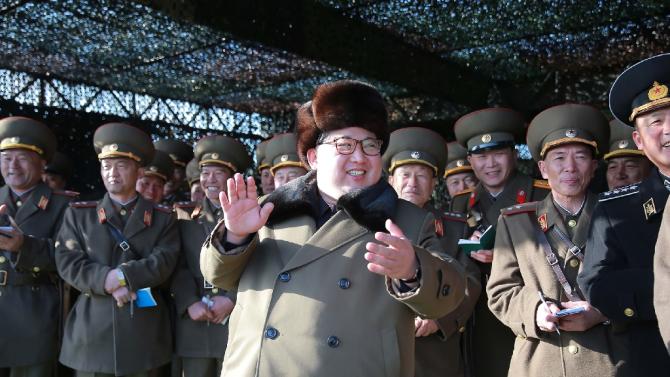
In this Oct. 10, 2015, file photo, North Korean leader Kim Jong Un delivers remarks at a military parade in Pyongyang, North Korea.
© Wong Maye-E/AP Photo In this Oct. 10, 2015, file photo, North Korean leader Kim Jong Un delivers remarks at a military parade in Pyongyang, North Korea.
SEOUL, South Korea — North Korea fired a short-range projectile from an area near its eastern coast on Tuesday, South Korean officials said, in what appears to be another weapons test seen as a response to ongoing military drills between Washington and Seoul.
The projectile was fired near the North Korean port city of Wonsan and flew about 200 kilometers (125 miles) before crashing into land northeast of the launch site, South Korean military officials said.
It was unclear whether the projectile was a ballistic missile or an artillery shell, said a Joint Chiefs of Staff official who didn’t want to be identified, citing office rules. It was too early to tell whether North Korea used a land target to test the accuracy and range of its weapons or experienced problems after planning a launch into the sea, said an official from Seoul’s Defense Ministry, who also didn’t want to be named because of department rules.
North Korea has fired a slew of short-range missiles and artillery shells into the sea and has threatened nuclear strikes on Washington and Seoul since the start on March 7 of the annual springtime war games between the United States and South Korea.
North Korea also launched a medium-range ballistic missile into waters off its east coast for the first time since 2014 and touted a new artillery system it says could turn the South Korean capital of Seoul into a “sea of flames.” Experts say the North’s new artillery launchers can fire 300-millimeter shells up to 200 kilometers (125 miles), theoretically reaching Seoul and its surrounding metropolitan area, where nearly half of the 50 million South Koreans live.
North Korea routinely tests short-range missiles and artillery systems but tends to do more launches in times of tension with the outside world. It condemns the annual military drills between Washington and Seoul as a rehearsal for an invasion. Tensions are particularly high this year because the drills are the largest ever and follow a recent North Korean nuclear test and a long-range rocket launch. Washington and Seoul say the drills are defensive in nature and they have no plans to invade North Korea.

Tuesday, March 22, 2016

North Korea fires more short-range missiles


North Korea fires short-range projectiles into sea amid tension over nuclear ambitions

SEOUL (Reuters) – North Korea fired five short-range projectiles into the sea off its east coast on Monday, South Korea’s military said, amid heightened tension over the isolated country’s nuclear and rocket programs.

The unidentified projectiles were launched from south of the city of Hamhung and flew about 200 km (120 miles), landing in waters east of North Korea, South Korea’s Joint Chiefs of Staff said in a statement.

On Friday, North Korea fired two mid-range ballistic missiles into the sea in defiance of tough new U.N. and U.S. sanctions slapped on the country following nuclear and rocket tests earlier this year.
“North Korea should refrain from all provocative actions, including missile launches, which are in clear violation of U.N. resolutions,” Sung Kim, the U.S. special envoy for North Korea, told reporters in Seoul when asked about Monday’s firing.

In recent weeks, North Korea has stepped up its bellicose rhetoric, threatening pre-emptive nuclear strikes against Washington and Seoul and firing short-range missiles and artillery into the sea.
The North protests annual ongoing joint U.S.-South Korea military drills.

North Korean leader Kim Jong Un said last week that the country would soon test a nuclear warhead and ballistic missiles capable of carrying nuclear warheads in what would be a direct violation of U.N. resolutions that have the backing of Pyongyang’s chief ally, China.

Chinese Foreign Ministry spokeswoman Hua Chunying said China was “deeply concerned” about the situation on the Korean peninsula.

“We hope North Korea does not do anything to contravene U.N. Security Council resolutions. We also hope all sides can remain calm and exercise restraint and avoid doing anything to exacerbate confrontation or tensions,” she told a daily news briefing.

(Reporting by Ju-min Park and James Pearson; Additional reporting by Ben Blanchard in Beijing; Editing by Nick Macfie and Tony Munroe)

Saturday, March 19, 2016

North Korea Fires Back At Babylon


North Korea launches ballistic missiles 
By KJ Kwon, Barbara Starr and Jim Sciutto, CNN
Updated 2034 GMT (0434 HKT) March 18, 2016

(CNN)North Korea has launched two ballistic missiles off the west coast of the Korean peninsula, the South Korean military and U.S. defense officials said Friday.

The South Korean Joint Chiefs of Staff said that one ballistic missile flew a distance of 800 kilometers overland toward the sea off the country’s east coast, while a second projectile, assumed to be a missile, was detected by radar but disappeared at an altitude of about 17 kilometers.

The military said it was closely tracking and monitoring the situation and maintaining a readiness posture for any North Korean provocation.

U.S. official confirmed the launch, with a U.S. defense official telling CNN that it tracked two ballistic missiles.

The launch came around 5:55 a.m. local time, near Sukchon county, South Pyongan province, the Joint Chiefs of Staff said.

Wednesday, March 16, 2016

North Korea Prepares For More Nuclear Tests


North Korean leader says will soon conduct nuclear, missile tests
north-korea-nuclear-programme


North Korean leader Kim Jong Un said his country would soon conduct a nuclear warhead test and a test launch of ballistic missiles capable of carrying nuclear warheads, the North’s official KCNA news agency reported on Tuesday.
Such tests would be in defiant violation of United Nations sanctions that were recently strengthened with the backing of China, North Korea‘s chief ally.
Kim made the comments as he supervised a successful simulated test of atmospheric re-entry of a ballistic missile that measured the “thermodynamic structural stability of newly developed heat-resisting materials”, KCNA said.
“Declaring that a nuclear warhead explosion test and a test-fire of several kinds of ballistic rockets able to carry nuclear warheads will be conducted in a short time to further enhance the reliance of nuclear attack capability, he (Kim) instructed the relevant section to make prearrangement for them to the last detail,” the agency said.
South Korea’s defense ministry said there were no indications of activities at the North’s nuclear test site or its long-range rocket station, but that North Korea continues to maintain readiness to conduct nuclear tests.
South Korean President Park Geun-hye said the North would lead itself to self-destruction if it did not change and continued the confrontation with the international community.
The North’s report comes amid heightened tension on the Korean peninsula as South Korean and U.S. troops stage annual military exercises that Seoul has described as the largest ever.
In the apparent re-entry simulation, the official newspaper of North Korea’s ruling Workers’ Party carried pictures on Tuesday of a dome-shaped object placed under what appeared to be a rocket engine and being blasted with flaming exhaust. In separate images, Kim observed the object described by KCNA as a warhead tip.
The North has issued belligerent statements almost daily since coming under a new U.N. resolution adopted this month to tighten sanctions against it after a nuclear test in January and the launch of a long-range rocket last month.
In 1962, the United States launched a ballistic missile with a live warhead in what was known as the Frigate Bird test. China conducted a similar test in 1966.
“What would be terrible is if the DPRK (North Korea) re-enacted Operation Frigate Bird or the fourth Chinese nuclear test and did a two-in-one,” said Jeffrey Lewis of the California-based Middlebury Institute of International Studies.
“For now, though, it looks like a nuclear test and several missile tests in close succession,” he said.
Technology doubts
South Korea‘s defense ministry said after the North’s report that it still does not believe the North has acquired missile re-entry technology, which should include the ability to guide the rocket after it re-enters the atmosphere.
U.S. and South Korean experts have said the general consensus was that North Korea had not yet successfully miniaturized a nuclear warhead to be mounted on an intercontinental ballistic missile.
More crucially, the consensus is that there have been no tests to prove it has mastered the re-entry technology needed to bring a payload back into the atmosphere.
The North, which has conducted four nuclear tests, also claims that its January nuclear test was of a hydrogen bomb, although most experts said the blast was too small for it to have been from a full-fledged hydrogen bomb.
The North also says the satellites it has launched into orbit are functioning successfully, although that has not been verified independently.
North Korea rejects criticism of its nuclear and missile programs, even from old ally China, saying it has a sovereign right to defend itself from threats and to run a space program putting satellites into orbit.
The new U.N. Security Council resolution sharply expanded existing sanctions by requiring member states to inspect all cargo to and from North Korea and banning the North’s trade of coal when it is seen as funding its arms program.
The foreign ministers of South Korea and China discussed the new sanctions against North Korea by telephone late on Monday and agreed it was important to implement them “in a complete and comprehensive manner”, China said on Tuesday.

Tuesday, March 15, 2016

N Korea Successfully Tests Transcontinental Nuke

N. Korea leader orders nuclear warhead test, missile launches
This undated picture released from North Korea's official Korean Central News Agency (KCNA) on March 11, 2016 shows North Korean leader Kim Jong-Un (C) attending the KPA tank crew competition
Seoul (AFP) – North Korean leader Kim Jong-Un has ordered an imminent nuclear warhead explosion test and multiple ballistic missile launches, just weeks after being slapped with tough, new UN sanctions, state media reported Tuesday.

The order came after Kim monitored the successful lab-test of the warhead re-entry technology required for a nuclear strike on the US mainland, the North’s official KCNA news agency said.Kim’s comments were the latest in a series of daily statements and warnings by Pyongyang, talking up the North’s nuclear strike capabilities and threatening attacks on Seoul and Washington.

The main focus of the threats have been ongoing, large-scale military exercises by South Korea and the United States that Pyongyang has condemned as rehearsals for invasion.

In order to boost the reliability of the nation’s nuclear deterrent still further, Kim said a nuclear warhead explosion test and test firings of “several kinds” of ballistic rockets would be carried out “in a short time”.

The warning came days after state media released photos of Kim posing with what was claimed to be a miniaturised nuclear warhead capable of fitting on a ballistic missile.

Kim had said last week that the North was planning to conduct new tests to gauge the “destructive power” of the new, miniaturised warheads.

While North Korea is known to have a small stockpile of nuclear weapons, its ability to deliver them accurately to a chosen target on the tip of a ballistic missile has been a subject of heated debate.

– Re-entry test –

There are numerous question marks over the North’s weapons delivery systems, with many experts believing it is still years from developing a working inter-continental ballistic missile (ICBM) that could strike the continental United States.

Others have doubted whether any miniaturised device the North has designed so far would be robust enough to survive the shock, vibration and temperature change associated with ballistic flight.

Tuesday’s KCNA report said Kim had personally monitored a test simulating the intense heat and vibration that a nuclear warhead would undergo during atmospheric re-entry.

Using “newly developed heat-resisting material” the warhead was subjected to thermal flows five times hotter than those associated with ICBM flight

The test was a complete success, the agency said, and provided a “sure guarantee” of the warhead’s ability to withstand re-entry.

Tensions have been rising on the Korean peninsula ever since the North conducted its fourth underground nuclear test on January 6, followed by a long-range rocket launch a month later.

The UN Security Council responded by adopting a resolution earlier this month laying out the toughest sanctions imposed on Pyongyang to date over its nuclear weapons programme.

The resolution broke new ground by targeting specific sectors key to the North Korean economy and seeking to undermine the North’s use of, and access to, international transport systems.

For all Pyongyang’s recent claims, most experts rule out the prospect of North Korea launching any sort of nuclear strike with a largely untested system, saying it would be tantamount to suicide given overwhelming US technical superiority.

Sunday, March 13, 2016

Korea Threatens To Wipe Out New York


North Korea Claims They Can Wipe Manhattan Off The Map With Missile And Nuclear Capabilities
north korea bomb
Jessica Dafoe
In the latest of of long list of threats by North Korea, the nation is now stating that they can easily wipe Manhattan off the map by sending a ballistic missile with a hydrogen bomb intact to the heart of the highly-populated city.
Although there are reasons to believe that the regime is exaggerating their technical and militant capabilities, the constant warnings and threats are not to be taken lightly. Kim’s anger is boiling over due to nations interfering in his own county’s ambitions.
The Washington Post relays the words of DPRK Today, a state-run outlet, reporting as to their leader’s intentions and capabilities in comparison to other nations with nuclear capabilities.
“Our hydrogen bomb is much bigger than the one developed by the Soviet Union. If this H-bomb were to be mounted on an inter-continental ballistic missile and fall on Manhattan in New York City, all the people there would be killed immediately and the city would burn down to ashes.”
The report was apparently citing the research and data collected by scientist Cho Hyong Il on the direction of Kim. It is a strange manner for the regime to communicate their latest threat, seeing as this specific state-run website has also focused on the farming of rabbits and school backpack manufacturing.
Although tensions between North Korea and other nations, including the United States, have run high continually, the latest string of threats began back in January, as the Post reminds.
“Kim in January ordered North Korea’s fourth nuclear test and claimed that it was ahydrogen bomb, not a simple atomic one. But most experts are skeptical of the claim, saying the seismic waves caused by the blast were similar to those caused by the North’s three previous tests. Then in February, Kim oversaw the launch of what North Korea said was a rocket that put a satellite into orbit but that is widely considered part of a long-range ballistic missile program.”
It’s been reported that North Korea has made up ground and advances in their nuclear capabilities and the distance which they are able to reach with their missiles. It’s predicted that the nation is now able to reach the west coast of the United States.
Although experts on the subject of weaponry and warheads were skeptical when Kim offered up a view to the world of a miniaturized warhead, mainly about it’s appearance, saying that it just doesn’t look right, Jeffrey Lewis, director of the East Asia nonproliferation program at the Middlebury Institute of International Studies at Monterey, indicated that it should not be dismissed as being what Kim insists it is.
“It does not look like US devices, to be sure, but it is hard to know if aspects of the model are truly implausible or simply that North Korean nuclear weapons look different than their Soviet and American cousins,” Lewis wrote in an analysis for 38 North, a website devoted to North Korea. “The size, however, is consistent with my expectations for North Korea.”
Sanctions have been called for in response to the Pyongyang regime and their increasingly hostile activity. Time reminds of these sanctions being ordered.
“North Korea, under the rule of Kim Jong-un, last week threatened nuclear strikes on the U.S. and South Korea and was hit with more sanctions after a nuclear test and rocket launch this year.”
The sanctions have been ordered at the same time annual spring drills between the U.S. and South Korean military are taking place. Kim views these drills as antagonist actions and a “rehearsal for invasion.” This has led to Kim ordering exercises to be practiced by his own military that involve “decapitation strikes” on leaders and destruction of nuclear and missile sites.The South Korean defense ministry urged North Korea to halt its threats in a statement.
“If the North continues to make provocations despite the stern warnings made by our military, it is inevitable for us to roll out a strict response that may lead to the destruction of the Pyongyang regime.”

Military Activities Accelerate With North Korea


North Korean submarine missing and presumed sunk, say reports

Vessel was operating off North Korean coast during the week when it disappeared, according to reports from the US and South Korea
Kim Jong Un on submarine
North Korean leader Kim Jong Un looks through a submarine periscope. A North Korean submarine has gone missing at sea, reports say. Photograph: KCNA/Reuters
A North Korean submarine has gone missing at sea and is presumed to have sunk, according to reports from the US and South Korea.

The vessel had reportedly been operating off the North Korean coast during the week when it disappeared.
A South Korean defence ministry said Seoul was investigating the reports. Pentagon officials declined to comment on the matter.

The US military had been observing the submarine off the North’s eastern coast, CNN said, citing three US officials familiar with the incident.

American spy satellites, aircraft and ships had been watching as the North Korean navy searched for the missing sub, the report said.

The US was unsure if the missing vessel is adrift or whether it has sunk, CNN reported, but officials believe it suffered a failure during an exercise.

The US Naval Institute (USNI) News said the submarine was presumed sunk.

“The speculation is that it sank,” an unidentified US official was quoted as telling USNI News.

“The North Koreans have not made an attempt to indicate there is something wrong or that they require help or some type of assistance.”

North Korea’s navy operates a fleet of 70 submarines, most of them being old diesel models capable of little more than coastal defence and limited offensive capabilities.

But they still pose a threat to South Korean vessels. In 2010 a South Korean corvette was reportedly torpedoed by a North Korean submarine near their sea border.

In August 2015 Seoul said said 70% of the North’s total submarine fleet – or around 50 vessels – had left their bases and disappeared from the South’s military radar, sparking alarm.

The incident comes as tensions were further heightened on the Korean peninsula by a fresh threat from Pyongyang.

The official KCNA news agency, citing a statement from military chiefs, warned of a “pre-emptive retaliatory strike at the enemy groups” involved in the joint US-South Korean drill.

Pyongyang added it planned to respond to the drills with an “operation to liberate the whole of South Korea including Seoul” with an “ultra-precision blitzkrieg”.

Responding to the statement, South Korea’s defence ministry urged Pyongyang to stop making threats or further provocations, according to Yonhap news agency.

With Agence France-Presse

Saturday, March 12, 2016

Korea Planning On More Nuclear Tests (Daniel 7:7)


North Korea reportedly orders more tests to build up nuclear attack capability

North Korean dictator Kim Jong Un reportedly ordered officials Friday to improve the country’s nuclear attack capability by conducting more weapons tests.

Reuters, citing North Korea’s official news agency (KCNA), reported Friday that Kim also watched a ballistic missile test take place.

The KCNA report did not say when the test happened, but it was most likely referring to the country firing two rockets into the sea on Thursday as a response to South Korea’s latest round of sanctions.
“Dear comrade Kim Jong Un said work… must be strengthened to improve nuclear attack capability and issued combat tasks to continue nuclear explosion tests to assess the power of newly developed nuclear warheads,” KCNA reported.

When asked about the comments, South Korea’s Unification Ministry spokesman Jeong Joon-hee described them as “rash and thoughtless behavior by someone who has no idea how the world works,” according to Reuters.

U.N. Secretary-General Ban Ki-moon called on Pyongyang a day earlier to “cease destabilizing acts.”
On Thursday, North Korea also “liquidated” South Korean assets at the closed joint factory park in the North Korean border town of Daesong and at a scrapped tourism resort at Diamond Mountain.
In a continuation of bellicose rhetoric that has spiked in recent weeks, a statement from the North’s Committee for the Peaceful Reunification of Korea said North Korea will also impose “lethal” military, political and economic blows on the South Korean government to accelerate its “pitiable demise.”

South Korea’s government called the statement a “provocative act” and warned the North not to damage any South Korean assets.

The missiles fired by North Korea on Thursday flew about 310 miles before falling into the ocean off the country’s east coast, according to Seoul’s Defense Ministry. They were believed to be Scud-type missiles, ministry spokesman Moon Sang Gyun said.

Such missile firings by the North are not uncommon when animosity rises. North Korea hates the annual military drills staged by Seoul and Washington, calling them preparations for an invasion. The allies say the drills, which this year are described as the biggest ever, are defensive and routine. North Korea warned at the start of the drills Monday of pre-emptive nuclear strikes.

On Wednesday, North Korea printed photos in official media of a purported mock-up of part of a nuclear warhead, with Kim repeating a claim that his country has developed miniaturized atomic bombs that can be placed on missiles.

Information from secretive, authoritarian North Korea is often impossible to confirm, and the country’s state media have a history of photo manipulation. But it was the first time the North has publicly displayed its purported nuclear designs, though it remains unclear whether the country has functioning warheads of that size or is simply trying to develop one.

South Korea’s Defense Ministry on Wednesday disputed the North’s claim that it possesses miniaturized warheads. The U.S. Department of Defense also said this week that it had no evidence that North Korea had succeeded in miniaturizing a warhead, Reuters reports.

The United States said Wednesday it has dispatched three B-2 stealth bombers capable of launching nuclear as well as conventional weapons to the Asia-Pacific region. The U.S. Strategic Command said the bombers will conduct training with the Australian military during their deployment, which amounts to a show of force at a time of mounting tensions with North Korea.

Wednesday, March 9, 2016

First A Hydrogen Bomb, Now A Miniaturized Nuke


North Korea’s Kim says country has miniaturized nuclear warhead

Tuesday, March 8, 2016 JACK KIM FOR REUTERS
By Jack Kim

SEOUL (Reuters) – North Korean leader Kim Jong Un said the country has miniaturized nuclear warheads to be mounted on ballistic missiles and ordered improvements in the power and precision of its arsenal, its state media reported on Wednesday.

Kim has called for his military to be prepared to mount pre-emptive attacks against the United States and South Korea and stand ready to use nuclear weapons, stepping up belligerent rhetoric after coming under new U.N. and bilateral sanctions.

U.S. and South Korean troops began large-scale military drills this week, which the North calls “nuclear war moves” and threatened to respond with an all-out offensive.

Kim’s comments released on Wednesday were his first direct mention of the claim, previously made repeatedly in state media, to have successfully miniaturized a nuclear warhead to be mounted on a ballistic missile, which is widely questioned.

“The nuclear warheads have been standardized to be fit for ballistic missiles by miniaturizing them,” KCNA quoted him as saying as he inspected the work of nuclear workers, adding “this can be called true nuclear deterrent.”

“He stressed the importance of building ever more powerful, precision and miniaturized nuclear weapons and their delivery means,” KCNA said.

Kim also inspected the nuclear warheads designed for thermo-nuclear reaction, KCNA said, referring to a hydrogen bomb that the country claimed to have tested in January.

North Korea conducted its fourth nuclear test on Jan. 6 claiming to have set off a miniaturized hydrogen bomb, which was disputed by many experts and the governments of South Korea and the United States. The blast detected from the test was simply too small to back up the claim, experts said at the time.

The U.N. Security Council imposed harsh new sanctions on the isolated state last week for the nuclear test. It launched a long-range rocket in February drawing international criticism and sanctions from its rival, South Korea.

On Tuesday South Korea announced further measures aimed at isolating the North by blacklisting individuals and entities that it said were linked to Pyongyang’s weapons program.m
China also stepped up pressure on the North by barring one of the 31 ships on its transport ministry’s blacklist.

But a U.N. panel set up to monitor sanctions under an earlier Security Council resolution adopted in 2009 said in a report released on Tuesday that it had “serious questions about the efficacy of the current United Nations sanctions regime.”

North Korea has been “effective in evading sanctions” by continuing to engage in banned trade, “facilitated by the low level of implementation of Security Council resolutions by Member States,” the Panel of Experts said.

“The reasons are diverse, but include lack of political will, inadequate enabling legislation, lack of understanding of the resolutions and low prioritization,” it said, referring to the incomplete enforcement of sanctions.

Read more at http://newsdaily.com/2016/03/north-korea-leader-kim-says-country-has-miniaturized-nuclear-warhead-kcna/#ZjH5LRMhYvsP4z1f.99

Tuesday, March 8, 2016

North Korea Threatens Pre-emptive Nuclear Strike


South Korean army soldiers stand on their K-55 self-propelled howitzers during an annual exercise in Paju, near the border with North Korea, Monday, March 7, 2016.

  • Brian Padden
South Korean army soldiers stand on their K-55 self-propelled howitzers during an annual exercise in Paju, near the border with North Korea, Monday, March 7, 2016.

North Korea has threatened a pre-emptive nuclear strike as U.S. and South Korean forces began their largest joint exercises ever conducted.

The annual joint drills often intensify tensions on the divided Korean peninsula, but this year the situation is particularly volatile, given tough new United Nations sanctions imposed on North Korea for its recent nuclear test and long-range rocket launch.

The Philippines has already acted to enforce the sanctions when it impounded a cargo vessel linked to North Korea.

Key Resolve and Foal Eagle

This year’s joint exercises, known as Key Resolve and Foal Eagle, involve 17,000 American troops, four times more than participated last year, as well as 300,000 South Korean troops, and an array of U.S. aircraft and naval vessels, including the nuclear-powered submarine the USS North Carolina and the nuclear-powered aircraft carrier the USS John C. Stennis.

North Korea’s National Defense Commission Monday denounced the military exercises in a statement and said it was prepared for a “sacred war of justice for reunification.”

“As the joint military exercises to be staged by the enemies are regarded as the most undisguised nuclear war drills, aimed to infringe upon the sovereignty of [North Korea], its military counteraction will be more a preemptive and offensive nuclear strike to cope with them,” the statement said.

While the U.S. and South Korea defend the annual joint drills as defensive in nature, this year the two allies will reportedly practice preemptive military strikes to take out North Korean targets.

Amphibious assault vehicles of the South Korean Marine Corps throw smoke bombs during a U.S.-South Korea joint landing operation drill in Pohang, southeast of Seoul, during Foal Eagle exercises in 2013.

South Korean Defense Ministry spokesman Moon Sang-kyun called the North Korean preemptive strike threat “unacceptable.”

“If North Korea ignores our warnings and provokes, our military will firmly and mercilessly respond. We warn North Korea that it must be responsible for all situations which lead to its reckless provocations,” he said on Monday.

No hotline

North Korea’s recent nuclear test and rocket launch has triggered retaliatory responses that increase the potential for inter-Korean conflict.

The Seoul government closed the Kaesong Industrial Complex (KIC) that it jointly operated with Pyongyang.

North Korea then immediately deported all South Koreans who were working at the KIC and cut an emergency communication hotline put in place to defuse dangerous military situations.

South Korean vehicles returning from North Korea's joint Kaesong Industrial Complex pass the customs, immigration and quarantine office near the border village of Panmunjom, in Paju, South Korea, Feb. 11, 2016.
South Korean vehicles returning from North Korea’s joint Kaesong Industrial Complex pass the customs, immigration and quarantine office near the border village of Panmunjom, in Paju, South Korea, Feb. 11, 2016.

With U.S. and South Korean forces on high alert and with no working communication hotline, any perceived North Korean provocation could easily escalate.

“If North Korea wants to take some kind of belligerent military action against the South and in some limited way, I think they are running a very high risk of facing some retaliation,” said Northeast Asia security analyst Daniel Pinkston with Troy University in Seoul.

Impounded cargo vessel

The Philippines has become the first country to enforce the new United Nations sanctions on North Korea.

The Philippine Coast Guard on Friday detained and searched the Jin Teng, a 4,355-ton cargo ship with a crew of 21 North Korean citizens.

The vessel was carrying agricultural byproducts often used as livestock feed.

The search revealed no illicit cargo related to North Korea’s banned arms trade or nuclear program, only minor safety violations.

FILE - In this March 4, 2016 file photo, crewmen of the North Korean cargo vessel Jin Teng stand on the middle of the deck as it unloads its cargo while docked at Subic Bay, in Zambales province, northwest of Manila, Philippines.
FILE – In this March 4, 2016 file photo, crewmen of the North Korean cargo vessel Jin Teng stand on the middle of the deck as it unloads its cargo while docked at Subic Bay, in Zambales province, northwest of Manila, Philippines.

However, the Jin Teng has been sanctioned by the U.N. as one of 31 vessels owned by Pyongyang-based Ocean Maritime Management Co. (OMM) for past involvement in trading arms.
In 2014, the OMM was banned by the U.N. when one of its ships was caught transporting jet fighters and other weapons from Cuba during an inspection in Panama.

Philippine authorities impounded the vessel, are planning to deport the crew and have called in the United Nations to coordinate further actions to be taken.

Manuel L. Quezon III, a member of President Benigno Aquino’s communications team, told a government-run radio station Saturday that “as a member of the U.N., the Philippines has to do its part to enforce the sanctions.”

Youmi Kim in Seoul contributed to this report.

Monday, March 7, 2016

North Korea Threatens South And US (Daniel 7)


N. Korea threatens pre-emptive nuclear strike on South, US

North_Korea__new-m_3588555b
Yahoo News
North Korea threatened “indiscriminate” nuclear strikes against South Korea and the US mainland if the two allies push ahead with joint military drills scheduled to begin Monday.
The threat to carry out what it described as a “pre-emptive nuclear strike of justice” was made in a statement by the North’s powerful National Defence Commission, citing the Supreme Command of the Korean People’s Army (KPA).
It came just days after leader Kim Jong-Un ordered the country’s nuclear arsenal to be placed on standby for use “at any moment,” in response to tough new UN sanctions imposed over the North’s fourth nuclear test in January and last month’s long-range rocket launch.
Pyongyang has issued dire warnings of nuclear attack in the past, usually during periods of elevated military tensions of the Korean peninsula.
While the North is known to have a small stockpile of nuclear warheads, experts are divided about its ability to mount them on a working missile delivery system.
The national Defence Commission described the annual South Korea-US military exercises as “undisguised nuclear war drills” that threatened the North’s national sovereignty, and vowed an all-out offensive in response.
“The indiscriminate nuclear strike… will clearly show those keen on aggression and war, the military mettle of (North Korea),” said the statement published by the North’s official KCNA news agency.
Any strike would not just target operational theatres on the Korean peninsula, but also US bases on the mainland and in the rest of the Asia-Pacific region.
“If we push the buttons to annihilate the enemies even right now, all bases of provocations will be reduced to seas in flames and ashes in a moment,” it added.
The annual exercises slated to begin Monday — called “Foal Eagle” and “Key Resolve” last for weeks and involve tens of thousands of US and South Korean troops.
Pyongyang has long condemned the drills as provocative rehearsals for invasion, while Seoul and Washington insist they are purely defensive in nature.

Saturday, March 5, 2016

North Korea Prepares for WW3


WW3 News: North Korea Readies Nuclear Warheads

Is North Korea preparing to unleash WW3 with its President, Kim Jong Un, urging the military to ready its nuclear arsenal to be fired at its enemies amid tougher sanctions imposed by the United Nations Security Council?

The North Korean leader said the country’s “nuclear warheads need to be ready for use at any time,” in response to the enemies that were threatening the country’s survival, the North Korean state news agency KCNA reported.

“Under the extreme situation that the U.S. Imperialist is misusing its military influence and is pressuring other countries and people to start war and catastrophe, the only way for our people to protect sovereignty and rights to live is to strengthen the quality and quantity of nuclear power and realize the balance of power,” Kim was quoted as saying.

He was speaking at a military exercise on Thursday, when the country had test-fired “short-range projectiles” of a new multiple launch rocket system.

On Thursday, Pyongyang launched six projectiles that flew 60 to 90 miles off the east coast of the Korean Peninsula.

South Korean defense officials said that the North had been testing the new multiple-rocket launcher with a range far enough to strike major American and South Korean military bases, including those in the Osan-Pyeongtaek hub 62 miles south of Seoul.

Apart from its nuclear weapons, North Korea’s multiple-rocket launchers and artillery pieces are its most-feared weapons in the South. The North is estimated to have 13,000 of them clustered on the inter-Korean border, 28 miles north of Seoul.

North Korea appeared to flexing its muscles in the wake of the toughest sanctions yet brought by the UN resolution aiming to cripple the economic factors that fuel Pyongyang’s nuclear and ballistic missile programs.

The flared up tensions could result in a WW3 given the United States’s attempt to move against the North wouldn’t be taken lightly by the communist nations. China, the North’s only ally could also end up in a confrontation with NATO and its allies on the Korean crisis since it wouldn’t like to see a US invasion of the country. Russia too would likely back China against the US and the thermo-nuclear war will the possible outcome of these developments.

Meanwhile, the move by South Korea to deploy an advanced missile defense system could further escalate the tensions in the fragile Korean peninsula. Representatives of the South Korean and American armed forces on a joint task force met last Friday in Seoul to discuss the possible deployment of the US missile system called Terminal High-Altitude Area Defense, or THAAD.
The move, however, will likely escalate tensions with the Chinese and Russians since they have repeatedly warned the South against hoisting the United States missile system. The missile will threaten the sovereignty of Beijing and could trigger a war similar to the Cuban crisis faced by Americans in the Cold war era.

Friday, March 4, 2016

North Korea Now Threatening Nuclear War


N. Korea threatens nuclear attacks after severe U.N. sanctions

  • AP Photo/Ahn Young-joon
North Korean leader Kim Jong-un has ordered his country’s nuclear weapons made ready for use at a moment’s notice, the country’s official state news agency reported Friday.
Kim also said his country will ready its military so it is prepared to carry out pre-emptive attacks, calling the current situation very precarious, according to the Korean Central News Agency.

The threats in the statement are part of the authoritarian nation’s regular propaganda effort to show strength in the face of what it sees as an effort by its enemies South Korea and the United States to overthrow its leaders; it follows harsh U.N. sanctions over the North’s recent nuclear test and long-range rocket launch and comes ahead of joint U.S.-South Korean war games this month that the North claims are invasion preparations.

North Korea has threatened nuclear war in the past, but it is unclear just how advanced the country’s nuclear program really is. Pyongyang is thought to have a handful of crude atomic bombs, but there is considerable outside debate about whether it is technologically able to shrink a warhead and mount it on a missile.

“The only way for defending the sovereignty of our nation and its right to existence under the present extreme situation is to bolster up nuclear force both in quality and quantity,” the North’s dispatch Friday said, paraphrasing Kim Jong Un. It said that Kim stressed “the need to get the nuclear warheads deployed for national defense always on standby so as to be fired any moment.”

On Thursday, North Korea fired six short-range projectiles into the sea off its east coast, South Korean officials said, just hours after the U.N. Security Council approved the toughest sanctions on the North in two decades.

The firings also came shortly after South Korea’s National Assembly passed its first legislation on human rights in North Korea.

The North Korean projectiles, fired from the eastern coastal town of Wonsan, flew about 100 to 150 kilometers (60 to 90 miles) before landing in the sea, South Korea’s Joint Chiefs of Staff said in a statement.

North Korea routinely test-fires missiles and rockets, but often conducts weapons launches when angered at international condemnation.

Thursday’s firings were seen as a “low-level” response to the U.N. sanctions, with North Korea unlikely to launch any major provocation until its landmark ruling Workers’ Party convention in May, according to Yang Moo-jin, a professor at the University of North Korean Studies in Seoul.

North Korean citizens in the capital, Pyongyang, interviewed by The Associated Press said Thursday they believe their country can fight off any sanctions.

“No kind of sanctions will ever work on us, because we’ve lived under U.S. sanctions for more than half a century,” said Pyongyang resident Song Hyo Il. “And in the future, we’re going to build a powerful and prosperous country here, relying on our own development.”

North Korean state media earlier warned that the imposition of new sanctions would be a “grave provocation” that shows “extreme” U.S. hostility against the country. It said the sanctions would not result in the country’s collapse or prevent it from launching more rockets.

The U.N. sanctions include mandatory inspections of cargo leaving and entering North Korea by land, sea or air; a ban on all sales or transfers of small arms and light weapons to the North; and the expulsion of North Korean diplomats who engage in “illicit activities.”

In Beijing, Foreign Ministry spokesman Hong Lei said China, North Korea’s closest ally, hoped the U.N. sanctions would be implemented “comprehensively and seriously,” while harm to ordinary North Korean citizens would be avoided.

At the United Nations, Russia’s ambassador, Vitaly Churkin, asked about the North’s firing of short-range projectiles, said, “It means that they’re not drawing the proper conclusions yet.”
Japan’s U.N. ambassador, Motohide Yoshikawa, said, “That’s their way of reacting to what we have decided.”

“They may do something more,” Yoshikawa said. “So we will see.”

In January, North Korea conducted its fourth nuclear test, which it claimed was a hydrogen bomb. Last month, it put a satellite into orbit with a long-range rocket that the United Nations and others saw as a cover for a test of banned ballistic missile technology.

Just before the U.N. sanctions were unanimously adopted, South Korea’s National Assembly passed a bill that would establish a center tasked with collecting, archiving and publishing information about human rights in North Korea. It is required to transfer that information to the Justice Ministry, a step parliamentary officials say would provide legal grounds to punish rights violators in North Korea when the two Koreas eventually reunify.

Sunday, February 7, 2016

The Nuclear EMP From Korea Could Destroy Babylon


Super-EMP Missile Launch Window Approaches: “A Mortal Nuclear Threat To The United States – Right Now”
emp-298
As of this writing, North Korea intends to launch another Unha-3 rocket, or a larger and more efficient version in a launch window falling between 8 – 25 February.  This launch follows on the heels of a nuclear test conducted by North Korea on January 6, 2016, and the claim by Kim Jung-Un that the bomb was a hydrogen bomb.  The MSM pundits and their positivist quacking “experts” all state the bomb was not a hydrogen bomb; however, experts such as Peter V. Pry disagree.
What was discussed by Dr. Pry was the intentionally low-yield weapon test that would have been optimal for a miniaturized EMP (Electromagnetic Pulse) device, that range being 5-10 kilotons.  I have cited Dr. Pry’s work in previous articles and am thoroughly convinced of both his professionalism and his expertise.  While the North Koreans claim this launch to be for the purpose of emplacing an earth observation satellite, there are differences in the rocket that satellite images have picked up.  The images revealed a gantry that differs in size and design from previous Unha-3 launches.  The latest attribution is that the rocket may be a Unha-9, the newest North Korean design that may include an 80-ton rocket booster.
The booster has been accomplished with the help of the Iranians. The U.S. Treasury department announced sanctions after proving that Iranians had been traveling to Pyongyang and indeed worked on such a project.  In addition, this new launch has concealment procedures not used before by North Korea, such as a mobile sub-surface rail system to transport the missile directly to the gantry unobserved.  The launch pad itself is shielded from view.
Let us return to Dr. Pry, who explained the details of the reality of just how far along North Korea truly is, as he wrote:
“…North Korea is a mortal nuclear threat to the United States – right now.  North Korea has already successfully tested and developed nuclear weapons.  It has also already miniaturized nuclear weapons for ballistic missile delivery and has armed missiles with nuclear warheads.
Any nuclear weapon detonated above an altitude of 30 kilometers will generate an electromagnetic pulse that will destroy electronics and could collapse the electric power grid and other critical infrastructures – communications, transportation, banking and finance, food and water – that sustain modern civilization and the lives of 300 million Americans.  All could be destroyed by a single nuclear weapon making an EMP attack.
A Super-EMP attack on the United States would cause much more and much deeper damage than a primitive nuclear weapon…North Korean nuclear tests look suspiciously like a Super-EMP weapon. A Super-EMP warhead would have a low yield, like the North Korean device, because it is not designed to create a big explosion, but to convert its energy into gamma rays, that generate the EMP effect.
Reportedly South Korean military intelligence concluded, independent of the EMP Commission, that Russian scientists are in North Korea helping develop a Super-EMP warhead. In 2012, a military commentator for the People’s Republic of China stated that North Korea has Super-EMP nuclear warheads.  A Super-EMP warhead would not weigh much, and could probably be delivered by North Korea’s ICBM.  The missile does not have to be accurate, as the EMP field is so large that detonating anywhere over the United States would have catastrophic consequences.
So, as of Dec. 12, North Korea’s successful orbit of a satellite demonstrates its ability to make an EMP attack against the United States – right now.”
Dr. Peter Vincent Pry, December 19, 2012, Washington Times, “PRY: North Korea EMP  attack could destroy U.S. – now.”
Please take note of the fact that Dr. Pry wrote the article in 2012.  Since then we have seen the North Koreans actually emplace a satellite into permanent orbit.  Now in addition to all of this, I found this interesting site for your approval, with the “How Stuff Works” site.  The article (with corresponding diagrams) is entitled How E-Bombs Work.
The article will give you some great information on how the Compton effect works, as well as detailing Non-nuclear EMP weapons.  As the article will show, it is not necessary to detonate a 20 megaton warhead to obtain the desired effect, nor rain down a succession of warheads to blanket the target country.  As Dr. Pry explained, the technology to reduce the EMP effect’s delivery vehicle is neither complex nor expensive.  The North Koreans already have one satellite in place, and it is not known whether or not such technology has been incorporated into it for use at a future time.
As of this writing, the Japanese government is on the alert, apparently with the Aegis anti-missile system coming into play.  The South Koreans have warned North Korea of “searing” consequences should the launch take place.  The interesting thing to note is that China is being very noncommittal in condemning North Korea’s planned launch.  The Chinese Foreign Ministry Spokesman Lu Kang said this at a news conference:
“We hope all sides show restraint and take prudent action to avoid any moves that may increase the tensions…”
Another point of interest is that on Sunday, January 31, 2016, Japanese fighter planes were scrambled to intercept two Chinese military aircraft, Shaanxi X-9’s, cargo transport planes that went into both South Korean and Japanese airspace.  This at a time when the Senkaku island dispute between Japan and China is far from over.  In essence, China wishes to appear to be advising restraint while applauding the North Koreans behind the curtain and blustering with their own maneuvers.
In addition to this, while condemning North Korea publicly, Vladimir Putin and Kim Jung-Un reaffirmed their ties of friendship and cooperation in 2015.  This included the transport of 250,000 tons of Russian bituminous coal through the North Korean city of Rajin to South Korea.
The Nyongbyon nuclear complex in North Korea is still producing both highly enriched uranium as well as plutonium.  The scientists in this facility are conducting tests and upgrades to improve the quality and increase the quantity of North Korea’s nuclear weapons.  The Koreans claim this newest launch to be a satellite launch, and indeed, this may be true…but the satellite may contain a miniaturized, Super EMP weapon of the type characterized earlier by Dr. Pry.  In addition, North Korea is going to celebrate the birthday of Kim Jong-Il on February 16, which coincidentally falls right in that announced launch window.
History has shown us in the past that auspicious dates and important events are usually made to coincide with one another deliberately.  Perhaps there will be no need for a candle on the birthday cake of the deceased Jong-Il.  Instead of blowing out the candles, maybe Kim Jong-Un will huff and puff and blow out the lights and power of the United States with an “EMP-candle,” with this latest launch.  We all need to take it seriously.  Regarding any type of potential threat of this magnitude, it is better to prepare and be wrong 364 ¼ days than to not prepare and be right for one day.

Jeremiah Johnson is the Nom de plume of a retired Green Beret of the United States Army Special Forces (Airborne).  Mr. Johnson is also a Gunsmith, a Certified Master Herbalist, a Montana Master Food Preserver, and a graduate of the U.S. Army’s SERE school (Survival Evasion Resistance Escape).  He lives in a cabin in the mountains of Western Montana with his wife and three cats. You can follow Jeremiah’s regular writings at SHTFplan.com.

Sunday, December 13, 2015

Antichrist Threatens Turkey (Rev 13:18)


IRAQ’S SADR WARNS TURKEY OVER TROOP DEPLOYMENT ‘INVASION’

Iraqi Shi’ite radical leader Muqtada al-Sadr delivers a sermon to worshippers during Friday prayers at the Kufa mosque near Najaf, December 11, 2015. REUTERS/Alaa Al-Marjani

KUFA, IRAQ — Iraq’s powerful Shi’ite cleric and leader of the Saraya Al-Salam (Formally known as Mahdi Army) Muqtada Al-Sadr said he will stand and watch how other parties react to Turkish presence near the frontline in northern Iraq, calling it an invasion.

“Everybody knows we fought the U.S. invasion and their allies and are still fighting, many were witnessing and many were against that and today the Turkish invasion at the doors, there are voices saying that it will end the Turkish invasion by military means, so today we stand to -only- watch these voices that wants to fight Turkey and what they will do, if they didn’t do their duty, then we will take action after a while,” said, Iraqi Shi’ite cleric, Muqtada Al-Sadr in a Friday sermon at the Kufa Mosque

Shi’ite paramilitary groups with ties to Iran threatened to use force against Turkey recently unless it withdraws its troops from Iraqi territory.

Turkey deployed a contingent of troops to a camp near the frontline in northern Iraq last week, provoking an outcry in Baghdad, which condemned it as a violation of sovereignty and asked NATO to intervene.

The area north of Mosul where the Turkish troops are stationed is under the control of Kurdish forces and Shi’ite militias have no presence there, which would make it difficult for them to follow through on the threats.

But it puts additional pressure on Prime Minister Haider al-Abadi, who was already under fire from the same Shi’ite factions over an announcement by the United States that it will send a new special operations force to conduct raids in Iraq.

Badr Brigade spokesman Karim al-Nuri likened the Turkish incursion with the occupation of Iraq by Islamic State (IS) militants and said “all options” were available.
(Reuters)

Saturday, December 12, 2015

Iranian Horn Threatens Babylonian Troops (Daniel 8:4)


Where’s the Coverage? Iran Threatens U.S. Troops

Iranian proxies have threatened to attack United States troops if the U.S. arms Kurdish Peshmerga forces fighting the Islamic State in Iraq and Syria—although you may not have seen it reported in major U.S. print news outlets.

On Dec. 9, 2015 the U.S. House of Representatives Foreign Affairs Committee passed bipartisan legislation that would authorize the military to arm and train Kurdish forces fighting ISIS.
Buried in the middle of an article on that legislation, The Hill (Dec. 10, “House panel votes to directly arm Kurdish forces against ISIS”) briefly notes the Iranian threats:

“Powerful Iran-backed Shiite militias in Iraq also oppose the U.S. directly arming the Kurds or the Sunnis, who are from a different Islamic sect, since it could also undermine their influence in Iraq. They have threatened to attack U.S. forces in Iraq in response to U.S. legislation that would grant those groups more autonomy.”

Current U.S. law requires all American military assistance to the Kurds to go through the central government in Baghdad, controlled by Shiites—many of whom have close ties to, and are even funded by Tehran.

House Foreign Affairs Chairman Ed Royce (R-Ca) told those at the committee hearing that “Kurdish forces in northern Iraq have been some of our closest partners in the fight against the ISIS.” Royce said the newly-passed legislation will remove “roadblocks” that have delayed providing Peshmerga with training and weapons, including anti-tank missiles, armored vehicles and long-range artillery. Kurds are currently using light weapons dating back to at least Saddam Hussein’s rule—with some World War II-era weaponry.

The Hill reports the bill “would authorize President Obama to provide equipment and training directly to Iraqi Kurds for three years, urges the president to continue consulting with the Iraqi government and requires that the weapons be used to meet the shared goal with the U.S. of defeating ISIS.”

This is not the first time that Iranian proxies have threatened to harm the United States in the event it arms Kurds fighting ISIS.

In April 2015, a proposed bill in the House Armed Services Committee that would have directly armed Peshmerga forces was opposed by the Obama administration, Shiite leaders in the Iraqi government, and Iraqi Shiite cleric Muqtada al-Sadr. Al-Sadr is the head of the Mahdi Army militia responsible for killing and wounding numerous U.S. and coalition troops following the 2003 Second Iraq War. He has received extensive funding and material support from Tehran.

At the time, The Associated Press noted al-Sadr wrote on his website that “In the event of approving this bill by the U.S. Congress, we will find ourselves obliged to unfreeze the military wing and start targeting the American interests in Iraq—even abroad, which is doable (Breitbart, April 30, 2015, “Shiite Cleric Threatens U.S. Over GOP Proposal to Arm Kurds, Sunnis in Iraq”).”

As Politico reported in March 2015: “The allegiances of many Iraqi Shiite fighters are no secret. Some openly display posters of Iran’s Supreme Leader, Ali Khamenei….the concern is that those fighters, under the direction of Suleimani [Qassem Suleimani, head of the Islamic Revolutionary Guard Corps Quds Force], may again train their sights on American troops (March 25, 2015, “Iran might attack American troops in Iraq, U.S. officials fear”).”

Yet, fast forward more than half a year and according to a Lexis-Nexis search, not a single major U.S. print outlet reported that Iran is—through its proxies—threatening American troops if Washington arms an ally in the fight against the Islamic State.

Where’s the coverage?

Posted by SD at December 11, 2015 09:48 AM

Wednesday, October 28, 2015

So This Is What Those ICBMs Are For (Daniel 8:4)


Iranian Military Chief Threatens Israel With Long-Range Missile Attack, Destruction
OCTOBER 26, 2015 1:01 PM

Algemeiner

The commander of Iran’s ground forces threatened Israel with a missile attack — and destruction in less than 25 years, Iran’s Arabic-language, state-run Al-Alam News Network reported on Monday.

“If Israel makes any move, we will respond with the Islamic Republic of Iran’s long-range missiles,” said Brigadier General Ahmad Reza Pourdastan. He added that Tehran would not hesitate to use its military capabilities to “direct fatal blows” to the Jewish state and “possibly erase it from existence.”

Referring to Iranian Supreme Leader Ali Khamenei’s assertion in September that Israel — which he called a “fake regime” — would be destroyed within 25 years, Pourdastan said Iran was “very eager to see Israel make a stupid move to put the Supreme Leader’s remarks into action as soon as possible.”

Saturday, July 25, 2015

The Scarlet Woman Is Off The Hook (Rev 17:4)


DOJ: No, We Weren’t Asked To Launch A Criminal Probe Into Clinton’s Emails
Catherine Thompson

JULY 24, 2015

The U.S. Justice Department said Friday that, contrary to media reports, it did not receive a request to open a criminal investigation into how sensitive information was handled in Hillary Clinton’s private emails.

The New York Times reported Thursday that two inspectors general asked the Justice Department “to open a criminal investigation into whether sensitive government information was mishandled in connection with the personal email account Hillary Rodham Clinton used as secretary of state.” The language of that report originally cast Clinton as a target of the requested probe, but notably was changed after Times reporters received complaints from Clinton’s presidential campaign.

The agency now says that it what it received was “not a criminal referral,” but a request related to the potential compromise of classified information, according to Washington Post report Sari Horowitz:
The Department of Justice now correcting their earlier statement & saying the referral regarding Clinton emails was not a criminal inquiry.

10:17 AM – 24 Jul 2015

Correct from DOJ:Dept has received a referral related to the potential compromise of classified information. It is not a criminal referral.”

10:23 AM – 24 Jul 2015

Rep. Elijah Cummings (D-MD), the top Democrat on the select House committee investigating the Benghazi attacks, also rejected the notion that the inspectors general of the State Department and intelligence agencies asked for a criminal probe into Clinton’s email account.

“I spoke personally to the State Department inspector general on Thursday, and he said he never asked the Justice Department to launch a criminal investigation of Secretary Clinton’s email usage,” Cummings said in a statement, as quoted by The Hill.

Cummings added that the State Department inspector general “told me the Intelligence Community IG notified the Justice Department and Congress that they identified classified information in a few emails that were part of the [Freedom of Information Act] review, and that none of those emails had been previously marked as classified,” according to The Hill.