Showing posts with label threatens. Show all posts

Friday, March 2, 2018

Back to the Nuclear Olympic Games

952bf0a5-37b4-427d-aa70-264176b9c6a1
The Olympics are over, and the high-stakes Trump-Kim showdown is no closer to resolution.
The Winter Games in South Korea are over, so the winter-is-coming games now resume. I refer, of course, to the storm clouds of bluff, brawn, and blind global terror swirling around the faceoff between Donald Trump and Kim Jong-un and the stupefyingly real chance that it could spark a nuclear war.
Trump’s latest maneuver came late last week, after he imposed new sanctions on North Korea and on companies that do business with the regime. “If the sanctions don’t work,” he said at a joint news conference with the Australian prime minister on Friday, “we’ll have to go to phase two. Phase two may be a very rough thing. Maybe very, very unfortunate for the world. But hopefully the sanctions will work.”
It might have been useful if Trump had spelled out what it means for the sanctions to “work”—that is, what the North Koreans need to do to avoid the dreaded phase two. Strategic ambiguity is one thing, and sometimes has its place in international discourse; vague threats rarely bear fruit and usually just spawn confusion and aggravate tensions.
One job of diplomats is to clean up such messes and to clarify, in backroom whispers, a president’s—particularly this president’s—random eruptions. But our nation is shedding its diplomats by the week, especially those with expertise in Asia, which Trump’s foreign policy triumvirate—Defense Secretary James Mattis, Secretary of State Rex Tillerson, and national security adviser H.R. McMaster—utterly lacks.
The latest casualty is Joseph Yun, a 30-year veteran of the foreign service and the State Department’s point of contact for back-channel talks with North Korea. Yun has been the main advocate for solving the problem through diplomacy, not military action.
His departure follows, by just one month, the scuttling of Victor Cha as the prospective ambassador to South Korea. Cha, who was President George W. Bush’s top adviser on North Korea, had raised objections to the growing support within Trump’s White House for pre-emptive military strikes against Kim’s regime.
In other words, Trump is courting a major crisis with North Korea with no advisers who’ve had experience at dealing with North Koreans. Old hands like Yun and Cha have acquired years of familiarity with the Kim dynasty’s negotiating style; they know what to take seriously and what to dismiss as gruff. They’ve also long thought through the military options, which Trump and his White House staff are now mulling, and concluded that those roads lead to likely catastrophe. (Colonels and generals in the Pentagon long ago reached the same verdict; the “bloody nose” option—the idea of socking Kim’s regime with a punch that stuns him into submission without destroying very much—isn’t one that many officers take seriously.)
Now come reports that North Korea might be willing to hold talks with the United States and South Korea. On the one hand, such overtures should be received with a cocked eyebrow; even South Korean President Moon Jae-in, who is desperate for a peaceful way out of the crisis, realizes that Kim’s main motive is to drive a wedge between Seoul, South Korea, and Washington, splintering their military alliance. For that reason, Moon politely declined an invitation, offered in person by Kim’s sister during the Olympics, for him to travel to Pyongyang, North Korea, for talks. On the other hand, given that there are no good military options, there can’t be much harm in talking, as long as all eyes are wide open.
“There are many reasons to have talks,” Kurt Campbell, CEO of the Asia Group and a former assistant secretary of state for East Asian and Pacific Affairs, said in a phone conversation. “Everybody in Asia expects these talks to happen, so it’s important for us to try to make them happen. Whether or not they accomplish anything as far as North Korean nuclear weapons are concerned, they’ll help cement our alliances, help weave the U.S. into the geopolitical fabric of Asia.”
But who’s going to do the talking on our side? There’s no one left who’s been there before. Meanwhile, the Trump administration is so divided on the main issues that those officials who do show up at the table will arrive with uncertain guidance, unless someone hammers together a basic strategy in the meantime—and there’s no sign of that happening any time soon.
The games of war whooping began in August, when Trump warned that “North Korea best not make any more threats to the United States” or it would “be met with fire and fury like the world has never seen.” It is standard practice for presidents to tell foes that they’ll meet fire and fury (though not in such colorful language) if they dare attack the United States or its homeland. But it is something else to promise the unleashing of cataclysmic powers if a foe merely makes threats against us—whether through belligerent statements or, say, the testing of a long-range missile.
The Kim dynasty—Pyongyang’s current leader as well as his father and grandfather, Kim Jong-il and Kim Il-Sung—have long indulged in vituperative verbiage. It’s an essential ingredient in their strategy of dealing with the fact that North Korea (as the country’s first president, Kim Il-sung, put it) is a “shrimp among whales”—a small, poor country in a region of rich giants. Act crazy, brandish a few weapons, play the larger powers off one another—and sometimes you’ll get what you need: food aid, trade, energy assistance, deterrence against an enemy invasion. Now that the current Kim actually has some nuclear weapons, he can play this card with more potency.
But no one has ever seen an American president—who shouldn’t need to talk loudly about the size of his missiles—matching this brand of rhetoric. What to make of it? Trump may be trying out Richard Nixon’s “madman theory.” When Nixon first came to office, he told his national security adviser, Henry Kissinger, to go to the Paris peace talks and tell the North Vietnamese negotiators that Nixon’s crazy, he’s particularly insane about communism, and he has his finger on the nuclear button. Ho Chi Minh, he assured Kissinger, will sign a peace deal in a matter of days. The trick didn’t work, perhaps because the North Vietnamese didn’t believe Nixon was that crazy; they knew he was bluffing.
But how does the madman theory work if the president really is a madman, or seems to be? It might have some effect. But to the extent it does, the outcome depends on what the madman puts on the table as an alternative to crazy war—it depends on the rewards as well as the punishments. If Trump won’t hold talks unless North Korea dismantles its nuclear machine as a precondition, then the talks aren’t going to happen. The nukes are Kim’s only asset, his only bargaining chip. Why should he give them up at the start—or at any point in the talks, unless he’s given something amazingly tempting in exchange?
In fact, Trump’s reckless talk about “fire and fury” probably makes Kim more determined to hang on to his nukes. He’s not an idiot. He looks around the world. Saddam Hussein dismantled his nascent WMD program after the first Gulf War; he’s dead. Muammar Qaddafi gave up his nuclear program; he’s dead. The Iranians agreed to give up their nukes, international inspectors affirm that they’re in compliance with the deal—and yet Trump wants to scuttle it. Under the circumstances, if the most rational person in the world were leader of North Korea, he or she would assemble a decent-size nuclear arsenal as quickly as possible.
If Trump is bluffing about war, it’s quite the gamble. What if Kim calls the bluff—doesn’t agree to dismantle his nukes, maybe test launch an intercontinental ballistic missile  or two? Will Trump really unleash fire and fury? Will he back down and thus risk appearing weak (his deepest fear)? We are all teetering on a tightrope, and the managers of the circus are clowns.

Saturday, February 24, 2018

North Korea Prepares for Nuclear War

North Korea says it's deploying nuclear missiles
Asia
23 hours ago
North Korea's ruling party newspaper says the country's military is pushing forward with its deployment of nuclear warheads and ballistic missiles.
The Rodong Sinmun made the comment in an editorial on Friday.
The article says the country possesses intercontinental ballistic missiles, submarine-launched ballistic missiles, and hydrogen bombs. It insists that it has made all preparations for a possible nuclear attack on the United States.
The editorial also says that wishing for the denuclearization of North Korea is more foolish than waiting for the ocean to dry up.
North Korea has been fostering a reconciliatory mood with South Korea during the ongoing PyeongChang Winter Olympics.
But the North staged a military parade on February 8th, the eve of the Games' opening ceremony, displaying the new ICBM-class missile known as the Hwasong-15.

Wednesday, February 7, 2018

North Korea soon ready to strike Babylon the Great

North Korea 'months away' from ability to hit U.S. with nuclear weapon: U.S. envoy
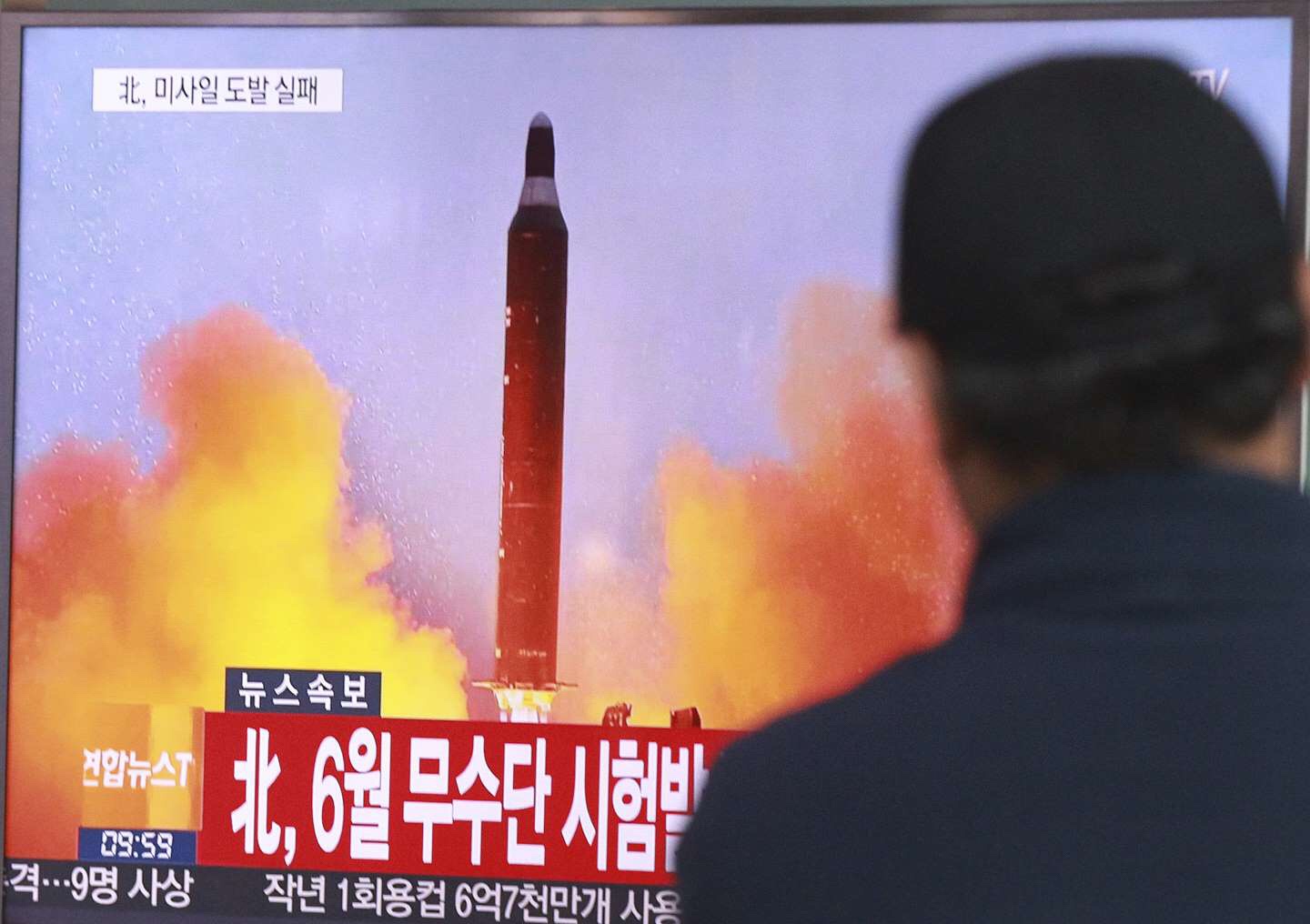
Stephanie Nebehay In this 2016 photo, a man in Seoul, South Korea, watches a TV news program showing a file image of a missile launch conducted by North Korea.
GENEVA — North Korea is only months away from obtaining the capability to hit U.S. territory with a nuclear weapon and must be disarmed, a U.S. envoy said on Tuesday, dismissing Pyonyang’s diplomatic thaw with South Korea as a “charm offensive” that fooled no one.
In a diplomatic showdown at a U.N.-sponsored Conference on Disarmament, North Korea responded by blaming Washington for escalating confrontation, saying it was deploying nuclear assets including aircraft carriers near the divided peninsula and was considering a pre-emptive strike against Pyongyang.
“North Korea has accelerated its provocative pursuit of nuclear weapons and missile capabilities, and expressed explicit threats to use nuclear weapons against the United States and its allies in the region,” U.S. disarmament ambassador Robert Wood told the Geneva forum.
“North Korean officials insist that they will not give up nuclear weapons, and North Korea may now be only months away from the capability to strike the United States with nuclear-armed ballistic missiles,” he said.
A new U.S. nuclear policy review outlined last week “reaffirms that North Korea’s illicit nuclear program must be completely, verifiably, and irreversibly eliminated, resulting in a Korean Peninsula free of nuclear weapons,” he said.
Asked later what the basis was for the assessment that North Korea would soon be able to hit the United States with a nuclear weapon, he said he had “no new information to share.”
North Korea tested its first intercontinental ballistic missile, the Hwasong-14, twice last July. In November it tested the Hwasong-15, believed to be capable of reaching the continental United States. It is not yet believed to have the capability to mount a nuclear warhead on a ballistic missile.
North Korea is under tightening U.N. Security Council sanctions for its banned nuclear and ballistic missile programs. But recent weeks have seen a thaw with South Korea, after Pyongyang agreed to send athletes to compete in the Olympic Games opening on Friday in the South.
“CHARM OFFENSIVE”
“What I would call ‘the charm offensive’ frankly is fooling no one,” Wood told the talks.
He also said arsenals in China and Russia were expanding, drawing rebukes from their respective delegations.
“Russia, China and North Korea are growing their stockpiles, increasing the prominence of nuclear weapons in their security strategies, and — in some cases — pursuing the development of new nuclear capabilities to threaten other peaceful nations,” Wood said.
“We are not going to stick our head in the sand, we are going to respond to these growing challenges,” he later told reporters.
North Korea accused the United States of seeking to aggravate the situation on the divided peninsula by “deploying large nuclear assets” nearby, laying the ground for a possible pre-emptive strike against it.
“In view of the nature and scale of U.S. military reinforcements, they are designed to make a pre-emptive strike against the DPRK,” North Korean diplomat Ju Yong Chol told the talks, referring to his country’s official name, the Democratic People’s Republic of Korea.
“U.S. officials including the defense secretary and the CIA director repeatedly talked about DPRK nuclear and missile threat to justify their argument for a military option and a new concept of a so-called ‘bloody nose,’ a limited pre-emptive strike on the DPRK is under consideration within the U.S. administration,” Ju said.
He said President Donald Trump’s "America First" doctrine and U.S. nuclear superiority would endanger global peace and security and “trigger off a new nuclear arms race and could bring the whole world close to a horrible catastrophe."
Reporting by Stephanie Nebehay; editing by Matthew Mpoke Bigg and Peter Graff

Saturday, June 10, 2017

Hatred Between Persia and the Saudis (Daniel 7/8)


People attend the funeral of the victims who were killed on the June 7 attack at the Iranian parliament and Ayatollah Khomeini's mausoleum, in Tehran, Iran June 9, 2017. TIMA via REUTERS ATTENTION EDITORS - THIS IMAGE WAS PROVIDED BY A THIRD PARTY. FOR EDITORIAL USE ONLY
People attend the funeral of the victims who were killed on the June 7 attack at the Iranian parliament and Ayatollah Khomeini’s mausoleum, in Tehran, Iran June 9, 2017. TIMA via REUTERS ATTENTION EDITORS – THIS IMAGE WAS PROVIDED BY A THIRD PARTY. FOR EDITORIAL USE ONLY

Thousands mourn Tehran attack victims, chant ‘Death to Saudi’ | Reuters

By Parisa Hafezi | ANKARA
ANKARA Thousands packed Tehran’s streets on Friday to mourn the victims of two suicide bomb and gun attacks, and joined their supreme leader in accusing regional rival Saudi Arabia of involvement in the assaults.
People in the crowds, some crying, chanted “Death to Saudi Arabia” alongside the more customary “Death to America” and slogans against Israel, as they reached out to touch coffins wrapped in flags and covered in flowers.
Bombers and gunmen killed 17 people in Iran’s parliament and near the mausoleum of the Islamic Republic’s founder, Ayatollah Khomeini, on Wednesday, in rare strikes on the capital that exacerbated regional tensions.
The Sunni Muslim militants of Islamic State claimed responsibility for the attacks on the Shi’ite Muslim state.
Iran’s Supreme Leader Ayatollah Ali Khamenei, in a message read at the funeral, said the raids would increase hatred for Saudi Arabia, the region’s main Sunni power, and America.
“It (the attacks) will not damage our nation’s determination to fight terrorism … but will only increase hatred for the governments of the United States and their stooges in the region like the Saudis,” Khamenei said. Saudi Arabia has said it was not involved.
MORE ARRESTS
Mourners chanted “God is greatest” and some carried pictures of Khamenei, captioned: “We are ready to sacrifice our blood for you.”
President Hassan Rouhani, a pragmatist more open to contacts with the West, attended the funeral alongside other clerics and officials. He said the attacks had targeted peace and democracy, but stopped short of blaming foreign powers.
The attacks came at a particularly charged time in the region, days after Riyadh and other Sunni Muslim powers cut ties with Qatar, accusing it of backing Tehran and militant groups.
The raids were the first claimed by Islamic State inside tightly controlled Iran, one of the powers leading the fight against the militants in Iraq and Syria.
Iran’s Intelligence Ministry said on Thursday five of the attackers were Iranian nationals recruited by Islamic State who had fought in the militants’ main strongholds in Syria and Iraq.
On Friday, the ministry said 41 suspects had been arrested around the country in connection with the attacks.
“With the help of security forces and families of the suspects, 41 people linked to the attacks and to Daesh (Islamic State) have been arrested in different provinces,” state TV quoted the interior ministry as saying.
“Lots of documents and weaponry have been seized as well.”
Two Sunni militant groups, Jaish al-Adl and Jundallah, have been waging an insurgency in Iran, mostly in remote areas, for almost a decade.
(Writing by Parisa Hafezi; Editing by Andrew Heavens)

Tuesday, May 31, 2016

Saudi Arabia Threatens The Iranian Horn (Daniel 7)


Saudi: Iran armed units must leave Iraq

By Staff writer Al Arabiya EnglishSunday, 29 May 2016

Saudi Foreign Minister Adel Jubeir said on Sunday that sending Iranian Shiite armed units to Iraq to participate in military operations or undergo training is unacceptable.

“Iraq’s problem is religious conflicts caused by the Iranian interference,” Jubeir stressed, adding that Saudi Arabia insists on withdrawal of Iranian troops from Iraq, saying that one of the Iranian senior officers is leading operations in Iraq against Sunnites.

Earlier last week, Iraqi Defense Ministry published an official report which includes statements confirming that the Iraqi Hezbollah Brigades are involved in the battle of Fallujah.

A YouTube account linked to Kata’ib Hezbollah, a US-designated terrorist organization and Iranian proxy, has uploaded a video showing a large convoy of its rocket launcher systems being sent to the front lines near Iraqi city of Fallujah.

From its part, days ago, Harakat al Nujaba, or Movement of the Noble, an Iranian-supported Shiite militia which operates in both Iraq and Syria, has said it is clearing a road in eastern Anbar province in preparation for an upcoming offensive to retake Fallujah from the ISIS.

Also, Qassem Soleimani, the head of the Iranian Revolutionary Guards Corps-Qods Force – the external operations wing of the Revolutionary Guards – was spotted in a picture said to be taken near Fallujah. A picture of Soleimani in the “Fallujah operations room” was posted to the Facebook account of Harakat al Nujaba.

Sending Iranian Shia armed units to Iraq or their training there is unacceptable both on invitation [of the Iraqi authorities] and without it,” Jubeir stated at a joint press conference with his UK counterpart Philip Hammond broadcast by Al Arabiya Channel.

al-Jubeir accused Iran of sowing “sedition” in Iraq urging Tehran to “stop intervening” in the affairs of its neighbors.

“Sedition and division in Iraq are the results of sectarian policies that developed out of Iran’s policies in Iraq,” said al-Jubeir.

“If Iran wants stability in Iraq, it has to stop intervening and withdraw,” he said after accusing Tehran of sending “Shiite militias” to the war-torn country.

Hammond said he was reassuring his Gulf counterparts that world powers are closely monitoring Iran in the wake of last year’s nuclear deal which paved the way for a partial lifting of sanctions.
“Just because we’ve made an agreement with Iran on its nuclear programme does not mean that we will turn a blind eye to Iran’s continuing attempts to destabilize the region or to its ballistic missiles programme which remains a serious threat to peace and which breaches UN resolutions,” Hammond said.

Jubeir, said “We supported that agreement so long as we were assured that Iran will not be able to acquire a nuclear capability. “They are, after all, a neighbor and we will have to live with them. But it’s difficult to live with a neighbour whose objective is to destroy you: that’s why the relation with Iran is not what it should be.”

“Iran should respect the principle of good neighborly relations, to focus on its internal situation and not intervene in the affairs of other countries in the region, mainly Iraq,” he said.

He added that Iran should deal with its domestic matters instead of interfering in internal affairs of other states in the region.

Thursday, January 14, 2016

North Korea Threatens To Wipe Out The US


By EDITH M. LEDERER, ASSOCIATED PRESS
UNITED NATIONS — Jan 13, 2016, 4:50 PM ET
North Korea called it a hydrogen bomb and said the test “scientifically proved the power of the smaller H-bomb,” though the United States and others expressed skepticism that Pyongyang actually tested a hydrogen bomb for the first time. Nonetheless, whatever the North detonated underground will likely push the country closer toward a fully functional nuclear arsenal, which it still is not thought to have.
A Security Council diplomat said Wednesday that the U.N.’s most powerful body is working on a resolution that imposes tougher sanctions on North Korea to reflect the claim that it tested a more powerful hydrogen bomb, which is “a step change” from its three previous atomic test.
The diplomat, speaking on condition of anonymity because consultations have been private, said all 15 council members agree that North Korea should be denuclearized, and this will be reflected in a new resolution.
North Korea’s U.N. mission circulated a report from the country’s news agency saying the Jan. 6 test wasn’t to “threaten” or “provoke” anyone but was indispensable to build a nuclear force “to cope with the U.S. ever-more undisguised hostile policy” toward the Democratic People’s Republic of Korea, the country’s official name.
It said North Korean scientists and technicians “are in high spirit to detonate H-bombs … capable of wiping out the whole territory of the U.S. all at once as it persistently moves to stifle the DPRK.”
Former Los Alamos National Laboratory director Siegfried Hecker, one of the world’s top experts on North Korea’s nuclear program, said last week he did not believe it tested “a real hydrogen bomb,” and that “North Korea is still a long way off from being able to strike the U.S. mainland.”
North Korea’s U.N. mission claimed Wednesday that its successful nuclear bomb test showed that it could now “wipe out” the United States, as the U.N. Security Council grappled with a response to the underground blast.
It said North Korean scientists and technicians “are in high spirit to detonate H-bombs … capable of wiping out the whole territory of the U.S. all at once as it persistently moves to stifle the DPRK.”
Former Los Alamos National Laboratory director Siegfried Hecker, one of the world’s top experts on North Korea’s nuclear program, said last week he did not believe it tested “a real hydrogen bomb,” and that “North Korea is still a long way off from being able to strike the U.S. mainland.”
But Hecker, who has visited the North seven times since 2004, said in an interview with Stanford University’s Center for International Security and Cooperation, that the most worrisome result of the test is that North Korea “will have achieved greater sophistication in their bomb design.” He added that “at this point, what makes their nuclear arsenal more dangerous is not so much explosive power of the bomb, but its size, weight and the ability to deliver it with missiles.”
There was no immediate response to a request for comment from the U.S. mission to the United Nations.
The Security Council last approved sanctions against North Korea three weeks after its third nuclear test on Feb. 12, 2013. That resolution was largely negotiated by the United States and China, North Korea’s traditional ally.
South Korea’s President Park Geun-hye called Wednesday for Chinese help to launch what she calls the “strongest” international sanctions on North Korea over the nuclear test.
The council diplomat said the United States, which is leading the current negotiations, is consulting closely with China but also with other council members, including Japan.
The diplomat said a new resolution isn’t expected immediately, likely not in less than three weeks.

Tuesday, January 12, 2016

Pakistani Horn Threatens Iran (Daniel 8)

Pakistan Warns Iran Against Crossing Saudi Arabia


BY: Abraham Rabinovich
January 11, 2016 3:57 pm
JERUSALEM – The rapidly shifting colors of the geopolitical map of the Middle East projected a surprising new hue over the weekend when nuclear-armed Pakistan warned its nuclear-ambitious neighbor Iran against tangling with Saudi Arabia.
After meetings between the Saudi defense minister Mohammed bin Salman and Pakistan’s military leadership, the Pakistani army issued a statement Sunday asserting “that any threat to Saudi Arabia’s territorial integrity would evoke a strong response from Pakistan”.
The spiraling regional tension follows the execution by Saudi Arabia this month of dissident Saudi Shiite cleric, Sheikh Nimr al-Nimr, who was revered in Iran. A mob in Tehran retaliated by sacking the Saudi embassy. Saudi Arabia promptly severed diplomatic relations with Iran, as did other Sunni-dominant states in the Gulf region and elsewhere.
Pakistan normally enjoys good relations with Iran, with which it has commercial ties. As the Pakistani newspaper, Dawn, put it, “Iran is an important neighbor, possibly on the verge of an economic breakout” as Western sanctions are lifted. However, Islamabad has come under a diplomatic blitz from Saudi Arabia, which has been a generous benefactor in the past, to stand shoulder-to-shoulder with its fellow Sunni nations.
Last week, Adel al-Jubeir, the Saudi foreign minister, flew to Pakistan to meet with its leaders and was immediately followed by bin Salman. Prime Minister Nawaz Sharif of Pakistan sought to avoid too tight an embrace after his meeting with the foreign minister, saying that Pakistan was willing to mediate between Saudi Arabia and Iran, but the statement by the generals after their meeting with the defense minister threatening a “firm response” was that of an ally, not a middle man. Sharif toughened his stance after his meeting with the 31-year-old defense minister, bin Salman, deputy crown prince of Saudi Arabia and favorite son of the aging King Salman. “The people of Pakistan will always stand with the people of Saudi Arabia,” he said. “Pakistan holds its defense ties with Saudi Arabia in highest esteem.”
Apart from its nuclear capability, Pakistan has a standing army of more than 500,000 troops as well as 500,000 reservists. More than any other Muslim nation it has the capacity to stand up to the Iranian armed forces. Although not actually part of the Middle East—it is considered part of South Asia or the Indian subcontinent—it has played a role in the region as a close neighbor and religious affiliate. It has stationed thousands of soldiers in Saudi Arabia in the past whenRiyadh felt threatened by Iraq’s Saddam Hussein. It has been Saudi Arabia that was the principal benefactor in this relationship. It has provided generous financial aid to Pakistan over the years and also employs 1.5 million Pakistanis whose remittances home are vital to the Pakistani economy.
Although it is a Sunni-majority country, Pakistan also has a sizeable Shiite minority. Violent clashes between the two sects in Pakistan have taken the lives of thousands in recent years, mostly Shiites.
Iran has for years been the most assertive nation in the Middle East as it attempts to attain regional hegemony. Its military presence is felt through proxies in Lebanon, Syria, Iraq, Yemen and Gaza. However, its sense of manifest destiny has suddenly encountered bumps in the road it had not anticipated. Both its military and political leadership have expressed regrets at the sacking of the embassy.
Riyadh is therefore pressing its potential Sunni allies to rally to its side. Some of them would prefer not being pressed. As a senior Pakistani official put it to a Western journalist, his country was part of the Saudi-led Sunni coalition “but we will only act in our national interest.”

Saturday, October 3, 2015

The Persian Horn Threatens The Arabs

 
Iran’s Khamenei threatens ‘harsh’ retaliation over Hajj stampede at Mina – CNN News

Posted: 2:51 pm, October 1, 2015 by Desk man

Iran’s Supreme Leader is threatening Saudi Arabia with “tough and harsh” retaliation after saying that the bodies of Hajj stampede victims are not being repatriated swiftly.

“Saudi Arabia failed to fulfill its duties concerning the desperate wounded (pilgrims),” said Ayatollah Ali Khamenei,according to Iran’s official PressTV.

“Should we decide to show any reaction, our reaction will be tough and harsh,” it quoted him as saying at a military academy Wednesday.

Iran’s Foreign Ministry released a statement saying that Khamenei had urged the formation of a fact-finding committee of Muslim nations, including Iran, to investigate the disaster.

The Ministry also summoned the Saudi charge d’affaires Wednesday, warning against any delay in identifying and repatriating missing and dead Iranian pilgrims, Iran’s state-run Mehr News Agency reported.

War of words

Iran and Saudi Arabia have been stepping up their war of words over last Thursday’s stampede, with Riyadh accusing Tehran of politicizing the tragedy and Tehran demanding an apology from Saudi Arabia, which it says mismanaged the Hajj.

The Saudi state-run SPA news agency says at least 769 people were killed and more than 900 injured in the crush at Mina, a neighborhood about 2 miles from the Mecca holy site, but Iran says the death toll is higher.

Iran’s Hajj and Pilgrimage Organization says 239 Iranian pilgrims have so far been confirmed dead, with 241 others unaccounted for, PressTV said Wednesday. It referred to what it said was an overall death toll of 4,173.

Khamenei also lashed out Sunday at Saudi Arabia over the Mina deaths.

“Saudi Arabia’s rulers, instead of shifting blame (to others), must accept their responsibility in this heavy mishap by apologizing to the Islamic Ummah and their bereft families, and meeting their obligations to that effect,” Khamenei said, according to a statement released by his office.

“The Muslim world has many questions, and the deaths of more than 1,000 people in this incident is not a minor issue; therefore, the Muslim world must think of a remedy to this issue,” he continued. Iran and some other Muslim nations dispute the death toll released by Saudi Arabia.

Yemen and Syria

Saudi Foreign Minister Adel bin Ahmed Al-Jubeir responded by saying Iranians should not politically exploit a tragedy, SPA reported Sunday.

“We are going to disclose the truth when it comes out (following the completion of an investigation) and not hide anything. Had a wrongdoing taken place in Hajj, those who were in charge would be fully held responsible,” it quoted him as telling reporters in New York as world leaders gathered for the United Nations General Assembly.

The Middle Eastern rivals have also been trading jabs over foreign policy in the war-torn nations of Yemen and Syria in their comments on the Hajj stampede.

In an interview with Al-Arabiya on Monday, Al-Jubeir again accused Iran of politicizing Mina and said Iran was fanning unrest in the Middle East by arming Houthi rebels in Yemen and backing Syrian President Bashar al-Assad.

Iran’s Foreign Ministry responded Tuesday by issuing a statement from a spokeswoman re-emphasizing “poor management and lack of prudence of Saudi officials in connection with the Mina tragedy” and saying Saudi Arabia’s armed intervention in Syria and Yemen would encourage extremism and instability in the region.

“Exactly at the time when thousands of Muslim countries’ Hajj pilgrims are becoming victim of their lack of prudence, hundreds of Yemeni civilians are killed in a wedding ceremony in an air raid in Yemen,” spokeswoman Marziyeh Afkha added.

A Saudi-led coalition backing President Abdu Rabu Mansour Hadi’s government has been carrying out nationwide airstrikes against the Houthis since March, but the Saudis denied involvement in an airstrike Monday that Houthi-run media said killed at least 131 people.

On Wednesday, a statement by the Saudi-led coalition in Yemen said the Saudi navy had intercepted an Iranian ship attempting to smuggle arms in to Yemen over the weekend off the coast of Oman.
Weapons including anti-tank shells and rocket launchers were seized from the ship, which was manned by 14 Iranians and had Iranian documents claiming it was a fishing boat, the coalition said.(Susannah Cullinane)
Link: http://edition.cnn.com/2015/09/30/middleeast/hajj-deaths-saudi-iran-yemen/index.html

Thursday, October 1, 2015

Korean Nuclear Horn Threatens US And UK (Daniel 7:7)

 
NORTH KOREA today directly warned Britain it is “prepared” to launch a nuclear strike

Just hours after Labour leader Jeremy Corbyn vowed to scrap the country’s nuclear weapons.

By GREG HEFFER, POLITICAL REPORTER

18:48, Wed, Sep 30, 2015 | UPDATED: 20:11, Wed, Sep 30, 2015

Speaking in London this afternoon, the rogue state’s ambassador to Britain claimed his country is ready to “cope with a nuclear world and a nuclear war“.

Admitting that North Korea and South Korea stood on “the brink of war” earlier this year, Hyon Hak-bong cautioned that “distrust” between the two countries is “growing serious” and increasing the risk of conflict breaking out.

The representative of the secretive state’s dictator Kim Jong-un spoke to an audience at international affairs think tank Chatham House.

He said: “With 70 years of division, the Korean peninsula is forced to stand on the horns of dilemma of peace and nuclear disaster.

“The Korean peninsula is at the crossroads of reunification or permanent division.”

Mr Hak-bong railed against US interference in peace efforts between the North’s capital Pyongyang and Seoul in the South, especially their collaboration in regular war games with his country’s hated neighbours.

He also warned that any new conflict in the region would be far more destructive than the Korean War in the early 1950s, which saw the US and Britain back the South.

Seoul and Pyongyang remain technically in a state of war since the 1950-53 Korean conflict ended in a truce rather than a peace treaty.

The ambassador, referring to North Korea as the Democratic People’s Republic of Korea (DPRK), said: “It is high time the US must realise provocative war moves bring much more loss than profit.

“Sixty years ago during the Korean War the DPRK stood against the US with rifles but today it has full capability to deter the latest nuclear threat with nuclear power.

“It is a new reality that the DPRK is prepared to counter any kind of war chosen by the US.

“Conventional war by conventional war and nuclear war by nuclear war.”

Nuclear warheads with their explosive power tens of times greater than the atomic bomb dropped on Hiroshima will be flying across the Pacific Ocean.

Earlier this year, tensions between North and South Korea escalated to their highest level in years and included an exchange of artillery fire.

Both nations were pushed towards conflict after South Korean soldiers were wounded in a landmine explosion.

A frenetic two days of talks, which Mr Hak-bong revealed took place with “contact at the highest level”, eventually saw the two sides reach an agreement.

But Mr Hak-bong claimed his country is “fully determined to face a new war” and that Pyongyang “is not afraid” of conflict.

The ambassador also warned that any new armed confrontation between North and South Korea could spark a third world war between global powers.

He said: “If a war breaks out, its calamity and destructiveness will be totally different to that of the 1950s.

“The range of the war will not only be limited to boundaries of the Korean peninsula.

“Nuclear warheads with their explosive power tens of times greater than the atomic bomb dropped on Hiroshima will be flying across the Pacific Ocean.”

Wednesday, September 16, 2015

Korean Nuclear Horn Threatens U.S. (Daniel 7:7)

 
North Korea warns U.S. it’s ready to use nuclear weapons ‘any time’

By Jethro Mullen, CNN
Updated 9:42 PM ET, Tue September 15, 2015

(CNN)In its latest bout of saber rattling, North Korea says it is ready to use nuclear weapons against the United States and other foes if they pursue “their reckless hostile policy” toward Kim Jong Un’s regime.

In a statement carried by the North’s state-run Korean Central News Agency on Tuesday, an atomic energy official said Pyongyang is improving its nuclear weapons arsenal “in quality and quantity.”
“If the U.S. and other hostile forces persistently seek their reckless hostile policy towards the DPRK and behave mischievously, the DPRK is fully ready to cope with them with nuclear weapons any time,” the director of the North Korean Atomic Energy Institute said, using an abbreviation of the country’s official name, the Democratic People’s Republic of Korea.

North Korea’s main nuclear complex at Yongbyon, which includes a uranium enrichment plant and a plutonium production reactor, is operating normally, the official told the news agency.

North says weapons are for self-defense

Notorious for issuing alarming and attention-grabbing statements, Pyongyang has repeatedly threatened to use nuclear weapons against the United States. But strong doubts remain over whether it has the missile technology to target the U.S. mainland.

An indication it wants to advance its missile capabilities, North Korea said Monday it was planning more satellite launches. Prohibited by U.N. Security Council resolutions, such launches are widely seen as a way of testing ballistic missile technology.


Kim’s regime didn’t say when the next launch would take place, but observers have speculated that it could launch a long-range rocket carrying a satellite in October around the 70th anniversary of North Korea’s ruling party.

The atomic energy official on Tuesday reiterated the North Korean stance that its nuclear weapons program is a self-defense measure “in the face of the U.S. extreme hostile policy and nuclear threats towards it.”

U.S. stresses missile defense measures

In an interview with CNN earlier Tuesday, U.S. Ambassador to South Korea Mark Lippert said Washington is constantly working with Seoul “to ensure that other allies in the region as well as the U.S. homeland are protected from threats posed by North Korea.”

“We’ve moved, over time, a good deal of missile defense capability to the region,” Lippert said before North Korea issued the statement about its nuclear program. “Ground-based interceptors to Alaska, surface combatants to the Western Pacific, a THAAD battery on Guam, another radar in Japan in order to be ready and vigilant for anything the North Koreans may or may not do.”
THAAD, which stands for Terminal High Altitude Area Defense, is a ballistic missile defense system.

After the North Korean statement, U.S. State Department spokesman John Kirby told a regular news briefing that the United States continues “to call on North Korea to refrain from irresponsible provocations that aggravate regional tensions, and instead focus on fulfilling its international obligations and commitments.”

Nuclear complex revamped

The North’s announcement that the Yongbyon nuclear complex is up and running comes as little surprise.

During a period of heightened tensions in the region in spring 2013, Pyongyang announced it would revamp and restart the facilities at the site.

In February of this year, U.S. Director of National Intelligence James Clapper said he believed that “North Korea has followed through on its announcement by expanding its Yongbyon enrichment facility and restarting the reactor.”

But some North Korea watchers have questioned whether the reactor is operating at full power.
A July article on 38 North, a website that specializes in analysis of North Korea, said satellite imagery suggested the reactor may not have been operating or was only functioning at low power levels.

The report’s authors also identified rapid construction at the uranium enrichment plant of a building they theorized could be used “to assemble or store conventional high explosive components of a nuclear weapon.”

The North Korean atomic energy official said Tuesday that the Yongbyon facilities were being employed for both economic development and “the building of a nuclear force.”

Expert says nuclear arsenal is growing

Kim Jong Un’s regime may already have 10 to 15 nuclear weapons, according to David Albright, a former U.N. weapons inspector who now heads the nonprofit Institute for Science and International Security.

In a report in February, Albright predicted that Pyongyang could increase its stockpile to anywhere between 20 and roughly 100 nuclear weapons by 2020.

The growing nuclear arsenal poses a serious strategic challenge for the United States.

The U.S. government has repeatedly called on North Korea to commit to denuclearization as a condition of any future negotiations, but Kim’s regime has repeatedly dismissed such an idea, demanding to be recognized as a nuclear power.

Pyongyang’s statement Tuesday provided few details about its specific grievances with U.S. policy, which it accused of “openly seeking the downfall” of North Korea’s “social system.”

The combative rhetoric comes just three weeks after North and South Korea reached a deal to dial down tensions in the region that were inflamed by landmine blasts and artillery fire in the Demilitarized Zone that separates the two countries.

South Korean President Park Geun-hye issued a joint statement with EU leaders after a summit in Seoul on Tuesday in which they strongly condemned the North’s “continued development of its nuclear and ballistic missile programs.”

The leaders urged North Korea to abandon all its nuclear weapons and existing nuclear program in a “complete, verifiable, and irreversible manner,” and to “refrain from any further provocation.”
CNN’s Kathy Novak and journalist HyoungJoo Choi contributed to this report.

Saturday, August 22, 2015

Maliki Threatens The Antichrist’s Men


Maliki threatens to expose officials responsible for murder

Middle East Monitor
Friday, 21 August 2015 12:49

Former Iraqi Vice President Nouri Al-Maliki has threatened to expose files he has on political officials that he says proves their involvement in the murder and kidnapping of ordinary Iraqis.
Maliki made his threat during his meeting with a number of officials from the State of Law Coalition and the Dawa Party. They had met him at Baghdad Airport after his return from his six-day visit to Tehran.

In a televised statement, Maliki said that those investigating the fall of Mosul are accused of murder and kidnapping –a reference to Hakim Al-Zamili, a leader of the Iraqi Islamist national movement led by Muqtada Al-Sadr. He also noted that Zamili is using the fall of Mosul report to divert attention from his own crimes.

Zamili currently heads the committee responsible for investigating the fall of Mosul to Islamic State militants in June 2014. He was a former leader in the militant Shia group, the Mahdi Army, and is now leader of Saraya Al-Salam (the “Peace Brigades”). He has been accused of running death and kidnapping squads while he was Deputy Health Minister in Maliki’s first government from 2006 to 2010.

The Iraqi parliament presented a report to the Prosecutor General last Monday that calls for the prosecution of Maliki and 35 senior officials for neglect in the case of the fall of Mosul. Many suspect that Maliki is threatening to expose other officials in a bid to turn the spotlight away from himself.

Saturday, August 15, 2015

Antichrist Threatens Us General (Revelation 13:11)


Baku-APA. Iraqi Prime Minister Haider al-Abadi has strongly condemned a top US military commander over his remarks on the possibility of the disintegration of Iraq, APA reports quoting Press TV.

The remark by US Army Chief of Staff General Raymond Odierno was “an irresponsible statement and reflects an ignorance of the Iraqi reality,” Abadi’s media office said on Thursday.

Abadi’s condemnation came after Odierno said on Wednesday that partitioning the country “is something that could happen” and “might be the only solution.”

Some lawmakers in the US Congress have been pushing for the division of Iraq through a controversial bill.

The draft of the US annual defense bill, which was released in April by the House Armed Services Committee, called on the US government to recognize separate Kurdish and Sunni states and provide them with at least 25 percent of the USD 715-million aid money allegedly planned to be given to the Iraqi government to help it fight the Daesh terrorist group.

The draft bill also stipulates the figure could even amount to 60 percent of the money, about USD 429 million.

The bill mandates that “the Kurdish Peshmerga, the Sunni tribal security forces with a national security mission, and the Iraqi Sunni National Guard be deemed a country,” adding that doing so “would allow these security forces to directly receive assistance from the United States.”

Iraqi politicians and clerics are opposed to the idea, saying only the Iraqi people can decide the future of their country.

In May, Abadi denounced the bill in a phone conversation with US Vice President Joe Biden, saying he is opposed to such a plan which is aimed at weakening the unity of Iraq.

The influential Iraqi Shia cleric, Muqtada al-Sadr, has warned against the bill, saying that if it is passed, Iraq will no longer be a safe place for the US, and its interests will become the target of attacks by the Iraqis who will never accept the “division of their country.”

Friday, October 31, 2014

Antichrist Threatens To Remove His Men (Revelation 13:18)

Iraq Shia cleric: Sadr movement will withdraw its armed wing in case of foreign intervention

Antichrist Army
Press TV
 
Iraq’s Shia cleric Moqtada al-Sadr says that he will withdraw “Saraya Assalam”, the armed wing of Sadr movement, from some areas under their control including Samara’a, Dhiala and Jurf Sakher. He made the remarks after some Iraqi politicians and tribes called for the need of foreign military presence and US-led ground operation in Iraq. Sadr however noted that that the rest of the armed wing will remain in the battlefield.

The Shia cleric threatened earlier to withdraw the force in case of any military intervention or ground troops. He also criticized the US-led coalition air strikes, emphasizing that volunteer forces, tribes and Iraqi army alone can defeat terrorism.Sadr said that the Withdrawal would be according to a specific strategy and the areas under Saraya Assalam control and all the liberated territory will be delivered to Iraqi security forces. Some in Iraq are calling for foreign military intervention in fight against ISIL Takfiri militants. But majority of people and the government oppose such measure, saying it will open the door for foreign troops’ presence in the country.