The prophecy is more than seeing into the future. For the prophecy sees without the element of time. For the prophecy sees things as they were, as they are, and as they always shall be.
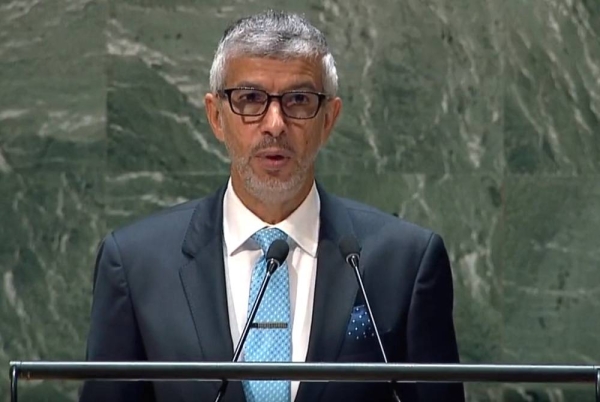
Al-Wasil speaking at the Tenth Review Conference of the Parties to the Treaty on the Non-Proliferation of Nuclear Weapons on Wednesday.
Saudi Gazette report
NEW YORK — Saudi Arabia’s new Permanent Representative to the United Nations Ambassador Dr. Abdulaziz Al-Wasil said that Iran’s practices increase the risks of nuclear proliferation.
Al-Wasil was speaking at the Tenth Review Conference of the Parties to the Treaty on the Non-Proliferation of Nuclear Weapons on Wednesday.
He said that freeing the Middle East from nuclear weapons is a collective responsibility.
“Transparency is necessary for the peaceful use of nuclear energy. Iran’s lack of transparency with the International Atomic Energy Agency violates the UN Charter.”
As New York City and the federal government strain to supply enough vaccines, patients face a private battle to find treatment and relief from serious symptoms.
July 18, 2022Updated 9:53 a.m. ET
Although he was covered with lesions, it took four hours of phone calls, and then five hours in a Harlem emergency room, for Gabriel Morales to be tested for the monkeypox virus earlier this month. And that was just the beginning of his wait.
He spent the next eight days alone in his apartment in what he described as excruciating pain, trying to find someone to prescribe him pain medication and a hard-to-access antiviral drug.
As time passed, the disorganization in the public health response disturbed him more and more: the city’s vaccine website glitches; a vaccine rollout that seemed designed to reach the privileged and that turned him away; an opaque process to access medicine that he believed could help, but that he couldn’t find.
When he received a $720 bill for his emergency room visit, it felt like more than incompetence. It felt like a lack of compassion.
“Iunderstand that this is new — but it is urgent,” said Mr. Morales, 27, who was eventually prescribed the antiviral drug to help with his symptoms. His test, he found out after 10 days, had never been picked up from the hospital. “It was just the worst pain I’ve experienced in my life.”
Beyond the very public shortcomings in the government’s vaccination efforts are the private struggles of the men infected with the disease who have found care hard to come by. Internal lesions in the anus, genitals and mouth can be particularly painful, and there is growing concern that they may cause debilitating scarring.
What’s also striking, she said, about this outbreak, is “how many of these patients have had difficulty getting the care they need to treat these symptoms.”
What to Know About the Monkeypox Virus
What is monkeypox? Monkeypox is a virus endemic in parts of Central and West Africa. It is similar to smallpox, but less severe. It was discovered in 1958, after outbreaks occurred in monkeys kept for research, according to the Centers for Disease Control and Prevention.
What to Know About the Monkeypox Virus
What are the symptoms? Monkeypox creates a rash that starts with flat red marks that become raised and filled with pus. Infected people may also have a fever and body aches. Symptoms typically appear in six to 13 days but can take as long as three weeks after exposure to show, and can last for two to four weeks. Health officials say smallpox vaccines and other treatments can be used to control an outbreak.
Should I be worried? The likelihood of the virus being spread during sexual contact is high, but the risk of transmission in other ways is low. Most people have mild symptoms and recover within weeks, but the virus can be fatal in a small percentage of cases. Experts say that monkeypox is unlikely to create a pandemic scenario similar to that of the coronavirus.
What to Know About the Monkeypox Virus
What’s the situation in the United States?Experts say that the rapid spread of monkeypox across the country and the government’s sluggish response raise questions about the nation’s preparedness for pandemic threats. Tests will not be readily available until later this month and vaccines will be in short supply for months. Official case counts, now in the hundreds, are likely a gross underestimate.
Monkeypox, endemic in parts of Africa for decades, has been spreading globally since early May through networks of men who have sex with men, probably sparked by transmission at one or more raves in Europe, researchers believe. The disease, which mostly transmits though intimate, skin-to-skin contact, has resulted in fatalities in Africa, but no one has yet died of the disease in the United States.
In New York City, cases have nearly tripled over the past week to 461 total cases on July 15, up from 160 on July 8. While some of that increase stems from expanded testing capacity and awareness, the spread of the disease in the city is “exponential,” said Dr. Foote, and is likely to continue for a while.
The unexpected severity of symptoms is making patients’ encounters with an overburdened health care system that was not prepared for this outbreak even more difficult. Interviews with six recent and current monkeypox patients in New York City, and three in other cities across the country, suggest that the public health response has been slow and underresourced at every level, from testing to treatment to vaccination.
Another of those patients, Sebastian Kohn, 39, felt exhausted and feverish through much of the July 4 weekend and had painful, swollen lymph nodes. Then the rash started.
Mr. Kohn, who lives in the Flatbush neighborhood of Brooklyn, has private health insurance, so he went to a local urgent care to get tested while dizzy with a 103-degree fever. But he was not prescribed anything stronger than Tylenol for the pain. “The most painful thing are the anal rectal lesions,” he said. “They are just excruciating.”
Ultimately, he said, lidocaine helped, but for a week, no one prescribed it to him.
Both Mr. Morales and Mr. Kohn are sexually active gay men, as are most patients so far in the outbreak in New York and beyond. Within that group, privilege and know-how has helped some people find care faster than others.
Sign up for the New York Today Newsletter Each morning, get the latest on New York businesses, arts, sports, dining, style and more.
A lawyer who asked to be identified by his initial, M., to protect his medical privacy, said he went into full litigator mode after a sexual partner called him on June 15 to tell him he had monkeypox.
M. was able to get a first vaccine dose at Bellevue, the city’s main public hospital and a hub of its monkeypox response, by showing up and insisting. After he tested positive despite the dose, he was able to get the sought-after antiviral drug, TPOXX, which relieves symptoms but requires special approval for each patient, because one medical practice helped.
“It was still horrible but I was lucky,” he said. “I’m just worried about everybody else.”
Mr. Kohn also eventually received TPOXX, but only after an exhausting process.
The urgent care center where he had been tested told him to call the Department of Health. The Department of Health told him he had to be referred by his primary care doctor. His doctor’s office told him to speak to the health department.
Eventually, he received a call back from a sexual health clinic affiliated with NewYork-Presbyterian Hospital, which said someone at the health department had referred him. “It’s just no coordination at all,” he said. “It’s just not fair to have patients who are severely ill run in circles to organize their own care.”
Providers and local health officials are pushing the federal government to open up access to the drug.
“This is not a mild disease, for a percentage of people it is much more worse than I would have anticipated,” said Dr. Jason Zucker, an infectious disease specialist at the NewYork-Presbyterian clinic.
His clinic has given the antiviral to 26 patients so far,he said. Citywide, 70 prescriptions have been written, Dr. Foote said.
“As a city and a system, we are still really struggling to meet the demand,” she said.
Sergio Rodriguez, 39, is a queer trans man who lives on Manhattan’s Lower East Side. Because he was already a patient at Callen-Lorde, a well-known sexual health clinic, he was able to quickly get an appointment to be swabbed there for lesions on July 5. But his results never came back, either.
A week after his test, he did receive a call from the Health Department — but it was a contact tracer telling him he had been exposed to someone else with the virus. Mr. Rodriguez told the tracer he was living with his immunocompromised, 76-year-old father, and that he desperately needed him vaccinated.
Finally, on July 15, the department called his father to arrange for his vaccination.
Mr. Rodriguez was frustrated with the response. “In my experience, especially as a trans Latino person in New York City, my health and my concerns are not going to be emphasized,” he said. “Things are going to go to people that have more access and that have more strings to pull and also who are of a different socioeconomic class.”
Dr. Foote said the Health Department is well aware of the difficulties people are having in accessing care. City health officials are trying to push the federal government for more vaccines and access to TPOXX and are concerned about equity in distributing it. Mayor Eric Adams recently wrote a letter to President Biden asking for more vaccines.
In recent weeks, aspects of the response have improved. Testing capacity has grown after LabCorp, a commercial lab, began offering tests. Vaccines have begun to flow into the city in greater numbers, though demand still far outstrips supply. On Friday, 9,200 vaccine appointments were booked in seven minutes, the city said.
The city has also been working to improve its vaccine rollout system, reserving some doses for distribution through community providers and developing a mass vaccination plan. And education among health care providers, though still uneven, has been growing: L.G.B.T.Q. health organizations have held webinars, and the city has issued treatment guidance to providers.
Eli,28, a Chelsea resident who works in nightlife and asked to be identified by his nickname to protect his medical privacy, was among the first in New York to test positive for monkeypox. He came down with a fever on June 22 and began noticing anal pain the next day, as did three friends he had been sexually active with on Fire Island.
The next day, he went to the Chelsea Sexual Health Clinic, where he was told by two providers that he most likely had a different sexually transmitted disease, not monkeypox.
By Sunday night, the pain had increased so much that he and his friends went to an urgent care clinic in Union Square. The doctor at first refused to test him for monkeypox, he said, but eventually agreed to submit photos of his lesions to the Department of Health.
He said the Health Department called five days later with his results, and that, after he pushed, the contact tracer gave him the cellphone number for the Department of Health’s head of bioterrorism. That connection helped him obtain shots for 26 close contacts — friends and people he works with in nightlife who he knew were at high risk.
Though his own case was relatively mild, Eli said he has found it very upsetting to watch the government flub its virus response. He has known from the beginning, he said, that it probably wasn’t going to go well.
“‘Y’all are being dumb about this,’” he recalled yelling at the Health Department tracer. “‘This is going to be bad.’”
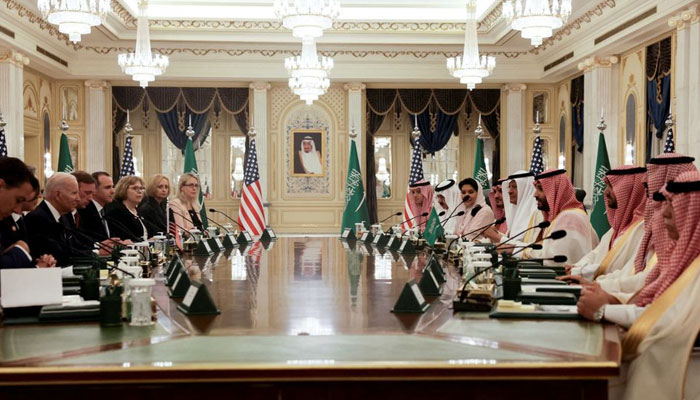
JEDDAH: The United States and Saudi Arabia agreed on the importance of stopping Iran from “acquiring a nuclear weapon”, during a visit by US President Joe Biden, a joint statement carried by the Saudi state news agency (SPA) said.
The statement said Biden also affirmed the United States’ continued commitment to supporting “Saudi Arabia’s security and territorial defence, and facilitating the Kingdom’s ability to obtain necessary capabilities to defend its people and territory against external threats.”
Tehran and Riyadh, the leading Shia and Sunni Muslim powers in the Middle East, severed ties in 2016 over backing opposing sides in proxy wars across the region, from Yemen to Syria and elsewhere.
Saudi Arabia and the United States underscored the need to further deter Iran’s interference in “the internal affairs of other countries, its support for terrorism through its armed proxies, and its efforts to destabilise the security and stability of the region,” the statement said.
Both sides stressed the importance of preserving the free flow of commerce through strategic international waterways such as the Bab al-Mandab and the Strait of Hormuz.
In 2015, Iran signed a deal with six major powers to limit its nuclear programme to make it harder to obtain a weapon in exchange for relief from economic sanctions. Iran says its nuclear programme seeks only civilian atomic energy.
In 2018, then-US President Donald Trump pulled the United States out of the pact, saying it was insufficient to keep Iran from developing nuclear weapons.
Iran has since ramped up some nuclear activities, putting a ticking clock on an attempt to return to a deal in talks between Western powers and Tehran in Vienna.
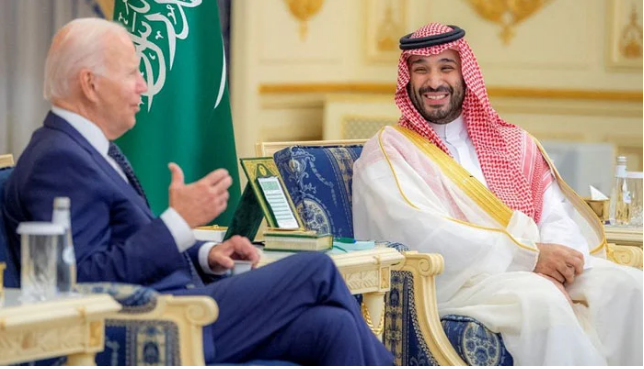
U.S. President Joe Biden participates in a bilateral meeting with Saudi Arabia’s Crown Prince Mohammed bin Salman, at Al Salam Royal Palace, in Jeddah.
The US president will also hold bilateral talks with the leaders of Egypt, the United Arab Emirates and Iraq before taking part in the wider summit where he will “lay out clearly” his vision and strategy for America’s engagement in the Middle East, US national security adviser Jake Sullivan said on Friday.
“He’s intent on ensuring that there is not a vacuum in the Middle East for China and Russia to fill,” Sullivan said.
Biden will discuss energy supplies with Gulf oil producers, but Washington said it does not expect OPEC heavyweight Saudi Arabia to boost oil output immediately and will await the outcome of an OPEC+ meeting on Aug. 3.
Gulf states, who have refused to side with the West against Russia in the Ukraine conflict, are in turn seeking a concrete commitment from the United States to strategic ties that have been strained over perceived US disengagement from the region.
Riyadh and Abu Dhabi have been frustrated by US conditions on arms sales and for being excluded from indirect US-Iran talks to revive a 2015 nuclear pact that they see as flawed for not tackling regional concerns about Tehran’s missile programme and behaviour.
“The most important demand from the Saudi leadership and other Gulf leaders — and Arabs in general — is clarity of US policy and its direction towards the region,” said Abdulaziz Sager, chairman of Riyadh-based Gulf Research Center.
Israel, which shares their concerns over Iran, encouraged Biden’s trip to the kingdom, hoping it would foster a warming between Saudi Arabia and Israel as part of a wider Arab rapprochement after the UAE and Bahrain forged ties with Israel in US-brokered pacts that received Riyadh’s blessings.
‘Groundbreaking process’
In a sign of progress under what Biden described as a groundbreaking process, Saudi Arabia said on Friday it would open its airspace to all air carriers, paving the way for more overflights to and from Israel.
Washington and Riyadh also announced the removal of US and other peacekeepers from Tiran — an island between Saudi and Egypt in a strategic position leading to the Israeli port of Eilat. The troops have been stationed as part of accords reached in 1978 and which led to a peace deal between Israel and Egypt.
The US-Arab summit would discuss “tighter coordination and collaboration when it comes to Iran,” Sullivan said, as well as regional integration, including that of Iraq, where Tehran has built deep influence. Support by wealthy Gulf states for global infrastructure and investment will also be discussed.
The United States and Israel are also seeking to lay the groundwork for a security alliance with Arab states that would connect air defence systems to combat Iranian drone and missile attacks in the Middle East, sources have said.
Such a plan would be a hard sell for Arab states that do not have ties with Israel and balk at being part of an alliance seen as against Iran, which has built a strong network of proxies around the region including in Iraq, Lebanon and Yemen.
Senior Emirati official Anwar Gargash said on Friday the idea of a so-called Middle East NATO was difficult and that bilateral cooperation was faster and more effective. Read full story
The UAE, he said, would not back a confrontational approach: “We are open to cooperation, but not cooperation targeting any other country in the region and I specifically mention Iran.”
Saudi crown prince, Iraq PM discuss ‘regional stability’
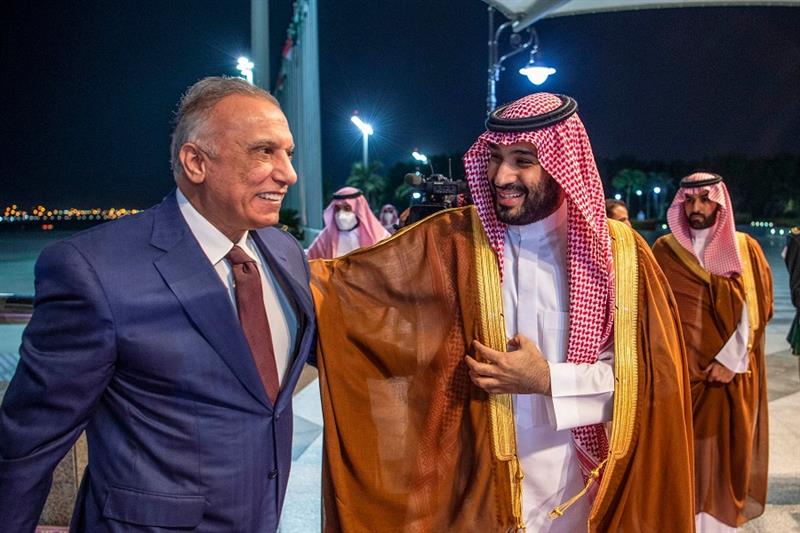
Iraq’s prime minister met with Saudi Arabia’s Crown Prince Mohammed bin Salman, in the kingdom Sunday as part of Baghdad’s efforts to mediate between Riyadh and Tehran.
Mustafa al-Kadhemi, who headed to Saudi Arabia on Saturday, is expected to then visit Iran, its regional rival with which Riyadh has had no diplomatic ties since 2016.
Prince Mohammed and Kadhemi addressed “bilateral relations and opportunities for joint cooperation”, reported the official Saudi Press Agency.
“They exchanged points of view on a number of issues that would contribute to supporting and strengthening regional security and stability,” it added.
Iraq has over the past year hosted five rounds of talks between the two regional rivals, with the last session held in April.
Kadhemi said at the time he believed that “reconciliation is near” between Riyadh and Tehran, a further reflection of shifting political alignments across the region.
On Saturday an Iraqi cabinet source said that Kadhemi’s trip to Saudi Arabia and Iran “comes in the context of talks that Riyadh and Tehran recently held in Baghdad”.
The source said those talks “represented a road map for mending relations and returning to the right course of strengthening bilateral relations” between Saudi Arabia and Iran, which support rival sides in conflict zones around the region.
Saudi Arabia and Iran have had no diplomatic ties for six years.
In early March, Prince Mohammed said his country and Iran were “neighbours forever”, and that it was “better for both of us to work it out and to look for ways in which we can coexist”.
After his arrival in the kingdom, Kadhemi performed the minor pilgrimage, known as umra, in the holy city of Mecca, according to pictures released by his office.
May 5, 2022 – 8:57 AM News Code : 1254665 Source : Al Waght NewsLink:
Saudi Arabia, a country that over the past decade has been giving away its petrodollars to the other Muslim countries to advance its plans in the region, is now focusing on the new Pakistani government. Shahbaz Sharif who recently assumed the prime minister post in Islamabad chose Riyadh his first foreign destination as a PM hoping that he persuades the Saudis for fundings to his country.
AhlulBayt News Agency (ABNA): Saudi Arabia, a country that over the past decade has been giving away its petrodollars to the other Muslim countries to advance its plans in the region, is now focusing on the new Pakistani government. Shahbaz Sharif who recently assumed the prime minister post in Islamabad chose Riyadh his first foreign destination as a PM hoping that he persuades the Saudis for fundings to his country.
According to Pakistani government officials, during Shahbaz’s visit to Riyadh, the country suggested to the Saudi officials doubling of oil purchase financing from $1.2 billion to $2.4 billion. Saudi Arabia agreed, they said. Therefore, Pakistan will receive a financing package worth about $8 billion from the oil-wealthy kingdom, which includes doubling the finances related to the purchase of oil from this country, receiving more money through bonds or Islamic sukuk and transferring the existing $4.2 billion in finances during Sharif’s trip to Riyadh.
The Pakistani PM may set hopes on the Saudi giveaways to inject new life into his government, the Saudis in the past, too, made financial aids promises to his predecessors but declined to fulfill much of them.
During a visit to Riyadh by former Pakistani PM Imran Khan, the Saudi Crown Prince Mohammed bin Salman agreed to invest billions of dollars in Pakistan and release thousands of Pakistanis imprisoned in the kingdom, but he did not keep his promises. The Saudis make huge aids promises to the Pakistanis but in practice do nothing for Islamabad benefit.
The Saudis have always shown that they invest on governments that are relatively politically-stable, but in Pakistan the government changes every few years following a stealth coup, and the short life of these governments does not allow them to benefit from the Saudis. The new government, which came to power with a narrow margin of votes of the members of parliament, sees its political future shaky. Actually, the Saudis do not bet on an already losing horse, and this time, too, agreeing to the multi-billion aid package will not go beyond simple words.
The Saudis always make demands from other countries in return for fundings. In recent years, Pakistan cozied up to Iran and Turkey, thus worrying Saudi Arabia, a rival to both countries. Riyadh always looks at Islamabad as a balance maker in relation to Tehran and tries to keep it away from Iran and bring it to its camp. The Saudis have badly suffered in Yemen war and blame Iran for their losses not just in Yemen but across the region. Riyadh is pushing for a regional alliance against Iran and is trying to bring Pakistan face to face with Iran through aid promises. Whereas the Saudis in the past months walked a path of de-escalation with Iran, they have always had on their table the choice of destabilizing the Iranian eastern borders. With takfiri factions active on the Pakistani and Afghanistani soil, Riyadh has in the back of its head bolstering terrorist cells on the Iranian borders.
Also, by the Western exit from Afghanistan, the Saudis are trying to fill their security vacuum in the region. They seek a toehold in Afghanistan through Pakistan for a role in Afghan developments.
Using Pakistan nuclear experiences
The Arab monarchy is eyeing use of technology and experiences of Pakistan, a nuclear state, for development of its nuclear power plants. In recent years, the Saudis have sought to build nuclear power plants under the pretext that Iran is building a nuclear bomb, and have asked Western countries for help. In 2018, bin Salman announced that if Iran acquired a nuclear bomb, Saudi Arabia would follow suit at the same speed, and such statements show that the Saudis are seriously pursuing a nuclear program. Repeated claims by the West that Iran is only one step away from building a nuclear weapon could lead the Saudis to the point where they think they must go nuclear in order to confront Iran.
Worried about a nuclear Saudi Arabia with a bomb, the West has so far not responded to the Saudi calls affirmatively. The source of the Western worry about a nuclear Saudi Arabia is Riyadh’s behavior in the region that includes waging war on Yemen and backing terrorist organizations in Syria and Iraq.
The Western ignorance of Saudi nuclear demands is frustrating to Riyadh and that is why it is heading to Pakistan, which it finds a suitable choice to respond to its nuclear ambitions. To that end, Riyadh took the initial steps, and last year sent a team of researchers in nuclear and renewable energy to Pakistan to see courses at Pakistani nuclear institutions. It is also said that Saudi Arabia intends to inject new funding into Pakistan’s military industry in exchange for further nuclear assistance.
Intermittent tensions between Washington and Riyadh in recent years and American opposition to the Saudi nuclear ambitions on the one hand and Riyadh’s feeling of a need to check the Iranian policies in the region on the other hand are expected to shore up Pakistan-Saudi Arabia nuclear cooperation in the future, causing new challenges to the region and Saudi relations with the West.
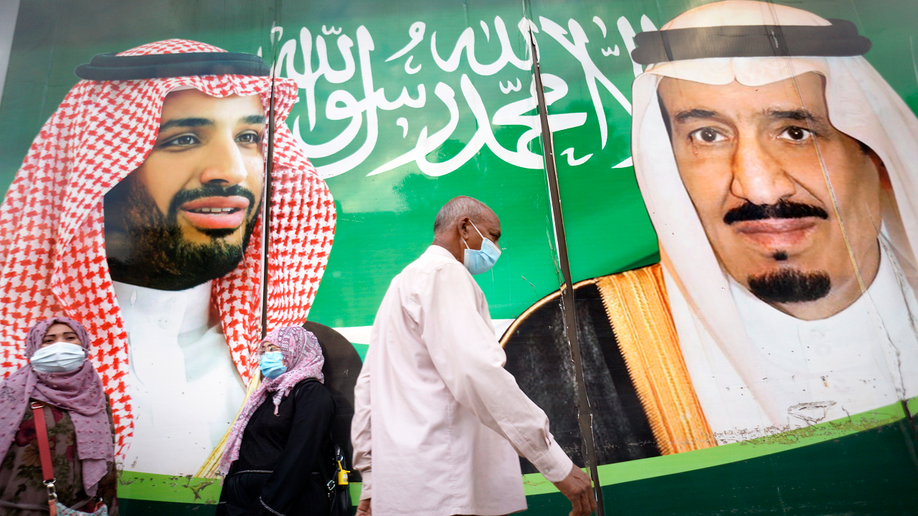
nextImage 1 of 3A banner shows Saudi King Salman, right, and his Crown Prince Mohammed bin Salman, outside a mall in Jeddah, Saudi Arabia, on Feb. 5. (AP Photo)
“If Iran went nuclear tomorrow, the next day the Saudis would probably buy a nuclear weapon from Pakistan or ratchet up their own nuclear program,” said Jim Phillips, a senior research fellow for Middle Eastern affairs at The Heritage Foundation. “They have a long way to go, but they reportedly financed the Pakistani program, and there might be some quid pro quo involved in that.”
Saudi Arabia strongly opposed the original nuclear deal but recently has shown more willingness to engage Tehran on an agreement. Experts point to a number of factors that have drawn Riyadh to the negotiating table – chiefly economic and security concerns for the region.
“I think Saudi Arabia is being more diplomatic, but not really positive because it saw the deal went through in 2015 despite its objection and the objections of Israel,” Phillips argued. “So, I think it’s minimizing its negative reception.”
“It’s publicizing its negative views of a possible deal, but I believe it remains strongly opposed because of the impact of a possible deal on its national interests.”
A nuclear deal would likely see Iran resume its previous level of trade, which would provide a significant impact on the economic balance of the region. Todd Young recently wrote in a Fox News opinion piece that the windfall could total as much as $130.5 billion.
“The Houthis are certainly the number one concern for the Saudis right now,” McInnis said. “That’s the number one thing on the Saudi agenda: how to deal with the Houthis. They want resolution of the conflict.”
The Wall Street Journal reported earlier this year that Saudi crown prince Mohammad bin Salman refused a call from President Biden – which the White House denies – and Phillips argued this was likely in reaction to how Biden has handled the Houthis security concern. Biden removed the Houthis from a list of designated terrorist groups shortly after taking office but has considered adding them back to the list as a means of easing tensions with Riyadh.
But the greatest concern remains Iran’s ability to obtain nuclear weapons should it start to develop its capabilities. The JCPOA limited Iran’s nuclear capabilities for a period of 10 years on centrifuges and 15 years on the amount of enriched uranium it can possess.
Critics argue the 15-year window only delays Iran’s nuclear pathway rather than stops it, and it provides Iran with upfront, permanent benefits of cash that cause immediate concerns for the region. Supporters believe that gap will allow a new generation to take power and make new agreements, but it’s a gamble that some other countries – such as Israel and, until more recently, Saudi Arabia – do not support.
Saudi Arabia’s program remains far less developed compared to Iran’s, but it has some potential shortcuts: A “variety of sources” told BBC Newsnight in 2013 that Saudi Arabia had invested in Pakistan’s nuclear weapons project, largely to prepare for the possibility of Iran obtaining a bomb.
McInnis argues that is may still be the case: Pakistan would likely provide the “easiest” option for Saudi Arabia to arm itself, but he questions how effectively that method would work.
“I think the Iranians probably underestimate the risk of other regional states pursuing nuclear weapons if they do decide to go for a bomb,” McInnis said. “This is one of the reasons why we have to be extremely concerned about the Iranians pursuing a nuclear weapon, considering the possibility of a nuclear arms race in the region.”
“Obviously, with the long-standing connections with Pakistan on a variety of fronts, there is the concern that that would be the avenue by which Saudi Arabia could achieve a nuclear weapon quickly,” he added. “I think the Pakistan pathway is probably the easiest, but I think there are still a number of questions as to whether that would work.”
Iraq is already scheduling crude oil shipments for delivery in March thanks to strong demand, the deputy head of the State Organization for the Marketing of Oil, or SOMO, told media in Baghdad, as quoted by Reuters.
Ali Nizar also told media that Iraq’s oil exports were stable this month and were going to be slightly higher next month, Bloomberg reported.
Asked about oil prices, the SOMO official declined to give a specific projection, saying it was too early to say whether benchmark crude would reach $100 per barrel.
Separately, however, Reuters reported last week that some in OPEC believe oil could indeed reach and even top $100 per barrel. The drivers behind a continued rally would be sustained demand and tight supply resulting from the cartel’s limited spare capacity.
“There will be increasing pressure on oil prices in at least the next two months,” one OPEC source told Reuters, adding, “Under these circumstances, the price of oil may be close to $100 but it will certainly not be very stable.”
Due to constraints of various nature, OPEC has been falling short of its own production targets for months now. In December, the cartel reported an output increase of just 170,000 bpd, while its quota was for a boost of 253,000 bpd, per the OPEC+ production control agreement that stipulates a 400,000-bpd output increase for the extended cartel.
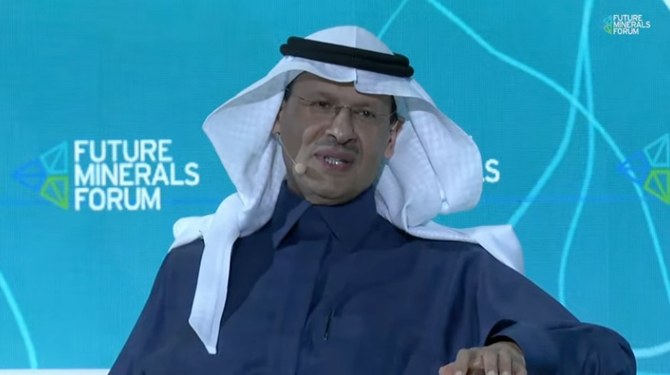
RIYADH: Saudi Arabia will not sacrifice energy security for the sake of energy transformation, a leading minister has warned as he talked up the importance of uranium to the Kingdom’s power plans.
Energy minister Prince Abdulaziz bin Salman made the comments at the Future Minerals Forum in Riyadh as he discussed how developing the Kingdom’s mining sector could help with economic and environmental transitions.
Prince Abdulaziz was bullish when it came to the use of nuclear power in the energy mix, telling delegates at the conference: “We have a huge amount of uranium resource, which we would like to exploit and put in the most transparent way.
“We will bring partners and we will be exporting and manufacturing and developing it and we will be commercially monetizing that resource.”
Referring to the drive to move the Kingdom away from its reliance on oil, he said: “We should not forfeit energy security for the sake of a publicity stunts — that transition needs to be well thought.
“Let’s not forfeit energy security for moving away from the classical concern of over-reliance in the Middle East when it comes to oil to different types of energy security challenges which has to do with availability of these minerals and the concentration of the ownerships of those minerals.”
The Future Minerals Forum is a special event bringing together ministers, organisations and mining leaders from more than 30 countries.
Hosted by the Saudi Ministry of Industry and Mineral Resources, is aimed at highlighting the role of mining in Saudi Vision 2030, after the government identified it as the third pillar of the Kingdom’s economy.
Last week CNN reported that US intelligence had assessed that Saudi Arabia was building its own ballistic missiles – with China’s assistance.
Saudi Arabia is known to have purchased ballistic missiles from China in the past, but has never been able to build any until now.
Satellite images of the Al Watah missile base show Saudi Arabia has expanded the base to include rocket engine production and test facilities, although it is unclear if any missiles are under production at this point.
The Saudi government had sought assistancefrom the People’s Liberation Army Rocket Force, China’s armed forces branch responsible for its land-based nuclear arsenal. Saudi advisers and an official familiar with US intelligence said talks between Saudi Arabia and China had moved to the stage of the former acquiring critical hardware necessary to produce its own ballistic missiles.
Ballistic missiles follow a ballistic trajectory, or arc, to deliver conventional or nuclear warheads on targets. They have a powered flight phase which takes them into the upper layers of the atmosphere, an unpowered free flight phase, and a re-entry phase.
In addition, last year China also assisted Saudi Arabia in building its own yellowcake uranium enrichment plant near Al Ula. This move seems to have enjoyed the tacit approval of the Trump administration, as it attempted to bypass US laws safeguarding against the US transfer of such sensitive technology to Saudi Arabia.
Saudi Arabia is also in the process of negotiating a civil nuclear cooperation agreement with the US, but is reluctant to agree on restrictions regarding fuel enrichment and international oversight.
Yellowcake enrichment is a critical step in manufacturing nuclear weapons. It is an important precursor for making highly-enriched uranium, a key element for nuclear warheads.
Saudi Arabia first acquired ballistic missilesfrom China in 1988, with the purchase of the DF-3A that year. However, the DF-3A was outdated as it first entered service in 1971, is highly inaccurate and is restricted to launch pads.
Saudi Arabia followed up this purchase by acquiring the DF-21 in 2007. The DF-21 entered service in 1991 and is a newer road-mobile design, making missile launches much harder to detect and stop.
While both the DF-3A and DF-21 are nuclear-capable, it appears the versions China sold to Saudi Arabia were modified to carry conventional warheads only. It was for this reason that perhaps the US tacitly approved the sale of these weapons to its Saudi ally. China’s DF-31 ballistic missile, a more recent version than the DF-21. Photo: WikiCommons
However, Saudi Arabia could later modify these missiles to fit a nuclear warhead.
These developments have raised concerns of nuclear proliferation, resulting in bleak prospects for negotiations on Iran’s nuclear and missile programs and a further escalation in Saudi-Iranian tensions.
That may make it hard to persuade Iran to scale down its nuclear program, missile development and support for its regional proxies in the Middle East if it sees that arch-rival Saudi Arabia has its own nuclear program with tacit, albeit reluctant, US approval.
It should be noted that Iran was the first state to carry out an attack against a nuclear facilityduring the Iran-Iraq War. However, a direct attack by Iran at this time would be implausible, considering the outdated state of its air force and the threat of retaliation by the US and its Gulf allies.
Considering such constraints, Iran could stage an attack against Saudi Arabia’s missile base at Al Watah and the yellowcake facility at Al Ula using rockets, missiles or drone swarms operated by its proxies in Gaza and Yemen.
Also, the US has been pushing the Abraham Accords which aim to normalize relations between Arab countries and Israel. However, this move may be interpreted as a US effort to form a de facto regional alliance against Iran.
With the Abraham Accords, the US has effectively outsourced its security role to regional military powers such as Saudi Arabia and Israel, as it refocuses its efforts to counter China in the Pacific.
That said, Saudi Arabia and Israel’s nuclear programs may substitute for the strategic deterrence formerly provided by the US against Iran.
Saudi Arabia is building its own ballistic missiles with the help of China, according to United States intelligence assessments and satellite images.
The assessment of U.S. intelligence agencies is that the kingdom, which is long thought to have acquired missiles from Beijing, is now manufacturing its own, according to a source familiar with the matter and a U.S. official.
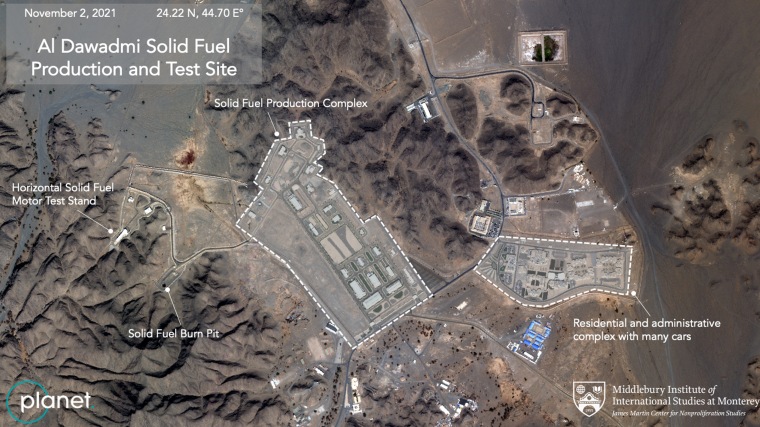
Satellite images obtained by NBC News also suggest that Saudi Arabia is producing ballistic missiles at a site west of the capital, Riyadh, according to researchers at the Middlebury Institute of International Studies at Monterey, in California.
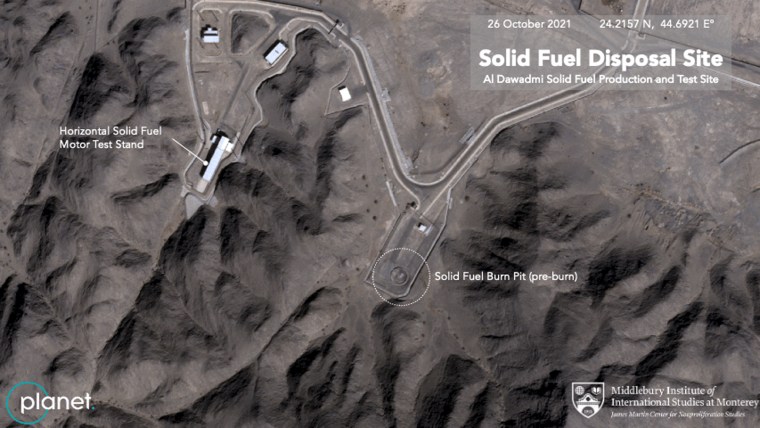
“The key piece of evidence is that the facility is operating a ‘burn pit’ to dispose of solid-propellant leftover from the production of ballistic missiles,” wrote Jeffrey Lewis and David Schmerler of the James Martin Center for Nonproliferation Studies at the Middlebury Institute.
They added that the site “appears to have been constructed with Chinese assistance.”
The news was first reported by CNN on Thursday. The images were provided by commercial imaging company Planet Labs PBC.
The development could shift security calculations in the Middle East and further complicate the Biden administration’s efforts to coax Iran back into its nuclear deal with world powers. It could also add another layer of complexity to Washington’s relations with Beijing.
Iran and Saudi Arabia are regional foes and there will be concern that Riyadh’s manufacturing of ballistic missiles could alter Tehran’s calculations on its possible agreements in talks aimed at reviving the 2015 accord. The new development comes days before the talks, which have struggled to make any headway, are expected to resume in Vienna, and may make Iran even more unlikely to give up its own ballistic missiles.
“If Iran were to enter into negotiations over its missile programme, it would be unlikely to accept limits that did not also apply to other countries,” wrote Mark Fitzpatrick, an associate fellow at the London-based International Institute for Strategic Studies, in an article about Saudi Arabia’s ballistic missile program published by the institute in August.
Fitzpatrick, a former State Department official, said at the time that other than a general desire to keep pace with Iran, Riyadh’s motivations for acquiring ballistic missiles were not entirely clear. Unlike Tehran, however, Saudi Arabia is not known to have initiated any work to develop a nuclear warhead for its missiles, he added.
Ballistic missiles are rocket-propelled weapons that can carry conventional explosives as well as nuclear warheads.
Nevertheless, the fact that Saudi Arabia is now known to be manufacturing its own ballistic missiles will spark concerns of a ramped-up arms race in a highly tense region that is already riven with conflict.
The Saudi Ministry of Media did not respond to requests for comment.
Britain on Friday condemned a launch of ballistic missiles by Iran in war games conducted this week.
“These actions are a threat to regional and international security and we call on Iran to immediately cease its activities,” the Foreign Office said in a statement.
In 2018, former President Donald Trump withdrew the United States from the nuclear accord and re-imposed crippling sanctions on Iran. Tehran has since reduced its compliance with the deal, announcing that it would enrich uranium to up to 60 percent purity — significantly closer to the amount needed to make an atomic bomb.
In the past, Saudi Arabia’s de facto leader, Crown Prince Mohammed bin Salman, has been clear that if Tehran develops a nuclear bomb, Riyadh will also do so.
“Saudi Arabia does not want to acquire any nuclear bomb, but without a doubt if Iran developed a nuclear bomb, we will follow suit as soon as possible,” he told CBS in 2018.
The crown prince is attempting to transform Saudi Arabia from an oil-dependent nation into an economic powerhouse that is more accepted in the West.
The Saudis have long been U.S. allies and enjoyed a close relationship with the Trump administration, but those efforts to overhaul the country’s image were tainted by the murder of journalist Jamal Khashoggi in the Saudi consulate in Istanbul in 2018.
Meanwhile, the continued close military relationship between Saudi Arabia and China will also probably be of concern to the Biden administration as it tries to manage a complex and fraught relationship with Beijing, criticizing its human rights record while also cooperating with Chinese leaders on major global threats like climate change and the Covid-19 pandemic.
The White House did not immediately return a request for comment.
Asked to respond to these fresh indications it was aiding Saudi Arabia’s push to produce ballistic missiles, China said it has always opposed the proliferation of weapons of mass destruction and their means of delivery, and implements strict export controls on missiles and related technologies, according to a statement from its Ministry of Foreign Affairs.
“China and Saudi Arabia are comprehensive strategic partners,” the ministry said. “Such cooperation does not violate any international law and does not involve the proliferation of weapons of mass destruction.”
It added that Beijing has always opposed unilateral sanctions and “will continue to take necessary measures to resolutely safeguard its own rights and interests.”
Saudi Arabia has been known to have purchased missiles from China in the past but has never built its own, the source familiar with the matter and the U.S. official confirmed.
The development could shift security calculations in the Middle East and further complicate the Biden administration’s efforts to coax Iran back into its nuclear deal with world powers.
Satellite images from commercial imaging company Planet show the test site in Saudi Arabia on Nov. 2, 2021. Planet Labs PBCDec. 24, 2021, 12:36 PM MSTBy Courtney Kube and Saphora Smith
Saudi Arabia is building its own ballistic missiles with the help of China, according to United States intelligence assessments and satellite images.
The assessment of U.S. intelligence agencies is that the kingdom, which is long thought to have acquired missiles from Beijing, is now manufacturing its own, according to a source familiar with the matter and a U.S. official.
Satellite images obtained by NBC News also suggest that Saudi Arabia is producing ballistic missiles at a site west of the capital, Riyadh, according to researchers at the Middlebury Institute of International Studies at Monterey, in California.
“The key piece of evidence is that the facility is operating a ‘burn pit’ to dispose of solid-propellant leftover from the production of ballistic missiles,” wrote Jeffrey Lewis and David Schmerler of the James Martin Center for Nonproliferation Studies at the Middlebury Institute.
They added that the site “appears to have been constructed with Chinese assistance.”
The news was first reported by CNN on Thursday. The images were provided by commercial imaging company Planet Labs PBC.
Planet Labs PBC
The development could shift security calculations in the Middle East and further complicate the Biden administration’s efforts to coax Iran back into its nuclear deal with world powers. It could also add another layer of complexity to Washington’s relations with Beijing.
Iran and Saudi Arabia are regional foes and there will be concern that Riyadh’s manufacturing of ballistic missiles could alter Tehran’s calculations on its possible agreements in talks aimed at reviving the 2015 accord. The new development comes days before the talks, which have struggled to make any headway, are expected to resume in Vienna, and may make Iran even more unlikely to give up its own ballistic missiles.
“If Iran were to enter into negotiations over its missile programme, it would be unlikely to accept limits that did not also apply to other countries,” wrote Mark Fitzpatrick, an associate fellow at the London-based International Institute for Strategic Studies, in an article about Saudi Arabia’s ballistic missile program published by the institute in August.
Fitzpatrick, a former State Department official, said at the time that other than a general desire to keep pace with Iran, Riyadh’s motivations for acquiring ballistic missiles were not entirely clear. Unlike Tehran, however, Saudi Arabia is not known to have initiated any work to develop a nuclear warhead for its missiles, he added.
Ballistic missiles are rocket-propelled weapons that can carry conventional explosives as well as nuclear warheads.
Nevertheless, the fact that Saudi Arabia is now known to be manufacturing its own ballistic missiles will spark concerns of a ramped-up arms race in a highly tense region that is already riven with conflict.
The Saudi Ministry of Media did not respond to requests for comment.
Britain on Friday condemned a launch of ballistic missiles by Iran in war games conducted this week.
“These actions are a threat to regional and international security and we call on Iran to immediately cease its activities,” the Foreign Office said in a statement.
In 2018, former President Donald Trump withdrew the United States from the nuclear accord and re-imposed crippling sanctions on Iran. Tehran has since reduced its compliance with the deal, announcing that it would enrich uranium to up to 60 percent purity — significantly closer to the amount needed to make an atomic bomb.
In the past, Saudi Arabia’s de facto leader, Crown Prince Mohammed bin Salman, has been clear that if Tehran develops a nuclear bomb, Riyadh will also do so.
“Saudi Arabia does not want to acquire any nuclear bomb, but without a doubt if Iran developed a nuclear bomb, we will follow suit as soon as possible,” he told CBS in 2018.
The crown prince is attempting to transform Saudi Arabia from an oil-dependent nation into an economic powerhouse that is more accepted in the West.
The Saudis have long been U.S. allies and enjoyed a close relationship with the Trump administration, but those efforts to overhaul the country’s image were tainted by the murder of journalist Jamal Khashoggi in the Saudi consulate in Istanbul in 2018.
Meanwhile, the continued close military relationship between Saudi Arabia and China will also probably be of concern to the Biden administration as it tries to manage a complex and fraught relationship with Beijing, criticizing its human rights record while also cooperating with Chinese leaders on major global threats like climate change and the Covid-19 pandemic.
The White House did not immediately return a request for comment.
Asked to respond to these fresh indications it was aiding Saudi Arabia’s push to produce ballistic missiles, China said it has always opposed the proliferation of weapons of mass destruction and their means of delivery, and implements strict export controls on missiles and related technologies, according to a statement from its Ministry of Foreign Affairs.
“China and Saudi Arabia are comprehensive strategic partners,” the ministry said. “Such cooperation does not violate any international law and does not involve the proliferation of weapons of mass destruction.”
It added that Beijing has always opposed unilateral sanctions and “will continue to take necessary measures to resolutely safeguard its own rights and interests.”
Saudi Arabia has been known to have purchased missiles from China in the past but has never built its own, the source familiar with the matter and the U.S. official confirmed.
Washington (CNN) — US intelligence agencies have assessed that Saudi Arabia is now actively manufacturing its own ballistic missiles with the help of China, CNN has learned, a development that could have significant ripple effects across the Middle East and complicate the Biden administration’s efforts to restrain the nuclear ambitions of Iran, the Saudis’ top regional rival.
Saudi Arabia is known to have purchased ballistic missiles from China in the past but has never been able to build its own — until now, according to three sources familiar with the latest intelligence. Satellite images obtained by CNN also suggest the Kingdom is currently manufacturing the weapons in at least one location.
US officials at numerous agencies, including the National Security Council at the White House, have been briefed in recent months on classified intelligence revealing multiple large-scale transfers of sensitive ballistic missile technology between China and Saudi Arabia, according to two sources familiar with the latest assessments. The Biden administration is now confronted with increasingly urgent questions about whether Saudi’s ballistic missile advancements could dramatically change regional power dynamics and complicate efforts to expand the terms of a nuclear deal with Iran to include restraints on its own missile technology — a goal shared by the US, Europe, Israel and Gulf countries.
Iran and Saudi Arabia are bitter enemies and it is unlikely Tehran will agree to stop making ballistic missiles if Saudi Arabia has begun manufacturing its own. “While significant attention has been focused on Iran’s large ballistic missile program, Saudi Arabia’s development and now production of ballistic missiles has not received the same level of scrutiny,” Jeffrey Lewis, a weapons expert and professor at the Middlebury Institute of International Studies, told CNN. “The domestic production of ballistic missiles by Saudi Arabia suggests that any diplomatic effort to control missile proliferation would need to involve other regional actors, like Saudi Arabia and Israel, that produce their own ballistic missiles,” Lewis added.Any US response could also be complicated by diplomatic considerations with China, as the Biden administration seeks to reengage Beijing on several other high-priority policy issues, including climate, trade and the pandemic. “It’s all a matter of calibration,” a senior administration official told CNN.The National Security Council and CIA declined to comment.Asked if there have been any recent transfers of sensitive ballistic missile technology between China and Saudi Arabia, a spokesperson for China’s Ministry of Foreign Affairs told CNN in a statement that the two countries are “comprehensive strategic partners” and “have maintained friendly cooperation in all fields, including in the field of military trade.””Such cooperation does not violate any international law and does not involve the proliferation of weapons of mass destruction,” the statement said.The Saudi Government and embassy in Washington did not respond to CNN’s request for comment.New challenges for BidenCNN first reported in 2019 that US intelligence agencies were aware that Saudi Arabia was collaborating with China to advance its ballistic missile program.The Trump administration did not initially disclose its knowledge of that classified intelligence to key members of Congress, infuriating Democrats who discovered it outside of regular US government channels and concluded it had been deliberately left out of a series of briefings where they say it should have been presented.That fueled Democratic criticism that the Trump administration was too soft on Saudi. Nuclear proliferation experts also say Trump’s lack of response emboldened the Saudis to continue expanding their ballistic missile program. “Normally, the U.S. would have pressured Saudi Arabia not to pursue these capabilities, but the first indicators that the Saudis were pursuing these capabilities indigenously emerged during the Trump era. The Trump administration, to put it lightly, was not interested in bearing down on Riyadh over these issues,” according to Ankit Panda, a nuclear policy and weapons expert at the Carnegie Endowment for International Peace.Some lawmakers have been briefed over the past few months on new intelligence about transfers of ballistic missile tech between Saudi Arabia and China, multiple sources told CNN. The Biden administration is preparing to sanction some organizations involved in the transfers, sources told CNN, though some on Capitol Hill are concerned the White House is not willing to impose significant consequences on the Saudi government for its actions. Given the current state of negotiations with Iran, the Saudi missile program could make an already thorny problem even more difficult. “A robust Saudi missile program would introduce new challenges to constraining other missile programs in the region. To take just one example, Iran’s missiles, which are a major concern to the U.S., would be more difficult to constrain in the future without parallel constraints on a growing Saudi program,” Panda told CNN. ‘First unambiguous evidence’New satellite images obtained by CNN indicate the Saudis are already manufacturing ballistic missiles at a site previously constructed with Chinese assistance, according to experts who analyzed the photos and sources who confirmed they reflect advancements that are consistent with the latest US intelligence assessments. Satellite photos taken by Planet, a commercial imaging company, between October 26 and November 9 show a burn operation occurred at a facility near Dawadmi, Saudi Arabia, according to researchers at the Middlebury Institute of International Studies, who told CNN this is “the first unambiguous evidence that the facility is operating to produce missiles.” New satellite images suggest Saudi Arabia is now producing ballistic missiles at the site. The key piece of evidence is that the facility is operating a “burn pit” to dispose of solid-propellant leftover from the production of ballistic missiles. Satellite image captured on November 2 shows the facility is operating a “burn pit” to dispose of solid-propellant leftover from the production of ballistic missiles. “The key piece of evidence is that the facility is operating a ‘burn pit’ to dispose of solid-propellant leftover from the production of ballistic missiles,” said Lewis, a weapons expert and professor at the Middlebury Institute of International Studies who reviewed the images. “Casting rocket motors results in leftover propellant, which is an explosive hazard. Solid-propellant missile production facilities often have burn pits where leftover propellant can be disposed of by burning. Burn operations are, therefore, a strong signature that the facility is actively casting solid rocket motors,” he added.A satellite image captured on November 9 shows the “burn pit,” which is used to dispose of solid-propellant leftover from the production of ballistic missiles, post-burn cleanup. Still, little is known about the ballistic missiles that Saudi Arabia is building at this site, including important details like range and payload. Considering the facility in question was built with Chinese assistance and new intelligence assessments showing Saudi Arabia has recently purchased sensitive ballistic missile technology from China, it is possible that the missiles being produced there are of Chinese design, according to Lewis. But there is also evidence Saudi Arabia has looked to other countries for help with developing a ballistic missile program in recent years, making it difficult to identify exactly which weapons system the Kingdom is now building at this facility, Lewis noted.



 nextImage 1 of 3A banner shows Saudi King Salman, right, and his Crown Prince Mohammed bin Salman, outside a mall in Jeddah, Saudi Arabia, on Feb. 5. (AP Photo)