Showing posts with label tactical. Show all posts

Sunday, April 30, 2017

The New Cold War


If you are looking for a reason the United States urgently needs to update its nuclear posture review, which is generally done every eight years, look no further than this sentence from the last review in 2010.”While policy differences continue to arise between the two countries and Russia continues to modernize its still-formidable nuclear forces, Russia and the United States are no longer adversaries, and prospects for military confrontation have declined dramatically.”That was then; this is now. “A resurgent Russia has turned from partner to antagonist as it seeks to re-emerge as a global power,” Gen. Curtis Scaparrotti, NATO’s supreme allied commander, told Congress in March.
Russia has not only morphed from “frenemy” to full-blown enemy since its 2014 covert invasion and subsequent annexation of Crimea, but it has also updated its nuclear doctrine to intimidate NATO nations along its periphery, as well as former Soviet states, including Ukraine and Georgia.
It’s a strategy known as “escalate to de-escalate,” the idea that a limited nuclear strike with a tactical or “battlefield” nuke could shock the U.S. into freezing a conflict in place.
“It’s one of the most challenging military questions you have,” Air Force Gen. John Hyten, the commander of America’s nuclear forces, testified before the Senate Armed Services Committee last month.
Hyten said “escalate to de-escalate” is really a strategy of “escalate to win,” which views the use of nuclear weapons as a normal extension of a conventional conflict.
“It’s important that we look at them seriously, understand what those pieces are,” Hyten testified April 4. “When we say ‘escalate to win,’ what does that really mean? And in order for us to win, we have two choices. One, to prevent that escalation. Or two, to respond in such a way after that escalation that would want to stop any aggression.”
While Russia remains America’s only peer in the area of nuclear weapons capabilities, China has been embarked on an ambitious military modernization campaign that includes both “qualitative and quantitative” upgrading of its nuclear arsenal, according to the last nuclear posture review.
And then there’s North Korea, whose leader Kim Jong Un has a stated goal of developing intercontinental ballistic missiles with the capability of delivering a nuclear warhead to a city on the U.S. mainland.
Hyten said that while the U.S. has de-emphasized the role of nuclear weapons for the past two decades, its adversaries have done the exact opposite.
“Russia, in 2006, started a huge, aggressive program to modernize and build new nuclear capabilities. They continue that to this day. New ballistic missiles, new weapons, new cruise missiles, significant air-launch cruise missile capabilities, now the ground launch cruise missile capabilities,” Hyten warned Congress. “China has done the same thing. Hypersonic glide vehicles on both sides that bring new threats to bear.”
It is, according to Air Force Chief of Staff Gen. David Goldfein, a grave new world.
“As service chiefs, you know, what we do is we look at [trying to balance] capability, capacity and readiness,” Goldfein testified before the House Armed Services Committee in April. “We make strategic trades based on our assumptions of the global security environment. What’s different now? The world’s different now.”
It’s against this backdrop that President Trump directed Defense Secretary Jim Mattis to begin a sweeping review of all aspects of U.S. nuclear deterrence policy, everything from how many warheads the U.S. needs, to how many delivery systems, to what threats the U.S. may need to counter in the coming decade.
National Security Presidential Memorandum 1, signed by Trump one week after his inauguration, directs Mattis to conduct the review “to ensure the U.S. nuclear deterrent is safe, secure, effective, reliable and appropriately tailored to deter 21st-century threats and reassure our allies.”
Last month, Mattis assigned the task to the deputy secretary of defense and the vice chairman of the Joint Chiefs of Staff and set a deadline of the end of 2017.
But even before the formal directive, the work had already begun, Hyten said. And it’s not just one review but multiple studies, including a review of the ballistic missile defenses and the appropriate response to Russia’s violation of the Intermediate-Range Nuclear Forces Treaty with its recent deployment of a land-based cruise missile. “I suspect there will be serious consideration of recommending pulling out of INF treaty and not extending New START,” said James Carafano, a defense analyst at the Heritage Foundation.
But Hyten said it appears Moscow is adhering to the New Strategic Arms Reduction Treaty agreement, which calls for both sides to be limited 1,550 deployed warheads and 700 deployed delivery systems by February 2018.
“From a strategic weapons perspective, I support the limits that are in the New START,” Hyten testified, adding that withdrawing from the treaty would not be part of the review.
Also off the table is consideration of eliminating any of the three legs of the nuclear triad, the Cold War strategy under which the U.S. maintains the capability to deliver nuclear weapons from submarines, bombers and land-based ICBMs.
The 30-year triad modernization plan calls for a new Columbia class of ballistic missile submarines, new B-21 Raider long-range stealth bombers, and new replacement ICBMs known as the ground-based deterrent, along with new bombs and cruise missiles. It is projected to cost $1 trillion.
But Michael O’Hanlon, an analyst at the Brookings Institution, said the review should not just be about counting warheads and systems but about the role nuclear deterrence can play in maintaining peace and stability.
“I feel the best focus now may be on counterforce and how much of it we really need to do,” O’Hanlon said. “I don’t think we need to aim for the capacity to substantially disarm the Russians in a first strike, yet much of our planning still does so, explicitly or implicitly.”
But with Russia thinking differently about the role of nuclear arms in the 21st century, the U.S. may have to adjust its calculus too, argued Armed Services Committee Chairman Sen. John McCain at last month’s hearing on the U.S. Strategic Command.
“Whatever well-intentioned hopes we may have had after the end of the Cold War,” McCain said, “the United States can no longer seek to reduce the role of nuclear weapons in our national security strategy or narrow the range of contingencies under which we would have to consider their use.”

Thursday, April 13, 2017

Russia Increases the Nuclear Ante (Revelation 15)


Russia developing 152 mm tank gun and small battlefield nuclear weapons

brian wang | April 12, 2017 |
Russia in considering upgrading future T-14 main battle tnks to use the 2A83 152 mm gun instead of its current 2A82 125 mm gun. The 2A83 gun has a high-speed APFSDS shell with a 1,980 m/s muzzle velocity, only dropping to 1,900 m/s at 2 km.
However, Russian engineers have so far kept the 125 mm-size gun, assessing that improvements in ammunition could be enough to increase effectiveness, while concluding that a larger bore weapon would offer few practical advantage.
Russia is both miniaturizing the nuclear warheads and using sub-kiloton low-yield warheads. Battlefield nuclear weapons could be pared with the larger tank gun.
The 152 mm tank gun could penetrate 1 meter of armor.
For 11 years, China has been testing a 140mm gun on one its Type 98 tanks. The 140mm gun could fire an armor piercing round with twice the penetrating power of one fired from a 120mm gun (about 22 mega joules of energy, versus 11), the amount of ammunition carried was reduced by about a third (to 20-30 rounds, depending on the tank). The 140mm shell was about fifty percent larger than the 120mm one, and could probably knock out an M-1 tank with a frontal shot.
When the Armata (T-14) tank gets the 152mm gun, it will be the most powerful cannon to be mounted on a main battle tank of any country ever.

Monday, March 13, 2017

Approaching The First Nuclear War (Revelation 8)

6:07 pm 12 Mar, 2017 
India aims to isolate Pakistan diplomatically. Ever since the Uri terror attacks, New Delhi has been making all efforts to corner Pakistan and expose its backing of terror outfits from its own soil.
“India’s public policy to ‘diplomatically isolate’ Pakistan, hinders any prospects for improved relations,” General Votel told the Senate Armed Services Committee.
According to the General, isolation attempts and military actions are “troubling as a significant conventional conflict between Pakistan and India could escalate into a nuclear exchange.”
Pakistan has around 130 nuclear warheads; 10 more than India’s. But while New Delhi has ratified the “no first use” policy, Islamabad continues to ignore it. And what is even more concerning is that Pakistan’s ruling establishment openly issues nuclear threats.
Pakistan’s defence minister Khwaja Muhammad Asif has issued such threats twice – first against India and then against Israel.
He said that though Pakistan has made a few moves, there has not been any permanent action against terrorist groups such as the Haqqani network “which poses the greatest threat” to US-led forces in Afghanistan.
Reuters

Friday, March 10, 2017

The Nuclear Prelude (Revelation 8)

Updated: Mar 10, 2017 10:38 IST
By HT Correspondent, Hindustan Times, Washington
A top US military general has warned that India’s policy to “diplomatically isolate” Pakistan hinders of the improvement of ties between the countries enhancing the risk, thus, of conventional conflict leading to a nuclear exchange.
General Joseph L Votel told the US Senate’s Armed Services Committee at a hearing on Thursday that attacks in India from terrorists based in Pakistan and the reaction “likelihood for miscalculation by both countries” and “India’s public policy to ‘diplomatically isolate’ Pakistan hinders any prospects for improved relations”.
The general spoke of India’s concerns about lack of action against India-focused militants based in Pakistan and the surgical strike undertaken by the Indian military against terrorist camps across the border in Pakistan in 2016.
The general’s command overseas US operations in Afghanistan and Pakistan and he echoed the country’s mounting concern with Pakistan, who he called a critical partner in counterterrorism, when he said that “of particular concern to us is the Haqqani Network (HQN) which poses the greatest threat to coalition forces operating in Afghanistan”.
To date, he stressed, “the Pakistan military and security services have not taken lasting actions against HQN” despite repeated calls from to the “Pakistanis to take the necessary actions to deny terrorists safe haven and improve security in the Federally Administered Tribal Areas (FATA) along the Afghanistan-Pakistan border region”.
Saying “there are challenges with respect to the US-Pakistani relationship, we have endeavoured to maintain a substantial level of engagement with our Pakistani military counterparts”.

Monday, March 6, 2017

The "Limited" Nuclear War (Revelation 8)

There’s no such thing as ‘limited’ nuclear war

 March 3
Dianne Feinstein, a Democrat, represents California in the U.S. Senate.
Last month, it was revealed that a Pentagon advisory committee authored a report calling for the United States to invest in new nuclear weapons and consider resuming nuclear testing. The report even suggested researching less-powerful nuclear weapons that could be deployed without resorting to full-scale nuclear war. This is terrifying and deserves a swift, full-throated rebuke.
The report comes from the Defense Science Board, a committee made up of civilian experts. The board recommended “a more flexible nuclear enterprise that could produce, if needed, a rapid, tailored nuclear option for limited use.”
Let me be crystal clear: There is no such thing as “limited use” nuclear weapons, and for a Pentagon advisory board to promote their development is absolutely unacceptable. This is even more problematic given President Trump’s comments in support of a nuclear arms race.
As Deputy Defense Secretary Robert Work testified in 2015, “Anyone who thinks they can control escalation through the use of nuclear weapons is literally playing with fire. Escalation is escalation, and nuclear use would be the ultimate escalation.”
Nuclear weapons present us with a paradox: We spend billions of dollars building and maintaining them in the hope that we never have to use them. The sole purpose of nuclear weapons must be to deter their use by others. Designing new low-yield nuclear weapons for limited strikes dangerously lowers the threshold for their use. Such a recommendation undermines the stability created by deterrence, thereby increasing the likelihood of sparking an unwinnable nuclear war.
Congress has stopped these reckless efforts in the past. During the George W. Bush administration, attempts to build a new nuclear “bunker buster” weapon were halted thanks to the leadership of then-Rep. David Hobson (R-Ohio).
Today, proponents of building new low-yield nuclear weapons claim that our nuclear arsenal is somehow insufficient to meet evolving threats around the globe. That is simply not true.
First, we already have low-yield weapons: One such bomb, the B61 gravity bomb, is currently being modernized at an estimated cost of as much as $10 billion. Second, our existing arsenal of deployed strategic weapons is more than adequate to deter aggression against us and our allies.
Our nuclear arsenal consists of approximately 4,000 stockpiled warheads, enough to destroy the world several times over. That’s roughly the same number of warheads as Russia and almost four times more than all other countries combined.
We currently have two warheads in reserve for every warhead deployed, a “hedge” of 2 to 1. As we modernize our stockpile, we should strive to reduce both hedge and deployed warheads. In fact, a 2013 report by the Defense Department stated that our deployed arsenal could be further reduced by one-third while maintaining deterrence.
The Defense Science Board also suggested we should consider resuming nuclear testing to have confidence in our nuclear deterrent. That is also a wrongheaded position.
The Energy Department has ensured the safety, security and reliability of the nuclear stockpile for decades without conducting nuclear tests. The department’s work has taught us more about our stockpile than we could ever learn from relying primarily on explosive testing. In fact, the National Nuclear Security Administration has reported that the country is in a better position to maintain the nuclear arsenal than it was before the testing ban went into effect more than 20 years ago.
Resuming nuclear testing would only encourage others to follow suit. The world is made far less safe if other nations begin testing and continue to pursue new nuclear weapons and capabilities. Instead of following the panel’s recommendations, the Pentagon should follow its own 2013 guidance and further reduce our nuclear arsenal in concert with other nations.
To start, we can lead the way by working with Russia to develop a global ban on nuclear-tipped cruise missiles. These weapons are particularly dangerous because they can be mistaken for conventional cruise missiles, increasing the likelihood of an accidental nuclear exchange.
When it comes to nuclear weapons, victory is not measured by who has the most warheads, but by how long we last before someone uses one. This latest proposal may lower the threshold for using nuclear weapons, and the secretary of defense would be wise to reject it.

Saturday, August 6, 2016

The Thin Threshold For Nuclear War (Rev 15)

Nuclear weapons aren’t just for the worst case scenario


Recent reports suggest that Republican presidential nominee Donald Trump insistently asked an anonymous foreign-policy expert why the United States should not use nuclear weapons more readily. This has led to a chorus of voices decrying the way in which Trump is reported to have spoken about the nuclear option, with many insisting the United States should only ever employ nuclear weapons in retaliation after an opponent has used them first.

It is certainly right that such terrible weapons should only be used in extreme circumstances (a point of view Trump appears to have expressed earlier this year), but the conventional wisdom is wrong in suggesting the United States should under no circumstances be the first to use nuclear arms.
This controversy is not merely another spark of the campaign season, for, according to newsreports, President Barack Obama himself is considering implementing a “no-first-use” pledge regarding nuclear weapons — that is, a promise never to be the first to use nuclear weapons. Such a pledge would be exceedingly unwise.

Nuclear weapons are horrible instruments of destruction, but they are also associated with the longest period of major-power peace in human history. And they only work because potentially ambitious states believe their use is plausible enough that starting a war or escalating one against a nuclear-armed state or its allies would just be too risky to countenance. The point of reserving the right to use nuclear weapons first (which, it must be emphasized, is different from a policy of preemption or heavy reliance on them) is not to convey a madman’s itchy trigger finger on the button. Rather, its purpose is to communicate clearly to any potential aggressor that attacking one’s vital interests too harshly or successfully — even without resorting to nuclear weapons — risks prompting a devastating nuclear response, something that, at scale, is far more costly than any realistic gains.
A no-first-use pledge would undermine this pacifying logic. If the policy were believed, then it would make the world safe for conventional war. Since potential aggressors would write the risk of nuclear use down to zero, they would feel they could safely start and wage fierce conventional wars.
Conventional wars can be small, quick, and decisive, which is why they can also be appealing — just ask Napoleon, James Polk, Otto von Bismarck, or Moshe Dayan. But they can also escalate dramatically and unpredictably, especially when major powers are involved. Thus, the most likely route to nuclear use is via a nasty conventional war, as happened in World War II. In such circumstances, high-minded pledges made in peacetime may well seem foolish or too burdensome.
A believable no-first-use pledge would likely raise, rather than diminish, the likelihood of nuclear weapons being used by lightening the shadow of nuclear weapons over the decision-making of potential combatants. Better for everyone to think as carefully and clearly as possible about nuclear weapons before a war is underway.

Alternatively, if the no-first-use pledge were not believed, what would the point of such a promise be other than diplomatic window dressing?

It is for these reasons that the United States has never adopted a no-first-use policy. During the Cold War, the United States relied on its nuclear deterrent to compensate for perceived Soviet and Warsaw Pact conventional advantages in Europe. But even in the post-Cold War period of American military supremacy, when Washington sought to diminish its strategic reliance on nuclear weapons, it judged the future was too uncertain to dispense with the reserved right to go first. While other countries such as China and India have declared no-first-use policies (though there is a great deal of skepticism about how reliable Beijing’s pledge is), Washington and the allies that depend on its nuclear umbrella have always recognized that a no-first-use pledge by the United States would be unwise because of the breadth of defense commitments it has assumed. If the U.S. nuclear arsenal were solely designed to deter conventional attacks on the continental United States, a no-first-use pledge might have more merit, as launching such an assault would be incredibly difficult. But Washington also seeks to deter attacks on its allies in areas like Eastern Europe and East Asia, where U.S. conventional superiority is far less assured.

The main reason why a no-first-use pledge does not make sense for Washington, then, is the reality that the United States cannot always expect to maintain the military upper hand everywhere, and a no-first-use pledge is not the kind of commitment a nation can turn on and off without damage to its credibility and reputation.

But can anyone plausibly challenge the United States in a conventional war in the near to medium term? The answer is yes; China might well be able to. Russia and North Korea are also very dangerous to the United States and its allies in their own ways, and Moscow could plausibly hope to take on the United States conventionally if it could localize a conflict in its “near abroad” and keep it short, but neither can reasonably expect to challenge the United States in a serious, prolonged conventional war and hope to prevail.

But China at some point in the not-too-distant future might. A range of authoritative sources are showing that the conventional military balance of power between the United States and China with respect to points of contention in East Asia such as Taiwan and the South and East China Seas is, at the very least, becoming increasingly competitive. Beijing is fielding more and more highly capable forces in the Western Pacific that present a growing challenge to America’s ability to effectively project military power in the region.

The days are therefore passing when the United States could easily swipe away any effort by the People’s Liberation Army at power projection in the Western Pacific. Instead, any future fight in the region between the United States and its allies on the one hand and China on the other would be hard and nasty. And the trend lines are not moving in a good direction. Indeed, within a decade, China might be in a position where it could reasonably expect to confront a U.S. ally or partner in the Western Pacific and hope to prevail if the conflict remained relatively limited.

If the United States adds to this a credible guarantee that it would not use nuclear weapons first, it would strengthen China’s confidence that it could wage a short, sharp conventional war and gain from it, just as such confidence is rising and becoming more plausible to decision-makers in Beijing already contemplating the use of force in the region. According to a recent Reuters report, for instance, influential voices in the Chinese military establishment are already pushing for firmer security policies and even military action in the South China Sea — and this at a time when the United States still enjoys the conventional upper hand. These voices are likely to seem more credible and appealing in the councils of power in Beijing as Chinese military advantages grow, and they would only be emboldened by a U.S. statement that it will not use nuclear weapons first. A no-first-use pledge would therefore increase the chances of war in Asia.

Indeed, rather than excluding the possibility of American nuclear first use, Washington should be emphasizing it. This does not mean the United States should ever use its nuclear weapons lightly. Rather, Beijing should simply understand that, even if it is able to gain conventional military advantages in the Western Pacific, Washington is prepared to seriously consider using nuclear weapons first to vindicate its own vital interests and those of its allies — for instance with respect to their territorial integrity. More than that, Beijing should understand clearly that if it pushes forward with its military buildup, it will spur the United States to rely even more on its nuclear forces to compensate — and, if that is not enough, the real possibility that U.S. allies will be impelled to pursue nuclear arsenals of their own.

Communicating all this to Beijing does not require any Strangelovian contortions. But it does require the United States to firmly and consistently say (or otherwise communicate) that it is prepared to use nuclear weapons first if truly pressed; to build the forces, such as a next-generation standoff cruise missile and intercontinental ballistic missile, useful in making such a declaration credible; and to exercise and deploy its forces in ways that show Beijing its earnestness about such a declaration.
Such a policy is more likely to contribute to peace and stability than a no-first-use pledge. China is very unlikely to turn away from its effort to achieve military dominance in East Asia and the Western Pacific based on appeals to goodwill or competitions in moral preening. What might actually work is persuading Beijing that succeeding in this effort is likely to backfire by resulting in little to no gain and a more menacing and dangerous set of opposing militaries. Does China want a U.S. defense posture for Asia that relies more on nuclear weapons? A proliferated Asia-Pacific? Washington must make Beijing understand that if it continues its military buildup, those are very real probabilities.
A no-first-use pledge would suggest to Beijing just the opposite — that continuing to build up, and perhaps even using, its military power may not be sufficiently dangerous or costly after all. That would be far worse for Asia and America than a perhaps unfashionable reminder that there will be a grim nuclear risk if Beijing ever seeks to capitalize on its growing conventional military strength.

Saturday, May 14, 2016

Pakistan’s Tactical Nukes Worry India (Daniel 8)


Pak’s tactical nuke weapons at heart of global concerns: India

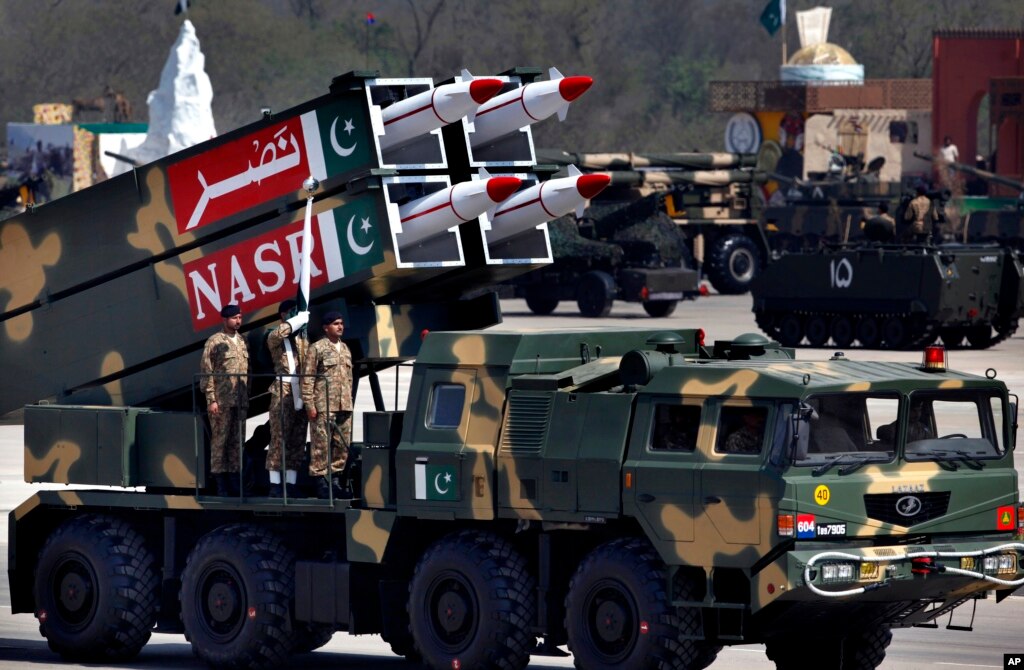
Pakistan's Nasr Hatf IX precision nuclear missiles
Pakistan’s Nasr Hatf IX precision nuclear missiles

PTI
Published May 12, 2016, 7:31 pm IST
Updated May 12, 2016, 7:32 pm IST
 
External Affairs Ministry Spokesperson Vikas Swarup expressed apprehension over Pak’s nuclear policy.
 
“There have been international concerns about Pakistan’s present nuclear policy. Tactical nuclear weapons are at the heart of such concerns,” External Affairs Ministry Spokesperson Vikas Swarup said.

He was replying to a question on former Pakistan Ambassador to the US Husain Haqqani’s comment that Pakistan’s policy on tactical nuke weapons continue and they are going to create such weapons which it will be handing over to its brigadiers and colonels in the field.

Replying to a separate question on what steps India was taking to bring back underworld don Dawood Ibrahim from Pakistan, Swarup said government was continuing to pursue the matter.
“Dawood Ibrahim is a UN-designated global terrorist and a fugitive from the Indian law. At several points of time, his details have been shared by the Indian government with the government of Pakistan which also includes his possible locations in Pakistan… We will continue to pursue this matter and we expect Pakistan to hand over this international terrorist to us,” he said.

Saturday, May 7, 2016

The US And Pakistani Nuclear Horns (Daniel)


Nuclear War: Pakistan, India Test Nuclear Weapons; US Spends $1 Trillion For Arsenal

Nuclear War: Pakistan, India Test Nuclear Weapons; US Spends $1 Trillion For Arsenal
There is greater safety in mutual show of ability and might. This is long held assumption showing that an assured mutual destruction would lead to cessation of actions, which can lead to a deadly war. It seems, however, that neither Pakistan or India are done showing off their arsenal and capabilities with another. Some are even worried that their continued practice may take on a deadly direction.
In fact, the Bulletin of the Atomic Scientists has just found that Pakistan is actively “rehearsing the use of nuclear weapons.” Last year, retired Pakistan general Khalid Kidwai has said that the country was already able to develop a number of “short range, low yield nuclear weapons” as they believe there is no longer any “space for conventional war.”

At the same time, Pakistan Foreign Secretary Aizaz Ahmad Chaudhry has also once declared that his country might just use nuclear weapons against India. In response, India continues to conduct its training against such weapons. According to a report from the Fiscal Times, India is yet to disclose information about their nuclear weapons stockpile as well as on overview of their present and future nuclear capabilities. Meanwhile, Pakistan is also yet to do the same.

While tensions continue to brew in South Asia, the U.S. is busy enhancing its nuclear weapon capability in response to any nuclear aggression in the world. According to the latest report from the Arms Control Association, the total cost of the country’s nuclear weapons program is expected to cost as much as $1 trillion over the next 30 years. In fact, the nonpartisan Congressional Budget Office puts the cost of nuclear forces between FY 2015 and FY 2024 at around $348 billion.

The country is said to be in the process of modernizing and refurbishing its existing warheads. They are either being replaced with new systems or getting completely rebuilt using new parts. Deputy Secretary of Defense Robert Work has also told the House Armed Services Committee that the process of “modernizing and sustaining” the countries nuclear weapons will cost around $18 billion a year between 2021 and 2035 if estimated in FY 2016 dollars. With the combined cost of maintaining the country’s current nuclear weapons, however, that cost roughly doubles, going from three percent to seven percent of the overall defense budget.

As of the moment, the U.S. has already deployed as much as 1,900 strategic nuclear warheads on Intercontinental Ballistic Missiles (ICBMs), Submarine-Launched Ballistic Missiles (SLBMs), and Strategic Bombers.

Friday, May 6, 2016

Pakistan And India Prepare For Nuclear War (Revelation 9)


Nuclear battles in South Asia

Pakistan-Test-Fires-Short-Range-Missile-Hatf-IX

Pervez Hoodbhoy

Zia Mian

The armies of Pakistan and India are practicing for nuclear war on the battlefield: Pakistan is rehearsing the use of nuclear weapons, while India trains to fight on despite such use and subsequently escalate. What were once mere ideas and scenarios dreamed up by hawkish military planners and nuclear strategists have become starkly visible capabilities and commitments. When the time comes, policy makers and people on both sides will expect—and perhaps demand—that the Bomb be used.

Pakistan has long been explicit about its plans to use nuclear weapons to counter Indian conventional forces. Pakistan has developed “a variety of short range, low yield nuclear weapons,” claimed retired General Khalid Kidwai in March 2015. Kidwai is the founder—and from 2000 until 2014 ran—Pakistan’s Strategic Plans Division, which is responsible for managing the country’s nuclear weapons production complex and arsenal. These weapons, Kidwai said, have closed the “space for conventional war.” Echoing this message, Pakistani Foreign Secretary Aizaz Ahmad Chaudhry declared in October 2015 that his country might use these tactical nuclear weapons in a conflict with India. There already have been four wars between the two countries—in 1947, 1965, 1971, and 1999—as well as many war scares.

The United States, which at one time deployed over 7,000 tactical nuclear weapons in Europe aimed at Soviet conventional forces, has expressed alarm about Pakistan’s plans. Amplifying comments made by President Barack Obama, White House Press Secretary Josh Earnest explained in April 2016 that “we’re concerned by the increased security challenges that accompany growing stockpiles, particularly tactical nuclear weapons that are designed for use on the battlefield. And these systems are a source of concern because they’re susceptible to theft due to their size and mode of employment. Essentially, by having these smaller weapons, the threshold for their use is lowered, and the[re is] risk that a conventional conflict between India and Pakistan could escalate to include the use of nuclear weapons.”

Responding to US concerns, Kidwai has said that “Pakistan would not cap or curb its nuclear weapons programme or accept any restrictions.” The New York Times reported last year that so far, “an unknown number of the tactical weapons were built, but not deployed” by Pakistan.

India is making its own preparations for nuclear war. The Indian Army conducted a massive military exercise in April 2016 in the Rajasthan desert bordering Pakistan, involving tanks, artillery, armored personnel carriers, and 30,000 soldiers, to practice what to do if it is attacked with nuclear weapons on the battlefield. An Indian Army spokesman told the media, “our policy has been always that we will never use nuclear weapons first. But if we are attacked, we need to gather ourselves and fight through it. The simulation is about doing exactly that.” This is not the first such Indian exercise. As long ago as May 2001, the Indian military conducted an exercise based on the possibility that Pakistan would use nuclear weapons on Indian armed forces. Indian generals and planners have anticipated such battlefield nuclear use by Pakistan since at least the 1990s.

Driving the current set of Indian strategies and capabilities is the army’s search for a way to use military force to retaliate against Pakistan for harboring terrorists who, from time to time, have launched devastating attacks inside India. In 2001, Pakistan-based Jaish-e-Mohammed claimed credit for an attack on India’s parliament. India massed troops on the border, but had to withdraw them after several months. International pressure, a public commitment by Pakistani President Pervez Musharraf to restrain militants from future strikes, and Pakistan’s threat to use nuclear weapons if it was attacked caused the crisis to wind down. Following the 2008 terrorist attack in Mumbai by Pakistan-based militants, General Deepak Kapoor, then India’s army chief, argued that India must find a way to wage “limited war under a nuclear overhang.”

Paths to destruction. It could come to pass that Pakistan’s army uses nuclear weapons on its own territory to repel invading Indian tanks and troops. Pakistan’s planners may intend this first use of nuclear weapons as a warning shot, hoping to cause the Indians to stop and withdraw rather than risk worse. But while withdrawal would be one possible outcome, there would also be others. It is more likely, for instance, that the use of one—or even a few—Pakistani battlefield nuclear weapons would fail to dent Indian forces. While even a small nuclear weapon would be devastating in an urban environment, many such weapons may be required to have a decisive military impact on columns of well-dispersed battle tanks and soldiers who have practiced warfighting under nuclear attack.
India’s nuclear doctrine, meanwhile, is built on massive retaliation. In 2003, India’s cabinet declared nuclear weapons “will only be used in retaliation against a nuclear attack on Indian territory or on Indian forces anywhere … nuclear retaliation to a first strike will be massive and designed to inflict unacceptable damage.” According to Admiral Vijay Shankar, a former head of Indian strategic nuclear forces, such retaliation would involve nuclear attacks on Pakistan’s cities. Kidwai describes such Indian threats as “bluster and blunder,” since they “are not taking into account the balance of nuclear weapons of Pakistan, which hopefully not, but has the potential to go back and give the same kind of dose to the other side.” For nuclear planners in both countries, threatening the slaughter of millions and mutual destruction seems to be the order of the day.

There are also risks short of war, of course. Nuclear weapon units integrated with conventional forces and ready to be dispersed on a battlefield pose critical command-and-control issues. Kidwai believes that focusing on “lesser issues of command and control, and the possibility of their falling into wrong hands is unfortunate.” He claims “Our nuclear weapons are safe, secure and under complete institutional and professional control.” The implication is that communications between the nuclear headquarters and deployed units in the field will be perfectly reliable and secure even in wartime, and that commanders of individual units will not seek—or have the capability to launch—a nuclear strike unless authorized.

It is difficult to believe these claims. Peering through the fog of war, dizzied by developments on a rapidly evolving battlefield, confronting possible defeat, and fuelled by generations of animosity towards India as well as a thirst for revenge from previous wars, it cannot be guaranteed that a Pakistani nuclear commander will follow the rules.

Add to this the risks in what now passes for peacetime in Pakistan. The Strategic Plans Division may dismiss fears that its nuclear weapons will be hijacked. However, the military has rarely succeeded in anticipating and preventing major attacks by militant Islamist groups in Pakistan. Look no further than the May 2011 attack on Karachi’s Mehran naval base. The attackers, who may have numbered up to 20 and had insider help, “scaled the perimeter fence and continued to the main base by exploiting a blind spot in surveillance camera coverage, suggesting detailed knowledge of the base layout,” The Guardian reported. It took elite troops 18 hours to regain control of the base.
It is also unclear how the officers who are in charge of Pakistan’s military bases and those who make security-clearance decisions are chosen, and whether their own commitment to fighting Islamic radicalism is genuine. In 2009, the former commander of Pakistan’s Shamsi Air Force Base was arrested for leaking “sensitive” information to a radical Islamist organization. In 2011, a one-star general serving in Pakistan’s General Headquarters was arrested for his contacts with a militant group. In a religion that stresses its own completeness, and in which righteousness is given higher value than obedience to temporal authority, there is room for serious conflict between piety and military discipline.

Grasping at straws? A first step to reducing all these nuclear dangers is to prevent an escalation of tensions. This must start with Pakistan tackling the threat of Islamist militancy at home and preventing militant attacks across the India-Pakistan border. The outlook is mixed on both fronts. Pakistan’s army accelerated its war against radical Islamist groups after a 2014 attack on an army school in Peshawar that killed more than 140 students and staff. Despite military claims of success, though, responding with massive force and inflicting countless deaths will not resolve what is at its core a political and social problem. Ending the threat of radical Islam in Pakistan will require sweeping changes in public attitudes and major policy reversals in many areas. These are nowhere in sight.

To its credit, Pakistan has recently been more forward-leaning in dealing with militants who attack India. Following the assault on India’s Pathankot airbase in January 2016, Sartaj Aziz, foreign affairs adviser to Prime Minister Nawaz Sharif, made the surprising revelation that a mobile phone number used by the attackers was linked to the militant group Jaish-e-Mohammed based in Bahawalpur, Pakistan. To collect evidence for possible legal action against Jaish-e-Mohammed leaders, Pakistan sent a fact-finding mission to Pathankot with the approval of the Indian government. This kind of cooperation by the two governments is unprecedented.

Rather than limit cooperation to crisis management after an attack, Pakistan and India could agree on a South Asian version of the Open Skies Treaty to provide each with limited access to the other’s air space for surveillance purposes. India has an interest in monitoring possible militant camps within Pakistan and border areas where militants may cross. Pakistan seeks early warning in case India is preparing to mount a surprise attack. The 1992 Open Skies Treaty, covering the United States and fellow North Atlantic Treaty Organization members and Russia and its former Soviet and Eastern European partners, allows for controlled surveillance flights with agreed instruments such as photographic and video cameras, radar, and infrared scanners. The goal is to promote “greater openness and transparency in their military activities” and “to facilitate the monitoring of compliance with existing or future arms control agreements and to strengthen the capacity for conflict prevention and crisis management.” The United States and other parties to the Open Skies Treaty could share their technical tools and flight management experience with Pakistan and India, as well as what they’ve learned about the value of the agreement.

The two countries should also prepare in case things go wrong. The 1999 Lahore Agreement committed Pakistan and India to “notify each other immediately in the event of any accidental, unauthorised or unexplained incident that could create the risk of a fallout with adverse consequences for both sides, or an outbreak of a nuclear war between the two countries, as well as to adopt measures aimed at diminishing the possibility of such actions, or such incidents being misinterpreted by the other.” The question is, who will each side call and how? One possibility is a direct line of communication—a hotline—from Pakistan’s Strategic Plans Division chief to the head of India’s Strategic Forces Command. There are other hotlines, and they are not always used or used wisely, but in a crisis this may be better than relying on television, Facebook, Twitter, or Washington.
Progress towards even such limited measures will confront the fact that in both India and Pakistan, nationalist passions forged over seven decades are being reinforced by the institutional self-interests of emerging nuclear military-industrial complexes and their political patrons and ideological allies. The United States and Soviet Union saw such deepening militarization during the Cold War. The institutional forces and ideas—what the great English anti-nuclear activist, thinker, and historian E.P. Thompson called “the thrust of exterminism”—proved so strong that even when the Cold War ended, and the Soviet Union fell, the Bomb remained. With expansive and costly nuclear arsenal modernizations underway in the United States, Russia, and the other established nuclear weapon states, the Bomb now seems ready for a second life. Increasingly subject to the same exterminist forces, South Asia may be locked in its nuclear nightmare for a very long time.

Saturday, April 30, 2016

The Nuclear Threat From Pakistan (Daniel 8:8)


Are Pakistan’s Nuclear Assets Under Threat?

nasr-multitube-ballistic-missile-is-displayed-during-the-pakistan-day-picture-id467324930
April 28, 2016

The fourth and final Nuclear Security Summit, held in Washington D.C. on March 31- April 1 2016, once again reiterated the apocalyptic threat of nuclear terrorism. Having over 1,000 atomic facilities across 50 odd countries, all having different standards of security, is bound to raise alarm bells in an age where terrorist organizations have expressed their intention of using the “absolute weapon.” The Islamic State in Iraq and Syria (ISIS) even asserted in the May 2015 issue of its propaganda magazine Dabiq that it can buy a nuclear bomb through links to corrupt officials in Pakistan. While there is no evidence of these alleged links, such statements are part of the group’s psychological war of spreading fear. They also accentuate the Islamic State’s interest in acquiring the bomb.

With al-Baghdadi’s group losing ground in both Syria and Iraq, ISIS is becoming more and more desperate to carry out spectacular attacks and reaffirm its strength. Already numerous reports have claimed that the Islamic State has enough radioactive material to make a dirty bomb and use it in Europe. The recent incident of a Belgian nuclear plant worker shot dead and his security pass stolen, alongside reports of two Belgian nuclear plant workers joining ISIS, signify the colossal threat confronting European states.

At the same time, some experts, journalists, and government officials have insinuated that Pakistan’s nuclear stockpile, especially its tactical weapons developed in response to India’s “Cold Start” doctrine, could be stolen by terrorists, including ISIS. President Barack Obama also mentioned in his speech at the Summit that “small, tactical nuclear weapons … could be at greater risk of theft.”

Do terrorist pose a threat to Pakistan’s nuclear assets? The answer is both yes and no.

Security of Pakistan’s Nuclear Assets

More than once, Pakistan has come under the limelight for not ensuring the security of its nuclear assets. For instance, in January 2001, Pakistani nuclear scientists with extremist sympathies created a what was supposedly a humanitarian nongovernmental organization, Ummah Tameer-e-Nau (UTN). Bashiruddin Mahmood, the former head of Pakistan’s Khushab plutonium reactor, was its chairman. In November 2001, at the request of the United States, Pakistan’s intelligence services arrested a number of UTN associates and members, including Mahmood. Mahmood later confessed that he met with Osama bin Laden and they discussed the possibility of developing a nuclear bomb.

Similarly, the discovery of the infamous AQ Khan network in 2004 almost jeopardized Pakistan’s entire nuclear program. The father of the country’s nuclear program, Abdul Qadeer Khan, was found proliferating nuclear technology to other countries, including Libya, North Korea, and Iran. While members of al-Qaeda also tried to contact Khan’s associates for assistance with their weapons program, the AQ Khan network reportedly rejected them.

The aforementioned events, together with the General Headquarters attack in 2009 by Tehreek-i-Taliban (TTP), underscore that Pakistan’s nuclear security might not be impregnable.

However, time and again Pakistan has expressed confidence in the security arrangements of its nuclear weapons. Even at the Nuclear Security Summit 2016, Pakistan reiterated that its nuclear assets are secure, and of a modest level, in accordance with the country’s doctrine of minimum deterrence. While the entire program is engulfed in secrecy, reports have ascertained that Pakistan is doing enough to prevent its weapons being used by rogue elements, including terrorists.

For instance, according to Dr. Samar Mubarakmand, who has been closely involved with the country’s nuclear program, Pakistan’s nuclear weapons are stored in “three to four different parts at three to four different locations.” Therefore, they are stockpiled in component form, which means if the weapon is not about to be launched then it is not in an assembled form.

With the warheads disassembled, they cannot be used by terrorists. Similarly, Islamabad has improved the reliability of its nuclear personnel by making security clearance procedures more stringent, decreasing the likelihood of an insider threat. However, Islamabad recognizes more can be done to control its nuclear expertise. The Nuclear Security Summit has raised awareness and the sense of urgency of increasing nuclear security among all nuclear states. Pakistan, being part of the NSS, has also pledged to take the necessary steps.

ISIS in particular does not have a profound presence in Pakistan and exists only in the form of small, independent cells. It’s extremely doubtful it can steal Pakistan’s nuclear material. However, a threat does emanate from local militant groups who can exploit the already unstable security environment in South Asia. India’s Cold Start doctrine and Pakistan’s acquisition of battlefield nukes are a cause for concern, and can be exploited by terrorists.

Exploiting Cold Start Doctrine and Tactical Nuclear Weapons

The Cold Start doctrine was developed after the 2001 terrorist attacks on the Indian Parliament. India claimed that the attacks were perpetrated by Pakistan-based militant groups, Lashkar-e-Taiba and Jaish-e-Mohammad, who were in cahoots with some institutions of Pakistan. In response, the Indian state initiated the largest military build-up since 1971. However, it took India three weeks to get to the international border. By that time Pakistan was able to counter-mobilize, which allowed for the United States to intervene and forestall the conflict from precipitating. Then Pakistani President Pervez Musharraf also denounced terrorism, and promised a crackdown. This reduced India’s political justification for a military action.

Unsatisfied with this slow response, India developed the Cold Start doctrine. The said doctrine involves offensive operations, allowing India’s conventional forces to perform holding attacks in order to prevent a nuclear response from Pakistan. In reply to this, Pakistan developed tactical nuclear weapons to deter any military action from India.

This situation should raise concern. If terrorist attack is plotted against India from Pakistani soil and India operationalizes its doctrine, presumably, in reaction, Pakistan will deploy its tactical nuclear weapons. India too then is likely to use its conventional nuclear weapons, inviting a full-blown nuclear war between the two neighboring states.

As such, the combination of tactical nuclear weapons and the Cold Start doctrine provides an opportunity for terrorist elements to initiate a nuclear war. Both India and Pakistan need to work out a plan whereby India gives up its Cold Start doctrine in the event of a militant attack, and in response, Pakistan abandons its tactical nuclear weapons. Otherwise, there will always be room for militants to ensure a nuclear attack by conducting traditional acts of terror. If a terrorist can compel a nuclear war between two nations, how is that different from nuclear terrorism?

Shahzeb Ali Rathore is a Research Analyst at the International Center for Political Violence and Terrorism Research (ICPVTR) of the S. Rajaratnam School of International Studies (RSIS), Singapore.

Wednesday, April 13, 2016

Cold Start Could Lead to a Hot War (Revelation 15)


Cold start doctrine a real threat, warn experts

Source:  Dawn.com Published in Current Affairs on Tuesday, April 12, 2016

WASHINGTON: Pakistan views India’s cold start doctrine as a real threat to its security and is unwilling to give up the defensive mechanism it has built to counter this threat, officials and experts said.

India’s cold start doctrine, and the tactical weapons that Pakistan has made to counter this threat, drew international attention when US President Barack Obama mentioned them at his news conference last week.

On the conclusion of the Nuclear Security Summit in Washington on April 1, President Obama urged both India and Pakistan to stop moving in the wrong direction as they develop their military doctrines.

President Obama also expressed concern over a rapid increase in “small tactical nuclear weapons, which could be at greater risk of theft”.

“President Obama indirectly vindicated Pakistani position that cold start exists and it is a move in wrong direction,” said a Pakistani nuclear expert while responding to the US leader’s statement.
The expert agreed that Mr Obama had also noted the existence of tactical nuclear weapons in South Asia but insisted that Pakistan was forced to make those weapons to counter the Indian threat.

Another Pakistani expert explained that the cold start doctrine or the proactive operations strategy, as India now preferred to call it, was not a putative or ‘hypothetical’ theory.

“It’s neither merely a concept nor a myth. It is an operationalised reality that has compelled Pakis­tan to take suitable deterrence measures,’ the expert added.

Both experts insisted that Pakistan had taken “minimal measures to credibly deter India” across the strategic, operational and tactical spectrum of threat.

“In the doctrine, caveats like ‘even the threat of use of nuclear weapons will invoke a nuclear strike’ indicate that India’s Not First Use policy is just a diplomatic jargon,” one of them said.

Both experts pointed out that India too possessed short-range tactical nuclear weapons like Prahaar and Pragati. Prahaar — with 150km range — was tested two months after Pakistan developed Nasr.
Later, Pragati — with 70km range — was also developed and is exhibited for sale.

“It would be a very dangerous assumption to enact cold start with a hope to dominate escalation and keep such a war limited and under nuclear threshold,” one of the experts warned. “Cold start can lead to hot wars.”

Sunday, April 10, 2016

Pakistan’s First Strike Policy (Daniel 8)


First strike
April 08, 2016Print : Newspost
According to media reports, Foreign Secretary Aziz Chaudhry has said that Pakistan may use nuclear weapons first in a future war with India. How does this scenario play out with small (tactical) nuclear weapons?
Our tactical nuclear weapons are meant to counter India’s large conventional army. It essentially means Pakistan is ready to use them on its own soil and nuke its own people should a need arise. This means Pakistan will not hesitate in using them against say a regiment of Indian tanks that crosses the Wagah Border and enter into Lahore. This strategy is flabbergasted. We should avoid resorting to nuclear warfare. We need to cut back – not continue to increase – nuclear weapons.
Unzila Tahir Huda
Karachi

Monday, March 28, 2016

Pakistan Rejects Nuclear Requests of Babylon (Daniel 8:8)


Pakistan Rejects US Calls for Curbing Tactical Nuke Weapons

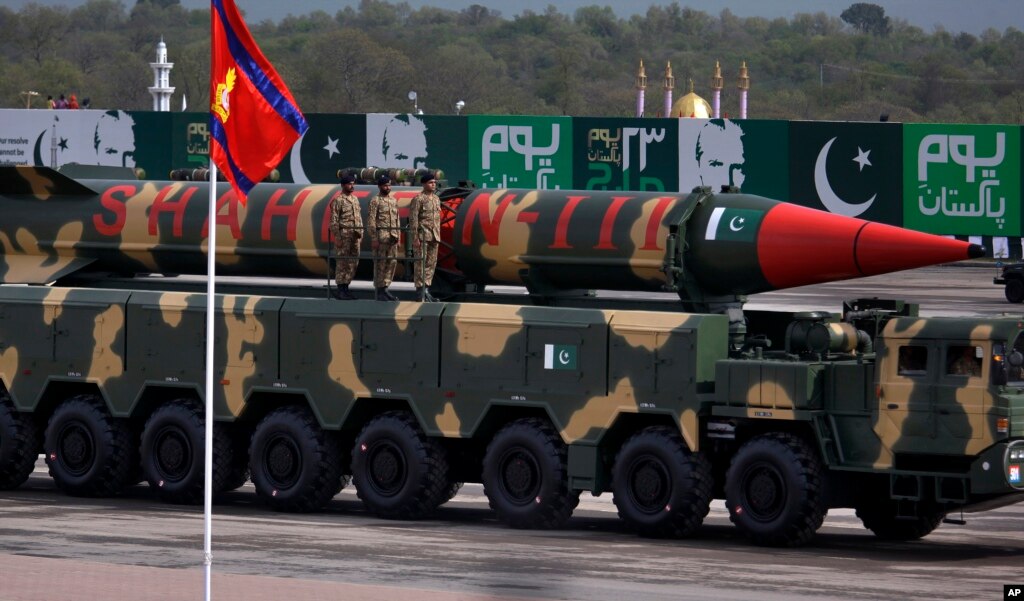
A Pakistani-made Shaheen-III missile, capable of carrying nuclear war heads, loaded on a trailer rolls down during a military parade to mark Pakistan's Republic Day in Islamabad, Pakistan, March 23, 2016.
A Pakistani-made Shaheen-III missile, capable of carrying nuclear war heads, loaded on a trailer rolls down during a military parade to mark Pakistan’s Republic Day in Islamabad, Pakistan, March 23, 2016. 

Ayaz Gul
Pakistan’s top nuclear security advisor has rejected growing U.S. pressure and safety concerns about its production and deployment of battlefield nuclear weapons.

We are not apologetic about the development of the TNWs [tactical nuclear weapons] and they are here to stay,” said Khalid Ahmed Kidwai, an advisor to the so-called National Command Authority (NCA) and a longtime custodian of the country’s nuclear arsenal.

The institutions responsible for planning storage and operational deployments do make sure that “it is so balanced on ground in time and space that it is ready to react at the point where it must react and at the same time it is not sucked into the battle too early and remains safe,” Kidwai told a seminar at Islamabad’s Institute of Strategic Studies.

Response to US

He was apparently responding to last week’s testimony before the U.S. Senate Foreign Relations Committee by Undersecretary of State for Arms Control and International Security Rose Gottemoeller, where she praised the “excellent” steps Pakistan has undertaken to secure its nuclear arsenal, but said Washington is troubled by the development of battlefield nuclear weapons.
She insisted that battlefield nuclear weapons, by their very nature, pose security threats because their security cannot be guaranteed when they are taken to the field.

“So, we are really quite concerned about this and we have made our concerns known and we will continue to press them about what we consider to be the destabilizing aspects of their battlefield nuclear weapons program,” Gottemoeller said.

Nuclear Security Summit

The tensions come ahead of next week’s Nuclear Security Summit in Washington (March 31 – April 1), where President Barack Obama and other global leaders will discuss terrorism threats related to radiological weapons and review proposed safety measures. Leaders of Pakistan and its nuclear-armed archival India will also attend.

Islamabad’s tactical nuclear weapons have been straining its traditionally rollercoaster ties with Washington since 2011, when Pakistan first tested and began producing its nuclear-capable “Nasr” ballistic missile, which has a range of 60 kilometers (36 miles).

FILE - A Nasr missile is loaded on vehicle during the Pakistan National Day parade in Islamabad, Pakistan, March 23, 2015.
FILE – A Nasr missile is loaded on vehicle during the Pakistan National Day parade in Islamabad, Pakistan, March 23, 2015.

Pakistani officials justify their development of tactical nuclear weapons by citing India’s so-called “Cold Start” doctrine, which they say is aimed at undertaking a quick, punitive, conventional military strike inside Pakistan.

While Pakistan’s long-range ballistic missiles can hit anywhere in India, Kidwai insisted the tactical nuclear weapons have been developed to keep the neighboring country’s conventionally huge military from imposing a limited conflict on his country for achieving “political objectives.”
“It compelled us to plug the gap that existed at the tactical level within the nuclear system,” the Pakistani advisor asserted. He reiterated Islamabad’s “full spectrum” nuclear weapons program is “India-specific” and described the neighboring country as “Pakistan’s only enemy.”

Pakistan-India rivalry

He criticized decades of U.S.-led international moves to penalize Pakistan for developing the nuclear program while “ignoring” Indian advancements.
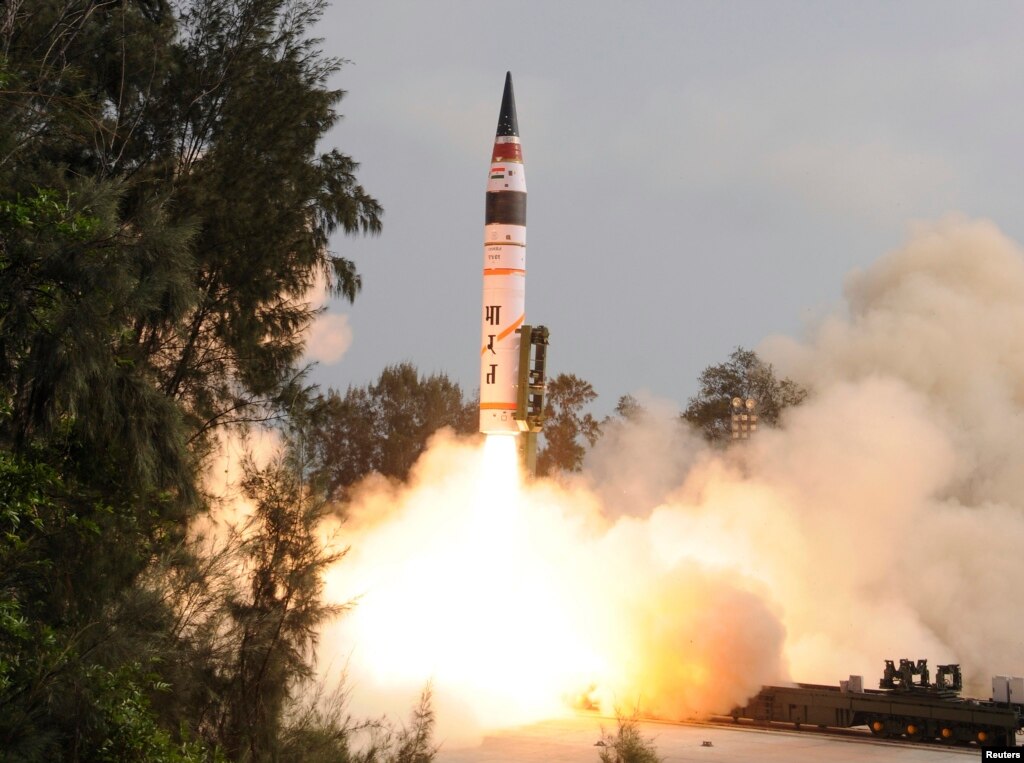
FILE -A surface-to-surface Agni V missile is launched from the Wheeler Island off the eastern Indian state of Odisha April 19, 2012. India test-fired the long range missile capable of reaching deep into China and Europe, thrusting the emerging Asian power into an elite club of nations with intercontinental nuclear weapons capabilities.

Kidwai insisted that the punitive actions might have caused political and diplomatic setbacks to his country but said it has not impacted its efforts to defend the country against another Indian aggression.

“Pakistan would not cap or curb its nuclear weapons program or accept any restrictions. All attempts in this regard… are bound to end up nowhere,” he added.

The Pakistani advisor particularly criticized the American media for being “completely negative, hostile and biased” towards Islamabad’s nuclear program, accusing it of publishing misleading reports and claims that Pakistan possesses the world’s fastest growing nuclear program.

“I think it is politically-motivated because the developments that are taking place in Pakistan are of a very modest level, very much in line with the concept of credible minimum deterrence, and they are always a reaction to an action that takes place in India. So, Pakistan does not have the fastest growing nuclear program,” he said.

Wednesday, January 13, 2016

Babylon Moves Into Tactical Nukes (Daniel 8)


By WILLIAM J. BROAD and DAVID E. SANGER
JANUARY 11, 2016
As North Korea dug tunnels at its nuclear test site last fall, watched by American spy satellites, the Obama administration was preparing a test of its own in the Nevada desert.
A fighter jet took off with a mock version of the nation’s first precision-guided atom bomb. Adapted from an older weapon, it was designed with problems like North Korea in mind: Its computer brain and four maneuverable fins let it zero in on deeply buried targets like testing tunnels and weapon sites. And its yield, the bomb’s explosive force, can be dialed up or down depending on the target, to minimize collateral damage.
In short, while the North Koreans have been thinking big — claiming to have built a hydrogen bomb, a boast that experts dismiss as wildly exaggerated — the Energy Department and the Pentagon have been readying a line of weapons that head in the opposite direction.
Mr. Obama has long advocated a “nuclear-free world.” His lieutenants argue that modernizing existing weapons can produce a smaller and more reliable arsenal while making their use less likely because of the threat they can pose. The changes, they say, are improvements rather than wholesale redesigns, fulfilling the president’s pledge to make no new nuclear arms.
But critics, including a number of former Obama administration officials, look at the same set of facts and see a very different future. The explosive innards of the revitalized weapons may not be entirely new, they argue, but the smaller yields and better targeting can make the arms more tempting to use — even to use first, rather than in retaliation.
Gen. James E. Cartwright, a retired vice chairman of the Joint Chiefs of Staff who was among Mr. Obama’s most influential nuclear strategists, said he backed the upgrades because precise targeting allowed the United States to hold fewer weapons. But “what going smaller does,” he acknowledged, “is to make the weapon more thinkable.”
As Mr. Obama enters his final year in office, the debate has deep implications for military strategy, federal spending and his legacy.
The B61 Model 12, the bomb flight-tested last year in Nevada, is the first of five new warhead types planned as part of an atomic revitalization estimated to cost up to $1 trillion over three decades. As a family, the weapons and their delivery systems move toward the small, the stealthy and the precise.
Already there are hints of a new arms race. Russia called the B61 tests “irresponsible” and “openly provocative.” China is said to be especially worried about plans for a nuclear-tipped cruise missile. And North Korea last week defended its pursuit of a hydrogen bomb by describing the “ever-growing nuclear threat” from the United States.
The more immediate problem for the White House is that many of its alumni have raised questions about the modernization push and missed opportunities for arms control.
It’s unaffordable and unneeded,” said Andrew C. Weber, a former assistant secretary of defense and former director of the Nuclear Weapons Council, an interagency body that oversees the nation’s arsenal.
He cited in particular the advanced cruise missile, estimated to cost up to $30 billion for roughly 1,000 weapons.
“The president has an opportunity to set the stage for a global ban on nuclear cruise missiles,” Mr. Weber said in an interview. “It’s a big deal in terms of reducing the risks of nuclear war.”
Last week, Brian P. McKeon, the principal deputy under secretary of defense for policy, argued that anyone who looks impartially at Mr. Obama’s nuclear initiatives in total sees major progress toward the goals of a smaller force and a safer world — themes the White House highlighted on Monday in advance of the president’s State of the Union address.
“We’ve cleaned up loose nuclear material around the globe, and gotten the Iran deal,” removing a potential threat for at least a decade, Mr. McKeon said.
He acknowledged that other pledges — including treaties on nuclear testing and the production of bomb fuel — have been stuck, and that the president’s hopes of winning further arms cuts in negotiations with Russia “ran into a blockade after the events in Ukraine.”
He specifically defended the arsenal’s modernization, saying the new B61 bomb “creates more strategic stability.”
Early in his tenure, Mr. Obama invested much political capital not in upgrades but in reductions, becoming the first president to make nuclear disarmament a centerpiece of American defense policy.
In Prague in 2009, he pledged in a landmark speech that he would take concrete steps toward a nuclear-free world and “reduce the role of nuclear weapons in our national security strategy.” The Nobel committee cited the pledge that year in awarding him the Peace Prize.
A modest arms reduction treaty with Russia seemed like a first step. Then, in 2010, the administration released a sweeping plan that Mr. Obama called a fulfillment of his atomic vow. The United States, he declared, “will not develop new nuclear warheads or pursue new military missions or new capabilities.”
The overall plan was to rearrange old components of nuclear arms into revitalized weapons. The resulting hybrids would be far more reliable, meaning the administration could argue that the nation would need fewer weapons in the far future.
Inside the administration, some early enthusiasts for Mr. Obama’s vision began to worry that it was being turned on its head.
In late 2013, the first of the former insiders spoke out. Philip E. Coyle III and Steve Fetter, who had recently left national security posts, helped write an 80-page critique of the nuclear plan by the Union of Concerned Scientists, a private group that made its name during the Cold War, arguing for arms reductions.
American allies and adversaries, the report warned, may see the modernization “as violating the administration’s pledge not to develop or deploy” new warheads. The report, which urged a more cautious approach, cited a finding by federal advisory scientists: that simply refurbishing weapons in their existing configurations could keep them in service for decades.
“I’m not a pacifist,” Mr. Coyle, a former head of Pentagon weapons testing, said in an interview. But the administration, he argued, was planning for too big an arsenal. “They got the math wrong in terms of how many weapons we need, how many varieties we need and whether we need a surge capacity” for the crash production of nuclear arms.
The insider critiques soon focused on individual weapons, starting with the B61 Model 12. The administration’s plan was to merge four old B61 models into a single version that greatly reduced their range of destructive power. It would have a “dial-a-yield” feature whose lowest setting was only 2 percent as powerful as the bomb dropped on Hiroshima in 1945.
The plan seemed reasonable, critics said, until attention fell on the bomb’s new tail section and steerable fins. The Federation of American Scientists, a Washington research group, argued that the high accuracy and low destructive settings meant military commanders might press to use the bomb in an attack, knowing the radioactive fallout and collateral damage would be limited.
Last year, General Cartwright echoed that point on PBS’s “NewsHour.” He has huge credibility in nuclear circles: He was head of the United States Strategic Command, which has military authority over the nation’s nuclear arms, before serving as vice chairman of the Joint Chiefs of Staff.
In a recent interview in his office at the Center for Strategic and International Studies, in Washington, General Cartwright said the overall modernization plan might change how military commanders looked at the risks of using nuclear weapons.
“What if I bring real precision to these weapons?” he asked. “Does it make them more usable? It could be.”
“Mr. President, kill the new cruise missile,” read the headline of a recent article by Mr. Weber, the former assistant secretary of defense, and William J. Perry, a secretary of defense under President Bill Clinton and an author of the plan to gradually eliminate nuclear weapons that captivated Mr. Obama’s imagination and endorsement.
The critique stung because Mr. Perry, now at Stanford, is a revered figure in Democratic defense circles and a mentor to Ashton B. Carter, the secretary of defense.
Mr. McKeon, the Pentagon official, after describing his respect for Mr. Perry, said the military concluded that it needed the cruise missile to “give the president more options than a manned bomber to penetrate air defenses.”
In an interview, James N. Miller, who helped develop the modernization plan before leaving his post as under secretary of defense for policy in 2014, said the smaller, more precise weapons would maintain the nation’s nuclear deterrent while reducing risks for civilians near foreign military targets.
“Though not everyone agrees, I think it’s the right way to proceed,” Mr. Miller said. “Minimizing civilian casualties if deterrence fails is both a more credible and a more ethical approach.”
General Cartwright summarized the logic of enhanced deterrence with a gun metaphor: “It makes the trigger easier to pull but makes the need to pull the trigger less likely.”
Administration officials often stress the modernization plan’s benign aspects. Facing concerned allies, Madelyn R. Creedon, an Energy Department deputy administrator, argued in October that the efforts “are not providing any new military capabilities” but simply replacing wires, batteries, plastics and other failing materials.
“What we are doing,” she said, “is just taking these old systems, replacing their parts and making sure that they can survive.”
In a recent report to Congress, the Energy Department, responsible for upgrading the warheads, said this was the fastest way to reduce the nuclear stockpile, promoting the effort as “Modernize to Downsize.”
The new weapons will let the nation scrap a Cold War standby called the B83, a powerful city buster. The report stressed that the declines in “overall destructive power” support Mr. Obama’s goal of “pursuing the security of a world without nuclear weapons.”
That argument, though, is extremely long term: Stockpile reductions would manifest only after three decades of atomic revitalization, many presidencies from now. One of those presidents may well cancel the reduction plans — most of the candidates now seeking the Republican nomination oppose cutbacks in the nuclear arsenal.
But the bigger risk to the modernization plan may be its expense — upward of a trillion dollars if future presidents go the next step and order new bombers, submarines and land-based missiles, and upgrades to eight factories and laboratories.
“Insiders don’t believe it will ever happen,” said Mr. Coyle, the former White House official. “It’s hard to imagine that many administrations following through.”
Meanwhile, other veterans of the Obama administration ask what happened.
“I think there’s a universal sense of frustration,” said Ellen O. Tauscher, a former under secretary of state for arms control. She said many who joined the administration with high expectations for arms reductions now feel disillusioned.
“Somebody has to get serious,” she added. “We’re spending billions of dollars on a status quo that doesn’t make us any safer.”