Andrew the Prophet

The prophecy is more than seeing into the future. For the prophecy sees without the element of time. For the prophecy sees things as they were, as they are, and as they always shall be.

Showing posts with label mirv. Show all posts

Monday, June 3, 2019

China Expands Her Nuclear Horn (Daniel 7)

U.S. Expects China to Quickly Double Its Nuclear Stockpile | Time

W.J. Hennigan
John Walcott
The Baker test during Operation Crossroads, a series of two nuclear weapons tests conducted by the United States at Bikini Atoll. 25th July 1946.Galerie Bilderwelt / Getty Images
China is expected to increase its nuclear weapons stockpile by twofold in the coming decade, according to a new U.S. military intelligence assessment, part of a sweeping build-up of Beijing’s strategic arsenal.
“Over the next decade, China is likely to at least double the size of its nuclear stockpile in the course of implementing the most rapid expansion and diversification of its nuclear arsenal in China’s history,” Lt. Gen. Robert Ashley, the director of the U.S. Defense Intelligence Agency said during a speech on Wednesday.
Speaking at the Hudson Institute in Washington, Ashley also accused both China and Russia of covertly testing low-yield nuclear weapons in violation of a 23-year old international treaty. The allegation came less than three months before the expected end of the 1987 Intermediate-range Nuclear Forcesagreement with Russia; and two years from the expiration of the landmark New Strategic Arms Reduction Treaty, or New START.
In response to the slow erosion of agreements, President Donald Trump has declared his desire to reach a post-Cold War détente with both China and Russia under an all-encompassing arms treaty. Yet that petition has been met by disinterest in Beijing and indifference in Moscow.
The grand bargain approach, critics say, is too time-consuming and unlikely to garner results within the remaining 19 months in Trump’s term. More likely, they say, it’s a stalling tactic for national security hawks in the Administration, such as Secretary of State Mike Pompeo and National Security Adviser John Bolton, who are known to be hostile toward international agreements.
“Pursuit of broader nuclear arms control deal with Russia and China is a worthwhile objective — but not at the expense of, or as a condition for, the extension of New START,” said Kingston Reif, director for disarmament and threat reduction policy at the Arms Control Association, a think tank. “So far the Trump Administration does not appear to have a plan or the capacity to negotiate a more far-reaching deal, which would likely take years. Which suggests that the real goal of this gambit is to run out the clock on New START.”
If New START sunsets, it will be the first time in the effort to limit the strategic stockpiles in the U.S. and Russia since 1972. The linchpin agreement limits each side to 1,550 deployed nuclear warheads and 700 deployed heavy bombers and ballistic missiles. It also includes a thorough monitoring and verification regime to help ensure compliance.
Tim Morrison, a senior director at the National Security Council, said New START’s expiration is more than a year away, which presents the Administration with more than enough time to try to secure that agreement. Trump has aspirations beyond a bilateral deal, he said.
“What we need to focus on is the comprehensive nuclear threat,” Morrison said at the Hudson Institute, after Ashley’s speech. “The higher priority is the totality of the Russian and Chinese programs, because we have so much time left on the clock for New START.”
Russia and the U.S. are capped at 1,550 deployed nuclear warheads until Feb. 5, 2021, when New START expires. After that, there will be no limits. China, however, only has an arsenal of an estimated 290 strategic weapons. So even if Beijing doubles its stockpile, as U.S. intelligence assesses, it will represent a fraction of those belonging to Washington and Moscow.
What has drawn U.S. officials’ attention is China’s arsenal of hundreds of smaller nuclear warheads, known as tactical nuclear weapons. These weapons are designed for use on the battlefield as opposed to strategic weapons, which are designed to destroy cities and hardened military targets. Numbers of those weapons are not capped under international treaty.
The Chinese military, headlong into a complete modernization of its forces, is nearly ready to field a so-called nuclear “triad”capable launching an attack from land, air, and sea — a capability Russia and the U.S. have had for decades. The Trump team points to this nuclear expansion as proof of China’s emergence on the world stage as a great power and why it must be included in future arms control conversations.
Analysts say China is more preoccupied with establishing regional preeminence in the Pacific. “It’s true that China has steadily expanded its nuclear forces,” said Hans Kristensen, a nuclear weapons expert at the Federation of American Scientists. “But their main goal is to deter regional powers, such as India and Russia.”
Meanwhile, Russia has about 2,000 tactical nukes in its arsenal. These include air-to-surface missiles, short-range ballistic missiles, air-dropped bombs, depth charges and torpedoes for surface ships and submarines, according to U.S. military assessments.
“We assess its overall nuclear stockpile is likely to grow significantly over the next decade,” Ashley said on Wednesday. “Russia’s stockpile of non-strategic nuclear weapons — already large and diverse — is being modernized with an eye towards greater accuracy, longer ranges, and lower yields to suit their potential warfighting role.”
The U.S. assesses that Russia has dozens of these systems already deployed or in development. One of the weapons, the Novator 9M729, was in violation of the Intermediate-Range Nuclear Forces (INF) Treaty, which led to its probable dissolution. First signed by President Ronald Reagan and Soviet Union leader Mikhail Gorbachev in December 1987, the INF treaty eliminated an entire class of nuclear weapons. It forced the superpowers to scrap more than 2,600 land-based missiles with ranges 310 to 3,420 miles — weapons considered destabilizing to the European continent because of their capability to launch a nuclear strike from anywhere without early warning.
Many U.S. military officials have viewed the United States’ adherence to the INF as a disadvantage with China, considering the country is not currently party to the INF. Beijing has more than 1,000 land-based missiles within INF range that could threaten U.S. and allies’ bases in the western Pacific and warships.
Ashley provided no proof for his claims that Russia and China likely violated the Comprehensive Nuclear Test Ban Treaty, which bans test explosions of nuclear weapons, known as a “zero-yield standard.” Nor did he indicate what further actions might be taken as a result of the violation.
A senior U.S. intelligence official said after Ashley’s speech that there is no consensus in the intelligence community that Russia has conducted a low-yield test, only that it is assembling the facilities that would be necessary to do so. The official said the Defense Intelligence Agency generally takes the “worst case” position on military matters, as it did on the question of whether Iraq had weapons of mass destruction.
However, said a second intelligence official, also speaking on the condition of anonymity because the remarks were not cleared for public release, the preparations for a possible test — which would be difficult to detect conclusively at a very low yield — fits a pattern of Russian arms treaty violations that began with the 2017 installation of medium-range cruise missiles in violation of the INF Treaty.
“There is concern in some quarters that Russia may be testing how the Administration responds to low-level treaty violations, especially given that it has abandoned a number of international agreements like the TPP, NAFTA and the Paris (climate) accord,” the official said.
The U.S. hasn’t tested a nuke since 1992, when then President George H.W. Bush declared a self-imposed testing moratorium. Four years later, the U.S. became the first of 184 nations to sign the Comprehensive Nuclear Test Ban Treaty. However, Congress never ratified it.
Posted by Andrew the Prophet at 1:00 PM No comments:
Email ThisBlogThis!Share to XShare to FacebookShare to Pinterest
Labels: Andrew the Prophet, andrewtheprophet, china, chinese, india, mirv, Nuclear, nuclear war, nuclear weapons, War

Monday, May 13, 2019

China’s Great Nuclear Horn (Daniel 7)


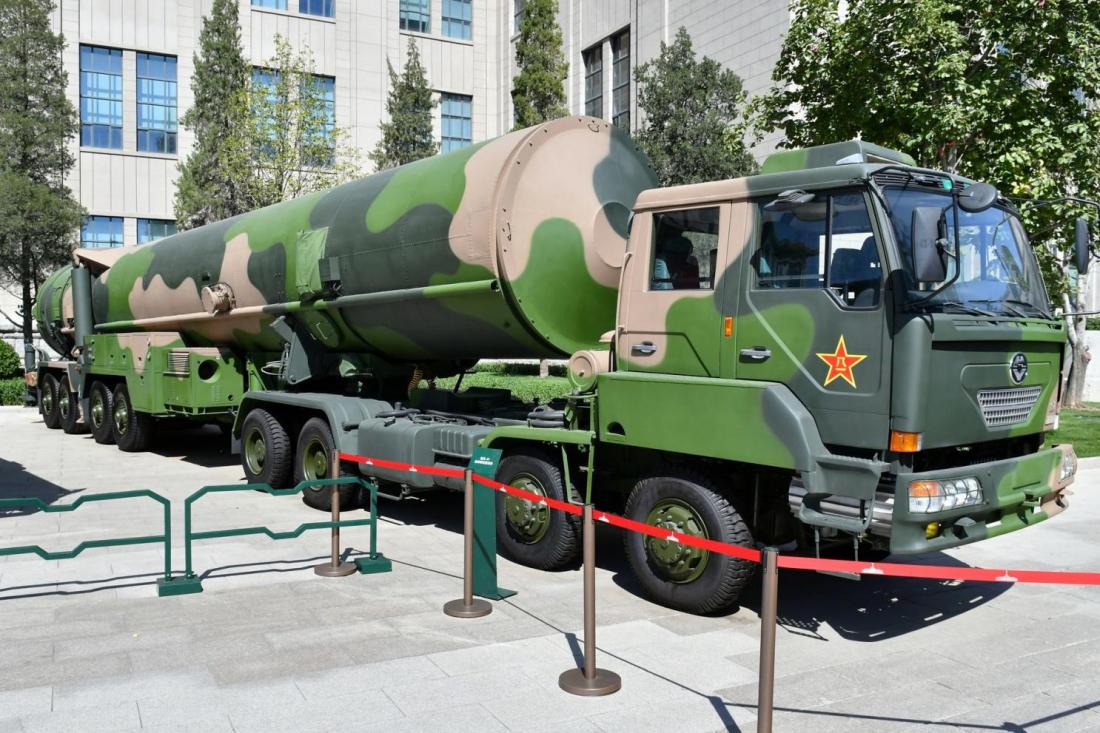
Visitors walk past China’s second nuclear missile on display as they visit the Military Museum in Beijing / Getty
China’s Great Nuclear Wall
Aaron Kliegman
When it comes to nuclear arms control, China is great at playing hard to get. Beijing is the elusive beauty, a difficult but attractive target for those who seek nuclear disarmament. Powerful yet mysterious, shrouding its nuclear program in a haze of opacity, the Chinese government never actually gives its pursuers what they want. And China knows that only makes them more interested. Indeed, Beijing leads on its suitors with seductive promises of reducing its arsenal of nuclear weapons, only to demand more in return from other states before taking any steps. And then the cycle begins anew, with no fewer nuclear weapons in China.
To illustrate the point, go back to June 1982, when the United Nations General Assembly held a second special session on disarmament. At the gathering, the late Huang Hua, then China’s foreign minister, presented a concrete proposal: if the United States and the Soviet Union halted the testing, improving, or manufacturing of nuclear weapons and reduced their arsenals by 50 percent, the Chinese government would be ready „to join all other nuclear states in undertaking to stop the development and production of nuclear weapons, and to further reduce and ultimately destroy them altogether.“ Just six years later, however, as the United States and the Soviet Union were drafting the Strategic Arms Reduction Treaty, or START I, which significantly reduced each country’s nuclear arsenal, China changed its standard for joining arms-control talks. The 50-percent threshold was just a start; Moscow and Washington also had to make further „drastic reductions“ in their arsenals. Then, in 1995, after Moscow and Washington signed START I and START II, Beijing changed its standard yet again. China would not, according to nuclear expert Brad Roberts, consider disarmament until the Americans and Russians „reduced their arsenals far beyond START II numbers, abandoned tactical nuclear weapons, abandoned ballistic missile defense, and agreed to joint no-first-use pledge,“ under which they would vow never to be the first to use nuclear weapons in a conflict. No matter the circumstance, China was simply not interested in nuclear arms control.
This trend continued throughout the 1990s and into the 21st century, with the United States continuously trying—and failing—to foster dialogue with China over nuclear weapons. China has also refused to be transparent about its nuclear capabilities, seeing opacity as key to Chinese deterrence. If the United States is unsure of what China can and cannot do, China’s thinking goes, then Washington will be much more wary of taking aggressive actions against Beijing. Here the Obama and Trump administrations have at least one thing in common: recognizing China’s lack of transparency in the nuclear realm as problematic. The Obama administration’s Nuclear Posture Review, or NPR, states that „the lack of transparency surrounding [Chinese] nuclear programs—their pace and scope, as well as the strategy and doctrine that guides them—raises questions about China’s future strategic intentions.“ The Trump administration’s NPR echoes the same point, arguing that, „while China’s declaratory policy and doctrine have not changed, its lack of transparency regarding the scope and scale of its nuclear modernization program raises questions regarding its future intent.“ China has, in effect, built a different kind of great wall around its nuclear arsenal, preventing others from even discussing what is behind it.
So it should not be surprising that, this week, China quickly dismissed a suggestion that it would talk with the United States and Russia about a new deal limiting nuclear arms. „China opposes any country talking out of turn about China on the issue of arms control, and will not take part in any trilateral negotiations on a nuclear disarmament agreement,“ Geng Shuang, a spokesman for the Chinese Foreign Ministry, said Monday. „[China’s] nuclear force is always kept at the minimum level required by national security, with an order-of-magnitude difference from that of the United States and Russia, which puts things in a completely different light.“ The spokesman added—and this may sound familiar—that „the pressing task at present“ is for the United States and Russia, which have the world’s two largest nuclear arsenals, „to adhere to the consensus reached by the international community to earnestly fulfill their special and primary responsibilities in nuclear disarmament.“ Only then, according to the Chinese Foreign Ministry, will other countries be able to participate in nuclear disarmament. China’s response came days after news reports said that President Trump ordered his administration to prepare to push new arms-control agreements with both China and Russia.
In the United States, when pundits and politicians discuss nuclear weapons, they tend to focus exclusively on Russia. Watch a congressional hearing on nuclear policy and see what percentage of the questions is about Russia, and what percentage is about China. In some ways, it makes sense why the difference is so large: China has about 280 nuclear warheads, while Russia has, under the New START Treaty, 1,550 deployed strategic nuclear warheads (in addition to thousands more stored and retired). Moreover, China advertises its nuclear strategy as one of „minimal deterrence,“ while Russian President Vladimir Putin regularly touts his country’s nuclear strength with belligerent statements.
Another reason why observers too often ignore China is because of the legacy of the Cold War, which for so many Americans puts Russia at the forefront of any discussion concerning nuclear weapons. Yet America’s extensive history with Russia’s arsenal is precisely why Washington should be so concerned about China. At least the United States has a well-established line of communication with Russia regarding nuclear weapons going back decades. And they negotiated an arms-control agreement as recently as 2010. Each side understands the other pretty well, and if there ever is a nuclear crisis between the two countries, there is a wealth of experience that leaders can use to help navigate through the situation. When it comes to China, however, there is no such experience, nor any line of communication. In a Sino-American nuclear crisis, no one would have a „number to call“ the other side. China’s unwillingness to engage on this issue in any meaningful way makes the prospect of reaching a resolution that much more of an unknown. The United States has no idea how China would react. At least it has some idea of how to deal with Russia.
Realistically, the prospects of the United States, or any country, making progress with China on arms control are remote—although such efforts are still worthwhile. Still, the United States should be very concerned about the Chinese arsenal. China may have fewer nuclear weapons and a seemingly less aggressive nuclear strategy, but that shows, perhaps counter intuitively, why China is a more dangerous adversary than Russia. China is smarter and more patient, looking to the long term. Beijing sees Chinese power on the rise and American power on the decline. There is no need to sound belligerent and risk conflict like the Russians. China can build up its economic and military might without provoking so much international condemnation. And then one day, when no one is ready, it may decide the time is right to seize Taiwan.
Over the long term, China sees itself supplanting the United States as the dominant power in East Asia and, eventually, in the world. Russia, meanwhile, is a fundamentally weak country with lots of nuclear weapons. Putin is certainly dangerous, but he lashes out in part because of that weakness—his country is on the path toward economic irrelevance, along with a demographic nightmare. In other words, China is the more mature adversary, the quiet yet observant mastermind plotting its grand scheme rather than the loud, obnoxious goon drunkenly challenging everyone to a fight.
The late Chinese leader Deng Xiaoping once outlined the following strategy for China: „Observe calmly; secure our position; cope with affairs calmly; hide our capacities; bide our time; be good at maintaining a low profile; never claim leadership.“ Today, many observers argue that Chinese President Xi Jinping has gone away from that model, and that is true to some extent. But China is still patiently biding its time, working to supplant the United States with a sophisticated strategy that involves all aspects of state power, from development to military modernization. That strategy includes maintaining a potent nuclear arsenal, which China hopes to use to get others to disarm, without having to do so itself.
Posted by Andrew the Prophet at 12:09 PM No comments:
Email ThisBlogThis!Share to XShare to FacebookShare to Pinterest
Labels: Andrew the Prophet, andrewtheprophet, china, chinese, india, mirv, Nuclear, nuclear war, nuclear weapons, War

Wednesday, May 8, 2019

The Chinese Nuclear Horn (Daniel 7:7)

Z7 (1)Why You Should Fear China’s Nuclear Weapons

It is all about deterrence.

by Mark B. Schneider
In 2006, China said that it was “progressively improving its force structure” of both nuclear and conventional missiles. This is exactly what has happened. This expansion of Chinese nuclear capability has occurred despite the fact that the U.S. drastically reduced its nuclear capabilities after 2001. China’s nuclear buildup must be viewed in the context of the largest and longest sustained military buildup in the post-Cold War world. What is very significant is that China began its military buildup after threats to China largely evaporated at the end of the Cold War.
China is extremely secretive about its nuclear forces. In 1982, Mao’s successor, Deng Xiaoping, said that China should “…hide our capabilities and bide our time.” This may be a good description of Chinese policy when it comes to revealing its nuclear capability. Its objective would appear to be to hide its capabilities to achieve strategic surprise and minimize the risk of a U.S. response to its nuclear buildup. However, it is noteworthy that the Chinese state media and, to some extent, the Chinese government have been more open in revealing China’s nuclear capability for its non-strategic systems.
Despite Chinese secrecy, what is known is troubling. Chinese nuclear expansion must be viewed against the backdrop of Chinese territorial expansion in the South and East China Seas and the overall growth of Chinese military capability. The Chinese government promotes strong nationalism and communist ideology is still prevalent in the People’s Liberation Army (PLA).
According to the 2018 Nuclear Posture Review, “China, too, is modernizing and expanding its already considerable nuclear forces. Like Russia, China is pursuing entirely new nuclear capabilities tailored to achieve particular national security objectives while also modernizing its conventional military, challenging traditional U.S. military superiority in the Western Pacific.” Furthermore, the report says China, like Russia, has added: “…new types of nuclear capabilities to their arsenals, increased the salience of nuclear forces in their strategies and plans, and engaged in increasingly aggressive behavior, including in outer space and cyberspace.”
A 2017 National Institute for Public Policy (NIPP) report points out, “The Obama Administration estimated that China has several hundred nuclear weapons, but other estimates place the number much higher.”[6] The high estimates go up to several thousand. Irrespective of what the current number is, there are indications of a major force expansion. The NIPP report further noted, “The extensive length of China’s ‘Underground Great Wall’ (which the Chinese say is 5,000 km of deep tunnels), suggests that a larger force of nuclear-armed ICBMs may be planned.” In addition to protecting mobile ICBMs, these tunnels provide a place to hide them. The implication of this extensive network of deep tunnels for U.S. nuclear weapons requirements has been largely ignored. While the Obama Administration stated we needed “significant” counterforce capability, its subsequent programmatic decisions went in the opposite direction. Some of this has been changed by the 2018 Nuclear Posture Review, but some of it has not. Thus, the U.S.’ ability to target these tunnels is limited because we have inadequate capability to destroy hard and deeply buried targets and it is actually declining.
According to the 2019 Defense Intelligence Agency report on “China Military Power”, “China is developing a new generation of mobile missiles, with warheads consisting of multi­ple independently targetable reentry vehicles (MIRVs) and penetration aids…” Over the last decade, China has developed and deployed new nuclear DF-31 and the DF-31A mobile ICBMs, a MIRVed version of their DF-5 silo-based ICBM, the type 094 ballistic missile submarines carrying JL-2 SLBMs and H-6J cruise missile-carrying bombers. The reported range of the H-6J, 8,000-km, would make it a heavy bomber under the New START Treaty range definition. Additionally, the Chinese J-20 air-launched cruise missile is nuclear capable. Indeed, in December 2013, a story in the Chinese state media talked about China’s H-6K bombers launching nuclear-armed cruise missiles against U.S. bases in South Korea and Japan.
China has displayed its new reportedly MIRVed, DF-31AC a road-mobile solid-fuel ICBM at a military parade. Chinese state media also recently indicated that the large mobile heavily MIRVed DF-41 mobile ICBM is operational. The state-run Global Times wrote that it would give China “respect.” The DF-41 is generally reported to carry 10 nuclear warheads. Moreover, China has said it is developing a new nuclear-capable bomber, reportedly a stealth design.
The 2017 Pentagon report on Chinese military power says that in the early 2020s China will likely begin the construction of new type 096 submarines which reportedly will carry the new JL-3 SLBM. There are reports that the JL-3 will be MIRVed. A 2017 unclassified DIA report indicates China is now deploying “two, new air-launched ballistic missiles, one of which may include a nuclear payload.”
China’s Theater Nuclear Capability
A 2017 unclassified National Air and Space Intelligence Center (NASIC) report indicated there were 33 types of Chinese battlefield rockets, theater-range ballistic and cruise missiles. Various unclassified U.S. government reports have said the DF-26 IRBM, the DF-21 medium-range missile, including the carrier killer DF-21D, the new cruise missiles, China’s hypersonic glide vehicles, and an air-launched ballistic missile are nuclear capable. According to the 2018 Nuclear Posture Review report, China’s new DF-26 is “a nuclear-capable precision guided… intermediate-range ballistic missile capable of attacking land and naval targets.” The U.S. does not have this capability.
The Taiwanese Defense Ministry has said that the DF-11 short-range ballistic missile is nuclear capable. The new short-range Chinese DF-15 ballistic missile is also reported to be nuclear capable. Russian experts credit much of China’s conventional missile force with dual capability (nuclear and conventional).
China has been testing hypersonic missiles for years. In 2018, Chinese state media claimed its hypersonic DF-17 boost-glide vehicle, with a range of 1,000-1,500 miles, can sink carriers. Initial operating capability for the DF-17 is reportedly expected in 2020. In December 2018, China reportedly tested the Starry Sky 2 Mach 6 powered hypersonic missile (it is also characterized as an aircraft, probably, inaccurately) which is reported to be nuclear capable.
Chinese Nuclear Testing and the Development of New Types of Nuclear Weapons
To modernize its nuclear forces, China continued high-yield nuclear testing through 1996. The purpose of Chinese nuclear tests in the 1990s was to “develop small, light warheads for the PRC’s new nuclear forces.” According to declassified intelligence reports, China’s nuclear tests in the 1990s were mainly involved with the development of new strategic and tactical nuclear weapons of advanced design. Significantly, Chinese officials have said China has developed new types of nuclear weapons after the end of the Cold War. Xue Bencheng, reportedly one of the most important scientists involved in the development of China’s neutron bomb, stated that the July 1996 Chinese nuclear test was “a great spanning leap” because it solved the problem of nuclear weapons miniaturization.
The House of Representatives’ Cox Committee, which extensively investigated Chinese theft of U.S. technology, concluded that, “If the PRC violates the Comprehensive Test Ban Treaty by testing surreptitiously, it could further accelerate its nuclear development.” It also concluded that China “…may be testing low yield nuclear explosive devices underground at its Lop Nur test site.” In May 2006, Chinese Defense Today also reported possible “low yield nuclear tests” after the declared end of nuclear testing. Covert Chinese nuclear testing could enhance Chinese capabilities to field advanced nuclear weapons.
Writing in 2002, Russian military journalists Vyacheslav Baskakov and Aleksandr Gorshkov maintained that China “…will succeed in making the shift from its current megaton-class nuclear ordinance to a level of hundreds and tens of kilotons, thereby increasing the effectiveness of available forces and weapons, flexibility of use in various circumstances and combat situations on both a strategic and tactical level.”
Moreover, the Cox Committee report stated:
The People’s Republic of China (PRC) has stolen classified information on all of the United States’ most advanced thermonuclear warheads, and several of the associated reentry vehicles…..The stolen U.S. secrets have helped the PRC fabricate and successfully test modern strategic thermonuclear weapons. The stolen information includes classified information on seven U.S. thermonuclear warheads, including every currently deployed thermonuclear warhead in the U.S. intercontinental ballistic missile arsenal. Together, these include the W-88 Trident D-5 thermonuclear warhead, and the W-56 Minuteman II, the W-62 Minuteman III, the W-70 Lance, the W-76 Trident C-4, the W-78 Minuteman III Mark 12A, and the W-87 Peacekeeper thermonuclear warheads. The stolen information also includes classified design information for an enhanced radiation weapon (commonly known as the ‘neutron bomb’)
What this means, as the Cox Committee pointed out, is that the stolen U.S. information and computer codes make it much easier for China to replicate the most advanced U.S. Cold War designs, including types that we unwisely eliminated at the end of the Cold War. This enhances the threat potential of reported covert Chinese nuclear testing.
Conclusion
China is expanding its nuclear capability which is what one would expect from a country that is preparing for a major war in Asia on the assumption it will have to fight the U.S. We face a very serious threat from China and its growing nuclear weapons capability is a key component. We may face a nuclear threat from China which is significantly greater than what most U.S. analysts will admit. If China plans to fight the U.S. it would be stupid to do so with an inferior nuclear force when it is now relatively easy for the Chinese to close the gap in nuclear weapons numbers and actually move ahead in the next ten years. China’s growing nuclear capability makes the confrontations that it is deliberately generating very dangerous.
Dr. Mark B. Schneider is a senior analyst at the National Institute for Public Policy and a former senior official in the Defense Department.
This article by Mark B. Schneider originally appeared at Real Clear Defense. This article first appeared in 2019.
Posted by Andrew the Prophet at 7:00 PM No comments:
Email ThisBlogThis!Share to XShare to FacebookShare to Pinterest
Labels: Andrew the Prophet, andrewtheprophet, china, chinese, india, mirv, Nuclear, nuclear war, nuclear weapons, War

Saturday, March 10, 2018

Pakistan Widens Its Nuclear Horn (Daniel 8)

Pakistan Has Just Tested the Ultimate Nuclear Missile

Zachary Keck
 

Pakistan has tested a ballistic missile with a multiple independently targetable reentry vehicle (MIRV), the United States confirmed this week.
During testimony to Congress outlining worldwide threats on March 6, Robert Ashley, the director of the Defense Intelligence Agency (DIA), stated: “In January 2017, Pakistan conducted the first test launch of its nuclear-capable Ababeel ballistic missile, demonstrating South Asia’s first MIRV payload.” It appeared to be the first time a U.S. official publicly confirmed that Islamabad tested a MIRVed missile; however, in a report last year on missile threats around the world, the Defense Intelligence Ballistic Missile Analysis Committee noted, “In January 2017, [Pakistan] began testing the MIRVed Ababeel MRBM.”
MIRVs allow a single missile to deliver multiple warheads against different targets.
The Pakistani military first announced its test of the MIRVed missile on January 24, 2017. “Pakistan has conducted its first successful flight test of Surface to Surface Ballistic Missile Ababeel, which has a maximum range of 2,200 kilometers,” the military announced in a press release at the time. “The missile is capable of delivering multiple warheads, using Multiple Independent Re-entry Vehicle (MIRV) technology.” The statement added that the test was aimed at “validating various design and technical parameters.” No other tests of the Ababeel missiles are known to have taken place since the first one.
Despite these claims, many outside experts questioned whether Pakistan really had developed or tested a MIRV. As the Center for Strategic and International Studies’ Missile Defense Project noted, “Some experts have expressed skepticism as to whether Pakistan has indeed surmounted the various technological hurdles required for MIRVed missiles. MIRV warheads are typically much smaller than unitary warheads, and thus require greater miniaturization. It is unclear if the country has manufactured a miniaturized nuclear warhead small enough to use in a MIRV.” Ashley’s confirmation should put this skepticism to rest.
Development of the Ababeel missile is believed to have begun in the mid-to-late 2000s, and the missile’s design is similar to other Pakistani solid-fuel medium-range ballistic missiles, such as the Shaheen II and Shaheen III, according to CSIS’s Missile Defense Project. Unlike those missiles— which both have two stages— the Ababeel is a three stage missile. The BBC reported back in 2010 that Pakistani missile designers were receiving substantial assistance from China in developing MIRV technology. The Ababeel appears to have a large nose cone, which may allow it to carry multiple warheads even if they are slightly larger than normal MIRVed warheads.
Islamabad’s stated rationale for pursuing MIRV technology is to defeat India’s ballistic-missile defense systems. “Development of Ababeel Weapon System is aimed at ensuring survivability of Pakistan’s ballistic missiles in the growing regional Ballistic Missile Defence (BMD) environment,” the Pakistani military said in the statement announcing the test last January. “This will further reinforce deterrence.”
MIRVs are undoubtedly useful for defeating missile defenses, as they present numerous targets in close range that interceptors must locate and destroy. At the same time, MIRVs are extremely valuable for counterforce attacks—that is, trying to destroy an adversary’s nuclear arsenal in a surprise first strike. In that sense, they are extremely destabilizing for strategic stability; during the Cold War MIRVs greatly exacerbated the nuclear arms race between the two superpowers.
Posted by Andrew the Prophet at 7:00 PM No comments:
Email ThisBlogThis!Share to XShare to FacebookShare to Pinterest
Labels: Andrew the Prophet, andrewtheprophet, cruise, Daniel 8, Iran, mirv, Missile, Nuclear, Pakistan, program, revelation 8, The Prophecy, theprophecy

Saturday, December 23, 2017

China Nuclear Horn Expands (Daniel 7:7)

The Dongfeng-41 during May Day celebrations in Beijing this year. Picture: Supplied

China unveils next-generation nuclear missile Dongfeng-41 that can strike ‘anywhere in the world’

Staff writer
 
CHINA has revealed its awe-inspiring next-generation nuclear weapon, capable of carrying 10 individual warheads and said to be able to strike anywhere.
News Corp Australia NetworkNovember 24, 201711:58am
AMID global concerns about North Korea’s threats of nuclear war, China has unveiled a next-generation nuclear weapon that is said to be able to strike “anywhere in the world”.
The nuclear warhead, called the Dongfeng-41, will be capable of reaching distances of at least 12,000km — putting the US well into the line of target. With a speed of up to Mach 10 (around 12,000kph), it can carry up to 10 nuclear warheads.
The ballistic missile is said to be about 15 metres long, 2 metres in diameter and weighs approximately 30,000 kilograms.
According to the Daily Star, China has tested the weapon eight times in the past five years, with the latest test reportedly taking place earlier this month deep in China’s western desert region.
The weapon, which according to Chinese media will be able to hit targets “anywhere in the world”, is scheduled to enter China’s arsenal in 2018.
“It can carry up to 10 nuclear warheads, each of which can target separately,” Missile expert Xu Guangyu, a senior adviser of the China Arms Control and Disarmament Association told China Central Television, reports Newsweek.com.
“Once the Dongfeng-41 goes into service, China’s ability to protect its own safety and to prevent wars would greatly increase.”
The missile will also be able to use decoy devices to make its way through other defence systems.
Military analyst Song Zhongping, a former member of the People’s Liberation Army Rocket Force, believes it’s possible the Dongfeng-41 is already in service, as tests can be conducted after the weapon has been commissioned.
The Global Times reported that China, which claims to have an arsenal of up to 2500 missiles, “does not have an arms race agenda and will not compete with any country for any such purpose”.
Posted by Andrew the Prophet at 7:00 PM No comments:
Email ThisBlogThis!Share to XShare to FacebookShare to Pinterest
Labels: Andrew the Prophet, andrewtheprophet, andrewtheprophet.com, china, daniel 7:7, Horn, mirv, mobility, Nuclear, Pakistan, program, The Prophecy, theprophecy, vehicle

Saturday, November 25, 2017

The Strengthening China Nuclear Horn


China unveils next-generation nuclear missile Dongfeng-41 that can strike ‘anywhere in the world’
Staff writer, News Corp Australia Network

AMID global concerns about North Korea’s threats of nuclear war, China has unveiled a next-generation nuclear weapon that is said to be able to strike “anywhere in the world”.
The nuclear warhead, called the Dongfeng-41, will be capable of reaching distances of at least 12,000km — putting the US well into the line of target. With a speed of up to Mach 10 (around 12,000kph), it can carry up to 10 nuclear warheads.
The ballistic missile is said to be about 15 metres long, 2 metres in diameter and weighs approximately 30,000 kilograms.


The Dongfeng-41 during May Day celebrations in Beijing this year. Picture: Supplied
According to the Daily Star, China has tested the weapon eight times in the past five years, with the latest test reportedly taking place earlier this month deep in China’s western desert region.
The weapon, which according to Chinese media will be able to hit targets “anywhere in the world”, is scheduled to enter China’s arsenal in 2018.
“It can carry up to 10 nuclear warheads, each of which can target separately,” Missile expert Xu Guangyu, a senior adviser of the China Arms Control and Disarmament Association told China Central Television, reports Newsweek.com.
“Once the Dongfeng-41 goes into service, China’s ability to protect its own safety and to prevent wars would greatly increase.”
The missile will also be able to use decoy devices to make its way through other defence systems.
Military analyst Song Zhongping, a former member of the People’s Liberation Army Rocket Force, believes it’s possible the Dongfeng-41 is already in service, as tests can be conducted after the weapon has been commissioned.
The Global Times reported that China, which claims to have an arsenal of up to 2500 missiles, “does not have an arms race agenda and will not compete with any country for any such purpose”.

US President Donald Trump, right, chats with Chinese President Xi Jinping during a visit to Beijing. Picture: AP Photo/Andy Wong
During his visit to China earlier this month, US President Donald Trump told Chinese President Xi Jinping that time was “running out” to solve the nuclear crisis with North Korea. The US wants China, which makes up the majority of North Korea’s foreign trade, to put more economic pressure on the regime.
Originally published as China unveils hypersonic nuke
Posted by Andrew the Prophet at 4:00 PM No comments:
Email ThisBlogThis!Share to XShare to FacebookShare to Pinterest
Labels: Andrew the Prophet, andrewtheprophet, andrewtheprophet.com, china, daniel 7:7, Horn, mirv, mobility, Nuclear, Pakistan, program, The Prophecy, theprophecy, vehicle

Tuesday, August 1, 2017

Nuclear Tensions Increase with China (Daniel 7)

Xi Jinping military parade camo

Chinese military displays conventional, nuclear missiles at parade

PTI|
Updated: Jul 30, 2017, 02.51 PM IST
BEIJING: Chinese military today showcased five models of its homemade conventional and nuclear missiles in a massive military parade, marking the 2.3-million strong People’s Liberation Army’s 90th founding anniversary.
The models include the Dongfeng-26 ballistic missile, which can be fired at short notice and fitted with a nuclear warhead, the Dongfeng-21D land-based anti-ship ballistic missile described as a “carrier killer” and the Dongfeng-16G conventional missile designed for precision strikes against key enemy targets.
Also on display were two types of solid-fuel inter- continental strategic nuclear missiles, which rumbled on top of long-bed missile launchers, state-run Xinhua news agency reported.
The equipment and soldiers driving the mobile launch vehicles came from the PLA‘s Rocket Force, which was established in December 2015 as part of the PLA’s extensive military structural reform.
The predecessor of Rocket Force, the Second Artillery Force, was founded on July 1, 1966.
China’s latest J-20 stealth fighters made their parade debut in north part.
Three J-20 jets led an echelon formation consisting of 15 fighter aircraft which roared over the Zhurihe military training base in Inner Mongolia Autonomous Region during the country’s first-ever Army Day parade.
The J-20 is China’s indigenous fourth-generation medium and long-range fighter jet. It made its maiden flight in 2011 and was first publicly displayed at the 11th Airshow China in Zhuhai, Guangdong Province, in November last year.
“The enlisting of fourth-generation jets will bring fundamental changes to the rules of the game in air battlefield,” said Wang Mingzhi, a professor with the PLA Air Force Command College.
“It will also draw the curtain on transformation in the PLA Air Force,” Wang said.
Besides J-20, J-16 fighters and Y-20 heavy transport aircraft were also among the new aircraft making parade debuts today.
The J-16 is a two-seat, dual-engine multi-role fighter with beyond-visual-range air-to-air and air-to-ship strike capabilities.
The Y-20 plane with a maximum take-off weight of about 200 tonnes, is designed to carry cargo and personnel over long distances in complicated meteorological conditions. It officially entered military service in July, 2016.
The PLA was founded on August 1, 1927 when the ruling Communist Party of China under the leadership of Mao Zedong carried on with his national liberation movement.
The parade was held in the backdrop of over month-long standoff between Indian and Chinese troops at Doklam in Sikkim section.
Besides Doklam, China is also concerned by the situation in North Korea and the deployment of Terminal High Altitude Area Defence (THAAD) missile by the US in South Korea much to the opposition of the Beijing.
Posted by Andrew the Prophet at 8:00 AM No comments:
Email ThisBlogThis!Share to XShare to FacebookShare to Pinterest
Labels: Andrew the Prophet, andrewtheprophet, china, daniel 7:7, Horn, mirv, mobility, Nuclear, Pakistan, program, The Prophecy, theprophecy, vehicle

Monday, February 6, 2017

The China Nuclear Horn Grows (Daniel 7)

China Boosting Nuclear Capabilities, Narrowing Gap With US, Russia
Sputnik
There appear to be more and more reasons to expect China to make a spectacular breakthrough in the field of nuclear weapons development, Russian military expert Vasily Kashin told Sputnik, adding that this could lead to radical changes in the ongoing geopolitical game over Asia-Pacific.
On January 31 Bill Gertz, a senior editor of the Washington Free Beacon, reported that Beijing had flight tested "a new variant of a long-range missile with 10 warheads," dubbing it a "dramatic shift in Beijing's strategic nuclear posture."
"The flight test of the DF-5C missile was carried out earlier this month using 10 multiple independently targetable reentry vehicles, or MIRVs," he wrote, citing US defense officials.
According to the journalist, the Dongfeng-5C intercontinental ballistic missile (ICBM) was fired from the Taiyuan Satellite Launch Center (TSLC) in Shanxi Province, and flew to a desert in western China.
"The test of a missile with 10 warheads is significant because it indicates the secretive Chinese military is increasing the number of warheads in its arsenal," the article reads, warning that a boost in the Chinese nuclear arsenal could prompt the Pentagon to join the race.
The journalist suggested that the test could have been carried out as response to growing tensions between Beijing and Washington.
However, Catherine Wong of South China Morning Post argues that the assumption that the test would have been aimed at US President Donald Trump, known for his tough rhetoric toward China, is unfounded.
She quoted a Chinese military expert from an institute affiliated with the People's Liberation Army (PLA) who explained that the flight test "is not a random decision to be made just because Trump is now in office."
"The test of a nuclear missile requires permission from the highest level — the Central Military Commission. It takes at least one year for the military to get the approval and to prepare for it," the expert said, as quoted by Wong.
Back in February 2016 in his article for The Washington Times, Gertz reported that China's military had begun upgrading their DF-5 missiles with multiple warheads (MIRVs), referring to data obtained by US intelligence services.
Speaking to Sputnik, Kashin underscored that these reports indicate that the PLA is unlikely to replace the DF-5C with its brand new Dongfeng-41 (DF-41) nuclear solid-fueled road-mobile intercontinental ballistic missiles (ICBM), as had previously been expected.
"The DF-5's strengths are obvious. This is a powerful liquid-fuel missile which weighs 183 tons. Its energy potential is so great that it [led to China] creating a family of space launch vehicles based [upon this missile]. It is capable of delivering a powerful front section with ten warheads and the means of overcoming ballistic missile defenses to the US," Kashin said.
On the other hand, however, this missile is not mobile and is fired from tunnels and silos, he noted. It also requires from 30-60 minutes to two hours to launch the rocket. Given a limited number of launches, these missiles could be destroyed by a preemptive strike.
"Now the situation has changed," Kashin noted, "First of all, the DF-5 is no longer the only Chinese carrier of nuclear weapons that could reach US territory. The DF-31 and DF-41 also pose a challenge. Second, China is creating its own ballistic missile early warning system (BMEWS) and strategic missile defense (MD) system."
According to Kashin, the deployment of the BMEWS and MD systems could enable Beijing to use these missiles for conducting a counter-preemptive strike against a hypothetical enemy.
The Russian military analyst assumed that Beijing could increase the production of the DF-5 given the fact that they are cheaper to produce and has a longer service than the DF-41.
"Thus, it appears that there are reasons to expect China to make a spectacular breakthrough that in coming years it will bring it closer to the US and Russia in terms of strategic nuclear capabilities. This will prompt radical changes in the rules of the game in the Asia-Pacific region," Kashin stressed.
Posted by Andrew the Prophet at 4:00 PM No comments:
Email ThisBlogThis!Share to XShare to FacebookShare to Pinterest
Labels: Andrew the Prophet, andrewtheprophet, china, daniel 7:7, Horn, mirv, mobility, Nuclear, Pakistan, program, The Prophecy, theprophecy, vehicle

The China Nuclear Horn Grows (Daniel 7)

China Boosting Nuclear Capabilities, Narrowing Gap With US, Russia
Sputnik
There appear to be more and more reasons to expect China to make a spectacular breakthrough in the field of nuclear weapons development, Russian military expert Vasily Kashin told Sputnik, adding that this could lead to radical changes in the ongoing geopolitical game over Asia-Pacific.
On January 31 Bill Gertz, a senior editor of the Washington Free Beacon, reported that Beijing had flight tested "a new variant of a long-range missile with 10 warheads," dubbing it a "dramatic shift in Beijing's strategic nuclear posture."
"The flight test of the DF-5C missile was carried out earlier this month using 10 multiple independently targetable reentry vehicles, or MIRVs," he wrote, citing US defense officials.
According to the journalist, the Dongfeng-5C intercontinental ballistic missile (ICBM) was fired from the Taiyuan Satellite Launch Center (TSLC) in Shanxi Province, and flew to a desert in western China.
"The test of a missile with 10 warheads is significant because it indicates the secretive Chinese military is increasing the number of warheads in its arsenal," the article reads, warning that a boost in the Chinese nuclear arsenal could prompt the Pentagon to join the race.
The journalist suggested that the test could have been carried out as response to growing tensions between Beijing and Washington.
However, Catherine Wong of South China Morning Post argues that the assumption that the test would have been aimed at US President Donald Trump, known for his tough rhetoric toward China, is unfounded.
She quoted a Chinese military expert from an institute affiliated with the People's Liberation Army (PLA) who explained that the flight test "is not a random decision to be made just because Trump is now in office."
"The test of a nuclear missile requires permission from the highest level — the Central Military Commission. It takes at least one year for the military to get the approval and to prepare for it," the expert said, as quoted by Wong.
Back in February 2016 in his article for The Washington Times, Gertz reported that China's military had begun upgrading their DF-5 missiles with multiple warheads (MIRVs), referring to data obtained by US intelligence services.
Speaking to Sputnik, Kashin underscored that these reports indicate that the PLA is unlikely to replace the DF-5C with its brand new Dongfeng-41 (DF-41) nuclear solid-fueled road-mobile intercontinental ballistic missiles (ICBM), as had previously been expected.
"The DF-5's strengths are obvious. This is a powerful liquid-fuel missile which weighs 183 tons. Its energy potential is so great that it [led to China] creating a family of space launch vehicles based [upon this missile]. It is capable of delivering a powerful front section with ten warheads and the means of overcoming ballistic missile defenses to the US," Kashin said.
On the other hand, however, this missile is not mobile and is fired from tunnels and silos, he noted. It also requires from 30-60 minutes to two hours to launch the rocket. Given a limited number of launches, these missiles could be destroyed by a preemptive strike.
"Now the situation has changed," Kashin noted, "First of all, the DF-5 is no longer the only Chinese carrier of nuclear weapons that could reach US territory. The DF-31 and DF-41 also pose a challenge. Second, China is creating its own ballistic missile early warning system (BMEWS) and strategic missile defense (MD) system."
According to Kashin, the deployment of the BMEWS and MD systems could enable Beijing to use these missiles for conducting a counter-preemptive strike against a hypothetical enemy.
The Russian military analyst assumed that Beijing could increase the production of the DF-5 given the fact that they are cheaper to produce and has a longer service than the DF-41.
"Thus, it appears that there are reasons to expect China to make a spectacular breakthrough that in coming years it will bring it closer to the US and Russia in terms of strategic nuclear capabilities. This will prompt radical changes in the rules of the game in the Asia-Pacific region," Kashin stressed.
Posted by Andrew the Prophet at 4:00 PM No comments:
Email ThisBlogThis!Share to XShare to FacebookShare to Pinterest
Labels: Andrew the Prophet, andrewtheprophet, china, daniel 7:7, Horn, mirv, mobility, Nuclear, Pakistan, program, The Prophecy, theprophecy, vehicle

Saturday, February 4, 2017

The Mighty China Nuclear Horn (Daniel 7)

China test-fires intercontinental missile with 10 nuclear warheads
BEIJING – China has reportedly tested a new version of a missile that can carry up to 10 nuclear warheads, which can bring a major shift in its nuclear capability.
The flight test of the Dongfeng-5C missile was carried out last month using 10 multiple independently targetable reentry vehicles, or MIRVs, the Washington Free Beacon reported.
The test of the inert warheads was monitored closely by US intelligence agencies, said two officials familiar with reports of the missile test.
The DF-5C missile, carrying 10 dummy warheads, was launched from the Taiyuan Space Launch Centre in Shanxi province, and flew to a desert in western China, the report said.
The missile is a new variant of the DF-5, an intercontinental ballistic missile that first went into service in the early 1980’s.
For decades, the US has put the estimated number of warheads in China’s nuclear arsenal at about 250. But the report suggested that the latest test with 10 warheads meant the actual number could be larger.
The timing of the test coincided with the election of Donald Trump as US President who signalled a tougher stance against China over a range of issues, from the trade deficit to Beijing’s military build-up in the disputed South China Sea.
Officials in Beijing have warned Trump against entering a confrontation, while some Chinese government media outlets have published a number of reports calling for strengthening the Chinese military to compensate for an increased perceived threat from the US.
Unlike China, the US has not pledged not to use nuclear weapons in a first strike, although the nuclear option is reserved for only dire circumstances in US military doctrine.
Just over two weeks ago, China launched a stealthy attack drone – Sharp Sword – that has two internal bomb bays and a likely payload of about 4,400 pounds.
The Sharp Sword is the first non-NATO stealthy unmanned combat aerial vehicle (UCAV). Built by Aviation Industry Corporation of China, with much of the work done by the Hongdu Aviation Industry Group, the drone has a non-afterburning WS-13 turbofan engine, with serpentine inlet to hide the engine from enemy radars. It has a length of about 33 feet, and a wingspan of about 46 feet.
Posted by Andrew the Prophet at 7:13 AM No comments:
Email ThisBlogThis!Share to XShare to FacebookShare to Pinterest
Labels: Andrew the Prophet, andrewtheprophet, china, daniel 7:7, Horn, mirv, mobility, Nuclear, Pakistan, program, The Prophecy, theprophecy, vehicle

Saturday, January 28, 2017

The Far Reach of China's Nuclear Horn

 How Far China's Nuclear Capabilities Stretch
Media Center, Image JANUARY 26, 2017 | 18:56 GMT 
China has had a nuclear missile capable of reaching the United States since the early 1980s, the Dongfeng-5, but it has issues that have recently limited its effectiveness as a deterrent. Its liquid fuel propellant means that it must undergo a lengthy fueling process before it can be launched, and its lack of mobility renders its silos vulnerable to strikes by increasingly accurate munitions. Those threats to its survivability reduce its value as a minimum credible deterrence. China needed to upgrade to a more survivable missile inventory given its historically smaller nuclear arsenal and no-first-use doctrine.
Development of the Dongfeng-41 — a solid-fuel nuclear-capable road-mobile system — is thought to have begun in the late 1980s, but the program was subject to multiple delays and pauses along the way. Other updates to China's strategic arsenal were introduced in the meantime. The medium-range Dongfeng-21 ballistic missile was deployed in 1991, followed by the intercontinental Dongfeng-31 missile in 2006. With those deployments, the Chinese replaced many of their older, less capable and immobile missiles with solid-fueled mobile systems. The Dongfeng-31 in particular gave China the capability to strike all of India or Russia, but China continued to rely on the aging Dongfeng-5 to underpin its nuclear deterrence posture against the United States. It was the only missile in the Chinese arsenal with the range to reach the U.S. mainland. This gap was ameliorated somewhat with the introduction of the extended-range Dongfeng-31A, but its payload was considered insufficient, so the capability gap remained.
Chinese media reported Jan. 24 on the possible deployment of long-range Dongfeng-41 intercontinental ballistic missiles in northeastern China close to Russia, triggering speculation in Russian media about China's intent. But since China has had the Dongfeng-31, a missile capable of reaching all of Russia, for more than a decade, Moscow does not consider the Dongfeng-41 to be an added threat. If anything, the recent deployment of the Dongfeng-41 near the Russian border actually increases the system's vulnerability to a Russian strike, including from conventional weapons. Instead, its deployment is influenced by geography. Given the distances involved and the ballistic missile trajectory from China to the United States, Heilongjiang province is the ideal location to maximize the missile's reach so it covers all of the continental United States. The Dongfeng-5 missiles have long been based in the same region for the same reasons.
China is in the middle of a campaign to expand both the scope and capabilities of its nuclear forces. But the nuances, deployments and developments of China's entire nuclear arsenal must be kept in perspective when evaluating the deployment of its new intercontinental ballistic missiles. It is even more crucial to maintain a close watch on the effect Chinese nuclear weapons developments have on the rest of the world. Its evolving capabilities have the potential to increase competition with India, in turn affecting Pakistan's nuclear growth. They could also complicate arms control dynamics between the United States and Russia.
Posted by Andrew the Prophet at 12:00 PM No comments:
Email ThisBlogThis!Share to XShare to FacebookShare to Pinterest
Labels: Andrew the Prophet, andrewtheprophet, china, daniel 7:7, Horn, mirv, mobility, Nuclear, Pakistan, program, The Prophecy, theprophecy, vehicle

Friday, January 27, 2017

The China Nuclear Horn Expands its Reach (Daniel 7)

China paper urges expanded nuclear arsenal in response to Trump
BEIJING – China must strengthen its nuclear arsenal to “force the U.S. to respect it” in response to the stance of new U.S. President Donald Trump, a leading newspaper said Tuesday.
The comments in the Global Times, a popular paper known for its inflammatory rhetoric and hawkish views, came just days after President Xi Jinping called for the eventual global elimination of atomic weapons.
In recent days, Chinese social media has carried pictures purporting to show an advanced intercontinental ballistic missile system deployed in the northeast.
The Dongfeng-41 is reportedly a nuclear road-mobile missile thought to have a payload of 10-12 warheads and a range of 14,000 km (8,700 miles), according to the Global Times.
The paper, a subsidiary of the Communist Party mouthpiece People’s Daily, plays to nationalist sentiment and is often believed to channel hard-line views within the government.
The Global Times said some media claimed the People’s Liberation Army leaked the photos as a warning to Trump.
“They think this is Beijing’s response to Trump’s provocative remarks on China,” it added.
The U.S. president, who took office Friday, has rattled Beijing with tough talk on trade and national security.
On Monday, White House spokesman Sean Spicer warned China the U.S. would “defend” American and international interests in the disputed South China Sea, where China has built a series of artificial islands capable of military use.
“If those islands are, in fact, in international waters and not part of China proper, yeah, we’ll make sure we defend international interests from being taken over by one country,” he said.
Trump’s nominee for secretary of state, Rex Tillerson, said last week China’s access to the islands might be blocked — raising the prospect of a military confrontation.
China lays claim to a vast stretch of the waterway within a so-called nine-dash line, including waters claimed by several of its neighbors.
The Global Times said Trump had called repeatedly for a U.S. nuclear arms build-up.
“Even Washington feels that its naval forces and nuclear strength are lacking, so how can China be content with its current nuclear strength when it is viewed by the U.S. as its biggest potential opponent?” it asked.
The paper said China’s nuclear forces “must be so strong that no country would dare launch a military showdown” with it.
“China must procure a level of strategic military strength that will force the U.S. to respect it.”
The comments were in marked contrast to Xi’s speech at the U.N. days earlier.
“Nuclear weapons should be completely prohibited and destroyed over time to make the world free of nuclear weapons,” Xi said.
China has been a nuclear power since 1964.
The PLA has been flexing its muscles since Trump’s election, showing off upgraded combat aircraft and new fighters. The country’s only aircraft carrier entered the Taiwan Strait this month in a symbolic show of strength.
On Monday the PLA navy announced it had commissioned its fifth “carrier killer” guided-missile destroyer and delivered it to the North Sea Fleet.
The system is believed to be designed to deter the U.S. Navy, which has the world’s largest number of carriers.
Posted by Andrew the Prophet at 8:00 AM No comments:
Email ThisBlogThis!Share to XShare to FacebookShare to Pinterest
Labels: Andrew the Prophet, andrewtheprophet, china, daniel 7:7, Horn, mirv, mobility, Nuclear, Pakistan, program, The Prophecy, theprophecy, vehicle
Older Posts Home
Subscribe to: Posts (Atom)

The Prophecy

  • Andrew the Prophet's Website

The Prophecy Archive

  • ▼  2026 (145)
    • ▼  September (3)
      • USGS Evidence Shows Power of the Sixth Seal (Revel...
      • The History Of New York Earthquakes: Before The Si...
      • Real Risk, Few Precautions for the Sixth Seal in N...
    • ►  August (23)
    • ►  July (38)
    • ►  June (60)
    • ►  May (21)
  • ►  2025 (13)
    • ►  December (1)
    • ►  October (2)
    • ►  June (1)
    • ►  April (1)
    • ►  March (1)
    • ►  January (7)
  • ►  2024 (47)
    • ►  December (2)
    • ►  November (1)
    • ►  April (4)
    • ►  March (5)
    • ►  February (14)
    • ►  January (21)
  • ►  2023 (324)
    • ►  December (20)
    • ►  November (25)
    • ►  October (24)
    • ►  September (29)
    • ►  August (32)
    • ►  July (29)
    • ►  June (28)
    • ►  May (30)
    • ►  April (28)
    • ►  March (29)
    • ►  February (26)
    • ►  January (24)
  • ►  2022 (1408)
    • ►  December (35)
    • ►  November (24)
    • ►  October (24)
    • ►  September (29)
    • ►  August (62)
    • ►  July (174)
    • ►  June (137)
    • ►  May (192)
    • ►  April (190)
    • ►  March (202)
    • ►  February (163)
    • ►  January (176)
  • ►  2021 (2121)
    • ►  December (115)
    • ►  November (182)
    • ►  October (197)
    • ►  September (185)
    • ►  August (184)
    • ►  July (184)
    • ►  June (189)
    • ►  May (164)
    • ►  April (182)
    • ►  March (156)
    • ►  February (185)
    • ►  January (198)
  • ►  2020 (2436)
    • ►  December (197)
    • ►  November (186)
    • ►  October (205)
    • ►  September (206)
    • ►  August (215)
    • ►  July (213)
    • ►  June (188)
    • ►  May (211)
    • ►  April (203)
    • ►  March (212)
    • ►  February (193)
    • ►  January (207)
  • ►  2019 (2171)
    • ►  December (212)
    • ►  November (206)
    • ►  October (211)
    • ►  September (204)
    • ►  August (195)
    • ►  July (203)
    • ►  June (173)
    • ►  May (167)
    • ►  April (169)
    • ►  March (157)
    • ►  February (128)
    • ►  January (146)
  • ►  2018 (1744)
    • ►  December (151)
    • ►  November (148)
    • ►  October (143)
    • ►  September (119)
    • ►  August (149)
    • ►  July (145)
    • ►  June (148)
    • ►  May (151)
    • ►  April (149)
    • ►  March (153)
    • ►  February (136)
    • ►  January (152)
  • ►  2017 (1543)
    • ►  December (134)
    • ►  November (121)
    • ►  October (121)
    • ►  September (115)
    • ►  August (121)
    • ►  July (125)
    • ►  June (102)
    • ►  May (146)
    • ►  April (146)
    • ►  March (131)
    • ►  February (132)
    • ►  January (149)
  • ►  2016 (1809)
    • ►  December (150)
    • ►  November (141)
    • ►  October (152)
    • ►  September (147)
    • ►  August (157)
    • ►  July (154)
    • ►  June (152)
    • ►  May (151)
    • ►  April (152)
    • ►  March (153)
    • ►  February (145)
    • ►  January (155)
  • ►  2015 (1610)
    • ►  December (153)
    • ►  November (145)
    • ►  October (120)
    • ►  September (137)
    • ►  August (126)
    • ►  July (124)
    • ►  June (130)
    • ►  May (154)
    • ►  April (145)
    • ►  March (153)
    • ►  February (106)
    • ►  January (117)
  • ►  2014 (920)
    • ►  December (145)
    • ►  November (121)
    • ►  October (117)
    • ►  September (119)
    • ►  August (91)
    • ►  July (79)
    • ►  June (65)
    • ►  May (57)
    • ►  April (43)
    • ►  March (31)
    • ►  February (26)
    • ►  January (26)
  • ►  2013 (138)
    • ►  December (26)
    • ►  November (25)
    • ►  October (10)
    • ►  September (7)
    • ►  August (9)
    • ►  July (13)
    • ►  June (8)
    • ►  May (7)
    • ►  April (2)
    • ►  March (2)
    • ►  February (6)
    • ►  January (23)

Translate

Andrew the Prophet

My photo
Andrew the Prophet
Welcome to the Endtimes .......... What is the meaning of prophecy? Prophecy is much more than seeing into the future. For prophecy sees things as God intended them to be. And signs, science and symbols are the greatest tools of prophecy. For they are not limited by the constraints of time.For prophecy sees things as they were as they are and as they always shall be.
View my complete profile

Andrew the Prophet

http://www.andrewtheprophet.com

Subscribe To Andrew the Prophet Blog

Posts
Atom
Posts
All Comments
Atom
All Comments
Andrew the Prophet, LLC . Simple theme. Theme images by luoman. Powered by Blogger.