Showing posts with label cruise. Show all posts

Friday, December 14, 2018

China’s Next Nuclear Weapon (Daniel 8:8)


SCIENCE
Operation Z machine: China’s next big weapon in the nuclear ‘arms race’ could create clean fuel – or deadly bombs
• The Chinese military is building a test facility to simulate thermonuclear explosions on a much greater scale than comparable US centres
• Information from the experiments could give scientists a much clearer picture of how weapons perform under extreme conditions
Stephen Chen
UPDATED : Thursday, 13 Dec 2018, 2:03PM
Deep in the heart of southwest China’s mountainous Sichuan province, the military is building a machine to simulate thermonuclear explosions on an unprecedented scale.
It’s been described as a Chinese version of America’s “Z machine” – formally known as the Z Pulsed Power Facility – a giant wheel-like device developed by the United States to see how particles react under extreme radiation and magnetic pressure.
Z machines have been used in the development of nuclear weapons, from conventional warheads to the pure fusion bomb – a hydrogen bomb that can in theory be made in any size, cost a fraction of today’s nuclear stockpile and burn “cleanly” without producing radioactive fallout.
And for decades, the Z machine at Sandia National Laboratories in Albuquerque, New Mexico, has led the way in the field.
But now Chinese researchers are trying to build a machine that will produce much more electricity to create much more extreme environments for testing weapons, allowing scientists to delve deeper into the nuclear unknown.

Tuesday, November 6, 2018

Pakistan’s Nukes Are NOT Secure (Daniel 8:8)

Are Pakistan’s Nukes Secure?

 
Since Pakistan acquired the nuclear capability in May 1998 by denoting six nuclear devices in response to India’s five nuclear tests, Western media has been the most ardent critics of Pakistan’s nuclear arsenal due to domestic instability in Pakistan. Also, Abdul Qadir Khan’s illicit nuclear proliferation episode has added fuel to the fire because of which Western media and authors started doubting Pakistani scientists and engineers. The two retired Pakistani scientists meeting with Osama Bin Laden in Kandahar is the best evidence provided by the Western authors in this regard. The most controversial discourses by Western scholars often described Pakistan’s nuclear weapon as the ‘Islamic Bomb’ as a threat to Middle East. For instance, Al. J Venters’ Allah’s Bomb: The Islamic Quest for Nuclear Weapons, Steve Weissman and Herbert Krosney’s Pakistan’s Islamic Bomb: Nuclear Threat to Israel and the Middle East, aBBC documentary on the same title was telecasted in 1980, and the biography titled Dr. A. Q. Khan and the Islamic Bomb of Dr. A. Q. Khan, written by Pakistani journalist Zahid Malik.
The impetus to accuse Pakistan’s nuclear weapon as the Islamic bomb to Western media was provided by Zulfiqar Ali Bhutto’s historic speech on the Islamic bomb. Later, Zia ul Haq also claimed that Pakistan would be the first Muslim nuclear state. Israel was the first state which was worried about the Islamic bomb as it was assumed that Pakistan might provide a nuclear security to Muslim states. There is no strong evidence to prove this hypothesis. However, Pakistani Jamaat-e-Islami senator Khurshid Ahmad is in favour of providing extended deterrence to Muslim states.
Another interesting episode in the history of Pakistan’s nuclear development was the threat posed by extremists or terrorists that might seize the nuclear assets in Pakistan. Terrorists attacked the nuclear weapons facilities including a nuclear missile storage facility in Sargodha, a nuclear air base at Kamra, and a Taliban suicide attack on entry point to one of the armament factories at the Wah Cantonment in Pakistan.
Nuclear expert, Shaun Gregory’s study entitled ‘Terrorists Tactics in Pakistan Threaten Nuclear Weapons Safety’ cannot be ignored in this regard. He argued that Pakistan nuclear sites are located near the borders where Taliban and Al-Qaida are dominated. The security personals with access to the nuclear weapons cycle might be willing to collude with terrorists. Also, the terrorists might get hold of fissile material and nukes in Pakistan. Surprisingly, Gregory argued that the ISI exists with strong anti-West sentiments and there is possibility of connection between security forces and Islamists in Pakistan. Additionally, Philip Bobbit’s study Terror and Consent states that Pakistan army might decide to transfer nukes to terrorists.
The western and few Pakistani analysts’ observation on Pakistan’s nuclear weapons safety and security resulted into the debates within Pakistan, the main mission was how to secure the nuclear warheads from terrorists. Also, Seymour Hersh’s puzzling report increased the anxieties to Pakistan. Hersh argued that at least two occasions the US Special Forces have prepared plans to take control of Pakistani nuclear assets in case they fall into the wrong hands. Pakistani military has already in their minds the pre-emptive strike threat to Pakistan’s nuclear facilities from India and Israel, the Hersh’s report has alerted Pakistan about the possible US attack.
Hersh’s report has not seriously taken by Pakistan, however, safety of nukes is now the paramount responsibility of Nuclear Command Authority (NCA)and Strategic Plans Division (SPD)of Pakistan. The new discourses on Pakistan nuclear programme, for instance, Feroz Hussan Khan’s Eating Grass and Naeem Salik’s Learning to Live with the Bomb provided detailed study of Pakistan’s nuclear doctrine, command and control structure. In Hans Born, Bates Gill, and Heiner Hanggi’s edited book Governing the Bomb, Zafar Iqbal Cheema argued that due to the Export Control Act of 2004, there is no possibility of any illegal nuclear exports from Pakistan. Also, with the help of United States, best practices related to protecting fixed installations, convoys transportation, sensitive nuclear materials, material production control &accounting, export and border controls, and personal reliability programme has been shared with Pakistan by the US. The US is confident about the safety of nuclear assets in Pakistan. The former US President Barack Obama to the US military officials have vehemently supported the nuclear control and command structure of Pakistan. Similarly, former British politician David Miliband and French military official Erard Corbin de Mangoux have praised Pakistan’s nuclear control and command structure. Also, some Indian nuclear strategists have openly acknowledged Pakistan’s NCA, SPD, and nuclear control and command system, for instance, Bharat Karnad and M. K. Narayanan.
However, some experts like Scott Sagan is still worried due to operational control of nuclear arsenals in the hands of military in Pakistan.Hassan Abbas’s book Pakistan’s Nuclear Bomb clearly displayed that Abdul Qadir Khan’s illicit nuclear episode was supported by politicians and military in Pakistan. Also, Hussain Haqqani in his piece Reimaging Pakistan argued that there is a nexus between the politicians, Islamists and army in Pakistan. The followers of Maududi’s version of Islam (Jamaat-e-Islamia) which talks about the political revolution are within the military, scientists, judiciary, academic, and media in Pakistan. Also, Haqqani argued that although Pakistan possesses nuclear weapons, it is still scared of India.
There is a possibility that that radical Islamist type personals might join the security forces particularly who are trained for security of nuclear installations in Pakistan. Also, there might be sympathisers of Islamists within the nuclear establishments. One employee dealing with nuclear installations was caught for distributing the religious pamphlets among his colleagues in Pakistan. Naeem Salik argues that Pakistan has developed a mechanism to identify an extremist person. However, it is difficult to figure out who is extremist and who is not. The facial expressions can hardly help Pakistani officials dealing with nuclear control and command system to identify an extremist person. The great source of alarm is that there is possibility that the officials dealing with recruiting the persons for security installations might be themselves the followers of extremism. Also, the sympathiser of terrorists can easily join the security forces for nuclear installations in Pakistan.
Undoubtedly, Pakistan managed to satisfy some Western nuclear strategists and politicians regarding the nuke security with the help of its NCA, SPD and control and command structure. Also, Pakistan had actively participated in many nuclear summits (Washington DC in 2010 and Seoul in 2012) to gain experience and knowledge to secure its nuclear assets from falling into wrong hands. Additionally, Pakistan has supported the Global Initiative to Combat Nuclear Terrorism. Interesting, according to the Nuclear Threat Initiative’s Nuclear Materials Security Index of 2014, Pakistan has won the seat in updating nuclear security regulations, to implement best practices and has overtaken India. However, Scott Sagan, Shaun Gregory, Philip Bobbit, Bruce Riedel, David Sanger, Joby Warrick, and Seymour Hersh are worried about the nuke security in Pakistan.
I am also worried due to the domestic instability and the religious-political-army nexus in Pakistan. The Islamists might prefer religion (violent Jihad) than army security during the crisis situations in Pakistan. For some Muslims, violent Jihad is part of their faith to fight against the enemies of Islam. Since Pakistan military has killed terrorists in Pakistan, in response, terrorists started attacking the military units and schools in Pakistan. Also, Ahmadiyya Muslims were forcibly declared non-Muslims in 1974, since then, the persecuted minority community have been seen as anti-Pakistan and anti-Islam. Ahmadi scientists and engineers who were busy in helping the nuclear development of Pakistan were forcibly removed during the Zia rule on the baseless charge of threat to Pakistan’s security. Astonishingly, Pakistan did not acknowledge the Nobel laureate, Dr. Abdul Salam’s role in nuclear development of Pakistan. Also, Islamists forced Pakistani government to remove the renowned economist, Dr. Atif Mian’s name in the Economic Advisory Council due to his Ahmadiyya faith. The minority community is also struggling to save their lives and property in Pakistan because for some Muslims it is part of Jihad/Islam to kill the blasphemers.
Recently, Pakistan’s supreme court has acquitted Asia Bibi (a Christian) after accepting her 2015 appeal against her sentence. She was arrested on the blasphemy charges. The supreme court’s verdict regarding Asia Bibi has resulted into protests supported by Islamists in Pakistan. The Dawn newspaper reported that ‘the Tehreek-i-Labbaik Pakistan called for ‘mutiny’ against the army’s top brass and the assassination of the top court’s justices.’ In response, Director General of Inter Services Public Relations (ISPR), Major General Ghafoor advised the religious-political parties to refrain from dragging army into the matter and legal actions would be taken in case of any violation. Also, prime minister of Pakistan, Imran Khan warned the protestors to refrain from clashing with the state. As expected, the weak Pakistani government was forced to accept the demand of agitators to put Asia Bibi on exit control list. Also, Asia Bibi’s lawyer Saiful Mulook left Pakistan due to threats to his life by Islamists. The killings in Pakistan is not difficult as in other states. Politician Salmaan Taseer was killed in 2011 by his body guard due to Taseer’s personal views on blasphemy laws in Pakistan.
The Islamists are powerful and there is a strong evidence that they enjoy a popular support from the public as well as a minor support from the civil and military officials in Pakistan. Former military official, Feroz Hassan Khan has admitted the power of Islamists and their threat to Pakistan’s nukes. Pakistani government can secure nukes from extremists as long as there is a peace between military and Jihadi organizations. Hussain Haqqani’s book Reimagining Pakistan have narrated about the new Jihad so-called ‘Ghazwa-e-Hind’ (Battle of India) that inspired the Jihadi groups in Pakistan to lunch the terrorist attacks across the border. The Jihadists also want the implementation of Sharia in Pakistan and to retaliate the deaths of famous Jihadists at the hands of Pakistani military. Haqqani states that there is possibility of future tussle between the Jihadists in Pakistan due to different interpretations of the Ghazwa-e-Hind. Thus, not only nukes but Pakistan as a whole is in great danger because some Jihadists have claimed Pakistan as part of the Ghazwa-e-Hind, too. Naeem Salik, however, is not confident about the total breakdown of the state structure as well as the complete meltdown of military in Pakistan that might led to an imminent takeover of power in Pakistan by religious extremists. Also, moderate mainstream religious political parties have never won more than five to seven percent of the votes in any national election.
Nevertheless, the historical experience is a valid evidence that Pakistan might fall into the hands of extremists. The extremist ideology is not confined to religious people only, people involved in media, military, judiciary, bureaucracy, and academics are also influenced by radicalism in Pakistan, Haqqani stated. The former president of Pakistan Zia ul Haq was the follower of Jamaat-e-Islamia. Zia implemented the blasphemy laws that resulted into persecution of minorities in Pakistan. The minority communities especially the Ahmadiyya Muslim Community were isolated in their own country. The Jihad policy was also introduced during Zia’s rule. Thus, this is not a distant dream when extremists might rule Pakistan and hopefully, Islamists would prefer to provide extended nuclear deterrence to Muslim states as senator of Jamaat-e-Islamia Khurshid Ahmad have stated. Khuram Iqbal in his piece The Making of Pakistani Human Bomb argued that suicide bombers (young, rural, and semi-literate) are the deadliest in the world and suicide terrorism is caused by religious fundamentalism. In case terrorists got access of some nukes in future in Pakistan, there is a possibility they might prefer suicide nuke bombings, too.

Sunday, November 4, 2018

Pakistan’s Tactical Nuclear Miscalculation

Pakistan's tactical nukes: What are the options for India?
Vikas Sv
Published:October 31 2018, 5:00 [IST]
New Delhi, Oct 31: Time and again Pakistan keeps talking about the use of tactical nuclear weapons against the Indian forces if any attempt is made to enter its territory. Pakistan's clamour in fact grew louder ever since it came to fore that India has something called as the Cold Start doctrine which is said to be an offensive plan of the Indian forces intended to quickly mobilise forces and subdue Pakistan before it even considers nuclear retaliation. This is is said to be a plan of swift multi-pronged attack in the event of conflict.
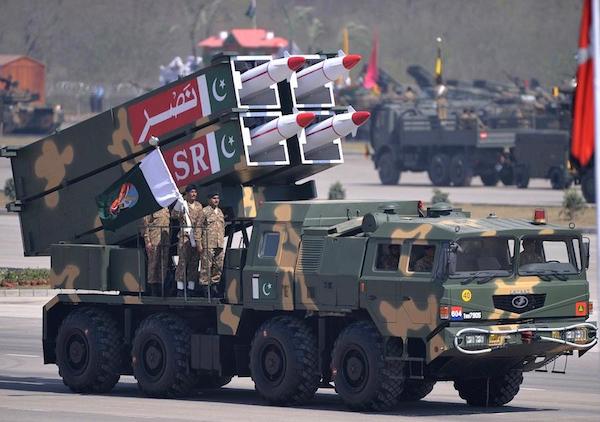
Pakistan has hinted in the past that it would not hesitate to use tactical nukes if Indian forces advance. Pakistan's short range missle NASR is the weapon that the Islamabad boasts of whenever the issue of Indian aggression comes up.
A tactical nuclear weapon (TNW) or non-strategic nuclear weapon is a nuclear weapon, generally smaller in its explosive power, which is designed to be used on a battlefield situations, in contrast to strategic nuclear weapons which are designed to be mostly targeted in the enemy interior away from the war front. Tactical nuclear weapons are of the range of 20-60 km with the blast radius of 3-5 km. These are developed to be used as deterrent against aggression on the border and not for a full-fledged war.
Pakistan claims that NASR can carry nuclear warheads of low yield with high accuracy. Pakistan has also claimed that it was designed to overcome missile defense systems.
Hypothetically speaking, if Indian Forces do enter Pakistan's territory and Islamabad does indeed use tactical nukes then it would also be risking the lives of its own civilians as the device would detonate in Pakistani soil.
Another thing is once Pakistan uses a nuclear weapon in any form, Indian retaliation would be unimaginable as New Delhi will not be bound by 'No First Use' policy. India had declared 'No First Use' (NFU) as a policy; Pakistan is averse to it and feels that NFU in principle negates its deterrence advantage against India. Pakistan's nuclear weapons are intended to compensate for conventional forces which is largely believed to be lagging behind India.
India's options against Pakistan's tactical nuclear weapons:
What Pakistan must keep in mind is that India has fairly developed secondary strike capability. India has ballistic missiles with nuclear warhead that can be launched from submarines in short notice. Pakistan can rest assured that any use of nukes- tactical or strategic - the retribution will be swift, severe and devastating threatening its very existence.
A tactic that India can use is to get closer to populated areas in Pakistan which would force Islamabad to think of collateral damage if a nuke device is used in its own territory. Indian Army can use this tactic to negate Pakistani nukes by inserting divisons in densely populated Pakistani regions like Punjab. If Pakistan resorts to battlefield nukes then it would effectively endanger its own population also making Pakistan lose its status and face in international society and will create a soft spot for India.
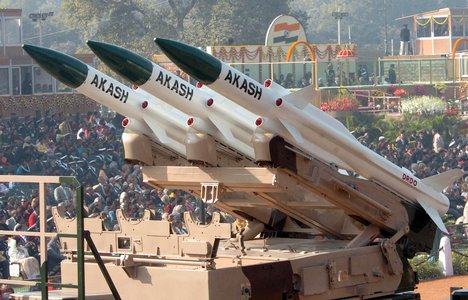
Use of assets like QR-SAM, S-400 and Akash Surface to Air missile can effectively negate Nasr. But, that would require careful and effective surveillance about where NASR would be fired from and how it can be met mid-air with air defence systems.
Best would, however, be for India to hit the locations where NASR missiles are deployed with conventional short range weapons. It must be considered that since NASR is aimed at stopping advances, it would be stored at locations close to the border and not in some remote area like strategic nuclear missiles. Again, effective intelligence and precise prior knowledge of military installations would be essential.

Friday, November 2, 2018

The Indian Nuclear Horn

Image result for indian nuclearIndian nuclear forces, 2018
By Hans M. Kristensen, Matt Korda, November 1, 2018
India continues to modernize its nuclear arsenal, with at least five new weapon systems now under development to complement or replace existing nuclear-capable aircraft, land-based delivery systems, and sea-based systems. India is estimated to have produced enough military plutonium for 150 to 200 nuclear warheads, but has likely produced only 130 to 140. Nonetheless, additional plutonium will be required to produce warheads for missiles now under development, and India is reportedly building several new plutonium production facilities. India’s nuclear strategy, which has traditionally focused on Pakistan, now appears to place increased emphasis on China.
India is estimated to have produced enough military plutonium for 150 to 200 nuclear warheads, but has likely produced only 130 to 140.

Sunday, October 21, 2018

China Helps the Pakistani Nuclear Horn


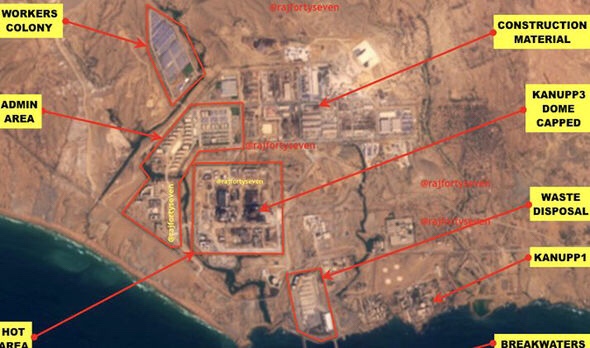
The nuclear plants in Karachi are part of Pakistan’s plans to tap nuclear power (Image: GETTY – @rajfortyseven)
REVEALED: Photos show China HELPING with Pakistan nuclear programme amid WW3 concern
CHINA is extending its influence into Pakistan as it rushes to help the nation’s nuclear programme by building two power stations, satellite images have revealed.
By Matt Drake 14:08, Sat, Oct 20, 2018 | UPDATED: 15:05, Sat, Oct 20, 2018
The nuclear plants in Karachi are part of Pakistan’s plans to tap nuclear power to address its energy crisis.
Its energy crisis has made headlines for years with power cuts a common phenomenon in the country.
Its close ally China stepped in five years ago in 2013 just as President Xi Jinping’s Belt and Road Initiative (BRI) began.
The project is often described as a 21st-century silk road, made up of a “belt” of overland corridors and a “road” of shipping lanes.
Beijing offered Islamabad two power reactors named Hualong-1, a Chinese pressurised water nuclear reactor developed by the China General Nuclear Power Group (CGNPG).
Pakistan is planning on building another Hualong-1 reactor for the Chashma Nuclear Power Plant-5.
Under the deal, 86 percent of the construction cost was borne by the vendor, but options to recover this loan amount to nearly $10billion, The Print reports.
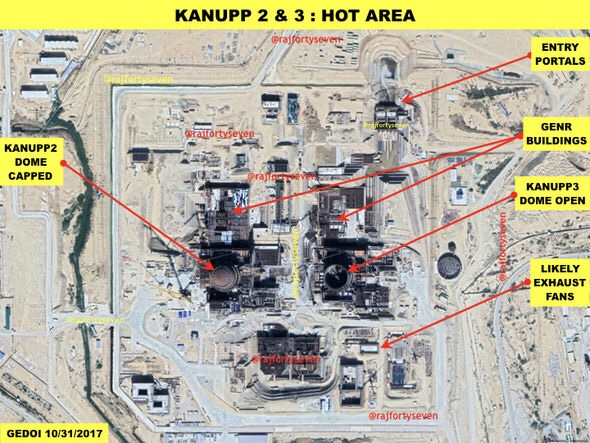
According to satellite images of the plant, the construction appears to extend into the ground which suggests the possibility almost the entire facility may go underground after construction.

Beijing offered Islamabad two power reactors named Hualong-1 (Image: @rajfortyseven)

Pakistan is planning on building another Hualong-1 reactor (Image: @rajfortyseven)
The idea to build underground nuclear plants is to limit the damage in the event of disasters.
But the plants have been set up in an area that is extremely prone to seismic shifts as Karachi is on the cusp of three tectonic plates – the Arabia plate, the Eurasia plate and the India plate.
During an earthquake or tsunami, buried structures bear the brunt of tremors and such a disaster could put the safety of the entire city and surrounding areas at risk.
The project has also been called a Chinese Marshall Plan, a state-backed campaign for global dominance.

The plants have been set up in an area that is extremely prone to seismic shifts (Image: @rajfortyseven)
People fear China is pursuing a form of economic imperialism which gives it too much leverage over other, poorer countries.
Associate professor at Australian National University, Jane Golley, said: “They’ve presented this very grand initiative which has frightened people.
“Rather than using their economic power to make friends, they’ve drummed up more fear that it will be about influence.”
Over the five years since President Xi announced the Chinese Marshall Plan to connect Asia, Africa and Europe, the initiative has been used to describe almost all aspects of Chinese engagement abroad.
Chinese companies have secured more than $340billion in construction contracts.
But China’s dominance comes at the expense of local contractors in partner countries.

Saturday, October 20, 2018

The Pakistani Nuclear Threat (Revelation 8)


Pakistan’s Nuclear Arsenal more worrisome than North Korea’s
@theindpanoramaOct 19, 2018 - 8:06 pm EDT
Pakistan is more dangerous than North Korea as it does not have a centralized control on its nuclear weapons, making them vulnerable to theft and sale.
By Ven Parmeswaran
9/11 happened because Pakistan supported the Taliban and the Al Qaeda.  We discovered that Pakistan was the epicenter of global terrorism.  Almost all terrorists emanated from Pakistan and committed terrorism in the U.S.A. and Europe.  President George W Bush sent his Secretary of State, Gen. Collin Powell to Pakistan, with whom the USA had a Mutual Security Pact from 1954.  Powell met Gen. Musharraf of Pakistan and made a deal. Pakistan agreed to cooperate fully with the USA and provide all help in finding Osama bin Laden and other leaders of Al Qaeda.”     
President Obama had intelligence that Pakistan was hiding and protecting Osama Bin Laden in one of military cantonments.  In 2011, that is 10 years after 9/11, the U.S. secretly got rid of Osama Bin Laden. The Pakistani doctor who confirmed the identity of Osama Bin Laden has been held in jail by Pakistan.  Thus, Pakistan betrayed its ally, the U.S.A.  For ten years, Pakistan was trying to use Osama bin Laden’s leadership to stage terrorism in India.  The mutual trust between the USA and Pakistan was broken.  However, President Obama chose not to punish Pakistan.
WAKE UP CALL BY PRESIDENT TRUMP
President Trump is the first U.S. President to challenge Pakistan.  He wrote in his tweet: “The U.S. has foolishly given Pakistan more than 33 billion dollars in aid over the last 15 years, and they have given us nothing but lies, deceit, thinking of our leaders as fools.”   President Trump withdrew military aid and gave an ultimatum to Pakistan to stop supporting the Taliban in Afghanistan and to dismantle all terror organizations and terrorist sanctuaries in Pakistan.
PAKISTAN’S ECONOMY IN SHAMBLES WITH NO FOREIGN EXCHANGE
Mr. Imran Khan, the new Prime Minister of Pakistan has been elected with the tacit support and help of Pakistan’s military.  For his survival his first loyalty is to the military.   Pakistan is negotiating with the I.M.F. for a $12 billion loan.  The U.S. has leverage in the IMF being the largest investor.  The IMF cannot approve the loan without consent from the USA.    Pakistan has been devoting its scarce resources to keep on producing nuclear bombs.
PAKISTAN’S NUCLEAR WEAPONS ARE VULNERABLE TO THEFT AND SALE
Pakistan is more dangerous than North Korea as it does not have a centralized control on its nuclear weapons, making them vulnerable to theft and sale, former Senator Larry Pressler warned, describing both the nations as rogue states.    He feared that Pakistan’s nuclear weapons might be used against the US, warning of the possibility of someone buying these nuclear weapons from generals.    “The weapons could be transported to the US fairly simply.  Just as 9/11 was a very simple operation run by 20 or 30 people,” he said.  “The Pakistani nuclear bombs are not controlled.  They are subject to sale or stealing and they could be easily gotten out of Pakistan to just about anywhere in the world,” he said speaking at an event sponsored by The Hudson Institute, a top American think-tank.    The former top American Senator, however, said he does not think that Pakistan’s nuclear weapons are going to be used against India. I do not agree.   The Senator said “I think what North Korea needs is just a lot of attention and hand-holding.  Pakistan Is a different thing because you don’t really have one person in-charge.  I think Pakistan is more dangerous to the US,” he reiterated in response to a question.
“We should declare Pakistan a terrorist state.  We should put certain sanctions on Pakistan,” he said.
PAKISTAN’S GROWING ARSENAL WITHOUT CENTRAL CIVILIAN CONTROL IS THREAT TO GLOBAL SECURITY
Why does Pakistan need to keep on increasing the number of bombs?  There are thousands of nuclear weapons in the world today.  According to the latest count from the Federation of American Scientists, the 5 original nuclear powers have a combined 15,465 nuclear weapons between them, most of which are divided amongst the US and Russia. Yet, the fastest growing arsenal in the world is not included in this number.  While Pakistan has a range of 100-120 nuclear weapons in its possession—a figure that pales in comparison to the US or Russia—Islamabad has devoted a tremendous amount of its military budget to growing its arsenal and producing the associated delivery systems that are needed to launch them.
More alarming than Pakistan’s current stockpile is the projected growth of its arsenal over the next decade.  In a wide ranging report for the Council on Foreign Relations, professor Gregory D Koblentz of George Mason University assessed that Pakistan had enough highly enriched uranium to increase its stockpile to 200 nuclear weapons by 2020 if fully utilized.  Percentage wise, this would mean that Pakistan could have as many nuclear weapons as the U.K. by 2020.  Moreover, Pakistan falls outside the purview of the Nuclear Nonproliferation Treaty.
To guarantee the ability to rapidly expand their stockpile, the Pakistani military is investing in reprocessing plutonium in addition to enriching uranium.  In January 2015, the Institute for Science and International Security reported that the Pakistanis opened up their fourth plutonium facility at Khushab, which provides Islamabad with an additional channel to construct nuclear bomb material in a relatively short period of time.  “Its expansion appears to be part of an effort to increase the production of weapons-grade plutonium,” the ISIS report (Pakistan’s intelligence agency) reads:  “Allowing Pakistan to build a larger number of miniaturized plutonium-based nuclear weapons that can complement its existing highly enriched uranium nuclear weapons.”
PAKISTANI NUKES A MAJOR U.S. INTELLIGENCE PRIORITY
To say that the U.S. Intelligence community is closely monitoring the development of Pakistan’s nuclear weapons program would be an understatement.  The U.S. government is doing more than just monitoring:  they are actively preparing for a terrible catastrophe and engaging Pakistani officials in the hopes that they will stop pouring resources into the expansion of their program.  The last thing Washington wants or needs is a nuclear crisis flashpoint in a dangerous and unpredictable region filled with an alphabet soup of Islamist terrorist groups.  The US government under both George W Bush and Barack Obama has been trying to prevent such a crisis scenario from occurring.
THE BOTTOM LINE
Despite all the attempts from the nuclear nonproliferation community, Pakistan will continue to develop and strengthen its nuclear deterrent as long as the high brass in the Pakistani military continues to have an India-centric mindset in its defense policy. India and Pakistan have fought three wars since independence in 1947, and in each case, the Pakistanis were either the losers or forced into a stalemate before acceding to a ceasefire (1971 breakaway of East Pakistan was an especially embarrassing defeat for the Pakistanis).  Islamabad has not forgotten these cases ever since.  And for the Pakistanis, the lessons of these past conflicts are all the same: we cannot repeat history.
PRESIDENT TRUMP’S NEW WORLD ORDER: INDIA AND THE USA HAVE SIGNED A DEAL THAT MAKES THEM CLOSEST ALLIES ON A PAR WITH THE NATO MEMBERS
The US and the IMF have told Pakistan that it cannot use IMF loan to repay China or divert the resources to increasing its nuclear arsenal.  President Trump, unlike George W Bush or Obama, is challenging Pakistan to behave.  In effect, Trump is saying that he will not tolerate Pakistan to betray again.  Trump is also anxious to withdraw from Afghanistan and he knows Pakistan is the bottleneck.  Based on his tough negotiations and policies towards his close allies, be it Canada or Western Europe, Trump means business.  Therefore, it is to be hoped that the U.S. will not allow Pakistan to mess up with international security.   I think President Trump is giving clear messages to Pakistan’s new Prime Minister and its military/ISIS leaders.
(Scarsdale, New York based Ven Parameswaran is Chairman, Asian American Republican Committee founded in 1988)

Monday, October 15, 2018

Pakistani Nuclear Horn Threatens India


In the latest war of words between the two estranged nuclear-armed neighbours, Pakistan on Saturday warned India of 10 surgical strikes in response to a single such attack.
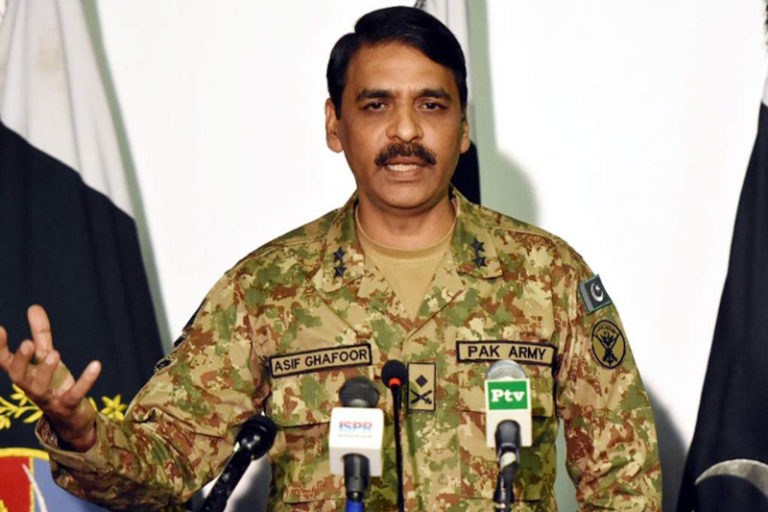
Major General Asif Ghafoor, the spokesperson of the military’s Inter-Services Public Relations, categorically stated that the surgical strike is a myth and India was running lies to discredit Pakistan. “We have the power to retaliate with 10 surgical strikes if a single adventure is carried out by our eastern neighbour. There should be no doubt about that,” he added.
Speaking to media in London, Major General Asif Ghafoor also asserted that the freedom movement of Kashmiris is indigenous and does not have external support. “Independence of Kashmir is in the DNA of Kashmiris, the movement for freedom is completely independent, India knows it well that there is no interference from Pakistan,” he added.
He said, “Kashmiris are fighting for the war of their survival and India knows Kashmiris are right and they will win and the struggle of Kashmiris will be won by Kahsmiris. They are freedom fighters and not terrorists, India has used every kind of power to suppress Kashmiris but failed.”
The military’s Inter-Services Public Relations spokesperson further noted that the Pakistan Army was the custodian of the USD 50 billion China Pakistan Economic Corridor (CPEC) and that the mega project will strengthen the economy of the country.

Sunday, October 14, 2018

Pakistani Horn Again Threatens India

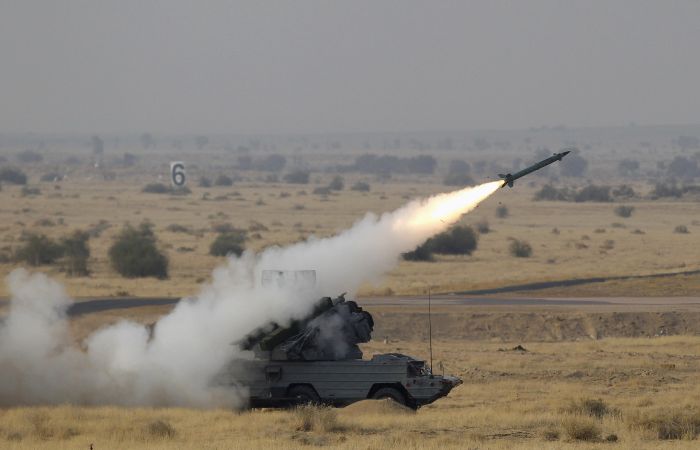
OSA-AKM surface-to-air missile launcher fires a missile on target during Indian Air Force fire power demonstration exercise "Iron Fist 2013" in Pokhran

Pakistan on Saturday said India will face ten surgical strikes in response if it dares to launch one inside Pakistan, in the latest war of words between the two estranged nuclear-armed neighbours.
"If India dares to launch a surgical strike inside Pakistan, it will face 10 surgical strikes in response," Ghafoor was quoted as saying by Radio Pakistan.
Major General Asif Ghafoor, spokesperson of the military's Inter Services Public Relations, stated this while talking to the media in London, where he is accompanying Pakistan Army Chief Gen Qamar Javed Bajwa on a visit.
He also said "those who think of any misadventure against us should have no doubt in their minds on Pakistan's capabilities".
The military spokesman said the Pakistan Army was the custodian of the USD 50 billion China Pakistan Economic Corridor (CPEC) and that the mega project will strengthen the economy of the country.
Ghafoor said the army wanted strengthening of democracy in Pakistan, and claimed that the general election in July was the most transparent in the history of the country.
"If anyone has evidence of rigging then it should be brought forward," he remarked.
He also rejected reports of restriction on the media and said there was "complete freedom of expression" in the country.
He said there were more good developments in Pakistan than bad and that the international media should also highlight the good things.

Friday, October 12, 2018

The Alignment of the Pakistani Nuclear Horn


Pakistan Tests Nuclear Missile To Spite India-Russia Missile Deal
Business TimesOct 10, 2018 06:50 PM
Pakistan, the only Arab Muslim country armed with nuclear weapons and indigenous ballistic missiles, sent a message of displeasure to India by intentionally testing one of its nuclear-capable ballistic missiles to coincide with India's acquisition of an advanced surface-to-air missile (SAM) defense system from Russia.
Pakistan on Oct. 8 announced another successful launch of a road-mobile Ghauri-I (Hatf-5) medium-range ballistic missile (MRBM). This weapon can deliver either a 700 kg high-explosive or a nuclear warhead (12 kT to 35 kT yield) with acceptable accuracy to a target as far away as 1,500 kilometers.
Pakistan's Inter-Services Public Relations revealed the launch was conducted by the Army Strategic Forces Command (ASFC), and was aimed at testing the operational and technical readiness of the command and its arsenal of missiles.
Commander, Army Strategic Forces Command Lt Gen Mian Muhammad Hilal Hussain praised the test as a successful demonstration of the Pakistan Armed Forces' (PAF) operational and technical readiness. A major command of the Pakistan Army, ASFC administers the armed forces' land-based nuclear weapons.
An official statement from the PAF said the launch consolidates Pakistan's nuclear capability, which is aimed at peace and stability through a credible deterrence regime. Pakistani President Dr. Arif Alvi and Prime Minister Imran Khan also announced their appreciation for the successful test of the missile system.
Behind the congratulatory messages, however, is a deeper strategic intent for the unannounced "testing" of an expensive Ghauri-I. The missile launch on Oct. 8 came only two days after arch-rival India signed a $5.43 billion deal with Russia to acquire five batteries of the latter's S-400 Triumf SAM system.
The deal was signed by Prime Minister Narendra Modi and Russian president Vladimir Putin who traveled to Delhi for the signing. It reaffirmed Moscow's role as India's most important defense partner. A joint statement said India and Russia welcomed the conclusion of the contract for the supply of the S-400 Long Range Surface to Air Missile System to India.
Deliveries of the S-400 will begin two years from now. All five SAM systems will have been delivered by 2020. Both countries also set a target of $30 billion in bilateral trade by 2025.
Political pundits in India also said the Ghauri-I launch was also meant to emphasize Pakistan's continuing anger at India's sudden decision to cancel peace talks with Islamabad that were to have taken place during the U.N. General Assembly meeting in New York last month.
Less than 24 hours after India agreed to talks with Pakistan, however, India reneged on its promise. Flabbergasted, Islamabad called India's decision "ill-considered" that wasted a "serious opportunity".
India said its sudden move responded to the latest brutal killings of our security personnel by Pakistan-based entities. India also said the decision to junk the talks was also due to the recent release of a series of 20 postage stamps by Pakistan glorifying a terrorist and terrorism.
Pakistan said it was "deeply disappointed" by India's decision to cancel the talks. It said the reasons cited by India were "entirely unconvincing."

Wednesday, October 10, 2018

Pakistan Prepares for World War 3

 
World War 3: Pakistan to buy deadly drones from China as India secures S-400 missile
PAKISTAN is ready to buy an arsenal of deadly drones from China as fears of a global arms race escalate.
By Joe Duggan 22:05, Tue, Oct 9, 2018 | UPDATED: 22:53, Tue, Oct 9, 2018
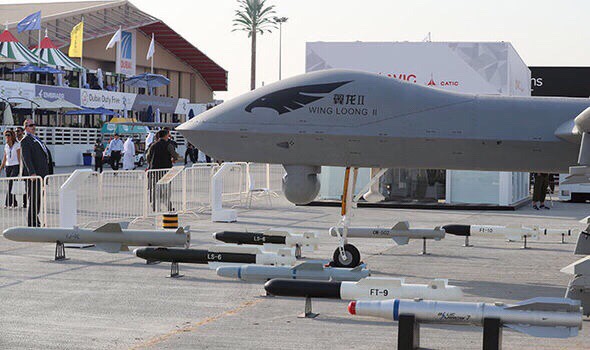
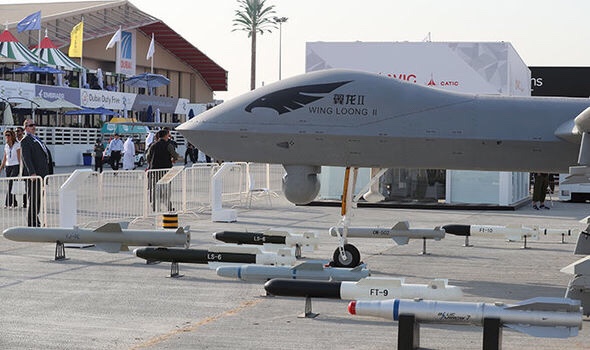
Wing Loong II UAV showcased at Dubai Airshow
The nuclear power is set to snap up 48 state-of-the art Wing Loong II UAV unmanned military drones in what would be Beijing’s biggest such arms-export deal.
With a length of 11 metres and a 20.5 metre wingspan, the Wing Loong II drones can carry laser-guided air-to-surface missiles.
They can also be mounted with laser and GPS-guided bombs as well as air-to-surface missiles to blast targets.
A special anti-tank missile - the Chinese equivalent of the American-made Hellfire missile - can also be launched.

Pakistan to buy an arsenal of Chinese Wing Loong II deadly drones (Image: Getty)

The Chinese drones can carry laser and GPS-guided bombs and air-to-surface missiles to blast targets (Image: Gettty)
It comes as India announced it was buying five regiments of S-400 air defence missile systems from Russia for around £4.1b ($5.4b).
The long-range, surface-to-air missile systems can destroy cruise and ballistic weapons.
Pakistan’s apparent decision to bolster its defence capabilities with Chinese weapons could challenge US military domination, it is feared.
Military expert Song Zhongping told China’s The Global Times: ”US drones like the MQ-1 Predator and MQ-9 Reaper are technologically more advanced, but Washington limits their export.
“Chinese drones will eventually be more successful in the international market in the future as they perform similarly at a lower cost.”
News of the deal was announced on the Pakistan Air Force PAF Sherdils Aerobatic Team Facebook page.
The unmanned Wing Loong II can be used for reconnaissance as well as combat operations.
It can also be laucnhed for disaster assessment, meteorological operations and environmental protection.

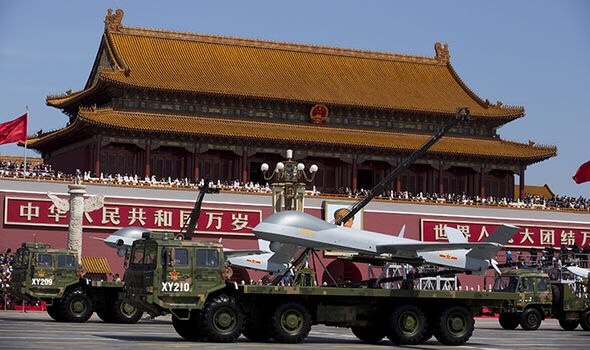
Anti-tank missiles similar to US Hellfire missile can be launched from Wing Loong II (Image: Getty)
India signs £4 billion deal with Russia for missile defence tech

Beijing will sell the weapons to ally Pakistan after India bought missile systems from Russia (Image: Getty)
Chinese drones will eventually be more successful in the international market in the future
China military expert Song Zhongping
Official figures on the weapons’ deal between China and Pakistan were not disclosed, according to The Global Times.
The Wing Loong II can fly for 20 hours with a maximum speed of 230mph (370kph).
Last year, China announced that Saudi Arabia is considering buying up to 300 Wing Loong II drones.
The drones have an operational radius of 1,500 kilometre

The Pakistani Nuclear Horn Grows (Daniel 8:8)

Pakistan Launches Nuclear-Capable Missiles After India Cancels Peace Talks
By Jason Lemon On 10/8/18 at 1:58 PM
Pakistan successfully launched and tested on Monday its Ghauri Missile System, which can carry conventional and nuclear warheads with a range of more than 800 miles.
Army Strategic Forces Command Lieutenant-General Mian Muhammad Hilal Hussain hailed the test as a successful demonstration of the military’s operational and technical readiness.
“The launch consolidates Pakistan’s nuclear capability which is aimed at peace and stability through a credible deterrence regime,” an official statement from the military said, Pakistan’s The Express Tribune reported. President Dr. Arif Alvi and Prime Minister Imran Khan also expressed their appreciation for the successful test of the missile system, according to the country’s Dunya television channel.
The demonstration came after regional rival India signed an agreement with Russia on Friday to purchase S-400 air defense system for $5 billion. At the end of last month, New Delhi also canceled peace talks with Islamabad that were slated to take place on the sidelines of the U.N. General Assembly in New York.
Shah Mehmood Qureshi, Pakistan’s foreign minister, criticized India for the decision, saying that it used incidents that occurred in July to justify canceling negotiations that had been scheduled in September.
"India is reluctant; we will not close our doors," he said, according to India’s Economic Times newspaper. “Hiding away from issues will not make them disappear. It will not improve the situation in Kashmir.”
"Engagement, no-engagement. Coming, not coming. We desired talks as we believe the sensible way is to meet and talk. They agreed, and then disagreed," Qureshi continued.
When asked by reporters if there was a possibility of another war between Pakistan and India, Qureshi suggested it wasn’t on the table.
"Who is talking of war? Not us. We want peace, stability, employment and improving lives. You identify where is the reluctance,” he said. “We want peace. It does not mean we cannot defend ourselves against aggression. We can but we do not have an aggressive mindset."
Information Minister Fawad Chaudhry also insisted in late September that Pakistan desires peace with India. “War will not be [a] viable option. Both the countries should resort to negotiation,” he said, according to Pakistan’s The Nation newspaper.

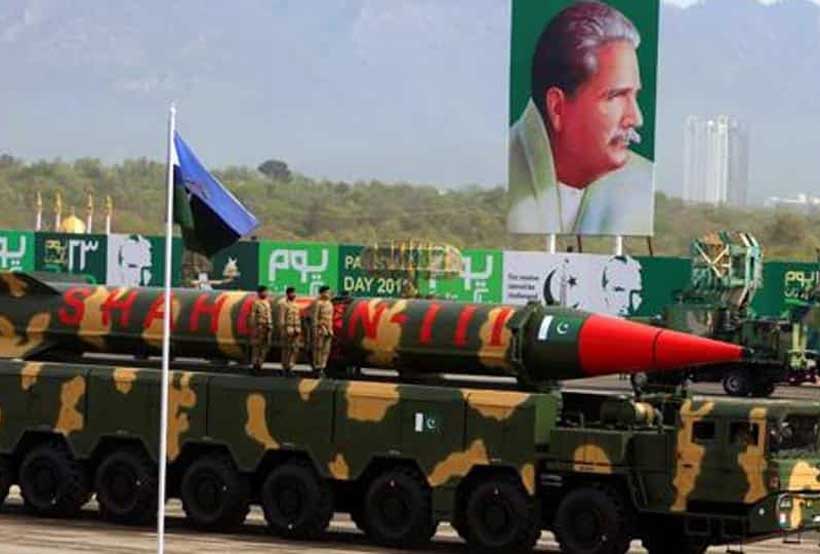
Pakistani military personnel stand beside a Ghauri nuclear-capable missile during a Pakistan Day military parade in Islamabad on March 23, 2017. Army Strategic Forces Command Lieutenant-General Mian Muhammad Hilal Hussain hailed the test as a successful demonstration of the military’s operational and technical readiness. AAMIR QURESHI/AFP/Getty Images
However, in a speech on September 29, India’s Foreign Minister Sushma Swaraj pushed back, rejecting the accusation that her country has worked to undermine negotiation. She also accused Pakistan of harboring terrorists.
"Our neighbor's expertise is not restricted to spawning grounds for terrorism,” Swaraj said, Radio Free Europe reported. “It is also an expert in trying to mask malevolence with verbal duplicity."
Pakistan and India have maintained a tense relationship for decades, beginning with the partition of British India in 1947. Violent conflicts and all-out war have broken out several times in the preceding decades. A primary point of tension is the disputed Kashmir region between the two nations, with parts of the territory currently administered by India, Pakistan and also China.

Sunday, October 7, 2018

Be Prepared for the First Nuclear War (Revelation 8)


Be Prepared for an India-Pakistan Limited War
Why is there an assumption that nuclear weapons would preclude a limited conflict between India and Pakistan?
Nishank Motwani
Nuclear strategy and deterrence in South Asia will play by its own rules. As obvious as this statement is, the problem is that most of the literature on the nuclear strategies and postures of regional nuclear powers is seen through the lens of the Cold War. This hangover imposes the experiences of the United States and the former Soviet Union on smaller nuclear weapons states and fails to acknowledge that the calculations and choices of India and Pakistan are fundamentally distinct. Because of the assumption that the strategic rivalry between India and Pakistan will largely mirror that of the superpowers, it is unsurprising that the strategic changes taking place on the subcontinent are overlooked.
What, exactly, is changing? Based on fieldwork, I argue that small but significant shifts in Indian and Pakistani strategic thinking point to the viability of a limited conventional war under a nuclear threshold. The interviews reaffirmed that this trend had gained traction in some sections of the strategic communities in New Delhi and Islamabad, increasing the likelihood of a short, sharp, but limited conflict. The potential ramifications of a war between the South Asian rivals mean that any such change in the strategic landscape should command serious attention.
Recent developments suggest that there is scope for a limited conflict under the nuclear threshold. Speaking at a press conference in January 2018, Indian Army Chief Bipin Rawat stated that India would not be restrained from responding to Pakistani aggression and questioned Islamabad’s red lines for nuclear first use. Unsurprisingly, a Pakistani military spokesperson invited New Delhi to test its resolve and cautioned Rawat against taking any military action. While the rhetoric between them follows an old playbook, the status quo on the subcontinent is not impermeable to change.
Tensions, Challenges, and Opportunities
What has held India back from initiating a limited conflict? The architect of Pakistan’s rationale for introducing short-range tactical nuclear weapons (TNWs), General Khalid Kidwai of Pakistan’s Strategic Plans Division, reasoned that TNWs would remove India’s ability to wage limited war. This need, he said, was urgently felt across Pakistan’s military establishment due to India’s growing conventional military superiority and its drive to modernize its military hardware. Yet it seems that Pakistan’s moves to permanently close the space for limited war have instead energized and prompted significant changes in India’s conventional military doctrine. In 2004, the Indian Army concluded that its defensively oriented doctrine, which it had maintained since 1947, was no longer suitable to respond to Pakistani threats at the conventional and subconventional levels. Although not formally in print, in April 2004 the Indian Army adopted a doctrine known as “Proactive Military Operations” or “Cold Start,” which it has been implementing ever since. This doctrine envisions rapid mobilization of integrated battle groups (IBGs) to enable a series of surprise but shallow offensives into Pakistan. Such offensives would seek to achieve limited objectives without triggering a nuclear response and occur before international pressure could come into play to halt India’s military operations.
Certain changes on the Indian side underscore small but notable shifts that have been taking place over the past few years and are designed to circumvent Pakistan’s lowering of the nuclear threshold via TNWs. New Delhi believes that the Pakistani military establishment has continued to calculate that it can sponsor terrorists to target India without the fear of reprisal attacks due to the belief that its first strike nuclear posture prevents India from taking military action. For Indian strategists, the lack of an Indian military response following the assaults in Mumbai in 2008 and Pathankot in January 2016, among others, reinforced the notion that New Delhi prefers strategic restraint. This restraint arguably reached its shelf life on September 18, 2016, when Pakistani militants killed 19 Indian soldiers in the Indian state of Jammu and Kashmir. On September 29, 2016, at a rare joint press conference at the Ministry of External Affairs, the Indian director general of military operations briefed the media about an Indian Special Forces operation against militant camps across the Line of Control (LoC) in Pakistan-administered Kashmir. Although Pakistan denied India’s claim that such an attack occurred, an independent BBC investigation confirmed that a covert operation of some sort had taken place. More recently, the Indian government released video footage of this operation.
India’s decision to retaliate challenges Pakistan’s view that its first-strike nuclear posture, together with its arsenal of short-range TNWs, compels India to eschew military action. Despite their limited deterrence value, India’s tactical strikes were packaged to convey the existence of a political will to respond to terrorist attacks traced back to the Pakistani state. Concurrently, the military action also helped to assuage public opinion that is increasingly demanding the political leadership in New Delhi punish Pakistan. But, as public opinion gets stronger, any government in New Delhi will have to grapple with the challenge of not being at odds with the electorate while balancing the efficacy of a proportionate response. For India, the dual requirements to counter Pakistani aggression and to convey to the public that New Delhi refuses to be hurt without a commensurate response are reasons why a window is being sought for the conduct of such offensive operations under the nuclear threshold. Whether this shift is likely to alter Pakistan’s behavior toward India is unknown, but it has the potential to change its cost-benefit calculus for better or for worse. These events demonstrate that the strategic dynamics on the subcontinent are not static and it would be perilous to assume otherwise.
Views From India and Pakistan
Proponents of India’s limited war doctrine discount Pakistan’s red lines for the use of its nuclear weapons. In interviews with advocates of this doctrine in New Delhi, including senior Indian military generals, intelligence officers, and diplomats, they argued that TNWs would not stop an Indian military response, despite Pakistan’s posturing. They disavowed claims by Pakistan that TNWs have changed the calculus and have improved its nuclear deterrence posture against India. Indian military specialists contended that the Pakistani military establishment might be adventuristic, but they are not suicidal, as any use of nuclear weapons by Pakistan would trigger massive retaliation from India.
A former Indian Army general who commanded one of three strike corps argued that Pakistan intentionally makes a show of instability to advance its strategic agenda, to suggest that Islamabad’s threshold for nuclear use would be low enough to result in early nuclear use. The general warned that the responsibility for escalating a conflict to the nuclear level rests on Pakistan’s shoulders, given India’s no-first-use nuclear doctrine, and he cautioned that if it chose to escalate, India would respond as per its doctrine of assured massive retaliation. Indian political and military leaders also stressed that the country possesses the military capability to execute proactive military operations, even though India’s Army, Air Force and Navy have well-known capability deficiencies.
Another argument advanced by those who want to call Pakistan’s nuclear bluff argue that geography calls into question Pakistan’s rationale for the employment of TNWs. A former Indian general that commanded a corps in Jammu and Kashmir gave credit to the Pakistani Army’s capability to mobilize more quickly than India’s after the forward deployment of many of its formations that leave a forward zone of 4 to 8 km from the international border. But Pakistan’s ability to mobilize rapidly near the border with India comes at the cost of diminishing the space in which it could use TNWs. The general cautioned that Pakistan would have to contend with the situation of using TNWs on its own soil that could endanger its own forces or alternatively launch a strike against Indian IBGs that would still be within Indian territory. He maintained that despite Islamabad’s rhetoric on the early use of nuclear weapons, “Pakistan is not itching to employ the TNW trigger” because it knows India would exercise its doctrine of massive retaliation, and due to these constraints India could exercise flexibility as it deems. This flexibility has been war-gamed by the Indian IBGs, which the general said suggests that thrusts of around 25 km into Pakistani territory across the international border are open for exploitation without the threat of a Pakistani TNW strike. Furthermore, he claimed that such shallow thrusts would be viable as they do not threaten Pakistan’s national highway, a likely Pakistani redline.
What these views indicate is that the doubting of Pakistan’s red lines within Indian political and military circles stems from a conviction that Pakistani decision-makers have deliberately manufactured instability to profit at the strategic level by inducing fear and policy deadlock in New Delhi. This means that Islamabad cannot discount an Indian military response if there is a gross provocation that New Delhi traces back to the Pakistani state.
Surprisingly, some interviewees in the Pakistani military agreed that nuclear deterrence does not necessarily preclude the space for a limited conventional conflict. For instance, a former head of Pakistan’s Inter-Services Intelligence Directorate in Islamabad noted that a limited conventional conflict was a possibility under the nuclear threshold as the introduction of TNWs has generated a paradoxical effect. On the one hand, TNWs have increased pressure on Pakistan to convince India that it would use these weapons at an early stage of a limited conflict, but the Pakistani military has failed to persuade India that it has lowered its nuclear threshold. On the other hand, labels such as “tactical” for TNWs are irrelevant, as nuclear weapons are inherently strategic weapons irrespective of their yield. What this means is that any nuclear exchange, once initiated, would be strategic and trigger India’s nuclear doctrine of assured massive retaliation.
Another Pakistani general in Islamabad had a similar view, noting that TNWs have failed to generate stability at the lower end of the nuclear threshold. He added that the inability of Pakistan’s TNWs to close the space for limited war had granted India an advantage to exploit for a limited conflict. The main advantage that exists for Pakistan, he quipped, was India’s haphazard military modernization program, which curbs New Delhi’s ability to prosecute a limited war.
A prominent Pakistani strategic analyst who agreed to be interviewed on the condition of anonymity also rejected the popularly held view on TNWs in Pakistan. This analyst stated that “TNWs are hugely detrimental for Pakistan,” and questioned the logic of deploying these weapons, which could fall into Indian hands, arguing that even desperate local commanders would not use them for fear of self-destruction. The interviewee added that more than the Pakistan Army, it was more likely for an extremist group to use them based on their long history of martyrdom operations and suicide bombings.
Such views demonstrate that Pakistan’s strategic community is not unanimous on whether its TNWs have permanently removed the prospect of a limited war under nuclear conditions.
Implications
The notion that the space for limited war exists makes the prospect seem more attractive and workable for its advocates in New Delhi. Notwithstanding the limited nature of India’s covert strike in September 2016, it is significant for four reasons. First, it demonstrates that New Delhi is determined to change the rules of the game by overtly showing that it has the political will to take military action against Pakistan, despite the risk of escalation. Second, it indicates New Delhi’s intention no longer to tolerate the costs of terrorism without inflicting costs of its own on the perpetrators: in other words, it seeks to increase the cost for Pakistan to employ terrorism against India. This cost, however, could be inflicted covertly to force Pakistan to retract or dampen its actions against India. Third, it is intended to show observers on both sides of the border as well as the international community (particularly China, Pakistan’s primary political and military supporter) that Pakistan is vulnerable to Indian strikes. Fourth, it signals India’s readiness to absorb the costs of a potential Pakistani retaliatory strike, as well as its willingness to escalate hostilities if required.
The political decision to attack militant camps in Pakistan does not mean that New Delhi has abandoned its decades-long policy of strategic restraint, but rather that it has shifted to an active policy of calibrated response, which opens the space for it to wage a limited conventional war. It is too early to say what impact a shift in India’s strategy will have on bilateral relations with Pakistan and how the latter intends to respond, but what can be said is that the old playbook is probably reaching its end. It is imperative to recognize these shifts given that despite the risk of escalation, India has demonstrated its willingness to use force and to publicize its action even though what it did was by no means strategic. Furthermore, New Delhi has signaled that it is progressively working toward developing and refining the means to devalue Pakistan’s nuclear deterrent posture and diminish its ability to serve as a firewall behind which it can sustain its strategic agenda.
Even if the views reported above are minimally held on either side of the India-Pakistan border, which currently they probably are, the emergence of these perspectives indicate that the strategic environment is not moored to the past. Over time, such views have the capacity to alter the strategic dynamics between New Delhi and Islamabad significantly, which would have broader political, military and strategic implications.
Dr. Nishank Motwani is a Visiting Fellow at the Asia-Pacific College of Diplomacy, The Australian National University, and Consulting Researcher for Armed Conflict at The International Institute for Strategic Studies (London). His research examines transnational conflicts, regional competition, nuclear strategy and security with a focus on South Asia.

Sunday, September 30, 2018

Why India is Not a Nuclear Horn (Daniel 7/8)

India’s challenge in asserting its stance on global nuclear disarmament requires a precise articulation of its goals and plans.
Photo: Peter Miller — © Flickr/CC BY-SA 2.0
For India, non-proliferation challenges have warranted special attention both from regional and global contexts for several decades. India’s tumultuous relationship with its neighbours and its desire to be a regional and global power has continually shaped the tenets of its nuclear weapons programme and policy. India has also remained a steadfast champion of global nuclear disarmament, including through multilateral initiatives such as the 1988 “Action Plan for A Nuclear Weapon Free and Non-violent World Order.
Nevertheless, proliferation of nuclear weapons and the current international security environment has created a tense space for making global disarmament a reality. India’s nuclear weapons programme, therefore, is heavily predicated upon its ability to act as a deterrence mechanism to prevent a nuclear conflict. The discourse on the logistics of nuclear non-proliferation has remained focused on the need to maintain regional stability. Even as India’s dominant assumption of its nuclear weapons has been determined by the effectiveness as a deterrence mechanism, the international community, from time to time, finds discrepancies in India’s ideology and its ability to actively promote nuclear disarmament (even if it is not actively increasing it either).

India’s nuclear weapons programme is heavily predicated upon its ability to act as a deterrence mechanism to prevent a nuclear conflict. The discourse on the logistics of nuclear non-proliferation has remained focused on the need to maintain regional stability.

The non-proliferation challenges faced by the world today require focused engagement by major nuclear powers like India, France and the US, since the popular understanding is that Pakistan has plans to steadily increase its nuclear weapons arsenal (in the near future), despite India putting the advancement of its weapons programme on hold. India’s position on the non-proliferation challenges cannot be divorced from the intentions of nuclear states like Pakistan and China. In order to engage major nuclear powers in a productive dialogue, there has to be special effort from New Delhi to reify its position as a responsible partner in the nuclear stability dialogue.
Another potential aspect that affects India’s stance is Pakistan’s development of tactical nuclear weapons and the expectations that come with a significant response to these advances. Common perception of defence policymaking in India dictates that many policies in the advancement of weapons on either side of the border is a calculated response to the other’s moves. Pakistan’s close relationship with China (a nuclear and global superpower) has also been a cause of concern for Indian policymakers. However, in India’s quest for a Nuclear Weapon Free World (NWFW), the exaggeration of this relationship is potentially detrimental. India has managed to gradually define its parameters for nuclear weapons in a manner that reflects its resistance to increasing its arsenal. However, the role of Pakistan’s stance and its relationship with its neighbours cannot be downplayed in the context of regional stability.
Another challenge that India faces, within this conversation, is in terms of the ability of international organisations to advocate and ensure the possibility of a NWFW. With the Treaty on the Prohibition of Nuclear Weapons, there was a legally binding feature that was introduced on the global nuclear disarmament policy narrative, which did not exist previously in other UN mechanisms such as the NPT and the CTBT. Therefore, it is crucial to acknowledge that the UN’s ability to produce tangible results has been sub-par. As is the case with such endeavours, major state actors are not signatories to one or the other, and therefore the attainment of a NWFW remains unfinished.

Pakistan’s close relationship with China has also been a cause of concern for Indian policymakers. However, in India’s quest for a Nuclear Weapon Free World, the exaggeration of this relationship is potentially detrimental.

Public perception in India on nuclear weapons is shaped by the India-Pakistan conflict dynamics, based on nuclear capability, among other parameters. Nuclear policy aspects such as No First Use (NFU) and Negative Security Assurance (NSA) have garnered extensive attention which has perpetuated India’s status as a responsible Nuclear Weapons State (NWS) in a relatively volatile region. India attempts to assert its relevance in the nuclear dialogue in order to perpetuate its stand on the policy of global nuclear disarmament.
With India maintaining a prolonged overt nuclear programme, there has been concern surrounding the country’s stance on non-proliferation. However, it is important to note that India has not wavered from its push towards universal disarmament in a credible time frame. Nevertheless, the international community has expressed anxieties over India’s own lack of credibility, due to its refusal to sign the Comprehensive Test Ban Treaty (CTBT) and concerns over the commitment to International Atomic Energy Agency (IAEA) safeguards. Within this context, it must be noted that India has agreed to partial safeguards, monitoring nuclear technology that has been acquired from outside sources. India has also categorically reassured the international community of its commitment to non-proliferation, but the sense of ambiguity around the commitment still plays out in the global nuclear debates.
India’s challenge in asserting its stance on global nuclear disarmament requires a precise articulation of the goals and plans to promote this agenda. Although India reinforces its commitment to the policy of nuclear disarmament, the complex security dynamics in the South Asian region has had a determining effect in its ability to pursue this agenda. Its pursuit of reduction is hampered by the qualitative and quantitative factors, demonstrated by the significant changes taking place in both China and Pakistan respectively. However, India holds the potential to provide the necessary push needed to create a space for accountability and action, in a situation that has previously remained relatively stagnant.
The non-proliferation and global disarmament discussions require a monumental shift towards more dialogue. The lack of concrete responses from the nuclear powers has perpetuated a gridlock situation. This provides New Delhi with an opportunity to articulate the pertinence of non-proliferation and disarmament dialogue, which can also strengthen the credibility of India as a responsible stakeholder in the regional and global nuclear context.

 The writer is a Research Intern at Observer Research Foundation, Delhi.

Thursday, September 27, 2018

Getting Closer to the First Nuclear War (Revelation 8)

India, Pakistan in war of words as tensions escalate
By Islamuddin Sajid and Shuriah Niazi
ISLAMABAD, Pakistan / New Delhi, INDIA
A new war of words has erupted between arch-rivals India and Pakistan, after New Delhi rejected an offer to initiate peace talks by Islamabad.
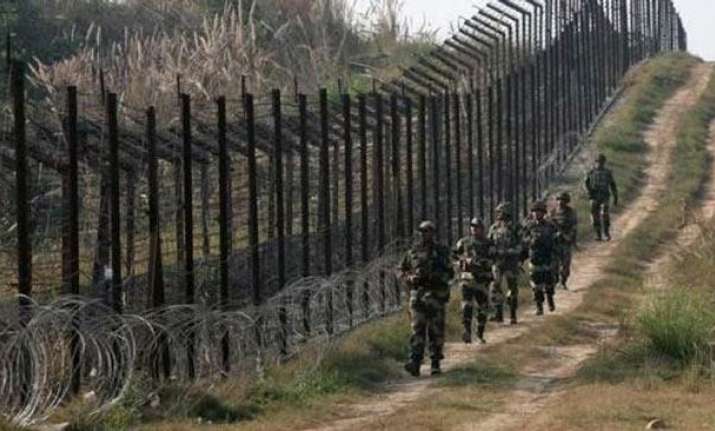
Indian army chief Gen. Bipin Rawat has threatened to launch attacks across the Line of Control, the border which bifurcates Indian- and Pakistan-controlled Kashmir, a disputed territory which remains at the heart of the conflict between the two nuclear powers.
In a Monday interview to news channel India Today, Rawat said: "I believe there is a need for one more action [surgical strike]. But I would not want to disclose how we want to do it.
“As long as the Pakistan government can't control its Army and the ISI [spy agency Inter-Services Intelligence], the situation at the border won't improve."
Responding to the statement the Pakistan army on Tuesday said they were open to peace talks, but will not hesitate to thwart any attack from the Indian side.
Speaking to Anadolu Agency, Maj. Gen. Asif Ghafoor, spokesman of the Pakistan army, said: “We are on a positive trajectory of peace and stability after having gone through efforts over the last two decades. We understand value of peace and shall not allow it to be reversed.
“We believe in coexistence and peace, however any misadventure shall be effectively and befittingly responded.
“War is never a solution to any problem. Pakistan has always positively responded to all peace initiatives. It’s India who backs out from dialogue."
He blamed the Indian government of war mongering to divert attention from internal criticism on "various corruption scams and failure of economic agenda".
Bitter relations
Relations between the two neighbors hit a fresh low after India last week suddenly called off a scheduled meeting between foreign ministers of both countries in New York later this month.
The move drew strong criticism from Pakistani Prime Minister Imran Khan, who tweeted: “Disappointed at the arrogant and negative response by India to my call for resumption of the peace dialogue. However, all my life I have come across small men occupying big offices who do not have the vision to see the larger picture.”
Earlier this year, Pakistan issued a postage stamp of Burhan Wani, a Kashmiri militant leader, who was killed by Indian troops in July 2016, drawing ire from India.
Analysts in both countries maintain both sides have to take confidence-building measures before any formal peace talks take place.
Condemning the Indian army chief's statement, Pakistani analyst retired Brig. Said Nazir said: "Surgical strike means to carry out any attack inside Pakistan using air force or special commandos near any border area which is very difficult because Pakistan reaction would be unexpected."
Pakistan and India both are nuclear powers and this time war would not be a conventional war, Nazir added, urging the international community to take measures to avoid such a confrontation.
Indian defense analyst retired Air Commodore Rashid Zafar told Anadolu Agency: “Pakistan has to show their intent that they want peace talks with India. They wanted India to talk peace with them, however, their intention seems totally different. In my opinion, in present condition, it is really difficult for the Indian government to sit with them."
Kashmir, a Muslim-majority Himalayan region, is held by India and Pakistan in parts and claimed by both in full. A small sliver of Kashmir is also held by China.
Since they were partitioned in 1947, the two countries have fought three wars -- in 1948, 1965 and 1971 -- two of them over Kashmir.
Also, in Siachen glacier in northern Kashmir, Indian and Pakistani troops have fought intermittently since 1984. A cease-fire came into effect in 2003.
Some Kashmiri groups in Jammu and Kashmir have been fighting against Indian rule for independence, or for unification with neighboring Pakistan.
According to several human rights organizations, thousands of people have reportedly been killed in the conflict in the region since 1989.
Anadolu Agency website contains only a portion of the news stories offered to subscribers in the AA News Broadcasting System (HAS), and in summarized form.

Monday, September 24, 2018

Pakistan-India Talks Fail Before the First Nuclear War


PAKISTAN Prime Minister Imran Khan labelled India arrogant on Saturday for cancelling what would have been the countries' first high-level talks in years, decrying "small men occupying big offices" who opposed change.

India on Friday called off the meeting between the nuclear-armed neighbours' foreign ministers, planned for the sidelines of the U.N. General Assembly this month.
The foreign ministry in New Delhi said its decision to scrap the meeting was to protest the killing of Indian security personnel in Kashmir and a Pakistani postage stamp it said was "glorifying" an anti-India separatist who Indian forces killed in the disputed Himalayan region last year.
Pakistan described India's reasons as excuses to enable it to avoid holding talks before national elections next year.
Mr Khan, a former national cricket captain, followed up on Twitter.
Mr Khan wrote on his official account: “Disappointed at the arrogant and negative response by India to my call for resumption of the peace dialogue.
"However, all my life I have come across small men occupying big offices who do not have the vision to see the larger picture."
Resumption of talks have been stalled for years over the issue of Kashmir, claimed by both countries and ruled in part by each of them. Pakistan and India have fought two of their three wars since independence from Britain in 1947 over the region.
The Indian government of Prime Minister Narendra Modi government has insisted that Pakistan act against Islamist militants Kashmir, saying Pakistan still aids the groups from the portion of Kashmir it rules.
 
Pakistan denies aiding any attacks there and says it is fighting militant groups for its own security.
The breakthrough appeared to been made after Mr Khan made an appeal to Indian premier Narendra Modi to end the fraught relations between the two nuclear powers.
Pakistan foreign minister Mehmood Qureshi said the decision to scrap talks was "unforunate".
He said: "We had already told India that if they take one step towards us, we will take two.
"However, it seems that they faltered after taking just one step."
The Indian foreign ministry announced the decision to cancel talks citing two reasons.
As well as the killing of an India soldier in Kashmir, officials raged at the release of 20 postage stamps containing the image of Burhan Wani, a militant killed by India in 2016.
The Indian ministry said: "Any conversation with Pakistan under such an environment would be meaningless."

Friday, September 21, 2018

The Risk of Pakistani Nuclear Terrorism (Daniel 8:8)

Not India, terrorism a bigger threat, say young Pakistani Army officers
ZeeNews
Pakistani Army is witnessing a generational shift in the anti-India stance that has long been ingrained in the minds of the military in Pakistan. For the young Pakistani Army officers, the growing internal security threats from a plethora of extremist groups in Pakistan are a bigger worry for the country instead of any military threat posed by India.
The finding is part of The Quetta Experience, written by retired US Army colonel David O Smith, who was an alumnus of the Command and Staff College in Quetta.
"Junior and mid-grade Army officers, particularly those who had served in the Federally Administered Tribal Areas (FATA), tended to view terrorism as a much more immediate threat to Pakistan than India. These officers had spent the bulk of their military careers fighting this new threat, had seen their brother officers and soldiers killed and wounded by the groups, and watched their friends and their families’ lives shattered forever," the report states.
The study examines the experiences of US Army Foreign Area Officers who have attended the Pakistan Army Command and Staff College in Quetta, the capital of Baluchistan province. These are the only US personnel ever to have had sustained interactions over an extended period of time with three distinct groups of Pakistan Army officers: senior officers (brigadier and major general), senior mid-level (lieutenant colonel and colonel), and junior midlevel (captain and major).
The study was aimed at examining the attitudes and values of the Pakistan Army officer corps over a 37-year period from 1977 to 2014 to determine if it had changed over time.
The report also states that the fear of 'Islamisation' within the officer corps or its susceptibility to radical religious influence is exaggerated. "Many students joked among themselves about the need to be seen going to the mosque on Fridays, but no one seemed to think the country needed or wanted more Islam than more democracy."
"Nearly all the Pakistani students, including those with more conservative religious views, expressed the attitude that religion is a personal matter that does not influence the performance of military duties. They also see little value in Islamic governance, preferring democracy and civilian governance in overwhelming numbers. There also was no evidence of any friction between Sunni and Shia officers," the report states.
The report also states that the implications of strategic or tactical uses of nuclear weapons are not well understood, and no doctrine for nuclear warfighting is taught at the Staff College.
"Certain aspects of nuclear usage might have been discussed in a Pakistani students-only exercise that has been conducted annually for several years to rehearse plans to deal with an Indian Cold Start (now called proactive operations) attack, but even this is apparently limited to a short briefing by the Strategic Plans Division with no questions or discussion by students being allowed," the study states.
"No doubt because of the absence of any opportunity to discuss nuclear issues, the Students noted a complete lack of awareness about the connection between the tactical use of nuclear weapons, the potential strategic impact of their use given the relatively short distances involved in the India-Pakistan case, and the likely Indian reaction to Pakistani “first use” of any nuclear weapon in a future war," the study adds.
The report also finds that the young Pakistani officers perceived that for the first time in history, the United States had become a serious military threat to them.
"The reasoning was highly emotional: the United States uses Pakistan and then discards her; the United States doesn’t respect Pakistani values; the United States is fighting people that Pakistani people support, such as the Palestinians; the United States is leading a “crusade” against Islam; the United States “screwed up Iraq” and “blundered into Afghanistan and made things worse (for Pakistan)," the report adds.

Sunday, September 9, 2018

Babylon the Great Creates the First Nuclear War

The Most Dangerous Place: A History of the United States in South Asia by Srinath Raghavan-Review
— By Jatin Desai | Sep 09, 2018 07:03 am
August 2017, US President Donald Trump announced his policy on South Asia. It emphasised primarily three countries: Afghanistan, India and Pakistan. It was expected that his policy will be different from his predecessor Barack Obama as he is a hardliner. It is one year since the policy was announced, but at the ground, there is hardly much difference.
US has been giving much political and strategic importance to South Asia, especially since the days of Cold War. The role of US in Afghanistan in the 80s and aggression in the background of Al Queada’s attack on the US in Afghanistan in 2001 is well-documented. US aided Mujahidin and then Taliban in 80s and later toppled Taliban-led government at the end of 2001. US is actively involved in the region. The significant change over the years is growing relations between India and US. Trump accorded India a critical role in the region, which is a departure from past policy.
International community sees South Asia as one of the most dangerous place in the world. Again, India and Pakistan are nuclear weapon states. US has invested billions of dollars in the region without much success in tackling militancy. For more than 225 years, US’ engagement with the region has been characterised by short-term thinking. Initially, it was limited to trade. The US has been a crucial player in the South Asian region. The Most Dangerous Place: A History of the United States in South Asia, a book written by Srinath Raghavan is significant in this background.
The relation between India and US was worse during the liberation war of Bangladesh. Archer Blood, then US Consul General in Dhaka, had sent a series of cables, giving details of terror unleashed on the people of then East Pakistan by the Pakistan Army. But, Nixon and Kissinger did not pay attention to the Blood’s telegrams. Ultimately, Bangladesh became a reality. On November 4, 1971, Indira Gandhi and P N Haksar met Nixon and Kissinger. She said, “It was no longer realistic to expect East and West Pakistan to remain together.” The author says, “Nixon and Kissinger met next morning to take stock of the meeting. Nixon remarked that Mrs Gandhi was being a ‘bitch’, but we really slobbered over the old witch.”
Traditionally, India was close to USSR (disintegrated in 1991) or Russia. The Soviet military intervention in Afghanistan was not liked by India. When Charan Singh was PM, India issued a statement in UN regretting Soviet intervention and seeking the withdrawal of Soviet troops. The author says, “Mrs Gandhi changed this policy soon after she took over. While she too held that Soviet intervention in India’s neighbourhood was highly undesirable, she refrained from publicly voicing her disapproval while privately trying to persuade Moscow to make a planned exit and Kabul to wean itself off Soviet military support.”
During her visit to Moscow in 1982 USSR supremo Brezhnev told her that they want to withdraw from Afghanistan but how they should get out? Mrs Gandhi replied, “Mr General Secretary, it is a good idea to withdraw your forces from Afghanistan. The way out is the same as the way in.”
The book gives an insight into the US thinking on South Asia. It is an important addition to the number of books written on South Asia in general and Afghanistan, Pakistan and India in particular.

Saturday, September 8, 2018

The Rising Pakistani Nuclear Horn (Daniel 8:8)


File image of Pakistan prime minister Imran Khan. AP
Pakistan may have 250 nuclear warheads By 2025; could emerge as world's 5th largest nuclear weapons state, says report
Washington: Pakistan currently has 140 to 150 nuclear warheads and the stockpile is expected to increase to 220 to 250 by 2025 if the current trend continues, according to the latest report by authors keeping a track of the country's nukes.
The current estimate of 140 to 150 nuclear weapons exceeds the projection made by the US Defense Intelligence Agency in 1999 that Pakistan would have 60 to 80 warheads by 2020.
"We estimate that the country's stockpile could more realistically grow to 220 to 250 warheads by 2025, if the current trend continues. If that happens, it would make Pakistan the world's fifth-largest nuclear weapon state," Hans M Kristensen, Robert S Norris and Julia Diamond said in the report 'Pakistani nuclear forces 2018'.
Kristensen, the lead author, is the director of the Nuclear Information Project with the Federation of American Scientists (FAS) in Washington, DC. Over the past decade, the US assessment of nuclear weapons security in Pakistan appears to have changed considerably from confidence to concern, particularly as a result of the introduction of tactical nuclear weapons, the report said.
"With several delivery systems in development, four plutonium production reactors, and its uranium enrichment facilities expanding, however, Pakistan has a stockpile that will likely increase further over the next 10 years," says the report. Pakistan continues to expand its nuclear arsenal with more warheads, more delivery systems and a growing fissile materials production industry, it said.
"Analysis of a large number of commercial satellite images of Pakistani army garrisons and air force bases shows what appear to be mobile launchers and underground facilities that might be related to nuclear forces," said the report. The authors observe that the size of the increase will depend on many factors.
Two key factors will be how many nuclear-capable launchers Pakistan plans to deploy, and how much the Indian nuclear arsenal grows.
"Speculation that Pakistan may become the world's third-largest nuclear weapon state – with a stockpile of some 350 warheads a decade from now – are, we believe, exaggerated, not least because that would require a buildup two to three times faster than the growth rate over the past two decades," the authors said. According to the report, Pakistan is modifying its nuclear posture with new short-range nuclear-capable weapon systems to counter military threats below the strategic level.
"The efforts seek to create a full-spectrum deterrent that is designed not only to respond to nuclear attacks, but also to counter an Indian conventional incursion onto Pakistani territory," it said. "This development has created considerable concern in other countries, including the United States, which fears that it lowers the threshold for nuclear use in a military conflict with India," the report added.
Published Date: Sep 06, 2018 14:14 PM | Updated Date: Sep 06, 2018 14:14 PM

Thursday, September 6, 2018

The Risk of the First Nuclear War (Revelation 8)

Risk of India-Pakistan crisis remains high
The Nation
LAHORE (PR) - The Institute for Policy Reforms held a memorable seminar about the risks of friction between nuclear armed countries in South Asia. The discussion was based on themes presented by Moeed Yusuf in his book "Brokering Peace in Nuclear Environments: US Crisis Management in South Asia", published by the prestigious Stanford University Press. Moeed Yusuf is Associate Vice President USIP Washington DC. In addition to the author, a dazzling group of respected experts gave their views, includingformer Foreign Secretary Riaz Mohammad Khan, General Waheed Arshad, Ambassador Shahid Malik, and analyst and anchor Ejaz Haider.
Welcoming the participants, Chairman and CEO IPR Humayun Akhtar Khan said that conventional wisdom informed us that possession of nuclear weapons ruled out the possibility of direct conflict between rival nuclear states. Trend of Pakistan India relations since 1998, however, shows the opposite. He said that continuous occurrence of incidents for seventy years confirms that Pakistan and India are unable to resolve disputes bilaterally. Involvement of non-state actors, tactical nuclear weapons, and missile technology added further layers of risk to an already complex situation.
Moeed Yusuf said that his book examines India-Pakistan crises since the nuclear tests of 1998 and focuses on US role inKargil, the2001-02 military standoff, and the Mumbai crisis. The book is original scholarship by a Pakistani about nuclear deterrence and crises between nuclear states.
Yusuf said that India and Pakistan acquired nuclear weapons to gain strategic independence. His research however finds that since the nuclear tests, both sides have become even more dependent on mediation. USA has actively mediated in South Asia as its concern for nuclear war overwhelms its leaning towards India. Breakdown of U.S.-Pakistan relations, if it happened, could make it difficult for America to influence Pakistani. In such situations, it will resist the temptation of siding with India as Pakistan may seek to bank more on China in future.
Yusuf predicted that the risk of India-Pakistan crises remains high. USA and others will continue to influence regional crisis situations. It is in Pakistan's interest to maintain good relations with USA. When asked what was the value-added of his work, Yusuf said he hoped his book encourages young Pakistani scholars to make original contribution to western literature for an informed debate about Pakistan.
Former Foreign Secretary Riaz Khan described Moeed's book as an "outstanding analytical study" and a "must-read" for policy circles in Pakistan, India, and elsewhere. He agreed with the thesis about critical third-party role in defusing a crisis. He emphasized the need for mid-crisis reevaluation which in the case of Kargil made clear the untenability of the operation. In his view, Kargil and later, Mumbai, damaged Pakistan and the Kashmir cause and helped India gain internationally. In the nuclear environment, militancy and drivers of sub-conventional conflict must be controlled and countered. Once a crisis begins, diplomacy must interject at every point. Also, Pakistan and India should revisit dangerous doctrines such as Cold Start and development of battlefield nuclear weapons. As responsible nuclear neighbours, they must institute top military contacts and hold regular summits regardless of the state of relations.
General Waheed Arshad said that while non-state actors affected both countries, there was no mechanism in place for sustained dialogue. That is why the concept of 'brokered bargaining' or "role of US as third party" is defining. Yet, US tilt towards India and her adversarial relationship with Pakistan raises concerns about its role as an honest broker. "For a sustained peaceful future" he counseled that India and Pakistan eschew recourse to third party and begin meaningful and candid bilateral dialogue to resolve differences.
Ejaz Haider said that the book's brilliant logic and the deterrence model it presents is applicable beyond the Pakistan India dyad. He said that while US is a natural third party because of its influence, there will be situations where other world powers, especially China and Russia, would act as third party. Former High Commissioner to New Delhi, Shahid Malik said that some instances covered in the book were directly relevant to his experience. He enthralled the meeting with a detail account of his experiences in India.