Showing posts with label The Pakistani Nuclear Threat (Daniel 8/Revelation 8)Andrew the Prophet. Show all posts

Friday, September 21, 2018

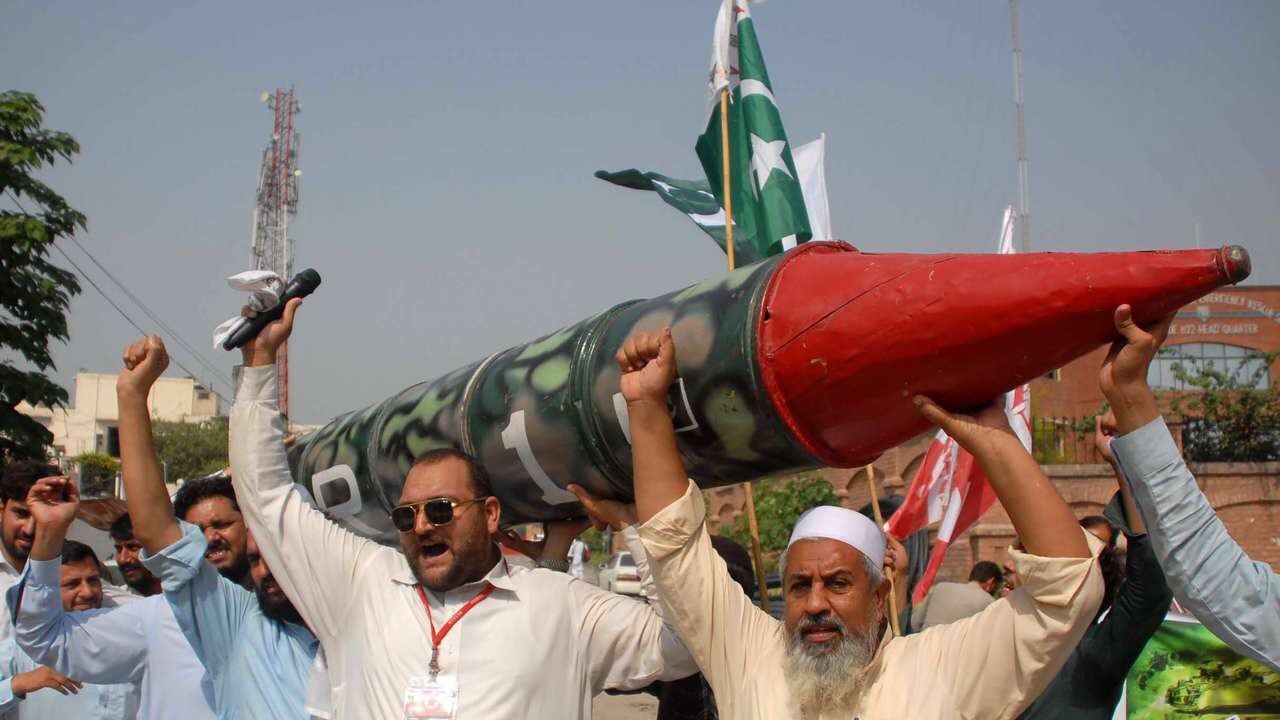
The Risk of Pakistani Nuclear Terrorism (Daniel 8:8)

Not India, terrorism a bigger threat, say young Pakistani Army officers
ZeeNews
Pakistani Army is witnessing a generational shift in the anti-India stance that has long been ingrained in the minds of the military in Pakistan. For the young Pakistani Army officers, the growing internal security threats from a plethora of extremist groups in Pakistan are a bigger worry for the country instead of any military threat posed by India.
The finding is part of The Quetta Experience, written by retired US Army colonel David O Smith, who was an alumnus of the Command and Staff College in Quetta.
"Junior and mid-grade Army officers, particularly those who had served in the Federally Administered Tribal Areas (FATA), tended to view terrorism as a much more immediate threat to Pakistan than India. These officers had spent the bulk of their military careers fighting this new threat, had seen their brother officers and soldiers killed and wounded by the groups, and watched their friends and their families’ lives shattered forever," the report states.
The study examines the experiences of US Army Foreign Area Officers who have attended the Pakistan Army Command and Staff College in Quetta, the capital of Baluchistan province. These are the only US personnel ever to have had sustained interactions over an extended period of time with three distinct groups of Pakistan Army officers: senior officers (brigadier and major general), senior mid-level (lieutenant colonel and colonel), and junior midlevel (captain and major).
The study was aimed at examining the attitudes and values of the Pakistan Army officer corps over a 37-year period from 1977 to 2014 to determine if it had changed over time.
The report also states that the fear of 'Islamisation' within the officer corps or its susceptibility to radical religious influence is exaggerated. "Many students joked among themselves about the need to be seen going to the mosque on Fridays, but no one seemed to think the country needed or wanted more Islam than more democracy."
"Nearly all the Pakistani students, including those with more conservative religious views, expressed the attitude that religion is a personal matter that does not influence the performance of military duties. They also see little value in Islamic governance, preferring democracy and civilian governance in overwhelming numbers. There also was no evidence of any friction between Sunni and Shia officers," the report states.
The report also states that the implications of strategic or tactical uses of nuclear weapons are not well understood, and no doctrine for nuclear warfighting is taught at the Staff College.
"Certain aspects of nuclear usage might have been discussed in a Pakistani students-only exercise that has been conducted annually for several years to rehearse plans to deal with an Indian Cold Start (now called proactive operations) attack, but even this is apparently limited to a short briefing by the Strategic Plans Division with no questions or discussion by students being allowed," the study states.
"No doubt because of the absence of any opportunity to discuss nuclear issues, the Students noted a complete lack of awareness about the connection between the tactical use of nuclear weapons, the potential strategic impact of their use given the relatively short distances involved in the India-Pakistan case, and the likely Indian reaction to Pakistani “first use” of any nuclear weapon in a future war," the study adds.
The report also finds that the young Pakistani officers perceived that for the first time in history, the United States had become a serious military threat to them.
"The reasoning was highly emotional: the United States uses Pakistan and then discards her; the United States doesn’t respect Pakistani values; the United States is fighting people that Pakistani people support, such as the Palestinians; the United States is leading a “crusade” against Islam; the United States “screwed up Iraq” and “blundered into Afghanistan and made things worse (for Pakistan)," the report adds.

Sunday, September 9, 2018

Babylon the Great Creates the First Nuclear War

The Most Dangerous Place: A History of the United States in South Asia by Srinath Raghavan-Review
— By Jatin Desai | Sep 09, 2018 07:03 am
August 2017, US President Donald Trump announced his policy on South Asia. It emphasised primarily three countries: Afghanistan, India and Pakistan. It was expected that his policy will be different from his predecessor Barack Obama as he is a hardliner. It is one year since the policy was announced, but at the ground, there is hardly much difference.
US has been giving much political and strategic importance to South Asia, especially since the days of Cold War. The role of US in Afghanistan in the 80s and aggression in the background of Al Queada’s attack on the US in Afghanistan in 2001 is well-documented. US aided Mujahidin and then Taliban in 80s and later toppled Taliban-led government at the end of 2001. US is actively involved in the region. The significant change over the years is growing relations between India and US. Trump accorded India a critical role in the region, which is a departure from past policy.
International community sees South Asia as one of the most dangerous place in the world. Again, India and Pakistan are nuclear weapon states. US has invested billions of dollars in the region without much success in tackling militancy. For more than 225 years, US’ engagement with the region has been characterised by short-term thinking. Initially, it was limited to trade. The US has been a crucial player in the South Asian region. The Most Dangerous Place: A History of the United States in South Asia, a book written by Srinath Raghavan is significant in this background.
The relation between India and US was worse during the liberation war of Bangladesh. Archer Blood, then US Consul General in Dhaka, had sent a series of cables, giving details of terror unleashed on the people of then East Pakistan by the Pakistan Army. But, Nixon and Kissinger did not pay attention to the Blood’s telegrams. Ultimately, Bangladesh became a reality. On November 4, 1971, Indira Gandhi and P N Haksar met Nixon and Kissinger. She said, “It was no longer realistic to expect East and West Pakistan to remain together.” The author says, “Nixon and Kissinger met next morning to take stock of the meeting. Nixon remarked that Mrs Gandhi was being a ‘bitch’, but we really slobbered over the old witch.”
Traditionally, India was close to USSR (disintegrated in 1991) or Russia. The Soviet military intervention in Afghanistan was not liked by India. When Charan Singh was PM, India issued a statement in UN regretting Soviet intervention and seeking the withdrawal of Soviet troops. The author says, “Mrs Gandhi changed this policy soon after she took over. While she too held that Soviet intervention in India’s neighbourhood was highly undesirable, she refrained from publicly voicing her disapproval while privately trying to persuade Moscow to make a planned exit and Kabul to wean itself off Soviet military support.”
During her visit to Moscow in 1982 USSR supremo Brezhnev told her that they want to withdraw from Afghanistan but how they should get out? Mrs Gandhi replied, “Mr General Secretary, it is a good idea to withdraw your forces from Afghanistan. The way out is the same as the way in.”
The book gives an insight into the US thinking on South Asia. It is an important addition to the number of books written on South Asia in general and Afghanistan, Pakistan and India in particular.

Saturday, September 8, 2018

The Rising Pakistani Nuclear Horn (Daniel 8:8)


File image of Pakistan prime minister Imran Khan. AP
Pakistan may have 250 nuclear warheads By 2025; could emerge as world's 5th largest nuclear weapons state, says report
Washington: Pakistan currently has 140 to 150 nuclear warheads and the stockpile is expected to increase to 220 to 250 by 2025 if the current trend continues, according to the latest report by authors keeping a track of the country's nukes.
The current estimate of 140 to 150 nuclear weapons exceeds the projection made by the US Defense Intelligence Agency in 1999 that Pakistan would have 60 to 80 warheads by 2020.
"We estimate that the country's stockpile could more realistically grow to 220 to 250 warheads by 2025, if the current trend continues. If that happens, it would make Pakistan the world's fifth-largest nuclear weapon state," Hans M Kristensen, Robert S Norris and Julia Diamond said in the report 'Pakistani nuclear forces 2018'.
Kristensen, the lead author, is the director of the Nuclear Information Project with the Federation of American Scientists (FAS) in Washington, DC. Over the past decade, the US assessment of nuclear weapons security in Pakistan appears to have changed considerably from confidence to concern, particularly as a result of the introduction of tactical nuclear weapons, the report said.
"With several delivery systems in development, four plutonium production reactors, and its uranium enrichment facilities expanding, however, Pakistan has a stockpile that will likely increase further over the next 10 years," says the report. Pakistan continues to expand its nuclear arsenal with more warheads, more delivery systems and a growing fissile materials production industry, it said.
"Analysis of a large number of commercial satellite images of Pakistani army garrisons and air force bases shows what appear to be mobile launchers and underground facilities that might be related to nuclear forces," said the report. The authors observe that the size of the increase will depend on many factors.
Two key factors will be how many nuclear-capable launchers Pakistan plans to deploy, and how much the Indian nuclear arsenal grows.
"Speculation that Pakistan may become the world's third-largest nuclear weapon state – with a stockpile of some 350 warheads a decade from now – are, we believe, exaggerated, not least because that would require a buildup two to three times faster than the growth rate over the past two decades," the authors said. According to the report, Pakistan is modifying its nuclear posture with new short-range nuclear-capable weapon systems to counter military threats below the strategic level.
"The efforts seek to create a full-spectrum deterrent that is designed not only to respond to nuclear attacks, but also to counter an Indian conventional incursion onto Pakistani territory," it said. "This development has created considerable concern in other countries, including the United States, which fears that it lowers the threshold for nuclear use in a military conflict with India," the report added.
Published Date: Sep 06, 2018 14:14 PM | Updated Date: Sep 06, 2018 14:14 PM