Showing posts with label reject. Show all posts

Wednesday, April 13, 2016

Cold Start Could Lead to a Hot War (Revelation 15)


Cold start doctrine a real threat, warn experts

Source:  Dawn.com Published in Current Affairs on Tuesday, April 12, 2016

WASHINGTON: Pakistan views India’s cold start doctrine as a real threat to its security and is unwilling to give up the defensive mechanism it has built to counter this threat, officials and experts said.

India’s cold start doctrine, and the tactical weapons that Pakistan has made to counter this threat, drew international attention when US President Barack Obama mentioned them at his news conference last week.

On the conclusion of the Nuclear Security Summit in Washington on April 1, President Obama urged both India and Pakistan to stop moving in the wrong direction as they develop their military doctrines.

President Obama also expressed concern over a rapid increase in “small tactical nuclear weapons, which could be at greater risk of theft”.

“President Obama indirectly vindicated Pakistani position that cold start exists and it is a move in wrong direction,” said a Pakistani nuclear expert while responding to the US leader’s statement.
The expert agreed that Mr Obama had also noted the existence of tactical nuclear weapons in South Asia but insisted that Pakistan was forced to make those weapons to counter the Indian threat.

Another Pakistani expert explained that the cold start doctrine or the proactive operations strategy, as India now preferred to call it, was not a putative or ‘hypothetical’ theory.

“It’s neither merely a concept nor a myth. It is an operationalised reality that has compelled Pakis­tan to take suitable deterrence measures,’ the expert added.

Both experts insisted that Pakistan had taken “minimal measures to credibly deter India” across the strategic, operational and tactical spectrum of threat.

“In the doctrine, caveats like ‘even the threat of use of nuclear weapons will invoke a nuclear strike’ indicate that India’s Not First Use policy is just a diplomatic jargon,” one of them said.

Both experts pointed out that India too possessed short-range tactical nuclear weapons like Prahaar and Pragati. Prahaar — with 150km range — was tested two months after Pakistan developed Nasr.
Later, Pragati — with 70km range — was also developed and is exhibited for sale.

“It would be a very dangerous assumption to enact cold start with a hope to dominate escalation and keep such a war limited and under nuclear threshold,” one of the experts warned. “Cold start can lead to hot wars.”

Sunday, April 10, 2016

Pakistan’s First Strike Policy (Daniel 8)


First strike
April 08, 2016Print : Newspost
According to media reports, Foreign Secretary Aziz Chaudhry has said that Pakistan may use nuclear weapons first in a future war with India. How does this scenario play out with small (tactical) nuclear weapons?
Our tactical nuclear weapons are meant to counter India’s large conventional army. It essentially means Pakistan is ready to use them on its own soil and nuke its own people should a need arise. This means Pakistan will not hesitate in using them against say a regiment of Indian tanks that crosses the Wagah Border and enter into Lahore. This strategy is flabbergasted. We should avoid resorting to nuclear warfare. We need to cut back – not continue to increase – nuclear weapons.
Unzila Tahir Huda
Karachi

Monday, March 28, 2016

Pakistan Rejects Nuclear Requests of Babylon (Daniel 8:8)


Pakistan Rejects US Calls for Curbing Tactical Nuke Weapons

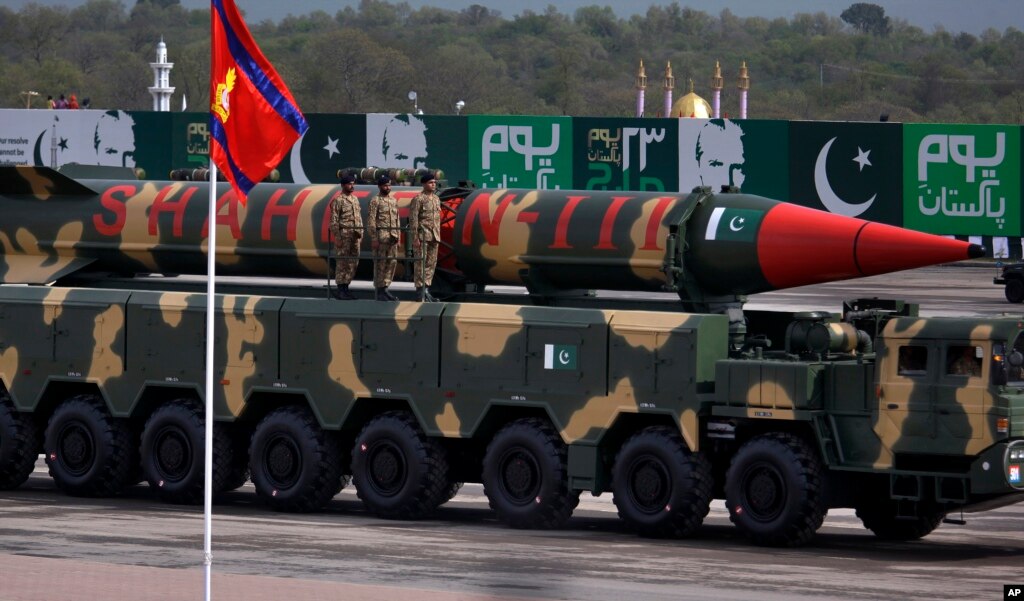
A Pakistani-made Shaheen-III missile, capable of carrying nuclear war heads, loaded on a trailer rolls down during a military parade to mark Pakistan's Republic Day in Islamabad, Pakistan, March 23, 2016.
A Pakistani-made Shaheen-III missile, capable of carrying nuclear war heads, loaded on a trailer rolls down during a military parade to mark Pakistan’s Republic Day in Islamabad, Pakistan, March 23, 2016. 

Ayaz Gul
Pakistan’s top nuclear security advisor has rejected growing U.S. pressure and safety concerns about its production and deployment of battlefield nuclear weapons.

We are not apologetic about the development of the TNWs [tactical nuclear weapons] and they are here to stay,” said Khalid Ahmed Kidwai, an advisor to the so-called National Command Authority (NCA) and a longtime custodian of the country’s nuclear arsenal.

The institutions responsible for planning storage and operational deployments do make sure that “it is so balanced on ground in time and space that it is ready to react at the point where it must react and at the same time it is not sucked into the battle too early and remains safe,” Kidwai told a seminar at Islamabad’s Institute of Strategic Studies.

Response to US

He was apparently responding to last week’s testimony before the U.S. Senate Foreign Relations Committee by Undersecretary of State for Arms Control and International Security Rose Gottemoeller, where she praised the “excellent” steps Pakistan has undertaken to secure its nuclear arsenal, but said Washington is troubled by the development of battlefield nuclear weapons.
She insisted that battlefield nuclear weapons, by their very nature, pose security threats because their security cannot be guaranteed when they are taken to the field.

“So, we are really quite concerned about this and we have made our concerns known and we will continue to press them about what we consider to be the destabilizing aspects of their battlefield nuclear weapons program,” Gottemoeller said.

Nuclear Security Summit

The tensions come ahead of next week’s Nuclear Security Summit in Washington (March 31 – April 1), where President Barack Obama and other global leaders will discuss terrorism threats related to radiological weapons and review proposed safety measures. Leaders of Pakistan and its nuclear-armed archival India will also attend.

Islamabad’s tactical nuclear weapons have been straining its traditionally rollercoaster ties with Washington since 2011, when Pakistan first tested and began producing its nuclear-capable “Nasr” ballistic missile, which has a range of 60 kilometers (36 miles).

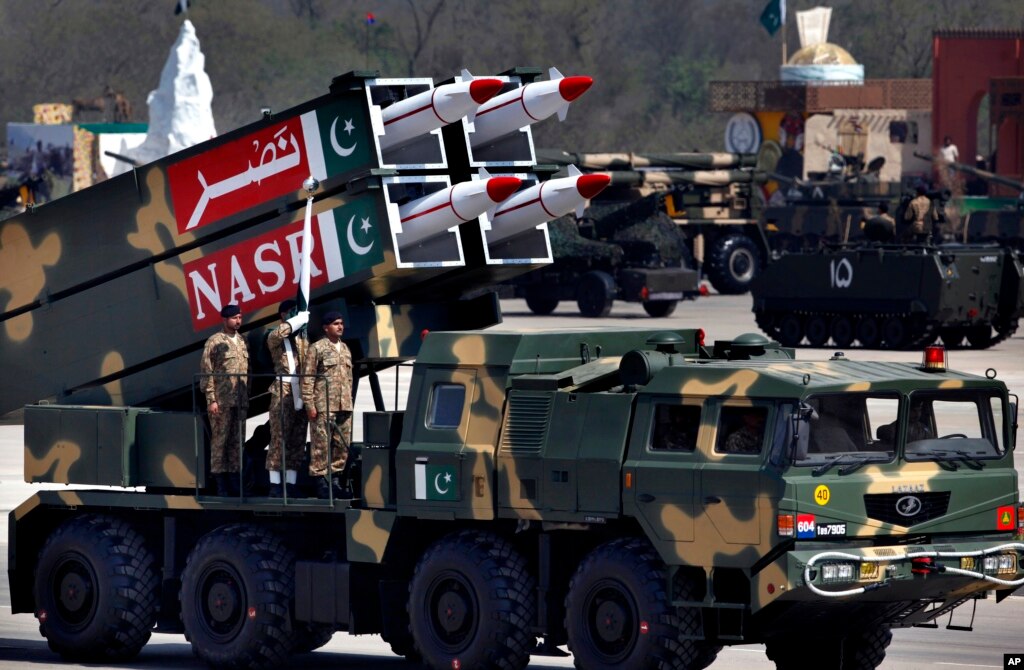
FILE - A Nasr missile is loaded on vehicle during the Pakistan National Day parade in Islamabad, Pakistan, March 23, 2015.
FILE – A Nasr missile is loaded on vehicle during the Pakistan National Day parade in Islamabad, Pakistan, March 23, 2015.

Pakistani officials justify their development of tactical nuclear weapons by citing India’s so-called “Cold Start” doctrine, which they say is aimed at undertaking a quick, punitive, conventional military strike inside Pakistan.

While Pakistan’s long-range ballistic missiles can hit anywhere in India, Kidwai insisted the tactical nuclear weapons have been developed to keep the neighboring country’s conventionally huge military from imposing a limited conflict on his country for achieving “political objectives.”
“It compelled us to plug the gap that existed at the tactical level within the nuclear system,” the Pakistani advisor asserted. He reiterated Islamabad’s “full spectrum” nuclear weapons program is “India-specific” and described the neighboring country as “Pakistan’s only enemy.”

Pakistan-India rivalry

He criticized decades of U.S.-led international moves to penalize Pakistan for developing the nuclear program while “ignoring” Indian advancements.
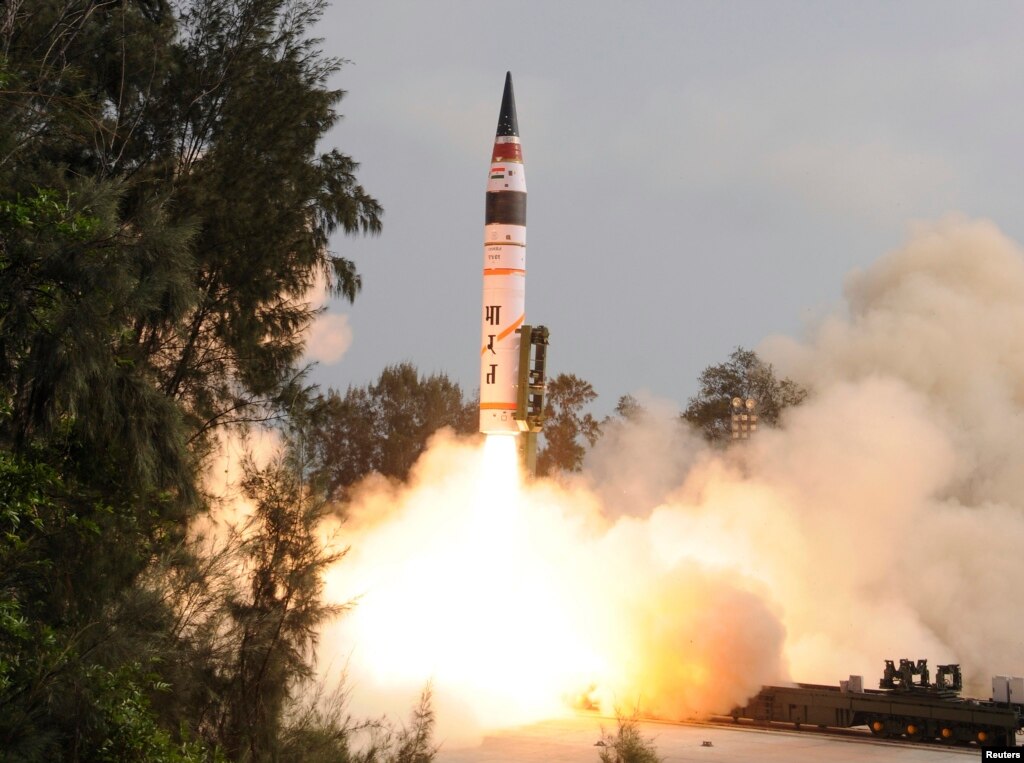
FILE -A surface-to-surface Agni V missile is launched from the Wheeler Island off the eastern Indian state of Odisha April 19, 2012. India test-fired the long range missile capable of reaching deep into China and Europe, thrusting the emerging Asian power into an elite club of nations with intercontinental nuclear weapons capabilities.

Kidwai insisted that the punitive actions might have caused political and diplomatic setbacks to his country but said it has not impacted its efforts to defend the country against another Indian aggression.

“Pakistan would not cap or curb its nuclear weapons program or accept any restrictions. All attempts in this regard… are bound to end up nowhere,” he added.

The Pakistani advisor particularly criticized the American media for being “completely negative, hostile and biased” towards Islamabad’s nuclear program, accusing it of publishing misleading reports and claims that Pakistan possesses the world’s fastest growing nuclear program.

“I think it is politically-motivated because the developments that are taking place in Pakistan are of a very modest level, very much in line with the concept of credible minimum deterrence, and they are always a reaction to an action that takes place in India. So, Pakistan does not have the fastest growing nuclear program,” he said.

Saturday, March 26, 2016

Antichrist Threatens Against Iraq Reforms (Revelation 13)

Iraqi Shia leader al-Sadr threatens leaders against blocking reforms

Reuters, Baghdad
Supporters of prominent Iraqi Shia cleric Moqtada al-Sadr shout slogans against government corruption during a protest in the streets outside Baghdad’s heavily fortified Green Zone in Iraq on Friday. (Reuters)


Sadr also called on Abadi to announce a new cabinet line-up by Saturday that would see current ministers replaced by technocrats with no party affiliation to tackle systemic political patronage that has abetted bribery and embezzlement.

The influential cleric spoke in a Friday sermon delivered by a representative to tens of thousands of faithful outside the gates of Baghdad’s fortified Green Zone that houses government offices, parliament and embassies.

Sadr’s followers began a sit-in a week ago outside the Green Zone to pressure the government to see through anti-corruption pledges. Abadi has shown a willingness to act but has been slow to deliver on a reshuffle announced in February.

Corruption is depleting the central government’s financial resources at a time when revenues are declining due to lower oil prices and Abadi needs to ramp up funding for the US-backed war against Islamic State militants.

Iraqi security forces gather in the streets during a sit-in for supporters of Moqtada al-Sadr in Baghdad on Friday. (Reuters)

“If he brings a logical reform package to parliament and does not get enough votes, there will be a call to escalate protests against those who did not vote” for the proposed cabinet, said Sadr’s envoy, Sheikh Asaad al-Nasiri.

“If (Abadi) does not announce a package that appeases the people, then we will have another stance we will announce tomorrow. We will not be content with a sit-in at the Green Zone,” Nasiri added amid crowd chants of, “Yes, yes to Moqtada our leader!”
He did not mention a deadline which Sadr gave Abadi last month to implement reforms. The deadline expires next week.

Abadi has voiced concern that the Shia street protests could spin out of control and put Iraq’s security in danger when it needs to keep its focus on fighting Islamic State.

Iraq, a major OPEC producer that relies on oil exports for most of its revenue, ranked 161 out of 168 on Transparency International’s Corruption Perceptions Index in 2015.

Antichrist Calls For New Iraqi Government (Revelation 13)


Muqtada al-Sadr Calls for New Iraqi Government Members

Edward Yeranian
Thousands of supporters of Iraqi Shi’ite cleric Muqtada al-Sadr held what they billed as a “joint” Sunni-Shi’ite prayer service Friday outside the main entrances to the government-controlled “Green Zone.”  Sahttp://andrewtheprophet.comdr has given Prime Minister Haider al-Abadi a Saturday deadline to carry out governmental “reform” and install a new Cabinet composed of technocrats instead of political loyalists.

It was the sixth consecutive Friday that supporters of Iraq’s mercurial Shi’ite cleric Muqtada al-Sadr protested in central Baghdad to demand government reform.  The mostly Shi’ite crowd chanted slogans and listened to a sermon by Sadr ally Sheikh Asad al-Nasiri.

Nasiri repeated a Sadr ultimatum to Prime Minister Haider al-Abadi that the Iraqi leader has until Saturday to present a new government to parliament.  Nasiri also threatened to raise the stakes against lawmakers.

He says his supporters want to see the prime minister come up with convincing, new reforms, including an independent government of technocrats, with new ministers loyal to the people and not to the political parties which are battling to dominate the political arena.

Nasiri pledged to support Prime Minister Abadi if he goes ahead and presents the new government to parliament, but warned of the potential wrath of demonstrators if the legislators vote down the new administration.

A member of the parliamentary committee vetting potential candidates for the government positions told Iraqi state TV that ministers will be required to have strong experience:

He says the committee is requiring ministerial candidates to have a higher degree in their field of specialization and at least 15 years of experience, as well as a plan of action.

Hilal Khashan, who teaches political science at the American University of Beirut, tells VOA that he thinks authentic reform will require more than a new government of technocrats.

“The new Iraqi political system was modeled after Lebanon’s.  That is: a confessional political system, based on sectarian and ethnic accommodation.  The political system in itself invites corruption.  So, unless we deal with the political question and the future of Iraq as a nation-state, dealing with corruption is a waste of time,” said Khashan.

Iraqi TV indicated that Prime Minister Abadi has spent the past 24 hours meeting with the country’s top political leaders to win their approval for his new government.

Friday, March 25, 2016

The Storm Of The Antichrist Is Coming (Revelation 13:18)


Calm before the storm at Baghdad protest camp

Supporters of prominent Shiite cleric Moqtada Al-Sadr shout slogans during a protest against corruption in Baghdad. — Reuters
BAGHDAD — Sitting in the shade near the protest tents, Raad Al-Haeri watched as convoys of armored SUVs ferried politicians and diplomats in and out of Baghdad’s Green Zone.

The 27-year-old scrapes together around $400 a month working odd jobs and has the spare time to join the thousands of supporters of cleric Moqtada Al-Sadr in their protest against corruption.
“When you see those MPs driving their huge armored cars getting salaries of $12,000 or whatever it is, you don’t feel good. These people are stealing Iraq’s money,” he said.

A few steps away, behind coils of razor wire and rows of anti-riot police, VIP traffic through one of the main gates of the Green Zone continued as usual.

Sadr’s followers set up protest camps on Friday at several entrances to the restricted zone, which houses Prime Minister Haider Al-Abadi’s office, parliament and foreign embassies, including the huge US mission.

They have vowed to stay until the expiry of a deadline Sadr gave Abadi to present names for a cabinet of technocrats meant to replace party-affiliated politicians they accuse of perpetuating a system based on nepotism and patronage.

The protest camps were not authorized but no incident has been reported so far and the demonstrators even bonded with the security forces.

But the mood could change in a week when the deadline expires as Sadr has threatened that his supporters will storm the Green Zone if their demands are not met.

“I sit here and struggle to buy bread. They still don’t understand that we are ready to die here and go into the Green Zone if Sayyed Moqtada asks us to,” said Raad.

As the protesters wait for orders from Moqtada Sadr from his base in the Shiite shrine city of Najaf, clips of his speeches aired by his Al-Taif TV channel play on a giant screen.

“There’s a good atmosphere here, it’s a big family. We meet friends we haven’t seen in a long time,” said Mohammed Mahmud, a 29-year-old from Zafaraniya, a large southern neighborhood of Baghdad. “It’s well organized and we are provided with food.”

Meanwhile, Hossam Jabbar “the teaman” lines up dozens of paper cups of heavily sweetened tea for the constant flow of protesters.

“Some Sunnis say the Shiites have it good because they are ruling but I want to say we are like dead, we are the worst off,” said Jabbar, wagging a finger while holding his kettle in the other hand.
“Only the parties have benefited, those politicians only represent themselves, not the Shiites,” he shouted, to cheers from the little crowd that gathered at his stand.

Many protesters are prepared to see Abadi as an exception in his party and and think he is sincere about reform.

They see no reason for him to oppose their movement, which they see as handing him a political victory he could never achieve alone. “If he implements our demands, he will liberate himself from his corrupt political bloc, it will be a big achievement for him,” said Ali Hashem, a 40-year-old Baghdad city council employee who took three days off to join the protest. “If he doesn’t, he’s either too weak or one of them.”

Hashem said Abadi already had strong support from top Shiite cleric Ali Al-Sistani and many foreign allies. “We can give him the street.”

Thursday, March 24, 2016

Iraq Rejects Antichrist’s Requests (Revelation 13)


PM Al-Abadi Rejects Al-Sadr Proposed New Cabinet

Baghdad- After announcing a 25- bulleted plan to “rescue” Iraq, Leader of the Sadrist Movement Muqtada al-Sadr declared, on Tuesday, assembling a thorough cabinet for parliament to vote on. However, Iraqi Prime Minister Haider al-Abadi hastily rejected al-Sadr’s proposition.

After al-Sadr convening, in Najaf, with his reform committee he told reporters that “the committee has completed assembling an independent ministerial cabinet which will be placed in the hands of PM al-Abadi”

Al-Sadr suggested that “the cabinet be put to vote at parliament, so that those who wish can vote, and those who don’t may abstain”

“This, highly adequate, cabinet must be placed in the hands of Iraqis,” he added.

The cabinet is proof of forming a government not compromised by sects and partisanship. It is now in the hands of the current government, and – using a threatening undertone- if guarantees on implementing reform are presented, in turn we will present reassurances not to escalate, Al-Sadr said.
On the other hand, committee leader Samy A’zara said that the cabinet comprises 90 Iraqi figureheads, among which are university professors, to-be-assigned ministers and representatives. “The committee has chosen 4-5 people from each ministry… and it is up to the government now,” he added.

Meanwhile al-Sadr hinted a potential rise of dispute, should his reform recommendations are not guaranteed implementation, PM al-Abadi , with head-turning U.S. backing , took no second thought on rejecting al-Sadr’s proposed cabinet.

State of Law Coalition led by Nouri al-Maliki also refused al-Sadr’s formation, which was rendered illegitimate and a violating confiscation of the opinion of other political parties who contribute to the country.

MP Jasem Mohammed Jafar told Asharq Al-Awsat newspaper that “al-Sadr proposed to a new cabinet PM al-Abadi, without negotiating with parliament bodies.”

“And thus, this approach is a violation to legitimacy, and even if put to vote, will not receive the votes of anyone but Sadrist movement parliament members.”

He emphasized that the time interval PM al-Abadi has given political parties ends next Saturday, which translates into nine minsters being relieved from duty.

The Iraqi PM had requested political parties to name substitutes which will replace resigned members, and if no names are received within a week, he will be naming the nine replacements. This would be the first step towards ministerial change, MP Jafar added.

Among those who are subject to replacement according to PM al-Abadi’s reform measures, are Minister of Foreign Affairs Ibrahim al-Jaafari, belonging to National Reform Trend, Finance Minister in the Interim government Adil Abdul-Mahdi, Minister of Housing and Reconstruction, Minister of Finance and Minister of Interior Baqir Jabr al-Zubeidi.

Al-Abadi completely undercut the significance of al-Sadr’s ministerial proposal.

A leader in the Sadrist movement, who requested anonymity, said that “there are no current instructions from al-Sadr on what measures would be taken in case of the committee’s proposal being ignored.”

As for the possible measures, the leader said: “we clearly stated that protests will continue, with an enraged crowd which the political strata should acknowledge the risk it represents- in reference to a preceding al-Sadr threat on invading the Green Zone.”

Monday, August 17, 2015

Iran May Reject Iran Deal Anyway (Ezekiel 17)

Iranian hard-liner says Khamenei opposes nuclear deal

By Ali Akbar Dareini, The Associated Press

TEHRAN, Iran — Iran’s Supreme Leader Ayatollah Ali Khamenei is opposed to a landmark nuclear deal reached with world powers, a prominent hard-liner claimed Saturday.

Hossein Shariatmadari, editor of the daily newspaper Kayhan and a representative of Khamenei, made the comments in an editorial Saturday. It marked the first time someone publicly has claimed where Khamenei, who has final say on all state matters, stands on the deal.

Khamenei has not publicly approved or disapproved the deal. However, he repeatedly has offered words of support for his country’s nuclear negotiators. Moderates also believe the deal would have never been reached without Khamenei’s private approval.

Iran’s parliament and the Supreme National Security Council will consider the agreement in the coming days. The deal calls for limiting Iran’s nuclear program in exchange for lifting economic sanctions.

Shariatmadari said in the editorial that many parts of the deal threaten Iran’s independence, security and “the sacred system of the Islamic republic of Iran” and that it would be “disastrous” if Tehran implements the accord. He did not specify which parts of the deal he thought were problematic.
He also referred to a speech by Khamenei last month during which the ayatollah said, “Whether this text is approved or disapproved, no one will be allowed to harm the main principles of the (ruling) Islamic system.

The editorial noted: “Using the phrase ‘whether this text is approved or disapproved’ shows his lack of trust in the text of the deal. If His Excellency had a positive view, he would have not insisted on the need for the text to be scrutinized through legal channels … It leaves no doubt that His Excellency is not satisfied with the text.”

Another prominent hard-liner and Khamenei representative, Ayatollah Ahmad Alamolhoda, recently criticized the deal, saying it “crossed the red lines” set by Khamenei. He said the ayatollah said outsiders should never be allowed access to Iran’s security apparatus, but the deal violated that by allowing inspection of military sites.

However, Gen. Hassan Firouzabadi, the chief of staff of Iran’s armed forces and a close Khamenei ally, backed the deal last week despite having concerns over it.

Babylonians Reject The Iran Deal (Ezekiel 17)


Most Americans Would Reject Iran Nuclear Deal, Fox News Poll Reports

By Jess McHugh @McHughJess j.mchugh@ibtimes.com
on August 15 2015 10:49 AM EDT

Most Americans would vote to disapprove the Iran nuclear agreement if they were members of the U.S. Congress, according to Fox News Poll results released Friday. Opposition to the deal has been strong since it was announced July 14, with many saying they feared the country would not adhere to the terms of the deal.

The nuclear agreement was negotiated between Iran and the P5+1 group of world powers: China, France, Russia, the U.K. and the U.S., plus Germany. It would end sanctions on Iran, while the country would cut its uranium stockpile by 98 percent and limit its future nuclear capacities. The terms of the deal have come under fire from lawmakers in the U.S. and around the world who fear that the deal will not stop Iran from becoming a nuclear power or from becoming more aggressive toward Israel. The pact still needs to be approved by Congress before it passes into law.

More than one-half, 58 percent, of the people polled by Fox News Aug. 11-13 responded that if they were members of Congress, they would vote to reject the Iran nuclear agreement. Less than one-third, 31 percent, said they would vote to approve the deal, while one-tenth, 10 percent, said they did not know how they would vote.

These poll numbers show bumps in the numbers of people who approve and disapprove of the Iran nuclear agreement, with a lower number saying they were uncertain of their opinion. A poll conducted by CBS July 29-Aug. 2 reported that only 33 percent of those polled were against the deal and that almost one-half, or 47 percent, did not know what they thought about the Iran deal.

The Fox News Poll also indicated that the vast majority of those surveyed, or 75 percent, believed that Iran would not honor the terms of the nuclear deal should it be approved by all parties. This number is actually the lowest in the past month by a margin of about 5 percentage points.

The Fox News Poll was carried out under the direction of Anderson Robbins Research and Shaw & Co. Research. The poll’s sample was 1,008 registered voters. Results based on the full sample have a margin of sampling error of plus or minus 3 percentage points, according to the pollsters.

Monday, March 16, 2015

Iranian Nukes Now The GOPs Responsibility (Daniel 8:3)

WORLD VIEW: REPORT: IRAN’S SUPREME LEADER HAS ALREADY VETOED ANY NUCLEAR DEAL
Khamnei Tehran
by JOHN J. XENAKIS Mar 2015

A report in Debka’s subscriber-only newsletter (sent to me by a subscriber) says that its intelligence sources have learned that Iran’s Supreme Leader Ayatollah Seyed Ali Khamenei, after vacillating over the nuclear negotiations with the United States for months, has now come down firmly against any deal. Secretary of State John Kerry and Iran’s Foreign Minister Mohamed Javad Zarif have been working to complete a deal by the March 31 deadline, but Khamenei has now rejected the entire framework that they were developing. The intelligence sources say that Iran may shut down nuclear negotiations completely, unless the West first removes all sanctions, a request that will not be satisfied.

A major reason given is that dissent within Iran itself has been increasing. The dissent is spilling over from government critics to broad sections of Iranian society, such as academics and op-ed writers.
From the point of view of Generational Dynamics, none of this is surprising. As I have said many times, it is a core principle of generational theory that, even in a dictatorship, major decisions are made by masses of people, by generations of people, and that politicians are irrelevant except insofar as they are implementing the wishes of the masses of people.

This is a good time to review Iran’s strategy with regard to the nuclear issue, which I have stated many times in the last few years, based on a relatively straightforward analysis of Iran’s history in the last century.

First, Iran will not be prevented from developing a nuclear weapon. Iran has already been victimized by Saddam Hussein’s weapons of mass destruction in the Iran/Iraq war of the 1980s, and is now surrounded by potential enemies — Pakistan, Russia, Israel — that have nuclear weapons, with Saudi Arabia planning to obtain nuclear technology from Pakistan. The Iranian people overwhelmingly feel that they need nuclear technology for self-defense.

Secondly, however, Iran has no intention at all of using a nuclear weapon on Israel. If you look at Iran’s major wars in the last century — the Constitutional Revolution of 1908-09, the Great Islamic Revolution of 1979, and the Iran/Iraq war that climaxed in 1989 — Iran did not attack any other nation, and takes pride in not having done so.

Another reason why Iran could not use a nuclear weapon on Israel is that doing so would kill millions of Palestinians, and Iran knows that the Arab backlash would be enormous, irrespective of what happened to Israel.

Furthermore, the younger generations of Iranians, the ones that grew up after the war, do not hate Israel, and do not wish Israel harm, and they would be particularly opposed to any Iranian nuclear attack on Israel.

The collapse of the Iran nuclear negotiations would be a major blow for the Barack Obama administration. The foreign policy of Obama and his clownish Secretary of State John Kerry has been one blunder and reversal after another, and they were hoping for a nuclear deal to burnish their legacies, and possibly to get Nobel Peace Prizes as a result. Look for them to blame it on the Republicans, but preventing Iran from developing a nuclear weapon was never a possibility.

By the way, Debka is also predicting that Benjamin Netanyahu’s defeat in Tuesday’s election is a foregone conclusion, and that unless something spectacular happens, Israel’s next prime minister will be Yitzhak Herzog.

Thursday, December 11, 2014

Babylon The Great Rejects Nuclear Treaty

U.S. rejects calls for treaty eliminating all nuclear weapons immediately

AFP-JIJI
The U.S. representative at a major conference on nuclear weapons rejected calls Tuesday for a treaty immediately eliminating them, saying Washington prefers a gradual approach.

“We think the most practical and realistic approach is to pursue reductions step by step,” Adam Scheinman, special U.S. representative for nuclear nonproliferation, told reporters on the sidelines of the conference in Vienna.

“As security conditions permit, we can move to still deeper reductions, as President Obama has committed to. But the idea of moving automatically to a treaty that would immediately eliminate all nuclear weapons is probably not the most practical option,” he said.

The comments came at a conference of some 800 representatives from 160 countries and civil organizations in Vienna looking at the potentially catastrophic consequences of a nuclear explosion.

Organizers hope it will inject momentum into stalled efforts to reduce nuclear stockpiles, with some participants calling for a treaty calling for the immediate scrapping of all the world’s atomic weapons.

It was the third gathering of its kind and the first that the United States, together with Britain, has attended. Fellow nuclear-armed nations Russia, China and France were absent.

Nuclear-armed India and Pakistan also attended, but other no-shows were North Korea, which has conducted three nuclear tests, and Israel, widely believed to have atomic weapons.

The numbers of nuclear weapons — 90 percent of them U.S. or Russian — have fallen dramatically since the end of the Cold War thanks to treaties like the New Strategic Arms Reduction Treaty (START), the Moscow Treaty and New START.

But there remain around 16,300. Some 4,000 of these are “operationally available” but 1,800 are on “high alert” and ready for use on short notice, according to the Bulletin of Atomic Scientists group.

The follow-through on an “action plan” adopted at a 2010 meeting of signatories to the Nuclear Nonproliferation Treaty (NPT), in particular 22 disarmament steps, has been “very disappointing,” said Kingston Reif from the Arms Control Association.

Since New START entered into force in 2011, Russia and the U.S. have failed to commence talks to further reduce their nuclear stockpiles, and progress toward an entry into force of the Comprehensive Test Ban Treaty (CTBT) is stalled, Reif said.

Efforts toward further measures, including at a new NPT review conference in May 2015, have also been stymied by tensions between Moscow and Washington over the Ukraine crisis, experts say.

Britain’s representative in Vienna, Susan le Jeune d’Allegeershecque, agreed with her U.S. counterpart. “Some have argued that the way to this goal (of a world without nuclear weapons) is to ban nuclear weapons now, or to fix a timetable for their elimination,” she said. “The U.K. considers that this approach fails to take account of, and therefore jeopardizes, the stability and security which nuclear weapons can help to ensure,” she said.

Tuesday, September 23, 2014

Antichrist’s Men Protest the US in Iraq

Iraqi lawmaker rejects US military presence in country

Sadrists Protest US Intervention
 
Sun Sep 21, 2014 2:38PM GMT

An Iraqi lawmaker from the Sadr movement has dismissed the military presence of the United States in his country under the guise of battling the Takfiri ISIL terrorists.
Abdul Aziz al-Dhalimi said US warplanes are planning to attack the Peace Brigades in Iraq and claim that the strikes were conducted by mistake.

The Peace Brigades have been formed by the Sadr movement, led by Shia cleric, Muqtada al-Sadr, to fight against ISIL militants operating inside Iraq.

The lawmaker also warned that they will battle with both the US and the Takfiri militants, adding that they are the two sides of the same coin.

Al-Dhalimi further stated that Sadr movement rejects the establishment of any US military base in Iraq, as the local council of Salahuddin Province has reportedly revealed that the US army would have some military bases there.

On Friday, Iraqi people staged a demonstration in central Baghdad to protest against the US military intervention in their country. The demonstrators were holding pictures of Muqtada al-Sadr during the protest.

Senior religious and political figures in Iraq, including Grand Ayatollah Ali al-Sistani, have in recent days called on the Baghdad government not to rely on foreign powers in the battle against the ISIL.

Washington says it is planning to intensify airstrikes against ISIL positions in Iraq, with General Martin Dempsey, the chairman of the US Joint Chiefs of Staff, noting that ground forces may be needed if current efforts to combat the ISIL militants fail.

Political experts believe that the real objective of the so-called international coalition recently formed by Washington to fight ISIL is to expand the US military presence in the region.