The prophecy is more than seeing into the future. For the prophecy sees without the element of time. For the prophecy sees things as they were, as they are, and as they always shall be.
The US Air Force has dispatched
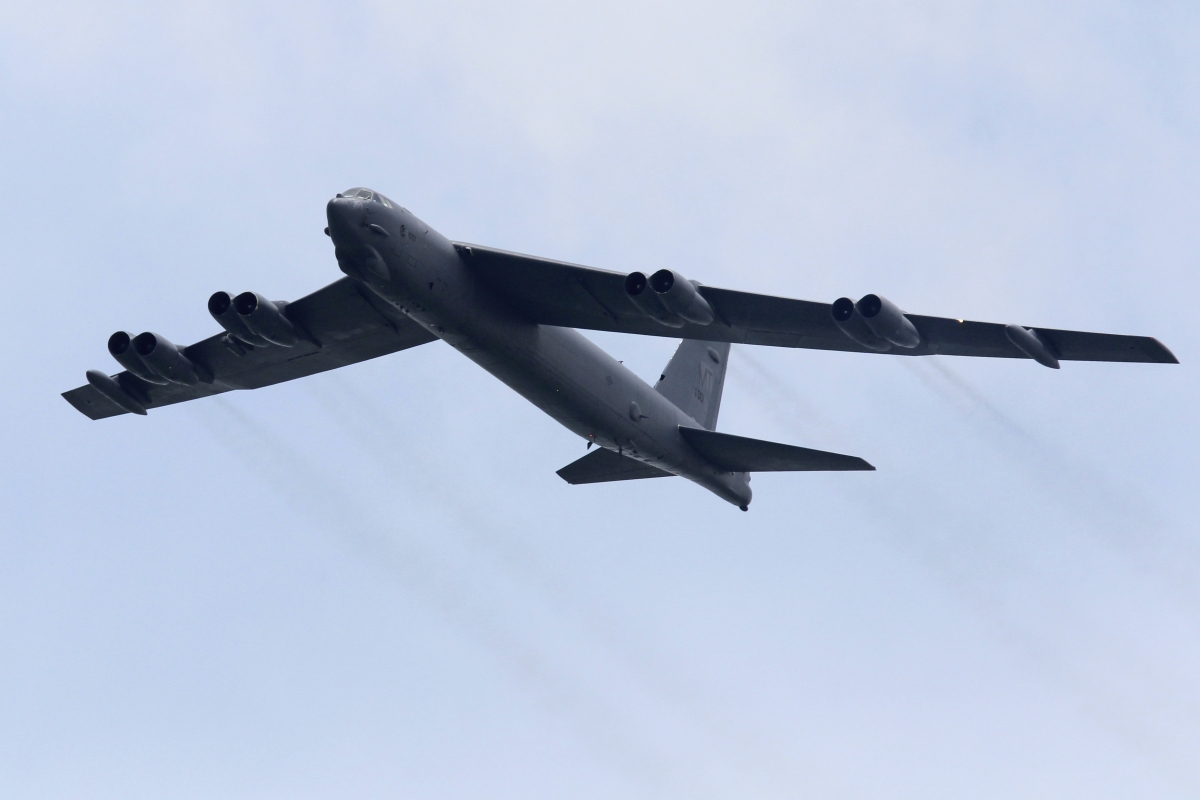
B-52 nuclear-capable bombers along with 800 airmen to Europe to take
part in the Nato exercises as a show of strength against Russia. The
US European Command said the units were deployed to the UK Royal Air
Force base Fairford in England ahead of the training exercises with the
Nato allies.
News about the latest mobilisation comes just hours after Moscow
warned against Nato’s military build-up in Russia’s doorstep. Military
exercises are set to take place in the Baltic Sea, the Arctic and in
several Nato member states which share a border with Russia.
The US B-52H Stratofortresses bombers, capable of carrying nearly
31,000kg payload for more than 8,000 miles, are being sent as part of
Washington’s bid the prepare the forces for “global challenges,” said
the US European Command.
“Training with allied nations and joint partners improves
coordination between nations and enables the US Air Force to build
enduring relationships necessary to confront a broad range of global
challenges. The strategic bomber deployment will support exercises
Arctic Challenge, Saber Strike and Baltic Operations in the US European
Command area of responsibility throughout the month of June 2017,” read a
statement from the US European Command.
While the Arctic Challenge drills, which are taking place in Norway,
Sweden, and Finland, will get over on 2 June, the Sabre Strike – war
games hosted by Poland, Estonia, Lithuania, and Latvia – will go on
until 24 June.
In what is called as a deterrent move to counter Russia’s aggressive military posture in the region, Nato said as many as 4,600 of its troops will participate in the exercises. B-52 Stratofortress bombers are sent to take part in Nato exercisesReutersSpeaking about the latest wargames,
Russian envoy to Nato Alexander Grushko warned: “Nato countries should
understand that all these efforts will not become unnoticed for us and
will not stay without response in terms of military planning. With these
military steps, military activities and military reinforcements, Nato
is building a new military, security situation that we cannot ignore,
that we should address using our own military instruments.”
Nato’s eastern states have been asked for bolster its defences ever
since the Ukrainian region of Crimean peninsula became a part of Russia
in 2014. Though the western world accuses Russia of annexing Crimea by
force, Moscow denies the charges.
On Thursday, US Secretary of Defense nominee James Mattis told a Senate committee in confirmation hearings that NATO must build capacity in eastern Europe to deter Russia’s alleged aggression. This came a day after Secretary of State nominee Rex Tillerson testified that the United States would defend NATO member states if Russia invaded.
Caldicott pointed out, however, that it was the United States and NATO, not Russia, that was building up its armed forces to unprecedented levels in central and eastern Europe and exacerbating tensions in the region.
Far from threatening nuclear war, the Russian government and media were warning their people about the dangers of the NATO military buildup, Caldicott claimed.
“Indeed, the Russian press and leading politicians in the Duma are now postulating that this could well be a future reality, and they are encouraging the Russian population to practice drills to shelter themselves from nuclear war,” she said.
The American public and US policymakers also need to take the threat of nuclear war and the nightmarish consequences that would flow from it far more seriously, Caldicott explained.
Although US Vice President Joe Biden praised the record of outgoing President Barack Obama on reducing the threat of nuclear war during his eight years in office, Caldicott said Obama’s anti-Russian policies had made the danger far worse.
“What on earth Obama, the once-peace-maker, and [US Secretary of Defense] Ashton Carter think they are doing, God only knows unless they are obeying the dictates of their military industrial masters, who need war or the risk of such to survive economically,” Caldicott added.
Caldicott expressed the hope that President-elect Donald Trump would reverse the US force build-up in Eastern Europe after he took office on January 20.
“Once Trump is inaugurated one hopes that his close relationship with [Russian President Vladimir] Putin will lead to rapid withdrawal of these forces and a refashioning of the relationship between Russia and the United States which may ensure our survival,” she said.
Caldicott is the author of many books, including “The New Nuclear Danger: George W. Bush’s Military Industrial Complex” and “War in Heaven: The Arms Race in Outer Space.”
Russia revamped its training exercises in the wake of its diplomatic fallout with the West over events in Ukraine in 2014—an incident that saw the country’s pro-Russian leadership toppled by a wave of pro-EU protesters.
The Kremlin responded by accusing the West of organizing the protests, before annexing Crimea from Ukraine and backing a pro-Russian insurgency in East Ukraine.
The Ministry of Defense has subsequently held more snap and mass drills to reflect the new militarized climate, and has stated that 2017 will see a further increase.
During each of the two annual training periods—held in the winter and summer—the troops will undergo 40 test deployments across the country in a bid to reach the highest possible battle readiness levels.
Russia’s missile drills have concerned neighbors and commentators in the past. However, experts such as former U.S. ambassador Steven Pifer have emphasized the need to look beyond Moscow’s nuclear posturing.
Pifer has claimed that Russia’s nuclear modernisation is nearing its end due to budget cuts, and has argued that the U.S. still outmatches Russia in its ability to store and deploy nuclear warheads.
In a speech that recapped military activities in 2016, Putin said the army's preparedness has "considerably increased" and called for continued improvement that would ensure it can "neutralise any military threat".
"We must carefully monitor any changes in the balance of power and in the political-military situation in the world, especially along Russian borders, and quickly adapt plans for neutralising threats to our country."
He said Russia's military had successfully demonstrated its capabilities in Syria, showcased its technology to potential arms buyers and helped the Syrian army make considerable advances.
"The Syrian army received considerable support, thanks to which it carried out several successful operations against militants," he said.
"The effective use of Russian weapons in Syria opens new possibilities for military-technical cooperation.
"We must take maximum advantage of this. We know there is interest in modern Russian weapons from foreign partners."
Russia began its bombing campaign in Syria in September 2015 in support of President Bashar al-Assad, with its special forces also operating on the ground in the country.
Defence Minister Sergei Shoigu said the military had used "162 types of modern armaments during the military campaign in Syria," including its Sukhoi warplanes and MiG and Kamov helicopters.
"They have shown to be highly effective," he said.
- '35,000 fighters' -
Shoigu produced figures for the entire campaign in Syria but did not mention any estimate of civilian casualties.
Russian warplanes have "liquidated 725 training camps, 405 weapon factories and workshops, 1,500 pieces of terrorist equipment, and 35,000 fighters, including 204 field commanders," he said.
The Russian airforce has conducted a total of 18,800 sorties and carried out 71,000 strikes since the start of its campaign, Shoigu said.
"In general, the operation has allowed (us) to solve several geopolitical problems," he said.
"We have considerably damaged international terrorist organisations in Syria, stopped their expansion... (and) prevented the breakup of Syria."
Russia is prioritising its Asian partners including India and China for arms sales, he added.
Shoigu said NATO activities along Russia's western borders have grown eight-fold over the past decade, forcing Moscow to send more warplanes to prevent breaches of Russian airspace.
Next year, four additional S-400 anti-missile defence systems will be delivered to the army, and Russia will pay particular attention to its Western flank and the Arctic, he said.
Despite Trump's assertion, the world has come to its senses about nukes (and not just in Hollywood). Political consensus over issues like denuclearization has been fairly stable since the 1980s, thanks in part to scientific researchers showing what would happen to a world ravaged by nuclear bombs. One such study was The Medical Implications of Nuclear War, published by Fred Solomon and Robert Q. Marston in 1986. This rigorous and grim estimate of nuclear war's effects on our planet is written in a bleak manner for good reason: to scare us straight.
"Our national security for the past 40 years has been based on the perception that nuclear war would be unhealthy," the study begins. "Understanding what the health consequences of a nuclear war would be, as best we can know them, is very important for informed opinions and actions by citizens and by government."
It seems we're due for a reminder.
Bright, hot, then cold
Nuclear war offers a multitude of bad ways to die. The bulk of the initial deaths from a nuclear bomb come from the intense heat from the detonation itself, followed by the firestorms triggered by the blast. Extrapolating from the incendiary bomb attacks in World War II (Tokyo and Dresden being among the more infamous), the authors note, “the projected number of injured requiring medical treatment would be drastically reduced relative to that projected by blast scaling, as many injured that would otherwise require treatment would be consumed in the fires.” If not vaporized at the center of a blast, many of those who survive the initial moments would then promptly be burned alive by a raging super-fire extending for many kilometers from the hypocenter of the blast.
Almost all of the energy of a nuclear bomb (fission or fusion) is released as very short wavelength light, in the X-ray range. These soft X-rays are rapidly absorbed by the surrounding air, heating it to immense temperatures. The result is the characteristic rapidly expanding fireball you’ve seen in stock film of nuclear explosions. For a one megaton airburst fusion bomb, the initial fireball is about 1.6 km (one mile) in diameter.
Shockwaves follow, demolishing structures and tearing apart human beings for miles. For a one-megaton airburst bomb, the EM radiation released is sufficiently intense to spark fires for about a 12km diameter circle around the detonation site, resulting in an enormous firestorm. The rapidly rising column of superheated air over the firestorm generates its own wind, drawing in more material, stoking the fire, and leading to a further expansion of the conflagration.
The net result is that as horrible as the human consequences of the Hiroshima and Nagasaki bombings were, modern nuclear weapons are much more likely to generate gigantic firestorms (easily a hundred square miles around an American city). With the rosier projections, there would be no survivors within a 4km radius from an air-burst one-megaton bomb over a city; all within that radius would be expected to die within minutes of the detonation. People would be severely injured for at least 18km from the center of the blast—in vast and overwhelming numbers. If one considers the effects of the resultant firestorms, it’s reasonable to expect no survivors within 10km of such a blast. (For quick reference, all of Manhattan is roughly 60 square km.)
Emerge from bunkers, battle superfires
For those who don’t perish in minutes or hours following the blast itself, the environmental consequences of a nuclear exchange become the next nightmare. The nuclear blast and resultant superfires will create massive amounts of black soot (the charred remains of the people, buildings, plants, and other material that made up the city), about 50 percent of which will be injected into the upper troposphere or stratosphere levels of the atmosphere—well above the heights where soot can be rapidly cleared. The remainder will fall as intensely radioactive black rain upon the straggling survivors below. The dark smoke high in the atmosphere will block out the Sun.
Regions below the cloud could see about a 20- to 40-degree Celsius local reduction in temperature within about a week (more during summer months, somewhat less in winter), with the most severe temperature drops persisting for weeks to months. The dramatic change in temperature would then drive winds that would further spread the cloud and the effect. The result is nuclear winter. Slowly, over years, the radioactive dust will drift down to the surface, eventually letting sunlight back through as temperatures gradually return to normal.
Radiation, curiously, contributes relatively little to the overall immediate misery after a nuclear war. The area surrounding a blast site remains intensely radioactive for days to weeks—with weather playing a big effect on the exact spread and locations of the more intense radioactivity. But radioactivity decays exponentially; the long-term effects are subtler, insidious, and include increased rates of cancer.
Exotic chemical changes to the atmosphere are possible, particularly in a larger war over multiple cities, with complex petrochemicals brewing in the upper atmosphere and comprehensive destruction of the ozone layer allowing much more ultraviolet radiation to reach the surface when sunlight returns. This results in a damaging "UV spring" following the nuclear winter. The projections here become less certain, as we lack the data to develop the right models.
Bunkers and shelters can attenuate some of the effects (mostly from the radiation, provided one is far enough away to avoid the blast and firestorm). A survivor of a nuclear war in which many nuclear devices are detonated would then contend with crumbling societies, failing crops, and chaotic, disturbed weather. For a large war, the end of modern life as we know it is probable; the extinction of humans as a species is possible.
"Everything needed for thinking clearly"
The aftermath of even a single nuclear detonation over an urban center is surreal in the sheer scope and nature of the horror induced. A larger nuclear exchange of hundreds or thousands of devices is and should be mortally terrifying to consider. Nuclear war is often described as unthinkable, but "unthinkable" is the wrong word.
In the study's forward, Dr. Lewis Thomas emphasizes the importance of researching the aftermath of such catastrophe: “Unthinkable is the word for whatever is in front of our eyes but too big to figure out, too frightening. Pay attention, in this book, to the doctors and the scientists here assembled. Everything needed for thinking clearly, wincing all the way but thinking anyway, is written down in these chapters. Anyone, any age, can read what's here and understand what we could be in for if we stay on this road. What to do is another matter, but at least the facts of the matter are laid out here. You'd better bet your life it's thinkable.”
In an era where our leaders look past the worst possibilities with blind optimism, it’s important once again to wince, read, think, and describe the "unthinkable."
Jonathan Golob is an MD-PhD physician scientist and science writer based in Seattle, Washington. His takes on modern science and medicine can be found at The Stranger and at his own personal site. His primary research interest is human microbiome research.
“This is years of work to build up the nuclear deterrence that this country has,” added Woodward, whose reporting helped expose the Watergate scandal in the 1970s. "I think if you asked Trump he’d say, ‘Yeah, that’s job one. We’ve got to do that.’”
Woodward said he recently spoke with retired Lt. Gen. Michael Flynn, Trump’s incoming national security adviser, about the president-elect's strategy for handling Russia’s nuclear weapons expansion.
“What Flynn said is that Trump is convinced that we have to modernize, spend vast amounts of money on this, and bring ourselves in a position of strength,” he said of his talk with Flynn Monday.
“It’s kind of a page from the Reagan playbook — talk tough, act tough, build up and then, I guess, presumably, negotiate,” Woodward added, referencing former President Ronald Reagan.
Trump last week tweeted about expanding America’s nuclear weapons stockpile, without making clear what inspired his remark.
“The United States must greatly strengthen and expand its nuclear capacity until such time as the world comes to its senses regarding nukes,” he said Dec. 22.
Russian President Vladimir Putin said the same day his nation must “strengthen [its] strategic nuclear forces” to handle any potential global threat.
MSNBC’s Mika Brzezinski claimed last Friday Trump privately told her he is comfortable with a nuclear arms race as the U.S. can “outlast” any other nation.
Trump spokesman Jason Miller, however, clarified that the president-elect’s remarks were “referring to the threat of nuclear proliferation and the critical need to prevent it."
Shares of uranium producers and a nuclear fuel technology company have jumped on Trump's comments with Uranium Resources Inc, Uranium Energy Corp, Cameco Corp and Lightbridge Corp all trading higher on Friday.
It was not clear what prompted Thursday's tweet by Trump, a Republican who takes office on Jan. 20, but it came the same day Russian President Vladimir Putin said his country needed to boost its nuclear forces.
In his year-end news conference in Moscow on Friday, Putin said Trump's comment on Wednesday was not out of line and that he did not consider the United States to be a potential aggressor.
Trump spokesman Sean Spicer said in several television interviews on Friday that there would not be an arms race because the president-elect would ensure that other countries trying to step up their nuclear capabilities, such as Russia and China, would decide not to do so.
"He's going to ensure that other countries get the message that he's not going to sit back and allow that," Spicer, who was named this week as White House spokesman for the president-elect, told NBC. "And what's going to happen is they will come to their senses, and we will all be just fine." (Reporting by Eric Walsh; Additional reporting by Susan Heavey and Dan Burns; Editing by Lisa Von Ahn and Bill Trott)
National security is shaping up to be the top issue in next year’s
presidential election. The media are awash in worries about terrorism
and cyber attacks, with President Obama generally getting low marks for
his handling of threats. Republican presidential candidates say he has
no coherent strategy for dealing with the danger posed by radical
jihadists, and complain that he has deprived the military of the funding
needed to protect America.
This isn’t what most observers expected from Obama. A longtime
supporter of nuclear disarmament, he gave a speech shortly after being
inaugurated in 2009 highlighting “America’s commitment to seek the peace
and security of a world without nuclear weapons.” He backed up that
commitment with concrete actions. When his administration completed the
third post-Cold War review of America’s nuclear posture in April of
2010, it called for “a multilateral effort to limit, reduce, and
eventually eliminate all nuclear weapons worldwide.” A nuclear arms pact
signed with Russia the same year called for cutting the number of
warheads in the strategic arsenal to a quarter of the level agreed to in
1991 — about 1,500. The New York Times reported early the following
year the administration wanted to cut the warhead count yet again to
1,000.
That doesn’t sound like much of an arsenal for a country that had
over 30,000 nuclear warheads the year Obama began elementary school.
Granted, there are several thousand additional warheads in storage or
not counted by the 2010 pact, but the general trend in inventory levels
has been down, down and down, and the Obama Administration began its
time in office planning to stay on that vector. So what changed?
What changed was that the White House ceased believing it could work
with Russia at a time when much of the Cold War nuclear arsenal was
reaching an advanced state of decay. With prospects for further arms
reduction agreements rapidly receding, the administration decided it had
to move forward with modernization of the entire nuclear enterprise.
Although plans to sustain a
nuclear “triad” of land-based intercontinental ballistic missiles,
sea-based ballistic missiles, and long-range nuclear bombers had
been endorsed by the 2010 posture review, the White House initially
appeared ambivalent about spending the money needed to revitalize the
nuclear arsenal. But any resistance to “recapitalizing” the arsenal
disappeared after Russia began threatening Eastern Europe, and
conducting nuclear exercises seemingly aimed at scaring the West.
So now Barack Obama, the longtime proponent of nuclear disarmament,
finds himself presiding over a vast reconstruction of the nation’s
strategic force, not to mention the introduction of new aircraft and
weapons for conducting tactical nuclear operations in places like
Europe. The basic goal is to dissuade any enemy from nuclear aggression
by fielding a resilient retaliatory force that can survive a surprise
attack, and then destroy the assets that matter most to the aggressor.
The strategy is called deterrence, and in the absence of active defenses
capable of intercepting a nuclear attack, it is the main bulwark
America has against a threat that could destroy the Republic in a single
day. Here are the key elements of the Obama buildup.
A new ballistic missile submarine.
The U.S. Navy’s 14 Ohio-class ballistic missile submarines are the most
survivable part of the nuclear triad, but the subs will begin retiring
at the rate of one per year toward the end of the next decade. To have a
replacement ready, the Obama Administration is pushing ahead with the
Ohio Replacement Program which will commence construction of a new class
of subs in 2021. There will be twelve such vessels, each carrying 16 ballistic missiles
equipped with multiple warheads. General Dynamics GD -0.72% Electric
Boat division, builder of the Ohio class, is leading development of the
next-generation subs, and will likely perform most of the construction. A
separate Navy program is extending the life of the Lockheed Martin LMT
-0.93% D5 missiles carried on the Ohio class, and at least initially on
its successor. Both the missiles and their improved warheads will be
operational for another 30 years.
A new strategic bomber.
The airborne part of the nuclear triad currently consists of 76 aged
B-52 bombers and 20 newer B-2s, both of which also perform non-nuclear
missions. However, a senior Air Force officer told Congress earlier this
year that the bombers “are becoming increasingly vulnerable to modern
air defenses,” so last month the service awarded a contract to Northrop
Grumman for development of a “Long Range Strike Bomber” that will
provide 80-100 very stealthy
successors beginning in 2025 (loser Boeing is protesting the award).
Meanwhile, all of the nuclear missiles and gravity bombs carried on the
bombers are being upgraded to extend their lives, improve their
accuracy, and assure their safety. A new air-launched cruise missile is
also planned, but the administration is taking no chances, pouring
billions of dollars into enhancing the performance and connectivity of
the existing fleet.
A new intercontinental ballistic missile.The third leg of the nuclear triad consists of 450 Minuteman III missiles deployed in hardened silos at three bases in the western U.S. The Air Force is spending $7 billion
to modernize the propulsion systems, guidance, warheads and other
elements of the Minuteman force, but the force’s projected service life
only extends to 2030. In 2014, the command responsible for managing the
missiles conducted an analysis of alternatives for developing a
next-generation “Ground Based Strategic Deterrent,” meaning a new ICBM.
InsideDefense.com reports that the Air Force will begin operating the
new missile in 2027. Missile silos and launch control centers, which
have become quite decrepit, will be renovated for decades of additional
service. A parallel effort is under way to upgrade the warheads carried
on ICBMs, substituting more powerful weapons from the retired MX
missile.
An enhanced command, control & communications network.Credible
deterrence requires a resilient command system that can ride out a
surprise attack and then execute appropriate responses (there are
numerous retaliatory options in nuclear war plans). The network of
assets supporting this system includes sensors that can detect an
attack, flying command posts, hardened underground operations centers,
secure communications satellites, and a complex array of links between
them. The Congressional Budget Office estimates that administration
plans for modernizing the nuclear command and control system will cost $52 billion between 2015 and 2024,
with the biggest outlays going to Boeing for flying command posts,
Lockheed Martin for satellites, and Northrop Grumman for sensors and
networks. Raytheon will also likely be a key player in nuclear-related
sensors and networks.
New tactical nuclear systems.Although
the Obama nuclear posture has sought to minimize the role of nuclear
weapons outside the area of strategic deterrence, the administration
faces a practical problem in countering thousands of tactical nuclear
systems that Russia has deployed in Europe. Under the doctrine of
“extended deterrence,” the U.S. must have credible retaliatory options
for dealing with the regional threat that these weapons pose in order to
reassure its overseas allies. The administration therefore plans to
equip at least some Lockheed Martin F-35 fighters with a capability to
deliver tactical nuclear weapons, and is upgrading the inventory of
nuclear munitions suitable for conducting such operations.
A revitalized nuclear weapons industrial base.Much
of the responsibility for supporting the U.S. nuclear posture resides
not in the Department of Defense, but in the Department of Energy. DoE
is expected to spend $121 billion between 2015 and 2024
on its nuclear-weapons functions, over a third of the $348 billion
spent on the nuclear enterprise during that period. A big chunk of that
money will go to the laboratories and industrial facilities involved in
researching, refurbishing, modifying or demilitarizing nuclear
devices. Although the U.S. no longer builds new nuclear warheads, it is
constantly reclaiming nuclear material from old devices and enhancing
the features of warheads already in the stockpile. That requires
extensive investment in revitalizing the plant and equipment at
facilities that often trace their origins to the dawn of the Cold War.
Some might quibble with using the word “buildup” to characterize this
sprawling effort, since the Obama Administration does not plan to
exceed weapons levels specified in arms reduction agreements. However,
the reality is that President Obama is backing efforts to upgrade and
replace every nuclear delivery system in the U.S. arsenal, plus
the warheads they carry, plus the command networks and industrial base
that supports them. None of his recent predecessors undertook nuclear
efforts this ambitious — the Arms Control Association says the
life-cycle cost of the new submarine alone will be over $300 billion
through 2080 — and whether the arsenal shrinks or grows will be left to
his successors. So for all of the criticism about Mr. Obama being weak
on defense, when it comes to the most fearsome weapons humanity has
devised, he will be remembered as the president who kept America on top.
(Disclosure: All of the companies mentioned here have contributed
to my think tank at one time or another; some are consulting clients.)
Air Force Gen. Paul J. Selva, currently the head of U.S.
Transportation Command, told Congress during his nomination hearing
Tuesday that increased Iranian revenue could be used “to sponsor state terrorism should they choose to do so.”
The agreement between the Iran and several Western countries,
including the U.S., would allow the Islamic republic to pursue a limited
atomic program for peaceful purposes over the next decade while also
lifting sanctions that have crippled the Iranian economy as well as a
key arms embargo.
“Under this deal, Iran’s vast nuclear infrastructure remains largely
intact,” Jim DeMint, the president of the Heritage Foundation, a
right-leaning think tank in Washington, D.C., and a former Republican
senator from South Carolina, said in a statement. “The ‘freeze’ on
uranium enrichment is both temporary and partial. That’s not a freeze;
it’s a slight chill at best.”
“The deal also gives Tehran plenty of money to ramp up these — and other — destabilizing activities,” DeMint said.
U.S. Defense Secretary Ash Carter will travel to Israel to reassure the key U.S. ally.
“We remain prepared and postured to bolster the security of our
friends and allies in the region, including Israel; to defense against
aggression; ensure freedom of navigation in the Gulf; and check Iranian
malign influence,” Carter said in a statement. “We will utilize the
military option if necessary.”
Russia and China pushed hard for this embargo to end as the two
countries stand to benefit from an increased arms trade with Iran. Other
countries and non-state actors such as Syria, Hezbollah and North Korea
could also stand to benefit as Iran seeks to boost its military while
also selling arms produced in Iran.
One U.S. intelligent analyst, who asked not to be named, feared
lifting the embargo will have wider influence on the U.S. and the Middle
East than the changes to nuclear policy. He explained that he foresaw
an arms race starting in the Middle East as the Gulf Arab states and
Israel seek to protect themselves from a strengthening Iran. Egypt, for
example, bought Dassault Rafale fighter jets from France in the midst of
negotiations.
Carter warned last week against the lifting of the embargo,
specifically on ballistic missiles, when he spoke before Congress. He
said the Pentagon wants to make sure Iran’s intercontinental ballistic
missile program does not advance.
The White House said the agreement will curb Iran’s stockpile of
enriched uranium by 98 percent, put two-thirds of its centrifuges under
international supervision, modify its nuclear reactor in Arak so it
can’t produce weapons-grade plutonium and ship spent fuel from the
reactor out of the country.
“Iran currently has a stockpile that could produce up to 10 nuclear
weapons,” Obama said in a statement. “Now, its uranium stockpile will be
reduced to a fraction of what would be required for a single weapon.”
He added, “This deal is not built on trust — it’s built on
verification. Under this deal, we will, for the first time, be in a
position to verify that Iran is meeting all of these commitments.”
— Brendan McGarry can be reached at brendan.mcgarry@military.com
— Michael Hoffman can be reached at mike.hoffman@military.com
Tuesday, July 7, 2015
The Saudis quietly launch a nuclear spending spree
Bill Law
Monday 6 July 2015 16:20 UTC
As US Secretary of State John Kerry leads the P5+1 group – the US,
UK, France, China and Russia plus Germany – in last-ditch talks aimed at
thwarting any ambitions Iran may have to build a nuclear weapon, Saudi Arabia has been on a hectic multi-billion dollar spending spree in the global nuclear technology marketplace.
The latest recipient of Saudi largesse is France. It just inked a
deal that French Foreign Minister Laurent Fabius boasted was part of a
package “worth $12 billion,”
ahead of a ceremony between President Francois Hollande and Saudi
Deputy Crown Prince and Defence Minister Mohammed bin Salman. The French and the Saudis
will undertake feasibility studies aimed at securing contracts for two
nuclear reactor facilities to be built by Areva, a French company that has struggled to secure export sales for its EPR reactor. That followed hard on the heels of a deal with Russia to cooperate on nuclear energy development. Add that to a similar agreement signed with South Korea in early March, as well as deals with China and Argentina, and the Saudis are well on their way to achieving their ambitious goal of building 16 nuclear reactors by 2032.
At a price of roughly $2 billion per reactor, to say nothing of
extremely lucrative maintenance deals once the facilities are in place,
the world’s builders of nuclear reactor plants are almost falling over
themselves wooing Saudi Arabia.
The Saudis make a cogent argument that they need to move beyond oil
dependency in generating power. Solar and nuclear are the way forward.
Fair enough. Saudi Arabia has a burgeoning population with a near
insatiable appetite for cheap energy and a wanton disregard for
conservation.
Thus far, the government has coped by taking oil off the global
market so as to generate the electricity it needs to satisfy a hungry
domestic market. Additionally, the kingdom is facing serious challenges
with water supply. Nuclear power will help to drive the new desalination
plants the country urgently needs.
Reasonable, forward thinking, responsible reactions by a government committed to serving the needs of its people, one would say.
The thing is, the Iranians have said pretty much the same thing. But
unlike the Saudis, Iran publicly insists there is no hidden agenda
toward building a nuclear weapon. There will be, they claim, no bomb.
The Supreme Leader Ayatollah Khamenei himself has said so. The world,
however, is wise to take the claim with a large dose of salt. Iran is a
rising power with a strong desire and the clear intent to challenge
Saudi Arabia for regional hegemony. So we are right to be wary. Hence
the forensic examination of Iranian claims and the stiff demands for
extensive international oversight of the country’s nuclear reactor
facilities.
The Saudis on the other hand have made it very clear and quite public
that when it comes to the bomb, all options are on the table. Most
recently, Nawaf Obaid, an analyst who often reflects official Saudi
government policy wrote in the Telegraph newspaper of a “nuclear defence
doctrine”.
He went on to claim that the kingdom already has the “capability
to produce HEU (highly enriched uranium), the skills to add PMDs
(possible military dimensions) and the advanced deliverable systems onto
which nuclear warheads can be placed. It now possesses all three of
these systems”.
Citing the widely held belief that Iraq is poised to nuclear arm itself, Obaid concludes that nuclear weapons are “seen by the Saudi leadership as absolutely necessary to carry out their most important mission: the defence of the realm”.
Even granting an element of bravura in what Obaid says, it is
nonetheless the case that for several years reports have circulated that
the Saudis have an “off the shelf” arrangement with Pakistan to deliver
either the necessary nuclear technology or indeed the warheads should a
request be made.
While it is true that the government ratified the Nuclear
Nonproliferation Treaty in 1988, Saudi Arabia, like Iran, has yet to
sign a protocol adopted in 2005 that calls for a tighter inspection
regime. And though it has long been on record as supporting calls for
the establishment of a nuclear weapons-free zone in the Middle East,
Saudi Arabia has yet to sign the Comprehensive Nuclear Test Ban Treaty
thus joining a small but select group of non-signers that includes North
Korea, India and Pakistan.
If, as many critics of President Obama say, America and the rest of
the world are being played the fool and that inevitably Iran will secure
nuclear weaponry, then perhaps the Saudis are wise to have all the
options in play.
But the lack of international scrutiny of the recent Saudi deals,
coupled with the kingdom’s opacity about what it is actually intending
as it attempts to cope with Iran’s growing regional clout bodes ill for
efforts to contain the spread of nuclear weapons.
In a region which is tumbling rapidly into chaotic violence the likes
of which we have not seen for many decades, if indeed ever, surely we
need to be taking a long, hard a look at the Saudis too. Or shall we
continue, as we have always done with Israel, to look the other way,
comfortable in trusting the good intentions of a friend and ally?
“This issue does not belong to the nuclear file so the natural
question is: What has been the reason for the inclusion of arms embargo
in the resolution in the first place?” the official said. “So this is a
question that should be posed to our European and American partners…What
was the reason that you put this issue in the agenda of the Security
Council?
The demand is among the final issues still being negotiated between
Iran and six world powers—Britain, China, France, Germany, Russia and
the U.S.
The Obama administration has set Tuesday as the deadline for
concluding the talks. But U.S. and Iranian officials have suggested
privately in recent days that the negotiations could extend to later in
the week.
U.S. officials have said a new U.N. Security Council resolution must
be drafted as part of any final agreement to lift associated sanctions.
They say the resolution must maintain elements of the arms embargo and
other restrictions.
Current resolutions ban Iran from producing nuclear fuel, mining
uranium, and developing ballistic missiles that could be used to carry
an atomic bomb.
Iran insists its nuclear activities are for peaceful purposes only, such as generating electricity.
The senior Iranian official indicated that the U.S. demands weren’t
acceptable, adding that the U.N. Security Council’s perception of Iran
needed to change to support a nuclear accord.
“In our opinion, the treatment of Iran by the Security Council has
been terrible, to put it mildly,” the official said. “If they want to
open a new page in relations with Iran, they have to make this hard
choice.”
The U.N. has imposed four rounds of economic sanctions on Iran in a bid to pressure Tehran into stopping its nuclear work.
Iran is also under a broader U.N. arms embargo that seeks to prevent
it from aiding and arming political and military allies in Lebanon,
Syria, Yemen and the Palestinian territories.
The Iranian official in Vienna said there has been significant
progress in negotiations between Iran and the world powers over the past
two weeks, adding that only a few final issues needed to be resolved.
He said the arrival in Vienna, beginning on Sunday, of the foreign
ministers representing the six countries negotiating with Iran would be
crucial to forging a final agreement.
The negotiator said his country didn’t want its diplomatic partners
to seek another formal extension of the talks. But he said Tehran didn’t
see Tuesday as a firm deadline to complete the process.
“We do not see any definite deadline as to our work here,” said the
Iranian official. “Even if we pass July 9th…there will be another period
which all of us can continue to work.”
The Republican chairman of the House Foreign Affairs Committee, Rep.
Ed Royce (R., Calif.) sharply criticized Iran’s calls for a lifting of
the arms embargo and the curbs on its missile program.
Mr. Royce repeated concerns raised by U.S. lawmakers that any
sanctions relief given to Tehran could provide it with new funds to
support its military allies in the Middle East, such as the regime of
President Bashar al-Assad in Syria and its ally Hezbollah in Lebanon.
Iran Terrorism Highlighted by U.S. as Nuclear Deadline Looms
by Indira Lakshmanan
June 19, 2015 — 8:28 AM PDT Updated on June 19, 2015 — 10:50 AM PDT
With a June 30 deadline looming for an agreement to curb Iran’s
nuclear program, the U.S. State Department said the Islamic Republic’s
terrorist activities continue “undiminished,” a finding sure to inflame
opponents of any deal with the regime in Tehran.
Asked if Iran can be trusted to abide by a nuclear deal while it
continues terrorist activities that destabilize the Middle East, a
senior State Department official on Friday said that the nuclear
negotiations are important to curb Iran’s actions.
If Iran agrees to nuclear curbs in exchange for relief from economic
sanctions, the U.S. won’t lift sanctions on any Iranians cited for
terrorism, Ambassador Tina Kaidanow, the State Department’s
counterterrorism coordinator, said at a press conference.
Asked if entities controlled by the IRGC, including the state-run
National Iranian Oil Company, would be taken off the sanctions list,
Kaidanow said, “It is not being contemplated.” She added: “We aren’t
going to remove any of the sanctions related to terrorism.
U.S. and European Union oil sanctions imposed in mid-2012 have
reduced Iran’s primary source of revenue, trimming its exports to about
1.1 million barrels a day from 2.5 million barrels a day and denying
Iran billions of dollars, according to the U.S. government. In addition
to congressional sanctions penalizing any country that doesn’t reduce
its imports of Iranian crude, the U.S. listed NIOC as an entity of the
IRGC.
Oil Sanctions
It’s unclear if buyers of Iranian oil could still face penalties if oil
sanctions are suspended but Iran’s state-owned oil company remains on
the U.S. sanctions list,
The State Department cited media reports that Quds Force soldiers
have taken part in combat operations supporting Syrian President Bashar
al-Assad, an Iranian ally, in his bloody four-year campaign to put down a
domestic uprising.
Iran is unwilling to bring senior al-Qaeda members it detains to
justice, and refuses to publicly identify those in its custody, the
State Department said. Previously, Iran had allowed al-Qaeda
facilitators to move funds and fighters through Iran to South Asia and
Syria, the report said.
Supporting Hezbollah
The report also accuses Iran of supplying weapons, financing and
training to Lebanese Hezbollah, which the U.S., the European Union and
Israel consider a terrorist group, and seeking to arm Palestinian militants in Gaza, citing Israeli seizures of rockets, mortar and ammunition hidden in crates of cement labeled “made in Iran”.
Despite numerous United Nations Security Council resolutions
demanding that Iran suspend illicit nuclear activities, the Islamic
Republic’s atomic program remains in “noncompliance,” the State
Department said.
At the same time, the report concludes that Iran has complied with
its commitments under an interim agreement to curb its nuclear
activities that took effect in January 2014. Iran says its atomic
program is for civilian energy and medical research.
Iran nuclear talks still mired by disagreement on all main elements
Iran’s supreme leader, Ayatollah Ali Khamenei, has for weeks rebuffed
U.S. demands that U.N. nuclear monitors have access to military sites
and nuclear scientists.
Their comments enforce concerns that obstacles to a pact remain
beyond the public debate on how far Iran must open its nuclear program
to outside purview under any deal.
Negotiators are concerned about a lack of headway on all issues.
Russian chief delegate Sergey Ryabkov said Friday the “the rate of
progress … is progressively slowing down.”
Negotiators have been meeting five days a week in Vienna over the
past few weeks. The two diplomats are familiar with the progress of the
talks and spoke shortly before a planned five-day round reconvened
Wednesday. They demanded anonymity because they are not authorized to
discuss the confidential negotiations.
Ways of implementing specific parts of the deal are supposed to be
contained in four or five annexes to the main text of an agreement.
The diplomats described said the draft of a main document as a
patchwork of text and dozens of blank spaces because of stubborn
disagreement on up to 10 elements crucial to any deal. Those details are
to be included in four or five annexes, which remain incomplete.
Both sides remain publicly committed to June 30. Still, the diplomats
said all nations at the table recognize that a delay up to July 8 is
not a deal-breaker.
Any deal would cap nearly a decade of international efforts to
restrict Iranian nuclear programs that could be turned toward making
weapons.
Tehran denies any interest in — or work on — atomic arms, but wants
negotiations with the United States, Russia, China, Britain, France and
Germany to conclude with an end to sanctions imposed over its nuclear
program.
The talks focus on ways to implement commitments by both sides
reached in a preliminary deal in April. Iran agreed then to slashing the
size of its uranium enrichment program for at least 10 years, as well
as re-engineering a nearly built reactor to minimize its output or
plutonium — like enriched uranium a potential pathway to nuclear
weapons.
It also has agreed to give experts of the U.N.’s International Atomic
Energy Agency unprecedented monitoring authority to ensure that Tehran
is hewing to its commitments, as well as more leverage in following up
on the allegations of past nuclear weapons work.
In the Iraqi city of Najaf, the streets are plastered with posters
commemorating the anniversary of the death of Ayatollah Khomeini, the
founder of Iran’s revolution.
At a public funeral for fighters from a local militia, a portrait of Iran’s current leader, Ayatollah Khamenei, is carried high.
The seizure of Iraq’s second city, Mosul, by IS fighters one year ago
was as much of a shock to Iran’s Shia leaders as it was to many Iraqis.
The prospect that a friendly neighbour and ally, ruled by fellow Shia
politicians, could be replaced by an extremist Sunni regime prompted
Tehran into swift action.
Within days, Iran’s shadowy revolutionary guard commander, Qasem Soleimani, had arrived in Baghdad to help defend the capital.
He embarked on quiet rounds of talks to encourage pro-Iranian Shia
clerics to put aside their differences and resurrect the militias they
had been forced to disband.
Gen Soleimani hoped with arms and support from Iran, they would take the lead in keeping Iraq together.
He was inadvertently helped in his quest by a fatwa from Iraq’s highest-ranking Shia cleric, Ayatollah Ali Sistani.
The ayatollah called on all able-bodied young men to take up arms to defend Iraq.
The fatwa gave legitimacy and impetus to the drive to recruit men for the militias.
In Baghdad and throughout the south, tens of thousands rushed to volunteer
Officials in both the Kurdish capital, Irbil, and Baghdad are open
about how instrumental these rapid weapons supplies were to fighting
power and morale.
They point out that the US at this time was still vacillating and even attaching conditions to its own weapons supply plans.
Iran also encouraged the Iraqi government to lend army officers and hardware to the militias.
Soon Iraqi army tanks were rolling north from Baghdad, driven by
militiamen waving green Shia flags and pictures of Iran’s Ayatollah
Khamenei.
Having bolstered Iraq’s military capacities, Iran now turned to the political crisis brewing in Baghdad.
In August, Iran finally backed plans to replace Prime Minister Nouri al-Maleki
He resigned, opening the way for a new government more representative
of Sunnis and Kurds – something the US, many Iraqis and even Ayatollah
Sistani had been pushing for.
Shia holy sites in Iraq:
Imam Ali Mosque, Najaf: Contains the tomb of the first Shia imam
Imam Husayn Shrine, Karbala: Contains the tomb of Hussein ibn Ali,
son of Imam Ali and third Shia imam, who was killed at the Battle of
Karbala in AD648
Al Abbas Mosque, Karbala: Contains the tomb of Al-Abbas ibn Ali, Hussein’s half-brother, who also died at the Battle of Karbala
Great Mosque of Kufa: The place where Imam Ali was attacked and killed while at prayer
Awlad Muslim Mosque, Musayyib: Tomb of the sons of the warrior Muslim ibn Aqeel
null
Meanwhile, the US and its allies had formed a coalition to carry out air strikes against IS.
Although Iran was not included, it was another check on IS’s room for manoeuvre.
The US strategy relied on local ground forces – the Kurds and the
Iraqi army – but not the Shia militias. US military leaders said they
did not want coalition aircraft to become “the air force for the
revolutionary guard”.
But in due course that’s in effect what happened.
On a few occasions, Iranian fighter jets reportedly flew over Iraq to
support the militias when US and coalition aircraft would not get
involved.
With each month, Iran sponsored and bankrolled more clerics and
pro-Iranian figures to establish their own militias, furthering Iranian
influence on the ground.
These well-equipped militias have launched a big PR campaign across
Iraq, with billboards, posters and social-media accounts showcasing
their military power, their martyrs and the Iranian leader
Many have now been placed under an umbrella organisation – the
Popular Mobilisation, under the nominal control of Prime Minister Haider
al-Abadi.
The force commander, Hadi Al-Ameri, says three things helped keep Iraq together:
Ayatollah Sistani’s fatwa
people’s response to it
Iran’s rush to help
The militias have succeeded in driving IS back in the north and in
the east, and now the government has called on them to lead the fight to
retake Iraq’s third largest city, Ramadi, which fell to IS in May.
The Americans, frustrated by the ineffectiveness of the Iraqi army,
seem to have now accepted the leading role of the militias, as long as
they remain under government command.
Meanwhile in the south, Shia militias have helped spread Iran’s
influence even in the holy cities of Karbala and Najaf – until last year
the sphere of influence of moderate Ayatollah Sistani.
Unlike Iran’s Ayatollah Khamenei, Ayatollah Sistani does not believe in a role for the clergy in government
But dozens of charitable organisations set up by Iran and linked to
the militias seem to be challenging his authority by publicly backing
Ayatollah Khamenei.
Some observers in Najaf now think the Iranians are waiting for the
85-year-old Ayatollah Sistani to die before moving in fully to claim the
religious guardianship of the holy cities.
But there are signs Iran is becoming increasingly mired in a conflict it can ill afford to fight.
Iran is now arming and funding an army of close to 100,000 militiamen
It is a burden for a country struggling under international sanctions.
Iran is receiving an increasing number of body bags, as military
advisers and officers die on the
battlefield. Dozens are thought to have
been killed already.
But Revolutionary guard commanders keep telling Iranians if they
don’t take the fight to Iraq or Syria, the war will come to Iran.


 Bob Woodward: US in nuclear arms race with Russia


