Thursday, May 2, 2019

World War 3 Cannot be Avoided (Revelation 16)


US-Iranian Conflict: Can A Fourth Gulf War Be Prevented? -By Marwan Bishara
Tensions between the United States and Iran have flared up since the Trump administration withdrew from the nuclear deal with Iran last year and began ratcheting up sanctions on the Islamic Republic.
Earlier this month, tensions turned into threats, as Washington refused to extend sanctions waivers for buyers of Iranian oil, designated Iran’s elite Revolutionary Guards (IRGC) a terrorist organisation, and began military preparations to deter Iran. 
These measures are pushing the Iranian economy to the brink. Oil exports, which have already dwindled from 2.5 million to less than 1.3 million barrels a day since last year, could drop even further, crippling the state budget. Ordinary Iranians, who are already suffering from the raging inflation (currently at 40 percent) and skyrocketing prices of goods, will likely bear the brunt of Washington’s push to bring Iranian oil exports to zero. And this is only the beginning.

The Iranian leadership has been defiant. Supreme Leader Ayatollah Ali Khamenei has said this “hostile measure” will not be left
“without a response”, while President Hassan Rouhani has threatened to disrupt oil shipments from Gulf countries. Foreign Minister Mohammad Javad Zarif has cautioned that Iran could walk away from the nuclear deal and warned against a potential escalation to war.
If the past three Gulf wars of the 1980s (Iraq-Iran), 1991 (US/UN-Iraq) and 2003 (US/UK-Iraq) are anything to go by, a confrontation between the US and Iran would prove far more devastating. So why are Washington and Tehran ignoring the lessons of war, and marching eyes wide shut towards another armed conflict? And can anyone stop them?
Washington’s arrogance
Even before he was elected president, Donald Trump famously branded the Joint Comprehensive Plan of Action (JCPOA) negotiated by the Obama administration “the worst deal ever” and once he took office, he embarked on dismantling it.
In May last year, his administration withdrew from the JCPOA and issued 12 demands to Iran. It was one of those impossible lists, designed to provoke and humiliate.
The US wants Iran to end all its nuclear and missile programmes, withdraw its forces from Syria, stop its “destabilising” policies in Iraq, Afghanistan and the Gulf, and cease its support for armed groups like Hezbollah, Hamas, and the Houthis in exchange for negotiating a new nuclear deal.
No one would have been more surprised than the US itself if Iran had said yes to any of it. These demands basically constitute total Iranian surrender, not only to the US but also to Israel and Saudi Arabia, Trump’s key regional partners and principle drivers behind the new Iran policy.
National Security Advisor of the United States John Bolton made this crystal clear on the sidelines of the UN General Assembly session last September, when he said: “If you cross us, our allies, or our partners; if you harm our citizens; if you continue to lie, cheat, and deceive, yes, there will indeed be hell to pay.”
The message was certainly heard loud and clear in Tehran, which has accused the so-called B-team (Bolton, Israel’s Benjamin Netanyahu, Saudi Arabia’s Mohammed Bin Salman and the UAE’s Mohammed Bin Zayed) of pushing Trump to seek regime or war with Iran.
Perhaps it is true that the US president has been ensnared by various warmongers in a vicious campaign against Iran, but the Iranian leadership has been anything but innocent in all of this, with its own A-team (led by Ayatollah Khamenei) pursuing regional hegemony.
Tehran’s arrogance
Instead of taking advantage of the windfall from the nuclear deal and the normalisation of relations with the West to rebuild its economy and country, Tehran has doubled down on its aggressive policies in the region.
Although it has accused the US, Israel, and Saudi Arabia of causing instability, it has itself chosen to advance its narrow interests with recklessness and indifference to the disastrous consequences.
Over the past few years, Iran has pursued a sectarian strategy that destabilised its neighbours and empowered the likes of Bashar al-Assad in Syria and Nouri al-Maliki in Iraq. It has also waged proxy wars against Saudi Arabia, crippling countries like Yemen and Lebanon and used paramilitary groups like the IRGC and its al-Quds Force to undermine opponents across the Arab world.
Its aggressive policies have fuelled a now widely held suspicion that it seeks to “create a new Persian and Shi’ite ’empire’ on Arab land”. Some members of its political elite have even bragged that Iran already rules in four Arab capitals: Baghdad, Damascus, Beirut, and Sanaa.
The Iranian strategy of exploiting instability to pursue regional hegemony has backfired. In the hope of curtailing Iran’s Middle Eastern ambitions, many Arab states are now not only siding with the US but are also drawing closer to Iran’s archenemy, Israel.
Religious fanaticism
In addition to economic, diplomatic and strategic tools, Washington and Tehran are also employing religion to justify their policies and rally their supporters at home and abroad.
Secretary of State Mike Pompeo, an evangelical Christian, has claimed that Trump may have been sent by God to protect Israel from Iran. He, along with Vice President Mike Pence and other evangelicals working with the Trump administration, supports Israel’s religious claims over Jerusalem and the rest of Palestine, and invokes biblical texts to explain US policy towards Iran and the region.
No less alarming is Iran’s use of religion and particularly the idea of protecting the oppressed and the downtrodden to pursue its hegemonic policies across the region. The Iranian leadership has also actively sought the sectarianisation of local tensions and conflicts in order to present itself as the “protector” of all Shia communities in the region. It has also employed Shia dogmas and calls to protect holy Shia shrines to recruit fighters for the various militias it supports in Iraq and Syria.
But it is not only the US and Iran who have engaged in religious fanaticism. Israel and Saudi Arabia have done so as well, and so have various non-state actors such as the Islamic State of Iraq and the Levant (ISIL)
They have all assumed their own versions of “manifest destiny”, claiming they were divinely ordained to conquer and occupy and willing to use God’s name in vain in order to advance their narrow political interests.
Arrogance breeds contempt; religious arrogance breeds conflict. So, could this “clash of fanaticism” escalate into a wider confrontation?
The prospect of war
I am not convinced that either Trump or Rouhani wishes for a war. There doesn’t seem to be a decision or a plan to go to war, yet – not today, not tomorrow.
But what about next year? Trump’s 12 demands have left Tehran with no option for an honourable exit and set it on the path towards an economic disaster. Feeling anxious about an implosion from within, it will have to devise a plan to respond.
Meanwhile, the US will continue to strangle it economically, destabilise it politically and undermine it regionally. It will pursue
various containment strategies like “offshore balancing“, but if those fail, military intervention will be a viable option.
Washington’s aggressive approach will likely weaken Iranian pragmatists like Rouhani, and empower hardliners. This will cause Iran to abandon diplomatic efforts to contain the crisis and seek to quit the nuclear deal and perhaps even the Nuclear Non-Proliferation Treaty altogether, rile up its Gulf neighbours, and undermine the US presence in Iraq and Afghanistan.
This would inevitably evoke a sharp reaction from Washington, which may lead to war or wars by proxy throughout much of the region.
Foreseeing such developments, the Trump administration is already preparing the public for possible escalation. Like the Bush administration, it is repeating the same false claims that paved the way for the invasion of Iraq – that there are weapons of mass destruction (WMD) threat and support for terrorism.
Clearly, some in Washington have forgotten the Iraq debacle, and continue to believe in limited wars and regime change.
Preventing a war
All of this begs the bigger question: Where are the world powers who signed the Iran deal, enshrined it in a UN Security Council resolution, and vowed to defend it? Shouldn’t they stop the ongoing escalation?
Europe may still support the deal but it is clearly spooked by Washington’s aggressive posturing and has not yet activated INSTEX, the alternative trade mechanism to bypass US sanctions.
Russia, an oil exporter, seems indifferent for now, and may even benefit from higher oil prices; India has found alternative suppliers, while Turkey continues to ask for waivers.
China, the biggest importer of Iranian oil, has reduced its oil imports by a quarter since last year. It still maintains business relations with Tehran, just enough to use it as a bargaining chip in the ongoing trade negotiations with Washington.
In short, the world powers have not been successful in saving the nuclear deal, or devising a viable plan to circumvent US sanctions.
They are also failing to curb the US-Iranian escalation to war. If there is any chance of stopping this madness, it may well have to come from the US itself.
The ball is in your court, America. But don’t wait until 2020 to make your voice heard against another mad, sick, stupid war.

Antichrist Calls for Urgent Response to Reappearance of ISIS Leader


Iraqi politicians call for urgent response to reappearance of ISIS leader
Mina AldroubiApril 30, 2019
Iraqi politicians made an urgent call on Tuesday to ensure that Baghdad is to ready to counter an ISIS resurgence, after the terror group’s leader made a video appearance for the first time in five years.
Abu Bakr Al Baghdadi appeared in a propaganda video released on Monday. It was his first appearance since 2014 and was designed to rally his remaining followers worldwide.
It was broadcast to prove that ISIS had not been defeated, a month after losing its last stronghold in Baghouz, Syria.
“The appearance of Al Baghdadi in the video is a very dangerous development facing the Iraqi government,” Sarkwat Shams, a member of parliament, told The National.
“The most important thing the parliament can do is to vote for the interior and defence ministers.“
Since assuming office last October, Iraqi Prime Minister Adel Abdul Mahdi has failed to form a complete government, with the defence, interior and justice portfolios still vacant.
Internal disagreement between rival blocs led by populist cleric Moqtada Al Sadr and Iranian-backed Hadi Al Ameri have prevented the appointment of a full Cabinet of 22 ministers.
The deadlock has raised fears that militants could exploit the power vacuum as the country struggles to rebuild after a brutal battle against ISIS.
“I believe we should take it seriously and we should analyse the size of the threat,“ Mr Shams said.
„However, ISIS will benefit from the crisis and corruption. We believe that the threat is serious and we should be ready for it.“
Terrorism remains a threat with or without Al Baghdadi, said former Iraqi vice president Ayyad Allawi.
ISIS has sleeper cells in Iraq, Syria and across the Middle East, Mr Allawi said.
The parliament needs to finalise the country’s security portfolios,” he said. „The economy must be revived so that jobs are created. Many Iraqis, especially the youth, are unemployed.
„Having a profession will give Iraqis a sense of stability in that they will have a purpose and means of income.
„It will divert them from joining ISIS.“
Iraq needs political stability and security to battle the threat and ideology of ISIS, said Falah Mustafa, the head of foreign relations for the Kurdistan Regional Government.
„For the current situation in Iraq to be consolidated, we need to have a complete Cabinet, we need have political stability and to support the current government,“ Mr Mustafa said.
The current situation is very fragile, he said, and Iraq needed to „be vigilant and on alert that ISIS may make a comeback“.
„We need to co-ordinate in terms of intelligence-sharing, and address the issue politically, economically, socially and culturally so that we address the root causes that led to the emergence of ISIS in Iraq and other places,“ Mr Mustafa said.
The reappearance of Al Baghdadi showed that ISIS was still a threat to Iraq’s security, MP Jaber Al Jaberi said.
„Those who think that ISIS is defeated in Iraq are wrong,“ Mr Al Jaberi said.
Mr Abdul Mahdi said on Tuesday that Al Baghdadi’s “appearance is a way of showing support towards his followers”.
He warned that although “ISIS’s capabilities have shrunk they still remain a threat” to the region.
The terror group has lost its strongholds in Iraq and Syria, which stripped Al Baghdadi of his assumed title of „caliph“ and turned him into a fugitive.
Experts predict that he is moving along the desert border between Iraq and Syria.
Last year Iraqi authorities formed a special task force with US special forces to search for Al Baghdadi, said Hashim Al Hashimi, a counter-terrorism expert in Iraq.
“The group has eliminated 13 out of 17 possibilities of his hideout and are very close to locating him, either in the Anbar desert in the Hawran valley region, or the Syrian Homs desert,” Mr Al Hashimi said.
But he said that Al Baghdadi’s reappearance, which was a shock for the Iraqi government, would give his supporters hope.
It will also put to rest rumours of his death and severe injuries, Mr Al Hashimi said.
Baghdad declared victory over the insurgents in 2017 but has struggled to dislodge their insurgency since.
Updated: May 1, 2019 10:07 AM

How the US is Building the Saudi Nuclear Horn (Daniel 7)


Saudi-U.S. nuclear hypocrisy exposed
KASHMIR – According to author and radio host, Harvey Wasserman, U.S. President Donald Trump’s recent decision to infuse $3.7 billion dollars into Vogtle nuclear power plants is a criminal act.
The U.S. nuclear industry is facing stiff competition from cheap natural gas and renewable energy, so financial assistance is critical for the survival of the industry. Trump administration is not only infusing money into the troubled U.S. nuclear energy sector but strongly advocating the transfer of sensitive nuclear technology to the regime in Riyadh. It has adopted a well-coordinated strategy to guarantee the survival of the U.S. nuclear industry.
The unilateral withdrawal of the U.S. from JCPOA, malign interests of the U.S. military-industrial complex and a comprehensive plan to contain Iranian influence in the Middle East are some important links that can explain the Saudi-U.S. nuclear hypocrisy.
At the superficial level, Saudi regime considers itself a strong advocate of weapons of mass destruction free zone (WMDFZ) in the Middle East but by praising the unilateral withdrawal of U.S. from JCPOA and an open admission to acquire nuclear weapons in case Iran undertakes a nuclear program is a testament to Saudi hypocrisy.
It seems logical to put deterrence against a rival but Saudi intentions to acquire nuclear weapons date back to the inception of Pakistan’s nuclear program.
The justification for deterrence against Iran is a fabricated story as we analyze the Iran nuclear deal which reduced the enriched uranium stockpile of Iran by 98% and the number of gas centrifuges reduced to two-thirds for 13 years.
Iran even agreed to halt building new heavy water facilities and enrich uranium up to 3.67%. Further it agreed on regular inspection of its nuclear program by international Atomic Energy Agency (IAEA).
In this context, the statement of former UK ambassador to UN and IAEA, Peter Jenkins that “as long as Iran is complying with the JCPOA, the U.S., Israel, and Saudi Arabia are deprived of any basis for claiming that Iran presents a nuclear threat which must be eliminated by use of force” sufficiently explains the Saudi nuclear hypocrisy.
Saudi criticism of Iran’s civilian nuclear program highlights its double standard as according to Abdul Hameed Nayyer, a Pakistani nuclear physicist, Saudi Arabia can demand nuclear weapons from Pakistan due to its generous investment in the country.
Additionally, Brigadier Feroz Hassan Khan in his book “Eating Grass: The Making Of the Pakistani Bomb” also explains the Saudi ambitions to acquire nuclear weapons.
Considering the nuclear option from Pakistan and potentially a huge space to exploit solar energy for clean power renders the establishment of nuclear infrastructure by Saudi regime useless. But the report from investigative journalist Kim Kleppin has revealed how Saudi lobby is pushing Trump administration to transfer the sensitive nuclear technology to the regime. According to the report a U.S. law firm linked to Trump vigorously lobbied the U.S. administration for nuclear technology transfer and received half a million dollars within one month of its establishment.
The vested business interests in Saudi nuclear program were revealed on February 19, 2019, in a report by the ‘house oversight and reform committee’ that disclosed Trump administration’s plan to bypass U.S. Congress for nuclear technology transfer to Saudi Arabia.
The report of the committee highlights intentions of IP3 international, a consortium of nuclear power producers. IP3 was founded by retired army general Jack Keane and its proposal was presented to White House officials by Thomas Barrack. Barrack is a close friend of Trump who raised $107 million for Trump’s inaugural committee. Michael Flynn is another central figure to the report who has worked as a paid advisor to a subsidiary of IP3 while serving in Trump’s presidential campaign. Flynn promoted IP3’s intention to sell nuclear technology to Saudi Arabia to white house officials.
McFarlane, the former national security advisor to the U.S. and currently an advisor to IP3, compared the transfer of nuclear technology to Saudi Arabia to the Marshall plan for the Middle East. According to the report, the founders of the IP3, McFarlane, and CEOs of Toshiba energy, GE power, Exelon Corporation Bechtel Corp and Siemens have promoted the plan to sell nuclear technology to Riyadh.
The retired generals who founded IP3 have always portrayed Iran as a nuclear threat but now their intentions to transfer such technology to Saudi regime is meant to serve their monetary interests. The house oversight committee quoting a senior Trumps official said “the proposal of IP3 is not a business plan but rather a scheme for these generals to make some money.”
In an interview with Sputnik, Tom Sauer of the University of Antwerp Belgium said the Saudi proposal to build about 40 nuclear reactors is a great business opportunity for troubled the U.S. nuclear industry and the Wall Street perceives peaceful Middle East as a nightmare for its military-industrial complex.
According to some experts, the nuclear technology transfer to Saudi Arabia will initiate an arms race in the Middle East that is what U.S. military-industrial complex wants.
According to Tom Collin, policy director at Ploughshares Fund, Saudis don’t require nuclear power and if the U.S. transfers such technology to the kingdom it will force Iran to restart its nuclear program.
The arms race will serve both the U.S. military industrial complex and the Saudi regime because Saudi regime wants to derail Iranian economy by draining its resources through arms race as they are frustrated by Iran’s influence and progress in the region.
It is similar to U.S. strategy to contain Russian influence by initiating arms race as the U.S. economy has an unlimited supply of petrodollars but Russian economy has limited options to finance its military and civilian projects.
IAEA has denied any military vector of Iran’s nuclear program but Saudi-U.S. hypocrisy to portray Iran as is a nuclear threat is meant to serve their vested interests. They consider nuclear arms race as a tool to serve private business interest and simultaneously a counterweight against Iran’s axis of resistance that consists of Iran, Assad government, Hezbollah and the alliance of Russia and China.
Mudasir Sheikh is a student and researcher based in Indian controlled Kashmir. 

Wednesday, May 1, 2019

East Coast Still Unprepared For The Sixth Seal (Rev 6:12)


East Coast Earthquake Preparedness
By By BEN NUCKOLS
Posted: 08/25/2011 8:43 am EDT
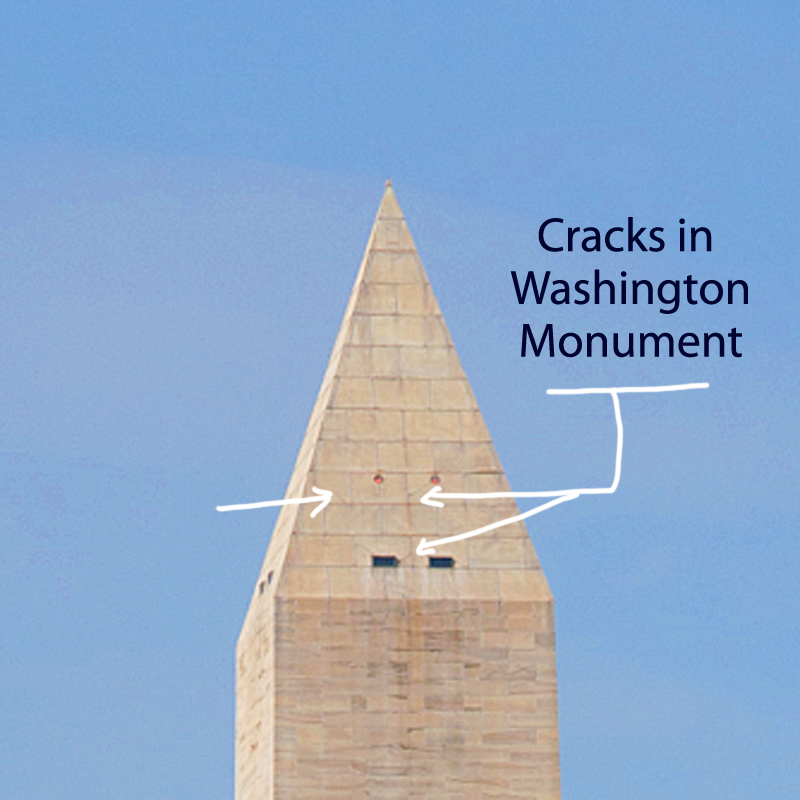
WASHINGTON — There were cracks in the Washington Monument and broken capstones at the National Cathedral. In the District of Columbia suburbs, some people stayed in shelters because of structural concerns at their apartment buildings.
A day after the East Coast’s strongest earthquake in 67 years, inspectors assessed the damage and found that most problems were minor. But the shaking raised questions about whether this part of the country, with its older architecture and inexperience with seismic activity, is prepared for a truly powerful quake.
The 5.8 magnitude quake felt from Georgia north to Canada prompted swift inspections of many structures Wednesday, including bridges and nuclear plants. An accurate damage estimate could take weeks, if not longer. And many people will not be covered by insurance.
In a small Virginia city near the epicenter, the entire downtown business district was closed. School was canceled for two weeks to give engineers time to check out cracks in several buildings.
At the 555-foot Washington Monument, inspectors found several cracks in the pyramidion – the section at the top of the obelisk where it begins narrowing to a point.
A 4-foot crack was discovered Tuesday during a visual inspection by helicopter. It cannot be seen from the ground. Late Wednesday, the National Park Service announced that structural engineers had found several additional cracks inside the top of the monument.
Carol Johnson, a park service spokeswoman, could not say how many cracks were found but said three or four of them were “significant.” Two structural engineering firms that specialize in assessing earthquake damage were being brought in to conduct a more thorough inspection on Thursday.
The monument, by far the tallest structure in the nation’s capital, was to remain closed indefinitely, and Johnson said the additional cracks mean repairs are likely to take longer. It has never been damaged by a natural disaster, including earthquakes in Virginia in 1897 and New York in 1944.
Tourists arrived at the monument Wednesday morning only to find out they couldn’t get near it. A temporary fence was erected in a wide circle about 120 feet from the flags that surround its base. Walkways were blocked by metal barriers manned by security guards.
“Is it really closed?” a man asked the clerk at the site’s bookstore.
“It’s really closed,” said the clerk, Erin Nolan. Advance tickets were available for purchase, but she cautioned against buying them because it’s not clear when the monument will open.
“This is pretty much all I’m going to be doing today,” Nolan said.
Tuesday’s quake was centered about 40 miles northwest of Richmond, 90 miles south of Washington and 3.7 miles underground. In the nearby town of Mineral, Va., Michael Leman knew his Main Street Plumbing & Electrical Supply business would need – at best – serious and expensive repairs.
At worst, it could be condemned. The facade had become detached from the rest of the building, and daylight was visible through a 4- to 6-inch gap that opened between the front wall and ceiling.
“We’re definitely going to open back up,” Leman said. “I’ve got people’s jobs to look out for.”
Leman said he is insured, but some property owners might not be so lucky.
The Insurance Information Institute said earthquakes are not covered under standard U.S. homeowners or business insurance policies, although supplemental coverage is usually available.
The institute says coverage for other damage that may result from earthquakes, such as fire and water damage from burst gas or water pipes, is provided by standard homeowners and business insurance policies in most states. Cars and other vehicles with comprehensive insurance would also be protected.
The U.S. Geological Survey classified the quake as Alert Level Orange, the second-most serious category on its four-level scale. Earthquakes in that range lead to estimated losses between $100 million and $1 billion.
In Culpeper, Va., about 35 miles from the epicenter, walls had buckled at the old sanctuary at St. Stephen’s Episcopal Church, which was constructed in 1821 and drew worshippers including Confederate Gens. Robert E. Lee and J.E.B. Stuart. Heavy stone ornaments atop a pillar at the gate were shaken to the ground. A chimney from the old Culpeper Baptist Church built in 1894 also tumbled down.
At the Washington National Cathedral, spokesman Richard Weinberg said the building’s overall structure remains sound and damage was limited to “decorative elements.”
Massive stones atop three of the four spires on the building’s central tower broke off, crashing onto the roof. At least one of the spires is teetering badly, and cracks have appeared in some flying buttresses.
Repairs were expected to cost millions of dollars – an expense not covered by insurance.
“Every single portion of the exterior is carved by hand, so everything broken off is a piece of art,” Weinberg said. “It’s not just the labor, but the artistry of replicating what was once there.”
The building will remain closed as a precaution. Services to dedicate the memorial honoring Rev. Martin Luther King Jr. were moved.
Other major cities along the East Coast that felt the shaking tried to gauge the risk from another quake.
A few hours after briefly evacuating New York City Hall, Mayor Michael Bloomberg said the city’s newer buildings could withstand a more serious earthquake. But, he added, questions remain about the older buildings that are common in a metropolis founded hundreds of years ago.
“We think that the design standards of today are sufficient against any eventuality,” he said. But “there are questions always about some very old buildings. … Fortunately those tend to be low buildings, so there’s not great danger.”
An earthquake similar to the one in Virginia could do billions of dollars of damage if it were centered in New York, said Barbara Nadel, an architect who specializes in securing buildings against natural disasters and terrorism.
The city’s 49-page seismic code requires builders to prepare for significant shifting of the earth. High-rises must be built with certain kinds of bracing, and they must be able to safely sway at least somewhat to accommodate for wind and even shaking from the ground, Nadel said.
Buildings constructed in Boston in recent decades had to follow stringent codes comparable to anything in California, said Vernon Woodworth, an architect and faculty member at the Boston Architectural College. New construction on older structures also must meet tough standards to withstand severe tremors, he said.
It’s a different story with the city’s older buildings. The 18th- and 19th-century structures in Boston’s Back Bay, for instance, were often built on fill, which can liquefy in a strong quake, Woodworth said. Still, there just aren’t many strong quakes in New England.
The last time the Boston area saw a quake as powerful as the one that hit Virginia on Tuesday was in 1755, off Cape Ann, to the north. A repeat of that quake would likely cause deaths, Woodworth said. Still, the quakes are so infrequent that it’s difficult to weigh the risks versus the costs of enacting tougher building standards regionally, he said.
People in several of the affected states won’t have much time to reflect before confronting another potential emergency. Hurricane Irene is approaching the East Coast and could skirt the Mid-Atlantic region by the weekend and make landfall in New England after that.
In North Carolina, officials were inspecting an aging bridge that is a vital evacuation route for people escaping the coastal barrier islands as the storm approaches.
Speaking at an earthquake briefing Wednesday, Washington Mayor Vincent Gray inadvertently mixed up his disasters.
“Everyone knows, obviously, that we had a hurricane,” he said before realizing his mistake.
“Hurricane,” he repeated sheepishly as reporters and staffers burst into laughter. “I’m getting ahead of myself!”
___
Associated Press writers Sam Hananel in Washington; Alex Dominguez in Baltimore; Bob Lewis in Mineral, Va.; Samantha Gross in New York City; and Jay Lindsay in Boston contributed to this report.

The Upcoming Nuclear War with Iran

Tensions between the US and Iran have escalated over the past month [File: AP/Laura Rauch]
Can a fourth Gulf War be prevented?
Tensions between the United States and Iran have flared up since the Trump administration withdrew from the nuclear deal with Iran last year and began ratcheting up sanctions on the Islamic Republic.
Earlier this month, tensions turned into threats, as Washington refused to extend sanctions waivers for buyers of Iranian oil, designated Iran’s elite Revolutionary Guards (IRGC) a terrorist organisation, and began military preparations to deter Iran.
These measures are pushing the Iranian economy to the brink. Oil exports, which have already dwindled from 2.5 million to less than 1.3 million barrels a day since last year, could drop even further, crippling the state budget. Ordinary Iranians, who are already suffering from the raging inflation (currently at 40 percent) and skyrocketing prices of goods, will likely bear the brunt of Washington’s push to bring Iranian oil exports to zero. And this is only the beginning.
The Iranian leadership has been defiant. Supreme Leader Ayatollah Ali Khamenei has said this „hostile measure“ will not be left „without a response“, while President Hassan Rouhani has threatened to disrupt oil shipments from Gulf countries. Foreign Minister Mohammad Javad Zarif has cautioned that Iran could walk away from the nuclear deal and warned against a potential escalation to war.
If the past three Gulf wars of the 1980s (Iraq-Iran), 1991 (US/UN-Iraq) and 2003 (US/UK-Iraq) are anything to go by, a confrontation between the US and Iran would prove far more devastating. So why are Washington and Tehran ignoring the lessons of war, and marching eyes wide shut towards another armed conflict? And can anyone stop them?
Washington’s arrogance
Even before he was elected president, Donald Trump famously branded the Joint Comprehensive Plan of Action (JCPOA) negotiated by the Obama administration „the worst deal ever“ and once he took office, he embarked on dismantling it.
In May last year, his administration withdrew from the JCPOA and issued 12 demands to Iran. It was one of those impossible lists, designed to provoke and humiliate.
The US wants Iran to end all its nuclear and missile programmes, withdraw its forces from Syria, stop its „destabilising“ policies in Iraq, Afghanistan and the Gulf, and cease its support for armed groups like Hezbollah, Hamas, and the Houthis in exchange for negotiating a new nuclear deal.
No one would have been more surprised than the US itself if Iran had said yes to any of it. These demands basically constitute total Iranian surrender, not only to the US but also to Israel and Saudi Arabia, Trump’s key regional partners and principle drivers behind the new Iran policy.
National Security Advisor of the United States John Bolton made this crystal clear on the sidelines of the UN General Assembly session last September, when he said„If you cross us, our allies, or our partners; if you harm our citizens; if you continue to lie, cheat, and deceive, yes, there will indeed be hell to pay.“
The message was certainly heard loud and clear in Tehran, which has accused the so-called B-team (Bolton, Israel’s Benjamin Netanyahu, Saudi Arabia’s Mohammed Bin Salman and the UAE’s Mohammed Bin Zayed) of pushing Trump to seek regime or war with Iran.
Perhaps it is true that the US president has been ensnared by various warmongers in a vicious campaign against Iran, but the Iranian leadership has been anything but innocent in all of this, with its own A-team (led by Ayatollah Khamenei) pursuing regional hegemony.
Tehran’s arrogance
Instead of taking advantage of the windfall from the nuclear deal and the normalisation of relations with the West to rebuild its economy and country, Tehran has doubled down on its aggressive policies in the region.
Although it has accused the US, Israel, and Saudi Arabia of causing instability, it has itself chosen to advance its narrow interests with recklessness and indifference to the disastrous consequences.
Over the past few years, Iran has pursued a sectarian strategy that destabilised its neighbours and empowered the likes of Bashar al-Assad in Syria and Nouri al-Maliki in Iraq. It has also waged proxy wars against Saudi Arabia, crippling countries like Yemen and Lebanon and used paramilitary groups like the IRGC and its al-Quds Force to undermine opponents across the Arab world.
Its aggressive policies have fuelled a now widely held suspicion that it seeks to „create a new Persian and Shi’ite ‚empire‘ on Arab land“. Some members of its political elite have even bragged that Iran already rules in four Arab capitals: Baghdad, Damascus, Beirut, and Sanaa.
The Iranian strategy of exploiting instability to pursue regional hegemony has backfired. In the hope of curtailing Iran’s Middle Eastern ambitions, many Arab states are now not only siding with the US but are also drawing closer to Iran’s archenemy, Israel.
Religious fanaticism
In addition to economic, diplomatic and strategic tools, Washington and Tehran are also employing religion to justify their policies and rally their supporters at home and abroad.
Secretary of State Mike Pompeo, an evangelical Christianhas claimed that Trump may have been sent by God to protect Israel from Iran. He, along with Vice President Mike Pence and other evangelicals working with the Trump administration, supports Israel’s religious claims over Jerusalem and the rest of Palestine, and invokes biblical texts to explain US policy towards Iran and the region.
No less alarming is Iran’s use of religion and particularly the idea of protecting the oppressed and the downtrodden to pursue its hegemonic policies across the region. The Iranian leadership has also actively sought the sectarianisation of local tensions and conflicts in order to present itself as the „protector“ of all Shia communities in the region. It has also employed Shia dogmas and calls to protect holy Shia shrines to recruit fighters for the various militias it supports in Iraq and Syria.
But it is not only the US and Iran who have engaged in religious fanaticism. Israel and Saudi Arabia have done so as well, and so have various non-state actors such as the Islamic State of Iraq and the Levant (ISIL). They have all assumed their own versions of „manifest destiny“, claiming they were divinely ordained to conquer and occupy and willing to use God’s name in vain in order to advance their narrow political interests.
Arrogance breeds contempt; religious arrogance breeds conflict.
So, could this „clash of fanaticism“ escalate into a wider confrontation?
The prospect of war
I am not convinced that either Trump or Rouhani wishes for a war. There doesn’t seem to be a decision or a plan to go to war, yet – not today, not tomorrow.
But what about next year? Trump’s 12 demands have left Tehran with no option for an honourable exit and set it on the path towards an economic disaster. Feeling anxious about an implosion from within, it will have to devise a plan to respond.
Meanwhile, the US will continue to strangle it economically, destabilise it politically and undermine it regionally. It will pursue various containment strategies like „offshore balancing„, but if those fail, military intervention will be a viable option.
Washington’s aggressive approach will likely weaken Iranian pragmatists like Rouhani, and empower hardliners. This will cause Iran to abandon diplomatic efforts to contain the crisis and seek to quit the nuclear deal and perhaps even the Nuclear Non-Proliferation Treaty altogether, rile up its Gulf neighbours, and undermine the US presence in Iraq and Afghanistan. This would inevitably evoke a sharp reaction from Washington, which may lead to war or wars by proxy throughout much of the region.
Foreseeing such developments, the Trump administration is already preparing the public for possible escalation. Like the Bush administration, it is repeating the same false claims that paved the way for the invasion of Iraq – that there are weapons of mass destruction (WMD) threat and support for terrorism.
Clearly, some in Washington have forgotten the Iraq debacle, and continue to believe in limited wars and regime change.
Preventing a war
All of this begs the bigger question: Where are the world powers who signed the Iran deal, enshrined it in a UN Security Council resolution, and vowed to defend it? Shouldn’t they stop the ongoing escalation?
Europe may still support the deal but it is clearly spooked by Washington’s aggressive posturing and has not yet activated INSTEX, the alternative trade mechanism to bypass US sanctions.
Russia, an oil exporter, seems indifferent for now, and may even benefit from higher oil prices; India has found alternative suppliers, while Turkey continues to ask for waivers.
China, the biggest importer of Iranian oil, has reduced its oil imports by a quarter since last year. It still maintains business relations with Tehran, just enough to use it as a bargaining chip in the ongoing trade negotiations with Washington.
In short, the world powers have not been successful in saving the nuclear deal, or devising a viable plan to circumvent US sanctions. They are also failing to curb the US-Iranian escalation to war.
If there is any chance of stopping this madness, it may well have to come from the US itself.
The ball is in your court, America. But don’t wait until 2020 to make your voice heard against another mad, sick, stupid war.
ABOUT THE AUTHOR
Marwan Bishara is the senior political analyst at Al Jazeera.

Rockets Launched from Outside the Temple Walls (Revelation 11)

Image result for islamic jihad rocket launch

Israel Accuses Islamic Jihad of Rocket Launch, Limits Gaza Fishing Zone in Response

In unusual move, Israel names Islamic Jihad officials, saying the organization acted without Hamas‘ approval
Israel minimized on Tuesday the fishing zone for Gazans from 15 nautical miles down to six, after a rocket fired overnight Monday landed in Israeli waters.
The Israeli army said the rocket launched by Islamic Jihad was aimed at hitting one of Israeli communities along the border. It named Islamic Jihad officials directly, publishing their photos, and laid responsibility for the attack on the organization, an unsual move as it normally holds Hamas accountable for aggression coming out of the Strip.
Aside from decreasing the fishing perimeter, no targets were struck so far by Israeli forces, as is usually the case after rocket fire. It is possible Israel is refraining from a military response to prevent a situation in which Hamas is forced to respond.
Islamic Jihad released a statement in response, saying, „Israel’s accusations are part of an organized campaign of incitement against Islamic Jihad and its leadership, headed by Ziad al-Nakhalah, and is an excuse to act against the organization’s leadership.“
According to Adi Meiri, the spokeswoman of the Negev Regional Council, an Israel Defense Force assessment identified a rocket launched toward Israel that failed to reach its target. No sirens were sounded.
On Sunday, an aircraft and a tank attacked two Hamas targets in the Gaza Strip, the military said. According to the statement, the attack was a response to shooting at Israeli soldiers stationed at the Gaza border. No injuries were reported.
Israel expanded the approved fishing zone for fishermen in the Strip to 15 nautical miles (equivalent to 28.8 kilometers from the shoreline) in the beginning of April, the maximum fishing range allowed in the Gaza Strip since the signing of the Oslo Accords in 1993.
At the time, fishermen in Gaza said the 15-mile range is partial, only applying to waters off the southern part of the Strip.

Thank You President Obama: Iran’s Supreme Leader Worth $200 Billion

Iran's supreme leader Ayatollah Ali Khamenei
Iran’s supreme leader, Ayatollah Ali Khamenei / Getty Images

U.S. Embassy: Iran’s Supreme Leader Worth $200 Billion

BY: 
Last week, the embassy posted on its Facebook page that the regime in Iran is rife with corruption from top to bottom, with Khamenei reaping the most benefits, Iran News Wire reported.
Meanwhile, the embassy added, the Iranian people „languish in poverty because of the dire economic situation in Iran after 40 years of rule by the mullahs.“
Reuters found in 2013, after a six-month investigation, that Khamenei controls exclusively a business empire, called Setad, worth around $95 billion.
„Setad has become one of the most powerful organizations in Iran, though many Iranians, and the wider world, know very little about it,“ Reuters reported at the time. „In the past six years, it has morphed into a business juggernaut that now holds stakes in nearly every sector of Iranian industry, including finance, oil, telecommunications, the production of birth-control pills, and even ostrich farming.“
The report also showed how „Setad built its empire on the systematic seizure of thousands of properties belonging to ordinary Iranians: members of religious minorities like Vahdat-e-Hagh, who is Baha’i, as well as Shi’ite Muslims, business people, and Iranians living abroad.“
The regime also exempts several profitable religious institutions, many of which Khamenei controls, from taxes.
Most estimates put Iran’s poverty level at somewhere between 30 and 40 percent, but last year, a member of the Iranian parliament’s Economic Committee said that 80 percent of the country’s population live below the poverty line.
A senior official at the International Monetary Fund said that inflation could reach 40 percent this year as the Iranian economy continues to shrink.
As the economy crumbles, Iranians have expressed outrage at their government’s response to major flooding caused by heavy rain across Iran, claiming that the Islamist regime cares more about crushing protests than helping those who are suffering.