Showing posts with label jihad. Show all posts

Wednesday, November 24, 2021

Palestinians clash with police outside the Temple Walls: Revelation 11

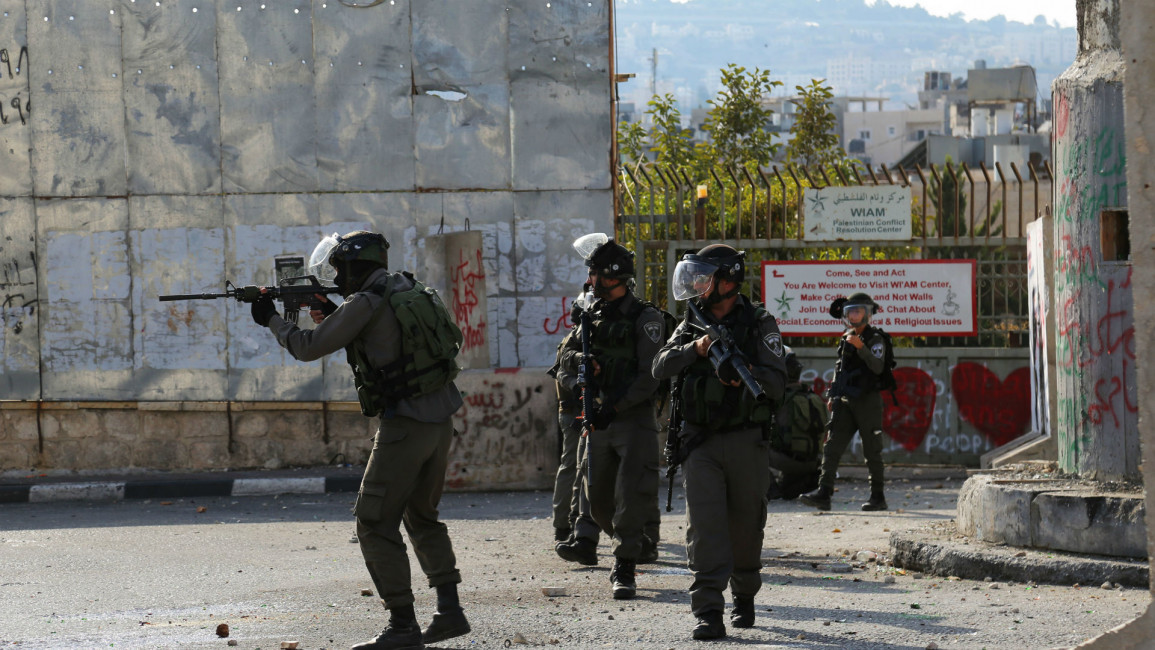
Palestinian rioters clash with Israeli police at the entrance to Jerusalem's Shuafat Refugee Camp, November 21, 2021. (Screenshot: Twitter)

Palestinians clash with police in East J’lem after march supporting their Hamas terrorist

Hundreds chant pro-Hamas slogans in Shuafat refugee camp; right-wing Israelis march through Old City to mourn Eli Kay, killed by terrorist gunman, some chanting anti-Arab slogans

By Aaron Boxerman21 Nov 2021, 11:28 pm

Clashes broke out between Palestinians and Israeli security forces in Jerusalem on Sunday night after hundreds marched in Shuafat Refugee Camp to honor Hamas terrorist Fadi Abu Shkhaydam, who killed an Israeli and wounded four others in Jerusalem’s Old City earlier in the day.

In videos circulating on social media, dozens of Palestinians can be seen hurling rocks as tear gas — apparently fired by police — fills the air around them. Israeli police had raidedthe neighborhood following the Sunday terror attack, reportedly arresting three relatives of Abu Shkhaydam’s family.

Paramedics also reported two Molotov cocktail attacks in the Jerusalem area, although it was not immediately clear who the perpetrators were.

One explosive bottle was hurled at a 30-year-old man near the Old City, who suffered light burns, according to Magen David Adom emergency responders.

The second Molotov cocktail was hurled at a bus near the Hizma checkpoint between Jerusalem and the West Bank. The bus driver, 25, was treated for shock; no passengers were hurt, MDA medics said.

Get The Times of Israel’s Daily Edition by email and never miss our top storiesBy signing up, you agree to the terms

The widening unrest was sparked by the bloody terror attack in the Old City. On Sunday morning, Abu Shkhaydam drew a submachine near the Chain Gate, which leads to the holy Temple Mount site, and opened fire on passersby.

Israeli police officers returned fire and killed Abu Shkhaydam on the scene, but not before he fatally wounded South African immigrant Eliyahu David Kay and seriously wounded another Israeli yeshiva student. Three other Israelis were treated for moderate to light wounds.

On Sunday night, hundreds of Palestinians marched towards Abu Shkhaydam’s house. Many could be seen waving the green flags emblazoned with the Islamic credo of faith, that are often associated with Hamas.Advertisement

“Millions of martyrs will march to Jerusalem,” the protesters chanted, according to videos circulating on social media.

In other videos, the Palestinian marchers pledged allegiance to shadowy Hamas terror chief Mohammad Deif.

Put sword next to sword,” Shuafat camp residents chanted, a reference to Hamas’ logo, which features crossed blades. “We’re Mohammad Deif’s men.”
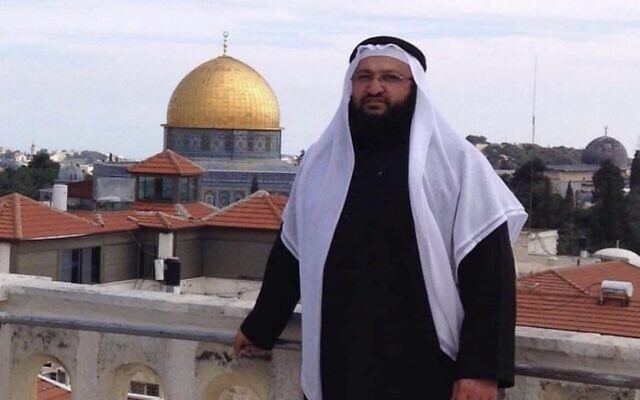
An umbrella coalition of Palestinian “Islamic and Nationalist Factions” in Shuafat declared a general strike in shops and schools in memory of Abu Shkhaydam.

Separately, dozens of right-wing Israeli nationalists marched through the Old City to the scene of the attack. They were joined by Simcha Rothman and Orit Struck, parliamentarians from the hard-right Religious Zionism party, who lit candles in memory of the late Kay.
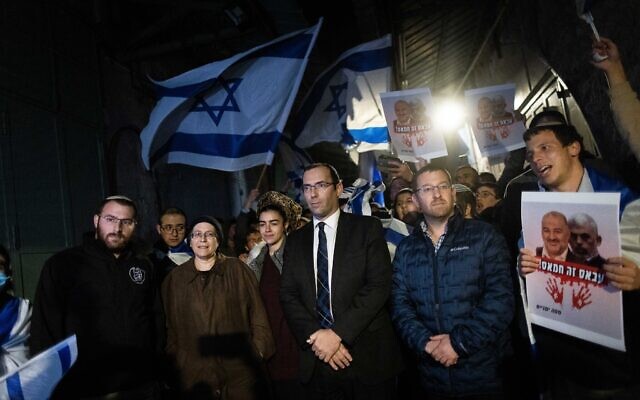
In some videos, Jewish demonstrators chanted anti-Arab slogans, such as, “May their village burn!”Advertisement

Kay had served in the Israel Defense Forces as a lone soldier (one of the soldiers from foreign countries who move to Israel without family) in the Paratroopers Brigade, until August 2019.

“He gave everything for this country,” his brother Kasriel told reporters on Sunday evening.

Israeli officials said they believed Abu Shkhaydam had planned his attack well in advance, citing the sophisticated submachine gun he had acquired. His wife and children also left the country three days ago, according to Public Security Minister Omer Barlev.

In Shuafat, Abu Shkhaydam raised five children — three boys and two daughters — and taught Islamic law at a boys high school, for which he received a salary from the Jerusalem municipality. According to Israeli authorities, he was a member of Hamas’ civilian branch, rather than its armed wing.

“He was the best teacher. He never cursed anyone, or called anyone a bad name, except the Jews, may God burn them,” Shuafat resident Mustafa Zaattra, a student of Abu Skhaydam, told al-Qastal.

Abu Shkhaydam also preached in local mosques. In a 2020 sermon circulated on social media, he assailed “the Jewish and Christian masters of heresy” as being “led by the devil.” Seething at the United Arab Emirates’ decision to normalize ties with Israel, he called the Emiratis, “filthy Bedouins.”

“They are joined by those with ulterior motives…all these unite for one thing only — to fight against God,” Abu Shkhaydam said at the time.

In a statement, Hamas praised Abu Shkhaydam for having spent his life “in proselytizing and in struggle.”

“This heroic operation carries a warning to the criminal enemy and its government to stop its aggression against our land and our holy sites,” the terror group said.

The attack was the second in recent days in Jerusalem’s Old City. East Jerusalem teenager Amr Abu Asab, 16, sought to stab police officers before being shot by a local civilian on Thursday night. Hamas also later claimed Asab as a member.
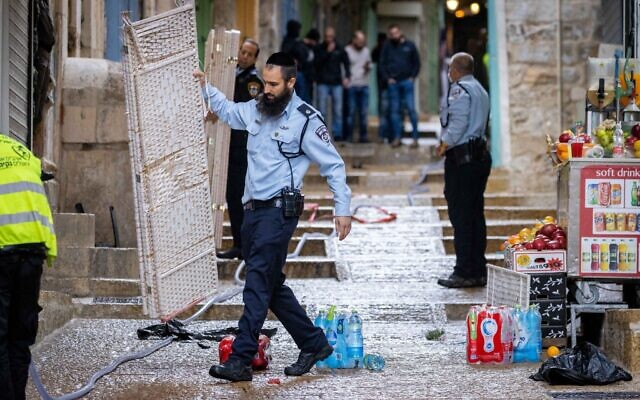
Asab’s death has sparked repeated nightly clashes between police and Palestinians in Issawiya, where he lived. On Saturday night, Palestinian residents managed to set a police water cannon on fire as it was deployed in the neighborhood.

Prime Minister Naftali Bennett said on Sunday morning that authorities were concerned about attacks inspired by the two successive acts of terrorism.

“This is the second terrorist attack in Jerusalem in recent days. I have instructed the security forces to mobilize accordingly and demonstrate vigilance

Tuesday, November 23, 2021

Forces thwart major Hamas terror plans outside the Temple Walls: Revelation 11

Shin Bet: Forces thwart major Hamas terror plans, nab more than 50 cell members

Shin Bet: Forces thwart major Hamas terror plans, nab more than 50 cell members

West Bank cell aimed to carry out some bombings imminently; suicide attacks planned; ringleader was offered $1m. for kidnapping; arrests come day after Old City killing of Eli Kay

By Judah Ari Gross

Israeli security forces arrested dozens of members of a Hamas cell that was in the advanced stages of planning major terror attacks in the West Bank and Israel, the Shin Bet security service said Monday.

The effort to uncover the cell has been ongoing for several months, first coming to light with a round of arrest raids in September, including one in which two Israeli soldiers were seriously injured and several Palestinian suspects were killed in gunfights.Advertisement

According to the Shin Bet, over 50 Hamas operatives were arrested across the West Bank for suspected involvement in the cell and large quantities of weaponry was seized, including the materials needed to make at least four explosive belts for suicide attacks. An undisclosed amount of money that was allegedly used by the cell was also seized in the raids, according to the Shin Bet.

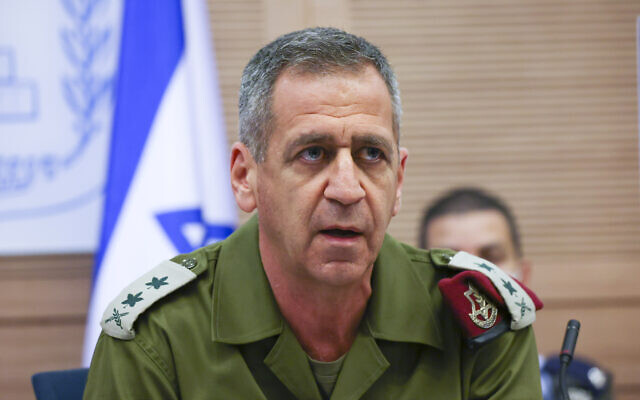
“You thwarted a large infrastructure, some of which you know was ready to go with explosive belts… grenades and other explosives,” IDF Chief of Staff Aviv Kohavi told the military commanders whose units took part in the raids.

The Shin Bet’s announcement about the discovery of the Hamas cell came a day after a member of the terror group in Jerusalem carried out a shooting attack in the Old City, killing one man, Eli Kay, and injuring four people.

Israeli officials generally believe that Hamas is looking to carry out attacks in the West Bank and in Israel while maintaining relative calm in the Gaza Strip, where the group serves as the de facto ruler.Advertisement

Ammunition and other materiel that was confiscated during arrest raids against major Hamas cell planning terror attacks on Israeli targets in the West Bank and Jerusalem. (Shin Bet)

According to the Shin Bet, the Hamas cell was led from afar by Saleh al-Arouri, deputy head of the terror group’s politburo, and Zacharia Najib, a member of the organization who was released from Israeli prison in the 2011 Gilad Shalit exchange and exiled to Turkey, where he allegedly continues to operate on behalf of Hamas. In the 2011 deal, over 1,000 Palestinian terrorists were released from Israeli incarceration in exchange for the release of Shalit, an IDF soldier who had been kidnapped by Hamas along the Gaza border in 2006.

Najib, who took part in the kidnapping and killing of Israeli soldier Nachshon Wachsman in 1994, was allegedly involved in a failed Hamas plot to assassinate Israelis abroad in 2019.

The Shin Bet said al-Arouri invested hundreds of thousands of shekels in the cell’s activities and offered a prize of $1 million if the cell successfully carried out a kidnapping.

Ismail Haniyeh, right, the head of the Hamas political bureau, shakes hands with his deputy Saleh al-Arouri, upon his arrival in Gaza from Cairo, Egypt, in Gaza City, August 2, 2018. (Mohammad Austaz/Hamas Media Office via AP)

“This was a major preventative effort that thwarted dangerous terrorist infrastructure, which was planning serious attacks. The goal of the terrorist activities, which were undertaken by Hamas operatives abroad and in Gaza with operatives in the West Bank, was to destabilize the region, while exacting a heavy price from local residents,” a senior Shin Bet officer said, referring to the toll on Palestinians in the West Bank.

According to the Shin Bet, the cell was planning “to carry out terror attacks in a number of formats in the West Bank and Jerusalem, as well as the possibility of carrying out bombings in Israel.”

Al-Arouri and Najib, who both live abroad, recruited a number of top operatives from Palestinian cities and towns across the West Bank, notably Jenin, Ramallah, and Hebron, who in turn found additional members, according to the Shin Bet.Advertisement

The Israeli security service identified one of those lieutenants as Hijazi Qawasmeh, a 37-year-old Hebron native, who has been arrested several times by Israel for allegedly planning terror attacks for Hamas, most recently in September.

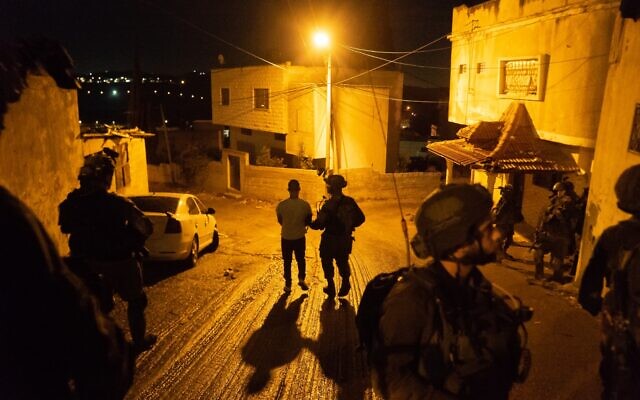
An undated photograph showing Israeli forces raiding a home as part of an effort to break up a major Hamas cell planning terror attacks on Israeli targets in the West Bank and Jerusalem. (Israel Defense Forces)

“Hijazi recruited operatives in the West Bank, including Hamzah Zahran, a 40-year-old Hamas operative from the village of Bidu, near Ramallah,” the Shin Bet said.

According to the Shin Bet, Zahran, who has also been arrested multiple times for Hamas activities, went on to recruit several other operatives, including his family members. One of his brothers, Ahmad Zahran, was killed in a firefight with Israeli troops during one of the raids in Bidu in September. Two other Hamas members — Mahmoud Hameedan and Zakria Badwan — were killed in the same exchange.

“They worked using the money they received from abroad to obtain weapons and to create explosives, which were seized as part of the efforts to thwart this infrastructure,” the Shin Bet said.

According to the IDF, large amounts of explosives were found and later destroyed in a series of controlled blasts.

The Shin Bet identified two of the main bomb makers that were used by the cell: Muhammad Abu al-Hassan, from the village of Burqin near Jenin, and Ghani Hadour, from Bayt Sira near Ramallah.

The Israeli security services warned that Hamas operatives in the Gaza Strip and abroad were “constantly funneling funding toward various terrorist activities” in the West Bank.

In a tacit threat, the Shin Bet identified “one of the noteworthy people involved” as Musa Dudin, a senior Hamas member whom the security service alleged led an operation to send large sums of money to Hamas in the West Bank through couriers.Advertisement

The Israeli army has killed at least 77 Palestinian children outside the Temple Walls: Revelation 11

Israeli army - Getty

The Israeli army has killed at least 77 Palestinian children in the West Bank and Gaza Strip since the beginning of 2021, a non-government organization reported on Sunday.


The Israeli army has killed at least 77 Palestinian children in the West Bank and Gaza Strip since the beginning of 2021, a non-government organization reported on Sunday. (Getty)

The Israeli army has killed at least 77 Palestinian children in the West Bank and Gaza Strip since the beginning of 2021, a non-government organisation reported on Sunday. 

In a press statement sent to The New Arab,Defense for Children International Palestine (DCI) said that 61 children were killed in the coastal enclave and 16 in the West Bank and East Jerusalem.

On the occasion of International Children’s Day, the organisation said that “since 2000 until today, the Israeli forces have killed about 2,200 Palestinian children.”

“The Israeli army resort to deliberate lethal force in the circumstances not justified by international law, and that the excessive use of force is the rule then, taking advantage of the state of systematic impunity and lack of accountability,” the statement said. 

Under international law, lethal force can only be justified in the circumstances with an immediate threat to life or severe injury.

Investigations and evidence collected by DCI regularly indicate that Israel uses lethal force against Palestinian children in conditions that may amount to extrajudicial or premeditated murder, according to the organisation.

From October 2015 until October 2021, the organisation documented the detention of 41 Palestinian children in Israeli prisons under administrative detention orders, four of whom remain in administrative detention.

“Israel is the only country in the world that systematically arrests and tries children in military courts, which lack a basic fair trial. It arrests and tries between 500 and 700 Palestinian children before military courts every year,” the DCI said.

Hamas gunman kills 1, wounds 4 in terror shooting outside the Temple Walls: Revelation 11

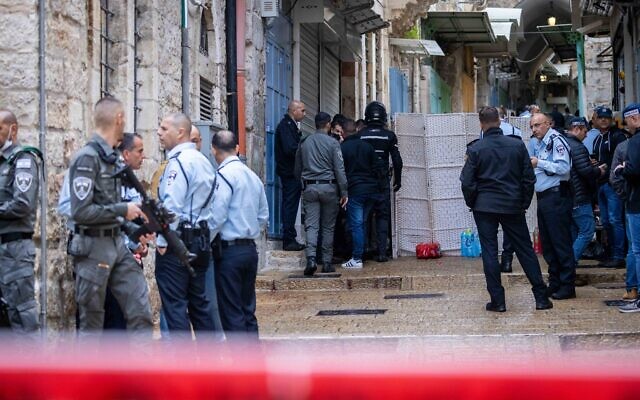
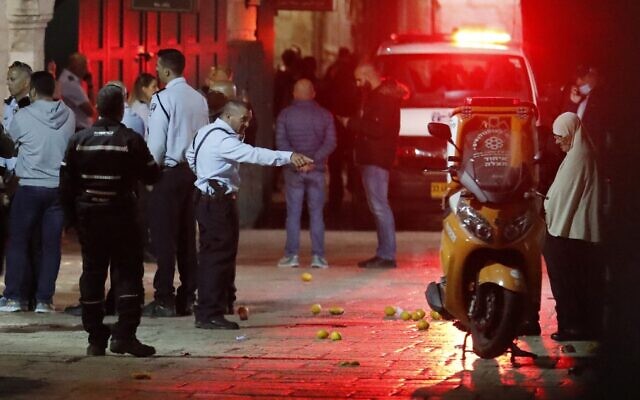
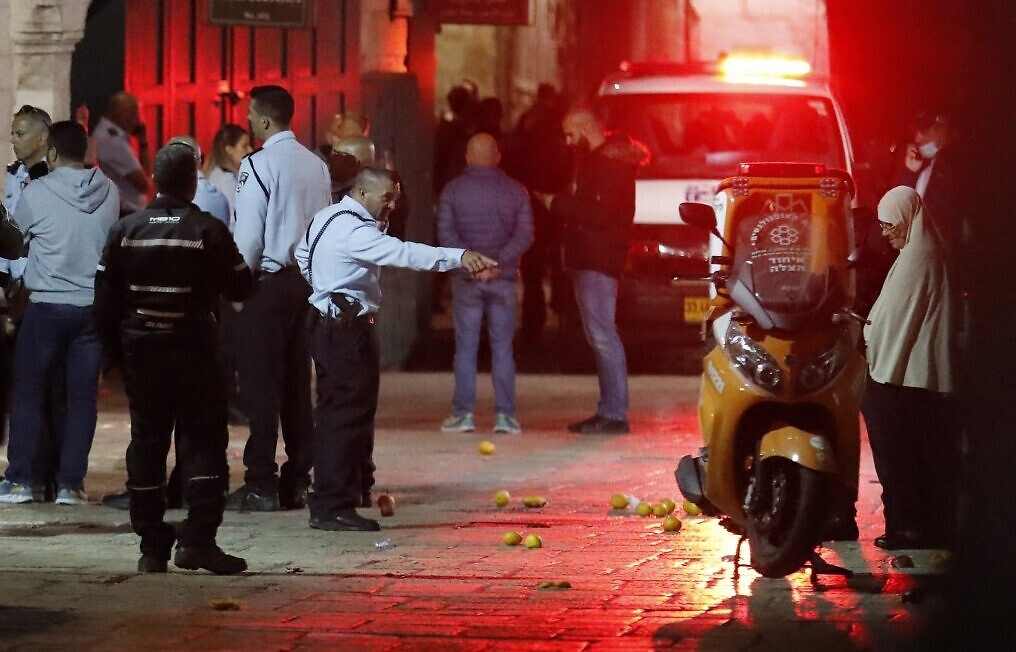
Police officers at the scene of a shooting attack in Jerusalem's Old City on November 21, 2021. (Yonatan Sindel/Flash90)

Hamas gunman kills 1, wounds 4 in terror shooting in Jerusalem Old City

Palestinian attacker shot dead by officers near entrance to Temple Mount; Hamas hails ‘heroic operation’; incident comes days after stabbing nearby; PM warns of ‘copycat attacks’

By Judah Ari Gross and Aaron BoxermanToday, 9:29 am

A Hamas gunman opened fire in the alleyways of Jerusalem’s Old City on Sunday morning, killing one Israeli man and wounding four others, two of them seriously, Israeli officials said.

Police officers at the scene opened fire at the terrorist, a 42-year-old Palestinian man from East Jerusalem, and killed him, according to police.

The fatality was named as Eliyahu David Kay, 26, a recent immigrant from South Africa who worked as a guide at the Western Wall and resided in the central city of Modiin.

He was the first Israeli civilian to be killed by Palestinian violence in over six months, since May’s 11-day conflict with terror groups in the Gaza Strip, which killed 12 civilians in Israel.

Hamas hailed the attack, calling it a “heroic operation,” and identified the terrorist as a member of the organization, Fadi Abu Shkhaydam, a Hamas leader in the Shuafat refugee camp in East Jerusalem, where he lived.

According to police, Abu Shkhaydam entered the Old City armed with a Beretta M12 submachine gun and opened fire at three Israeli men who were walking through the area, near the Chain Gate entrance to the Temple Mount, fatally wounding one of them and seriously injuring the other two.

Two female police officers rushed to the scene from one side of the alleyway, opening fire at Shkaydam. Shortly thereafter, two male officers ran in to assist them.

“[The gunman] moved through the alleys and fired quite a bit. Luckily, the alley was mostly empty because otherwise — heaven forbid — there would have been more casualties. The entire incident lasted 32 or 36 seconds. The actions of the female officers was — operationally — at the highest possible level,” Public Security Minister Omer Barlev said at the scene of the attack.Advertisement

Kay was taken to Hadassah Hospital Mount Scopus, where he was pronounced dead. One of the severely injured victims, a rabbi, was taken to Shaare Zedek Medical Center, where his condition stabilized somewhat after emergency surgery, doctors said. Another man sustained moderate-to-severe injuries — from gunshots and from shrapnel — and was taken to Hadassah Hospital Ein Kerem.

Saturday, November 20, 2021

Israel plans to attack outside the temple walls : Revelation 11

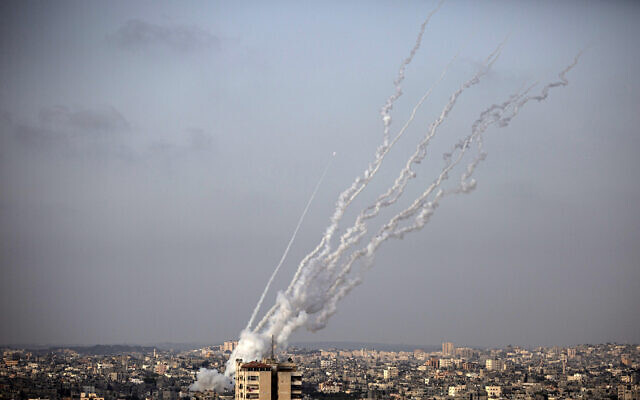
Rockets are launched from the Gaza Strip towards Israel, on May 10, 2021. (AP Photo/Khalil Hamra)

IDF chief said to order acceleration of plans for attack on Gaza rocket stocks

Military sources say plan aimed at undercutting terror groups’ ability to fire rockets during early stages of a future conflict after failure to properly target them in May war

By TOI staff19 Nov 2021, 10:03 pm

IDF Chief of Staff Aviv Kohavi has ordered the military to accelerate plans for a possible broad attack on the rocket stockpiles of Gaza-based terror groups, according to a report Friday.

Citing unnamed sources in the General Staff’s Planning Directorate, the Walla news site said that the plan is aimed at significantly reducing the ability of Hamas and Palestinian Islamic Jihad to target Israel with rockets in the early stages of a future conflict in the Gaza Strip.

The report said the Shin Bet security agency will also be involved in the planning.

The news site also reported that the Iran-backed Islamic Jihad is working to replenish its rocket supply following the 11-day fight in Gaza this May between Israel and Palestinian terror organizations.

Additionally, Hamas has been working to conceal its rockets in order to be able to attack the Israel Defense Forces from the land, sea and air, the report added, without citing a source.

Get The Times of Israel’s Daily Edition by email and never miss our top storiesBy signing up, you agree to the terms

During the conflict in May, known in Israel as Operation Guardian of the Walls, Hamas and other armed factions fired over 4,360 rockets and mortar shell, far higher than previous rounds of violence. Many of the projectiles were intercepted by the Iron Dome missile defense system.

In the days after the conflict, military officials acknowledged that due mostly to a lack of precise intelligence, the IDF was unable to destroy the lion’s share of the terror groups’ existing arsenals of rockets.

While the IDF developed techniques to somewhat address this rocket fire during the conflict, according to a senior IDF Southern Command officer, Hamas and the Islamic Jihad were overwhelmingly free to launch massive barrages at major Israeli population centers and key infrastructure.Advertisement

The IDF destroyed some 850 of the more than 15,000 rockets that the terror groups had between them going into the conflict, according to Israeli military tallies.

After recognizing that the rockets were an area of weakness, the IDF has since set out to improve its ability to locate the launchers that have been buried and hidden throughout the Gaza Strip, including deep within civilian areas, in order to strike them in advance or, at least, destroy them more rapidly after they have been used.

Friday, November 19, 2021

Hamas hails alleged stabbing attack outside the Temple Walls as ‘heroic’: Revelation 11

An ambulance drives through as Israeli police gather at the scene of an alleged stabbing attack in Jerusalem's Old City on November 17, 2021. (Ahmad Gharabli/AFP)

Hamas hails alleged stabbing attack in Jerusalem’s Old City as ‘heroic’

By AARON BOXERMAN17 November 2021, 7:50 pm  

An ambulance drives through as Israeli police gather at the scene of an alleged stabbing attack in Jerusalem’s Old City on November 17, 2021. (Ahmad Gharabli/AFP)

The Hamas terror group praises the perpetrator of an alleged stabbing attack in Jerusalem’s Old City that left two Border Police officers injured, calling it “a heroic commando operation.”

“This is the latest confirmation that our people’s revolution against the occupation will continue until the occupier is swept away,” terror group spokesperson Hazim Qasim says in a statement.

The alleged stabber, 16-year-old Amr Abu Asab from East Jerusalem’s Issawiya neighborhood, was shot and killed by officers on the scene during the terror attack, according to police.

Wednesday, November 17, 2021

Israeli troops kill armed Palestinian outside the Temple : Revelation 11

Israeli troops kill armed Palestinian in West Bank clash, militant groups say

November 16, 20213:44 AM MSTLast Updated 13 hours ago

RAMALLAH, West Bank, Nov 16 (Reuters) – Israeli troops killed an armed Palestinian on Tuesday in an exchange of fire in the occupied West Bank, the Hamas and Islamic Jihad militant groups said, each claiming the man as a member.

The Israeli military said soldiers returned fire after being shot at and having an explosive device thrown at them during an operation in the Palestinian village of Tubas. It said it was aware of reports of Palestinian casualties but it gave no details.

Advertisement

Scroll to continue with content

In a statement, Hamas identified the Palestinian killed in Tubas as Saddam Hussein Bani Odeh, 26, hailing him as a “hero martyr” shot dead in an “armed clash with Zionist occupation forces”.

Islamic Jihad issued a similar statement, claiming Odeh as a member.

The Israeli military frequently mounts operations in Palestinian villages and towns in the West Bank, territory it captured in the 1967 Middle East war, to detain suspected militants.

Israeli-Palestinian peace talks, opposed by Hamas and Islamic Jihad, broke down in 2014.

Reporting by Ali Sawafta, Nidal al-Mughrabi in Gaza and Maayan Lubell in Jerusalem; Editing by Nick Macfie

Our Standards: The Thomson Reuters Trust Principles.

Monday, November 15, 2021

Deindustrialization outside the Temple Walls: Revelation 11


Gaza ‘undergone deindustrialization’ as a result of the Israeli siege, World Bank warn

November 12, 2021 at 4:55 pm

Gaza is still suffering “from a particularly difficult economic situation with very high unemployment and deteriorating social conditions”, the World Bank warned in a report this week.

The report highlights the critical challenges facing the Palestinian economy in general and more specifically Gaza’s economic performance and development needs and will be presented to the Ad Hoc Liaison Committee (AHLC) in Oslo on 17 November.

It highlights that though the occupied West Bank is seeing a “rebound” following the coronavirus pandemic and subsequent closures, “The economy still suffers from restrictions on movement, access, and trade– the biggest impediment to investment and access to markets,” Kanthan Shankar, World Bank country director for West Bank and Gaza, said.

“The improved economic performance was fully driven by the West Bank while Gaza’s economy remained almost stagnant impacted by the 11-day conflict in May,” the World Bank added.https://d-3084160681580021656.ampproject.net/2110290545003/frame.html

It said the Palestinian Authority’s (PA) fiscal situation “remains very challenging”, with Israel’s deduction of monthly tax revenue adding to “the fiscal stress”. This, it warned, meant the “PA may encounter difficulties in meeting its recurrent commitments toward the end of the year.”

Gaza’s contribution to the overall Palestinian economy, it explained, “was cut by half over the past three decades, narrowing to just 18 percent currently” as a result of the 15-year Israeli siege on the enclave. Gaza has also “undergone deindustrialization” and its economy has become highly dependent on external transfers.

“Priority actions require increasing electricity supply and upgrading infrastructure and networks to enable economic growth and improve public services.”

The report, details of which were released on Tuesday, adds to warnings released yesterday by the UN which claim the financial situation in the Palestinian territories is “dire”. The full UN report is also set to be unveiled in Oslo next week

Thursday, November 11, 2021

Israeli Bulldozers Level Farm Land Outside the Temple Walls

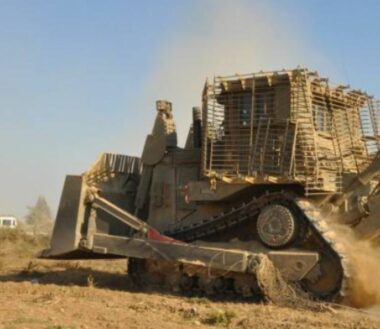
Armored D9 bulldozer (archive image)

Israeli Bulldozers Level Farm Land in the Southern Gaza Strip

NOV 10, 2021

Israeli military bulldozers razed, on Tuesday, Palestinian lands east of Khan Younis in the southern besieged Gaza strip, local sources reported.

Sources said that five bulldozers, 2 graters infiltrated into Palestinian territory, across the so-called security fence, while military tanks were situated along the fence to provide cover for the invading machines.

The heavy machinery was seen razing large sections of Palestinian-owned farm land east of Abasan al-Jadida town in Khan Younis, 70 meters past the Israeli border fence.

The Israeli occupation has maintained a brutal air, land and sea blockade on the tiny coastal enclave for the past 15 years, in addition to launching 4 major military offensives against the more than two million inhabitants.

The military frequently invades Palestinian-owned farm land, opens fire on farmers, and the Navy harasses fishermen while they attempt to fish in the Mediterranean sea.

Tuesday, November 9, 2021

IDF’s new arsenal outside the Temple Walls: Revelation 11

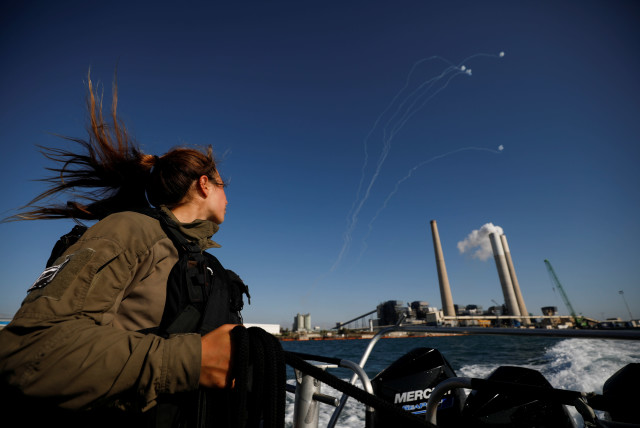
An Israeli soldier looks on as Israel's Iron Dome anti-missile system intercept rockets launched from the Gaza Strip towards Israel, as it seen from a naval boat patrolling the Mediterranean Sea off the southern Israeli coast as Israel-Gaza fighting rages on May 19, 2021. (photo credit: AMIR COHEN/REUTERS)

IDF’s new arsenal: More munitions, precise missiles, greater firepower

The IDF plans to allocate some NIS 5 billion of the budget to ‘third circle threats,’ usually a reference to Iran.

The IDF is planning to significantly increase the number of precision munitions in its arsenal in the coming years now that a state budget has been finalized.

The IDF will look to purchase a substantially larger amount of munitions from the United States than before, due to the increase in threats facing the country as well as an increase in targets picked out by the military.Israel purchased tens of thousands of precision-guided munitions from the US in recent years, and used hundreds of Joint Direct Attack Munitions (JDAM) during Operation Guardian of the Walls in May, leading to precision strikes on targets in the densely populated Gaza Strip.

Though all JDAMs have been replenished by Washington, The Jerusalem Post learned that with the passing of the budget, the military plans to acquire far more by 2024.

The military expects to increase its requests further by 2030. Though Washington has replenished Israel’s JDAM stockpile, the Americans are not willing to fulfill every Israeli request.

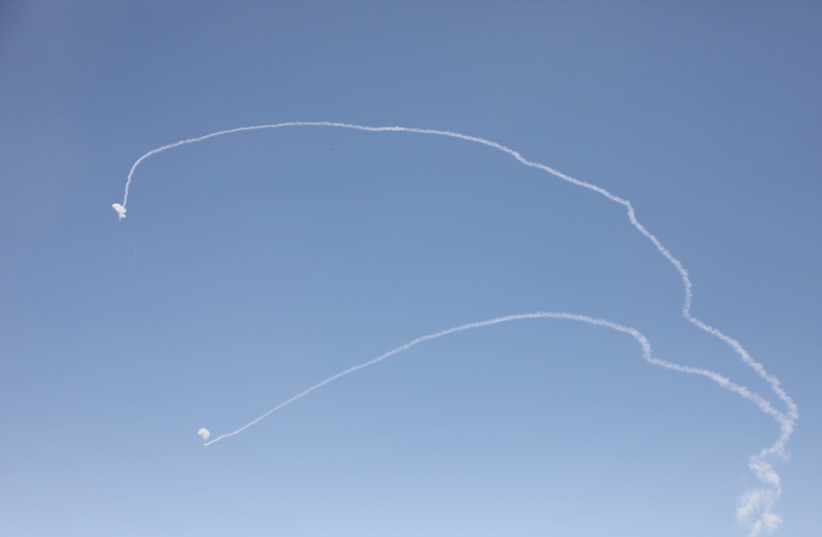
Iron dome anti-missile system fires interception missiles as rockets fired from the Gaza Strip to Israel, in the southern Israeli city of Ashkelon, May 19, 2021 (credit: OLIVIER FITOUSSI/FLASH90)

Iron dome anti-missile system fires interception missiles as rockets fired from the Gaza Strip to Israel, in the southern Israeli city of Ashkelon, May 19, 2021 (credit: OLIVIER FITOUSSI/FLASH90)

The IDF has been busy gathering intel on thousands of targets in Gaza, Lebanon, Syria, and even Iran over the past two years, in expectation of sudden eruptions of violence. The use of such extremely precise munitions allows Israel to hit strategic targets in a crowded civilian environment with relatively small civilian casualty figures.

During the 11 days of war in May, the Hamas-run Health Ministry said at least 243 Palestinians were killed, including 66 children and teenagers, with 1,910 people wounded. Hamas leader Yahya Sinwar said 80 operatives were killed during the fighting – 57 from Hamas and 22 from Palestinian Islamic Jihad.

The Israeli military said more than 100 operatives belonging to the terrorist groups were killed, and that some of the civilian casualties were caused by Hamas rockets falling short or the collapse of civilian homes after an airstrike on Hamas’s tunnel network.During Operation Protective Edge in 2014, in comparison, over 1,400 Palestinians were killed in Gaza.

In addition to the large increase in precision weaponry the IDF plans to purchase, NIS 5 billion of the budget will go exclusively to what the IDF calls “third-circle threats,” usually a reference to Iran. The funds will be allocated to training and intelligence-gathering capabilities, increasing the military’s target bank even further.

Israel considers Iran’s nuclear program to be the No. 1 challenge. Though Iran has consistently denied seeking to build a nuclear bomb, tensions have risen as the West seeks to resume talks on reviving the deal to curb Tehran’s nuclear program.

The past year has seen an increase in the number of war-between-war operations carried out by Israel, as well as the number of targets struck, with most airstrikes targeting Iranian entrenchment and weapon smuggling in Syria and even at sea.

It is estimated that alleged Israeli attacks against Iranian ships have stopped $1.2b.-$2b. from going to terrorist groups in the Middle East.

But the IDF has admitted that Iran’s conventional missile threat is a major concern for Israel, which despite its multi-layered air defenses, may not be able to contend with intensive missile barrages fired by Iran and its proxy groups like Hezbollah in Lebanon or Shi’ite militias in Iraq.

The budget will also allow the IDF to complete other important defensive projects, such as building a wall along the border with Lebanon and implementing a permanent defensive coverage in the airspace of northern Israel with additional fixed Iron Dome batteries that would be able to shoot down incoming drones and missiles.

Iran Horn begins annual war games: Daniel 8

Iran begins annual war games ahead of renewed nuclear talks with West

Nov. 7, 2021

Iran’s military began its annual war games in a coastal area of the Gulf of Oman, state TV reported Sunday, less than a month before upcoming nuclear talks with the West.

The report said navy and air force units as well as ground forces were participating in a more than 1 million square-kilometer (386,100 square-mile) area east of the strategic Strait of Hormuz.

Subscribe

Nearly 20 percent of all oil shipping passes through the strait to the Gulf of Oman and Indian Ocean.

The drill comes amid heightened tensions between Iran and the U.S. in the wake of former President Donald Trump’s unilateral withdrawal of America from Iran’s 2015 nuclear deal with world powers.

State TV said brigades including commandos and airborne infantry deployed for the annual exercise. Fighter jets, helicopters, military transport aircraft, submarines and drones were also expected to take part in the drill. It wasn’t immediately clear how long the exercise would last.

Dubbed “Zolfaghar-1400,” the war games are aimed at “improving readiness in confronting foreign threats and any possible invasion,” state TV said.

U.S. officials said last week that Iran had seized a Vietnamese-flagged oil tanker in the Gulf of Oman last month and was still holding the vessel in its port.

Iran offered conflicting accounts of what happened, claiming that elite Revolutionary Guard commandos had thwarted a U.S. seizure of a tanker carrying Iranian oil in the Gulf of Oman and freed the vessel. It aired dramatic footage on state television but did not further explain the incident.

The nuclear deal, known as the Joint Comprehensive Plan of Action, or JCPOA, promises Iran economic incentives in exchange for limits on its nuclear program, and is meant to prevent Tehran from developing a nuclear bomb.

Breaking news and analyses straight to your inbox Click here

After the U.S. withdrew from the deal in 2018 and restored sanctions on Iran, the Islamic Republic gradually — and publicly — abandoned the deal’s limits on its nuclear development.

Iran says its stockpile of 20 percent enriched uranium has reached over 210 kilograms (463 pounds), the latest defiant move ahead of upcoming nuclear talks with the West.

Under the historic nuclear deal, Iran was prohibited from enriching uranium above 3.67 percent. Enriched uranium above 90% can be used for nuclear weapons, though Tehran insists its nuclear program is peaceful.

After months of delays, the European Union, Iran and the U.S. announced last week that indirect talks to resuscitate the deal would resume Nov. 29 in Vienna

Iran Announces Increase in Nuclear Stockpile: Daniel 8

Iran Announces Increase in Stockpile of 60% Enriched Uranium, to 25 kg

3 Kislev 5782 – November 6, 2021

Photo Credit: US Photonics Inc. / US Nuclear Regulatory CommissionGas Centrifuges used to enrich uranium, 1984 (illustrative)

Iran has increased its stockpile of 60 percent-enriched uranium to 25 kilograms (55 pounds), Reuters reported on Friday, quoting Iranian state media.

“So far, we have produced 25 kilograms of 60 percent uranium which, except for countries with nuclear weapons, no other country is able to produce,” Behrouz Kamalvandi, spokesperson for the Atomic Energy Organization of Iran, was quoted as saying.Advertisement 


The stockpile of highly enriched uranium is a violation of the 2015 Joint Comprehensive Plan of Action (JCPOA) nuclear deal between Iran and world powers, which capped the purity of uranium that Iran was allowed to produce at 3.67 percent enrichment.

Negotiations on reviving the JCPOA are due to begin November 29.

On Saturday, Iranian Foreign Minister Hossein Amirabdollahian said in a telephone conversation with Russian Foreign Minister Sergei Lavrov that the negotiations will make “rapid progress” if European and American negotiators “abandon excessive demands, avoid making any request beyond the JCPOA, and adopt a realistic and constructive approach,” the semi-official Tasnim News Agency reported. 

Lavrov reportedly stressed the importance of reviving the JCPOA and said all parties . . . should return to their commitments.

This past June, Iran announced that it had produced 6.5 kilos of 60 percent enriched uranium.

That is the level that is appropriate for most civilian nuclear energy, one far below the 20 percent that Iran had produced before the JCPOA was signed. 

Uranium must be enriched to 90 percent to produce a nuclear weapon.

Sunday, November 7, 2021

Hamas and Iran Join Forces to Encircle Israel Outside the Temple Walls: Revelation 11


Hamas and Iran Join Forces to Encircle Israel

Iran’s Supreme Leader Ayatollah Ali Khamenei delivers a televised speech in Tehran, Iran June 4, 2021. Official Khamenei Website/Handout via REUTERS

A senior Hamas delegation that visited Iran in October — and met with Supreme Leader Ayatollah Khamenei — is the latest sign of the close partnership between the Sunni Palestinian terror organization and the Shiite Islamic Republic.

Hamas has an important role to play in Iran’s scheme to surround Israel with Islamist, heavily armed forces, said Col. (res.) David Hacham, a former Arab-affairs adviser to seven Israeli defense ministers. However, Hacham said that there isn’t a clear consensus within Hamas over just how far it should align with Tehran.

“There is no doubt that in recent years, there has been an improvement in Hamas-Iran ties,” Hacham said. In 2011, a riftdeveloped over the Syrian civil war, with Hamas backing Sunni Muslim Brotherhood-affiliated rebels against Iran’s ally, the Assad regime.

Following that split, the former head of Hamas’ political bureau, Khaled Mashaal, was expelled from Damascus. He moved to Qatar, where he re-established an overseas Hamas headquarters.

Iran suspended military and economic ties to Hamas.

In 2017, new attempts were made to bridge the gap between the two sides, and Iran renewed its financial aid to Hamas. “Since 2017, the money has been flowing in without stop, and the sum is estimated to be many tens of millions of dollars per year,” Hacham added.

The reconciliation was enabled partly because Hamas’ current head of the political bureau, Ismael Haniyeh, who is based in Qatar, and the head of Hamas in Gaza, Yahya Sinwar — whose roots lie in Hamas’ military wing — have a positive view of Iran.

“The military wing is more aware of the military and economic significance of Iran’s assistance to Hamas,” he said. The political wing, meanwhile, has taken a more cautious view of Iran, and is more concerned about how the alliance could affect Hamas’ Sunni Arab credentials.

It appears as if the military wing has won the argument.

“The recent years have seen many Hamas delegations visiting Iran,” Hacham said. Haniyeh was a prominent guest at the funeral of the late Quds Force Commander Qassem Soleimani in January 2020. There, he dubbed Soleimani “the martyr of Jerusalem,” and said he “provided to Palestine.”

Within Gaza, meanwhile, Hamas is using Iranian technical know-how to enhance its rocket arsenal’s range. Hamas routinely fires rockets into the Mediterranean Sea to test their ranges and performance.

Iran has taught Hamas how to build its own domestic rocket manufacturing industry,” Hacham said. “In the past, Iranian weapons were smuggled from the Sinai Peninsula into Gaza; though the Egyptian campaign to destroy smuggling tunnels appears to have largely stopped this activity, it is fair to assume that a small number of tunnels remain.”

Despite the disruption in smuggling, Iran continues to play an invaluable role in Hamas’ military-terrorist build-up. Iran provides training for Hamas operatives, shares offensive and defensive operational plans and battle doctrines, and passes along scientific and engineering information needed for producing ever-improving rockets, explosives, and other weapons in Gaza.

This is all continuing at full speed,” said Hacham.

The latest Hamas delegation to Tehran, which was reported by the Al-QudsPalestinian newspaper, included Khalil Al-Hayya, Sinwar’s deputy, who leads Hamas’s Arab-Islamic relations portfolio.

The delegation was welcomed in Iran by Hamas’ representative to the Islamic Republic, Khaled Al-Kadumi.

After the visit, Iran’s Supreme Leader, Ayatollah Khamenei, released a statement calling for “the unity of Muslims” as a precondition for solving “the Palestinian problem in the best manner.”

“Iran has an interest in relations with Hamas, because it wants to surround Israel from all sides,” said Hacham. “By establishing strongholds in Gaza, Lebanon, and Syria, it is surrounding Israel, effectively putting it under a blockade. This motivates Iran to continue investing in its relations with Hamas, in addition to propping up their direct puppet, Palestinian Islamic Jihad [Gaza’s second largest armed faction].”

United by their war against Israel, Iran viewed May’s armed conflict between Palestinian terror factions in Gaza and Israel as a ‘victory‘ for its cause, said Hacham.

After Hamas’ violent coup in Gaza in 2007, Iran expanded its support, based on the vision of turning Gaza into an escalation front against Israel. “Assistance grew from tens of millions of dollars per year in 2007 to $200 million per year a few years later, according to reliable assessments,” said Hacham.

At the same time, Iran has been careful not “to put all of its eggs in Hamas’ basket,” Hacham said, noting that it provides supports to “all variants of radical Islamic organizations in Gaza, with an emphasis on Palestinian Islamic Jihad, which is a central Iranian proxy.”

Hamas activities in other parts of the Middle East, such as Lebanon, also receive Iranian support, he added. “The financial and military assistance isn’t slowing down. Iran has a need to exert its influence over all radical Islamist forces in the region.”

All of this is happening as Iran faces an ongoing, deep economic crisis, which has not deterred its leadership from investing significant treasure in its regional long-range influence program. That fact alone is testament to the depth of the regime’s dedication to its radical hegemony objective and Israel’s destruction, irrespective of the troubles faced by everyday Iranians back home.

I Investigative Project on Terrorism (IPT) Senior Fellow Yaakov Lappin is a military and strategic affairs correspondent. He also conducts research and analysis for defense think tanks, and is the military correspondent for JNS. His book, The Virtual Caliphate, explores the online jihadist presence. A version of this article was originally published by IPT.

Friday, November 5, 2021

Situation is Escalating Outside the Temple Walls: Revelation 11

People hold banners during a protest against Israel's administrative detention and a demonstration in support of Palestinian prisoners on hunger strike in Israeli jails outside the International Committee of the Red Cross building in Gaza City, Gaza on 1 November 2021. [Mustafa Hassona - Anadolu Agency]

Hamas: Situation is heading to escalation with Israelhttp://andrewtheprophet.com

September 21, 2021

People hold banners during a protest against Israel’s administrative detention and a demonstration in support of Palestinian prisoners on hunger strike in Israeli jails outside the International Committee of the Red Cross building in Gaza City, Gaza on 1 November 2021. [Mustafa Hassona – Anadolu Agency]November 2, 2021 at 9:29 am 

The situation between the Palestinians and Israel is heading towards a military confrontation, member of Hamas’ Political Bureau, Zaher Jabareen, said yesterday.

Speaking to Al Aqsa Radio, Jabareen said: “Tensions inside prisons have been escalating since the escape from Gilboa Prison.”

Jabareen called for the Palestinians to unite and “stand as one body” beside their brothers inside Israeli jails.

“We, the resistance, are monitoring what is going on inside the prisons… We, the resistance, have informed all the countries with which we have relations that this issue [of the prisoners] could cause the situation to deteriorate.”

The Hamas official continued: “We, the resistance and the Palestinian people, cannot stay silent while our prisoners are being hurt.”

Jabareen said that the Palestinian will tirelessly continue their solidarity with prisoners.

Tuesday, November 2, 2021

Israel: Army simulates war outside the Temple Walls Revelation 11

Israel: Army simulates war during domestic strife

‘We will test what we learned and experienced at levels I didn’t anticipate in terms of the domestic front’

On Sunday, Israel’s army and the Defense Ministry’s National Emergency Management Authority launched a simulation of a full-scale war. 

According to officials, the exercise will prepare Israeli forces for a major military conflict with Lebanon’s Hezbollah – the Shia Islamist political party and militant group – amid a period of domestic turmoil, The Times of Israel (ToI) reported.

The drill is meant to implement lessonslearned from past events such as the Second Lebanon War in 2006, as well as from fighting in May between Israel and the Palestinian group Hamas in Gaza.

“We will test what we learned and experienced at levels I didn’t anticipate in terms of the domestic front,” said Brig. Gen. Itzik Bar, chief of staff of the Israeli army Home Front Command.

Israeli emergency response organizations will consider the lessons learned following conflicts like the most recent 11-day conflict with Hamas, known as Operation Guardian of the Walls, which spurred large riots throughout IsraelToI reported.

Scheduled to last until Thursday, the exercise will be a “great opportunity for all government ministries to understand the implications,” Bar added, “starting with disruptions in the energy sector… and other such aspects in terms of continual functioning.”https://twitter.com/i/web/status/1454644305516285954 …

This post can’t be displayed because social networks cookies have been deactivated. You can activate them by clicking .

According to The Jerusalem Post, the drill will focus on a new alert system in northern Israel, as well as the rate of fire and the ability of Hezbollah to attack specific areas, especially near the border fence.

Some military officials consider a conflict with the Lebanese faction to be the second most serious threat facing the country, after only an Iranian nuclear weapon.

Germany’s Merkel concerned about the Iran Nuclear Horn

Germany's Merkel concerned about Iran's uranium enrichment

Germany’s Merkel concerned about Iran’s uranium enrichment


| Frankfurt | Updated: 30-10-2021 22:44 IST | Created: 30-10-2021 22:44 IST


German Chancellor Angela Merkel said on Saturday that she and other leaders were concerned about Iran’s uranium enrichment and called for a return to the negotiating table for a nuclear deal.

She was speaking after the United StatesGermanyFrance and Britain urged Iran to resume compliance with a 2015 nuclear deal in order to “avoid a dangerous escalation”.

“We are counting on a return of Iran to the negotiating table. But the clock is ticking. Uranium enrichment is occurring in Iran and this deeply concerns us,” she said on the sidelines of the G20 meeting in Rome.

Monday, November 1, 2021

Hamas may try to attack the Temple Walls in next round: Revelation 11


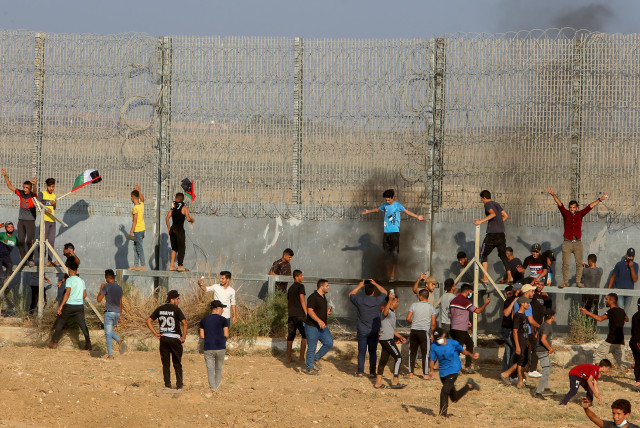
 Palestinian protesters clash with Israeli forces during a protest at the Israel-Gaza border, east of Gaza City, on August 21, 2021. (photo credit: ABED RAHIM KHATIB/FLASH90)

Hamas may try to attack the border fence in next round of fighting

The defense establishment believes Hamas may try to carry out attacks by damaging the border fence in the next round of fighting.

Six months after Operation Guardian of the Walls, the defense establishment is preparing as it expects Hamas to try and damage the border fence between the Gaza Strip and the southern border by blowing up car bombs, infiltrating Israeli territory and hitting soldiers. In an exercise held this week in the Gaza Division, the forces practiced such scenarios, including an infiltration into Israeli territory.

The aboveground barrier, made of steel, is about 65 km long and six meters high. It will extend from Zikim Beach to the Kerem Shalom crossing and its purpose is to prevent terrorists from entering Israeli territory from aboveground.

The defense establishment believes that Hamas leaders understood, as part of the conclusions drawn from Operation Guardian of the Walls, that alongside the attack tunnels, which its people continue to invest in, the organization must develop additional options for operations that it has used effectively in the past, but abandoned in recent years. The security tensions and stalemate in talks with Hamas over an agreement for calm and a prisoner swap agreement, mediated by Egypt, could push the organization to take action against Israel.

According to evaluations, as part of operational orders for when the order is given, Hamas members are training for raids and infiltrations into Israeli territory as well as the use of large explosive vehicles.

As mentioned, the defense establishment is aware of the fact that Hamas is investing a lot of effort in digging new defensive and attack tunnels and in rehabilitating the tunnels damaged in the operation. It is estimated that the route of the attack tunnels is approaching the barrier area, although no tunnel out into Israeli territory is known.

Hamas terror operatives in Gaza tunnel (credit: REUTERS)

Hamas terror operatives in Gaza tunnel (credit: REUTERS)

Israel has noticed that in recent months Hamas has been making a major effort to rehabilitate and improve its military capabilities, as a lesson from the operation in which its men found it difficult to hit IDF soldiers and targets along the border.

Among the areas in which Hamas is investing are: cyber warfare, unmanned aerial vehicles (UAVs), various airspace methods and anti-tank weapons. The IDF believes that the terrorist organization is not currently interested in a military confrontation due to the need to rehabilitate the Gaza Strip and its military capabilities. The defense establishment has identified a large presence of Hamas restraining forces in order to prevent clashes with the IDF. Recently, Hamas forces even aggressively arrested Palestinian Islamic Jihad (PIJ) terrorist operatives, in order to maintain stability in the region at this stage.In Israel, it is believed that incidents that may occur in security prisons, such as the death of a hunger striking PIJ prisoner, could lead to a terrorist attack and it is estimated that the PIJ is already preparing to carry out attacks. On the other hand, in recent months, Hamas leaders have repeatedly sent messages to the leadership of the PIJ that if the organization acts contrary to the position of the joint factions, its people will not receive military assistance from Hamas, as has already happened twice in recent years.