Saturday, September 28, 2019

The Iran-North Korean Nuclear Horn (Daniel 8:8)


Iranian Foreign Minister Mohammed Javad Zarif (right) and North Korean Foreign Minister Ri Yong Ho during their meeting in Tehran on Aug. 7, 2018
ATTA KENARE/AFP/Getty Images
Iran-North Korea: A Nuclear Partnership
What began with shared anti-American and anti-Israel ideologies continues with shared missile and nuclear development programs.
By Warren Reinsch • September 26
“A nuclear Iran would be transformative, a country not easily gone to war against, and one that will have considerably more power on the regional stage,” writes Hirsh Goodman in The Anatomy of Israel’s Survival.
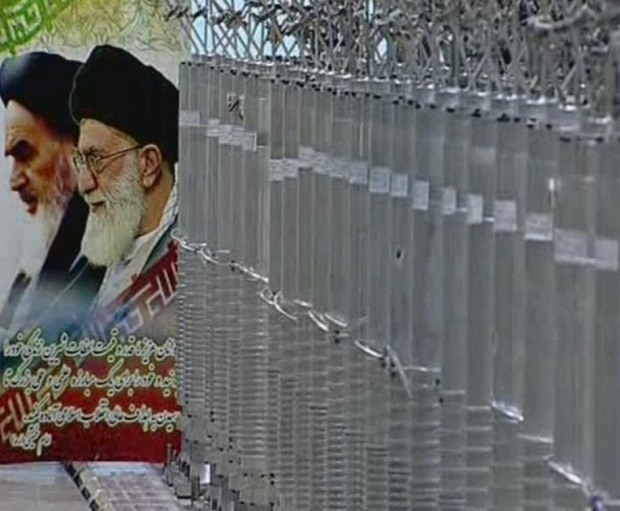
Iran’s frequent announcements about the advancements of its nuclear program have been widely reported in the news. As it pushes Europe to consent to its demand for sanctions relief, Iran has repeatedly broken the terms of the 2016 Joint Comprehensive Plan of Action nuclear agreement. Although its recent nuclear developments have been in the spotlight, a very important aspect of its sinister program remains dangerously underreported: Its shared nuclear cooperation with North Korea.
The two nations have a historically close relationship in the field of nuclear development, which began after the Islamic Revolution. When the whole world isolated Iran, North Korea came to the rescue. Ever since, the two radical regimes have been pushing the world closer to nuclear war.
A Prelude to Partnership
The 1979 Islamic Revolution of Iran saw the overthrow of the Western-backed Shah Mohammed Reza Palahvi by a theocratic republic led by Grand Ayatollah Ruhollah Khomeini. In response, the United States led an embargo on the new Iranian Republic. As a result, Iran sunk into a deep mire of economic instability.
Fearing the Islamic Revolution would spread to Iraq and topple his dictatorship, then Iraqi President Saddam Hussein led an invasion of Iran in 1980. It was in this desperate time of need—a time of devastating war and economic trouble—that Iran found an ally.
Attracted by their mutual anti-American and anti-Israel ideologies, the first premier of North Korea, Kim Il-sung, sought to increase diplomatic and economic ties between the two fledgling nations. The American-led embargo made it extremely difficult for Iran to acquire military armaments to use in its war against Iraq. Throughout the 1980s, the North Korean leader sent military aid to Iran.
A senior North Korean defector who worked in the munitions industries relayed his story to a journalist in South Korea. In cooperation with Iran’s Islamic Revolutionary Guard Corps, he said that he was tasked with the construction of several missile batteries on Iran’s island of Kish to enhance the Islamic Republic’s ability to control enemy ships traveling through the Strait of Hormuz. The former mechanic said, “The Iranians always remember that it was us who came to their defenses when the rest of the world isolated them.”
With North Korea’s support, Iran managed to withstand the Iraqi invasion. After the Iran-Iraq War ended in a ceasefire, the diplomatic ties between Iran and North Korea strengthened as the two nations developed even closer research and military cooperation.
Joint Research
In August 2012, North Korean former Vice Head-of-state Kim Yong-nam visited Tehran. During his visit, Iran and North Korea signed a formal scientific cooperation agreement calling for the establishment of joint laboratories, an exchange of Iranian and North Korean scientists, and the transfer of energy and information technology.
Iranian Supreme Leader Ayatollah Seyyed Ali Khamenei told Kim during the visit that “Iran and North Korea have common enemies since the arrogant powers can’t bear independent governments.”
Israeli analysts say that Iran’s and North Korea’s missile programs actually complement each other. According to Tablet Magazine, “Pyongyang has a better mastery of the electronics used in the navigation systems of the projectiles, while Tehran is seen as having a better grasp of the solid-fuel propellants used to ignite them.” By sharing these technologies, they have increased the effectiveness of their missile arsenals.
In some cases, it seems like Iran and North Korea have been synchronizing their tests. On July 4, 2017, North Korea tested its Hwasong-14 intercontinental ballistic missile. A few weeks later, on July 27, Iran tested its Simorgh space-launch vehicle. Both rockets are said to share many significant properties.
“Is it coincidental? Maybe. But it seems like they’re learning from each other,” said an Israeli intelligence analyst in Jerusalem. “It seems to be a two-way street.”
Missile Development
According to U.S. and Israeli officials, no nation has as close of a relationship with North Korea in the field of missile development as Iran. According to the National Interest, Iran has the largest stockpile of ballistic missiles in the Middle East, many of which are derivatives of North Korean models.
Iran’s Shahab-3 medium-range ballistic missile, which is capable of carrying a nuclear warhead, is a variant of North Korea’s Nodong-1 missile. The Center for Strategic and International Studies claims the Nodong-1 only had a range of 930 miles, while the Iranian Shahab-3 was upgraded to a range of about 1,200 miles. Whether North Korea sold Iran a complete Nudong-1 assembly line or received approximately 150 missiles from North Korea, the two nations helped each other upgrade their missile development. The missile’s major issue was its inaccuracy, which could land up to 1.2 miles away from its target. A later variant, called the Ghadr-1, has a shorter range but is reportedly more accurate. In the early 2000s, Iran, likely with North Korea’s navigation expertise, developed the Emad warhead, which made the two ballistic missiles much more accurate, maneuverable and stable.
When Iran announced its new Khorramshahr medium-range ballistic missile in September 2017, American and Israeli intelligence officials quickly recognized similarities with the North Korean Hwasong-10. North Korea is believed to have sold the technology to Iran.
According to Uzi Rabin, a missile expert at the Begin-Sadat Center of Strategic Studies in Tel Aviv, the Khorramshahr, which has a range of 1,200 miles to 2,100 miles, “constitutes a potential threat to Europe” because if it were equipped with a “lighter weight nuclear warhead,” the missile could “thereby threaten Berlin, Brussels, Paris and Rome.”
Additionally, the Iran-backed Houthi rebels in Yemen seem to have benefited from the North Korea connection. The Houthi Scud-type Borkan-3 missile, which proved accurate within at least 800 miles in an attack against a Saudi military site on August 1, is an upgraded version of the North Korean Hwasong-6.
As Iran and North Korea continue to work together, their military cooperation has expanded from solely missile development to sharing nuclear technology.
Iran’s Testing Ground
Since 2006, Iranian officials have attended at least six North Korean nuclear tests and several North Korean parades and missile tests. According to U.S. and Israeli intelligence from Iranian opposition groups, Islamic Revolutionary Guard Corps Gen. Mohsen Fakhrizadeh, the father of Iran’s nuclear program, attended a very important nuclear test in 2013 in North Korea. According to reports, it is likely that the test was focused around the detonation of a uranium bomb. This joint research cooperation between Iran and North Korea was all in the lead-up to the Jan. 16, 2016, implementation of the Iranian nuclear agreement, even while negotiations were underway.
Once Iran was forced to sign the Joint Comprehensive Plan of Action, it was subject to a number of regulations curbing its nuclear development. Iran was also required to consent to periodic inspections from the International Atomic Energy Agency. It was at this moment that Iran’s focus shifted. The nation, which previously pushed to develop the nuclear bomb, was suddenly desiring a “peaceful” nuclear program. It went from pushing to develop an intercontinental ballistic missile to developing the technology to launch a satellite into orbit—a similar yet more advanced technology—as an attempt to cover up its sinister schemes.
After the nuclear agreement, Iran shifted its focus: North Korea became Iran’s testing ground for nuclear development.
Trumpet editor in chief Gerald Flurry describes Iran’s nuclear program, its desire to develop the nuclear bomb, and the flaws of the Joint Comprehensive Plan of Action in his booklet The King of the South. After the agreement was signed by Iran, he asked: “Will Iran cheat? History says yes. When has it not cheated after making a significant agreement with the West?”
A few days after the nuclear deal was implemented, Melanie Phillips explained in an article for the Jerusalem Post that Iran had “outsourced the testing of the bomb to North Korea.” North Korea’s July 4, 2017, test of the Hwasong-14 intercontinental ballistic missile and Iran’s July 27, 2017, test of a space-launch vehicle add significant weight to the argument that the relationship between these radical regimes did not end, but rather strengthened.
“[M]aybe the Iranian nuclear negotiation was a blind from start to finish,” Phillips wrote. “The real action was going on in North Korea ….” She wrote that it’s likely that if North Korea has a certain technology, Iran either has the same technology, or at the very least has access to it.
In Nuclear Armageddon Is ‘At the Door,’ Mr. Flurry writes, “It gets even worse. B Jong-un shares his nuclear power with Iran, the number one terrorist-sponsoring nation in the world by far!”
In The King of the South, Mr. Flurry writes:
One of the most worrying aspects of Iran’s growing power is its flirtation with nuclear weaponry. Iran has had a nuclear program of its own for many years. Information leaks have shown that Iran, while publicly stating that its program is purely for energy use, actually want other nations to know it could be a nuclear threat. … Nuclear bombs and weapons are about to be put to use on a scale this world has never seen!
Several biblical passages indicate that nuclear war is coming. Isaiah 1:7 says the nations will become “desolate” and the cities will be “burned with fire.” Not even modern-day Israel—referring primarily to the United States, Britain and the State of Israel—will escape this warfare. (Request your free copy of The United States and Britain in Prophecy, by Herbert W. Armstrong, to understand the modern identity of ancient Israel.) Ezekiel 5:4 says, “[T]hereof shall a fire come forth into all the house of Israel.”
The book of Joel says the nuclear fallout will worsen to the point that “the sun and the moon shall be dark, and the stars shall withdraw their shining” (Joel 2:10). This horrific war is part of “the great and the terrible day of the Lord” (verse 31).
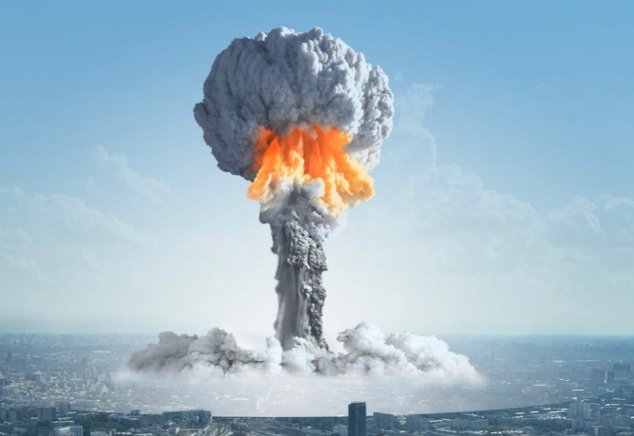
If mankind was left to himself, “there should no flesh be saved” (Matthew 24:22). This is where Iran’s push for nuclear proliferation is leading. Whether or not Iran acquires the nuclear bomb, it will galvanize a nuclear war.
Thankfully, there is hope. In the midst of this terrible destruction, Jesus Christ will return to this Earth. He will put an end to all war (Isaiah 2:4; Micah 4:3), heal the land (Hosea 6:1), and establish an everlasting kingdom of peace and prosperity (Daniel 2:44-45; Isaiah 9:6-7).
For more about Iran’s connection to North Korea and its deception around the nuclear agreement, read The King of the South, by Gerald Flurry.

Iran Advances Her Nuclear Horn (Revelation 8:4)


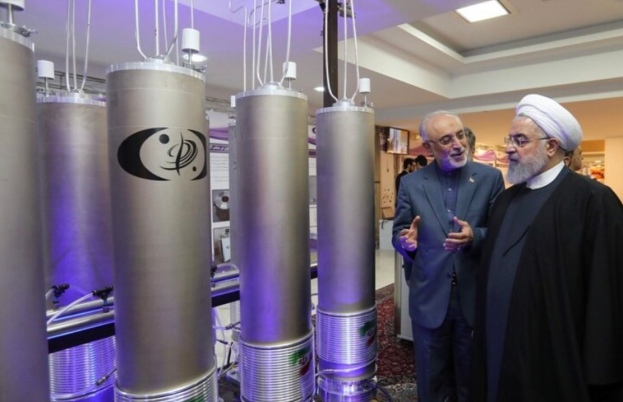
Iran is now using advanced centrifuge models to enrich uranium
(CNN) — Iran is using advanced models of centrifuges to enrich uranium, President Hasan Rouhani confirmed today.
The move marks another breach of the 2015 nuclear agreement which lifted economic sanctions against Iran in exchange for strict limits on the country’s nuclear program.
In 2018, President Donald Trump withdrew from the agreement, formally known as the Joint Comprehensive Plan of Action (JCPOA) — a move which Iran says nullified its own obligations. Trump has since reinstated sanctions on Iran.
Iran has already taken steps that are in breach of the landmark deal. It started increasing uranium enrichment beyond the purity threshold it originally agreed to, and has increased stockpiles of low-enriched uranium above the deal’s limits.
“The third step in the decrease of JCPOA commitments by us was that the limitations that we had vis a vis research and development; within the framework of the JCPOA we have left those limitations,” Rouhani told journalists at a press conference in New York City.

No Hope for the Iran Deal


Iranian Supreme Leader Ayatollah Ali Khamenei speaks in Tehran last April. (Iran Leader’s Press Office – handout/Anadolu Agency/Getty Images)
Ayatollah Ali Khamenei, Iran’s supreme leader, says there is no use believing that Britain, France and Germany will end up helping the Islamic Republic circumvent crushing sanctions imposed by the United States. “Despite their promises, the Europeans have adhered to America’s sanctions and have not taken any action, and are unlikely to do anything for the Islamic Republic in the future. So one should give up all hope on Europeans,” Khamenei’s official website quoted him as saying on Thursday. The US imposed the sanctions after withdrawing from a 2015 multilateral agreement intended to bar Tehran from developing nuclear weapons. Britain, France and Germany, which have stuck with the deal, are said to be working on a bartering mechanism that would allow Iran to import crucial goods such as food and medicine. These efforts, however, seem to be leading nowhere, and with a recent spike in tensions in the Gulf that have been blamed squarely on the Iranians, London, Paris and Berlin have taken a much more critical stance toward Tehran.
Personalize Your News
Upgrade your experience by choosing the storylines that matter most to you.

Rating Donald Trump: At least he’s not the Beast From the Sea (Revelation 13:1)


Rating Donald Trump: At least he’s not George W. Bush
By Zachary Karabell, Opinion Contributor
September 26, 2019 – 04:30 PM EDT
The views expressed by contributors are their own and not the view of The Hill
Let’s stipulate the following: By most measures, Donald Trump has been a problematic president. For some, he is the worst ever; for others, he is a hero for breaking the mold of Washington as usual, for deregulating, for appointing judges in a particular Federalist Society mold. His standing in national opinion polls is rather low for this point in a presidency, and augur a tough road to reelection.
For those who believe he is the worst ever – and, with this week’s scandal surrounding what Trump might have said to Ukraine’s president and the subsequent opening of an impeachment inquiry, that view has been amply reinforced – let’s stipulate something else: Nothing Trump has done, not a single thing, would rank in the top five of what George W. Bush did in the first term of his presidency in terms of sheer, utter, unequivocal harm to the United States, to its legal and governing norms, to the stability of the international system and to the economic security of Americans.
It is remarkable, and not a bit weird, how quickly the Bush years have receded into the past, with Bush himself the recipient of a Trump-era nostalgia for a time when men (yes, men) of character occupied the White House, honored the office and took the responsibilities of “leader of the free world” seriously. Bush’s somber, quiet rectitude during his father’s funeral earned him high accolades even from former adversaries. And he has been praised for staying above the fray as an ex-president and refusing to call out either Barack Obama or Trump when he disagrees with them.
And yet, Bush’s first term was an unmitigated disaster whose ill effects still bedevil the world, and from which we have never fully recovered. The fact that Trump occupies so much mind-space — because of his often odious language, lack of world view and utter disregard for law, norms, civility and thoughtful policy-making — seems to have obscured just how little he actually has done compared to his Republican predecessor, who did a lot and caused irreparable harm.
Let’s catalogue: In Bush’s first term, his administration either deliberately falsified or purposefully fudged intelligence reports about Iraq’s nuclear capabilities, as well as connections between Saddam Hussein and Osama bin Laden, in order to steer public opinion to support an invasion of Iraq that, by most estimates, took the lives of at least half a million Iraqi civilians in order to oust a brutal dictator.
Most of those deaths were not directly caused by American munitions or troops but by a combination of the subsequent Iraqi civil war and disease among refugees. But they were the product of a U.S. invasion that included, at best, minimal planning for the invasion’s aftermath; the resulting haphazard nature of the occupation, in turn, gave rise to a violent insurgency and a metastasizing Islamic extremism in the form of ISIS that ultimately helped turn Syria into a war zone.
The Bush administration also opened and then maintained both the extralegal prison system at Guantanamo Bay for suspected terrorists, interrogation techniques that skirted the line between agreed Geneva conventions and actual torture, and the Abu Ghraib prison in Iraq, which undoubtedly crossed that line. In addition, the administration actively solicited allies such as Egypt and Saudi Arabia for extralegal “rendition” of suspects for “enhanced” interrogation, all under the justification that the war on terror required extraordinary measures not contemplated under existing law.
For similar reasons, the administration authorized, via the National Security Agency, an extensive metadata spying program, purposely circumventing delegated congressional authority and declining to inform Congress. It was only terminated (purportedly) when the program came to light in 2004. Even the Department of Justice challenged the program’s legality at the time, with most of the department concluding that the program violated the law.
Those three things alone – the invasion of Iraq on false grounds and the subsequent chaos due to lack of planning, the sanctioning of torture and encouragement of it beyond U.S. borders, and domestic spying without congressional authorization – are beyond anything yet done or accomplished by Trump. But wait, as they say in late-night commercials, there’s more.
Bush’s first term also saw a substantial deregulation of the housing market and the financial markets in terms of due diligence and oversight of bank lending and financial sector risk. That had already begun during the 1990s when Bill Clinton was president, and enjoyed wide support among elites in both parties.
At the time, of course, those moves were seen not just as benign but actively beneficial not just to financial markets but to millions who could suddenly afford to buy homes and faced less scrutiny when applying for mortgages. Nonetheless, this loosening and indifference to earlier standards enabled the vast distortions in the financial system that helped set the stage for the massive financial crisis of 2008-2009. There were factors other than Bush administration policies, of course, but his role cannot be elided.
And, finally, following the highly questionable Supreme Court decision Bush v. Gore in 2000, the Bush administration opened the floodgates to a political system that now distorts the Electoral College and allows an administration to claim the mantle of a majority while winning a minority of the popular vote. The ballot results, if they had been counted in Florida as agreed on by Florida law, might, of course, have favored Bush and led to his election regardless. But by short-circuiting that process, the administration (with the help of the Supreme Court) set a precedent of cherry-picking law and precedent as it suits rather than being bound regardless. We are witnessing that tendency in excess today.
Recalling the harms of the Bush years is important because, in our hysterical present, where hyperbole is the coin of the realm, we have an unfortunate predilection to hold up “Now” as the worst of all possible worlds and forget just how bad it was only a few years ago.
Trump, for all his evident and multiple faults, has yet to manufacture an invasion of another country that not only costs thousands of lives but creates a trail of regional instability and global violence. He has not, as far as we know, unleashed the national security state on U.S. citizens at home, and he has not authorized torture. Grim conditions in detention camps on the Mexican border are pristine compared to Abu Ghraib or Guantanamo, and downright cushy compared to the “black” rendition sites of our allies in 2002; that doesn’t make border conditions defensible, but there is a material distinction that matters.
And while some of Trump’s deregulatory efforts could yet backfire, most would seem to enable possible corruption in oil, gas and land use contracts rather than systemic dangers a la the mid-2000s’ housing and mortgage bubble.
Some will say, “So, Bush was bad, but he’s in the past.” This reminder of the Bush administration should be a corrective to the view of terminal American decline, to the belief that we will never again be the same and that we are living in some sort of end-of-days. We’ve been worse in the past; we’ve also been far better. And here we are, to tell those tales and fight these fights.
Zachary Karabell, founder of the Progress Network and the author of a dozen books, including “The Leading Indicators: A Short History of the Numbers that Rule Our World,” is president of River Twice Research and River Twice Capital.

Friday, September 27, 2019

Two Centuries Before The Sixth Seal (Revelation 6:12)


The worst earthquake in Massachusetts history 260 years ago
It happened before, and it could happen again.
By Hilary Sargent @lilsarg
Boston.com Staff | 11.19.15 | 5:53 AM
On November 18, 1755, Massachusetts experienced its largest recorded earthquake.
The earthquake occurred in the waters off Cape Ann, and was felt within seconds in Boston, and as far away as Nova Scotia, the Chesapeake Bay, and upstate New York, according to the U.S. Geological Survey.
Seismologists have since estimated the quake to have been between 6.0 and 6.3 on the Richter scale, according to the Massachusetts Historical Society.
While there were no fatalities, the damage was extensive.
According to the USGS, approximately 100 chimneys and roofs collapsed, and over a thousand were damaged.
The worst damage occurred north of Boston, but the city was not unscathed.
A 1755 report in The Philadelphia Gazette described the quake’s impact on Boston:
“There was at first a rumbling noise like low thunder, which was immediately followed with such a violent shaking of the earth and buildings, as threw every into the greatest amazement, expecting every moment to be buried in the ruins of their houses. In a word, the instances of damage done to our houses and chimnies are so many, that it would be endless to recount them.”
The quake sent the grasshopper weathervane atop Faneuil Hall tumbling to the ground, according to the Massachusetts Historical Society.
An account of the earthquake, published in The Pennsylvania Gazette on December 4, 1755.
The earthquake struck at 4:30 in the morning, and the shaking lasted “near four minutes,” according to an entry John Adams, then 20, wrote in his diary that day.
The brief diary entry described the damage he witnessed.
“I was then at my Fathers in Braintree, and awoke out of my sleep in the midst of it,” he wrote. “The house seemed to rock and reel and crack as if it would fall in ruins about us. 7 Chimnies were shatter’d by it within one mile of my Fathers house.”
The shaking was so intense that the crew of one ship off the Boston coast became convinced the vessel had run aground, and did not learn about the earthquake until they reached land, according to the Massachusetts Historical Society.
In 1832, a writer for the Hampshire (Northampton) Gazette wrote about one woman’s memories from the quake upon her death.
“It was between 4 and 5 in the morning, and the moon shone brightly. She and the rest of the family were suddenly awaked from sleep by a noise like that of the trampling of many horses; the house trembled and the pewter rattled on the shelves. They all sprang out of bed, and the affrightted children clung to their parents. “I cannot help you dear children,” said the good mother, “we must look to God for help.”
The Cape Ann earthquake came just 17 days after an earthquake estimated to have been 8.5-9.0 on the Richter scale struck in Lisbon, Portugal, killing at least 60,000 and causing untold damage.
There was no shortage of people sure they knew the impretus for the Cape Ann earthquake.
According to many ministers in and around Boston, “God’s wrath had brought this earthquake upon Boston,” according to the Massachusetts Historical Society.
In “Verses Occasioned by the Earthquakes in the Month of November, 1755,” Jeremiah Newland, a Taunton resident who was active in religious activities in the Colony, wrote that the earthquake was a reminder of the importance of obedience to God.
“It is becaufe we broke thy Laws,
that thou didst shake the Earth.

O what a Day the Scriptures say,
the EARTHQUAKE doth foretell;
O turn to God; lest by his Rod,
he cast thee down to Hell.”
Boston Pastor Jonathan Mayhew warned in a sermon that the 1755 earthquakes in Massachusetts and Portugal were “judgments of heaven, at least as intimations of God’s righteous displeasure, and warnings from him.”
There were some, though, who attempted to put forth a scientific explanation for the earthquake.
Well, sort of.
In a lecture delivered just a week after the earthquake, Harvard mathematics professor John Winthrop said the quake was the result of a reaction between “vapors” and “the heat within the bowels of the earth.” But even Winthrop made sure to state that his scientific theory “does not in the least detract from the majesty … of God.”
It has been 260 years since the Cape Ann earthquake. Some experts, including Boston College seismologist John Ebel, think New England could be due for another significant quake.
In a recent Boston Globe report, Ebel said the New England region “can expect a 4 to 5 magnitude quake every decade, a 5 to 6 every century, and a magnitude 6 or above every thousand years.”
If the Cape Ann earthquake occurred today, “the City of Boston could sustain billions of dollars of earthquake damage, with many thousands injured or killed,” according to a 1997 study by the US Army Corps of Engineers.

Even Trump Realizes the Risk of the First Nuclear War


‘Those Are Two Nuclear Countries’: Trump Calls on Pakistan and India to ‘Work it Out’
New Delhi (Sputnik): US President Donald Trump said he had “very productive” conversations with the prime ministers of Pakistan and India on the sidelines of the UN General Assembly Session in New York.
US President Donald Trump has once again signalled his readiness to broker talks between Indian Prime Minister Narendra Modi and his Pakistani counterpart Imran Khan, whom he described as “two good friends”, on the long-standing Kashmir issue.
“You look at the two gentlemen heading those two countries — two good friends of mine — I said, ‘Fellas, work it out. Just work it out.’ Those are two nuclear countries. They’ve got to work it out,” said Trump in his opening remarks at the press conference.
The US president said that while, with many other nations, he talked about “achieving stronger ties of fair and reciprocal trade”, with Pakistan and India “we talked about Kashmir”.
“Because they’re at very serious odds right now, and hopefully that’ll get better,” he added.
Trump shared a stage at a stadium in Houston, Texas with Prime Minister Modi and addressed an Indian diaspora crowd numbering in the tens of thousands earlier this week, and later the two had bilateral discussions on a wide range of issues, including Kashmir and the trade deficit between US and India. He also met Pakistan’s Imran Khan on Monday on the sidelines of the UN General Assembly session in New York.
“I would be willing to help if both wanted. If both Pakistan, let’s say, and India wanted me to do that, I am ready, willing, and able. It’s a complex issue. It’s been going on for a long time. But if both wanted it, I would be ready to do it,” said the US president after the meeting with Khan.
Kashmir has been a major flashpoint between India and Pakistan, ever since they gained independence from British colonial rule in 1947. Both control part of Kashmir, but claim it in full. They’ve also fought three wars since then; two were over Kashmir.
Tensions between the nuclear-armed neighbours escalated in the first week of the August after New Delhi revoked Jammu and Kashmir’s special status. Pakistan, which claims to be a stakeholder in the Kashmir issue, reacted furiously to India’s move. Islamabad downgraded diplomatic ties with New Delhi and expelled the Indian envoy. Pakistan also suspended trade and communications with New Delhi and mounted a diplomatic offensive.

Trying to Survive Through the Fire (Revelation 16)


If a nuclear bomb is dropped on your city, here’s what you should (and shouldn’t) do to stay alive
Aria Bendix
DO: Drop to the ground with your face down and your hands tucked under your body.
Reuters/Issei Kato
The Centers for Disease Control and Prevention (CDC) recommends this position because it will keep your hands, arms, and face away from any flying debris or sweltering heat that could burn your skin. Once the shockwaves have subsided, you can get up and look for shelter.
DON’T: Stare directly at the blast.
Depending on how close you are to a nuclear explosion, it might be impossible to avoid the initial burst of light, which can blind you for about 15 seconds to a minute. But for those farther away, it’s best to avert and cover your eyes, according to the CDC.
A 1-megaton bomb (that’s about 80 times larger than the “Little Boy” atomic bomb dropped on Hiroshima, Japan) could temporarily blind people up to 13 miles away on a clear day, and up to 53 miles away on a clear night.
DO: Cover your face with a towel or article of clothing.
If you have a scarf or handkerchief nearby at the time of a nuclear explosion, it’s wise to cover your nose and mouth. Even before fallout reaches the ground, an explosion stirs up other debris that might be dangerous to breathe in.
DON’T: Seek shelter in your car.
The Federal Emergency Management Agency (FEMA) advises people not to take shelter in their vehicles. Cars’ glass windows and metal frames make them too flimsy to protect you from nuclear fallout. Driving away is also futile, since it’s tough to anticipate where radiation will travel.
The one exception to this rule is ducking inside your car in an underground parking garage, which could provide an added layer of protection.
DO: Find a brick or concrete building, such as a school or office.
FEMA identifies brick or concrete buildings as the safest forms of shelter after a nuclear attack. Ideally, the best shelter would have few to no windows and a basement for camping out.
Schools or offices usually meet these criteria. Mobile homes, however, are considered too fragile to offer enough protection.
If there aren’t any sturdy buildings within 15 minutes of where you’re standing, it’s better to find some form of shelter than stay outside. If you discover that there’s a safer building close by, wait at least an hour before attempting to move. By that time, the potential for radiation exposure would likely have decreased by around 55%.
DON’T: Stand near windows once you’re indoors.
If you take cover in multistory building, choose a central location and steer clear of the top and bottom floors.
If your structure has windows, FEMA advises standing far away from them, in the center of a room. That’s because shockwaves can shatter windows up to 10 miles away from an explosion, resulting in flying glass that could injure people who are too close.
DO: Shut off heaters and air conditioners.
Heating or air-conditioning units pull in air from the outside, so they could spread contaminated particles throughout your home or shelter.
DON’T: Search for your family members right away.
The US Department of Health and Human Services recommends staying indoors for at least 24 hours in the event of a nuclear explosion. After 48 hours, the exposure rate from a 10-kiloton explosion (the type that might damage but not destroy a city) goes down to just 1%.
“While sheltering is a priority for protecting public health, it goes against natural instincts,” a collection of government agencies wrote in a 2010 report. “After a nuclear detonation, people will need to understand why they and their families are safest staying sheltered.”
DO: Take a shower as soon as possible.
People who were outside during an explosion should shower as soon as possible, making sure the water is warm and soap is applied gently. Scrubbing too hard could break your skin, which acts as a natural protective barrier.
You should also cover any cuts or abrasions while you’re rinsing off. For those without access to a shower, FEMA recommends using a sink or faucet. The next-best option is to clean your body with a wipe or wet cloth. Blowing your nose and wiping your ears and eyelids is also important, since debris could get stuck in these orifices.
DON’T: Use conditioner after you shampoo.
Rinsing your hair with shampoo is critical after being exposed to radiation, but conditioner is a major no-no, according to the CDC.
That’s because conditioners carry compounds called cationic surfactants, which bind to radioactive particles and can trap them in your hair. They’d essentially act like glue between your hair and radioactive material.
As a general rule, it’s best to only use products on your body that are designed to get rinsed off in the aftermath of a nuclear disaster. Items like body lotion and face cream should wait until a second or third wish.
DO: Seal away contaminated clothes.
Because outer layers of clothing would likely be contaminated by fallout, the CDC recommends sealing them in a plastic bag that’s out of the reach of children and pets. You should also seal off any tissues or cloths used to wipe your body or face.
DON’T: Eat unpackaged food or food that was left outside.
Following any kind of nuclear explosion, the CDC says it’s alright to consume food from sealed containers such packages, bottles, or cans. You can also eat things from your pantry or refrigerator, as long as you wipe off food containers, cookware, counters, and utensils.
But anything that was left uncovered, especially if it was outdoors — such as fruits or veggies from a garden — would be unsafe to eat.
DO: Listen to the radio for instructions.
Nuclear explosions produce a powerful phenomenon called a nuclear electromagnetic pulse (EMP), an invisible burst of energy that can slash power, phone, and internet lines. A nuclear EMP could also disrupt radio waves, but that’s less likely, since radios have a simpler circuitry.
So in the wake of an explosion, emergency-response officials will likely broadcast safety instructions over the radio. Unless these officials tell you it’s safe to go outside, it’s best to stay put until the risk of contamination has gone down.