Earthquakes May Endanger New York More Than Thought, Says Study
A study by a group of prominent seismologists suggests that a pattern of subtle but active faults makes the risk of earthquakes to the New York City area substantially greater than formerly believed. Among other things, they say that the controversial Indian Point nuclear power plants, 24 miles north of the city, sit astride the previously unidentified intersection of two active seismic zones. The paper appears in the current issue of the Bulletin of the Seismological Society of America.
Many faults and a few mostly modest quakes have long been known around New York City, but the research casts them in a new light. The scientists say the insight comes from sophisticated analysis of past quakes, plus 34 years of new data on tremors, most of them perceptible only by modern seismic instruments. The evidence charts unseen but potentially powerful structures whose layout and dynamics are only now coming clearer, say the scientists. All are based at Columbia University’s Lamont-Doherty Earth Observatory, which runs the network of seismometers that monitors most of the northeastern United States.
Lead author Lynn R. Sykes said the data show that large quakes are infrequent around New Yorkcompared to more active areas like California and Japan, but that the risk is high, because of the overwhelming concentration of people and infrastructure. “The research raises the perception both of how common these events are, and, specifically, where they may occur,” he said. “It’s an extremely populated area with very large assets.” Sykes, who has studied the region for four decades, is known for his early role in establishing the global theory of plate tectonics.
The authors compiled a catalog of all 383 known earthquakes from 1677 to 2007 in a 15,000-square-mile area around New York City. Coauthor John Armbruster estimated sizes and locations of dozens of events before 1930 by combing newspaper accounts and other records. The researchers say magnitude 5 quakes—strong enough to cause damage–occurred in 1737, 1783 and 1884. There was little settlement around to be hurt by the first two quakes, whose locations are vague due to a lack of good accounts; but the last, thought to be centered under the seabed somewhere between Brooklyn and Sandy Hook, toppled chimneys across the city and New Jersey, and panicked bathers at Coney Island. Based on this, the researchers say such quakes should be routinely expected, on average, about every 100 years. “Today, with so many more buildings and people, a magnitude 5 centered below the city would be extremely attention-getting,” said Armbruster. “We’d see billions in damage, with some brick buildings falling. People would probably be killed.”
Starting in the early 1970s Lamont began collecting data on quakes from dozens of newly deployed seismometers; these have revealed further potential, including distinct zones where earthquakes concentrate, and where larger ones could come. The Lamont network, now led by coauthor Won-Young Kim, has located hundreds of small events, including a magnitude 3 every few years, which can be felt by people at the surface, but is unlikely to cause damage. These small quakes tend to cluster along a series of small, old faults in harder rocks across the region. Many of the faults were discovered decades ago when subways, water tunnels and other excavations intersected them, but conventional wisdom said they were inactive remnants of continental collisions and rifting hundreds of millions of years ago. The results clearly show that they are active, and quite capable of generating damaging quakes, said Sykes.
One major previously known feature, the Ramapo Seismic Zone, runs from eastern Pennsylvania to the mid-Hudson Valley, passing within a mile or two northwest of Indian Point. The researchers found that this system is not so much a single fracture as a braid of smaller ones, where quakes emanate from a set of still ill-defined faults. East and south of the Ramapo zone—and possibly more significant in terms of hazard–is a set of nearly parallel northwest-southeast faults. These include Manhattan’s 125th Street fault, which seems to have generated two small 1981 quakes, and could have been the source of the big 1737 quake; the Dyckman Street fault, which carried a magnitude 2 in 1989; the Mosholu Parkway fault; and the Dobbs Ferry fault in suburban Westchester, which generated the largest recent shock, a surprising magnitude 4.1, in 1985. Fortunately, it did no damage. Given the pattern, Sykes says the big 1884 quake may have hit on a yet-undetected member of this parallel family further south.
The researchers say that frequent small quakes occur in predictable ratios to larger ones, and so can be used to project a rough time scale for damaging events. Based on the lengths of the faults, the detected tremors, and calculations of how stresses build in the crust, the researchers say that magnitude 6 quakes, or even 7—respectively 10 and 100 times bigger than magnitude 5–are quite possible on the active faults they describe. They calculate that magnitude 6 quakes take place in the area about every 670 years, and sevens, every 3,400 years. The corresponding probabilities of occurrence in any 50-year period would be 7% and 1.5%. After less specific hints of these possibilities appeared in previous research, a 2003 analysis by The New York City Area Consortium for Earthquake Loss Mitigation put the cost of quakes this size in the metro New York area at $39 billion to $197 billion. A separate 2001 analysis for northern New Jersey’s Bergen County estimates that a magnitude 7 would destroy 14,000 buildings and damage 180,000 in that area alone. The researchers point out that no one knows when the last such events occurred, and say no one can predict when they next might come.
“We need to step backward from the simple old model, where you worry about one large, obvious fault, like they do in California,” said coauthor Leonardo Seeber. “The problem here comes from many subtle faults. We now see there is earthquake activity on them. Each one is small, but when you add them up, they are probably more dangerous than we thought. We need to take a very close look.” Seeber says that because the faults are mostly invisible at the surface and move infrequently, a big quake could easily hit one not yet identified. “The probability is not zero, and the damage could be great,” he said. “It could be like something out of a Greek myth.”
The researchers found concrete evidence for one significant previously unknown structure: an active seismic zone running at least 25 miles from Stamford, Conn., to the Hudson Valley town of Peekskill, N.Y., where it passes less than a mile north of the Indian Point nuclear power plant. The Stamford-Peekskill line stands out sharply on the researchers’ earthquake map, with small events clustered along its length, and to its immediate southwest. Just to the north, there are no quakes, indicating that it represents some kind of underground boundary. It is parallel to the other faults beginning at 125th Street, so the researchers believe it is a fault in the same family. Like the others, they say it is probably capable of producing at least a magnitude 6 quake. Furthermore, a mile or so on, it intersects the Ramapo seismic zone.
Sykes said the existence of the Stamford-Peekskill line had been suggested before, because the Hudson takes a sudden unexplained bend just ot the north of Indian Point, and definite traces of an old fault can be along the north side of the bend. The seismic evidence confirms it, he said. “Indian Point is situated at the intersection of the two most striking linear features marking the seismicity and also in the midst of a large population that is at risk in case of an accident,” says the paper. “This is clearly one of the least favorable sites in our study area from an earthquake hazard and risk perspective.”
The findings comes at a time when Entergy, the owner of Indian Point, is trying to relicense the two operating plants for an additional 20 years—a move being fought by surrounding communities and the New York State Attorney General. Last fall the attorney general, alerted to the then-unpublished Lamont data, told a Nuclear Regulatory Commission panel in a filing: “New data developed in the last 20 years disclose a substantially higher likelihood of significant earthquake activity in the vicinity of [Indian Point] that could exceed the earthquake design for the facility.” The state alleges that Entergy has not presented new data on earthquakes past 1979. However, in a little-noticed decision this July 31, the panel rejected the argument on procedural grounds. A source at the attorney general’s office said the state is considering its options.
The characteristics of New York’s geology and human footprint may increase the problem. Unlike in California, many New York quakes occur near the surface—in the upper mile or so—and they occur not in the broken-up, more malleable formations common where quakes are frequent, but rather in the extremely hard, rigid rocks underlying Manhattan and much of the lower Hudson Valley. Such rocks can build large stresses, then suddenly and efficiently transmit energy over long distances. “It’s like putting a hard rock in a vise,” said Seeber. “Nothing happens for a while. Then it goes with a bang.” Earthquake-resistant building codes were not introduced to New York City until 1995, and are not in effect at all in many other communities. Sinuous skyscrapers and bridges might get by with minimal damage, said Sykes, but many older, unreinforced three- to six-story brick buildings could crumble.
Art Lerner-Lam, associate director of Lamont for seismology, geology and tectonophysics, pointed out that the region’s major highways including the New York State Thruway, commuter and long-distance rail lines, and the main gas, oil and power transmission lines all cross the parallel active faults, making them particularly vulnerable to being cut. Lerner-Lam, who was not involved in the research, said that the identification of the seismic line near Indian Point “is a major substantiation of a feature that bears on the long-term earthquake risk of the northeastern United States.” He called for policymakers to develop more information on the region’s vulnerability, to take a closer look at land use and development, and to make investments to strengthen critical infrastructure.
“This is a landmark study in many ways,” said Lerner-Lam. “It gives us the best possible evidence that we have an earthquake hazard here that should be a factor in any planning decision. It crystallizes the argument that this hazard is not random. There is a structure to the location and timing of the earthquakes. This enables us to contemplate risk in an entirely different way. And since we are able to do that, we should be required to do that.”
New York Earthquake Briefs and Quotes:
Existing U.S. Geological Survey seismic hazard maps show New York City as facing more hazard than many other eastern U.S. areas. Three areas are somewhat more active—northernmost New York State, New Hampshire and South Carolina—but they have much lower populations and fewer structures. The wider forces at work include pressure exerted from continuing expansion of the mid-Atlantic Ridge thousands of miles to the east; slow westward migration of the North American continent; and the area’s intricate labyrinth of old faults, sutures and zones of weakness caused by past collisions and rifting.
Due to New York’s past history, population density and fragile, interdependent infrastructure, a 2001 analysis by the Federal Emergency Management Agency ranks it the 11th most at-risk U.S. city for earthquake damage. Among those ahead: Los Angeles, San Francisco, Seattle and Portland. Behind: Salt Lake City, Sacramento, Anchorage.
New York’s first seismic station was set up at Fordham University in the 1920s. Lamont-Doherty Earth Observatory, in Palisades, N.Y., has operated stations since 1949, and now coordinates a network of about 40.
Dozens of small quakes have been felt in the New York area. A Jan. 17, 2001 magnitude 2.4, centered in the Upper East Side—the first ever detected in Manhattan itself–may have originated on the 125th Street fault. Some people thought it was an explosion, but no one was harmed.
The most recent felt quake, a magnitude 2.1 on July 28, 2008, was centered near Milford, N.J. Houses shook and a woman at St. Edward’s Church said she felt the building rise up under her feet—but no damage was done.
Questions about the seismic safety of the Indian Point nuclear power plant, which lies amid a metropolitan area of more than 20 million people, were raised in previous scientific papers in 1978 and 1985.
Because the hard rocks under much of New York can build up a lot strain before breaking, researchers believe that modest faults as short as 1 to 10 kilometers can cause magnitude 5 or 6 quakes.
In general, magnitude 3 quakes occur about 10 times more often than magnitude fours; 100 times more than magnitude fives; and so on. This principle is called the Gutenberg-Richter relationship.
Showing posts with label Revelation. Show all posts
Showing posts with label Revelation. Show all posts
Tuesday, April 4, 2023


Sunday, February 12, 2023
Columbia University Warns Of Sixth Seal (Revelation 6:12)
Earthquakes May Endanger New York More Than Thought, Says Study
A study by a group of prominent seismologists suggests that a pattern of subtle but active faults makes the risk of earthquakes to the New York City area substantially greater than formerly believed. Among other things, they say that the controversial Indian Point nuclear power plants, 24 miles north of the city, sit astride the previously unidentified intersection of two active seismic zones. The paper appears in the current issue of the Bulletin of the Seismological Society of America.
Many faults and a few mostly modest quakes have long been known around New York City, but the research casts them in a new light. The scientists say the insight comes from sophisticated analysis of past quakes, plus 34 years of new data on tremors, most of them perceptible only by modern seismic instruments. The evidence charts unseen but potentially powerful structures whose layout and dynamics are only now coming clearer, say the scientists. All are based at Columbia University’s Lamont-Doherty Earth Observatory, which runs the network of seismometers that monitors most of the northeastern United States.
Lead author Lynn R. Sykes said the data show that large quakes are infrequent around New Yorkcompared to more active areas like California and Japan, but that the risk is high, because of the overwhelming concentration of people and infrastructure. “The research raises the perception both of how common these events are, and, specifically, where they may occur,” he said. “It’s an extremely populated area with very large assets.” Sykes, who has studied the region for four decades, is known for his early role in establishing the global theory of plate tectonics.
The authors compiled a catalog of all 383 known earthquakes from 1677 to 2007 in a 15,000-square-mile area around New York City. Coauthor John Armbruster estimated sizes and locations of dozens of events before 1930 by combing newspaper accounts and other records. The researchers say magnitude 5 quakes—strong enough to cause damage–occurred in 1737, 1783 and 1884. There was little settlement around to be hurt by the first two quakes, whose locations are vague due to a lack of good accounts; but the last, thought to be centered under the seabed somewhere between Brooklyn and Sandy Hook, toppled chimneys across the city and New Jersey, and panicked bathers at Coney Island. Based on this, the researchers say such quakes should be routinely expected, on average, about every 100 years. “Today, with so many more buildings and people, a magnitude 5 centered below the city would be extremely attention-getting,” said Armbruster. “We’d see billions in damage, with some brick buildings falling. People would probably be killed.”
Starting in the early 1970s Lamont began collecting data on quakes from dozens of newly deployed seismometers; these have revealed further potential, including distinct zones where earthquakes concentrate, and where larger ones could come. The Lamont network, now led by coauthor Won-Young Kim, has located hundreds of small events, including a magnitude 3 every few years, which can be felt by people at the surface, but is unlikely to cause damage. These small quakes tend to cluster along a series of small, old faults in harder rocks across the region. Many of the faults were discovered decades ago when subways, water tunnels and other excavations intersected them, but conventional wisdom said they were inactive remnants of continental collisions and rifting hundreds of millions of years ago. The results clearly show that they are active, and quite capable of generating damaging quakes, said Sykes.
One major previously known feature, the Ramapo Seismic Zone, runs from eastern Pennsylvania to the mid-Hudson Valley, passing within a mile or two northwest of Indian Point. The researchers found that this system is not so much a single fracture as a braid of smaller ones, where quakes emanate from a set of still ill-defined faults. East and south of the Ramapo zone—and possibly more significant in terms of hazard–is a set of nearly parallel northwest-southeast faults. These include Manhattan’s 125th Street fault, which seems to have generated two small 1981 quakes, and could have been the source of the big 1737 quake; the Dyckman Street fault, which carried a magnitude 2 in 1989; the Mosholu Parkway fault; and the Dobbs Ferry fault in suburban Westchester, which generated the largest recent shock, a surprising magnitude 4.1, in 1985. Fortunately, it did no damage. Given the pattern, Sykes says the big 1884 quake may have hit on a yet-undetected member of this parallel family further south.
The researchers say that frequent small quakes occur in predictable ratios to larger ones, and so can be used to project a rough time scale for damaging events. Based on the lengths of the faults, the detected tremors, and calculations of how stresses build in the crust, the researchers say that magnitude 6 quakes, or even 7—respectively 10 and 100 times bigger than magnitude 5–are quite possible on the active faults they describe. They calculate that magnitude 6 quakes take place in the area about every 670 years, and sevens, every 3,400 years. The corresponding probabilities of occurrence in any 50-year period would be 7% and 1.5%. After less specific hints of these possibilities appeared in previous research, a 2003 analysis by The New York City Area Consortium for Earthquake Loss Mitigation put the cost of quakes this size in the metro New York area at $39 billion to $197 billion. A separate 2001 analysis for northern New Jersey’s Bergen County estimates that a magnitude 7 would destroy 14,000 buildings and damage 180,000 in that area alone. The researchers point out that no one knows when the last such events occurred, and say no one can predict when they next might come.
“We need to step backward from the simple old model, where you worry about one large, obvious fault, like they do in California,” said coauthor Leonardo Seeber. “The problem here comes from many subtle faults. We now see there is earthquake activity on them. Each one is small, but when you add them up, they are probably more dangerous than we thought. We need to take a very close look.” Seeber says that because the faults are mostly invisible at the surface and move infrequently, a big quake could easily hit one not yet identified. “The probability is not zero, and the damage could be great,” he said. “It could be like something out of a Greek myth.”
The researchers found concrete evidence for one significant previously unknown structure: an active seismic zone running at least 25 miles from Stamford, Conn., to the Hudson Valley town of Peekskill, N.Y., where it passes less than a mile north of the Indian Point nuclear power plant. The Stamford-Peekskill line stands out sharply on the researchers’ earthquake map, with small events clustered along its length, and to its immediate southwest. Just to the north, there are no quakes, indicating that it represents some kind of underground boundary. It is parallel to the other faults beginning at 125th Street, so the researchers believe it is a fault in the same family. Like the others, they say it is probably capable of producing at least a magnitude 6 quake. Furthermore, a mile or so on, it intersects the Ramapo seismic zone.
Sykes said the existence of the Stamford-Peekskill line had been suggested before, because the Hudson takes a sudden unexplained bend just ot the north of Indian Point, and definite traces of an old fault can be along the north side of the bend. The seismic evidence confirms it, he said. “Indian Point is situated at the intersection of the two most striking linear features marking the seismicity and also in the midst of a large population that is at risk in case of an accident,” says the paper. “This is clearly one of the least favorable sites in our study area from an earthquake hazard and risk perspective.”
The findings comes at a time when Entergy, the owner of Indian Point, is trying to relicense the two operating plants for an additional 20 years—a move being fought by surrounding communities and the New York State Attorney General. Last fall the attorney general, alerted to the then-unpublished Lamont data, told a Nuclear Regulatory Commission panel in a filing: “New data developed in the last 20 years disclose a substantially higher likelihood of significant earthquake activity in the vicinity of [Indian Point] that could exceed the earthquake design for the facility.” The state alleges that Entergy has not presented new data on earthquakes past 1979. However, in a little-noticed decision this July 31, the panel rejected the argument on procedural grounds. A source at the attorney general’s office said the state is considering its options.
The characteristics of New York’s geology and human footprint may increase the problem. Unlike in California, many New York quakes occur near the surface—in the upper mile or so—and they occur not in the broken-up, more malleable formations common where quakes are frequent, but rather in the extremely hard, rigid rocks underlying Manhattan and much of the lower Hudson Valley. Such rocks can build large stresses, then suddenly and efficiently transmit energy over long distances. “It’s like putting a hard rock in a vise,” said Seeber. “Nothing happens for a while. Then it goes with a bang.” Earthquake-resistant building codes were not introduced to New York City until 1995, and are not in effect at all in many other communities. Sinuous skyscrapers and bridges might get by with minimal damage, said Sykes, but many older, unreinforced three- to six-story brick buildings could crumble.
Art Lerner-Lam, associate director of Lamont for seismology, geology and tectonophysics, pointed out that the region’s major highways including the New York State Thruway, commuter and long-distance rail lines, and the main gas, oil and power transmission lines all cross the parallel active faults, making them particularly vulnerable to being cut. Lerner-Lam, who was not involved in the research, said that the identification of the seismic line near Indian Point “is a major substantiation of a feature that bears on the long-term earthquake risk of the northeastern United States.” He called for policymakers to develop more information on the region’s vulnerability, to take a closer look at land use and development, and to make investments to strengthen critical infrastructure.
“This is a landmark study in many ways,” said Lerner-Lam. “It gives us the best possible evidence that we have an earthquake hazard here that should be a factor in any planning decision. It crystallizes the argument that this hazard is not random. There is a structure to the location and timing of the earthquakes. This enables us to contemplate risk in an entirely different way. And since we are able to do that, we should be required to do that.”
New York Earthquake Briefs and Quotes:
Existing U.S. Geological Survey seismic hazard maps show New York City as facing more hazard than many other eastern U.S. areas. Three areas are somewhat more active—northernmost New York State, New Hampshire and South Carolina—but they have much lower populations and fewer structures. The wider forces at work include pressure exerted from continuing expansion of the mid-Atlantic Ridge thousands of miles to the east; slow westward migration of the North American continent; and the area’s intricate labyrinth of old faults, sutures and zones of weakness caused by past collisions and rifting.
Due to New York’s past history, population density and fragile, interdependent infrastructure, a 2001 analysis by the Federal Emergency Management Agency ranks it the 11th most at-risk U.S. city for earthquake damage. Among those ahead: Los Angeles, San Francisco, Seattle and Portland. Behind: Salt Lake City, Sacramento, Anchorage.
New York’s first seismic station was set up at Fordham University in the 1920s. Lamont-Doherty Earth Observatory, in Palisades, N.Y., has operated stations since 1949, and now coordinates a network of about 40.
Dozens of small quakes have been felt in the New York area. A Jan. 17, 2001 magnitude 2.4, centered in the Upper East Side—the first ever detected in Manhattan itself–may have originated on the 125th Street fault. Some people thought it was an explosion, but no one was harmed.
The most recent felt quake, a magnitude 2.1 on July 28, 2008, was centered near Milford, N.J. Houses shook and a woman at St. Edward’s Church said she felt the building rise up under her feet—but no damage was done.
Questions about the seismic safety of the Indian Point nuclear power plant, which lies amid a metropolitan area of more than 20 million people, were raised in previous scientific papers in 1978 and 1985.
Because the hard rocks under much of New York can build up a lot strain before breaking, researchers believe that modest faults as short as 1 to 10 kilometers can cause magnitude 5 or 6 quakes.
In general, magnitude 3 quakes occur about 10 times more often than magnitude fours; 100 times more than magnitude fives; and so on. This principle is called the Gutenberg-Richter relationship.
A study by a group of prominent seismologists suggests that a pattern of subtle but active faults makes the risk of earthquakes to the New York City area substantially greater than formerly believed. Among other things, they say that the controversial Indian Point nuclear power plants, 24 miles north of the city, sit astride the previously unidentified intersection of two active seismic zones. The paper appears in the current issue of the Bulletin of the Seismological Society of America.
Many faults and a few mostly modest quakes have long been known around New York City, but the research casts them in a new light. The scientists say the insight comes from sophisticated analysis of past quakes, plus 34 years of new data on tremors, most of them perceptible only by modern seismic instruments. The evidence charts unseen but potentially powerful structures whose layout and dynamics are only now coming clearer, say the scientists. All are based at Columbia University’s Lamont-Doherty Earth Observatory, which runs the network of seismometers that monitors most of the northeastern United States.
Lead author Lynn R. Sykes said the data show that large quakes are infrequent around New Yorkcompared to more active areas like California and Japan, but that the risk is high, because of the overwhelming concentration of people and infrastructure. “The research raises the perception both of how common these events are, and, specifically, where they may occur,” he said. “It’s an extremely populated area with very large assets.” Sykes, who has studied the region for four decades, is known for his early role in establishing the global theory of plate tectonics.
The authors compiled a catalog of all 383 known earthquakes from 1677 to 2007 in a 15,000-square-mile area around New York City. Coauthor John Armbruster estimated sizes and locations of dozens of events before 1930 by combing newspaper accounts and other records. The researchers say magnitude 5 quakes—strong enough to cause damage–occurred in 1737, 1783 and 1884. There was little settlement around to be hurt by the first two quakes, whose locations are vague due to a lack of good accounts; but the last, thought to be centered under the seabed somewhere between Brooklyn and Sandy Hook, toppled chimneys across the city and New Jersey, and panicked bathers at Coney Island. Based on this, the researchers say such quakes should be routinely expected, on average, about every 100 years. “Today, with so many more buildings and people, a magnitude 5 centered below the city would be extremely attention-getting,” said Armbruster. “We’d see billions in damage, with some brick buildings falling. People would probably be killed.”
Starting in the early 1970s Lamont began collecting data on quakes from dozens of newly deployed seismometers; these have revealed further potential, including distinct zones where earthquakes concentrate, and where larger ones could come. The Lamont network, now led by coauthor Won-Young Kim, has located hundreds of small events, including a magnitude 3 every few years, which can be felt by people at the surface, but is unlikely to cause damage. These small quakes tend to cluster along a series of small, old faults in harder rocks across the region. Many of the faults were discovered decades ago when subways, water tunnels and other excavations intersected them, but conventional wisdom said they were inactive remnants of continental collisions and rifting hundreds of millions of years ago. The results clearly show that they are active, and quite capable of generating damaging quakes, said Sykes.
One major previously known feature, the Ramapo Seismic Zone, runs from eastern Pennsylvania to the mid-Hudson Valley, passing within a mile or two northwest of Indian Point. The researchers found that this system is not so much a single fracture as a braid of smaller ones, where quakes emanate from a set of still ill-defined faults. East and south of the Ramapo zone—and possibly more significant in terms of hazard–is a set of nearly parallel northwest-southeast faults. These include Manhattan’s 125th Street fault, which seems to have generated two small 1981 quakes, and could have been the source of the big 1737 quake; the Dyckman Street fault, which carried a magnitude 2 in 1989; the Mosholu Parkway fault; and the Dobbs Ferry fault in suburban Westchester, which generated the largest recent shock, a surprising magnitude 4.1, in 1985. Fortunately, it did no damage. Given the pattern, Sykes says the big 1884 quake may have hit on a yet-undetected member of this parallel family further south.
The researchers say that frequent small quakes occur in predictable ratios to larger ones, and so can be used to project a rough time scale for damaging events. Based on the lengths of the faults, the detected tremors, and calculations of how stresses build in the crust, the researchers say that magnitude 6 quakes, or even 7—respectively 10 and 100 times bigger than magnitude 5–are quite possible on the active faults they describe. They calculate that magnitude 6 quakes take place in the area about every 670 years, and sevens, every 3,400 years. The corresponding probabilities of occurrence in any 50-year period would be 7% and 1.5%. After less specific hints of these possibilities appeared in previous research, a 2003 analysis by The New York City Area Consortium for Earthquake Loss Mitigation put the cost of quakes this size in the metro New York area at $39 billion to $197 billion. A separate 2001 analysis for northern New Jersey’s Bergen County estimates that a magnitude 7 would destroy 14,000 buildings and damage 180,000 in that area alone. The researchers point out that no one knows when the last such events occurred, and say no one can predict when they next might come.
“We need to step backward from the simple old model, where you worry about one large, obvious fault, like they do in California,” said coauthor Leonardo Seeber. “The problem here comes from many subtle faults. We now see there is earthquake activity on them. Each one is small, but when you add them up, they are probably more dangerous than we thought. We need to take a very close look.” Seeber says that because the faults are mostly invisible at the surface and move infrequently, a big quake could easily hit one not yet identified. “The probability is not zero, and the damage could be great,” he said. “It could be like something out of a Greek myth.”
The researchers found concrete evidence for one significant previously unknown structure: an active seismic zone running at least 25 miles from Stamford, Conn., to the Hudson Valley town of Peekskill, N.Y., where it passes less than a mile north of the Indian Point nuclear power plant. The Stamford-Peekskill line stands out sharply on the researchers’ earthquake map, with small events clustered along its length, and to its immediate southwest. Just to the north, there are no quakes, indicating that it represents some kind of underground boundary. It is parallel to the other faults beginning at 125th Street, so the researchers believe it is a fault in the same family. Like the others, they say it is probably capable of producing at least a magnitude 6 quake. Furthermore, a mile or so on, it intersects the Ramapo seismic zone.
Sykes said the existence of the Stamford-Peekskill line had been suggested before, because the Hudson takes a sudden unexplained bend just ot the north of Indian Point, and definite traces of an old fault can be along the north side of the bend. The seismic evidence confirms it, he said. “Indian Point is situated at the intersection of the two most striking linear features marking the seismicity and also in the midst of a large population that is at risk in case of an accident,” says the paper. “This is clearly one of the least favorable sites in our study area from an earthquake hazard and risk perspective.”
The findings comes at a time when Entergy, the owner of Indian Point, is trying to relicense the two operating plants for an additional 20 years—a move being fought by surrounding communities and the New York State Attorney General. Last fall the attorney general, alerted to the then-unpublished Lamont data, told a Nuclear Regulatory Commission panel in a filing: “New data developed in the last 20 years disclose a substantially higher likelihood of significant earthquake activity in the vicinity of [Indian Point] that could exceed the earthquake design for the facility.” The state alleges that Entergy has not presented new data on earthquakes past 1979. However, in a little-noticed decision this July 31, the panel rejected the argument on procedural grounds. A source at the attorney general’s office said the state is considering its options.
The characteristics of New York’s geology and human footprint may increase the problem. Unlike in California, many New York quakes occur near the surface—in the upper mile or so—and they occur not in the broken-up, more malleable formations common where quakes are frequent, but rather in the extremely hard, rigid rocks underlying Manhattan and much of the lower Hudson Valley. Such rocks can build large stresses, then suddenly and efficiently transmit energy over long distances. “It’s like putting a hard rock in a vise,” said Seeber. “Nothing happens for a while. Then it goes with a bang.” Earthquake-resistant building codes were not introduced to New York City until 1995, and are not in effect at all in many other communities. Sinuous skyscrapers and bridges might get by with minimal damage, said Sykes, but many older, unreinforced three- to six-story brick buildings could crumble.
Art Lerner-Lam, associate director of Lamont for seismology, geology and tectonophysics, pointed out that the region’s major highways including the New York State Thruway, commuter and long-distance rail lines, and the main gas, oil and power transmission lines all cross the parallel active faults, making them particularly vulnerable to being cut. Lerner-Lam, who was not involved in the research, said that the identification of the seismic line near Indian Point “is a major substantiation of a feature that bears on the long-term earthquake risk of the northeastern United States.” He called for policymakers to develop more information on the region’s vulnerability, to take a closer look at land use and development, and to make investments to strengthen critical infrastructure.
“This is a landmark study in many ways,” said Lerner-Lam. “It gives us the best possible evidence that we have an earthquake hazard here that should be a factor in any planning decision. It crystallizes the argument that this hazard is not random. There is a structure to the location and timing of the earthquakes. This enables us to contemplate risk in an entirely different way. And since we are able to do that, we should be required to do that.”
New York Earthquake Briefs and Quotes:
Existing U.S. Geological Survey seismic hazard maps show New York City as facing more hazard than many other eastern U.S. areas. Three areas are somewhat more active—northernmost New York State, New Hampshire and South Carolina—but they have much lower populations and fewer structures. The wider forces at work include pressure exerted from continuing expansion of the mid-Atlantic Ridge thousands of miles to the east; slow westward migration of the North American continent; and the area’s intricate labyrinth of old faults, sutures and zones of weakness caused by past collisions and rifting.
Due to New York’s past history, population density and fragile, interdependent infrastructure, a 2001 analysis by the Federal Emergency Management Agency ranks it the 11th most at-risk U.S. city for earthquake damage. Among those ahead: Los Angeles, San Francisco, Seattle and Portland. Behind: Salt Lake City, Sacramento, Anchorage.
New York’s first seismic station was set up at Fordham University in the 1920s. Lamont-Doherty Earth Observatory, in Palisades, N.Y., has operated stations since 1949, and now coordinates a network of about 40.
Dozens of small quakes have been felt in the New York area. A Jan. 17, 2001 magnitude 2.4, centered in the Upper East Side—the first ever detected in Manhattan itself–may have originated on the 125th Street fault. Some people thought it was an explosion, but no one was harmed.
The most recent felt quake, a magnitude 2.1 on July 28, 2008, was centered near Milford, N.J. Houses shook and a woman at St. Edward’s Church said she felt the building rise up under her feet—but no damage was done.
Questions about the seismic safety of the Indian Point nuclear power plant, which lies amid a metropolitan area of more than 20 million people, were raised in previous scientific papers in 1978 and 1985.
Because the hard rocks under much of New York can build up a lot strain before breaking, researchers believe that modest faults as short as 1 to 10 kilometers can cause magnitude 5 or 6 quakes.
In general, magnitude 3 quakes occur about 10 times more often than magnitude fours; 100 times more than magnitude fives; and so on. This principle is called the Gutenberg-Richter relationship.
Wednesday, December 25, 2019
Israel Kills Civilians Outside the Temple Walls (Revelation 11)

Army says investigation into raid during Operation Black Belt showed that home in Dir al-Balah had been used by Islamic Jihad for terror activity
By TOI staffToday, 6:45 pm
The Israel Defense Forces on Tuesday defended an airstrike that killed nine civilian members of the same family in Gaza last month, saying the compound targeted was used by the Palestinian Islamic Jihad terror group.
Announcing that it had concluded its review of “Operation Black Belt,” which was sparked by Israel’s targeted killing of PIJ commander Baha Abu al-Ata last month, the army said “military activity had been conducted in the compound in the past as well as during the combat days of [the operation].”
“The review also concluded that when planning and carrying out the attack [in Deir el-Balah], it was estimated in the IDF that civilians would not be harmed as a result of an attack,” the IDF said in a statement. “The [review] clarified that even though military activity was conducted in the compound, it was not a closed compound, and in reality civilians were present there.”
The army said its investigation included recommendations on how to avoid such “irregular events” in the future, but didn’t give further details.
The IDF’s Arabic-language spokesman initially claimed on social media that the strike targeted the head of Islamic Jihad’s rocket unit, whom he identified as Rasmi Abu Malhous.
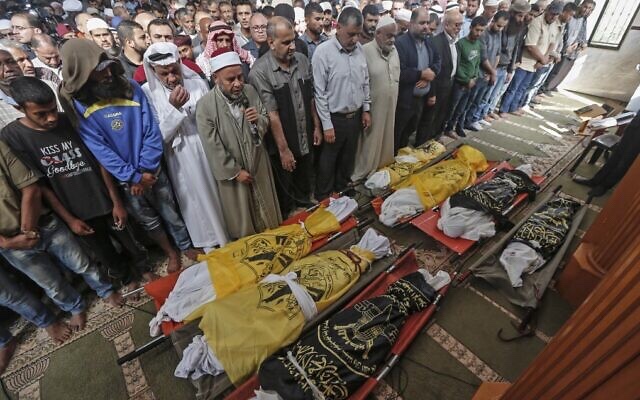
Palestinians attend the funeral procession of members of the same family who were killed in an Israeli airstrike, on November 14, 2019 in Deir al-Balah (MAHMUD HAMS / AFP)
However, no such figure exists in the Islamic Jihad organization, IDF officials told the Haaretz daily last month, and the claim appeared to have been based on false rumors that were spread on civilian channels on the Telegram application.
Neighbors who spoke on condition of anonymity told The Associated Press that Rasmi’s brother, who they claimed was an Islamic Jihad commander, lived in the home, but they said that he was not there at the time of the strike
Abu Malhous was killed, along with his wife, brother, sister-in-law and five children under the age of 13, including his 7-year-old son and two nephews, aged 2 and 3.
Haaretz reported that the IDF’s “target bank” which included the Sawarka family’s home targeted in the strike had not been updated to show that the site was no longer the home of a PIJ commander. Moreover, the daily interviewed a pair of Air Force pilots who said there is substantial pressure on their unit to produce as many targets as possible and that limited review is carried out on existing ones once they are in the target bank.
During the escalation of violence last month, Palestinian terror groups fired 450 or so rockets and mortars at Israel, which responded with many retaliatory strikes in Gaza. While the Israeli military said as many as 25 terrorists were killed in the days of fighting, Palestinian human rights monitors said the dead included 18 terror operatives and 16 civilians. They included three women and eight minors.Saturday, September 28, 2019
Rating Donald Trump: At least he’s not the Beast From the Sea (Revelation 13:1)

Rating Donald Trump: At least he’s not George W. Bush
By Zachary Karabell, Opinion Contributor
September 26, 2019 – 04:30 PM EDT
The views expressed by contributors are their own and not the view of The Hill
Let’s stipulate the following: By most measures, Donald Trump has been a problematic president. For some, he is the worst ever; for others, he is a hero for breaking the mold of Washington as usual, for deregulating, for appointing judges in a particular Federalist Society mold. His standing in national opinion polls is rather low for this point in a presidency, and augur a tough road to reelection.
For those who believe he is the worst ever – and, with this week’s scandal surrounding what Trump might have said to Ukraine’s president and the subsequent opening of an impeachment inquiry, that view has been amply reinforced – let’s stipulate something else: Nothing Trump has done, not a single thing, would rank in the top five of what George W. Bush did in the first term of his presidency in terms of sheer, utter, unequivocal harm to the United States, to its legal and governing norms, to the stability of the international system and to the economic security of Americans.
It is remarkable, and not a bit weird, how quickly the Bush years have receded into the past, with Bush himself the recipient of a Trump-era nostalgia for a time when men (yes, men) of character occupied the White House, honored the office and took the responsibilities of “leader of the free world” seriously. Bush’s somber, quiet rectitude during his father’s funeral earned him high accolades even from former adversaries. And he has been praised for staying above the fray as an ex-president and refusing to call out either Barack Obama or Trump when he disagrees with them.
And yet, Bush’s first term was an unmitigated disaster whose ill effects still bedevil the world, and from which we have never fully recovered. The fact that Trump occupies so much mind-space — because of his often odious language, lack of world view and utter disregard for law, norms, civility and thoughtful policy-making — seems to have obscured just how little he actually has done compared to his Republican predecessor, who did a lot and caused irreparable harm.
Let’s catalogue: In Bush’s first term, his administration either deliberately falsified or purposefully fudged intelligence reports about Iraq’s nuclear capabilities, as well as connections between Saddam Hussein and Osama bin Laden, in order to steer public opinion to support an invasion of Iraq that, by most estimates, took the lives of at least half a million Iraqi civilians in order to oust a brutal dictator.
Most of those deaths were not directly caused by American munitions or troops but by a combination of the subsequent Iraqi civil war and disease among refugees. But they were the product of a U.S. invasion that included, at best, minimal planning for the invasion’s aftermath; the resulting haphazard nature of the occupation, in turn, gave rise to a violent insurgency and a metastasizing Islamic extremism in the form of ISIS that ultimately helped turn Syria into a war zone.
The Bush administration also opened and then maintained both the extralegal prison system at Guantanamo Bay for suspected terrorists, interrogation techniques that skirted the line between agreed Geneva conventions and actual torture, and the Abu Ghraib prison in Iraq, which undoubtedly crossed that line. In addition, the administration actively solicited allies such as Egypt and Saudi Arabia for extralegal “rendition” of suspects for “enhanced” interrogation, all under the justification that the war on terror required extraordinary measures not contemplated under existing law.
For similar reasons, the administration authorized, via the National Security Agency, an extensive metadata spying program, purposely circumventing delegated congressional authority and declining to inform Congress. It was only terminated (purportedly) when the program came to light in 2004. Even the Department of Justice challenged the program’s legality at the time, with most of the department concluding that the program violated the law.
Those three things alone – the invasion of Iraq on false grounds and the subsequent chaos due to lack of planning, the sanctioning of torture and encouragement of it beyond U.S. borders, and domestic spying without congressional authorization – are beyond anything yet done or accomplished by Trump. But wait, as they say in late-night commercials, there’s more.
Bush’s first term also saw a substantial deregulation of the housing market and the financial markets in terms of due diligence and oversight of bank lending and financial sector risk. That had already begun during the 1990s when Bill Clinton was president, and enjoyed wide support among elites in both parties.
At the time, of course, those moves were seen not just as benign but actively beneficial not just to financial markets but to millions who could suddenly afford to buy homes and faced less scrutiny when applying for mortgages. Nonetheless, this loosening and indifference to earlier standards enabled the vast distortions in the financial system that helped set the stage for the massive financial crisis of 2008-2009. There were factors other than Bush administration policies, of course, but his role cannot be elided.
And, finally, following the highly questionable Supreme Court decision Bush v. Gore in 2000, the Bush administration opened the floodgates to a political system that now distorts the Electoral College and allows an administration to claim the mantle of a majority while winning a minority of the popular vote. The ballot results, if they had been counted in Florida as agreed on by Florida law, might, of course, have favored Bush and led to his election regardless. But by short-circuiting that process, the administration (with the help of the Supreme Court) set a precedent of cherry-picking law and precedent as it suits rather than being bound regardless. We are witnessing that tendency in excess today.
Recalling the harms of the Bush years is important because, in our hysterical present, where hyperbole is the coin of the realm, we have an unfortunate predilection to hold up “Now” as the worst of all possible worlds and forget just how bad it was only a few years ago.
Trump, for all his evident and multiple faults, has yet to manufacture an invasion of another country that not only costs thousands of lives but creates a trail of regional instability and global violence. He has not, as far as we know, unleashed the national security state on U.S. citizens at home, and he has not authorized torture. Grim conditions in detention camps on the Mexican border are pristine compared to Abu Ghraib or Guantanamo, and downright cushy compared to the “black” rendition sites of our allies in 2002; that doesn’t make border conditions defensible, but there is a material distinction that matters.
And while some of Trump’s deregulatory efforts could yet backfire, most would seem to enable possible corruption in oil, gas and land use contracts rather than systemic dangers a la the mid-2000s’ housing and mortgage bubble.
Some will say, “So, Bush was bad, but he’s in the past.” This reminder of the Bush administration should be a corrective to the view of terminal American decline, to the belief that we will never again be the same and that we are living in some sort of end-of-days. We’ve been worse in the past; we’ve also been far better. And here we are, to tell those tales and fight these fights.
Zachary Karabell, founder of the Progress Network and the author of a dozen books, including “The Leading Indicators: A Short History of the Numbers that Rule Our World,” is president of River Twice Research and River Twice Capital.
Tuesday, September 3, 2019
Why do Western analysts ignore Iran’s apocalyptic vision?

(Shutterstock)
Opinion: Do Western analysts ignore Iran’s apocalyptic vision?
September 1, 2019
The Islamist Shia doctrine embraced by the leadership of the Islamic Republic of Iran heralds the arrival of a messianic figure whose apocalyptic appearance will be preceded by violence, chaos and warfare.
By Lela Gilbert
Most American pundits write that current threats of violence and warnings of war are Iran’s boastful way of defying the U.S, and not only regarding its harsh economic sanctions, which presently have a strangle-hold on their leaders and institutions. Iran is also attempting to disrupt international oil shipments in the Persian Gulf and beyond.
But there is, perhaps, a less obvious reason as well. The Islamist Shia doctrine, embraced by the leadership of the Islamic Republic of Iran, heralds the arrival of a messianic figure known as the Twelfth or Hidden Imam. His apocalyptic appearance will be preceded by violence, chaos and warfare.
Most observers and pundits have concluded that Iran’s escalating threats of violence and drumbeats of war represent their defiant response to U.S. economic sanctions, which seem to have a strangle-hold on Iranian leaders and institutions. Meanwhile, upticks in Iran’s military activities have been widely reported and continue to be analyzed by U.S. military leaders.
However, on Aug. 6, the invaluable MEMRI news site – which translates and broadcasts speeches, sermons or other pronouncements by sheikhs, imams and mullahs – reported the words of senior Iranian Ayatollah Mohammad Mehdi Mirbagheri: “In order for the Hidden Imam to reappear, we must engage in widespread fighting with the West.”
By daybreak on Sunday morning, Aug. 25, virtually every Middle East news source was headlining the same story: An unprecedented direct attack by Israeli forces on an Iranian Quds Force base had taken place in Syria. The attack was preemptive, in advance of an assault by a number of Iranian “killer drones,” which Israeli military intelligence had detected.
For months, Middle East news sources have reported a mounting crescendo of hostility emanating from Iran, along with encroachment of its tentacle-like militias into several nearby countries – Iraq, Syria, Lebanon, Yemen and Afghanistan. Meanwhile, tensions surrounding shipping routes in the Persian Gulf and the Straits of Hormuz have not abated for weeks.
Along with ever-increasing efforts to magnify their power and prowess, Iran’s ceaseless antagonism continues to be amplified by repeated chants of “Death to America” and “Death to Israel.”
Iran’s ambitions for regional supremacy are nothing new. Since the 1979 Iranian Revolution led by Ayatollah Ruhollah Khomeini, the regime has proved itself a dangerous foe to any and all who do not embrace its radical ayatollahs’ views.
Its response has played out in international terrorism, state-funded violence by numerous proxies and horrendous human rights abuses.
In recent years, Iran’s thinly veiled efforts to develop a nuclear weapon, along with its accompanying ballistic missile delivery system, has elevated global concerns to an urgent level. In response, former U.S. President Barack Obama tried to slow down the nuke development process by negotiating the 2015 Joint Comprehensive Plan of Action (JCPOA), while handing over untold billions of U.S. dollars to assuage the mullahs’ antagonism.
The results of the 2016 U.S. presidential elections reflected considerable push-back against Obama’s strategy. Many Americans and Israelis viewed the JCPOA it as a flawed and unenforceable agreement.
In May 2018, President Donald Trump pulled out of the JCPOA and subsequently slammed heavy financial sanctions on Iran’s leadership, military and oil exports. That September, the discovery by Israeli intelligence of a warehouse-sized cache of nuclear-related files inside Iran was revealed, which cast even deeper doubt on the veracity of the Iranian regime’s denials of nuclear ambitions.
The Hidden Imam
Some observers are aware of the deeply religious nature of Iran’s regime. However, in the U.S. and Western Europe, references to religious influences in international affairs are often disregarded.
But some declarations should not be overlooked. And that includes references – particularly among Iran’s highest levels of leadership – to the Hidden Imam.
The Hidden, or Twelfth Imam plays a dominant role in one specific form of Shi’ite Islamic theology, called “Twelverism” – which happens to be the primary belief system of Iran’s leadership. There is a messianic belief that, at the end of days, the Hidden Imam will appear in the midst of a violent apocalyptic scenario, played out on a battleground stained with infidels’ blood.
About a month before Mirbagheri’s sermon, Lebanon’s Hezbollah leader Sayyed Nasrallah declared that while “life and death are in the hands of God, logic points to me praying in Al-Aqsa mosque.”
Bear in mind that while serving as Iran’s most influential religious and political emissary in Lebanon, Nasrallah has been living in a secret underground “bunker” ever since the 2006 Israel-Lebanon War.
Meanwhile, the Al-Aqsa Mosque, one of Islam’s holy sites, is located on the Temple Mount in Jerusalem. And that has remained Judaism’s most holy site, where the Jewish Temple stood until 70 CE. Nasrallah’s prediction essentially meant that, at some point, Israel would no longer be able to prevent his emergence from his Lebanese hideout and entrance into the Holy City.
Just days after Nasrallah’s declaration, Iran’s Supreme Leader Khamenei affirmed that prediction: “The return of this holy land [Israel] to the World of Islam is not a strange and unattainable matter.” He declared Nasrallah’s goal of praying at the Al-Aqsa Mosque “an absolutely practical and achievable aspiration for us.”
More recently, as I reflected on the intensifying tension between the West, Israel and Iran, I came across a blog post by Saeed Ghasseminejad, an Iranian scholar who is now in the West, serving as a fellow at Washington, D.C.’s highly respected Foundation for Defense of Democracies (FDD).
In 2013, he penned an article titled “Iran’s Apocalyptic Policy Makers.” He wrote:
Two of the most lunatic and apocalyptic high-ranking figures in Iran are Ayatollah Ali Khamenei himself and his now disgraced one-time protégé, Mahmoud Ahmadinejad… While many experts tell us Iran is a rational, pragmatic regime like any other in the world, all the facts shout that it is not.
“A large number of Iranian officials and decision makers have deeply rooted apocalyptic beliefs. Underestimating this radical ideology even as the Iranian regime is on its way to building a nuclear bomb can lead to dangerously wrong conclusions. The suggestion taking hold of late that a nuclear armed Iran is not the end of the world may unfortunately be dead wrong.
He also wrote, “To IRGC officers, Mahdi may be hidden, but he is far from absent. In a rare public appearance at Qum, Ghassem Soleimani, the notorious commander of the Quds force, said that during the Iran-Iraq war some IRGC commanders in war-fronts were in contact with the Hidden Imam.”
Apocalyptic thought ‘overlooked’
With all this in mind, I contacted Ghasseminejad to learn more about how these apocalyptic convictions may be affecting Iran’s current aggressions.
“This apocalyptic aspect of the Islamic regime in Tehran is usually overlooked by analysts in the West,” he explained, “probably because God is more or less dead among the elite in the West, and it is hard for them to imagine that apocalyptic religious thought can turn into actual policies pursued by the State.”
Clearly in much of the Middle East, however, belief in God is very much alive, and deeply held dogmas can influence decisions made by policymakers. As with Judaism and Christianity, the idea of a coming Messiah and apocalypse is a central Islamic belief.
“The key,” Ghasseminejad told me, “is that Khomeini belonged to a minority school of thought in the Twelver Shia community who believe that Ulama (clerics) should rule, and their rule would be legitimate because they were deputies of the hidden Imam and they were preparing the world for his reappearance of the hidden Imam.
“So what does that have to do,” I asked, “with Tehran’s extremely aggressive anti-Israel and anti-Saudi foreign policy?”
“I think it can be explained, at least partly, by the importance of Jerusalem in the apocalyptic Shia literature. And the same is true about Mecca, which is the place where the Hidden Imam will reappear.”
“To summarize,” Ghasseminejad concluded, “I think the Islamic Republic of Iran and its leadership’s apocalyptic vision can explain a good part of what Tehran is doing in the region. And ignoring it leads to misinterpretation of Tehran’s decisions.
“While I do not believe the apocalyptic ideology is the only force behind the regime’s decision-making process, I think it plays a significant role in how the Supreme Leader and the IRGC see the world.”
Lela Gilbert is an award-winning writer who has authored or co-authored more than 60 books. She lived in Israel for ten years, is a fellow at Hudson Institute and also writes for Jerusalem Post, Fox News, World Israel News and various other publications. This article was first published by Religion Unplugged.
Thursday, August 22, 2019
Shiites Shoot Down Another US Drone
U.S. drone shot down over Yemen: officials
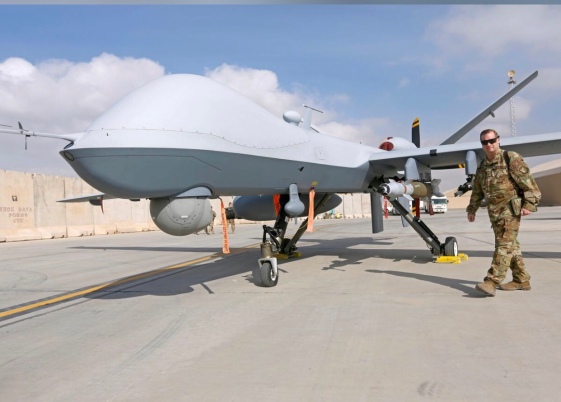
WASHINGTON (Reuters) – A U.S. military MQ-9 drone was shot down in Yemen’s Dhamar governate, southeast of the Houthi-controlled capital Sanaa, two U.S. officials told Reuters on Wednesday, the second such incident in recent months.
FILE PHOTO: U.S. Air Force officer passes in front of a MQ-9 Reaper drone, one of a squadron that has arrived to step up the fight against the Taliban, at the Kandahar air base, Afghanistan January 23, 2018. REUTERS/Omar Sobhani
A Houthi military spokesman had earlier said that air defenses had brought down a U.S. drone.
The officials, speaking on the condition of anonymity, said the drone was shot down late on Tuesday.
This is not the first time a U.S. drone has been shot down in Yemen. In June, the U.S. military said that Houthi rebels had shot down a U.S. government-operated drone with assistance from Iran.
U.S. forces have occasionally launched drone and air strikes against Yemen’s al Qaeda branch, known as Al Qaeda in the Arabian Peninsula (AQAP).
The group has taken advantage of a four-year-old war between the Houthi movement and President Abd-Rabbu Mansour Hadi’s Saudi-backed government to try to strengthen its position in the impoverished country.
One of the officials said that it appeared that the armed military drone, made by California-based General Atomics, had been shot down by a surface-to-air missile operated by the Iran-aligned Houthi group.
“It appears to have been fired by the Houthis and enabled by Iran,” the official said, without providing details or specific evidence.
The official said that while losing a drone was expensive, it was not unprecedented and it was unlikely to lead to any major response by the United States.
The other official cautioned that it was too early to tell who was responsible for the incident.
In a statement, the U.S. military said it was investigating reports that a drone had been attacked “in authorized airspace over Yemen.”
“We have been clear that Iran’s provocative actions and support to militants and proxies, like the Iranian-backed Houthis, poses a serious threat to stability in the region and our partners,” the U.S. military’s Central Command said.
The White House said it was aware of the reports and President Donald Trump had been briefed on the matter.
“This attack is only possible because of Iran’s lethal aid to the Houthis and serves as yet another example of the regime’s relentless efforts to escalate conflict and threaten regional stability,” National Security Council spokesman Garrett Marquis said.
Iran rejects accusations from the United States and its Gulf Arab allies that Tehran is providing military and financial support to the Houthis and blames Riyadh for the deepening crisis there.
Overnight, Houthi military spokesman Yahya Saria said that the drone had been shot down.
“The rocket which hit it was developed locally and will be revealed soon at a press conference,” Saria said on Twitter.
“Our skies are no longer open to violations as they once were and the coming days will see great surprises,” he added.
The drone shoot-down comes as tensions between Iran and the United States have risen since Trump’s administration last year quit an international deal to curb Iran’s nuclear ambitions and began to ratchet up sanctions. Iranian officials denounced the new penalties as “economic warfare.”
In June, Iran shot down a U.S. Global Hawk drone, far larger than the MQ-9 drone, and almost led to retaliatory U.S. strikes. Trump later said he had called off the strikes because it could have killed 150 people.
Reporting by Idrees Ali. Additional reporting by Steve Holland in Washington and Lisa Barrington in Dubai; Editing by Nick Zieminski and Steve Orlofsky
More Proxy Wars in Iraq (Daniel)
Iraq Hit By New Blasts After Israel Hints It Can Attack Iran There
By Tom O’Connor On 8/20/19 at 5:58 PM EDT
Explosions rocked once again rocked military positions in Iraq just days after the country imposed new airspace restrictions and Israel hinted it would target Iran there.
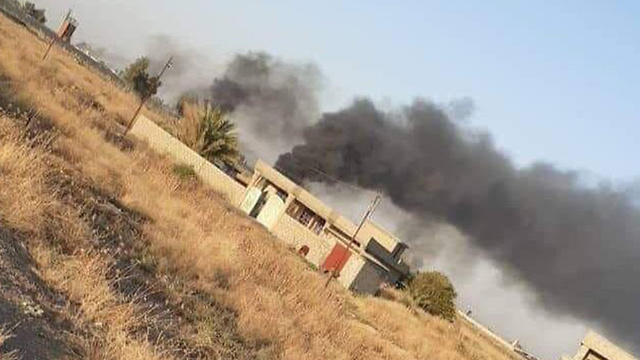
Iraq’s Civil Defense announced Tuesday that firefighters managed to contain a fire that broke out at a site in Balad, a city in Salaheddin province north of Baghdad, following a series of blasts of yet undetermined cause. Iraqi Defense Minister Najah al-Shammari also flew to the nearby Balad Air Base, an installation known to host U.S. forces and contractors, and visited the site, confirming there were no casualties and ordering his men to search the premises.
Various outlets such as Al Jazeera and BBC cited unnamed Iraqi officials who identified the site of the explosions as a base for one of the state-sponsored militias comprising the Popular Mobilization Forces, a mostly Shiite Muslim gathering with ties to Iran. Reuters cited one paramilitary official as saying the site was targeted by air.
The incident comes just over a week after another arms depot explosion killed one person and injured more than a dozen others outside of Baghdad and a month after two more explosions at sites elsewhere in Salaheddin and the Diyala province, fueling speculation that Israel had expanded its anti-Iran campaign in neighboring Syria.
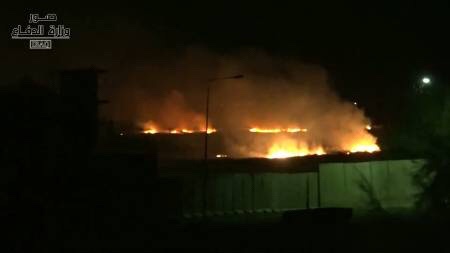
Flames burn at a weapons depot near Balad Air Base in Iraq’s northern Salaheddin province following reports of blasts, August 20. The explosion is the latest in a series of mysterious such incidents to take place at sites said to be connected to the Popular Mobilization Forces. Iraqi Ministry of Defense
Since overthrowing the government in 2003, Washington has generally worked alongside Baghdad, while remaining critical of Tehran’s close ties as all three tried to tackle a growing Islamist insurgency led first by Al-Qaeda and later by the Islamic State militant group (ISIS). With the jihadis largely defeated and U.S.-Iran tensions on the rise, however, Iraqi Prime Minister Adel Abdul-Mahdi has warned he would not let his country become a battleground for the two foes.
The U.S.-led coalition against ISIS has denied its participation in the previous attacks, however, and announced Friday it would comply with new, stricter regulations announced by Iraq. The new policy canceled all previous permissions granted for Iraqi and non-Iraqi aerial forces and stated that parties much ask new permissions or be treated as “hostile aviation.” As an investigation into the most recent blasts continued, eyes were on another suspect, Israel, which has launched hundreds of attacks against alleged Iran-associated sites in Syria and has vowed to take this campaign elsewhere too.
Israeli Prime Minister Benjamin Netanyahu further fueled this speculation told reporters Thursday that “Iran has no immunity, anywhere” as quoted by The Times of Israel. He added: “We will act — and currently are acting — against them, wherever it is necessary.”
Netanyahu gave similar statements ahead of revealing Israel’s years-long campaign in Syria, where Iran has also been accused of using allied groups to set up forward bases. Like Washington, Tehran has argued the presence of its forces and those of partnered fighters were necessary to battle terrorism, though both foes accuse one another of sponsoring militant groups responsible for destabilizing the region.
Such claims led President Donald Trump’s administration last year to abandon a 2015 nuclear deal with Iran that was opposed by Israel but endorsed by China, the European Union, France, Germany, Russia and the United Kingdom. Despite Tehran’s compliance with the agreement, Washington has slapped the Islamic Republic with strict sanctions designed to undermine its economy and leadership.
Tensions accelerated between the longtime foes in the Persian Gulf region in recent months as the U.S. accused Iran of attacking commercial vessels in the Gulf of Oman and both claimed to have downed one another’s drones in the Strait of Hormuz. The Trump administration has called for a multinational maritime security initiative to safeguard the flow of goods in the region, but so far the only participant was the U.K., which recently released a detained Iranian oil tanker despite an appeal by the U.S. not to.
Israel too has expressed interest in joining such a coalition, angering Iran and frustrating U.S. allies on the Arabian Peninsula who do not formally recognize Israel but have informally joined it in a coalition meant to isolate Iran. As he sought to muster regional opposition toward Israeli presence in the region, Iranian Defense Minister Amir Hatami said earlier this month that such a move “could be very provocative and have disastrous consequences for the region.”
Monday, August 19, 2019
Iran’s Aggression and the Shi’ite Apocalypse (Daniel 8:4)
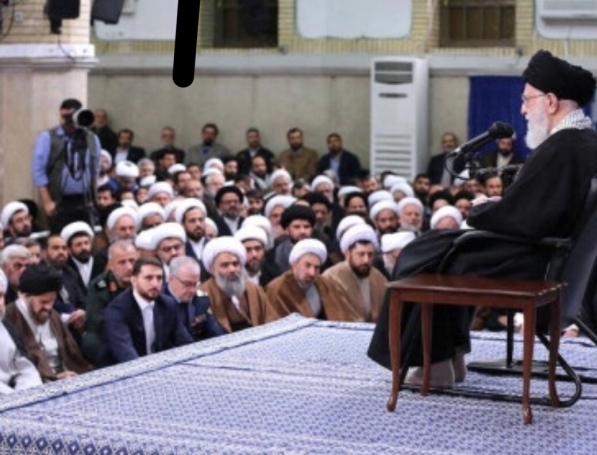
By LELA GILBERT
Why does Iran continue to saber-rattle and threaten to massacre Israelis? Why do Iranian religious and military leaders constantly vow to impose terrible violence on their enemies? And why is the ever-escalating aggression carried on by various Iranian proxies across the Middle East?
These days, international commentators assume that threats of violence and warnings of war are Iran’s boastful way of defying US economic sanctions, which presently have a strangle-hold on their leaders and institutions. Meanwhile, disturbances in the Persian Gulf have underscored the Islamic Republic’s rage at America’s withdrawal from the JCPOA.
But there is, perhaps, another reason as well – an apocalyptic belief that is widely held by Iran’s supreme leader and his followers.
On August 6, the indispensable MEMRI news site – which translates and broadcasts speeches, sermons or other pronouncements by sheikhs, imams and mullahs – reported the words of senior Iranian Ayatollah Mohammad Mehdi Mirbagheri: “In Order for the Hidden Imam to Reappear We Must Engage in Widespread Fighting with the West.”
Meanwhile, in recent weeks, the regime has threatened to cut off international routes for petroleum shipments. Oil tankers have been attacked, seized or threatened. And there has been a nearly constant stream of doomsday warnings – “Death to America” and “Death to Israel.”
In mid-July, Lebanon’s Hezbollah leader, Sayyed Nasrallah, declared that while “life and death are in the hands of God, logic points to me praying in Al-Aqsa mosque.” Bear in mind that while serving as Iran’s front-man in Lebanon, Nasrallah has been living in a secret underground location ever since the 2006 Israel-Lebanon War.
Al-Aqsa Mosque is, of course, located on the Temple Mount in Jerusalem. So Nasrallah’s prediction essentially means that at some point, Israel will no longer be able to prevent his coming out of hiding to enter the Holy City.
Then, just days after that declaration, Iran’s Supreme Leader Khamenei affirmed Nasrallah’s prediction: “The return of this holy land [Israel] to the World of Islam is not a strange and unattainable matter.” He declared Nasrallah’s goal of praying at the Al-Aqsa Mosque “an absolutely practical and achievable aspiration for us.”
Some observers are aware of the deeply religious nature of Iran’s regime. However, in the US and Western Europe particularly, references to religious influences in international affairs are either disregarded or find their way into an editor’s trash can.
But in fact, some declarations should not be overlooked. And that includes references – particularly among Iran’s highest levels of leadership – to the Hidden Imam.
The Hidden – or Twelfth – Imam plays a dominant role in one specific form of Shi’ite Islamic theology, called “Twelverism,” which happens to be the primary belief system of Iran’s leadership. There is a messianic belief that at the end of days, the Hidden Imam will appear in the midst of a violent apocalyptic scenario played out on a battleground stained with infidels’ blood.
My first awareness of this Shi’ite theological issue came from a 2009 book, The Rise of Nuclear Iran, written by Ambassador Dore Gold, who serves as an advisor to Israel’s Prime Minister Benyamin Netanyahu.
More recently, as I reflected on the intensifying tension between the West, Israel and Iran, I came across a blog post from an Iranian scholar who is now serving as a fellow at Washington DC’s highly respected Foundation for Defense of Democracies (FDD). In 2013, Saeed Ghasseminejad penned an article titled “Iran’s Apocalyptic Policy Makers.” He wrote:
“Two of the most lunatic and apocalyptic high-ranking figures in Iran are Ayatollah Ali Khamenei himself and his now disgraced one-time protégé, Mahmoud Ahmadinejad. While Khamenei deeply believes his task is to prepare for Mahdi’s appearance, Ahmadinejad takes the apocalyptic narrative to an unprecedented level of lunacy and weirdness, even by the Islamic republic’s measures. He believes, for example, that the real reason behind the US invasion of Iraq was to search for the Hidden Imam and to postpone his appearance. Many observers believe Khamenei chose Ahmadinejad as president mainly because of their shared belief in this apocalyptic version of Islam.
“While many experts tell us Iran is a rational, pragmatic regime like any other in the world, all the facts shout that it is not. A large number of Iranian officials and decision makers have deeply rooted apocalyptic beliefs. Underestimating this radical ideology even as the Iranian regime is on its way to building a nuclear bomb can lead to dangerously wrong conclusions. The suggestion taking hold of late that a nuclear armed Iran is not the end of the world may unfortunately be dead wrong.”
With this in mind, I interviewed Saeed Ghasseminejad and asked what he thinks about Iranian aggressions today.
“I think policymakers in the West should take the IRI official’s apocalyptic vision seriously,” he told me, “because that is what drives Tehran’s decision-making process. Preparing the ground for the reappearance of the Hidden Imam is the Islamic Republic’s raison d’etre. Ignoring it leads to misinterpretation of Tehran’s actions and miscalculation by Western policymakers.”
Short version: When assessing the next scenario vis-à-vis Iran’s aggression and seemingly relentless push toward conflict, don’t overlook their apocalyptic theology. It’s more significant than most of us imagine.
Lela Gilbert is an expert on religious persecution, an author and adjunct fellow at the Hudson Institute who lived in Jerusalem for over a decade. Her book “Saturday People, Sunday People: Israel through the Eyes of a Christian Sojourner” received wide critical acclaim. Follow her on Facebook and Twitter @lelagilbert
Sunday, March 17, 2019
Thousands Protest Outside the Temple Walls— Against Hamas

By Dov Benovadiaט’ אדר ב’ תשע”ט
YERUSHALAYIM –
Hundreds of Arabs rioted along the Gaza border fence Friday afternoon, throwing rocks and firebombs at IDF troops – but the real action was in the interior of Gaza, where tens of thousands demonstrated against Hamas, demanding that the terror group provide for their welfare, instead of the “privileged groups” who have been receiving money and benefits over the years, protesters charged.
Sources associated with Fatah on Saturday night distributed footage of a resident of the Jabalya refugee camp, Ahmed Abu Tahoun, who set himself on fire. According to the sources, Abu Tahoun was thrown out of his home because he couldn’t pay his rent. With that, Maariv quoted Israeli officials as saying that the footage was apparently old, and had been circulated last year.
The official reason for the protests was the high cost of living in Gaza, but Kan News showed numerous video clips of dissatisfied Gazans slamming Hamas for their poverty. “They [Hamas] have houses, money, vacations, enough money to marry off their children, while we have nothing,” one protester says. “The time has come to sweep away this corrupt regime. If you do not listen to the demands of the people we will sweep you away,” another protester says.
Footage shows Gazans throwing rocks at black-clad Hamas police, who chase the protesters throughout Gaza City and use live fire against them. Hundreds were reported injured, but the number could not be confirmed, because Hamas has been silent on the protests. Protesters reported that Hamas has been beating protesters and raiding houses, and that hundreds have been arrested. Among those arrested have been journalists who have been chronicling the events, protesters said.
Hamas is blaming Fatah for the protests. A source in Gaza told Maariv that “if these protests continue through Monday, Hamas will have a real revolution on its hands. It’s a shame that Fatah is turning this into a political thing, because there is real anger here against the high cost of living and Hamas corruption.” Because of the Fatah interference, the source said, “Hamas can accuse protesters of being traitors, and thus quash the rebellion.”
Palestinian Authority chief and Fatah chairman Mahmoud Abbas months ago shut down all transfer payments to Gaza, in an effort to incite Gazans against Hamas. As tens of thousands protested in Gaza’s towns and refugee camps against Hamas, several thousand also protested against Abbas, demanding that he end the “siege” against Gaza, and begin sending payments again.
On Friday, Hamas, for the first time in a year, canceled the weekly demonstration at the Gaza border fence. The cancellation came after two Fajr missiles were fired Thursday night from Gaza at the Tel Aviv area. Both Hamas and Islamic Jihad denied firing the rockets, but the IDF responded by hitting over 100 Hamas targets in Gaza, causing heavy damage to the group’s infrastructure, as well as buildings and structures, including a port used by the terror group to conduct naval exercises. Despite the cancellation of the demonstrations, several hundred Gazans showed up anyway and rioted, and IDF troops used anti-riot measures to quell the crowd.
Thursday, June 15, 2017
Kissinger, The Prophecy Is Inevitable (Revelation)
 Henry Kissinger: Is nuclear catastrophe inevitable?
By James Lewis
Henry Kissinger, who is still (to my mind) the wisest foreign policy analyst in the land, just wrote a Wall Street Journal piece called “A path out of Middle East Collapse.”
Today that article is being carefully analyzed all over the world.
Kissinger’s most crucial point: “If nuclear weapons become established (in the Middle East), a catastrophic outcome is nearly inevitable.”
Well, Obama and Europe have just handed the nuclear key to Iran, and Saudi Arabia is shopping for its own. Pakistan is selling. Are we in “inevitable catastrophe” territory yet?
Our delusional liberals have been whistling past that graveyard to protect Obama. But the next president won’t have that option. Putin just said that “some American politicians have mush for brains,” and that isn’t just braggadocio.
Dr. K starts with the disastrous collapse of the power balance in the Middle East. And because he writes in long, thought-provoking sentences, it’s worth focusing on some of his high points.
1. “With Russia in Syria, a geopolitical structure that has lasted four decades is in shambles.”
2. Four Arab states have ceased to function: Libya, Syria, Iraq, and Yemen. All are at risk of being taken over by ISIS, which aims to become a global caliphate governed under shariah law.
3. The U.S. and the West need a coherent strategy. We don’t have one now.
4. Treating Iran as a normal power is wishful thinking. It could happen over time. But today, Iran “is taking on an Armageddon dimension.”
Israel is in the maelstrom, but so is the rest of the world, which is why Russia is making an unprecedented military intervention in Syria. Putin is protecting Russia first of all.
5. “So long as ISIS survives and remains in control of a geographically defined territory, it will compound Middle East tensions… The destruction of ISIS is more urgent than the overthrow of Bashar Assad.”
6. “The US has already acquiesced in a Russian military role.” (Vladimir Putin has suggested a new Russo-Western alliance, on the World War II model.)
Given the general failure of political will in the West, combined with Putin’s strategic clarity, a practical alliance could work.
Dr. Kissinger didn’t say it, but Putin has been watching jihadist forces on his southern border come closer and closer to nuclear weapons. Putin rose to the top by fighting jihadist Chechens, in Russia’s usual merciless fashion. Today, thousands of Chechens have joined ISIS in Iraq and Syria, and may go back to fight in Russia and China.
Imagine thousands of suicidal fanatics on our southern border, and you get the picture as seen from Moscow.
Bottom line: To avoid the “catastrophe” of a hot nuclear arms race in the Middle East, a practical alliance of the West with Russia might save the world.
Tuesday, October 20, 2015
Kissinger, The Prophecy Is Inevitable (Revelation)
Henry Kissinger: Is nuclear catastrophe inevitable?
By James Lewis
Henry Kissinger, who is still (to my mind) the wisest foreign policy analyst in the land, just wrote a Wall Street Journal piece called “A path out of Middle East Collapse.”
Today that article is being carefully analyzed all over the world.
Kissinger’s most crucial point: “If nuclear weapons become established (in the Middle East), a catastrophic outcome is nearly inevitable.”
Well, Obama and Europe have just handed the nuclear key to Iran, and Saudi Arabia is shopping for its own. Pakistan is selling. Are we in “inevitable catastrophe” territory yet?
Our delusional liberals have been whistling past that graveyard to protect Obama. But the next president won’t have that option. Putin just said that “some American politicians have mush for brains,” and that isn’t just braggadocio.
Dr. K starts with the disastrous collapse of the power balance in the Middle East. And because he writes in long, thought-provoking sentences, it’s worth focusing on some of his high points.
1. “With Russia in Syria, a geopolitical structure that has lasted four decades is in shambles.”
2. Four Arab states have ceased to function: Libya, Syria, Iraq, and Yemen. All are at risk of being taken over by ISIS, which aims to become a global caliphate governed under shariah law.
3. The U.S. and the West need a coherent strategy. We don’t have one now.
4. Treating Iran as a normal power is wishful thinking. It could happen over time. But today, Iran “is taking on an Armageddon dimension.”
Israel is in the maelstrom, but so is the rest of the world, which is why Russia is making an unprecedented military intervention in Syria. Putin is protecting Russia first of all.
5. “So long as ISIS survives and remains in control of a geographically defined territory, it will compound Middle East tensions… The destruction of ISIS is more urgent than the overthrow of Bashar Assad.”
6. “The US has already acquiesced in a Russian military role.” (Vladimir Putin has suggested a new Russo-Western alliance, on the World War II model.)
Given the general failure of political will in the West, combined with Putin’s strategic clarity, a practical alliance could work.
Dr. Kissinger didn’t say it, but Putin has been watching jihadist forces on his southern border come closer and closer to nuclear weapons. Putin rose to the top by fighting jihadist Chechens, in Russia’s usual merciless fashion. Today, thousands of Chechens have joined ISIS in Iraq and Syria, and may go back to fight in Russia and China.
Imagine thousands of suicidal fanatics on our southern border, and you get the picture as seen from Moscow.
Bottom line: To avoid the “catastrophe” of a hot nuclear arms race in the Middle East, a practical alliance of the West with Russia might save the world.
Wednesday, June 10, 2015
Rumsfeld Reveals His True Color: Blood Red (Rev 13:10)

Rumsfeld: ‘Unrealistic’ for Bush to pursue democracy in Iraq
Published June 09, 2015
FoxNews.com
Donald Rumsfeld, one of the leading architects of the Iraq war, said in a recent interview that then-President George W. Bush was unrealistic to pursue democracy in the country.
Rumsfeld, who served as Bush’s defense secretary from 2001 to 2006, made the comments in an interview with the Times of London.
“I’m not one who thinks that our particular template of democracy is appropriate for other countries at every moment of their histories,” Rumsfeld said.
“The idea that we could fashion a democracy in Iraq seemed to me unrealistic. I was concerned about it when I first heard those words.”
The comments are a departure from Rumsfeld’s robust public defense of the war during the Bush administration, and mark a rare break between him and the former president on foreign policy.
Since the 2003 invasion and the toppling of dictator Saddam Hussein, Iraq has held multiple elections. But most recently, majority Shiites have been accused of sidelining minority Sunnis, feeding tensions that were exploited by the Islamic State, a Sunni terror group.
Even as he voiced second thoughts about the U.S. goals in the Iraq war, Rumsfeld scolded western governments for their current failure to deal with Muslim extremists.
“The movement for a caliphate, the movement against nation states is central and fundamental. And no one’s talking about it,” he said.
In Iraq and Syria, foreign fighters have flocked to the region to join the Islamic State’s self-declared caliphate. Rumsfeld told the Times that western leaders are refusing to even admit the nature of the threat.
“If leaders aren’t willing to do it, why the hell should a guy with a wife and kids in the community put himself at risk?” he asked, describing the fight ahead as “more like the Cold War” — won with ideas, not “bullets.”
Rumsfeld also accused President Obama of abandoning “America’s historic role in promoting and defending free societies.”
Sunday, March 15, 2015
Nuclear Terrorism: The Fulfillment of Prophecy (Rev 16)
Nuclear Terrorism in America

Review: ‘Right of Boom’ by Benjamin E. Schwartz
BY:
Benjamin Schwartz deserves much credit. Annihilating the claim that terrorism isn’t an existential threat to America, Schwartz’s new book, Right of Boom, forces us to consider what just one atomic explosion might mean for humanity’s future. Even better for a book about public policy, he writes with accessibility for serious readers, neither talking down to us nor assuming that we have technical expertise in his field.
Schwartz, a national security analyst at the Department of Defense, paints a picture of mayhem in the aftermath of such an explosion. “On an otherwise calm and uneventful morning, a small nuclear weapon explodes in downtown Washington, DC.… The casualty count rises to over a hundred thousand, and the destruction is measured in hundreds of billions of dollars.”
Discussing the history of the nuclear age, Schwartz seeks to educate the reader about the fact that the development of nuclear weapons is not cutting-edge science, nor is it nearly as complicated as commonly assumed. As he puts it, “Iran is a large and wealthy country; Iranian scientists are capable; and the atomic bomb is 1940s technology.” Nuclear proliferation is an inevitability we simply have to admit: “The greatest danger remains the great discovery—the knowledge that can’t be unlearned.”
There’s no going back. Schwartz argues convincingly that, “even in the absence of super-secret Presidential eye-only intelligence, there is enough information in the public domain about the threat to reach the conclusion that a single atomic bomb going off in an American city is a real possibility.” Discussing the cases of Pakistan and North Korea, Schwartz explores how existing nuclear states have been open to exporting their atomic capabilities. Threats of retaliation and sanctions have not deterred the trade of atomic information. He also notes that a state’s development of nuclear weapons does not require that the state have a strong or stable government, and his warnings about Pakistani extremist control of nuclear weapons are especially concerning.
Discussing the complexity of post-nuclear event forensic investigations, Schwartz warns that policymakers could very possibly struggle to ascribe responsibility for an attack. Diplomatic crises, he says, would almost certainly follow. Would, for example, China and Russia support U.S. policies in the aftermath of an attack, or seize the opportunity to push the international order in a direction that better suits them? Would smaller nuclear states not involved in the attack be willing to accede to aggressive American security demands? Schwartz convincingly argues that much post-attack support for the United States would likely be less-than-tangible.
While Right of Boom points out that a nuclear attack upon an major city would change America forever, Schwartz also makes clear that retaliation would be far from Hollywood simple. How many presidents—especially when faced with convoluted intelligence—would authorize nuclear retaliation against a foreign city, packed with civilians?
These issues are terrible to contemplate. Schwartz’s book leaves us with more knowledge and many more questions.
While Schwartz could have developed some themes—for example, more detail about what might happen if most of the U.S. government were to be killed in a blast would have been welcome—Right of Boom addresses the greatest threat facing America. Balanced and packed with impressive analysis, it should be required reading for policymakers, and for all those who care about American security.
Benjamin Schwartz deserves much credit. Annihilating the claim that terrorism isn’t an existential threat to America, Schwartz’s new book, Right of Boom, forces us to consider what just one atomic explosion might mean for humanity’s future. Even better for a book about public policy, he writes with accessibility for serious readers, neither talking down to us nor assuming that we have technical expertise in his field.
Schwartz, a national security analyst at the Department of Defense, paints a picture of mayhem in the aftermath of such an explosion. “On an otherwise calm and uneventful morning, a small nuclear weapon explodes in downtown Washington, DC.… The casualty count rises to over a hundred thousand, and the destruction is measured in hundreds of billions of dollars.”
Discussing the history of the nuclear age, Schwartz seeks to educate the reader about the fact that the development of nuclear weapons is not cutting-edge science, nor is it nearly as complicated as commonly assumed. As he puts it, “Iran is a large and wealthy country; Iranian scientists are capable; and the atomic bomb is 1940s technology.” Nuclear proliferation is an inevitability we simply have to admit: “The greatest danger remains the great discovery—the knowledge that can’t be unlearned.”
There’s no going back. Schwartz argues convincingly that, “even in the absence of super-secret Presidential eye-only intelligence, there is enough information in the public domain about the threat to reach the conclusion that a single atomic bomb going off in an American city is a real possibility.” Discussing the cases of Pakistan and North Korea, Schwartz explores how existing nuclear states have been open to exporting their atomic capabilities. Threats of retaliation and sanctions have not deterred the trade of atomic information. He also notes that a state’s development of nuclear weapons does not require that the state have a strong or stable government, and his warnings about Pakistani extremist control of nuclear weapons are especially concerning.
Discussing the complexity of post-nuclear event forensic investigations, Schwartz warns that policymakers could very possibly struggle to ascribe responsibility for an attack. Diplomatic crises, he says, would almost certainly follow. Would, for example, China and Russia support U.S. policies in the aftermath of an attack, or seize the opportunity to push the international order in a direction that better suits them? Would smaller nuclear states not involved in the attack be willing to accede to aggressive American security demands? Schwartz convincingly argues that much post-attack support for the United States would likely be less-than-tangible.
While Right of Boom points out that a nuclear attack upon an major city would change America forever, Schwartz also makes clear that retaliation would be far from Hollywood simple. How many presidents—especially when faced with convoluted intelligence—would authorize nuclear retaliation against a foreign city, packed with civilians?
These issues are terrible to contemplate. Schwartz’s book leaves us with more knowledge and many more questions.
While Schwartz could have developed some themes—for example, more detail about what might happen if most of the U.S. government were to be killed in a blast would have been welcome—Right of Boom addresses the greatest threat facing America. Balanced and packed with impressive analysis, it should be required reading for policymakers, and for all those who care about American security.
Saturday, March 14, 2015
The True Church Should Be Okay With The End (Rev 15:2)
Church joins faith leaders’ call to eradicate nuclear weapons
13 March, 2015

The Moderator of the General Assembly has joined representatives of other faiths from across the UK in calling for new approaches to eliminate nuclear weapons around the world.
13 March, 2015

The Moderator of the General Assembly has joined representatives of other faiths from across the UK in calling for new approaches to eliminate nuclear weapons around the world.
The
Moderator of the General Assembly has joined representatives of other
faiths from across the UK in calling for new approaches to eliminate
nuclear weapons around the world.
The
faith leaders’ statement urges nuclear weapons states – including
Britain – to do more to work with others to work for the global
abolition of nuclear weapons. It follows the pledge of the Austrian
Government to fill the gap in international law with respect to nuclear
weapons.
The
Church of Scotland has been opposed to nuclear weapons for more than
thirty years, and supports positive efforts which work for disarmament,
both at home and around the world. Scottish Christians Against Nuclear
Arms (SCANA) are organising their annual Witness for Peace at Faslane on
Saturday 23 May – Pentecost weekend.
Ahead
of the Nuclear Non-Proliferation Treaty (NPT) Review Conference meeting
from 27 April to 22 May 2015, senior representatives from more than
nine faiths in the UK, including Christian, Muslim, Hindu, Sikh and
Buddhist, have given their backing to a statement calling for the
elimination of nuclear weapons. The
faith leaders argue that nuclear weapons “violate the principle of
dignity for every human being that is common to each of our faith
traditions”.
The
statement urges nuclear weapons states to “develop a robust plan of
action that will lead us to a nuclear weapon free world” and stressed
that “it is necessary to move beyond the division of our world into
recognised nuclear and non-nuclear weapons states”.
The
Rev Sally Foster-Fulton, Convener of the Church of Scotland’s Church
and Society Council, said: “Nuclear weapons are inherently evil.This
joint statement demonstrates, to the Government and to society, the
strong support for faith communities for new initiatives to tackle old
problems. The time is ripe for fresh approaches and new ideas to be
considered in the global moves towards disarmament. As faith communities
we urge the UK Government to use its considerable influence to build
diplomatic support for the sake of peace.”
Subscribe to:
Posts (Atom)