Showing posts with label Labels Andrew the Prophet. Show all posts

Friday, May 8, 2026

The Quakes Preceding the Sixth Seal: Revelation 6:12


East Coast Quakes: What to Know About the Tremors Below

By Meteorologist Dominic Ramunni Nationwide PUBLISHED 7:13 PM ET Aug. 11, 2020 PUBLISHED 7:13 PM EDT Aug. 11, 2020

People across the Carolinas and Mid-Atlantic were shaken, literally, on a Sunday morning as a magnitude 5.1 earthquake struck in North Carolina on August 9, 2020.

Centered in Sparta, NC, the tremor knocked groceries off shelves and left many wondering just when the next big one could strike.

Items lie on the floor of a grocery store after an earthquake on Sunday, August 9, 2020 in North Carolina.

Fault Lines

Compared to the West Coast, there are far fewer fault lines in the East. This is why earthquakes in the East are relatively uncommon and weaker in magnitude.

That said, earthquakes still occur in the East.

According to Spectrum News Meteorologist Matthew East, “Earthquakes have occurred in every eastern U.S. state, and a majority of states have recorded damaging earthquakes. However, they are pretty rare. For instance, the Sparta earthquake Sunday was the strongest in North Carolina in over 100 years.”
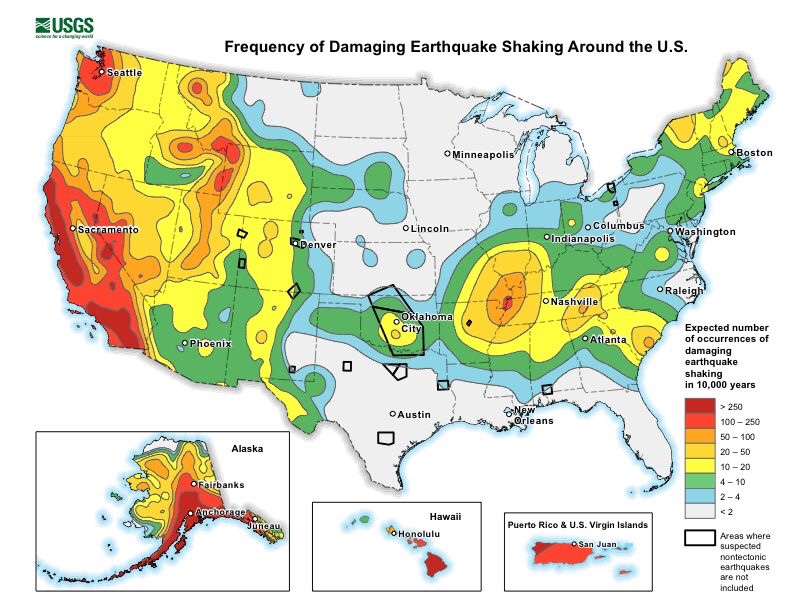
While nowhere near to the extent of the West Coast, damaging earthquakes can and do affect much of the eastern half of the country.

For example, across the Tennesse River Valley lies the New Madrid Fault Line. While much smaller in size than those found farther west, the fault has managed to produce several earthquakes over magnitude 7.0 in the last couple hundred years.

In 1886, an estimated magnitude 7.0 struck Charleston, South Carolina along a previously unknown seismic zone. Nearly the entire town had to be rebuilt.

Vulnerabilities

The eastern half of the U.S. has its own set of vulnerabilities from earthquakes.

Seismic waves actually travel farther in the East as opposed to the West Coast. This is because the rocks that make up the East are tens, if not hundreds, of millions of years older than in the West.

These older rocks have had much more time to bond together with other rocks under the tremendous pressure of Earth’s crust. This allows seismic energy to transfer between rocks more efficiently during an earthquake, causing the shaking to be felt much further.

This is why, during the latest quake in North Carolina, impacts were felt not just across the state, but reports of shaking came as far as Atlanta, Georgia, nearly 300 miles away.
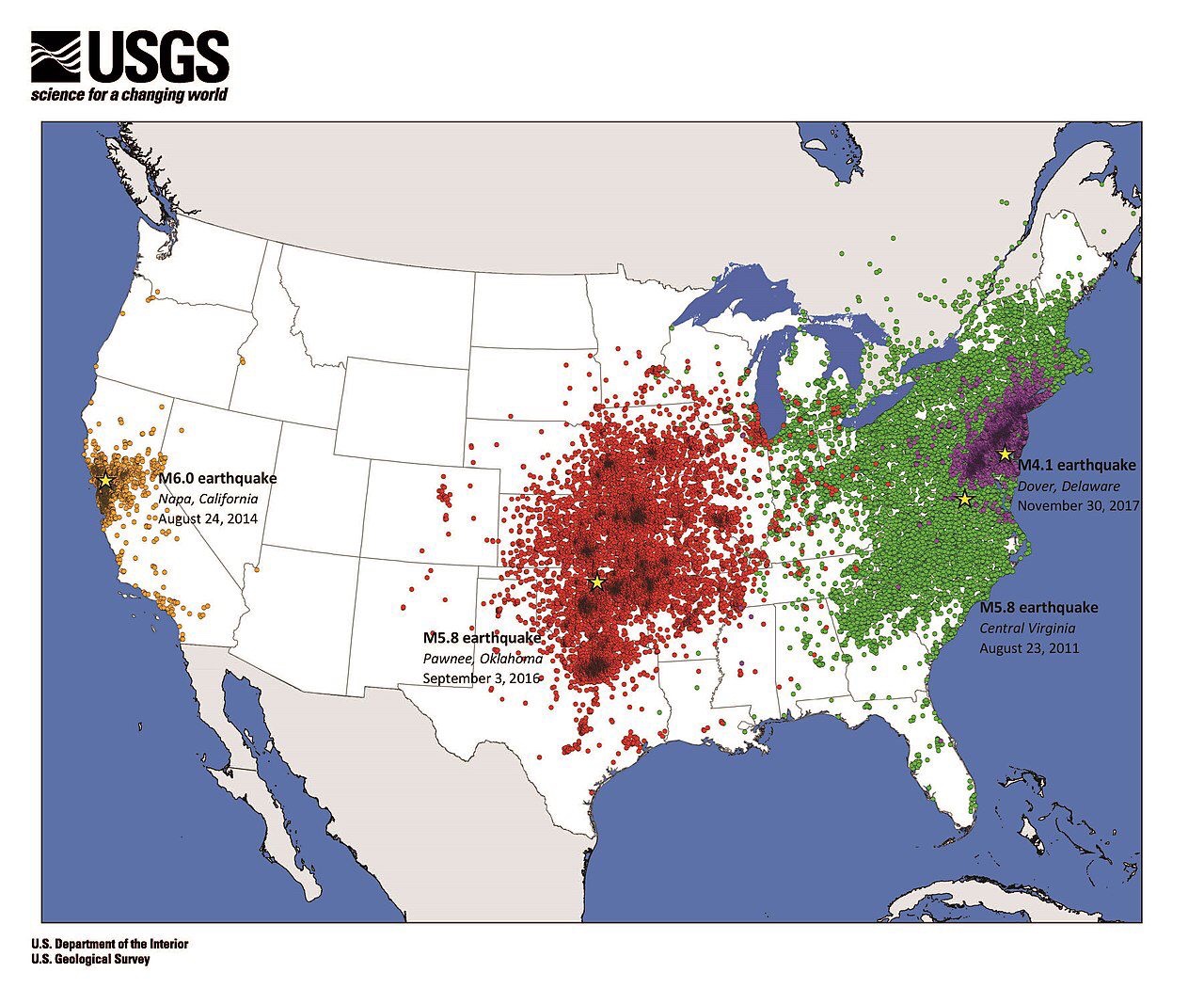
Reports of shaking from different earthquakes of similar magnitude.

Quakes in the East can also be more damaging to infrastructure than in the West. This is generally due to the older buildings found east. Architects in the early-to-mid 1900s simply were not accounting for earthquakes in their designs for cities along the East Coast.

When a magnitude 5.8 earthquake struck Virginia in 2011, not only were numerous historical monuments in Washington, D.C. damaged, shaking was reported up and down the East Coast with tremors even reported in Canada.

Unpredictable

There is no way to accurately predict when or where an earthquake may strike.

Some quakes will have a smaller earthquake precede the primary one. This is called a foreshock.

The problem is though, it’s difficult to say whether the foreshock is in fact a foreshock and not the primary earthquake. Only time will tell the difference.

The United State Geological Survey (USGS) is experimenting with early warning detection systems in the West Coast.

While this system cannot predict earthquakes before they occur, they can provide warning up to tens of seconds in advance that shaking is imminent. This could provide just enough time to find a secure location before the tremors begin.

Much like hurricanes, tornadoes, or snowstorms, earthquakes are a natural occuring phenomenon that we can prepare for.

The USGS provides an abundance of resources on how to best stay safe when the earth starts to quake.

Wednesday, December 31, 2025

Two Centuries Before The Sixth Seal in NYC (Revelation 6:12)


The worst earthquake in Massachusetts history 260 years ago
It happened before, and it could happen again.
By Hilary Sargent @lilsarg
Boston.com Staff | 11.19.15 | 5:53 AM
On November 18, 1755, Massachusetts experienced its largest recorded earthquake.
The earthquake occurred in the waters off Cape Ann, and was felt within seconds in Boston, and as far away as Nova Scotia, the Chesapeake Bay, and upstate New York, according to the U.S. Geological Survey.
Seismologists have since estimated the quake to have been between 6.0 and 6.3 on the Richter scale, according to the Massachusetts Historical Society.
While there were no fatalities, the damage was extensive.
According to the USGS, approximately 100 chimneys and roofs collapsed, and over a thousand were damaged.
The worst damage occurred north of Boston, but the city was not unscathed.
A 1755 report in The Philadelphia Gazette described the quake’s impact on Boston:
“There was at first a rumbling noise like low thunder, which was immediately followed with such a violent shaking of the earth and buildings, as threw every into the greatest amazement, expecting every moment to be buried in the ruins of their houses. In a word, the instances of damage done to our houses and chimnies are so many, that it would be endless to recount them.”
The quake sent the grasshopper weathervane atop Faneuil Hall tumbling to the ground, according to the Massachusetts Historical Society.
An account of the earthquake, published in The Pennsylvania Gazette on December 4, 1755.
The earthquake struck at 4:30 in the morning, and the shaking lasted “near four minutes,” according to an entry John Adams, then 20, wrote in his diary that day.
The brief diary entry described the damage he witnessed.
“I was then at my Fathers in Braintree, and awoke out of my sleep in the midst of it,” he wrote. “The house seemed to rock and reel and crack as if it would fall in ruins about us. 7 Chimnies were shatter’d by it within one mile of my Fathers house.”
The shaking was so intense that the crew of one ship off the Boston coast became convinced the vessel had run aground, and did not learn about the earthquake until they reached land, according to the Massachusetts Historical Society.
In 1832, a writer for the Hampshire (Northampton) Gazette wrote about one woman’s memories from the quake upon her death.
“It was between 4 and 5 in the morning, and the moon shone brightly. She and the rest of the family were suddenly awaked from sleep by a noise like that of the trampling of many horses; the house trembled and the pewter rattled on the shelves. They all sprang out of bed, and the affrightted children clung to their parents. “I cannot help you dear children,” said the good mother, “we must look to God for help.”
The Cape Ann earthquake came just 17 days after an earthquake estimated to have been 8.5-9.0 on the Richter scale struck in Lisbon, Portugal, killing at least 60,000 and causing untold damage.
There was no shortage of people sure they knew the impretus for the Cape Ann earthquake.
According to many ministers in and around Boston, “God’s wrath had brought this earthquake upon Boston,” according to the Massachusetts Historical Society.
In “Verses Occasioned by the Earthquakes in the Month of November, 1755,” Jeremiah Newland, a Taunton resident who was active in religious activities in the Colony, wrote that the earthquake was a reminder of the importance of obedience to God.
“It is becaufe we broke thy Laws,
that thou didst shake the Earth.

O what a Day the Scriptures say,
the EARTHQUAKE doth foretell;
O turn to God; lest by his Rod,
he cast thee down to Hell.”
Boston Pastor Jonathan Mayhew warned in a sermon that the 1755 earthquakes in Massachusetts and Portugal were “judgments of heaven, at least as intimations of God’s righteous displeasure, and warnings from him.”
There were some, though, who attempted to put forth a scientific explanation for the earthquake.
Well, sort of.
In a lecture delivered just a week after the earthquake, Harvard mathematics professor John Winthrop said the quake was the result of a reaction between “vapors” and “the heat within the bowels of the earth.” But even Winthrop made sure to state that his scientific theory “does not in the least detract from the majesty … of God.”
It has been 260 years since the Cape Ann earthquake. Some experts, including Boston College seismologist John Ebel, think New England could be due for another significant quake.
In a recent Boston Globe report, Ebel said the New England region “can expect a 4 to 5 magnitude quake every decade, a 5 to 6 every century, and a magnitude 6 or above every thousand years.”
If the Cape Ann earthquake occurred today, “the City of Boston could sustain billions of dollars of earthquake damage, with many thousands injured or killed,” according to a 1997 study by the US Army Corps of Engineers.

Friday, June 23, 2023

Two Centuries Before The Sixth Seal (Revelation 6:12)


The worst earthquake in Massachusetts history 260 years ago
It happened before, and it could happen again.
By Hilary Sargent @lilsarg
Boston.com Staff | 11.19.15 | 5:53 AM
On November 18, 1755, Massachusetts experienced its largest recorded earthquake.
The earthquake occurred in the waters off Cape Ann, and was felt within seconds in Boston, and as far away as Nova Scotia, the Chesapeake Bay, and upstate New York, according to the U.S. Geological Survey.
Seismologists have since estimated the quake to have been between 6.0 and 6.3 on the Richter scale, according to the Massachusetts Historical Society.
While there were no fatalities, the damage was extensive.
According to the USGS, approximately 100 chimneys and roofs collapsed, and over a thousand were damaged.
The worst damage occurred north of Boston, but the city was not unscathed.
A 1755 report in The Philadelphia Gazette described the quake’s impact on Boston:
“There was at first a rumbling noise like low thunder, which was immediately followed with such a violent shaking of the earth and buildings, as threw every into the greatest amazement, expecting every moment to be buried in the ruins of their houses. In a word, the instances of damage done to our houses and chimnies are so many, that it would be endless to recount them.”
The quake sent the grasshopper weathervane atop Faneuil Hall tumbling to the ground, according to the Massachusetts Historical Society.
An account of the earthquake, published in The Pennsylvania Gazette on December 4, 1755.
The earthquake struck at 4:30 in the morning, and the shaking lasted “near four minutes,” according to an entry John Adams, then 20, wrote in his diary that day.
The brief diary entry described the damage he witnessed.
“I was then at my Fathers in Braintree, and awoke out of my sleep in the midst of it,” he wrote. “The house seemed to rock and reel and crack as if it would fall in ruins about us. 7 Chimnies were shatter’d by it within one mile of my Fathers house.”
The shaking was so intense that the crew of one ship off the Boston coast became convinced the vessel had run aground, and did not learn about the earthquake until they reached land, according to the Massachusetts Historical Society.
In 1832, a writer for the Hampshire (Northampton) Gazette wrote about one woman’s memories from the quake upon her death.
“It was between 4 and 5 in the morning, and the moon shone brightly. She and the rest of the family were suddenly awaked from sleep by a noise like that of the trampling of many horses; the house trembled and the pewter rattled on the shelves. They all sprang out of bed, and the affrightted children clung to their parents. “I cannot help you dear children,” said the good mother, “we must look to God for help.”
The Cape Ann earthquake came just 17 days after an earthquake estimated to have been 8.5-9.0 on the Richter scale struck in Lisbon, Portugal, killing at least 60,000 and causing untold damage.
There was no shortage of people sure they knew the impretus for the Cape Ann earthquake.
According to many ministers in and around Boston, “God’s wrath had brought this earthquake upon Boston,” according to the Massachusetts Historical Society.
In “Verses Occasioned by the Earthquakes in the Month of November, 1755,” Jeremiah Newland, a Taunton resident who was active in religious activities in the Colony, wrote that the earthquake was a reminder of the importance of obedience to God.
“It is becaufe we broke thy Laws,
that thou didst shake the Earth.

O what a Day the Scriptures say,
the EARTHQUAKE doth foretell;
O turn to God; lest by his Rod,
he cast thee down to Hell.”
Boston Pastor Jonathan Mayhew warned in a sermon that the 1755 earthquakes in Massachusetts and Portugal were “judgments of heaven, at least as intimations of God’s righteous displeasure, and warnings from him.”
There were some, though, who attempted to put forth a scientific explanation for the earthquake.
Well, sort of.
In a lecture delivered just a week after the earthquake, Harvard mathematics professor John Winthrop said the quake was the result of a reaction between “vapors” and “the heat within the bowels of the earth.” But even Winthrop made sure to state that his scientific theory “does not in the least detract from the majesty … of God.”
It has been 260 years since the Cape Ann earthquake. Some experts, including Boston College seismologist John Ebel, think New England could be due for another significant quake.
In a recent Boston Globe report, Ebel said the New England region “can expect a 4 to 5 magnitude quake every decade, a 5 to 6 every century, and a magnitude 6 or above every thousand years.”
If the Cape Ann earthquake occurred today, “the City of Boston could sustain billions of dollars of earthquake damage, with many thousands injured or killed,” according to a 1997 study by the US Army Corps of Engineers.

Friday, May 26, 2023

Two Centuries Before The Sixth Seal (Revelation 6:12)


The worst earthquake in Massachusetts history 260 years ago
It happened before, and it could happen again.
By Hilary Sargent @lilsarg
Boston.com Staff | 11.19.15 | 5:53 AM
On November 18, 1755, Massachusetts experienced its largest recorded earthquake.
The earthquake occurred in the waters off Cape Ann, and was felt within seconds in Boston, and as far away as Nova Scotia, the Chesapeake Bay, and upstate New York, according to the U.S. Geological Survey.
Seismologists have since estimated the quake to have been between 6.0 and 6.3 on the Richter scale, according to the Massachusetts Historical Society.
While there were no fatalities, the damage was extensive.
According to the USGS, approximately 100 chimneys and roofs collapsed, and over a thousand were damaged.
The worst damage occurred north of Boston, but the city was not unscathed.
A 1755 report in The Philadelphia Gazette described the quake’s impact on Boston:
“There was at first a rumbling noise like low thunder, which was immediately followed with such a violent shaking of the earth and buildings, as threw every into the greatest amazement, expecting every moment to be buried in the ruins of their houses. In a word, the instances of damage done to our houses and chimnies are so many, that it would be endless to recount them.”
The quake sent the grasshopper weathervane atop Faneuil Hall tumbling to the ground, according to the Massachusetts Historical Society.
An account of the earthquake, published in The Pennsylvania Gazette on December 4, 1755.
The earthquake struck at 4:30 in the morning, and the shaking lasted “near four minutes,” according to an entry John Adams, then 20, wrote in his diary that day.
The brief diary entry described the damage he witnessed.
“I was then at my Fathers in Braintree, and awoke out of my sleep in the midst of it,” he wrote. “The house seemed to rock and reel and crack as if it would fall in ruins about us. 7 Chimnies were shatter’d by it within one mile of my Fathers house.”
The shaking was so intense that the crew of one ship off the Boston coast became convinced the vessel had run aground, and did not learn about the earthquake until they reached land, according to the Massachusetts Historical Society.
In 1832, a writer for the Hampshire (Northampton) Gazette wrote about one woman’s memories from the quake upon her death.
“It was between 4 and 5 in the morning, and the moon shone brightly. She and the rest of the family were suddenly awaked from sleep by a noise like that of the trampling of many horses; the house trembled and the pewter rattled on the shelves. They all sprang out of bed, and the affrightted children clung to their parents. “I cannot help you dear children,” said the good mother, “we must look to God for help.”
The Cape Ann earthquake came just 17 days after an earthquake estimated to have been 8.5-9.0 on the Richter scale struck in Lisbon, Portugal, killing at least 60,000 and causing untold damage.
There was no shortage of people sure they knew the impretus for the Cape Ann earthquake.
According to many ministers in and around Boston, “God’s wrath had brought this earthquake upon Boston,” according to the Massachusetts Historical Society.
In “Verses Occasioned by the Earthquakes in the Month of November, 1755,” Jeremiah Newland, a Taunton resident who was active in religious activities in the Colony, wrote that the earthquake was a reminder of the importance of obedience to God.
“It is becaufe we broke thy Laws,
that thou didst shake the Earth.

O what a Day the Scriptures say,
the EARTHQUAKE doth foretell;
O turn to God; lest by his Rod,
he cast thee down to Hell.”
Boston Pastor Jonathan Mayhew warned in a sermon that the 1755 earthquakes in Massachusetts and Portugal were “judgments of heaven, at least as intimations of God’s righteous displeasure, and warnings from him.”
There were some, though, who attempted to put forth a scientific explanation for the earthquake.
Well, sort of.
In a lecture delivered just a week after the earthquake, Harvard mathematics professor John Winthrop said the quake was the result of a reaction between “vapors” and “the heat within the bowels of the earth.” But even Winthrop made sure to state that his scientific theory “does not in the least detract from the majesty … of God.”
It has been 260 years since the Cape Ann earthquake. Some experts, including Boston College seismologist John Ebel, think New England could be due for another significant quake.
In a recent Boston Globe report, Ebel said the New England region “can expect a 4 to 5 magnitude quake every decade, a 5 to 6 every century, and a magnitude 6 or above every thousand years.”
If the Cape Ann earthquake occurred today, “the City of Boston could sustain billions of dollars of earthquake damage, with many thousands injured or killed,” according to a 1997 study by the US Army Corps of Engineers.

Thursday, March 30, 2023

Two Centuries Before The Sixth Seal (Revelation 6:12)


The worst earthquake in Massachusetts history 260 years ago
It happened before, and it could happen again.
By Hilary Sargent @lilsarg
Boston.com Staff | 11.19.15 | 5:53 AM
On November 18, 1755, Massachusetts experienced its largest recorded earthquake.
The earthquake occurred in the waters off Cape Ann, and was felt within seconds in Boston, and as far away as Nova Scotia, the Chesapeake Bay, and upstate New York, according to the U.S. Geological Survey.
Seismologists have since estimated the quake to have been between 6.0 and 6.3 on the Richter scale, according to the Massachusetts Historical Society.
While there were no fatalities, the damage was extensive.
According to the USGS, approximately 100 chimneys and roofs collapsed, and over a thousand were damaged.
The worst damage occurred north of Boston, but the city was not unscathed.
A 1755 report in The Philadelphia Gazette described the quake’s impact on Boston:
“There was at first a rumbling noise like low thunder, which was immediately followed with such a violent shaking of the earth and buildings, as threw every into the greatest amazement, expecting every moment to be buried in the ruins of their houses. In a word, the instances of damage done to our houses and chimnies are so many, that it would be endless to recount them.”
The quake sent the grasshopper weathervane atop Faneuil Hall tumbling to the ground, according to the Massachusetts Historical Society.
An account of the earthquake, published in The Pennsylvania Gazette on December 4, 1755.
The earthquake struck at 4:30 in the morning, and the shaking lasted “near four minutes,” according to an entry John Adams, then 20, wrote in his diary that day.
The brief diary entry described the damage he witnessed.
“I was then at my Fathers in Braintree, and awoke out of my sleep in the midst of it,” he wrote. “The house seemed to rock and reel and crack as if it would fall in ruins about us. 7 Chimnies were shatter’d by it within one mile of my Fathers house.”
The shaking was so intense that the crew of one ship off the Boston coast became convinced the vessel had run aground, and did not learn about the earthquake until they reached land, according to the Massachusetts Historical Society.
In 1832, a writer for the Hampshire (Northampton) Gazette wrote about one woman’s memories from the quake upon her death.
“It was between 4 and 5 in the morning, and the moon shone brightly. She and the rest of the family were suddenly awaked from sleep by a noise like that of the trampling of many horses; the house trembled and the pewter rattled on the shelves. They all sprang out of bed, and the affrightted children clung to their parents. “I cannot help you dear children,” said the good mother, “we must look to God for help.”
The Cape Ann earthquake came just 17 days after an earthquake estimated to have been 8.5-9.0 on the Richter scale struck in Lisbon, Portugal, killing at least 60,000 and causing untold damage.
There was no shortage of people sure they knew the impretus for the Cape Ann earthquake.
According to many ministers in and around Boston, “God’s wrath had brought this earthquake upon Boston,” according to the Massachusetts Historical Society.
In “Verses Occasioned by the Earthquakes in the Month of November, 1755,” Jeremiah Newland, a Taunton resident who was active in religious activities in the Colony, wrote that the earthquake was a reminder of the importance of obedience to God.
“It is becaufe we broke thy Laws,
that thou didst shake the Earth.

O what a Day the Scriptures say,
the EARTHQUAKE doth foretell;
O turn to God; lest by his Rod,
he cast thee down to Hell.”
Boston Pastor Jonathan Mayhew warned in a sermon that the 1755 earthquakes in Massachusetts and Portugal were “judgments of heaven, at least as intimations of God’s righteous displeasure, and warnings from him.”
There were some, though, who attempted to put forth a scientific explanation for the earthquake.
Well, sort of.
In a lecture delivered just a week after the earthquake, Harvard mathematics professor John Winthrop said the quake was the result of a reaction between “vapors” and “the heat within the bowels of the earth.” But even Winthrop made sure to state that his scientific theory “does not in the least detract from the majesty … of God.”
It has been 260 years since the Cape Ann earthquake. Some experts, including Boston College seismologist John Ebel, think New England could be due for another significant quake.
In a recent Boston Globe report, Ebel said the New England region “can expect a 4 to 5 magnitude quake every decade, a 5 to 6 every century, and a magnitude 6 or above every thousand years.”
If the Cape Ann earthquake occurred today, “the City of Boston could sustain billions of dollars of earthquake damage, with many thousands injured or killed,” according to a 1997 study by the US Army Corps of Engineers.

Thursday, March 9, 2023

The Quakes Preceding the Sixth Seal: Revelation 6:12


East Coast Quakes: What to Know About the Tremors Below

By Meteorologist Dominic Ramunni Nationwide PUBLISHED 7:13 PM ET Aug. 11, 2020 PUBLISHED 7:13 PM EDT Aug. 11, 2020

People across the Carolinas and Mid-Atlantic were shaken, literally, on a Sunday morning as a magnitude 5.1 earthquake struck in North Carolina on August 9, 2020.

Centered in Sparta, NC, the tremor knocked groceries off shelves and left many wondering just when the next big one could strike.

Items lie on the floor of a grocery store after an earthquake on Sunday, August 9, 2020 in North Carolina.

Fault Lines

Compared to the West Coast, there are far fewer fault lines in the East. This is why earthquakes in the East are relatively uncommon and weaker in magnitude.

That said, earthquakes still occur in the East.

According to Spectrum News Meteorologist Matthew East, “Earthquakes have occurred in every eastern U.S. state, and a majority of states have recorded damaging earthquakes. However, they are pretty rare. For instance, the Sparta earthquake Sunday was the strongest in North Carolina in over 100 years.”

While nowhere near to the extent of the West Coast, damaging earthquakes can and do affect much of the eastern half of the country.

For example, across the Tennesse River Valley lies the New Madrid Fault Line. While much smaller in size than those found farther west, the fault has managed to produce several earthquakes over magnitude 7.0 in the last couple hundred years.

In 1886, an estimated magnitude 7.0 struck Charleston, South Carolina along a previously unknown seismic zone. Nearly the entire town had to be rebuilt.

Vulnerabilities

The eastern half of the U.S. has its own set of vulnerabilities from earthquakes.

Seismic waves actually travel farther in the East as opposed to the West Coast. This is because the rocks that make up the East are tens, if not hundreds, of millions of years older than in the West.

These older rocks have had much more time to bond together with other rocks under the tremendous pressure of Earth’s crust. This allows seismic energy to transfer between rocks more efficiently during an earthquake, causing the shaking to be felt much further.

This is why, during the latest quake in North Carolina, impacts were felt not just across the state, but reports of shaking came as far as Atlanta, Georgia, nearly 300 miles away.

Reports of shaking from different earthquakes of similar magnitude.

Quakes in the East can also be more damaging to infrastructure than in the West. This is generally due to the older buildings found east. Architects in the early-to-mid 1900s simply were not accounting for earthquakes in their designs for cities along the East Coast.

When a magnitude 5.8 earthquake struck Virginia in 2011, not only were numerous historical monuments in Washington, D.C. damaged, shaking was reported up and down the East Coast with tremors even reported in Canada.

Unpredictable

There is no way to accurately predict when or where an earthquake may strike.

Some quakes will have a smaller earthquake precede the primary one. This is called a foreshock.

The problem is though, it’s difficult to say whether the foreshock is in fact a foreshock and not the primary earthquake. Only time will tell the difference.

The United State Geological Survey (USGS) is experimenting with early warning detection systems in the West Coast.

While this system cannot predict earthquakes before they occur, they can provide warning up to tens of seconds in advance that shaking is imminent. This could provide just enough time to find a secure location before the tremors begin.

Much like hurricanes, tornadoes, or snowstorms, earthquakes are a natural occuring phenomenon that we can prepare for.

The USGS provides an abundance of resources on how to best stay safe when the earth starts to quake.

Wednesday, February 15, 2023

Two Centuries Before The Sixth Seal (Revelation 6:12)


The worst earthquake in Massachusetts history 260 years ago
It happened before, and it could happen again.
By Hilary Sargent @lilsarg
Boston.com Staff | 11.19.15 | 5:53 AM
On November 18, 1755, Massachusetts experienced its largest recorded earthquake.
The earthquake occurred in the waters off Cape Ann, and was felt within seconds in Boston, and as far away as Nova Scotia, the Chesapeake Bay, and upstate New York, according to the U.S. Geological Survey.
Seismologists have since estimated the quake to have been between 6.0 and 6.3 on the Richter scale, according to the Massachusetts Historical Society.
While there were no fatalities, the damage was extensive.
According to the USGS, approximately 100 chimneys and roofs collapsed, and over a thousand were damaged.
The worst damage occurred north of Boston, but the city was not unscathed.
A 1755 report in The Philadelphia Gazette described the quake’s impact on Boston:
“There was at first a rumbling noise like low thunder, which was immediately followed with such a violent shaking of the earth and buildings, as threw every into the greatest amazement, expecting every moment to be buried in the ruins of their houses. In a word, the instances of damage done to our houses and chimnies are so many, that it would be endless to recount them.”
The quake sent the grasshopper weathervane atop Faneuil Hall tumbling to the ground, according to the Massachusetts Historical Society.
An account of the earthquake, published in The Pennsylvania Gazette on December 4, 1755.
The earthquake struck at 4:30 in the morning, and the shaking lasted “near four minutes,” according to an entry John Adams, then 20, wrote in his diary that day.
The brief diary entry described the damage he witnessed.
“I was then at my Fathers in Braintree, and awoke out of my sleep in the midst of it,” he wrote. “The house seemed to rock and reel and crack as if it would fall in ruins about us. 7 Chimnies were shatter’d by it within one mile of my Fathers house.”
The shaking was so intense that the crew of one ship off the Boston coast became convinced the vessel had run aground, and did not learn about the earthquake until they reached land, according to the Massachusetts Historical Society.
In 1832, a writer for the Hampshire (Northampton) Gazette wrote about one woman’s memories from the quake upon her death.
“It was between 4 and 5 in the morning, and the moon shone brightly. She and the rest of the family were suddenly awaked from sleep by a noise like that of the trampling of many horses; the house trembled and the pewter rattled on the shelves. They all sprang out of bed, and the affrightted children clung to their parents. “I cannot help you dear children,” said the good mother, “we must look to God for help.”
The Cape Ann earthquake came just 17 days after an earthquake estimated to have been 8.5-9.0 on the Richter scale struck in Lisbon, Portugal, killing at least 60,000 and causing untold damage.
There was no shortage of people sure they knew the impretus for the Cape Ann earthquake.
According to many ministers in and around Boston, “God’s wrath had brought this earthquake upon Boston,” according to the Massachusetts Historical Society.
In “Verses Occasioned by the Earthquakes in the Month of November, 1755,” Jeremiah Newland, a Taunton resident who was active in religious activities in the Colony, wrote that the earthquake was a reminder of the importance of obedience to God.
“It is becaufe we broke thy Laws,
that thou didst shake the Earth.

O what a Day the Scriptures say,
the EARTHQUAKE doth foretell;
O turn to God; lest by his Rod,
he cast thee down to Hell.”
Boston Pastor Jonathan Mayhew warned in a sermon that the 1755 earthquakes in Massachusetts and Portugal were “judgments of heaven, at least as intimations of God’s righteous displeasure, and warnings from him.”
There were some, though, who attempted to put forth a scientific explanation for the earthquake.
Well, sort of.
In a lecture delivered just a week after the earthquake, Harvard mathematics professor John Winthrop said the quake was the result of a reaction between “vapors” and “the heat within the bowels of the earth.” But even Winthrop made sure to state that his scientific theory “does not in the least detract from the majesty … of God.”
It has been 260 years since the Cape Ann earthquake. Some experts, including Boston College seismologist John Ebel, think New England could be due for another significant quake.
In a recent Boston Globe report, Ebel said the New England region “can expect a 4 to 5 magnitude quake every decade, a 5 to 6 every century, and a magnitude 6 or above every thousand years.”
If the Cape Ann earthquake occurred today, “the City of Boston could sustain billions of dollars of earthquake damage, with many thousands injured or killed,” according to a 1997 study by the US Army Corps of Engineers.

Thursday, January 26, 2023

The Quakes Preceding the Sixth Seal: Revelation 6:12


East Coast Quakes: What to Know About the Tremors Below

By Meteorologist Dominic Ramunni Nationwide PUBLISHED 7:13 PM ET Aug. 11, 2020 PUBLISHED 7:13 PM EDT Aug. 11, 2020

People across the Carolinas and Mid-Atlantic were shaken, literally, on a Sunday morning as a magnitude 5.1 earthquake struck in North Carolina on August 9, 2020.

Centered in Sparta, NC, the tremor knocked groceries off shelves and left many wondering just when the next big one could strike.

Items lie on the floor of a grocery store after an earthquake on Sunday, August 9, 2020 in North Carolina.

Fault Lines

Compared to the West Coast, there are far fewer fault lines in the East. This is why earthquakes in the East are relatively uncommon and weaker in magnitude.

That said, earthquakes still occur in the East.

According to Spectrum News Meteorologist Matthew East, “Earthquakes have occurred in every eastern U.S. state, and a majority of states have recorded damaging earthquakes. However, they are pretty rare. For instance, the Sparta earthquake Sunday was the strongest in North Carolina in over 100 years.”

While nowhere near to the extent of the West Coast, damaging earthquakes can and do affect much of the eastern half of the country.

For example, across the Tennesse River Valley lies the New Madrid Fault Line. While much smaller in size than those found farther west, the fault has managed to produce several earthquakes over magnitude 7.0 in the last couple hundred years.

In 1886, an estimated magnitude 7.0 struck Charleston, South Carolina along a previously unknown seismic zone. Nearly the entire town had to be rebuilt.

Vulnerabilities

The eastern half of the U.S. has its own set of vulnerabilities from earthquakes.

Seismic waves actually travel farther in the East as opposed to the West Coast. This is because the rocks that make up the East are tens, if not hundreds, of millions of years older than in the West.

These older rocks have had much more time to bond together with other rocks under the tremendous pressure of Earth’s crust. This allows seismic energy to transfer between rocks more efficiently during an earthquake, causing the shaking to be felt much further.

This is why, during the latest quake in North Carolina, impacts were felt not just across the state, but reports of shaking came as far as Atlanta, Georgia, nearly 300 miles away.

Reports of shaking from different earthquakes of similar magnitude.

Quakes in the East can also be more damaging to infrastructure than in the West. This is generally due to the older buildings found east. Architects in the early-to-mid 1900s simply were not accounting for earthquakes in their designs for cities along the East Coast.

When a magnitude 5.8 earthquake struck Virginia in 2011, not only were numerous historical monuments in Washington, D.C. damaged, shaking was reported up and down the East Coast with tremors even reported in Canada.

Unpredictable

There is no way to accurately predict when or where an earthquake may strike.

Some quakes will have a smaller earthquake precede the primary one. This is called a foreshock.

The problem is though, it’s difficult to say whether the foreshock is in fact a foreshock and not the primary earthquake. Only time will tell the difference.

The United State Geological Survey (USGS) is experimenting with early warning detection systems in the West Coast.

While this system cannot predict earthquakes before they occur, they can provide warning up to tens of seconds in advance that shaking is imminent. This could provide just enough time to find a secure location before the tremors begin.

Much like hurricanes, tornadoes, or snowstorms, earthquakes are a natural occuring phenomenon that we can prepare for.

The USGS provides an abundance of resources on how to best stay safe when the earth starts to quake.

Saturday, December 24, 2022

Two Centuries Before The Sixth Seal (Revelation 6:12)


The worst earthquake in Massachusetts history 260 years ago
It happened before, and it could happen again.
By Hilary Sargent @lilsarg
Boston.com Staff | 11.19.15 | 5:53 AM
On November 18, 1755, Massachusetts experienced its largest recorded earthquake.
The earthquake occurred in the waters off Cape Ann, and was felt within seconds in Boston, and as far away as Nova Scotia, the Chesapeake Bay, and upstate New York, according to the U.S. Geological Survey.
Seismologists have since estimated the quake to have been between 6.0 and 6.3 on the Richter scale, according to the Massachusetts Historical Society.
While there were no fatalities, the damage was extensive.
According to the USGS, approximately 100 chimneys and roofs collapsed, and over a thousand were damaged.
The worst damage occurred north of Boston, but the city was not unscathed.
A 1755 report in The Philadelphia Gazette described the quake’s impact on Boston:
“There was at first a rumbling noise like low thunder, which was immediately followed with such a violent shaking of the earth and buildings, as threw every into the greatest amazement, expecting every moment to be buried in the ruins of their houses. In a word, the instances of damage done to our houses and chimnies are so many, that it would be endless to recount them.”
The quake sent the grasshopper weathervane atop Faneuil Hall tumbling to the ground, according to the Massachusetts Historical Society.
An account of the earthquake, published in The Pennsylvania Gazette on December 4, 1755.
The earthquake struck at 4:30 in the morning, and the shaking lasted “near four minutes,” according to an entry John Adams, then 20, wrote in his diary that day.
The brief diary entry described the damage he witnessed.
“I was then at my Fathers in Braintree, and awoke out of my sleep in the midst of it,” he wrote. “The house seemed to rock and reel and crack as if it would fall in ruins about us. 7 Chimnies were shatter’d by it within one mile of my Fathers house.”
The shaking was so intense that the crew of one ship off the Boston coast became convinced the vessel had run aground, and did not learn about the earthquake until they reached land, according to the Massachusetts Historical Society.
In 1832, a writer for the Hampshire (Northampton) Gazette wrote about one woman’s memories from the quake upon her death.
“It was between 4 and 5 in the morning, and the moon shone brightly. She and the rest of the family were suddenly awaked from sleep by a noise like that of the trampling of many horses; the house trembled and the pewter rattled on the shelves. They all sprang out of bed, and the affrightted children clung to their parents. “I cannot help you dear children,” said the good mother, “we must look to God for help.”
The Cape Ann earthquake came just 17 days after an earthquake estimated to have been 8.5-9.0 on the Richter scale struck in Lisbon, Portugal, killing at least 60,000 and causing untold damage.
There was no shortage of people sure they knew the impretus for the Cape Ann earthquake.
According to many ministers in and around Boston, “God’s wrath had brought this earthquake upon Boston,” according to the Massachusetts Historical Society.
In “Verses Occasioned by the Earthquakes in the Month of November, 1755,” Jeremiah Newland, a Taunton resident who was active in religious activities in the Colony, wrote that the earthquake was a reminder of the importance of obedience to God.
“It is becaufe we broke thy Laws,
that thou didst shake the Earth.

O what a Day the Scriptures say,
the EARTHQUAKE doth foretell;
O turn to God; lest by his Rod,
he cast thee down to Hell.”
Boston Pastor Jonathan Mayhew warned in a sermon that the 1755 earthquakes in Massachusetts and Portugal were “judgments of heaven, at least as intimations of God’s righteous displeasure, and warnings from him.”
There were some, though, who attempted to put forth a scientific explanation for the earthquake.
Well, sort of.
In a lecture delivered just a week after the earthquake, Harvard mathematics professor John Winthrop said the quake was the result of a reaction between “vapors” and “the heat within the bowels of the earth.” But even Winthrop made sure to state that his scientific theory “does not in the least detract from the majesty … of God.”
It has been 260 years since the Cape Ann earthquake. Some experts, including Boston College seismologist John Ebel, think New England could be due for another significant quake.
In a recent Boston Globe report, Ebel said the New England region “can expect a 4 to 5 magnitude quake every decade, a 5 to 6 every century, and a magnitude 6 or above every thousand years.”
If the Cape Ann earthquake occurred today, “the City of Boston could sustain billions of dollars of earthquake damage, with many thousands injured or killed,” according to a 1997 study by the US Army Corps of Engineers.

Tuesday, November 15, 2022

The Quakes Preceding the Sixth Seal: Revelation 6:12


East Coast Quakes: What to Know About the Tremors Below

By Meteorologist Dominic Ramunni Nationwide PUBLISHED 7:13 PM ET Aug. 11, 2020 PUBLISHED 7:13 PM EDT Aug. 11, 2020

People across the Carolinas and Mid-Atlantic were shaken, literally, on a Sunday morning as a magnitude 5.1 earthquake struck in North Carolina on August 9, 2020.

Centered in Sparta, NC, the tremor knocked groceries off shelves and left many wondering just when the next big one could strike.

Items lie on the floor of a grocery store after an earthquake on Sunday, August 9, 2020 in North Carolina.

Fault Lines

Compared to the West Coast, there are far fewer fault lines in the East. This is why earthquakes in the East are relatively uncommon and weaker in magnitude.

That said, earthquakes still occur in the East.

According to Spectrum News Meteorologist Matthew East, “Earthquakes have occurred in every eastern U.S. state, and a majority of states have recorded damaging earthquakes. However, they are pretty rare. For instance, the Sparta earthquake Sunday was the strongest in North Carolina in over 100 years.”

While nowhere near to the extent of the West Coast, damaging earthquakes can and do affect much of the eastern half of the country.

For example, across the Tennesse River Valley lies the New Madrid Fault Line. While much smaller in size than those found farther west, the fault has managed to produce several earthquakes over magnitude 7.0 in the last couple hundred years.

In 1886, an estimated magnitude 7.0 struck Charleston, South Carolina along a previously unknown seismic zone. Nearly the entire town had to be rebuilt.

Vulnerabilities

The eastern half of the U.S. has its own set of vulnerabilities from earthquakes.

Seismic waves actually travel farther in the East as opposed to the West Coast. This is because the rocks that make up the East are tens, if not hundreds, of millions of years older than in the West.

These older rocks have had much more time to bond together with other rocks under the tremendous pressure of Earth’s crust. This allows seismic energy to transfer between rocks more efficiently during an earthquake, causing the shaking to be felt much further.

This is why, during the latest quake in North Carolina, impacts were felt not just across the state, but reports of shaking came as far as Atlanta, Georgia, nearly 300 miles away.

Reports of shaking from different earthquakes of similar magnitude.

Quakes in the East can also be more damaging to infrastructure than in the West. This is generally due to the older buildings found east. Architects in the early-to-mid 1900s simply were not accounting for earthquakes in their designs for cities along the East Coast.

When a magnitude 5.8 earthquake struck Virginia in 2011, not only were numerous historical monuments in Washington, D.C. damaged, shaking was reported up and down the East Coast with tremors even reported in Canada.

Unpredictable

There is no way to accurately predict when or where an earthquake may strike.

Some quakes will have a smaller earthquake precede the primary one. This is called a foreshock.

The problem is though, it’s difficult to say whether the foreshock is in fact a foreshock and not the primary earthquake. Only time will tell the difference.

The United State Geological Survey (USGS) is experimenting with early warning detection systems in the West Coast.

While this system cannot predict earthquakes before they occur, they can provide warning up to tens of seconds in advance that shaking is imminent. This could provide just enough time to find a secure location before the tremors begin.

Much like hurricanes, tornadoes, or snowstorms, earthquakes are a natural occuring phenomenon that we can prepare for.

The USGS provides an abundance of resources on how to best stay safe when the earth starts to quake.

Wednesday, October 26, 2022

The Quakes Preceding the Sixth Seal: Revelation 6:12


East Coast Quakes: What to Know About the Tremors Below

By Meteorologist Dominic Ramunni Nationwide PUBLISHED 7:13 PM ET Aug. 11, 2020 PUBLISHED 7:13 PM EDT Aug. 11, 2020

People across the Carolinas and Mid-Atlantic were shaken, literally, on a Sunday morning as a magnitude 5.1 earthquake struck in North Carolina on August 9, 2020.

Centered in Sparta, NC, the tremor knocked groceries off shelves and left many wondering just when the next big one could strike.

Items lie on the floor of a grocery store after an earthquake on Sunday, August 9, 2020 in North Carolina.

Fault Lines

Compared to the West Coast, there are far fewer fault lines in the East. This is why earthquakes in the East are relatively uncommon and weaker in magnitude.

That said, earthquakes still occur in the East.

According to Spectrum News Meteorologist Matthew East, “Earthquakes have occurred in every eastern U.S. state, and a majority of states have recorded damaging earthquakes. However, they are pretty rare. For instance, the Sparta earthquake Sunday was the strongest in North Carolina in over 100 years.”

While nowhere near to the extent of the West Coast, damaging earthquakes can and do affect much of the eastern half of the country.

For example, across the Tennesse River Valley lies the New Madrid Fault Line. While much smaller in size than those found farther west, the fault has managed to produce several earthquakes over magnitude 7.0 in the last couple hundred years.

In 1886, an estimated magnitude 7.0 struck Charleston, South Carolina along a previously unknown seismic zone. Nearly the entire town had to be rebuilt.

Vulnerabilities

The eastern half of the U.S. has its own set of vulnerabilities from earthquakes.

Seismic waves actually travel farther in the East as opposed to the West Coast. This is because the rocks that make up the East are tens, if not hundreds, of millions of years older than in the West.

These older rocks have had much more time to bond together with other rocks under the tremendous pressure of Earth’s crust. This allows seismic energy to transfer between rocks more efficiently during an earthquake, causing the shaking to be felt much further.

This is why, during the latest quake in North Carolina, impacts were felt not just across the state, but reports of shaking came as far as Atlanta, Georgia, nearly 300 miles away.

Reports of shaking from different earthquakes of similar magnitude.

Quakes in the East can also be more damaging to infrastructure than in the West. This is generally due to the older buildings found east. Architects in the early-to-mid 1900s simply were not accounting for earthquakes in their designs for cities along the East Coast.

When a magnitude 5.8 earthquake struck Virginia in 2011, not only were numerous historical monuments in Washington, D.C. damaged, shaking was reported up and down the East Coast with tremors even reported in Canada.

Unpredictable

There is no way to accurately predict when or where an earthquake may strike.

Some quakes will have a smaller earthquake precede the primary one. This is called a foreshock.

The problem is though, it’s difficult to say whether the foreshock is in fact a foreshock and not the primary earthquake. Only time will tell the difference.

The United State Geological Survey (USGS) is experimenting with early warning detection systems in the West Coast.

While this system cannot predict earthquakes before they occur, they can provide warning up to tens of seconds in advance that shaking is imminent. This could provide just enough time to find a secure location before the tremors begin.

Much like hurricanes, tornadoes, or snowstorms, earthquakes are a natural occuring phenomenon that we can prepare for.

The USGS provides an abundance of resources on how to best stay safe when the earth starts to quake.

Tuesday, September 27, 2022

The Quakes Preceding the Sixth Seal: Revelation 6:12


East Coast Quakes: What to Know About the Tremors Below

By Meteorologist Dominic Ramunni Nationwide PUBLISHED 7:13 PM ET Aug. 11, 2020 PUBLISHED 7:13 PM EDT Aug. 11, 2020

People across the Carolinas and Mid-Atlantic were shaken, literally, on a Sunday morning as a magnitude 5.1 earthquake struck in North Carolina on August 9, 2020.

Centered in Sparta, NC, the tremor knocked groceries off shelves and left many wondering just when the next big one could strike.

Items lie on the floor of a grocery store after an earthquake on Sunday, August 9, 2020 in North Carolina.

Fault Lines

Compared to the West Coast, there are far fewer fault lines in the East. This is why earthquakes in the East are relatively uncommon and weaker in magnitude.

That said, earthquakes still occur in the East.

According to Spectrum News Meteorologist Matthew East, “Earthquakes have occurred in every eastern U.S. state, and a majority of states have recorded damaging earthquakes. However, they are pretty rare. For instance, the Sparta earthquake Sunday was the strongest in North Carolina in over 100 years.”

While nowhere near to the extent of the West Coast, damaging earthquakes can and do affect much of the eastern half of the country.

For example, across the Tennesse River Valley lies the New Madrid Fault Line. While much smaller in size than those found farther west, the fault has managed to produce several earthquakes over magnitude 7.0 in the last couple hundred years.

In 1886, an estimated magnitude 7.0 struck Charleston, South Carolina along a previously unknown seismic zone. Nearly the entire town had to be rebuilt.

Vulnerabilities

The eastern half of the U.S. has its own set of vulnerabilities from earthquakes.

Seismic waves actually travel farther in the East as opposed to the West Coast. This is because the rocks that make up the East are tens, if not hundreds, of millions of years older than in the West.

These older rocks have had much more time to bond together with other rocks under the tremendous pressure of Earth’s crust. This allows seismic energy to transfer between rocks more efficiently during an earthquake, causing the shaking to be felt much further.

This is why, during the latest quake in North Carolina, impacts were felt not just across the state, but reports of shaking came as far as Atlanta, Georgia, nearly 300 miles away.

Reports of shaking from different earthquakes of similar magnitude.

Quakes in the East can also be more damaging to infrastructure than in the West. This is generally due to the older buildings found east. Architects in the early-to-mid 1900s simply were not accounting for earthquakes in their designs for cities along the East Coast.

When a magnitude 5.8 earthquake struck Virginia in 2011, not only were numerous historical monuments in Washington, D.C. damaged, shaking was reported up and down the East Coast with tremors even reported in Canada.

Unpredictable

There is no way to accurately predict when or where an earthquake may strike.

Some quakes will have a smaller earthquake precede the primary one. This is called a foreshock.

The problem is though, it’s difficult to say whether the foreshock is in fact a foreshock and not the primary earthquake. Only time will tell the difference.

The United State Geological Survey (USGS) is experimenting with early warning detection systems in the West Coast.

While this system cannot predict earthquakes before they occur, they can provide warning up to tens of seconds in advance that shaking is imminent. This could provide just enough time to find a secure location before the tremors begin.

Much like hurricanes, tornadoes, or snowstorms, earthquakes are a natural occuring phenomenon that we can prepare for.

The USGS provides an abundance of resources on how to best stay safe when the earth starts to quake.