Showing posts with label guard. Show all posts

Thursday, January 26, 2017

Iran Builds Up The Shia Horn (Daniel 8:4)

 In an article by Majid Rafizadeh, political scientist and Harvard University scholar is president of the International American Council on the Middle East, published by the Gatestone Institute addresses the issue of Iran iusing new methods of recruiting and training children through its paramilitary militia group, Basij.  This group is one of the five branches of Iran's Islamic Revolutionary Guard Corps (IRGC). Children, some as young as eight years old, are trained to hate the US and Israel, to attack their enemies in the West, and to oppose Western values.
One of Iran's is titled, "Martyrs who defend the sacred shrine.”
The translation of the video clip, according to the National Council of Resistance of Iran (NCRI), says:
"Let us rise up to save the sacred shrine.
I have joined [Imam] Hossein's army division.
... I have a warrant from the [Imam Ali] to defend the sacred shrine.
On my leader [Ali Khamenei's] orders I am ready to give my life.
The goal is not just to free Iraq and Syria;
My path is through the sacred shrine [in Syria], but my goal is to reach Jerusalem.
... I do not regret parting from my country;
In this just path I am wearing my martyrdom shroud.
... From Mashhad [north-east Iran], I will walk on foot to Damascus.
I am like the bird who flocks to the sacred shrine.”
The training and teachings inspire hatred in these young children, through rampant anti-Americanism and anti-Semitism, and focus on damaging the national security of the Unites States (‘the Great Satan’) and Israel (‘the Little Satan’).”
Rafizadeh writes,  “At Mashad's theme park, ‘City of Games for Revolutionary Children,’ children are trained to engage in wars against the US and Israel. They fire bullets through US and Israeli flags or at effigies such as that of the Israeli Prime Minister Benjamin Netanyahu.”
According to Israel National News:  "After registering, children don military uniforms and split up into groups of 8-10. They are accompanied by a 'commander' whom they pledge to obey. They then go through 12 activity stations, which include simulations of the Iran-Iraq war, a 'Revolution chamber,' defending various holy shrines, and traversing a minefield with barbed wire. Along the way, they are told about the directives of the Imam (Ayatollah Ruhollah) Khomeini and Supreme Leader Khamenei.”
A "commander" teaches the children Islamist values. The Middle East Research Media Research Institute (MEMRI) quotes Hamid Sadeghi, director of Iran's Child and the Future Cultural Center, who run the theme park, "One of [our] cultural experts guides the children at the City of Games. First they are brought into the stations of the Ghadir [Shi'ite holiday honoring Imam 'Ali's succession to the Prophet Muhammad] and of the Lovers of Ahl Al-Bayt [the family of the Prophet Muhammad descended from 'Ali], and [the guide] explains to them about the Mahdi [the Shi'ite messiah]. Then they reach the station of the Rule of the Jurisprudent [Velayat-e Faqih], and then the station of the Revolution, where the guide explains about the Islamic Revolution ...An explanation is also provided about the directives of the Imam [Ayatollah Ruhollah] Khomeini and [Supreme] Leader Khamenei."
Training includes religious holy wars teachings. Sadeghi, pointed out,  "At the City of Games, we are trying to convey to the children messages about fighting, the Holy Defense and current global issues, through games, amusements, and group activities.”
Iran is seducing children, and has actually used children in wars, assigning them tasks such as clearing minefields.
Iran's actions are a direct violation of international humanitarian law that is defined as a war crime by the International Criminal Court. According to the United Nations, "Human rights law declares 18 as the minimum legal age for recruitment and use of children in hostilities. Recruiting and using children under the age of 15 as soldiers is prohibited under international humanitarian law – treaty and custom – and is defined as a war crime by the International Criminal Court. Parties to conflict that recruit and use children are listed by the Secretary-General in the annexes of his annual report on children and armed conflict.”
Iranian institutions such as the Office of the Supreme Leader, Ayatollah Ali Khamenei, the Islamic Revolutionary Guard Corps, the Ministry of Intelligence (Etela'at), and the militia group Basij, all play a crucial role in this matter. Institutions who recruit children for war, in violation of the international humanitarian law, are the beneficiaries of the sanctions relief and billions of dollars being poured into the Islamic republic as a result of the nuclear deal.
Rafizadeh summarizes this issue:
• Iran's actions are a direct violation of international humanitarian law that is defined as a war crime by the International Criminal Court. According to the United Nations, "Human rights law declares 18 as the minimum legal age for recruitment and use of children in hostilities.
• Finally, these institutions that recruit children for war, in violation of the international humanitarian law, are the main beneficiaries of the sanctions relief and billions of dollars being poured into the Islamic republic as a result of the nuclear deal.

Friday, January 13, 2017

Iran Continues To Persecute Christians

Pakistan Christian Post
Tehran: January 12, 2017. Iranian Christians request further prayer for Christian converts in Rasht facing various charges. These converts have also reportedly been threatened by Revolutionary Guards, a branch of the Iranian armed forces effectively under the direct control of the Supreme Leader Ayatollah Ali Khamenei.
Since the arrest of Yousef Nadarkhani, Yaser Mosibzadeh, Saheb Fadayee and Mohammed Reza Omidi on 13th May 2016, they have had two court hearings facing charges of action against national security - a common charge levelled against Christian converts in Iran - and a verdict is still pending.
In addition Yaser, Saheb and Mohammed Reza were charged with consumption of alcohol for drinking wine during a communion service*. After a court hearing on 10th September they were found guilty and sentenced to 80 lashes each. They have an appeal hearing scheduled for 9th February 2017.
The 2016 Christmas period was notably calm for Christians in Iran and no raids on house groups or churches have been reported. This is a positive development compared to previous years when there were frequent arrests. The Human Rights Activists News Agency (HRANA) also reported that Christian prisoner Maryam Naghash Zargaran was allowed out of prison on 27th December 2016 for a five-day furlough.
Although Iranian Christians are thankful for a quiet Christmas, they point out that harassment of Christians, especially converts, is continuing.
Source: Middle East Concern

Friday, December 2, 2016

Death Toll of the Iranian Horn (Daniel 8:4)

NCRI Statements | Terrorism and Fundamentalism
Wednesday, 30 November 2016 16:44
Security and Anti-terrorism Committee
According to Mullah Seyyed Mohammad Ali Shahidi Mahallati, Khamenei’s representative in “Martyrs and Veterans affairs foundation” and Rouhani’s deputy, the number of IRGC forces killed in the Syria war is more than one thousand. In a seminar on the occasion of “Bassij Week” he stressed: “Number of our country’s martyrs defending the holy shrine has exceeded one thousand and we owe all of them. (Tasnim- the terrorist Quds force daily -Nov. 22, 2016)
According to the report by the Iranian Resistance from inside the country, the number of losses of IRGC forces and its Lebanese, Afghan, Pakistani, Iraqi and other mercenaries under their command are more than ten thousand. According to the IRGC’s internal report, in order to prevent the leaking of the extent of the casaulties and its social negative impacts, the corpses of most of Afghan, Pakistani and Iraqi mercenaries of the regime who are killed in Syria are not returned to Iran. The corpses of Lebanese mercenaries are all buried in Lebanon or Syria. By the number of IRGC’s commanders killed in the war against the Syrian people, one could imagine the extent of the regime's casaulties. The following are the names of 39 IRGC Brigadiers, 28 IRGC Colonels and two colonels of the army under Khamenei's command who were killed in Syria.
IRGC Brigadiers: Hassan Shateri, Seid Hamid Tabatabaei Mehr, Haj Esmaeel Heidari, Mohammad Jamal Pa Ghalehei, Dadollah Sheibani, Jaber Darisavi, Mohammad Ali Aliabadi, Alireza Tavassoli, Hossein badpa, Hadi Kajbaf, rousbeh Helisiaei, Haj Abdollah Eskandari, Mohammad Ali Allahabadi, Ezzatollah Soleimani, Farshad Hosseini-nejad, Abdolreza Majiri, Hossein Fadaei, SaeedSayyah Taheri, Sattar Orang, Hassan Razzaghi, Hamidreza Ansari, Ahmad Majdi Nasab, Haj Ali Ghorbani, Reza farzaneh, Hassan Ali Shamsabadi, Mohsen Ghajarian, Masha-allah Shamseh, Javad dourbin, Seid Shafi Shafiei, Jahangir Jafarnia, Mohammad Hassan Hakimi, Reza Rostami Moghaddam, Ahmad Gholami, Daryoush Dorosti, Mostafa Rashidpour, Akbar Nazari, Hossein Alikhani, Gholamreza Samaei and Zaker Heidari.
IRGC Colonels: Amir Reza Alizadeh, Heshmatollah Sohrabi, Abbas Abdullahi, Ghasem Gharib, Karim Qavabesh, Moslem Khizab, Mostafa Sadrzadeh, Esmaeel Khanzadeh, Mohammadreza Ali-Khani, Abdulreza Roshvand, Mohammad Tahan, Sattar Mahmoudi, Ghasem teimouri, morteza Torabi Kamel, Asghar Falahat Pisheh, Hamzeh Kazemi, Abdulhossein Saadatkhah, Ahmad Goodarzi, Mohsen Mandani, Ali Taheri Tarshizi, Saeed Shamloo, Mohammad Balbasi, Rahim Kaboli, Ali Mansouri, Ghodratollah Abdian, Morteza Ataee, Adel Saad and Mohammadreza Zare Alvani, and also two colonel of the army under command of Khamenei called Morteza Zarhoon and Mojtaba Zolfaghar Nasab.
High casualties in Syria has sparked a wave of discontent among their families, and the IRGC attempts to dispatch young people, students, employees and workers to Syria has fomented people's hatred against this war. People consider the regime's casualties in Syria as a reminder of eight-year war with Iraq.
Mullahs' inattention to the families of the killed, especially the Afghans, has imposed additional suffering on their families. They even delay treatment of injured and disabled Afghans who have returned from war.
Escalation of public's disgust has even resulted in protests by some of the regime's factions against the war in Syria. Mostafa Tajerzadeh writes in this regard, "We had an intervention in Syria full of loss with little profit… no country has had so much casualties in Syria as Iran…Despite the toll, we are accused of killing the Syrian people and pursuing sectarianism. Our credibility is damaged, and every day we go deeper into the Syrian quagmire."
Mehdi Khazali said on September 11, "Wasn't the eight-year war (with Iraq) enough, now we have been fighting in Syria for five years; it was a mistake and shouldn't happen, and I have said this many times before…In fact the war has occurred and we are engaged in this quagmire, and we are engaged with the issue of ISIS which was created due to mismanagement of Haj Ghasem Soleimani. Hadn't he done this, there wouldn't have been ISIS…this is the mistake of Haj Ghasem Soleimani."
Security and Anti-terrorism Commission of the National Council of Resistance of Iran
November 29, 2016

Tuesday, May 26, 2015

More Iranian Threats (Daniel 8:3)


Iran’s response to any aggression won’t be limited to borders: official
Tehran Times 

TEHRAN (Tasnim) – Any wrong move against the Iranian territories will be followed by an unforgettable lesson for invaders, Secretary of Iran’s Expediency Council Mohsen Rezaee said, noting that such response will not be confined to the country’s borders.

 “If there is any aggression against Iran’s borders, we will not remain at the borders like (we did) in the past,” Rezaee said in the southwestern city of Khorramshahr on Sunday morning.

He was speaking in a ceremony to commemorate the anniversary of liberation of Khorramshahr, a city in southwestern Iran which had been occupied by Iraq’s Baathist army in the early 1980s. The city was recaptured by the Iranian armed forces on May 24, 1982.

Rezaee also lashed out at the U.S. and Israel for triggering unrest in Muslim countries over the past 70 years, warning that they want insecurity to spill into Iran.

While the Iranian diplomats try to put out the flames of wars through diplomatic approaches, the country’s military commanders are vigilantly prepared for every possibility, he underlined.
I
n relevant comments on May 6, Supreme Leader of the Islamic Revolution Ayatollah Seyed Ali Khamenei reaffirmed that the Iranian nation will not let any possible act of aggression against the country go unanswered.

The Leader said he has already made it clear, even in the tenure of former U.S. president, that “the era of hit and run has ended” and that the Iranian nation will chase aggressors.

Monday, May 25, 2015

The Failed Iraqi National Guard (Rev 13:18)

 
The Foreign Policy Essay: Harnessing Militia Power—Lessons of the Iraqi National Guard

Ariel I. Ahram and Frederic Wehrey
May 24, 2015

Editor’s Note: National governments seem to be failing throughout the Middle East. The United States, unfortunately, does not usually have the luxury of waiting until a strong government returns, and building a strong state is often beyond what the United States is able or willing to do. One option to fight terrorists and otherwise fill the governance void is to work more with local militias. Ariel I. Ahram of Virginia Tech and Frederic Wehrey of Carnegie draw on the U.S. experience in Iraq and offer lessons for what to do—and what to avoid—when going down this road.

***

Faced with the breakdown of national armies in Iraq, Libya, Syria, and Yemen, Arab states have increasingly turned toward alliances with armed militias to ensure security. Popular, anti-government protests and insurgencies for the most part precipitated the breakdown of regime military institutions, yet pre-existing internal ethnic, clan, and ideological cleavages helped to hasten the breakdown. The beleaguered state security forces have now entered into a variety of alliances—tacit or active—with militias they deem sympathetic to their interests, often organized on the basis of entrenched ethno-sectarian or tribal identities. Such militia forces supplement and at times even stand in for the weak or absent army and police as providers of local security.

On the one hand, militia forces have in certain circumstances proven effective at counterinsurgency and counterterrorism. On the other hand, they have also committed atrocities against civilians that hamper long-term efforts to build trust and stability. Their greatest risk is that, by eroding the central government’s monopolization on force, they jeopardize the territorial cohesion of the state.

In Iraq, the rise of powerful communal militias has paralleled the growth of the threat from the Islamic State. This has presented the United States with a quandary: how to combat the Islamic State by mobilizing local Sunnis while at the same time safeguarding the broader integrity of the Iraqi state and its security institutions. The national guard concept, which successive Iraqi governments have tried in the past, was seen as one way to do this. A national guard force would retain the militias’ local knowledge and roots, both unique tools necessary for a successful counterinsurgency against the Islamic State. At the same time, the guard would (at least in theory) be subject to increased oversight and control by the central government.

Other fractured Arab states, most notably Libya, have tried to implement a national guard model as a way to harness militia power, but this too has failed. Variations of hybrid, provincially-organized military forces exist in Yemen and Syria. While each case is different, the failure of national guards bears certain similarities. Examining the Iraqi case in particular can highlight the potential utility of national guards but also the parallel political and institutional reforms that are necessary to make the concept work.

False Analogies and False Starts in Iraq

The idea of creating a national guard in Iraq has been a centerpiece of U.S. engagement since the dramatic advance of the Islamic State on Tikrit and Mosul in 2014. President Obama specifically mentioned U.S. support for a national guard as a means to help Iraqi Sunnis “secure their own freedom” from the Islamic State. Much of U.S. thinking about the Iraqi National Guard (ING) was guided by the example of the Sunni Awakening of 2006 and 2007, when the United States actively recruited and “flipped” Sunni tribes that had supported the al-Qaeda-inspired insurgency. In return for guarantees of autonomy and military, financial, and political backing, the Sunni tribes were able to turn the tables on the insurgent fighters and impose a measure of peace and stability. The 2014 initiative essentially sought to reproduce this arrangement. The idea was that given proper incentives, the Sunni tribes would again fight the radical Islamists who threatened their supremacy. Over the long term, such national guard forces could be integrated formally as auxiliary troops in a federal structure, comparable in many ways to the U.S. National Guard.

Yet the Awakening analogy failed on a number of levels. The Shi’i-dominated Iraqi central government had never been enthusiastic about empowering Sunni tribes in the first place. With the dismantling of the Iraqi army in 2003, security had effectively devolved to party, tribal, and sectarian militias. Many Iraqis wondered why the United States would seek to create new militias, especially ones recently tied to al-Qaeda and other terrorists. As Iraq scholar Adeed Dawisha described, the gains in security came “not because of the state, but in spite of it.”

As the U.S. began withdrawing from Iraq in 2009 and 2010, then-Prime Minister Nuri al-Maliki quickly moved to dismantle the Awakening-associated militias. Only a handful of former militia fighters received their promised positions in the police, army, or civil services. Some former militia leaders were arrested on seemingly politically-motivated charges of terrorism or subversion. Efforts to enact a Sunni-dominated super-region comparable to the federal status of the Kurdish Regional Government in the north were rebuffed, despite the provisions of Iraq’s constitution that allowed for the creation of such an entity. Politically marginalized, some Sunnis returned to their alliance with the radical mujahideen.

The election of the new prime minister Haydar al-Abadi in 2014 raised the promise of renewed Sunni-Shi’i reconciliation. Abadi expressed support for the national guard initiative and forwarded a bill to parliament in 2014. Thousands of volunteers came forward from the Sunni tribes in the west and U.S. and Iraqi officials met with tribal leaders to help solidify support. The United States began to enlist support from Iraq’s Sunni neighbors to provide training and support for the ING.

Yet resistance within Abadi’s own political coalition stymied these efforts. The National Guard bill foundered in parliamentary committee, with open questions about the extent of control vested in provincial governors and the chain of command subordinating the ING to the ministries of interior, defense, or the prime minister himself. Officers of the Iraqi Security Forces (ISF) regarded the militias as unfit for duty and as rivals for budget and resources. Iraq’s constitution specifically prohibited the formation of militias outside the framework of the armed forces (with an exception of the peshmerga forces of the Kurdish Regional Government). Moreover, there was concern that once the Sunnis were authorized to organize a militia, other ethno-sectarian communities, such as Christians or Turkomen, might try to follow suit out of fear of falling under the mercy of their more powerful neighbors. The ING, then, could undercut any pretense of the Iraqi state possessing a monopoly over the use of force.

At base, though, many of Iraq’s Shi’i leaders simply believed that they didn’t need Sunni support. With the ING initiative stalled in parliament, the Shi’i factions have actively cultivated Shi’i militias as part of the Popular Mobilization Forces (PMF, or Hashd al-Shaabi). The origins of the PMF can be traced to a statement by Grand Ayatollah Ali Sistani, Iraq’s senior Shi’i cleric, which explicitly called on the faithful to take up arms to defend Iraq in the face of the Islamic State onslaught in 2014. Muqtada al-Sadr’s Jaysh al-Mahdi, the Badr Organization, and other political factions quickly took the opportunity to reconstitute or expand their private armies.

Backed by Iran’s expeditionary al-Qods Force, PMF militias played a prominent role in the spring 2015 offensive against the Islamic State in Tikrit. By spring 2015, PMF counted around 60,000 men under arms. Still, the performance of these militias has been less than stellar. In the spring 2015 offensive on Tikrit, PMF forces failed repeatedly to dislodge Islamic State resistance, despite enjoying superiority in numbers. U.S. air support proved critical to allowing the offensive to proceed. Some PMF units quit the fight instead of working under American air cover. Others were involved in a campaign of terror against Sunnis, looting, kidnapping, and killing those suspected of collaborating with the Islamic State.

Awakening Again?

The prospects for the mobilization of Iraq’s Sunnis are not dead—yet. A handful of Sunni tribes joined the PMF during the Tikrit offensive. In Anbar, likely the next front in the campaign against the Islamic State, U.S. and Iraqi officials have cultivated ties with local Sunni tribes and organized some 8,000 men into Sunni PMF units. Some tribes have made their service conditional on guarantees of greater autonomy and the removal of Shi’i militia forces. Yet the intake for training programs remains slow and drop-out rates high. On the one hand, tribes continue to resent the central government. On the other hand, they fear retribution should the Islamic State return.

Abadi’s visit to Washington in April 2015 focused on expanding and enhancing security cooperation with the United States. The United States has insisted that the PMF be brought more fully under the control of the Iraqi Security Forces and that PMF units reflect the demographics of the provinces and districts in which they operate. This would mean that in ethnically-mixed areas, such as in Nineveh or Babil, each ethnic group would have its own militia proportional to its size in the locality. The Iraq Train and Equip Program (ITEP) is slowly coming online, funneling American money and weapons to various local militia forces as well as ISF.

Cooperating with the United States has been a delicate balancing act for Abadi. While Kurdish and Sunni leaders see U.S. military support as a means to their own ends, Abadi’s own Shi’i political camp—as well as his allies in Tehran—are far more wary. When the U.S. Congress passed a bill in May 2015 effectively mandating the Defense Department to bypass Baghdad and provide support for Sunni and Kurdish fighters directly, Abadi protested that this constituted a grave violation of Iraqi sovereignty.

Still, reliance on the ragtag PMF alone is not sustainable in the long term. Operating far from home and with limited training, these overwhelmingly Shi’i forces cannot be expected to become an army of occupation in Sunni areas like Tikrit or Fallujah. Ultimately, local partners will be necessary to build and maintain peace and stability. The national guard, then, may well re-emerge as a more sustainable structure for administrative and security devolution.

Lessons Learned From Failure

While analysts and policymakers naturally focus on cases of success, there are important lessons to be learned from Iraq’s failures. For countries like Iraq where central armies have more or less broken down and a bevy of militias has emerged in its stead, as in Libya, Yemen, and Syria, the national guard could represent a path to reconstituting fragile state authority.

But for this to happen, several broad principles need to be heeded:

National guards cannot simply be conceived as short-term, improvised solutions to immediate security crises. Rather, the creation of national guards is part of the impetus of security-sector reform (SSR) and post-conflict demobilization, disarmament, and reintegration (DDR) of armed groups.

National guards must overcome the legacies of past authoritarian experiences where pro-government militias were often seen as mere thugs for the regime, not a disciplined professional fighting force. In particular, the older officer class of regular forces may see them as competitors. To build trust among the population and other military institutions, national guards should be accompanied by revisions to chain of command establishing clear relationships of authority between the guards, the police, the army, and other security agencies, and subordinating all security services to civilian authorities.
National guard initiatives must also be accompanied by moves toward political power-sharing arrangements. The success of national guards ultimately depends not just on their short-term tactical effectiveness but on the degree of local buy-in. Constitutions can provide a structure for bolstering confidence between a central government and subnational militia forces. Since militia membership and cohesion is often based on geographic linkages—to town, municipality or province—national guards may well be a part of federalist power devolution, especially in countries with overlapping ethno-sectarian and regional cleavages.

Western governments can assist in setting up and training national guards, but they must ensure that proper political and institutional reforms are also undertaken. In many cases, Western states provide models for how decentralized, federally-organized military forces can complement national armies and local police. The United States, for instance, has a great deal of experience with its own federalized national guard structure and can draw on this example in its train-and-equip programs. There are other potentially useful models as well, including the British Territorial Army, a part-time, volunteer force that was integrated into the British Army in the early twentieth century; the Danish Home Guard, which incorporated anti-Nazi resistance militias into a national command structure after World War II; or the Italian Carabineri, which is often discussed as a potential model for dealing with Libya’s unique security challenges.

Outside assistance to national guards must avoid exacerbating existing communal and political fault lines. Helping peripheral and minority groups set up their own armed forces can, on one hand, embolden these groups to resist the central government and, on the other hand, spur resentment from the central government and fear of future disloyalty or rebellion. These concerns become even more acute when national guards are seen as proxies for outside powers. With this in mind, the U.S. and outside powers should calibrate their assistance to both regionally-based national guards and central government forces to ensure rough parity between the two. This could entail making funding, equipment and training for the central security services contingent on a proportional commitment to strengthen the guards.

National guards are political institutions, not just military instruments. They can have far-ranging consequences for political stability and cohesion. While no panacea for the challenge of building effective states, they can play an important role in addressing security concerns and moving toward more meaningful power sharing.

Friday, March 27, 2015

Why Wouldn’t Iran Attack US Troops? (Dan 8)

Mideast Irans Shadow Force

U.S. officials fear Iran might attack American troops in Iraq: report

U.S. officials fear Tehran could direct Iraqi Shiite militias it commands to attack American troops who are assisting in the fight against ISIS. 

US officials have growing concerns Iran might launch attacks against American troops in Iraq should nuclear talks between Tehran and world powers collapse, journal Politico reported on Wednesday.
The  U.S. officials, according to the report, voiced concern that a collapse in the nuclear talks between Iran and the P5+1 (United States, United Kingdom, Russia, China, and France, plus Germany) could embolden Iranian hard-liners and potentially lead to attacks on Americans in Iraq.
According to the report, U.S. officials also voiced concern over the safety of U.S. troops in Iraq in relation to U.S. attempts to see the ouster of Syrian President Bashar al-Assad, one of Iran’s principal allies in the region.

U.S. officials fear that in either scenario, Tehran could direct Iraqi Shiite militias it commands to attack American troops who are assisting in the fight against the Islamic State of Iraq and Syria (ISIS), according to the journal.

“The current [nuclear] negotiations likely have a restraining effect, but there are other incentives and national interests at stake for the Iranians,” the journal quoted one senior U.S. military official as saying.

“This is something that we are continually assessing. [Iran’s] history as regional provocateurs and exporters on terrorism demands it,” the official said.

The U.S. has dispatched 3,000 troops to Iraq as trainers and advisers to Iraqi forces fighting ISIS and Iran is heavily involved military in its neighbor, including sending one of its top generals, Maj. Gen. Qassem Suleimani, the commander of Iran’s secretive Quds Force.

The journal quoted one military official as saying that there was no imminent threat to U.S. troops in Iraq. It also quoted sources saying that the potential danger was factored into U.S. military planning.

This concern of Iran harming American troops in Iraq has also impacted on the debate in the Obama administration on whether to push for the removal of Syria’s Assad, the journal reported.

It quoted Robert Ford, the former U.S. ambassador to Syria, as saying: “Multiple [officials] have told me they’re worried about retaliation in Iraq, which does seem to be influencing our Syria policy.”

“Basically, they’re afraid that if they provide serious help to the armed opposition against Assad, the Iranians will have their surrogates in Iraq attack  us.

Thursday, March 12, 2015

Making A Deal With The Devil (Daniel 8)

Analysis: Iran is no partner in the fight against the Islamic State

B_vsofcXEAAtDRv
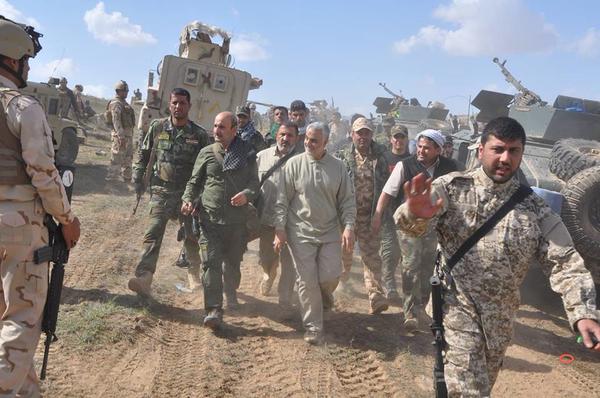
Qassem Soleimani (center) with his bodyguards near the frontlines of Tikrit.
 
Testifying on Capitol Hill on March 3, Joint Chiefs Chairman General Martin Dempsey characterized the joint attempts of the Iraqi military, Iraqi Shia militias, and Iran’s Islamic Revolutionary Guards Corps (IRGC) at taking back control of Tikrit, Saddam Hussein’s hometown, from the Islamic State, as “a positive thing.” “Frankly,” General Dempsey said, “it will only be a problem if it results in sectarianism.”

General Dempsey’s caveat is an interesting one, since there is every reason to believe that Shia control of Tikrit will result in further sectarianism. While the US administration says in its most recent National Security Strategy that it desires to “degrade and ultimately defeat ISIL [Islamic State]” in an attempt to “support Iraq … free itself from sectarian conflict and the scourge of extremists,” Tehran is actively perpetuating the sectarian crisis in Iraq. 


In the past, the Iraqi Shia have demonstrated little interest in reducing themselves to puppets of Tehran. During the war with Iraq from 1980-1988, Iraqi nationalism trumped sectarian identity: the Shia constituted the rank and file of the Iraqi military, and Shia leaders in Iraq kept their distance from the regime in Tehran. After the collapse of Saddam Hussein’s regime in 2003, Iraq became a sanctuary to Iranian clerics critical of the regime in Tehran, including Hossein Khomeini, grandson of the founder of the Islamic Republic. 

But Iraq did not remain a refuge for long. The civil war in Iraq, followed by the rise of Islamic State, forced moderate Iraqi Shia, who otherwise would have pursued a line independent of Iran, to become dependencies of Tehran. After being rebuffed by the US following the Islamic State’s takeover of Mosul in 2014, General Qassem Atta, head of the Iraqi National Intelligence Service, asked Tehran for help and received assistance within 48 hours. Iraqi Prime Minister Haider al Abadi continues to press Washington for more support in his fight against the Islamic State and uses US hesitancy to justify reliance on Iran, which according to Vice President Iyad Allawi, only increases Iran’s influence in Iraq and could lead to dismantlement of the Iraqi state.

The Obama administration may desire to help secure the survival of the Iraqi state, but the small contingent of US advisers in Iraq is relying on a heavily Iranian-influenced Iraqi sectarian intelligence and security apparatus. The Iraqi security forces are predominantly Shia, and in addition, Shia militias and “advisers” from the IRGC Quds Force are now fighting as legitimate Iraqi forces. 
This creates an environment in which targeting operations developed by Iranian forces and the militias have primacy over those developed by the US, leading to the possibility that  Washington could be portrayed by Islamic State as complicit in the indiscriminate targeting of Sunnis. Such operations will be perceived the same way by the very Sunnis we need to fight Islamic State, thus undermining the US strategy to “support Iraq … free itself from sectarian conflict and the scourge of extremists.” 

Any US reliance on Iranian support in the fight against the Islamic State is also likely to strengthen Tehran’s bargaining position in the nuclear negotiations. 


Iran has Washington where it wants it. Iran wants a favorable deal, and the Obama administration is signaling that such a deal is forthcoming. US “strategic patience” is allowing Iran to increase its influence and presence in Iraq and Syria. Assad is waiting out the Americans and the international community, and Shia militias are now viewed as legitimate forces in Iraq, Syria, and Yemen. But most importantly, US “strategic patience” signals to Iran an unwillingness to jeopardize the talks by linking them to Iran’s role in Iraq, Syria, and Yemen. 


Ali Alfoneh is a senior fellow at Foundation for Defense of Democracies. Michael P. Pregent is a former intelligence officer and military adviser and now adjunct at National Defense University.

Thursday, December 18, 2014

The Pressure For The Iranians To Attack Israel Mounts

MEMRI: Iranian Regime Escalates Threats To Annihilate Israel

December 17, 2014
MEMRI Special Dispatch No.5906
Iranian Regime Escalates Threats To Annihilate Israel
irans-elite-revolutionary-guards-march-past.jpg.CROP.promo-mediumlarge

As the November 24, 2014 deadline for the Joint Plan of Action between Iran
and the P5+1 approached, and as global oil prices have dropped sharply –
severely impacting the Iranian economy – Iranian officials, mostly from
Iran’s Islamic Revolutionary Guards Corps (IRGC), have within a short span
of six weeks significantly ratcheted up their calls to annihilate Israel.
IRGC officials emphasized the missile capabilities of Iran and of the
Palestinian factions that it arms, saying that these will hasten Israel’s
elimination.

One major motif in statements during this time by Iranian regime officials
is the arming of the West Bank. At an Islamic conference in Tehran in late
November 2014, Supreme Leader Ali Khamenei reiterated the promise he had
made several months previously, that the West Bank will be armed with
missiles, as Gaza had been armed, and that Israel’s security would
deteriorate by the day. IRGC commander Mohammad Ali Jafari predicted that
Israel would be eliminated thanks to the missile capabilities of the
resistance factions, and his deputy, Hossein Mohammad Salami, stated that
the West Bank would become hell for Israel, whose destruction is imminent.
Basij commander Mohammad Reza Naqdi said that Iran was determined to hold
victory prayers at Al-Aqsa Mosque in Jerusalem.

Furthermore, Hossein Sheikholeslam, secretary-general of the Tehran-based
Committee for Support for the Palestinian Intifada and an advisor to Majlis
speaker Ali Larijani, said that Iran was committed to implementing Iranian
regime founder Ayatollah Ruhollah Khomeini’s call to destroy Israel, and
called on Palestinians to launch an intifada as “the most peaceful way” to
regain their stolen lands. Members of the Majlis National Security and
Foreign Policy committee stressed that Leader Khamenei had ordered the West
Bank armed in order to hasten Israel’s annihilation and that Iran intended
to follow those orders.

Also, Tasmimnews.com, which is affiliated with the IRGC, threatened, on
December 4, 2014, that in its next confrontation with Israel, Hizbullah will
use its Iranian missiles to attack five infrastructure and energy centers in
Haifa, including Haifa Port, the Petrochemical Industries, the Electric
Corporation, the Matam Scientific Industries Center, and the city’s subway
system.
 
This paper by MEMRI reviews statements by Iranian officials announcing the coming
annihilation of Israel.

Tuesday, November 18, 2014

The Power of the Iranian Horn (Daniel 8)

Khamenei says world relies on Iran’s armed forces

Iranian Air Force soldiers march in formation during the Army Day military parade in Tehran
Author Arash Karami Posted November 17, 2014 | Al Monitor

At an Imam Ali University for Army Officers commencement ceremony, Iran’s Supreme Leader Ayatollah Ali Khamenei told young officers to prepare themselves to further the Iranian military’s scientific progress.

According to Khamenei.ir, discussing the “spiritual capabilities, the scientific abilities, power of ingenuity and resolution” of Iran’s armed forces during the Iran-Iraq war, Ayatollah Khamenei said, “The world counts on the Islamic Republic of Iran’s armed forces and takes it seriously because it knows that in any area of responsibility … the armed forces will do their best.”

He did not elaborate on any specifics, but encouraged the students to “elevate Iran’s military organization” by taking advantage of the country’s scientific abilities.

A number of Iranian officials have touted Iran’s military capabilities recently. Last week, Iran introduced its own version of the US RQ-170 drone that landed inside Iran in December 2011 while on a reconnaissance flight in eastern Iran.

Gen. Amir Ali Hajizadeh, commander of the Islamic Revolutionary Guard Corps (IRGC) Aerospace Force, said during a televised interview, “From the time the American RQ-170 was taken to the time the Iranian RQ-170 took flight, less than three years passed, and during this time, dozens of projects were introduced and one of these projects was the building and reverse engineering of RQ-170.”

Hajizadeh said that there are plans to introduce at least four more of these drones by the end of the Iranian calendar year in March. He taunted the United States, saying that with the flight of the Iranian RQ-170, “The partial heart attack they had three years ago has been completed.”

When asked if he would respect President Barack Obama’s request to return the US drone, Hajizadeh said, “The American RQ-170 is a spoil [of war] and naturally, we cannot return that. But if the sanctions are removed, we will give them an Iranian version.”

He added that despite US claims that Iran would not be able to reverse engineer the RQ-170 or use the information stored in it, “Iranian experts and specialists were able to do all of this.”

Iran’s Defense Minister Hossein Dehghan also praised Iran’s aerospace capabilities. He said that expectations are that Iran’s aerospace capabilities will become stronger every day and be able to defend the Islamic Republic in the international arena.

Raja News reported that the IRGC’s aerospace achievements are not recognized in the Iranian media even though the “air and missile industry have reached a milestone.”

The article quoted IRGC public relations head Gen. Ramazan Sharif, who said that projects late engineer Hassan Tehrani Moghaddam had been experimenting on three years ago are now coming to fruition. He said that Tehrani Moghaddam “made our remote enemies accessible.”

Tehrani Moghaddam, known as the father of Iran’s ballistic program, died in a November 2011 explosion along with 16 others. According to Raja News, one of Tehrani Moghaddam’s main projects was a missile to send a satellite into orbit.