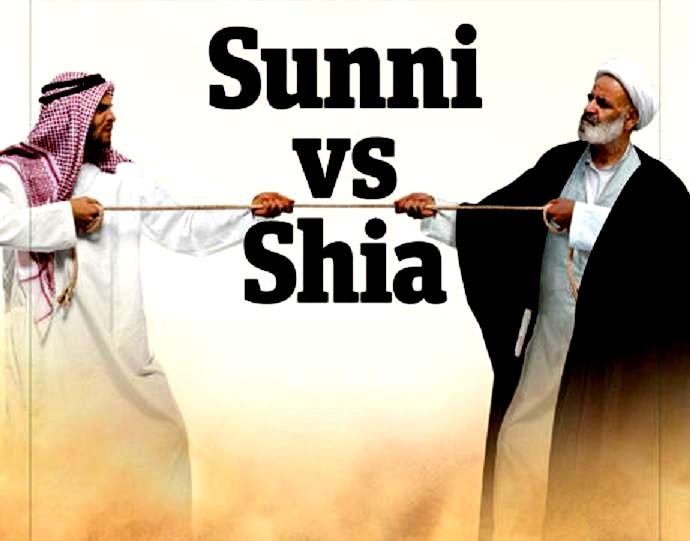
The prophecy is more than seeing into the future. For the prophecy sees without the element of time. For the prophecy sees things as they were, as they are, and as they always shall be.
August 20, 2017 – 12:24 (AhlulBayt News Agency) – Leader of a political party, the
Sadrist Movement and the leader of Saraya al-Salam Muqtada al-Sadr
pointed to historic and stable ties between two countries.
Mina Aldroubi Iraq and Iran signed an
agreement on Sunday to boost military cooperation days after the US
imposed new sanctions against Tehran for its “malign” activity in the
region.
The agreement to help “combat terrorism” was signed a day after the
Iraqi prime minister Haider Al Abadi said Shiite militias backed by Iran
would remain an integral part of the state. Iranian military advisers have played a key role in the campaign to drive ISIL
from territory seized by the extremist group in 2014 and the militias,
known as Hashed Al Shaabi, have also fought against the extremists along
with Iraq’s regular military and police.
But the militias have been accused of abuses against Sunni
populations in areas recaptured by government forces and there are fears
over their future role in the country. The agreement between Iran and Iraq, which extends “cooperation and exchanging experiences in fighting terrorism” was signed in Tehran by the Iranian defence minister Hossein Dehghan and his Iraqi counterpart, Erfan Al Hiyali.
The agreement also covered border security, logistics and training, the Iranian official news agency IRNA reported.
Since the 2003 US-led invasion of Iraq, Iran’s influence in the
country has increased, empowering Shiite leaders and leaving Sunni
populations neglected and resentful of the central government, which
contributed to the rise of ISIL.
With the extremists defeated in Mosul, the last major city under its
control, many Sunnis are fearful of a sectarian backlash as the country
tries to rebuild.
The role of the Hashed Al Shaabi in Iraq has been an issue of
widespread contention and will be a key issue in elections next year.
The government passed a bill in November that made the Hashed a
legitimate entity of Iraq’s security forces and on Saturday Mr Al Abadi
declared after meeting militias commanders that “the forces are an
essential and neutral security entity and will remain within the
structure of the Iraqi state”.
While maintaining that “the state is the main leader” of the security
structure in the country, he said the Hashed “is a neutral security
establishment, and it is here to stay”.
“It is our duty to protect it, because we are one,” Mr Al Abadi added.
The announcement is the clearest sign of support from the prime
minister for the Hashed’s continued role in Iraq after ISIL’s defeat.
While his predecessor, Nouri Al Malaki, was widely condemned for his
sectarian policies, Mr Al Abadi has been more conciliatory.
He has condemned sectarian violence carried out by the militias and
tried to build ties with Sunni countries in the region. Last month, he
travelled to Jeddah and met King Salman after the Saudi foreign minister
visited Baghdad in February.
But the Hashed endorsement will raise concerns among Sunni leaders in Iraq.
Sarah Allawi, advisor to Iraqi vice president Ayad Allawi, said: “We
thank the security forces for their efforts in liberating Mosul from
ISIL – however we now are entering a new phase rebuilding Iraq post
ISIL, which is aiming to achieve national reconciliation between
political forces.”
The Hashed are an amalgamation of various subgroups with allegiances
to Iran’s supreme leader Ayatollah Ali Khamenei and Iraq’s top Shiite
clerics Ali Al Sistani and Muqtada Al Sadr, according to a report on the
militias by the Carnegie Middle East Center.
“Some subgroups have assumed political roles and will seek to
leverage their roles in combatting ISIL to win votes in Iraq’s 2018
elections,” said the report.
For militia members, the legitimacy of their struggle against ISIL is
a direct result of a fatwa issued by Ali Al Sistani in response to the
fall of Mosul in 2014 in which he called the fight a “sacred defence”.
“As of November 2016 and the passing of the Hashed Al Shaabi law, the
Hashed has become a formally institutionalised part of Iraq’s security
apparatus tied to the office of the commander-in-chief,” said Fanar
Haddad, senior research fellow in the National University of Singapore.
“However, unlike other security units, disbanding the Hashed would
not be a straightforward administrative procedure given their immense
popularity and legitimacy amongst many Iraqis and given the Hashed’s
powerful backers in Iraq and Iran”.
The Hashed’s role in defeating ISIL has also given them support from other sections of Iraq and not just Shiites.
“The fact is that the Hashed will be a permanent feature of Iraq’s
social, political and military landscapes for the foreseeable future,”
Mr Haddad added.
Military Intelligence head: Terrorism is here to stay
Arutz Sheva Staff, 22/06/17 19:11
The head of the IDF’s Intelligence Directorate, Major General Hertzi
Halevi, spoke at the Herzliya Conference and addressed the security
threats to Israel. “Terror is here to stay,” Halevy
said. “ISIS has lost territory and shrunk, but instead of an Islamic
Caliphate, we see a virtual Caliphate. There is a clear connection
between the pressure on Mosul and al-Raka and the wave of terrorism in
Europe.”
According to him, the likelihood of an initiated war against Israel
is low. “Power-building processes, especially in Gaza and Lebanon,
transfer military power into irresponsible hands.Our enemies, who seek
to deter Israel, are liable to bring upon themselves the next war.”
Today, Halevi said, wars begin and end differently. “These
are wars with organizations. They do not start with a decision, but
rather with a deterioration between the organizations. They do not end with a unilateral decision by paratroopers at the Western Wall.”
The head of Military Intelligence said that Iran, the Assad regime
and Hezbollah constitute the main threat to the region, “with global
funding and a major danger to the State of Israel. Iran is problematic
not only because of the nuclear issue. It is in Iraq, Syria and Yemen.”
“We see clearly that Hezbollah
is building a military industry with Iranian knowledge, producing
weapons and transferring them to southern Lebanon. He said the terrorist attacks in Europe would continue for the foreseeable future.
Maj. Gen. Halevi said that Iran has been working in the past year to
establish an infrastructure for the production of precise weapons in
Yemen and in Iraq. “The nuclear agreement prohibits Iran from creating a
certain weapon, but it produces other weapons. 20 countries are threatened by the deployment of Iranian Zelzal missiles.”
Addressing the recent Iranian missile strikes on ISIS targets, he
said: “We saw it from medium range missiles. I think ISIS was hit hard. I
ask myself: if Iran is so involved in Syria – why did not they strike
from there? If it’s a show, it’s not clear it was so successful and it’s
still disturbing.”
He also said that Israel has allowed more than seven million tons of
construction material into Gaza in the three years since Operation
Protective Edge. “How much of this has gone to the benefit of the
civilians in Gaza? Do the children in Gaza receive a better education
system? The answer is usually no. This is really a dilemma, since Israel
has an interest in not having a crisis in Gaza.”
“The electricity dilemma reflects this well. On the one hand, the
oxygen masks in the hospitals are connected to electricity, but the
digging machines in the Hamas tunnels are connected to the same
electricity. We have to let Hamas choose. We cannot let Hamas build an
army so easily.”
Saudi rulers will perish: Khamenei
ANI | Tehran [Iran] May 28, 2017 03:10 PM IST
On the occasion of the beginning of the holy fasting month of Ramadan, Iran’s supreme leader Ayatollah Seyyed Ali Khamenei said that “Saudi rulers are going to perish”.
He further added that the Saudi rulers “are too harsh on Muslims, yet
kind to the disbelievers. They are giving special handouts to the US.
To whom does all this wealth belong? This is the Saudi people’s wealth,
which they give away to disbelievers and their people’s enemies.”
“Among the Muslim world, a group of worthless, inept and villainous
people are ruling over a community of the Muslim nation, namely the
Saudi government. The fools actually think they can gain the friendship
of Islam’s enemies by providing them with money and assistance. There is
no friendship there; as they say themselves, they are ‘milking them’
like cattle. They oppress their own people in this manner, and oppress
the people of Yemen and Bahrain in other ways. But they are going to
perish.”IRNA news agency quoted Iran’s supreme leader as saying.
After re-elected for a second term, Iran’s reformist president,
Hassan Rouhani asserted that unity and consensus is the solution against
the terrorism.
The era of interfering in other countries’ affairs, waging wars and
funding terrorism is over and fighting terrorism is the only way ahead,
he added. Iran’s leader also reminded his
audience on the experience of the Iranian nation’s victory over the
eight-year imposed war; adding that the Iranian nation triumphed during
the eight-year war as the ‘underdog.’
Referring to the afflictions of the Islamic world and disputes
imposed on the Muslim states, Foreign Minister Mohammad Javad Zarif
called on leaders of the Islamic world to undertake further
responsibility regarding unity of the Islamic nations.
US officials: Up to 100,000 Iran-backed fighters now in Iraq
By Lucas Tomlinson
Published August 16, 2016 As many as 100,000 Iranian-backed Shiite militia are now fighting on the ground in Iraq,
according to U.S. military officials — raising concerns that should the
Islamic State be defeated, it may only be replaced by another
anti-American force that fuels further sectarian violence in the region. The ranks have swelled inside a network of Shiite militias known as the Popular Mobilization Forces. Since the rise of Sunni-dominated ISIS fighters inside Iraq more than two years ago, the Shiite forces have grown to 100,000 fighters, Col. Chris Garver, a Baghdad-based U.S. military spokesman, confirmed in an email to Fox News. The fighters are mostly Iraqis.
Garver said not all the Shia militias in Iraq are backed by Iran,
adding: “The [Iranian-backed] Shia militia are usually identified at
around 80,000.”
According to some experts, this still is an alarmingly high number.
“The effect of the Obama administration’s policy has been to replace American boots on the ground with the Iranian’s. As
Iran advances, one anti-American actor is being replaced with another,”
Thomas Joscelyn, a senior fellow at the Foundation for Defense of
Democracies, said in a recent phone interview.
Garver said other Popular Mobilization fighters also consist of Sunni tribal fighters from Anbar and Nineveh provinces in Iraq.
Whether the force size is 80,000 or 100,000, the figures are the
first-known estimates of the Iranian-backed fighters. The figure first
surfaced in a recent Tampa Bay Times article and marks the latest
evidence of Tehran’s deepening involvement in the war against ISIS, with
the U.S. military also confirming that Russian bombers are now flying
into Syria from a base in Iran. The growth also could create greater
risk for Americans operating in the country, as at least one Iran-backed
group vowed earlier this year to attack U.S. forces supporting the
Iraqis. Even more troubling to the
U.S. military are reports that Qassem Soleimani, an Iranian general who
commands the Islamic Revolutionary Guard’s Quds Force, is now on the
ground outside Mosul ahead of an expected operation to retake Iraq’s second-largest city which has been under ISIS control for the past two years.
According to the Long War Journal, a spokesman for the Iranian-backed
forces said earlier this month that Soleimani is expected to play a
“major role” in the battle for Mosul.
When asked about Shia militias participating in the liberation of
Sunni-dominated Mosul, the top U.S. military commander in Iraq said last
week, “The government of Iraq is in charge of this war. We’re here to
support them. So, who they [want in] the campaign is really their
decision.”
A U.S. military official could not confirm Soleimani’s presence in
Mosul, but said Soleimani had been seen throughout Iraq and Syria in the
past two years coordinating activities.
Garver stressed Tuesday there is no coordination between the U.S. and
Iranians. “We are not coordinating with the Iranians in any way, we are
not working with them in any way,” he said during a press conference,
adding: “However the government of Iraq comes up with the plan, we are
supporting [their] plan for the seizure of Mosul.”
Last August, Fox News first reported Soleimani’s visit to Moscow 10
days after the landmark nuclear agreement in July to meet with Russian
President Vladimir Putin and top Russian officials to plan Russia’s
upcoming deployment to Syria in late September.
Soleimani is banned from international travel through United Nations
Security Council resolutions. He was first designated a terrorist and
sanctioned by the U.S. in 2005. In October 2011, the U.S. Treasury
Department tied Soleimani to the failed Iranian plot to assassinate the
Saudi ambassador to the United States at a popular restaurant in
Washington, D.C. Soleimani’s Quds Force is the special forces external
wing of the Iranian Revolutionary Guard, responsible for supporting
terrorist proxies across the Middle East.
At his confirmation hearing last year, Chairman of the Joint Chiefs
of Staff Gen. Joseph Dunford was asked how many Americans were killed by
Iranian-backed forces under the command of Soleimani.
“The number has been recently quoted as about 500. We weren’t always
able to attribute the casualties we had to Iranian activity, although
many times we suspected it was Iranian activity even though we didn’t
necessarily have the forensics to support that,” Dunford said. The threat to American troops
remains. Last month, firebrand Shia cleric Muqtada al-Sadr — responsible
for attacks against U.S. troops in Iraq a decade ago – once again
called for his supporters to kill American troops.
“[U.S. forces] are a target for us,” he said on his website.
In March, one Iranian-backed group said it would attack U.S. forces
after the Pentagon announced that hundreds of U.S. Marines were
supporting Iraqi forces with artillery fire.
“If the U.S. administration doesn’t withdraw its forces immediately,
we will deal with them as forces of occupation,” Asa’ib Ahl al-Haq (AAH)
said on its TV channel.
The Iranian-backed group has claimed responsibility for over 6,000
attacks against U.S. forces in Iraq since 2006 and operates under the
supervision of Soleimani, according to a report by the Institute for the
Study of War.
Meanwhile, there are more indications that Russia and Iran are
expanding their military ties. The U.S. military has confirmed that
Russian bombers flying from a base in Iran have bombed three areas in
Syria.
In addition to the up to 100,000 Iranian-backed forces in Iraq, there
are thousands of Iranian-backed forces in Syria as well in support of
President Bashar al-Assad. Some of these Iranian-backed forces come from
as far as Afghanistan and hundreds have recently died fighting Syrian
rebels in the city of Aleppo, according to recent reports.
Lucas Tomlinson is the Pentagon and State Department producer for Fox News Channel. You can follow him on Twitter: @LucasFoxNews
Muqtada al-Sadr, whose
Mahdi Army was instrumental in the civil war that erupted in Iraq in
2006-2008, was asked in a letter by a follower to respond to U.S.
Defense Secretary Ashton Carter announcement that Washington would
dispatch 560 more troops to help Iraqi forces retake the northern city
of Mosul from ISIS, which has held it since August 2013.
On Sunday, Sadr posted this ominous answer to his official Facebook page: “They are a target for us.”
The popular cleric didn’t elaborate further, but his followers have
been hugely supportive of this apparent threat, which circulated on
social media and in Facebook groups and pages that back him. Dozens on
Facebook and Twitter answered with the slogan “No, no to America,”
and posted an image of Sadr alongside a burned U.S military tank. Users
on a pro-Sadr group page shared the threat, quoting the Quranic verse:
“if you return [to sin], We will return [to punishment]. We will shake
the land beneath their feet.” Others said: “We are at your service Muqtada,” and posted images allegedly showing American troops being targeted in Iraq.
Sadr has been fiercely anti-American since the U.S.-led military
invasion ousted former Iraqi leader Saddam Hussein in 2003. Since then,
Sadr and his many followers have battled coalition forces across Iraq
and he has continually pressed to have all U.S. and Western influence
removed from the country.
Sadr’s followers said “America is the great Satan, no, no to America”
and dismissed the announcement as “a new occupation, one time in the
excuse of Saddam, and later because of ISIS.” Another said “America is
actually ISIS.” An Iraqi user tweeted that “Sadr’s threat to target
American forces in Mosul is a wise decision because the Iraqis can
liberate their land, Iraq isn’t a colony.”
Alongside the support, several social media users in Arabic also criticized Sadr’s
new threat and mocked him. “Are you kidding? Without America you and
your corrupt government wouldn’t be able to last a day in Iraq,”one user
wrote. Another criticized Sadr
“like he doesn’t know that Americans are taking part in the liberation
of his country while bombing ISIS day and night,” or that “without
America, Sadr would become chicken food.”
— صوت العراق الناطق (@sawtalaraq) July 18, 2016
No, no to America. No, no to Israel
According to Reuters, other Shiite militias have made similar pledges
to attack U.S. soldiers in the past year, but any casualties that have
struck the U.S. have come during battles with ISIS fighters in the
north.
On July 4, 2016 (8:35 pm Iraqi time), over 50 missiles were fired
against Camp Liberty. Because of the proximity of Tehran’s militias in
range of Camp Liberty, it appears as if they were launched by those
affiliated with the Quds Force of Iran’s Islamic Revolutionary Guard Corps.
Damage assessment reveals that parts of the camp were completely
destroyed. As many as 40 residents were injured, and astonishingly no
one was killed during this massive attack.
Nevertheless, each time the oppressors of Liberty get away with
attacking the camp it increases the likelihood of even more hostile
assaults in the future.
Once several opponents of Iran left for safety in Iraq, Tehran sought
to destroy them there. Several factors coincide to explain why Tehran
is assaulting its dissidents in Iraq—members of the Mujahedeen-e-Khalq (MEK), the main resistance group that rejects clerical rule, and espouses a secular, democratic, and nonnuclear Iran.
The regime is using the upcoming anniversary of the nuclear deal with Iran on July 14, 2016, as a time to crack down on its opponents.
Washington has placed the deal with Tehran over the security of those
aligned with the United States and have the capacity to place pressure
on the regime on behalf of the Iranian people.
In 2014, Washington agreed to a four-month extension of ongoing
nuclear talks until Nov. 24. This period was a time of peril for
opponents of Iran because they were and are of great value in revealing
intelligence about its nuclear cheating.
Three Western allies disclosed on Sept. 25, 2009 intelligence about
the Qom site during a G-8 economic summit in Pittsburgh, implicitly
validating a resistance disclosure of the same site four years earlier.
And by January 2012, Iran acknowledged it had begun enrichment at that
heavily fortified site, now known as the Fordow Fuel Enrichment Plant.
A case of retaliation as it relates to nuclear revelations came on
September 1, 2013. The organization had in previous years uncovered a
number of undeclared nuclear sites and announced them in a series of
press conferences, e.g., in Washington during July.
Tehran retaliated to take advantage of ongoing secret nuclear talks
with Washington, which let the regime off the hook by saying very little
about the assault. Yet in October 2013, the resistance disclosed
additional intelligence about suspect weaponization activities by Iran.
Another missile attack was waged on Camp Liberty in December 2013,
killing four and wounding dozens.
On top of the upcoming nuclear anniversary, there are the
deteriorating political-military situation in Iraq and Tehran’s
increasing problems with its discontented population. Iran uses such
moments as times to crack down on its opponents at home and abroad.
In June of 2009, the regime put down country-wide demonstrations in
which dissidents tied to the MEK participated. Iraqi forces acting on
behalf of Tehran then attacked MEK members located at that time in Camp
Ashraf, Iraq during July of that year. Iraqis killed 13, held 36 as
hostages, and only released them in October under intense international
pressure.
On April 8, 2011, a day after a major nuclear revelation in
Washington by the dissidents, Camp Ashraf came under a major assault by
the Iraqi Security Forces, leaving 36 dead, and hundreds wounded, in
what was described as “Massacre” by then Senate Foreign Relations chair,
John Kerry.
A year after moving to Camp Liberty, on Feb. 9, 2013, rocket and
mortar shells fell on the dissidents, killing 9 and wounding over fifty.
The United Nations High Commissioner for Refugees called these attacks,
“a despicable act of violence,” describing residents as asylum seekers
entitled to international protection.
The Way Forward
Hark back to the nuclear deal with Iran agreed on July 14, 2015.
Senators Robert Menendez (D-NJ) and Mark Kirk (R-IL) introduced
legislation to extend the sanctions law for 10 years. Other members are
exploring the possibility of introducing bills that focus on the Iranian
regime’s financial infrastructure involved in terrorism, missile
development, and human rights abuses.
Democrats and Republicans are unhappy with the lack of change in the behavior of the Iranian regime,
are considering tougher measures. A Democratic senator who voted for
the Iran deal said it is not America’s responsibility to promote foreign
investment in Iran, despite efforts by Secretary of State Kerry to
encourage investment there. Delaware Senator Chris Coons said on June
23, 2016, “I don’t think it’s our job to act as the chamber of commerce
for Tehran.”
Nearly a year after the 2015 Iran nuclear agreement, Iranian dissidents in Iraq are more vulnerable than ever to Tehran-sponsored assaults by its militias in Iraq.
To prevent them from intensifying attacks on Camp Liberty, Washington
could use its diplomatic leverage with Baghdad to protect Iranian
oppositionists and expedite their resettlement out of Iraq to Albania.
On June 29, 2016, Senator John McCain introduced a bill (S.3114), which
calls for the safety and security of Camp Liberty residents as well as
their safe and the expeditious resettlement to Albania. Absent political
pushback against Iranian militias from the executive branch, such
congressional initiatives are a welcome path forward.
As Henry Kissinger once said, Iran needs to decide whether it is “a
nation or a cause.” The Ayatollah Khamenei stubbornly prefers Iran
remain a “cause.”
The record of meddlesome, terror-laden interference throughout the
Middle East by Tehran is growing longer by the day. The oppressive
military dictatorship may be fronted by a so-called “moderate” President
Rouhani, but Iran is undeniably under the control of the Revolutionary
Guards and their political hacks within the Ayatollah Khamenei’s
clerical politburo. As it stubbornly clings to the cause of belligerence
and revolution the regime has been resuscitated and emboldened by a
nuclear agreement that has imposed nary a speed bump on its road to
fulfilling its regional ambitions.
Cases in point: the incendiary and venomous anti-Israel/anti-Semitic
rhetoric emanating from the highest reaches of the regime have become
more dangerous and more provocative than ever. The terror-funding money
laundered cash flowing into Hezbollah and Hamas coffers has accelerated,
fueled in part, from U.S. and European unfrozen asset transfers and
sanctions relief. Elie Weisel’s passing was met with another
Holocaust-denying tirade from several high level hardliners. The number
of Iranians hanging from the gallows under President Rouhani has reached
tallies higher than under his predecessor: the notorious Ahmadinejad.
Oppression has escalated against average Iranians as the regime stomps
hard on any effort to leverage assets relief for fear of breathing new
life into Iran’s suppressed democratic movement.
The Iranian government’s propaganda arm is running at warp speed
warning Iranians that should Assad’s regime fall ISIS will soon be on
Tehran’s doorstep. The Farsi-language media is relentlessly pounding
this nonsense into every crevice of Iranian society. Iran, in other
words, is figuratively and literally getting away with murder in both
Iraq and Syria “in defense of Iran.”
The regime’s apologists demand patience and excoriate those who
question any effort to hold Iran accountable for these actions. Soon the
regime, they argue, will inevitably bend to the winds of globalization
and confront the exigencies required of a “proper” nation state. After
all, Boeing just signed a major deal with Iran. More such deals will
surely follow. Isn’t that evidence, they assert, that the Ayatollah’s
iron grip will weaken under the weight of western investment.
Hope springs eternal.
A new, more moderate regime, the Iranian amen choir chant, will
surely emerge. Just give it time. The great Iranian gamble is buttressed
by U.S. assurances that it is doing everything possible to challenge
Iran’s expansionism. Not true! What are we to make then of Secretary of
State’s recent comments that Iran’s presence in Iraq to be “helpful” to
American attempts to beat back the threat of ISIS, given their common
enemy?
It appears that Mr. Kerry, whose inclination is to sugar-coat
anything that may give rise to criticism of Iran, has turned a blind eye
to what U.S. commanders in Iraq are reporting up their chains of
command to the Pentagon. Moreover, Mr. Kerry’s limited interest in the
future of Iraq’s independence and integrity reflect the Obama
Administration’s own indifference to Iraq’s long term future.
Time will tell whether U.S. national security interests can sustain
the gamble, but given Iran’s international and regional conduct in
recent months, Mr. Kerry may need to adjust his assessment if Iraq’s
future stability is of consequence to the U.S.
U.S. commanders stationed on the ground in both the battles to
liberate Falluja and Ramadi from ISIS forces have expressed alarm that
rogue Iranian-commanded Shiite militias (aka The Popular Mobilization
Units (PMUs)) are moving into these towns after their liberation and
committing sectarian abuses against Sunnis, thus making refugee and
displaced persons more sympathetic to the remnants of ISIS operatives in
the region. The New York Times reported a few weeks ago that a Shiite
militia leader, in a widely circulated video, was seen rallying his men
with a message of revenge against the imprisoned civilians of Falluja,
whom they accuse of being sympathizers of ISIS: “Falluja is a terrorist
stronghold,” said Iranian-backed militia leader Aws al-Khafaji, the head
of the Abu Fadhil al-Abbas militia.
As Iraq reels from a grave escalation of ISIS-inspired terrorism
across the country in recent days, Iran-backed Shiite militiamen (often
with the connivance of the Iraqi leadership) have used the growing chaos
inside Iraq to launch a series of attacks against Iranian adversaries
in Iraq, including a heinous attack yesterday against innocent civilian
Iranian dissidents imprisoned against their will at Camp Liberty,
wounding more than 40 residents. There is no doubt that this attack, as
previous ones on Camp Liberty, are the work of Iranian controlled forces
operating virtually at will, both covertly and overtly in Iraq. All the
while, Iran is doing everything possible to fallaciously present itself
as the ultimate and only reliable savior of the truncated Iraqi state.
Iran’s meddling in Iraq is incessant, albeit with mixed results.
Tehran’s goals are overt and evident: subjugate the central government
to its whim while marginalizing the minority Sunni population without
driving it back into the hands of whatever remnants of ISIS remains
after it is driven from the all-important city of Mosul. A balancing
act? Surely. But isn’t Iran really interested in having Iraq
disintegrate – leaving it gobble up as much of Iraq’s territory as
possible up to the very frontier of the Sunni heartland?
Iran is determined to resist a revitalized and reinvigorated American
effort to politically, militarily, and financially stabilize a
pro-secular, reform-minded Iraqi central government. Iran takes an
extraordinarily dim view of national Iraqi reconciliation, and will
apparently do everything possible to sabotage that goal – a goal 180
degrees opposite to U.S. policy.
Who wins in the end from Iran’s deviousness in Iraq? ISIS, or
whatever remnants there are of ISIS. Tehran’s machinations, intended to
force Baghdad and the south to fall directly under its sway, will doom
any hope for national reconciliation among Iraq’s three major sects
(Sunnis, Kurds, and Shiites) – giving rise to ISIS 2.0 inside of Iraq.
That is the hope of any future ISIS leadership…living to fight another
day to restore the Caliphate in northern Iraq…and the cycle of terror
will find yet another home from which to reconstitute itself.
The next president faces an extraordinary challenge again in Iraq,
and it all goes back to Iran and its loathsome, meddling regional
militant strategy to stir as much terrorism and instability as possible
to thwart any semblance of normalcy and stability.
The next president will have to reconstruct that very missing
regional strategy, but at a severe disadvantage given how much the Obama
Administration intentionally dropped the ball – brushing aside all the
warnings to avoid empowering Iran to at the expense of core American
national security interests in the Middle East.
Disunity from abroad, tensions at home allowed Tehran to pressure
Baghdad into a dramatic departure from the American war strategy.
By Paul D. Shinkman | Senior National Security Writer
June 2, 2016, at 5:00 a.m.
Iraqi Prime Minister Haider al-Abadi’s decision to engage the Islamic
State group in Fallujah is about more than defeating the terrorist
network. It’s about more than establishing safety in Baghdad, and it’s
even about more than securing his own political future.
His abrupt departure from America’s script for the war against the
Islamic State group, which prioritizes above all else the liberation of
Iraq’s second-largest city, Mosul, shows the strength of the other major
international influence in Iraq, and its sway on Baghdad. Iran has reportedly been pressuring Abadi for weeks, if not months, to prioritize Fallujah. But
now domestic tensions in Baghdad and disunity among the world powers
that have involved themselves in the conflict have cleared the way for
the Islamic republic to have more potency than the U.S., Russia, Turkey
or any other world power involved in the conflict. “Tehran has more influence on
Abadi’s focus, whether on Fallujah or anywhere else, than Moscow,
Washington and Ankara combined,” says a former U.S. combat commander
with extensive experience working with Iraq’s senior leaders. “The
political disarray in Baghdad, the strangely wandering American
political strategy, and the opaque rationale for what American forces we
will commit to what tasks in the worst form of gradual escalation,
combine to leave decisions open to a host of inputs from military and
civilian policy makers from Baghdad to Tehran, before even considering
the enemy’s vote.”
The U.S. has spent the week since Abadi announced his new battlefield
priorities downplaying the sudden shift, despite reports that the
Iraqis provided only scant notice of the campaign to their American
military counterparts. Reports have also emerged that U.S. officials
privately don’t agree and are concerned about what opening a new front
might mean for the overall success of the war if Iraqi forces get bogged
down in a protracted battle.
It became immediately clear this week the fight would not mirror
previous liberations of some Iraqi towns where disenfranchised Islamic
State group presence almost immediately fled. As Pentagon officials
point out, Fallujah serves as the extremist network’s last haven in
Iraq’s massive Anbar province, and they won’t withdraw easily.
Iraqi forces began capturing villages on the outskirts of Fallujah
soon after the fighting began on Monday but have since been met with
fierce resistance from the extremist group’s fighters.
“They intend to put up a fight for it, and we definitely have seen
intense fighting for those two days,” Pentagon spokesman Navy Capt. Jeff
Davis said Tuesday.
After acknowledging before the effort began that Fallujah offers no
tactical benefit in recapturing Mosul, U.S. officials have since
publicly backed the new campaign and minimized inconsistencies with the
larger strategy. Defense Secretary Ash Carter said last week “we are
obviously supportive of this operation” and that the U.S. was very much
aware of Iraq’s intentions to shift toward Fallujah, despite claims to
the contrary from defense officials who spoke to U.S. News.
Marine Gen. Joseph Dunford, chairman of the Joint Chiefs of Staff,
insisted the Iraqi military could continue preparing for the Mosul
operation and simultaneously pursue a detour in Fallujah. Army Col.
Steve Warren, speaking from the coalition’s headquarters in Baghdad’s
Green Zone on Friday, confirmed that the need to retake Fallujah is
driven by “political calculus for the civilian leadership of Iraq” and
said success there would ease political pressure on Baghdad before
refocusing on Mosul.
That pressure, however, is intense. Shiite
protesters loyal to powerful cleric and militia leader Muqtada al-Sadr
have stormed the central Green Zone where the Iraqi government and most
foreign embassies are based. Outraged by a lack of reform, protesters in
April capped months of popular street demonstrations by occupying and
ultimately ransacking the parliament building amid fears the government
could collapse.
“We often tend to underestimate the degree of threats to Abadi,
particularly from other Shiites,” says Stephen Biddle, formerly an
adviser to Gens. Stanley McChrystal and David Petraeus who is now with
the Council on Foreign Relations. “For most governments like Iraq,
internal threats loom larger than external threats, and you can’t just
ignore them and treat them as electoral noise. Because that’s how you
get killed in a coup d’etat.”
Underscoring concerns that the political instability could hamper the
fight against the extremists, the Islamic State group in recent weeks
has staged a series of car bombs and suicide attacks in Shiite
neighborhoods that marked the group’s return to the terror tactics of
its roots, as al-Qaida in Iraq, and exacerbated sectarian tensions.
The long-stalled Mosul operation optimistically appears months away,
so targeting Fallujah provides a temporary quick-fix for Abadi
politically, using the urgency of the campaign to prove to Iraqis he’s
acting to keep them safe. Successfully liberating Fallujah, which is
predominantly Sunni, could also earn Abadi some good faith among that
constituency nationwide.
But some say that, tactically, his attention is likely misplaced.
Fallujah, about 40 miles west of Baghdad, is indeed an Islamic State
group haven and source of much of its bomb-making capabilities. However,
most of the recent attacks on Baghdad have originated from the north,
not the west as would be the case if they came from Fallujah, according
to the Institute for the Study of War, which regularly analyzes battle
rhythms in Iraq.
Other forces are also at play behind the decision, including
influences from Tehran that would like the Shiite majority in Iraq’s
government to protect Baghdad from what it sees as the threat posed by
the proximity of Sunni extremists, like the Islamic State group, while
also solidifying its hold on power.
“Iran does not see a government of Iraq that has a Sunni presence in
it,” says Scott Mann, who retired as a lieutenant colonel after 18 years
as a U.S. Army Special Forces officer with deployments to Iraq and
Afghanistan. “This is a way to further divide those ethnicities, between
Persians and Arabs, and between Sunni and Shiite, and create a more
polarized environment around that conflict.
“They know it, and they’re going to seize any opportunity they can to
do that. And ISIS is going to do exactly the opposite. They’re going to
create those situations, because they know how Iran is going to play
it.”
The overwhelmingly Sunni Muslim city of Fallujah has long been
associated with combat in Iraq. It served as a headquarters for al-Qaida
in Iraq during the last war and witnessed some of the most gruesome
fighting, as U.S. forces in two separate campaigns in 2004 engaged in
bloody, door-to-door combat to clear the town of the extremist presence.
Complicating the campaign, the Iraqi government has had to rely on
overwhelmingly Shiite Muslim militia forces, known as the Popular
Mobilization Forces, in part due to the the U.S.-led coalition’s
limitations on providing ground forces, which leaves Baghdad with few
other options for the sheer numbers of fighters it needs. These forces
are supposed to remain outside the city, where they help prevent
extremists’ lines of escape or reinforcement.
Pictures emerged last week of Iranian Revolutionary Guards Corps’
Qassem Soleimani’s meeting with leaders from the local Shiite militias,
one of the first times he had appeared in public media since his visit
to Aleppo, Syria – another central focus of Iran’s fight against enemy
forces in the region. That the shadowy Quds Force commander would
publicize his whereabouts further emphasizes the degree to which Iran
now prioritizes Fallujah.
Iranian proxy forces, like some of the militias, are a critical
component to any chance of success in defeating the Islamic State group.
They have contributed to most of the fighting to secure the area around
Fallujah, particularly to the north, clearing the way for Baghdad’s
announcement late Monday that its U.S.-trained counterterrorism
commandos had begun the arduous work of actually entering the city to
clear it of the Islamic State group presence. This use of various kinds
of military forces has produced a winning combination in the past, like
for the liberation of Ramadi. But now it faces its most serious
challenge as the few hundred Islamic State group fighters in Fallujah
dig in and and use the estimated 50,000 local residents held there as
human shields.
The U.S. military argues none of the conventional forces used for the
Fallujah campaign would be needed in Mosul. Most experts agree, but
that doesn’t mean the sudden detour won’t affect America’s fundamental
plans for the battlespace.
“Operations like this chew through resources,” says Patrick Martin,
research analyst for Iraq with the Institute for the Study of War. “It’s
just going to delay everything.”
He cites reports that the U.S.-trained Counter Terrorism Service –
considered the most effective Iraqi fighting force on the ground – has
grown exhausted by the continuous demand for troops to lead the way in
clearing Islamic State group positions.
And fundamental questions about the future of Fallujah remain, Martin
says, particularly following widespread concerns that the Shiite
militias wish to exact revenge on Sunni populations for their perceived
complicity toward the Islamic State group – a key reason why the U.S.
refuses to provide air support to ground operations involving the
militias. Shiite militias also have reportedly prevented Sunnis from returning to homes they helped liberate.
“We shouldn’t kid ourselves,” Martin says. “This is what pushes the
Mosul operation into delaying it indefinitely, because there are still
other questions that haven’t been answered yet.”
All sides agree that liberating Fallujah is simply a matter of time.
The effect, though, of an Iranian sponsored victory may only further
complicate the total war against the Islamic State group.
The heavy presence of Shiite militia encircling Fallujah provide
prime fodder for the extremist network to convince their fellow Sunni
Muslims that the Iraqi government is beholden to Iran and has no
intention of including them among the ruling classes.
“All they have to say is, ‘Look who’s coming. This is your government
that is allowing this to happen, backed by the American Air Force. Only
we can help you.’ And they do this brilliantly,” says Mann, the former
special forces lieutenant colonel.
“In the short term, will it be effective? Probably. It will force
ISIS to go to ground. It may kill some and displace some of them,” Mann
says. “In my assessment, this is nothing more than mowing the grass.”
At this point, it isn’t clear how much say the U.S. will have in that.
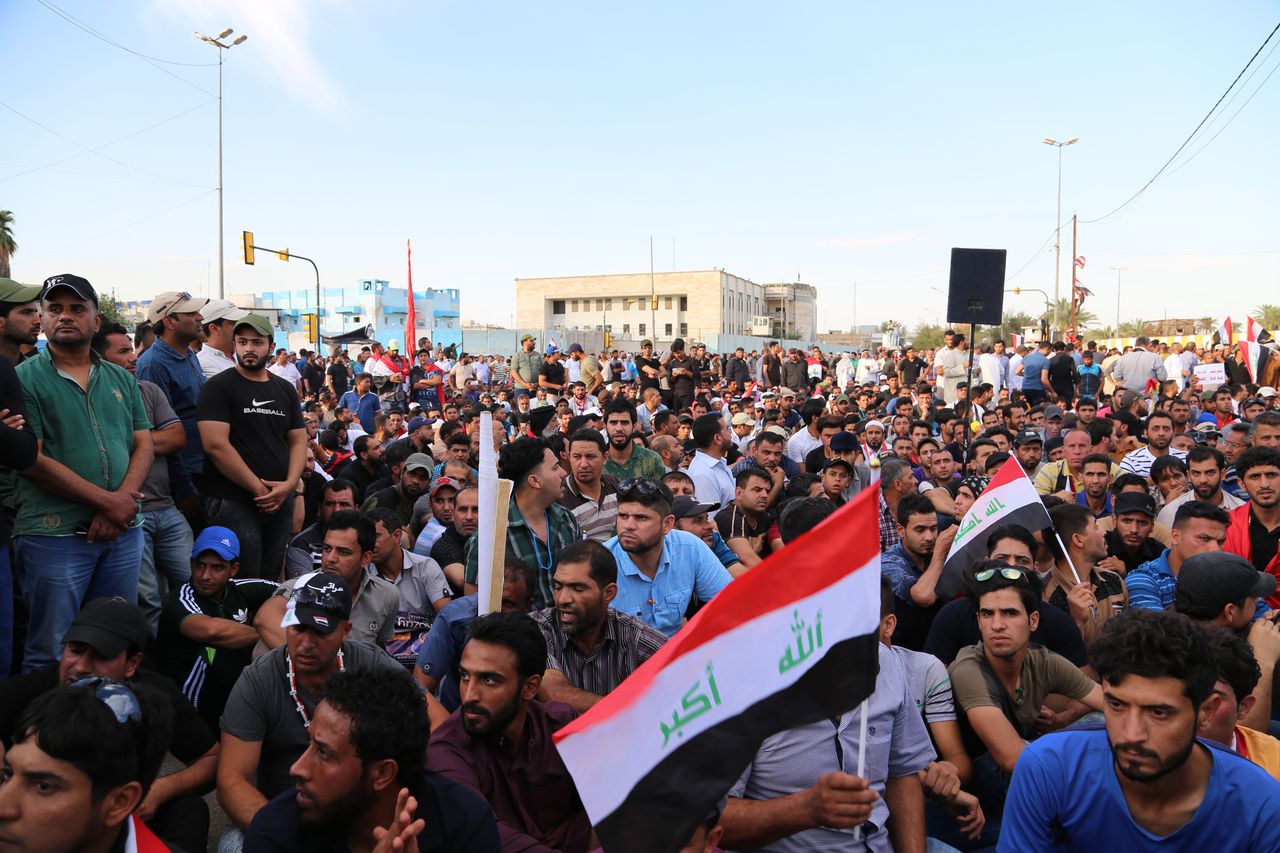
BAGHDAD: Iraqi supporters of the Sadrist movement hold national flags and shout slogans during a demonstration to press for reforms yesterday at Baghdad’s Tahrir Square. — AFP
The proposed changes have been opposed by powerful political parties
that rely on control of ministries for patronage and funds, and
parliament has repeatedly failed to vote on a new cabinet list. The
demonstrators, many of them carrying Iraqi flags, marched from Tahrir
Square in central Baghdad to an entrance to the heavily-fortified Green
Zone, where the government is headquartered, chanting that politicians
“are all thieves.”
“Our participation in the demonstration aims to reject this
government for being sectarian,” protester Abu Ali Al-Zaidi said. Key
government posts have for years been shared out based on political and
sectarian quotas, a practice demonstrators have called to end. The
government “did not bring the country and Iraqis anything but poverty
and killing,” said Zaidi, who travelled from Maysan province in southern
Iraq to take part in the protest. “All Iraqis must protest to reject
this government, which failed in all fields,” said Abu Mohammed
Al-Sudani, a demonstrator from Baghdad.
The protest came on the same day that parliament speaker Salim
Al-Juburi was seeking to hold a session to vote on a new cabinet.
Parliament has been paralyzed for weeks by the dispute over the cabinet,
with MPs holding a sit-in, brawling in the chamber, seeking to sack the
speaker and repeatedly failing to move forward on the issue of new
ministers. Abadi called a week ago for parliament to put aside its
differences and do its job, saying he hoped for a vote on a new cabinet
within days-something that has yet to take place.
Abadi called in February for “fundamental” change to the cabinet so
that it includes “professional and technocratic figures and academics”.
That kicked off the latest chapter in a months-long saga of Abadi
proposing various reforms that parties and politicians with interests in
the existing system have sought to delay or undermine. The political
crisis comes as Iraqi forces battle to regain more ground from the
Islamic State group, and both the United Nations and Washington have
warned that it could undermine the fight against the jihadists. Iraq has
also been hit hard by the plummeting price of oil, revenues from which
account for the vast majority of government funds._ AFP
Thousands of Iraqis traveled to Baghdad Tuesday to voice their opposition to government leaders, rallying for an end to political corruption.
The “million-man march” was called for by influential Shiite cleric Muqtada al-Sadr ahead of a scheduled parliament session to vote on a new government.
Many of the protesters are aligned with former Prime Minister Nouri
al-Maliki and have demanded the resignation of the current Prime
Minister, Haider al-Abadi, as well as other high-level leaders.
Karim Kadim/AP Photo
Followers of Iraq’s influential Shiite cleric Muqtada al-Sadr
gather ahead of a scheduled parliament session to press for a vote on a
new government, at Tahrir Square on April 26, 2016, in Baghdad.
The Parliament approved a partial cabinet “reshuffle,” originally proposed by al-Abadi.
The move would transfer key portfolios to independent technocrats in
an effort to rid the government of “patronage and corruption that have
hindered the provision of public services since the 2003 U.S.-led
invasion,” according to The Associated Press.
In preparation for the massive protests, Iraqi security forces
blocked off all roads leading to the downtown Tahrir Square with razor
wire and concrete blocks.
Karim Kadim/AP Photo
Iraqi security forces guard the heavily fortified Green Zone as followers of Iraq’s influential Shiite cleric Muqtada al-Sadr wave national flags as they gather in front of the Green Zone, April 26, 2016, in Baghdad.more +
Some protesters arrived several weeks ago and have been holding a
“sit-in” outside of the heavily guarded Green Zone, creating huge
traffic jams in parts of the city.
Many demonstrators carried photos of Muqtada al-Sadr and praised him with songs.
Protesters said they would not leave Tahrir Square until a new government was in place, according to The Wall Street Journal.
Col. Steve Warren, the U.S. military spokesman in Baghdad, said
American military personnel and operations were not affected by today’s
protests.
Followers of Shiite cleric Moqtada al-Sadr march toward parliament, which elected some new ministers before adjourning
Followers of Iraq’s Shiite cleric Moqtada al-Sadr chant
slogans during a protest Tuesday in the Iraqi capital Baghdad demanding
that parliament approves a new cabinet and end political and sectarian
wrangling. Photo: Reuters
The beginning of the cabinet voting appeared to appease Mr. Sadr and his supporters for the time being.
“Today the change has been achieved by your insistence,” said Khadhum
al-Essawi, an assistant to Mr. Sadr, in an address to protesters
Tuesday evening. “We are demanding to change the whole cabinet with no
exceptions, but we accepted the current change just to let things move
on.”
Parliament announced lawmakers cast their ballots on seven
ministerial posts on Tuesday, correcting earlier state television
reports that they had voted on nine. Among the posts they voted on, the
parliament retained only the justice and education ministers from the
current government. Speaker Salim al-Jubori suspended voting until
Thursday for a remaining 21 positions.
Prime Minister Haider al-Abadi last year announced a slate of reforms
intended to reduce the size of government, diminish sectarian quotas in
the cabinet and improve the delivery of basic services, including
electricity.
But ministers and lawmakers, many of whom rely on corruption and a
system of patronage based on the sectarian quotas, have repeatedly
delayed voting on them.
Parliament’s installation of a technocratic cabinet would mark a
major departure from Iraq’s long-standing political tradition in which
parties representing ethnic and religious groups—primarily Kurds and
Sunni and Shiite Arabs—grapple for power.
The political turmoil threatens Iraq’s already fragile government,
which has struggled to turn back Islamic State’s gains. Since oil prices
plummeted in 2014, unemployment has soared.
Thousands of Mr. Sadr’s followers protested in Baghdad last month,
their sit-in breaching the gates of the International Zone. They were
joined by a cross-sectarian group of legislators who demanded the
resignation of Mr. Jubori, Mr. Abadi and Iraqi President Fouad Masoum.
Some of those lawmakers have staged a sit-in in the parliament
building, sparking fistfights and shouting matches. Parliamentary
leaders shut off the chambers’ water and power last week in a bid to
oust them.
The insurgent members repeatedly interrupted Tuesday’s parliament
session, shouting that the session was illegal and calling for the
dismissal of top leaders, including Mr. Jubori, who later moved the
session to another room in the assembly hall to avoid further
disruption.
It was unclear if the approval of the seven new ministers would end the sit-in.
“Such opposition and chanting inside the parliament is a democratic
thing, but we also believe that this delays parliament’s performance,”
said Majid Shingali, a parliamentarian who participated in the vote.
State television said 180 members were in attendance, but past head
counts have been disputed. A quorum mandates that 165 be present.
Protests have continued in the capital since last month, when Sadr staged
a sit-in inside Baghdad’s heavily fortified Green Zone, demanding that
Prime Minister Haidar al-Abadi throw out corrupt officials and announce a
new cabinet.
“Our main demand is to put an end to corruption,” one of the protesters told Rudaw in the Iraqi capital.
“The present and former Iraqi politicians had a hand in destroying
Iraq and in corruption. They handed Iraq into the hands of the Islamic
State (ISIS). They handed Mosul to ISIS, and finally the country has
collapsed,” he said.
The Iraqi government has been at war with ISIS since June 2014, when
the militants swept across the country and seized a third of the
territory.
Government coffers also have been emptied because of the war, and
reportedly due to massive corruption inside the previous government of
prime minister Nouri al-Maliki. Parliamentary auditors say they have
also found irregularities in the present government’s massive arms
purchases.
Meanwhile, the parliament has remained paralyzed over moves to oust
the speaker, Salim al-Jabouri, who has said he is determined to remain
at his post and that moves to unseat him are illegal.
A new cabinet cannot be named before it is approved by parliament.
“We want a technocratic government and we are sending a message to
the Iraqi politicians. We are here for reform,” said another protester.
“If they think we will get tired they are wrong, we will not, even if we
stay here for three years we will achieve reforms,” he warned.
The Rudaw correspondent in Baghdad said that security forces had surrounded ministries in Baghdad, were gates were padlocked.
Sadr called recent peaceful demonstrations in the country’s capital “historical” and urged for a large turnout on Monday.
“Your readiness for a demonstration of a million on Monday will
frighten the authorities and oblige them to hold a parliamentary session
to vote [the new cabinet] freely and transparently,” he said.
Imad Khafaji, Spokesman for Iraqi Parliament’s Speaker Salim
al-Jabouri, said on Sunday (April 24) that parliament would hold a
session on at 1 pm on Tuesday (April 26) to discuss reform and new
cabinet reshuffle.
Jabouri ordered the suspension of the assembly on April 22 due to
ongoing political disputes in over government reforms and a cabinet
shakeup.
Leaders in Iraq and Coalition countries have warned that political
disputes among blocs threaten the effort to advance against Islamic
State militants.
Whereas Baqir advocated for a political revolution, his cousin Muhammad Sadiq al-Sadr (Sadr II) built a mass movement,
one that would restore Shiism’s relevance to the spiritual and
sociopolitical needs of the faithful. After the United States routed the
Iraqi military and expelled it from Kuwait in 1991, the Shia rose up in
the hope that Washington would come to their aid. No help came.
Following Saddam’s horrific suppression of the Shaaban Intifada, Iraq’s
Shia poor were angry and fearful. Compounding the suffering, UN
sanctions devastated the Iraqi masses rather than the political elite
supposedly targeted. Sadiq’s overt hostility to the West resonated
profoundly. He prefaced his Friday
sermons with “No, no to America! No, no to Israel!” Saddam assassinated
Sadiq and his two elder sons on February 19, 1999.
Muqtada assumed leadership over the Sadrist movement after the murder of his father and brothers. The coalition invasion enabled Muqtada to transform himself from little known, modestly credentialed cleric to one of the most important political figures in post-Saddam Iraq.
Muqtada’s vigorous nationalism and unwavering anti-Americanism were
central to his popular appeal. When Washington set up the Iraqi
Governing Council on July 13, 2003, rival Shia and secular leaders
eagerly joined. Muqtada did not. More so than any other leader in
occupied Iraq, Muqtada understood the grave domestic consequences of
being perceived as a puppet of a foreign entity. Muqtada tailored his messaging to the young, poor, urbanized Shia.
International Crisis Group observed in 2006 that, from the outset,
Muqtada “gave voice to a proud, authentic popular identity while
advocating violent struggle against the root causes of oppression.” As
far as the Sadrists were concerned, the root causes of oppression in
post-Saddam Iraq emanated, above all, from the American occupying force.
In the eyes of many, Muqtada’s hands will forever be stained with the blood of Americans and Iraqis alike.
On April 4, 2004, the Coalition Provisional Authority issued an arrest
warrant for Muqtada. The Sadrist leader retreated to Kufa and issued a
direct call to arms. In a Friday sermon, Muqtada declared, “I and my
followers of the believers have come under attack from the occupiers,
imperialism, and the appointees. . . . Be on the utmost readiness, and
strike them where you meet them.” In Sadr City, JAM fighters pinned down
a patrol from the First Cavalry Division and stormed seven police
stations in the area. Eight U.S. soldiers were killed and fifty-one were
wounded. JAM took up tactical positions in and around the holy shrines
of Najaf, Kufa and Karbala. The fighting lasted nearly two months.
The Sadrist masses pitched a sprawling protest camp just outside the Green Zone’s fortified walls.
The deadline passed in early March with no progress. Instead of
ordering his legions to storm the Green Zone, Muqtada nonchalantly
strutted in himself, accompanied by only a handful of aides. The optics
were impeccable. The soldiers defending the capital’s most secure zone literally embraced him. “The general in charge of security knelt and kissed his hand,” the Washington Post reported.
Muqtada’s aides set up camp. Five days later, Abadi proposed a
reformist, technocratic cabinet to parliament, going so far as to thank
Muqtada in his speech. Parliament’s sectarian power brokers predictably
erected roadblocks. Muqtada redirected his threat-laden rhetoric their
way. Hezbollah’s Hassan Nasrallah reportedly attempted to broker a truce
between Muqtada and the still-powerful Nouri al-Maliki. He was
unsuccessful.
Wednesday witnessed the political crisis’s apex. Muqtada called for
“peaceful protests under the same intensity and even more in order to
pressure the politicians and the lovers of corruption.” Moreover,
“Nobody has the right to stop it otherwise the revolution will take
another turn.” And then it happened. Not unlike George H. W. Bush
reversing his “read my lips” pledge not to raise taxes, Iraq’s most
demagogic nationalist appealed for foreign intervention. “We call upon
the Organization of Islamic Cooperation and the United Nations to
interfere to get the Iraqi people out of their ordeal and to correct the
political process even through holding early elections.”
Some analysts believe Muqtada is cynically hijacking Abadi’s reform
agenda—publicly championing anticorruption, while privately blocking
progress. It’s probably too soon to tell. Muqtada al-Sadr has never been
one thing. During the American occupation, he was at once proxy,
populist, patriot, politician—and, to AQI, pagan. Plotting his
trajectory can feel like a fool’s errand. Muqtada may not appear
himself, but he probably hasn’t truly shed his populist skin to don an
establishment suit. He won’t betray his nationalist roots so lightly.
Zach Abels is assistant editor at the National Interest.
Iraq’s influential Shi’ite cleric Muqtada al-Sadr
called for renewed protests and international intervention after
powerful factions in parliament once against blocked a government reform
effort.
Prime Minister Haider al-Abadi has been seeking to overhaul the
government and rid it of corruption, having offered a new cabinet of
technocrats earlier this month to replace officials who obtained their
positions through political patronage.
He also warned Abadi not to restrict a resumption of protests in
Baghdad’s Tahrir Square. “Nobody has the right to stop it, otherwise the
revolution will take another turn,” he said. And Sadr appealed for international aid.
“We call upon the Organization of Islamic Cooperation and the United
Nations to interfere to get the Iraqi people out of their ordeal and to
correct the political process, even through holding early elections.”
Iraqi protesters amid the Liberation Square demonstrating against corruption and three premierships A.F.P
Baghdad- Iraqi capital, Baghdad, is caught up in a roaming chaos of
protests and demonstrations. Movements and banners put up, contradictory
to each other, to the extent that the viewer no longer is able to track
down who is protesting against whom.
The people of Iraq, since 2011, have been watching protests held at
the Liberation Square and in many other streets in Baghdad. Most
demonstrations are provoked by the governmental corruption, sectarian
division and the absence of public service.
As for the parliament, ministers are protesting against the current
parliamentary premiership, demanding the removal of Salim al-Jabouri,
the Parliament’s Spokesman, and his two deputies; and the Iraqi Prime
Minister Haidar al-Abadi.
Protesting ministers only seem to aim at removing premierships from
office, while acting on the impulse of desiring themselves and their
affiliated parties high-up posts and places of authority, which they can
later exploit.
The protest started from Baghdad’s Tahrir Square, where people have
been holding a one-day sit-in, and then reached the gates of the heavily
fortified Green Zone, where the government and foreign embassies are
located.
There was a call over loudspeaker in Tahrir, urging people to run
from the sit-in site to the Jumhuriyah Bridge which leads to the gates
of the Green Zone.
However Abadi’s bid to replace the cabinet of party-affiliated
ministers with a government of technocrats has met heavy resistance in
the legislature, with dominant parties still wanting affiliated figures
as ministers in a bid to maintain their grip on power and wealth in
Iraq.
“It is a message we want to deliver to the government and the
parliament,” Ibrahim al-Jaberi, the head of Sadr’s east Baghdad office
said Monday, adding that the demonstrators would not try to enter the
Green Zone. He said, however, that people could be quickly mobilized to
gather there.
On March 31, the parliament in Iraq rejected an initial list
presented by Abadi, which mainly included independent professionals. The
Iraqi premier then replaced most of his nominees with those proposed by
political blocs. The move sparked protests and clashes in the
parliament with voting on government reshuffle postponed three times.
The global slump in oil prices and Iraq’s costly battle against the
Daesh Takfiri group has badly shattered the Arab country’s finances.
That has apparently affected the daily life of Iraqis, making corruption
a major issue in light of the current political wrangling.
Updated by Jennifer Williams on April 19, 2016, 8:20 a.m. ET @jenn_ruthjennifer@vox.com
Supporters of Iraqi Shia leader Muqtada al-Sadr
stage a protest calling for a technocratic government at the entrances
to the Green Zone, a central area that houses a number of critical
government buildings, in Baghdad, Iraq, on April 18, 2016. Visam Ziyad Muhammet/Anadolu Agency/Getty Images
The protests over perceived corruption and mismanagement by the
government of Prime Minister Haider al-Abadi have been running off and
on since August, and restarted most recently on Friday. They do not
appear to have grown violent, but security forces have deployed to
protect government buildings.
The protests are, at least nominally, over relatively narrow
political demands: Sadr wants the prime minister to appoint a new
cabinet. (Abadi actually agreed a few weeks ago, after which the
protesters went home; they have now returned because parliament is
blocking the vote on the new cabinet.) This is just the latest in a string of political crises that expose just how fractious and unstable Iraq’s government remains. The
political turmoil is even affecting the fight against ISIS — the Iraqi
government has reportedly recalled some troops who were fighting ISIS
back to Baghdad, in case of clashes with the protesters.
But beyond the immediate fight against ISIS, Baghdad’s political
chaos raises concerns about the future political stability of the
country.
The political drama
Thousands of Iraqis have been protesting on and off for months, calling for government reforms.
They’re angry over Baghdad’s failure to provide basic services such
as electricity, and government corruption in general. Public outrage is
further exacerbated by Iraq’s deepening economic crisis, due to
exceptionally low oil prices and the costs of the war against ISIS.
But many of Iraq’s political parties opposed this, seeing it as a
threat to their hold on government ministries. Political leaders in
parliament are reluctant (to say the least) to give up such powerful and
potentially lucrative positions.
Last week, lawmakers tried to prevent the vote for a new cabinet by
staging a sit-in inside parliament and tried (unsuccessfully) to oust
the speaker of parliament, Salim al-Jabouri.
The UN on Friday called on Iraqi leaders to resolve the political crisis.
“The only party that benefits from the political divisions and chaos …
is Daesh,” said the UN’s acting head of mission to Iraq, Gyorgy
Busztin, using the derogatory Arabic acronym some use for the group.
It is not the case that ISIS will win because of protests in the
Green Zone, of course, but it is an unhelpful distraction at a time when
Iraqi officials could stand to focus less on Baghdad politics and more
on fighting ISIS, which still controls much of northern and western
Iraq. This crisis comes as the Iraqi army, with US assistance, is
gearing up to try to retake the city of Mosul, an ISIS stronghold.
But more broadly, while this one political crisis is not so
catastrophic on its own, it is symptomatic of Iraq’s larger,
longer-running problems with corruption and political instability. And
most analysts believe that Iraq’s political turmoil was one of the
conditions that allowed ISIS to rise in the first place. Those problems
make defeating ISIS, and preventing it or another group like it from
rising up yet again, much harder.
In this way, it can help to think of ISIS as a symptom of the
underlying disease of political instability in Iraq (along with, of
course, factors such as the chaos created by the 2003 US-led invasion).
Defeating ISIS militarily is important, but it only treats the symptom.
Unless you successfully treat the underlying disease, the symptoms may
keep coming back.
That’s the hard lesson the rise of ISIS taught us. In 2009, as US
troops were beginning their drawdown from Iraq, al-Qaeda in Iraq (ISIS’s
predecessor organization) was largely defeated.
However, the power-sharing arrangement set up to govern Iraq was far
from stable, and as the US was leaving, Iraq’s prime minister at the
time, Nouri al-Maliki, made a series of political moves designed to
bolster his own power that resulted in dramatically escalating sectarian
tensions in the country and severely weakening the country’s military.
Thus, as I have written elsewhere, when the remnants of al-Qaeda in
Iraq, who had been quietly rebuilding their organization amid the
growing chaos in neighboring Syria, exploded back into Iraq under the
new name ISIS, they were able to capitalize on the political chaos,
heightened sectarian tensions, and crippled Iraqi army to take over a
huge chunk of Iraq and establish their so-called caliphate.
Although a number of factors came together to enable ISIS’s rise in
Iraq, there is little question that the absence of a stable, functional,
representative government in Baghdad played a real role.
The fight against ISIS on the ground is far from over — in fact,
Secretary of Defense Ash Carter just announced the US would be sending
an additional 200 troops along with some Apache helicopters to Iraq to
assist the Iraqis in the fight to retake Mosul — and the current
political instability in Baghdad is distracting attention and resources
from the fight on the ground.
But even more important, the continued failure of Iraq’s political
leaders to create a stable and inclusive government in Baghdad means
that any battlefield successes against ISIS may, in the long run, prove
to be short-lived.