Showing posts with label revolutionary. Show all posts

Friday, December 2, 2016

Death Toll of the Iranian Horn (Daniel 8:4)

NCRI Statements | Terrorism and Fundamentalism
Wednesday, 30 November 2016 16:44
Security and Anti-terrorism Committee
According to Mullah Seyyed Mohammad Ali Shahidi Mahallati, Khamenei’s representative in “Martyrs and Veterans affairs foundation” and Rouhani’s deputy, the number of IRGC forces killed in the Syria war is more than one thousand. In a seminar on the occasion of “Bassij Week” he stressed: “Number of our country’s martyrs defending the holy shrine has exceeded one thousand and we owe all of them. (Tasnim- the terrorist Quds force daily -Nov. 22, 2016)
According to the report by the Iranian Resistance from inside the country, the number of losses of IRGC forces and its Lebanese, Afghan, Pakistani, Iraqi and other mercenaries under their command are more than ten thousand. According to the IRGC’s internal report, in order to prevent the leaking of the extent of the casaulties and its social negative impacts, the corpses of most of Afghan, Pakistani and Iraqi mercenaries of the regime who are killed in Syria are not returned to Iran. The corpses of Lebanese mercenaries are all buried in Lebanon or Syria. By the number of IRGC’s commanders killed in the war against the Syrian people, one could imagine the extent of the regime's casaulties. The following are the names of 39 IRGC Brigadiers, 28 IRGC Colonels and two colonels of the army under Khamenei's command who were killed in Syria.
IRGC Brigadiers: Hassan Shateri, Seid Hamid Tabatabaei Mehr, Haj Esmaeel Heidari, Mohammad Jamal Pa Ghalehei, Dadollah Sheibani, Jaber Darisavi, Mohammad Ali Aliabadi, Alireza Tavassoli, Hossein badpa, Hadi Kajbaf, rousbeh Helisiaei, Haj Abdollah Eskandari, Mohammad Ali Allahabadi, Ezzatollah Soleimani, Farshad Hosseini-nejad, Abdolreza Majiri, Hossein Fadaei, SaeedSayyah Taheri, Sattar Orang, Hassan Razzaghi, Hamidreza Ansari, Ahmad Majdi Nasab, Haj Ali Ghorbani, Reza farzaneh, Hassan Ali Shamsabadi, Mohsen Ghajarian, Masha-allah Shamseh, Javad dourbin, Seid Shafi Shafiei, Jahangir Jafarnia, Mohammad Hassan Hakimi, Reza Rostami Moghaddam, Ahmad Gholami, Daryoush Dorosti, Mostafa Rashidpour, Akbar Nazari, Hossein Alikhani, Gholamreza Samaei and Zaker Heidari.
IRGC Colonels: Amir Reza Alizadeh, Heshmatollah Sohrabi, Abbas Abdullahi, Ghasem Gharib, Karim Qavabesh, Moslem Khizab, Mostafa Sadrzadeh, Esmaeel Khanzadeh, Mohammadreza Ali-Khani, Abdulreza Roshvand, Mohammad Tahan, Sattar Mahmoudi, Ghasem teimouri, morteza Torabi Kamel, Asghar Falahat Pisheh, Hamzeh Kazemi, Abdulhossein Saadatkhah, Ahmad Goodarzi, Mohsen Mandani, Ali Taheri Tarshizi, Saeed Shamloo, Mohammad Balbasi, Rahim Kaboli, Ali Mansouri, Ghodratollah Abdian, Morteza Ataee, Adel Saad and Mohammadreza Zare Alvani, and also two colonel of the army under command of Khamenei called Morteza Zarhoon and Mojtaba Zolfaghar Nasab.
High casualties in Syria has sparked a wave of discontent among their families, and the IRGC attempts to dispatch young people, students, employees and workers to Syria has fomented people's hatred against this war. People consider the regime's casualties in Syria as a reminder of eight-year war with Iraq.
Mullahs' inattention to the families of the killed, especially the Afghans, has imposed additional suffering on their families. They even delay treatment of injured and disabled Afghans who have returned from war.
Escalation of public's disgust has even resulted in protests by some of the regime's factions against the war in Syria. Mostafa Tajerzadeh writes in this regard, "We had an intervention in Syria full of loss with little profit… no country has had so much casualties in Syria as Iran…Despite the toll, we are accused of killing the Syrian people and pursuing sectarianism. Our credibility is damaged, and every day we go deeper into the Syrian quagmire."
Mehdi Khazali said on September 11, "Wasn't the eight-year war (with Iraq) enough, now we have been fighting in Syria for five years; it was a mistake and shouldn't happen, and I have said this many times before…In fact the war has occurred and we are engaged in this quagmire, and we are engaged with the issue of ISIS which was created due to mismanagement of Haj Ghasem Soleimani. Hadn't he done this, there wouldn't have been ISIS…this is the mistake of Haj Ghasem Soleimani."
Security and Anti-terrorism Commission of the National Council of Resistance of Iran
November 29, 2016

Tuesday, May 26, 2015

More Iranian Threats (Daniel 8:3)


Iran’s response to any aggression won’t be limited to borders: official
Tehran Times 

TEHRAN (Tasnim) – Any wrong move against the Iranian territories will be followed by an unforgettable lesson for invaders, Secretary of Iran’s Expediency Council Mohsen Rezaee said, noting that such response will not be confined to the country’s borders.

 “If there is any aggression against Iran’s borders, we will not remain at the borders like (we did) in the past,” Rezaee said in the southwestern city of Khorramshahr on Sunday morning.

He was speaking in a ceremony to commemorate the anniversary of liberation of Khorramshahr, a city in southwestern Iran which had been occupied by Iraq’s Baathist army in the early 1980s. The city was recaptured by the Iranian armed forces on May 24, 1982.

Rezaee also lashed out at the U.S. and Israel for triggering unrest in Muslim countries over the past 70 years, warning that they want insecurity to spill into Iran.

While the Iranian diplomats try to put out the flames of wars through diplomatic approaches, the country’s military commanders are vigilantly prepared for every possibility, he underlined.
I
n relevant comments on May 6, Supreme Leader of the Islamic Revolution Ayatollah Seyed Ali Khamenei reaffirmed that the Iranian nation will not let any possible act of aggression against the country go unanswered.

The Leader said he has already made it clear, even in the tenure of former U.S. president, that “the era of hit and run has ended” and that the Iranian nation will chase aggressors.

Friday, March 27, 2015

Why Wouldn’t Iran Attack US Troops? (Dan 8)

Mideast Irans Shadow Force

U.S. officials fear Iran might attack American troops in Iraq: report

U.S. officials fear Tehran could direct Iraqi Shiite militias it commands to attack American troops who are assisting in the fight against ISIS. 

US officials have growing concerns Iran might launch attacks against American troops in Iraq should nuclear talks between Tehran and world powers collapse, journal Politico reported on Wednesday.
The  U.S. officials, according to the report, voiced concern that a collapse in the nuclear talks between Iran and the P5+1 (United States, United Kingdom, Russia, China, and France, plus Germany) could embolden Iranian hard-liners and potentially lead to attacks on Americans in Iraq.
According to the report, U.S. officials also voiced concern over the safety of U.S. troops in Iraq in relation to U.S. attempts to see the ouster of Syrian President Bashar al-Assad, one of Iran’s principal allies in the region.

U.S. officials fear that in either scenario, Tehran could direct Iraqi Shiite militias it commands to attack American troops who are assisting in the fight against the Islamic State of Iraq and Syria (ISIS), according to the journal.

“The current [nuclear] negotiations likely have a restraining effect, but there are other incentives and national interests at stake for the Iranians,” the journal quoted one senior U.S. military official as saying.

“This is something that we are continually assessing. [Iran’s] history as regional provocateurs and exporters on terrorism demands it,” the official said.

The U.S. has dispatched 3,000 troops to Iraq as trainers and advisers to Iraqi forces fighting ISIS and Iran is heavily involved military in its neighbor, including sending one of its top generals, Maj. Gen. Qassem Suleimani, the commander of Iran’s secretive Quds Force.

The journal quoted one military official as saying that there was no imminent threat to U.S. troops in Iraq. It also quoted sources saying that the potential danger was factored into U.S. military planning.

This concern of Iran harming American troops in Iraq has also impacted on the debate in the Obama administration on whether to push for the removal of Syria’s Assad, the journal reported.

It quoted Robert Ford, the former U.S. ambassador to Syria, as saying: “Multiple [officials] have told me they’re worried about retaliation in Iraq, which does seem to be influencing our Syria policy.”

“Basically, they’re afraid that if they provide serious help to the armed opposition against Assad, the Iranians will have their surrogates in Iraq attack  us.

Thursday, March 12, 2015

Making A Deal With The Devil (Daniel 8)

Analysis: Iran is no partner in the fight against the Islamic State

B_vsofcXEAAtDRv
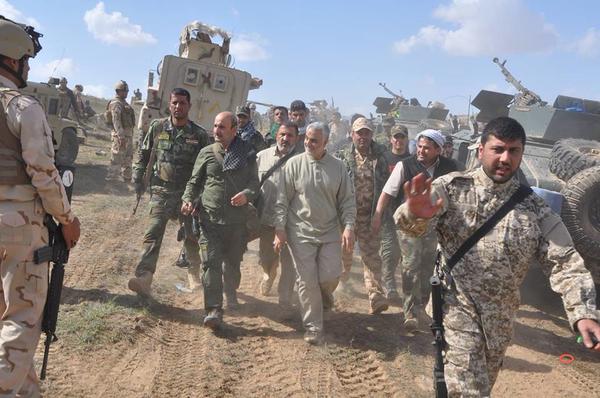
Qassem Soleimani (center) with his bodyguards near the frontlines of Tikrit.
 
Testifying on Capitol Hill on March 3, Joint Chiefs Chairman General Martin Dempsey characterized the joint attempts of the Iraqi military, Iraqi Shia militias, and Iran’s Islamic Revolutionary Guards Corps (IRGC) at taking back control of Tikrit, Saddam Hussein’s hometown, from the Islamic State, as “a positive thing.” “Frankly,” General Dempsey said, “it will only be a problem if it results in sectarianism.”

General Dempsey’s caveat is an interesting one, since there is every reason to believe that Shia control of Tikrit will result in further sectarianism. While the US administration says in its most recent National Security Strategy that it desires to “degrade and ultimately defeat ISIL [Islamic State]” in an attempt to “support Iraq … free itself from sectarian conflict and the scourge of extremists,” Tehran is actively perpetuating the sectarian crisis in Iraq. 


In the past, the Iraqi Shia have demonstrated little interest in reducing themselves to puppets of Tehran. During the war with Iraq from 1980-1988, Iraqi nationalism trumped sectarian identity: the Shia constituted the rank and file of the Iraqi military, and Shia leaders in Iraq kept their distance from the regime in Tehran. After the collapse of Saddam Hussein’s regime in 2003, Iraq became a sanctuary to Iranian clerics critical of the regime in Tehran, including Hossein Khomeini, grandson of the founder of the Islamic Republic. 

But Iraq did not remain a refuge for long. The civil war in Iraq, followed by the rise of Islamic State, forced moderate Iraqi Shia, who otherwise would have pursued a line independent of Iran, to become dependencies of Tehran. After being rebuffed by the US following the Islamic State’s takeover of Mosul in 2014, General Qassem Atta, head of the Iraqi National Intelligence Service, asked Tehran for help and received assistance within 48 hours. Iraqi Prime Minister Haider al Abadi continues to press Washington for more support in his fight against the Islamic State and uses US hesitancy to justify reliance on Iran, which according to Vice President Iyad Allawi, only increases Iran’s influence in Iraq and could lead to dismantlement of the Iraqi state.

The Obama administration may desire to help secure the survival of the Iraqi state, but the small contingent of US advisers in Iraq is relying on a heavily Iranian-influenced Iraqi sectarian intelligence and security apparatus. The Iraqi security forces are predominantly Shia, and in addition, Shia militias and “advisers” from the IRGC Quds Force are now fighting as legitimate Iraqi forces. 
This creates an environment in which targeting operations developed by Iranian forces and the militias have primacy over those developed by the US, leading to the possibility that  Washington could be portrayed by Islamic State as complicit in the indiscriminate targeting of Sunnis. Such operations will be perceived the same way by the very Sunnis we need to fight Islamic State, thus undermining the US strategy to “support Iraq … free itself from sectarian conflict and the scourge of extremists.” 

Any US reliance on Iranian support in the fight against the Islamic State is also likely to strengthen Tehran’s bargaining position in the nuclear negotiations. 


Iran has Washington where it wants it. Iran wants a favorable deal, and the Obama administration is signaling that such a deal is forthcoming. US “strategic patience” is allowing Iran to increase its influence and presence in Iraq and Syria. Assad is waiting out the Americans and the international community, and Shia militias are now viewed as legitimate forces in Iraq, Syria, and Yemen. But most importantly, US “strategic patience” signals to Iran an unwillingness to jeopardize the talks by linking them to Iran’s role in Iraq, Syria, and Yemen. 


Ali Alfoneh is a senior fellow at Foundation for Defense of Democracies. Michael P. Pregent is a former intelligence officer and military adviser and now adjunct at National Defense University.

Thursday, December 18, 2014

The Pressure For The Iranians To Attack Israel Mounts

MEMRI: Iranian Regime Escalates Threats To Annihilate Israel

December 17, 2014
MEMRI Special Dispatch No.5906
Iranian Regime Escalates Threats To Annihilate Israel
irans-elite-revolutionary-guards-march-past.jpg.CROP.promo-mediumlarge

As the November 24, 2014 deadline for the Joint Plan of Action between Iran
and the P5+1 approached, and as global oil prices have dropped sharply –
severely impacting the Iranian economy – Iranian officials, mostly from
Iran’s Islamic Revolutionary Guards Corps (IRGC), have within a short span
of six weeks significantly ratcheted up their calls to annihilate Israel.
IRGC officials emphasized the missile capabilities of Iran and of the
Palestinian factions that it arms, saying that these will hasten Israel’s
elimination.

One major motif in statements during this time by Iranian regime officials
is the arming of the West Bank. At an Islamic conference in Tehran in late
November 2014, Supreme Leader Ali Khamenei reiterated the promise he had
made several months previously, that the West Bank will be armed with
missiles, as Gaza had been armed, and that Israel’s security would
deteriorate by the day. IRGC commander Mohammad Ali Jafari predicted that
Israel would be eliminated thanks to the missile capabilities of the
resistance factions, and his deputy, Hossein Mohammad Salami, stated that
the West Bank would become hell for Israel, whose destruction is imminent.
Basij commander Mohammad Reza Naqdi said that Iran was determined to hold
victory prayers at Al-Aqsa Mosque in Jerusalem.

Furthermore, Hossein Sheikholeslam, secretary-general of the Tehran-based
Committee for Support for the Palestinian Intifada and an advisor to Majlis
speaker Ali Larijani, said that Iran was committed to implementing Iranian
regime founder Ayatollah Ruhollah Khomeini’s call to destroy Israel, and
called on Palestinians to launch an intifada as “the most peaceful way” to
regain their stolen lands. Members of the Majlis National Security and
Foreign Policy committee stressed that Leader Khamenei had ordered the West
Bank armed in order to hasten Israel’s annihilation and that Iran intended
to follow those orders.

Also, Tasmimnews.com, which is affiliated with the IRGC, threatened, on
December 4, 2014, that in its next confrontation with Israel, Hizbullah will
use its Iranian missiles to attack five infrastructure and energy centers in
Haifa, including Haifa Port, the Petrochemical Industries, the Electric
Corporation, the Matam Scientific Industries Center, and the city’s subway
system.
 
This paper by MEMRI reviews statements by Iranian officials announcing the coming
annihilation of Israel.

Tuesday, November 18, 2014

The Power of the Iranian Horn (Daniel 8)

Khamenei says world relies on Iran’s armed forces

Iranian Air Force soldiers march in formation during the Army Day military parade in Tehran
Author Arash Karami Posted November 17, 2014 | Al Monitor

At an Imam Ali University for Army Officers commencement ceremony, Iran’s Supreme Leader Ayatollah Ali Khamenei told young officers to prepare themselves to further the Iranian military’s scientific progress.

According to Khamenei.ir, discussing the “spiritual capabilities, the scientific abilities, power of ingenuity and resolution” of Iran’s armed forces during the Iran-Iraq war, Ayatollah Khamenei said, “The world counts on the Islamic Republic of Iran’s armed forces and takes it seriously because it knows that in any area of responsibility … the armed forces will do their best.”

He did not elaborate on any specifics, but encouraged the students to “elevate Iran’s military organization” by taking advantage of the country’s scientific abilities.

A number of Iranian officials have touted Iran’s military capabilities recently. Last week, Iran introduced its own version of the US RQ-170 drone that landed inside Iran in December 2011 while on a reconnaissance flight in eastern Iran.

Gen. Amir Ali Hajizadeh, commander of the Islamic Revolutionary Guard Corps (IRGC) Aerospace Force, said during a televised interview, “From the time the American RQ-170 was taken to the time the Iranian RQ-170 took flight, less than three years passed, and during this time, dozens of projects were introduced and one of these projects was the building and reverse engineering of RQ-170.”

Hajizadeh said that there are plans to introduce at least four more of these drones by the end of the Iranian calendar year in March. He taunted the United States, saying that with the flight of the Iranian RQ-170, “The partial heart attack they had three years ago has been completed.”

When asked if he would respect President Barack Obama’s request to return the US drone, Hajizadeh said, “The American RQ-170 is a spoil [of war] and naturally, we cannot return that. But if the sanctions are removed, we will give them an Iranian version.”

He added that despite US claims that Iran would not be able to reverse engineer the RQ-170 or use the information stored in it, “Iranian experts and specialists were able to do all of this.”

Iran’s Defense Minister Hossein Dehghan also praised Iran’s aerospace capabilities. He said that expectations are that Iran’s aerospace capabilities will become stronger every day and be able to defend the Islamic Republic in the international arena.

Raja News reported that the IRGC’s aerospace achievements are not recognized in the Iranian media even though the “air and missile industry have reached a milestone.”

The article quoted IRGC public relations head Gen. Ramazan Sharif, who said that projects late engineer Hassan Tehrani Moghaddam had been experimenting on three years ago are now coming to fruition. He said that Tehrani Moghaddam “made our remote enemies accessible.”

Tehrani Moghaddam, known as the father of Iran’s ballistic program, died in a November 2011 explosion along with 16 others. According to Raja News, one of Tehrani Moghaddam’s main projects was a missile to send a satellite into orbit.