Thursday, October 26, 2017

The Sixth Seal: Real Risk, Few Precautions (Revelation 6:12)

Eastern Quakes: Real Risk, Few Precautions


https://i.ytimg.com/vi/eHzLOXE7pWo/maxresdefault.jpg1989 San Francisco Earthquake
By WILLIAM K. STEVENS
Published: October 24, 1989
AN EARTHQUAKE as powerful as the one that struck northern California last week could occur almost anywhere along the East Coast, experts say. And if it did, it would probably cause far more destruction than the West Coast quake.
The chances of such an occurrence are much less in the East than on the West Coast. Geologic stresses in the East build up only a hundredth to a thousandth as fast as in California, and this means that big Eastern quakes are far less frequent. Scientists do not really know what the interval between them might be, nor are the deeper-lying geologic faults that cause them as accessible to study. So seismologists are at a loss to predict when or where they will strike.
But they do know that a temblor with a magnitude estimated at 7 on the Richter scale – about the same magnitude as last week’s California quake – devastated Charleston, S.C., in 1886. And after more than a decade of study, they also know that geologic structures similar to those that caused the Charleston quake exist all along the Eastern Seaboard.
For this reason, ”we can’t preclude that a Charleston-sized earthquake might occur anywhere along the East Coast,” said David Russ, the assistant chief geologist of the United States Geological Survey in Reston, Va. ”It could occur in Washington. It could occur in New York.”
If that happens, many experts agree, the impact will probably be much greater than in California. Easterners, unlike Californians, have paid very little attention to making buildings and other structures earthquake-proof or earthquake-resistant. ”We don’t have that mentality here on the East Coast,” said Robert Silman, a New York structural engineer whose firm has worked on 3,800 buildings in the metropolitan area.
Moreover, buildings, highways, bridges, water and sewer systems and communications networks in the East are all older than in the West and consequently more vulnerable to damage. Even under normal conditions, for instance, water mains routinely rupture in New York City.
The result, said Dr. John Ebel, a geophysicist who is the assistant director of Boston College’s Weston Observatory, is that damage in the East would probably be more widespread, more people could be hurt and killed, depending on circumstances like time of day, and ”it would probably take a lot longer to get these cities back to useful operating levels.”
On top of this, scientists say, an earthquake in the East can shake an area 100 times larger than a quake of the same magnitude in California. This is because the earth’s crust is older, colder and more brittle in the East and tends to transmit seismic energy more efficiently. ”If you had a magnitude 7 earthquake and you put it halfway between New York City and Boston,” Dr. Ebel said, ”you would have the potential of doing damage in both places,” not to mention cities like Hartford and Providence.
Few studies have been done of Eastern cities’ vulnerability to earthquakes. But one, published last June in The Annals of the New York Academy of Sciences, calculated the effects on New York City of a magnitude 6 earthquake. That is one-tenth the magnitude of last week’s California quake, but about the same as the Whittier, Calif., quake two years ago.
The study found that such an earthquake centered 17 miles southeast of City Hall, off Rockaway Beach, would cause $11 billion in damage to buildings and start 130 fires. By comparison, preliminary estimates place the damage in last week’s California disaster at $4 billion to $10 billion. If the quake’s epicenter were 11 miles southeast of City Hall, the study found, there would be about $18 billion in damage; if 5 miles, about $25 billion.
No estimates on injuries or loss of life were made. But a magnitude 6 earthquake ”would probably be a disaster unparalleled in New York history,” wrote the authors of the study, Charles Scawthorn and Stephen K. Harris of EQE Engineering in San Francisco.
The study was financed by the National Center for Earthquake Engineering Research at the State University of New York at Buffalo. The research and education center, supported by the National Science Foundation and New York State, was established in 1986 to help reduce damage and loss of life from earthquakes.
The study’s postulated epicenter of 17 miles southeast of City Hall was the location of the strongest quake to strike New York since it has been settled, a magnitude 5 temblor on Aug. 10, 1884. That 1884 quake rattled bottles and crockery in Manhattan and frightened New Yorkers, but caused little damage. Seismologists say a quake of that order is likely to occur within 50 miles of New York City every 300 years. Quakes of magnitude 5 are not rare in the East. The major earthquake zone in the eastern half of the country is the central Mississippi Valley, where a huge underground rift causes frequent geologic dislocations and small temblors. The most powerful quake ever known to strike the United States occurred at New Madrid, Mo., in 1812. It was later estimated at magnitude 8.7 and was one of three quakes to strike that area in 1811-12, all of them stronger than magnitude 8. They were felt as far away as Washington, where they rattled chandeliers, Boston and Quebec.
Because the New Madrid rift is so active, it has been well studied, and scientists have been able to come up with predictions for the central Mississippi valley, which includes St. Louis and Memphis. According to Dr. Russ, there is a 40 to 63 percent chance that a quake of magnitude 6 will strike that area between now and the year 2000, and an 86 to 97 percent chance that it will do so by 2035. The Federal geologists say there is a 1 percent chance or less of a quake greater than magnitude 7 by 2000, and a 4 percent chance or less by 2035.
Elsewhere in the East, scientists are limited in their knowledge of probabilities partly because faults that could cause big earthquakes are buried deeper in the earth’s crust. In contrast to California, where the boundary between two major tectonic plates creates the San Andreas and related faults, the eastern United States lies in the middle of a major tectonic plate. Its faults are far less obvious, their activity far more subtle, and their slippage far slower. 
Any large earthquake would be ”vastly more serious” in the older cities of the East than in California, said Dr. Tsu T. Soong, a professor of civil engineering at the State University of New York at Buffalo who is a researcher in earthquake-mitigation technology at the National Center for Earthquake Engineering Research. First, he said, many buildings are simply older, and therefore weaker and more vulnerable to collapse. Second, there is no seismic construction code in most of the East as there is in California, where such codes have been in place for decades.
The vulnerability is evident in many ways. ”I’m sitting here looking out my window,” said Mr. Silman, the structural engineer in New York, ”and I see a bunch of water tanks all over the place” on rooftops. ”They are not anchored down at all, and it’s very possible they would fall in an earthquake.”
Buildings of reinforced masonry, reinforced concrete and steel would hold up much better, engineers say, and wooden structures are considered intrinsically tough in ordinary circumstances. The best performers, they say, would probably be skyscrapers built in the last 20 years. As Mr. Silman explained, they have been built to withstand high winds, and the same structural features that enable them to do so also help them resist an earthquake’s force. But even these new towers have not been provided with the seismic protections required in California and so are more vulnerable than similar structures on the West Coast.
Buildings in New York are not generally constructed with such seismic protections as base-isolated structures, in which the building is allowed to shift with the ground movement; or with flexible frames that absorb and distribute energy through columns and beams so that floors can flex from side to side, or with reinforced frames that help resist distortion.
”If you’re trying to make a building ductile – able to absorb energy – we’re not geared to think that way,” said Mr. Silman.
New York buildings also contain a lot of decorative stonework, which can be dislodged and turned into lethal missiles by an earthquake. In California, building codes strictly regulate such architectural details.
Manhattan does, however, have at least one mitigating factor: ”We are blessed with this bedrock island,” said Mr. Silman. ”That should work to our benefit; we don’t have shifting soils. But there are plenty of places that are problem areas, particularly the shoreline areas,” where landfills make the ground soft and unstable.
As scientists have learned more about geologic faults in the Northeast, the nation’s uniform building code – the basic, minimum code followed throughout the country – has been revised accordingly. Until recently, the code required newly constructed buildings in New York City to withstand at least 19 percent of the side-to-side seismic force that a comparable building in the seismically active areas of California must handle. Now the threshold has been raised to 25 percent.
New York City, for the first time, is moving to adopt seismic standards as part of its own building code. Local and state building codes can and do go beyond the national code. Charles M. Smith Jr., the city Building Commissioner, last spring formed a committee of scientists, engineers, architects and government officials to recommend the changes.
”They all agree that New York City should anticipate an earthquake,” Mr. Smith said. As to how big an earthquake, ”I don’t think anybody would bet on a magnitude greater than 6.5,” he said. ”I don’t know,” he added, ”that our committee will go so far as to acknowledge” the damage levels in the Scawthorn-Harris study, characterizing it as ”not without controversy.”
For the most part, neither New York nor any other Eastern city has done a detailed survey of just how individual buildings and other structures would be affected, and how or whether to modify them.
”The thing I think is needed in the East is a program to investigate all the bridges” to see how they would stand up to various magnitudes of earthquake,” said Bill Geyer, the executive vice president of the New York engineering firm of Steinman, Boynton, Gronquist and Birdsall, which is rehabilitating the cable on the Williamsburg Bridge. ”No one has gone through and done any analysis of the existing bridges.”
In general, he said, the large suspension bridges, by their nature, ”are not susceptible to the magnitude of earthquake you’d expect in the East.” But the approaches and side spans of some of them might be, he said, and only a bridge-by-bridge analysis would tell. Nor, experts say, are some elevated highways in New York designed with the flexibility and ability to accommodate motion that would enable them to withstand a big temblor.
Tunnels Vulnerable
The underground tunnels that carry travelers under the rivers into Manhattan, those that contain the subways and those that carry water, sewers and natural gas would all be vulnerable to rupture, engineers say. The Lincoln, Holland, PATH and Amtrak tunnels, for instance, go from bedrock in Manhattan to soft soil under the Hudson River to bedrock again in New Jersey, said Mark Carter, a partner in Raamot Associates, geotechnical engineers specializing in soils and foundations.
Likewise, he said, subway tunnels between Manhattan and Queens go from hard rock to soft soil to hard rock on Roosevelt Island, to soft soil again and back to rock. The boundaries between soft soil and rock are points of weakness, he said.
”These structures are old,” he said, ”and as far as I know they have not been designed for earthquake loadings.”
Even if it is possible to survey all major buildings and facilities to determine what corrections can be made, cities like New York would then face a major decision: Is it worth spending the money to modify buildings and other structures to cope with a quake that might or might not come in 100, or 200 300 years or more?
”That is a classical problem” in risk-benefit analysis, said Dr. George Lee, the acting director of the Earthquake Engineering Research Center in Buffalo. As more is learned about Eastern earthquakes, he said, it should become ”possible to talk about decision-making.” But for now, he said, ”I think it’s premature for us to consider that question.”

American and Saudi Horns Stand Together (Daniel 7:7)

Saudi Arabia's Foreign Minister Adel Al-Jubeir affirmed that the Kingdom supports the position of US President Donald Trump on Iran, saying that the nuclear agreement contains several shortcomings.
This came during his participation today in a panel discussion organised by the British Royal Institute of International Affairs (Chatham House) on "the future turbulence in the world."
In his speech during the conference, he said that Tehran's policy of supporting terrorism is not acceptable at all, and its consequences will be dire. The new sanctions would be welcome, he said, stressing that the international community must support these sanctions in order to send a strong message to Iran that its conduct and its shameful activities have consequences.
Regarding Iraq, the foreign minister said that the relations between the Kingdom and Iraq are historic and the two countries have social, economic and geographical ties. He said that the establishment of the Saudi-Iraqi Coordination Council will contribute to enhancing bilateral relations and supporting the security and stability of Iraq and the region.
He added that the interest of the Kingdom in Iraq is a reflection of its desire to restore Iraq's advancement away from ethnic and sectarian conflicts, for a unified, stable and secure Iraq, contrary to what Iran seeks to try to control Iraq, as an extension of its expansion plans.
Asked about the latest developments in the Qatar crisis and the lack of commitment of Doha to implement the demands of countries calling for the fight against terrorism, Adel Al-Jubeir said the matter is up to Qatar. We reject terrorism and extremism and harboring the wanted. We refuse to publish discourses of incitement and hatred and interfere in the affairs of other countries. We do not accept that suicide bombings are justified in the media by extremist religious figures hosted by Qatar, he said.
He added, "Qatar's boycott resulted in the signing of a memorandum of understanding with the United States of America to combat the financing of terrorism, and the Qatari authorities allowed officials of the US Treasury Department to be in Qatari banks, in addition to Qatar's amendments to the regulations on combating terrorism, pointing out that these steps were rejected by the Qatari authorities before the boycott.

Pakistan's Nuclear Influence (Daniel 8:8)


India on Tuesday sought a probe into North Korea's nuclear proliferation linkages and demanded that those responsible for it be held accountable, in a veiled reference to Pakistan.
Nirmala Sitharaman, who is on her first foreign visit since taking over as India's first woman defence minister last month, said in the capital of the Philippines that the nuclear and missile tests conducted by North Korea were in violation of its international commitments and have triggered serious concerns.
North Korea has launched a series of ballistic missiles that potentially can strike the US mainland and recently conducted its largest ever underground nuclear explosion, triggering a fresh round of sanctions on Pyongyang from the international community.
US President Donald Trump told the U N General Assembly last month that if America was "forced to defend itself or its allies, we will have no choice but to totally destroy North Korea."
Addressing the 4th ASEAN Defence Ministers' meeting, Sitharaman said India had criticised North Korea's nuclear and missile tests.
"India has deplored these tests. We remain concerned about the proliferation of nuclear and missile technologies which has adversely impacted India's national security and that of the entire region," she was quoted as saying by an official statement.
"It is important that North Korea's proliferation linkages are investigated and those who have supported its nuclear and missile programme are held accountable," she said, in a veiled reference to Pakistan's links with Pyongyang.
Pakistan had secretly supplied North Korea with nuclear enrichment technology when A Q Khan headed the country's nuclear programme.
According to western media reports, Pakistan supplied vital machinery, drawings and technical advice to North Korea, allowing Pyongyang to enrich uranium as early as 2002.
Earlier, External Affairs Minister Sushma Swaraj had also raised India's concerns over North Korea's nuclear proliferation and demanded that those responsible for it be held accountable.
Swaraj's remarks came during her trilateral meeting with US Secretary of State Rex Tillerson and her Japanese counterpart Taro Kono on the sidelines of the United Nations General Assembly session in New York last month.

How the Antichrist is Shaping Iraq (Rev 13)


With Islamic State in fatal decline and the edges of Kurdistan afire, the Middle East is entering a new era, dominated by the Saudi-Iranian power struggle. The United States, which did so much via its unnecessary invasion of Iraq and tragic handling of the post-incursion period to nurture the growth of Islamic State, will be largely missing from the scene. Instead, the struggle will, as it did during the fight against the Sunni extremists of Islamic State, involve shifting Sunni and Shi’ite allegiances.
For the moment, there seems to be an easing in the historic tensions between the two main – and often warring – branches of Islam. Religious differences are not the focus; this is a classic geopolitical power struggle for control of Iraq, Syria, and Kurdistan, and for expanding diplomatic and strategic reach throughout the region.
Iran is lined up to be the big winner in Syria. Islamic State's defeat will significantly lessen Sunni influence, and Tehran’s role as Syrian President Bashar al-Assad's protector will only increase now that it appears Assad will remain in control of some portion of the country. Iran will have pieced together a land corridor to the Mediterranean. The Saudis will be left with little influence.
The same goes for the United States. American forces have been largely relegated to playing traffic cop among various on-again off-again allies such as the Turks and Kurds, each with its own agenda in Syria. Any influence Washington thinks it still has is further diluted by the presence of the Russians, who are there to support Assad while maintaining a permanent presence in the heart of the Middle East. American efforts may wind up as little more than fumbling around to keep Israel and Jordan from overreacting to the increased Iranian influence on their borders.
In Saudi Arabia, meanwhile, Riyadh appears to be pivoting towards warmer relations with the Shi’ite government in Baghdad. That a Saudi airline is announcing the first return of direct service between the two countries since Saddam Hussein invaded Kuwait in 1990 is no coincidence, nor is it an isolated event.
The Saudis also appear ready to take advantage of a looming intra-Shi’ite power struggle in Baghdad among Prime Minister Haider al-Abadi, former Prime Minister Nouri al-Maliki, and Shi’ite cleric Moqtada al-Sadr. Sadr, the most religiously zealous of the group, has always been something of a nationalist and is wary of Iranian influence. It is thus not surprising he made friendly trips under official invitation to Sunni Riyadh, and the United Arab Emirates, in recent months.
The Saudis otherwise have little to work with in Iraq compared to Iran. Tehran’s ties to officials in Baghdad are just a tiny part of a deep relationship forged in the bloody fight against the American occupiers and the ousting of Islamic State. Iranian money continues to support Iraq, and the Shi’ite militias are still mostly under Iranian influence.
Iran is also probably the most stable Muslim nation in the Middle East. It has existed more or less within its current borders for thousands of years, and is largely religiously, culturally, and linguistically homogeneous (though keep an eye on the Kurdish minority.) While governed in significant part by its clerics, the country has held a series of increasingly democratic elections. And unlike the Saudi monarchs, Iran’s leaders do not rule in fear of an Islamic revolution. They already had one.
Power struggles create flashpoints, and the Saudi-Iranian fight post-Islamic State is no exception. The Saudi-Iranian proxy war in Yemen has settled into a version of World War One-style trench warfare, with neither side strong enough to win nor weak enough to lose. In an ugly form of stasis, the conflict seems likely to stay within its present borders.
The powder keg is Kurdistan. Though arguably a de facto state since 2003, after the Kurds voted formally voted for independence in a Sept. 25 referendum, Iran and the Iranian-backed government in Baghdad were pressed to make clear they will not tolerate an actual Kurdish nation. With Islamic State nearly defeated and combat-tested Shi’ite militias ready for their next tasks, Tehran and Baghdad no longer need to keep the Kurds on their side. Fighting has already broken out around Kirkuk, an oil-rich city in Iraqi Kurdistan, between forces supported by Baghdad/Tehran and Kurdish fighters – leaving a gap for the Saudis to offer financial or covert support to the Iraqi Kurds.
Saudi involvement could morph an Iraqi civil war into a new proxy struggle right on Iran’s own western border, with the possible complication of further unrest inside Iran by its Kurdish minority.
While it may seem odd to write about the changing balance of power in the Middle East largely leaving out the United States, that may well describe America’s range of options post-Islamic State.
Washington’s influence in Baghdad is limited and relations with Iran are in shambles under the Trump administration. It is highly unlikely America will join Iran to fight against Kurdish allies who helped defeat Islamic State. Nor are American troops likely to battle Iranian-led militias in support of Kurdish independence that Washington says it doesn’t really support right now.
That leaves the United States sidelined, with few options other than perhaps supporting the Saudis from afar in whatever anti-Iranian meddling they do in Iraq. A long fall from the heady days of 2003 when America was going to remake the Middle East. The victor after some 14 years of overlapping struggles? In the post-Islamic State Middle East, look for Tehran to emerge dominant.

About the Author

Peter Van Buren, a 24 year State Department veteran, is the author of We Meant Well: How I Helped Lose the Battle for the Hearts and Minds of the Iraqi People and Hooper’s War: A Novel of WWII Japan. Views expressed here do not represent those of the Department of State. @WeMeantWell

Wednesday, October 25, 2017

The Ramapo Fault and the Sixth Seal (Revelation 6:12)

http://www.standeyo.com/NEWS/10_Earth_Changes/10_Earth_Changes_pics/100227.NY.PA.EQ.map.jpg

Living on the Fault Line

A major earthquake isn’t likely here, but if it comes, watch out.
Posted June 15, 2010 by Wayne J. Guglielmo
This chart shows the location of the Ramapo Fault System, the longest and one of the oldest systems of cracks in the earth’s crust in the Northeast. It also shows the location of all earthquakes of magnitude 2.5 or greater in New Jersey during the last 50 years. The circle in blue indicates the largest known Jersey quake.

The couple checked with Burns’s parents, who live in nearby Basking Ridge, and they, too, had heard and felt something, which they thought might have been an earthquake. A call by Burns some 20 minutes later to the Bernardsville Police Department—one of many curious and occasionally panicky inquiries that Sunday morning, according to the officer in charge, Sergeant John Remian—confirmed their suspicion: A magnitude 2.6 earthquake, its epicenter in Peapack/Gladstone, about seven miles from Bernardsville, had hit the area. A smaller aftershock followed about two and a half hours later.
After this year’s epic earthquakes in Haiti, Chile, Mexico, Indonesia, and China, the 2.6 quake and aftershock that shook parts of New Jersey in February may seem minor league, even to the Somerset County residents who experienced them. On the exponential Richter Scale, a magnitude 7.0 quake like the one that hit Haiti in January is almost 4 million times stronger than a quake of 2.6 magnitude. But comparisons of magnitude don’t tell the whole story.
Northern New Jersey straddles the Ramapo Fault, a significant ancient crack in the earth’s crust. The longest fault in the Northeast, it begins in Pennsylvania and moves into New Jersey, trending northeast through Hunterdon, Somerset, Morris, Passaic, and Bergen counties before terminating in New York’s Westchester County, not far from the Indian Point Energy Center, a nuclear power plant. And though scientists dispute how active this roughly 200 million-year-old fault really is, many earthquakes in the state’s surprisingly varied seismic history are believed to have occurred on or near it. The fault line is visible at ground level and likely extends as deep as nine miles below the surface.
During the past 230 years or so, New Jersey has been at the epicenter of nearly 170 earthquakes, according to data compiled by the New Jersey Geological Survey, part of the United States Department of Environmental Protection. The largest known quake struck in 1783, somewhere west of New York City, perhaps in Sussex County. It’s typically listed as 5.3 in magnitude, though that’s an estimate by seismologists who are quick to point out that the concept of magnitude—measuring the relative size of an earthquake—was not introduced until 1935 by Charles Richter and Beno Gutenberg. Still, for quakes prior to that, scientists are not just guessing.
“We can figure out the damage at the time by going back to old records and newspaper accounts,” says Won-Young Kim, a senior research scientist at Columbia University’s Lamont-Doherty Earth Observatory in Palisades, New York, directly across the New Jersey border. “Once the amount and extent of contemporary damage has been established,” Kim says, “we’re then able to gauge the pattern of ground shaking or intensity of the event—and from there extrapolate its probable magnitude.”
Other earthquakes of magnitude 5 or higher have been felt in New Jersey, although their epicenters laying near New York City. One—which took place in 1737 and was said to have been felt as far north as Boston and as far south as northern Delaware—was probably in the 5 to 5.5 range. In 1884, an earthquake of similar magnitude occurred off New York’s Rockaway Beach. This well-documented event pulled houses off their foundations and caused steeples to topple as far west as Rahway. The shock wave, scientists believe, was felt over 70,000 square miles, from Vermont to Maryland.
Among the largest sub-5 magnitude earthquakes with epicenters in New Jersey, two (a 3.8 and a 4.0) took place on the same day in 1938 in the Lakehurst area in Ocean County. On August 26, 2003, a 3.5 magnitude quake shook the Frenchtown/Milford area in Hunterdon County. On February 3 of last year, a 3.0 magnitude quake occurred in the Morris County town of Mendham. “A lot of people felt this one because of the intense shaking, although the area of intensity wasn’t very wide,” says Lamont-Doherty’s Kim, who visited the site after the event.
After examining the known historical and geological record, Kim and other seismologists have found no clear evidence that an earthquake of greater than 5.3 to 5.5 magnitude has taken place in this area going back to 1737. This doesn’t mean, of course, that one did not take place in the more remote past or that one will not occur in the future; it simply means that a very large quake is less likely to occur here than in other places in the east where the seismic hazard is greater, including areas in South Carolina and northeastern New York State.
But no area on the East Coast is as densely populated or as heavily built-up as parts of New Jersey and its neighbors. For this reason, scientists refer to the Greater New York City-Philadelphia area, which includes New Jersey’s biggest cities, as one of “low earthquake hazard but high vulnerability.” Put simply, the Big One isn’t likely here—but if it comes, especially in certain locations, watch out.
Given this low-hazard, high-vulnerability scenario, how far along are scientists in their efforts to predict larger magnitude earthquakes in the New Jersey area? The answer is complex, complicated by the state’s geographical position, its unique geological history, the state of seismology itself, and the continuing debate over the exact nature and activity of the Ramapo Fault.
Over millions of years, New Jersey developed four distinct physiographic provinces or regions, which divide the state into a series of diagonal slices, each with its own terrain, rock type, and geological landforms.
The northernmost slice is the Valley and Ridge, comprising major portions of Sussex and Warren counties. The southernmost slice is the Coastal Plain, a huge expanse that covers some three-fifths of the state, including all of the Shore counties. Dividing the rest of the state are the Highlands, an area for the most part of solid but brittle rock right below the Valley and Ridge, and the lower lands of the Piedmont, which occupy all of Essex, Hudson, and Union counties, most of Bergen, Hunterdon, and Somerset, and parts of Middlesex, Morris, and Passaic.
For earthquake monitors and scientists, the formation of these last two provinces—the Highlands and the Piedmont—are of special interest. To understand why, consider that prior to the appearance of the Atlantic Ocean, today’s Africa was snuggled cozily up against North America and surrounded by a single enormous ocean. “At that point, you could have had exits off the New Jersey Turnpike for Morocco,” says Alexander Gates, professor of geology and chair of the department of Earth and Environmental Sciences at Rutgers-Newark.
Under the pressure of circulating material within the Earth’s super-hot middle layer, or mantle, what was once a single continent—one that is thought to have included today’s other continents as well—began to stretch and eventually break, producing numerous cracks or faults and ultimately separating to form what became the Atlantic Ocean. In our area, the longest and most active of these many cracks was the Ramapo Fault, which, through a process known as normal faulting, caused one side of the earth’s crust to slip lower—the Piedmont—relative to the other side—the Highlands. “All this occurred about 225 million years ago,” says Gates. “Back then, you were talking about thousands of feet between the Highlands and the Piedmont and a very active Ramapo Fault.”
The Earth’s crust, which is 20 to 25 miles thick, is not a single, solid shell, but is broken into seven vast tectonic plates, which drift atop the soft, underlying mantle. Although the northeast-trending Ramapo Fault neatly divides two of New Jersey’s four physiographic provinces, it does not form a so-called plate boundary, as does California’s infamous San Andreas Fault. As many Californians know all too well, this giant fault forms the boundary between two plates—to the west, the Pacific Plate, and to the east, the North American Plate; these rub up against each other, producing huge stresses and a regularly repeating pattern of larger earthquakes.
The Ramapo Fault sits on the North American Plate, which extends past the East Coast to the middle of the Atlantic, where it meets the Mid-Atlantic Ridge, an underwater mountain range in constant flux. The consequences of this intraplate setting are huge: First, as Gates points out, “The predictability of bigger earthquakes on…[such] settings is exceedingly poor, because they don’t occur very often.” Second, the intraplate setting makes it more difficult to link our earthquakes to a major cause or fault, as monitors in California can often do.
This second bit of uncertainty is especially troubling for some people, including some in the media who want a neat story. To get around it, they ignore the differences between plate settings and link all of New Jersey’s earthquakes, either directly or implicitly, to the Ramapo Fault. In effect, such people want the Ramapo Fault “to look like the San Andreas Fault,” says Gates. “They want to be able to point to one big fault that’s causing all of our earthquakes.”
Gates does not think that’s the case, and he has been working with colleagues for a number of years to prove it. “What we have found is that there are smaller faults that generally cut from east to west across the northeast-trending Ramapo Fault,” he explains. “These much smaller faults are all over the place, and they’re actually the ones that are the active faults in the area.”
But what mechanisms are responsible for the formation of these apparently active auxiliary faults? One such mechanism, say scientists, is the westward pressure the Atlantic Ocean exerts on the North American Plate, which for the most part resists any movement. “I think we are in an equilibrium state most of the time,” says Lamont-Doherty’s Kim.
Still, that continuous pressure on the plate we sit on causes stress, and when that stress builds up sufficiently, the earth’s crust has a tendency to break around any weak zones. In our area, the major weak zone is the Ramapo Fault—“an ancient zone of weakness,” as Kim calls it. That zone of weakness exacerbates the formation of auxiliary faults, and thereby the series of minor earthquakes the state has experienced over the years.
All this presupposes, of course, that any intraplate stress in this area will continue to be released gradually, in a series of relatively minor earthquakes or releases of energy. But what if that were not the case? What if the stress continued to build up, and the release of large amounts of energy came all at once? In crude terms, that’s part of the story behind the giant earthquakes that rocked what is now New Madrid, Missouri, between 1811 and 1812. Although estimates of their magnitude have been revised downward in recent years to less than magnitude 8, these earthquakes are generally regarded as among the largest intraplate events to have occurred in the continental United States.
For a number of reasons—including the relatively low odds that the kind of stored energy that unleashed the New Madrid events could ever build up here—earthquakes of plus-6 magnitude are probably not in our future. Still, says Kim, even a magnitude 6 earthquake in certain areas of the state could do considerable damage, especially if its intensity or ground shaking was of sufficient strength. In a state as geologically diverse and densely populated as New Jersey, this is a crucial wild card.
Part of the job of the experts at the New Jersey Geological Survey is to assess the seismic hazards in different parts of the state. To do this, they use a computer-simulation model developed under the direction of the Federal Emergency Management Agency, known as HAZUS, for Hazards US. To assess the amount of ground shaking likely to occur in a given county during events ranging in magnitude from 5 to 7 on the Richter Scale, NJGS scientists enter three features of a county’s surface geology into their computer model. Two of these features relate to the tendency of soil in a given area to lose strength, liquefy, or slide downhill when shaken. The third and most crucial feature has to do with the depth and density of the soil itself and the type of bedrock lying below it; this is a key component in determining a region’s susceptibility to ground shaking and, therefore, in estimating the amount of building and structural damage that’s likely to occur in that region. Estimates for the various counties—nine to date have been studied—are sent to the New Jersey Office of Emergency Management, which provided partial funding for the project.
To appreciate why this element of ground geology is so crucial to earthquake modelers, consider the following: An earthquake’s intensity—which is measured on something called the Modified Mercalli Scale—is related to a number of factors. The amount of energy released or the magnitude of an event is clearly a big factor. But two earthquakes of the same magnitude can have very different levels of intensity; in fact, it’s quite possible for a lower magnitude event to generate more ground shaking than a higher magnitude one.
In addition to magnitude, other factors that affect intensity are the distance of the observer or structure from the epicenter, where intensity is the greatest; the depth beneath the surface of the initial rupture, with shallower ruptures producing more ground shaking than deeper ones; and, most significantly, the ground geology or material that the shock wave generated by the earthquake must pass through.
As a rule, softer materials like sand and gravel shake much more intensely than harder materials, because the softer materials are comparatively inefficient energy conductors, so whatever energy is released by the quake tends to be trapped, dispersing much more slowly. (Think of a bowl of Jell-O on a table that’s shaking.)
In contrast, harder materials, like the solid rock found widely in the Highlands, are brittle and break under pressure, but conduct energy well, so that even big shock waves disperse much more rapidly through them, thereby weakening the amount of ground shaking. “If you’ve read any stories about the 1906 earthquake in San Francisco, you know the most intense damage was in those flat, low areas by the Bay, where the soil is soft, and not in the hilly, rocky areas above,” says Karl Muessig, state geologist and NJGS head.
The map that accompanies the online version of the NJGS’s Earthquake Loss Estimation Study divides the state’s surface geology into five seismic soil classes, ranging from Class A, or hard rock, to Class E, or soft soil (state.nj.us/dep/njgs/enviroed/hazus.htm).
Although the weakest soils are scattered throughout the state, including the Highlands, which besides harder rock also contains areas of glacial lakes, clays, and wetlands, they are most evident in the Piedmont and the Coastal Plain. “The largest expanses of them are in coastal areas where you have salt marshes or large glacial lakes, as in parts of the Passaic River basin,” says Scott Stanford, a research scientist with NJGS and lead author of the estimate. Some of the very weakest soils, Stanford adds, are in areas of filled marshland, including places along the Hudson waterfront, around Newark Bay and the Meadowlands, and along the Arthur Kill.
Faults in these areas—and in the coastal plain generally—are far below the ground, perhaps several hundred to a thousand feet down, making identification difficult. “There are numerous faults upon which you might get earthquake movement that we can’t see, because they’re covered by younger sediments,” Stanford says.
This combination of hidden faults and weak soils worries scientists, who are all too aware that parts of the coastal plain and Piedmont are among the most densely populated and developed areas in the state. (The HAZUS computer model also has a “built environment” component, which summarizes, among other things, types of buildings in a given area.) For this reason, such areas would be in the most jeopardy in the event of a large earthquake.
“Any vulnerable structure on these weak soils would have a higher failure hazard,” Stanford says. And the scary truth is that many structures in New Jersey’s largest cities, not to mention New York City, would be vulnerable, since they’re older and built before anyone gave much thought to earthquake-related engineering and construction codes.
For example, in the study’s loss estimate for Essex County, which includes Newark, the state’s largest city, a magnitude 6 event would result in damage to 81,600 buildings, including almost 10,000 extensively or completely; 36,000 people either displaced from their homes or forced to seek short-term shelter; almost $9 million in economic losses from property damage and business interruption; and close to 3,300 injuries and 50 fatalities. (The New York City Area Consortium for Earthquake Loss Mitigation has conducted a similar assessment for New York City, at nycem.org.)
All of this suggests the central irony of New Jersey geology: The upland areas that are most prone to earthquakes—the counties in or around the Ramapo Fault, which has spawned a network of splays, or auxiliary faults—are much less densely populated and sit, for the most part, on good bedrock. These areas are not invulnerable, certainly, but, by almost all measures, they would not sustain very severe damage, even in the event of a higher magnitude earthquake. The same can’t be said for other parts of the state, where the earthquake hazard is lower but the vulnerability far greater. Here, the best we can do is to prepare—both in terms of better building codes and a constantly improving emergency response.
Meanwhile, scientists like Rutgers’s Gates struggle to understand the Earth’s quirky seismic timetable: “The big thing with earthquakes is that you can commonly predict where they are going to occur,” Gates says. “When they’re going to come, well, we’re nowhere near being able to figure that out.”
***********************
Planning for the Big One
For the men and women of the state police who manage and support the New Jersey Office of Emergency Management (OEM), the response to some events, like hurricanes, can be marshalled in advance. But an earthquake is what responders call a no-notice event.
In New Jersey, even minor earthquakes—like the one that shook parts of Somerset County in February—attract the notice of local, county, and OEM officials, who continuously monitor events around the state from their Regional Operations and Intelligence Center (The ROIC) in West Trenton, a multimillion dollar command-and-control facility that has been built to withstand 125 mph winds and a 5.5 magnitude earthquake. In the event of a very large earthquake, during which local and county resources are apt to become quickly overwhelmed, command and control authority would almost instantly pass to West Trenton.
Here, officials from the state police, representatives of a galaxy of other state agencies, and a variety of communications and other experts would assemble in the cavernous and ultra-high tech Emergency Operations Center to oversee the state’s response. “A high-level earthquake would definitely cause the governor to declare a state of emergency,” says OEM public information officer Nicholas J. Morici. “And once that takes place, our emergency operations plan would be put in motion.”
Emergency officials have modeled that plan—one that can be adapted to any no-notice event, including a terrorist attack—on response methodologies developed by the Federal Emergency Management Agency (FEMA), part of the U.S. Department of Homeland Security. At its core is a series of seventeen emergency support functions, ranging from transportation to firefighting, debris removal, search and rescue, public health, and medical services. A high-magnitude event would likely activate all of these functions, says Morici, along with the human and physical resources needed to carry them out—cranes and heavy trucks for debris removal, fire trucks and teams for firefighting, doctors and EMTs for medical services, buses and personnel carriers for transportation, and so on.
This is where an expert like Tom Rafferty comes in. Rafferty is a Geographic Information Systems Specialist attached to the OEM. His job during an emergency is to keep track electronically of which resources are where in the state, so they can be deployed quickly to where they are needed. “We have a massive database called the Resource Directory Database in which we have geolocated municipal, county, and state assets to a very detailed map of New Jersey,” Rafferty says. “That way, if there is an emergency like an earthquake going on in one area, the emergency managers can quickly say to me, for instance, ‘We have major debris and damage on this spot of the map. Show us the location of the nearest heavy hauler. Show us the next closest location,’ and so on.”
A very large quake, Rafferty says, “could overwhelm resources that we have as a state.” In that event, OEM has the authority to reach out to FEMA for additional resources and assistance. It can also call upon the private sector—the Resource Directory has been expanded to include non-government assets—and to a network of volunteers. “No one has ever said, ‘We don’t want to help,’” Rafferty says. New Jersey officials can also request assistance through the Emergency Management Assistance Compact (EMAC), an agreement among the states to help each other in times of extreme crisis.
“You always plan for the worst,” Rafferty says, “and that way when the worst doesn’t happen, you feel you can handle it if and when it does.”
Contributing editor Wayne J. Guglielmo lives in M

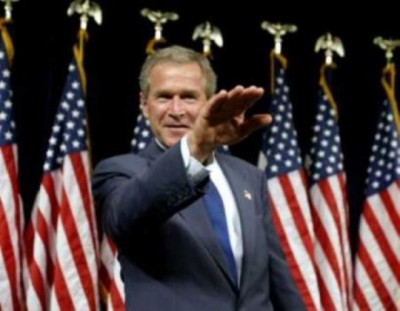
George Bush is A CHARACTER (Revelation 13:1)


In George W. Bush’s home state of Texas, if you are an ordinary citizen found guilty of capital murder, the mandatory sentence is either life in prison or the death penalty. If, however, you are a former president of the United States responsible for initiating two illegal wars of aggression, which killed 7,000 U.S. servicemen and at least 210,000 civilians, displaced more than 10 million people from their homes, condoned torture, initiated a global drone assassination campaign, and imprisoned people for years without substantive evidence or trial in Guantanamo Bay, the punishment evidently is to be given the Thayer Award at West Point.
On October 19th, George W. Bush traveled to the United States Military Academy, my alma mater, to receive the Sylvanus Thayer Award at a ceremony hosted by that school’s current superintendent and presented on behalf of the West Point Association of Graduates. The honor is “given to a citizen… whose outstanding character, accomplishments, and stature in the civilian community draw wholesome comparison to the qualities for which West Point strives.”
The Thayer may be one of the most important awards that hardly anyone has ever heard of. In a sense, it’s a litmus test when it comes to West Point’s moral orientation and institutional values. Academy graduates around the world — in dusty GP medium tents as well as Pentagon offices — all sit at the proverbial table where momentous, sometimes perverse decisions are regularly made. To invade or not to invade, to bomb or not to bomb, to torture, or not to torture — those are the questions. As the Trump era has reminded us, the U.S. military’s ability to obliterate all organized human life on Earth is beyond question. So it stands to reason that the types of beliefs pounded into cadets at West Point — the ones that will serve to guide them throughout their military careers — do matter.  To the classes of cadets now there, this award will offer a message: that George W. Bush and the things he did in his presidency are worth emulating. I could not disagree more.
The United States Military Academy is, or at least should be, a steward of American military values and yet the presentation of the Thayer Award to our former president represents an unprincipled lapse in judgment. In what it condones, it has committed a brazen violation of West Point’s honor code, which instructs that “a cadet will not lie, cheat, steal, or tolerate those who do.”
George W. Bush deceived the nation, cheated noncombatants of both their bodily autonomy and moral significance, and waged unjustifiable, unnecessary wars, which misallocated trillions of dollars that would have been better used to ensure the prosperity and well-being of Americans.  And he once described his messianic mission as “this crusade.” Is the world’s premier military academy not then honoring the dishonorable?
As I recall from my time wearing cadet grey, West Point regularly indulged in talk about doing “the harder right rather than the easier wrong,” about exhibiting “moral courage,” and about “Army Values.” Our ethical compass was given to us, standard issue, early on, often in the form of quaint military parables.
These were meant to set the ethical standards for behavior in war. Despite serious transgressions of those values by West Point graduates in these years, I still believe that the majority of West Pointers, even in the most stressful situations, are challenged by a nagging little voice asking what West Point would do.  In a sense, we have all been hard-wired to follow the ethical protocols we learned at the academy. As far as I’m concerned, however, this award shifts the goal posts. It establishes a new moral paradigm for what should be considered acceptable behavior in war and foreign policy.
As someone who also fought in one of those wars, let me just say that presenting Bush’s legacy as a template for cadets to follow is — not to mince words — a moral obscenity. Once the collective “we” — that is, West Point and its alumni — acknowledge that Bush’s wars and the state-sanctioned torture that went with them are not just acceptable, but laudable, we have lost any plausible claim to the moral high ground, the ground I once believed West Point was founded on.
Now that the Thayer Award has been given to former President Bush and we, the alumni, have even officially sponsored the act (not me, of course), it seems that the values we were taught don’t stand for anything at all.
A Cadet Will Not Lie
By idolizing Bush, a man whose major legacy is defined by acts of state terrorism (rebranded “counterterrorism”), West Point and its alumni have canonized by association his now-16-year-old war on terror. West Pointers have long been placed in a precarious position in relation to that war, simultaneously helping to perpetrate it and suffering from it. Too much energy has been devoted to pursuing it and too much lost for it not to have some grand meaning. By retrofitting the past, West Point and its graduates are now attempting to lessen the sting of, the reality of, those last 16 years.  In the process, they are continuing to delude its graduates, who are still being deployed to commit political violence in, at best, a morally dubious set of wars.
The very act of misleading a generation of salt-of-the-earth people — as most West Pointers I’ve encountered are — making them willing participants (and I include myself in this) in Bush’s supreme international crime should qualify as a tragedy. Convincing cadets of Bush’s widely discredited, false narrative is also a lie by West Point’s own doctrinal definition of the word.  The academy’s honor code defines lying as “an untruth or… the telling of a partial truth and the vague or ambiguous use of information or language with the intent to deceive or mislead…”
West Point generally doesn’t teach those facts that would cause cadets to feel embarrassed by or skeptical of the state. During wars of aggression like Bush’s, cadets will never be permitted to come to the conclusion that the political violence they will be sent off to commit after graduation is illegal or morally unsavory. Acknowledging all the emotive connotations that come with the word, one could still credibly call this practice “brainwashing.”  
At West Point, it’s still possible to believe that we are fighting in the interests of the Afghan people when, for 16 years, a coalition of the most powerful armies on Earth led by the United States — supposedly with the support of most Afghans — hasn’t been able to get rid of a few thousand ragtag Taliban fighters. Why is it that, at the academy, the contradictoriness of such claims never leads to an inconvenient but possibly more reasonable explanation: that we’ve failed because enough of them oppose us, that we’re part of the problem, not the solution? In his final address to the Afghan parliament in 2014, President Hamid Karzai suggested as much, claiming that the last 12 years of war had been “imposed” on Afghanistan.
The extreme psychosocial dynamics of West Point make it a masterful teacher of such Orwellian “doublethink.” In the process, people like Bush — or former National Security Adviser and Secretary of State Henry Kissinger (another Thayer Award recipient) — are deified. They must exist as role models, not villains or war criminals. Being sure that the enemy is the enemy is an imperative of combat, so it’s essential that no one thinks about this topic too much or too deeply.
Inconvenient facts are deliberately omitted as threats to both recruitment and retention. Blind devotion is considered a virtue. Cadets are trained to proverbially place all their self-esteem eggs in the military basket. Morality is partitioned. Emphasis is put on individual actions in combat, not the morality of the war being fought. We were typically taught that, a few bad apples aside, throughout its history the United States has always been “the good guy,” never the perpetrator.
In direct combat in Afghanistan, my soldiers and I faced death, disability, and despair. But perhaps the deepest wound was coming to realize that such tragedies were in service to, at best, a quixotic cause and, at worst, political expediency.
Due to an overriding obligation to the state and a purely subordinate obligation to the truth, West Point is structurally incapable of adhering to its own honor code in practice. Dishonesty, however, has a subtler aspect to it. It leeches away whatever integrity the academy does possess beneath its granite foundation. In that sense, the latest Thayer Award is an attempt to revise history by denying the illegality of Bush’s wars and absolving him of any accountability for them.
Lest we forget: none of the 19 hijackers on 9/11 were Iraqi or Afghan citizens, nor did Iraq’s autocratic ruler have nuclear or other weapons of mass destruction, nor was he in any way involved with al-Qaeda. Instead, as revealed in the leaked Downing Street Memo, President Bush “wanted to remove Saddam, through military action… [T]he intelligence and facts were being fixed around the policy.” Meanwhile, his top officials continued to publicly push the lie that Iraq “possesses and produces chemical weapons,” as well as supposed evidence (fraudulent, as they knew at the time) indicating that Iraq was “reconstituting its nuclear weapons program.” This claim would be explicitly contradicted by the U.S. intelligence community’s prewar National Intelligence Estimate, which stated that Saddam Hussein’s regime did not have “sufficient material” to manufacture any nuclear weapons and that “the information we have on Iraqi nuclear personnel does not appear consistent with a coherent effort to reconstitute a nuclear weapons program.” The very justification for Bush’s invasion and occupation of that country, in other words, was built upon lies. This year’s Thayer Award is simply a concrete manifestation of those lies.
To former President Bush, I’d like to say: there is no betrayal more intimate than being sent to kill or die unnecessarily by your own countrymen.
… Cheat
Whatever one thinks about soldiers invading another country or the people who defend that country from those foreign aggressors, this year’s Thayer Award cheats the far more numerous victims of those wars, Iraqi and Afghan civilians, of their status as human beings. To give this award to Bush is to say that their lives didn’t matter, that they got what they deserved. Or as soldiers I came across liked to say, often with high-wattage smiles, “We freed the shit out of them.”
Osama bin Laden was connected to the deaths of thousands of innocent civilians, George W. Bush to hundreds of thousands (at least 70 September 11ths), not to speak of the unrecorded torments of millions. One can only argue that Bush’s invasions of Iraq and Afghanistan were less of a crime if Iraqi and Afghan noncombatants are counted as fractional human beings — if, that is, there is one set of rules for America and another, heavily enforced by the U.S. military, for the rest of the world. By any elementary definition, this is “cheating.”
It should be self-evident that the use of torture is a dishonorable thing. What then could be a worse crime than for a leader of a democracy to organize the state-sanctioned torture of both the innocent and the guilty on a large scale?  The very act of torture cheats people of their bodily autonomy. When West Point overlooks the hypocrisy of giving an award for “outstanding character” to a former leader who put his stamp of approval on torture — for which the U.S. once punished Japanese war criminals with hanging or lengthy prison sentences — it makes a mockery of those values. The International Criminal Court reported that, under the Bush-era torture program, members of the U.S. Army and the CIA may be guilty of war crimes. Former National Coordinator for Security and Counterterrorism Richard Clarke went further, saying, “It’s clear that some of the things [the Bush administration] did were war crimes.”
Think of this Thayer Award, then, as an undeserved rehabilitation of George W. Bush’s reputation that’s meant to cheat history. Put another way, West Point supports giving the former president this award not because he earned it, but because they wish he had.
… Steal
 It’s hard to find a time in American history when more was spent to accomplish less. Even on the most practical level, the spread of terror groups and insurgencies of various kinds continues to outpace the rate at which the U.S. can kill the latest “bad guys.” The entire war is, in the long run and to the tune of trillions of taxpayer dollars, unsustainable. It’s only a question of how much damage we want to do to our own soldiers, how much public funding we intend to divert, while destroying the social fabric of other countries, before we pack it up and leave.
What did Bush, or any of us, get from stealing sovereignty from the people of Iraq and Afghanistan? Global terrorism deaths increased 4,000% from 2002 to 2014 (from 725 to 32,727). The Taliban now hold more ground in Afghanistan than at any point since the invasion of 2001.  TSA airport screenings fail to detect mock weapons in 95% of tests. The U.S.-friendly client regime established in Iraq looted billions of dollars in American aid. And that’s just to start down a long, long list.  As journalist Patrick Cockburn wrote“The invasion and occupation of Iraq by the U.S…. destroyed Iraq as a united country and nobody has been able to put it back together again. It opened up a period when Iraq’s three great communities — Shia, Sunni and Kurds — are in a permanent state of confrontation, a situation that has had a deeply destabilising impact on all of Iraq’s neighbours.”
Bush leveraged the future prosperity of America into trillions of dollars of debt, an intergenerational heist meant to give him the appearance of being “tough on terror.” That’s a reality that should be unappealing to members of both political parties.  For fiscally conservative Republicans, it bloats the budget; for Democrats, it diverts precious funding that might otherwise have gone into crucial social programs. In short, the honored former president stole from American citizens a chance to deal adequately with climate change, infrastructure needs, education, and healthcare.
And it’s difficult to discuss stealing without recalling Bush’s illegal mass surveillance program. It’s hard to imagine how spying on one’s own citizens without a warrant could be emblematic of what the Thayer Award stands for.
… Or Tolerate Those Who Do
When cadets, soldiers, and other servicemen swear an oath, they trust that the president will be guided by sound principles. By sending us to fight his bogus war on terror, George W. Bush betrayed that commitment. In giving the Thayer Award to him, West Point and its graduates not only put their stamp of approval on a president who broke with their stated values, they glorified and cleansed him. This award, in Dubya’s hands, is distinctly stolen valor.
There are many Americans who exemplify the very best of what our country — and West Point — could be. As graduates of the academy, none of us should have difficulty finding deserving Thayer Award recipients. George W. Bush’s terror wars, however, were not just a tragedy but also a crime. It’s now a secondary tragedy that West Point lacked both the honor and conviction to say so.
The former president deserves a cold metal bench in a stockade awaiting trial, not an award and a warm round of applause from the academy. No coffee table books featuring his paintings — a perverse form of macabre exhibitionism — will atone for his actions. If West Point and its Association of Graduates want to maintain any credible pretense of adhering to the values they claim to espouse, they should revoke the most recent Thayer Award immediately.
Erik Edstrom is a graduate of the West Point class of 2007. He was an infantry officer, Army Ranger, and Bronze Star Medal recipient who deployed to direct combat in Afghanistan.

Trump Playing into Iranian Hands


Asking Congress to examine the Iran nuclear deal is a thoughtful means to get the United States to re-assess our greater Middle East policy in general and our relationship with Iran specifically.
President Trump’s October 13 request also included an outline of a new Iran policy, which is the culmination of executive orders issued early in the administration.
To change Iran policy intelligently, we must understand the nature of the Iranian regime now in power. Only then will we be able to adopt a sound counter Iranian policy rather being stuck with the current disjointed appeasement-like policy we inherited at the start of the year.
What is the fundamental problem?
Supporters of the Joint Comprehensive Plan of Action (JCPOA) appear to think that while we can sanction those Iranian elements involved in Iranian missile production, conventional arms modernization and terrorism, we can simultaneously “un-sanction” the country’s nuclear work.
But the latter’s lack of sanctions makes it nearly impossible to enact effective sanctions on the former. And even worse, especially among our JCPOA partners, the assumption is by eliminating sanctions we can curtail Iran’s nuclear ambitions now, as the JCPOA seeks to do (but won’t) even as we simultaneously largely ignore Tehran’s current growing conventional hegemonic role in the Middle East through its proxy wars, terror campaigns and growing conventional weapons development.
The fear of JCPOA supporters is quite explicit: if we push too hard against these threats, the former nuclear deal will unravel.
However, while we might make neat distinctions among Iran’s nuclear and conventional capabilities, Iran does not — all these capabilities are elements of the same Iranian power strategy.
Iran is using the end of sanctions on its nuclear program to improve the Iranian economy and with that enhance Tehran’s conventional military, missile and terror strengths, while waiting down the road for the phases of the JCPOA currently inhibiting Iranian nuclear ambitions to expire.
In short, Iran seeks to use a pause in their pursuit of nuclear weapons capabilities to strengthen their conventional military while simultaneously using the JCPOA as a smokescreen to camouflage their continued aggression in Yemen, Iraq, Syria and Lebanon.
And unfortunately, the other partners of the JCPOA are playing into the Iranian strategy. Iran curtails some of its nuclear programs, while simultaneously threatening to drop out of the deal if the U.S. and its allies try aggressively to curtail Iran’s other military adventures. The fear of the nuclear deal unraveling has become the all-encompassing excuse to simply look the other way as Iran commits serial “mayhem.”
Important American media outlets, for example, give prominent space to the wildest Iranian propaganda. For example its foreign minister claims that Iran is a peaceful country, and justifiably worried about foreign interference in its affairs, seeking only to “responsibly patrol the Persian Gulf.” But the U.S. Navy says in 2016 alone Iran was involved in some 35 unsafe naval “instances” with American naval forces.
The key instrument the Iranians use is the IRGC — the Iranian Revolutionary Guard Corps. This group directs what Secretary Mattis accurately describes as “mayhem” across the Middle East, including attacking whole villages in Syria; mass shelling of civilian enclaves in Yemen; murdering political opponents in Lebanon; supplying thousands of rockets and missiles to terror groups Hamas and Hezbollah; and moving Iranian militias into Kirkuk in Iraq.
Iran’s history of attacking Americans and American interests also cannot be ignored. Iran is the country that blew up our embassy and Marine barracks in Lebanon in 1983; bombed Khobar Towers in Saudi Arabia in 1996; blew up our embassies in Africa in 1998; and facilitated the training of the hijackers who flew planes into the World Trade Centers and our Pentagon on 9-11.
But there is more. Iran has killed and wounded American servicemen and women with IED’s supplied to their IRGC militias in Iraq even as they aid the Taliban in Afghanistan, vicious militias in Syria, and child-warrior recruiting terrorists in Yemen.
Let us be honest. This is the Iranian way of war.
And it will get worse as Iran enhances the reach of its ballistic missiles even as it supplies missiles to Houthi rebels in Yemen as they launch attacks at key strategic military and energy assets in Saudi Arabia. This is all within the context of Iran’s financing and weapons supplies to the Youthi in Yemen, Shia-militia in Iraq, as well as the terror groups such as Islamic Jihad and Hamas that are proximate to Israel.
In Yemen, the Iranians and their Houthi rebel allies have become particularly gruesome. This includes massive forced recruitment of child soldiers, now some 70 percent of their forces. And a refusal to allow humanitarian assistance into the areas it controls — and as a result creating both zones of starvation and cholera outbreaks — even as the Houthi oppose peace talks to end the conflict.
The Yemen conflict is but one part of the Iranian campaign of war. And as Jonathan Spyer writes, the current Iran way of war “vividly demonstrates the currently unrivaled efficacy of the Iranian methods of revolutionary and political warfare, as practiced by IRGC throughout the Arab world” as Iran establishes a dangerous Shia crescent from Iran to the Mediterranean.
Considering the foregoing, what should the United States do?
Three near-term policy choices emerge:
First, the IRGC is the spear head of this violence. As such they should be totally sanctioned as a mini-state sponsor and financier of terrorism within of course the larger, maxi-state sponsor of terror, Iran.
Second, we should work to get Qatar — an ally of Iran — out of the terrorism business. Key problems are Qatar’s continued co-production of 1) Muslim brotherhood subversion, 2) financing both Hamas/Hezbollah terrorism and Al Jazeera’s jihad disinformation. Otherwise continuing to maintain a USAF base in Qatar may become increasingly untenable, however valuable it is.
And third, we should be bluntly honest — too many of our European allies are in financial bed with Iran. In 2016, EU imports from Iran increased by 344.8 percent. The increased income goes partly to the IRGC, a key part of the Iranian economy. Curtailing Iran’s nuclear program while simultaneously strengthening its conventional terror capability makes no sense.
We must thus coax our European allies to reconnect any nuclear agreement with Iran with a newly created coalition to curtail, reduce and then end its terror sponsoring ways.
In short, these three challenges can be met more easily in the context of a new American Middle East policy rather than done in isolation. Already the American administration has made substantial progress putting together a tacit coalition of allied countries, including Israel and Saudi Arabia, to contain and confront Iran’s hegemonic ambitions.
A hopeful sign is the Saudi Press Agency report that King Salman called the U.S. president to offer his support for America's more "firm strategy" on Iran and commitment to fighting "Iranian aggression." And Israel's Prime Minister, Benjamin Netanyahu, offered similar praise for the new U.S. posture, saying in a statement that President Trump "has created an opportunity to fix this bad deal, to roll back Iran's aggression and to confront its criminal support of terrorism."
One analyst said this was quite noteworthy, explaining “It is no secret that these two previously discordant states are now cooperating in unprecedented ways as they try to counter the threat posed by a nuclear Iran. When Israel and the Gulf States are on the same page, the world should listen.”
With the nuclear deal now before them, hopefully Congress will indeed listen. And begin the hard road of formulating a sound and effective policy that finally sees Iran for the threat it is and helps put together the appropriate United States security policy.
Peter Huessy is the director of Strategic Deterrent Studies at the Mitchell Institute for Aerospace Studies of the Air Force Association. He is also the president of Geostrategic Analysis, a defense consulting firm.