Thursday, November 2, 2017

The Nuclear Reach of Babylon the Great (Daniel 7:7)

ANKARA
The United States has a total of 150 nuclear weapons in five NATO member countries, including Turkey, according to a report on worldwide nuclear arms prepared by the Turkish Parliament.
The report, titled “Data on Nuclear Weapons,” said there were around 15,000 nuclear weapons at 107 sites in 14 countries as of July this year, daily Milliyet reported on Oct. 31.
“Nearly 9,400 of these weapons are in arsenals for military use and the rest are standing idle to be destroyed,” the report read.
It added that some 4,150 of the weapons in arsenals are ready to be used at any minute, while 1,800 are in “high alarm” status, which means they can be prepared for use in a short period of time.
According to the report, 93 percent of the world’s nuclear weapons belong to Russia and the U.S.
The report also said that nuclear weapons belonging to the U.S. are present in five NATO countries that do not themselves have nuclear weapons.
Saying there are nuclear weapons belonging to the U.S. in five NATO countries that do not have nuclear weapons.
“There are nearly 150 U.S. nuclear weapons in six air bases in Belgium, Germany, Italy, the Netherlands and Turkey, which are NATO countries that don’t themselves own nuclear weapons,” it added.
The U.S., China, Russia, France and Britain are nuclear-armed state parties to the Treaty on the Prohibition of Nuclear Weapons, while India, Pakistan and Israel never became parties even though they own nuclear weapons.
According to the data in parliament’s report, Russia has 7,000 nuclear weapons, the U.S. has 6,800, France has 300, China has 260, Britain has 215, Pakistan has 130, India has 120, Israel has 80 and North Korea has 10 nuclear weapons.
During the Cold War, the U.S. placed nuclear weapons in NATO countries, including Turkey, as part of the organization’s nuclear sharing program. Some of the nuclear weapons placed in the 1960s are still in Turkey today.
At the time, negotiations were carried out between Ankara and Washington in the 1950s and they were concluded at the beginning of the 1960s.
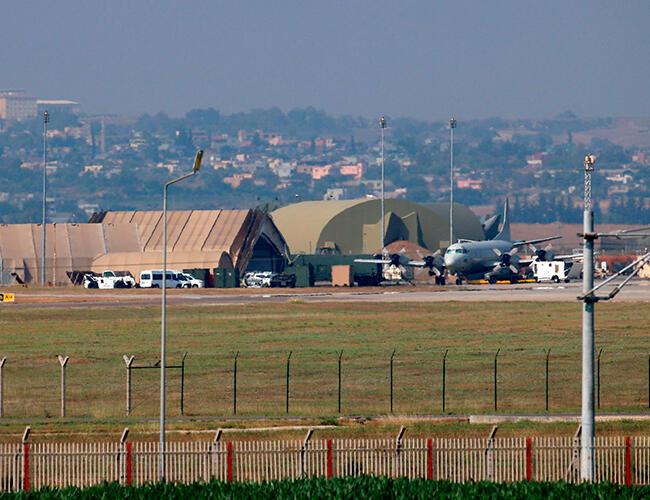
Among those weapons, B61 type bombs are still in the İncirlik air base in the southern Turkish province of Adana. Nuclear warhead Jupiter missiles that were sent to the country during the same time period were only kept in the country between 1961 and 1963.
According to data from the Federation of American Scientists (FAS), the number of B61s in Turkey is estimated to be nearly 50.

The Antichrist not Iraq's PM is in Control

Riding on the nationalist fervor from defeating the Islamic State (IS) and now through armed confrontation to drive back the Kurds, Iraqi Prime Minister Haider al-Abadi sought to dispel criticism of being a weak leader and simultaneously put himself in the driving seat ahead of national elections in 2018.
However, with many parties with divergent affiliations and allegiances dotting the political and military landscape, Abadi’s political future is far from certain.
The crucial upcoming elections in Iraq will usher a critical post-IS phase in the country. This phase begs a number of questions.
Will the recent show of force against the Kurds backfire on Baghdad? Have Sunni concerns that spawned IS been truly addressed? Can Iraq undertake the huge rebuilding exercise required? Can Baghdad deliver on its elusive reform package? And, importantly, will the growing power and influence of the Shia Popular Mobilization Forces (PMF) undercut the political scene?
The heavy-handed approach to damage Kurdish statehood aspirations may have spurred Arab nationalism, but the disproportionate measures against the Kurdish people as a whole only masks the enormous challenges and fractures faced in Iraq.
Former Iraqi Prime Minister Nouri al-Maliki remains fixated on returning to the hot seat and has already amassed a string of allies among the pro-Iranian elements of the PMF as well as support from Iran.
Meanwhile, the PMF itself is deeply polarized with groups split broadly between loyalty to Iran, Grand Ayatollah Ali Sistani, or influential cleric Moqtada al-Sadr.
Abadi may give the impression that he commands the PMF forces but, in reality, these forces, who wield significant sway, have a great deal of autonomy. Abadi will remain cautious in approaching and appeasing the PMF, especially the pro-Iranian elements such as the Badr Organization, Sayara al-Salam, and Asa’ib Ahl al-Haq.
These groups can make or break the Prime Minister, and Abadi will have to achieve a delicate balancing act. In recent actions against the Kurds, many sides, not least Iran, would have pressured and greatly influenced Abadi’s decision making.
The likes of Sadr, who has assumed an increasingly anti-Iranian stance and who commands significant influence among the working class, will remain a thorn in the side of the future Prime Minister as well as the Iranian-allied groups.
Sadr’s mass protests in 2016 lead to a great dilemma for Baghdad, and he can easily mobilize such protests again if desired. When Maliki tried to reign in Sadr and his militias in the past, it largely backfired.
Almost all political parties have armed wings that further their own agendas. With such a diverse number of groups and end goals, there is every danger of intra-Shia fighting that will complicate the huge work that Baghdad has in front of it.
With the Kurds dominating the news, the Sunni voice has taken a quieter tone. However, the same sectarian undertones that saw Iraq slip into a vicious cycle of violence long before IS even took power have not been addressed. The Sunni insurgency is far from over, and Baghdad needs to take practical and meaningful measures to appease the long disenfranchised Sunni population.
With Shia militias dominating the security apparatus, the Sunnis remain as wary as ever.
Abadi’s strong reaction against the Kurds was as much for the audience in Baghdad as that in Erbil. However, with a tussle for power and influence among several groups and pressure to appease many state and non-state actors, Abadi’s quest to retain power is far from certain.
Bashdar Pusho Ismaeel is a London-based freelance writer and analyst whose primary focus and expertise is on the Kurds, Iraq, and current Middle Eastern affairs.
The views expressed in this article are those of the author and do not necessarily reflect the position of Kurdistan 24.

Preparing for War with Iran


With the US President Donald Trump’s decertification of Iran nuclear deal, the prospect of peace and stability in the Middle East appears to be a distant dream. Largely seen as dangerously irresponsible act,
Trumps policy decision has not only casted a dark shadow over peace and stability in Middle East but has also escalated the ongoing tensions and conflicts among various competing forces whose interests diverge more than they converge on the complex geopolitical landscape of Middle East.
The 2015 Iran nuclear deal or Joint Comprehensive Plan of Action (JCPOA) is a multilateral, international agreement negotiated between Iran and five permanent members of UN Security Council plus EU. The deal which lifted US-led international sanctions in return for crippling limitations imposed on Iran’s capabilities to acquire nuclear weapons is now under serious strain since US president Donald Trump refused to recertify the deal on October 13, despite reluctantly doing so twice before.
Trump has taken this decision in complete defiance of international community and the remaining signatories of the deal. Also, the endorsement of Iranian unwavering compliance with the deal by International Atomic Energy Commission (IAEA) that intrusively inspects Iran’s nuclear program has no effect on Trump. Even some key policy makers in his own administration namely Rex Tillerson, Sect. defence James Mattis voiced for staying in the deal as long as it is working but Trump seems adamant in his approach and seeks options to tighten the noose around Iran which he blames for promoting terrorism and destabilizing the region.
So let’s try to understand what led Donald Trump to take such an infamous decision? What policy objectives does he want to achieve? What will be Iran’s response? And finally how it affects regional security environment in the Middle East?
By now it should be clear that Trump decision has less to do with Iran’s compliance with the deal per se and more so with Iran’s regional activities. It seems that the decision is primarily aimed at restoring the waning credibility and supremacy of US in shaping the outcomes and pleasing Washington’s allies like Israel and gulf countries including Saudi Arabia. These countries perceive Iran’s growing presence in areas like Syria, Lebanon, Iraq and Yemen a blow to their strategic interests.
Moreover, now that the Middle East is heading towards a post Islamic State ( IS ) era after the near complete military defeat of IS, the US is now looking determined to secure its interests vis-a vis Iran and its regional ally Russia. When it comes to Iraq, Iran has an upper hand which is not acceptable to US and allies. Iraq’s predominantly Shia government rebuffed a statement by US secretary of state Rex Tillerson in which he called on Iranian backed forces to go home. Most importantly, Iran’s Missile program and missile tests is a thorn on the side of US that he wants to contain. This combined with Iran’s growing resurgence regionally has caused the mounting hostilities.
Since assuming power and even during the election campaigned Trump expressed his displeasure with Iran nuclear deal describing it the “worst deal ever” and “an embarrassment to the US” that he will end.
However, at least for now Donald Trump has stopped short of entirely walking away from the deal and has opened the window for congress to come up with an improved version that should allay Donald Trump’s primary concerns related to the “sun set clauses” of the deal and Iran’s missile program.  But the trouble is that Iran has already ruled out any possibility of renegotiating the deal and has rebuked Donald Trump for tinkering with international agreements protected by UN Security Council resolution.
Trump’s predicament is further compounded by the fact that Washington’s key European allies have also vowed to protect the deal and have instead suggested that issues outside of the scope of the deal should be dealt separately. EU considers the deal as an important foreign policy achievement that serves the purpose of non-proliferation while demonstrating diplomacy and negations as the most viable and cost effective methods of conflict resolution.
Bolstered by this international support in favour of the deal, Iran is very unlikely to step back from its ballistic missile program that it argues and rightly so is out of the deal’s scope. This will inevitably lead the two states in to war with each other if a situation so arises.
The US has already imposed economic sanctions on various entities of Iran including its powerful paramilitary force IRGC thus making the situation precarious. In the worst case scenario,  if Trump administration fails to come up with an agreeable revised version of the deal and Iran resists US pressures, the deal can find itself in a trash and economic sanctions lifted under the deal could be re-imposed thereby potentially leading Iran to pursue nuclear capability if it so desires.
This seems plausible given the fact that Russia and China and most probably EU will continue their economic relations with Iran. Thus, it can only be hoped that sense prevails and all stake holders once again reconsider their respective stances and try to overcome their differences through negations and diplomacy since Middle East cannot afford further deterioration. It’s time to rehabilitate and reconstruct the region for wandering refugees to return home and live a peaceful life.

Wednesday, November 1, 2017

The Antichrist's Men (Revelation 13:18)


For almost two years, US-backed Iraqi government forces, along with Kurdish Peshmerga forces and other allies, fought to push ISIL fighters out of the country.
One of the key actors, who played a major role in the campaign declared by Iraqi Prime Minister Haider al-Abadi, were Shia-dominated paramilitaries.
Roughly 63 factions make up Iraq's Popular Mobilisation Forces (PMF, also known as PMU) - an umbrella of groups rallied by ethnic and tribal leaders, whose fighters are either loyal to religious scholars, Iraqi political leaders, or Iran's Revolutionary Guard Corps (IRGC).
The diverse makeup of the PMF's 40 divisions - comprising more than 60,000 fighters - sheds light on many of Iraq's sectarian tensions and its ambiguous political future.
Although formed via a religious decree to fight ISIL in 2014 by Grand Ayatollah Ali al-Sistani, Iraq's top Shia religious scholar, many of the fighters are empowered by Iran and other non-state actors. Some have existed for decades prior, and others have political representation in parliament.
The PMF is largely outside government control, yet the Iraqi parliament formally recognised it as a state-affiliated institution when its own forces became depleted in the fight against the Islamic State of Iraq and the Levant group (ISIL, also known as ISIS).
There are three main distinct factions in the PMF with various ideological underpinnings: those loyal to Iran's supreme leader, Ayatollah Ali Khamenei; those loyal to Iraqi popular Shia religious leader Muqtada al-Sadr, who heads the Peace Brigades; and those loyal to Sistani.
All of these groups have one thing in common: They are backed by Iran and have become the most powerful military force in Iraq, analysts say, since ISIL leader Abu Bakr al-Baghdadi stood at the pulpit of Mosul's Grand al-Nuri mosque and announced the creation of a Sunni caliphate.
Since the PMF is not a single unified body, its various factions operate under the policy recommendations of different heads.

Political recognition

The PMF has not publicly demanded political recognition in Baghdad due to the absence of government control and the involvement of non-state actors.
However, two main groups already have political recognition and are members of the Iraqi parliament.
The Badr organisation, which is part of a coalition - the National Iraqi Alliance (NIA) - is headed by former Iraqi Transport Minister Hadi al-Ameri.
Out of the Iraqi parliament's 328 seats, the NIA holds 183 seats, 22 of which belong to the Badr organisation.
The Badr organisation was well established in Iraq's political system prior to 2014, and before entering the realm of politics was previously known as the Badr Brigades, Iran's oldest proxy in Iraq.
The other, Asa'ib Ahl al-Haq, is a Shia armed group founded by Qais al-Khazali. One member of the group is currently sitting in parliament, Chatham House fellow Renad Mansour told Al Jazeera.
"These [groups] will continue to be involved in politics," he said.
Basically, the PMF became an umbrella for anyone who wanted to fight ISIL … There is no standard process to say ok, you are now part of the PMF - it's a loose term.
Renad Mansour, Chatham House
Considered to be the senior, de-facto leaders of the PMF, Ameri and Khazali have established close ties to the PMF's administrator, Abu Mahdi al-Muhandis, who works in alignment with the two and is among the PMF's leadership.
Muhandis is an Iraqi military commander who leads organisations close to Iran's Quds Force, an IRGC offshoot that oversees operations overseas. Like Ameri, he is considered to be among the top military leaders who have maintained close ties with Tehran.
"There is no question that someone like Hadi al-Ameri definitely has political ambition. He was upset when he wasn't made interior minister by Abadi a few years ago, but continues to influence the Ministry of Interior because the Badr organisation has a lot of influence in that industry," Mansour said.
"And they have good relations with Nouri al-Maliki, the former Iraqi prime minister, and he created the PMF."
According to Mansour, who frequently travels to Iraq, it has become clear that Ameri's popularity in the Badr organisation increased significantly through the fight against ISIL.
"When we used to go to Baghdad, we'd see big posters with pictures of martyrs and the logo of the organisation - so basically, using the fight against ISIL, and using slogans like 'we defended Iraq, we defended Baghdad, from Daesh [ISIL]', either way to gain political favour," he said.
"But at the same time, Abadi's influence has also grown, so it's a struggle between these two spheres of influence."

Facade of control

Similarly, Middle East Forum analyst Aymenn Jawad al-Tamimi told Al Jazeera that various PMF factions have been fighting to expand their political influence.
"The idea is to gain ground for the 2018 parliamentary elections, using the victory over the Islamic State, preserving Iraq's unity and restoring security as playing cards," he said.
Despite this, many other smaller PMF factions who emerged in 2014 remain weak, although political ambitions among them cannot be ruled out, Tamimi said.
Prior to becoming a state-recognised institution, the PMF received much of its budget from Iran. Currently, the PMF reportedly receives about $1.5bn a year from Abadi's government - but Muhandis, the PMF's administrator, decides where to allocate the funds.
 
"The government doesn't have much control over it," Mansour said.
The lack of transparency with budget management has resulted in smaller factions claiming they have not received salaries. Some, said Mansour, have accused Muhandis of favouritism.
Since taking office in September 2014, Abadi has worked on developing Iraq's security sector and has succeeded in revamping "three or four divisions, including the police", Mansour said, "but he needs the PMF as well … that's why there is still a role for the PMF".
According to Tamimi, Abadi allowed for the recognition of the PMF in hopes of being able to control them.
"The idea of the numbering for brigades, for example, is probably based on the idea that the PMF should not be political, but function as a reserve force of the state," he said.
Tamimi noted that some PMF factions "clearly" have a good relationship with state institutions, but others are tied to pro-Iranian factions, which have an agenda differing from Abadi's.

Where were they before ISIL?

According to Mansour, seven groups existed before the 2014 decree and Maliki's creation of the PMF.
"Some have existed for decades and used to be a part of the Islamic Supreme Council of Iraq, which was Ayatollah al-Hakim's party," said Mansour, referencing the late Iraqi top Shia leader.
Some of the pre-existing groups fought against the United States and the Iraqi state itself, but have since shifted closer towards Iran and Maliki, such as Sadr's Peace Brigades.
Iran realises that Abadi isn't someone they can trust completely, so they need to work with people like Nouri al-Maliki and other PMF leaders to ensure that they have influence on the ground.
Renad Mansour
When Maliki was in office back in 2010, he grew closer to the Badr organisation and to Khazali's forces - essentially relying on them, Mansour said.
"These seven groups continued to exist in one way or another until 2014, when they created a commission, and then, 50 or so more groups emerged - some of them just local groups, some just gangs and criminal networks, and others tribal forces including Sunnis, Christians, Turkmen," he said.
"Basically, the PMF became an umbrella for anyone who wanted to fight ISIL … There is no standard process to say ok, you are now part of the PMF - it's a loose term."

Iranian proxy

After taking control of the Kurdish-held province of Kirkuk, Iraqi forces, backed by PMF fighters, defeated Peshmerga forces on the outskirts of the oil-rich city.
Over the past week, Abadi has sought to maintain relationships with neighbouring countries as he visited Turkey, Iran and Jordan, while preserving an alliance with the US - a move Mansour said was aimed at limiting Iranian influence in Iraq.
"Iran realises that Abadi isn't someone they can trust completely, so they need to work with people like Nouri al-Maliki and other PMF leaders to ensure that they have influence on the ground," he said.
According to him, Iran's main objectives are to ensure that Iraq remains stable, and to ensure that whoever is leading Iraq is "loyal, but then again not too powerful at the same time".
While it is unlikely for rival PMF factions to seek political recognition in Baghdad, it is in Iran's best interests for various PMF groups to expand or gain a political foothold "as a means of ensuring Iraq remains an ally of Tehran", Tamimi said.
"From Iran's perspective, it is best to have multiple pro-Iranian Shia factions and have them compete for influence, with Iran acting as kingmaker among the various groups."
Given the country's large Shia population, it is difficult to unite Iraq's Shia behind one ideology or a single ideological group.
In 2014, when Sistani issued the religious decree calling on Iraqis to fight against ISIL, he referred to potential fighters as volunteers. In his statement, Sistani urged fighters to steer away from violence so as not to threaten Iraq's long-term stability.
And, earlier this year, local media reported that his office expressed concern over the actions committed by various PMF subgroups.
"Sistani is against what happened with the PMF, and is against what is largely a misinterpretation of the decree - the misuse and politicisation of it," Mansour said.
As such, both Mansour and Tamimi agreed that the differing loyalties of PMF factions create the possibility of future infighting, as well as infighting for less ideological reasons, such as "control of extortion opportunities in various areas".
Sixth Seal: New York City (Revelation 6:12)

EARTHQUAKE HAZARD
http://www.nysl.nysed.gov/libdev/flooding/nysquake.gif


(Source: US Geological Survey)
New York State Geological Survey
Damaging earthquakes have occurred in New York and surely will again. The likelihood of a damaging earthquake in New York is small overall but the possibility is higher in the northern part of the state and in the New York City region.Significant earthquakes, both located in Rockaway and larger than magnitude 5, shook New York City in 1737 and 1884. The quakes were 147 years apart and the most recent was 122 year ago. It is likely that another earthquake of the same size will occur in that area in the next 25 to 50 years. A magnitude 5.8 earthquake in New York City would probably not cause great loss of life. However the damage to infrastructure – buildings, steam and gas lines, water mains, electric and fiber optic cable – could be extensive.
Earthquake Hazard Map of New York State
Acceleration of the ground during an earthquake is more important than total movement in causing structural damage. This map shows the two-percent probability of the occurrence of an earthquake that exceeds the acceleration of earth’s gravity by a certain percentage in the next fifty years.
If a person stands on a rug and the rug pulled slowly, the person will maintain balance and will not fall. But if the rug is jerked quickly, the person will topple. The same principle is true for building damage during an earthquake. Structural damage is caused more by the acceleration of the ground than by the distance the ground moves.
Earthquake hazard maps show the probability that the ground will move at a certain rate, measured as a percentage of earth’s gravity, during a particular time. Motion of one or two percent of gravity will rattle windows, doors, and dishes. Acceleration of ten to twenty percent of gravity will cause structural damage to buildings. It takes more than one hundred percent of gravity to throw objects into the air.

Trump and the Nuclear Button

Can Trump be trusted with the nuclear launch codes? Can any president?
Ralph Vartabedian
Ever since Harry Truman ordered the atomic bombing of Hiroshima during World War II, the president of the United States has controlled the most lethal arsenal in history -- a major reason the position is considered the most powerful on Earth.
In recent months, remarks by President Trump threatening North Korea with "fire and fury like the world has never seen" have raised new questions about the concentration of power in one person, though Trump has not explicitly said he might use nuclear weapons.
Legislation sponsored by Rep. Ted Lieu (D-Torrance) and Sen. Edward J. Markey (D-Mass) would prevent Trump or any future president from ordering a first strike with nuclear weapons without a declaration of war by Congress. The bill would maintain the president’s authority to use nuclear weapons at a moment’s notice if an enemy launches its weapons first.
A restriction put on the president’s control of the arsenal -- the 450 Minuteman land-based missiles and the roughly 1,000 warheads aboard U.S. submarines -- could upend half a century of nuclear deterrence and war fighting theory. In a crisis, it would eliminate an adversary’s fear of a surprise attack by the U.S.
The legislation faces little chance of passage in the Republican-controlled Congress. Still, Trump’s heated rhetoric has taken past concerns about the judgment of presidents to a new level.
"It is a problem not only with this president, but all presidents," said former Defense Secretary William Perry. "This president just accentuates the problem. His personality and behavior has brought it to a fore."
In hindsight, some have questioned whether President Kennedy’s judgment was compromised by painkillers for his back problems during the Cuban missile crisis. And in his final days in office, President Nixon was morose and sometimes drunk, exhibiting odd behavior. Some believe that Ronald Reagan was showing symptoms of mild dementia in his final days in office.
But the concerns about Trump are more basic.
"It is not just a concern that the president is drunk or has a brain malfunction, but that he just doesn’t have the character," said Hans Kristensen, a nuclear arms expert at the Federation of American Scientists. "That is a whole different ballgame."
This perception has raised concerns that Trump might impulsively launch a preemptive nuclear attack on North Korea that would not only kill innocent civilians but also put South Korea, Japan and even the U.S. at risk of a counterattack.
Lieu, an attorney and a colonel in the Air Force reserve, argues that such an order would violate international laws of war, which require proportionality so that civilian deaths are not excessive compared with the military advantage gained. And he asserts it would violate the U.S. Constitution, because a nuclear attack would be the most extreme act of war and only Congress has the power to declare war.
Lieu questions whether senior military leaders would comply with such an order, given the legal doubts about it.
But independent military law experts worry about the legislation, and say they have no doubts that a presidential order for an attack on North Korea would be legal and executed by senior military leaders along with their subordinates.
"I would worry about destabilizing our entire nuclear strategy of deterrence," said Rachel VanLandingham, a former Air Force attorney and law professor at Southwestern Law School. "We have been very careful not to overly limit ourselves. Part of deterrence is not taking nuclear weapons off the table."
If Trump's opponents believe he is not fit to control the nuclear arsenal, she said, then the proper action is to remove him from office, not undermine the nation’s nuclear deterrent, she said.
Throughout the Cold War and in the quarter-century since, the U.S. has never renounced the first use of nuclear weapons.
It threatened to use tactical nuclear weapons against Soviet Union forces if they attempted to overrun Western Europe; and it has indicated it could use them in response to biological or chemical attacks on the U.S. or its allies, said John Pike, executive director of GlobalSecurity.org, a Washington-based military analysis firm.
In the early 1950s, the U.S. had more brutal policies than today, backed by a war plan that would inflict "massive retaliation" with nuclear weapons against an enemy attack on the U.S. or its allies.
In the heat of the Cold War, President Eisenhower said the U.S. would use tactical nuclear weapons in a potential battle with communists "just exactly as you would use a bullet or anything else."
The nation’s nuclear war fighting plan is shrouded in secrecy, and much of it is based on precedent. Many senior experts, including former defense officials and nuclear weapons experts, say it is not even clear what law, executive order or military regulation gives the president sole authority over nuclear weapons use.
But nobody doubts that only the president can authorize their use, Perry said.
U.S. policy has always warned adversaries that the president is ready to launch its missiles within minutes of detecting a nuclear attack against the nation, a scenario that would give the president about 10 minutes to consider the options before enemy missiles hit.
Jeffrey Lewis, a nuclear weapons analyst with the James Martin Center for Nonproliferation Studies in Monterey, Calif., said that putting nuclear missiles on alert and believing that complex decisions can be made by any president in minutes has always been unrealistic. The current controversy involving Trump has created a long overdue public discussion, he said.
"It is a crazy policy, because it is designed in complete ignorance of human beings," he said.
The nation’s "launch on warning" scenario could also include a preemptive strike if the U.S. obtained intelligence that an adversary was preparing to launch its missiles, but had not yet done so.
A lot of this policy would have to be junked if the president had to ask permission to use nuclear warheads from Congress. And that’s just fine with some retired four-star generals, defense secretaries, arms control experts and Lieu, the sponsor of the legislation.
Geoffrey Corn, a law professor at the South Texas College of Law in Houston and a former military attorney, said he has no doubts that senior military officers would obey an order to attack North Korea.
Unless an order were so bizarre, such as an ad hoc nuclear strike on London or Paris, the military is trained and sworn to uphold its duty to obey the president, Corn said.
"When the secretary of Defense conveys the order to the military, it comes with the assumption that it has been legally vetted," Corn said. "I can’t imagine that an officer would legally refuse to execute an order for a preplanned attack."

The Saudi Nuclear Horn Expands (Daniel 8)

img_0764
Why Saudi Arabia is doubling down on its nuclear program
Tom Rogan
Oct 30, 2017, 3:53 PM
Counterbalancing Iran, Saudi Arabia is doubling down on its nuclear program.
That's my analysis of the Saudi statement Monday that it will commence uranium extraction efforts towards nuclear "self-sufficiency." While it's not clear if Saudi Arabia intends to enrich any uranium, its statement is notable nevertheless. For a start, recognizing U.S. concerns in relation to nuclear proliferation, Saudi Arabia has traditionally been hesitant in its nuclear development strategy.
What has changed? Iran's nuclear program.
Under the direction of Crown Prince Mohammed bin Salman, Saudi Arabia has adopted an increasingly aggressive strategy toward Iran. While this dynamic is most evident in the Saudi intervention to counter Iranian influence in Yemen, it follows that bin-Salman would want to ensure parity with Iran in every possible sector, including nuclear.
Still, Saudi Arabia's nuclear strategy is also focused on domestic interests.
First, by diversifying its energy sector away from oil, Saudi Arabia ensures its long term energy security. Second, Saudi Arabia signals to its population and the world that big changes are coming.
That latter point is crucial.
After all, since its inception, the House of Saud has governed in a remarkably sustaining fashion. At home, in return for their recognition of the royal family, Wahhabi clerics have been granted supreme social and cultural power. And abroad, since the end of World War II, Saudi Arabia has sold oil in return for American guarantees of security.
Now, however, the crown prince is determined to alter the status quo by moving towards a westernized model of greater individual freedom and economic diversification. As he undertakes these reforms, bin Salman seems to believe his regime's security requires an independent nuclear program. And while the Saudis are unlikely to weaponize their nuclear program unless and until they view Iran as committed to that same course, the kingdom has an ace card up its sleeve: Pakistan.
Having supported Pakistan with tens of billions of dollars over the decades, the Saudis are convinced that the Pakistani government would, on request, transfer nuclear weapons technology to Riyadh. That gives bin Salman confidence that he has time on his side to first develop a purely peaceful nuclear program.
Ultimately, this development is just another reminder as to why the U.S. has an indispensable role in the Middle East. Absent the influencing mix of our deterrent and diplomatic power, the great game of Iranian vs. Saudi sectarian power politics escalates unhindered. And if that game ever goes nuclear, it will be too late for all of us.