Showing posts with label pakistani. Show all posts

Monday, August 10, 2015

China And The Pakistani Nuclear Horn (Daniel 8:8)


How China is desperate to Complete Pakistan’s Nuclear triad

Published August 4, 2015 | By admin

SOURCE: SUDESH CHARI / FOR MY TAKE / IDRW.ORG

“You can die crossing the street,” he observed, “or you could die in a nuclear war. You’ve got to die some day anyway.” Pakistan’s ambassador to the UN in Geneva, Munir Akram, reiterated Pakistan’s refusal of a no-first-use policy amid 2001-2002 India-Pakistan standoff after an attack on Indian Parliament, then India’s Defence Minister George Fernandes responded by saying “India can survive a nuclear attack, but Pakistan cannot”.

For long Pakistan believed that its aggressive nuclear posturing will deter any Indian response in event of any terror-related incidents but all that changed due to two main development in India, which many in India believed gave India enough reasons to call Pakistan’s nuclear bluff.
India’s Mythical Cold start doctrine shattered Pakistani military planners confidence that its nuclear weapons will deter India from every crossing Line of Control or the international border. Popular belief in Pakistani military after Kargil war and after the 2001-2002 standoff was that Nuclear Arsenal of Pakistan had successfully deterred India from carrying out surgical strikes in Pakistan against terror infrastructure.

India’s Cold start doctrine gave India some level of advantage since it allowed Indian armies Strike corps to assemble on shortest notice period and gave the ability to launch an attack before International pressure could build up on India.

In response to India’s Cold start doctrine, Pakistan came up with the development of two key projects to counter or stop Indian armies strike corps from bulldozing its way into Pakistan. Pakistan developed battlefield Ballistic missile Nasr which when armed with a tactical nuclear weapon could be used to attack invading force even when Indian Army is well inside Pakistani territories.
India on other hand refused to start tactical nuclear weapons race with Pakistan which India could have countered by allowing invading Strike corps to move with tactical nuclear weapons, Indian military planners stuck to strategic nuclear weapons and responded by saying that No Matter what will be size of nukes or where our forces are attacked our response will be massive, this left an element of doubt on Pakistani military planners on effectiveness on use of Tactical nukes which might deny them use of strategic nuclear weapons on Indian territories.

In 2012, Pakistan established new Naval Strategic Force Command, described by the military as the custodian of the country’s nuclear second strike capability which will strengthen Pakistan’s policy of credible minimum deterrence and ensure regional stability which they believed shifted due to launch of India’s first nuclear INS Arihant ballistic missile submarine .

Shortly after visit of Chinese president Xi visit from Pakistani, there was media buzz about talks which was underway with china in supply of eight Conventional diesel submarines in a 5$ billion deal that could more than double Pakistan’s submarine fleet size.

Submarine in question which have been offered are Yuan-Class Diesel submarines in line Kilo submarine currently operated by Indian Navy, But submarine which Pakistanis are eyeing to complete their low-cost Nuclear triad against rise of expensive Nuclear submarine program initiated by India in the region is to procure much larger Qing-Class submarines which reportedly are equipped with vertical launch system which will allow Pakistan to deploy permanent sea-based deterrent equipped with plutonium-based warheads fitted into Submarine launched variant of Babur cruise missiles which can strike targets 700-1000km.

AIP-equipped conventional submarines with Cruise missiles armed with Tactical nukes will provide Cheaper second strike platform for Pakistani military against rising Nuclear submarine force which India is developing which is both Capital intensive and involves technically complex technology which Pakistan cannot match

Sunday, January 4, 2015

Even Obama Foresees The Third Nuclear Horn of Pakistan (Daniel 8:8)

What if Pakistan hands a nuclear bomb to Mullah Omar or Haqqani?

modi-obama2-620x330
What happens if one day some cranky army general of Pakistan fails to give in to the temptation of knocking more than a few heads and decide to hand over one or more of the bombs to a Mullah Omar or a Haqqani, asks veteran diplomat Rajiv Dogra in his new book: “Where Borders Bleed: An Insider’s Account of Indo-Pakistan Relations.

Here are some excerpts from the book published by Rupa and priced Rs.360.

“Actor George Clooney recalls in an interview in the December 2012 issue of Esquire magazine: I talked with the President (Obama) at one of those fundraisers some months back, and I asked him, ‘What keeps you up at night?’

And he said, ‘Everything. Everything that gets to my desk is a critical mass. If it gets to my desk, then no one else could have handled it.’

So I said, ‘So what’s the one that keeps you up at night?’

He goes, ‘There are quite a few.’

So I go, ‘What’s the one? Period.’

And he says, ‘Pakistan.’

Do Indian leaders lose any sleep because of Pakistan? There is nothing in the public domain to suggest that they do. However, one thing is certain, and it is this that Indian leaders lose no opportunity in convincing the world at large that they have no ill-will towards Pakistan, and that a prosperous and stable Pakistan is in India’s interest. They also go on to say that they would do all they can to help promote stability in Pakistan.

How exactly will they help, and what form India’s help would assume, is never clarified. Nor is the fact taken into consideration that help by India would be seen as the kiss of death for anyone in Pakistan who receives or agrees to receive such assistance, be it a political party or an individual.
On the other hand, if the desire is to shore up Pakistan economically by cash transfers, it will be well worth recalling the US experience. Its billions have disappeared without trace, and without any stabilizing effect, in a bottomless pit called Pakistan.

Therefore critics of a realistic persuasion have often asked, ‘Is Pakistan an Indian responsibility? Or is it a dangerous distraction?’

Political scientist and economist Francis Fukuyama wrote in his book State Building, ‘Weak and failing states have become the single most important problem for international order.’ Fukuyama may or may not have had Pakistan in view as the perfect model for his conclusion, but the vast body of international writing on Pakistan has consistently maintained that Pakistan is weak as a society and failing as a state.

There is no indication so far that Pakistan would, at any identifiable future date, be able to put in place a system that delivers efficiently and reasonably transparently. Nor is there any sign that the massive effort required to industrialize the country is about to begin in the immediate future. Without the necessary wherewithal of job creation, the large numbers of unemployed youth will take the only option available to them. And that is the path of terror. There is no antidote that India can provide to prevent that from happening.

In fact India’s equanimity in the face of a very grim situation surprises observers.

The US worries endlessly about a nuclear bomb that Iran is nowhere close to possessing. It fought two wars with Iraq on the suspicion that there were weapons of mass destruction in its basement. The US’ treatment of Libya bordered on impetuous brutality despite the fact that it had already forced Muammar Gaddafi to dismantle the nuclear process that was still in a nascent stage. And the US keeps worrying about the trigger-happy Pakistani generals and their arsenal of hundred-plus nuclear bombs. But the US sits thousands of kilometres away, well out of the reach of Pakistan’s nuclear delivery systems.

So, is Obama right to have sleepless nights over Pakistan? Given all the information at his disposal, he may have many reasons to be worried. A principal one could be the unpredictability of the Pakistani generals. No one is denying the fact that they are solid, professional army men. But if they can commit atrocities of the type they did in (what is now) Bangladesh, and continue to do in Baluchistan, and if they gloat over 9/11 and 26/11, who and what can stop an angry general from ordering a nuclear strike?

The record shows that they are prone to using violent means. Look, for instance, at the number of wars they have dragged Pakistan into. If you count the two Afghan wars and the continuing terror enterprise, then Pakistan has fought a major war in every decade of its existence; sometimes even two wars simultaneously.

Or look at the number of coups it has had over the years. No other major country is held to ransom as whimsically as Pakistan is by its volatile generals.

Therefore, if they are happy providers for the likes of Mullah Omar, and long-time protectors of terror icons like Osama bin Laden, what is the guarantee that one day some angry general may not give in to the temptation of knocking more than a few heads and decide to hand over one or more of the bombs to a Mullah Omar or a Haqqani?

(Rajiv Dogra has served as India’s consul general in Karachi and as ambassador to Romania and Italy. He can be contacted at ambraja@gmail.com)

Thursday, January 1, 2015

Like Israel, Pakistan At An Existential Point

Pakistan at an existential point
pakistan-taliban-school-attack-kids-dead-land-lead
Harlan Ullman
Make no mistake: Pakistan is at an existential point in its almost 70-year history. The ghastly killing of nearly 150 students and adults in Peshawar earlier this month was more than an atrocity. This act of terror orchestrated by the Tehreek-e-Taliban Pakistan (TTP) has forced Pakistan and Pakistanis to confront the most critical question since partition in 1947: is Pakistan to be a democracy under the rule of law or a pseudo-state serving as a shell and shill for breeding extremism, terror and threats to humanity? While the jury is out, the indications are that unless and until Pakistanis realise the precariousness and danger of the current situation, do not bet on democracy. Indeed, while still an outside wager, do not discount the prospect of the TTP fomenting civil war and unseating any semblance of a democratic government.

Of course, Pakistanis were so sufficiently outraged six years ago when a videotape of the Taliban beating a young girl went viral that the army could be sent to Swat to clean out these ‘miscreants’. But a great deal has happened since to change perceptions. First, for too many Pakistanis, the US has superseded the Taliban as the enemy. Drone attacks and collateral damage, however small, provoked understandable resentment. The Abbottabad raid that killed Osama bin Laden is still seen as an attack against Pakistani sovereignty. The Raymond Davis case in which two Pakistanis were gunned down in more or less cold blood and then Davis was freed accelerated anti-US sentiments. And former chairman of the US Joint Chiefs, Admiral Mike Mullen’s parting shot calling the Afghan Taliban a “veritable arm” of the Inter-Services Intelligence Agency (ISI) brought the relationship to a nadir.
Over the last year, as time passed, the relationship with the US improved. However, fundamentalism has spread and more Pakistanis have turned to tolerate, if not accept, extremism. Nearly a decade ago, then President and General Pervez Musharraf mightily tried to close down extremist clerics and thousands of madrassas that fostered this distorted interpretation of Islam. He failed. No one has tried since.

Four years ago this January, Punjab’s Governor Salmaan Taseer was brutally murdered by one of his bodyguards for challenging the blasphemy laws. Judges and courts are terrified of trying the assassin who was viewed as a hero by large numbers of the public, including lawyers. Two years ago, when asked by then Senator John Kerry as to why Pakistan would not take on the Haqqani network, a senior diplomat replied: “If we did, they would burn my house down!” About 80,000 Pakistanis and soldiers have died so far in this battle against extremism. The assault into North Waziristan earlier this year was long overdue although the army has been overstretched. Meanwhile, the TTP are consolidating and plotting.

While Prime Minister Nawaz Sharif has promised that distinctions between ‘good’ (i.e. Afghan) and ‘bad’ (i.e. Pakistani) Taliban no longer exist, the government lacks the stomach, backbone and brains to neutralise these extremists and their fellow travelling criminal organisations such as the Haqqanis and others. The formation of military courts to try terrorists because civilian courts cannot be trusted to dispense justice is an understandable but further strain on the constitution and democracy.

What can be done? First, the US and other external powers have little leverage. However, in the case of the US, removing textile tariffs on Pakistani cotton goods is long overdue. Such a step will have greater psychological and political benefit than economic. But that is essential to enhance US influence in other areas. Second, outside states can move Pakistan to closer dialogue with India and Afghanistan. Given the new leadership in both neighbours, the time was never riper for fruitful diplomatic initiatives. Given the TTP’s intent on launching another Mumbai-like attack to generate a crisis and possibly war between India and Pakistan, both nuclear armed, pre-emptive steps must be taken now to prevent such a crisis. Third, Pakistan also needs an additional 100,000 or so in the police force. Outside aid and assistance to help fund this force is essential.

A further list of actions is too lengthy to repeat, ranging from dealing with grave water, electricity and food shortages to de-radicalisation and providing jobs and hope for the 80 to 90 million young Pakistanis who are without both. Many will argue that Pakistan will muddle through. Tragically, the Peshawar massacre contradicts that expectation. It is up to Pakistan and Pakistanis. Do they wish Pakistan to be a liberal democracy or a haven for terror, violence and terrorists? The choice is theirs.

Monday, December 29, 2014

Don’t Count On Pakistan, The Birthplace Of Terrorism, Fighting The Taliban

Washington Merry-Go-Round: Pakistan may finally fight the Taliban
Pakistan-Taliban
By Douglas Cohn and Eleanor Clift Posted Dec. 28, 2014 @ 6:57 pm

WASHINGTON — As a recent episode of the popular television series “Homeland” displayed, elements in Pakistan, including its intelligence service, may be in league with the Taliban, which means the friend of our enemy is our friend. And the fact that Osama bin Laden was found residing in an armed compound in Abbottabad, a short distance from the Pakistan Military Academy, gives credence to the suspicion that our friend has been the enemy’s friend for quite a while.

In fact, Pakistan’s friendships have not changed. When the Soviet Union invaded Afghanistan in 1979 and placed a puppet in charge, its forces were confronted by mujahedeen rebels, primarily supported by Saudi Arabia, China, Pakistan and the United States. Eventually, U.S. support became dominant when President Ronald Reagan vowed to make Afghanistan the Soviet’s Vietnam. By that he referred to the Soviet use of a surrogate, North Vietnam, to wage war against South Vietnam. A safe haven being the key to surrogacy, Soviet ships bearing supplies and munitions anchored in North Vietnamese waters, signaling a U.S. invasion of the North would involve the Soviet Union. Hence, North Vietnam became the safe haven for the North Vietnamese Army.

In like manner, Pakistan, a nuclear power and U.S. ally, became the safe haven for the mujahedeen, Osama bin Laden among them. And as would be expected in a safe haven surrogate war, the surrogates prevailed. After nine years of fighting, Soviet forces were withdrawn from Afghanistan. Then, in 1992, the Soviet puppet regime of Mohammad Najibullah fell to the mujahedeen, and in 1996 the Taliban branch of the mujahedeen, with the aid of Pakistan, Saudi Arabia and the United Arab Emirates, prevailed in the Afghan civil war.

Pakistan remained the common thread, protecting and supplying the hardliners, and as hardline as the fanatical Taliban was, al-Qaida was worse, and the Taliban was providing that group with sanctuaries where they trained Islamic militants to export terror, all of which led to the Osama bin Laden-directed al-Qaida attacks against the United States on Sept. 11, 2001. The U.S. responded with aerial and covert support of the Afghan Northern Alliance to overthrow the Taliban and hound Taliban and al-Qaida fighters out of the country. Most of them slipped across the border into Pakistan. Meanwhile, the U.S. found itself in league with its longtime adversary, Iran, the other nation then supporting the Northern Alliance.

While the U.S. has switched sides from the mujahedeen to the Northern Alliance and the U.S.-allied Afghan government, Pakistan has remained the constant supporter of the Islamic fundamentalists who made up the mujahedeen, including the Taliban, though apparently not al-Qaida.

Now all that may have changed. Just as the Taliban appeared to be on the brink of success in Afghanistan as U.S. forces are rapidly withdrawing, a Taliban attack on a Pakistani school resulted in the slaughter of 149 students and teachers. Pakistan’s army swung into action and began hunting down the perpetrators. The heinous crime delivered a gruesome reminder of who and what the Taliban are, and maybe, just maybe, Pakistan will finally realize it has been supporting a rogue organization that they must now thwart.
 
Twitter @WMerryGoRound

Saturday, December 27, 2014

The West Created The Third Nuclear Horn Of Pakistan (Daniel 8:8)

Pakistanisation of India
Pakistan India border
Ever since this government came into existence, it has left no stone unturned to polarise society. From ‘love jihad’ to religious conversions they have run the entire gauntlet.
Are there any takeaways for India from the sickening slaughter of hundreds of innocent school children, teachers and other enablers at the Army school in Peshawar? Was it an act of utter depravity by the Tehrik-e-Taliban Pakistan which underscores that no abomination is beyond them? Was it unfortunately a cataclysm waiting to happen with the cycle of violence becoming all the more brutal in Pakistan? To answer these questions one has to take a step back into history. A recap is imperative to contextualise the chronicle.

It all began four decades ago, after the liberation of Bangladesh in 1971. Pakistan, that had been formed in the name of religion, tore itself apart in the name of ethnicity. The West Pakistani Punjabi was not able to accommodate the East Pakistani Bengali. The flower of the Pakistani Army 90,000 officers and men became Indian prisoners of war. The largest number in any single conflict, post the Second World War. Pakistan was aching for revenge.

Fully cognisant that India held the strategic advantage in conventional military terms around the middle of the Seventies, Pakistan honed a three-pronged approach. The first was the quest to acquire nuclear arms ominously articulated in the words of late Zulifkar Ali Bhutto: “Pakistanis will eat grass but we will get a nuclear bomb”. The second was the journey to Islamise the Pakistani armed forces and the larger social milieu in an attempt to define the identity of Pakistan by Gen. Zia-ul-Haq. The third was the mission to bleed India with a thousand cuts.

By the beginning of the Eighties, all three projects were well underway. A.Q. Khan, ably assisted by the Pakistani intelligence services, was stealing nuclear technology wherever it could be purloined from. The transformation of the Pakistani armed forces from an institution incubated in British traditions to an Islamic military was on a roll. A proxy war against India, first targeting Punjab and, by the late Eighties, encompassing Jammu and Kashmir was being implemented.

What proved to be providential for the Pakistani establishment through the Eighties and later became their Achilles’ heal was its voluntary enrolment as a frontline cat’s-paw in the West’s cold hot war against the Soviet occupation of Afghanistan ubiquitously referred to as the “Afghan jihad”.

Advantageous because it gave Pakistan access to billions of dollars and sophisticated weaponry that it was able to divert into funding and equipping its proxy war with India. Expedient because it provided the human resource in the form of internally displaced Afghans who had crossed over from Afghanistan to Pakistan to execute its diabolical agenda. Disastrous because the legacy of those years the use of religious institutions to radicalise young minds to keep the human resource for the Afghan jihad and the proxy war against India flowing, coupled with the adoption of terror as an instrument of state policy has brought Pakistan to the state it finds itself in today.

By the end of the Eighties, the Cold War had ended, the Soviets went back over the Amu Darya, but Pakistan could not dismount the tiger it had willingly straddled petrified that it would devour it. Pakistan, therefore, did what it thought would provide it strategic depth: unleashing the Taliban on the war ravaged people of Afghanistan and broadening the proxy war with terrorist strikes deep into Indian mainland.

By the time the millennium turned the Al Qaeda had already attacked American assets worldwide from its safe havens in Afghanistan. On September 11, 2001, Al Qaeda launched the most audacious outrage on the American mainland that dwarfed even Pearl Harbour. The Americans came back to the Afghanistan they had abandoned a decade ago. Pakistan, under the threat of being bombed back to the Stone Age, was again a frontline state in the notorious “war against terror”, overcharging and shortchanging its allies simultaneously.

In this process, the major fatality was the collective ethos of Pakistan. To sustain these multiple conflicts Pakistan had to demonise other nations and peoples, especially India. It had to patronise multiple terrorist groups. What it did not perhaps visualise is that when hate and negative energy begin to override national impulses, then all that you are doing is traipsing on the edges of a catastrophe. That is the tale of Pakistan over the past four decades.

This is exactly the tutorial that the Bharatiya Janata Party government, its fellow travellers and doctrinal mentors need to absorb. Ever since this government came into existence, it has left no stone unturned to polarise society. From “love jihad” to religious conversions they have run the entire gauntlet. What is playing out is a very insidious attempt at the “Pakistanisation” of India. Just as in the late Seventies, President Zia-ul-Haq erroneously thought that the idea of Pakistan should begin and end with a strictly circumscribed Islamic identity, similarly our home grown zealots speciously think that the philosophical postulate that should underpin the Indian identity should be that of a “Hindu rashtra”.

The reason why the idea of India survived and has thrived in the past 67 years is primarily because of its holistic and pluralistic conception what is often referred to in a dismissive manner as pseudo-secularism nowadays. This perhaps is the most vital ingredient that has held India together, notwithstanding the multiple stresses and strains on its substance and structure.

The cause for Pakistan to go belly up was the proclivity to move away from the conception of Pakistan as envisaged by its founder Muhammad Ali Jinnah, howsoever hypocritical it may have been, to the vision of Zia-ul-Haq.

Just as in the Eighties and the Nineties, the toxic hot mix of the politics of identity and religion the ubiquitous “Mandal and Mandir” left in its wake a noxious legacy whose after-affects the nation has to still contend with, the attempt to equate national identity with a undenominational religious identity is a very hazardous hand to play.

If there is one message that the Peshawar massacre sends out, it is that a radicalised society, a polarised nation and a myopic notion of national priorities eventually debases populaces, leading to the basic tenets of humanity being cynically sacrificed for objectives wrongly interpreted as being divinely ordained. Social conflict is the bane of national security. The BJP should reflect on this before leading India down that path.

The writer is a lawyer and a former Union minister. The views expressed are personal. Twitter handle @manishtewari

Sunday, December 21, 2014

Pakistani Nuclear Horn Becoming Enormous (Daniel 8:8)

Pakistan Could Soon Have More Nukes Than the U.K. and France

Pakistan nuclear missiles

And smaller and more destabilizing ones, too

by CHRIS BIGGERS
Pakistan has one of the fastest growing nuclear stockpiles in the world. Islamabad refuses to release any information regarding its nuclear stockpile, but open sources suggest it possesses as many as 120 atomic warheads.
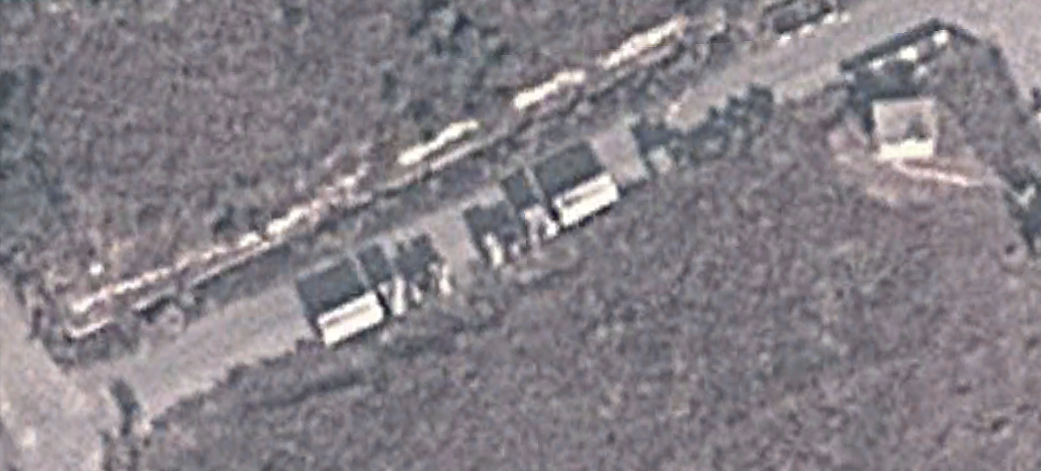
A satellite image from January 2014 seems to indicate that Pakistan’s National Defense Complex has finished fitting out of two additional Hatf-7 Babur cruise missile launchers, one of the few non-strategic nuke systems that Pakistan could deploy against an attacking Indian army.
The 350-kilometer-range Babur, which debuted in 2005, is Pakistan’s first land-attack cruise missile. There’s also an air-launched version. The more recent Nasr, a surface-to-surface missile system with a 60-kilometer range, first appeared in 2011.
Both platforms are highly mobile and sport technology that many analysts believe originated in China.
We don’t know how many of each system Pakistan’s NDC has produced, but continuing production underscores Islamabad’s intention to deploy nukes to counter India’s conventional forces.

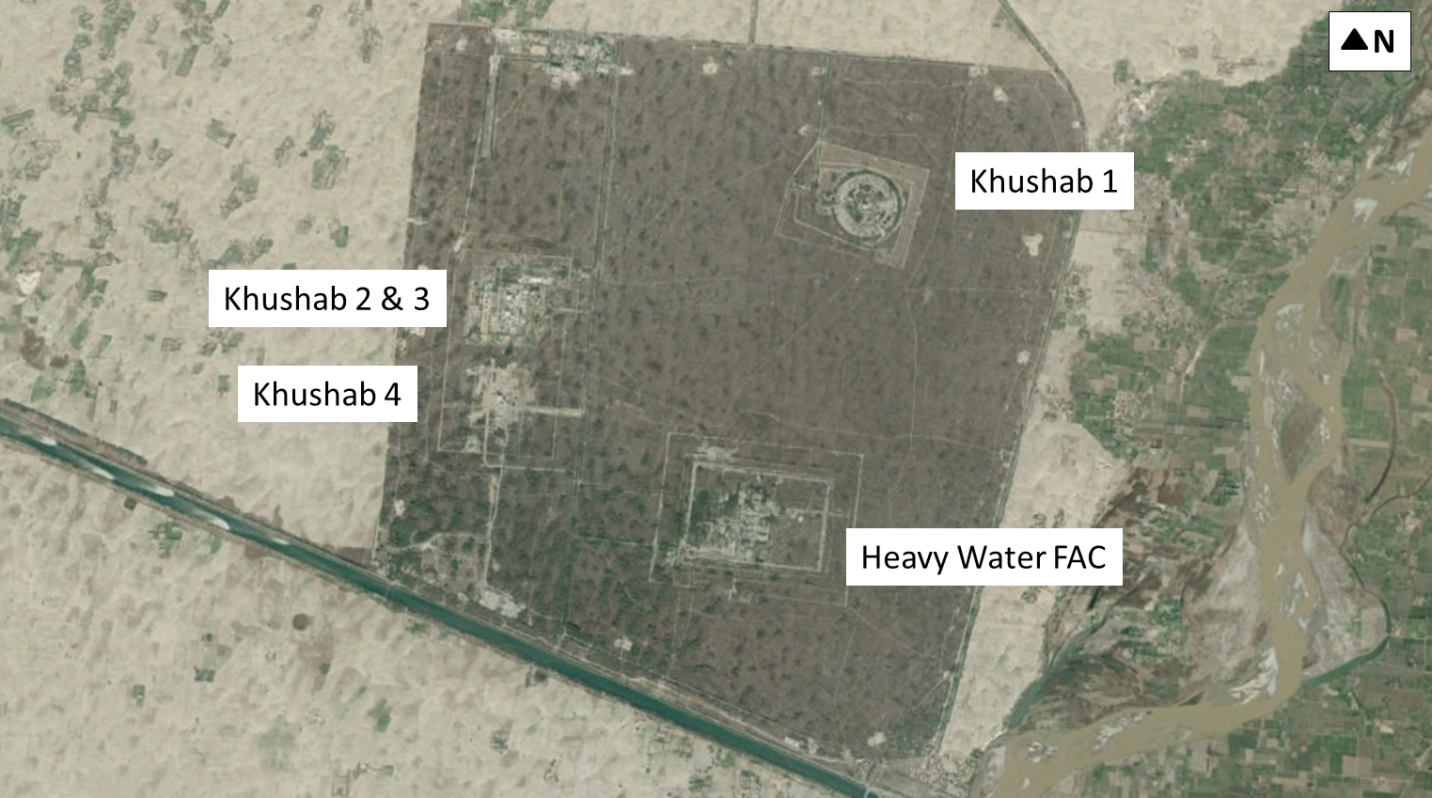
DigitalGlobe imagery from January 2014 shows Pakistan’s Khushab complex with Khushab 4 still under construction
Pakistan and India have been at odds since decolonization. The two countries clashed over Jammu and Kashmir in 1947, 1965 and 1999, over the creation of Bangladesh in 1971 and almost recently over the Indian parliament and Mumbai terrorist attacks in 2001 and 2008.
The tense relationship got tenser when both countries conducted nuclear weapons tests in 1998.
To be fair, the regional atomic arms race on the subcontinent is tiny compared to the USA and the USSR’s own race during the Cold War. There has been no South Asia equivalent of the Cuban missile crisis, no false alarms or computer glitches that could have led to massive retaliation on a catastrophic scale.
But that doesn’t mean we shouldn’t worry.

DigitalGlobe imagery from January 2014 shows two completed Hatf-7 and one possible Hatf-7 chassis parked in front of three high bay garages at Pakistan’s NDC
Pakistan, in particular, is a problem. Due to India’s overwhelming conventional forces, Pakistan increasingly sees nuclear weapons not as a strategic deterrent but as a means to help level the playing field — or so it says.
Parroting sentiments in the army, Pakistani politicians often cite the bomb as the ultimate guarantor of the nation’s security. Not surprising, Islamabad is boosting its fissile material production capacity and building more warheads in the process.
According to the International Panel on Fissile Nuclear Materials, those countries maintain approximately 225 and 300 warheads, respectively.
Satellite imagery from 2013 suggests that Pakistan has begun operating its third plutonium production reactor at Khushab. Imagery from 2014 shows further progress on a fourth reactor that’s still under construction.
Each of the three 50-megawatt reactors produces approximately 11.5 kilograms of weapons-grade plutonium, providing up to 35 kilograms per year. When the fourth comes online, possibly around 2016, Pakistan could be producing up to 46 kilograms a year.
And since the Khushab complex went operational in 1998, Pakistan has been shifting from highly enriched uranium to plutonium-based weapons. This is an important development if the country wants to create smaller and lighter warheads. A typical plutonium weapon requires four kilograms of Pu-239 to create a bomb, while HEU devices require 15 kilograms of U-235.
Using plutonium can mean a lighter device on a smaller and more mobile missile. More and more, Pakistan’s military planners believe they need these tactical nukes to balance India, which in April 2004 proposed a new military doctrine emphasizing rapid mobilization and offensive operations.
Pakistan’s potential tactical nukes could lower the barrier to a nuclear exchange. At least that’s what Indian officials believe.
“India will not be the first to use nuclear weapons, but if it is attacked with such weapons, it would engage in nuclear retaliation which will be massive and designed to inflict unacceptable damage on its adversary,” Shyam Saran, former Indian foreign secretary and the current chairman of India’s National Security Advisory Board, told an audience at Delhi’s Habitat Centre in April.
“The label on a nuclear weapon used for attacking India, strategic or tactical, is irrelevant from the Indian perspective,” Saran said.
“[A] limited nuclear war is a contradiction in terms,” he continued. “Any nuclear exchange, once initiated, would swiftly and inexorably escalate to the strategic level. Pakistan would be prudent not to assume otherwise as it sometimes appears to do, most recently by developing and perhaps deploying theater nuclear weapons.”
All that said, it’s unclear how close Pakistan is to actually deploying its tactical nukes. Likewise, India has only proposed its new offensive doctrine—it hasn’t implemented the plan. But that’s not to say tragic miscalculations couldn’t occur.
“Pakistani motivation is to dissuade India from contemplating conventional punitive retaliation to sub-conventional but highly destructive and disruptive cross-border terrorist strikes,” Saran said.
But it seems unlikely New Delhi will cave to the implicit threat. And what happens when India calls Pakistan’s atomic bluff? Assuming it is a bluff.

Friday, December 19, 2014

Administration Fails To Stop The Third Nuclear Horn (Daniel 8:8)

Analysis: Despite billions in aid, U.S. unable to get Pakistan to confront militants

pakistani-taliban-militants
WASHINGTON Fri Dec 19, 2014 5:12am IST

(Reuters) – Since 2001 the United States has tried virtually every strategy available to persuade Pakistan’s army to take the threat of militancy more seriously, but 12 years and $28 billion in aid later, all the American approaches are widely viewed as having failed.

First, the Bush administration heaped praise on former Pakistani President Pervez Musharraf, agreed to reimburse the Pakistani army for anti-Taliban military operations and launched drone strikes that killed al Qaeda leaders and militants wanted by the Pakistani government.

Adopting a more confrontational stance, the Obama administration unilaterally carried out the raid that killed Osama bin Laden, vastly increased aid to Pakistan’s weak civilian institutions and, at times, cut off aid to the Pakistani military.

Yet the militants continue to operate, ever more brazenly, as illustrated by Tuesday’s harrowing attack on a school in Peshawar, in which 132 students were killed by a faction of the Pakistan Taliban. And with the United States increasingly focused on other crises, Washington’s options for bringing about change in an increasingly unstable Pakistan are dwindling fast.

“There is great ‘Pakistan fatigue’ in Washington,” said Cameron Munter, who served as the American ambassador to Pakistan from 2010 to 2012. “Not only have the last dozen years been very difficult, but other challenges – from Syria to Ukraine to Iran, to name a few – demand our attention.”

Although Tuesday’s attack sparked widespread condemnation, current and former U.S. officials expressed cynicism that the bloodshed would cause Pakistan’s military to change its view of militants.

Munter and other officials said the United States has been unable to break a powerful, army-backed narrative in Pakistan that militant attacks are the result of America’s war on terror. Foreign powers, not Pakistan, are responsible for growing militancy in Pakistan, according to the narrative. And Pakistan is not responsible for the problem and unable to stop it.

That narrative played out immediately when Pakistan’s army chief, General Raheel Sharif, flew to Afghanistan within 24 hours of the attack to meet Afghan leaders. They said they had information that the school attack was directed by militants hiding inside Afghanistan.

“We are hoping that we will see strong action from the Afghan side in the coming days,” said Pakistani army spokesman Major General Asim Saleem Bajwa.

One senior American official said he hoped the trip was not “communications Kabuki” designed to divert blame for the failure to stop the attack away from the Pakistani army. Analysts said the army is failing to live up to its decades-long history of training, funding and sheltering some militant groups and using them as proxies to counter archrival India in Afghanistan and Kashmir.

Since 2001 a parade of American officials – from presidents to CIA directors – have repeatedly warned Pakistan’s generals that they will lose control of their militant proxies and eventually be attacked by them. Pakistani military officials have denied sheltering militants.

CHINESE PRESSURE?

But some current and former U.S. officials said the sheer brutality of this week’s attack would intensify demands from Pakistan’s public for the army to confront militancy. James Dobbins, who served as the Obama Administration’s Special Representative to Afghanistan and Pakistan from 2013 to 2014, said there was also growing pressure from Pakistan’s longtime ally China.

“I think they are pressing Pakistan to take this threat more seriously,” he said.

Munter, the former ambassador, argued that the problem reflects a more fundamental question of whether militants have become so entrenched that the Pakistani army cannot defeat them.

The senior administration official was more optimistic, contending that even before the school attack, the Pakistani public was raising pressure on the army to act. The ongoing military operation in North Waziristan that militants said prompted the school attack was evidence of change.

“There has been a growing sense in Pakistan that this is an issue that they need to deal with,” said the senior official, who asked not to be identified by name.

But Shamila Chaudhary, who served as senior director for Pakistan and Afghanistan on the National Security Council from 2010 to 2011, warned that as U.S. attention has shifted elsewhere, the steady deterioration of Pakistan’s institutions, security forces and economy has continued.

For years, Chaudhary said, she dismissed alarmist warnings from other U.S. experts on Pakistan that the country’s nuclear arsenal was unsafe. The inability of Pakistan’s security forces to protect a military-run school, she said, has given her doubts regarding Pakistan’s atomic arsenal for the first time.

“I will have a hard time saying to people that militants can never steal Pakistan’s nuclear weapons,” she said. “The more these things happen, that rate of risk goes ahead, and I just think, well, it could happen one day.”

(Editing by Jason Szep and Douglas Royalty)

Friday, December 5, 2014

The Pakistani Nuclear Threat: The Third Horn (Daniel 8:8)


Adnan R. Khan
Premium content image
Pakistan India Nukes
Last week was supposed to offer a noteworthy moment in the history of nuclear disarmament. Iranian negotiators met in Vienna with leaders from the United States, Russia, France, China, the U.K. and Germany, and got down to the tricky business of finding a way out of a growing nuclear standoff. It was touted as the most promising opportunity in years to reach a deal that would, once and for all, put the brakes on what many fear are Iran’s secret plans to build a nuclear bomb.

That deal, however, never materialized. When the talks ended on Nov. 24, the best U.S. Secretary of State John Kerry could offer was some promising rhetoric: “Today, we are closer to a deal that would make the entire world . . . safer and more secure,” he said.

But while the world’s major powers fretted over Iran’s “breakout” potential—the time it would take to produce enough fissile material to build one nuclear device—a report by the Council on Foreign Relations, timed to come out during the Vienna talks, warned that other countries have not only broken out, but appear to be running wild. This is the reality of the “second nuclear age,” the report stated. Even as the traditional nuclear powers reduce their stockpiles, emergent states in Asia—Pakistan and India, in particular, but also North Korea and China—are becoming increasingly tangled in a new arms race, one that is much more complex and difficult to control than what the world witnessed in the second half of the 20th century.

According to the report, Pakistan currently has the world’s fastest-growing nuclear arsenal, with enough fissile material to build 120 bombs and the potential to build at least 80 more by 2020. India has the ability to build 110 nuclear devices, but is also reported to have ramped up its production capacity.

Iran, according to the report, is only one piece in an increasingly complex nuclear puzzle. There is reason to be concerned about its nuclear program, of course. A brooding Middle Eastern Cold War pitting Shia-led Iran against Sunni Saudi Arabia poses some serious international security threats. If Iran does “break out,” the experts say, the Saudis will be sure to follow, igniting another nuclear arms race in what is the most unstable region in the world. (Pakistan’s nuclear program, reportedly, owes its success to Saudi funding.)

More worrying for the near term, however, is the existing arms race. While Indian and Pakistani arsenals are paltry compared to the word’s nuclear powerhouses (Russia and the United States have thousands of strategic warheads deployed), the threat they pose to global security is more dire, considering the geopolitical challenges of the region. The potential for nuclear conflict between India and Pakistan has hovered over the world since 1998, when Pakistan first entered the nuclear club. The two rivals have fought three conventional wars since 1947 and have come dangerously close to a fourth.

Over the past 15 years, the environment has shifted dramatically. Pakistan’s struggle with Islamist extremism and its consequences for India, including a devastating 2008 shooting rampage in Mumbai, are redefining the military landscape. India has moved away from its defensive posture and embraced a more “proactive strategy,” says Walter Ladwig, assistant professor in the department of war studies at King’s College London. “Their new military doctrine, originally called Cold Start, has been evolving since 2003,” he says. “It remains the foundation of India’s military procurement, including modernizing its conventional capabilities to allow for a more mobile and offensive response against Pakistan in the event of another attack inside India.”

Pakistan, concerned by the fact that it cannot compete in conventional military terms against a much richer India, has responded by developing its nuclear capability to include tactical warheads, giving it the ability to strike back with precision nuclear weapons targeting advancing Indian troops, without resorting to all-out nuclear war. “India’s strategy has created a lot of consternation in Pakistan,” says Ladwig, who has written extensively on the evolution of India’s military. “The U.S. has put pressure on India to back away from the Cold Start strategy.”

While Indian authorities have disavowed the Cold Start name, the strategy itself remains intact, Ladwig adds, but will take many years to reach operational levels. The Indian army, he says, is still too outdated to achieve the desired goals of a Cold Start offensive at the moment, but, 10 or 15 years down the road, things could change dramatically.

If that happens, which appears likely, considering India’s current rate of weapons procurement, it would push the nuclear Armageddon clock forward significantly, warn experts such as Ladwig and the authors of the Council on Foreign Relations report. The chain of events that could lead to a nuclear confrontation are relatively straightforward: In the event of a large-scale terrorist attack in India blamed on Pakistan-based militants, Indian authorities would demand action (as they did following the Mumbai attack). Pakistan would almost certainly deny involvement. Under Cold Start, India would (unlike after Mumbai) launch a military strike inside Pakistan. The goal would be to disorient the Pakistanis and, before they could recover, control a buffer zone inside Pakistan 10 to 15 km wide—providing it a strong position for any negotiations.

But, as Ladwig points out, “an operational Cold Start capability could lead Pakistan to lower its nuclear red line, put its nuclear weapons on a higher state of readiness, develop tactical nuclear weapons or undertake some equally destabilizing course of action.” For Pakistani generals, Cold Start might not look like a limited operation, but rather a prelude to a wider invasion or a tactic to subjugate Pakistan to India’s will. Neither side would want to use its nuclear weapons, but the trigger could be as simple as an overzealous Pakistani artillery commander armed with a tactical nuke, or a miscommunication on the Indian side.

For the time being, the potential for that scenario to play out remains low, says retired colonel Baseer Malik, a military analyst in Islamabad. “India knows it outmatches Pakistan in conventional terms,” he says. “But, in terms of nuclear, it is a different story. India would not be so short-sighted as to provoke Pakistan in this way. They know how quickly things could escalate.”

The threat of escalation now has as much to do with advances in conventional weapons as it does with nuclear imbalances. “Strategic stability is no longer just a product of the interaction between comparable nuclear forces,” the Council on Foreign Relations report says, “but, increasingly, between nuclear forces and non-nuclear technologies, such as missile defences, anti-satellite weapons, conventional precision-strike weapons, and cyberweapons.”

Thankfully, the worst-case scenario for India and Pakistan is not likely to play out any time soon. India’s modernization of its conventional arsenal is still in its infancy, says Ladwig. But as long as it aggressively pursues advanced weaponry, Pakistan will feel threatened and respond with the expansion of its nuclear option. With no end in sight to the animosity between the two countries, the end result can only be bad.

Sunday, November 23, 2014

India Preparing For Pakistani Biologic Terrorism

ISI ragging “Disease Warfare”

ISIS-planning-an-Ebola-terror-attack
New Delhi Times

India-Pakistan rivalry has existed ever since Pakistan was created out of the larger land form in 1947. The countries have faced each other in battlefield over years deepening the rivalry and hatred, the aim of Pakistan to win the race against India in developing nuclear weapons has led to lack of development of the country as all funds are focused on planning and plotting terrorism and terrorist activities in the rival nation.

It is not easy for any country to stand the embarrassment of losing the battlefield against the enemy over and over again. To avenge the vengeance, Pakistan is creating more weapons of destruction. The arms race is no more limited to the battlefield. Pakistan has been involved in sending Taliban militants in India to spread terrorist activities in the country. Allegedly, 26/11 was one such operation that was incorporated by the ISI agents of Pakistan was confirmed by the lone surviving terrorist Ajmal Kasab of the incidence.

Pakistan’s nuclear weapons program is driven by its need to counter India’s superiority in conventional forces. As a matter of fact, Pakistan has never conducted missile tests only to confirm its success. It is known to both the countries that the race of dominance has increased to a level that Pakistan has been involved in taking steps beyond army’s mode of conduct, infiltrating jihadis in India through Jammu and Kashmir, Rajasthan and through other parts of the country aiming to cause maximum destruction on the land.

The rage of vengeance of Pakistan has now not been limited to development of artillery and continuing terrorist activities. According to some confident EU think tank reports attained exclusively by New Delhi Times affirm that Pakistan is on the verge of waging disease terrorism in India. The reports specially describe the role of ISI Major Rahim Khan in inducing disease-terrorism activities in India. As per records Major Rahim Khan on 10th October 2014 issued standing orders to find Ebola patients and send them to India. Ebola outbreak that has claimed nearly three thousand lives in West Africa and has shown the potential of travelling miles in infected patients has increased the possibility of claiming all the more life across the globe. Of the three regimes of weapons of mass destruction- nuclear, chemical and biological, it is the last one that is most potent, accessible and the weakest regime in the global efforts to prohibit and prevent.

Pakistan has a past record of being a major contributor of chaotic situations in India, killing lives to claim it’s superiority and take on it’s rival nation; the orders of Rahim Khan would not be something that would surprise Indian authorities. Small-scale ‘disease terrorism’ option would be to recruit individuals for Ebola suicide missions, such a plan would hinge on injecting Ebola virus into a limited number of people. In the wake of the Ebola outbreak, the potential disease terrorism has emerged with a convenient retribution.

In the past, there have been only two known cases of disease terrorism which have been extensively researched and analyzed. Since terrorist groups often strike without warning, it is difficult to know when and where a terrorist organization might strike after taking inspiration from the previous cases and the incidents relating to anthrax as being used as disease terrorism weapon.

CIA director George Tenet on 2nd February, 1999 said to have made a statement that Bin Laden, was trying to acquire chemical, biological and nuclear weapons. His operatives were trained to conduct such attacks with toxic chemicals or biological toxins and there are indications he is seeking to obtain chemical, biological and radiological or nuclear weapons. The ISI had established well fortified facilities in Kandahar in Afghanistan for production of chemical, bacteriological and radiological weapon too. This set-up was established in May 1998 with the acquisition of plant and machinery from Yugoslavia. This plant arrived via Pakistan with assistance of ISI. It is hence a proven fact that Pakistan has been involved in incubating terrorism and contributing to weapons of mass destruction from past.

The Indian authorities need to be more vigilant over prospect of such deal of terror that would spread fast and claim many lives. India has set up a group of experts to formulate a plan to counter the threat of biological terrorism. India has maintained its sanctity of keeping peace and has followed the legacy of not attacking or inflicting attacks on Pakistan. On the other hand Pakistan has played a vital role not just in spreading terrorism in India but all over the world. India has always been Pakistan’s priority rival so it would test its first mission of spreading disease terrorism in India. India needs to be well prepared and should pay attention to waft away the plans of Pakistan.

Russian Horn Loving Pakistani Nuclear Horn

‘From Russia, with Love': Policy reset begins now

indian-nuclear-missiles

Pakistan and Russia signed a “milestone” military co-operation pact on Thursday aimed at bringing peace and stability to the region, Islamabad’s defence ministry said. The agreement was signed during a visit by Russian Defence Minister General Sergei Shoygu with defence minister Khawaja Asif.
“The signing of the military co-operation agreement between the two significant countries of the region is a milestone,” Asif said after the signing ceremony in a ministry statement. “Both sides will translate this relationship in tangible terms and further strengthen military to military relations,” Asif added.

The pair expressed hope that the agreement will pave the way for exchange of views and information, as well as issues related to strengthening of mutual trust and international security, counter-terrorist and arms control activities. “The first ever visit of the defence minister from Russian Federation has come at a very critical juncture when US-led Nato forces are drawing down from Afghanistan by the end of 2014,” the statement said. “Apart from promoting bilateral defence relations, the visit will enable both countries to join hands in bringing peace and stability in the region,” it added.

Russia has long been the largest supplier of arms to Pakistan’s nuclear-armed arch rival India, which is the world’s top arms buyer. Russia’s ITAR-TASS news agency reported in June that the country had lifted its embargo on arms supplies to Pakistan and was holding talks on supplying Islamabad with combat helicopters. Shoigu, who is accompanied by a 41-member high level delegation, commended the skill and expertise of Pakistani armed forces in fighting the war against terrorism, the Pakistani defence ministry said. “The world community not only praises but wants to do business with Pakistan now,” it quoted Shoigu as saying.

During his stay, the Russian defence minister will also hold in-depth talks with Pakistani authorities as well as meeting Prime Minister Nawaz Sharif. “The Prime Minister stressed upon the need to increase bilateral trade between the two countries which currently stands at $542 million and does not correspond to their trade potential,” the prime minister’s office said in a statement after Shoigu-Sharif meeting. Sharif invited Russian companies to invest in Pakistan, particularly in the energy sector and benefit from the business-friendly policies of the government, it added. “Pakistan is keen to enhance its multi-dimensional relations with Moscow, including defence,” Sharif said.

Friday, November 21, 2014

The Iraqi And Pakistani Nuclear Horns Align (Daniel 8:8)

The World Must Prevent ISIS from Obtaining Pakistani Nukes

Pak-nuke
By Ahmad Hasib Farhan – Thu Nov 20 2014, 7:03 pm

The Islamic State of Iraq and Syria (ISIS) or Daesh, the most extreme among all the terrorist groups, has arrived in Pakistan.

The Pakistani media reported recently that a group of 10 commanders from ISIS are currently in Baluchistan to seek allegiance of Tehrik-i-Taliban Pakistan (TTP) and the Baloch freedom movement. This happened just a few weeks after a group of TTP under Maulana Fazlullah, voiced support for the terror group and swore allegiance to ISIS leader Abu Bakr al-Baghdadi.

However, it was not only Maulana Fazlullah who teamed up with ISIS, another local group called Jamaatul Ahrar, also declared its support for ISIS. Jamaatul Ahrar’s leader, Ehsanullah Ehsan, was quoted by Reuters as saying: “We respect them. If they ask us for help, we will look into it and decide.” According to the Daily Mail, the spokesperson of TTP and six senior figures have declared loyalty to ISIS.

The presence of ISIS was also confirmed by the Pakistani government. A Pakistani security official was quoted by Pakistani media as saying: “We came across them 22 days ago and we are aware of their presence here… Pakistani security agencies are working on the Pakistan-Afghan border and have arrested a number of Taliban fighters and recovered CDs, maps, literature in Persian, Pashto and Dari. We will not permit them to work in our country and anyone who is involved in this will be crushed by the government.”

Why ISIS chose Pakistan?

The presence of ISIS in Pakistan and allegiance of TTP groups is truly a disturbing news and is likely to have serious consequences for a country that is already in turmoil due to incompetent governance, economic crises and political tension. However, this is not the sole reason behind ISIS desire to start operations in Pakistan. There are multiple encouraging points that brought ISIS to the country that is already in turmoil.
Will ISIS get hold of Pakistan’s nuclear weapons?

The global leaders certainly understand that the extreme threat to global security is the risk that terrorists could get a hold of nuclear weapons and start new terrorism. Although world leaders especially Americans hold several international conferences on addressing this immediate and extreme threat, there is no guarantee that terrorist organization such as ISIS won’t acquire nuclear weapons. Al-Qaeda struggled for several years to obtain nuclear and chemical weapons but they failed. However, ISIS is much stronger than Al-Qaeda and was able to hold some sort of chemical weapons in Iraq which they used against the Kurds.

In the 16 years since Pakistan emerged as an active nuclear weapons state in 1998, there has been no reliable report of a terrorist seizure of nuclear weapons in Pakistan. Nevertheless, the risk that terrorists could acquire new weapons in Pakistan cannot be ignored.

Among all the new clear stats Pakistan is the only country that leaked and transferred nuclear technology to the countries that are still under UN and US sanctions. It is also the only nuclear state that shelters and protect terrorist organizations such as Al-Qaeda, the Taliban, Haqani Network and many others. The Pakistani nuclear scientist Abdul Qadeer Khan, leaked nuclear secrets to North Korea, Libya and Iran.

Abdul Qadeer Khan not only accepted the full responsibility for transferring sensitive technology to mentioned stats but he also revealed in 2004, that the former military ruler, General Pervez Musharraf was involved neck-deep in nuclear proliferation. However, after that incident Pakistan enhanced protection of its nuclear weapons, but still ISIS will strive for acquiring nuclear weapons in Pakistan. This means even if ISIS don’t fight for it, there are elements in Pakistan that may sell either nuclear technology or nuclear weapons to ISIS.

How to protect the world from nuclear terrorism in Pakistan?

If ISIS obtains nuclear weapons in Pakistan a new chapter of terrorism will emerge, and ISIS will turn into an invincible force. This time the world will have to deal with nuclear terrorism in Pakistan which will be fueled by drug money from Afghanistan and oil money from Iraq. It will certainly have severe consequence not only for Pakistan but for the region and international community.

It is important for world leaders to secure Pakistan’s nuclear weapons and make sure ISIS never gets hold of them. This bears considerable weight on the United States because America is a pioneer of the nuclear technology, and a close ally of Pakistan. Moreover, the US is a prime target of terrorism from Al-Qaeda and ISIS.

There are only two options that will work to make sure ISIS and other terrorist organizations do not obtain Pakistani nuclear weapons. First, the US takes control of Pakistan’s nukes and disarms Pakistan. In return, Washington can provide security guarantees to Pakistan similar to how it did with South Korea.

The second option is to help Pakistan increase protection of its nuclear arsenal. Although it will incur a high cost for such an action, it can’t be more than the cost of combating nuclear terrorism. However, the first option seems more feasible than the second option.

Ahmad Hasib Farhan is a graduate of Kabul University and holds a Master degree from Japan in Public Policy and Economics. Farhan is an Afghan analyst and commentator on political and socioeconomic affairs in Afghanistan. Farhan can be reached at haseebnadiri@gmail.com.
This article was first published on http://www.sharnoffsglobalviews.com/

Wednesday, November 5, 2014

Pakistan’s Nuclear Terrorist Threats

India warns of nuclear terrorism threats; Pakistan reacts

Pakistani+terrorism

United Nations, Nov 4 (IANS): Warning that nuclear terrorism threats were a pressing challenge to the global community, India has called for stronger national and international action to prevent terrorists getting hold of nuclear material.

“The threat of nuclear terrorism is one of the pressing challenges facing the international community,” Abhishek Singh, a first secretary in India’s UN Mission, told the UN General Assembly (UNGA) Monday.

“Responsible national action and effective international cooperation are therefore required for strengthening nuclear security to prevent vulnerable nuclear material falling into hands of non-state actors.”

A vital amendment to an international convention on protecting nuclear materials coming into force would strengthen global efforts for nuclear safety, Singh said.
The amendment introduced in 2005 to the Convention on the Physical Protection of Nuclear Materials (CPPNM) would make it legally binding on nations to protect nuclear facilities and material while being used, stored or transported. It would also expand international cooperation to recover stolen or smuggled nuclear material.

The amendment, which requires the acceptance of two-thirds of the 151 nations that are parties to the convention, has been has been languishing with approvals by only 81 countries.

Singh asked the International Atomic Energy (IAEA) “to continue its efforts to promote early entry into force of the amendment.”

Participating in the NGA discussion on the IAEA, Pakistan, which has not yet accepted the amendment, sought to give assurances about safeguarding its nuclear facilities and materials.

Khalil Hashmi, a minister in Pakistan’s UN Mission, said, it has “deployed radiation detection mechanisms at several exit and entry points to prevent illicit trafficking of radioactive and nuclear materials.”

“Pakistan attaches highest importance to nuclear security because it is directly linked to our national security,” he asserted listing what he said were the “five pillars” of Islamabad’s nuclear security:

“A strong command and control system led by the National Command Authority; an integrated intelligence system; a rigorous regulatory regime; comprehensive export control regime and active international cooperation.”

These appeared to be aimed at assuaging the main international fears about Pakistan’s nuclear program and arsenal. Abdul Qadeer Khan, it’s top atomic scientist, ran a network that provided nuclear technology to Iran and North Korea. And, on the security front, at least three cases of terrorists attacking nuclear weapons-related facilities in Pakistan have been documented. Harvard University’s Belford Center said in a 2010 report, Pakistan “faces a greater threat from Islamic extremists seeking nuclear weapons than any other nuclear stockpile on earth”.

Monday, November 3, 2014

ISIS Coming To Pakistan

Islamic State Coming to Pakistan

ISIS-terrorists

In Pakistan, support for the Islamic State is growing more visible. Elements of the Taliban, which all but controls small areas of the country, are openly giving a nod to their ideological kinship with the terrorist organization that has cut a path of destruction across large areas of Iraq and Syria. A spokesman for the Pakistan Taliban, Shahidullah Shahid, recently stated “I pledge allegiance to the Caliph of Muslims, [ISIS leader] Abu Bakr al-Baghdadi.” The statement highlights a measure of internal strife, however; Shahid, it has been reported, was not speaking for the Taliban as a whole and the organization had apparently disowned him, following the remarks. An unnamed Taliban commander told Reuters “He used our name and tried to make it big news in the media.” As military operations against the Taliban in Pakistan continue to weaken the organization, there are growing fears that it could be vulnerable to a takeover by ISIS.

The swift gains made by the Islamic State in both Syria and Iraq – and the rapid swelling of its ranks – caught western nations off guard. Afghanistan, a barely functioning state, and Pakistan, are both vulnerable to the spreading influence of ISIS. Speaking to the AFP news agency, security analyst Amir Rana said “ISIS is becoming the major inspiration force for both violent and non-violent religious groups in the region.”

Pro-ISIS propaganda leaflets have surfaced in the northwest of Pakistan and slogans supporting the Islamic State have been spray-painted on walls even in Karachi. Taliban leaders both in Pakistan and in neighboring Afghanistan have signaled their support for the Islamic State, although they appear to have broken ranks in order to do so. A loose federation of radical Islamist organizations in Pakistan, known as the Tehreek-e-Taliban Pakistan (TTP), has sent large numbers of fighters to Syria and it is feared that those who return may spread the Islamic State’s message and provide inspiration for further radicalization. According to Dr Hasan Askari Rizvi, a political analyst writing in The Express Tribune, some radical factions in Pakistan have even taken to using the name ‘Islamic State Movement.’

In Afghanistan, the black flag adopted by the Islamic State was raised recently in the Ghazni province as fighters identified with ISIS joined a Taliban offensive against several villages.

Although authorities in Pakistan have struck an optimistic note on operations against the Taliban and other radical groups, the country’s United Nations Ambassador sounded the alarm in an address to the UN Security Council on October 21. “We must all, collectively, oppose and defeat its evil ideology of ‘hate, murder and destroy’,” said Masood Khan. “We must remain united in our fight against this new face of terrorism and violent extremism.” Other Pakistani officials, however, believe that the Taliban’s attempt to create a ‘merger’ with ISIS is little more than an attempt to remain relevant, as Pakistan’s security forces continue to weaken Taliban control in the tribal northwest.

Pakistan has an arsenal of nuclear weapons, making it a potentially tempting target for the Islamic State. Whether the Taliban would welcome the presence of ISIS or resist it continues to be a subject for speculation.

Saturday, October 18, 2014

India Capable Of Hitting Pakistani Horn With Nukes

India Successfully Test-Fires Nuclear Capable Cruise Missile Nirbhaynirbhay_missile_testfired_650


Integrated Missile Test Range, Balasore, Odisha:  India today successfully test-fired its potent nuclear-capable cruise missile ‘Nirbhay’, a state-of-the-art missile developed by the Defence Research and Development Organisation (DRDO).

The test was conducted from the Integrated Missile Test Range in Chandipur, Odisha, days after Cyclone Hudhud hit the state’s coastal region. (10 must-know facts about Nirbhay)

Nirbhay (which means fearless) is very manoeuvrable and can fly at tree-top level, making it difficult to detect on radar, and strikes targets more than 700 km away carrying nuclear warheads, giving India the capability to strike deep into enemy territory.

Very soon when India’s own satellite navigation fleet is fully deployed, cruise missiles will start using signals from the country’s space system.

Unlike other ballistic missiles like the Agni, Nirbhay has a wing and pronounced tail fins. It launches like a missile and in early flight the small wings get deployed. It then flies like an aircraft and can even hover near the target, striking at will from any direction.

On its first flight on March 12, last year, Nirbhay had to be terminated, as it deviated from its course about 20 minutes after launch. As the missile went off its flight trajectory, its engine was cut off to bring it down to ensure coastal safety. It fell near the coast; the DRDO said no one was injured.

The Nirbhay is a sub-sonic cruise missile and gives India the capacity to launch different kinds of payloads at different ranges from various platforms at a very low cost. The missile has a fire-and-forget system that cannot be jammed.

India has had the capability to make ballistic missiles for some time now and has made tactical missiles of different capacity. But it had not mastered a cruise missile yet.

The US had used cruise missiles very effectively during the Gulf War.

The Nirbhay is India’s answer to America’s Tomahawk and Pakistan’s Babur.

Wednesday, October 15, 2014

India Ups The Ante Against the Pakistani Nuclear Horn

Nuclear-capable missile to be tested on October 17

Nirbhay-Cruise-Missile-DRDO
Hindustan Times
 
Rahul Singh
 
India will test-fire the nuclear-capable Nirbhay cruise missile from the integrated test range at Balasore in Odisha on October 17, the second launch of the indigenous weapon developed by the Defence Research and Development Organisation (DRDO).All eyes will be on the upcoming launch as the Nirbhay’s much-hyped maiden launch last March had failed to hit the pre-designated target in the Bay of Bengal. When ready, the missile will be able to deliver nuclear warheads at ranges of up to 1,000 km.
The DRDO had to terminate the Nirbhay flight mid-way in March 2013 after the long-range missile deviated from its intended course, leading to some delays in the programme. A senior DRDO official said glitches in the missile’s inertial navigation system had been ironed out.

“The first test was a partial success as several mission objectives were met. The upcoming test is crucial as we have to demonstrate the capability of the missile,” he added. It will require a few more successful tests before being declared ready for induction.

Low-flying cruise missiles such as the Nirbhay can easily slip past enemy air-defence systems due to small radar cross section. The Nirbhay will be configured to be launched from multiple platforms such as land, air and sea.

Tuesday, October 14, 2014

Loose Nukes In The Pakistani Military

Counter-Terrorism: Loose Nukes In Pakistan

Nuclear Terrorism
Strategy Page
 
October 13, 2014: Pakistan is being accused by many Pakistanis of trying to cover up the participation of navy personnel in a recent al Qaeda attempt to hijack a frigate. This all began on September 6 when ten members of the new AQIS (Al Qaeda in the Indian Subcontinent) attacked a Karachi naval base and were repulsed after a six hour gun battle. Three attackers were killed and seven arrested. One of the defenders was killed. The attackers came via small boats and at first were believed to have bribed some of the naval security personnel to assist them in getting on board the Pakistani frigate docked there. The gun battle on the ship did minimal damage (mostly bullet holes). Interrogation of those arrested led to raids that seized weapons, ammo and explosives as well as documents. It was also eventually found that some of the attackers thought they were going after an American warship tied up at dockside in the base. But that was a Pakistani frigate and there were no American warships in the base. ISIL responded by mocking al Qaeda for being inept and getting ten Moslems killed or captured because of a stupid mistake. ISIL, it turned out, was misinformed.

Further investigation found that three of the attackers, including one of those killed, were junior naval officers. Actually one was a former naval officer, having been dismissed from the navy in May for his outspoken support of Islamic terrorism. That man, Owais Jakhrani, was killed. He was also the son of a senior police commander in Karachi and had recruited two of the other attackers who were junior officers still on duty. The plan was apparently to hijack the frigate and use it to attack an American warship currently off the coast. Taking a frigate out to sea requires more than four people, even if all four are trained sailors. So the question is; who else was in on this plot and how many of them were sailors at the naval base? If the investigators have found out anything they have not gone public and the famously paranoid Pakistani media is speculating about Islamic terrorist networks within the navy.

Some speculation blames the United States and the CIA, or Israel, or Britain. That’s normal, but the September 6 attack on the frigate was real as was the participation of three navy officers. At least eight additional naval personnel have been arrested, apparently because they had been in touch with the three Islamic terrorist naval officers. It is also known that three higher ranking naval officers (lieutenant commanders) were arrested two days later as they attempted to flee the country.

Military officials complain, off the record, that the military has no procedure to keep track of military personnel who are dismissed for Islamic terrorist activity or sympathies and some of these men are increasingly being caught, often when their bodies are identified, participating in Islamic terrorist attacks. All this is worrisome for many Westerners, and a growing number of Pakistanis and Indians because the Pakistani military has control of Pakistani nuclear weapons. The Pakistani government always insisted that its nukes were well guarded, but after this latest incident there are more doubts.

Saturday, June 14, 2014

Nuclear Terrorism Will Happen … Guaranteed (Rev 15)


The brutal recent attack by the Taliban on Pakistan’s largest airport raises major questions about security. It also exposes Pakistan’s impotence in the task of routing the Taliban — and its failure to even develop a strategy for doing so.

Worse is the possibility that Islamabad might be unable to protect its nuclear assets in the future.

Pakistan’s civilian and military leadership have long been incapable of deciding if they should launch full-fledged operations against the Taliban. It is unclear if even the recent attacks will lead to the emergence of a needed coherent policy and civilian-military consensus in the country.


Reports indicate weapons used in the attack were imported from India, fueling more distrust within Pakistan for its eastern neighbor.

But Pakistan has to get serious about defeating the militants, especially as the American war effort winds down next door in Afghanistan. Otherwise, the risks increase that the Taliban may regroup on the Afghan border, further destabilizing the region.

Friday, June 6, 2014

Pakistani Nuclear Officers Assassinated

Two Linked to Pakistan nuclear program killed in attack

First Iran, Now Pakistan
Agencia EFE June 4, 2014 6:21pm

Islamabad, Jun 4 (EFE).- A suicide attacker killed two military officers linked to Pakistan’s nuclear program, along with three civilians, near the Kamra air base, not far from this capital, police told Efe.
The incident occurred in the Fateh Jang area about 10 a.m. when a vehicle belonging to the Pakistan Atomic Energy Commission was boarded by the suicide bomber, who was on foot, after which he detonated the explosives attached to his body.

The attacker took advantage of the moment when the vehicle slowed down briefly to jump on board, according to police officer Mohammed Altaf, who said that a guard and the driver of the vehicle were wounded.

Military spokesman Abid Askari told Efe that both men who were killed held the rank of lieutenant colonel, but he did not mention the fact that they were working in the nuclear program and placed the attack in the nearby city of Rawalpindi.

Police said that the vehicle had come from one of the country’s air bases, which analysts and international media said is part of Pakistan’s nuclear program.

The installation, where dozens of the best aircraft in the air force are based, two years ago was the target of a Taliban attack in which a guard and eight insurgents died.

The Fateh Jang attack is the second one to be staged on Wednesday against the armed forces after an insurgent assault on two posts in northwestern Pakistan, near the border with Afghanistan, in which two soldiers died and three others were wounded.

Friday, May 30, 2014

Thank You Dr. Khan

Dr AQ Khan unfurls saga of atomic bomb
Khan: Father of the Islamic Nuclear Bomb
 Zubair Qureshi

Thursday, May 29, 2014 – Islamabad—Pakistani nuclear scientists were ready to conduct nuclear tests even back in 1984. What they waited for was a go ahead signal by the then government led by Gen Zia-ul-Haq President and Chief of the Army Staff. However, the historic moment came fourteen years later in 1998 when Pakistan was compelled to conduct nuclear tests on May 28 as a prompt reply to India’s 11 May tests.

This was revealed by the Father of Pakistan’s Nuclear Programme Dr AQ Khan at a ceremony titled “Atom Bomb ki Kahani——Dr AQ Khan ki Zubani” marking Youm-e-Takbeer at Aiwan-e-Quaid here on Wednesday. Nazriya Pakistan Council (NPC) had arranged the function.

NPC Chairman and Editor-in-Chief of Pakistan Observer Zahid Malik presided over the function.
Dr AQ Khan who had the distinguished honour to lead the Pakistan nuclear Programme from its inception to the successful conduct of nuclear tests, shared with the audience some fond memories of the days when he had to start from scratch.

Dr AQ Khan said he was in Europe in 1971 working on a project that was monitored jointly by the nuclear scientists of Holland, Germany and the UK and being a nuclear project it had been declared a top secret. He was in Europe when he learned the disturbing news of separation of East Pakistan from the Western wing. This was a deep shock for the patriotic Dr AQ Khan. A few years later, India tested first nuclear explosion in March 1974. Dr Khan who was already disturbed about the future of his country that had been deprived of its eastern part due to the conspiracies of a clever and hostile neighbour, at once decided to come into action. The enemy had gone nuclear and Pakistan’s redemption too lay in acquiring nuclear capability.

Dr AQ Khan went on to tell the jam-packed hall of the Aiwan-e-Quaid the story of atomic bomb. In December 1974, a meeting was arranged between the young AQ Khan and the then Prime Minister Zulfikar Ali Bhutto. Dr Khan gave him a number of proposals and having done so, he returned to Holland. Again in December 1975, he returned to his homeland and after spending a month or so in Pakistan when he was preparing to return, ZAB asked him to stay in Pakistan and work on its nuclear programme. According to Dr Khan, it was indeed a test for him as quitting a lucrative job, a peaceful and prosperous life was not easy. However, his wife turned out to be a source of strength for him and asked him to stay in Pakistan if his country needed him. Dr AQ Khan paid tributes to ZA Bhutto who initiated the nuclear programme of the country. However, it was not Bhutto alone as all the successive rulers approved the programme and gave their full support, said Dr AQ Khan.

Dr Khan was allotted a land in Kahuta to set up laboratories there. Then he searched for competent patriotic Pakistani scientists from across the world and in this way a team of dedicated scientists came into being.

“I can still remember we worked for 20 hours a day for weeks and months,” shared Dr Khan with the audience. Gen Zia once on a visit to Kahuta laboratories was so much impressed that in the visitors’ book he wrote “These laboratories should be titled as Khan Research Laboratories instead of Kahuta Research Laboratories,” said Dr AQ Khan while turning another page of history.

However, Dr Khan regretted that the present government that claims the credit for the nuclear tests has not for once remembered scientists who realized the dream of making Pakistan a nuclear power. “I don’t need any credit as people’s love is more than any worldly wealth, name or fame,” he said. Dr Khan was given standing ovation for these remarks and youth especially students of various schools of Haripur and Hazara who had come all the way to attend the function vigorously cheered the ageing father of Pakistan’s nuclear programme. He shrugged the rumours about security and safety of Pakistan’s nuclear programme. “Our nuclear programme is in safe hands,” he said. Dr Khan said if one wanted to know the complete story of Pakistan’s atom bomb and evolution of Pakistan’s nuclear programme, one should read Zahid Malik’s book “Dr AQ Khan and Islamic Bomb”. Zahid Malik has given details of our nuclear history and “has suffered for doing so,” Dr Khan lightly shared with the audience.

Gen Retired Hameed Gul said Dr AQ Khan is a courageous man and keeps the country in his highest esteem. He regretted that the government did not acknowledge Dr Khan’s services. “They fear lest the nation should follow Dr Khan Sb,” said Gul. Pakistan’s nuclear programme is for peace, he said but for those who are against Pakistan’s security and integrity it serves as a warning. The entire Islamic world is proud of Pakistan’s nuclear programme, he said.

Senator Razina Alam Khan paid tribute to Dr AQ Khan in verse. She had composed the poem on May 28, 1998. The poem was well received and appreciated by all including Dr Khan. Senior Vice President NPC Mian Muhammad Javed said the government should utilize the talent of Dr AQ Khan. Such personalities are our asset and we should take maximum advantage of their foresight, creative genius and scientific innovative ideas. He said the entire nation and the successive rulers had consensus on Pakistan’s nuclear programme. It is for peace and prosperity of the country.

At the end, students had group photo with Dr AQ Khan while President NPC Haripur Chapter and President Private Education Network Khyber Pakhtunkhwa presented flowers to Dr AQ Khan.