Showing posts with label aresnal. Show all posts

Sunday, December 21, 2014

Pakistani Nuclear Horn Becoming Enormous (Daniel 8:8)

Pakistan Could Soon Have More Nukes Than the U.K. and France

Pakistan nuclear missiles

And smaller and more destabilizing ones, too

by CHRIS BIGGERS
Pakistan has one of the fastest growing nuclear stockpiles in the world. Islamabad refuses to release any information regarding its nuclear stockpile, but open sources suggest it possesses as many as 120 atomic warheads.
A satellite image from January 2014 seems to indicate that Pakistan’s National Defense Complex has finished fitting out of two additional Hatf-7 Babur cruise missile launchers, one of the few non-strategic nuke systems that Pakistan could deploy against an attacking Indian army.
The 350-kilometer-range Babur, which debuted in 2005, is Pakistan’s first land-attack cruise missile. There’s also an air-launched version. The more recent Nasr, a surface-to-surface missile system with a 60-kilometer range, first appeared in 2011.
Both platforms are highly mobile and sport technology that many analysts believe originated in China.
We don’t know how many of each system Pakistan’s NDC has produced, but continuing production underscores Islamabad’s intention to deploy nukes to counter India’s conventional forces.

DigitalGlobe imagery from January 2014 shows Pakistan’s Khushab complex with Khushab 4 still under construction
Pakistan and India have been at odds since decolonization. The two countries clashed over Jammu and Kashmir in 1947, 1965 and 1999, over the creation of Bangladesh in 1971 and almost recently over the Indian parliament and Mumbai terrorist attacks in 2001 and 2008.
The tense relationship got tenser when both countries conducted nuclear weapons tests in 1998.
To be fair, the regional atomic arms race on the subcontinent is tiny compared to the USA and the USSR’s own race during the Cold War. There has been no South Asia equivalent of the Cuban missile crisis, no false alarms or computer glitches that could have led to massive retaliation on a catastrophic scale.
But that doesn’t mean we shouldn’t worry.
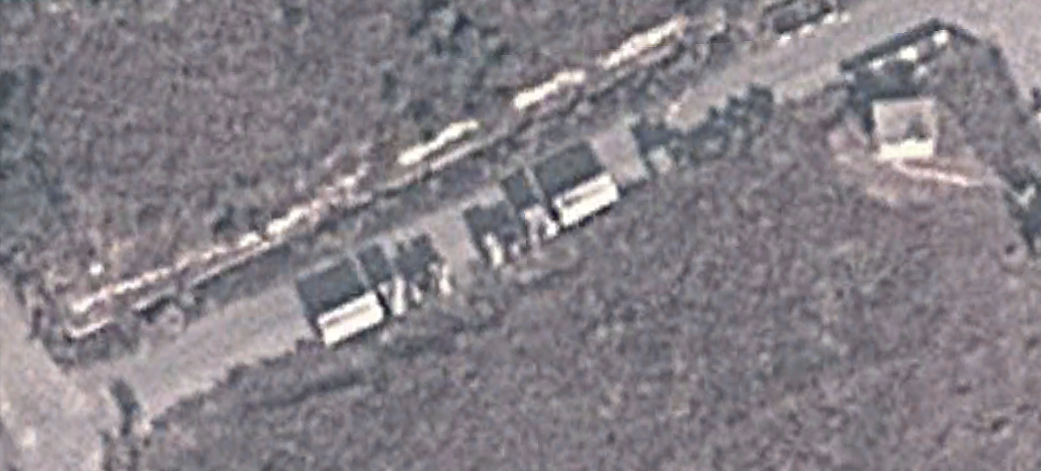
DigitalGlobe imagery from January 2014 shows two completed Hatf-7 and one possible Hatf-7 chassis parked in front of three high bay garages at Pakistan’s NDC
Pakistan, in particular, is a problem. Due to India’s overwhelming conventional forces, Pakistan increasingly sees nuclear weapons not as a strategic deterrent but as a means to help level the playing field — or so it says.
Parroting sentiments in the army, Pakistani politicians often cite the bomb as the ultimate guarantor of the nation’s security. Not surprising, Islamabad is boosting its fissile material production capacity and building more warheads in the process.
According to the International Panel on Fissile Nuclear Materials, those countries maintain approximately 225 and 300 warheads, respectively.
Satellite imagery from 2013 suggests that Pakistan has begun operating its third plutonium production reactor at Khushab. Imagery from 2014 shows further progress on a fourth reactor that’s still under construction.
Each of the three 50-megawatt reactors produces approximately 11.5 kilograms of weapons-grade plutonium, providing up to 35 kilograms per year. When the fourth comes online, possibly around 2016, Pakistan could be producing up to 46 kilograms a year.
And since the Khushab complex went operational in 1998, Pakistan has been shifting from highly enriched uranium to plutonium-based weapons. This is an important development if the country wants to create smaller and lighter warheads. A typical plutonium weapon requires four kilograms of Pu-239 to create a bomb, while HEU devices require 15 kilograms of U-235.
Using plutonium can mean a lighter device on a smaller and more mobile missile. More and more, Pakistan’s military planners believe they need these tactical nukes to balance India, which in April 2004 proposed a new military doctrine emphasizing rapid mobilization and offensive operations.
Pakistan’s potential tactical nukes could lower the barrier to a nuclear exchange. At least that’s what Indian officials believe.
“India will not be the first to use nuclear weapons, but if it is attacked with such weapons, it would engage in nuclear retaliation which will be massive and designed to inflict unacceptable damage on its adversary,” Shyam Saran, former Indian foreign secretary and the current chairman of India’s National Security Advisory Board, told an audience at Delhi’s Habitat Centre in April.
“The label on a nuclear weapon used for attacking India, strategic or tactical, is irrelevant from the Indian perspective,” Saran said.
“[A] limited nuclear war is a contradiction in terms,” he continued. “Any nuclear exchange, once initiated, would swiftly and inexorably escalate to the strategic level. Pakistan would be prudent not to assume otherwise as it sometimes appears to do, most recently by developing and perhaps deploying theater nuclear weapons.”
All that said, it’s unclear how close Pakistan is to actually deploying its tactical nukes. Likewise, India has only proposed its new offensive doctrine—it hasn’t implemented the plan. But that’s not to say tragic miscalculations couldn’t occur.
“Pakistani motivation is to dissuade India from contemplating conventional punitive retaliation to sub-conventional but highly destructive and disruptive cross-border terrorist strikes,” Saran said.
But it seems unlikely New Delhi will cave to the implicit threat. And what happens when India calls Pakistan’s atomic bluff? Assuming it is a bluff.

Wednesday, October 8, 2014

Pakistani Terrorists Attempted To Steal Nukes Last Month

Clear and present danger

In September, TTP Terrorists Attempted to Steal Pakstan's Naval Nuclear Missiles
In September, TTP Terrorists Attempted to Steal Pakstan’s Naval Nuclear Missiles

 
DC | Arun Kumar Singh | October 08, 2014, 03.10 am IST

The Indian media has missed out on analysing a recent incident at the Karachi naval dockyard. On the night of September 6, half a dozen serving and retired Pakistan Navy (PN) personnel, led by an officer, entered the Karachi naval dockyard in a boat and attempted to take over the 3,000-tonne Chinese-built frigate, PNS Zulfiqar, when the warship was in the harbour. They killed a petty officer and wounded six PN personnel on board the warship before this brazen attack was foiled. Some of the attackers were killed and interrogation of one of the captured attackers resulted in the subsequent arrest of 17 more conspirators.

Media reports speculated that the attackers wanted to hijack PNS Zulfiqar, take it to sea and use its eight 180-km range anti-ship missiles to attack an American aircraft carrier in the Arabian Sea. This was also stated later by the Tehreek-e-Taliban Pakistan (TTP) spokesman on September 10, while claiming responsibility for the attack. Another media report said that the attackers had entered the dockyard with the aim of attacking a US Navy aircraft carrier, but mistakenly attacked PNS Zulfiqar as it was the first warship they saw.

In my view, both these theories are incorrect, as it is almost impossible for six men to hijack and sail out with a 3,000-tonne warship manned by over 200 men, and no serving or retired Pakistan Navy officer would mistake a 100,000-tonne American aircraft carrier for a 3,000-tonne frigate. In my view, the hijackers were probably after nuclear weapons. In 2012, the PN announced the creation of a “Strategic Naval Command” to be headed by a vice-admiral. Media reports indicated that, in 2011, Pakistan had commenced work on a miniaturised two-kilo tonne plutonium warhead, ba-sed on a Chinese design tested in 1991-92. It was to be deployed by the Pak-istan Army on the new 60-km range battlefield ballistic missile Nasr.

This new, low-yield tactical nuclear weapon (TNW) was also meant to be deployed on the 700-km range land attack cruise missile (LACM) Babur, and the 350-km range air launched cruise missile (ALCM) R’aad. On December 19 and 21, 2012, the PNS Zulfiqar successfully test-fired LACMs at sea. While it was not known whether the missile fired was the Babur or a version of the 120 to 180-km range Chinese C-802 anti-ship missile modified to become an LACM carrying a two-kilotonne miniaturised nuclear warhead, the fact is that the test firings were witnessed by then Pakistan Navy chief, Admiral Mohammad Asif Sandila, and the media reported that the PN had now got a sea-based nuclear deterrent which could threaten Indian coastal cities.

The PN will soon begin to induct six Chinese-built Qing-class conventional submarines capable of firing nuclear tipped LACMs on Indian coastal cities. The jihadis in Pakistan have apparently set their eyes on “grabbing” some nuclear weapons. On August 16, 2012, six terrorists in Pakistan Air Force (PAF) uniforms infiltrated and attacked the high security Pakistan Aeronautical Complex at Kamra (45 miles northwest of Islamabad), which houses not only the plant to build new JF-17 fighter jets but also some of Pakistan’s nuclear weapons. This was the third terrorist attack on this facility (the earlier attacks were in December 2007 and August 2009).

On the night of May 23, 2011, terrorists belonging to the TTP infiltrated and attacked the PN air station (PNS Mehran) in Karachi. The 15 attackers killed 18 military personnel and injured another 16, and destroyed two of the seven America-supplied P-3C Orion long range maritime patrol (LRMP) aircraft. These can fly for 15 hours and destroy enemy ships and oil rigs with the America supplied Harpoon anti-ship missiles which have a range of 130 km. Sooner or later, the terrorists will discover that rather than attack Pakistani military facilities to acquire nuclear weapons, it is simpler to have enough radicalised elements in Pakistan’s military who can be trained and then transferred to units storing and operating nuclear weapons. These “sleeper cells” can be activated for strikes at the opportune moment.

Pakistan Army needs to take the possibility and threat of jihadi sleeper cell in its military seriously. It needs to place the nuclear button firmly under the control of the Prime Minister. Its homegrown terrorists won’t hesitate to use a stolen nuclear weapon or a conventional weapon.

Tuesday, May 13, 2014

Is This Really Breaking News?


Hans Blix demanded that Israeli officials join the Non-Proliferation Treaty (NPT).

He underlined that Tel Aviv’s refusal to sign international nuclear treaties and its deliberate ambiguity policy with regards to its nuclear program are because of support from Washington.

The Israeli regime is widely believed to be the only possessor of nuclear arms in the Middle East. The regime reportedly maintains between 200 and 400 atomic warheads.

Furthermore, the Israeli regime has never allowed any inspection of its nuclear facilities and continues to defy international calls to join the NPT.

Blix cautioned that all countries in possession of nukes pose a threat to global security, adding that the world has enough bombs to wipe out the Earth several times.

He also accused the US of spying on him following his revelations that Iraq did not possess weapons of mass destruction.

Under the pretext that former Iraqi dictator, Saddam Hussein, possessed weapons of mass destruction, the US and its allies invaded Iraq in March 2003.

Iraq is currently witnessing a wave of attacks unprecedented in recent years. Based on official figures, over 1,000 people, mostly civilians, lost their lives in attacks across Iraq in April.

HRM/AB/SS