Saturday, October 2, 2021

Concerns over low Iraqi turnout prompt Antichrist to urge voting

Concerns over low Iraqi turnout prompt top Shia cleric to urge voting

BAGHDAD–Iraq’s top Shia Muslim cleric on Wednesday urged Iraqis to vote in order to “carry out real change” in next month’s parliamentary elections.

The statement from Grand Ayatollah Ali Sistani’s office came against the backdrop of potentially high rates of abstention in the October 10 ballot, which follows a popular uprising.

Initially expected in 2022, the vote was brought forward in a rare official concession to autumn 2019 protests, when tens of thousands of Iraqis took to the streets to demonstrate against crumbling public services and a government they decried as corrupt and inept.

Hundreds died in months of protest-related violence.

But the ballot has generated little enthusiasm among Iraq’s 25 million voters, while the activists and parties behind the uprising have largely decided to boycott the ballot.

“The supreme religious leader encourages everyone to participate consciously and responsibly in the next elections,” the statement from Sistani’s office said.

Even if the process has shortcomings, “it is the best way to move the country toward a future that one hopes will be better.”

One of Shia Islam’s top clerics, Sistani spent years under house arrest during Saddam Hussein’s repressive regime. After Saddam’s fall in 2003, Sistani threw his support behind elections, was a voice for moderation and criticised government graft.

In his statement on Wednesday, he asked voters to “benefit from this opportunity to carry out real change in the administration of the state and dismiss the corrupt and incompetent hands from its main cogs”.

The statement emphasised that Sistani does not support any candidate and appealed to voters to choose those “who support the sovereignty of Iraq, its security and prosperity.”

Political scientist Marsin Alshamary said that in Iraq’s last elections, held in 2018, Sistani had said people could choose to vote or not.

“It was up to them. And people interpreted that as you can boycott,” Alshamary said.

The 2018 elections saw the entry into parliament for the first time of candidates from the Hashed al-Shaabi, a network of mostly pro-Iran paramilitary groups who helped defeat the Sunni-extremist Islamic State group.

The Hashed held the second-largest bloc in Iraq’s outgoing parliament and hopes for bigger gains this election.

Analysts are doubtful, however, favouring the movement of firebrand Shia Muslim cleric Moqtada Sadr, whose Saeroon bloc held 54 seats, the largest in parliament.

IDF shooting of Gaza suspect crosses ‘all red lines’ outside the Temple Walls: Revelation 11

Palestinian terror factions: IDF shooting of Gaza suspect crosses ‘all red lines’

The Israeli military identified three suspects approaching the border, and that one of them began digging while holding a suspicious item.

(September 30, 2021 / JNS)

The joint control room in Gaza that represents several terrorist factions said the shooting of a Palestinian suspect by the Israel Defense Forces on Thursday represented a “crossing of all red lines, which will require harsh replies of a special kind.”

According to Israel’s Kan news, the statement warned that “a continuation of these crimes will act as explosives for blowing up the situation, and the occupation will bear the consequences.”

Later during the day, Palestinian Islamic Jihad—the second-largest terror faction operating in the Gaza Strip after Hamas—said the statement from the joint control room did not represent it and stressed “the right of our people to resist aggression.” PIJ’s distancing itself from the joint statement appears to be linked to the statement’s threat of future, rather than immediate, action against Israel.

Earlier, a 41-year-old Arab resident of Gaza was shot and killed. Palestinian sources in Gaza claimed that the man was a bird hunter.

Subscribe to The JNS Daily Syndicate
by email and never miss
our top stories

The Israel Defense Forces said in a statement that military-observation center controllers identified three suspects approaching the border fence, and that one was seen digging into the ground while carrying a suspicious bag.

The IDF then opened fire. The military said it was investigating the incident.

Following the shooting, the Popular Resistance Committees in Gaza called for “setting the ground ablaze with anger under the feet of the Zionist occupiers as a response to their ongoing crimes against our people,” adding that “Israel will pay a heavy price.”

Israel outspends Hamas by huge margin outside the Temple Walls: Revelation 11

Israel outspends Hamas by huge margin on Gaza operations

Hamas’ short ranged Qassam rockets, which are fired out of Gaza, cost around $550

A new report finds Israel outspends Hamas on military initiatives in Gaza by a massive amount after looking at data from the most recent conflict.

The operation is known as Guardian of the Walls by Israel’s military, and as Sword of Jerusalem by Hamas.

Israel’s operations in Gaza cost the state approximately $37 million every single day – a huge disparity from Hamas, who spent pennies comparatively on the conflict.

Hamas’ short ranged Qassam rockets, which are fired out of Gaza, cost around $550. 

The faction’s longer range rockets come with a price tag of around $2,000. 

However, an interception to stop these rockets from hitting Israel, through the country’s Iron Dome system, would cost approximately $100,000.

Last week, crucial funding for Israel’s Iron Dome was approved by the United States House of Representatives, with 420 votes cast in favor of the initiative, and nine votes against.

While Hamas spends around $800,000 per mile for their tunnel network, it costs the Israeli military $145,000 for every GBU 28 Bunker Buster bomb employed against the faction’s underground passageways.

During the recent operation, the Israeli military employed a massive aerial bombardment against such tunnels in a strike against a subterranean network known as the Hamas Metro.

Friday, October 1, 2021

The Saudi Nuclear Horn Should Face Full UN Inspection: Revelation 7

Saudis Nuclear Program Should Face Full UN Inspection: Iran Official

As top US officials variously meet leading Saudis, Iran’s deputy foreign minister calls for Riyadh to open its atomic sites to full inspection and for Israel to sign NPT.

Iran’s Deputy Foreign Minister Reza Najafi Tuesday urged Saudi Arabia to be transparent over its nuclear activities and open up the access of the United Nations’ International Atomic Energy Agency (IAEA).

Najafi rejected remarks by Saudi Foreign Minister Prince Faisal bin Farhan earlier Tuesday to the UN General Assembly criticising “Iran’s continued breaches and violations of international agreements and treaties related to the nuclear agreement, and its escalation of its nuclear activities in addition to research and development activities.”

Addressing the UN General Assembly’s high-level meeting held to commemorate and promote International Day for the Total Elimination of Nuclear Weapons (September 26), Najafi said Iran rejected the retention, stockpiling, development, use, and proliferation of nuclear arms.

Iran is in a dispute with the International Atomic Energy Agency (IAEA) over traces of previously undeclared radioactive material that it has failed to fully explain and over monitoring access to the UN nuclear watchdog.

Reza Najafi, Iran's Deputy Foreign Minister for legal affairs. FILE PHOTO

Reza Najafi, Iran’s Deputy Foreign Minister for legal affairs. FILE PHOTO

It has also been enriching uranium to 60 percent and stockpiling it in violation of the 2015 nuclear agreement with world powers.

Najafi condemned the modernization and strengthening of nuclear arsenals by the United States and other nuclear-weapon states in violation of their arms-reduction commitments under the Nuclear Non-Proliferation Treaty (NPT). Najafi said Israel continued to “threaten peace and security in the Middle East and beyond through its clandestine nuclear program,” and urged the world to invite Israel to join the NPT and place its nuclear facilities under IAEA monitoring.

Unlike Israel, which is believed to hold around 180 nuclear bombs, both Iran and Saudi Arabia are NPT signatories. Saudi Arabia – which has no nuclear reactor but reportedly past nuclear links with both Iraq and Pakistani scientist AQ Khan – has limited the Safeguards access of the IAEA under a ‘small quantities protocol.’

Referring to a 2018 interview with the US CBC’s 60 Minutes program in which Saudi Crown Prince Mohammed bin Salman suggested Riyadh might adopt nuclear weapons if Iran developed one, Iran’s state-run English channel Press TVand Tasnim news agency both claimed Wednesday that there is “international concern” over Saudi Arabia’s nuclear ambitions.

Saudi Arabia backed former United States president Donald Trump’s 2018 withdrawal from Iran’s 2015 deal with world powers limiting its nuclear program – the JCPOA, Joint Comprehensive Plan of Action. The new administration of President Joe Biden has continued Trump’s ‘maximum pressure’ sanctions as Iran has continued to expand its atomic program with steps that began in 2019.

Prince Faisal this week met with US special envoy for Iran Robert Malley on the sidelines of the UN General Assembly to discuss recent developments in Iran’s nuclear case. US National Security Advisor Jake Sullivan met with Saudi Arabia’s Crown Prince Mohammed bin Salman in Saudi Arabia Tuesday to discuss Yemen and Iran – the White House kept Sullivan’s visit low-profile and no photos were issued.

In his speech to the annual UN General Assembly last week, Saudi Arabia’s King Salman bin Abdulaziz expressed hope that continuing talks with Iran, brokered by Baghdad, to restore relations would build confidence. The kingdom cut diplomatic ties in 2016 when protestors attacked its Tehran embassy after Riyadh executed 47 dissidents including leading Shi’ite cleric Sheikh Nimr al-Nimr

This nightmare WWIII scenario will soon become reality: Revelation 8

‘2034’: This nightmare WWIII scenario could soon become reality

Sep. 30, 2021

This is a highly appropriate time to read “2034: A Novel of the Next World War,” a thriller published in March that describes a chain of events leading to a third world war. 

Its coauthors are seasoned veterans of the U.S. military. One is James Stavridis, 66, a retired Navy admiral who served in a variety of command positions. In 2009 he was named supreme commander of NATO and the top U.S. commander in Europe, positions he held until his retirement in 2013. The second, Elliot Ackerman, is 25 years his junior. A journalist and author, he served eight years in the U.S. Marine Corps as an infantry and special operation officer, including a brief stint with the Ground Branch of the CIA’s Special Activities Division. Ackerman served multiple tours of duty with elite covert CIA units in the Middle East and southwest Asia, including in Iraq and Afghanistan.

The Korean Nuclear Horn ests new hypersonic weapon: Revelation 16

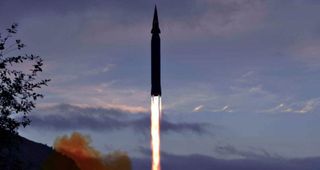
North Korea conducted a test launch of its Hwasong-8 vehicle, which features a hypersonic upper stage, on Sept. 28, 2021. This photo of the launch was released by North Korean state media.

North Korea conducted a test launch of its Hwasong-8 vehicle, which features a hypersonic upper stage, on Sept. 28, 2021. This photo of the launch was released by North Korean state media. (Image credit: KCNA via NK News)

North Korea tests new hypersonic weapon: reports

By Mike Wall 1 day ago

North Korea is apparently getting into the hypersonic arms race.

The nuclear-armed nation conducted a test launch Tuesday (Sept. 28) of a new “hypersonic missile” called Hwasong-8, state-run outlet KCNA reported on Wednesday (Sept. 29), according to KCNA Watch, which aggregates news released by official North Korean media.  

Hwasong-8 was topped with a hypersonic gliding vehicle (HGV) warhead, KCNA wrote. Hypersonic craft travel at least five times faster than the speed of sound, or Mach 5, and are highly maneuverable. They’re much tougher to track and intercept than intercontinental ballistic missiles, which follow predictable trajectories.

The United States, Russia and China have prioritized the development of hypersonic weapons in recent years. The U.S. has been working on a number of different hypersonic designs over the past decade, for instance, and scored an important success with one, the Hypersonic Air-breathing Weapon Concept, during a trial last week, Pentagon officials announced Monday (Sept. 27).

KCNA declared Tuesday’s Hwasong-8 mission, which launched from North Korea’s east coast, a success as well.

“In the first test launch, national defense scientists confirmed the navigational control and stability of the missile in the active section and also its technical specifications, including the guiding maneuverability and the gliding flight characteristics of the detached hypersonic gliding warhead,” KCNA’s report reads.

Outside experts aren’t so sure, however. Missile specialist Chang Young-keun told Reuters that the Hwasong-8’s HGV reached a top speed of just Mach 2.5 during Tuesday’s test, citing analyses by South Korean military intelligence.

“The North’s HGV technology is not comparable to those of the U.S., Russia or China and for now seems to aim for short-range that can target South Korea or Japan,” Chang, who’s based at the Korea Aerospace University in Goyang, South Korea, told Reuters.

In addition, South Korea’s Joint Chiefs of Staff believe that North Korean hypersonics tech is far from battle ready and that both the U.S. and South Korea are capable of detecting and neutralizing the Hwasong-8, the BBC reported Wednesday.

As the BBC noted, Tuesday’s test was the third missile launch that North Korea has performed in September, suggesting that the nation may be accelerating some of its weapons programs. Work on those programs has proceeded despite numerous sanctions imposed over the past 15 years by the United Nations Security Council, as well as the United States and some of its allies.

North Korea is an isolated autocracy run by the dictator Kim Jong-un. In recent years, the nation’s top officials have repeatedly indulged in saber-rattling against North Korea’s perceived enemies — for example, threatening to turn major U.S. cities into “seas of fire.” North Korea possesses nuclear weapons, which gives such threats an edge and explains why experts track the country’s rocket and missile programs so assiduously.

Mike Wall is the author of “Out There” (Grand Central Publishing, 2018; illustrated by Karl Tate), a book about the search for alien life. Follow him on Twitter @michaeldwall. Follow us on Twitter @Spacedotcom or Facebook. 

Join our Space Forums to keep talking space on the latest missions, night sky and more! And if you have a news tip, correction or comment, let us know at: community@space.com.

SPACE.COM SENIOR SPACE WRITER — Michael has been writing for Space.com since 2010. His book about the search for alien life, “Out There,” was published on Nov. 13, 2018. Before becoming a science writer, Michael worked as a herpetologist and wildlife biologist. He has a Ph.D. in evolutionary biology from the University of Sydney, Australia, a bachelor’s degree from the University of Arizona, and a graduate certificate in science writing from the University of California, Santa Cruz. To find out what his latest project is, you can follow Michael on Twitter.

Tensions outside the Temple Walls continue with violence:

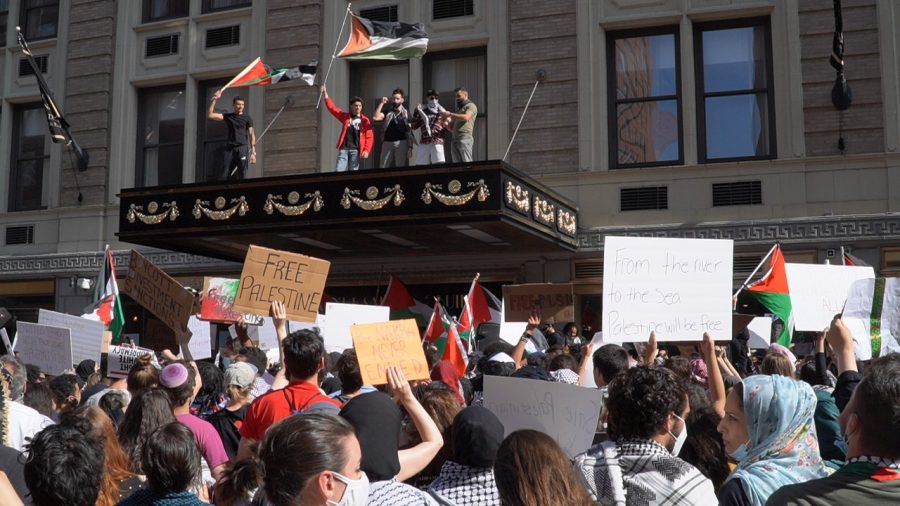
Palestinian+protestors+in+Boston+stand+outside+the+Israeli+Consulate+General.+

Tensions between Palestinians and Israeli settlers continue with violence

Ongoing tensions between Palestinians and Israeli settlers in Jerusalem and the West Bank remain high, months after a two-week period of violence this past May into June.

The Human Rights Watch has recently accused the Israeli and Palestinian militias of committing war crimes in the Gaza Strip and Israel. These areas are recognized as occupied Palestine under international law, declared by the United Nations.

The violence began on May 6, when the Israeli Supreme Court ruled to evict six Palestinian families from the city’s Sheikh Jarrah neighborhood, which is recognized by international law as Palestinian territory under Israeli occupation.

Tensions reached a breaking point when the Al-Aqsa Mosque in Jerusalem was stormed by the Israeli Police during the final night of Ramadan, the most important holiday for Muslims, injuring hundreds of worshippers.

This coincided with Jerusalem Day, an Israeli national holiday celebrating the reunification of the city of Jerusalem under Israeli control. Israelis celebrated with the annual Dance of Flags and paraded around the Western Wall, the holiest site in Judaism. The Western Wall is located directly adjacent to the Al-Aqsa Mosque, as both lie on the Temple Mount, considered one of the holiest sights in Judiasm, Islam and Christianity alike.

According to the Associated Press, immediately after the celebrations ended violence broke out between the two groups, as Israeli nationalists began to taunt Palestinians outside of the Al-Aqsa Mosque. Palestinians responded and the clashes intensified until they were broken up by police, who fired tear gas and rubber bullets into the crowd.

These actions angered not only Palestinians in the West Bank and Gaza Strip, but Arabs all over the world.

Jerusalem, which is home to the Greek Orthodox, Armenian Apostolic and Roman Catholic Patriarchs, as well as clergy from the Syriac and Coptic Churches, blamed the growing tensions on the increase of right-wing radicals moving to Jerusalem, according to a statement by the Middle East Council of Churches.

Fatah, the left-wing nationalist party who governs the West Bank, condemned the increase right-wing nationalism and violence that occurred in Jerusalem.

Hamas, the Islamist party that controls the Gaza Strip, issued an ultimatum to Israel to withdraw from the al-Aqsa mosque and Sheikh Jarrah by 6:00 p.m. on May 10, or they would take revenge. When Israel refused, Hamas began firing rockets into Israeli territory. The Israeli government responded forcefully, igniting further tension between the two.

The result was a 12 day long conflict between the Israeli government and Hamas, which caused casualties on both sides. However, the civilian casualties in Gaza were much higher due to Israel’s Iron Dome rocket defense system, which is designed to intercept and destroy short-range rockets and artillery shells before they can reach populated areas.

The Office for the Coordination of Humanitarian Affairs reported that Israel suffered 15 casualties, while the Palestinians suffered 256 casualties. Much of the infrastructure in Gaza was destroyed as a result, including homes, schools, hospitals, and the al-Jalaa high-rise building, which housed the offices of the Associated Press and Al Jazeera in Gaza City.

Reporters Beyond Borders and the Committee to Protect Journalists called these attacks war crimes. Gary Pruitt, CEO of the Associated Press, said he was “shocked and horrified that the Israeli military would target and destroy the building,” and declared that, “the world will know less about what is happening in Gaza because of what happened today,” according to a statement by the Associated Press.

In addition to the airstrikes and rocket attacks between the two, riots broke out across Israel between its Jewish and Arab populations, leading to several synagogues being vandalized in response to the Al Aqsa Mosque being rushed, and Israeli nationalists attacking Arabs on the streets. The most contentious rioting happened in Jerusalem, as well as the cities of Ashkelon and Lod, which are all home to large Arab populations.

In response to the escalation of violence, the United Nations called for an immediate ceasefire. According to The Independent, diplomats from France, Greece, Egypt, Jordan, the United Arab Emirates and the United States all drafted a ceasefire, which went into effect on May 21.

The conflict between Israel and the Palestinians, as well as other Arab states, dates back to 1948, when the UN partitioned the former British mandate of Palestine into a Jewish and Arab state. Many Jews see Israel as a reclamation of their ancestral homeland in Judea. However, Palestinians view Israel as an illegal occupation of land they have inhabited for many generations, with both Muslim and Christian Arabs living alongside Jews for centuries before the partition, Elon University reported.

This led to subsequent wars in 1948, 1956, 1967, 1973, 1982, 2000 and 2006. The only decade without violence between the two groups was in the 1990s, when the Israeli Prime Minister Yitzhak Rabin and the leader of the Palestinian Authority Yasser Arafat nearly signed a peace deal. 

The peace treaty almost led to a two-state solution, which would have resulted in an independent State of Palestine alongside the State of Israel, both being recognized by the internal community with diplomatic relations with one another. The alternative to this plan is the one-state solution, which would incorporate both the Jewish and Arab communities into one multiethnic state.

The situation sparked an international outcry and led to worldwide pro-Palestine as well as pro-Israel demonstrations.

In Boston, protestors gathered outside Boston Public Library on May 15, where they shouted, chanted, waved Palestinian flags and held banners.

The protestors then marched over to the Israeli Consulate General near Beacon Hill, where they continued to shout and chant and play patriotic music, climbing onto awnings and up lampposts in order to wave their flags and banners in the windows of the Consulate General.

The protestors consisted of not only Palestinians and other Arabs, but many other Americans as well supporting their cause. Jewish organizations such as the Jewish Voice for Peace, as well as U.S. military veteran organizations, such as Veterans for Peace, were both noticeably present, as they marched alongside the protestors to express their resentment towards the actions of the Israeli government.

Although there were a few pro-Israel counter protestors present, the interactions between the two groups remained peaceful throughout the entire duration of the march.