The prophecy is more than seeing into the future. For the prophecy sees without the element of time. For the prophecy sees things as they were, as they are, and as they always shall be.
Russian President Vladimir Putin is no longer interested in a joint freeze of nuclear weapons production with the United States, according to a senior Russian envoy who protested American inspections requests and a recent agreement to provide nuclear-powered submarines to Australia.
“No, it was a one-time offer, and it was said so to the U.S. They missed the opportunity,” Russian Deputy Foreign Minister Sergei Ryabkov told the Geneva Center for Security Policy, per state media. “They didn’t want a freeze on all warheads — they wanted an extremely intrusive verification and control at all our nuclear-related facilities.”
Ryabkov aired the withdrawal of that proposal following a meeting Deputy Secretary of State Wendy Sherman for what both sides described as “intensive and substantive” arms control talks. He complained about the U.S. and United Kingdom’s decision to partner with Australia on a submarine deal widely perceived as directed at China, and both Russian and American officials underscored that the negotiations are unlikely to produce a deal anytime soon.
“Arms control dialogues take a very long time,” Sherman said Friday. “The dialogue has a value in and of itself because it unveils norms that we both believe in and want to establish as the [two nations with the] largest number of nuclear weapons, so it’s very good in and of itself.”
The Ryabkov-Sherman meeting comes months after President Joe Biden’s summit with Russian President Vladimir Putin, when the two leaders echoed Ronald Reagan and Mikhail Gorbachev’s affirmation that “a nuclear war cannot be won and must never be fought.” That joint statement drew criticism from Marshall Billingslea, former President Donald Trump’s point man for arms control, who observed that Putin “believes that a nuclear war CAN be fought & won” and faulted Biden for making a joint statement while “knowing Putin to be lying.”
Russia has adopted a military doctrine that contemplates the use of nuclear weapons to win a conflict in Eastern Europe before U.S. forces can intervene, according to Western officials, spurring at least one NATO ally to warn publicly that Russian might launch a nuclear “blitzkrieg” against one of its neighbors. Trump withdrew the U.S. from the Reagan-Gorbachev treaty that banned the development of intermediate-range land-based ballistic missiles after Republicans and Democrats, as well as the rest of NATO, assessed that Putin has developed and deployed such systems in defiance of the treaty.
Putin acknowledged in December that an arms race “has already begun,” but Ryabkov argued a more one-sided case on Friday, when he attributed any arms control tensions to an American quest “for decisive unilateral advantages at the expense of Russia’s security.”
He broadened his complaints about NATO member-state decisions to include U.S. and British efforts to upgrade their defenses against Chinese threats.
“We are concerned especially by the statements produced earlier in the year in London on future prospects for expansion of its nuclear capabilities,” Ryabkov said, referring to a British plan to increase its nuclear stockpile in response to “China’s military modernization and growing international assertiveness within the Indo-Pacific region.”
And he maintained that the recent U.S. decision to provide nuclear-powered submarines to Australia is “a great challenge to the international nonproliferation regime” despite Biden and Australian Prime Minister Scott Morrison’s stipulation that the deal will cover nuclear power for the submarines but no nuclear weapons.
U.S. officials have expressed doubt about whether they’ll be able to reach another arms control deal with Russia, but Sherman and Ryabkov separately touted the launch of two working groups on arms control as a positive step.
“We all hope that we head to achieving some objectives about moving forward,” she said.
‘Neighboring countries and others should not interfere in Iraq’s internal affairs’, says Shia leader
MIDDLE EAST
Prominent Iraqi Shia politician Muqtada al-Sadr Friday warned against external interference in the early parliamentary elections in Iraq.
“The Iraqi elections are an internal affair. Neighboring countries and others should not interfere in the internal affairs, neither by carrots nor by sticks,” al-Sadr posted on his Twitter account.
Al-Sadr added that he will retaliate “in the same way in the future,” without giving names.
Observers argue that al-Sadr aimed at neighboring Iran in his post as it supports his main opponent in the elections, the Al-Fatah alliance made up of Asa’ib Ahl al-Haq and Iraqi Hezbollah Shia factions.
In the previous elections, al-Sadr-backed the Sairoon alliance which came ahead of Al-Fatah with 54 of 329 parliamentary seats. Al-Fatah, meanwhile, came second with 48 seats.
The Sairoon alliance seeks to win more seats in the upcoming elections to enable it to have the prime minister’s post, according to previous statements by al-Sadr.
Figures from the Iraqi Electoral Commission in July showed that 3,249 candidates representing 21 coalitions and 109 parties, as well as independent candidates, will run for the 329 parliamentary seats.
The polls were originally scheduled to be held in 2022, but Iraq’s political parties have decided to hold early elections following mass protests that erupted in the country in 2019 against deep-seated corruption and poor services.
14 Palestinians were injured during protests calling for the end of Israel’s brutal siege on the Gaza Strip on 25 August 2021 [Mohammed Asad/Middle East Monitor]October 1, 2021 at 10:24 am
A member of the Hamas political bureau, Mousa Abu Marzouk, yesterday revealed a scheme involving countries and individuals in the region who aim to tighten the siege imposed on the Gaza Strip and thwart the Palestinian resistance.
Speaking to Arabi21, Abu Marzouk said Hamas and the Palestinian masses will not tolerate the continuation of the restrictions and siege imposed on the Palestinian people in the Gaza Strip.
The scheme includes tightening the Israeli siege on the Gaza Strip and deterring the movement from confronting any possible Israeli aggression on Jerusalem and the rest of Palestine.
Abu Marzouk accused the Palestinian Authority of being involved in the scheme after support for the armed resistance option increased in May. This led to the obstruction of the entry of Qatari aid to Gaza and the implementation of Gaza reconstruction projects.
He added that Hamas has decided to give international and Arab efforts an opportunity to achieve a real breakthrough in dismantling the siege, and ending the suffering of the Palestinian people in Gaza.
“Some non-nuclear States have historically opposed the resolution in response to India testing nuclear weapons and becoming a nuclear-armed State in 1998. India can and needs to do more to get countries to reconsider their opposition, especially in light of Taliban’s takeover of Afghanistan that has already led to rise in India-Pakistan tensions.
“While there are enough pundits predicting that Taliban and Pakistan will make for the most volatile bedfellows, there is no denying that the region’s power dynamics have been dramatically and drastically altered. A change that has taken everyone by surprise only goes to show that nothing can be ruled out. So, speaking of Pakistan’s nuclear stockpile falling in the hands of Taliban is not as far-fetched as one would imagine.”
By Priyanka Khanna
The predictable India-Pakistan rhetoric during the United Nations General Assembly (UNGA) in New York and accusations flying right and left at the ongoing 48th session of the Human Rights Council (UNHRC) in Geneva are shadowing the simmering worry as to what will happen to Pakistan’s growing nuclear arsenal.
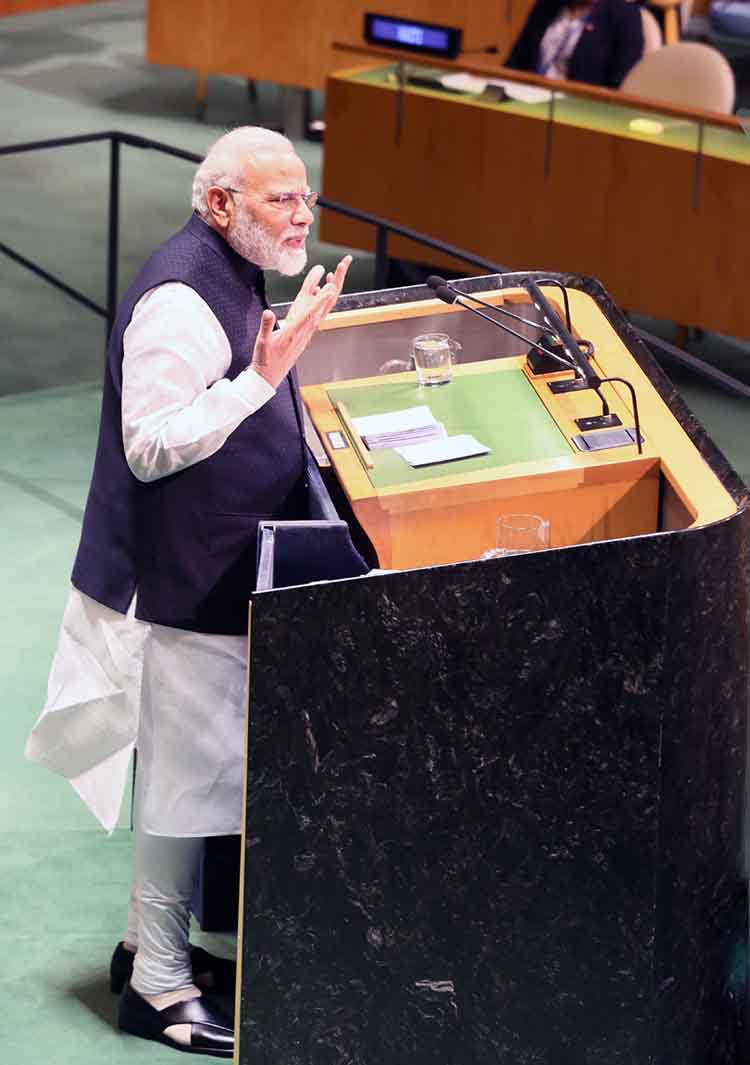
Indian Prime Minister Narendra Modi has repeatedly raised doubts about Pakistan’s intentions (Photograph / Jay Mandal- on assignment)
With the Afghanistan takeover by Taliban and given their bon homie with Pakistan, especially its intelligence, it is singularly worrying that Pakistan is the sole country that is blocking negotiations of the Fissile Material Cut-Off Treaty (FMCT).
While there are enough pundits predicting that Taliban and Pakistan will make for the most volatile bedfellows, there is no denying that the region’s power dynamics have been dramatically and drastically altered. A change that has taken everyone by surprise only goes to show that nothing can be ruled out. So, speaking of Pakistan’s nuclear stockpile falling in the hands of Taliban is not as far-fetched as one would imagine.
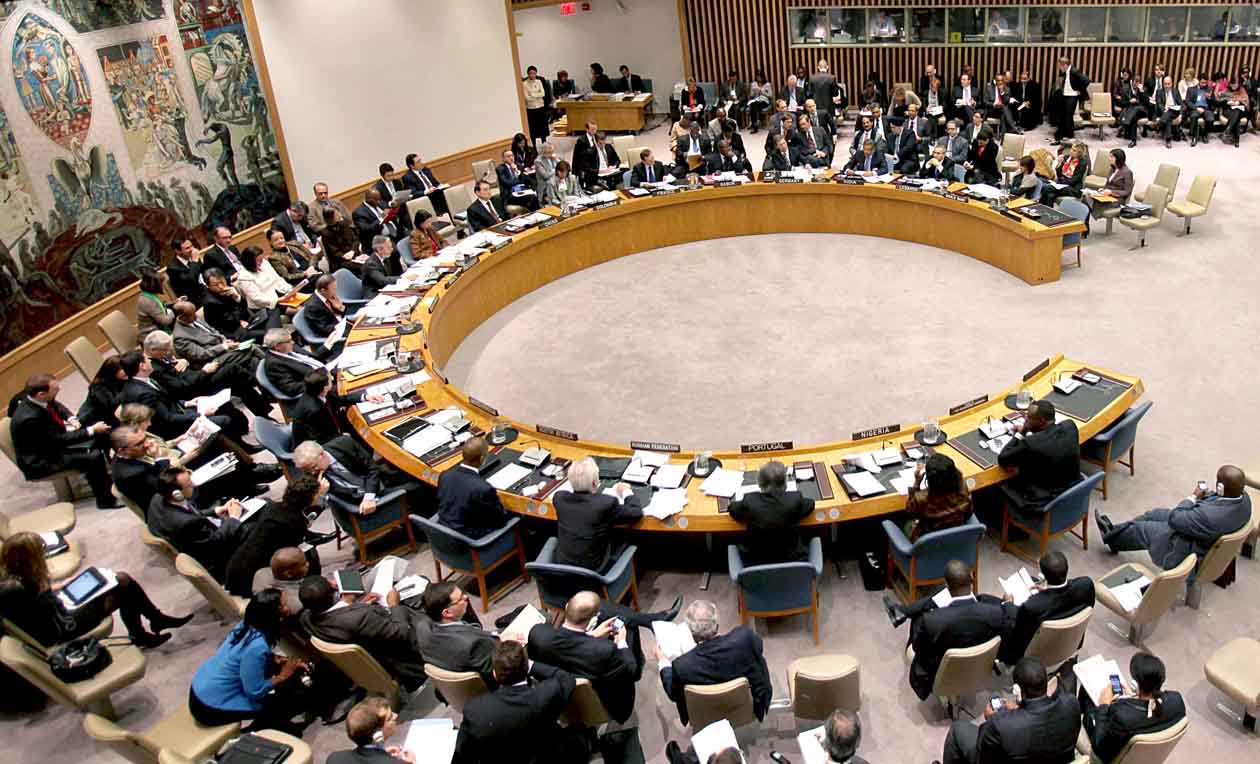
The UN is not doing enough to push Pakistan to undertake disarmament. (Photograph / Jay Mandal- on assignment)
Which brings us to the question of why the UN is not doing enough to push Pakistan to undertake disarmament. In fact, according to the advocacy group – Unfold Zero – the UNGA was not even able to come together on nuclear disarmament resolutions. In the last nuclear disarmament UN meeting, nuclear risk-reduction was perhaps the only measure countries could come together for.
A resolution reducing nuclear danger submitted by India received 127 votes in favor (mostly non-aligned countries). It failed to get support of nuclear-armed or European countries, primarily because it only calls for nuclear risk reduction measures by China, France, Russia, UK and USA – leaving out the other nuclear armed States – India, Pakistan, DPRK and Israel, according to unfoldzero.org.
A resolution on decreasing the operational readiness of nuclear weapons systems submitted by a group of non-nuclear countries, was much more successful receiving 173 votes in favor, including from most of the NATO countries and from four nuclear armed States (China, DPRK, India, Pakistan).
A resolution on the Treaty on the Prohibition nuclear weapons (TPNW) was supported by 122 countries. This is more than the number who have signed the Treaty, which is 68 (with 19 of these countries having now ratified). The vote indicates that more signatures are likely. However, the resolution was not supported by any of the nuclear-armed countries, nor any of the countries under nuclear deterrence relationships, i.e., NATO, Australia, Japan, South Korea. The opposition of nuclear-armed and allied States to the resolution is another indication that they do not intend to join the new treaty. In general, this means that they will not be bound by the treaty’s obligations. However, the customary law against the use of nuclear weapons which is re-affirmed by the treaty will apply to all States regardless of whether or not they join.
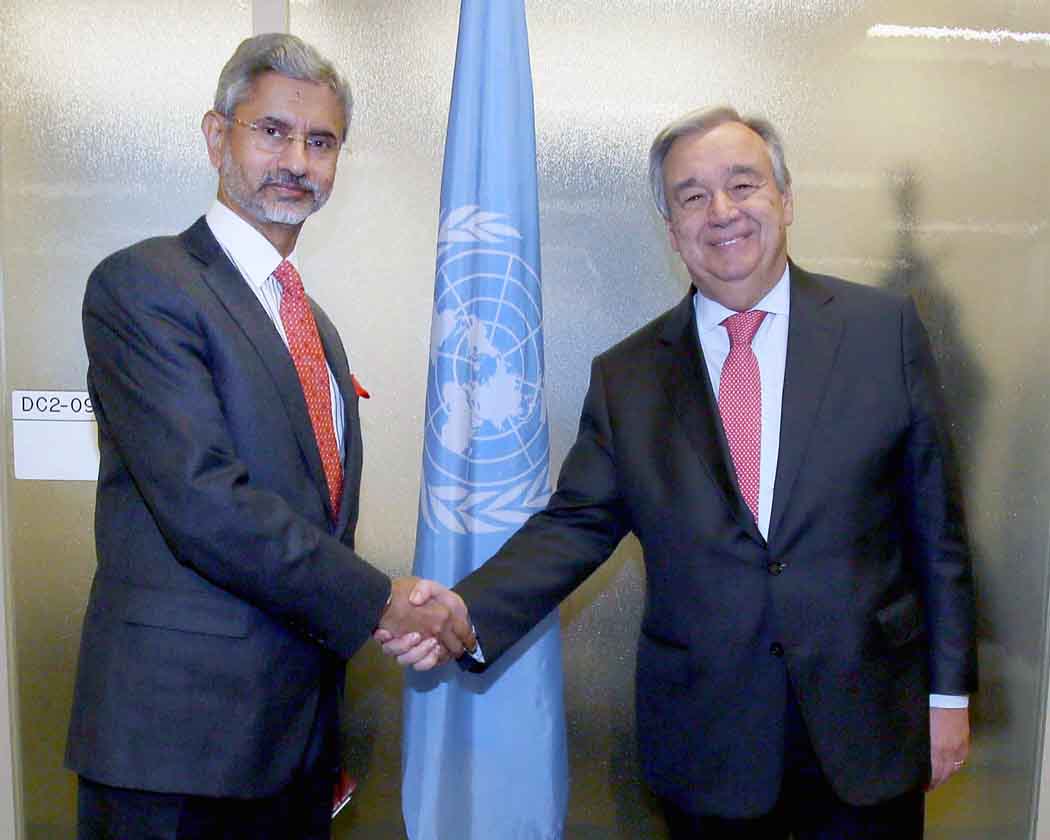
India’s External Affairs Minister has voiced India’s concern about Pakistan’s stockpile of nuclear weapons to the world, including the Secretary General of the United Nations, António Guterres. (Photograph / Jay Mandal- on assignment)
A resolution on the prohibition of the use of nuclear weapons submitted by India received 120 votes in favor, including from themselves and another three nuclear-armed States (China, DPRK and Pakistan). Some non-nuclear States have historically opposed the resolution in response to India testing nuclear weapons and becoming a nuclear-armed State in 1998. India can and needs to do more to get countries to reconsider their opposition, especially in light ofTaliban’s takeover of Afghanistan that has already led to rise in India-Pakistan tensions.
Seismicity in the vicinity of New York City. Data are from the U.S. Geological Survey (Top, USGS) and the National Earthquake Information Center (Bottom, NEIC). In the top figure, closed red circles indicate 1924-2006 epicenters and open black circles indicate locations of the larger earthquakes that occurred in 1737, 1783 and 1884. Green lines indicate the trace of the Ramapo fault.
At well-studied plate boundaries like theSan Andreas faultsystem in California, scientists can often make observations that allow them to identify the specific fault on which an earthquake took place. In contrast, east of the Rocky Mountains this is rarely the case.The NYC area is far from the boundaries of the North American plate, which are in the center of the Atlantic Ocean, in the Caribbean Sea, and along the west coast of North America. The seismicity of the northeastern U.S. is generally considered to be due to ancient zones of weakness that are being reactivated in the present-day stress field. In this model, pre-existing faults that were formed during ancient geological episodes persist in the intraplate crust, and the earthquakes occur when the present-day stress is released along these zones of weakness.The stress that causes the earthquakes is generally considered to be derived from present-day rifting at the Mid-Atlantic ridge.
Earthquakes and geologically mapped faults in the Northeastern U.S.
There is insufficient evidence to unequivocally demonstrate any strong correlation of earthquakes in the New York City area with specific faults or other geologic structures in this region. The damaging earthquake affecting New York City in 1884 was probably not associated with the Ramapo fault because the strongest shaking from that earthquake occurred on Long Island (quite far from the trace of the Ramapo fault). The relationship between faults and earthquakes in the New York City area is currently understood to be more complex than any simple association of a specific earthquake with a specific mapped fault.
Just off the northern terminus of the Ramapo fault is theIndian Point Nuclear Power Plant, built between 1956 and 1960 byConsolidated Edison Company. The plant began operating in 1963, and it has been the subject of a controversy over concerns that an earthquake from the Ramapo fault will affect the power plant. Whether or not the Ramapo fault actually does pose a threat to this nuclear power plant remains an open question.
The United States has experienced a nearly unbroken string of catastrophic intelligence failures in the last eighty years. The Japanese attack on Pearl Harbor caught America by surprise in 1941, only to be followed by North Korea’s invasion of South Korea and China’s intervention in the Korean War a decade later. More recently, American intelligence failed to predict or warn U.S. policymakers about the terror attacks on Sept. 11, 2001, or the recent outbreak of the deadly global coronavirus pandemic, which has taken the lives of over 700,000 Americans and millions of more people around the world. It seems possible that the U.S. intelligence community will fail to predict—let alone provide advance warning of—an existential nuclear, cyber, or electromagnetic pulse (EMP) attack upon the U.S. homeland from America’s adversaries.
U.S. leaders have been seemingly unconcerned about the increasingly bellicose and militarily superior “New Axis” powers aligning against it since the end of the Cold War. This alliance by America’s two most powerful adversaries is not a recent development. The Russian Federation and the People’s Republic of China formed the Shanghai Cooperation Organization in June 2001. Russian president Vladimir Putin has since described it as “a reborn Second Warsaw Pact.” Russia and China now lead a military alliance that includes over 68 percent of the landmass of Eurasia, nearly42 percent of the world’s population, nearly 30 percent of the world’s GDP, and approximately 75 percent of the world’s operational nuclear weapons, with over two-thirds of them deployed by Russia.
Russia developed super-electromagnetic pulse weapons more than two decades ago. These nuclear weapons are designed to greatly enhance their EMP effects. It subsequently shared this deadly technology with its Chinese and North Korean allies. More recently, Russia, China, and North Korea have been assessed as likely having the capability to use EMP and cyberwarfare attacks to shut down America’s electrical power grid and other critical infrastructure, including the internet, financial systems, transportation systems, food, and water distribution systems, communications systems and emergency services in a matter of minutes. Such attacks could possibly disable the Global Positioning System andmilitary early-warning satellites, blinding Americans to subsequent attacks against the United States and its allies. U.S. military leaders have even expressed concern that our nuclear command, control, and communications system might be vulnerable to cyberattack. Such an attack could disrupt the president’s ability to launch a retaliatory nuclear strike. Also, it could prevent America’s conventional military forces from being able to communicate with their commanders or coordinate their attacks, making them much easier to defeat. The United States has yet to develop any super-EMP weapons to help deter any such attack.
President Joe Biden was elected, in part, on a platform of protecting the environment from global climate change. However, few people realize that a super-EMP or cyberattack on the U.S. homeland would likely be far more catastrophic for American citizens and the environment. Such an attack could cause all ninety-four nuclear reactors in the United States to meltdown, spreading radioactive contamination and fallout to nearby cities. If such an attack were to occur, then U.S. leaders might not be certain which country attacked us or who to retaliate against. In 2008, the Congressional EMP Commission estimated that such a cataclysmic attack on a national scale could cause up to 90 percent of Americans to die within twelve months due to starvation, disease, and societal breakdown. A comprehensive cyberattack on the U.S. homeland could also kill tens of millions of Americans. Given their destructive potential, U.S. national security professionals should seriously consider reclassifying cyber and EMP weapons as weapons of mass destruction. Despite these warnings, U.S. leaders have done little to protect the American people from EMP and cyberattacks. They have also failed to deploy a national missile defense system to protect against nuclear missile attacks. In the event of a catastrophic Sino-Russian attack against the U.S. homeland, there is a good chance that even America’s allies would decline to come to its defense for fear of sharing its fate.
How did America’s leaders allow the country to become so vulnerable? U.S. leaders began a policy of nuclear disarmament at a pace far exceeding Russia’s following the end of the Cold War, naively believing the existential threat had passed. This exposed the United States to unnecessary and increasingly intolerable risks. By 2016, the U.S. nuclear arsenal had been reduced from 30,000 nuclear weapons to only 1,750 operational warheads. Many of these weapons are deployed on aging delivery systems of increasingly questionable reliability. Today, only 720 of America’s warheads are ready to launch at any given time, of which 50 percent would likely survive a full-scale nuclear first strike. The reliability of the U.S. nuclear stockpile is also a major concern. Successive administrations have failed to ensure it will function as designed in the event of a crisis.
Over the past decade, the United States has allowed itself to be overtaken by the Sino-Russian alliance in virtually every recognized measure of strategic military power. This includes offensive nuclear weapon systems, national missile defenses, hypersonic weapons, super-EMP weapons, and cyberwarfare capabilities. America has fallen behind its adversaries in terms of their combined economic and industrial manufacturing might, their ability to produce major weapon systems without foreign components, their hardening of critical infrastructures against EMP/cyberattack, their civil defenses, and overall nuclear war survivability.
The Department of Defense estimated in 2017 that the Russian Federation was in the process of building its own nuclear arsenal to total 8,000 deployed warheads, which is over four and a half times more operational nuclear warheads than the United States possesses. Russia has also deployed six strategic nuclear “superweapon” systems of a type the United States does not even possess that are not limited by existing arms control treaties. Former Defense Intelligence Agency intelligence officer Rebekah Kofflerhas stated, Putin believes war with the United States is “unavoidable.”
In August, Koffler wrote in an op-ed for The Hill that,
Moscow is prepared to fight a nuclear war over its perceived sphere of influence, on which Russia has relied for centuries as its strategic security perimeter… The Kremlin envisions fighting a limited nuclear war with Washington, over contested areas such as Ukraine and Crimea, the latter of which Russia illegally annexed in 2014… Moscow also has conducted mock nuclear attacks on the U.S. homeland. The Russians regularly practice nuclear launches in simulation exercises, with Putin “pressing the button.” … There is no question that Russia is preparing for a nuclear conflict with the United States and NATO. The only question is whether this conflict can be deterred or fought.
Meanwhile, U.S. satellite imagery has revealed that China is in the process of rapidly expanding its strategic nuclear arsenal by up to 4,000 warheads–a number of nuclear warheads up to twenty times greater than recent U.S. Department of Defense estimates of the size of their entire nuclear arsenal. Peter Huessy recently noted in an op-ed published by the National Interest that “U.S. satellites have discovered some 350-400 new Chinese missile silos, each laid out in a grid pattern some three kilometers apart. These new intercontinental ballistic-missile ‘launchers’ are designed to hold the DF-41 missile.”
“The DF-41 is a ten-warhead missile,” Huessy explained. “Added up, the Chinese potential sprint to nuclear superiority may indeed be materializing, a possible four-thousand warhead build that would be 266 percent of the total deployed warheads currently in the U.S. nuclear arsenal. More worrisome, China’s future nuclear force could be 400 percent of today’s U.S. alert nuclear forces. … Alongside China, America’s two nuclear-armed enemies would have combined strategic nuclear warheads some 600 percent greater than the United States. If compared by the number of nuclear weapons that are on alert on a day-to-day basis, the imbalance reaches on the order of 1,000 percent.”
Huessy estimates that Russia and China could field a combined force of 9,000 deployed strategic nuclear warheads within the next few years, 7,200 of which will be on alert and ready to fire at any given time. Based on the time it took the United States to build its own missile silos during the Cold War, China could complete the construction of its four hundred DF-41 intercontinental ballistic missile (ICBM) silos in as little as two years. However, given the rapid pace of their construction, it’s possible they could finish them even sooner. Last month, Adm. Charles Richard, that commander of U.S. Strategic Command, said that America was “witnessing a strategic breakout by China.” “The explosive growth in their nuclear and conventional forces can only be what I described as breathtaking. … Frankly, that word ‘breathtaking’ may not be enough,” he said. Richard characterized China as a “peer” nuclear competitor and noted that we now face two nuclear “peer” competitors, Russia and China, compared to one during the Cold War. Air Force Gen. John Hyten, the vice chairman of the Joint Chiefs of Staff, confirmed Richard’s assessment.
“It is going to take us 10 to 15 years to modernize 400 silos that already exist,” Hyten said. “And China is basically building almost that many overnight. So the speed of difference in that threat is what really concerns me most. … Why are they building that enormous, enormous nuclear capability faster than anybody in the world? … It’s the almost unprecedented nuclear modernization. … They could put, you know, ten reentry vehicles on every one of those ICBMs if they wanted to; There’s nothing to limit that ability.”
Ever since the Clinton administration in 1993, new US presidents have conducted a Nuclear Posture Review (NPR) to assess whether the stockpile size, composition, and operational deployment of US nuclear weapons align with their military policy, foreign policy, and budgetary objectives. The results are used to guide nuclear policies and programs for the remainder of a president’s term.
Although all prior NPRs (there have been four) have generally—and disappointingly—rubber-stamped the nuclear status quo, this one had the potential to be different thanks to President Biden’s deep knowledge of—and longstanding involvement in—nuclear policy matters as a US senator and vice president. Just as important to the possibility of a real review of the US nuclear posture was Leonor Tomero, the highly experienced woman (she served as a senior aide on the House Armed Services Committee for nearly 11 years) Biden nominated to work on those issues and lead the review for the Defense Department as deputy assistant secretary of defense for nuclear and missile defense policy.
The Biden administration’s much-anticipated NPR finally and formally got underway in mid-July. But suddenly, last Thursday, Politicoreported that Tomero had been effectively fired when the Defense Department abruptly reorganized her position out of existence and transferred her responsibilities to two other offices—one of which is so new it does not even have a confirmed nominee to lead it. Tomero was further informed she could not take another job in the department, even though multiple open positions at the equivalent seniority level remain unfilled. Although Defense Department spokesman John Kirby offered some unconvincing explanations about the “reorganization” being routine, it wasn’t difficult to discern what had actually happened when an unidentified current Defense official told Politico that Tomero was one of the “arms controllers who used to seem naïve but now seem irrational given what China and Russia are doing.”
Tomero had run afoul of the permanent nuclear bureaucracy (or theocracy, given this cadre’s better-known appellation: the nuclear priesthood), the largely male, largely white, largely conservative group of civilian and military officials who for more than 76 years have designed, built, tested, operated, maintained, and upgraded US nuclear weapons and prepared, programmed, and practiced numerous highly-detailed war plans across a variety of threat scenarios.
As deputy assistant secretary of defense for nuclear and missile defense policy, Leonor Tomero testified at a May 12 Senate Armed Services Committee hearing on the defense authorization request for 2022.It’s telling that being willing to ask serious questions on behalf of the president of the United States about the purpose and costs of US nuclear weapons (of which up to 900 thermonuclear warheads remain on 24/7 alert to enable the president to order their launch at a moment’s notice) and not just accept the dogma of deterrence was sufficient to rile up members of Tomero’s own professional staff, who complained to Republicans on the Senate Armed Services Committee (SASC), who in turn reportedly put pressure on Tomero’s bosses to get rid of her. (That attitude was already on display during a May 12 hearing of the SASC strategic forces subcommittee when Sen. Tom Cotton, Republican of Arkansas, grilled Tomero about whether the United States should adopt a nuclear no-first-use policy or sole-use policy. When Tomero explained her job was to coordinate the review process, consider the risks and benefits of current declaratory policy, assess alternative options, and not impose any personal views she might have, Cotton ended his questioning by complaining he was “now troubled by the direction” of the NPR.) What kind of a “robust” nuclear posture can supposedly deter World War III but not withstand some hard questions about whether all 3,800 nuclear bombs and warheads in the US stockpile (as well as the 400 ICBMs, 280 SLBMs, 66 strategic bombers, and 14 nuclear-powered ballistic missile submarines that carry them) are vital to that mission, to say nothing of affordable?The writing was on the wall back in early January when Adm. Charles Richard, commander of US Strategic Command, toldthe Defense Writers Group that the objective of the NPR should be “validation, that we like the strategy that we have. … [T]his nation has had basically the same strategy dating back to the Kennedy administration. It’s been repeatedly validated through multiple administrations. It would be useful to do that again. And then to be satisfied that the capabilities that we have are able to accomplish that.” For Richard, the most senior military officer with operational responsibility over the nuclear arsenal, undertaking any kind of serious, thorough evaluation of nuclear requirements, let alone exploring any potentially beneficial alternatives to a strategy that, in his words, hasn’t changed for 60 years, was wholly unnecessary. But that’s exactly what President Biden wanted when he nominated Leonor Tomero to head up his NPR and to oversee nuclear weapons and missile defense issues more broadly. The question now is whether he will accept an NPR that is likely to do far, far less or find a way to ensure he receives actual policy options to pursue, rather than a nuclear fait accompli that changes little or nothing.RELATED: Four takeaways from the 2021 World Nuclear Industry Status ReportSome of Biden’s former colleagues in Congress expressed alarm this week at Tomero’s removal. Among them was Sen. Ed Markey, Democrat of Massachusetts and co-chair of a congressional working group on nuclear weapons and arms control that earlier this summer called on Biden to “actively guide” the NPR process. On Friday, Markey sent the presidentanother letter with a dozen detailed questions about the Pentagon’s abrupt personnel shake-up and its effect on the NPR, telling Biden that he is “concerned that the sudden departure of a top appointee, charged with presenting you options on the future of the U.S. nuclear weapons enterprise, will result in a draft Nuclear Posture Review that reflects the Cold War era’s overreliance on nuclear weapons, rather than your lifetime of work championing policies that reduce nuclear weapons risks.”Back to basics. What would an honest and productive NPR look like? Rather than starting with the unquestioned assumption that all the weapons we have and everything we’re already doing to upgrade them is essential and effective, it would go back to first principles to identify the fundamental national security and foreign policy objectives of the United States beforeproposing a strategy for how nuclear weapons can help to achieve some of them. Next, the review would identify specific military targets to support that strategy, assess the best weapons for those targets, and determine the precise force posture and deployment numbers to hold those targets at risk. Finally, it would quantify the amount of money required to accomplish all of this—including designing, building, testing, and maintaining the warheads and all the supporting infrastructure—both today and well into the future. It would also be managed not just by the Defense Department but jointly with the State Department (to fully assess diplomatic and arms reduction concerns) and the Energy Department (to better include the perspectives of those charged with actually maintaining the nuclear warheads and the facilities that sustain them). And it would allow academics and non-governmental experts (including retired governmental and military officials) opportunities to contribute their knowledge and experience to the process before any drafts are written.Failing to do that will continue to perpetuate the so-called nuclear triad based on the longstanding but unsubstantiated (and unprovable) belief it is absolutely necessary to our deterrent posture. In fact, the received wisdom of maintaining three distinct strategic delivery systems (four really, given that bombers can drop gravity bombs and launch cruise missiles—but who’s counting?) to enhance our own security and fully thwart state-level adversary threats is a myth. The triad as a concept did not even exist until the 1970s, and from the beginning, it was a post-hoc justification for the results of a massively uncoordinated Cold War arms race—not the one you know about, between the United States and the Soviet Union, but the one between the Air Force, Navy, and Army from the late 1940s well into the 1970s. That arms race was spurred (and maintained) by interservice rivalry, fear, bad intelligence estimates, arbitrary decision-making, fierce competition among defense contractors, and ample pork-barrel politics. In short, the triad is a wholly accidental artifact of decades of decisions that were never fully thought through, not least in terms of how our adversaries would likely react to the tens of thousands of nuclear weapons we mindlessly amassed throughout the Cold War in a futile and increasingly costly effort to guarantee our and our allies’ perpetual security.RELATED: Satellites and climate change threaten the night. This October meteor shower celebrates it.A bottom-up approach to the NPR would be far more helpful to the White House and Congress than section 1537 of the yet-to-be-approved Senate version of the 2022 National Defense Authorization Act, which would require Defense, in “consultation with” State, Energy, and the Director of National Intelligence, “to conduct a comprehensive review of the nuclear posture of the United States for the next 5 to 10 years,” with specific emphasis on “current and projected nuclear capabilities of the Russian Federation and the People’s Republic of China, and such other potential threats,” and to submit this so-called “revised” NPR in 2022. Evidently, some senators on the Armed Services Committee were concerned an NPR overseen by Tomero would be insufficiently focused on such matters, or would not fully endorse a suite of new, more advanced US nuclear weapons as a direct response to the nuclear weapons Russia and China appear to be developing.President George H. W. Bush delivers a national address announcing nuclear weapons reductions, September 27, 1991. (C-SPAN)To boldly go. It wasn’t always this way. Presidents, and their military advisors, have boldly embraced changes to the nuclear status quo in the past. For example, September 27 marked the 30th anniversary of President George H.W. Bush’s unprecedented decision to order the unilateral elimination of all land-based US nuclear weapons in Europe and South Korea and all US non-strategic naval nuclear weapons, the end of ground alert for all US bombers, and the immediate de-alerting of 450 Minuteman II ICBMs (at the time almost half of our entire ICBM force). Bush acted swiftly following an alarming but failed coup in the Soviet Union and out of a desire to lead the way toward a safer and more secure world by transcending the laborious arms control process. And it worked. Soviet President Mikhail Gorbachev reciprocated eight days later with his own series of unilateral measures, which new Russian President Boris Yeltsin reaffirmed and expanded upon the following January. Thanks to what became known as the Presidential Nuclear Initiatives and the 1991 Strategic Arms Reduction Treaty, by the time Bush left office in January 1993, he had slashed the bloated US nuclear stockpile by nearly 9,500 nuclear warheads (a massive 41 percent reduction).Today, we’re moving in the opposite direction, spending more than $1.2 trillionover the next several decades to maintain, upgrade, and replace not just every delivery system we currently have but also every operational nuclear bomb and warhead. During US Strategic Command’s recent “Deterrence Symposium,” Sen. Deb Fischer (Republican of Nebraska), the ranking member on the Senate Armed Services Committee’s strategic forces subcommittee, simplistically quoted former Secretary of Defense James Mattis when asked how to balance the considerable cost of nuclear “modernization” against all the other urgent military and civilian needs currently facing the United States: “America can afford survival.” Senator Fischer may believe that every nuclear weapon we built, currently have, or plan to build is essential to our national survival, but there is abundant historical evidence proving just the opposite, and we ignore it at our peril.President Biden still has the potential to make meaningful, lasting changes to US nuclear policies and weapons programs that can strengthen US and global security and avoid wasteful spending. But to do that, he must do the one thing none of his predecessors were willing to do: play an active, ongoing role in his administration’s own NPR to ensure it presents him with fresh options for the future and not just the same outdated, counterproductive, and hugely expensive justifications from the past.