Showing posts with label pompeo. Show all posts

Tuesday, July 14, 2020

Pompeo’s Flimsy Case Against the Iranian Nuclear Horn

As part of its continued “maximum pressure” campaign against Iran, the Trump administration is pushing to extend a UN arms embargo on the Islamic Republic that is set to expire in October. Secretary of State Mike Pompeo recently presented the UN Security Council with a list of grievances against Iran, a list full of unsubstantiated claims and half-truths. And like most things Washington accuses Tehran of, the U.S. and its allies in the region are guilty of similar or worse offenses.
The arms embargo on Iran will expire under terms agreed to in the 2015 nuclear deal, an agreement the U.S. withdrew from in 2018 when it reimposed sanctions on Iran. “Because of the flawed nuclear deal negotiated by the previous American administration, the arms embargo on the world’s most heinous terrorist regime is scheduled to expire on October 18th, a mere four months from now,” Pompeo said to the UN Security Council on June 30th.
Pompeo went on to list attacks on U.S. forces and allies in the region that he claimed Iran was behind, either directly or indirectly. “In January, Iran launched an attack on the coalition forces in Iraq with its own advanced missiles,” Pompeo said referring to Iran’s attack on bases in Iraq housing U.S. troops, retaliation for the assassination of top Iranian General Qassem Soleimani – crucial context the secretary left out of his remarks.
Pompeo also mentioned Iran’s support for Kataib Hezbollah, a Shia militia that is frequently blamed for attacks on U.S. forces in Iraq. “Iran, even as we sit here today, supplies Shia militia groups like Kata’ib Hizballah – groups which have launched dozens of rocket attacks since the fall of last year against U.S. and coalition forces fighting the important continued important campaign against Daesh,” Pompeo said.
Like most accusations Pompeo makes, no evidence has been presented to corroborate the claim that Kataib Hezbollah was behind rocket attacks against U.S. forces. The series of events that led up to the assassination of Soleimani was sparked by a rocket attack that killed a U.S. contractor in Kirkuk, Iraq, which was blamed on Kataib Hezbollah.
A report from The New York Times revealed that Iraqi intelligence believes the attack in Kirkuk was more likely carried out by ISIS. Abu Ali al-Basri, Iraq’s head of intelligence and counterterrorism, told the Times that the U.S. did not share any information about the Kirkuk attack. “They did not ask for my analysis of what happened in Kirkuk and neither did they share any of their information,” he said. “Usually, they would do both.”
After a rocket attack on Camp Taji in Iraq killed two American soldiers and one British soldier in March, the U.S. pinned the blame on Khataib Hezbollah and bombed targets said to be weapons facilities belonging to the Shia group. The U.S. bombing killed five members of Iraq’s security forces and one civilian. Shortly after the bombing, a new group called the League of Revolutionaries emerged and took credit for the Camp Taji attack. The League also threatened future attacks on the U.S. embassy in Baghdad, a frequent target for lone rockets. Many groups inside Iraq want U.S. troops out of their country, including Iraq’s parliament, who voted unanimously in favor of expelling the occupation forces after the killing of Soleimani.
Kataib Hezbollah is part of the Popular Mobilization Forces (PMU), a group of about 40 Iraqi-state sponsored militias. The PMU was formed in 2014 to fight ISIS and played a crucial role in driving the radical militants out of major cities like Mosul and Fallujah. The drone strike that killed Soleimani on January 3rd also killed Abu Mahdi Al-Mohandes, the commander of the PMU.
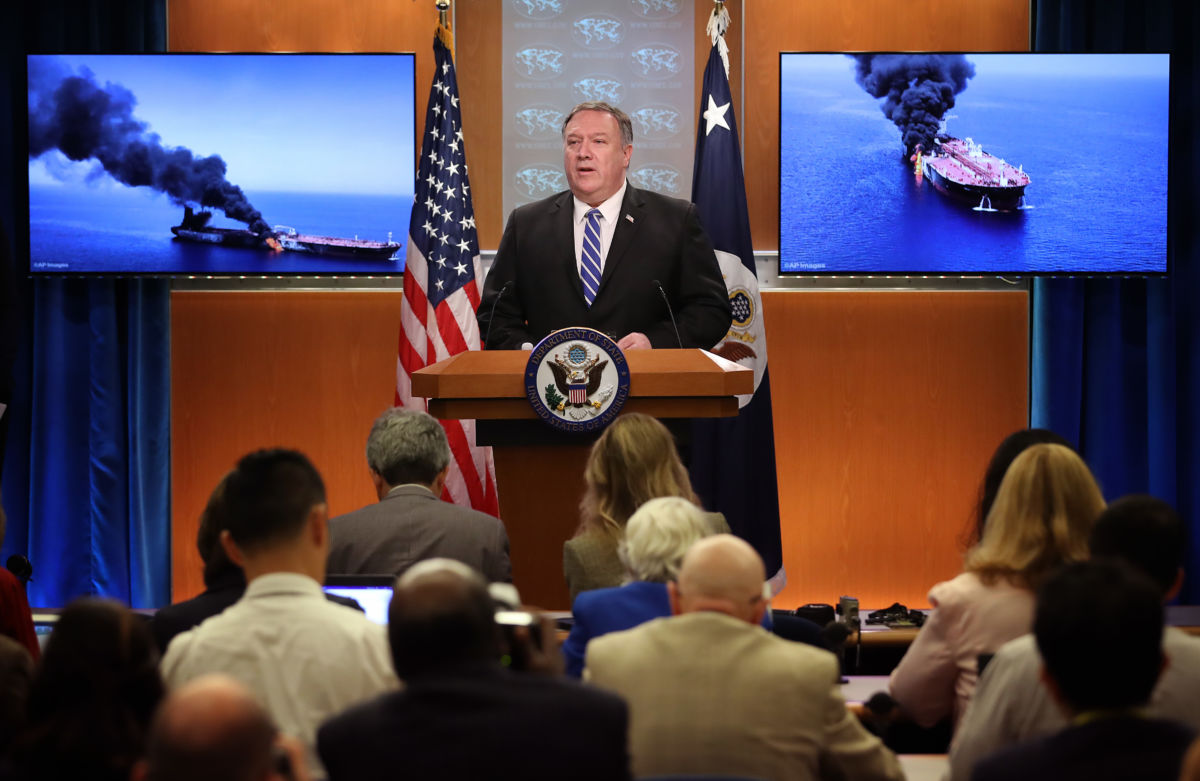
In the Spring of 2019, multiple attacks on oil tankers anchored in the Gulf of Oman were blamed on Iran by Pompeo and other Trump administration officials. These claims were never corroborated, the best the U.S. could do was release photos of the damaged ships, and a grainy black and white video of a small boat alongside one of the tankers, nothing even remotely conclusive. This lack of evidence does not stop Pompeo from repeating the allegation that Iran was behind the sabotaged oil tankers as fact. “Iran unleashes ship-mining attacks on commercial vessels in the Gulf of Oman, as it did in May and June of last year,” Pompeo told the Security Council.
Pompeo also accused Iran of being behind the September 2019 attack against Saudi Arabia’s oil infrastructure that severely damaged the Kingdom’s oil production. Yemen’s Houthis claimed responsibility for the attack, but Pompeo was eager to pin it on his favorite boogeyman. The day the news broke, the top diplomat immediately blamed Iran, ignoring the brutal war the Saudis have been waging against the Houthis.
Despite claims to the contrary in the wake of the attack, the Saudi oil facilities struck in September are in the range of the Houthis drones. The Houthis drone technology rapidly improved over the past few years, and the group has successfully launched many attacks deep inside Saudi territory.
The UN secretary-general released a report in June that discusses the Houthis attack on Saudi oil facilities. The report says, based on the analysis of debris recovered from sights of the September 2019, and debris recovered from other attacks that occurred in 2019, “the Secretariat assessed that the cruise missiles and/or parts thereof used in the four attacks were of Iranian origin.”
Pompeo cited this report in his remarks to the Security Council and said the report “confirmed that weapons used to attack Saudi Arabia in September 2019 were of Iranian origin.” The goalposts shifted with allegations against Iran concerning this attack. Initially, the Trump administration claimed satellite photos showed the attack came from the direction of Iran. Now it seems they have settled on the idea that Iran provided the Houthis with the weapons.
Despite the claims from Pompeo and the UN, it is not clear if Iran directly provided the weapons used in the September attack to the Houthis. A story from the U.S. Embassy in Georgia about the Iranian embargo says the UN report confirmed the weapons were of Iranian origin based on a “U.S. fact sheet.” Some analysts believe the Houthis might build their drones based on Iranian designs and blueprints, which would explain why the UN found similarities between the debris and weapons made in Iran.
The report also went over weapons seized off the coast of Yemen that were said to be of “Iranian origin,” something Pompeo mentioned at the Security Council meeting. Most recently, Pompeo claimed the U.S. seized a vessel off the coast of Yemen that was carrying weapons from Iran on June 28th. Iran denied the charge and said Washington is just looking for an excuse to extend the arms embargo. While Iran openly supports the Houthis politically, they repeatedly deny sending weapons to the Zaydi Shia group, and the U.S.-Saudi blockade on Yemen would make it difficult to do so.
It is not clear how far Tehran’s support for the Houthis goes, but what is clear is Washington’s support for the Saudi-led coalition, the other party to the conflict in Yemen, and the one with the most civilian blood on its hands. Since 2015 the Saudis, along with the UAE and other Gulf allies, have mercilessly bombed Yemen in an effort to oust the Houthis and reinstate President Hadi. Support for the war has been a bipartisan effort, as it was started with the blessing of the Obama administration and eagerly continued by the Trump administration.
Experts agree, if the U.S. ended its support for the Saudi-led coalition, the war would quickly come to an end. But no matter how dire the situation gets on the ground for Yemenis, Washington continues its support for the Saudi’s under the guise of combating “Iranian influence,” even though the Houthi movement is entirely homegrown. Zaydi Shia Imams ruled the areas of North Yemen that the Zaydi Shia Houthis now control for over 1,000 years until 1962 — but these details are lost on Washington.
One of the most egregious Saudi airstrikes took place in Yemen in August 2018, when a coalition plane struck a school bus with a U.S.-made bomb, killing 40 children and 11 adults. This horrific attack did not phase Mike Pompeo, who told Congress a month later that the coalition was taking “demonstratable” action to minimize civilian casualties. Pompeo’s statement ensured U.S. support for the coalition would continue.
And for all Pompeo’s talk of Iran being a “terrorist regime,” it is actually the U.S. weapons sold to Saudi Arabia and the UAE that end up in the hands of al-Qaeda in Yemen. In fact, the Houthis were previously an ally of Washington in its fight against al-Qaeda in the Arabian Peninsula. A Wall Street Journal report from January 2015 (the Saudi war on the Houthis started in March 2015) lays it all out. “The U.S. has formed ties with Houthi rebels who seized control of Yemen’s capital, White House officials and rebel commanders said, in the clearest indication of a shift in the U.S. approach there as it seeks to maintain its fight against a key branch of al Qaeda,” the report reads.
Another belligerent ally of Washington, which prefers to wage war more covertly than the Saudis, has been ramping up tensions with Iran. Besides regularly bombing what is dubbed as “Iranian targets” in Syria, it appears Israel may be behind a recent string of explosions and fires in Iran. An intelligence source told The New York Times that Israel planted a bomb in the Natanz nuclear facility resulting in a blast that severely damaged the facility. Some experts believe a cyberattack caused the explosion, a method the U.S. and Israel have used together to attack the Islamic Republic in 2010 with the Stuxnet virus.
Pompeo’s appeal to the Security Council will likely fail since Russia and China can veto the motion. Pompeo has argued the U.S. can impose “snapback” sanctions on Iran under conditions of the nuclear deal, but other signatories have pointed out that the U.S. can not enforce an agreement that it has already violated.
Whatever happens with the arms embargo, Pompeo will continue to hurl accusations at Iran. But whenever America’s top diplomat gets up to speak, it would be wise to keep in mind a rather candid admission he made last year in front of an audience at Texas A&M University. “When I was a cadet, what’s the cadet motto at West Point? You will not lie, cheat, or steal or tolerate those who do. I was the CIA director. We lied, we cheated, we stole. We had entire training courses.”
Dave DeCamp is the assistant news editor of Antiwar.com and is based in Brooklyn, NY. Follow him on Twitter @decampdave.

Thursday, March 19, 2020

Iran Praises Attack on Babylon the Great and the Clown

March 17, 20204 Min Read
President Trump on Friday fired again at Iran’s Ayatollah Ali Khamenei — who earlier within the day known as him “a clown” — with a tweet warning that he had higher “be very cautious” when selecting his phrases.
“The so-called ‘Supreme Leader’ of Iran, who has not been so Supreme currently, had some nasty issues to say about america and Europe. Their financial system is crashing, and their persons are struggling. He must be very cautious together with his phrases!” the commander in chief wrote on his strategy to a weekend at his Mar-a-Lago resort in Florida.
In his first Friday sermon in Tehran in eight years, the Ayatollah excoriated the US for its “cowardly” killing of prime basic Qassem Soleimani, who he stated was the best commander within the battle in opposition to ISIS.
In response to the drone strike, Iran launched a barrage of ballistic missiles concentrating on two bases housing US troops in Iraq, with out inflicting critical accidents.
“The truth that Iran has the ability to offer such a slap to a world energy reveals the hand of God,” Khamenei stated, including that the killing of Soleimani, commander of the Quds Pressure, confirmed Washington’s “terrorist nature.”
“The Quds Pressure is a humanitarian group with human values that protects folks throughout the area,” he stated. “They’re fighters with out borders.”
Khamenei, who delivered a part of his sermon in Arabic, stated the strike had dealt a blow to America’s picture as a superpower, including that stated the true punishment could be in forcing the US to withdraw from the Center East.
“Resistance should proceed till the area is totally free of the enemy’s tyranny,” Khamenei stated.
As Iran’s Revolutionary Guard braced for a US counterattack that by no means got here, it mistakenly shot down a Ukrainian airliner shortly after it took off from Tehran, killing all 176 passengers on board, largely Iranians.
Donald TrumpEPA
“The airplane crash was a bitter accident, it burned by means of our coronary heart,” Khamenei stated in an deal with punctuated by cries of “Loss of life to America” from the lots.
“However some tried to… painting it in a strategy to neglect the nice martyrdom and sacrifice” of Soleimani, the top of the international operations arm of the Revolutionary Guards, he stated, including that the elite drive can take its combat past Iran’s borders.
Iran initially denied its position within the tragedy, blaming the crash on a technical drawback, however later admitted duty.
As a outcome, avenue protests erupted across the nation, prompting safety forces to disperse the crowds with dwell ammo and tear fuel.
Trump despatched tweets in Farsi and English to help the protesters, drawing a sharp response from Khamenei.
“These American clowns who lie and say they’re with the Iranian folks ought to see who the Iranian persons are,” he stated Friday.
Iranians chanting slogans throughout Friday prayers in Tehran.Getty Photos
Khamenei additionally lashed out at Britain, France and Germany, saying they’re too weak to convey Iranians to their knees after they triggered a dispute mechanism to attempt to convey Iran again into compliance with the unraveling 2015 nuclear settlement.
“After the US exited the deal, I instructed you then that these international locations can’t be trusted. Even their negotiations with Iran are stuffed with deceit,” he stated.
However, he added, he was nonetheless open to negotiation — simply not with the US.
“The gents behind the desks that negotiate are the identical as those that terrorized Gen. Soleimani,” stated Khamenei, 80, who brazenly wept on the funeral of the revered army commander.
Tensions between Tehran and the Washington have spiked since Trump withdrew the US from the nuclear cope with world powers, which had imposed restrictions on its nuclear program in alternate for the lifting of worldwide sanctions.
After Soleimani was killed, Iran introduced it could now not be certain by the restrictions within the settlement.

Pompeo Issues A Warning To The Iranian Horn

March 17, 2020
Pompeo told Iraqi PM Adil Abd al-Mahdi that Baghdad “must defend Coalition personnel supporting the Iraqi government’s efforts to defeat ISIS,” the US Department of State said in a statement on Monday.
Al Arabiya English
@AlArabiya_Eng
US Secretary of State Mike Pompeo (@SecPompeo) tells Iraq’s prime minister the US will take measures in self-defense if attacked, after a second rocket attack on an Iraqi base that houses US troops.
Those “responsible for the attacks must be held accountable,” the official warned, adding that Washington “will not tolerate attacks and threats to American lives” and will take “action as necessary in self-defense.”
Back in January, the Iraqi parliament passed a non-binding resolution, urging all foreign militaries, including the US to withdraw from the country.
The landmark decision came after the US assassinated Iranian top general Qassem Soleimani and deputy chief of Iraq’s Popular Mobilization Forces (PMF) Abu Mahdi al-Muhandis in a drone strike outside Baghdad.
The US was quick to refuse withdrawal, yet its forces have been repeatedly attacked throughout the country since then.
The response from Mike Pompeo came at a time when Iraq was bombed a couple of days ago.
Iraq was attacked in the past when the country was accused of possessing weapons of mass destruction.
At that time US President George W Bush accused Saddam Hussain of making the nuclear weapon.
However, after the attack the US took back its accusation and declared Iraq a nuclear free state.

Tuesday, February 25, 2020

Pompeo urges Iraq’s Allawi to defy the antichrist


ERBIL, Kurdistan Region – In a phone call on Sunday, US Secretary of State Mike Pompeo urged Iraq’s Prime Minister-designate Mohammed Tawfiq Allawi to protect US troops stationed in Iraq and to reach an agreement with Kurdish and Sunni parties over the composition of his new cabinet.
Allawi was tasked on February 1 with forming a new Iraqi government after caretaker PM Adil Abdul-Mahdi resigned in late 2019 in the face of mass protests over corruption, unemployment, and the lack of basic public services.
This is Allawi’s first phone call with the US secretary of state.
“During the call, the latest political developments on the regional and international levels were reviewed, and the necessity for coordination and joint work was emphasized,” read a statement from the Iraqi prime minister’s office.
“Pleased to speak with new #Iraq PM-designate Mohammed Allawi.  I welcomed his promise to hold early elections, reaffirmed our commitment to Iraq, urged an end to violence, and called for accountability and urgent action to address protesters’ legitimate demands,” Pompeo said in a tweet following the call.
A longer State Department statement included mention of some thorny issues between the two countries, including the recent spate of rocket attacks against Iraqi bases hosting US troops in Iraq.
One such rocket attack on December 27, 2019 killed a US civilian contractor in Kirkuk and injured other personnel.
Pro-Iran militias are thought to be behind the attacks – acting as proxies for Tehran, which is locked in an ever-escalating tit-for-tat with Washington.
Iran and the US appeared on the brink of all-out war after the US killing of Iranian general Qasem Soleimani on January 3. Tehran responded with ballistic missile strikes on Iraqi bases hosting US troops.
Iraqi Shiite politicians responded to the killing of Soleimani and Iraqi paramilitary commander Abu Mahdi al-Muhandis in a US drone strike by demanding the removal of all US troops from Iraqi soil.
Pompeo “stressed Iraq’s obligation to protect US and Coalition diplomats, forces, and facilities,” the State Department statement added.
On Monday, influential Shiite cleric Muqtada al-Sadr, who has become the figurehead of anti-US feeling in Iraq, accused the Americans of interfering.
“Pompeo calling Allawi is an intervention in Iraqi affairs, and, if it is repeated, we will have a stance,” Sadr told Iraqi TV channel al-Sharqiya.
Allawi faces an uphill struggle. Last week he called for an extraordinary session of parliament to be held on Monday to seek approval for his cabinet. The session did not materialized, however, as parliament’s Sunni and Kurdish minorities continue to demand their choice of candidates.
Kurds and Sunnis have largely rejected Allawi’s approach to picking his own “independent, technocratic” candidates, fearing their communities will be marginalized from power by the Shiite majority.
A Kurdish delegation composed of multiple parties, including those with intense political rivalries, returned to the Kurdistan Region from Baghdad on Sunday.
They are expected to meet with Kurdistan Region President Nechirvan Barzani and other top officials on Monday to decide whether to boycott or join the cabinet.
Pompeo “urged the new Prime Minister to resolve differences with Iraq’s Kurdish and Sunni political leaders to assure success in pursuing the vital tasks faced by his government,” the State Department said.
Rejecting Allawi’s call for a parliamentary session on Monday, Parliamentary Speaker Mohammed al-Halbousi and his deputy Hassan al-Kaabi said they must first meet to examine the resumes of Allawi’s chosen ministers and his cabinet manifesto.
Pompeo also used the call to raise concerns about Iraq’s handling of the mass protests sweeping the country’s central and southern provinces, where kidnappings, torture, and targeted killings have drawn condemnation.
“The Secretary and the Prime Minister-designate also agreed on the importance of beginning reforms that would better position the government to provide the Iraqi people a life of dignity, prosperity, and security,” the State Department added.

Monday, February 3, 2020

Babylon the Great Prepares for Nuclear War Against Iran

US deploys “usable” nuclear weapon amid continuing war threats against Iran

1 February 2020
The Pentagon deployed a new, smaller nuclear warhead aboard the ballistic missile submarine USS Tennessee as it sailed into the Atlantic last month in the midst of the spiraling crisis with Iran. The weapon, known as the W76-2 warhead, has an explosive yield of roughly five kilotons, a third of the destructive power of the “Little Boy” bomb that claimed the lives of some 140,000 people in Hiroshima in 1945.
The Federation of American Scientists (FAS) revealed the deployment this week, citing unnamed civilian and military figures. It stated that two of the 20 Trident submarine-launched ballistic missiles onboard the USS Tennessee and other subs will be armed with the W76-2 warheads. Each missile can be loaded with as many as eight such warheads, capable of striking multiple targets.
The new weapon has been rolled out with remarkable speed. The Trump administration’s 2018 Nuclear Posture Review called for the development of“a low-yield SLBM [submarine-launched ballistic missile] warhead to ensure a prompt response option that is able to penetrate adversary defenses”and close “an exploitable ‘gap’ in US regional deterrence capabilities.”
The pretext for the warhead’s deployment was the unsubstantiated claim that Russia is developing similar weapons and has adopted a doctrine of “escalate to de-escalate” or “escalate to win” by utilizing low-yield nuclear weapons, with the expectation that Washington would not retaliate with strategic warheads for fear of initiating an all out thermonuclear war. The Pentagon’s argument has been that a low-yield and rapid reaction ballistic missile is needed to “restore deterrence.”
The report by the FAS strongly suggests, however, that this alleged Russian doctrine is a pretext and that “it is much more likely that the new low-yield weapon is intended to facilitate first-use of nuclear weapons against North Korea or Iran.”
It points out that both the US National Security Strategy and the Nuclear Posture Review (NPR) envision the use of nuclear weapons in response to “non-nuclear attacks, and large-scale conventional aggression,” and that the NPR explicitly stated that the W76-2 warhead was designed to “expand the range of credible US options for responding to nuclear or non-nuclear strategic attack.” Washington does not rule out a nuclear strike, including against non-nuclear armed countries like Iran.
The deployment of the USS Tennessee with its new “usable” nuclear warheads came at roughly the same time as President Donald Trump huddled with his top aides on December 29 at his Mar-a-Lago resort in Florida, ordering the criminal drone missile assassination of Gen. Qassem Suleimani, one of Iran’s top officials. The drone killing was carried out at Baghdad’s international airport five days later.
In a report Thursday, NBC News, citing unnamed senior US officials, established that at the same meeting in Florida, “Trump also authorized the bombing of Iranian ships, missile launchers and air defense systems… Technically, the military can now hit those targets without further presidential authorization, though in practice, it would consult with the White House before any such action.”
The report warned that “the two sides remain in a dangerous boxer’s clench, in which the smallest miscalculation, some officials believe, could lead to disaster.”
In other words, for all the talk of war having been averted following the act of war and war crime carried out by Washington in the murder of Suleimani, the reality is that the world remains on the knife’s edge of a catastrophic military confrontation, which could rapidly escalate into the first use of nuclear weapons in three-quarters of a century.
The threat against Iran is part of far broader buildup to global war through which US imperialism is seeking to offset the erosion of its previously hegemonic domination of the global economy by resorting to the criminal use of overwhelming military force.
After securing a $738 billion military budget for 2020 with the support of an overwhelming majority—Democratic and Republican alike—in the US Congress, the Trump administration is now preparing to push through a 20 percent increase in the budget for the National Nuclear Security Administration (NNSA), the agency overseeing the buildup of the US nuclear arsenal. This $20 billion budget proposal, made public this week, represents only a fraction of the more than $1 trillion the US is projected to spend on “modernizing” the arsenal over the next three decades—plans that were set into motion under the Democratic administration of Barack Obama, before Trump took office.
Trump is a war criminal. His threats to carry out the “obliteration” of Iran and to rain “fire and fury” upon North Korea are not merely hyperbole. The “usable” nuclear weapons to commit such atrocities have already been placed in his hands.
As the Senate impeachment trial of the US president limps to an ignominious close, it is striking that Trump’s greatest crimes, including acts of war and his threat to drag the world into a nuclear war, feature in no way in the charges against him. On the contrary, the articles of impeachment center on allegations that he withheld lethal military aid to Ukraine and has been insufficiently aggressive in confronting Russia.
This charge is made, as Newsweek pointed out this week, after the Pentagon staged an unprecedented 93 separate military exercises between May and the end of September of last year,all of them simulating or preparing for war against Russia. This includes practice bombing runs less than 500 miles from the Russian border and the steady build-up of ground forces in the three Baltic states and Poland, together with escalating US air deployments described as “bomber assurance” and “theater security” programs.
The drive to war has its source not in the diseased mind of Donald Trump, but rather in the insoluble crisis of global capitalism. There exists no antiwar faction within the US ruling class, including its Democratic representatives, only tactical differences over how US imperialist interests should best be pursued on the global arena.
The struggle against a new imperialist world war and the threat it poses to the survival of humanity can be based only upon the struggles of the working class, which is engaged in a wave of strikes and social upheavals across the planet. These emerging mass struggles must be armed with a socialist and internationalist program to unify workers in the common fight to put an end to the source of war and social inequality, the capitalist system.
Bill Van Auken

Tuesday, January 28, 2020

The President WILL Destroy the World

Photo illustration by Slate. Photos by Eric Baradat/AFP via Getty Images and Lambert/Fototrove/Getty Images Plus.
This piece is adapted from Fred Kaplan’s new book, The Bomb: Presidents, Generals, and the Secret History of Nuclear War.
As senators try President Donald Trump for impeachment and some of them call for placing limits on his ability to wage war against Iran, it is worth recalling that, early on in his term, lawmakers of both parties raised fearful concerns about Trump’s war powers more broadly—specifically whether he should have the power to start a nuclear war all on his own.
On Oct. 30, 2017, the Senate Foreign Relations Committee held a hearing on whether the president needed new congressional authorization to use military force against terrorists around the world. When his turn came to ask questions, Democratic Sen. Edward Markey asked the witnesses whether Trump could launch a nuclear first strike without consulting anyone from Congress.
At first, the witnesses, Secretary of State Rex Tillerson and Secretary of Defense Jim Mattis, hesitated, calling the question “hypothetical,” but Markey wouldn’t relent, and finally, Mattis allowed that the president could order a first strike if an adversary was seen “preparing” to launch an attack.
Markey, a longtime advocate of nuclear arms treaties, knew the answer before asking the question, but some of the senators were surprised. Among them was the Republican chairman, Bob Corker. A businessman from Tennessee, Corker was deeply conservative, but he was also agitated by stories he’d been hearing about Trump’s mental state. Recently Corker had made a stir by likening the White House to an “adult day center” and warning that Trump’s reckless threats toward other countries could pave a “path to World War III.”
After the hearing, Corker told his staff that he was “riled up” by Markey’s exchange with the two secretaries and that he wanted to hold a separate hearing on the subject as soon as possible—“something real sober,” as he put it, “pointing out that the president has the power to basically destroy the world.”
The hearing was held just two weeks later, on Nov. 14, the first such hearing on the subject in 41 years. The staff assembled three witnesses—one Democrat, one Republican and one retired four-star general. The general was C. Robert Kehler, former head of U.S. Strategic Command, which is in charge of plans and policies on nuclear weapons.
Kehler testified that the president did not have a completely free hand. “The United States military does not blindly follow orders,” he said. “A presidential order to employ U.S. nuclear weapons must be legal. The basic legal principles of military necessity, distinction, and proportionality apply to nuclear weapons, just as they do to every other nuclear weapon.”
Sen. Benjamin Cardin, the ranking Democrat on the panel, asked who would decide whether the order was illegal.
“Well,” Kehler replied, “that is one of the things that would be on the plate of the commander of Strategic Command.” If he thought the order was illegal, he would be “obligated to refuse to follow it.”
But on further questioning, Kehler’s bold assurance turned wobbly. Republican Sen. Ron Johnson asked him how, as Stratcom commander, he would have gone about refusing to follow an illegal order.
Kehler replied, “I would have said, ‘I have a question about this,’ and I would have said, ‘I’m not ready to proceed.’ ”
“And then what happens?” Johnson asked.
“Well,” Kehler said. He paused, and nervous laughter flitted through the hearing room. “As I say,” he went on, with a slight grin, “I don’t know exactly. Fortunately, we’ve never—these are all hypothetical scenarios. I mean, they’re real, in terms of—”
Johnson interrupted: “We are holding a hearing on this, so—”
“Exactly,” Kehler replied. “This is the human factor in our system. The human factor kicks in.”
Democratic Sen. Chris Murphy made the point in the starkest terms. “Let me just pull back the cover for a minute from this hearing,” he began. “We are concerned that the president of the United States is so unstable, is so volatile, has a decision-making process that is so quixotic, that he might order a nuclear-weapons strike that is wildly out of step with U.S. national security interests. Let’s just recognize the exceptional nature of this moment in the discussion that we are having today.”
Remarkably, no one—not even any of the committee’s Republican senators—challenged this charge.
Murphy then asked the Republican witness, Peter Feaver, who had been a special adviser to President George W. Bush, whether an adversary’s mere possession of a nuclear weapon, with the range to reach the United States, would constitute an “imminent attack” and thus put the president on solid legal grounds in ordering a first strike.
Feaver, while noting that he wasn’t a lawyer, replied that it probably did pass the legal test, saying, “I think it would, in most people’s minds, constitute a grave threat to U.S. national security, particularly if it was a North Korean nuclear warhead atop a North Korean missile that was capable of reaching the United States.”
Brian McKeon, the Democratic witness, who had worked in the National Security Council and the Pentagon under President Barack Obama, disagreed. “Senator,” he said, “the mere possession of a nuclear weapon, I do not think would meet that test.” After all, the North Koreans “have a nuclear weapon today, we know that much.” If the president considered that fact sufficiently threatening to warrant a U.S. first strike, there would be plenty of time to seek congressional authorization.
As the hearing went on, it became clear that the debate was ultimately beside the point. Kehler noted that, in deciding whether to launch nuclear weapons, the president would consult with many officials—the secretary of defense, head of Strategic Command, and others, any one of whom could say, “Wait, stop, we need to resolve these issues.” But, he finally acknowledged, the “decision authority”—the legal power to launch nuclear weapons—“resides with the president.”
Markey, who had first raised the issue, made what he considered the central point:
Absent a nuclear attack upon the United States or our allies, no one human being should have the power to unilaterally unleash the most destructive forces ever devised by humankind. Yet under existing law, the President of the United States can start a nuclear war without provocation, without consultation, and without warning. It boggles the rational mind. I fear that, in the age of Trump, the cooler heads and strategic doctrine that we once relied upon as our last best hope against the unthinkable seem less reassuring than ever.
The hearing came to a close after a few hours—by contrast, 1976 House hearings on the same subject lasted four days—with no conclusions or consequences. A bill introduced by Markey, to give Congress a say on approving an unprovoked first strike, had no more chance of passing than similar bills put forth in the past. (In 1972, Sen. William Proxmire proposed an amendment to the War Powers Act, barring the president from launching a nuclear first strike without congressional approval. It was voted down, 10–68.) Few in Congress have ever wanted the responsibility of making weighty decisions on war and peace. Few Republicans at the 2017 hearing even took much interest in exploring the dilemmas. Most of them used their time not to ask probing questions but to warn against the dangers of letting—as Sen. Marco Rubio put it—“a bunch of bunker lawyers decide that they are going to disobey any order that they disagree with.”
Kehler was flustered by the whole proceeding. To his mind, it was up to Congress to set the rules on the procedures and safeguards for the use of nuclear weapons. If the members of Congress thought the president was unfit to command, then they needed to take responsibility and change the procedures. They couldn’t just toss it in the laps of the military. Worse still would be if they raised provocative questions about the president’s fitness then did nothing, leaving the generals with a chain of command that no one trusted. But this, he thought to himself, was exactly what this committee was doing.
There was a history of senior officials and underlings maneuvering around an untrustworthy chain of command. Back in the summer of 1974, amid reports of President Richard Nixon’s frequent drunkenness under the pressures of Watergate and his imminent impeachment, Secretary of Defense James Schlesinger quietly asked the Joint Chiefs of Staff to call him if they received any “unusual orders” from the president. (Neither Schlesinger nor the chiefs, then or now, were in the chain of command for nuclear orders, so this would have technically been an act of insubordination.)
In late 1973, Maj. Harold Hering, a Minuteman missile launch officer in training, asked his instructors, “How can I know that an order I receive to launch my missiles came from a sane president?” And, more broadly, “What checks and balances exist to verify that an unlawful order does not get in to the missile men?” Hering, a proud Air Force officer, had served multiple tours as a helicopter pilot in Vietnam. He simply wanted assurances that, if he ever got the signal to launch nuclear missiles against a foreign country, he would be following legal orders as military law required. For his devotion to the law, he was instantly yanked out of missile crewman class, given a desk job, and, after a review board meeting, drummed out of the military.
Nobody wanted to answer Hering’s questions, in part because they couldn’t be answered without raising doubts about the whole system of command and control over nuclear weapons. They aroused suspicions that the elaborate process of consultation over the decision to launch nuclear weapons might be fragile. “The human factor kicks in,” as Kehler testified. There was no safety switch in place, no circuit breaker that someone could throw, if the human in charge turned out to be crazy.

Monday, January 13, 2020

How Pompeo Started the Final War (Revelation 16)


Pompeo’s Gulf Of Tonkin Incident
by Gareth Porter / January 11th, 2020
Like the crucial steps toward public acceptance preceding the U.S. invasions of Vietnam and Iraq, the assassination of Qassem Soleimani was aimed at building popular support for war on Iran. Not only the justification, but the assassination itself were part of a broader strategy to grease the skids into war.
The Soleimani ploy has apparently failed, however, thanks to the carefully prepared Iranian response, which did not provoke Donald Trump to raise the stakes further. At least not yet.
The fingerprints of Pompeo are all over this provocation to war. In a striking parallel to the deception that accompanied the Gulf of Tonkin crisis in 1964—in which the American public was told about an attack on a U.S. ship that never happened, precipitating the Vietnam War—Pompeo and his allies carried out a complex deception in regard to the Soleimani hit. They claimed they had to kill the second most popular leader of Iran with no advance notice to Congress because the Iranian general was planning a massive attack that put the country in “imminent” danger. Trump officials have so far not provided any evidence publicly to back up this version of events. In fact, when briefed by DoD officials Wednesday, Democrats complained about the lack of hard evidence presented, leaving them unconvinced there was an imminent threat. Republican Sen. Rand Paul, R-KY., said the briefing was “less than satisfying.”
The deception accompanying Soleimani’s killing was just the latest in a much longer string of efforts by Pompeo that began in September  2018.  That’s when Pompeo and then-National Security Advisor John Bolton established the basic propaganda line that was used to sell the Soleimani assassination. They claimed that a few mortar rounds in the vicinity of the U.S. embassy and a consulate in Basra were evidence of an effort by Tehran to kill or injure U.S. diplomats. Bolton then demanded the Pentagon come up with retaliatory options if any Americans were harmed by any action of an Iranian “proxy,” Pompeo issued a public threat to attack Iran over the incidents.
But in fact those rockets landed a kilometer away from the U.S. Embassy in the Green Zone where all foreign embassies are located, and that the one that fell near the Basra airport’s outer perimeter was nowhere near the U.S. consulate. And they were fired the same night that anti-Iran rioters were setting fire to the Iranian consulate in Basra and shutting down the country’s only seaport, and at the same time Sadrist protesters were rallying against the Iraqi government at the entrance to the Green Zone in sympathy with the anti-Iran protests.
In May 2019, Bolton claimed new “escalatory indications and warnings” of a threat to U.S. personnel in the Middle East and vowed, “[A]ny attack on United States interests or on those of our allies will be met with unrelenting force.”  He and Pompeo leaked to major news outlets that there was intelligence about Iran ordering militia allies in the region to “target” Americans. But other officials who had seen the intelligence told the Wall Street Journal that Tehran sent its allies a directive telling them to prepare for possible attack by the United States.
The Bolton-Pompeo effort to lure Trump into a war with Iran faltered when the president twice refused their advice to retaliate militarily over the shoot-down of a U.S. drone and the drone attack on a key Saudi oil facility.  Bolton got fired in September, but Pompeo continued what they had begun. On December 13, he condemned two attacks on a Iraqi military base located near the Baghdad Airport on Dec. 7 and Dec. 9, in which two Iraqi anti-terrorist troops were injured, and then added, “We must also use this opportunity to remind Iran’s leaders that any attacks by them, or their proxies of any identity, that harm Americans, our allies, or our interests will be answered with a decisive U.S. response.”
But the circumstances surrounding those rocket attacks made it unclear who might have fired the two to four mortars or rockets at the Iraqi Security Forces headquarters near Baghdad Airport, wounding two Iraqi counter-terrorism personnel. Opponents of the government had just launched new protests against repression of demonstrations by lethal forces by Iraqi security forces, including anti-riot police, and Moqtada al Sadr, who had been supporting the Iraqi government, but had just started to support the demonstrators. It is entirely possible that Sadrist militiamen or other opponents of the government had fired the rockets at the base in protest.
Two weeks later, on December 27, a rocket attack on the K1 Iraqi base near Kirkuk killed an American contractor, as “Operation Inherent Resolve” command confirmed.  The Trump administration immediately went into crisis mode, discussing both killing Soleimani and retaliatory strikes against Kataib Hezbollah. But the provenance of the event that triggered the fateful decisions that followed is shrouded in ambiguity. As The New York Times reported on Dec. 27, “It wasn’t clear who was responsible for the attack,” adding that the base had been threatened previously by both Iranian-backed militias and Islamic State forces.
The IS forces in the area of Kirkuk where the K1 base was located had become increasingly active in 2018 and 2019, with a rapidly growing pace of attacks, operating freely out of the rugged mountainous north and south of the city. In fact there had been more attacks by IS on government targets in Kirkuk in 2018 than anywhere else in Iraq, and it had the highest rate of growth as well.
To confirm the origins of the rockets might have taken some time, but Pompeo wasn’t interested in waiting. Instead of taking on the responsibility of investigating the incident thoroughly, the Pentagon and the command of Operation Inherent Resolve turned that responsibility over to the Iraqi Security Forces. If there was indeed an investigation that turned up information indicating that Kataib Hezbollah was responsible, it would certainly have been released publicly, but no further information on the incident has been forthcoming from either Iraqi or U.S. commands. The only specific information available has been a Reuters report from “security sources that Iraqi security forces had found a ‘launchpad’ for Katyusha rockets in ‘an abandoned vehicle near the base,’” which further deepened the mystery.
But it can be argued that Pompeo was eager for the United States to provoke a military confrontation with Iran, just as Secretary of Defense Robert McNamara was eager to begin airstrikes against North Vietnamese targets in August 1964. Even though he knew there were serious doubts on the part of the U.S. commander in the Gulf of Tonkin that an American ship had been attacked by North Vietnamese patrol boats on Aug. 4, McNamara did not inform President Lyndon Johnson, and went ahead with the order for retaliatory strikes that night, as I have documented in detail. Similarly, Pompeo apparently led Trump to believe that there was no doubt that pro-Iranian militia forces had killed an American in Kirkuk, despite the genuine uncertainty about the provenance of the attack.
In the initial meeting with Trump to discuss retaliation for the Dec. 27 attack, Pompeo, Defense Secretary Mark Esper, and Joint Chiefs of Staff Chairman Gen. Mark A. Milley presented the option of assassinating Gen. Soleimani along with strikes against Kataib Hezbollah, which they were blaming for the attack. According to The New York Times, the principals suggested the “improbable” assassination option only to make the retaliatory airstrikes more palatable. But considering Pompeo’s record of pushing for a military confrontation with Iran, and everything he has said publicly since, “taking Soleimani out” was probably Pompeo’s ultimate objective.
The U.S. retaliatory strikes against the militia’s weapons storage sites and other targets on Dec. 29 were nowhere near Kirkuk. One of the strikes was against al Qaim on the Syrian border 400 kilometers away from Kirkuk and two others were in Syria. It was obvious those retaliatory strikes would provoke a response by pro-Iranian militias in Baghdad that could be used to justify the assassination of Soleimani. And the response was not long in coming: thousands of angry pro-Iranian Shiite militants, many in militia uniforms, broke into the Embassy compound and set fire to three trailers near the outer wall a reception area before being ordered by militia leaders to disperse, because they had delivered the desired “message.”
That was enough to persuade Trump to support the Soleimani assassination option. Pompeo had achieved his objective of U.S. military aggression, while publicly making the obviously specious argument that it was aimed at “deterring” Iran from further military actions. No one in the national security elite, which was universally convinced that Iran would have to retaliate against the assassination, took Pompeo’s argument seriously.
Iran is too clever, however, to allow Pompeo to so easily maneuver it into a confrontation that would serve the interests of American hawks and Israel. Iran has its own much more complex political-military strategy for managing the problem of the Trump administration’s policy of economic and military warfare. It now appears from the results of Iran’s military retaliation Tuesday night that it has foregone any mass casualty strike in revenge for the U.S. assassination of its second most prominent official. And Trump, as yet, will not retaliate in response. Now Pompeo will have to come up with a new deception to try to provoke U.S.-Iran war.
First published the American Conservative.
Gareth Porter is an investigative reporter and regular contributor to the American Conservative. He is also the author of Manufactured Crisis: The Untold Story of the Iran Nuclear Scare. Read other articles by Gareth.

Thursday, August 1, 2019

Iran Mocks Babylon the Great’s Hypocrisy

BY RACHEL FRAZIN
Foreign Minister Mohammad Javad Zarif said Wednesday in comments directed at Pompeo, “You don’t need to come to Iran,” according to The Associated Press. 
Speaking from a Cabinet meeting, Zarif said that Pompeo should rather allow Iranian reporters to obtain visas to go to the U.S. and interview him, saying that Pompeo rejected their attempts to get visas. 
His statements follow a recent tweet by Pompeo in which the secretary of State offered to visit Tehran and address the Iranian people.
“We aren’t afraid of [Zarif] coming to America where he enjoys the right to speak freely,” Pompeo tweeted.
“Are the facts of the [Khamenei] regime so bad he cannot let me do the same thing in Tehran?” he said, referring to Supreme Leader Ayatollah Ali Khamenei. “What if his people heard the truth, unfiltered, unabridged.”
Iran in recent weeks exceeded the uranium stockpile and enrichment levels agreed to in that deal.

Tuesday, June 18, 2019

The Nefarious Players in the White House


U.S. Secretary of State Mike Pompeo speaks from the State Department briefing room on June 13, 2019, in Washington, D.C.Win McNamee / Getty Images

Bolton and Pompeo Are Trying to Start Another Forever War

Matt Korda is a Research Associate with the Federation of American Scientists, where he analyzes global nuclear forces and arms control treaties.
It is becoming increasingly evident that National Security Advisor John Bolton and Secretary of State Mike Pompeo—President Trump’s top two foreign policy appointees—are manufacturing a crisis in order to catapult the United States into an explosive conflict with Iran.
This shouldn’t be remotely surprising, given their track records of supporting regime change across the Middle East, opposing the Iran nuclear deal and salivating at the prospect of bombing Tehran. Given these actions, it is frustrating to see many reporters simply parroting their unverified claims. This is exactly what Bolton and Pompeo are counting on: They want the public to be looking the other way. 
On June 13, Pompeo delivered his assessment that Iran was behind that day’s incident in the Gulf of Oman, when two oil tankers were reportedly attacked with limpet mines. In his five-minute remarks, he provided no evidence and took no questions. 
Pompeo’s assertion follows a similar pattern of behavior from Bolton, who claimed last month that Iran had deployed ballistic missiles on small Iranian sailing vessels––an extremely unlikely possibility, given the size of the ships and the notable lack of previous ship-based missile tests. He also claimed that Iran was responsible for subsequent attacks on Saudi ships.
Like Pompeo, Bolton provided zero evidence for his claims. An anonymous government official has even stated that the “new intelligence of an increased Iranian threat was ‘small stuff’ and did not merit the military planning being driven by Mr. Bolton.”
Despite the lack of evidence for Iran’s “escalatory behavior,” as they call it, Bolton and Pompeo have used these incidents to justify escalations of their own. Under their direction, the United States has deployed a Carrier Strike Group and a bomber task forceto the region, partially evacuated the U.S. embassy in Baghdad, deployed 1,500 U.S. troops to the region, designated the Iranian Revolutionary Guard Corps––a branch of Iran’s armed forces––as a terrorist organization, and issued a threatening statement against the Iranian government. Given the clear parallels with the prelude to the Iraq War––of which Bolton was a key architect–– Bolton and Pompeo appear to be attempting to trigger a military crisis or regime change once again.
Some Members of Congress, however, are trying to stop them. 
During the early hours of the June 12 debate over next year’s National Defense Authorization Act, Representatives Elissa Slotkin and Matt Gaetz recalled being given a “full formal presentation” by Pompeo “on how the 2001 [Authorization on the Use of Military Force] might authorize war with Iran.” The 2001 AUMF––passed in the immediate wake of 9/11—is essentially a blank check that gives the government unlimited war-making powers, and has been used to justify U.S. military engagement in nearly a dozen countries. 
In an attempt to limit the broad authority of the AUMF, Representatives Ro Khanna, Anthony Brown, John Garamendi and presidential candidate Seth Moulton have introduced an amendment to the NDAA that would explicitly prohibit the United States from using military force in or against Iran, unless Congress has declared war.
The representatives withdrew their amendment during the mark-up; however, House Armed Services Committee (HASC) chairman Adam Smith promised that a similar proposal would be re-introduced when the NDAA eventually comes to a vote on the House floor next month. The amendment has bipartisan support; the top Republican on HASC, Rep. Mac Thornberry, explicitly statedduring the early morning mark-up that the 2001 AUMF does not authorize war with Iran. 
As Representative Brown noted in a collective press release, “The Trump administration cannot set us down the path to war with Iran without Congressional approval, no matter how many specious arguments they make about previous and unrelated authorizations.” Representative Moulton described the clear parallels between Iran and Vietnam: “The Administration seems to be hoping to provoke a situation like the Gulf of Tonkin incident that they would use to justify a U.S. response.” 
Interestingly, Bolton and Pompeo’s quest for war with Iran has publicly put them at odds with President Trump, who reportedly told his acting Secretary of Defense that “he does not want war with Iran.” It also puts them at odds with some of Trump’s strongest supporters, like Fox News’ Laura Ingraham and Tucker Carlson, who have publicly stated that a war with Iran would lower his electability in 2020. If this is the case, then sustained public, media and congressional pressure might prompt Trump to realize that enabling his top two foreign policy appointees is simply more trouble than it’s worth.