Wednesday, January 1, 2020

Trump accuses Iran over storming of US embassy

]

Guardian News
Iraq: protesters set fires and throw stones at US embassy in Baghdad
Iraq
Trump accuses Iran over storming of US embassy compound in Baghdad
Iraqi Shia militia supporters break into compound after US strikes on state-sanctioned militia
Luke Harding
Tue 31 Dec 2019 09.39 EST
Donald Trump has accused Iran of orchestrating an attack on the US embassy in Baghdad after dozens of Iraqi Shia militia supporters broke into its compound after smashing a door and storming inside.
The angry demonstration followed US airstrikes on Sunday against three camps in Iraq and two in Syria. The bases belonged to the Iran-backed Kata’ib Hezbollah militia group, which is formally part of the Iraqi army. At least 25 fighters were killed and dozens injured.
The Pentagon said the strikes were in response to a rocket attack on Friday against a US base in Kirkuk, in which a US civilian contractor was killed and four other Americans were hurt. It described them as “defensive”.
An Associated Press reporter at the embassy in Baghdad’s heavily fortified Green Zone saw flames rising from inside the compound and at least three US soldiers on the roof.
“Iran killed an American contractor, wounding many. We strongly responded, and always will,” Trump tweeted. “Now Iran is orchestrating an attack on the US Embassy in Iraq. They will be held fully responsible.”
The US embassy denied earlier reports from Iraq’s foreign ministry that the ambassador and his staff were hastily evacuated, as protesters surged towards the building to protest against the US.
An embassy spokesperson told CNN that the chief of the US mission in Iraq, Matthew Tueller, was away on a scheduled vacation and had left Baghdad a week ago. The embassy was under lockdown but had not been formally evacuated, the spokesperson said.
Video from the scene showed protesters climbing over the wall of the embassy and setting fires. They shouted “No, no, America!” and “No, no, Trump!”, and “Death to America!”, witnesses said. Iraqi forces fired stun grenades at those who were trying to pull down barbed wire.
The bombings have provoked outrage inside Iraq and are the most serious incident yet in an escalating conflict between American forces and armed Iranian proxies. Iraq’s prime minister, Adel Abdul-Mahdi – an ally of both Iran and the US – said they were an attack on his country’s sovereignty.
The US secretary of state, Mike Pompeo, called Abdul-Mahdi on Tuesday and said the US would “protect and defend its people”. The Iraqi prime minister said his government would guarantee the safety and security of US personnel and property, the state department said.
According to reports, mourners attended funerals for some of the dead militia fighters in Baghdad. They then marched on the city’s Green Zone. Local security guards made no effort to turn them back and the crowd kept going until it reached the main US embassy gate.
Iraqi special forces were deployed around the perimeter to stop the protesters from breaking in. Mourners threw stones and water bottles at security guards. They draped flags over the fence belonging to Kata’ib Hezbollah and to Hashd al-Shaabi (Popular Mobilization Forces), a powerful paramilitary group of which Kata’ib Hezbollah is a part.
Qais al-Khazali, the leader of the Iranian-backed Asa’ib Ahl al-Haq militia, and many other senior militia leaders were among the demonstrators. On Monday, Iran condemned the US strikes as “terrorism” and pro-Iranian militia leaders in Iraq vowed to carry out further attacks on US forces.
Street protests take place regularly in the Iraqi capital. In recent months, security guards have shot dead more than 450 people protesting against rampant government corruption and the growing influence of Iranian-backed groups, including Kata’ib Hezbollah.

The Iraqi Horn Rises Against Babylon the Great (Daniel 7)

Protesters storm U.S. embassy in Baghdad following airstrikes
(Popular Mobilisation Forces)
By Mustafa Salim and Liz Sly
December 31, 2019 at 8:41 AM EST
BAGHDAD — Hundreds of angry supporters of an Iranian-backed militia shouting “Death to America” attempted to storm the U.S. Embassy in Baghdad on Tuesday, trapping diplomats inside in response to U.S. airstrikes that killed or wounded scores of militia fighters.
“Iran killed an American contractor, wounding many,” Trump tweeted from his Mar-a-Lago estate in Florida. “We strongly responded, and always will. Now Iran is orchestrating an attack on the U.S. Embassy in Iraq. They will be held fully responsible. In addition, we expect Iraq to use its forces to protect the Embassy, and so notified!”
Iran’s foreign minister claims U.S. is drowning the region in ‘a bucket of blood’
A spokesman for the Kataib Hezbollah militia said the demonstrators intend to besiege the embassy until the facility shuts down and U.S. diplomats leave Iraq.
But the angry demonstrators defied appeals delivered over loudspeakers by the group’s leaders not to enter the embassy compound and smashed their way into one of the facility’s reception areas, breaking down fortified doors and bulletproof glass and setting fire to the room.
American guards inside the embassy fired tear gas to keep the militia supporters at bay. U.S. troops could be seen nearby and on rooftops, their weapons drawn, but they did not open fire. Embassy civil defense workers just inside the gates attempted to put out the fires with water hoses.
The protesters also smashed security cameras, set two guardrooms ablaze and burned tires. They made a bonfire out of a pile of papers and military MREs (meals ready to eat) found in the reception area, where guards normally search visitors. Kataib Hezbollah flags were draped over the barbed wire protecting the embassy’s high walls.
The embassy’s sirens wailed continually as dense black smoke billowed into the air.
Iraqi security forces stand guard in front of the U.S. Embassy in Baghdad on Tuesday. (Khalid Mohammed/AP)
Inside the embassy, U.S. diplomats and embassy staffers were huddled in a fortified safe room, according to two reached by a messaging app. They declined to give details but added that they felt secure.
By early afternoon, tensions had eased somewhat after an Iraqi army commander showed up and ordered Iraqi security forces, who had initially made no attempt to intervene, to prevent the demonstrators going farther inside the facility. The security forces formed an impromptu buffer between the demonstrators and the American guards inside.
Shortly after that, acting Iraqi prime minister Adel Abdul Mahdi appealed for calm and urged the demonstrators to refrain from entering the compound. He said in a statement that it is the government’s responsibility to protect foreign embassies.
The embassy compound lies inside the heavily fortified Green Zone, which is normally off limits to ordinary people. But earlier in the morning, thousands of people walked unimpeded into the zone to join the demonstrations, as many Iraqi security forces simply mingled with the crowd.
Their chants of “Death to America” carried echoes of the 1979 Iran hostage crisis, when Iranian students seized control of the U.S. Embassy in Tehran and detained American diplomats and other personnel there for 444 days.
Many were wearing militia uniforms and carried flags signifying their allegiance to the Iranian-backed Kataib Hezbollah militia, which had vowed to retaliate for the U.S. airstrikes on Sunday that killed 25 militia members.
Among the crowd were some of Iran’s most powerful allies in Iraq, including Hadi al-Amiri, leader of the Badr Organization; Qais al-Khazali, who heads the Asaib Ahl al-Haq militia and was once imprisoned by the U.S. military; and Jamal Jaafar Ibrahimi, better known by his nom de guerre Abu Mahdi al-Mohandes, who spent years in prison in Kuwait for bombing the U.S. Embassy there.
The demonstrators daubed graffiti on the embassy walls signifying their allegiance to Iran: the names of Iran’s supreme leader, Ayatollah Ali Khamenei, and powerful Quds Force commander Qasem Soleimani. Other slogans simply read: “America get out.”
Some protesters began erecting tents nearby, indicating that they intend to remain for the long haul. Jaafar al-Husseini, a Kataib Hezbollah spokesman, said the group plans to encamp outside the embassy until it closes and all U.S. diplomats and troops leave Iraq.
U.S. Embassy officials did not respond to requests for comment, and it was not immediately clear how many U.S. diplomats or troops are trapped inside the compound, the largest U.S. diplomatic facility in the world. Opened with much fanfare over a decade ago as a symbol of American influence in Iraq, on Tuesday it seemed as much a symbol vulnerability of the United States in an Iraq in which it now has few friends.
(Tech. Sgt. Joseph Park/U.S. Air Forces Central Command Public Affairs)
The demonstration comes amid an outpouring of rage in Iraq directed against the United States for carrying out airstrikes Sunday against Kataib Hezbollah bases near the Iraqi-Syrian border. The strikes were in response to the death of an American contractor in a rocket attack last Friday on a base housing U.S. troops in Kirkuk. The United States blamed the rocket attack on the Iranian-backed group.
U.S. officials said the airstrikes were “defensive” and aimed at deterring further rocket attacks against U.S. personnel by Iranian allies in Iraq.
But in Iraq they have been widely denounced as a violation of Iraqi sovereignty and of the rules governing the presence of the approximately 5,000 U.S. troops based there to help in the fight against the Islamic State.

Antichrist is willing to work with Iran-backed rivals to oust U.S. troop

December 31, 2019
BAGHDAD (Reuters) – Iraqi Shi’ite cleric Moqtada al-Sadr said on Monday he was willing to work with Iran-backed militia groups – his political rivals – to end the United States military presence in Iraq through political and legal means.

The Final Showdown Begins (Revelation 16)


Ktaib Hezbollah fighters in Anbar province, Iraq.PHOTO: JONATHAN SPYER
By Jonathan Spyer
Dec. 30, 2019 7:05 pm ET
The U.S. killed at least 25 Ktaib Hezbollah fighters on Sunday night in its first counterstrike in a decade against an Iran-aligned Iraqi Shia militia. U.S. F-15E aircraft struck three sites in Iraq and two in Syria in retaliation for Ktaib’s Friday rocket attack, which killed an American contractor and wounded four U.S. service personnel.
The war against Islamic State in Iraq looks likely to be overshadowed by a growing confrontation between Iranian proxies and the roughly 5,200 U.S. troops in the country.
Ktaib Hezbollah is one of the best-organized and most effective of the Shia militia forces that form Tehran’s main political and military instrument in Iraq. I embedded with the Ktaib in Anbar Province during Iraq’s war with Islamic State in June 2015, spent time with its fighters and commanders, and interviewed its leader, Jamal Jaafar Ibrahimi, who uses the nom de guerre Abu Mahdi al Muhandis, “The Engineer.”
Ktaib, which claims to have 30,000 fighters, is unambiguously an Iranian proxy group, modeled after Lebanon’s Hezbollah. The Islamic Revolutionary Guard Corps created it in 2007 to fight the U.S. presence in Iraq and advance Iranian interests.
Mr. Ibrahimi, 65, is a half-Iranian native of Basra, in Shia southern Iraq. He is wanted by the U.S. for the 1983 bombing of the U.S. Embassy in Kuwait. A Kuwaiti court sentenced him to death for this act in 2007. Some Iraqis refer to him as the country’s de facto prime minister.
Mr. Ibrahimi fought on the Iranian side in the Iran-Iraq war. He then became an adviser to the Quds Force, the external operations wing of the IRGC. He helped smuggle explosively formed projectiles during the Shia insurgency in Iraq a decade ago. He has the blood of many Western soldiers on his hands.
After the U.S. departure in 2011, Mr. Ibrahimi helped establish the Popular Mobilization Units, the Shia militias that battled ISIS. As field commander of the PMU, he remained the archetype of the IRGC-affiliated Shia Islamist professional revolutionary. That is, the type of man who has been the main instrument for the advance of Iran’s power across the Middle East over the last decade.
Even at the height of the ISIS war, Mr. Ibrahimi and his men made no secret of their affiliations, or of whom they regarded as the real enemy. I met and interviewed him outside the town of Baiji in the summer of 2015. I asked about the sources of his movement’s support. “We rely,” he told me bluntly, “on capacity and capabilities provided by the Islamic Republic of Iran.”
The Ktaib fighters with whom I embedded in the town of Husseibeh al-Sharqiyeh, east of Ramadi City, were younger, keener and better equipped than either the Iraqi Army soldiers or the representatives of other militias I met at the time.
They were also the most vividly anti-American. At the height of the struggle with ISIS, rumors of ISIS-U.S. cooperation were taken as obvious truth in their ranks. “I’ve seen it with my own eyes!” one fighter, his face burned by a recent wound, told me. “They parachute aid, weapons and clothing, and they drop it to ISIS.”
Alongside their military activities, Ktaib were engaged in unabashed criminality. In Baghdad in June 2015, I interviewed Hikmat Guwood, leader of the Albu Nimr Bedouin tribe. Mr. Guwood worked with the U.S. during the Anbar Awakening of 2006-07, when Sunni sheikhs in that province allied with the U.S. against al Qaeda. Ktaib members visited Mr. Guwood’s house, where they told him his association with the Americans meant he either had to leave the city or be killed. I met him as he was making for Erbil, in the Kurdish north, where the Ktaib’s influence did not extend.
Throughout this period and today, Ktaib Hezbollah wasn’t an underground or fringe group. It was and is deeply embedded in both the political and security structures of the official Iraqi state.
I witnessed Mr. Ibrahimi giving a briefing to security forces outside Baiji in 2015. Senior Iraqi army commanders, such as Maj. Gen. Juma’a Enad, commander of the Iraqi Security Forces in Salah al-Din Province, were present. Mr. Ibrahimi was the acknowledged senior man in the room.
Ktaib and Baghdad are still entwined today. Ktaib and other militias are closely involved in the bloody, IRGC-organized repression of demonstrations, confirmed and reported extensively by Iraqi journalists on the ground. Ktaib is also part of the Fatah alliance, the second-largest bloc in the Iraqi Parliament and an integral part of the current government. In this capacity, Ktaib works in close cooperation with larger and more-established pro-Iranian groups.
This militia edifice is the most potent enemy of the U.S. and its allies in Iraq today. Mr. Ibrahimi promised a “harsh response” to the U.S. strikes. Experience suggests he should be taken at his word.
Mr. Spyer is director of the Middle East Center for Reporting and Analysis and a research fellow at the Jerusalem Institute for Strategy and Security and at the Middle East Forum. He is author of “Days of the Fall: A Reporter’s Journey in the Syria and Iraq Wars.”

Tuesday, December 31, 2019

Antichrist warns of ‘consequences’ if Iraq dragged into US-Iran conflict

ERBIL (Kurdistan 24) – Influential Iraqi Shia cleric Muqtada al-Sadr warned on Monday against the consequences of throwing Iraq into the escalating conflict between the United States and Iran following targeted airstrikes by the US against Iran-backed militias in Iraq.
In a statement on his official Twitter page, Sadr said he does not support the “fueling of war between Iran and the US,” and that he is against Iraq “becoming an arena for the conflict.”
“We need a serious stand by the senior [government] officials to keep Iraq away from the ferocious war that will eat green and dry land,” he continued.
The US launched five strikes on Sunday against facilities belonging to the Iraqi militia, Kata’ib Hizbollah, as it charged that the Iranian-backed militia was behind Friday’s lethal attack on K-1, an Iraqi military base outside Kirkuk.
In what appeared to be a retaliatory strike, an Iraqi Interior Ministry official said four Katyusha rockets hit the al-Taji military base – located about 30 kilometers (18 miles) from the Iraqi capital of Baghdad – which houses American troops.
In his statement on Monday, Sadr called on the Iraqi people “to raise their voices” and “condemn those who want to bring Iraq to war.”
The incidents come amid ongoing anti-government protests in central and southern parts of Iraq that have left over 500 people dead and scores more injured, leading to the resignation of Prime Minister Adil Abdul Mahdi.
“We need peace and reconstruction,” Sadr concluded. “Iraq does not want war, and any party that throws Iraq into war will be the enemy of the people.”
Sadr is the leader of the Sairoon Coalition, which came first in last year’s election with 54 seats out of a total of 329.

Babylon the Great Races to War Against Iran

“We consider it as a violation of Iraqi sovereignty.”
Jake Johnson, staff writer
Iraqi Prime Minister Adel Abdul-Mahdi on Sunday accused the Trump administration of violating his nation’s sovereignty and further heightening tensions in the region after the U.S. bombed several targets in Iraq and Syria, killing at least 25 fighters and injuring dozens more.
“We have previously confirmed our rejection of any unilateral action by the coalition forces or any other forces inside Iraq, and we consider it as a violation of Iraqi sovereignty and a dangerous escalation that threatens the security of Iraq and the region,” Abdul-Mahdi said of the U.S. strikes.
“The dangerous escalation in Iraq occurs in the context of the Trump administration’s reckless and needless ‘maximum pressure’ campaign that threatens to make Iraq an all-out battlefield between the U.S. and Iran.”
—Sina Toossi, National Iranian American Council
The U.S. blamed the Kataib Hezbollah militia for the attack and pointed fingers at Iran, which the Trump administration said is funding and arming the group.
“We will not stand for the Islamic Republic of Iran to take actions that put American men and women in jeopardy,” U.S. Secretary of State Mike Pompeo, a long-time supporter of regime change in Iran, said in a statement following the strikes on Sunday.
“Trump should know that he will pay a heavy price in Iraq and the countries where his criminal forces are present,” the group said.
Asa’ib Ahl al-Haq, an Iraqi militia group allied with Kataib Hezbollah, said “it is our duty to put an end to the U.S. military presence in Iraq through every legitimate method” and called on “political forces to stand against this cowardly aggression.”
The latest U.S. bombing campaign in the Middle East prompted urgent calls for deescalation and warnings that the intensifying conflict could spark a full-blown regional war.
Sina Toossi, senior research analyst with the National Iranian American Council, said the U.S. strikes are linked to Trump’s longstanding aggressive posture toward Iran and his decision last year to violate the 2015 nuclear accord.
The dangerous escalation in Iraq occurs in the context of the Trump administration’s reckless and needless ‘maximum pressure’ campaign that threatens to make Iraq an all-out battlefield between the U.S. and Iran,” Toossi said in a statement. “Avoiding this scenario requires a broader rethinking of the maximum pressure policy away from mindless saber-rattling to one that opens channels of dialogue with Tehran.”
“By reneging on the Iran nuclear deal and pursuing a maximalist goal of denying Iran influence in Iraq and elsewhere, President Trump has set the stage for chaos to overtake large parts of the region,” Toossi added. “In its misplaced aim to sanction and isolate Iran, the administration risks yet again plunging Iraq into total chaos.”

Division in the Iranian Horn

Activities of the MEK Resistance Units in Tehran and other cities
29 December 2019
Written by Secretariat of the National Council of Resistance of Iran (NCRI) on .
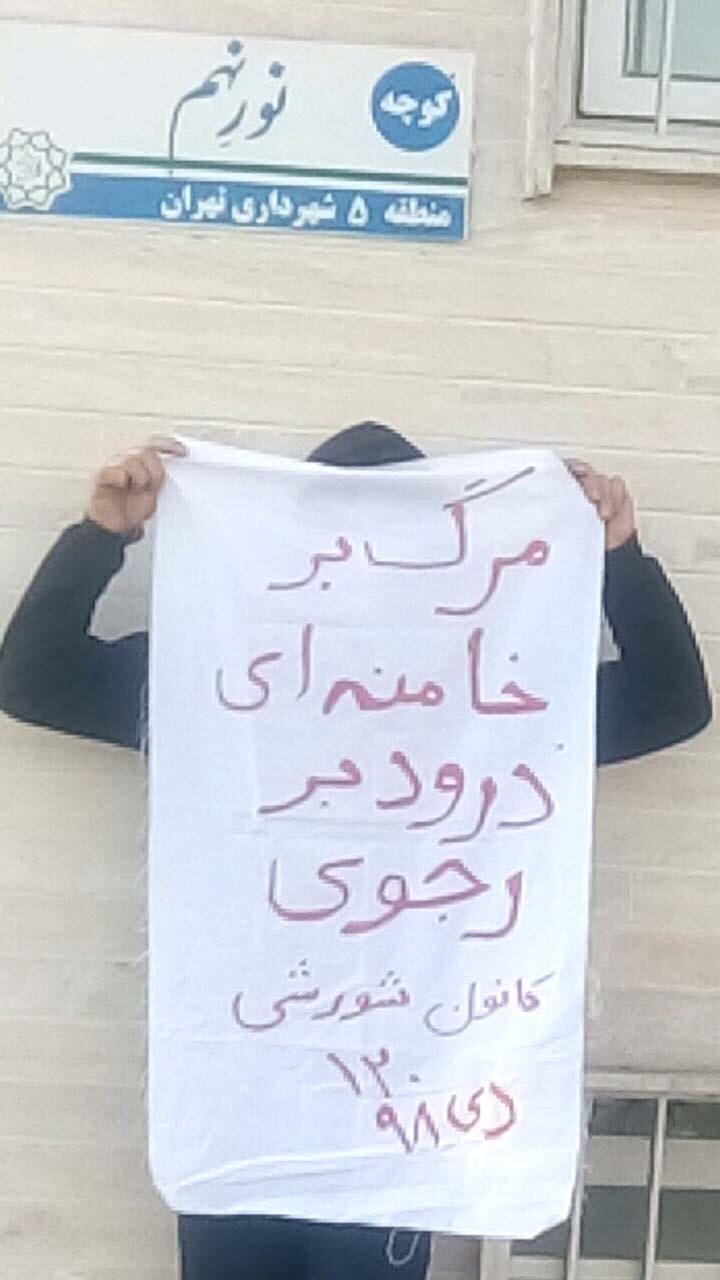
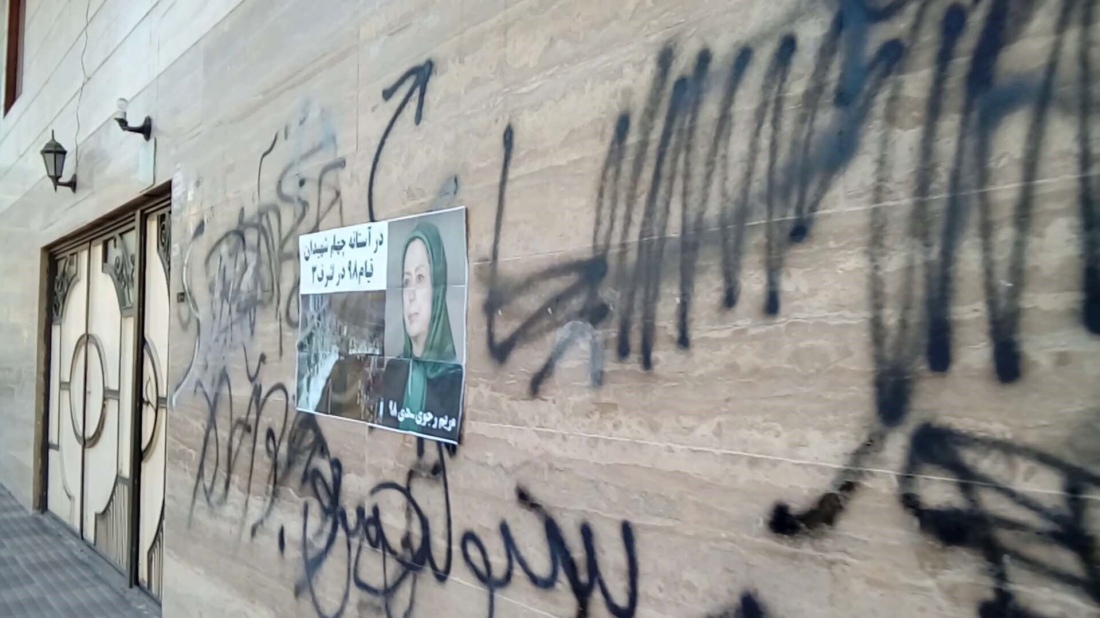
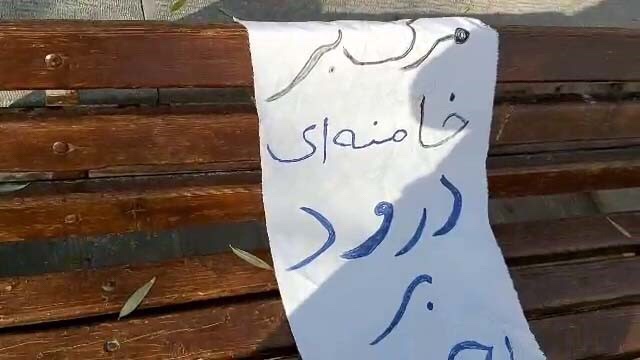
Iran: Posting messages, pictures of Resistance’s Leadership in Tehran, other cities on 40th day memorial of martyrs
On December 27, 2019, Resistance Units posted pictures and messages of Mrs. Maryam Rajavi, the President-elect of the National Council of Resistance of Iran (NCRI), and Mr. Massoud Rajavi, the Leader of the Iranian Resistance, in Tehran and other cities, including Tabriz, Isfahan, Karaj, Ahvaz, Neka (Mazandaran Province), and Golestan Province.
The banners read in part, “Khamenei, Rouhani must face justice for committing crimes against humanity,” “Death to Khamenei, hail to Rajavi,” “The blood of martyrs has blossomed into flowers,” “Hail to the proud martyrs of the Iranian people’s uprising,” “Hail to rebels for freedom, hail to Iran uprising for the overthrow [of the regime],” “Hail to heroes who shook the regime to its foundations,” “Blood of hundreds of martyrs have strengthened the resolve for rebellion in Iran,” and “The only answer to the Sheikh is fire.”
Secretariat of the National Council of Resistance of Iran
December 29, 2019
Tehran – District 5
Tehran- Picture and Message of Mrs. Maryam Rajavi, the President-elect of the NCRI
Tabriz – Vali Asr Park
Karaj-  Picture of Mrs. Maryam Rajavi, the President-elect of the NCRI
Isfahan
Ahvaz
Pictures and Messages of Mrs. Maryam Rajavi, the President-elect of the NCRI, and Mr. Massoud Rajavi, the Leader of the Iranian Resistance
Tabriz, Daneshsara Square – Picture of Mrs. Maryam Rajavi, the President-elect of the NCRI
Isfahan
Isfahan
Tabriz
Naka – Mazandaran Province