Showing posts with label economy. Show all posts

Saturday, May 22, 2021

The UK and French Nuclear Horns: Daniel 7

An F-35B fighter jet flies over HMS Queen Elizabeth as defence chiefs said the aircraft carrier will present a potent force when it teams up with the French carrier in the Mediterranean this summer. Getty

An F-35B fighter jet flies over HMS Queen Elizabeth as defence chiefs said the aircraft carrier will present a potent force when it teams up with the French carrier in the Mediterranean this summer. Getty

UK’s ‘HMS Queen Elizabeth’ to form powerful armada with French nuclear-powered carrier

Likelihood of Britain’s new warship flexing its might on maiden deployment is growing

Britain’s new HMS Queen Elizabeth warship will join France’s Charles de Gaulle aircraft carrier to form a highly potent armada in the Mediterranean in the coming months, defence chiefs say.

The Royal Navy’s £3 billion ($4.25bn) carrier with its 18 advanced F35 jets and the French Navy’s 30 Rafale fighters will present a considerable force, particularly against any Turkish forays in the Eastern Mediterranean over the summer.

HMS Queen Elizabeth is also ready to meet any potential ISIS threat at sea, senior naval commanders confirmed, as her maiden operational voyage approaches.

The likelihood of HMS Queen Elizabeth demonstrating her strength when she heads on the six-month deployment in the coming days is growing, with strikes against terrorist targets in Syria and Iraq being considered.

READ MORE

To pack a punch: UK’s maritime strike force must double in size

Furthermore, the carriers could be used against potential Houthi anti-ship missiles installations in Yemen, if it was decided they posed an imminent threat.

Defence chiefs have emphasised that the 65,000-tonne warship will lead an extremely potent force when it teams up with the French nuclear-powered carrier.

“There will be a very significant link-up with the French Navy in the Mediterranean with the Charles De Gaulle aircraft carrier and Queen Elizabeth which will come together and exercise together,” said Angus Lapsley, the MOD’s Director General Strategy. “This will help among other things underline just how potent the UK-French combined expeditionary force can be.”

The united fleet of more than a dozen of the world’s most modern warships, including Britain’s Type 45 missile destroyers and Astute hunter-killer submarines, will be the strongest force seen in the Mediterranean for decades.

It will also be a symbolic moment of Anglo-French unity following a souring of relations post-Brexit that saw the two country’s warships on opposing sides during a fishing spat off the island of Jersey earlier this month.

This will help among other things underline just how potent the UK-French combined expeditionary force can be

The fleet will present an imposing sight and a dilemma particularly for President Recep Tayyip Erdogan, who has tried to build up a reputation of Turkey’s military might with numerous foreign interventions.

The commander of Britain’s military operations, Vice Admiral Sir Ben Key, also suggested that the fleet would be able to contribute to the campaign against terrorists. “I am entirely sure we can meet the threat of ISIS from the strike group,” he said.

Defence chiefs have also made it clear that the F35 jets will be used to strike the extremists to prevent them gaining a foothold in Iraq.

Once the carrier strike group composed of six warships accompanying HMS Queen Elizabeth leaves the Arabian Sea in the summer, it will sail east to make four lengthy stops in Asia, in Singapore, India, South Korea and Japan.

The potential for a further flashpoint will come when it enters the South China Sea. The British government has yet to confirm whether HMS Queen Elizabeth will make a highly symbolic but provocative passage through the Taiwan Strait, just off the coast of mainland China.

Thursday, August 20, 2020

No Obstacle to Developing Nuclear Weapons: Iran (Daniel 8:4)

No Obstacle to Development of Strategic Arms in Iran: Defense Minister

No Obstacle to Development of Strategic Arms in Iran: Defense Minister

  • August, 18, 2020 – 18:12

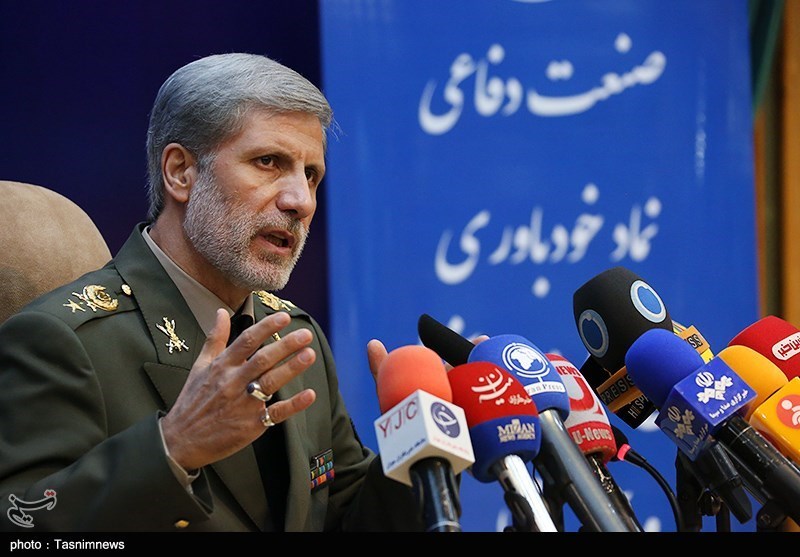
TEHRAN (Tasnim) – Iran’s Defense Minister Brigadier General Amir Hatami gave an assurance that Tehran faces no infrastructural hurdle in manufacturing strategic weapons inside the country.

In a meeting with members of the Iranian Parliament’s National Security and Foreign Policy Commission on Tuesday, Brigadier General Hatami said the Defense Ministry does not face any problem in the production of strategic weapons and products, thanks to various infrastructures inside the country.
He also noted that the Defense Ministry has successfully carried out the strategies to strengthen national security and maintain the deterrent power in cooperation with the Parliament.
Highlighting the abundant capacities and infrastructures available at the Defense Ministry for supplying the defense needs, the general said the Defense Ministry is prepared to help the country’s economic and civilian sectors with the surplus of its defense technologies and knowledge.
He further pointed to the great role that parliamentary support plays in preserving and boosting the Defense Ministry’s efforts to ensure security and national power, proposing that special funds for the defense-related research studies will help the country attain emerging technologies and respond to the threats, according to the Iranian government’s official website.
Iranian officials have repeatedly underscored that the country will not hesitate to strengthen its military capabilities, including its missile power, which are entirely meant for defense, and that Iran’s defense capabilities will be never subject to negotiations.
Leader of the Islamic Revolution Ayatollah Seyed Ali Khamenei has also called for efforts to maintain and boost Iran’s defense capabilities, hitting back at the enemies for disputing the country’s missile program.
“Without a moment of hesitation, the country must move to acquire whatever is necessary for defense, even if the whole world is opposed to it,” Ayatollah Khamenei said in February 2018.

Tuesday, August 18, 2020

The Trump Administration is Handed Another Humiliating Defeat

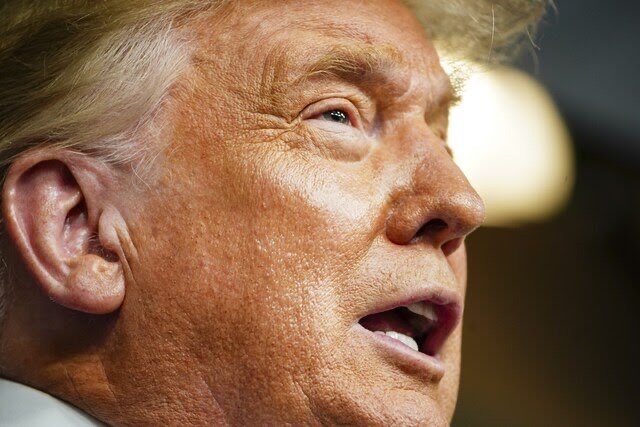
President Trump. (Jim Lo Scalzo/Bloomberg)
August 17, 2020 at 3:31 PM EDT
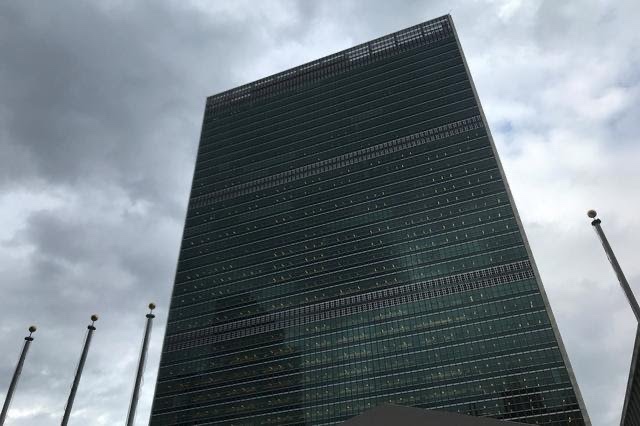
TWO DAYS after taking credit for the opening of diplomatic relations between Israel and the United Arab Emirates, the Trump administration suffered a humiliating reverse at the U.N. Security Council that was, in some ways, more telling about the results of its Middle East policies. The United States asked the council to approve an extension of the 13-year-old embargo on arms trade with Iran — something that matters greatly to Israel and U.S. Arab allies, and which most of the democratic world favors. Yet only one member of the 15-member council, the Dominican Republic, sided with Washington. Russia and China opposed the motion, while 11 countries — including Britain, France and Germany — abstained.
The vote could open the way for Iran to obtain Chinese and Russian arms — for example, missiles it could employ against Israel, the UAE or U.S. ships in the Persian Gulf. At the least, it demonstrated how the Trump administration’s attempt to crush Iran’s Islamic regime has instead made it more dangerous, while isolating the United States.
The U.N. defeat was a direct result of President Trump’s repudiation of the 2015 accord limiting Iran’s nuclear program, which was brokered by the Obama administration in collaboration with the European Union, China and Russia. Mr. Trump claimed renewed U.S. sanctions would force a better deal; instead, Iran renewed its enrichment of uranium and launched attacks in the Persian Gulf. Now the arms embargo, which the U.N. resolution ratifying the nuclear pact extended to this October, is also gone. European allies chose not to vote for renewing it, in part because they wish to preserve what remains of the agreement, including U.N. inspections of Iranian nuclear facilities.
Trump administration officials sought to force the support of allies by threatening to invoke another provision of the nuclear deal allowing one of the parties to unilaterally mandate the renewal of the sweeping international sanctions regime that strangled Iran before 2015. But the U.S. right to invoke the provision after withdrawing from the pact is in question: Even Mr. Trump’s former national security adviser John Bolton, an unquestioned hawk on Iran, called it “too cute by half.” Mr. Bolton warns that such a move, which would involve using the U.S. veto to block a Security Council resolution preventing the resumption of sanctions, might not only fail, but result in the undercutting of the veto power.
Secretary of State Mike Pompeo, a prime architect of the failed Iran policy, railed against the Security Council’s vote, while promising unspecified U.S. action to stop Iran from obtaining new weapons. “We can’t allow the world’s biggest state sponsor of terrorism to buy and sell weapons,” Mr. Pompeo said. “I mean, that’s just nuts.” Agreed. But if Tehran nevertheless succeeds in doing so, it will be due to the gross malfeasance of Mr. Pompeo — and Mr. Trump’s foolish torching of the Obama administration’s legacy.

Monday, August 17, 2020

Iran hits Iraqi army base holding US troops

TWO rockets have hit an army base in Iraq holding US troops.
By REBECCA PERRING
20:06, Sat, Aug 15, 2020 | UPDATED: 22:10, Sat, Aug 15, 2020
Two Katyusha rockets fell in Iraq’s Taji base that hosts US-led coalition troops, the state news agency said on Saturday, citing a military statement. No injuries have been reported. Jason Brodsky, policy director at United Against Nuclear Iran, said: “Another rocket attack today on Camp Taji in #Iraq just days before its prime minister is scheduled to visit the White House on August 20.”
The attacks took place near to the border of Kuwait and just north of the capital.
The missile strikes did not cause any casualties but there was damage to equipment.

Time for Babylon the Great to Snapback

NEW YORK (Reuters) – The United States on Friday failed in its attempt to extend a U.N. arms embargo on Iran, and Washington could now act on a threat to trigger a return of all U.N. sanctions on Tehran.
Here is a look at the events leading to the showdown and an explanation of what could happen next.
WHY IS THE ARMS EMBARGO ON IRAN EXPIRING?
ADVERTISEMENT
The United Nations Security Council imposed an arms embargo on Iran in 2007.
The embargo is due to expire in mid-October, as agreed to under the 2015 nuclear deal among Iran, Russia, China, Germany, Britain, France and the United States that prevents Tehran from developing nuclear weapons in return for economic sanctions relief. That accord is enshrined in a 2015 Security Council resolution.
In 2018, U.S. President Donald Trump quit the accord reached under his predecessor Barack Obama, calling it “the worst deal ever.”
The United States failed on Friday in a bid to extend the arms embargo on Iran at the U.N. Security Council.
WHAT DOES THIS MEAN FOR THE 2015 NUCLEAR DEAL?
Even though the United States has withdrawn from the nuclear deal, Washington has threatened to use a provision in the agreement to trigger a return of all U.N. sanctions on Iran if the Security Council does not extend the arms embargo.
While diplomats have predicted that the so-called sanctions snapback process at the Security Council would be messy – with the remaining parties to the nuclear deal opposed to such a move – it could ultimately kill the nuclear deal because Iran would lose a major incentive for limiting its nuclear activities.
After the United States quit the deal, it imposed strong unilateral sanctions. In response, Iran has breached parts of the nuclear deal.
Iran’s Foreign Minister Mohammad Javad Zarif on Tuesday described the next few weeks and months as critical.
WHAT SANCTIONS WOULD SNAP BACK?
A snapback of U.N. sanctions would require Iran to suspend all nuclear enrichment-related and reprocessing activities, including research and development, and ban imports of anything that could contribute to those activities or to the development of nuclear weapon delivery systems.
It would reimpose the arms embargo, ban Iran from developing ballistic missiles capable of delivering nuclear weapons and reimpose targeted sanctions on dozens of individuals and entities. Countries also would be urged to inspect shipments to and from Iran and authorized to seize any banned cargo.
ADVERTISEMENT
HOW DOES THE UNITED STATES TRIGGER A SANCTIONS SNAPBACK?
The United States would have to submit a complaint about Iran breaching the nuclear deal to the Security Council.
The council would then have to vote within 30 days on a resolution to continue Iran’s sanctions relief. If such a resolution is not put forward by the deadline, all U.N. sanctions in place before the 2015 nuclear deal would be automatically reimposed.
Some diplomats have said the United States could submit its complaint as early as next week.
CAN THE U.S. EFFORT BE STOPPED?
It was not immediately clear how Russia, China or any other Security Council members might try to stop the United States from triggering a sanctions snapback or if procedurally there is any way they can.
Diplomats have said several countries are likely to argue that the United States legally could not activate a return of U.N. sanctions and therefore they simply would not reimpose the measures on Iran themselves.
(Reporting by Michelle Nichols; Editing by Will Dunham)

Provoking the Iranian Horn

Bijan Zanganeh, the Minister of Oil, in September 2019 said: “The current economic situation in the country has become more difficult since the war because during the war we sold oil without any restrictions, the money from the sale of oil went to the banks and we bought whatever we wanted.”
Translating the words of this official, as he said, “we bought whatever we wanted”, are the staggering costs of the war, taken from the pockets of the people. Things like the purchase of TOW and Hawk missiles as well as F-4 and M-60 spare parts, and AIM-9 Sidewinder and of course many other things and war equipment.  In those circumstances, the people were only able to provide their basic goods by coupons. Long queues to buy oil and gas, as well as basic necessities such as chicken, cheese, sugar, were part of people’s daily lives. In those years, in some months of the year, Iran’s oil sales had dropped from a few million barrels per day to 1,000 barrels per day, and the Iranian economy was in a severe recession.
Now after a year the state-run daily Aftab Yazd, while repeating the confessions of the regime’s Minister of Oil, quoting an economic specialist, Morteza Afagheh wrote:
Our current economic and political situation is much worse than it was during the war, because during the war, although there were trade restrictions, we were able to sell oil and import the goods we needed, and the population was not so large. But in the current situation, we are not able to sell oil and we cannot import the required goods in the reserve currency.
“Nor can we import currency from the goods we possibly sell through the banking system. But we have to admit that three decades after the war, we recklessly lost a lot of resources and failed to bring the economy to a point where people are not under so much pressure and below the poverty line under sanctions.” (Aftab Yazd, 6 August 2020)
The question is where the huge oil revenues have gone over the past few decades and on what priority are, they spent. What about other non-oil products? What has happened to fisheries, petrochemicals, forests and mines, and other national resources over all these years?
These are the main questions that no one in Iran will answer because tracking the traces of all these resources, you will land on nowhere else than the so-called Beyt-e-Khamenei (House of the supreme leader Ali Khamenei), and of course, this is a red line.
But such people are not even concerned about Iran and the people’s lives, instead their main concerns are just the security and the existence of this regime. Of course, to find out a way, not to been overthrow:
“We should blame the people who in these three decades, especially in the eighties (Persian calendar equivalent to the 2000s), with their abundant oil revenues, could not take the economic infrastructure to a position where we do not suffer so much now. Now more than 40 percent of the population is below the poverty line and measures must be considered, otherwise socio-political and economic tensions are inevitable.” (Aftab Yazd)
About the illusion of the coupon, the state-run daily Jahan Sanat on 6 August wrote: “Granting a commodity coupon to the poor and needy can be useful in the current difficult and complex situation and provide the poor with a minimum standard of living, but the implementation of this policy requires the allocation of huge financial resources by the government. At the same time, the government has been unable to cover its current costs and is struggling with all kinds of costs, from retirement costs to the payment of workers’ salaries to state-owned and semi-government companies.”
The regime is investing all of its resources on its global terror and supporting its proxy groups from Lebanon’s Hezbollah to Iraq on the Al-Hashd Al-Sha’bi (PMF) and the Houthis in Yemen, and many other places. So, nothing will be left for the people.

Sunday, August 16, 2020

Trump Claims the Obvious About Iran

August 14, 20202 Min Read
President Trump asserted on Twitter Wednesday that Iran was plotting a “sneak assault” on US troops or amenities in Iraq — together with the bottom that was hit in a previous missile strike after the USA killed a high Iranian navy chief.
“Upon data and perception, Iran or its proxies are planning a sneak assault on U.S. troops and/or belongings in Iraq. If this occurs, Iran can pay a really heavy value, certainly!” Trump wrote.
The tweet adopted the revelation that the US had deployed Patriot air-defense techniques to an Iraqi navy base as a precaution towards Iranian-backed militia assaults, the web site Center East Eye reported, citing US and Iraqi navy sources.
One battery was deployed to the Ain al-Asad base final week and was being assembled, in line with the report.
The bottom was focused by Iran in January, following a US strike that killed Iranian Gen. Qassem Soleimani, whom the Washington accused of plotting terrorist operations.
The White Home didn’t instantly reply to a request for remark.
Trump’s tweet got here as each nations have been struggling to comprise the coronavirus outbreak.
Iran has 47,593 circumstances and three,036 deaths so far.
Secretary of State Mike Pompeo mentioned late final month that Iran had rejected gives of US assist to fight the pandemic.
Pompeo additionally ­condemned Iranian Supreme Chief Ayatollah Ali Khamenei for promulgating conspiracy theories that the USA was accountable for the outbreak, and identified Iran’s personal misdeeds that he claimed exacerbated the unfold of the virus.
“The U.S. has provided $100M+ in medical assist to different nations—together with Iran—and our scientists are working 24/7 to develop a vaccine. @khamenei_ir has rejected American gives and spends 24/7 concocting conspiracy theories. How does that assist the Iranian individuals?” Pompeo tweeted, ­referring to Khamenei.
US-Iranian relations have been bitter for the reason that Islamic Revolution ­toppled the US-backed shah of Iran, Mohammed Reza Pahlavi, in 1979 and ushered in an period of ­theocratic rule.
Whereas there was a ­detente with the 2015 Iran nuclear deal, relations have deteriorated with Trump’s choice practically two years in the past to desert that multilateral settlement and to reimpose US sanctions, which have have severely crippled the Iranian financial system.

Friday, August 14, 2020

The Shi’a Horn Vs Babylon the Great

Katie Bo WilliamsAugust 12, 2020
Countering the threat from Iran is the U.S. military’s top priority in the Middle East, America’s top commander in the region said Wednesday, blaming rocket attacks from Shiite militia groups in Iraq for hampering U.S. efforts to defeat ISIS in the region.
“As I look at the theater, we remain focused on Iran as our central problem. This headquarters focuses on Iran, executing deterrence activities against Iran, and doing those things,” U.S. Central Command head Gen. Kenneth McKenzie said at an U.S. Institute for Peace event.
“The threat against our forces from Shiite militant groups has caused us to put resources that we would otherwise use against ISIS to provide for our own defense and that has lowered our ability to work effectively against them,” McKenzie said.
In March, U.S. forces began pulling back from bases across Iraq, turning them over to Iraqi security partners. At the time, Pentagon officials insisted that the base hand-offs were part of a long-planned consolidation that reflected the success of the anti-ISIS fight — not concerns over the ongoing rocket attacks by Iran-linked proxy militias.
On Wednesday, McKenzie reiterated that justification, saying that Iraqi security forces had improved their ability to fight ISIS and that “the fact that we’re getting smaller is actually a sign of campaign progress.”
But the CENTCOM commander also explicitly linked the withdrawals to the threat from Iran. 
“Over the last seven or eight months, we have had to devote resources to self-protection that we would otherwise devote for the counter-ISIS fight and we’ve had to pull back and our partners have had to pull back,” he said. “At the same time we’ve done things to harden our positions to make it more difficult for Iran to attack us in Iraq — but it has had an effect.”
Rocket attacks have continued to target U.S. military and diplomatic installations in Iraq during the spring and summer, although tensions have ebbed since January, when the United States killed top Iranian general Qassem Soleimani. The Trump administration has made constraining Iranian military adventurism in the Middle East a cornerstone of its foreign policy. In 2018, the president withdrew from the Iran nuclear deal struck by his predecessor, in part over concerns it didn’t go far enough to restrain other bad behavior from Tehran. Critics say Iran is now closer to acquiring a nuclear weapon, while continuing to lash out militarily as it struggles under pressure from withering sanctions applied by the Trump administration.
McKenzie cautioned that a final “defeat” of ISIS is unlikely — because there will always be pockets of fighters enamoured with the ideology — but that the hope is that the United States will eventually be able to hand off the fight to local security forces.
“There’s not going to be a significant victory celebration. There’s not going to be a clear-cut military victory,” McKenzie said.
He also acknowledged that the U.S. military presence in Syria has no clear end in sight.
“I don’t think we’re going to be in Syria forever. I don’t know how long we’re going to be in Syria,” he said. “That’s going to be a political decision, not a military decision.”
But, he added, “As long as we remain, we’re going to work very hard to finish off ISIS.”

Payback is Coming to Babylon the Great

Tasnim News Agency
“Our enemies should know that nowhere is safe for them,” General Salami said on Thursday, during a ceremony marking the 14th anniversary of Lebanon’s historic victory in the 33-day war of 2006 against Israel.
With the assassination of Hajj Qassem, they (the enemies) created a permanent source of danger and revenge for themselves. Sooner or later, there will be a revenge for his death and certainly it will be harsh,” he added. 
The Iranian General and his companions were assassinated in a US airstrike near Baghdad airport on January 3, as General Soleimani was on an official visit to the Iraqi capital.
In late July, Leader of the Islamic Revolution Ayatollah Seyed Ali Khamenei said Iran will never forget Washington’s assassination of General Soleimani and will definitely deliver a “counterblow” to the United States.
“The Islamic Republic of Iran will never forget this issue and will definitely deal the counterblow to the Americans,” Ayatollah Khamenei said in a meeting with visiting Iraqi Prime Minister Mustafa al-Kadhimi in Tehran.
“They killed your guest at your own home and unequivocally admitted the atrocity. This is no small matter,” the Leader told the Iraqi premier.

Friday, June 26, 2020

Babylon the Great Sanctions the Iranian Nuclear Horn

‘SNAP BACK’ FUSS: The US secretary of state said that Washington has the ability to put sanctions back in place, but Russia’s envoy said the US had no right to do so
AP, UNITED NATIONS
US Secretary of State Mike Pompeo on Wednesday threatened to seek to reimpose UN sanctions on Iran if the UN Security Council does not approve a resolution that would indefinitely extend the arms embargo on Tehran, which is set to expire in October.
Pompeo told a news conference at the US Department of State in Washington that without extending the arms embargo, “Iran will be able to purchase advanced weapons systems and become an arms dealer of choice for terrorists and rogue regimes all throughout the world. This is unacceptable.”
He spoke ahead of a closed video briefing to Security Council members on a US draft resolution to maintain the arms embargo by US Special Representative for Iran Brian Hook and US Ambassador to the UN Kelly Craft.
Tensions between Iran and the US have escalated since Washington in 2018 withdrew from the 2015 nuclear deal between Tehran and six major powers and reimposed US sanctions.
A year ago, the US sent thousands more troops, long-range bombers and an aircraft carrier to the Middle East in response to what it called a growing threat of Iranian attacks on US interests in the region.
The five other powers that signed the nuclear deal — Russia, China, the UK, France and Germany — remain committed to it, saying that the agreement is key to continuing inspections by the International Atomic Energy Agency and preventing Iran from pursuing nuclear weapons.
Lifting the arms embargo is part of the 2015 Security Council resolution endorsing the nuclear agreement. The council is scheduled to discuss the resolution’s implementation on Tuesday next week.
“But, in the event that doesn’t happen, I would remind the world that the [former US president Barack] Obama administration’s officials said very clearly that the United States has the unilateral ability to snap back sanctions into place,” he said.
The 2015 nuclear deal includes a “snap back” provision that would restore all UN sanctions against Iran that had been lifted or eased if the nuclear deal is violated.
The State Department said that in his briefing, Hook pointed to Iranian arms transfers and “the full range of Iran’s malign activity, including its September 2019 direct attack on Saudi Arabia,” which violate current restrictions.
Drone strikes hit two Saudi Arabian oil installations on Sept. 14, which the US blamed on Iran.
Russian Ambassador to the UN Vassily Nebenzia said that Moscow opposes a new arms embargo and has dismissed as “ridiculous” the possibility of Washington using the “snap back” provision.
Nebenzia said that the US pulled out of the agreement and “they have no right” to its provisions.
However, Pompeo and Craft said the resolution makes it clear that the US retains to right to use the “snap back” provision.

The Iranian Nuclear Horn Continues to Grow

by Raphael Ofek
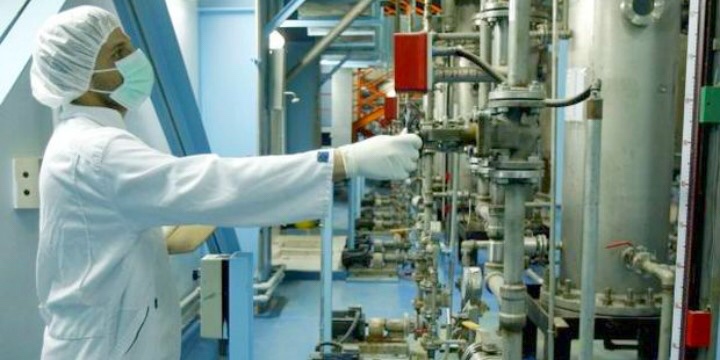
An IAEA inspector at an Iranian nuclear facility. Photo: IAEA.
The International Atomic Energy Agency (IAEA) Director-General issued a report on June 5 that is worded to deflate Iran’s renunciation of its signing of the JCPOA nuclear agreement. The report notes Tehran’s announcement on January 5 that its nuclear program is no longer “subject to any restrictions in the operational sphere,” but also notes that it claims a willingness to “continue to cooperate with the agency as in the past.”
On June 1, Iran notified the agency that it had decided to stop implementing its commitment to limit centrifuge research and development. The report goes on to detail Tehran’s many deviations from the nuclear agreement, as discovered by the IAEA inspectors. These deviations include the following:
• On July 1, 2019, the agency verified that Iran’s accumulated enriched uranium stock exceeds the allowable amount of 300 kg of UF6 (uranium hexa-fluoride compound used in the uranium enrichment process) enriched to 3.67% (uranium content at 300 kg UF6 is 202.8 kg).
• On July 9, 2019, Iran began enriching uranium up to 4.5%, above the allowable rate of 3.67%.
• On November 6, 2019, Iran began once again to enrich uranium at the Fordow facility using 1,044 IR-1 centrifuges (Iran’s first centrifuge model).
• On May 11, 2020, Iran’s heavy water stockpile reached 132.6 tons. This exceeds the quantity allowed for aggregation (up to 130 tons).
• According to recent IAEA examinations, Iran has developed and manufactured centrifuge components as well as assembled centrifuge cascades in violation of the nuclear agreement.
• On May 20, 2020, the IAEA verified that the enriched uranium stockpile accumulated by Iran had reached a volume of 1,571.6 kg (550.7 kg over the amount found in the previous quarterly report). This quantity included 873.4 kg of enriched uranium to 4.5%, 215.1 kg of uranium enriched at 3.67%, and uranium enriched up to 2% or less. This is a significant breach of the agreement by Iran.
• The most significant deviation from the agreement, which was discovered on June 1, 2020, was the operation at the Natanz enrichment plant of advanced centrifuges developed in Iran for uranium enrichment to 4.5%: 164 IR-2m centrifuges, 164 IR-4 centrifuges, and 164 IR-6 centrifuges. According to a report by the Washington-based Institute of Science and International Security (ISIS) of June 8, 2020, which referred to the latest IAEA report, the IR-2m centrifuge enrichment capacity is 3.7 SWU (Separative Work Unit) per year, the estimated capacity of the IR-4 model is about 3.3 SWU/year, and the estimated capacity of the IR-6 centrifuge is 6.8 SWU/year. This can be compared with the first Iranian model, the IR-1, which, based on IAEA reports from the first half of this decade, is about 0.9 SWU/year.
As previously reported in the media, for example in the case of Pakistan’s nuclear weapons project (Pakistan, as is well known, has supplied know-how on this topic to Iran in the past), to enrich natural uranium (whose fissile uranium-235 isotope’s concentration is about 0.7%) to 90% (weapons grade), the enrichment process must be performed in four steps. They are enrichment to less than 5%; enrichment of the product obtained from the previous stage to 20%; enrichment to 60%; and finally to 90%. Theoretically, if Iran’s current uranium quantities — one portion enriched to 4.5% (873.4 kg) and the other to 3.67% (215.1 kg) as of May 20 — were subsequently enriched to 20%, 60%, and 90%, the final product would be about 15 kg of uranium enriched to 90%. That is enough to produce one nuclear bomb core.
The enrichment capacity required for this is approximately 2,800 SWU. If we include the IR-1 centrifuges that Iran operates — 5,600 at Natanz and 1,044 at Fordow — Iran’s current enrichment capacity is about 8,240 SWU/year. This implies that within four months, Iran could possibly break out of its commitment to the NPT and enrich the amount of uranium it needs for its first nuclear bomb.
Kazem Garibabadi, Iran’s representative at the IAEA, confirmed the data presented in the IAEA’s latest report. He stressed that while Iran has suspended its 2015 commitments under the JCPOA nuclear agreement, it continues to cooperate with the IAEA in “nuclear verification and monitoring.” As for its decision in January to withdraw from the agreement, Tehran said that was in response to the sanctions imposed on it by the US and a signal to the EU, which it believes has not acted sufficiently to revoke or circumvent those sanctions.
Garibabadi’s comments appeared to reflect his country’s official statement that its nuclear program is “peaceful,” and that its signing of the 2015 nuclear agreement was “voluntary.” He also apparently wanted to send a message to the IAEA member states that Iran’s significant progress in developing its enrichment program is of a civilian nature. Iran’s presentation of itself as a country building a peaceful nuclear program is flatly contradicted by the vast amount of intelligence revealed to date, particularly that gleaned from the “Iran’s Nuclear Archive” operation. That intelligence unequivocally indicated that the program is intended primarily for nuclear weapons production.
According to a March 3 report, the IAEA said it has identified three sites in Iran, undisclosed by the regime, where it may be storing undeclared nuclear materials or carrying out nuclear-related activities. In a statement to the IAEA’s Board of Governors on March 9, IAEA Director-General Rafael Grossi urged Iran to fully cooperate with IAEA inspectors and allow them quick access to the suspected sites. Garibabadi had this to say on the matter: “’Intelligence services’ (of course Western services) fabricated information … [which] creates no obligation for Iran to consider such requests.”
In April, a cyber-attack attributed to Iran on Israeli water facilities was intended to increase the concentration of chlorine in the drinking water of Israeli citizens. Had it succeeded, the attack would have sickened many Israeli civilians and deprived many more of drinking water during a heat wave. Fortunately, the Iranian attack was detected at its beginning and thwarted before it could do any damage.
Iran’s attempt to poison the citizens of a country it considers to be an enemy demonstrates its willingness to go very far to harm the State of Israel. As it has stated many times over four decades, it wishes to destroy Israel completely. If it succeeds in achieving a nuclear arsenal, that would constitute an existential threat to Israel.
Lt. Col. (res.) Dr. Raphael Ofek, a BESA Center Research Associate, is an expert in the field of nuclear physics and technology who served as a senior analyst in the Israeli intelligence community.
A version of this article was originally published by The BESA Center.

The East Fails the Iranian Horn

Alex VatankaJune 24, 2020, 10:15 AM
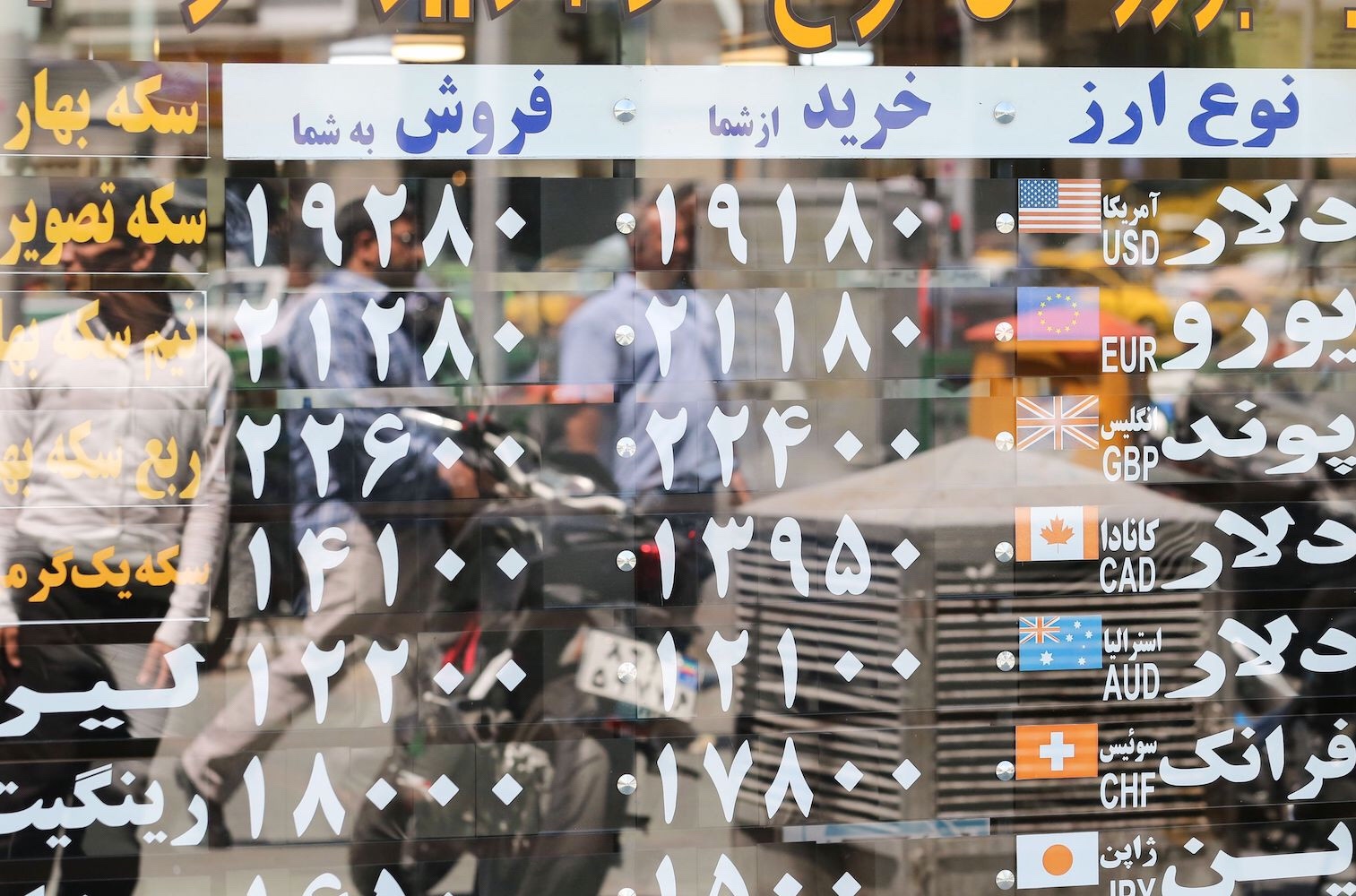
Pedestrians are reflected in a window displaying currency exchange rates in the Iranian capital Tehran on June 22. Atta Kenare/AFP/Getty Images
Officials in Tehran have a lot to worry about. But they are particularly irked at the speed by which Asian states have dropped Iran as a trading partner. Iran had hoped that the East would save the country’s economy from the barrage of sanctions enacted by the administration of U.S. President Donald Trump. In early 2018, at a time when Trump and his team were about to unveil the most punishing sanctions regime ever imposed on a country, Supreme Leader Ali Khamenei explicitly urged Tehran to look east for trading partners. Khamenei’s track record in vilifying the West is lengthy, with the ayatollah regularly scorning any official in Tehran who disagreed as a simpleton or “unreasonable.” But his alternative has so far proved to be nothing but a pipe dream. Even so, Khamenei maintains the charade of a promised bailout.
Over the course of the Trump presidency, Iran’s relations with Asian countries have varied, but there is no sign of a clear success anywhere. Among the country’s big former trading partners, South Korea and India stand out as the most eager to respect U.S. sanctions on Iran. They stopped buying Iran’s oil, halted any long-term investments they had in Iran, and more or less refuse to sell anything to the country. In June, after two years of negotiations, South Korea finally sent to Iran a cargo of humanitarian goods worth $500,000. Another shipment worth $2 million is said to be under way, but only if Seoul first secures the approval of Washington.
Tehran is also livid that Seoul is still blocking payments of some $7 billion for oil that was exported to South Korea before U.S. sanctions were implemented in late 2018. Iranian media are full of headlines demanding not only that Koreans pay up but also that they hand over maintenance fees for having kept the money in two South Korean banks. Iranian President Hassan Rouhani has asked his government take legal action against Seoul to deter other countries from behaving the same way.
Iran’s protestations have had few results. When in 2019 the South Korean companies Samsung and LG announced that they would stop operating in Iran, officials in Tehran warned them that coming back to the Iranian market might not be so easy. “Commercial logic dictates that keeping a market is easier than reentering a market once you leave,” said one. Still, the South Koreans left. Although Iran does represent a big market, of course, the United States represents a bigger one.
South Korea is not alone. Take India. New Delhi has in recent years rebuffed Tehran at every critical turn. When the Trump administration first reimposed sanctions on Iran in 2018, the Indians first sought to push for a hard bargain with Tehran. India has historically had a large trade deficit with the country. In 2018, for example, its imports amounted to around $13 billion from Iran, but its exports were worth merely $3 billion. New Delhi was looking to address that imbalance. The Indians offered a barter of oil for goods. It was a major setback for Tehran, since such an arrangement would have deprived it of much-needed foreign currency exchange. In the end, U.S. pressure was impossible for the Indian government to resist, and it basically cut Iran loose altogether.
The United States had even given New Delhi a waiver so it could continue as an investor and operator in the development of Iran’s deep-sea port at Chabahar on the Gulf of Oman, but the Indians still dragged their feet on that project. Chabahar has long been touted as India’s strategic conduit to markets in Afghanistan and in Central Asia and as a regional counter to the Chinese-sponsored port of Gwadar in Pakistan. But India had second thoughts, and Tehran’s anger was palpable. In retaliation, Khamenei himself has begun to issue criticism of Indian policies in Kashmir, a conflict he had in the past largely ignored.
Among Iran’s other top trading partners in the East, Japan and China stand out for different reasons. In the case of Japan, Tokyo swiftly ended trade with Iran in compliance with U.S. sanctions. Still, the government, as former National Security Advisor John Bolton’s new book underscores, was at the same time happy to play a possible mediator role between Tehran and Washington. Since Japan is a top U.S. ally, Tehran never held out much hope for maintaining trade with Tokyo, but it seemed to genuinely appreciate Japanese efforts aimed at a diplomatic resolution. This was evident in Rouhani’s decision to pay a state visit to Tokyo in December 2019, the first by an Iranian president since 2000. Even as Japanese mediation failed to result in a breakthrough, Tokyo’s handling of the U.S.-Iranian standoff stood out as rather skillful diplomatic navigation.
Meanwhile, in Tehran’s eyes, China has ranged from being a potential silver bullet to the mother of all disappointments. In May 2019, Foreign Minister Mohammad Javad Zarif visited China on a two-pronged mission. Zarif asked Beijing to help save the Iran nuclear deal of 2015, which the Trump administration left in May 2018. He also pushed the Chinese to continue to buy Iran’s oil and ignore U.S. sanctions. At first it looked like Zarif’s message had been well received. As he was in Beijing, it was reported that a tanker with Iranian oil had delivered its cargo to a Chinese port. This was the first time Iranian oil arrived in China since the Trump administration put a total ban on all Iranian oil exports starting in late 2018.
Just a few weeks before, at the January 2019 Munich Security Conference, Zarif had admonished the Europeans for abandoning trade with Iran under U.S. pressure. The Europeans had that month launched Instex, a mechanism to facilitate trade with Iran, but it was already clear that European investors and firms were rushing out of Iran. Only China could be Iran’s economic savior—or so the thinking went in Tehran. In fact, for the year 2019, Iran-China trade dropped by one-third to a total of around $23 billion. Both Iran and ChinaX are exporting less to each other.
The alarming data was revealed at a time when the Iranian public was already increasingly anti-Chinese due to the coronavirus, which had arrived in Iran from China sometime in late 2019. The state of affairs became so tense that China’s ambassador to Tehran, Chang Hua, had to write an open letter. He explained that the downturn in trade was due to the COVID-19 crisis in China and that it would be temporary. Since then, the Chinese ambassador has periodically reminded the Iranian public that China has long-term strategic plans for Iran and said that it is bound to be a country that will eventually dominate the global economy.
Still, while China has a strong protector in Tehran in Khamenei, there are official voices within the ranks of the ruling class that question the logic behind Iran putting all its eggs in the Chinese basket. Iran’s dependence on Beijing is creating tough questions about Tehran’s inability to risk offending its partner. And yet, the two institutions most dedicated to China in Iran are the Office of the Supreme Leader and his armed foot soldiers in the Islamic Revolutionary Guard Corps, the two most significant centers of power in the country. This is why China feels comfortable in its position as Tehran’s matchless foreign partner.
There is no doubt that Iran’s relationship with China is bigger than mere trade. As was evident in China’s vote against censuring Iran at the International Atomic Energy Agency on June 19, Iran and China have a multitiered engagement. Most notably, each see the other as a card to be played in their respective tugs of war with the United States. But even in the unlikely event that Beijing comes through for Iran in saving its economy from U.S. sanctions, this would not be tantamount to a successful Iranian anchor in the so-called East as Khamenei has for years advocated. It is more a case of subjugation to China and its interests. There is otherwise no sign of a working Iranian policy toward the East. There are plenty of analysts and commentators in Tehran who recognize this hard reality, but very few are willing to stick their necks out and say so publicly and loudly. After all, self-censorship is a way of life for Iranian officials, and very few of them dare to question the purported wisdom of Ayatollah Khamenei’s much-coveted pivot to the East.
Alex Vatanka is a senior fellow and the director of the Iran Program at the Middle East Institute in Washington, D.C. His forthcoming book is The Battle of the Ayatollahs in Iran: The United States, Foreign Policy and Political Rivalry Since 1979. Twitter: @AlexVatanka

Thursday, June 25, 2020

Iran Approaching Nuclear Breakout (Daniel 8:4)

Lt. Col. (res.) Dr. Raphael Ofek
June 24, 2020
Main sites of Iran’s nuclear program, image by Yagasi, translation of original work by Sémhur, via Wikimedia Commons
BESA Center Perspectives Paper No. 1,614, June 24, 2020
EXECUTIVE SUMMARY: Iran continues to insist that its nuclear program is designed for peaceful purposes despite all evidence of its military nature. This evidence includes the IAEA’s recent findings regarding Tehran’s progress in the field of uranium enrichment. Given Iran’s current uranium holdings and enrichment capabilities, it can theoretically break out from its NPT commitment and develop its first nuclear bomb within four months.
The International Atomic Energy Agency (IAEA) Director-General issued a report on June 5, 2020 that is worded to deflate Iran’s renunciation of its signing of the JCPOA nuclear agreement. The report notes Tehran’s announcement on January 5 that its nuclear program is no longer “subject to any restrictions in the operational sphere,” but also notes that it claims a willingness to “continue to cooperate with the agency as in the past.”
Be that as it may, the report is hardly reassuring.
On June 1, Iran notified the agency that it has decided to stop implementing its commitment to limit centrifuge research and development. The report goes on to detail Tehran’s many deviations from the nuclear agreement, as discovered by the IAEA inspectors. These deviations include the following:
• On July 1, 2019, the agency verified that Iran’s accumulated enriched uranium stock exceeds the allowable amount of 300 kg of UF6 (uranium hexa-fluoride compound used in the uranium enrichment process) enriched to 3.67% (uranium content at 300 kg UF6 is 202.8 kg).
• On July 9, 2019, Iran began enriching uranium up to 4.5%, above the allowable rate of 3.67%.
• On November 6, 2019, Iran began once again to enrich uranium at the Fordow facility using 1,044 IR-1 centrifuges (Iran’s first centrifuge model).
• On May 11, 2020, Iran’s heavy water stockpile reached 132.6 tons. This exceeds the quantity allowed for aggregation (up to 130 tons).
• According to recent IAEA examinations, Iran has developed and manufactured centrifuge components as well as assembled centrifuge cascades in violation of the nuclear agreement.
• On May 20, 2020, the IAEA verified that the enriched uranium stockpile accumulated by Iran had reached a volume of 1,571.6 kg (550.7 kg over the amount found in the previous quarterly report). This quantity included 873.4 kg of enriched uranium to 4.5%, 215.1 kg of uranium enriched at 3.67%, and uranium enriched up to 2% or less. This is a significant breach of the agreement by Iran.
• The most significant deviation from the agreement, which was discovered on June 1, 2020, was the operation at the Natanz enrichment plant of advanced centrifuges developed in Iran for uranium enrichment to 4.5%: 164 IR-2m centrifuges, 164 IR-4 centrifuges, and 164 IR-6 centrifuges. According to a report by the Washington-based Institute of Science and International Security (ISIS) of June 8, 2020, which referred to the latest IAEA report, the IR-2m centrifuge enrichment capacity is 3.7 SWU (Separative Work Unit) per year, the estimated capacity of the IR-4 model is about 3.3 SWU/year, and the estimated capacity of the IR-6 centrifuge is 6.8 SWU/year. This can be compared with the first Iranian model, the IR-1, which, based on IAEA reports from the first half of this decade, is about 0.9 SWU/year.
As previously reported in the media, for example in the case of Pakistan’s nuclear weapons project (which, as is well known, has supplied knowhow on this topic to Iran in the past), to enrich natural uranium (whose fissile uranium-235 isotope’s concentration is about 0.7%) to 90% (weapons grade), the enrichment process must be performed in four steps. They are: enrichment to less than 5%; enrichment of the product obtained from the previous stage to 20%; enrichment to 60%, and finally to 90%. Theoretically, if Iran’s current uranium quantities—one portion enriched to 4.5% (873.4 kg) and the other to 3.67% (215.1 kg) as of May 20—were subsequently enriched to 20%, 60%, and 90%, the final product would be about 15 kg of uranium enriched to 90%. That is enough to produce one nuclear bomb core.
The enrichment capacity required for this is approximately 2,800 SWU. If we include the IR-1 centrifuges that Iran operates—5,600 at Natanz and 1,044 at Fordow—Iran’s current enrichment capacity is about 8,240 SWU/year. This implies that within four months, Iran could break out of its commitment to the NPT and enrich the amount of uranium it needs for its first nuclear bomb.
Kazem Garibabadi, Iran’s representative at the IAEA, confirmed the data presented in the IAEA’s latest report. He stressed that while Iran has suspended its 2015 commitments under the JCPOA nuclear agreement, it continues to cooperate with the IAEA in “nuclear verification and monitoring.” As for its decision in January to withdraw from the agreement, Tehran said that was in response to the sanctions imposed on it by the US and a signal to the EU, which it believes has not acted sufficiently to revoke or circumvent those sanctions.
Garibabadi’s comments appeared to reflect his country’s official statement that its nuclear program is “peaceful,” and that its signing of the 2015 nuclear agreement was “voluntary.” He also apparently wanted to send a message to the IAEA member states that Iran’s significant progress in developing its enrichment program is of a civilian nature.
Iran’s presentation of itself as a country building a peaceful nuclear program is flatly contradicted by the vast amount of intelligence revealed to date, particularly that gleaned from the “Iran’s Nuclear Archive” operation. That intelligence unequivocally indicated that the program is intended primarily for nuclear weapons production.
According to a March 3 report, the IAEA said it has identified three sites in Iran, undisclosed by the regime, where it may be storing undeclared nuclear materials or carrying out nuclear-related activities. In a statement to the IAEA’s Board of Governors on March 9, IAEA Director-General Rafael Grossi urged Iran to fully cooperate with IAEA inspectors and allow them quick access to the suspected sites.
Garibabadi had this to say on the matter: “’Intelligence services’ (of course Western services) fabricated information… [which] creates no obligation for Iran to consider such requests.”
In April, a cyberattack attributed to Iran on Israeli water facilities was intended to increase the concentration of chlorine in the drinking water of Israeli citizens. Had it succeeded, the attack would have sickened many Israeli civilians and deprived many more of drinking water during a heat wave. Fortunately, the Iranian attack was detected at its beginning and thwarted before it could do any damage.
Iran’s attempt to poison the citizens of a country it considers to be an enemy demonstrates its willingness to go far to harm the State of Israel. As it has stated many times over four decades, it wishes to destroy Israel completely. If it succeeds in achieving a nuclear arsenal, that would constitute an existential threat to Israel.
View PDF
Lt. Col. (res.) Dr. Raphael Ofek, a BESA Center Research Associate, is an expert in the field of nuclear physics and technology who served as a senior analyst in the Israeli intelligence community.

Wednesday, June 24, 2020

The Iranian Nuclear Horn Continues to Grow (Daniel 8:4)

Illustration on Iranian aims for nuclear armament by Linas Garsys/The Washington Times
Yet more evidence that those who despise us can’t be bought off
By Clifford D. May – – Tuesday, June 23, 2020
ANALYSIS/OPINION:
Baden-Wurttemberg is a bucolic state in southwest Germany but its capital is Stuttgart, one of the world’s great high-tech centers. Like other German states, Baden-Wurttemberg has its own intelligence agency.
That agency, the State Office for the Protection of the Constitution, last week released a lengthy report. An accompanying press release neglected to mention this nugget uncovered by my Foundation for Defense of Democracies (FDD) colleague, Benjamin Weinthal: The Islamic Republic of Iran, which for years has sworn that its nuclear research is exclusively for peaceful purposes, has been deploying agents in Baden-Wurttemberg.
Their mission: to acquire the “products and relevant knowhow” necessary “to complete existing arsenals, perfect the range applicability and effectiveness of their weapons and develop new weapons systems.”
This revelation comes at an inconvenient moment for those Americans and Europeans inclined to give the clerical regime the benefit of every doubt. Earlier this month, the International Atomic Energy Agency issued a report revealing that Iran’s rulers, in violation of their legally binding commitments under the Nuclear Non-Proliferation Treaty (NPT), have been preventing International Atomic Energy Agency (IAEA) inspectors from searching for undeclared nuclear materials and evidence of continuing work on nuclear weapons.
On Friday, the IAEA’s Board of Governors adopted a resolution demanding Tehran provide “prompt access” to sites where nuclear weapons research is suspected to have taken place in the past. The Islamic Republic reflexively dismissed the appeal as “unconstructive and disappointing.”
You need to understand that the NPT is entirely separate from the Joint Comprehensive Plan of Action (JCPOA), the deal President Obama concluded — despite congressional disapproval — with Iran’s rulers in 2015. Spin aside, the JCPOA was not designed to permanently shut down Tehran’s nuclear weapons program — only to put it on ice for a few years. In exchange, the Islamic Republic received hundreds of billions of dollars, and the promise that the river of funds would continue to flow.
President Trump and his advisers regarded the JCPOA as can-kicking, and withdrew the U.S. from it in 2018. But Iran’s rulers remained in the deal, along with France, Britain, Germany (the E3), Russia and China. That means that Tehran has continued to be bound by the commitments it made under the JCPOA. In response to violations of those commitments, E3 leaders have mostly turned a blind eye. Russia and China’s leaders seem to be enjoying the West’s predicament.
Iran’s rulers also have curated a nuclear archive to preserve information on weapons development, and created a secret organization, which is chaired by the founder of Iran’s nuclear weapons program and employs scientists who worked on that program.
In other words, we now have overwhelming evidence that the nuclear weapons development program whose existence Iran’s rulers have consistently denied continues to progress.
Activities not clearly prohibited (e.g. the development of missiles that can deliver nukes to targets anywhere on the planet) have been carried out overtly. Activities unambiguously restricted have been carried out covertly.
That should trigger a response, specifically: The re-imposition of the international sanctions that were lifted under the JCPOA.
It would be best if our European allies on the U.N. Security Council would demand such a “snapback.” But if they won’t, the United States has the power to do the job on its own.
Simply put — and giving credit where credit is due — Mr. Obama’s negotiators succeeded in passing a U.N. Security Council Resolution that authorizes any of the original parties to the JCPOA to re-impose international sanctions in response to Iranian violations. Nothing in the resolution suggests that America’s withdrawal from the JCPOA changes that.
The larger issue underlying this controversy merits a brief discussion. For decades, American and European strategists on both the left and the right have embraced the comforting notion that those who self-identify as our enemies can be transformed into friends through patient diplomacy and the prospect of economic rewards.
Mr. Obama had faith that Iran’s rulers, once in receipt of his respect and U.S. taxpayer cash, would decide they’d rather lead a nation than champion a cause (to borrow one of Henry Kissinger’s concepts). That would mean they’d focus on alleviating poverty at home, while ending the pursuit of regional hegemony (in the near-term) and “Death to America!” (in the long-term).
Similarly, both Bill Clinton and Donald Trump bet that visions of detente and economic benefits would mellow the dynastic Kim dictatorship in North Korea. In truth, the despots in Pyongyang have always taken whatever goodies were offered, while never contemplating serious concessions in return.
And, of course, for nearly half a century we’ve labored under the delusion that China’s Communist rulers were evolving into responsible stakeholders in the “liberal, rules-based, international order.” To that end, we provided them a seat on the U.N. Security Council, brought them into the World Trade Organization and elaborately intertwined their economy with ours.
<iframe src=”https://tpc.googlesyndication.com/safeframe/1-0-37/html/container.html?n=0&#8243; name=”1-0-37;15736;window.dicnf = {};(function(){/* Copyright The Closure Library Authors. SPDX-License-Identifier: Apache-2.0 */ ‘use strict’;var n=this||self,r=”closure_uid_”+(1E9*Math.random()>>>0),aa=0,ba=Date.now;function t(a){return a};var u;function v(a,b){this.b=a===ca&&b||””;this.a=da}var da={},ca={};function w(a){w[” “](a);return a}w[” “]=function(){};var ea=(a,b)=>”&adurl=”==a.substring(a.length-7)?a.substring(0,a.length-7)+b+”&adurl=”:a+b;let y=n.dicnf||{};function fa(a,b,c){a.addEventListener&&a.addEventListener(b,c,!1)};function A(a){try{var b;if(b=!!a&&null!=a.location.href)a:{try{w(a.foo);b=!0;break a}catch(c){}b=!1}return b}catch(c){return!1}}function ha(a,b){if(a)for(const c in a)Object.prototype.hasOwnProperty.call(a,c)&&b.call(void 0,a[c],c,a)}var ia=(a,b)=>{“complete”===a.readyState||”interactive”===a.readyState?b():a.addEventListener(“DOMContentLoaded”,b)};const B=[“FRAME”,”IMG”,”IFRAME”],ja=/^[01](px)?$/;function ka(a){return”IMG”!=a.tagName||!a.complete||a.naturalWidth&&a.naturalHeight?ja.test(a.getAttribute(“width”))&&ja.test(a.getAttribute(“height”)):!0} function la(a,b){var c;if(a=”string”===typeof a?document.getElementById(a):a){c||(c=(l,p,q)=>{l.addEventListener(p,q)});var d=!1,f=l=>{d||(d=!0,b(l))};for(var g=0;g<B.length;++g)if(B[g]==a.tagName){var e=3;var h=[a];break}h||(h=a.querySelectorAll(B.join(“,”)),e=2);var m=0;a=!1;for(g=0;g<h.length;g++){const l=h[g];if(!ka(l)){if(“IMG”==l.tagName)var k=l.naturalWidth&&l.naturalHeight?!0:!1;else try{k=”complete”===(l.readyState?l.readyState:l.contentWindow&&l.contentWindow.document&&l.contentWindow.document.readyState)? !0:!1}catch(p){k=!1}k?a=!0:(m++,c(l,”load”,()=>{m–;m||f(e)}))}}h=null;if(0===m&&!a&&”complete”===n.document.readyState)e=5;else if(m||!a){c(n,”load”,()=>{f(4)});return}f(e)}};function ma(a){const b=a.length;let c=0;return new C(d=>{if(0==b)d([]);else{const f=[];for(let g=0;g<b;++g)D(a[g],e=>{f[g]=e;++c==b&&d(f)})}})}function na(){let a;const b=new C(c=>{a=c});return new oa(b,a)}function D(a,b){new C(c=>{pa(a,d=>{c(b(d))})})}function qa(a,b){if(!a.b)if(b instanceof C)D(b,c=>{qa(a,c)});else{a.b=!0;a.c=b;for(b=0;b<a.a.length;++b)pa(a,a.a[b]);a.a=[]}}function pa(a,b){a.b?b(a.c):a.a.push(b)}class C{constructor(a){this.b=!1;this.a=[];a(b=>{qa(this,b)})}} var oa=class{constructor(a,b){this.b=a;this.a=b}};function E(a){return{visible:1,hidden:2,prerender:3,preview:4,unloaded:5}[a.visibilityState||a.webkitVisibilityState||a.mozVisibilityState||””]||0}function ra(a){let b;a.visibilityState?b=”visibilitychange”:a.mozVisibilityState?b=”mozvisibilitychange”:a.webkitVisibilityState&&(b=”webkitvisibilitychange”);return b};function F(a,b){a.google_image_requests||(a.google_image_requests=[]);const c=a.document.createElement(“img”);c.src=b;a.google_image_requests.push(c)}var sa=(a,b)=>{var c;if(c=a.navigator)c=a.navigator.userAgent,c=/Chrome/.test(c)&&!/Edge/.test(c)?!0:!1;c&&a.navigator.sendBeacon?a.navigator.sendBeacon(b):F(a,b)};let G=null;function ta(a,b){/(google|doubleclick).*\/pagead\/adview/.test(b)&&(b=ea(b,`&vis=${E(a.a)}`));D(a.c,()=>{var c=a.f,d=b;y.atsb?sa(c,d):F(c,d)})}function ua(a){const b=[];if(y.umi){const c=new C(d=>{a.b=d});b.push(c)}if(y.ebrpfa){const c=na();b.push(c.b);ia(a.a,()=>{la(a.a.body,c.a)})}3==E(a.a)&&3==E(a.a)&&b.push(va(a));a.c=ma(b)} function va(a){return new C(b=>{const c=ra(a.a);if(c){var d=()=>{if(3!=E(a.a)){var f=a.a;f.removeEventListener&&f.removeEventListener(c,d,!1);b()}};G&&(d=G(521,d));fa(a.a,c,d)}})}class H{constructor(){this.a=n.document;this.f=n;this.b=null;ua(this)}}(function(){var a=H;a.j=void 0;a.m=function(){return a.j?a.j:a.j=new a}})();let I=0;var wa=document,J=window;var xa=!!window.google_async_iframe_id;let K=xa&&window.parent||window;var ya,L=new v(ca,”//fonts.googleapis.com/css”);ya=L instanceof v&&L.constructor===v&&L.a===da?L.b:”type_error:Const”;var Aa;if(void 0===u){var M=null,N=n.trustedTypes;if(N&&N.createPolicy){try{M=N.createPolicy(“goog#html”,{createHTML:t,createScript:t,createScriptURL:t})}catch(a){n.console&&n.console.error(a.message)}u=M}else u=M}(Aa=u)&&Aa.createScriptURL(ya);class Ba{constructor(a,b,c={}){this.error=a;this.context=b.context;this.msg=b.message||””;this.id=b.id||”jserror”;this.meta=c}};const Ca=/^https?:\/\/(\w|-)+\.cdn\.ampproject\.(net|org)(\?|\/|$)/;var Da=class{constructor(a,b){this.a=a;this.b=b}},Ea=class{constructor(a,b,c,d,f){this.url=a;this.o=!!d;this.depth=”number”===typeof f?f:null}};function Fa(a,b){const c={};c[a]=b;return[c]}function Ga(a,b,c,d,f){const g=[];ha(a,function(e,h){(e=Ha(e,b,c,d,f))&&g.push(h+”=”+e)});return g.join(b)} function Ha(a,b,c,d,f){if(null==a)return””;b=b||”&”;c=c||”,$”;”string”==typeof c&&(c=c.split(“”));if(a instanceof Array){if(d=d||0,d<c.length){const g=[];for(let e=0;e<a.length;e++)g.push(Ha(a[e],b,c,d+1,f));return g.join(c[d])}}else if(“object”==typeof a)return f=f||0,2>f?encodeURIComponent(Ga(a,b,c,d,f+1)):”…”;return encodeURIComponent(String(a))}function O(a,b,c,d){a.a.push(b);a.b[b]=Fa(c,d)} function Ia(a){if(!a.f)return a.h;let b=1;for(const c in a.b)b=c.length>b?c.length:b;return a.h-a.f.length-b-a.c.length-1} function Ja(a,b,c,d){b=b+”//”+c+d;let f=Ia(a)-d.length;if(0>f)return””;a.a.sort(function(e,h){return e-h});d=null;c=””;for(var g=0;g<a.a.length;g++){const e=a.a[g],h=a.b[e];for(let m=0;m<h.length;m++){if(!f){d=null==d?e:d;break}let k=Ga(h[m],a.c,a.i);if(k){k=c+k;if(f>=k.length){f-=k.length;b+=k;c=a.c;break}a.g&&(c=f,k[c-1]==a.c&&–c,b+=k.substr(0,c),c=a.c,f=0);d=null==d?e:d}}}g=””;a.f&&null!=d&&(g=c+a.f+”=”+(a.s||d));return b+g} class P{constructor(a,b,c,d,f){this.h=c||4E3;this.c=a||”&”;this.i=b||”,$”;this.f=void 0!==d?d:”trn”;this.s=f||null;this.g=!1;this.b={};this.l=0;this.a=[]}};function Ka(a,b,c,d,f){if((d?a.a:Math.random())<(f||a.c))try{let g;c instanceof P?g=c:(g=new P,ha(c,(h,m)=>{var k=g,l=k.l++;h=Fa(m,h);k.a.push(l);k.b[l]=h}));const e=Ja(g,a.h,a.f,a.g+b+”&”);e&&(a.b?sa(n,e):F(n,e))}catch(g){}}class La{constructor(a,b,c,d,f=!1){this.h=a;this.f=b;this.g=c;this.c=d;this.b=f;this.a=Math.random()}};let Q=null;var Ma=()=>{const a=n.performance;return a&&a.now&&a.timing?Math.floor(a.now()+a.timing.navigationStart):ba()},Na=()=>{const a=n.performance;return a&&a.now?a.now():null};class Oa{constructor(a,b,c,d=0,f){this.label=a;this.type=b;this.value=c;this.duration=d;this.uniqueId=Math.random();this.slotId=f}};const R=n.performance,Pa=!!(R&&R.mark&&R.measure&&R.clearMarks),S=function(a){let b=!1,c;return function(){b||(c=a(),b=!0);return c}}(()=>{var a;if(a=Pa){var b;if(null===Q){Q=””;try{a=””;try{a=n.top.location.hash}catch(c){a=n.location.hash}a&&(Q=(b=a.match(/\bdeid=([\d,]+)/))?b[1]:””)}catch(c){}}b=Q;a=!!b.indexOf&&0<=b.indexOf(“1337″)}return a});function Qa(a){a&&R&&S()&&(R.clearMarks(`goog_${a.label}_${a.uniqueId}_start`),R.clearMarks(`goog_${a.label}_${a.uniqueId}_end`))} class Ra{constructor(a,b){this.b=[];this.c=b||n;let c=null;b&&(b.google_js_reporting_queue=b.google_js_reporting_queue||[],this.b=b.google_js_reporting_queue,c=b.google_measure_js_timing);this.a=S()||(null!=c?c:Math.random()<a)}start(a,b){if(!this.a)return null;const c=Na()||Ma();a=new Oa(a,b,c);b=`goog_${a.label}_${a.uniqueId}_start`;R&&S()&&R.mark(b);return a}};function T(a){let b=a.toString();a.name&&-1==b.indexOf(a.name)&&(b+=”: “+a.name);a.message&&-1==b.indexOf(a.message)&&(b+=”: “+a.message);if(a.stack){a=a.stack;try{-1==a.indexOf(b)&&(a=b+”\n”+a);let c;for(;a!=c;)c=a,a=a.replace(/((https?:\/..*\/)[^\/:]*:\d+(?:.|\n)*)\2/,”$1″);b=a.replace(/\n */g,”\n”)}catch(c){}}return b} function Sa(a,b,c,d){let f,g;try{if(a.a&&a.a.a){g=a.a.start(b.toString(),3);f=c();var e=a.a;c=g;if(e.a&&”number”===typeof c.value){var h=Na()||Ma();c.duration=h-c.value;var m=`goog_${c.label}_${c.uniqueId}_end`;R&&S()&&R.mark(m);!e.a||2048<e.b.length||e.b.push(c)}}else f=c()}catch(k){e=a.h;try{Qa(g),e=a.i(b,new Ba(k,{message:T(k)}),void 0,d)}catch(l){a.f(217,l)}if(!e)throw k;}return f}function U(a,b,c,d){var f=V;return(…g)=>Sa(f,a,()=>b.apply(c,g),d)} class Ta{constructor(a,b,c,d=null){this.g=a;this.l=b;this.h=c;this.b=null;this.i=this.f;this.a=d;this.c=!1}f(a,b,c,d,f){f=f||this.l;let g;try{const q=new P;q.g=!0;O(q,1,”context”,a);b.error&&b.meta&&b.id||(b=new Ba(b,{message:T(b)}));b.msg&&O(q,2,”msg”,b.msg.substring(0,512));var e=b.meta||{};b=e;if(this.b)try{this.b(b)}catch(x){}if(d)try{d(b)}catch(x){}d=q;e=[e];d.a.push(3);d.b[3]=e;{{d=n;e=[];b=null;let Y;do{var h=d;if(A(h)){var m=h.location.href;b=h.document&&h.document.referrer||null;Y=!0}else m= b,b=null,Y=!1;e.push(new Ea(m||””,h,Y));try{d=h.parent}catch(z){d=null}}while(d&&h!=d);for(let z=0,za=e.length-1;z<=za;++z)e[z].depth=za-z;h=n;if(h.location&&h.location.ancestorOrigins&&h.location.ancestorOrigins.length==e.length-1)for(m=1;m<e.length;++m){var k=e[m];k.url||(k.url=h.location.ancestorOrigins[m-1]||””,k.o=!0)}var l=e}let x=new Ea(n.location.href,n,!0,!1);h=null;const Z=l.length-1;for(k=Z;0<=k;–k){var p=l[k];!h&&Ca.test(p.url)&&(h=p);if(p.url&&!p.o){x=p;break}}p=null;const Xa=l.length&& l[Z].url;0!=x.depth&&Xa&&(p=l[Z]);g=new Da(x,p,h)}g.b&&O(q,4,”top”,g.b.url||””);O(q,5,”url”,g.a.url||””);Ka(this.g,f,q,this.c,c)}catch(q){try{Ka(this.g,f,{context:”ecmserr”,rctx:a,msg:T(q),url:g&&g.a.url},this.c,c)}catch(x){}}return this.h}};let Ua,V;if(xa&&!A(K)){let a=”.”+wa.domain;try{for(;2<a.split(“.”).length&&!A(K);)wa.domain=a=a.substr(a.indexOf(“.”)+1),K=window.parent}catch(b){}A(K)||(K=window)}const W=K,X=new Ra(1,W);var Va=()=>{W.google_measure_js_timing||(X.a=!1,X.b!=X.c.google_js_reporting_queue&&(S()&&Array.prototype.forEach.call(X.b,Qa,void 0),X.b.length=0))};Ua=new La(“http:”===J.location.protocol?”http:”:”https:”,”pagead2.googlesyndication.com”,”/pagead/gen_204?id=”,.01);”number”!==typeof W.google_srt&&(W.google_srt=Math.random()); var Wa=W.google_srt;0<=Wa&&1>=Wa&&(Ua.a=Wa);V=new Ta(Ua,”jserror”,!0,X); V.b=a=>{var b=J.jerExpIds;if(Array.isArray(b)&&0!==b.length){var c=a.eid;if(c){c=[…c.split(“,”),…b];b={};for(var d=0,f=0;f<c.length;){var g=c[f++];var e=g;var h=typeof e;e=”object”==h&&null!=e||”function”==h?”o”+(Object.prototype.hasOwnProperty.call(e,r)&&e[r]||(e[r]=++aa)):(typeof e).charAt(0)+e;Object.prototype.hasOwnProperty.call(b,e)||(b[e]=!0,c[d++]=g)}c.length=d;a.eid=c.join(“,”)}else a.eid=b.join(“,”)}0!==I&&(a.jc=String(I));(c=J.jerUserAgent)&&(a.useragent=c)};V.c=!0; “complete”==W.document.readyState?Va():X.a&&fa(W,”load”,()=>{Va()});I=40;G=(a,b,c,d)=>U(a,b,c,d);window.vu=U(492,function(a){y.ebrpfa&&(a=ea(a,”&cbvp=2″));a=a.replace(“&amp;”,”&”);ta(H.m(),a)},void 0,void 0);window.vv=U(494,function(){const a=H.m();if(!a.b)throw Error(“aiv::err”);a.b()},void 0,void 0);}).call(this);vu(“https://securepubads.g.doubleclick.net/pcs/view?xai\x3dAKAOjstb7Zpq6g2HzRPRLJtH0z7Ioyf_mgS5gD7PyjGGx5oliAFtfb2EyvzMbYGhcmbanKXbqOCST9Ym2OppnvB0_YcL7eIfpd77ErhZ7BUMcW6e6yfE9cicKlusMb3_2h6FyN0GCyhXxVTg0qaaqvjIw0i9G3sxW_xf9zQn7Ikjw6medpntlkelAv0JtyXDW03epA6LYGkabXsEEPpSz26q5A18GnjJ5spEFZ9ltiaXSiZpCUP9aeGrC_xXXDTDtVn0LhZh9qKInr_2nj0Jhz3eePvv0W45RapQzOCtRIG0nJWDCGpP_R7-m7CvmQS0zrxr\x26sai\x3dAMfl-YRlgWnvgfPcDbbFU5v_dDZnGFIyPDJvkZvkN3SdrYCB5q1NaADtPIFb0-0bhz9PjmZmb5sp9JM0uuC7E3RHMh8IwMpY5WShLiEcU-g\x26sig\x3dCg0ArKJSzHmQArdh58vsEAE\x26urlfix\x3d1\x26adurl\x3d”)


(adsbygoogle = window.adsbygoogle || []).push({});
{&amp;quot;transport&amp;quot;: {&amp;quot;beacon&amp;quot;: false, &amp;quot;xhrpost&amp;quot;: false},&amp;quot;requests&amp;quot;: {&amp;quot;amp_btr&amp;quot;: &amp;quot;https://securepubads.g.doubleclick.net/pcs/view?xai=AKAOjstgZSN6hY5-zr3cqDIrcjtD1xqua342VTlCkRh7aeeG5uFOG-t_rWeACnodegMNtunulFzHndmu5OQ5Xszq6-tdO_bUcG7Tuata7HXbJmv-RRc1xjleX3cBJjVqUR3HAuJMWhTl3MUxAx_kNYHXDxYhPgMjRUxdDOxFhdhYVTEIx-dDR4iYoZ2qx-XwpzQWtiCvwqEVDpEAE_VnzIQX5JOFg9GDWSEFgdzf8wCaHHSMDgb4Nj0pkCu_V26CKtTRkkhFHpUMpE7wkkPuWoFKqWhdtQ6F-ofiNBQFnMqALPOBfBv898l_FA-7xLu9g57BDzo&amp;amp;sai=AMfl-YSjCS4s1JW2YITnsjIRtPMSGcu2s6xbuFti1cd41THLJUNujLeIsJv31gVujZWJkvr2-iBLzsgbuTYCePeM6JEAOzX-uG16C_n-ESo&amp;amp;sig=Cg0ArKJSzMkr-aTqKV0gEAE&amp;amp;urlfix=1&amp;amp;adurl=&amp;quot;},&amp;quot;triggers&amp;quot;: {&amp;quot;b2r_iniLoad&amp;quot;: {&amp;quot;on&amp;quot;: &amp;quot;ini-load&amp;quot;,&amp;quot;request&amp;quot;:&amp;quot;amp_btr&amp;quot;}}}{&amp;quot;transport&amp;quot;: {&amp;quot;beacon&amp;quot;: true, &amp;quot;xhrpost&amp;quot;: false},&amp;quot;requests&amp;quot;: {&amp;quot;ampeos&amp;quot;: &amp;quot;https://pagead2.googlesyndication.com/pcs/activeview?xai=AKAOjsuHAP2IRnLL_oMDuf2Vm4XAMFlMmSgF5AZcQqkts8SWTMKf4byjPk_euyRt22W4sBVJLL48pq3l1lT7CEu1JiGPNPcVCOjeIQJCa7AURnQ&amp;amp;sig=Cg0ArKJSzPMHX5bfuTb6EAE&amp;amp;id=ampeos&amp;amp;o=${elementX},${elementY}&amp;amp;d=${elementWidth},${elementHeight}&amp;amp;ss=${screenWidth},${screenHeight}&amp;amp;bs=${viewportWidth},${viewportHeight}&amp;amp;mcvt=${maxContinuousVisibleTime}&amp;amp;mtos=0,0,${maxContinuousVisibleTime},${maxContinuousVisibleTime},${maxContinuousVisibleTime}&amp;amp;tos=0,0,${totalVisibleTime},0,0&amp;amp;tfs=${firstSeenTime}&amp;amp;tls=${lastSeenTime}&amp;amp;g=${minVisiblePercentage}&amp;amp;h=${maxVisiblePercentage}&amp;amp;pt=${pageLoadTime}&amp;amp;tt=${totalTime}&amp;amp;rpt=${navTiming(navigationStart,loadEventStart)}&amp;amp;rst=${navTiming(navigationStart)}&amp;amp;r=de&amp;amp;isd=${initialScrollDepth}&amp;amp;msd=${maxScrollDepth}&amp;amp;avms=ampa&amp;quot;},&amp;quot;triggers&amp;quot;: {&amp;quot;endOfSession&amp;quot;: {&amp;quot;on&amp;quot;: &amp;quot;visible&amp;quot;,&amp;quot;request&amp;quot;: &amp;quot;ampeos&amp;quot;,&amp;quot;visibilitySpec&amp;quot;: {&amp;quot;reportWhen&amp;quot;: &amp;quot;documentExit&amp;quot;,&amp;quot;selector&amp;quot;: &amp;quot;:root&amp;quot;,&amp;quot;visiblePercentageMin&amp;quot;: 50}}}}
 
{“uid”:0.6987164009607696,”hostPeerName”:”https://amp-washingtontimes-com.cdn.ampproject.org”,”initialGeometry”:”{\”windowCoords_t\”:0,\”windowCoords_r\”:375,\”windowCoords_b\”:537,\”windowCoords_l\”:0,\”frameCoords_t\”:17290,\”frameCoords_r\”:338,\”frameCoords_b\”:17340,\”frameCoords_l\”:38,\”posCoords_t\”:7245,\”posCoords_b\”:7295,\”posCoords_r\”:338,\”posCoords_l\”:38,\”styleZIndex\”:\”\”,\”allowedExpansion_r\”:75,\”allowedExpansion_b\”:487,\”allowedExpansion_t\”:0,\”allowedExpansion_l\”:0,\”yInView\”:0,\”xInView\”:1}”,”permissions”:”{\”expandByOverlay\”:true,\”expandByPush\”:true,\”readCookie\”:false,\”writeCookie\”:false}”,”metadata”:”{\”shared\”:{\”sf_ver\”:\”1-0-37\”,\”ck_on\”:1,\”flash_ver\”:\”26.0.0\”,\”canonical_url\”:\”https://www.washingtontimes.com/news/2020/jun/23/irans-rulers-still-seek-nuclear-weapons/\”,\”amp\”:{\”canonical_url\”:\”https://www.washingtontimes.com/news/2020/jun/23/irans-rulers-still-seek-nuclear-weapons/\”}}}”,”reportCreativeGeometry”:false,”isDifferentSourceWindow”:false,”sentinel”:”1-1491724717221700865″,”width”:336,”height”:280,”_context”:{“ampcontextVersion”:”2006050512001″,”ampcontextFilepath”:”https://3p.ampproject.net/2006050512001/ampcontext-v0.js”,”sourceUrl”:”https://amp.washingtontimes.com/news/2020/jun/23/irans-rulers-still-seek-nuclear-weapons/#origin=https%3A%2F%2Fwww.google.com&prerenderSize=1&visibilityState=visible&paddingTop=32&p2r=0&csi=1&aoh=15929420824046&viewerUrl=https%3A%2F%2Fwww.google.com%2Famp%2Fs%2Famp.washingtontimes.com%2Fnews%2F2020%2Fjun%2F23%2Firans-rulers-still-seek-nuclear-weapons%2F&history=1&storage=1&cid=1&cap=navigateTo%2Ccid%2CfullReplaceHistory%2Cfragment%2CreplaceUrl%2CiframeScroll”,”referrer”:”https://www.google.com/”,”canonicalUrl”:”https://www.washingtontimes.com/news/2020/jun/23/irans-rulers-still-seek-nuclear-weapons/”,”pageViewId”:”9998″,”location”:{“href”:”https://amp-washingtontimes-com.cdn.ampproject.org/v/s/amp.washingtontimes.com/news/2020/jun/23/irans-rulers-still-seek-nuclear-weapons/?amp_js_v=0.1&usqp=mq331AQFKAGwASA%3D#origin=https%3A%2F%2Fwww.google.com&prerenderSize=1&visibilityState=visible&paddingTop=32&p2r=0&csi=1&aoh=15929420824046&viewerUrl=https%3A%2F%2Fwww.google.com%2Famp%2Fs%2Famp.washingtontimes.com%2Fnews%2F2020%2Fjun%2F23%2Firans-rulers-still-seek-nuclear-weapons%2F&history=1&storage=1&cid=1&cap=navigateTo%2Ccid%2CfullReplaceHistory%2Cfragment%2CreplaceUrl%2CiframeScroll”},”startTime”:1592942114280,”tagName”:”AMP-AD”,”mode”:{“localDev”:false,”development”:false,”esm”:false,”minified”:true,”lite”:false,”test”:false,”version”:”2006050512001″,”rtvVersion”:”012006050512001″},”canary”:false,”hidden”:false,”initialLayoutRect”:{“left”:38,”top”:7245,”width”:300,”height”:50},”initialIntersection”:{“time”:12627,”rootBounds”:{“left”:0,”top”:0,”width”:375,”height”:537,”bottom”:537,”right”:375,”x”:0,”y”:0},”boundingClientRect”:{“left”:38,”top”:-2800,”width”:300,”height”:50,”bottom”:-2750,”right”:338,”x”:38,”y”:-2800},”intersectionRect”:{“left”:0,”top”:0,”width”:0,”height”:0,”bottom”:0,”right”:0,”x”:0,”y”:0},”intersectionRatio”:0},”domFingerprint”:”327286862″,”experimentToggles”:{“fie-init-chunking”:false,”amp-mega-menu”:true,”amp-nested-menu”:true,”amp-ad-no-center-css”:true,”swg-gpay-api”:true,”fixed-elements-in-lightbox”:true,”canary”:false,”chunked-amp”:true,”random-subdomain-for-safeframe”:false,”fix-inconsistent-responsive-height-selection”:false,”doubleclickSraExp”:false,”flexAdSlots”:false,”amp-sidebar-swipe-to-dismiss”:true,”amp-auto-ads-adsense-holdout”:false,”pump-early-frame”:true,”amp-action-macro”:true,”ios-fixed-no-transfer”:false,”amp-consent-restrict-fullscreen”:true,”a4aProfilingRate”:false,”layoutbox-invalidate-on-scroll”:true,”ampdoc-closest”:true,”amp-accordion-display-locking”:false,”swg-gpay-native”:true,”amp-story-responsive-units”:true,”amp-list-init-from-state”:true,”amp-access-iframe”:true,”hidden-mutation-observer”:true,”amp-story-v1″:true,”analytics-chunks”:true,”doubleclickSraReportExcludedBlock”:false,”blurry-placeholder”:true,”amp-playbuzz”:true,”version-locking”:true,”as-use-attr-for-format”:false,”amp-ad-ff-adx-ady”:false,”adsense-ad-size-optimization”:false},”sentinel”:”1-1491724717221700865″}}” height=”50″ width=”300″ data-amp-3p-sentinel=”1-1491724717221700865″ allow=”sync-xhr ‘none’;” frameborder=”0″ allowfullscreen=”” allowtransparency=”” scrolling=”no” marginwidth=”0″ marginheight=”0″ sandbox=”allow-top-navigation-by-user-activation allow-popups-to-escape-sandbox allow-forms allow-modals allow-pointer-lock allow-popups allow-same-origin allow-scripts” class=”i-amphtml-fill-content” id=”google_ads_iframe_6″ style=”margin: auto; border: 0px !important; padding: 0px !important; display: block; height: 50px; max-height: 100%; max-width: 100%; min-height: 0px; min-width: 0px; width: 300px; position: absolute; top: 0px; left: 0px; bottom: 0px; right: 0px;”>

To demonstrate their gratitude, they’ve been stealing our intellectual property, accelerating military buildups, aggressing against their neighbors, and brutally oppressing their subject peoples — China’s ethnic and religious minorities especially.
The hard reality that should now be apparent is that America’s adversaries are fanatical ideologues, not material girls (to borrow one of Madonna’s concepts).
In an election year, and at a time when Americans are deeply divided on a range of issues, fresh strategic thinking is unlikely to be formulated, much less implemented. The best we can expect — and this will be challenging enough — are policies that limit the resources available to those most hostile to us, frustrate their ambitions, and perhaps persuade them that, should they do us harm, they will pay a steep price.
Clifford D. May is founder and president of the Foundation for Defense of Democracies (FDD) and a columnist for The Washington Times.