Friday, July 30, 2021

Israel and Hamas war crimes outside the Temple Walls: Revelation 11

Israel and Hamas attacks in May could be war crimes, says rights body

HRW report focuses on three Israeli strikes that killed civilians during Gaza war

Israel and the Palestinian militant group Hamas carried out attacks that could amount to war crimes during the latest round of hostilities in the Gaza Strip, a report from Human Rights Watch has found.

The international rights watchdog’s investigation, published on Tuesday, focused mainly on three Israeli airstrikes that killed scores of civilians in areas where “there were no evident military targets”.

Palestinian militant groups were also guilty of breaching international humanitarian law by indiscriminately targeting civilians with more than 4,000 unguided rockets and mortars aimed at Israeli population centres, HRW said. A separate report into the actions of Hamas and other Palestinian militant groups is expected next month.

Some 254 people were killed in Gaza, a coastal enclave ruled by Hamas, during the 11-day war in May – the fourth large-scale military operation Israel has launched on the area since the militants seized control in 2007.

At least 67 children and 39 women died, according to the Gaza health ministry. Hamas has acknowledged the deaths of 80 combatants, while Israel has claimed the number is much higher. Several Palestinians also died when rockets fired by armed groups fell short and landed in the strip. Thirteen people were killed in Israel: 12 civilians, including two children, and a soldier.

Both sides’ long track record of failing to investigate violations related to Gaza showed an urgent need for an international inquiry, HRW said. The group called on the international criminal court to include the most recent fighting in its ongoing investigation into rights violations in the Israeli-Palestinian conflict, which opened in March.

“Israel and the Palestinian authorities have shown little or no interest in addressing abuses by their forces, so global and national judicial institutions should step up to break the vicious cycle of unlawful attacks and impunity for war crimes,” the organisation’s associate crisis and conflict director, Gerry Simpson, said in a statement.

The New-York based group said Israel had denied its investigators access to the Gaza Strip. The report relied on local field researchers, satellite imagery, expert reviews of photos of munitions fragments and 30 interviews with witnesses and victims’ relatives conducted remotely.

It found that in three conspicuous cases “Israeli forces carried out attacks in Gaza in May that devastated entire families without any apparent military target nearby”.

The attacks included a series of strikes on 16 May on a central street in Gaza City, which destroyed three apartment buildings and killed 44 civilians; a 10 May explosion that killed eight people, including six children, near the town of Beit Hanoun; and a 15 May airstrike in the Shati refugee camp that killed 10 people, including two women and eight children.

HRW said it found no evidence that any of those killed in the three strikes investigated were combatants, and there was no proof of military activity at any of the sites.

In a statement, the Israeli Defence Force said the strikes had been aimed at military targets and that it took numerous precautions to avoid harming civilians.

“While the terror organisations in the Gaza strip deliberately embed their military assets in densely populated civilian areas, the IDF takes every feasible measure to minimise, as much as possible, the harm to civilians and civilian property,” it said.

HRW also accused Israel earlier this year of committing the international crimes of committing the crimes of apartheid and persecution – the first major international rights body to level such allegations.

After decades of warnings that an entrenched hold over Palestinian life could lead to crimes against humanity, the organisation said it had found that the threshold had been crossed.

Israel’s foreign ministry accused HRW of a “longstanding anti-Israeli agenda” in response, and said the report was a “propaganda pamphlet” that had “no connection to facts or reality on the ground”.

Iran is NOT Bluffing About Its Enriched Uranium Stockpile: Daniel 8

Rafael Grossi, the director general of the International Atomic Energy Agency, speaks to the media about the agency’s monitoring of the Iranian nuclear program in Vienna on May 24.

Is Iran Bluffing About Its Enriched Uranium Stockpile?

Tehran’s numbers don’t add up. They seem to be exaggerated to pressure Biden for sanctions relief.

July 28, 2021, 12:04 PM

U.S. National Security Advisor Jake Sullivan has attributed the Biden administration’s push for talks with Tehran to the need to “put Iran’s nuclear program in a box.” Iran has added urgency to the White House’s efforts by announcing ever greater nuclear advances in recent months.

But what if Iran is bluffing?

Tehran recently made largely unnoticed but remarkable claims about rapid progress to the brink of nuclear weapons capability, which we detailed in a recent report for the Jewish Institute for National Security of America. While these Iranian claims are certainly concerning, they are likely overstated for tactical effect. Tehran may be using the numbers in an attempt to raise the pressure on the Biden administration—and win sanctions relief in exchange for limiting its nuclear activities.

On Jan. 4, Iran resumed enriching uranium to 20 percent purity—not yet weapons-grade but far above the 3 to 5 percent needed for use in civilian power plants—after having agreed to stop enrichment and get rid of its entire stockpile in 2014. Five months after restarting enrichment, on June 15, Iran announced it had stockpiled 108 kilograms of the material. Though still short of the roughly 155 kilograms needed to produce enough weapons-grade uranium for one bomb, the June number was significantly more than the 63 kilograms reported by International Atomic Energy Agency (IAEA) inspectors just 24 days earlier on May 22.

Tehran’s claim, if accurate, implies a new breakneck campaign to cross the threshold of nuclear weapons capability as early as mid-July. This would be no trifling matter. Because 20 percent enrichment represents nine-tenths of the effort to achieve weapons-grade purity, the prospect of Iran accumulating 155 kilograms of uranium at this enrichment level was serious enough for then-Israeli Prime Minister Benjamin Netanyahu to define it as Israel’s red line at the United Nations General Assembly in 2012. Iran often came close to that red line but never dared to cross it. Until, it seems, now.

All this strongly suggests Iran is overstating its stockpile of enriched uranium, which it can do because it has effectively kicked out international inspectors.

At first blush, this news might reaffirm U.S. and European officials’ desire to reenter the Joint Comprehensive Plan of Action quickly and roll back Iran’s worrisome stockpile, at least until 2031, when the deal would allow Iran to enrich however much uranium to whatever level it desired.

But Iran’s claimed stockpile is highly implausible. Between Jan. 4, when Iran resumed enrichment to 20 percent at its deeply underground Fordow facility, and May 22, it produced somewhere between 14 and 17 kilograms per month, depending on whether one believes Tehran’s data or the IAEA-verified numbers. These rates would put Iran on pace to cross Netanyahu’s red line by late September or early October, respectively. Both these enrichment rates are already significantly higher than the peak of 8 kilograms per month reached at Fordow prior to the 2014 agreement to stop enrichment.

For Tehran’s stockpile to have jumped to 108 kilograms between May 22 and June 15, however, would have required Tehran roughly to double or even triple its Fordow enrichment rate overnight, to either 37 or 54 kilograms per month, depending on whether one believes Iran’s or the IAEA’s numbers. This is well above what the site’s limited number of rudimentary centrifuges can handle. Other scenarios for making such a massive leap—suddenly installing a huge number of advanced centrifuges or using an undisclosed facility—are equally improbable.

Iran’s incredible claim is further undermined by its July 6 decision to produce enriched uranium metal from the enriched uranium gas produced by the Fordow centrifuges. On the one hand, this announcement is deeply troubling because Iran will be gaining mastery of yet another step on the path to a nuclear warhead. On the other hand, this move increases the time Iran still needs for making a bomb because making the metal does require drawing down its stockpile of 20 percent enriched uranium.

All this strongly suggests Iran is overstating its stockpile of 20 percent enriched uranium. It can do so because, since February, it has effectively kicked out international inspectors who could verify its nuclear program.

The question is why Tehran would want to exaggerate like this. One reason is that the Biden administration has proved particularly susceptible to pressure from Tehran’s ticking nuclear clock. A sudden increase in Iran’s stockpiles might inject new urgency into the plodding—and seemingly stalled—Vienna negotiations.

Tehran might also have been testing the intentions of the new leadership in Jerusalem. The stockpile announcement with its likely exaggeration came less than 48 hours after the official formation of the new Israeli government, a tenuous coalition whose approach to Iran’s nuclear ambitions—and how that approach would differ from Netanyahu’s—remains to be seen.

Ultimately, no matter whether Tehran has taken a massive nuclear leap or is boldly exaggerating its achievements, it underscores growing Iranian confidence that it can threaten to step right up to the nuclear red line without any real pushback from the United States. For U.S. President Joe Biden to fulfill his promise that Iran will “never get a nuclear weapon on my watch,” his administration must flip these dynamics on their head.

U.S. officials should note Netanyahu’s success: Tehran conspicuously avoided crossing his red line, fearing Israeli military action.

Neither Iran’s deceptions nor its sense of impunity can go unchallenged. U.S. diplomats need to publicly question inconsistent Iranian claims while pressing Tehran to adhere to its nonproliferation obligations and allow full access for international inspectors. Washington should explain that Tehran’s current ambiguity about its enrichment activities will ultimately prove dangerous: It raises uncertainty and reduces risk tolerance among those determined to stop Iran from acquiring nuclear weapons capability.

While resisting Iranian pressure to make concessions, the United States must also build more effective counterpressure. If, despite Iran’s deceptions, the White House feels compelled to continue negotiations toward what will necessarily be an even weaker deal than in 2015, it should set a firm and timely deadline and communicate the consequences of further Iranian intransigence.

In this, U.S. officials should note Netanyahu’s success: Tehran conspicuously avoided crossing his red line, fearing Israeli military action. Beyond publicly endorsing and supporting Israel’s freedom of action to continue defending itself, the Biden administration should make clear that the United States also has viable alternatives to diplomacy for preventing a nuclear Iran.

Washington cannot “put Iran’s nuclear program in a box” without first putting Tehran in a box. That means calling its bluff and refusing to give in to its nuclear brinkmanship.

Trauma is constant for children outside the Temple Walls: Revelation 11

Trees have been planted in honor of the Abu Hatab family, bombed by Israel during its May attack on Gaza. Omar Ashtawy APA images

Trauma is constant for Gaza’s children

Isra Saleh el-Namey The Electronic Intifada 28 July 2021

Ahmad is 8.

At that age, children can feel increasingly confident, their creativity can blossom, they can become more aware of what is happening in the world.

Over the past eight years, Ahmad has been exposed to a world of both horror and joy. He has already lived through two large-scale Israeli attacks on Gaza: one in the summer of 2014, the other in May this year.

On 15 May, Israel bombed the Abu Hatab family’s home in Beach refugee camp without warning. Of the 10 people killed in that incident, two were mothers and eight were children.

Ahmad was a neighbor and friend to some of those children. He cannot understand why they were wiped out so violently.

“We used to play together in the yard,” he said. “We played football and hide and seek. Why will we never see them again?”

Both during and after the May attack, Ahmad has encountered trouble sleeping at night. When he gets to sleep, he often has nightmares.

Triggering painful memories

The term “post-traumatic stress disorder” is widely used to describe the psychological effects of war or disaster. Yet the term may not be applicable to Palestinians who have been attacked repeatedly and oppressed without pause for many decades.

Dr. Yasser Abu Jamei from the Gaza Community Mental Health Programme points out that each Israeli attack triggers painful memories of previous attacks. Healing thereby becomes more difficult.

“Gazans are not in a post-traumatic condition but in an ongoing condition that needs deeper attention,” he wroteduring the May offensive.

In 2020, the Gaza Community Mental Health Programme assisted more than 3,200 children, according to Abu Jamei.

“It is two months since Israel’s latest attack ended,” he told The Electronic Intifada. “We don’t yet have the final figures for how many children we are assisting because of that attack. But I can tell you that the numbers are big. And they will be bigger than those for last year.”

There has been a discernible increase, he confirmed, in problems associated with childhood stress since the May offensive. Such problems include hyperactivity, disobedience toward parents, nightmares, aches in joints and panic attacks.

The Euro-Mediterranean Human Rights Monitor states that before the May attack, approximately 33 percent of Gaza’s children required support because of trauma resulting from previous Israeli violence. The proportion of children who are traumatized has risen to more than 90 percent following the May offensive.

Israel killed 63 children during the attack. Eleven of those children had been receiving psychological support from the Norwegian Refugee Council.

Muhammad, 11, vomited frequently in the two weeks after the May attack. His weight dropped considerably.

“The area near us was bombed very heavily,” said Muhammad’s father. “My son was terrified. He started to deteriorate gradually.”

As a result of trauma care, Muhammad’s health has subsequently improved.

Sharing fears

Dr. Sami Owaida from the Gaza Community Mental Health Programme has counseled Muhammad. Encouraging children to express themselves is vital, Owaida noted.

“We notice sometimes that children avoid speaking about the traumatic experiences that they went through,” he said. “Our task is to urge them to speak about their experiences and to share their fears. We have to respect children’s thoughts and feelings so that we can dispel their fears.”

Reaching out to their mothers or fathers for comfort is literally impossible for some. More than 240 children lost one or both parents during the May attack, according to the Euro-Mediterranean Human Rights Monitor.

Turning to teachers is not a viable option in many cases, either.

Schools in Gaza remain closed because of the COVID-19 pandemic. This situation makes dealing with trauma all the more difficult.

“Children need to spend time together,” said Owaida. “In school, they are with their peers. They can talk and express themselves better for that reason.”

The importance of having a good time cannot be exaggerated for traumatized children. Much therapy is based on enabling children to have fun.

“Children need to play,” said Owaida. “That is how they release the negative energy inside them.”

Isra Saleh el-Namey is a journalist from Gaza.

The names of children mentioned in this article have been changed to protect their identities.

Thursday, July 29, 2021

Why Babylon the Great Needs a Bigger Nuclear Horn: Daniel 7

Why America Needs Broader Missile Defense Capabilities

China is in the midst of a nuclear buildup that merits a strong response.

China’s increasing belligerence combined with the discovery of what are believed to be 120 missile silos in a 700 square mile deployment area near Yumen City, located in north-central China, is a reminder that the United States needs to develop a broader missile-defense network and push ahead with nuclear modernization.

For the first time since the Soviet Union exploded its first atomic bomb in 1949, the United States finds itself amid a three-way nuclear arms race. We are in an arms race whether the Biden administration and the Democrats want to acknowledge it or not. Inaction and playing ostrich will not make it disappear.

Close Chinese-Russian military ties raise concern that the two powers could pool their nuclear arsenals in case of war to attack the United States and its allies.

“I would also like to single out the words from this statement that say that our ties now surpass such a form of interstate interaction as the military-political alliances of the Cold War era,” Russian foreign minister Sergei Lavrov said earlier this month. “This is the most important guideline for deepening relations between Russia and China in all areas without exception.”

The Trump administration made arms control with China a priority, but the Biden administration has been largely quiet.

President Joe Biden began his term by giving Vladimir Putin an unconditional renewal of the 2010 START treaty without any preconditions on Russian nuclear modernization or including China in an arms-control regime. From a treaty perspective, China is off the leash and has zero treaty restrictions to its buildup or the number of nuclear missiles it can develop.

The Biden administration requested $8.9 billion for the Missile Defense Agency in its May budget wish list, down from $10.5 billion in the current fiscal year. Greater investment is needed because the costs of doing nothing will be much less than the costs associated with the destruction of American cities or other potential nuclear targets.

The George W. Bush administration built the first real missile-defense system. The Ground-based Midcourse Defense (GMD) has a narrow focus that protects American targets from North Korea was deployed in the 2000s. A total of forty-four interceptors are located at Ft. Greeley, Alaska and at Vandenberg Space Force Base in California.

This current missile-defense program provides no real protection against the growing threats from Russia or China. Only twelve of the nineteen tests of the GMD have succeeded in the past two decades. Meanwhile, forty-three of fifty-three tests of the shipborne Aegis Missile Defense have succeeded. The Terminal High Altitude Area Defense that provides mobile, deployable missile defense has a perfect record of sixteen successful tests and sixteen intercepts.

“Russia has actually fielded the hypersonic technology. China has been developing hypersonic technology,” Rep. Mike Turner, the ranking Republican on the House Armed Services subcommittee on strategic forces, said earlier this month at The Hudson Institute. “We don’t have in place what is necessary to ensure that we both even up on the sensing side and the response side . . . to defend against such weapons, and at the same time we’re not fielding them ourselves.”

China and Russia have made great strides in developing hypersonic missiles that could deliver nuclear payloads and evade current missile defenses. The Russians claim their newly fielded Tsirkon hypersonic glide vehicle is invisible to radar; it would be particularly lethal if it could carry a nuclear warhead. China’s new hypersonic DF-17 cruise missile could carry a nuclear warhead.

Technological advances could make ideas from the Reagan-era Strategic Defense Initiative such as “Brilliant Pebbles” practical, and they could fill in the capability gap left by shortcomings in ground-based missile-defense platforms. “Brilliant Pebbles” would use satellite-based interceptors that target intercontinental ballistic missiles (ICBMs) in their boost phase, eliminating them before they can deploy their nuclear warheads.

Another possible component could be a series of networked laser satellites that also could destroy ICBMs during the launch phase.

These newly discovered Chinese silos could potentially house DF-5C nuclear missiles that U.S. intelligence analysts believe could carry multiple warheads. China is well on its way to having the two hundred ICBMs that the U.S. Defense Department sounded an alarm about last year. Having multiple warheads on each ICBM would multiply the threat to the American homeland.

“Construction began in March 2020, although the vast majority of construction occurred after February 2021, suggesting an extremely rapid pace of construction over the past few months,” nuclear weapons analysts Jeffrey Lewis and Decker Eveleth wrote on the Arms Control Wonk blog. “(In earlier conversations we stated that construction began after February 2021, although a closer examination of historical imagery shows that we simply overlooked some earlier construction.)”

Lewis previously dismissed top Trump arms negotiator Amb. Marshall Billingslea’s warning that China was undertaking a nuclear arms buildup in October 2020, telling CNN he didn’t see any reason for alarm. The Trump administration was aware of what China was up to, according to a source with first-hand knowledge.

The Defense Department estimated that China had one hundred missile silos in total last year. This latest buildup suggests that China has discarded its longstanding claim to not having a no first-strike nuclear doctrine, a senior Trump administration official said under the condition of anonymity. Recent Chinese Communist Party (CCP) propaganda threatening a nuclear strike against Japan if it defends Taiwan reinforces this concern, and the proliferation of the coronavirus pandemic around the globe shows that the CCP has little interest in human life.

This development shows that China’s leadership hopes to have enough nuclear missiles to be able to survive a strike from the American nuclear deterrent.

The Biden administration’s decision to spend trillions on pet projects in the wake of the coronavirus pandemic, which the CCP let proliferate globally, killing four million worldwide, shows it has little excuse not to provide similar defense against a nuclear attack by a hostile peer like China. Although the chances of a nuclear exchange are statistically considered remote, there isn’t an excuse not to put defenses into place now instead of waiting until later.

Investments on par with former President Ronald Reagan’s Strategic Defense Initiative are needed to protect the homeland and America’s allies from nuclear attack amid the breakdown of international arms-controls.

John Rossomando is a senior analyst for Defense Policy and served as Senior Analyst for Counterterrorism at The Investigative Project on Terrorism for eight years. His work has been featured in numerous publications such as The American ThinkerDaily Wire, Red Alert Politics, CNSNews.com, The Daily CallerHuman Events, NewsmaxThe American Spectator, TownHall.com and Crisis Magazine. He also served as senior managing editor of The Bulletin, a 100,000-circulation daily newspaper in Philadelphia and received the Pennsylvania Associated Press Managing Editors first-place award in 2008 for his reporting.

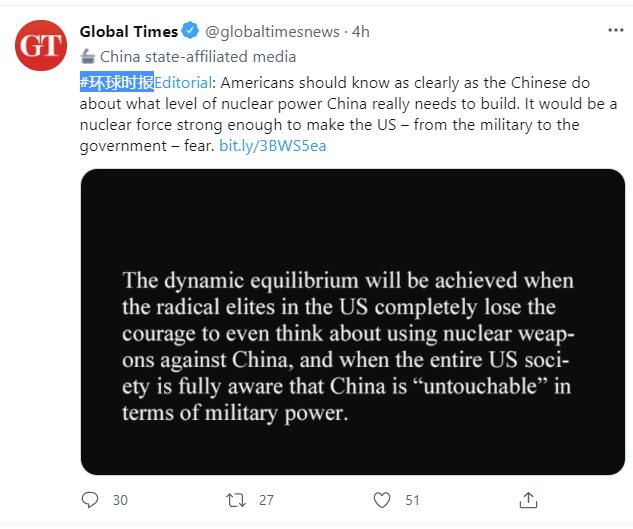
China’s Global Times says the US will fear the China nuclear horn: Daniel 7


China's Global Times is a state tabloid newspaper, threatening the US with China's nuclear weapons development program:

China’s Global Times says the US will fear China’s nuclear threat

Wed 28 Jul 2021 02:07:52 GMT

A nuclear force to make the US fear

China is not likely to issue an idle threat like this. The country is fully capable of accelerating its nuclear weapon’s program. Its a cheaper alternative than other options too.

Israel’s War Crimes Outside the Temple Walls: Malachi 2

Israel appears to have committed war crimes in May conflict with Hamas, Human Rights Watch says

5:00 p.m. EDT

According to a leading human rights group, Israel violated international law during the 11 days of fighting with Hamas militants in the densely packed Gaza Strip in May, in what “apparently amount to war crimes.”

New York-based Human Rights Watch released a report Tuesday that highlighted three Israeli strikes on Gaza in which it said 62 civilians, including families, were killed and “where there were no evident military targets in the vicinity.” It said other strikes also are likely to have violated international law.

Human Rights Watch said that Palestinian armed groups, including Hamas, which has controlled the coastal territory since 2007, also “committed unlawful attacks” in firing over 4,300 unguided rockets and mortars into Israeli communities. The organization said it would release a separate report on Palestinian violations in August.

Story continues below advertisement

The report renews scrutiny of this May’s deadly exchange of Hamas rockets and Israeli fire in which over 250 Palestinians in Gaza, among them 67 children, and 13 residents of Israel, including two children, died. It was the fourth war between the two sides since 2009, alongside frequent flare-ups.

Moments before the blast, she ushered her children inside. She wasn’t so lucky herself.

Israel has argued that it took precautions to protect Palestinians civilians and targeted only sites related to Hamas, which it accused of intentionally operating in residential areas, thereby leaving Israel little recourse.

But the report’s findings could be used as part of an ongoing investigation by the International Criminal Court of violations by both Israeli forces and Palestinian armed groups. The court in February ruled that it has jurisdiction over the Palestinian territories that Israel occupied in 1967, a claim Israel rejects.

Story continues below advertisement

Palestinians have increasingly lobbied for rights in international bodies and agencies as the model for peace talks between the two sides has broken down.

Hamas said 80 of the dead in Gaza were militants, according to the Associated Press, a figure Israel has disputed as being higher. One of those killed in Israel was a soldier.

While most rockets fired from Gaza were intercepted by Israel’s Iron Dome air defense system, the nearly 2 million Palestinians in Gaza had few places to flee. Israel controls nearly all crossings into and out of Gaza, which is facing multiple compounding humanitarian crises, including a severe shortage of clean water and electricity as well as a lack economic opportunities. Most Gazans cannot leave, and Hamas, an extremist group, suppresses any internal opposition.

After unending conflicts, Gazans wrestle with rebuilding — and whether it’s worth it

Human Rights Watch said that Israel refused to allow the organization’s senior investigators to enter Gaza. For the report, the group relied on a local Gaza researcher, as well as satellite images, expert analysis of photos and munition fragments, and phone and video interviews.

In one of the attacks investigated, Human Rights Watch said that around 6 p.m. on May 10, an Israeli guided missile hit four houses belonging to a family named al-Masri in an area near the town of Beit Hanoun. Eight civilians, including six children, were killed, and 18 people were reported injured. No members of the family were part of an armed group, they said, and Israel did not list any of the dead as members of a militant group.

The Israeli military has said that the strike was caused by an errant missile fired from inside Gaza by the militant group Islamic Jihad aiming for Israel.

On social media, Israel also suggested that one of those identified as a victim in the strike was part of a group killed by its military, who it said were “activists” with Hamas and Islamic Jihad, which the family has denied, Human Rights Watch found.

Speaking with residents and analyzing footage, Human Rights Watch found that the nature of the blast site was consistent with damage caused by missiles that Israel is known to use and inconsistent with Islamic Jihad rockets. The absence of an impact crater, among various signs, suggested that the explosion was the result of “munition with a small explosive yield” that detonated in midair, the report said.

The group said it “found no evidence of a military target at or near the site of the strike.”Souad al-Masri’s husband was killed and home destroyed by an Israeli bombing in 2014. This year, they struck again, leaving a crater where her home once stood. (Jon Gerberg/The Washington Post)

On May 15, 10 civilians, including eight children, were killed when a U.S.-made guided bomb collapsed a three-story building in the Shati refugee camp around 1:40 a.m. Israel said it was targeting an apartment used by Hamas militants. It said the missile struck a bunker below, which led to the building’s collapse.

Residents told Human Rights Watch they did not know of any Hamas cell or operations in their building. The group also said it did not find evidence of a bunker below.

The group called for further investigation into “whether Israeli forces targeted a military objective, and, if there was a legitimate military objective, whether all feasible precautions were taken to minimize civilian harm.”A Palestinian shopkeeper in Gaza hasn’t been able to bring himself to tell his injured wife that two of their daughters are gone. (Jon Gerberg/The Washington Post)

In another deadly series of Israeli airstrikes on May 16, 44 civilians were killed during a four-minute assault on al-Wahda Street in Gaza City in which three multistory buildings collapsed. Among the dead were over a dozen members of an extended family and one of the doctors leading Gaza’s coronavirus response.

The Israeli military said it targeted underground military tunnels and a command center, though it has not publicly provided evidence. Human Rights Watch found no evidence of military targets in the area and said that residents had not been warned to evacuate in time.

“An attack that is not directed at a specific military objective is unlawful,” the group said.

Human Rights Watch has previously accused Israelis and Palestinians of abuses, including apparent war crimes. In April, it released a report accusing Israel of “the crimes of apartheid and persecution” against Palestinians in the military-occupied territories and inside Israel.

Over the years, said Omar Shakir, the Israel and Palestinian territories director at Human Rights Watch, “we have documented a pattern of excessive force, attacks that are disproportionate, indiscriminate … that did not hit an apparent military target.”

“Accountability is critical,” he said.

The Antichrist’s mystery boycott

Al-Sadr’s mystery boycott

The changes in Iraqi Shia cleric Muqtada Al-Sadr’s attitude have always been tactical, but could his grim and lonely game this time be a strategic mistake before Iraq holds critical elections in October, asks Salah Nasrawi

When the Iraqi Shia cleric Muqtada Al-Sadr met with a group of his lieutenants at his base in the Shia holy city of Najaf in southern Iraq earlier this month, he had a message he wanted them to convey nationwide.

“If the Sadrist trend is a football team, where should I fit in? Shouldn’t I be the manager?” Al-Sadr, known by his supporters as “His Eminence the Leader,” asked rhetorically.

Al-Sadr’s remarks, part of a series of videoed speeches aimed at mobilising his followers ahead of upcoming national elections, were shorthand for saying that over the course of recent years he has masterfully consolidated the Sadrists into a cult of personality.

Because of his growing weight politically and militarily, which has allowed his grassroots Shia Movement to dominate the apparatus of the Iraqi state, Al-Sadr expects to be given his due as a national leader.

With elections due in October, Al-Sadr has claimed that his Sadrist Movement will secure the majority of seats in the 319-member parliament, allowing him to nominate Iraq’s next prime minister.

Al-Sadr’s muscular speeches to his followers was clearly designed to send a signal to the Iraqi people that the time has come for a change in the political system, which has been under the control of an alliance of Shia blocs since the US-led invasion that toppled the regime of former dictator Saddam Hussein in 2003.

For months, senior Sadrist officials have been expressing their confidence that the movement will win a landslide victory in Iraq’s autumn elections and will have the final say on who will be in the country’s next government.

But in a surprise move on 15 July, Al-Sadr reversed course on the elections, which many expect will be a decisive battleground that will shape Iraq’s politics for years, or probably decades, to come.

Al-Sadr unexpectedly announced that he will not take part in the vote, denying his support for all politicians, even those affiliated with his movement, in this government and the one that will be formed after the elections.

Al-Sadr attributed his withdrawal from the elections to his wish to “safeguard the country from the corrupt.” But his announcement fell short of addressing the core issue of what he will do if he stays away from politics.

This is a tricky subject among many Iraqis, including those close to Al-Sadr, who do not believe that the populist cleric will stop trying to maintain his relevance to Iraq’s politics.

Al-Sadr is widely considered to be one of the most powerful Shia political leaders to have emerged from the shadows of the US-led invasion in 2003. Over the years, Al-Sadr’s political strategy has seen a sea change that has seen him change from a militant Shia cleric into a populist political leader.

But analysts believe that any attempt by Al-Sadr to rock the boat in a crucial election year will have a serious impact on Iraq’s shaky political establishment and the country at large.

To begin with, Al-Sadr has made the headlines before by speaking out against Iraqi politicians and declaring that he will quit politics only to quickly change his mind and return to build his power base.

Al-Sadr, 47, has long been known for his unpredictability. His maverick image, which is quite familiar to most Iraqis, has always stirred some uncertainty in Iraq’s troubled politics.

But Iraq’s smoldering political crisis is working differently now compared to how it did after 2003, meaning that Al-Sadr’s bid to invest in the future distribution of power will have very different consequences.

Since his Sa’aroon bloc came first in the country’s 2018 elections, winning 52 seats, the Sadrist Movement has come to control the Iraqi government. The Sadrists’ key opening in what has become a political chess game was implanting Hamid Al-Ghizzi, a Sadr loyalist, as secretary-general of the prime minister’s office.

Al-Ghizzi’s main job was to clear government offices of unaffiliated bureaucrats and bring Sadrists into the offices in their place in order to infiltrate the state apparatus. Soon Sadrists were taking top jobs within most ministries and local administrations.

Notably, the Sadrists have been able to dominate the bureaucracy in key ministries such as defence, the interior, communications, oil, electricity and transport. They wield enormous power in Iraq’s three state-owned banks and even in Iraq’s Central Bank.

In addition to being able to dominate Iraq’s huge civil service, the movement now exerts control over the country’s financial resources through the state budget and its own economic influence. 

Most importantly, Al-Sadr controls two powerful militias, the Peace Companies and the Promised Day Brigade, both vaguely linked to Al-Sadr’s Mahdi Army, which was established after 2003 but allegedly disbanded in 2008.

Today, Al-Sadr is the most powerful Shia leader in Iraq with tremendous hopes of ruling the country in the future. Through his masterful playbook, Al-Sadr has set the country on the path of taking his omnipotence as a given.

In recent weeks, the Western media, which used to describe him as a hardliner and a radical, has started to promote Al-Sadr as a moderate politician and the “face of reform in Iraq” in an apparent attempt to accept him as Iraq’s next leader.

Under the headline, “Firebrand cleric Muqtada Al-Sadr and America move closer in Iraq,” the UK Economist magazine reported in April that some in the Biden administration were encouraging America’s political allies in Iraq to align with Al-Sadr before an election in October.

The Reuters news agency also suggested in a lengthy report this month that some Western diplomats would now prefer to deal with an Iraq dominated by Al-Sadr, whom they believe is the only leader able to enact reform.

Both reports, which could underscore a shift in Western thinking, are based on the assumption that Al-Sadr is on the ascendant and that he has become “a more nationalist Shia figure” and could stand up to Iran and the Iran-backed Shia groups in Iraq.

However, the problem with this narrative of Al-Sadr’s making a U-turn to make Western policy-makers feel better about the man they have long demonised as a pariah is that it seems too far-fetched, if not utter analytical heresy.

While Al-Sadr may have succeeded in dominating many of the Iraqi state bodies, he is far away from being able to ensure that his group remains in complete control of the country.

Indeed, much of the blame for Iraq’s woes, such as the collapse of the health system, the electricity failures, and the falling living standards caused by a devalued local currency, has been placed on Al-Sadr’s ministers and their poor statecraft and corruption.

Al-Sadr has also sparked controversy in another way. He tried repeatedly to suppress the anti-government protests that took place in Iraq last year through intimidation, threats and sometimes even sheer brutality, all with the aim of stamping out their movement.

The crackdown on the pro-reform and anti-Iran protesters sparked public outrage against Al-Sadr and reversed his image as an anti-corruption nationalist leader, underlining his naked power-grab ambitions.

Analysts say that the Sadrists’ overall performance has damaged their leader’s once-rising popularity and ruled out the possibility that the movement could garner 100 seats in the next parliament that they hope would allow them to name their own prime minister.

Now, apart from a few Sadrists who have gathered to burn their electoral cards to show solidarity with their leader, no single Sadrist candidate has officially pulled out of the race.

Ministers and hundreds of Sadrists in top jobs in the government have also not stepped down and are still in their posts, some of them powerful enough to determine the October polling.

Given Al-Sadr’s background of unpredictability and contradiction, his declaration to withdraw from Iraq’s politics may not be a major turning point as many have predicted.

Al-Sadr will once again realise that the Iraqi state is too fragile to be controlled by one man or one group, and the machinations of recent months are unlikely to make him play a lose-lose game and let the band he has assembled stop the music playing.