Showing posts with label stole. Show all posts

Friday, June 9, 2017

The Terrorism of These End Times


1-q7vmWMEGFKQ20ZjWyVWB-A

Why Americans Don’t Understand Terrorism, At All

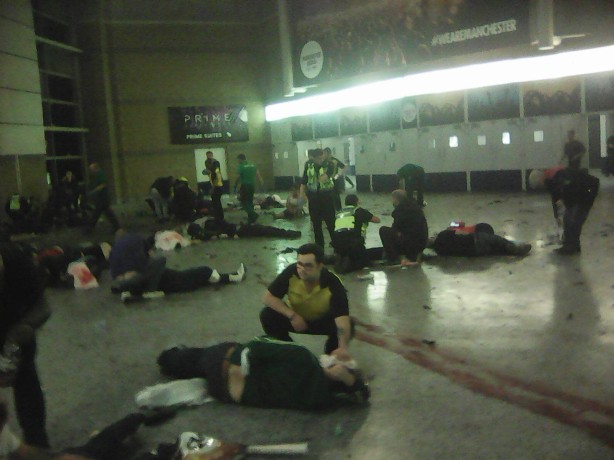
We live in an invisible empire, and so the mechanics of the empire are never openly discussed with the rabble. Americans don’t comprehend how power actually works across the planet that their country seeks to control. They live from momentary headline to headline without any honest, in-depth analysis of why events like the Manchester bombing occur and keep occurring.
When it comes to terrorism it is dire, urgent, and desperate that the public understand, if anything is to change. But it certainly appears that Americans never will. Perhaps Britons may, and then lead the effort to stop it.
In the United States, a bigoted faction demonizes all Muslims. That faction calls for more weapons and for their own wanton terror to be perpetrated everywhere. An opposing faction absolves all Muslims and calls for peace and reconciliation… with suicide bombers? The two sides mindlessly shout clichés back and forth at one another in a cacophony, and they drown out the larger global issues that have transpired for many years. The public is thus rendered impotent, irrelevant and ignored: divided and conquered.
Gross historical ignorance leads to this inability to see what should be glaringly obvious: the deep state—covert intelligence agencies operating in secret—play a “double game.” They are in bed with terrorists, whom they see as useful proxies. The terrorists do their dirty work for them in places like Libya, Syria, Chechnya and Dagestan.
Americans are largely incapable of comprehending what a proxy is. It’s one level too abstract. Ask people on the street about such matters, and the results would be akin to the 64% who cannot even find North Korea on a map. Korea’s location is in no way a secret, and the government doesn’t officially deny its existence.
The corporate media has been criminal in distracting the public from the role of western allied intelligence agencies in these terror games. Despite the decade-long Afghanistan Jihad against the Soviets, the similarities of multiple current conflicts do not make it onto the evening news shows. This default censorship extends into so-called “alternative” media too. There is an unspoken air of collusion with intelligence in the United States. Some matters, for example Operation Gladio, are simply never, ever brought up. That chapter has been tossed down Orwell’s Memory Hole.

Just what is a “proxy” and “proxy war?”

The Cambridge Dictionary says:
“a war fought between groups or smaller countries that each represent the interests of other larger powers, and may have help and support from these.”
Al Qaeda has been a proxy for US, Saudi and Pakistani interests since at least 1979, when Jimmy Carter’s CIA began aiding them and setting up the largest logistical support network in its history: Operation Cyclone. While official government claims mislead the public into assuming that the relationship ended in the late 1980s, it did not.
Al Qaeda maintains relationships with US allies, notably Saudi Arabia and Pakistan (where bin Laden lived for a decade and Ayman Zawahiri is assumed to be right now). Other states in the Persian Gulf region such as Qatar, Kuwait and Turkey are also implicated. These nations receive US arms and US protection. Although they are repeatedly exposed for aiding and abetting Al Qaeda and associated groups operating under various names, these countries are tolerated and rewarded by US administrations and other Western powers.
This absurdity can only continue because of the gross ignorance and the distractibility of western populations.
“Saudis Bankroll Taliban, Even as King Officially Supports Afghan Government”
-NY Times, Dec. 6 2016
The Manchester bombing produced some uncharacteristically revealing news reports in the UK, but these are censored to US audiences. US media is more tightly controlled, apparently, when it comes to the shenanigans of western intelligence services protecting terrorists.

Here is what we learned about Manchester:

One of the friends who called the anti-terrorism hotline about one of the London Bridge attackers said, “’He was not arrested and was allowed to keep his passport. I did my bit, I know a lot of other people did their bit, but the authorities did not do their bit.”
Previously, and related, a radical Muslim cleric named Anjem Choudary was protected from arrest by MI5 for nearly twenty years!
“Met counter-terror officers often felt they enough evidence to build a case against the radicalising cleric, only to be told to hang fire by MI5, because he was crucial to one of their on-going investigations, a source has claimed… After almost 20-years at the forefront of radical Islam in Britain, Choudary was finally convicted of a terrorism offence last month and faces up to ten years in prison when he is sentenced on September 6. But following his conviction it was revealed that the 49-year-old former lawyer had been linked to at least 15 terror plots dating back as far as 2001.”
Needless to say, those five warnings flagging Manchester bomber Salman Abedi were completely ignored by authorities—for some reason. This is very similar to the warnings about the Tsarnaev Brothers in 2013. The pattern is almost identical to the Boston Marathon Bombing.
Russia sent the FBI two warnings about the Tsarnaevs including one that was ignored after Tamerlan met with a known extremist guerrilla leader in Dagestan. Israel’s DEBKAFile suggested at the time that the Tsarnaevs were being recruited by US intelligence to go stir up trouble in the Russian provinces of Chechnya and Dagestan. This was confirmed by Michele McPhee in her recent book Maximum Harm: The Tsarnaev Brothers, the FBI, and the Road to the Marathon Bombing.
Warnings were ignored, systematically, in both cases. Numerous warnings were also ignored concerning the 9/11 attacks, and for similar reasons. FBI chief division counsel Coleen Rowley explained in painstaking detail how her efforts to stop the 9/11 attacks were blocked by her own headquarters.
“Within days of terrorist suspect Zaccarias Moussaoui’s arrest in Minnesota on Aug. 16, 2001, French intelligence confirmed that Moussaoui had been fighting under and recruiting for [Chechen Al Qaeda leader] Ibn al-Khattab, raising concerns about Moussaoui’s flight training. Yet FBI Headquarters officials balked at allowing a search of his laptop and other property, still refusing to recognize that: 1) the Chechen separatists were themselves a “terrorist group” for purposes of the Foreign Intelligence Surveillance Act’s (FISA) legal requirement of acting “on behalf of a foreign power” and 2) that Moussaoui’s link to Ibn al Khattab inherently then linked him to bin Laden’s well-recognized Al Qaeda group for purposes of FISA (the point in my memo).”
The Minnesota FBI agents were thwarted from investigating Moussaoui’s intelligence, and it remained untouched when hijacked planes crashed into the World Trade Center and Pentagon a month later.
Those are three clear examples of interference in the fight against terrorism on western soil. A fourth example is the Berlin 2016 Christmas attack, which killed 12 and injured 56 others. “The attack was carried out by a man whom security officials across Germany were very well aware of,” according to the Interior Minister Ralf Jäger. Anis Amri was investigated seven times before striking, and yet officials claimed that nothing could be done about him. The public is to believe that the entire law enforcement and intelligence apparatus of Germany is powerless against one man. Police knew prior to his attack that he had traveled through Germany under 14 different aliases.
Newsbud compiled a timeline to dispute the claims of German officials:
26 September 2016:
Tunisian and Moroccan security authorities inform the North Rhine-Westphalia LKA that Amri is an Islamic State supporter, that he is in contact with suspected Tunisian terrorists in Libya, “wants to carry out a project” in Germany and is staying in Berlin. German authorities receive similar information on October 14 and October 26.
Coincidentally, that December, German intelligence produced a report that “10,000” Salafists were living in Germany. The report pointed the finger at Saudi Arabia, Qatar and Kuwait for their direct funding and support to “mosques, religious schools,” and “hardline preachers.”
The corporate media in the US today is a cacophony of irrelevant distraction. There, 99% of what is broadcast about terrorist attacks is completely unrelated to why it actually happened or how to stop it from happening again. TV news serves only as propaganda and does not inform its viewers of these otherwise knowable facts above.
The public would be far more attuned to these security breaches, and the impunity which surrounds them, if they understood modern history, and particularly the history since 1948 with the creation of the CIA and the “National Security State.” Soon after, we have it on the record, that the CIA began engaging in false-flag terrorism. It was a key component of Operation Ajax, the criminal plot to overthrow the democratically elected president of Iran.
New York Times revealed, in 2000 (47 years late):
“The [CIA’s own] history says agency officers orchestrating the Iran coup worked directly with royalist Iranian military officers, handpicked the prime minister’s replacement, sent a stream of envoys to bolster the shah’s courage, directed a campaign of bombings by Iranians posing as members of the Communist Party, and planted articles and editorial cartoons in newspapers.” (emphasis added)
Upon this “success,” the destruction of Iranian democracy and the installation of a murderous tyrant, the Central Intelligence Agency was thus encouraged to engage in more anti-communist false-flag attacks. That was Operation Gladio, a “forty year” spree of state-sponsored terrorist attacks across Europe, according to the BBC investigation.
Clearly we should be listening to meticulous experts like Dr. Nafeez Ahmed, rather than the barrage of talking heads who obfuscate on CNN. The Strategy of Tension persists and is the conceptual foundation of the perpetual “War on Terrorism.”
“The ‘strategy of tension’ denotes a highly secretive series of interconnected covert operations conducted jointly by the CIA and MI6 largely in Western Europe during this period. Well-documented by several respected historians, confirmed by official inquiries, and corroborated by former intelligence officials, the ‘strategy of tension’ is one of those unsavoury moments in contemporary history that we don’t learn about in school, or even university… The objective was to galvanize public opinion against leftwing policies and parties, and ultimately to mobilize popular support for purportedly anti-Soviet policies at home and abroad – most of which were really designed to legitimize brutal military interventions against nationalist independence movements in the ‘Third World’.”
Terrorism serves those who would destroy civil liberties at home and wage wars of aggression abroad. Attacks on random civilians have been allowed to proceed, and the efforts of lower-level law enforcement officers halted in their tracks, over and over again in multiple allied nations. That is the main reason we see repeated high-profile attacks perpetrated by people who are well-known to the security-intelligence complexes that are supposed to stop them but choose not to.
—–
Joe Giambrone publishes Political Film Blog, where all these stories were tagged and compiled.

Saturday, April 8, 2017

Nuclear Terrorism (Revelation 15)


5721e5bbc3618833538b45b1 
Inside the Uranium Underworld: Dark Secrets, Dirty Bombs
Simon Shuster / Tbilisi, Georgia
Apr 06, 2017
One night last spring, Amiran Chaduneli, a flea-market trader in the ex-Soviet Republic of Georgia, met with two strangers on a bridge at the edge of Kobuleti, a small town on the country’s Black Sea coast.
Over the phone, the men had introduced themselves as foreigners—one Turkish, the other Russian—and they were looking for an item so rare on the black market that it tends to be worth more, ounce for ounce, than gold. Chaduneli knew where to get it. He didn’t know that his clients were undercover cops.
From the bridge, he took them to inspect the merchandise at a nearby apartment where his acquaintance had been storing it: a lead box about the size of a smartphone, containing a few pounds of radioactive uranium, including small amounts of the weapons-grade material known as uranium-235. The stash wasn’t nearly enough to make a nuclear weapon. But if packed together with high explosives, these metallic lumps could produce what’s known as a dirty bomb—one that could poison the area around the blast zone with toxic levels of radiation.
In the popular culture, the dealers who traffic in such cargo are usually cast as lords of war with tailored suits and access to submarines. The reality is much less cinematic. According to police records reviewed by TIME in Tbilisi, the Georgian capital, Chaduneli’s associates in the attempted uranium sale last spring included construction workers and scrap-metal traders. Looking at the sunken cheeks and lazy left eye in his mug shot, it seems improbable that lousy capers like this one could rise to the level of a national-security threat. But the ease of acquiring ingredients for a dirty bomb is precisely what makes them so worrying.
As the number of nuclear-armed countries has grown from at least five to as many as nine since the 1970s, the danger of World War III has been joined by a host of secondary nuclear threats. The possibility that a warhead, or the material to build one, could fall into the hands of a rogue state or terrorist helped drive President Barack Obama’s deal to temporarily halt Iran’s alleged weapons program. North Korea, which is now believed to have more than a dozen warheads and has been busily testing intercontinental missiles to carry them, has also been the world’s most active seller of nuclear know-how. Pakistan is developing battlefield tactical nuclear weapons, which are smaller and more portable than strategic ones, even as its domestic extremist threat grows.
The danger from dirty bombs is spreading even faster. For starters, they pose none of the technical challenges of splitting an atom. Chaduneli’s type of uranium was particularly hard to come by, but many hospitals and other industries use highly radioactive materials for medical imaging and other purposes. If these toxic substances are packed around conventional explosives, a device no bigger than a suitcase could contaminate several city blocks—and potentially much more if the wind helps the fallout to spread. The force of the initial blast would be only as deadly as that of a regular bomb, but those nearby could be stricken with radiation poisoning if they rushed to help the injured or breathed in tainted dust. Entire neighborhoods, airports or subway stations might need to be sealed off for months after such an attack.
The lasting effects of a dirty bomb make this weapon especially attractive to terrorists. Fear of contamination would drive away tourists and customers, and cleanup would be costly: the economic impact could be worse than that of the attacks of 9/11, according to a study conducted in 2004 by the National Defense University. “It would change our world,” President Obama said of a potential dirty bomb in April 2016. “Wecannot be complacent.”
Obama’s successor is certainly alive to the nuclear threat. In a Republican primary debate in December 2015, Donald Trump said the risk of “some maniac” getting a nuclear weapon is “the single biggest problem” the country faces. But he suggested that the world would be safer if more countries acquired nukes. His Administration has yet to set out a policy for countering the danger of a dirty bomb; the position Trump takes could be crucial. By training and equipping foreign governments to stop nuclear traffickers, the U.S. has played a central role in fragile or unstable areas of the world where highly dangerous materials can fall into the wrong hands. The goal, according to Simon Limage, who led the State Department’s nonproliferation efforts during the last five years of the Obama Administration, is “to push the threat away from U.S. shores.”
Georgia is one of the best examples of how these efforts have worked on the ground. Over the past 12 years, the U.S. government has provided more than $50 million in aid to help the former Soviet republic, a nation of only 3.7 million people, in combatting the trade in nuclear materials. Though it possesses no nuclear fuel of its own, Georgia sits in the middle of what atomic-energy experts sometimes refer to as the “nuclear highway”—a smuggling route that runs from Russia down through the Caucasus Mountains to Iran, Turkey and, from there, to the territory that ISIS still controls in Syria and Iraq.
All along that route, the U.S. has helped install nuclear detectors at borders, trained police units to intercept traffickers and provided intelligence and equipment to local regulators of nuclear material. “The Americans brought all the technology,” says Vasil Gedevanishvili, director of Georgia’s Agency of Nuclear and Radiation Safety. “They secured every border around Georgia.”
The payoff was clear in 2016, when Georgian police busted three separate groups of smugglers for attempting to traffic in nuclear materials—a spike in arrests the region hadn’t seen in at least a decade. They foiled an attempt in January to smuggle cesium-137—a nasty form of nuclear waste that could be used in a dirty bomb—across the border into Turkey. Three months later, on April 17, Georgian police caught a group of traffickers trying to sell a consignment of uranium for $200 million.
At the end of that month, Chaduneli and four of his associates were arrested in Kobuleti by a team devoted to countering nuclear trafficking that has received training, equipment and intelligence from various arms of the U.S. government. “So in some sense this was a success story,” says Limage, who met the team during a visit to Georgia in December, less than two months before he resigned from his post as Deputy Assistant Secretary of State. “But none of the gains we’ve made with these partnerships are permanent. They’re all reversible.”
And they’re becoming even more essential to international security. Over roughly the past three years, as the U.S.-led coalition has advanced against ISIS in Syria and Iraq, the terrorist group has been shifting tactics. Rather than urging its followers to come join the fight in Syria, ISIS recruiters now call for attacks against the West using whatever weapons are available. The continued erosion of the group’s territory may not make it any less dangerous. “It may make them more desperate,” says Andrew Bieniawski, vice president of the Nuclear Threat Initiative, a U.S. nonprofit that works to reduce the risk of nuclear weapons and materials. “And they may try to raise the stakes.”
There have already been plenty of signs that ISIS would like to go nuclear. After the series of ISIS-linked bombings in Brussels killed at least 32 people in March 2016, Belgian authorities revealed that a suspected member of a terrorist cell had surveillance footage of a Belgian nuclear official with access to radioactive materials. The country’s nuclear-safety agency then said there were “concrete indications” that the cell intended “to do something involving one of our four nuclear sites.” About a year earlier, in May 2015, ISIS suggested in an issue of its propaganda magazine that it was wealthy enough to purchase a nuclear device on the black market—and to “pull off something truly epic.”
Though the group is unlikely to possess the technical skill to build an actual nuclear weapon, there are indications it could already possess nuclear materials. After the group’s fighters took control of the Iraqi city of Mosul in 2014, they seized about 40 kg of uranium compounds that were stored at a university, according to a letter an Iraqi diplomat sent to the U.N. in July of that year. But the U.N.’s nuclear agency said the material was likely “low grade” and not potentially harmful. “In a sense we’ve been lucky so far,” says Sharon Squassoni, who heads the program to stop nuclear proliferation at the Center for Strategic and International Studies (CSIS) in Washington, D.C. “I honestly think it is only a matter of time before we see one of these dirty-bomb attacks.”
Obtaining ingredients for such a weapon is not, it turns out, the hard part. According to Chaduneli’s lawyer, Tamila Kutateladze, his associates found the box of uranium in one of the scrapyards where he would find old bric-a-brac to sell. His co-defendant in the case, Mikheil Jincharadze, told police that “unknown persons” had delivered the box inside a sack of scrap iron, according to interrogation records and other court documents obtained by TIME in Georgia.
That version of the story did not convince investigators, and even Chaduneli’s lawyer wondered how such a thing could turn up in a pile of trash. “A mere mortal cannot just get his hands on this stuff,” Kutateladze told TIME in her office in Tbilisi. “You have to have a source.”
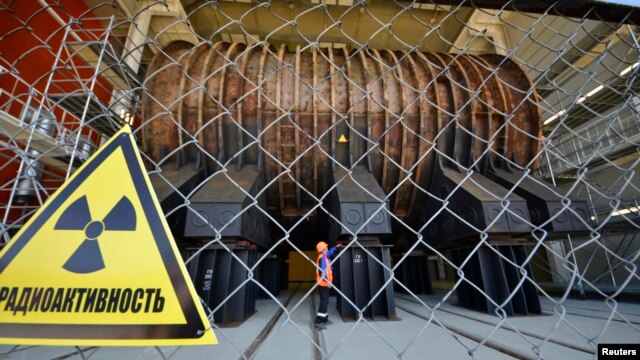
File photo shows Russian citizen Oleg Khintsagov who was arrested on charges of smuggling weapons grade uranium in Tbilisi
But the Georgian authorities have so far been unable to determine that source with any certainty. Similar investigations in the past, most recently in 2010 and 2011, have traced the nuclear material back to reactors in Russia. Among the most famous cases involved a small-time Russian smuggler named Oleg Khintsagov, who tried to sell a sample of highly enriched uranium in 2006 to a Georgian police officer posing as a wealthy Turkish trafficker. “He said he could get much larger quantities from his sources in Siberia,” recalls Shota Utiashvili, who oversaw that case as Georgia’s Deputy Interior Minister at the time. “We think it’s from an old stockpile of this stuff that’s been laying around and periodically looking for a buyer.”
During the chaos that followed the Soviet collapse in the early 1990s, radioactive material was frequently stolen from poorly guarded reactors and nuclear facilities in Russia and its former satellite states. Police intercepted shipments of it transiting through cities as faraway as Munich and Prague in those years, and nuclear experts believe that large batches of Soviet nuclear fuel are still unaccounted for and most likely accessible for well-connected traders on the black market.
The potential source that most concerns investigators in Georgia is the region of Abkhazia, a Russian protectorate that broke away from Georgian control in the early 1990s. It is one of several unrecognized pseudo states—often referred to as frozen conflict zones—that Russia has helped maintain in the former Soviet space. With no internationally acknowledged borders, these regions often function as way stations for smugglers, allowing everything from guns and cigarettes to contraband caviar to be trafficked under the radar of international law. “These spaces are ungoverned,” says Squassoni of CSIS. “So what we risk when we look at these conflict-torn regions is that people will try to make a living any way they can, and they may not have any scruples about what they’re smuggling across these borders.”
On the border between Moldova and Ukraine is the pro-Russian enclave of Trans-Dniestr, where Moscow has stationed about a thousand troops since the region’s violent split from Moldova in the early 1990s. This sliver of land along the Dniestr River was a base for one of the world’s most notorious nuclear smugglers, Alexandr Agheenco, a dual Russian-Ukrainian citizen nicknamed the Colonel, who is wanted by U.S. and Moldovan authorities for attempting to sell weapons-grade uranium to Islamist terrorist groups in 2011. One of his middlemen was caught that year in a Moldovan sting operation; police reportedly found the blueprints for a dirty bomb in his home. But the Colonel remains at large.
More recently, Russia has carved a fresh pair of conflict zones out of eastern Ukraine, where separatist rebels used weapons and fighters from Russia in 2014 to seize territory around the cities of Luhansk and Donetsk. According to research compiled by CSIS, the war has destroyed 29 of the radiation detectors that would normally monitor the movement of nuclear material along the border between Russia and Ukraine.
But Abkhazia is the only one of these conflict zones that has ever possessed its own nuclear facilities. Physicists recruited from Germany after World War II set up the first Soviet centrifuges at the Sukhumi Institute of Physics and Technology, which remained a key pillar in the Soviet nuclear program through the Cold War. After the fall of Soviet Union, the newly independent Georgian government fought separatists who wanted to keep Abkhazia within Moscow’s orbit.
When the civil war reached Sukhumi in 1992, its scientists set up patrols to protect their stores of radioactive material from looters and paramilitaries. The war ended the following year with Abkhazia’s de facto secession from the rest of Georgia, and the fate of its nuclear stockpiles has been something of a mystery for international observers ever since.
Officials in Russia say there is no longer any nuclear material in Abkhazia. But Georgia disputes this. Gedevanishvili, the head of the country’s nuclear-safety agency, says the Sukhumi Institute still conducts experiments using radioactive sources. “We don’t know what security measures they take. We know nothing about their work.”
Russia has its own reasons to worry about dirty bombs. The explosion that killed at least 14 people and wounded dozens of others in the St. Petersburg metro on April 3 was just the latest of dozens of terrorist attacks since the early 1990s. Over that time, Moscow has worked to secure nuclear stockpiles throughout the former Soviet Union, often with help and funding from the U.S. But as relations with Washington have eroded, Moscow has cut off cooperation, insisting it no longer needs American assistance.
Whether he wants to or not, President Trump will play a key role in determining the danger from dirty bombs in coming years. Since his election, Trump has denounced the work of the U.N. as a “waste of time and money,” even though U.N. organizations like the International Atomic Energy Agency are responsible for monitoring nuclear stockpiles and advising countries on keeping them safe. Trump’s pick to lead the Department of Energy, former Texas governor Rick Perry, previously called for its dissolution, but defended its mission during nomination hearings; the department oversees the U.S. nuclear arsenal and safety at nuclear sites.
Trump’s new budget proposal, which the White House published on March 16 under the title “America First,” would slash programs that contribute to U.S. security in ways subtler than guns and walls. It would cut foreign aid, diplomacy and development programs—all of which have helped the U.S. forge a global network of alliances against nuclear trafficking. “This isn’t rocket science,” says Limage, the former State Department official. “A lot of the nonproliferation progress that has been made around the world has been through patient, careful diplomacy.” Countries that would otherwise not have the means or the motivation to target smugglers of nuclear material have received regular encouragement, training and aid from the U.S. in these efforts.
The Trump Administration says it takes the threat “extremely seriously,” a White House official tells TIME. “We have active programs within the U.S. government and with international partners to reduce the risks of such an attack and to mitigate the effects if one should occur. The prospect of terrorists using WMD is one of many reasons we need to remain vigilant in pursuing our counterterrorism strategy around the globe,” the official says.
In Georgia, there are obvious risks to letting partnerships lapse. From the bridge where Chaduneli went to meet his buyers, it would take just a couple hours for a dirty bomb’s ingredients to reach Turkey by car or boat, and only days more to reach Syria or Iraq. His family home stands within view of the border with Azerbaijan, a notoriously corrupt dictatorship with links to Iran. Local kids often ride their bikes next to the border crossing, a barbed-wire fence guarded by a few lethargic soldiers.
They are a thin line of defense in an era when nuclear threats emerge not only from military and rogue regimes, but from the hard economic reality of some of the world’s most forgotten places. An honest job in this region brings in a few hundred dollars per month. So the lure of trafficking across these borders is constant, says Chaduneli’s mother Tamila.
The undercover agents who arrested him offered to pay $3 million for that box of uranium. At the end of their trial in December, all of the suspects in Chaduneli’s case took a plea deal in exchange for lighter sentences; Chaduneli got three years in prison. In his one-story home, which has an outdoor kitchen with a wood-burning stove and gets intermittent electricity, his mother says she has no idea how his friends got their hands on a batch of nuclear material—or why her son joined a plot to sell it. “The money,” she says, “might have clouded his eyes.”
—With reporting by ZEKE J. MILLER/WASHINGTON

Friday, December 23, 2016

More Uranium On The Black Market Seized (Revelation 8)

Uranium worth Rs 24 cr seized, 2 held

 Uranium worth Rs 24 cr seized, 2 held
Summary: According to the police, they received a tip-off that two persons were in possession of the suspected radioactive material, and were looking for a buyer. On being interrogated, the duo said the radioactive material was brought in from a foreign country. The duo were supposed to sell the depleted radioactive material to a person in Thane on Wednesday night. A First Information Report (FIR) will be registered against the duo soon, police said. The uranium is suspected to have been smuggled in from an overseas atomic power plant.
The Thane police on Tuesday arrested two men for allegedly possessing eight kilograms of uranium valued at more than Rs 24 crore. The uranium is suspected to have been smuggled in from an overseas atomic power plant. The duo were supposed to sell the depleted radioactive material to a person in Thane on Wednesday night. A First Information Report (FIR) will be registered against the duo soon, police said. According to the police, they received a tip-off that two persons were in possession of the suspected radioactive material, and were looking for a buyer. "We posed as prospective buyers and got in touch with the duo
We arranged to meet outside a hotel on Ghodbunder Road in Thane on Wednesday, and nabbed them as soon as they arrived. After we inspected them, we found a blue pouch inside a handbag which contained two pieces of black uranium, a carbon paper and an envelope," said a senior officer on condition of anonymity. The uranium pieces were tested at the BARC laboratory, which in its report said that while one piece contained 87.70 per cent of uranium, the other piece had 79.50 per cent of the chemical element. A senior crime branch officer said, "The depleted uranium has been smuggled into the country. On being interrogated, the duo said the radioactive material was brought in from a foreign country.

Thursday, December 22, 2016

More Black Market Uranium Seized (Revelation 8)

Thane crime branch detains 2, claims seizure of 8kg ‘depleted uranium’

MUMBAI Updated: Dec 22, 2016 00:32 IST
Padmja Sinha
Hindustan Times
Highlight Story
The police show the plates that they claim are depleted uranium. (Praful Gangurde/HT)
The Thane crime branch on Wednesday detained two people and claimed to have seized 8 kg of depleted uranium plates worth Rs 24 crore from them. The officials are investigating the case for further information.Joint commissioner of police Ashutosh Dumbre said, “The detention has been result of the efforts put by the officials under the guidance of Deputy Commissioner of Police Parag Manere and senior police inspector Ravindra Doiphode.”Bharat Shelke, an official who was also part of the investigation team, said, “We got a tip off regarding the uranium from our informers and accordingly we took steps to nab them. The culprits were nabbed near Byke Hotel at Ghodbunder Road and are being grilled for more information.”
The two persons, who have been detained, were allegedly looking for customers and planning to sell it at throw away prices. “The sample of the uranium has been sent to the Bhabha Atomis Research Center (BARC) Lab for testing to establish content and worth of the depleted uranium. As the samples have already been sent it will take at least two days’ time to get the reports. Depending on the BARC report, we will take further action,” added Shelke.
When HT asked the official if there are chances that others too are involved in a similar illegal trade, Shelke said, “Though we are not sure but it is possible. That’s why we are continuously talking to them and grilling them. A detailed FIR would be filed once reports are obtained and we suppose that the investigation will go on for long also we have activated our informers for more clues.”

Monday, September 12, 2016

Terrorism Is On The Rise

The terrorist threat is worse now than it was before 9/11
Pamela Engel
9/11 September 11th AttacksNew York police stand near a wanted poster printed by on a full page of a New York newspaper for Saudi-born militant Osama bin Laden in the financial district of New York.REUTERS/Russell Boyce-Files
It's been 15 years since the 9/11 terror attacks, but in some ways, we're no safer from terrorism today than we were before 2001.
Al Qaeda still has a formidable presence across the world, and a new terror threat - ISIS - rose up during the chaos that followed the US invasion of Iraq.
The world is also now contending with spates of attacks carried out by radicalized individuals who have managed to fly under the radar of Western intelligence officials.
The Soufan Group, a strategic security firm, contended in a note this week that the terror threat against the US is actually more pronounced today than it was before 9/11.
Since September 11, 2001, "the global terror threat has compounded and cascaded," said the note. We're now facing "unprecedented terror concerns" that will likely persist for years to come, according to the firm.
The firm noted that after the attacks, the US outlined several goals with regards to fighting terrorism: Preventing another terrorist attack on the scale of 9/11; denying terrorists sanctuaries in countries like Afghanistan; destroying Al Qaeda, and countering extremist ideology.
"As the 15th anniversary of the 9/11 attacks approaches, only one of these goals - the prevention of an attack nearing the scale of 9/11 - has been met," the firm stated. "While the prevention of another such attack is a significant achievement, many of the other post-9/11 concerns are considerably worse now than in 2001."
The US successfully toppled the Taliban in Afghanistan, but the group still controls territory there.
And the death of Al Qaeda founder Osama bin Laden hasn't weakened the group to the point where it's no longer a threat. Bin Laden's ideology has actually continued to inspire and radicalize people across the globe, especially with the rise of ISIS, a group that borrowed from the ideological doctrine bin Laden espoused, and the use of social media by extremist recruiters.
Al Qaeda is in fact stronger today than it was before 9/11, The Soufan Group argued in its note. The intelligence apparatus in the US has grown to counter this threat, and new counterterrorism and security measures have succeeded at preventing many attacks, but some terrorists have still been able to slip through the cracks.
"The spread of violent extremism since 9/11 has surpassed anything bin Laden likely thought achievable in a fifteen-year period," The Soufan Group note said. And the threat of attacks by lone actors as well as terrorist cells in the West "will remain for years to come."
Richard Haass, president of the Council on Foreign Relations, noted in a column this week how widespread terrorism has become since 9/11.
"September 11, 2001, was unique in the sense of its scale; otherwise it was anything but," Haass wrote. "Terrorism has become commonplace."
But Haass also puts things into perspective - while terrorism certainly is a serious threat, it is not yet a threat to the very existence of the US.
"Over the last decade, there have been, on average, more than 10,000 terrorist attacks per year, causing an average of more than 15,000 deaths per year," Haass noted.
He continued: "Relatively little of this terrorism has involved Americans. Over this same decade, there have been fewer than 15 terrorist attacks a year in the United States. An average of five Americans per year have died on US soil and approximately 20 per year have lost their lives worldwide."
Where terrorism could become an existential threat, however, is with the use of nuclear weapons or a "dirty bomb" with nuclear material.
"Such 'grand terrorism' has for decades been the nightmare of many strategic thinkers," Haass wrote.
While such "grand terrorism" hasn't become a reality yet, it could be in the future. Pakistan, for example, is country that has nuclear weapons, a significant terrorist presence, and a weak government. This could create conditions where nuclear material could fall into the hands of terrorists.
Even the US has nuclear material that could fall into the hands of terrorists, some of which is relatively accessible in places like hospitals.
Steven Brill noted recently in The Atlantic that "despite significant work done by the Obama administration, large quantities of radioactive material already sit unguarded in the US."
"It doesn't require a wild leap to imagine someone with terrorist sympathies planting shielded radioactive material in a car or a cargo container that then makes its way through one of our ports," Brill wrote. "But it's even easier to imagine a dirty bomb being constructed from material that doesn't have to be snuck through the ports."
As the threats have grown, Americans have also been forced to grapple with another reality: Terrorism doesn't just threaten American lives - it threatens our way of life. Terrorists seek to sow fear and provoke overreactions that could fundamentally change not only US policies but how Americans live their lives day-to-day.
In his editorial, Haass wrestled with the balance between freedom and security.
"Terrorism will happen sometimes despite our best efforts," he wrote, concluding, "This argues for resilience in addition to all else. This may require some compromise on privacy for individuals in order to promote collective security, but this is a price worth paying, since the threat to democracy would quickly become far greater if existential terrorism were to become a reality." 

Wednesday, August 31, 2016

The Reality Of The Dirty Bomb (Daniel 8:4)


Dirty bombs: update on US safeguardsdirty-bomb-ISIS
What is a dirty bomb?

Yahoo News

The Nuclear Regulatory Commission (NRC) defines a dirty bomb as a device that “combines conventional explosives, such as dynamite, with radioactive material.” Its detonation would result in a “regular” explosion, with the added effect of dispersing radioactive material.

But the consequences might not be as dire as some fear. “This wouldn’t be like a nuclear bomb,” says David Albright, the first nongovernmental inspector of Iraq’s nuclear program in 1996, and a frequent testifier on nuclear issues before Congress. “It’s important for people to understand that it can be dangerous, but the risk isn’t what the public often imagines – making a city uninhabitable, causing hundreds or thousands of deaths.”

What are the safeguards surrounding radioactive materials in the United States?

The NRC is responsible for ensuring the safe use of radioactive sources for civilian uses. The group works with other agencies, both domestic and international, to track and control all nuclear material designated for peaceful purposes. “We as a country have spent billions making sure these materials can’t be smuggled in,” but those efforts would be for naught if a “bad actor” could simply acquire them from within, says David Trimble, who heads the department in the Government Accountability Office (GAO) that conducted the recent investigation.

A set of regulations, based upon International Atomic Energy Agency designations, governs the distribution of radioactive sources in the US. Category 1 materials are the most dangerous, and Category 5 the least.

Why did the GAO conduct its investigation?

In 2007, the agency carried out an operation almost identical to the recent effort – with sobering results. It set up fictitious companies and was able to obtain an NRC license for Category 3 materials. And by altering that license, it entered into agreements with multiple suppliers, giving it access to dangerous quantities.

Now, almost a decade later, the GAO aimed to assess what had changed. After the last investigation, for example, mandatory site visits were introduced; previously, the whole process had taken place over the phone.

This time, the GAO team created fake websites to serve as refer-ences, giving their fake businesses glowing reviews. It set up spaces for the nonexistent companies but left them vacant, doing nothing to make them appear legitimate.

Twice, inspectors refused to grant licenses – one uncovering the fake references, the other demanding that the site be more developed. The third, however, was content with assurances that the site would be further developed, and granted the license. Again, the operatives altered the license and were able to place orders with two suppliers.

What can be done?

“NRC staff are already considering the GAO recommendations,” says Maureen Conley, an NRC spokeswoman. “All of that will then be rolled into a paper and presented to the commission. They will decide how to proceed.”

The commission is led by five politically appointed commissioners.

In 2009, after the GAO’s first covert operation, the commission rejected a proposal to include Category 3 materials in the nascent National Source Tracking System. The argument was that the NSTS was experiencing too many teething troubles to be expanded beyond Categories 1 and 2. As soon as the GAO’s new report was published in July, Jeff Baran, one of the NRC commissioners, stated in a memorandum that it was “time to revisit the question of whether and how to track Category 3 sources.”

“The NRC appears to be taking our work seriously and is already implementing corrective actions,” says Mr. Trimble of the GAO. “Of course we can’t be sure they’ll get them all done, but they’re on the right track.”

Is it a good idea to publicize this kind of information?

Some may question the wisdom of sharing publicly how an undercover investigation obtained materials for a dirty bomb. But Trimble says the only way the shortcomings will be addressed is if they “see the light of day.”

“The point is that these things can be fixed,” he says. “If we had uncovered things that couldn’t be fixed, we would have considered that very sensitively.” There certainly are occasions, he says, when issues are handled “through other channels.”

Mr. Albright, who is also founder and president of the Institute for Science and International Security in Washington, agrees. First, he says, it acts as an alert for people to show “due diligence” in controlling the hazardous materials. Second, it provides an opportunity to put things in perspective, to remind people that while a dirty bomb is dangerous, the imagined horrors tend to exceed reality.

Wednesday, August 24, 2016

The Nuclear Terrorism of the End


nuketerror-300x198 
Terrorism: The biggest challenge
The Nation

The terrorist attack in Quetta that killed more than 70 people and a number injured, was a heart wrenching incident. The attack on lawyers who have been targeted quite a few times depicts the undeniable reality of RAW’S involvement in the attack and other terrorist activities going on to destabilise Balochistan. CM Balochistan Nawab Sanaullah Zehri has also stated that RAW is behind the terrorist attack in Quetta and he even said that the terrorist attacks have increased in Balochistan after the arrest of the RAW agent Kalbhushan Yadev. Balochistan Home Minister Sarfraz Bugti has also been denying the presence of Tehrik-i-Taliban Pakistan and Daesh in Balochistan and highlighted that Indian and Afghan Intelligence agencies execute terrorist attacks through local dissidents. Terrorist attacks firing on police, polio workers and the Khalid Aviation Base are the main recent incidents and these have been initiated by RAW and NDS from Afghanistan.

Balochistan ranks the lowest in development but currently several development projects are in progress and one of the major developmental projects is the Gwadar port. Once developed, the port would be a game changer for the province, country and region as well. It would promote trade in the entire region, as this would be the shortest route to Central Asia and China. The China-Pakistan Economic Corridor is a one-time opportunity for Pakistan to resolve its crippling power supply shortfalls. Balochistan is a province with abundant mineral resources like gas, coal and gold. Pakistan’s close ties with China pinches India and it has an agenda of destabilising the country. Balochistan’s Gwader project irks India and some others. India’s External Affairs Minister Sushma Swaraj gave a statement that their government is aware that China is involved in the construction of or assistance to infrastructure projects, including hydroelectric and nuclear projects, highways, motorways, export processing zones and economic corridors in Pakistan including construction of China-Pakistan Economic Corridor and their government had conveyed its concerns to China about their activities, and asked them to cease such activities.

Balochistan Liberation Army and other outfits, which have been fighting for secession of the province allegedly get logistic, material and financial support from RAW. Under this movement Balochistan saw the massacre of people through suicide attacks, bomb blasts, targeted killings and sectarian violence. There have been killings and on a few occasions these insurgent groups have claimed the responsibility. Their main aim is to create hostility within and by doing that they tend to destabilise the country.

Balochistan, a huge, sparsely populated and undeveloped region that occupies the southwestern part of Pakistan bordering Iran, is believed to possess significant oil-and-gas reserves but the economic development of the region has been slow, the ethnic violence that has been going on for so long creates a chaotic situation. Thousands of Baloch people have gone missing over the past few years which has further aggravated the situation. India has been involved in all these activities by funding the insurgents. The strategic location of Balochistan is one of the critical factors. India, Iran and Afghanistan do not want to see the formation of Balochistan because they have their own vested interests. India has adopted a multiple strategy to wear down Pakistan’s resistance. One of them is to counterpoise Pakistan’s nuclear capabilities as well as infiltration, sponsorship and support for dissidents, which has now been confirmed by the recent capture and confession of the Indian spy. India is backing the existing terrorism in Pakistan. We also know that Pakistan’s armed forces are the remaining institution that poses any resistance to Indian dominance.

We need to seriously think about how to counter these objectives of our adversaries. We will have to involve the international community on a wider scale as we have been in War On Terror for so long and have sacrificed so many lives. The inauguration of the quadrilateral cooperation and coordination mechanism consisting of Pakistan, China, Afghanistan and Tajikistan towards countering terrorism is a positive step and all the three countries recognise that terrorism and extremism is a serious threat to regional stability as its about the whole region. It has been agreed that the QCCM will coordinate and provide mutual support in counter – terrorism situation evaluation, clue verification, intelligence sharing, counter- terrorism capacity building, counter terrorism joint training exercises and personnel training and all decisions reached by the QCCM would be based on mutual consultation and consensus. Terrorism is the biggest threat to Pakistan’s progress. Its roots can be traced back from 1979, when there was an effort to kick out Russia from Afghanistan. But the problem became severe after 9/11. The million dollar question is what are the ways to eradicate or to overcome this most dangerous problem, so that as a result our nation can be brought back to the road of progress in all fields of life?

Pakistan’s armed forces started operation Zarab-e-Azab and their effort to curb terrorism has improved drastically .The civil society should also come to the forefront to help the state machinery. A mass movement is required to defeat the ideologies of terrorist organisations. But this should be a collaborative effort from all stakeholders of the society. We need not worry as long as we are united, and with our Armed forces doing their best , we need faith and united. As the saying goes, “united we stand divided we fall.”

Monday, August 22, 2016

ISIS planning ‘dirty bomb’ terror attack on London


ISIS planning ‘dirty bomb’ terror attack on European city claims nuclear expert

17:45, 9 JUN 2016 UPDATED 18:03, 9 JUN 2016 BY CHRIS HUGHES

A ‘dirty bomb’ terror attack on a European city is more likely than at any time since the end of the Cold War, nuclear experts claim.

Islamic State terrorists want to seize nuclear materials to strike terror in the West and have already launched many chemical attacks in Iraq and Syria.

The group attacked rebels and government forces in Iraq and Syria and militants linked to both the Paris and Brussels attacks are thought to have studied a Belgian nuclear power plant.

Moshe Kantor, head of the Luxembourg Forum on Preventing Nuclear Catastrophe, warned: “ISIS has already carried out numerous chemical weapons attacks in Syria . We know it wants to go further by carrying out a nuclear attack in the heart of Europe.

“This, combined with poor levels of security at a host of nuclear research centres in the former Soviet Union mean the threat of a possible ‘dirty-bomb’ attack on a Western capital is high.”

Khalid El Bakraoui planned attack on nuclear site in Belgium

He warned the US and Russia to co-operate on using their technological resources to monitor the illegal transportation of radioactive materials.

Brussels suicide bomber brothers Khalid and Ibrahim El Bakraoui had originally planned an attack on a nuclear site in Belgium and had filmed the routine of the head of Belgium’s nuclear research and development programme.

On Tuesday the Kurdish military warned IS is planning on using chemical weapons in future suicide bombings.

Peshmerga General Akram Mohammed Abdulrahman said that while ISIS has previously used both chemical weapons and suicide bombings separately, they are now looking to combine them, training brainwashed teenage insurgents to carry out suicide bombings using munitions containing harmful chemicals.

Nuke cops face cuts

The warning comes after claims the police force guarding Britain’s nuclear arsenal is operating “at the limits of its resources”

Chairman of the Defence Police Federation Eamon Keating spoke out as the civilian Ministry of Defence Police (MDP) faces a potential further reduction of 15% in its workforce.

Read more: Paris attacks suspect had papers about nuclear research base hidden in flat
He said: “There is the potential for a substantial skills gap that would affect the security of our most important defensive asset. Not only this, but service personnel used for guarding duties could not then be deployed for any other duties – even in the event of a crisis.

“The loss of officers will put defence assets at greater risk, and that is not a decision that should be taken to cut costs.”

There are currently around 2,600 MDP officers and the workforce was reduced by a third due to Coalition budget cuts in 2010.

Friday, July 1, 2016

Worry About The Islamic State Dirty Bomb


Islamic State And The Threat Of WMDs

By David Patrikarakos
From Fallujah to Mosul, Paris to Brussels, the terrorist organization that calls itself Islamic State (IS) murders, maims, and enslaves with wanton abandon, if not exactly impunity. By now the world has woken up to the serious threat that the group poses, not just in the Middle East but also in Europe and the United States.

Islamic State’s crimes are horrific enough with its present capabilities, but a question increasingly asked among politicians and military officials is: What if IS were to acquire the unthinkable — a weapon of mass destruction (WMD)?

Earlier this month I attended the International Luxembourg Forum on Preventing Nuclear Catastrophe in Amsterdam, an NGO set up to tackle exactly this type of problem. And what emerged is that the danger of IS acquiring its most fearsome weapon yet is now a significant one.

According to an expert who participated in the forum, the danger is twofold. The gravest threat would come if IS were able to get its hands on nuclear materials. These would mean, for example, the type of enriched uranium Iran uses in its nuclear program — from which IS could theoretically make a small nuclear bomb with further enrichment — or existing weapons-grade plutonium, from which it could do the same.

But the probability of IS being able to do this is slim. The requisite materials are located in only 24 countries and are in highly guarded facilities. Set against this fact, however, have been several lapses in security. In 2012 an 82-year-old nun and peace activist, Megan Rice, broke into the Oakridge nuclear reservation in Tennessee. Rice never got near any nuclear material but a lot of systems had to fail for her to get as close as she did. Likewise, according to a British Ministry of Defense report, guards at one of the U.K.’s nuclear facilities were caught sleeping on the job. And then there is the problem of poor levels of security at a host of nuclear research centers in the former Soviet Union.
The probability of IS taking advantage of these lapses in security is low, but not insignificant. The greatest danger comes from the most unstable countries with the largest amounts of documented radical activity: Pakistan, Russia, and India — with Pakistan at the top of the list.

Moreover, as retired Major General Vladimir Dvorkin, a chief researcher at the Center for International Security at the Russian Academy of Sciences’ Institute of World Economy and International Relations, told me: “there is a lot of illegal activity, trafficking in illegal natural material…so [IS] could either pull off a purchase for a significant amount of money or intercept illegal trafficking. Plus, they seem to have enough money to recruit scientists to build a rudimentary nuclear device. Not a nuclear warhead, but an explosive nuclear device; it may, in fact, only weigh a few tons but it’s still something you could assemble close to an urban area, or on a vessel that could then be brought to U.S. or European shores.”

Many Ways To Dirty Bomb

Another problem would be a conventional weapons attack on a nuclear facility, which could conceivably cause a Chernobyl-like disaster or worse. It remains nearly impossible to attack a nuclear power plant, as they have substantial protection, but attacking nuclear-research facilities that have reactors filled with nuclear materials is far easier, and a lot of cities have these. According to Dvorkin even bombing a nuclear-storage facility with a relatively small bomb would mean the destruction of buildings within a 3-4-kilometer radius and fallout covering a much larger area and creating a lasting effect.

The second and far more immediate threat is that of attack with a radiological device. The materials for this are located in over a 100 countries and, critically found not just in specialized facilitates but in hospitals and research centers used, for example, in treating cancer — places that, unlike major nuclear facilities, don’t have gates, guards, and guns. The expert who attended the forum warned me that IS has many such facilities within the land it already controls and that is where the “dirty bomb” (a radiological as opposed to nuclear bomb) threat is now unequivocally real.

One can easily use conventional resources to make a dirty bomb, use agents to plant it in a major urban center, then simply watch it ignite and cause billions of dollars of damage. The loss of life would likely be modest — only those in its immediate vicinity would die. But the psychological element would be huge; as a nuclear specialist told me, the public hears “radiological” and immediately panics. Then there would be the cost of demolishing and rebuilding the buildings that had been contaminated in a far wider area.

While nothing is certain when dealing with what is clearly a fanatical organization, it is clear that IS is organized and thinks strategically. As Dvorkin points out, the chances of IS using even a rudimentary nuclear device are accordingly slim. First, it would risk alienating even Sunni Muslim communities across the Middle East that might presently have some sympathy with its aims. Second, what is now a fractious coalition fighting against IS would almost certainly unite and bring its combined weight to utterly annihilate the organization.

Nonetheless, as The New York Times reported in February, a man linked to the November 13 Paris attackers was found in possession of surveillance footage of a high-ranking Belgian nuclear official. With IS any horror is possible, even if it is not probable.

The question more realistically facing us is not whether IS can employ a dirty bomb — most likely in Europe or the United States — but will it? And experts fear the worst. According to Dr. Moshe Kantor, president of the Luxembourg Forum, “the threat of a terrorist group, such as Islamic State, staging a nuclear bomb attack on a major European city, such as London, is ‘high.'”

Given that IS has already carried out numerous chemical-weapons attacks in Syria, its willingness to use a WMD of some kind is clearly present. As Kantor continued “the threat of a so-called ‘dirty bomb’ attack is at its highest level since the end of the Cold War.”

The world should be worried.

Tuesday, June 28, 2016

US And Russia’s Contribution To The London Dirty Bomb


Poor U.S.-Russia relations increase risk of dirty bomb in Europe – experts

(Corrects this June 7 story to remove reference in paragraph 6 to Swedish diplomat Hans Blix and IAEA chief Yukiya Amano, who did not attend the conference.)

By Toby Sterling

(Reuters) – Tension between Russia and the West may be distracting them from cooperating to prevent an accidental nuclear confrontation or a dirty bomb attack by militants, nuclear policy experts said on Tuesday.

Former U.S. Secretary of Defence William Perry said he regretted the current lack of communication between the United States and Russia, which went into a deep freeze after Russia’s 2014 annexation of Crimea.

“We are about to recreate the conditions that nearly brought us to the brink of nuclear war” during the Cold War, Perry said.

Anatoly Adamishin, a former Russian Deputy Foreign Minister, argued that the U.S. has focused on a policy of “strangling Russia” and hoping for the departure of Russian President Vladimir Putin, which has the effect of putting Russia at the forefront of a list of U.S. enemies.

“The U.S. simply has to rethink its own policy: what should be in focus is nuclear reductions,” he said. “Russia and the U.S. are not inherent enemies.”

They made their comments at a conference organised by the the Luxembourg Forum on Preventing Nuclear Catastrophe.

The forum’s head, Moshe Kantor, said the threat of a ‘dirty bomb’ attack on a European city was at its highest level since the end of the Cold War.

Security experts have raised concerns since the attacks in Paris and Brussels by Islamist militants that poorly guarded European nuclear facilities pose a risk.

Kantor cited chemical weapons attacks carried out by Islamic State in Iraq, their stated desire to carry out more attacks in Europe, and evidence militants linked to the attacks in Paris had also been studying a Belgian nuclear power plant.

“This, combined with poor levels of security at a host of nuclear research centres in the former Soviet Union mean the threat of a possible ‘dirty-bomb’ attack on a Western capital is high,” Kantor said.

He urged the United States and Russia, both nuclear powers, to cooperate on using their technological resources to monitor the illegal transportation of radioactive materials.

Gorbachev, appearing by satellite link, said he was alarmed by the increasing readiness of many nations to use military force to resolve conflict rather than negotiation.

“I note that these have not solved the problems, but they have served to undermine international law and weaken international relations,” he said.

Monday, June 27, 2016

More Uranium On The Terrorist Market


Moldova seizes radioactive uranium from criminal group

In this May 27, 2015 photo, former Moldovan police investigator Constantin Malic pauses during an interview in Chisinau, Moldova. In 2009, Malic was a 27-year-old police officer when he first stumbled upon the nuclear black market. There have been at least four attempts in the past five years in which criminal networks sought to sell radioactive material to extremists through Moldova. (Vadim Ghirda / AP)

By Associated Press
Fri., June 24, 2016

CHISINAU, MOLDOVA — Moldovan intelligence officials say they have seized an “imposing quantity” of radioactive uranium from a criminal group and detained several people.
The Moldovan Intelligence and Security Service on Friday said the uranium was due to be sold for $210,000 (U.S.) but did not say how big the haul was.

In a statement, it said “a criminal group specializing in smuggling radioactive substances was uncovered.”

It said there was an ongoing investigation into where the uranium came from and how the detained people got involved.

An Associated Press investigation revealed in 2015 that there have been at least four attempts in the past five years in which criminal networks with suspected Russian ties sought to sell radioactive material to extremists through Moldova.