Showing posts with label The Threat of Trump’s Nuclear Waramerica. Show all posts

Friday, December 28, 2018

The Growing Risk of Nuclear War


An unsettled year in nuclear weapons
By John Mecklin, December 24, 2018
In 2018, the world’s arms control architecture teetered on the brink of collapse as the United States withdrew from the Iran nuclear deal and threatened withdrawal from the landmark Intermediate-Range Nuclear Forces Treaty. Negotiations between the United States and North Korea over Pyongyang’s nuclear program stalled. And Hawaii went through 38 dreadful minutes of believing it was under nuclear missile attack.
The Bulletin’s coverage of these events and many other aspects of the modern nuclear dilemma was truly comprehensive last year. What follows, then, is not a “best of” list, per se, but eight prime examples from the remarkably consistent and excellent offerings our expert authors provided throughout the year. I thank and applaud them all.
Facing nuclear reality, 35 years after The Day After
A special report by Dawn Stover
A comprehensive look at the meaning, in today’s world, of a landmark TV movie, including an interview with Ted Koppel, who led an expert panel discussion after the airing of a film that changed world nuclear history.
Dawn of a new Armageddon
By Cynthia Lazaroff
 The truly gripping account of 38 minutes of chaos that ensued after Hawaii received an all-too-believable warning that it was under what appeared to be a nuclear missile attack.

George H.W. Bush worked toward a soft nuclear landing for the dissolving Soviet Union
By Siegfried S. Hecker
How the late president aided the effort to secure the Soviet Union’s nuclear material and scientists as the USSR dissolved.
Expert comment: The INF and the future of arms control
By John Mecklin
A collection of extraordinary experts assesses the import of the Trump administration’s declared interest in leaving the landmark Intermediate-range Nuclear Forces Treaty, a foundation of the world’s arms control regime.
Robert Oppenheimer: The myth and the mystery
By Richard Rhodes
The Pulitzer Prize-winning author of The Making of the Atomic Bomb explains, in brilliant detail, the reality of J. Robert Oppenheimer, in contrast with his portrayal in the opera Dr. Atomic.

Under siege: Safety in the nuclear weapons complex
By Robert Alvarez
One of the premier experts on the US nuclear weapons complex explores an Energy Department attack on the Defense Nuclear Facilities Safety Board, which oversees and reports on safety practices in the complex.
Hiroshima & Nagasaki
A collection
Through the decades, the Bulletin has been home to distinguished analysis of the US atomic bombing of two Japanese cities at the end of World War II. This collection provides an authoritative starting point for anyone interested in understanding the lasting meaning of those attacks.

Thursday, December 20, 2018

RUSSIA WARNS OF U.S. ARMS RACE


RUSSIA TO TEST NUCLEAR FORCES AS VLADIMIR PUTIN WARNS OF U.S. ARMS RACE
By Tom O'Connor On Tuesday, December 18, 2018 - 13:06
The Russian military's Strategic Missile Forces launch a Topol intercontinental ballistic missile from the Plesetsk Cosmodrome at the Kura range in Mirny, Arkhangelsk Oblast, Russia, October 26, 2017. Moscow is seeking to enhance its offensive nuclear power in order to deter any potential U.S. attacks.
PHOTO: RUSSIAN MINISTRY OF DEFENSE
Russia has announced that its military will hold an exercise of its nuclear forces next year, one of the thousands of drills scheduled after the United States threatened to pull out of a key arms control treaty.
Addressing his ministry's annual defense board meeting Tuesday, Russian Defense Minister Sergei Shoigu said that over 18,000 exercises and training sessions were conducted in the past year and that new ones are being planned for 2019. These included the strategic command and staff drill called Center-2019 and the strategic forces Thunder exercise, both designed to test the country's ability to unleash nuclear attacks, if necessary.
"The Strategic Nuclear Forces are maintained at a level that makes it possible to guarantee nuclear deterrence," the ministry said in a readout of the meeting. "The task set out in 2017 to bring the Strategic Nuclear Forces to a level of 82 percent modernization has been completed."
According to the ministry, Shoigu noted that "in contrast to the U.S. deployment of a global missile defense system, the armed forces are increasing their strike potential." He touted the addition of new strategic carriers for air, land and sea, as well as the development of new nuclear-capable weapons such as the RS-28 Sarmat intercontinental ballistic missile, the Avangard hypersonic glide vehicle and the Kinzhal hypersonic air-launched missile, which were "all guaranteed to overcome the most modern anti-missile systems."

Both President Donald Trump and Russian President Vladimir Putin have sought to modernize their nuclear arsenals, the scopes of which have been limited by arms control agreements such as the 1987 Intermediate-Range Nuclear Forces (INF) treaty and the 2010 New Strategic Arms Reduction Treaty, itself a renewal of the earlier START signed between the U.S. and Soviet Union in 1991.
In 2014, however, Washington first accused Moscow of violating the INF through its development of the Novator 9M729 missile system, said to fall within the restricted 310- to 3,400-mile range for land-based nuclear and conventional weapons. Russia has denied this and instead charged the U.S. with breaking the agreement by installing defensive missile systems that could allegedly be used to attack as well.
The Trump administration announced in October that it intended to withdraw from the INF and has reportedly refused to begin negotiations on renewing the New START, which expires in 2021. Putin has vowed to respond by working to "restore balance" in the military sphere and warned during Tuesday's Russian Defense Ministry meeting that a U.S. exit from the INF "will have the most negative consequences and will noticeably weaken regional and global security."
"In fact, in the long term, we can talk about the degradation and even collapse of the entire architecture of arms control and the nonproliferation of weapons of mass destruction," Putin said. "We will be forced to take additional measures to strengthen our security."

With Russia's new nuclear-capable weapons said to have demonstrated unprecedented capabilities, Putin added that he hoped those who "got accustomed to militaristic rhetoric" would now be made to "think." The words echoed his previous speech in March, when—upon revealing his country's new "super weapons"—he warned rivals who dismissed Russia as a world player that "you will listen to us now."
Though the U.S. maintains a sizable lead over Russian military power, Putin has sought to close this gap by increasing his country's strategic offensive prowess and by seeking closer regional relations with countries such as China, India and Pakistan. Russian senators have also reportedly considered easing the country's nuclear doctrine in response to growing tensions with the Trump administration and its own nuclear vision.
Neither Russia nor the U.S. has agreed to maintain a "no-first-use" policy, and both countries reserve the right to use nuclear weapons pre-emptively.

Wednesday, December 19, 2018

RUSSIA WARNS OF U.S. ARMS RACE


RUSSIA TO TEST NUCLEAR FORCES AS VLADIMIR PUTIN WARNS OF U.S. ARMS RACE
By Tom O'Connor On Tuesday, December 18, 2018 - 13:06
The Russian military's Strategic Missile Forces launch a Topol intercontinental ballistic missile from the Plesetsk Cosmodrome at the Kura range in Mirny, Arkhangelsk Oblast, Russia, October 26, 2017. Moscow is seeking to enhance its offensive nuclear power in order to deter any potential U.S. attacks.
PHOTO: RUSSIAN MINISTRY OF DEFENSE
Russia has announced that its military will hold an exercise of its nuclear forces next year, one of the thousands of drills scheduled after the United States threatened to pull out of a key arms control treaty.
Addressing his ministry's annual defense board meeting Tuesday, Russian Defense Minister Sergei Shoigu said that over 18,000 exercises and training sessions were conducted in the past year and that new ones are being planned for 2019. These included the strategic command and staff drill called Center-2019 and the strategic forces Thunder exercise, both designed to test the country's ability to unleash nuclear attacks, if necessary.
"The Strategic Nuclear Forces are maintained at a level that makes it possible to guarantee nuclear deterrence," the ministry said in a readout of the meeting. "The task set out in 2017 to bring the Strategic Nuclear Forces to a level of 82 percent modernization has been completed."
According to the ministry, Shoigu noted that "in contrast to the U.S. deployment of a global missile defense system, the armed forces are increasing their strike potential." He touted the addition of new strategic carriers for air, land and sea, as well as the development of new nuclear-capable weapons such as the RS-28 Sarmat intercontinental ballistic missile, the Avangard hypersonic glide vehicle and the Kinzhal hypersonic air-launched missile, which were "all guaranteed to overcome the most modern anti-missile systems."

Both President Donald Trump and Russian President Vladimir Putin have sought to modernize their nuclear arsenals, the scopes of which have been limited by arms control agreements such as the 1987 Intermediate-Range Nuclear Forces (INF) treaty and the 2010 New Strategic Arms Reduction Treaty, itself a renewal of the earlier START signed between the U.S. and Soviet Union in 1991.
In 2014, however, Washington first accused Moscow of violating the INF through its development of the Novator 9M729 missile system, said to fall within the restricted 310- to 3,400-mile range for land-based nuclear and conventional weapons. Russia has denied this and instead charged the U.S. with breaking the agreement by installing defensive missile systems that could allegedly be used to attack as well.
The Trump administration announced in October that it intended to withdraw from the INF and has reportedly refused to begin negotiations on renewing the New START, which expires in 2021. Putin has vowed to respond by working to "restore balance" in the military sphere and warned during Tuesday's Russian Defense Ministry meeting that a U.S. exit from the INF "will have the most negative consequences and will noticeably weaken regional and global security."
"In fact, in the long term, we can talk about the degradation and even collapse of the entire architecture of arms control and the nonproliferation of weapons of mass destruction," Putin said. "We will be forced to take additional measures to strengthen our security."

With Russia's new nuclear-capable weapons said to have demonstrated unprecedented capabilities, Putin added that he hoped those who "got accustomed to militaristic rhetoric" would now be made to "think." The words echoed his previous speech in March, when—upon revealing his country's new "super weapons"—he warned rivals who dismissed Russia as a world player that "you will listen to us now."
Though the U.S. maintains a sizable lead over Russian military power, Putin has sought to close this gap by increasing his country's strategic offensive prowess and by seeking closer regional relations with countries such as China, India and Pakistan. Russian senators have also reportedly considered easing the country's nuclear doctrine in response to growing tensions with the Trump administration and its own nuclear vision.
Neither Russia nor the U.S. has agreed to maintain a "no-first-use" policy, and both countries reserve the right to use nuclear weapons pre-emptively.

Monday, December 10, 2018

Russia Builds Up Forces in Crimea

 
Two weeks after Russia fired on and seized three Ukrainian vessels in the contested Kerch Strait, satellite images obtained exclusively by Fox News on Sunday show that additional forces may be headed to the region.
In the images taken on Saturday, three Russian Ilyushin -76 cargo planes were spotted in the Dzhankoi airbase in Crimea.
The images, captured by Imagesat International, appear to show that Russia is continuing to step up and consolidate its military forces in the Crimea, which it annexed from Ukraine in 2014.
According to social media reports in Russia, Four IL-76 planes departed on December 6 from Anapa airport in Novorossiysk and landed in Dzhankoi.
© FoxNews.com 24 Ukrainian sailors held by Russia near Crimea have reportedly been extensively questioned and will appear before a Russian court; Trey Yingst reports.
One of those airplanes returned Saturday to Anapa, while the three remain on base.
Ilushin-76 cargo planes are used by the Russian Army to deliver outsized or heavy cargo unable to be carried on the ground. The cargo planes are also used for mobilizing large numbers of troops.
The base of the elite unit of the Russia Airborne troops, the 7th Guards Mountain Air Assault Division is located in Novorossiysk, not far from Anapa.
The division's troop participated in the last round of violence between Ukraine and Russia in August 2014, in addition to the fighting in Syria.
The IL-76 were spotted in the same airbase where the fourth S-400 surface-to-air missile battery was deployed, Fox News has previously reported.
The mobile S-400 missile has a range of up to almost 250 miles and can climb to an altitude of almost 19 miles. It's intended to bring down a variety of aerial threats, from aircraft to cruise and ballistic missiles.
The apparent troop buildup comes as Ukraine's defense ministry warned Friday that it will soon send naval ships through the Kerch Strait.
Ukraine has responded to the actions by Russia by introducing martial law for 30 days, a measure Kiev did not take even after Crimea's annexation and amid large-scale fighting between Ukrainian forces and Russia-backed separatists in 2014-2015.
As part of martial law, Ukraine has beefed up its forces on the border with Russia and called up reservists for training. Ukrainian Defense Minister Stepan Poltorak told reporters on Friday that his country intends to send naval ships through the Kerch Strait soon, saying that "otherwise Russia will fully occupy the Sea of Azov."

Nuclear Weapons and Nuclear Winter (Revelation 16)


Nuclear Weapons and Climate Change Threaten Human Survival
Ramesh Jaura09 December 2018
Photo credit: Hiroshima Peace Memorial Museum, Shigeo Hayashi - RA119-RA134
John Avery interviews David Krieger
COPENHAGEN | SANTA BARBARA, CA (IDN) – One of the five “M’s” can trigger a nuclear war any time: malice, madness, mistake, miscalculation and manipulation. "Of these five, only malice is subject to possibly being prevented by nuclear deterrence and of this there is no certainty. But nuclear deterrence (threat of nuclear retaliation) will not be at all effective against madness, mistake, miscalculation or manipulation (hacking)," David Krieger tells John Scales Avery in an exceptional interview.
Krieger is the Founder and President of the Nuclear Age Peace Foundation (NAPF) that has been committed to a world free of nuclear weapons since 1982. He has been working steadily and unwaveringly for peace and the total abolition of nuclear weapons. Avery is an eminent academician and scientist, and an impassioned peace activist.
As reflected in this Q&A, Avery and Krieger have great admiration for each other, which has not been filtered out. Nor have the style and content been confined in an editorial straitjacket.
The following is the full text of the interview:
John Avery (JA): Dear David, I have long admired your dedicated and heroic life-long work for the complete abolition of nuclear weapons. You did me the great honor of making me an advisor to the Nuclear Age Peace Foundation (NAPF). Could you tell us a little about your family, and your early life and education? What are the steps that led you to become one of the world's most famous advocates of the complete abolition of nuclear weapons?
David Krieger (DK): John, you have honored us by being an advisor to the Nuclear Age Peace Foundation. You are one of the most knowledgeable people I know on the dangers of nuclear and other technologies to the future of life on our planet, and you have written brilliantly about these threats.
Regarding my family, early life and education, I was born three years before the cities of Hiroshima and Nagasaki were destroyed by nuclear weapons. My father was a pediatrician, and my mother a housewife and hospital volunteer. Both were very peace oriented, and both rejected militarism unreservedly.
I would describe my early years as largely uneventful. I attended Occidental College, where I received a good liberal arts education. After graduating from Occidental, I visited Japan, and was awakened by seeing the devastation suffered by Hiroshima and Nagasaki. I realized that in the U.S., we viewed these bombings from above the mushroom cloud as technological achievements, while in Japan the bombings were viewed from beneath the mushroom cloud as tragic events of indiscriminate mass annihilation.
After returning from Japan, I went to the graduate school at the University of Hawaii and earned a Ph.D. in political science. I was also drafted into the military, but was able to join the reserves as an alternate way of fulfilling my military obligation. Unfortunately, I was later called to active duty.
In the military, I refused orders for Vietnam and filed for conscientious objector status. I believed that the Vietnam War was an illegal and immoral war, and I was unwilling as a matter of conscience to serve there. I took my case to federal court and eventually was honorably discharged from the military. My experiences in Japan and in the U.S. Army helped shape my views toward peace and nuclear weapons. I came to believe that peace was an imperative of the Nuclear Age and that nuclear weapons must be abolished.
JA: Humanity and the biosphere are threatened by the danger of an all-destroying thermonuclear war. It could occur through a technical or human failure, or through uncontrollable escalation of a war fought with conventional weapons. Can you say something about this great danger?
DK: There are many ways in which a nuclear war could start. I like to talk about the five "M's". These are: malice, madness, mistake, miscalculation and manipulation. Of these five, only malice is subject to possibly being prevented by nuclear deterrence and of this there is no certainty. But nuclear deterrence (threat of nuclear retaliation) will not be at all effective against madness, mistake, miscalculation or manipulation (hacking).
As you suggest, any war in the nuclear age could escalate into a nuclear war. I believe that a nuclear war, no matter how it would start, poses the greatest danger confronting humankind, and can only be prevented by the total abolition of nuclear weapons, achieved through negotiations that are phased, verifiable, irreversible and transparent.
JA: Can you describe the effects of a nuclear war on the ozone layer, on global temperatures, and on agriculture? Could nuclear war produce a large-scale famine?
DK: My understanding is that a nuclear war would largely destroy the ozone layer allowing extreme levels of ultraviolet radiation to reach the earth’s surface. Additionally, a nuclear war would dramatically lower temperatures, possibly throwing the planet into a new Ice Age. The effects of a nuclear war on agriculture would be very marked.
Atmospheric scientists tell us that even a “small” nuclear war between India and Pakistan in which each side used 50 nuclear weapons on the other side’s cities would put enough soot into the stratosphere to block warming sunlight, shorten growing seasons, and cause mass starvation leading to some two billion human deaths. A major nuclear war would produce even more severe effects, including the possibility of destroying most complex life on the planet.
JA: What about the effects of radiation from fallout? Can you describe the effects of the Bikini tests on the people of the Marshall Islands and other nearby islands?
DK: Radiation fallout is one of the unique dangers of nuclear weapons. Between 1946 and 1958, the U.S. conducted 67 of its nuclear tests in the Marshall Islands, with the equivalent power of detonating 1.6 Hiroshima bombs daily for a twelve-year period. Of these tests, 23 were conducted in the Bikini Atoll in the Marshall Islands.
Some of these tests contaminated islands and fishing vessels hundreds of miles away from the test sites. Some islands are still too contaminated for the residents to return. The U.S. shamefully treated the people of the Marshall Islands who suffered the effects of radioactive fallout like guinea pigs, studying them to learn more about the effects of radiation on human health.
Between 1946 and 1958, the U.S. conducted 67 of its nuclear tests in the Marshall Islands, with the equivalent power of detonating 1.6 Hiroshima bombs daily for a twelve-year period. Of these tests, 23 were conducted in the Bikini Atoll in the Marshall Islands.
JA: The Nuclear Age Peace Foundation cooperated with the Marshall Islands in suing all of the nations which signed the Nuclear Nonproliferation Treaty [NPT] and which currently possess nuclear weapons for violating Article VI of the NPT. Can you describe what has happened? The Marshall Islands' foreign minister, Tony de Brunn, received the Right Livelihood Award for his part in the lawsuit. Can you tell us something about this?
DK: The Nuclear Age Peace Foundation consulted with the Marshall Islands on their heroic lawsuits against the nine nuclear-armed countries (U.S., Russia, UK, France, China, Israel, India, Pakistan, and North Korea). The lawsuits in the International Court of Justice (ICJ) in The Hague were against the first five of these countries for their failure to fulfill their disarmament obligations under Article VI of the NPT for negotiations to end the nuclear arms race and achieve nuclear disarmament. The other four nuclear-armed countries, those not parties to the NPT, were sued for the same failures to negotiate, but under customary international law. The U.S. was sued additionally in U.S. federal court.
Of the nine countries, only the UK, India and Pakistan accepted the compulsory jurisdiction of the ICJ. In these three cases the Court ruled that there was not a sufficient controversy between the parties and dismissed the cases without getting to the substance of the lawsuits. The votes of the 16 judges on the ICJ were very close: in the case of the UK the judges split 8 to 8 and the case was decided by the casting vote of the president of the Court, who was French.
The case in U.S. federal court was also dismissed before getting to the merits of the case. The Marshall Islands was the only country in the world willing to challenge the nine nuclear-armed states in these lawsuits, and did so under the courageous leadership of Tony de Brunn, who received many awards for his leadership on this issue. It was an honor for us to work with him on these lawsuits. Sadly, Tony passed away in 2017.
JA: On July 7, 2017, the Treaty on the Prohibition of Nuclear Weapons (TPNW) was passed by an overwhelming majority by the United Nations General Assembly. This was a great victory in the struggle to rid the world of the danger of nuclear annihilation. Can you tell us something about the current status of the Treaty?
DK: The Treaty is still in the process of attaining signatures and ratifications. It will enter into force 90 days after the 50th country deposits its ratification or accession to it. At present, 69 countries have signed and 19 have ratified or acceded to the treaty, but these numbers change frequently. ICAN [the International Campaign to Abolish Nuclear Weapons] and its partner organizations continue to lobby states to join the treaty.
JA: ICAN received a Nobel Peace Prize for its efforts leading to the establishment of the TPNW. The Nuclear Age Peace Foundation is one of the 468 organizations that make up ICAN, and therefore, in a sense, you have already received a Nobel Peace Prize. I have several times nominated you, personally, and the NAPF as an organization for the Nobel Peace Prize. Can you review for us the activities that might qualify you for the award?
DK: John, you have kindly nominated me and NAPF several times for the Nobel Peace Prize, for which I deeply thank you. I would say that my greatest accomplishment has been to found and lead the Nuclear Age Peace Foundation and to have worked steadily and unwaveringly for peace and the total abolition of nuclear weapons. I don’t know if this would qualify me for a Nobel Peace Prize, but it has been good and decent work that I am proud of. I also feel that our work at the Foundation, though international, focuses largely on the United States, and that is a particularly difficult country in which to make progress.
But I would say this. It has been gratifying to work for such meaningful goals for all humanity and, in doing such work, I have come across many, many dedicated people who deserve to receive the Nobel Peace Prize, including you. There are many talented and committed people in the peace and nuclear abolition movements, and I bow to them all. It is the work that is most important, not prizes, even the Nobel, although the recognition that comes with the Nobel can help with making further progress. I think this has been the case with ICAN, which we joined at the beginning and have worked closely with over the years. So, we are happy to share in this award.
JA: Military-industrial complexes throughout the world need dangerous confrontations to justify their enormous budgets. Can you say something about the dangers of the resulting brinkmanship?
DK: Yes, the military-industrial complexes throughout the world are extremely dangerous. It is not only their brinkmanship which is a problem, but the enormous funding they receive that takes away from social programs for health care, education, housing, and protecting the environment. The amount of funds going to the military-industrial complex in many countries, and particularly in the U.S., is obscene.
I have recently been reading a great book, titled Strength through Peace, written by Judith Eve Lipton and David P. Barash. It is a book about Costa Rica, a country that gave up its military in 1948 and has lived mostly in peace in a dangerous part of the world since then. The book’s subtitle is “How Demilitarization Led to Peace and Happiness in Costa Rica, & What the Rest of the World can Learn from a Tiny Tropical Nation.”
The Romans said, “If you want peace, prepare for war.” The Costa Rican example says, “If you want peace, prepare for peace.” It is a much more sensible and decent path to peace.
It is a wonderful book that shows there are better ways of pursuing peace than through military strength. It turns the old Roman dictum on its head. The Romans said, “If you want peace, prepare for war.” The Costa Rican example says, “If you want peace, prepare for peace.” It is a much more sensible and decent path to peace.
JA: Has Donald Trump's administration contributed to the danger of nuclear war?
DK: I think that Donald Trump himself has contributed to the danger of nuclear war. He is narcissistic, mercurial, and generally uncompromising, which is a terrible combination of traits for someone in charge of the world’s most powerful nuclear arsenal. He is also surrounded by Yes men, who generally seem to tell him what he wants to hear. Further, Trump has pulled the U.S. out of the agreement with Iran, and has announced his intention to withdraw from the Intermediate-Range Nuclear Forces Treaty [INF Treaty] with Russia. Trump’s control of the U.S. nuclear arsenal may be the most dangerous threat of nuclear war since the beginning of the Nuclear Age.
JA: Could you say something about the current wildfires in California? Is catastrophic climate change a danger comparable to the danger of a nuclear catastrophe?
DK: The wildfires in California have been horrendous, the worst in California history. These terrible fires are yet another manifestation of global warming, just as are the increased intensity of hurricanes, typhoons and other weather-related events. I believe that catastrophic climate change is a danger comparable to the danger of nuclear catastrophe. A nuclear catastrophe could happen at any time. With climate change we are approaching a point from which there will be no return to normalcy and our sacred earth will become uninhabitable by humans. [IDN-InDepthNews – 09 December 2018]
Photo (top): David Krieger, Founder and President of the Nuclear Age Peace Foundation. Credit: NAPF
IDN is the flagship of International Press Syndicate.
facebook.com/IDN.GoingDeeper - twitter.com/InDepthNews

Saturday, December 8, 2018

Russia Horn threatens to develop nuclear missiles


Putin threatens to develop nuclear missiles banned by US-Russia treaty
MOSCOW: A defiant Vladimir Putin on Wednesday threatened to develop nuclear missiles banned under a treaty with the United States after Washington gave Moscow a deadline to comply with the key arms control agreement.
The latest spike in tensions came a day after US Secretary of State Mike Pompeo said Washington would withdraw from a major Cold War treaty limiting mid-range nuclear arms within 60 days if Russia does not dismantle missiles that the US claims breach the deal.
Putin dismissed Pompeo’s statement as a smokescreen, saying Washington had already decided to ditch the Intermediate-Range Nuclear Forces treaty (INF).
“They thought we would not notice,” the Kremlin chief said, claiming the Pentagon has already earmarked an amount for the development of missiles banned by the treaty.
“We are against the destruction of this treaty. But if this happens, we will react accordingly.”
Putin said about a dozen countries were now producing mid-range missiles of the type banned by the INF treaty.
“Apparently now American partners believe the situation has changed so much that the United States should also have such weapons.
“What will be our answer? A simple one: we will also do this,” Putin said.
In Brussels, EU diplomatic chief Federica Mogherini urged Russia and the US to save the treaty, warning that Europe did not want to become a battlefield for global powers once again, as it had been during the Cold War.
“The INF has guaranteed peace and security in European territory for 30 years now,” Mogherini said as she arrived for talks with NATO foreign ministers.
In October, President Donald Trump sparked concern globally by declaring the United States would pull out of the deal and build up America’s nuclear stockpile “until people come to their senses”.
Putin at the time warned that abandoning the treaty and failure to extend another key arms control agreement known as the New START, would unleash a new arms race and put Europe in danger.
On Monday, the US leader said he wants talks with Putin and his Chinese counterpart Xi Jinping “to head off a major and uncontrollable arms race”.
Valery Gerasimov, head of Russia’s General Staff, said that Moscow would increase the capabilities of its ground-based strategic nuclear arms.
“One of the main destructive factors complicating the international situation is how the US is acting as it attempts to retain its dominant role in the world,” he said in comments released by the defence ministry.
“It is for these purposes that Washington and its allies are taking comprehensive, concerted measures to contain Russia and discredit its role in international affairs.”
Signed in 1987 by then US president Ronald Reagan and Mikhail Gorbachev, the last Soviet leader, the INF resolved a crisis over Soviet nuclear-tipped ballistic missiles targeting Western capitals.
But it was a bilateral treaty between the US and the then Soviet Union, so it puts no restrictions on other major military actors like China.
Pompeo said at a meeting with fellow NATO foreign ministers on Tuesday that there was no reason why the US “should continue to cede this crucial military advantage” to rival powers.
NATO said it was now “up to Russia” to save the treaty.
The Trump administration has complained of Moscow’s deployment of Novator 9M729 missiles, which Washington says fall under the treaty’s ban on missiles that can travel distances of up to 5,500 kilometres (3,400 miles)
The nuclear-capable Russian cruise missiles are mobile and hard to detect and can hit cities in Europe with little or no warning, according to NATO, dramatically changing the security situation on the continent.
US-Russia ties are under deep strain over a number of crises including accusations Moscow meddled in the 2016 US presidential election.
The two Cold War enemies are also at odds over Russian support for Bashar al-Assad’s regime in Syria’s civil war, and the conflict in Ukraine.
Washington on Tuesday promised Russia more “pain” if Moscow did not release three Ukrainian vessels and 24 sailors captured off Crimea last last month.

Friday, December 7, 2018

Russia Extends Her Nuclear Horn Into Crimea


Russia deploys nuclear weapon carriers in occupied Crimea – Yelchenko
Ever since Russia occupied Crimea, it has been tightening its military grip over the illegally annexed peninsula, according to the Ukrainian envoy.
REUTERS
Ukraine's Permanent Representative to the United Nations Volodymyr Yelchenko has said Russia deployed in occupied Crimea carriers and other means capable of delivering nuclear weapons.
"After the Russian Federation occupied Crimea, it has been tightening its military grip over the occupied peninsula. Comparing to the pre-occupation period, Russia has more than doubled its military personnel from 12,500 to over 28,000, and up to 31,500 probably, according to the recent estimations," he said at a briefing on the security in the Black Sea and the Sea of Azov Region.
"Russia has also substantially reinforced and modernized its military land, air, and naval components," he said.
"Russian military in Crimea got tanks and anti-aircraft systems, which were not present there before, up to six-seven times more combat vehicles, artillery systems, combat aircraft."
He added that Russia more than doubled the number of combat helicopters, combat ships and submarines in the area.
"These forces are capable of carrying out comprehensive military operations in south-western strategic direction, which includes water and coastal areas, corresponding airspace over the Azov and Black Seas, as well as in the far-operating zone of the Mediterranean," Yelchenko stressed.
"Particularly dangerous are the Russian actions, which could lead to re-nuclearization of Crimea. The occupation authorities in Crimea are preparing military infrastructure for potential deployment of nuclear weapons, including the refurbishment of the Soviet-era nuclear warheads storage facilities."
"Since 2015, the 12th General Directorate of the Russian Military General Staff, which is known to be in charge of the maintenance, transportation and disposal of nuclear warheads for tactical and ballistic missiles, conducts regular inspections in the occupied Crimea," he said.
The Ambassador noted that Russia had "already deployed in the occupied Crimea carriers and other means capable of delivering nuclear weapons."
Among them there is a "Russian cruiser 'Moskva' with the missile system 'Vulkan,' three submarines, one frigate, two small missile ships, which are equipped with cruise missiles 'Kalibr,' SU-24 bombers, which can carry nuclear bombs."
"Anytime Moscow can bring back other means of delivery of nuclear weapons to Crimea, which have been already used in the occupied territory for training purposes. This includes operational tactical missile complexes 'Iskander,' additional fighter bombers and other armament," Yelchenko said.

Thursday, December 6, 2018

America and Russia are threatening Nuclear War (Revelation 16)

America and Russia, the world's two biggest nuclear powers, are threatening to make more weapons. Here's how many nukes each nation has
Amanda Macias | @amanda_m_macias
Published 3 Hours Ago Updated 1 Hour Ago
CNBC.com
Russian President Vladimir Putin said he will develop ground-launched nuclear missiles if the U.S. withdraws from the Intermediate-Range Nuclear Forces Treaty.
• Nine nations make up the world's nuke club, with approximately 14,500 nuclear weapons.
• The U.S. and Russia own the majority of the world's nuclear weapons.
Brendan Smialowski | AFP | Getty Images
A deactivated Titan II nuclear ICMB is seen in a silo at the Titan Missile Museum on May 12, 2015 in Green Valley, Arizona.
The two leaders of the world's nuclear club are threatening to withdraw from an arms control agreement, a move that will allow each country to bolster its arsenal with more nukes.
Russian President Vladimir Putin said Wednesday that he will develop ground-launched nuclear missiles if the U.S. withdraws from the Intermediate-Range Nuclear Forces, or INF, treaty.
The pact, signed by the U.S. and Soviet Union in 1987, prohibits the development of midrange nuclear-tipped missiles. The agreement forced each country to dismantle more than 2,500 missiles with ranges of 310 to 3,420 miles. The arms ban kept nuclear-tipped cruise missiles off the European continent for three decades
Of the 14,500 nuclear weapons on the planet, Russia and the United States own the lion's share, with a combined total of approximately 13,350 nukes. The remaining 1,150 weapons are held by seven countries.
North Korea, the latest unwelcome addition to the world's nuke club, remains the only country to test nuclear weapons in this century.
While the exact number of nukes in each country's arsenal is closely guarded, below is a breakdown of how many weapons exist, according to estimates from the Arms Control Association and Federation of American Scientists.
North Korea

KCNA | Reuters
North Korean leader Kim Jong Un inspects the long-range strategic ballistic rocket Hwasong-12 (Mars-12) in this undated photo released by North Korea's Korean Central News Agency (KCNA) on May 15, 2017.
• Total nuclear weapons: ~10 to 20
• Total nuclear tests: ~6
• First tested: October 2006
• Most recent test: September 2017
Israel
• Total nuclear weapons: ~80
• Total nuclear tests: 0
• First tested: No confirmed tests
• Most recent test: No confirmed tests
India
• Total nuclear weapons: ~120 to 130
• Total nuclear tests: ~3
• First tested: May 1974
• Most recent test: May 1998
Pakistan
• Total nuclear weapons: ~130 to 140
• Total nuclear tests: ~2
• First tested: May 1998
• Most recent test: May 1998
United Kingdom
• Total nuclear weapons: ~215
• Total nuclear tests: ~45
• First tested: October 1952
• Most recent test: November 1991
China

Getty Images
Chinese President Xi Jinping
• Total nuclear weapons: ~270
• Total nuclear tests: ~45
• First tested: October 1964
• Most recent test: July 1996
France
• Total nuclear weapons: ~300
• Total nuclear tests: ~210
• First tested: February 1960
• Most recent test: January 1996
United States
• Total nuclear weapons: ~ 6,550
• Total nuclear tests: ~ 1,030
• First tested: July 1945
• Most recent test: September 1992
Russia

Sasha Mordovets | Getty Images News | Getty Images
Russian President Vladimir Putin visits the destroyer Vice-Admiral Kulakov at the Naval Base of Black Sea Fleet on September 23, 2014 in Novorossiysk, Russia.
• Total nuclear weapons: ~6,800
• Total nuclear tests: ~ 715
• First tested: August 1949
• Most recent test: October 1990

Saturday, November 17, 2018

Time to Use Those Nukes (Revelation 16)

Trump ending nuclear treaty paves way for “usable” weapons
Donald Trump is welcoming the age of “usable” nuclear weapons
James Carroll
It was only an announcement, but think of it as the beginning of a journey into hell. Last week, President Donald Trump made public his decision to abrogate the Intermediate-Range Nuclear Forces Treaty (INF), a 1987 agreement with the Soviet Union. National Security Advisor John Bolton, a Cold Warrior in a post-Cold War world, promptly flaunted that announcement on a trip to Vladimir Putin’s Moscow. To grasp the import of that decision, however, quite another kind of voyage is necessary, a trip down memory lane.
That 1987 pact between Moscow and Washington was no small thing in a world that, during the Cuban Missile Crisis only 25 years earlier, had reached the edge of nuclear Armageddon. The INF Treaty led to the elimination of thousands of nuclear weapons, but its significance went far beyond that. As a start, it closed the books on the nightmare of a Europe caught between the world-ending strategies of the two superpowers, since most of those “intermediate-range” missiles were targeting that very continent. No wonder, last week, a European Union spokesperson, responding to Trump, fervently defended the treaty as a permanent “pillar” of international order.
To take that trip back three decades in time and remember how the INF came about should be an instant reminder of just how President Trump is playing havoc with something essential to human survival.
In October 1986 in Reykjavik, Iceland, the leaders of the United States and the Soviet Union, Ronald Reagan and Mikhail Gorbachev, briefly came close to fully freeing the planet from the horrifying prospect of nuclear annihilation. In his second inaugural address, a year and a half earlier, President Reagan had wishfully called for “the total elimination” of nuclear weapons. At that Reykjavik summit, Gorbachev, a pathbreaking Soviet leader, promptly took the president up on that dream, proposing — to the dismay of the aides of both leaders — a total nuclear disarmament pact that would take effect in the year 2000.
Reagan promptly agreed in principle. “Suits me fine,” he said. “That’s always been my goal.” But it didn’t happen. Reagan had another dream, too — of a space-based missile defense system against just such weaponry, the Strategic Defense Initiative (SDI), also dubbed “Star Wars.” He refused to yield on the subject when Gorbachev rejected SDI as the superpower arms race transferred into space. “This meeting is over,” Reagan then said.
Of the failure of Reykjavik, Soviet Foreign Minister Eduard Shevardnadze would then comment: “When future generations read the transcripts of this meeting, they will not forgive us.” At that point, the nuclear arsenals of the U.S. and the USSR had hit a combined 60,000 weapons and were still growing. (Five new American nuclear weapons were being added each day.) A month after Reykjavik, in fact, the U.S. deployed a new B-52-based cruise missile system in violation of the 1979 SALT II Treaty. Hawks in Moscow were pressing for similar escalations. Elites on both sides — weapons manufacturers, intelligence and political establishments, think tanks, military bureaucracies, and pundits — were appalled at what the two leaders had almost agreed to. The national security priesthood, East and West, wanted to maintain what was termed “the stability of the strategic stalemate,” even if such stability, based on ever-expanding arsenals, could not have been less stable.
But a widespread popular longing for relief from four decades of nuclear dread had been growing on both sides of the Iron Curtain. In a surge of anti-nuclear activism, millions of ordinary citizens took to the streets of cities in the U.S. and Europe to protest the superpower nuclear establishments. Even behind the Iron Curtain, voices for peace could be heard. “Listen,” Gorbachev pleaded after Reykjavik, “to the demands of the American people, the Soviet people, the peoples of all countries.”
A watershed treaty
As it happened, the Soviet leader refused to settle for Reagan’s no. Four months after the Iceland summit, he proposed an agreement “without delay” to remove from Europe all intermediate missiles — those with a range well under that of intercontinental ballistic missiles (ICBMs). When Pentagon officials tried to swat Gorbachev’s proposal aside by claiming that there could be no such agreement without on-site inspections, he said fine, inspect away! That was an unprecedented concession from the Soviet Union.
President Reagan was surrounded by men like then-Assistant Secretary of State Paul Wolfowitz (later to become infamous for his role in promoting a post-9/11 invasion of Iraq), who assumed Gorbachev was a typical Soviet “master of deceit.” But for all his hawkishness, the president had other instincts as well. Events would show that, on the subject of nukes (SDI notwithstanding), Reagan had indeed recognized the threat to the human future posed by the open-ended accumulation of ever more of those weapons and had become a kind of nuclear abolitionist. Even if ending that threat was inconceivable to him, his desire to mitigate it would prove genuine.
At the time, however, Reagan had other problems to deal with. Just as Gorbachev put forward his surprising initiative, the American president found himself engulfed in the Iran-Contra scandal — a criminal conspiracy to trade arms for hostages with Iran, while illegally aiding right-wing paramilitaries in Central America. It threatened to become his Watergate. It would, in the end, lead to the indictments of 14 members of his administration. Beleaguered, he desperately wanted to change the subject. A statesman-like rescue of faltering arms-control negotiations might prove just the helping hand he was looking for. So the day before he went on television to abjectly offer repentance for Iran-Contra, he announced that he would accept Gorbachev’s INF proposal. His hawkish inner circle was thoroughly disgusted by the gesture. Secretary of Defense Casper Weinberger promptly resigned in protest. (He would later be indicted for Iran-Contra.)
On December 8, 1987, Reagan and Gorbachev would indeed meet in Washington and sign the INF Treaty, eliminating more than 2,000 ground-based warheads and giving Europe the reprieve its people had wanted. This would be the first actual reduction in nuclear weapons to occur since two atomic bombs were built at Los Alamos in 1945. The INF Treaty proved historic for turning back the tide of escalation. It showed that the arms race could be not just frozen but reversed, that negotiations could lead the two superpowers out of what seemed like the ultimate impasse — a model that should be urgently applicable today.
In reality, the mutually reinforcing hair-trigger nuclear posture of the United States and the Soviet Union was not much altered by the treaty, since only land-based, not air- and submarine-launched missiles, were affected by it and longer range ICBMs were off the table. (Still, Europe could breathe a bit easier, even if, in operational terms, nuclear danger had not been much reduced.) Yet that treaty would prove a turning point, opening the way to a better future. It would be essential to the political transformation that quickly followed, the wholly unpredicted and surprisingly non-violent end to the Cold War that arrived not quite two years later. The treaty showed that the arms race itself could be ended — and eventually, it nearly would be. That is the lesson that somehow needs to be preserved in the Trump era.
A man for all apocalypses
In reality, the Trump administration’s abandonment of the INF Treaty has little to do with the actual deployment of intermediate-range missiles, whether those that the Pentagon may now seek to emplace in Europe or those apparently already being put in place in Russia. In truth, such nuclear firepower will not add much to what submarine- and air-launched cruise missiles can already do. As for Vladimir Putin’s bellicosity, removing the restraints on arms control will only magnify the Russian leader’s threatening behavior. However, it should be clear by now that Donald Trump’s urge to trash the treaty comes from his own bellicosity, not from Russian (or, for that matter, Chinese) aggressiveness. Trump seems to deplore the pact precisely because of what it meant to Ronald Reagan and Mikhail Gorbachev, as well as to the millions who cheered them on long ago: its repudiation of an apocalyptic future. (As his position on climate change indicates, the president is visibly a man for all apocalypses.)
Trump has launched a second nuclear age by rejecting the treaty that was meant to initiate the closing of the first one. The arms race was then slowed, but, alas, the competitors stumbled on through the end of the Cold War. Shutting that arms-contest down completely remained an unfinished task, in part because the dynamic of weapons reduction proved so reversible even before Donald Trump made it into the Oval Office. George W. Bush, for instance, struck a blow against arms control with his 2002 abrogation of the Anti-Ballistic Missile Treaty, which rekindled Reagan’s Star Wars fantasy. The way Washington subsequently promoted missile defense systems in Europe, especially in Poland, where a nearly $5 billion missile contract was agreed to this year, empowered the most hawkish wing of the Kremlin, guaranteeing just the sort of Russian build-up that has indeed occurred. If present Russian intermediate-range missile deployments are in violation of the INF Treaty, they did not happen in a vacuum.
Barack Obama, of course, won the Nobel Peace Prize in the early moments of his presidency for his vision of a nuclear-weapons-free world, yet not even he could curb the malevolent influence of nuclear planning in the Pentagon and elsewhere in Washington. To get approval of the 2010 New START Treaty, which was to further reduce the total number of strategic warheads and launchers on both sides, from the Republican Senate, the Peace Laureate president had to agree to an $80 billion renewal of America’s existing nuclear arsenal just when it was ripe for a fuller dismantling. That devil’s bargain with Washington’s diehard nuclear hawks further empowered Russia’s similarly hawkish militarists.
All of this reflects a pattern established relatively early in the Cold War years. U.S. arms escalations in that era — from the long-range bomber and the hydrogen bomb to the nuclear-armed submarine and the cruise missile to the “high frontier” of space — inevitably prompted the Kremlin to follow in lockstep (and these days, you would need to add the Chinese into the equation as well). Americans should recall that, since August 6, 1945, the ratcheting up of nuclear weapons competition has always begun in Washington. And so it has again.
By the time the Obama administration left office, the Defense Department was already planning to “modernize” the U.S. nuclear arsenal in a massively expensive way. Last February, with the release of the Pentagon’s 2018 Nuclear Posture Review, the Trump administration committed to that arsenal's full bore reinvention, big time, to the tune of at least $1.2 trillion and possibly $1.6 trillion over the next three decades. ICBM silos only recently slated for closing will be rebuilt. There will be new generations of nuclear-armed bombers and submarines, as well as nuclear cruise missiles. There will be wholly new nuclear weapons expressly designed to be “usable.” And in that context, American nuclear strategy is also being recast. For the first time, the United States is now explicitly threatening to launch those “usable” weapons in response to non-nuclear assaults.
The surviving lynchpin of arms control is that New START Treaty that mattered so to Obama in 2010. It capped deployed strategic nuclear warheads at 1,550 and implied that there would be further reductions to come. It must, however, be renewed in 2021. Trump is already on record calling it a bad deal, but he may not have to wait until possible reelection in 2020 to do it in. His INF Treaty abrogation might do the trick first. Limits on long-range strategic missiles may not survive the pressures that are sure to follow an arms race involving the intermediate variety.
No less worrisome, the Trump administration’s fervent support for the Pentagon’s modernization, and so reinvention, of the American nuclear arsenal amounts to a blatant violation of the 1968 Nuclear Non-Proliferation Treaty, which required nuclear powers to work toward “the cessation of the nuclear arms race at an early date.” The president’s explicit desire to maintain an ever more lethal nuclear arsenal into the indefinite future violates that requirement and will certainly undermine that treaty, too.
It’s no exaggeration to say that those arms control treaties, taken together, probably saved the world from a nuclear Armageddon. President Trump’s cavalier and supremely ignorant readiness to walk away from America’s most solemn international commitments should offer us all a grim reminder of just how precious that nuclear weapons treaty regime has been. The most decisive covenant of all was the 1987 INF Treaty, which demonstrated that nuclear reductions are possible, and that the movement toward nuclear abolition is, too. The INF Treaty was the pin that has held the mechanism of hope together all these years. Now, our nihilistic president has pulled the pin, apparently mistaking that structure of human survival for a grenade, sure to blow.
To stay on top of important articles like these, sign up to receive the latest updates from TomDispatch.com here.
James Carroll, is a former Boston Globe columnist, and is the author of 20 books, most recently the novel The Cloister (Doubleday).
James Carroll

Tuesday, November 6, 2018

Dying With a Nuclear-Armed Iran

Living With a Nuclear-Armed Iran
5th Nov '18
Since becoming president, Donald Trump has sought to undo the Obama Administration’s policies towards Iran, especially regarding the Islamic Republic’s nuclear program. He has withdrawn the United States from the Joint Comprehensive Plan of Action and staffed the upper ranks of his administration with hawks, like Mike Pompeo and John Bolton, who have long seen force as America’s best option for defusing any Iranian threat. At the same time, the administration has voiced support for anti-government protests in Iran, and Trump has announced a willingness to talk to Iranian President Hassan Rouhani.
These mixed messages take already volatile situations in the Middle East and make them even more so. Fortunately, there is something the administration could do that would clarify U.S. intentions and undo much of the damage already done by Trump’s belligerent attitude thus far. It could choose to live with a nuclear-armed Iran.
History does not suggest that a preventive strike on a would-be nuclear power dissuades it from pursuing nuclear weapons. Israel’s attack on Iraq’s nuclear facility at Osirak in 1981 was intended to force Saddam Hussein to give up his quest for a warhead. But when, after the 1991 Gulf War, international inspectors viewed Iraq’s weapons of mass destruction programs, they discovered that Iraq had continued its quest, not abandoned it.
Accepting Iran’s acquisition of a nuclear weapon in the event it attains one is the lesser evil. This need not be an officially stated U.S. policy. The U.S. could choose not to forcibly prevent Iranian acquisition of the bomb. When military force is unlikely to work, and when the Trump Administration is sending mixed messages about its willingness to engage diplomatically, a de facto policy of inaction is the least bad option available.
There would be several obstacles to this policy. First would be Israel’s reaction. The Islamic Republic’s long hostility to Israel, plus Tehran’s support for implacably anti-Israel terrorist groups like Hamas and Hezbollah, make Israel naturally frightened of an Iranian nuclear weapon.
The U.S. could assuage these concerns by formalizing the U.S.-Israel alliance. It could turn it into a collective security treaty similar to the U.S.-South Korea Alliance formed in 1953. Furthermore, whether the Israeli government acknowledges it or not, the world is already well aware that Israel possesses nuclear weapons of its own. A mutual defense treaty that includes coordination of nuclear strategy between Jerusalem and Washington, perhaps combined with further investment in Israel’s missile defense systems, ought to mollify a sensible Israeli government.
Another concern would be the reaction of Saudi Arabia. Under both Obama and Trump, the U.S. has supported Saudi Arabia’s war in Yemen against the Iranian-backed Houthis. Trump has also continued prior administrations’ arms sales, worth billions of dollars, to Saudi Arabia. Crown Prince Mohammad bin Salman, who has made confrontation of Iranian proxies throughout the Middle East a key priority, would certainly be worried about an Iranian nuke.
The U.S. could temper that worry by extending its nuclear umbrella to the Middle East. Officials could announce what John F. Kennedy did during the Cuban Missile Crisis, when he declared that any Soviet missile launched from Cuba, against any country in the Western Hemisphere, would provoke a “full retaliatory response” against the Soviet Union. The U.S. could announce that any Iranian nuclear attack, on any country, will be met with overwhelming force. Iran and its ally Russia might condemn such an announcement, but the U.S. should hold firm. By making clear that this move was a defensive one on behalf of vulnerable countries, Washington would signal that its policy toward Iran truly is one of deterrence. The upcoming modernization of America’s nuclear arsenal gives the U.S. a chance to update its nuclear strategy, formalizing an extension of nuclear protection from its European and Asian allies to any country Iran might strike.
A final worry concerns Iran’s allies. From the Houthis and Hezbollah to the Assad regime in Syria and Shiite militias in Iraq, Iran has asserted itself across the Middle East. A longstanding fear is that a nuclear weapon would embolden Iran even further.
A nation whose pride has been severely wounded by an attack would only become bolder in backing its proxies and undermining its rivals. Not only would Iran respond to a preventive strike by ramping up its nuclear program, as Iraq did, but it would see all the more reason to act against the U.S. and its allies. Thus preventive force would be counterproductive twice over, not only failing to deter Iran’s nuclear ambitions but leading it to commit even more strongly to its friends.
The choice is not between an active Iran and a passive Iran. It is between an Iran whose people are divided and whose regional activities are forceful but limited and an Iran whose people are united in the wake of a foreign attack and which is aching for revenge. The U.S. has the capacity to protect its friends in the Middle East and deter Iranian aggression short of preventive force. Protecting friends is preferable to inadvertently emboldening an enemy. As frustrating as the existence of an Iranian nuclear weapon would be, living with it is the world’s least bad option.
Michael D. Purzycki is an analyst at Powell Strategies, a communications and analytics firm based in Annapolis, MD. All views expressed are entirely his own. In addition to Charged Affairs, he has written about international affairs and public policy for the Washington Monthly, the Truman National Security Project, and France 24. You can follow him on Twitter @MDPurzycki.

Sunday, November 4, 2018

Trump Hastens War With Iran (Daniel 8)

An exchange shop displays rates for various currencies in downtown Tehran last month. Iran is bracing for the restoration of U.S. sanctions on its vital oil industry set to take effect on Monday, as it grapples with an economic crisis that has sparked sporadic protests over rising prices, corruption and unemployment.
The Trump administration is imposing major sanctions on Iran, effectively ending America's participation in a nuclear deal it helped forge in 2015.
Effective Nov. 5, Iran will see sweeping sanctions imposed on its banking, shipping and petroleum sectors. The move will "put a vise on Iran's ability to conduct economic activities internationally," says Corey Hinderstein, a vice president at the nonprofit Nuclear Threat Initiative.
The new sanctions are the final step in President Trump's promise to extricate the U.S. from Iran nuclear deal, which lifted sanctions in exchange for limits on the country's nuclear program.
"The fact is that this was a horrible, one-sided deal that should have never ever been made," Trump said during his announcement withdrawing the U.S. from the deal in May.
The 2015 nuclear deal was designed to address a very specific problem. At the time, Iran had thousands of centrifuges in operation. It had enriched uranium up to 20 percent, far above the level required for a commercial nuclear reactor. Taken together, Hinderstein says, Iran was getting perilously close to developing a nuclear bomb.
"They would have been able to produce enough of the material, the highly enriched uranium for a nuclear weapon, in a matter of weeks," says Hinderstein, who helped to negotiate the deal as part of the Obama administration.
So in exchange for surrendering enriched uranium, shelving equipment and opening up to inspections, the deal lifted sanctions. The U.S. wasn't alone — Europe, Russia and China were all part of the deal.
"I believe that this deal was the best deal we could have gotten at the time," Hinderstein says.
Not everyone agrees with that assessment.
"I think that it had flaws that were known from the very beginning," says Olli Heinonen, a former weapons inspector now at the conservative Foundation for Defense of Democracies.
Under the deal, some of the restrictions on Iran's enrichment activities are only temporary. And the deal entirely ignores Iran's efforts to build powerful missiles that could deliver nuclear weapons.
"It's also important to have the delivery vehicle as part of your verification system," Heinonen says.
The Trump administration's complaints about the deal go further still. It has a dozen issues it wants resolved, only four of which relate to the nuclear program. The rest have to do with things like sponsoring terrorism and supporting groups opposed to U.S. interests in the region.
Until all these issues are dealt with, the sanctions are back on — though on Friday, the U.S. said it would grant temporary waivers to eight countries buying oil from Iran, including India, Japan and South Korea.
Secretary of State Mike Pompeo described re-imposition of the sanctions Friday as a policy of "maximum pressure" designed to bring Iran back to the table. And Heinonen believes it may be possible to come up with another more comprehensive plan. "I think the Iranians will agree to negotiate another deal, it's in their interest," he says.
But Hinderstein and others aren't so sure. Until now, Iran has been holding up its end of the bargain by allowing in inspectors and curtailing research. But that was with the expectation of economic benefits. Now, even companies in countries that are part of the deal will be unable to do business in the U.S. if they're doing business with Iran without a waiver.
The Trump administration is counting on its pressure policy to bring Iran back to the table. But Hinderstein says that, with the international community divided, "I see no hope of a better deal on the horizon."

Saturday, November 3, 2018

Trump Finalizes the End to the Iran Deal

U.S. reimposes all Iran sanctions lifted under nuclear deal
It's the second batch of penalties reimposed since President Donald Trump withdrew from the deal in May.
Nov. 2, 2018 / 9:05 AM MDT
By Erik Sherman
The White House announced Friday it is reimposing economic and trade sanctions on Iran, starting at midnight on Sunday. The move is intended to change the country's politics through economic pressure on its ability to sell oil. But the impact is likely to be small on world markets, and even possibly reduced, for now, on Iran itself.
When President Donald Trump announced in May that the U.S. would pull out from the multi-party Iran nuclear deal and resume sanctions, global oil markets reacted quickly. Prices topped $85 a barrel, a four-year high. But the rally faded as markets digested the news and planned for the immediate future.
Following Friday’s announcement by Secretary of State Mike Pompeo and Treasury Secretary Steven Mnuchin, crude oil prices on Friday were actually down, not up. Brent crude oil was at around $72 a barrel and U.S. light crude was at just over $68, both down by around 18 percent since early October.
The reason is that Iranian production is a "tertiary" factor at best right now, according to Chirag Rathi, a consulting director with market research firm Frost & Sullivan.
The biggest issue affecting oil prices is the tension between the U.S. and China, which is causing a "global trade war," said Rathi. When economic activity slows, there is less demand for oil, reducing price pressures — and the U.S. and China are the world's two largest oil consumers.
The second major factor is domestic oil production, which has continued to climb, according to U.S. Energy Information Administration figures. Also, U.S. stocks of crude oil have been climbing. The additional supply strengthens the effect of lowered demand on prices.
For now, possible little effect on Iran
Although the intent of the sanctions is to hurt Iran economically, two factors may undermine the intent, at least in the short run. One is the list of eight countries that are reported to be on the exemptions list the administration has acknowledged.
Countries such as China, India, South Korea, and Japan have all sought waivers and are rumored to have received them, with promises to limit imports. So, for now, exemptions have "downgraded the effect of the sanctions," Rathi said.
The executive order of Aug. 6, 2018 that reimposed sanctions contained an exemption for natural gas, "only if the financial transaction is solely for trade between the country with primary jurisdiction over the foreign financial institution and Iran, and any funds owed to Iran as a result of such trade are credited to an account located in the country with primary jurisdiction over the foreign financial institution."
President Barack Obama’s 2013 executive order had identical language.
Iran produces much more natural gas than oil, noted Eric Anderson, a political scientist and former senior intelligence analyst for the CIA. "There's a larger market for natural gas than straight raw oil product," Anderson told NBC News. "The reason is natural gas is readily convertible into energy production of electricity."
It may be that the exception is a way to undercut Russian influence in Europe, as the country is also a significant exporter. But the results could help insulate Iran from some of the effects of the sanctions.

Inflaming the Iranian Nuclear Horn


Strangulation Of Persia: Why Trump’s Iran Policy Will Backfire
November 1, 2018Guest
by Sina Azodi
Over the past four decades, U.S.-Iranian relations have experienced frequent periods of hostility. The Trump administration, however, has escalated tensions, going as far as threatening Iran with war. The administration is under the false impression that by strangling Iran’s economy through sanctions and applying a “maximum pressure policy” it can force Iran to capitulate to its demands or face the possibility of its collapse. This is either a dangerous misjudgment or a calculated decision to go to war with Iran that will have devastating ramifications for regional stability and U.S. interests.
Prior to the attack on Pearl Harbor, the Japanese ambassador to the United States warned that “Japan is being placed under severe pressure by the United States to yield to the American position…..it is preferable to fight rather than to yield to pressure.” Imperial Japan concluded that, under severe U.S. economic pressure, only military action could alter the situation. Although Japan was eventually forced to sign an unconditional surrender, once the survival of a state is at stake, the perceived military and political benefits of an attack could outweigh a suffocating demise.
While the Trump administration works to cut Iran’s oil exports to zero, Iranian officials have repeatedly warned that, if Iran cannot export its oil, they will halt other countries’ oil shipments from the Persian Gulf. Surely, any attempts by Iran to close the Strait of Hormuz will provoke a U.S. military response. Recently, General Hossein Alayi, a former commander of the Islamic Revolutionary Guard Corps (IRGC) noted that “if Iran can shut down the strait of Hormuz, America can reopen it…. Iran must analyze the costs and benefits of such an action.” Under extreme pressure, Iranians may conclude that the “political and military” benefits of closing the Strait of Hormuz outweigh the costs and act upon their threats. The ensuing war will be disastrous for everyone, including the United States.
It may seem “irrational” for Iran to provoke a direct confrontation with the United States. However, Iran’s cost-benefit analysis is unique in the sense that, under foreign pressure, it will not act on the basis of what Western observers call “rationality.” Iran is an ancient civilization with deep roots in Persian nationalism and Shia teachings, both of which denounce capitulation and honor sacrifice in the face of oppression. In the Iran-Iraq War (1980-1988), the strategically isolated Iran fought eight years to repel the internationally backed Saddam Hussein. Iranians retain a bitter memory of this lopsided conflict.
Newly declassified documents released by the National Security Archive reveal that America’s allies in both Europe and in the Persian Gulf have previously warned the United States of the dangers of attempting to isolate Iran or pursue a regime collapse. In a cable from the U.S. embassy in Abu Dhabi to Washington, an Emirati official wrote that “If Iran were pushed over the brink … the aftermath could pose risks for the entire region,” and if seriously threatened “it might try to retaliate.” He further cautions against attempts at precipitating regime collapse by suggesting that the “ensuing instability will create serious problems for the region.”
The Trump administration’s  current maximum-pressure policy to force Iran to capitulate to its long list of demands also affects Iran’s domestic politics in ways that undermine American interests in the long term. First, as the United States tightens the noose around Iran’s mismanaged economy, competing factions of Iran’s political establishment are converging to address the external pressure. Recently, Iranian President Hassan Rouhani called on different political factions to “unite against [US] economic and political pressure.” Meanwhile, Supreme Leader Ayatollah Khamenei recently urged state institutions to support President Rouhani’s fight against U.S. pressure.
Second, the current U.S. strategy will simultaneously undermine the position of pro-engagement factions and set the stage for the return of Iranian hardliners who oppose any engagement with the West, especially the United States. Another State Department cable quotes former French President Jacques Chirac’s warning that “It would be very dangerous to isolate Iran totally…. experience proves that the U.S. embargo benefits only the extremists.”
The rise of Mahmoud Ahmadinejad to power in 2005 was the product of another pressure policy on Iran. When Iran’s reformist President Mohammad Khatami initiated a détente with the United States, the Bush administration not only dismissed Iran’s overtures but put Iran on the Axis of Evil list. “Some people at the White House rewarded Iranians with a President that went on for eight years. He gave me an early retirement. Now I am back from the dead,” Iran’s Foreign Minister Javad Zarif noted in 2014.
The Trump administration may not care about the rise of hardliners in Iran or, worse, welcomes the development as a pretext for war. President Trump’s national security team is comprised of well-known Iran hawks, such as National Security Advisor John Bolton, who not only dismiss any negotiations with America’s enemies but see war with Iran as a desirable outcome. U.S.-Iranian relations are already on a worrisome trajectory; war is not unimaginable. The rise of hardliners in Iran could escalate tensions even further, making the outbreak of a conflict even more likely.
The Trump administration’s approach to Iran is a dangerous shift from the long practiced “carrots and sticks” to a “no carrots and only sticks” approach. For a nationalistic country like Iran, which over the course of its long history has never bowed down to its adversaries, it is simply inconceivable to negotiate under circumstances that resemble a humiliating capitulation to a bullying adversary.
Sina Azodi is a PhD student in political science and a graduate researcher at University of South Florida’s Center for Strategic and Diplomatic Studies. He received his BA & MA from Elliott School of International Affairs, George Washington University. Follow him on Twitter @azodiac83

Wednesday, October 31, 2018

America is Stoking Nuclear War

World War 3: US military stokes tensions with Global Thunder 2019 nuclear drills | World | News | Express.co.uk
Simon Osborne11:12, Tue, Oct 30, 2018
SIMMERING international tensions have been ramped up with the launch of the US military’s Global Thunder 2019 command and control exercise.
By
Operation Rising Thunder 2018: USA and Japan collaborate
The annual training drills are designed to assess all US Stategic Command mission areas with a specific focus on the West’s nuclear readiness to “curb, locate and, if necessary, avert strategic attacks on the US and its allies”.
Forces personnel from the UK, Australia, Canada, Denmark and South Korea are also taking part in this year’s war games.
US Strategic Command chief General John E. Hyten said: “For Global Thunder 2019, the headquarters staff, USSTRATCOM components and subordinate units are participating in this exercise to test readiness and ensure a safe, secure, ready and reliable strategic deterrent force.
The nuclear triad is the backbone of strategic deterrence."
Deterrence in the 21st century has to be a global approach and it must involve our allies and partners
General John E. Hyten
He continued: “Exercises like these integrate our unique capabilities across the joint force, in order to deter strategic threats and defend the nation.
“Our forces must be ready and prepared to execute orders globally wherever and whenever needed.”
Gen Hyten said personnel from allied forces integrate into senior leadership teams and work across a broad spectrum of areas, offering legal, public affairs and policy support as well as targeting and information operations insight.
He said: “Deterrence in the 21st century has to be a global approach and it must involve our allies and partners.

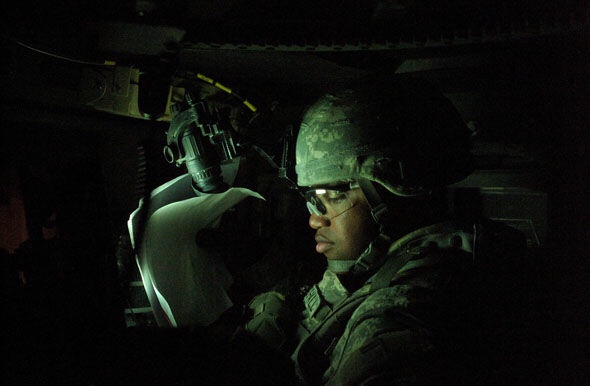
A US soldier taking part in nuclear readiness drills (Image: USSTRATCOM)

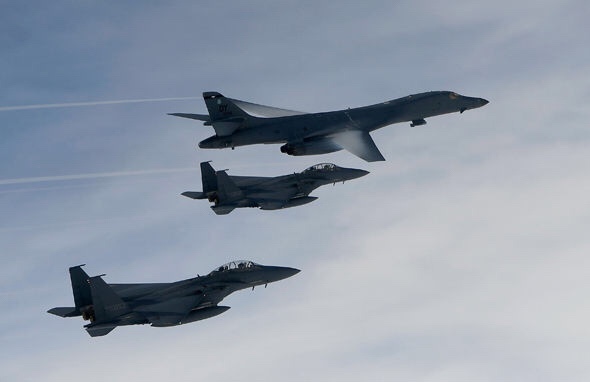
US warplanes on manoeuvres (Image: GETTY)
“This is why Global Thunder is a multinational exercise that operates on a global scale.
“Large-scale exercises like Global Thunder involve extensive planning and coordination to provide unique training for assigned units and our allies.”
US Strategic Command is responsible for strategic deterrence, nuclear operations, space operations, joint electromagnetic spectrum operations, global strike, missile defence and analysis and targeting.
Global Thunder 2019 are the first military manoeuvres since the US announced it was pulling out of the Intermediate-Range Nuclear Forces Treaty with Russia – an agreement dating from the Cold War era.
The decision to withdraw from the treaty sparked fears of fresh conflict between the two old foes.
Andrei Belousov, deputy head of the Department of Nonproliferation and Arms Control at the Russian Foreign Ministry, declared Moscow would defend its territorial integrity and principles in response to US aggression.
He said: “Here recently at the meeting, the United States said that Russia is preparing for war. Yes, Russia is preparing for war, I have confirmed it.
“We are preparing to defend our homeland, our territorial integrity, our principles, our values, our people - we are preparing for such a war.”