Thursday, September 30, 2021

Growing presence of Hamas in West Bank worries Israel: Revelation 11

Growing presence of Hamas in West Bank challenges Abbas, worries Israel | | AW

JERUSALEM–The raids launched by the Israeli security forces in the West Bank, on Saturday night, as they tracked down a Hamas cell, reflected Israel’s concern about the growing influence of the Palestinian militant movement  in the West Bank.

According to analysts, the growing presence of Hamas, which controls the Gaza Strip, also poses a challenge to Palestinian Authority President Mahmoud Abbas, who seems unable to keep security under control in the whole of the West Bank.

Israeli Channel 13 reported that the raids carried out by Israeli security forces in the West Bank prevented a “major terrorist attack.” The channel alleged that the Hamas cell planned to carry out a series of kidnappings and killings.

IDF and police forces arrested 20 suspected members of the cell in recent days, according to the IDF, which believes there are more Hamas cell members still at large.

The Israeli channel said the arrest raids began after Shin Bet, Israel’s internal security service, concluded that the group was about to carry out a series of armed attacks. The channel said that officials suspect that there is a direct line of communication between the cell and the Hamas movement in Gaza.

On Sunday, the Israeli army reported the killing of five Palestinians after an exchange of fire between Israeli soldiers and Palestinian gunmen in four West Bank towns, against the backdrop of the arrest raids.

“Hamas is trying to escalate the situation in the West Bank,” said Ram Ben-Barak, chairman of the Knesset’s foreign affairs and defence committee, in a press statement.

He pointed out that “Hamas cannot be allowed to escalate the situation in the West Bank, while it tries to maintain calm in Gaza.”

Recent months have witnessed a ratcheting up in violence in the West Bank with increased clashes between Israeli forces and Palestinian militants. Last month, four Palestinians were killed in Jenin refugee camp by Israeli troops during violent clashes.

Direct confrontations often occur between Palestinians and Israeli forces when the latter carry out raids in PA-controlled areas of the West Bank.

Although the radical Islamist movement has been ruling the Gaza Strip since 2007, it has a strong presence in the West Bank, which is run by the PA and its most prominent faction, the Fatah.

Israeli officials have long worried that Hamas, which controls the Gaza Strip, is seeking to consolidate its clout in the West Bank so as to challenge the Western-backed PA. This, they fear, would increase security risks to Israel.

Analysts attribute the escalation by Hamas of tensions in the areas under the control of the PA to its conclusions that Mahmoud Abbas’s hold on power has weakened and that his security services are unable to control Hamas elements in areas under his authority. This, they say, muddles the calculations of the PA as it seeks to resume peace negotiations with Israel, especially now that security agreements between Tel Aviv and Ramallah include provisions for cooperation over the extradition of wanted persons, coordination in combating terrorism and the exchange of intelligence information. The PA seems however unable to implement the security agreements.

Israeli officials assert that it is not possible to resume Palestinian-Israeli peace negotiations while areas remain outside the control of the Palestinian Authority in the West Bank and Gaza.

The upsurge by Hamas comes amid signs of the authority’s inability to enforce security in the West Bank and in the absence of any prospects for a political settlement.

Hamas leading figure and former minister of health Basem Naim, said Monday that the main front for the upcoming battle with Israel will be the West Bank, as “it is the Achilles heel of the occupation and the most important pretext it uses to legitimise its presence on our land.”

Naim added that, “all national and popular efforts must be harnessed to revolutionise the cities, villages and hamlets of the occupied West Bank,” noting that “to achieve this great and strategic goal, there must be a consensus, starting with a national vision to confront the doctrine of security coordination.”

He called on those he described as the adepts of this doctrine to “either side with their people and their national project, or step aside, having lost any legitimacy, so that our people can exercise their natural duty in resisting the occupation.”

Naim’s statements aim to exacerbate existing pressures on Abbas, who faces growing divisions within the Fatah movement and a sharp decline in popularity.

Analysts say that Abbas was never weaker politically and in public opinion than he is today. They point out that ten years ago Hamas would not have dared anger the president, let alone spark an escalation in the West Bank under his watch.

They believe, also, that any moves by Abbas at this stage to bring the security situation under control by reining in Hamas cells, especially in the Jenin camp, will further weaken him at the grass root level and make him appear uncommitted to the liberation agenda, which Hamas is cultivating in various ways, including in its preparations for the upcoming elections.


Wednesday, September 29, 2021

The Sixth Seal: The Big Apple Shake (Revelation 6:12)


Image result for new york earthquake


Big Apple shake? Potential for earthquake in New York City exists

NEW YORK CITY (PIX11) – For the last 43 years John Armbruster has been a seismologist with Columbia University’s Lamont Doherty Earth Observatory.  A veteran of what he describes as “a couple of dozen” quakes, he is interested in the seismic activity throughout the Pacific region in recent weeks.
However, does the amount of plate movements around the world in recent weeks as well as years to translate to New York City being more vulnerable, “These earthquakes are not communicating with each other, they are too far apart,” said Armbruster in an interview with PIX 11 News on Wednesday.
What would a magnitude 6.0 earthquake inflict upon the city?
“We know that its unlikely because it hasn’t happened in the last 300 years but the earthquake that struck Fukushima Japan was the 1000 year earthquake and they weren’t ready for the that.

The increasing risk of miscalculation: Revelation 16

Nuclear deterrence and the risk of miscalculation | The Strategist

Nuclear deterrence and the risk of miscalculation

The Latin adage Si vis pacem, para bellumwarns: ‘If you want peace, prepare for war.’ Given the heightened risk of war between China and the United States, we might take heed of this ancient wisdom. It is better to deter wars than wage them.

Part of the tragedy of the two world wars was that the principal aggressors who initiated or escalated them did so against objectively more powerful enemies. So, in theory, such aggression should have been easy to deter.

In 1914, Germany launched an unprovoked assault on neutral Belgium, bringing Belgium’s ally Great Britain into the war. Thus, after the opening gambits of World War I, the alliance of Germany and Austria-Hungary found itself at war against an objectively more powerful alliance of Russia, France and Great Britain.

In 1939, Poland had security guarantees from Britain and France, an alliance more powerful than Nazi Germany alone, but Hitler attacked Poland anyway. In 1941, Hitler attacked the Soviet Union, a much bigger and more populous country than Germany. Later that year, Japan attacked the world’s greatest industrial power, the US, by bombing Pearl Harbor. Thus, the alliance of Germany, Italy and Japan was at war against a much more powerful alliance of the British Empire, the Soviet Union and the United States.

The overconfidence and misjudgement displayed by Germany and Japan in the two world wars were in large measure attributable to a perception of a lack of resolve on the part of their foes.

In 1914, it wasn’t clear that Britain would fight on the side of Russia and France, and the British had made woefully inadequate preparations to do so.

In 1939, Hitler had been appeased for years, which made the British and French security guarantees to Poland seem hollow. The Soviet Union had fought poorly in the 1939–40 Winter War with Finland, and Hitler perceived that one kick would knock the whole rotten structure down. Japan thought that, with the US fleet destroyed, an indulgent and lazy America would seek a peace treaty rather than fight it out.

Since 1945, there’s been a ‘long peace’. There have been no big international wars and overt military conflict between nations has grown increasingly rare.

Nuclear weapons have changed the risk–benefit calculus for aggressors. It is difficult to misjudge a nation’s military capability if it has nuclear weapons, and such a misjudgement risks a mutually destructive Armageddon. Thus, the two superpowers and their alliances never directly fought each other during the Cold War.

Both China and the US have nuclear weapons today, so is there any reason to doubt that deterrence will continue to prevail?

A hot war between China and the US is mostly likely to break out over the issue of Taiwan. Nuclear weapons alone are unlikely to deter such a conflict.

If the risk of nuclear annihilation could deter all acts of aggression, then nobody would ever attack a nuclear-armed foe. But nuclear-armed US military forces have previously been attacked by North Korea, China, North Vietnam, Iraq and the Taliban. Egypt and Syria attacked nuclear-armed Israel in 1973.

Would a country invade an island it claims as its own that is allied to a nuclear-armed nation on the other side of the world? It’s happened before, when Argentina invaded the Falkland Islands, a colonial territory of nuclear-armed Britain, in 1982.

Nuclear weapons haven’t been used in anger since 1945 and a taboo has long since developed over initiating their use. Nuclear weapons are only likely to ever be used if a nuclear-armed nation is facing an existential threat. The reality is that, in all the above examples, no existential threat existed for the nuclear-armed power.

Is the loss of Taiwan an existential threat to the US? If Washington is unwilling to initiate the use of nuclear weapons to prevent Taiwan’s loss, how will China be deterred?

Even if the US still retains the conventional capabilities to defeat China, the history of the 20th century suggests that what is truly important is the aggressor’s perception of the other side’s willingness to fight. This is where the recent debacle in Afghanistan is so dangerous.

After capitulating to the Taliban, who in the leadership of the Chinese Communist Party thinks Joe Biden would be willing to risk the lives of thousands of Americans to defend Taiwan? They might be calculating that, if Taiwan can only ever be brought back into the fold of the mainland by force, doing so before Biden leaves office will be the most opportune time.

Of course, the loss in Afghanistan might have the same impact on Biden that the loss of Czechoslovakia had on British Prime Minister Neville Chamberlain in 1939—a determination not to be embarrassed again.

The danger in the capitulation to the Taliban may not be that it has made America weak, but that it has made America appear weak. The issue may not be that Taiwan could be lost, but that China will misjudge American resolve, in which case the long peace will be at an end.

John Storey, a lawyer and military historian, is the author of Big wars: why do they happen and when will the next one be?released earlier this month by Hybrid Publishers. Image: Steve Jurvetson/Flickr.

The Antichrist calls on public to ‘save’ the country through elections

Iraq’s Al Sadr calls on public to ‘save’ the country through elections

The leading Shiite cleric launches hashtag in the run-up to October 10 ballot

Iraq’s popular political leader Moqtada Al Sadr on Tuesday urged his supporters to “save” the country at the ballot box.

In a short message on Twitter, Mr Al Sadr launched the hashtag “Saving Iraq is a National Duty” in an effort to rally support for his bloc’s candidates in the October 10 parliamentary election.

The Shiite cleric is known to be one of Iraq’s most influential religious figures, leading a political bloc in Parliament that was the biggest winner of the 2018 elections with 54 seats out of 329.

Iraq has been beset by a wave of public-service issues, including hospital fires, power cuts in the blazing summer heat and a lack of employment opportunities for the youth and security.

For years, Mr Al Sadr’s movement, known as the Sadrist Movement, has been voicing their views from a nationalist perspective. It has sought to detach itself from Iran-backed militias in Iraq.

Following the US-led invasion in 2003, Mr Al Sadr led militants against the US forces, which increased his popularity among Iraq’s impoverished Shiites.

His father, Sadiq Al Sadr, led dissent among Shiite majority against Iraqi dictator Saddam Hussein and was killed by the regime in 1999.

In the past few years, Mr Al Sadr has withdrawn from frontline politics without dismantling his powerful movement.

In July, he changed his political stance and said he would boycott the parliamentary elections that are set to be held on October 10.

Mr Al Sadr said he wanted to distance himself from the government.

He reversed his decision again by the end of August and expressed willingness to participate in the elections. He urged his supporters to go to the polls and vote.

A vote for his movement, he said earlier, would mean an Iraq liberated from foreign meddling and rampant corruption.

Updated: September 28th 2021, 6:42 AM

Hamas Explosives Meant for Attacks in Israel Found Outside the Temple Walls: Revelation 11

Hamas Explosives Meant for Attacks in Israel Found in West Bank

Israeli security forces are still searching for additional Hamas members suspected of planning attacks against Israel

Sep. 27, 2021 9:34 PM

Explosives belonging to a Hamas cell were found in the village of Kafr Bidu near Ramallah in the West Bank on Monday, and according to defense officials they were meant to be used to carry out attacks in Israel.

Israeli security forces are still searching for additional Hamas members suspected of planning attacks against Israel 

Five Palestinians were killed Sunday by Israeli military fire in a large-scale arrest operation in the West Bank. The target was Hamas’ military infrastructure in the Ramallah and Jenin areas after intelligence showed the group was planning to carry out attacks in Israel, at least one of them in Jerusalem, according to defense sources. 

Three Palestinians were killed in the village of Kafr Bidu. Two other Palestinians were killed in Burkin in the northern West Bank. 

An officer and a soldier from the elite Duvdevan military unit were seriously wounded by friendly fire during the overnight raids. 

There have recently been several shooting attacks on army checkpoints in the Jenin area. Israeli arrest operations, especially near the Jenin refugee camp, have been met with an unusual volume of Palestinian gunfire.

The Evolving Chinese Nuclear Horn: Daniel 7

China’s Possible First-Strike Capabilities Are Changing the Threat Equation

China’s massive and fast-paced push to add more nuclear weapons to its arsenal is fast changing the threat equation for U.S. leaders who see the country’s ongoing large-scale increase in Intercontinental Ballistic Missiles (ICBMs) as a very “destabilizing” event.

U.S. Air Force Secretary Frank Kendall says China’s move to add hundreds of new land-based, fixed ICBM silos amounts to their developing a “first-strike” capability. 

“Most of their weapons have been mobile ICBMs, so this is a very destabilizing move and I am not sure they understand the risk they are taking. Whether they intend it or not … their move creates a first-strike capability. If they continue down this path to increase their ICBM force, then that is a de facto first-strike capability,” Kendall told reporters at the Air Force Association Symposium. 

Kendall may have been referring to an event described in August at the Space and Missile Defense Symposium by the Commander of U.S. Strategic Command Adm. Charles “Chaz” Richard. 

“Only four months ago, commercial satellite imagery discovered what is accepted to nuclear missile fields in western China. Each has nearly 120 ICBM silos. Now these compliment and are added into what they already have,” Richard told an audience at the symposium in Huntsville, Alabama. 

Sure enough, Richard’s mention of Chinese ICBM silos being detected by commercial satellites is something that aligns entirely with the information referred to by Kendall.

China’s clear ambition to massively expand its nuclear arsenal is something that has been on the Pentagon’s radar for some time, as it was cited as a serious concern last year in the Pentagon’s 2020 China Military Report.  

Following the publication of this report, senior Pentagon weapons developers and experts added even more specificity and expansion metrics describing China’s ambitious nuclear weapons expansion. 

“We do believe that over the next decade, that China is likely to at least double the size of its nuclear stockpile in the course of implementing the most rapid expansion and diversification of its nuclear arsenal in its history, China’s history,” Chad Sbragia, deputy assistant secretary of defense for China, told reporters last year according to a Pentagon transcript. “An ability to double the stockpile demonstrates a move away from their historical minimum deterrence posture.”

At the moment, China is known to have an official “no first use” policy with nuclear weapons. However that position does not appear to remain the case, Kendall explained. 

“I am reacting to what they are doing, which is significantly increasing their nuclear force with silo-based ICBMs. Several years ago they made a decision to move in the direction of a much larger ICBM force. Policies are declarations of intent, but intent can change very quickly,” Kendall said.

Kendall’s concern about Chinese ICBMs aligns in several respects with the Pentagon’s 2020 China Report which adds that the number of Beijing’s ICBMs capable of threatening America will likely grow to 200 in the next five years. As an element of this expansion, China is increasing its inventory of long-range land-fired DF-26 Anti-Ship missiles able to fire both conventional and nuclear missiles.

If merely a few nuclear weapons could unleash massive, unimagined devastation upon cities and even entire countries, why would any country need more than a small number of weapons in their arsenal?

In keeping with Ancient military philosopher Sun Tzu’s famous “Mass Matters” concept, Richard said, “it does not matter if your weapons are superior if you do not have enough of them.”

Kris Osborn is the defense editor for the National Interest. Osborn previously served at the Pentagon as a Highly Qualified Expert with the Office of the Assistant Secretary of the Army—Acquisition, Logistics & Technology. Osborn has also worked as an anchor and on-air military specialist at national TV networks. He has appeared as a guest military expert on Fox News, MSNBC, The Military Channel, and The History Channel. He also has a Master’s Degree in Comparative Literature from Columbia University.

Image: Wikimedia Commons 

The Taliban Will Definitely Have Nukes: Revelation 8

Afghanistan: Taliban could get their hands on up to 150 nuclear weapons, says John Bolton

By Lauren Lewis For Dailymail.Com 08:21 EDT 27 Sep 2021 , updated 17:01 EDT 27 Sep 2021

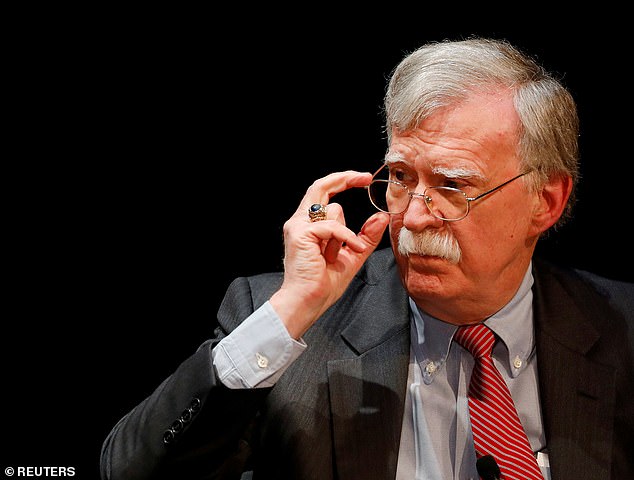
The could get their hands on up to 150 nuclear weapons after America’s catastrophic withdrawal from , former Trump security advisor John Bolton has warned.

Bolton said it was possible the nuclear weapons could end up in the hands of the Taliban if the Islamists take control of in an interview with WABC 770 on Sunday. 

‘The Taliban in control of Afghanistan threatens the possibility of terrorists taking control of Pakistan … that means maybe 150 nuclear weapons in the hands of terrorists,’ he said.

The US completed a chaotic withdrawal from Afghanistan on August 31, leaving behind military equipment that has already been seized by the Taliban, after the Islamists swept to power in a lightning offensive of the country.

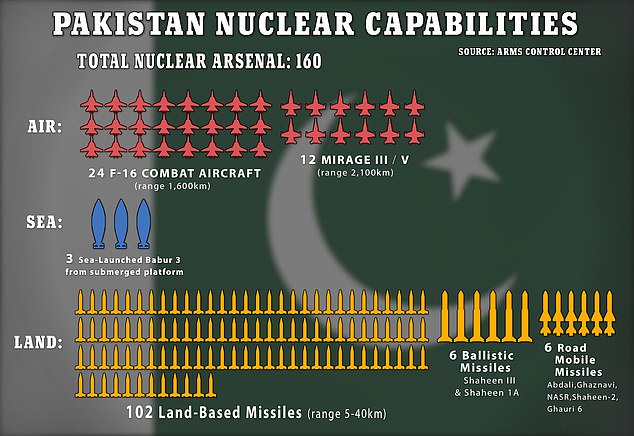
Pakistan has an arsenal of approximately 160 nuclear warheads including 102 land-based missiles and F-16 combat aircrafts with 24 nuclear launchers.

The Taliban could get their hands on up to 150 nuclear weapons after America's catastrophic withdrawal from Afghanistan, former Trump security advisor John Bolton has warned
The Taliban could get their hands on up to 150 nuclear weapons after America’s catastrophic withdrawal from Afghanistan, former Trump security advisor John Bolton has warned 
The US completed a chaotic withdrawal from Afghanistan on August 31 after the Taliban swept to power in a lightning offensive of the country
The US completed a chaotic withdrawal from Afghanistan on August 31 after the Taliban swept to power in a lightning offensive of the country 
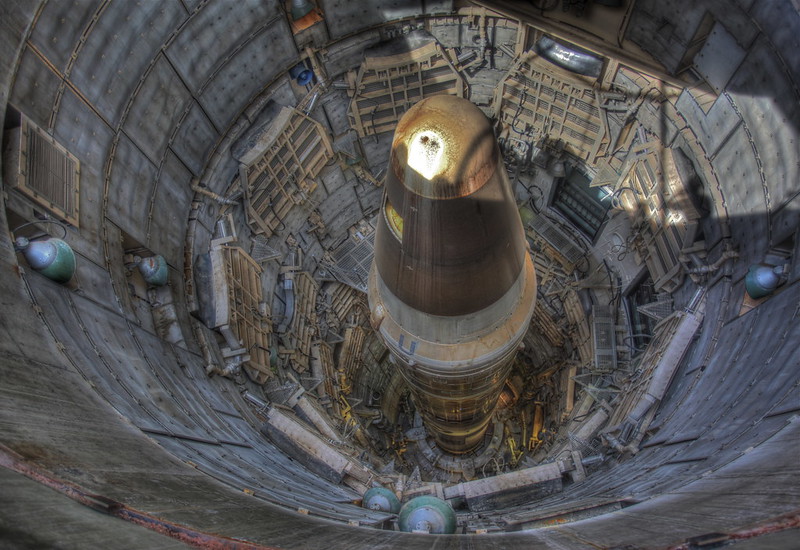
Former security advisor Bolton warned the Taliban could gain control of Pakistan's 160 nuclear warheads (pictured a Shaheen II) if they overrun the country
Former security advisor Bolton warned the Taliban could gain control of Pakistan’s 160 nuclear warheads (pictured a Shaheen II) if they overrun the country 

How big is Pakistan’s nuclear inventory? 

Pakistan first tested a nuclear warhead in 1998, becoming the seventh country in the world to officially do so. 

Its arsenal is seen as a defense against India, which first tested nuclear warheads in 1974.

Number of nuclear warheads: 160 

Air capabilities: F-16 combat aircrafts with 24 nuclear launchers with a range of 1,600 km, Mirage III and V aircraft with 12 launchers with a range of 2,100km, and Ra’ad air-launched missiles with a 350km range

Sea capabilities: Recently tested a Babur 3 from a submerged platform and are working towards firing from a submarine

Land capabilities: 102 land-based missiles, six operational nuclear capable ballistic missiles

Bolton, who served under then President Donald Trump between April 2018 and September 2019, slammed Joe Biden’s management of the withdrawal, warning allies are ‘wondering if he has a grip on his own administration’s foreign policy.’ 

Biden and the White House have repeatedly insisted they were blindsided by the swept Taliban takeover because the Afghan security forces gave up so easily. 

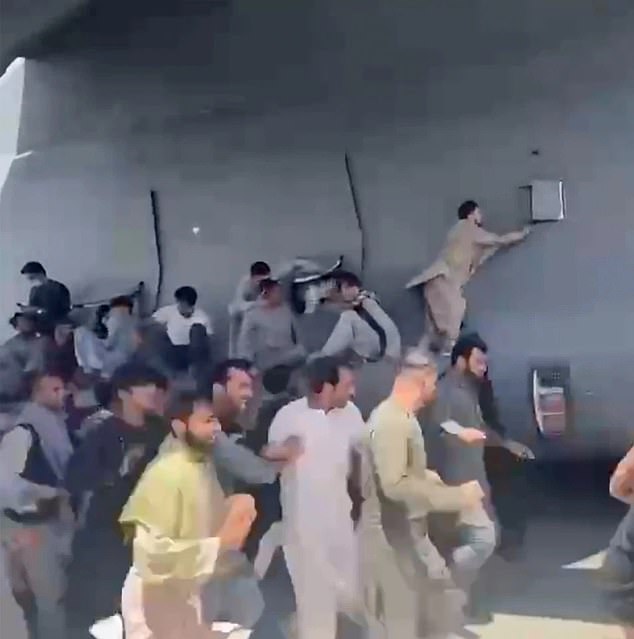
It led to scenes of chaos with thousands of Afghans swarming the airport as they desperately tried to flee the country before the Islamists imposed their rule.

Thousands gathered at the perimeter of Kabul airport – some standing in sewage, others attempting to scale the walls and many brandishing travel documents – as US soldiers attempted to control the chaos. 

Early evacuation flights saw hundreds of young men sat on a fin below the US military’s plane’s turbine as it barreled down the runway, only to then fall hundreds of feet to their deaths.

At least two people fell to their deaths from a C-17 on August 16 and the remains of another were discovered in the wheel well of the jet when it arrived in Qatar. 

Videos captured snapshots of the chaos showed US soldiers being handed babies over barbed wire fences as desperate Afghans gathered at the edge of the airport. 

Meanwhile other footage emerged of women pleading with US troops to let them onto an evacuation flight, telling them ‘the Taliban is coming’. 

And days later a suicide explosion claimed by ISIS-K, an Islamic State offshoot based in Afghanistan’s Khorasan region, left 170 dead, including 13 US service members.  

Biden later claimed the withdrawal was an ‘extraordinary success’ and local soldiers for the mess in Afghanistan and the Taliban takeover – a claim the White House has repeated in recent weeks. 

The President also laid the blame for the chaos on his predecessor Donald Trump for striking a peace deal in February 2020 with the Taliban. Trump’s peace deal had promised US withdrawal by May if the Taliban did not harbor terrorists or attack US forces or allies. 

Bolton’s warning comes after the Taliban seized much of the equipment abandoned by the US during the chaotic end to the 20-year war in Afghanistan.  

Anwari was among young Afghan men were seen clambering onto the USAF jet as it took off from Kabul on Monday. At least three of them died, two teenage brothers by falling from the wheels and Anwari was reportedly found dead in the wheel well
Anwari was among young Afghan men were seen clambering onto the USAF jet as it took off from Kabul on Monday. At least three of them died, two teenage brothers by falling from the wheels and Anwari was reportedly found dead in the wheel well 
At least three bodies were seen falling from the USAF jet as it climbed into the air on Monday
At least three bodies were seen falling from the USAF jet as it climbed into the air on Monday 

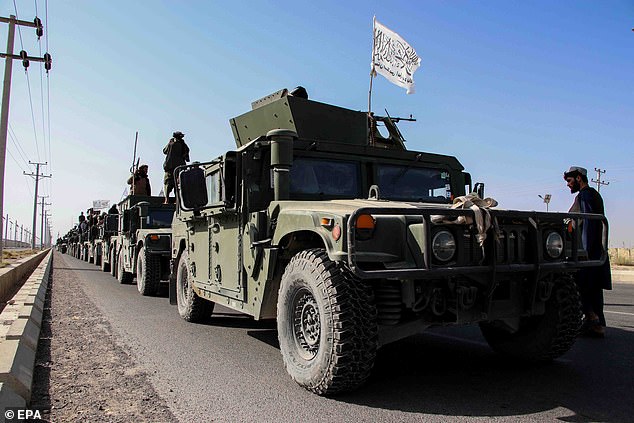
Days after the withdrawal ended, the Taliban paraded dozens of US-made armored vehicles and weaponry captured from Afghan forces during the group’s takeover. 

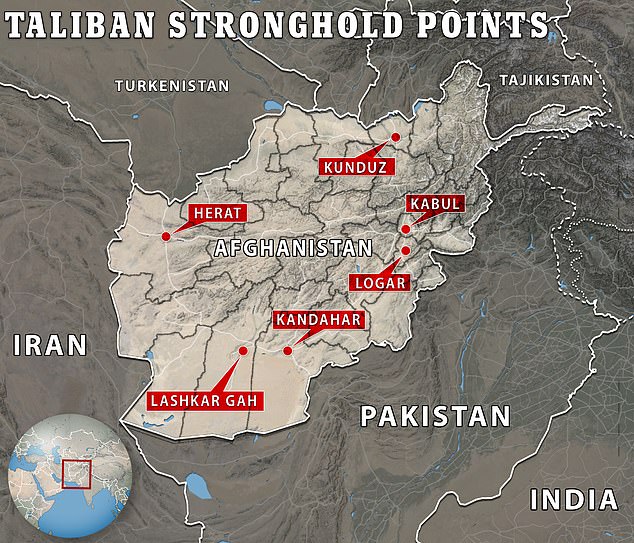
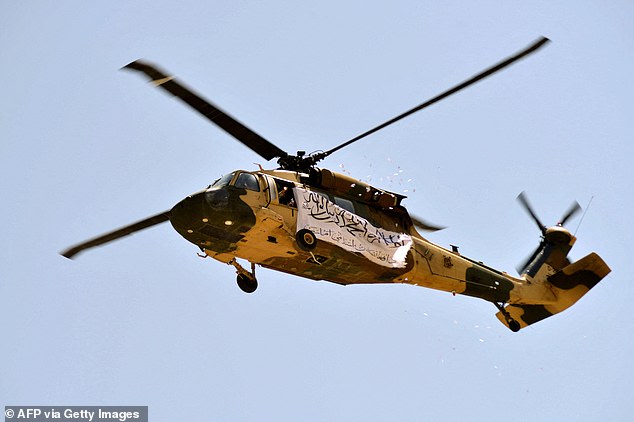
One event, in the southern city of Kandahar, even featured a fly-past from a Black Hawk helicopter flying the flag of the Taliban. 

Meanwhile a long line of green Humvees and armored fighting vehicles drove in single file along a highway outside Kandahar – the spiritual birthplace of the militant group. Many of the vehicles had the white and black Taliban flag attached to them.

Footage posted on social media showed a helicopter flying overhead trailing the Taliban’s standard behind it as fighters waved from below.  

One event, in the southern city of Kandahar, even featured a fly-past from a Black Hawk helicopter (pictured) flying the flag of the Taliban
One event, in the southern city of Kandahar, even featured a fly-past from a Black Hawk helicopter (pictured) flying the flag of the Taliban 
The parades of the hardware, captured during the group's takeover of Afghanistan, were held just hours after U.S. President Joe Biden defended his decision to end two decades of American presence in the country
The parades of the hardware, captured during the group’s takeover of Afghanistan, were held just hours after U.S. President Joe Biden defended his decision to end two decades of American presence in the country 

Taliban spotted in Afghan army truck provided by US Military

US withdrawal from Afghanistan: 

April 14, 2021 

Biden announces U.S. forces will withdraw unconditionally by Sept. 11, implementing the agreement reached with the Taliban by his predecessor, Trump.

July 2, 2021

U.S. troops abruptly pull out of their main base at Bagram airfield 60 km (40 miles) north of Kabul.

August 15, 2021 

After a stunning week-long advance capturing cities across the country, the Taliban seize Kabul without a fight. President Ashraf Ghani flees the country. The United States and Western allies launch an urgent airlift from Kabul airport to bring out their own citizens and tens of thousands of Afghans who aided them.

August 26, 2021

Islamic State offshoot ISIS-K launches a suicide bomb attack on the crowded gates of Kabul airport, killing scores of civilians and 13 U.S. troops.

In the days that followed, the U.S. conducted drone strikes on ISIS-K assets in Kabul in response. ISIS-K also fired five rockets towards Kabul airport as U.S. and western forces tried to get the last American citizens and Afghan allies to safety. 

August 30, 2021 

U.S. General Frank McKenzie, head of U.S. Central Command, announces completion of the U.S. troop withdrawal. The Taliban celebrated with gunfire in the streets as Western forces finally left after 20 years.

There were still at least 250 American citizens stranded on the ground and thousands of Afghan allies – SIV applicants are those designated as vulnerable – left to face the Taliban.