Showing posts with label theprophecy.hegemony. Show all posts

Saturday, June 16, 2018

Iran Maintains Hegemony in Iraq (Daniel 8)


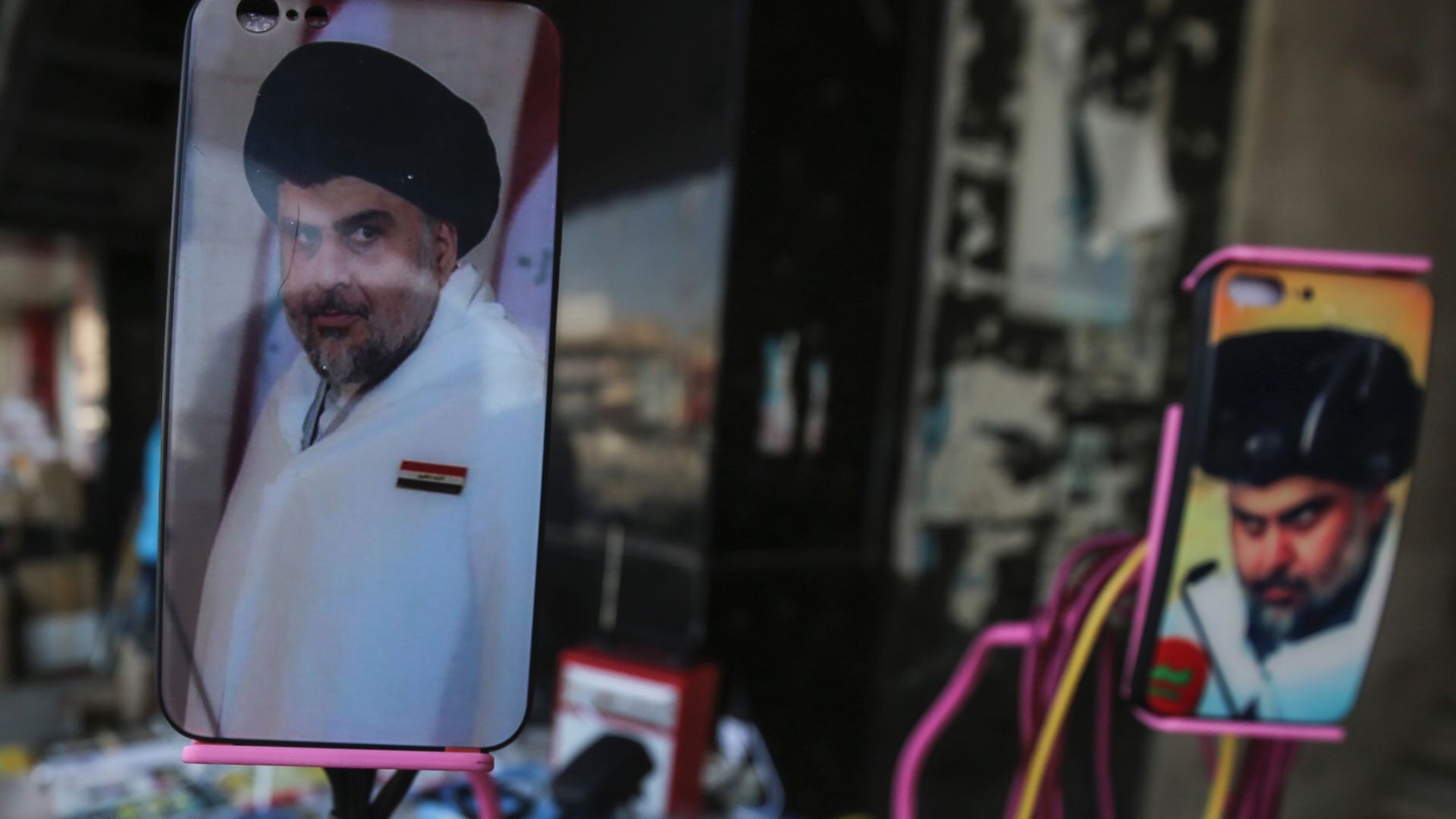
Muqtada al-Sadr on cell phone covers. Photo: Ahmad Al-Rubaye/AFP/Getty Images
Iraq may soon have a pro-Iran government
Haley Britzky
A coalition of blocs loyal to cleric Moqtada al-Sadr and Hadi al-Amiri, an Iran-backed militia chief, has emerged from Iraq's disputed election and is now seeking to ease concerns in Washington as it works to form a government, Al-Monitor reports.
The details: A leader in Al-Amiri's Fatah Alliance, Karim al-Nuri, said in a statement on Wednesday that the coalition "is in tune with the vision of Iran and the United States." The coalition is viewed as a win for Iran, which will be able to "maintain its influence" in Iraq, Al-Monitor notes. The coalition is currently sitting at 141 seats, 24 seats below the 165 needed to form a government, per Al-Monitor.

Monday, May 14, 2018

Korea and Iran are not Parallels

http://www.bbcnewspoint.com/wp-content/uploads/2017/02/Top-10-Countries-With-Best-And-Most-Powerful-Nuclear-Weapons-In-The-World-2017-Iran.jpgKhamenei and the North Korean precedent
Did you know that South Korea’s Gross Domestic Product (GDP) is to the tune of $1.5 trillion, whereas the North Korean GDP is not more than $28 billion? It’s true that North Korea is a nuclear country and it can fire ballistic missiles against the US. In spite of this military strength, North Korea decided to engage in peace talks with the US and its neighbor South Korea that will end with the declaration that it would give up its nuclear weapons arsenal to denuclearize the Korean Peninsula.
The question is, why did the North Korean leader take such a decision? All the objective indicators suggest that the North Korean president apparently realized that his nuclear weapons will neither help feed his people nor solve the country’s several economic problems, but abandoning his nuclear arsenal may help resolve these issues.
Poverty and hunger in Iran
Iran, under Khamenei, suffers from similar economic woes, particularly extreme poverty which continues to increase by the day. But Khamenei does not care about these issues as he only cares about Iran becoming a regional power and about spreading Shiism among the peoples of the region, which is a goal typical to any theocratic country. He thus thinks that he can only achieve these goals by having a strong military that is protected by a nuclear deterrence mechanism to impose whatever he wants, whenever he wants. In fact, he has started splurging Iranian economic revenues on sectarian Shiite militias, moving them from one place to another and investing in any foreign political dispute. He neglected Iran’s domestic affairs and as a result poverty increased and entrapped more than half of the population. According to statistics this percentage is still increasing. This means that there are 40 million hungry people out of a total population of about 80 million.
What if Khamenei and the theocrats abandon their expansionist ambitions and decide to become objective and rational? What if they benefited from the North Korean experience, and decided to cooperate with countries of the world, instead of destabilizing global security?
Mohammed Al Shaikh
The politicized Persian theocrats are not aware that the world standards today differ from those in the past — when invasion, jihad and dominance and exporting ideological revolutions by force controlled the relations of peoples. It has become impossible to invade nowadays. Today’s world would never, I repeat never, let a theocratic state expand and act like terrorist militias, which it’s working to combat and to eradicate their culture.
The option of development
On the other hand, what if Khamenei and the theocrats abandon their expansionist ambitions and decide to become objective and rational? What if they benefitted from the North Korean experience, and decided to cooperate with countries of the world, instead of destabilizing global security?
I am almost certain that Iran would witness massive development if it adopts such a stance because of its rich natural resources. Investors will invest in Iran and develop it economically and help its citizens catch up the 21st century. By the way, first among these countries would be the neighboring Gulf states, headed by Saudi Arabia.
But such a brave decision needs a man like Mohammed bin Salman, someone with his awareness, determination and courage. Khamenei does not have the ability, the qualifications or the mindset, which is still stuck in the past, to execute such a decision. Opportunists around the mullahs are aware that any real economic development and reform and eradication of corruption will turn Iran into a civil state. When civilians rule, the mullahs will return to their mosques and hawzas (seminaries).
This article is also available in Arabic.
_____________________
Mohammed Al Shaikh is a Saudi writer with al-Jazirah newspaper. He tweets @alshaikhmhmd.
Last Update: Sunday, 13 May 2018 KSA 17:00 - GMT 14:00
Disclaimer: Views expressed by writers in this section are their own and do not reflect Al Arabiya English's point-of-view.

Sunday, May 6, 2018

The Large Horn of Iran and the Small Horn of Iraq (Daniel 8)

Iran has maintained a significant interest in Iraq for many years, acting as a safe haven for dissidents from Saddam Hussain’s regime and, following the 2003 intervention, taking up a role as both a major political actor and providing support to Shiite militias who targeted coalition forces and the country’s Sunni population.
This activity has been stepped up considerably since the capture of Mosul by the terrorist organization ISIS in 2014. The then ongoing nuclear negotiations acted to deter any significant U.S. attempt to mitigate Iranian influence. In fact, it appears that the talks may have resulted in just the opposite: in September 2014, it was reported that Iran had offered to work with the U.S. in defeating ISIS in exchange for more flexibility on the number of centrifuges it could retain as part of a deal.
Although it is not possible to quantify in its entirety the impact of the proposal on U.S. behavior, it was ultimately this preferred Iranian option – that they were allowed to retain all of their centrifuges, but with only some in an operation state – which was a cornerstone of the final JCPOA.
Iran currently exerts significant political and economic powers in Iraq. Tehran’s influence is being felt at the highest level by regular visits from General Qassem Soleimani, commander of Iran’s Quds Force – a man described as “the single most powerful operative in the Middle East today” and “Iran’s viceroy for Iraq.”
Former Iraqi Prime Minister Nouri al Maliki was only forced out of power once Tehran withdrew their support of his premiership. But despite this fall from grace, al Maliki – the man most directly responsible for ISIS’ rise – remains Iran’s point man in the country, and continues to plot his own return to the top.
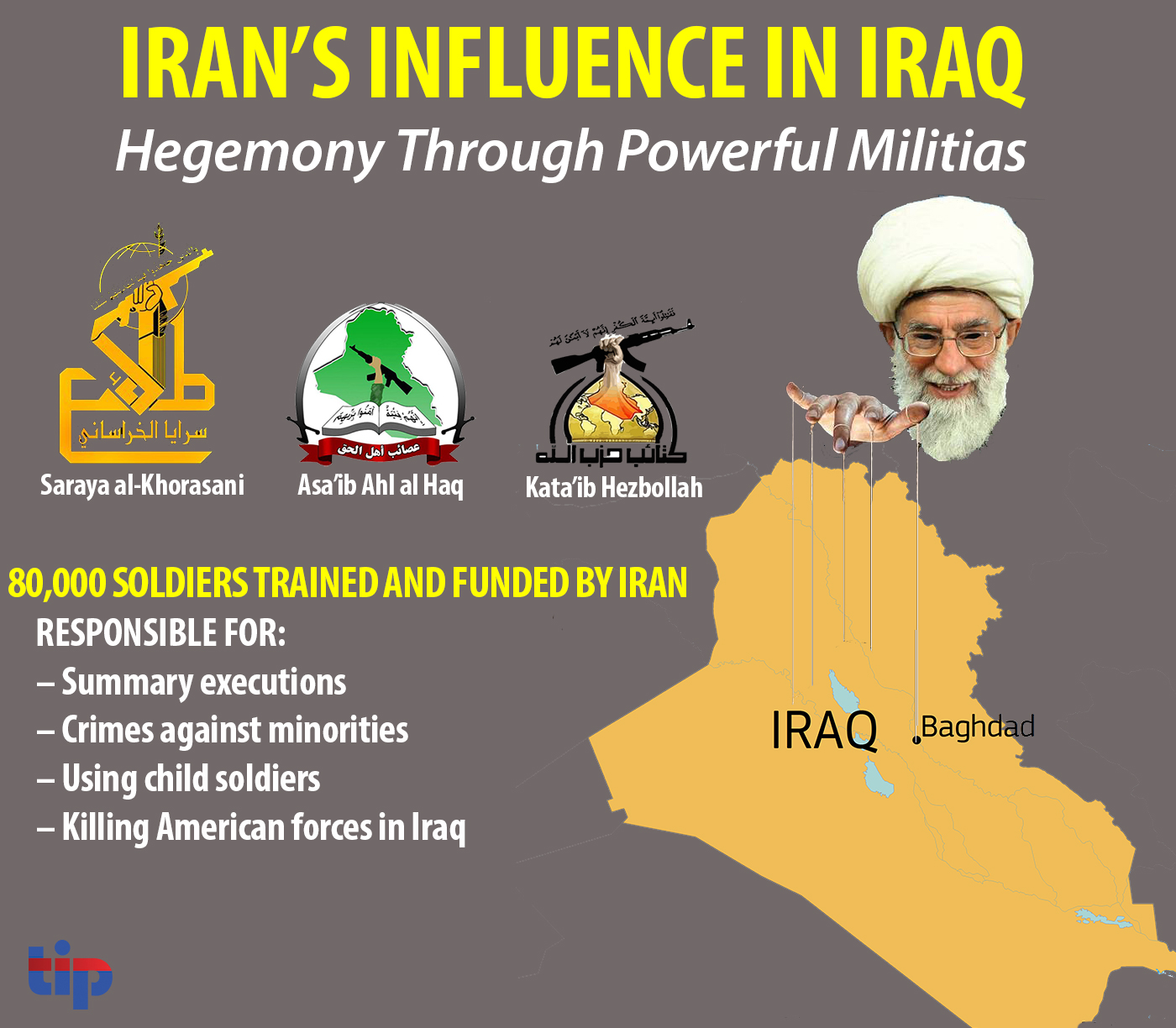
On the ground, Iranian efforts have centered on training and supplying a variety of Shiite militias under the wider umbrella of the “Popular Mobilization Forces” (PMU), a diverse 60,000 to 140,000 strong group formed in 2014 to counter the rise of ISIS and compensate for the repeated failures of the Iraqi Army.
The group’s aggressive behavior has raised concerns over their potential future role in Iraqi society, especially since a number of the militias pledged spiritual allegiance to Iranian Supreme Leader Ali Khamenei, including the Badr Organization and Saraya al-Khorasani. The official logo of the al-Khorsani group is an exact replica of that of Iran’s Revolutionary Guard Corps (IRGC).
iran-in-iraq-graphic
During the Iraqi insurgency of Abu Musab al Zarqawi’s al-Qaeda in Iraq, Hezbollah’s Iraqi branch Kata’ib Hezbollah sprang to prominence in 2007 and was involved in a series of lethal attacks against coalition forces. In the conflict in Iraq against ISIS, Kata’ib Hezbollah joined the alliance of PMU. They have also been party to a litany of human rights abuses and war crimes documented by Human Rights Watch, and yet continue to attract Iranian funding.
Reports from June 2017 claim that dozens of bodies were found in Mosul handcuffed, executed, and buried in shallow, unmarked graves. In May 2017, two aid workers found a group of 15 bodies on the side of the road between Athba and Hammam al-Alil, just outside Mosul. Armed forces reported that they saw Iraqi “security forces”, mostly likely PMU, bring the men to the site and execute them. The U.S. Department of State noted that, under the guise of fighting ISIS, Kata’ib Hezbollah is advancing Iran’s interests in Iraq, further adding: “Iranian-supported Shia militias in Iraq have committed serious human rights abuses against primarily Sunni civilians.”
Asa’ib Ahl al Haq (AAH) is another Shia paramilitary organization operating largely in Iraq in allegiance with the PMU. It was founded by Qais al-Khazali, after his split from Muqtada al-Sadr’s Mahdi Army. Khazali was recruited in 2006 by the IRGC and AAH fighters have since received extensive training either in Iran or at Hezbollah camps in Lebanon. It has been reported that “since its inception, AAH has relied heavily on Iranian funding, training, and logistical support, and in return has acted as an Iranian proxy in Iraq, carrying out its agenda and promoting its interests.” Iraqi intelligence officials estimated that as of March 2014, AAH received $1.5-2m per month from Iran, adding that: “They see themselves as the “Soldiers of the Marjaeen” [the ultimate Shia religious authority]…their power is unchecked.”
AAH forces have also been implicated in human rights abuses including raiding Sunni homes and mosques and murdering Sunni civilians. In 2014, Human Rights Watch reported that AAH had executed at least 109 Sunni men in the villages surrounding Baghdad between March and April of that year. Two years later, Human Rights Watch described AAH attacks on Sunni civilians in Iraq as “serious violations of international humanitarian law” and “deadly abuse.”
Iraqi Prime Minister Haider al-Abadi, who has long had a strained relationship with the regime in Tehran, deserves credit for calling out the lawless behavior of Iranian-backed groups. His government’s policy has been to strengthen state institutions and to reinforce the chain of command to contain Iran’s influence in Iraq. In March, the prime minister signed a decree that formalized the PMU as a force under the command of his office, in an attempt to curb their power.
“The United States also has a crucial role to play in countering Iraq’s malign ambitions in Iraq by maintaining a military presence in the country,” Joshua S. Block, President and CEO of The Israel Project, said. “To keep Tehran in check, the United States must exert pressure on Baghdad to prevent the PMU from receiving the $1 billion allocated to the group from the Iraqi national budget. They could also put checks in place to prohibit Iranian-backed forces from profiting from the billions of dollars pledged to Iraq by the international community for the reconstruction of the country.”
Block warned: “These resources strengthen Iran’s proxies on the battlefield and help them to manipulate Iraq’s political system, social fabric, and ideological nature. With every inch of territory these groups acquire, Tehran’s influence in Iraq becomes stronger.”
As an example, he cited the assault on the former Kurdish-held town of Kirkuk in October 2017 and U.S. failure to come to the aid of Kurdish forces – the most reliable anti-Iran force in Iraq. As a result, Iranian proxies now control the oil-rich city and strategically vital towns nearby.
As Iraqis prepare to go to the polls on May 12 – the same day President Trump is set to “nix or fix” the nuclear deal – powerful Iranian-backed forces have their eyes on the election and are set to win a large chunk of seats, reinforcing concerns over Tehran’s sectarian agenda and interference in Iraq’s democratic election process.
This development has also caused concern in the United States. In March of this year, Reuters reported that U.S. Defense Secretary James Mattis accused Iran of “mucking around” in Iraq’s upcoming elections. Mattis told reporters that the U.S. had what he called “worrisome evidence” that Iran is funneling “not an insignificant amount of money” into Iraq to interfere in Iraq’s democratic election process.
Iran’s Supreme Leader, Ayatollah Ali Khamenei, has previously warned the Iraqi government not to allow U.S. troops to remain in Iraq, after the defeat of ISIS.
In February, Qais al-Khazali, the founder and leader of AAH, vowed that Shiite groups will form Iraq’s next government and their priority will be to “expel the American forces from Iraq and terminate the strategic cooperation agreement between the two countries.” The same month, Kata’ib Hezbollah warned that its fighters will begin to attack American troops “at any moment,” if they build a permanent military presence in Iraq.
Strategically, Iran seeks to secure Iraq as part of its “corridor to the Mediterranean” – allowing them a direct route through to Syria, Lebanon and – ultimately – all the way to the Israeli border. Already, Tehran controls large elements of Iraq’s economy and political system. Blessed with both the financial windfall and political legitimacy the JCPOA has generated, Iran is well-placed to secure its goals.
This is the third in a series of reports prepared by TIP Senior Fellow Julie Lenarz looking at the consequences of the 2015 nuclear deal with Iran.

Friday, May 4, 2018

The Korea and Iran Deal are Closely Intertwined


Any North Korea nuclear deal must involve Iran’s nuclear program
May 02, 2018 - 11:30 AM EDT
By A.J. Caschetta, opinion contributor
The views expressed by contributors are their own and not the view of The Hill
With the prospect of another round of North Korean diplomacy in the air, the United States must take full advantage by insisting that any deal with Kim Jong Un’s regime include full disclosure of everything it knows about the Iranian nuclear program and the decades-long nuclear proliferation abetted by Pakistan’s AQK Network. The president frequently mentions the North Korean and Iranian nuclear threats in the same speech, but he needs to link the two.
As Anthony H. Cordesman at the Center for Strategic and International Studies points out, there is “no reliable open-source data on exactly how Iran reached out to North Korea (or vice versa),” but the evidence of cooperation is incontrovertible. From shared Scud missile technology, to Iranian scientists present at North Korean nuclear tests, North Korea knows many of Iran’s secrets and can certainly provide enough evidence to satisfy even the most skeptical members of the international community.
The origin of North Korea’s success as a nuclear power began with assistance of the world’s most prolific proliferator, Abdul Qadeer Khan (AQK), Pakistan’s “Father of the Islamic Bomb” whose underground network sold centrifuge designs and equipment to numerous countries, both known (North Korea, Libya, Iraq and Iran) and unknown.
AQK provided much of the knowledge and materiel necessary for the North Korean and Iranian nuclear programs, but there were other connections. The founder of the Kim dynasty, Kim Il-Sung, was among the first to congratulate Ruhollah Khomeini after he seized power from the Shah of Iran. When Iraq invaded Iran in 1980, Kim offered Khomeini Scud missiles and sent military advisors to aid the Islamic Revolutionary Guards Corps (IRGC). Amir Taheri with Gatestone Institute suggests that even the Iranian “swarm attack,” or “human wave attack,” was derived from a tactic Kim used against American forces in the 1950s.
North Korea also helped Iran to make giant leaps forward in its missile program. When the Iraq-Iran War ended, North Korea helped Iran develop its own Shahab missile based on the Scud B design it had obtained from the Soviet Union. Iran’s current long-range Shahab-3 missile is based on the North Korean Nodong-1. Even the submarines used to launch missiles are similar; the Iranian Ghadir-class submarine is a close copy of North Korea’s Ono-class submarine.
Perhaps the most alarming evidence of cooperation came when North Korea tested a nuclear device in February 2013 and Iran’s seldom-seen chief nuclear scientist, Mohsen Fakhrizadeh-Mahabadi, was there to witness the event. Some analysts believe that the cooperation is so complete that Iran actually has moved its most secret nuclear research facilities to North Korea.
With the almost dizzying images and prospects coming out of North Korea, it will be tempting to go down the perilous path toward another bad deal with another Kim. It is encouraging that this round of diplomacy is being led by Secretary of State Mike Pompeo, who does not come from the world of traditional, weak diplomacy. And with John Bolton as national security adviser, we can be sure that President Trump is being advised of the North Korean-Iranian link. Bolton wrote in August of last year, “If Tehran’s long collusion with Pyongyang on ballistic missiles is even partly mirrored in the nuclear field, the Iranian threat is nearly as imminent as North Korea’s.”
If a peace deal with North Korea brings an apology for the murder of Otto Warmbier, return of any of the remains of the thousands of U.S. military personnel who disappeared fighting in the Korean War, or even the return of the USS Pueblo, which has sat in a North Korean harbor for over 50 years, Trump will be applauded.
But information that helps us expose and dismantle the Iranian nuclear threat might be the most important thing to come from any deal. Even if the next generation of Kims cheats and reneges on the deal, as the earlier generation of Kims did, we still will have gotten the goods on Iran.
Congress must urge the administration to push for a full disclosure of the entire history of North Korea’s participation with the Iranian nuclear program and everything it knows about the AQK Network. Adopting the tactics of law enforcement will make it possible to “flip” Kim Jong Un and turn him into an informant in return for his regime’s survival and the fabulous rewards that no doubt await him.
A.J. Caschetta is a Ginsburg-Ingerman Fellow at the Philadelphia-based think tank Middle East Forum and a senior lecturer at the Rochester Institute of Technology, where his focus has been the rhetoric of radical Islamists and Western academic narratives explaining Islamist terrorism.

Friday, April 20, 2018

Iran Forms the Shi’a Sickle (Daniel 8:8)


Boosts Ties With Syria, Iraq and Lebanon
By Tom O'Connor On 4/18/18 at 5:55 PM
Iran's supreme leader warned top officials Wednesday that their country was facing threats of espionage and subversion from foreign foes who sought to undermine the Islamic Republic and its increasingly large sphere of influence in the Middle East.
Ayatollah Ali Khamenei told Iranian Ministry of Intelligence officials to be ready to fight an "intelligence war" over public opinion and the integrity of the country's ruling ideology that required both offensive and defensive strategies to win. Without naming any specific foes, Khamenei praised his spies for thwarting the plots of "the intelligence systems of the opposition" and recommended forming a united front at a time when tensions were rising with the U.S., Israel and Saudi Arabia.
"We are now placed in the middle of this great, big battlefield; one side of it being the System of the Islamic Revolution; the other side is the huge, powerful front of the enemies," Khamenei said, according to his official website. "We have to resist during this war, against the plans of the adverse front; to overcome the enemy, we have to develop offensive strategies besides defensive ones, so that a strategical blueprint on playing field is laid out by our intelligence services."
The Iranian Foreign Ministry came out strongly Tuesday against Israeli airstrikes that killed Iranian personnel on a Syrian air base last week, warning that "Tel Aviv will be punished for its aggressive action." The attack was followed by a trilateral U.S., French and U.K. cruise missile strike Friday on three Syrian government research centers allegedly involved in a chemical weapons attack in rebel territory the previous weekend. Iran is a staunch ally of Syrian President Bashar al-Assad and, along with Russia, has helped him overcome a seven-year uprising supported by the West, Turkey and Gulf Arab states.
The U.S. and Iran were both supporting efforts to battle the Islamic State militant group (ISIS), but the former saw a political future in Syria without Assad. As the Syrian leader claimed victories nationwide and the U.S.-led effort to battle ISIS faltered, however, Iran has increasingly invested in the war-torn nation. Alaeddin Boroujerdi, the head of the national security and foreign policy commission in Iran's parliament, said Monday that he would soon visit Syria in the wake of the Western attack, which he said was "was carried out with the aim to boost the terrorists’ morale," according to the semi-official Mehr News Agency.
Iran has also shored up its relations with neighboring Iraq, where a 2003 U.S. invasion installed a Shiite Muslim government much friendlier to Iran and spurred a Sunni Muslim insurgency that ultimately helped to form ISIS. The U.S. and Iran both supported the Iraqi military, while a U.S.-led coalition provided air support and Iran established a powerful collective of militias known as the Popular Mobilization Forces. With ISIS largely defeated, these paramilitary fighters were made official members of the country's armed forces and they have threatened to expel the U.S. military by force.
Iranian Defense Minister Amir Hatami arrived Wednesday in Baghdad for a two-day visit he said was mainly aimed at "enhancing defense and military cooperation between Iran and Iraq," according to The National. The visit came as Iraqi Prime Minister Haider al-Abadi carefully balanced the interests of Iran, Saudi Arabia and the U.S. ahead of next month's elections.

Iranian Defense Minister Amir Hatami and his Iraqi counterpart Arfan al-Hayali listen to their countries' national anthems at the Ministry of Defense in Baghdad, Iraq, on April 18, 2018. Iran has shored up ties with allies Lebanon, Iraq and Syria as tensions rise with Israel, Saudi Arabia and the U.S. Stringer/Reuters
Lebanon was also set to hold elections next month, its first legislative vote in nine years. Iran grew influential in Lebanon after it helped to establish the Shiite Muslim Hezbollah movement that played a main role in resisting two Israeli incursions. Hezbollah, considered a terrorist organization by the U.S. and some of its allies, comprised the second-largest political party in the ruling March 8 alliance and has been deployed in heavy numbers to battle Syrian rebels and jihadis in both Syria and Lebanon, whose regular armed forces receive U.S. support.
Leading Lebanese newspaper Al-Nahar, which is closer to the opposition March 14 bloc, reported Wednesday that Qassem Soleimani, head of the elite Iranian Revolutionary Guards' expeditionary Quds Force, visited the southern suburbs of Beirut earlier this month to meet with Hezbollah Secretary-General Hassan Nasrallah.
President Donald Trump has attempted to roll back the diplomatic efforts of his predecessor, who established a landmark nuclear deal with Iran in 2015. International reviews have shown Iran to be in compliance with the deal and its other signatories—China, France, Germany, Russia and the U.K.—have all urged Trump not to abandon the deal as a deadline approached next month. The White House has argued, however, the deal gave Iran too much in the way of sanctions relief and did not adequately prevent it from funding U.S.-designated terrorist groups, developing ballistic missiles and ultimately pursuing nuclear weapons.

Thursday, April 19, 2018

Iran Continues to Threaten Israel (Daniel 8:4)


Following last week’s airstrike that targeted Iranian forces based at the Tiyas or T-4 airbase in Syria, two Iranian officials have threatened Israel.
On Monday, according to Iran’s Islamic Revolutionary Guard Corps (IRGC)-affiliated Tasnim News,  Iranian Foreign Ministry Spokesman Bahram Qassemi said that Israel would receive “required responses sooner or later,” and that Israel “cannot take (such) an action and be exempt from punishment.”
Seven Iranian military advisers, including one colonel, were killed in the airstrike.
In addition, last Friday, Iranian Army Ground Forces commander Brigadier General Kiumars Heidari said that Israel can no longer attack Iran and that the date has already been set for Israel’s destruction.
The latter comment is an apparent reference to Supreme Leader Ayatollah Ali Khamenei’s prediction that Israel will be destroyed within 25 years.
Heidari also boasted that “Iran is the most stable and strongest country in an unstable and volatile region now.” He did not address the ongoing protests against the regime or the continued devaluation of its currency.
The threats against Israel by Qassemi and Heidari follow one by Ali Akbar Velayati, a foreign policy adviser to Ayatollah Ali Khamenei, last week in the wake of the strikes against the airbase. Velayati said a week ago that the “crimes will not remain unanswered.”
In addition to Iranian officials threatening retaliation for the airstrikes against the T-4 airbase, two officials threatened Tel Aviv and Haifa, two of Israel’s largest cities, with destruction.
On Friday last week, the IDF announced that the Iranian drone that entered Israeli airspace in February was loaded with explosives and showed “an Iranian intent to carry out an attack,” an act of war against Israel.
The threats from Iran, as well as the escalation of military activity in Syria, including a coordinated attack on Syria’s chemical weapons facilities by the United States and its allies, has prompted Israel to be on alert for possible direct attack by Iran.

Wednesday, April 18, 2018

Why Syria Will NEVER Complete the Shia Sickle


 “What kind of a nation wants to be associated with the mass murder of innocent men, women, and children?” President Trump asked Russia and Iran Friday night after launching air strikes against the Syrian regime. “The nations of the world can be judged by the friends they keep.”
Despite his speechwriters’ best efforts, if there is one thing Donald Trump and Iran share it is an inability to be shamed. Over the last seven years no country has done more, financially and militarily, to back the Bashar al-Assad regime’s mass murder of Syrians than the Islamic Republic of Iran, a theocracy that claims to rule from a moral high ground. Within hours of joint American, French, and British targeted military strikes in Syria, Iranian president Hassan Rouhani called Assad to pledge his solidarity.
At a time of great economic hardship in Iran, Tehran has provided billions of dollars to arm, train, and pay tens of thousands of Arab, Afghan, and Pakistani Shia militants help Assad crush Sunni Islamist rebels. Tehran, the victim of heinous chemical weapons attacks by Saddam Hussein three decades ago, has provided Assad the means to deliver these same weapons, while simultaneously denying that he uses them. The question is why?
Distilled to its essence, Tehran’s steadfast support for Assad is not driven by the geopolitical or financial interests of the Iranian nation, nor the religious convictions of the Islamic Republic, but by a visceral and seemingly inextinguishable hatred for the state of Israel. As senior Iranian officials like Ali Akbar Velayati, a close adviser to Supreme Leader Ayatollah Ali Khamenei, have commonly said, “The chain of Resistance against Israel by Iran, Syria, Hezbollah, the new Iraqi government and Hamas passes through the Syrian highway. … Syria is the golden ring of the chain of resistance against Israel.” So long as the 78-year-old Khamenei remains in power, this hatred will justify Tehran’s continued commitment of blood and treasure to support Assad’s use of all means necessary—including chemical weapons—to preserve his rule.
Though Israel has virtually no direct impact on the daily lives of Iranians, opposition to the Jewish state has been the most enduring pillar of Iranian revolutionary ideology. Whether Khamenei is giving a speech about agriculture or education, he invariably returns to the evils of Zionism. “The Zionist regime is a true cancer tumor on this region that should be cut off,” Khamenei said in a 2012 speech. “We will support and help any nations, any groups fighting against the Zionist regime across the world.” Given Israel’s military superiority, Khamenei’s stated strategy is not Israel’s short-term annihilation, but its long-term political dissolution. “If Muslims and Palestinians unite and all fight,” he commonly says, “the Zionist regime will not be in existence in 25 years.”In ostensibly trying to avenge what he portrays as one injustice, however, Tehran has helped Assad perpetrate a far greater one. The number of Syrian deaths since 2011 (an estimated 500,000, though the UN has stopped counting) is more than five times greater than the approximately 90,000 Arabs (roughly 20-30 percent of them Palestinian) killed in the last 70 years of the Palestinian-Israeli conflict, while more than twice as many Syrians (12 million) as Palestinians have been displaced.* Indeed since 2011 far more Palestinians have been killed by Assad (nearly 3,700) than by Israel, including by chemical weapons.  “If their way to return Palestinians back home is displacing millions of Syrians,” said my friend Kassem Eid, one of around half a million Palestinian refugees who grew up in Syria, and a victim of one of Assad’s chemical weapons attack, “I don't want to go back to Palestine.”
* * *The Iran-Assad alliance is a study in contradictions. While Iranian advocates for secularism are viciously repressed, Assad routinely says, “The most important thing is that Syria should be secular.” Iranian women who defy the mandatory hijab are subject to violence and imprisonment, while Hezbollah fighters celebrate military victories in Damascus nightclubs alongside scantily-clad escorts. While nude Renaissance art is censored in Europe so as not to offend the religious sensibilities of visiting Iranian officials, Assad’s forces have deliberately used rape as a tool of repression against opponents. Khamenei implores his subjects to buy Iranian products to boost economic self-sufficiency, while Tehran’s largesse has helped subsidize Assad’s wife Asmaa—an unveiled fashionista—sustain what looks like her primary passion: shopping in London.
From the outset of the Syrian uprising in 2011, Assad and Iran assiduously sought to crush moderate opposition and indulge radical Islamists in order to engineer a no-win proposition for the West: Assad or jihadists. Yet Tehran has tried to portray its role in Syria as an existential battle for Iran, against the forces of Sunni radicalism. “Syria is Iran’s 35th province,” said Mehdi Taeb, a head of the Revolutionary Guards intelligence wing and a close advisor to Iranian Supreme Leader Ayatollah Ali Khamenei. “If we lose Syria we won’t be able to hold Tehran.” While Assad’s collapse would undoubtedly be a strategic blow to the Islamic Republic, Iran has been a nation-state for virtually 2,500 years before now without the benefit of a Syrian vassal state. Just as Russia outlived the USSR, so will Iran outlive the Islamic Republic.
Today the Tehran-Damascus axis has come to resemble a mutually exploitative love affair: Iran likes Syria for its body (which borders Israel and serves as Tehran’s waystation to Hezbollah), and Syria likes Iran for its money. In exchange for Iranian largesse, Assad has forsaken his sovereignty. “Syria is occupied by the Iranian regime,” said former Syrian Prime Minister Riad Hijab. “The person who runs the country is not Bashar al-Assad but [Iranian Revolutionary Guard Corps commander] Qassem Suleimani.” As for the other half of the couple, Tehran’s staggering expenditures in Syria—estimated to be several billion annually—have become a growing cause of popular resentment amidst deteriorating economic conditions in Iran. During anti-government protests last January in Iran, residents of Mashhad—a large Shiite Shrine town—chanted “Leave Syria alone, think about us.”Though Iranians feel the financial costs of the Syria war, Tehran has outsourced the human costs. Iran’s 40,000-strong Shia foreign legion—composed of Lebanese, Afghans, Iraqis, and Pakistanis—have endured five times more casualties in Syria than Iranians. Afghan militias—known as the Fatemiyoun Division—have paid the highest price. Most are not enthusiastic holy warriors but undocumented manual laborers, some underage, whom the Iranian Revolutionary Guards present with an offer they can’t refuse: 10-year residency permits in Iran—mitigating the risk of forced deportation—and $800 per month to go to Syria, purportedly to protect the Shiite shrine of Sayyida Zainab, a granddaughter of the Prophet Muhammad, outside Damascus. Lacking basic training and often illiterate, these Afghan troops are instead used as initial assault cannon fodder. "Sometimes we had no supplies,” said one former Afghan fighter, “no water, no bread—hungry and thirsty in the middle of the desert.” For Palestine.
* * *The burden of defending Iran’s role in Syria to Western audiences has fallen on the shoulders of Tehran’s U.S.-educated Foreign Minister Javad Zarif. Among Zarif’s considerable talents is an ability, and willingness, to tell brazen untruths with tremendous conviction. Shortly after Zarif insisted Iran had “no boots on the ground” in Syria, for example, the Revolutionary Guards announced their 1,000th casualty. In the aftermath of each chemical weapons attack by Assad, Zarif has systematically absolved Assad of responsibility by following the same playbook:
First, remind everyone that Saddam Hussein—backed by Western powers—used chemical weapons against Iran during the 1980-1988 Iran-Iraq war. In other words, Syrian children are not the victims; Iran is still the victim. Second, ambiguously condemn chemical weapons use "by anyone." This allows Zarif’s Western allies to acknowledge his humanity. When pressed, however, Zarif has always claimed that it was the Syrian opposition—backed by American and Israel—that has used chemical weapons, not Assad. Zarif has paid little reputational cost for this whitewashing; the Nobel Peace Prize committee continues to mention him as an annual nominee.
After seven years, and with billions of dollars of sunk costs, an assertive Russian partner, and a U.S. president that aspires to withdraw from the region, Tehran feels vindicated in Syria. It is alleged to be building permanent military bases outside Damascus, with armed drones capable of reaching Israel. Periodic, limited U.S. military strikes against Assad’s weapons depots are not likely to change this calculus. Hopes that Assad’s mass repression or use of chemical weapons would compel Tehran to reassess its support have been proven wrong. Just as Iranians today frequently evoke how Saddam used chemical weapons against Iran over three decades ago, Syrians will have similarly long memories of Iranian complicity.
While Friday night’s missile shower illustrated the clear power asymmetry between Washington and Tehran, the last seven years have also illustrated the two countries’ asymmetry of commitment in Syria. In contrast to Donald Trump—who did not care about Syria last week and will likely not care about Syria next week—Ayatollah Khamenei’s opposition to Israel, and his commitment to Syria, has not wavered for four decades. Like Captain Ahab chasing Moby Dick, the 78-year-old Khamenei will take this pursuit to the grave with him.In the 1998 movie American History X, a vivid portrait of America’s neo-Nazi movement—America’s Islamist equivalent—Edward Norton’s character is a young radical sent to prison for committing a hate crime. When a sympathetic former teacher visits him in prison to try to talk sense, he remains intransigent. The teacher’s simple parting comment, however, was powerful enough to cause Norton to reflect. “Just ask yourself one thing,” said the teacher.  “Has anything you’ve done made your life better?
Amidst all the carnage and destruction in Syria, a similar question could be posed to Khamenei. Has anything that Iran has done in Syria, or elsewhere for that matter, advanced its goal of destroying Israel and liberating Palestine? Khamenei appeared to contemplate this question recently. “Today the body of Muslim world is severely wounded,” he said. “Enemies of Islam have managed to baffle the Muslim world by staging war and discord, giving the enemy more security in the region. In Western Asia, the Zionist regime thrives in a safe haven, while Muslims are posed against one another.” Long live Palestine.

Sunday, April 15, 2018

Iran Correctly Calls the Syria Attack a Crime

Iran leader calls US-led strike 'military crime'

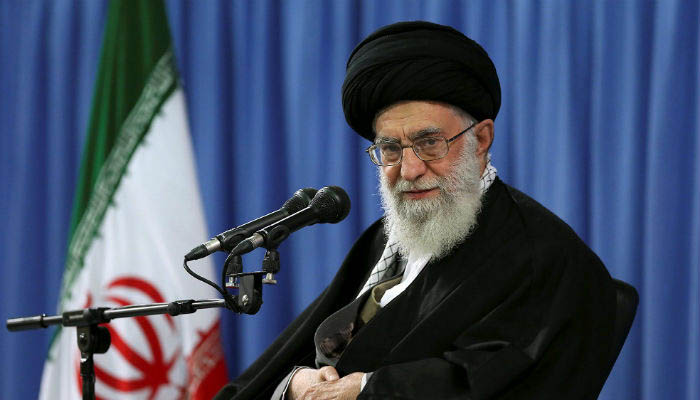
In this picture released by an official website of the office of the Iranian supreme leader, Supreme Leader Ayatollah Ali Khamenei speaks at a meeting in Tehran, Iran, Saturday, April 14, 2018. (Office of the Iranian Supreme Leader via AP)
He spoke at a meeting with Iranian officials and ambassadors from some Islamic countries.
The report quotes Khamenei as calling the leaders of the United States, Britain and France -- the countries that launched the attack -- "criminals."
The allies' operation was intended to punish Syrian President Bashar Assad for an apparent chemical attack against civilians and to deter him from doing it again.

Iran Upset America Attacked the Shia Sickle

Iran´s supreme leader Ayatollah Ali Khamenei. Photo: Reuters

Iran's Khamenei slams 'criminals' Trump, Macron, May | World

By

Iran's supreme leader Ayatollah Ali Khamenei denounced US President Donald Trump, France's Emmanuel Macron and Britain's Theresa May after they launched strikes Saturday against the Syrian regime, branding them "criminals".
"The attack this morning against Syria is a crime," Khamenei said in remarks published on his Telegram channel.
"The American president, the French president and the British prime minister are criminals."
The Iranian Foreign Ministry has also lashed out at the Western states that had conducted a joint massive missile strike on targets in Syria and warned of "regional consequences."
"The United States and its allies have no proof and, without even waiting for the Organisation for the Prohibition of Chemical Weapons to take a position, have carried out this military attack," said Iran's foreign ministry in a statement.
They "are responsible for the regional consequences of this adventurist action," it said, condemning a "clear violation of international rules and laws".
The United States, Britain and France carried out a wave of punitive strikes against Bashar al-Assad´s Syrian regime on Saturday in response to alleged chemical weapons attacks that President Donald Trump branded the "crimes of a monster."
"A short time ago, I ordered the United States armed forces to launch precision strikes on targets associated with the chemical weapons capabilities of Syrian dictator Bashar al-Assad," Trump said, in a prime-time address.
"A combined operation with the armed forces of France and the United Kingdom is now under way. We thank them both," Trump added.
"This massacre was a significant escalation in a pattern of chemical weapons use by that very terrible regime," he said of the suspected deadly gas attack a week ago on the rebel-held Damascus suburb of Douma.
"The evil and the despicable attack left mother and fathers, infants and children thrashing in pain and gasping for air. These are not the actions of a man. They are crimes of a monster instead," he said.

Saturday, April 14, 2018

Iran Threatens Israel...Again (Daniel 8:4)


ANKARA (Reuters) - Iran could destroy Israel so Tel Aviv should avoid any stupid measures against the Islamic Republic, the supreme leader’s representative to the Quds force said on Thursday according to the semi-official Fars news agency.
“If Israel wants to continue its treacherous existence ... it should avoid stupid measures. If they give excuses to Iran, Tel Aviv and Haifa will be destroyed,” Supreme Leader Ayatollah Ali Khamenei’s representative at the Quds force cleric Ali Shirazi was quoted by Fars as saying. “Iran can destroy Israel.”
The Quds Force is the espionage and paramilitary wing, in charge of overseas operations, of the elite Revolutionary Guards.
Fars said Shirazi made the comments in response to Prime Minister Benjamin Netanyahu’s Wednesday speech at Israel’s annual Holocaust commemorations when he called for action against Iran.
The United States has threatened air strikes against Syria over the use of chemical weapons that Syria and its allies Iran and Russia deny.
Writing by Parisa Hafezi; Editing by Matthew Mpoke Bigg

Tuesday, April 10, 2018

Nations Should Be Threatened by Iran's Hegemony

manar-07453150015232608534Enemies Feel Threatened by Iran’s Growing Power – Al-Manar TV Lebanon

Leader: Enemies Feel Threatened by Iran’s Growing Power

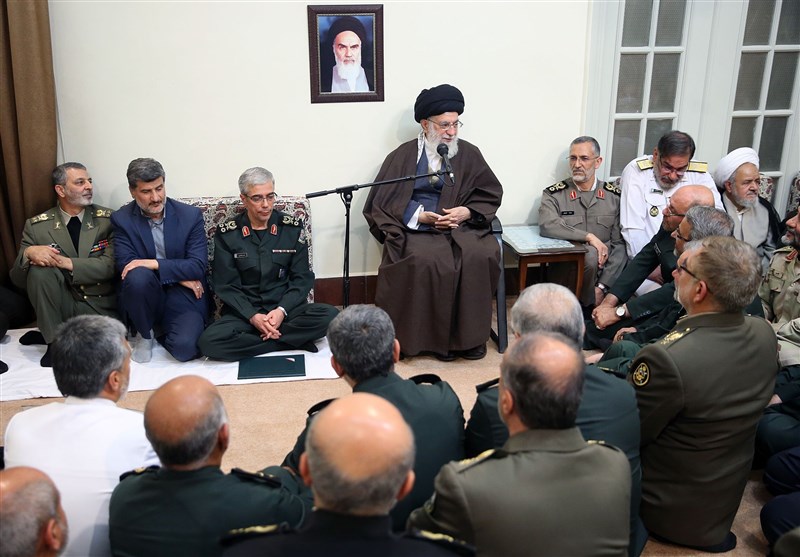
Leader of the Islamic Revolution in Iran, Imam Sayyed Ali Khamenei said enemies have stepped up their attacks against the Islamic Establishment as they feel threatened by its rising power.
In a meeting with a group of senior Armed Forces commanders on Sunday, the Leader cited power, security and dignity as the main objectives of the Armed Forces.
His eminence underlined the necessity of training the personnel and designating successors in the Armed Forces.
“The result of the activities and measures carried out in the Armed Forces must be in line with the fulfillment of determined goals,” Imam Khamenei said, according to Tasnim news agency.
He described the current times as the era of pride for the Islamic Republic of Iran.
“The reason behind the unprecedented attacks against the Islamic Establishment is the growing power of the Establishment, because the enemies feel threatened by this ever-increasing power and have stepped up their attacks.”
The Leader stressed meanwhile that “despite threats and enemies’ dismay, the might of the Islamic Establishment will increase day by day.”
According to official website of the Leader, Chief of the General Staff of the Iranian Armed Forces Major General Mohammad Baqeri presented a report on the achievements and activities of the Armed Forces over the past Iranian calendar year, which ended on March 20.
“In the new year, we are committed to boosting our efforts and warrior-like bids to achieve goals,” Baqeri was quoted as saying during the meeting with Imam Khamenei.
Source: Agencies

Tuesday, March 20, 2018

Iraq Continues to Distance Itself from Iran (Daniel 8:6)


The repercussions of Iran's controversial arrest of the Shiite cleric Hussein Shirazi could include a weakening of Iranian influence over Shiites in Iraq. On March 6, Iranian authorities arrested Shirazi, who was beaten and insulted in front of his father, Grand Ayatollah Sayed Sadeq Shirazi, while the Shirazis were on their way home in the city of Qom. Hussein's detention stems from a recent lecture he gave to Qom seminary students on jurisprudence in which he compared the practices of Ayatollah Ali Khamenei, Iran's supreme leader, to those of oppressive Egyptian pharaohs who couldn't be criticized or held accountable for their actions.
Hussein Shirazi and his father hold dual citizenship in Iran as well as in Iraq, where their influence is especially strong. Their family, whose roots date back 150 years in Iraq, founded the Shirazi political movement, which has followers across the Middle East. The Shirazi movement has traditionally held that a council of Islamic jurists should be in a position of authority in a country, rather than just one supreme leader, such as has been the case with Ayatollah Ruhollah Khomeini or Khamenei.
Iraqi demonstrations against Hussein Shirazi's arrest broke out in front of the Iranian Consulate in
Karbala
, the Iranian Embassy in Baghdad and near the border with Iran in
Basra
. The protesters shouted slogans against the Iranian regime's ongoing repression of their religious leaders in Iran, and demanded Shirazi's
immediate release
. They also called on Iraqi Prime Minister Haider al-Abadi and his government to intervene and pressure Iran to release Shirazi.
In London, members of the Iraqi community protested in front of the Iranian Embassy. Four people were arrested after they climbed onto the porch and lowered the Iranian flag and then raised the Shirazi flag. British police intervened to restore calm.
Protests also took place in Kuwait and other Arab countries. During a demonstration in front of the Iranian Embassy in Kuwait City, Sheikh Yussef Mulla Hadi, a leader in the Shirazi movement in the country, described the Iranian regime as a dictatorship masquerading under the banner of velayet-e faqih (clerical rule) and demanded that Shiites around the world renounce it.
Sadeq Shirazi's older brother, Mohammad, was among the founders of the principle of velayet-e faqih, but the family believes Khamenei and Islamic Republic founder Khomeini have corrupted the concept. Mohammad Shirazi, who died in 2001, had called for establishing a velayet-e faqih, or council of jurists, but Khomeini advocated that ultimate authority be held by an individual.
Differences in interpretations appear to be leading to a Shirazi rejection of the concept of velayet-e faqih altogether. Hussein Shirazi now says velayet-e faqih, as implemented by Iran, enslaves the citizenry and contradicts the principles of freedom, equality and democracy
Mohammad Shirazi, who led the Shirazi movement, established his religious authority in Karbala during the 1960s and 1970s, until moving to Iran and settling in Qom in 1979. In the early 1970s, he founded the Islamic Action Organization, which supported liberation movements in the Islamic world, including that of the Palestinians. There also was a third brother, Hassan Shirazi, who was assassinated in Lebanon in 1980 because of his activities on behalf of the Shirazi movement.
Hussein Shirazi has made scathing comments against Khamenei over the years. In his most recent speech, he also criticized the brutal eight-year war (1980-88) between Iran and Iraq, which he described as a Khomeini political venture to expand Iran's Islamic Revolution. Shirazi has even gone so far as to compare Khomeini and Khamenei to the men who killed the Prophet Muhammad's grandson Hussein, revered by Shiite Muslims as the third imam.
Mohsen Kadivar, a prominent Iranian reformist cleric and visiting professor of religious studies at Duke University, has called velayet-e faqih a religious dictatorship. He believes the unprecedented, open criticism of clerical rule by Shiite clerics could create major problems for the Iranian regime. This is especially the case because such criticism is coming from the Shirazi movement, which is so strongly associated with political Shiite Islam and so deeply tied to the establishment of Iran's velayet-e faqih. Kadivar has called on the Shirazi movement's religious jurists to produce a doctrinal theory rejecting velayet-e faqih.
These developments, among a series of previous Iraqi Shiite reactions to Iran's role in Iraq — such as the cleric Muqtada al-Sadr's distancing himself from Iran and Iraqi Ayatollah Ali Sistani's refusal to meet with several Iranian officials — are likely to signal a potential curtailing of Iranian influence among Iraqi Shiites. It appears some Shiites are changing their views after experiencing the repressive practices of religious rule.
Ali Mamouri is Al-Monitor's Iraq Pulse Editor and a researcher and writer who specializes in religion. He is a former teacher in Iranian universities and seminaries in Iran and Iraq. He has published several articles related to religious affairs in the two countries and societal transformations and sectarianism in the Middle East.

Sunday, March 18, 2018

The Usual Iranian Hegemony in Iraq (Daniel 8:4)

 AFP , Friday 16 Mar 2018
Speaking to reporters as he returned from a trip to Oman, Afghanistan and Bahrain, Mattis said officials he met with had expressed frequent concerns about Iranian behavior.
"One thing that came through loud and clear is the suspicion of Iran and the evidence of Iranian destabilizing efforts," said Mattis, a longtime Iran hawk.
"I heard it when I was up in Afghanistan. You know what's going on in terms of Iran's support to Assad. Now Iran is following Russia's example (and) mucking around in Iraq's elections," Mattis said, referring to Syrian President Bashar al-Assad.
"It was just brought home to me again that they are not changing their behavior, they are continuing to be a destabilizing influence," Mattis added.
The Pentagon chief said he would not speculate as to whether Iran's efforts were having any impact on the Iraqi electorate ahead of the May parliamentary and provincial assembly elections.
"Iran is trying to influence using money the Iraqi elections. That money is being used to sway candidates, to sway votes," he said.
"Iran should leave the Iraqis to determining their own future," said Mattis.
Despite increased rhetoric from Washington about Iran's activities in the region and US President Donald Trump's continual railing against the Iran nuclear deal, Mattis noted that Iranian naval vessels in the Gulf have become less provocative toward US ships.
He said ships from both the regular Iranian navy and the Iranian Revolutionary Guards Corps have curtailed the sorts of incidents that had become almost routine over the past few years, and are now staying away from American vessels.
"In the Gulf itself, they are not coming in as close to our ships, the provocative actions in the Gulf seem to have relented somewhat," Mattis said.
"They are not doing as many bellicose confrontations and that sort of thing."
Commander Bill Urban, spokesman for the Navy's Bahrain-based Fifth Fleet, said there had been no "unsafe or unprofessional" interactions with the Iranians at sea since August 14, 2017 when an Iranian drone with no lights on flew close to US aircraft operating in the Gulf.
Urban told reporters that "a substantial period time" has passed since then, "something that we think is great."
He said there has been "an across-the-board change in behavior."
Last year and in 2016, the US Navy frequently complained about the behavior of Iranian Revolutionary Guard Corps vessels, which would often shadow and steer toward American ships.
In at least one incident, US sailors had to fire flares and warning shots before the Iranians turned away.
Urban said that since then, the Iranians have stopped approaching so closely.
Mattis said that off the Yemen coast around the Bab-al-Mandab strait, the Islamic Republic is testing a number of offensive capabilities.
"It's where you find (Iran's) radars, their ballistic missiles, anti-ship cruise missiles," Mattis said.
"We've found their mines, their explosive boats all being tested, increased capability being demonstrated down there."
Fifth Fleet and its associated task forces continually patrol the Gulf and inspect some of the ships passing through the region.
In 2016, sailors seized weapons apparently headed from Iran to Yemen, including machine guns and rocket launchers.
Urban said task forces this year have confiscated record amounts of heroin, much of which may have been grown in Afghanistan to fund the Taliban.
The Iranian Revolutionary Guards Corps is a paramilitary force that answers directly to the Islamic republic's supreme leader.
In January 2016, the Iranians briefly captured the crew of two small US patrol boats that strayed into Iranian waters.
The 10 US sailors were released 24 hours later.

Saturday, March 10, 2018

The Coming War Against Iran

https://andrewtheprophetcom.files.wordpress.com/2018/03/87258-israel-iranwarscenarios.jpgAnalysis: The coming war - Israel National News

Contact Editor Yochanan Visser, 09/03/18 00:39

Yochanan Visser is an independent journalist/analyst who worked for many years as Middle East correspondent for Western Journalism.com in Arizona and was a frequent publicist for the main Dutch paper De Volkskrant. He authored a book in the Dutch language about the cognitive war against Israel and now lives in Gush Etzion. He writes a twice weekly analysis of current issues for Arutz Sheva
Iran’s Supreme Leader Ayatollah Ali Khamenei has changed his time schedule for the destruction of Israel and at the beginning of March promised a Sunni Syrian religious scholar he would lead prayers in Jerusalem fairly soon.
His words are not merely rhetoric since the Iranians are making rapid progress in preparations for a concerted effort to destroy the Jewish state via its proxies in Lebanon, Syria and the territories controlled by the PA and Hamas.
During a meeting with Muhammad Abdul-Sattar al-Sayyid, the Syrian Minister of religious affairs and Syrian religious scholars, Khamenei promised al-Sayyid he would see the day that he would be able “to lead prayers in al-Quds” (Jerusalem).
“I hope that you and we will see the day when you are conducting public prayers in Quds, God willing. We believe that that day will come. It is possible that this humble person and people like us will not be living on that day, but it will come eventually and it will not come late,” according to Khamenei
Severeal years ago, the Iranian dictator said Israel would be erased from the face of earth within 25 years.
During the meeting with the Syrian scholars Khamenei elevated the status of Syrian dictator Bashar al-Assad whom he praised for being "a great example of resistance and a fighting image.”
Calling al-Assad an “example” for the resistance movement – the loose coalition of terrorist movements and rogue regimes fighting Israel- is another indication Iran and its allies in Syria are shifting their focus toward Israel now that the Russian-supported Iranian axis is on the verge of victory in the seven-year-old Syrian war.
The pro-Assad coalition of Shiite militias who make up the bulk of the Syrian army today is currently eliminating the last hubs of Islamist rebels in eastern Ghouta near Damascus and in the northern province Idlib in Syria.
At the same time Iran is continuing to build the military infrastructure which will be needed in the coming confrontation with the IDF.
A recent New York Times report indicated the Islamic Republic is building missile facilities and military bases in Syria while bringing its proxies closer to the Israeli border.
In addition, Fox News reported last week Iran is building big missile silos on a military base near Damascus.
Fox News obtained images of the base from ImageSat International which showed the Quds force of the Iranian Revolutionary Guards Corps (IRGC) had built two hangars for missiles which can hit Israel anywhere.
A similar base was destroyed by Israel during the first direct confrontation between the IAF and the IRGC on February 10, 2018.
This week Amir Ali Hajizadeh, the commander of the Islamic Revolutionary Guard Corps Aerospace Force, said Iran has tripled its missile production despite international efforts to curb the program.
Hajizadeh scoffed at Israel and other Western powers such as France for their “hypocrisy” in trying to stop further expansion of the Iranian missile program.
France is leading the effort to reduce the threat from Iranian missiles, however, French Foreign Minister Jean-Yves Le Drian failed to book progress while visiting Iran at the beginning of this week.
Another indication both Israel and Iran are preparing for war is detectable in Lebanon.
Last week, Joseph Aoun, the commander of the Lebanese Armed Forces (LAF), told reporters the Lebanese army is ready for a new conflict with Israel if the IDF encroaches further on the border of Lebanon.
Aoun’s threat was related to mounting tensions between Lebanon and Israel over additional security measures the IDF is currently undertaking near the Lebanese border and a dispute over a gas field which straddles the maritime border between the two countries.
There’s more.
A former Syrian general who headed the chemical weapons program of Assad’s army this week disclosed Iran and Syria have supplied chemical weapons to Hezbollah.
Suhair al-Saqit told the Hebreeuw paper Maariv the chemical warheads in Hezbollah’s possession are produced in Syria.
He also said Assad had transferred a large part of his chemical weapons stockpile to Hezbollah ahead of international inspections which took place after Assad gassed thousands of Syrian civilians during the first period of the Syrian civil war.
Fox News furthermore, reported a new UN investigation revealed North Korea has delivered new chemical weapons to Syria and that satellite images showed North Korean engineers are working on chemical weapons facilities in Syria.
Republican senator Lindsey Graham who visited Israel last week said he had become increasingly worried about the Iranian threat to Israel after he visited the borders between Israel, Lebanon and Syria.
“It’s far worse than I thought it would be,” Graham said before reporting he had seen Hezbollah and Syrian army flags very close to the Israeli border on the Golan Heights.
“Southern Lebanon is a nightmare, it makes Gaza looking stable” Graham said before adding “Israel is in a no-win situation.”
He was referring to the approx. 130,000 missiles pointing at Israel from Lebanon.
Graham could have added that the Lebanese army has been turned into an ally of Hezbollah with U.S. support as columnist Caroline Glick reported this week.
Glick also wrote the presence of UNIFIL in southern Lebanon has been rendered useless against Hezbollah’s growing threat against Israel because the LAF is blocking UNIFIL from carrying out its mandate as a peace keeping force.
Israel on the other hand, is increasingly carrying out reconnaissance missions in Lebanon.
The Lebanese army almost daily reports violations of Lebanese airspace by IAF warplanes and drones while the Israeli navy briefly entered Lebanese territorial waters this week.
“There is a feeling of calm before the storm here in Israel,” blogger Vic Rosenthal wrote this week adding that the “coming war” will probably be the “toughest in Israel’s history.”
Iran and its proxies are expected to lob more than 1,000 missiles a day at Israel from at least three fronts in this ‘coming war’ as many observers, politicians and IDF officers in Israel call it.
These three fronts are Lebanon, Gaza and Syria and it is expected Israel’s various anti-missile shields will be unable to cope with this amount of missiles.
This is why some observers now think the time has come to take preemptive action against the Iranian threat on the lines of what happened in 1967 at the outset of the Six-Day-War when the IAF destroyed almost all Egyptian and Syrian warplanes before the war actually began.
“Israel is exceptionally vulnerable to attack by precision weapons, as on the one hand it is an advanced Western country dependent on sophisticated technologies, and on the other it is small, with very concentrated infrastructures and very little redundancy,” two IAF veterans wrote in a study last year.
They could have added that the bulk of Israel’s population is living in areas in the center of country and the Iranians have already warned they would flatten Tel Aviv and its suburbs in the Gush Dan area.
All the above are the reasons Prime Minister Benyamin Netanyahu spoke in apocalyptic terms regarding the increasing Iranian threat to Israel when he held a speech at the annual American Israel Public Affairs Committee (AIPAC) conference in the U.S.
“We must stop Iran. We will stop Iran,” Netanyahu vowed.
Wednesday, March 7, 2018

Israel is Correct about the Iran Deal

Speaking at the AIPAC conference on Tuesday, Israeli Prime Minister Benjamin Netanyahu sought to shift focus away from his mounting political and legal struggles to focus instead on a favored subject of discussion, how worried he is about Iran.
Holding a map of the Middle East which claimed to show Iran’s growing “empire,” Netanyahu declared that “darkness is descending on our region,” while talking up Israel’s willingness, and indeed eagerness,  to confront them militarily in Syria.
At the same time, Netanyahu talked up discussions with President Trump earlier in the week, saying that Trump remains committed to walking away from the P5+1 nuclear deal, adding that Israel and other countries in the region stand by that decision.
Netanyahu sought to die Trump’s hostility to the nuclear deal to general opposition to Iran’s putative “aggression,” and said Trump’s position proved he won’t accept a “nuclear-armed Iran,” even though Trump’s objections about the Iran deal are entirely based on extending restrictions on Iran’s civilian nuclear program.

Wednesday, February 28, 2018

Iranian Reasserts Hegemony in the Middle East (Daniel 8:4)

See the source imageVelayati on Iranian Involvement in Middle East

MEMRI
 Speaking on February 1, 2018 in Mashhad, at the Conference for Support of the Palestinian Intifada, Ali Akbar Velayati, senior advisor to Iranian Supreme Leader Ali Khamenei, responded to Iranian critics of the regime who, during last month's uprising, protested against Iran's involvement in various battlefronts in the Middle East. Addressing an audience of students, he stated that Iran would maintain its involvement and presence in the region, in order to thwart the plots of Israel and the U.S., among other goals.
The following are his main points, as reported by the Iranian news agencies ISNA and Fars.
According to Fars, Velayati said: "Let me tell you, you don't have to worry about that mess [i.e. last month's popular uprising], some of whose [participants] stupidly became a tool in the hands of the mercenaries and speak against the sacred goals of the revolution. The call 'Neither Gaza nor Lebanon' conceals a misunderstanding of the developments in the world. Can someone sit at home and say that the conflagration at his neighbor's home does not concern him?
"Everyone wants a foothold in our country. That is the essence of the global developments.
"Let's assume we aren't Muslims. [Even so], could we conceivably [watch] the Israeli flag being raised near our border, in the Kurdish region of Iraq, and remain silent?
"The Lebanese Hizbullah has grown stronger thanks to Iran, and we are proud of this. Hizbullah is now in a situation similar to [its situation in] the 2006 Lebanon war: The Israeli leaders are fleeing from it.
"In the Gaza war [presumably the 2014 war with Israel], the leaders of the resistance in Palestine said, 'Iran supplied us with everything, from bread to bullets.' After the war, [Palestinian Islamic Jihad leader] Ramadan [Shalah] declared this at a press conference. We are proud to sit here and help the Muslims against the Zionists.[1] For 22 days, Gaza, only 300 [square] kilometers in size, was under attack from all directions, yet managed to resist. This attests to the will of the Palestinian people, and to the support we extended. We are proud to have paralyzed Israel...
"Today, America wants to dismantle countries. The plot of the New Middle East [involves] breaking up countries, and Iran opposes this.
"The global arrogance [i.e. the U.S.] has excessive demands in the region. One [member of the P5+1] says that the JCPOA should be maintained, but [tells us], 'limit your missiles.' Another tells us, 'limit your presence in the region.' Why? Isn't this an excessive demand? You could make such excessive demands in the Shah's era, but not today.
"The Iranian people has always opposed the arrogance. It has rejected arrogance since the dawn of history...
"Our presence in the region is inevitable. We will continue this process, so as to become the most decisive force in the region. We are present in Iraq, Syria, Palestine, and Lebanon, at the behest of and in coordination with the governments of these countries. We help Yemen because it is our human duty to do so. Saudi Arabia must know that this ongoing process will make Yemen its Vietnam."[2]
ISNA also quoted Velayati as saying: "If we had sat in silence, if the great Islamic general [commander of the Islamic Revolutionary Guards Corps' Qods Force] Mr. [Qassem] Soleimani and the wisdom of the Leader [Ali Khamenei] had not existed, the Israelis would have opened up a front only dozens of kilometers from our border [i.e. in Iraqi Kurdistan]. In that situation, could we live in Iran? [Even] someone who does not share Iran's religion and identity – could they live where Israeli tanks are only dozens of kilometers away? How can anyone be so deficient in understanding?"[3]

Saturday, February 24, 2018

Pakistan Joins the Four Horns (Daniel 8:8)

Pakistan to Be Placed Back on Terror-Financing List, Source Says
by Chris Kay
February 23, 2018, 4:04 AM MST
Photographer: Banaras Khan/Bloomberg
Pakistan will be placed back onto an international terrorism-financing watch list from June, according to a person with direct knowledge of the matter, a move that may hinder the country’s access to financial markets.
The move follows a push from the U.S., U.K., France and Germany to get Pakistan placed on the Financial Action Task Force’s “grey” monitoring list during a review meeting in Paris this week. China, which is financing more than $50 billion of infrastructure projects across Pakistan, removed its earlier objections to the move, said the person, who asked not to be identified as the discussions are private. Pakistan’s benchmark stock index reversed earlier gains and fell 0.6 percent at the close in Karachi.
A statement from FATF after the Paris meeting on Friday made no mention of Pakistan. Technically the South Asian nation has three months to convince the body that it has acted against terror organizations, though it will be difficult for them in practice, the person said. Earlier this week, Foreign Minister Khawaja Muhammad Asif said no consensus had been reached to put Pakistan on the list and that the nation had been given a three-month “pause.” Officials at Pakistan’s finance ministry couldn’t immediately comment.
The move is the latest attempt to get Islamabad to take more action against terror groups that allegedly have support and sanctuary within Pakistan. Relations with the U.S. have deteriorated drastically in the past year and in his first tweet of 2018, President Donald Trump said Pakistan gave “lies and deceit” in return for American funding. FATF removed the nuclear-armed nation after three years in 2015 from a list of countries which are subjected to regular monitoring.
‘More Pressure’
Being placed on the list may impede Pakistan’s access to global markets at a time when its foreign reserves are dwindling and external deficits are widening ahead of national elections in July. Yet during the previous period under FATF monitoring Pakistan managed to negotiate an International Monetary Fund bailout and continued to tap the international bond market.
“Gradually the U.S. is coming up with more pressure,” Shamoon Tariq, the Stockholm-based vice chief investment officer at Tundra Fonder AB, said before the decision. If the U.S. “puts more pressure on the World Bank and IMF on future funding, that would be a real challenge.”
Last week Pakistan vigorously tried to avoid inclusion to the list and said the U.S. had voiced concerns about the freedom with which the suspected planner of the 2008 Mumbai attacks, Hafiz Saeed, and his organizations operated in the country.
Last week, Pakistan announced that it changed a law and now allowed its security forces to take action against groups on the UN Security Council list -- such as Saeed’s charities which are alleged fronts for militant group Lashkar-e-Taiba. It also seized dozens of offices, buildings, seminaries and ambulances belonging to Saeed’s Jamaat-ud-Dawa and Falah-e-Insaniat Foundation.
‘Economic Hardship’
Pakistan’s Prime Minister Shahid Khaqan Abbasi also said in an interview this month that in the last two to three months Pakistan has “more or less complied” with sanctions against Saeed’s organizations. However, Abbasi said more action against Saeed himself was unlikely as “we have no charges against him.” India says it has provided evidence against Saeed to Pakistan.
On Thursday, White House spokesman Raj Shah said Trump was not yet satisfied with Pakistan’s progress in fighting terrorism. However, Pakistan’s government has said any financial squeeze will ultimately aid extremism.
“If Pakistan faces any economic hardship because of this, it’s going to affect our budget and capacity to fight the anti-terrorism war,” Pakistan’s Interior Minister Ahsan Iqbal told reporters in Islamabad on Monday. “The question is whether these nations want to help terrorists or the war against terrorism?”
— With assistance by Ismail Dilawar

Friday, February 23, 2018

Iraq Struggles to Break Away from the Iranian Horn

How Will Iraq Contain Iran's Proxies?
Grand Ayatollah Ali al-Sistani may be the only man who can—but he’ll need help.
Ranj Alaaldin4:50 AM ET
Members of the Abbas combat squad, a Shiite militia group, carry a picture of Grand Ayatollah Ali al-Sistani during a parade in Basra, Iraq, on September 26, 2015. Nabil al-Jurani / AP
In June 2014, Grand Ayatollah Ali al-Sistani, one of the leading Shiite clergyman in the world, called on all able-bodied Iraqis to defend their country against the Islamic State. Iraq’s U.S.-trained armed forces had collapsed, fleeing the advance of ISIS as it seized Mosul and much of northern Iraq. Sistani’s fatwa mobilized a 100,000-strong fighting force known as the Hashd al-Shaabi, or Popular Mobilization Forces (PMF), whose mostly Shiite fighters were instrumental in the fight against ISIS. The PMF is comprised of multiple Shiite militias who were established after 2014 as volunteer groups that took up arms in response to Sistani’s fatwa, filling the void left by the collapse of the Iraqi army. The majority of these groups are aligned with the Iraqi state and take their orders from the Iraqi government.
But residing within the PMF are Iran-aligned groups who have become the Forces’ most-powerful militias. While technically they have been under Baghdad’s command since 2016, in reality, they answer to their sponsors in Tehran. These groups have long exploited conflict and disorder in Iraq since the toppling of the Baath regime, while also expanding Iran’s influence in the country. They have been accused of sectarian atrocities that helped lay the groundwork for groups like ISIS and played a critical role in the bloody 2006 war between Arab Sunnis and Shiites. They have violently resisted attempts by the Iraqi state and the United States to disarm them. Since the emergence of ISIS and Sistani’s fatwa, these groups have exploited the security vacuum and the weakening of Iraq’s conventional forces to further consolidate their hold. Now, they seem poised to translate their wartime popularity into political gains in the coming elections in May, when they will contest the elections as the al-Fateh (or “Conquest”) bloc.
With ISIS vanquished and Iraq’s security forces reconstituted and reorganized (thanks to U.S. training and support), some expected that Sistani would revoke his fatwa and dismantle the PMF last December. But Sistani cannot simply dissolve the PMF, a state institution that provides livelihoods and prestige to its fighters. Doing so would spark a public backlash and undermine Iraq’s Shiite clerical establishment. Neither can he confront Iran’s proxies alone as they, and Shiite militias more generally, have proved themselves formidable actors. (The United States tried with more than 100,000 troops during the occupation and failed. )
But left untouched, Iran’s proxies will continue exacerbating sectarian tensions that could very well enable the resurgence of ISIS. Sistani will have to confront them eventually—but not by himself, and not in the way some may expect.
Essential to the Shiite militias’ survival over the years has been their capacity to adapt to the political and legal constraints imposed on them. They either attach themselves to longstanding parties or rebrand themselves as socio-cultural movements that provide social services to local, often destitute communities. Groups like Asaib ahl al-Haq, which has been complicit in attacks on U.S. and Iraqi personnel and civilians, were established by Iran after 2003 and have since transitioned into powerful armed groups that enjoy access to state institutions and resources, yet continue to function autonomously. Iran-aligned Shiite militias have, in essence, established themselves as Iraq’s version of Lebanon’s Hezbollah: socio-cultural movements with a military and social-welfare wing that operates independently of the state.
Asaib al-Haq is not the only Shiite militia in Iraq that has benefitted from Baghdad’s resources without ever submitting to its control or to civilian oversight. Another prominent example is the Badr Brigade, an organization established by Iran during the 1980s Iran-Iraq war. While it began as a militia, since 2003 it has controlled Iraq’s interior ministry, and today commands a 37,000-strong federal police force. The Iraqi interior ministry answers not to the prime minister, but to the Badr hierarchy, led by its leader Hadi al-Ameri, who fought alongside Iranian forces during the Iran-Iraq war. He also now leads the PMF. While the Badr Brigade is the only Iranian proxy that controls an Iraqi ministry, this may not be the case for long.
Iraq’s army is not strong enough to confront these groups. But Sistani has the credibility to lead such an effort. He has long served as a critical check on the power of Iraq’s corrupt ruling elite. After the toppling of Saddam, he ensured that the process of writing a new constitution would be led by an elected assembly, rather than by Washington’s favored Iraqi elites. While he failed to prevent sectarian war, his call for calm, restraint, and unity, helped ensure that the conflict did not transform into a genocide against Sunnis. In August 2014, only two months after his call to arms against ISIS, he forced out then-prime minister Nouri al-Maliki, whose corrupt and authoritarian rule led to the collapse of the Iraqi army.
The Ayatollah has historically resisted Iran’s efforts to export its theocracy to Iraq. He has criticized and will continue to pressure Iran’s proxies through his sermons. While Sistani’s record suggests he’s up for combatting Iran’s proxies, he’ll need help. That may come from nationalist, anti-Iran voices like Muqtada al-Sadr and his followers. Both al-Sadr and Sistani have backed Iraq’s anti-corruption protests, which have been led by members of civil society, including human rights organizations and other NGOs. Hundreds of thousands of Sadr’s supporters, for instance, mobilized in 2016 to call for reform and an end to sectarian governance. Many chanted anti-Iranian slogans. Sadr’s visits to the Gulf have also strengthened Iraq’s ties with the Arab Sunni world. These relationships could establish cross-sectarian alliances to contain Iran-aligned factions.
The United States has an important role to play in all this. Maintaining its military presence in Iraq will help contain Iran’s proxies, so long as it does not weaken Tehran’s rivals like the Kurds and Sunnis. This is exactly what happened last October, when al-Abadi’s forces and Iranian proxies reclaimed oil-rich Kirkuk and its surrounding areas from the Kurds. Indeed, al-Abadi, who has been billed in some quarters as America’s man in Baghdad, has relied on Iran-backed militias to maintain Baghdad’s control over territories that are disputed with the Kurds.
As a result of that onslaught, Iran’s proxies now control Kirkuk and other strategically vital towns and cities. With every inch of territory Iran’s proxies acquire, their influence becomes stronger in the rest of Iraq. Al-Abadi has even contemplated an alliance with Iran’s proxies, a move that has been criticized by Sistani and the Najaf religious establishment, al-Sadr, and Arab Sunni and Kurdish factions. Washington would do well to heed the lessons of the past and avoid creating a strongman in Baghdad who may one day turn his back on the United States.
To contain Tehran, the United States could also help prevent these groups from appropriating the $1 billion allocated to the PMF from the Iraqi national budget, and curb their access to the billions of dollars that the international community intends to contribute to the reconstruction of Iraq. These resources enhance the battlefield superiority of Iran’s proxies. They also allow them to shape Iraq’s political system according to their own ideologies, while molding the fabric of its society through its sophisticated propaganda.
Sistani, who champions a pluralistic, representative Iraqi state, can go a long way toward containing Iran’s proxies. On his own, however, he can only do so much.