Showing posts with label nato. Show all posts

Tuesday, July 7, 2020

The Growing Threat of World War 3 (Revelation 16)

By CIARAN MCGRATH
PUBLISHED: 14:26, Sun, Jul 5, 2020
Mr Trump has already pulled 9,500 troops out of Germany after accusing the country, led by Angela Merkel, of being “delinquent” in its payments to NATO. Georgette Mosbacher, US Ambassador to Poland, hinted Mr Trump could go even further, saying of nuclear missiles currently stationed in Germany: “Perhaps Poland, which pays its fair share, understands the risks and is on NATO’s Eastern Flank, could house the capabilities.”
Such a move would be highly controversial, given Poland was once a part of the USSR-dominated Eastern bloc.
Marion Messmer, co-director of the British and American Information and Security Council (BASIC) has outlined her concerns in a new report entitled Strategic Risk Reduction in the European Context, in which she considers the renewed risk of conflict in Europe.
She told Express.co.uk: “If the Trump administration’s threat of removing nuclear weapons from Germany and moving them to Poland happens, this would be a big escalation with regards to Europe and Russia, as it would be a violation of the Russia NATO Founding Act.
Moving weapons to Poland would be problematic, Ms Messmer warned (Image: GETTY)
Ms Messmer added: “At this point in time, I would estimate the risk of escalation to be more likely to come from inadvertent or unfortunate Western signalling where internal tensions and external messaging get mixed up (as in my example about moving US nuclear weapons from Germany to Poland) whereas it seems that Russia is going to stay well away of any NATO member states.”
Recent history has derailed Russia’s relations with the West, Ms Messmer said.
She explained: “Russia is a neighbour and the political relationship with Russia, having been largely positive from 1990-2008ish, deteriorated sharply with the war in Georgia in 2008, then recovered again to take another nosedive in 2014 with the Crimea crisis.
“In a way, European states and institutions like NATO are still adjusting to this new reality and trying to figure out how to respond to it.
This is the context in which our risk reduction project came about.”
The tense situation between both Russia and China on the one hand, and the West on the other, is sometimes described as Cold War 2.0.
Ms Messmer said: “The relationship between Russia and Europe and Russia and the US is probably as strained as it’s ever been since the end of the Cold War – and it won’t be an easy fix.”
Potential World War 3 flashpoints (Image: Express)
However, she added: “I don’t think that Cold War 2.0 is quite the right description, for two reasons: we are missing the ideological clash and the arms racing dynamics which were huge components of the Cold War.
“And in a way, the current dynamics are a way of path dependency where not enough effort was made after the end of the Cold War to transform the relationship between Russia and the Western states.”
With respect to China, whose increasing belligerence on the world stage has added a further complicating factor, there are suggestions future treaties aimed at cutting nuclear weapons must factor in Beijing.
Ms Messmer said “That is certainly how the Trump administration sees it.
“However, there is no real reason as to why China needs to engage in arms control at the moment as the US and Russia still have vastly higher arsenal numbers, and the arms control treaties which have broken down over the past two years have all been bilateral US-Russia treaties.
“Chinese arsenal numbers are much closer to France in all estimations – but China and France are not locked in an arms race dynamic, whereas the US and Russia could slide back into this dynamic.
“If the Trump administration keeps insisting on trilateral arms control without a good solution as to why China ought to engage and what it would get out of any arms control agreement, this will in effect block any possibility of reviving arms control at this point.”

Sunday, July 5, 2020

Russia’s Plans For Nuclear War (Revelation 16)

Here’s What You Need To Remember: Fortunately for the world as a whole no one ever had the chance to give this plan an actual go.
There have been numerous discussions regarding how NATO could have defeated the Soviet Union and its Warsaw Pact allies in a World War III that fortunately never occurred. As the National Interest has previously noted, crucial to NATO’s strategic mission was to prevent the destruction of the alliance by military force. That required four wartime goals of gaining and maintaining air superiority, keeping sea lines of communication open to North America, maintaining the territorial integrity of West Germany and avoiding the use of nuclear weapons.
The failure of any of those four goals meant the war likely couldn’t be won.
According to a secret plan, the use of nuclear weapons was apparently a key consideration to crush NATO in seven days and ensure a Soviet/Warsaw Pact victory. The possible scenario was part of a top-secret military simulation exercise that was developed in 1979 to determine how much from NATO could be gained in a short space of time.
While never put into actual practice, the files were only released by the Polish government following the former Soviet bloc country’s national election in 2005. The Daily Express newspaper reported this was done in order to “draw a line under the country’s Communist past” and to “educate the Polish public about the old regime.”
The plan was known as the “Seven Days to the River Rhine,” and was formulated even as U.S. President Jimmy Carter and Soviet Premier Leonid Brezhnev were discussing détente. The plan’s map highlighted how much of Europe could have been laid to waste, as the then German capital of Bonn, as well as Frankfurt, Cologne, Stuttgart, Munich, and Hamburg would have also been targeted. In addition, Brussels, the political headquarters of NATO, as well as cities in Denmark, the Netherlands, and northern Italy would have also been in the Soviet’s crosshairs; while it was expected that NATO might have responded by destroying Prague and Warsaw.
Notable in the plan is that France would have been spared such an attack as it was not a member of NATO’s integrated structure. The UK too wouldn’t have faced nuclear annihilation. With Austria and Yugoslavia remaining neutral, it would have created what the plan describes as an “invasion funnel” where the bulk of any frontline ground combat would have been in Germany. The goal of the plan was always to reach the Rhine in the shortest amount of time possible—making a NATO victory almost impossible.
To ensure that France wouldn’t respond, a second wave called for a push to the Spanish border in another seven days—a truly ambitious plan if there ever was one.
Not all of the Warsaw Pact nations were on board with the seemingly-overreaching attack plan however. Czechoslovakia’s military suggested it was far too optimistic. While the goal of the simulation was to avoid total nuclear annihilation and to be in the stronger position when peace was agreed upon, it failed to take into account a tactical nuclear response from France or other factors that could have slowed down even a determined Soviet juggernaut.
Such an ambitious plan to strike into Germany and rush to the Rhine was part of the plot of the James Bond film Octopussy, but in the film even other leaders in the Kremlin described it as “madness.” Fortunately for the world as a whole no one ever had the chance to give this plan an actual go.
Peter Suciu is a Michigan-based writer who has contributed to more than four dozen magazines, newspapers and websites. He is the author of several books on military headgear including A Gallery of Military Headdress, which is available on Amazon.com.
This article first appeared in May 2020 and is being republished due to reader interest.
Image: Reuters

Sunday, December 29, 2019

The New Cold War In Space

PUBLISHED THU, DEC 5 2019 2:06 AM EST
UPDATED THU, DEC 5 2019 2:43 AM EST
Holly Ellyatt
KEY POINTS
• Russian President Vladimir Putin said that he was “seriously concerned” about NATO’s “attempts to militarize outer space” when he met with members of the Kremlin’s Security Council last month.
NATO, the U.S. and Russia have a new domain to compete and conflict over: space.
Russian President Vladimir Putin warned Wednesday that the U.S. saw space as as “theater of military operations” and that the development of the U.S. Space Force posed a threat to Russia.
“The U.S. military-political leadership openly considers space as a military theater and plans to conduct operations there,” Putin said at a meeting with defense officials in Sochi, according to Russian news agency TASS.
“For preserving strategic supremacy in this field the United States is accelerating creation of its space forces, which are already in the process of operative preparations,” Putin said, adding that the world’s leading countries are fast-tracking the development of modern military space systems and dual purpose satellites and that Russia needed to do the same.
“The situation requires us to pay increased attention to strengthening the orbital group, as well as the rocket and space industry as a whole.”
Russia opposed the militarization of space, Putin insisted, but said “at the same time the march of events requires greater attention to strengthening the orbital group and the space rocket and missile industry in general.”
NATO too
Putin’s comments Wednesday reiterated those he made in late November to his security council, in which he said he was “seriously concerned” about NATO’s “attempts to militarize outer space.”
That comment came after NATO had declared space a fifth “operational domain” for the military alliance, alongside air, land, sea and cyber.
“Space is part of our daily life here on Earth. It can be used for peaceful purposes. But it can also be used aggressively,” NATO Secretary General Jens Stoltenberg said at a meeting of foreign ministers on November 20.
“Satellites can be jammed, hacked or weaponized. Anti-satellite weapons could cripple communications and other services our societies rely on, such as air travel, weather forecast or banking,” he said. “Space is also essential to the alliance’s deterrence and defense,” Stoltenberg added, referencing the organization’s ability to navigate, to gather intelligence, and to detect missile launches.
“Making space an operational domain will help us ensure all aspects are taken into account to ensure the success of our missions,” he said. “For instance, this can allow NATO planners to make a request for allies to provide capabilities and services, such as satellite communications and data imagery.”
He said that around 2,000 satellites currently orbit the Earth with around half of them owned by NATO countries.
Stoltenberg insisted that “NATO has no intention to put weapons in space. We are a defensive alliance.” He added the alliance’s approach to space will remain fully in line with international law. The 1967 Outer Space Treaty is a global agreement considered a foundation stone of international space law.
The treaty was first signed by the U.K., U.S. and then-Soviet Union at the height of the Cold War to promote the peaceful exploration of space. It banned the placing of nuclear weapons in space and limited the use of the Moon and all other celestial bodies to peaceful purposes only. It also established that space shall be free for exploration and use by all nations, but that no nation may claim sovereignty on any part of it.
Star Wars
There are other space treaties covering, for example, the rescue of astronauts, the moon, the International Space Station (ISS) and liability for damage caused by space objects. Still, the use of space for defensive activities is likely to be litigious and provocative territory.
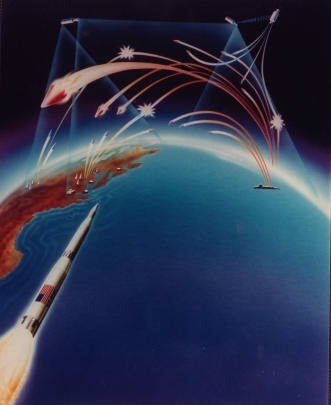
It’s not the first time that space has been seen as a potential realm for defense though, especially during the Cold War. The “Strategic Defense Initiative” was a program first initiated in 1983 under President Ronald Reagan. The aim of the program was to develop an anti-ballistic missile system that was designed to shoot down nuclear missiles in space, with potential missile attacks from the Soviet Union specifically in mind.
Artist’s concept of interceptor under development for the U.S. Army’s HEDI (High Endoatmospheric Def. Interceptor), a key element of its 1983 Strategic Defense. Initiative (aka Star Wars) Time Life Pictures | The LIFE Picture Collection | Getty Images
It was dubbed “Star Wars” because it envisaged that technologies like space-based x-ray lasers could be used as part of the defensive system. Funding shortages as well as the collapse of the Soviet Union in 1991 meant that the SDI was never built.
“Space is a war-fighting domain, just like the land, air, and sea,” Trump said. “We have the Air Force, we’ll have the Space Force.” In June 2018, he ordered the Pentagon to begin the creation of the new branch.
At the start of 2019, the U.S. unveiled an overhaul of its missile defense program in its “Missile Defense Review” in which it stated the need for a “comprehensive approach to missile defense against rogue state and regional missile threats.” The review also recognized “space is a new war-fighting domain, with the Space Force leading the way” and said it would ensure “American dominance in space.”
In a speech presenting more detail on the Missile Defense Review, Trump said the U.S. would “invest in a space-based missile defense layer. It’s new technology. It’s ultimately going to be a very, very big part of our defense and, obviously, of our offense,” he said.
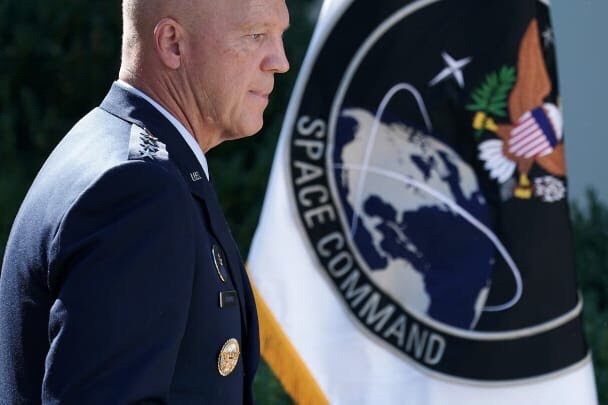
U.S. Air Force Space Command Gen. John “Jay” Raymond stands next to the flag of the newly established U.S. Space Command, the sixth national armed service, in the Rose Garden at the White House August 29, 2019 in Washington, DC. Citing potential threats from China and Russia and the nation’s reliance on satellites for defense operations, Trump said the U.S. needs to launch a ‘space force.’
Chip Somodevilla | Getty Images News | Getty Images
“The system will be monitored, and we will terminate any missile launches from hostile powers, or even from powers that make a mistake. It won’t happen. Regardless of the missile type or the geographic origins of the attack, we will ensure that enemy missiles find no sanctuary on Earth or in the skies above.”
Arms race in space?
Russia responded angrily to the comments, saying it was tantamount to the U.S. relaunching the Cold War-era “Star Wars” program. According to a statement from Russia’s foreign ministry, reported by Reuters, Russia condemned the strategy as an act of confrontation and it urged Washington to reconsider its plans.
“The strategy, de facto, gives the green light to the prospect of basing missile strike capabilities in space,” the statement said. “The implementation of these ideas will inevitably lead to the start of an arms race in space, which will have the most negative consequences for international security and stability,” it said.
“We would like to call on the U.S. administration to think again and walk away from this irresponsible attempt to re-launch, on a new and more high-tech basis, the still-remembered Reagan-era ‘Star Wars’ program,” it said, Reuters reported.
Experts say Russia is wary of the U.S., and NATO, opening up a new operational frontier in space as Russia would be easily out-competed by the combined NATO countries’ technological expertise, advances and weaponry in space. 
“I think when the Russians hear this, they primarily think of the ‘Strategic Defense Initiative’, they think of missile defense, and those are the kinds of things they can’t compete in those areas as well and something they would be very keen to avoid (competing over). The question is, what is NATO actually going to do here?,” Daragh McDowell, principal Russia analyst at Verisk Maplecroft, told CNBC Wednesday.
Russia was quick to criticize NATO’s announcement of space as a new operational domain with Putin telling his security council that “we are also seriously concerned about the NATO infrastructure approaching our borders, as well as the attempts to militarize outer space.”
Earlier this year, Putin had said Russia needs to heavily upgrade its space industry, telling his security council in April that “it is obvious that it is necessary to fundamentally modernize the rocket and space industry,” according to news agency TASS. He also said that leading positions in space exploration were essential for solving national development tasks, ensuring the country’s security and technological and economic competitiveness, TASS reported.
Christopher Granville, managing director of EMEA and Global Political Research at TS Lombard, told CNBC Wednesday that Russia had spent considerable time and effort, in the last few decades, developing technologies to defend against “any conceivable U.S. strategic defense or anti-missile defense capabilities.”
“And if the U.S. were hypothetically to develop new capabilities in outer space, then Russia would have to come up with new responses in addition to the weapon system that Putin announced with some fanfare last year,” he said, referencing Putin’s revealing of new nuclear weapons in March 2018 that he said were “invincible.”

Thursday, December 26, 2019

The German Nuclear Horn (Daniel 7)


Heiko Maas against unilateral removal of nuclear weapons from Germany
22.11.2019
Only a world without nuclear weapons can be a “safe world,” the German foreign minister said on a trip to Hiroshima. But that requires international consensus, and Germany won’t be taking the first step.
German Foreign Minister Heiko Maas visited Hiroshima on Friday to commemorate victims of the 1945 nuclear attack and  promote a nuclear-weapon-free world.
“One day living in a nuclear-weapon-free world has to remain our goal,” he said. “Even though that will not be easy and may take a long time.”
Germany not to disarm
However, the foreign minister said he was against a unilateral German withdrawal of nuclear weapons.
“It’s no use if nuclear weapons are just moved from one country to another. If they are to disappear then they should disappear everywhere,” he said. “As far as nuclear disarmament is concerned, we need agreements on a broad basis, not only in individual countries.”
Germany currently stores around 20 US nuclear warheads. The armed forces have Tornado jets on standby to deploy them if necessary.

Infografik nukleare Sprengköpfe weltweit EN
In the memorial book of the Peace Museum of Hiroshima, Maas wrote: “The memory of suffering by the people of Hiroshima and Nagasaki must never fade. We have a shared responsibility to ensure that such suffering is never repeated. For a peaceful world without nuclear weapons!”
Attack on Hiroshima and Nagasaki
The US nuclear attack on Hiroshima at the end of World War II almost completely destroyed the city and killed around 140,000 people, mostly civilians.
Tens of thousands died subsequently as a result of the long-term effects of the radiation. Three days after the attack on Hiroshima, US forces dropped another nuclear bomb on the city of Nagasaki, where a further 70,000 people died.
The bombings remain the only use of nuclear weapons in armed conflict in history.

Nuclear disarmament efforts will be discussed at the upcoming G20 foreign ministers’ meeting in Nagoya, which Maas will attend.
The agenda also includes talks on free trade, the United Nations’ goals for sustainable development, and policies on Africa.
mvb/rt (AFP, dpa)

Sunday, December 15, 2019

Babylon the Great Tests Nuclear Threshold


By Ryan Browne, CNN
Updated 4:43 PM EST, Thu December 12, 2019
“The Department of Defense conducted a flight test of aconventionally-configured ground-launched ballistic missile at approximately 8:30 a.m. Pacific Time, today, Dec. 12, 2019, from Vandenberg Air Force Base, California,” Pentagon spokesman Lt. Col. Robert Carver told CNN in a statement.
The test comes just two days after Russian Foreign Minister Sergei Lavrov visited Washington for talks with President Donald Trump and Secretary of State Mike Pompeo. During the visit, Lavrov criticized the US decision to leave the INF Treaty and urged Washington to renew the New START Treaty, the last remaining nuclear arms control pact between Russia and the United States.
Carver said that the missile tested Thursday “terminated in the open ocean after more than 500 kilometers of flight. Data collected and lessons learned from this test will inform the Department of Defense’s development of future intermediate-range capabilities.”
‘Unilateral moratorium’
The 1987 INF Treaty banned land-based ballistic missiles, cruise missiles and missile launchers with ranges of 500 to 1,000 kilometers, but the US and NATO have long accused Russia of testing and fielding missiles that were in violation of the pact.
This is the second test of an intermediate range land-based missile by the US since it left the INF Treaty. The US military launched a land-based cruise missile in August that would also have been prohibited.
The US and its NATO allies have said that Moscow has already fielded such a missile, the SSC-8/9M729. Russia has denied fielding an intermediate missile and has blamed the US for the treaty’s demise.
“We have directed the attention of our partners at the negative consequences of the US stepping out of the INF Treaty,” Lavrov said Tuesday during a news conference with Secretary of State Mike Pompeo in Washington.
Lavrov said Russia was announcing “a unilateral moratorium on deploying such missiles and they will not be deployed up until then and in those regions, up until the point where the similar systems appear, the American systems appear.”
A challenge from China could be just the thing to pull NATO together
The Russian foreign minister said that “suggestion was made to our Western partners, including the US, for such a moratorium to become mutual. This offer remains on the table.”
China, which was not party to the INF Treaty, also fields a significant number of intermediate range missiles.
The development of a new American intermediate range missile has been opposed by some members of Congress. The recently passed National Defense Authorization Act “prohibits the procurement and deployment of new ground launched INF-range missiles in fiscal year 2020 and requires information on the analysis of alternatives to such new missiles, basing options and foreign countries consulted, including NATO” according to the bill’s summary.
Asked Thursday if the test meant that the US will deploy intermediate range missiles, Secretary of Defense Mark Esper told reporters at the Pentagon“once we develop intermediate range missiles and if my commanders require them, then we will work closely and consult closely with our allies in Europe, Asia and elsewhere with regard to any possible deployments.”
But there is also concern that America’s European and Asian allies would be unwilling to host intermediate range missiles if the US sought to deploy them to counter Russian or Chinese deployments.

Sunday, November 24, 2019

The German Nuclear Horn (Daniel 7)

22.11.2019
Only a world without nuclear weapons can be a “safe world,” the German foreign minister said on a trip to Hiroshima. But that requires international consensus, and Germany won’t be taking the first step.
German Foreign Minister Heiko Maas visited Hiroshima on Friday to commemorate victims of the 1945 nuclear attack and  promote a nuclear-weapon-free world.
“One day living in a nuclear-weapon-free world has to remain our goal,” he said. “Even though that will not be easy and may take a long time.”
“It’s no use if nuclear weapons are just moved from one country to another. If they are to disappear then they should disappear everywhere,” he said. “As far as nuclear disarmament is concerned, we need agreements on a broad basis, not only in individual countries.”
Germany currently stores around 20 US nuclear warheads. The armed forces have Tornado jets on standby to deploy them if necessary.
In the memorial book of the Peace Museum of Hiroshima, Maas wrote: “The memory of suffering by the people of Hiroshima and Nagasaki must never fade. We have a shared responsibility to ensure that such suffering is never repeated. For a peaceful world without nuclear weapons!”
Nuclear disarmament efforts will be discussed at the upcoming G20 foreign ministers’ meeting in Nagoya, which Maas will attend.
The agenda also includes talks on free trade, the United Nations’ goals for sustainable development, and policies on Africa.
mvb/rt (AFP, dpa)

Sunday, November 3, 2019

The German Nuclear Horn (Daniel 7)

BY JOSUÉ MICHELS • OCTOBER 23
On October 18, Germany’s Die Welt broke the news: “The Bundeswehr Is Training in a Secret Exercise for Nuclear War.” Referring to information released by the German Press Agency (dpa), Die Welt noted that Germany and the Netherlands are training together for the eventuality of nuclear conflict.
Within the North Atlantic Treaty Organization, Germany and the Netherlands have access to nuclear bombs. They are part of nato’s nuclear-sharing agreement that allows them to use nuclear bombs to strike opposing forces. Their preparation to use these weapons is ignored by most media, but it should alarm the world.
“The German Luftwaffe is training with natopartners for the horror scenario of a nuclear war,” Die Welt noted. Under the nato mission Steadfast Noon, Germany and the Netherlands are developing concrete plans and are practicing for using the B61 tactical nuclear weapons that America has stationed in Europe. In the exercises, Germany contributes Tornado jets capable of carrying nuclear bombs.
“According to military experts, the regular Steadfast Noon maneuvers include practicing how to safely transport U.S. nuclear weapons from underground magazines to the aircraft and install them under the combat jets,” Die Welt further explained. Pictures of the maneuvers also show Italian aircraft participating.
All exercises are conducted without the bombs, though the bombs are believed to be stationed in the Volkel air base in the Netherlands, where the maneuvers are held.
Though Germany is not considered, by most people, to be a threat to world peace, we should pay close attention to Germany’s military preparations.
At the beginning of the nuclear arms race, the U.S. gained the upper hand. One can only imagine what the consequences would have been had Germany under Adolf Hitler gained access to weapons of mass destruction. Instead, Germany was disarmed and prohibited from having its own army.
But at the end of the war, the late Herbert W. Armstrong—editor in chief of the Trumpet’s forerunner magazine, the Plain Truth—warned that the danger emanating from Germany had not ceased. On May 9, 1945, he said: “We don’t understand German thoroughness. From the very start of World War ii, they have considered the possibility of losing this second round, as they did the first—and they have carefully, methodically planned, in such eventuality, the third round—World War iii!”
Since Mr. Armstrong spoke these words, Germany has quietly worked to gain access to nuclear bombs. Our article “Germany Prepares for Nuclear War” explains how Germany’s second defense minister, Franz Josef Strauss, pushed to get nuclear weapons. But while his ambition was greatly restricted by the U.S., he made vital preparations for Germany to gain access to these bombs.
His ambitions alarmed Henry Kissinger in 1961 to the point that he warned the Kennedy administration of Strauss’s plans to “simply take” these weapons when he saw fit. Kissinger suggested that America should secure its nuclear weapons in Germany in a way that would make it “physically impossible” to use them without American consent.
Today, however, the fears of Germany using these bombs for its own purposes is nearing zero. Instead, nations are focused on Russia’s military buildup, Iran’s nuclear pursuits, and North Korea’s military games. But the Bible reveals that the nations that started two world wars will yet start another, even more devastating war.
Referring to Germany by its ancient name Assyria, the Bible writes: “O Assyria, the rod of mine anger, and the staff in their hand is mine indignation” (Isaiah 10:5). In various other Bible passages the Bible reveals that God’s wrath has again turned against His people Israel, referring primarily today to the U.S., Britain and the Jewish nation in the Middle East.
These nations have in this prophesied end time come to trust and rely on Germany as a partner against Russia and various other conflicts. But the Bible’s warning is clear, and we see evidence all around that Germany is about to betray its current partners. For this reason, the Trumpet continues to repeat Mr. Armstrong’s warning (Revelation 10:11). This warning is now more urgent than ever. While the last world war ended with nuclear weapons, many believe—for good reason—that the next world war will start with them.
To understand why and how Germany is rising militarily, request your free copy of Daniel Unlocks Revelation, by Trumpet editor in chief Gerald Flurry. This booklet explains how God is actually contributing to the rise of Germany.
Germany is preparing for nuclear war. All humanity should prepare for the Bible’s warning to come true.

Friday, August 9, 2019

The German Nuclear Horn (Daniel 7:7)

Top U.S. Air Force (USAF) and Pentagon officials are working to respond to the German query, the sources said.

Anonymous sources said Berlin would also like to find out how long is the certification process and the cost involved.
Top U.S. Air Force (USAF) and Pentagon officials are working to respond to the German query, the sources said.
Airbus is confident Eurofighter – a joint project with Britain’s BAE Systems and Italy’s Leonardo – could be certified by 2025. Sources familiar with the Eurofighter said it was possible to reconfigure the European jet to carry nuclear bombs.
But U.S. government sources say that schedule is ambitious given that the F-35 and other aircraft must be certified first. Washington has suggested it could take 7-10 years to certify the Eurofighter for nuclear missions, well beyond the Tornado’s retirement date, according to one German military source.
While urging Europe to boost defence spending, U.S. officials are worried about being shut out of European defence projects after 25 EU governments signed a pact in December to fund, develop and deploy armed forces together.
U.S. officials will also weigh whether the Eurofighter could survive a mission into enemy territory to drop a nuclear bomb without stealth capability at a time when Russia and other potential future enemies have bolstered their sensors and air defences, a second source said.
As we have previously reported the Luftwaffe has a shortlist of existing platforms to replace its Panavia Tornado fighter bombers from 2025 to 2030 but the service “preferred choice” is the Lockheed Martin F-35 Lightning II, a German Air Force official said at the International Fighter Conference on Nov. 8, 2017.
According to the same official in fact, the Lightning II can satisfy most of Germany’s requirements and offer other benefits as well.
“The Tornado replacement needs to be fifth-generation aircraft that can be detected as late as possible, if at all. It must be able to identify targets from a long way off and to target them as soon as possible. The German Ministry of Defence [MoD] is looking at several aircraft today, including the F-35 – it is commercially available already, has been ordered by many nations and is being introduced into service today, and has most of the capabilities required.”
But the German Defense Ministry said in a December letter to a lawmaker that the Eurofighter is the preferred choice to replace the Tornado fighter-bomber.
In fact in a letter to a Greens lawmaker who had inquired about the deliberations, the German Defense Ministry said U.S. fighters (the F-35 as well as Boeing’s F-15 and F/A-18 aircraft) were secondary options.
This article by Dario Leone originally appeared on The Aviation Geek Club in 2018.
Image: Wikimedia.

Monday, July 8, 2019

The European Horns Will Join Babylon the Great (Daniel 7)

GEORGE OURFALIAN/AFP/Getty Images
Tim O’Donnell
July 6, 2019
On Saturday, Ali Akbar Velayati, a top aide to Iran’s Supreme Leader Ayatollah Ali Khamenei, said in a video message that the Islamic Republic is prepared to breach the pact after Iran bolstered its stockpile of uranium last week. The message comes just ahead of a Sunday deadline Iran set for European countries to offer new terms in light of recently-imposed U.S. sanctions. If Europe does go along with the sanctions, Velayati said, „every component of the establishment“ has agreed to boost uranium enrichment levels, citing the fact that the U.S. failed to hold up its end of the bargain when Washington left the agreement last year.
But Uranium enrichment is not the only thing stirring up trouble between Tehran and Europe.
In related news, Mohammad Ali Mousavi Jazayeri, a member of the Assembly of Experts, a powerful religious body in Iran, said on Saturday that the United Kingdom „should be scared“ of Iran’s retaliatory measures after the seizure of an Iranian supertanker in Gibraltar by the British navy on Thursday. „We have shown that we will never remain silent over bullying,“ he said.
A British-flagged oil tanker came to a halt in the Persian Gulf, but Iran quickly denied reports that it had seized the ship in retaliation. Hours later, a U.K. Maritime Trade Operations official told Reuters that the tanker is „safe and well,“ further dispelling any suspicion.

Wednesday, August 23, 2017

A Nuclear War Against Russia Will Never Happen


German army tanks line up during the course of the NATO Noble Jump exercise on a training range near Swietoszow Zagan, Poland, June 2015. The German military has seen an increase in deployments for exercises in Eastern Europe and on Russia's borders since the start of the Ukrainian crisis in February 2014.Provoked NATO-Russia Conflicts’ Possible but ‘No One Needs Nuclear Apocalypse

Sputnik
Get short URL
Occasional incidents between Russian and NATO military forces are fairly possible, and some of them may be intentionally provoked, Russian International Affairs Council expert Prokhor Tebin told Sputnik.
“Our relations with the US and NATO will certainly remain tense  and I do not expect any reset like the one we had after the 2008 conflict in Georgia happening any time soon. Limited local-scale military incidents between Russia, the US and NATO, or its individual members, with real fighting and losses,” Tebin said while presenting a report in Euro-Atlantic stability at the recent meeting of the Valdai Discussions Club.
“Moreover, some of these incidents could be intentional,” he added.
Prokhor Tebin highlights the November 2016 incident when Turkey shot down a Russian warplane in Syria as an example of such a conflict.
Tebin added that “both sides have a chance to pragmatically resolve such conflicts before they spill over to full-blown war confrontation or a Cold War.”
He proposed closer dialogue between politicians, diplomats, experts and military men on both sides and the need “to outline their priorities and national interests they will not budge on and the “red lines” they’re not willing to let each other cross.
Tebin continuedsaid that “a major war between Russia and the West is “extremely unlikely because no one needs a nuclear apocalypse.”
US and Canada Institute’s deputy director Pavel Zolotarev likewise ruled out the possibility of Russia and the West actually coming to blows.
“Even if we imagine that [the US] goes to war with Russia, it would have to enlist the help of its NATO allies in Europe, which is unrealistic,” Zolotarev said.
He mentioned how reluctantly America’s fellow NATO members in Europe supported Washington’s military operations in Iraq and Afghanistan.
“Where was NATO when the US was preparing to invade [Iraq]? The Americans were forced to cobble together the so-called ‘Coalition of the Unwilling’. In Afghanistan Russia acted as a partner, but NATO didn’t,” he added.
Zolotarev believes that aside from the post-Soviet territory, there is really nothing Russia and NATO can’t agree on.
NATO-Russia relations have been complicated over the past few years, as NATO has set a sustainable course for the alliance’s expansion by engaging Eastern European states since 2014.
NATO justified its eastward expansion as a response to Russia’s alleged meddling in the Ukrainian conflict.
Moscow has repeatedly and vehemently refuted these allegations.

Saturday, March 11, 2017

The European Nuclear Horns Grow (Daniel 7)

The New York Times By MAX FISHER 4 days ago
A technician under the French nuclear aircraft carrier Charles De Gaulle. In Europe, there is talk of forming a joint nuclear deterrent in the event the Trump administration withdraws American protection. © Jean-Paul Pelissier/Reuters A technician under the French nuclear aircraft carrier Charles De Gaulle. In Europe, there is talk of forming a joint nuclear deterrent in the event the Trump administration withdraws American protection.
BERLIN — An idea, once unthinkable, is gaining attention in European policy circles: a European Union nuclear weapons program.
Though no new countries would join the nuclear club under this scheme, it would amount to an unprecedented escalation in Europe’s collective military power and a drastic break with American leadership.
Analysts say that the talk, even if it never translates into action, demonstrates the growing sense in Europe that drastic steps may be necessary to protect the postwar order in the era of a Trump presidency, a resurgent Russia and the possibility of an alignment between the two.
Even proponents, who remain a minority, acknowledge enormous hurdles. But discussion of a so-called “Eurodeterrent” has entered the mainstream — particularly in Germany, a country that would be central to any plan but where antinuclear sentiment is widespread.
Jana Puglierin of the German Council on Foreign Relations said that a handful of senior European officials had “for sure triggered a public debate about this, taking place in newspapers and journals, radio interviews and TV documentaries.”
She added: “That in itself is remarkable. I am indeed very astonished that we discuss this at all.”
A Nuclear ‘Plan B’
Jaroslaw Kaczynski, Poland’s former prime minister and now the head of its ruling party, provided the highest-level call for a European Union nuclear program in a February interview with a German newspaper.
But the most important support has come from Roderich Kiesewetter, a lawmaker and foreign policy spokesman with Germany’s ruling party, who gave the nuclear option increased credibility by raising it shortly after President Trump’s election.
In an interview in the German Bundestag, Mr. Kiesewetter, a former colonel who served in Afghanistan, calibrated his language carefully, providing just enough detail to demonstrate the option’s seriousness without offering too much and risking an outcry from German voters or encouraging the American withdrawal he is hoping to avoid.
“My idea is to build on the existing weapons in Great Britain and France,” he said, but acknowledged that Britain’s decision to leave the European Union could preclude its participation.
The United States bases dozens of nuclear warheads in Germany, Italy, Belgium and the Netherlands as both a quick-reaction force and a symbol of its guarantee to protect the Continent. Mr. Kiesewetter said his plan would provide a replacement or parallel program.
This would require, he said, four ingredients: a French pledge to commit its weapons to a common European defense, German financing to demonstrate the program’s collective nature, a joint command and a plan to place French warheads in other European countries.
The number of warheads in Europe would not increase under this plan, and could even decrease if the United States withdraws.
“It’s not a question of numbers,” Mr. Kiesewetter said. “The reassurance and deterrence comes from the existence of the weapons and their deployability.”
He envisioned a program designed to deter nuclear as well as conventional threats — a clear nod to Russia’s military superiority.
This would require a doctrine, he said, allowing Europe to introduce nuclear weapons to a non-nuclear conflict. He compared it to the Israeli program, which is believed to allow for a nuclear strike against an overwhelming conventional attack.
“These are political weapons. Their use must be unpredictable,” he said. Smaller nuclear powers often maintain vague doctrines to deter more powerful adversaries.
The goal, he said, would be to maintain Europe’s defense, seen as crucial for its internal unity, as well as its international diplomatic standing.
German lawmakers across the political spectrum worry that Mr. Trump could strike a grand bargain with Russia that excludes Europe, a potential first step toward Washington and Moscow dictating Europe’s future. Mr. Kiesewetter believes a European nuclear program would allow Europe to preserve its autonomy.
‘A Political Minefield’
Mostly, Mr. Kiesewetter said he hoped to spur Mr. Trump to end doubts over American security commitments to Europe, rendering unnecessary the nuclear “Plan B.”
For now, Mr. Kiesewetter’s intention is merely to “trigger a debate” over addressing “this silent, gigantic problem.”
Mr. Kiesewetter said he had heard interest from officials in the Polish and Hungarian governments, at NATO headquarters in Brussels and within relevant German ministries, though he would not say which.
But any European nuclear program would face enormous hurdles.
“The public is totally opposed,” Ms. Puglierin said, referring to German antinuclear sentiment, which has at times culminated in nationwide protests against the weapons.
In practical terms, the plan would change the flag on Europe’s nuclear deterrent from that of the United States to that of France. But this would risk making an American exit from Europe more permanent.
Oliver Thränert, a German analyst with the Switzerland-based Center for Security Studies, warned in a white paper that any plan “would not only be expensive, but also a political minefield full of undesirable potential political consequences.”
The biggest challenge may be who controls the French arsenal and where it is based.
The United States currently shares warheads with allies like Germany, whose militaries are equipped to deliver the weapons, granting the program credibility as a Pan-European defense.
But France has shown no willingness to share its weapons, much less put them under a joint European command. If Paris maintains final say over their use, this might cause an adversary to doubt whether France would really initiate a nuclear conflict to protect, say, Estonia.
France and ‘a Special Responsibility’
These sorts of problems are why Bruno Tertrais of the Foundation for Strategic Research in Paris said, “In other times I would have told you don’t bother, there’s no story here.”
Similar proposals have been floated before, including by the French government, and always rejected as politically risky and strategically unnecessary. But, he said, that calculus appears to have a potential to change with Mr. Trump.
“There’s already a bit more interest in Berlin and in Paris,” Mr. Tertrais said, though he emphasized that this talk would become action only if there were “a serious loss of trust in the U.S. umbrella.”
But a joint European command or funding scheme would most likely be impossible, he warned. The French government would insist on maintaining “the final decision to use nuclear weapons.”
That is also United States policy in Europe, which is why Mr. Tertrais believes a more workable plan would be for France to reproduce American-style practices of basing its warheads abroad, while keeping them under French control.
While most French warheads are lodged on submarines, a few dozen are fitted to air-launched cruise missiles that could be housed in, for example, German airfields. These are smaller, shorter-range tactical weapons — exactly the American capability that Europe most fears losing.
French policy already allows for, though does not require, using nuclear weapons in defense of an ally.
With Britain’s exit from the European Union, “the French might feel they have a special responsibility” as Europe’s sole nuclear power.
Vipin Narang, a Massachusetts Institute of Technology professor who studies regional nuclear powers, was initially skeptical but came to see such a plan as both technically and politically feasible.
For France, he said, “it extends their frontier,” making it likelier that a nuclear conflict would be fought far from French soil. For Germany and other European states, it would “increase the credibility of the forward deployment against Russian aggression.”
An Insurance Policy
Some observers believe that official shows of support are intended only to pressure Mr. Trump into maintaining the status quo, which Mr. Kiesewetter emphasized is his preferred outcome.
But Mr. Narang said that, regardless of intentions, there is a blurry line between mere signaling and actually pursuing a fallback nuclear option.
Nuclear scholars call this “insurance hedging,” in which a protectee comes to doubt its protector and responds by taking steps toward, but not actually completing, its own nuclear program. This is meant to goad the protector into staying, and to prepare in case it doesn’t.
Japan, for instance, has quietly developed latent capabilities that are sometimes figuratively described as a “screwdriver’s turn” away from a bomb.
Because Europe’s primary challenges are political rather than technical — France already possesses the warheads — sparking public discussion and exploring options makes those challenges more surmountable and the option more real.
“In order for it to be credible there has to be some sort of workable option,” Mr. Narang said.
‘I Never Thought We Would See This Again’
Mr. Kiesewetter hopes the United States will come around. He puts particular faith in Jim Mattis, the defense secretary, whom he met in Afghanistan and Brussels while both were military officers.
But Mr. Mattis has echoed Mr. Trump’s warnings that the United States could lessen its support for Europe, saying in a recent speech in Brussels, “I owe it to you to give you clarity on the political reality in the United States.”
If Europeans grew more serious about a nuclear program, Mr. Tertrais said, “you would not necessarily see it.” Negotiations would most likely remain secret for fear of giving Mr. Trump an excuse to withdraw — or of triggering a reaction from Russia.
Mr. Narang said he was reeling from the seriousness of the discussion, the first since a failed and now-forgotten effort in the 1950s for French-German-Italian nuclear cooperation.
“I never thought we would see this again. I never thought there would actually be this concern,” he said. But, he added, “You can see where the debate is surfacing from. There is a logic to it.”