Showing posts with label awareness. Show all posts

Friday, October 23, 2020

The New Space Wars: Revelation 16

NATO to set up new space center amid China, Russia concerns

By LORNE COOK – 10/22/20 5:57 PM

KESTER, Belgium — To a few of the locals, the top-secret, fenced-off installation on the hill is known as “the radar station.” Some folks claim to have seen mysterious Russians in the area. Over the years, rumors have swirled that it might be a base for U.S. nuclear warheads.

It’s easy to see how the rumors start. The site is visually striking. Four huge white Kevlar balls sit like giant spherical spacecraft in a compound in the middle of open farm country 25 kilometers (16 miles) west of Belgium’s capital, Brussels.

But the Kester Satellite Ground Station is both safer and more sophisticated than local lore might suggest. It’s central to space communications at NATO — the biggest and most modern of four such stations the military alliance runs.

Around 2,000 satellites orbit the earth, over half operated by NATO countries, ensuring everything from mobile phone and banking services to weather forecasts. NATO commanders in places like Afghanistan or Kosovo rely on some of them to navigate, communicate, share intelligence and detect missile launches.

This week, the site at Kester is set to fall under a new orbit, when NATO announces that it is creating a space center to help manage satellite communications and key parts of its military operations around the world.

In December, NATO leaders declared space to be the alliance’s “fifth domain” of operations, after land, sea, air and cyberspace. Over two days of talks starting Thursday, NATO defense ministers will greenlight a new space center at the alliance’s Air Command in Ramstein, Germany.

“This will be a focal point for ensuring space support to NATO operations, sharing information and coordinating our activities,” NATO Secretary-General Jens Stoltenberg said before the meeting.

It’s part of the alliance’s efforts to keep ahead in a fast moving and hi-tech sector, particularly amid concern about what member countries say is increasingly aggressive behavior in space by China and Russia.

Around 80 countries have satellites and private companies are moving in too. In the 1980s, just a fraction of NATO’s communications was via satellite. Today, it’s at least 40%. During the Cold War, NATO had more than 20 stations, but new technologies mean the world’s biggest security organization can double its coverage with a fifth of that number.

At Kester, behind a double security fence, massive steel gates and bulletproof glass in a facility that can withstand a terror attack or any attempt to jam communications, four satellite dishes ensconced in Kevlar domes connect NATO’s civilian and military headquarters in Belgium to their operations around the world.

From their elevated position, the dishes — two of them 16 meters (52 feet) in diameter — beam information and imagery down across Europe and over Africa into space above the equator where satellites owned by allies like the United States, Britain, France and Italy orbit. NATO itself doesn’t own any satellites.

Around the globe, commanders in ships, aircraft and mobile or static headquarters decrypt the data to gather orders, pictures and intelligence, prepare missions, or move troops and military equipment. From Kester, new lines of communication can be set up for NATO within a half-hour.

Much of the facility is encased in thick steel plates, including the ducts where cables run, to withstand any attack by electromagnetic pulses — high bursts of energy that can knock out electrical power grids or destroy electronic circuit boards and components.

But NATO allies are increasingly concerned about other kinds of attacks using anti-satellite weapons miles above the earth which could wreak havoc below and leave dangerous debris adrift in space.

“Some nations – including Russia and China – are developing anti-satellite systems which could blind, disable or shoot down satellites and create dangerous debris in orbit. We must increase our understanding of the challenges in space and our ability to address them,” Stoltenberg said.

For the moment, the military alliance insists that its “approach will remain defensive and fully in line with international law.” And despite the strides being made in the “fifth domain,” Stoltenberg has repeatedly said over the last year that “NATO has no intention to put weapons in space.”

Wednesday, October 14, 2020

The growing threat of nuclear war under Trump: Revelation 16

Threat from nuclear weapons and missiles has grown since Trump entered office

Paul Sonne

This image made from video broadcast by North Korea’s KRT shows what appears to be a new intercontinental ballistic missile during a parade in Pyongyang on Oct. 10. (AP)

North Korea’s new road-mobile intercontinental ballistic missile, paraded through the streets of Pyongyang this past weekend, has underscored a worrying reality: The global threat from nuclear weapons and menacing missiles has grown since President Trump entered office, despite his administration’s fitful efforts to control them.

The unveiling of the untested weapon — which appeared to be a larger version of a North Korean missile that can reach the United States — came less than a week after Russia test launched an anti-ship hypersonic cruise missile on President Vladimir Putin’s birthday and a month and a half after China test fired its “carrier killer” and “Guam killer” ballistic missiles into the disputed South China Sea.

The situation presents a broader challenge to the United States. The administration has heralded an era of “great power competition” with China and Russia, resulting in a competitive buildup that arms-control advocates warn is risking a full-blown arms race.

Russia is developing nuclear-armed underwater drones, nuclear-powered cruise missiles and other destabilizing weapons designed to penetrate U.S. missile defenses. China is ramping up its missile force and building out its nuclear capabilities with new nuclear submarines. And the United States is modernizing its own arsenal, while adding low-yield nuclear warheads to submarines and enhancing missile defenses. All the while, Iran and North Korea are advancing as threats.

The result is an escalatory cycle that experts say is threatening decades of progress controlling the world’s most dangerous weapons. A recent report from the Center for Strategic and International Studies warned that the decline of U.S. global influence and the rise of regional security tensions, coupled with the staying power of authoritarian leaders, will incentivize more nations to pursue nuclear weapons and limit Washington’s ability to respond.

The issue looms over the final days of the U.S. presidential campaign, as North Korea demonstrates that, despite Trump’s efforts, Kim Jong Un’s regime is busy enhancing its nuclear missile arsenal. Trump is also rushing to conclude a last-minute arms control deal with Russia, hoping to secure an agreement he can tout as a diplomatic win before the Nov. 3 presidential election.

Trump’s interest in arms control dates to at least the 1980s, when he sought unsuccessfully to engage in nuclear talks with the Soviets on behalf of the Reagan administration. On the campaign trail in 2016, Trump described nuclear weapons as the world’s biggest problem and has called the issue more important than climate change.

But after nearly four years in office, he hasn’t signed any significant new treaties to regulate the world’s most devastating weapons and has populated his administration at times with arms-control skeptics, such as John Bolton, the former national security adviser.

“You have the U.S. leaving arms agreements with the Russians, failing to open any kind of meaningful talks with the Chinese, really just succeeding in antagonizing the Iranians and the North Koreans and looking the other way while allies like the Saudis acquire some interesting capabilities,” said Jeffrey Lewis, an arms-control advocate who serves as director of the East Asia Nonproliferation Program at the Middlebury Institute of International Studies, describing the situation as “bad.”

Trends were already moving in a worrisome direction before Trump took office, and any administration would struggle to strike substantive new arms control deals in the current environment, said Vipin Narang, associate professor of political science at the Massachusetts Institute of Technology. But Trump has exacerbated the challenges, he argued.

China and Russia are becoming more aggressive in their own neighborhoods; nuclear-armed India and Pakistan are clashing over disputed territory; and the Trump administration is alienating allies in Europe, Narang said. The U.S. killing of Iranian Maj. Gen. Qasem Soleimani in a drone strike in Iraq, he said, has only increased the rationale for Iran and North Korea to pursue nuclear programs to safeguard their regimes.

“It’s not just we are building and modernizing our nuclear weapons program; we are doing it at a time when states are seeking riskier behavior with each other also,” Narang said.

Trump’s administration has overseen an arms control rollback that has unnerved antinuclear advocates but cheered hawks who say Washington shouldn’t stay in problematic agreements just because prior presidents signed them. Trump pulled out of the 2015 nuclear accord that the Obama administration negotiated with Iran, citing flaws with the pact and malign activities by Tehran outside the agreement, and withdrew from the Intermediate-Range Nuclear Forces Treaty with Russia and the Treaty on Open Skies, citing violations by Moscow.

Tim Morrison, a senior fellow at the Hudson Institute who served as the National Security Council’s senior director for counterproliferation and biodefense under Trump, said the increasing threat shouldn’t be blamed on the president.

“What I have trouble doing is saying that it’s Trump’s fault, that somehow the Obama administration or a Biden administration would do it better,” Morrison said. “I think the problem is this era that we’re in — it’s an incredibly complicated era.”

Trump’s critics, however, counter that his brash and undisciplined approach to foreign policy has squandered diplomatic opportunities, undermined work with allies and contributed to global instability.

“It’s not just that the U.S. is not playing a leadership role, which it’s definitely not, but it’s not providing any of the functions that it used to provide,” Lewis said. “Everyone is on their own, and there are no rules, and there is no predictability, so I do think things can get a little crazy.”

An array of new weapons

Perhaps Trump’s biggest achievement in the arms-control space has been to broker an informal agreement with Kim to pause North Korea’s tests of intercontinental ballistic missiles and nuclear warheads in exchange for a U.S. suspension of military exercises with South Korea. The moratorium reduced tension that flared between Washington and Pyongyang in 2017.

But Kim has continued to advance his nuclear weapons and missile programs in the meantime, according to a U.N. Panel of Experts report and U.S. officials, conducting a ballistic missile test from a submarine last year and more recently threatening to resume the long-range-missile and nuclear tests he agreed to halt.

On Saturday, North Korea underscored the advancing threat its nuclear program poses by unveiling an ICBM on an 11-axle truck. The missile, which hasn’t been tested, appeared to be the nation’s biggest and most powerful to date, according to analysts, some of whom described it as a larger derivative of the Hwasong-15 tested in late 2017. The larger size suggests North Korea is working on advancing its arsenal by affixing several warheads to one missile.

In the Middle East, Iran has ramped up production of enriched uranium since the Trump administration pulled out of the 2015 nuclear deal, according to the U.N. nuclear watchdog. The country’s regional archrival, Saudi Arabia, meanwhile, has been working with the Chinese to build production capacity for nuclear fuel, according to a report in the New York Times, and has moved to expand its missile capabilities, raising concerns about the kingdom’s nuclear ambitions.

In Russia, Putin unveiled new weapons in 2018 that are designed to penetrate American missile defenses, including the nuclear-armed Avangard hypersonic glide vehicle and the nuclear-armed undersea Poseidon drone. Development of a nuclear-powered cruise missile, known as the Burevestnik or Skyfall, led to an accident that killed five people last year in Russia’s far north, according to U.S. officials. Washington explored similar technology during the Cold War but deemed it too dangerous.

Putin has said some of the new weapons Russia is developing would fall under the New START agreement if Washington and Moscow agree to prolong the 2010 pact, which expires in early February but includes a five-year extension option. In his platform, Democratic nominee Joe Biden has said that if elected president, he would extend the treaty; Putin has also expressed a willingness to do so.

But the Trump administration wants a broader treaty. According to U.S. officials, the administration is discussing a one- or two-year extension of New START with Russia, pending the negotiation of a new pact. The deal would also freeze both countries’ nuclear stockpiles in the meantime, a detail first reported by the Wall Street Journal.

The Trump administration previously has demanded Russia put all its nuclear weapons up for negotiation and include China in the framework for a follow-on treaty. If the talks falls apart, Washington and Moscow would have no substantive restraints on their arsenals for the first time since the Cold War. 

China, which has refused to take part in the talks, is pursuing a full nuclear triad that can launch nuclear warheads from air, land and sea — and is developing its own stealth strategic bomber. The Pentagon predicts that Beijing’s arsenal will double from about 200 to 400 warheads over the next decade. The United States and Russia each have more than 5,000, according to the Federation of American Scientists.

Still, the Chinese military’s advancements have raised questions about whether the nation, which has long said it will use a nuclear weapon only after being hit by one, is moving away from that “second strike” doctrine.

Beijing has also developed a formidable missile force that has checked U.S. power in Asia, including the nuclear-capable ­DF-26 ballistic missile, sometimes called the “Guam killer” because it can reach U.S. military facilities on the island, and the DF-21D, an intermediate-range ballistic missile that has been dubbed the “carrier killer” because it can threaten U.S. aircraft carriers. It is also developing hypersonic glide vehicles that can move more than five times the speed of sound.

U.S. modernization plans

The buildups by Moscow and Beijing come as the United States modernizes its nuclear arsenal, with the Pentagon planning to introduce a new nuclear bomber, submarine, intercontinental ballistic missile system and air-launch cruise missile in the coming years. The 30-year effort, when including the sustainment of the current nuclear force, is projected to cost more than $1 trillion.

The Trump administration earlier this year deployed a new low-yield nuclear warhead for Trident ballistic missiles on submarines and is starting work on a new nuclear cruise missile for submarines as well. It’s also in the early stages of developing a nuclear warhead known as the W93. The Pentagon is working on a range of hypersonic weapons to keep pace with China, though it says they are conventional rather than nuclear.

The developments have led to growing concerns about a nascent arms race. Trump’s recent comments to journalist Bob Woodward about a secret, unidentified nuclear weapons system heightened those fears.

The United States has continued investments in missile defense — which the Russians have said prompted their investments in exotic weapons.

Despite the tension, it’s important to put the current state of affairs in broader context, said Rose Gottemoeller, a fellow at Stanford University’s Hoover Institution, who served as deputy secretary general of NATO and one of the Obama administration’s top arms-control negotiators.

In the late 1960s, Gottemoeller said, the United States had more than 30,000 nuclear weapons, and the Soviet Union by some accounts had at least 40,000 — far more than today. She said that the Trump administration is right to sound the alarm about Russia’s new systems and China’s expanded nuclear and missile forces, but that people shouldn’t overreact.

“There is no need to panic,” Gottemoeller said.

The Nuclear Non-Proliferation Treaty — a Cold War-era pact whereby nuclear nations pledged to reduce their arsenals in exchange for nonnuclear nations not pursuing nuclear weapons — could be strained if New START falls apart, Gottemoeller warned, and there is no follow-on agreement between the United States and Russia to limit strategic arms. But she said she expects Washington and Moscow to come to an agreement.

The other big issue that must be addressed, Gottemoeller said, is the rapid advance and proliferation of missile technology around the globe, which is giving more countries access to very fast and highly accurate missiles.

“At the end of the day, I think the likelihood of nuclear use has gone up since President Trump took office,” said James Acton, co-director of the nuclear policy program at the Carnegie Endowment for International Peace, who said Trump has built up leverage on countries such as North Korea but hasn’t been able to use it. “I think the trend lines are bad and moving us further in that direction.”

Tuesday, October 13, 2020

World War 3 fears EXPLODE: Revelation 16

World War 3 fears EXPLODE – Pakistan warns India is planning attack with new fighter jets

PAKISTAN has said India is planning a military operation just a few weeks after New Delhi introduced new fighter jets into its Air Force.

By MANON DARK

Pakistan’s Air Force Marshal, Mujahid Anwar Khan, claimed India is planning an offensive in an attempt to spread conflict. He expressed his fears while speaking at the Centre for Aerospace and Security Studies in Pakistan.

Mr Khan said that Indian forces will come within 5 kilometres to prove their dominance in the air.

He added that India will attempt to inflect “conflict beyond Kashmir and at international border”.

The Air Marshal said: “I would imagine India offensive in 18-24 months.

“As it received a sizeable number meteor equipped Rafale from France.

India introduced the new Rafale jets into its Air Force earlier this month (Image: getty)

Mujahid Anwar Khan claimed India is planning an offensive (Image: getty)

“Only this time she will enter deeper than 5 kilometres and engage multiple targets to stamp its superiority in the aerospace domain.

“I imagine India’s willingness to spread the conflict in the air beyond Kashmir and possibly at the international border.”

Mr Khan’s statement comes just a few days after Indian Air Chief Marshal RKS Bhadauria told a press conference about the induction of the new fighter jets.

India introduced the new Rafale jets into its Air Force earlier this month.

India said it was ready to handle a possible two-front war with China and Pakistan (Image: getty)

The Indian Air Chief Marshal said the country was ready to handle a possible two-front war with China and Pakistan.

He said: “The integration of Rafales brings in a platform which is way ahead and would give us an edge and capability to strike first and deep.

“Indian Air Force is ready for any possible conflict including a two-front war.”

He added: “Our position as a credible combat-ready force is vital, given the role Air Force will play towards ensuring victory in any future conflict.

Prime Minister of India Narendra Modi (Image: getty)

“The emerging threat scenario in our neighbourhood and beyond mandates need to have a robust capability to fight across the entire spectrum of warfare.

“I can share with you with confidence that operationally, we are amongst the best.”

Mr Bhadauria also spoke about India’s ongoing standoff with China.

He said: “The talks towards disengagement, followed by de-escalation, are on. We hope that the talks will progress along the lines that are expected.”

Mr Bhadauria also insisted that the Indian Air Force is “well-positioned” for any conflict.

The largest militaries in the world (Image: Express.co.uk)

Last year, Pakistan said it shot down two Indian military jets in an attack over Kashmir.

The two sides both claim the whole of Kashmir as its territory but only control parts of it.

The aerial attacks across the border in Kashmir were the first since a war in 1971.

Last year, India formally divided the state of Jammu and Kashmir into two federally-administered territories.

It was part of a move to tighten India’s control over the part of Kashmir it controls.

Thursday, October 8, 2020

How Obama and Biden betrayed the United States


No, Iran nuclear program was not ‘bottled up’

Leaving aside politics, I am concerned that your editorial, “As voting begins, our choice is Joe Biden,” (Oct. 1), incorrectly described the vitally important situation involving Iran’s quest for nuclear weapons.

You said that the Iran deal “had kept Iran’s nuclear program bottled up.” That statement has no basis in fact. In the negotiations toward that deal, our negotiators conceded away any meaningful way to verify Iran’s compliance. We surrendered the IAEA’s right to inspect all facilities. It may inspect only selected ones. Even the limited inspections are often subject to enough advance notice to Iran that its fanatical and ruthless leaders can easily cover up their nuclear efforts. Nothing is “bottled up.” Instead, the deal is like Swiss cheese.

While accepting on faith that Iran would keep its word, we gave it $100 billion, which it is using to fund terrorism and military proxies throughout the Middle East, including Syria and Iraq. Moreover, Iran will have plenty of arms available to purchase, as we  conceded away the UN arms embargo against Iran, which will now expire imminently.

The Day has a right to its political preferences but has an obligation not to make unfounded factual statements.

Mark I. Fishman

President of PRIMER-Connecticut (Promoting Responsibility in Middle East Reporting)

New Haven

Tuesday, October 6, 2020

The nuclear deal unravels: Revelation 16

October 2020

By Kingston Reif and Shannon Bugos

As the clock winds down on the last remaining U.S.-Russian arms control treaty, the United States and Russia remain locked in a stalemate with numerous obstacles blocking the path to prolonging the agreement. U.S. President Donald Trump’s administration will only contemplate a short-term extension of the 2010 New Strategic Arms Reduction Treaty (New START) if Russia agrees to a framework for a new trilateral treaty that verifiably covers all nuclear warheads, includes those of China in the future, and makes changes to the painstakingly negotiated New START verification regime.

Russian Deputy Foreign Minister Sergei Ryabkov arrives for nuclear talks with U.S. officials in Vienna on June 22. The discussions yielded little progress, and more recently he said “there are no grounds for any kind of deal in the form proposed.” (Photo: Joe Klamar/AFP/Getty Images)

Moscow, which supports an unconditional five-year extension of the treaty, has called the U.S. proposal “absolutely unrealistic.” Russian Deputy Foreign Minister Sergei Ryabkov said that “there are no grounds for any kind of deal in the form proposed” by Washington in a Sept. 21 interview with Kommersant. New START permits an extension of up to five years so long as the U.S. and Russian presidents agree.

The U.S. approach raises several questions, such as whether the Trump administration is actually interested in extending New START at all, what the United States would be willing to put on the negotiating table in exchange for concessions from Russia, and why the administration believes that withholding an extension of the treaty provides the United States leverage in negotiations.

With Russia showing little sign of agreeing to the framework, the Trump administration will soon face the choice of whether to extend the treaty as is or set it on a path to expiration in February, which could trigger a costly arms race.

The Trump administration has also suggested that, if Russia does not agree to framework prior to the U.S. presidential election in November, Washington will tack on additional conditions for New START extension. What those conditions would be are unknown.

Democratic presidential candidate Joe Biden has said that if he is elected president in November and New START has not been extended, he will pursue the treaty’s extension and “use that as a foundation for new arms control arrangements,” according to his campaign website.

Marshall Billingslea, U.S. special envoy for arms control, told Kommersant on Sept. 21 that if Russia does not agree to the Trump administration’s framework, the United States will not extend New START. Billingslea also threatened that the United States would increase the deployed strategic arsenal “immediately after the expiration of the treaty in February.”

The U.S. insistence on the framework and refusal to extend New START without unilateral concessions by Moscow has prompted some skeptics to wonder whether the Trump administration is attempting to set Russia and China up to take the blame for an expiration of the treaty.

U.S. officials said that, with four months until New START expires on Feb. 5, 2021, sufficient time remains for Russia to agree to the U.S. offer before a decision must be made on an extension. Yet even if Russia were open to discussions with the United States on its demands, negotiating the specifics of a framework could take weeks if not months.

In addition, according to officials from the Russian Foreign Ministry, Moscow might need months to process a “technical extension” of the treaty.

Billingslea has claimed that the United States has significant leverage because Russia is desperate for an extension of the treaty. But Russia has said that it desires an extension of the treaty only as much as the United States and will not pursue an extension at any cost.

Russian Foreign Minister Sergey Lavrov said in July that, if the Trump administration does not agree to extend New START, “we will not insist.”

Extending the treaty for a period of less than five years, as the Trump administration is contemplating, also poses risks. Negotiations on arms control treaties are difficult and time consuming. A new agreement along the lines proposed by the Trump administration could take years.

Billingslea has declined to say how long an extension the administration has proposed, telling Kommersant that it “depends on how flexible the Russian leadership will be.”

Moreover, assuming Moscow would even agree to multiple short-term extensions totaling less than five years, preparing and posturing for such extensions could distract from the broader talks the administration says it seeks.

Although any framework agreement is likely to require mutual concessions from Washington and Moscow, the Trump administration refuses to detail what it would be willing to put on the negotiating table, besides a short-term extension of New START, in order to secure Russia’s agreement.

Russia has long said that it prioritizes the inclusion of U.S. allies France and the United Kingdom in arms control discussions. In addition, Moscow seeks to capture other factors it deems essential to maintaining strategic stability, such as missile defense, ground-based short- and intermediate-range missiles, space weapons, and hypersonic weapons.

Billingslea, however, has dismissed the idea of including limits on U.S. missile defenses, involving France and the UK in multilateral talks, and removing U.S. nuclear weapons deployed in Europe.

The Trump administration also has yet to describe what it would be willing to do in order to bring China to the table. Billingslea told CNN on Sept. 18 that Russia could persuade China to join talks, although Moscow has previously refused to do so.

“It’s [Russian President] Vladimir Putin,” he said. “He’s got all kinds of leverage. If they really wanted to help, they could.”

China has repeatedly declined to join trilateral arms control talks with the United States and Russia. The only way that Beijing would join, said Fu Cong, director-general of the Chinese Department of Arms Control and Disarmament, in July, was if the United States decreased its nuclear arsenal to the size of China’s. (See ACT, September 2020.) The United States has an estimated 6,000 nuclear weapons, including retired warheads; China’s arsenal numbers in the low 200s, according to a U.S. Defense Department report in September.

Billingslea claims that the verification regime put into place by New START suffers from significant loopholes and deficiencies, such as the absence of sufficient exchanges of missile telemetry and the limited frequency of on-site inspection.

The U.S. military, however, places great value on the treaty’s inspections and has not indicated that such flaws exist. Vice Adm. David Kriete, deputy commander of U.S. Strategic Command, said in July 2019 that “those verification procedures that the U.S. gets to execute all the time provide great insight into Russia’s capabilities, numbers, and all kinds of things associated with their nuclear weapons.” If those procedures disappeared, he said, then “we would have to go look for other ways to fill in the gaps.”

Rose Gottemoeller, chief U.S. negotiator for New START, also emphasized the importance of New START’s verification setup, saying that it used what worked in previous treaties and discarded those elements that previously encountered issues with implementation. “In the end,” she said in May, “the United States got what it wanted in the New START verification regime: streamlined inspection procedures at a sufficient level of detail to be effectively implemented.”

Although the Trump administration has expressed its willingness to let New START expire, members of Congress continue their calls for the treaty’s five-year extension.

Sens. Dianne Feinstein (D-Calif.), Chris Van Hollen (D-Md.), Rand Paul (R-Ky.), and Susan Collins (R-Maine) sent a Sept. 8 letter to Trump calling for the United States to extend New START.

According to an internal State Department report for Congress obtained by Foreign Policy in September, U.S. allies are “concerned about the potential repercussions to the international security environment should New START expire before its full term.”

Meanwhile, the United States and Russia have continued a pause on inspections under New START and a postponement of the Bilateral Consultative Commission (BCC), which oversees implementation of the treaty.

“The United States is studying how and when to resume inspections and the BCC while mitigating the risk of COVID-19 to all U.S. and Russian personnel,” a State Department spokesperson told Arms Control Today. “The United States continues to implement and abide by” New START.

New START caps the U.S. and Russian strategic nuclear arsenals at 1,550 deployed warheads and 700 deployed missiles and heavy bombers each.

Sunday, September 13, 2020

The Irony Is Biden And Obama Started This Process


On 9/11/20 at 5:15 AM EDT
At a virtual fundraiser hosted by the JStreet PAC on Thursday, Biden said he would seek to re-engage with Tehran though admitted this would not be easy after four years of antagonism.
On Thursday, Biden said Trump had made an Iranian nuclear weapon more likely despite his claims to the contrary. “Iran is closer to a weapon now than we were when we left office in 2017,” he said, according to a press pool report sent out by his campaign.
The former vice president defended the JCPOA, describing it as the “most intrusive inspection regime in history.”
Newsweek subscription offers >
Trump abandoned the Joint Comprehensive Plan of Action in May 2018, claiming the deal was too lenient and fulfilling a promise that became a key part of his foreign policy campaign strategy.
Trump withdrew despite other signatories urging him to reconsider and despite the International Atomic Energy Agency confirming that Tehran was complying with the agreement.
U.S.-Iran reactions have continued deteriorating since, with the two sides launching strikes against each other and flirting with an open conflict. Trump has maintained his “maximum pressure” campaign against Tehran, seeking to undermine the regime with crippling economic sanctions.
The Trump administration has tried to rally its allies against Iran but has failed. The other signatories to the JCPOA—Russia, China, the U.K., Germany and France—remain committed, and the United Nations Security Council has rejected U.S. efforts to extend an arms embargo on Iran or re-apply the sanctions lifted by the JCPOA.
Meanwhile, Iran has ended compliance with the JCPOA’s terms. Tehran is now expanding its enriched uranium stockpile and ramping up its ability to produce more. Iran had been ending compliance piecemeal since Trump’s withdrawal, but said it would no longer respect any restrictions after the U.S. assassinated Major General Qassem Soleimani in January.
The Trump administration has accused Iran of running a clandestine nuclear operation outside of the JCPOA, citing Israeli intelligence. A nuclear-armed Iran would represent an existential threat for Israel.
Iran has denied the allegations and international inspectors repeatedly confirmed Iranian compliance in the years before Trump’s withdrawal.
Biden said Thursday he would reenter the deal if Iran “returns to compliance,” though said he would need help from the other JCPOA signatories, including U.S. rivals Russia and China. “I promise you it will be a significant initiative of mine to get back into the deal,” Biden said.
Trump has vowed to secure a new, more restrictive deal with Iran, one that would include limits on Tehran’s ballistic missile program and malign regional influence. Earlier this year, Trump urged Iran to “make the big deal” before November’s presidential election.
But Iranian officials have repeatedly refused new talks with the Trump administration, and dismissed any suggestion it would renegotiate the deal to make it more restrictive.

Friday, September 11, 2020

The Evasive Russian Nuclear Horn (Daniel 7)


September 10, 2020 Christina Kitova
• Mephi developed technology using Red-100 detector.
• The plutonium detection will include the weapons grade levels.
• The technology will be utilized next year in the Tver region first.
Russia announced a device that can scan nuclear reactors at a distance. The device is developed and designed by the Mephi Nuclear University.  The surveillance can be carried out without needing permission to access the facility. It is essentially the RED-100 neutrino detector.
National research nuclear University is one of the first two national research universities in Russia (along with MISIS), established on April 8, 2009 on the basis of the Moscow Institute of engineering and physics (state University). The history goes back to the Moscow mechanical Institute of ammunition (MMIB), founded on November 22, 1942.
National Research Nuclear University MEPhI (Moscow Engineering Physics Institute) is one of the most recognized technical universities in Russia. MEPhI was founded in 1942 as the Moscow Mechanical Institute of Munitions.
The RED-100 detector uses 200 kilograms of liquid xenon cooled to -105 °C as the working substance. The entire installation is comparable in size to a human and can be mounted on a car. Such a machine could stop many kilometers away from a neutrino-emitting reactor and get information about it without attracting anyone’s attention.
The team does not need to be located on the nuclear station grounds. Additionally, this technology can be also mounted on drones in the future. It should be noted that as of now, the technology is not being mounted on unmanned aerial vehicles.
Furthermore, one of the most unique capabilities is the detection of plutonium. The plutonium detection will include weapons grade levels. The most common isotope, Pu-239, is produced when the most common isotope of uranium, U-238, absorbs a neutron and then quickly decays to plutonium.
It is this plutonium isotope that is most useful in making nuclear weapons, and it is produced in varying quantities in virtually all operating nuclear reactors. Project Manager Alexander Bolozdyn, in an interview with Russian news said:
Eight sovereign states— the United States, Russia, the United Kingdom, France, China, India, Pakistan, and North Korea— have publicly announced successful detonation of nuclear weapons. Another, Israel, is widely suspected to possess nuclear weapons.
“Neutrinos are elementary particles formed in large quantities during nuclear reactions. To guarantee that the neutrinos [coming] from the nuclear reactor will be stopped, a light-year-thick wall of lead will be required, so that they can easily pass through the protection of the nuclear power plant. Based on the analysis of neutrino radiation, we can understand both the isotopic composition of the reaction and what is happening right now in the center of the reactor core.”
Neutrinos easily pass through any walls, since they rarely interact with matter. But for the same reason, they are difficult to catch. This requires bulky multi-ton installations. The largest of them uses a cubic kilometer of Antarctic ice.
Thus far, the device is in the final stages of being tested in the Mephi laboratory. The technology will be utilized next year in the Tver region first. There is a large interest in the device. This technology could be revolutionary to be able to conduct testing, including in countries like Saudi Arabia.
This is a huge announcement and it can be a great aid to understand and analyze capabilities of the myriad of nations pertaining to the weapons of mass destruction. This is especially true with escalation of Iran, North Korea, and possibly even China to expand nuclear weapons production.

Saturday, September 5, 2020

Babylon the Great Confronts the Russian Horn

American and British spy planes lurked in the Black Sea during the B-52’s highly unique visit to Ukrainian airspace.
By Tyler Rogoway
USAF / AirNav RadarBox
In another unprecedented show of force aimed at Russia, U.S. Air Force B-52H Stratofortress bombers flew from the United Kingdom to Ukraine airspace earlier today. After arriving there, they orbited for an extended period right at the edge of the Russian-occupied Crimean Peninsula and near areas under the control of Kremlin-supported separatists. These sorties are the latest in a flurry of geopolitical posturing between Washington and Moscow and come a week after a Russian Su-27 Flanker fighter jet performed a potentially dangerous maneuver in front of another B-52H flying over the Black Sea.
Three B-52Hs, with the call signs Julia 51, 52, and 53 departed RAF Fairford in the United Kingdom on Sept. 4, 2020. There are conflicting reports about whether the third bomber took part in the mission to Ukraine, but only two of them were ever visible on online flight tracking software. Regardless, the bombers subsequently returned to Fairford, where a total of six of them – all of which are capable of carrying nuclear weapons – have been forward-deployed as part of a Bomber Task Force mission since Aug. 22.
After they had entered Ukrainian airspace, the B-52Hs flew to the southeastern portion of the country and entered a racetrack-like orbit along the coast of the Sea of Azov. The orbit’s southwesternmost point was over the Ukrainian port city of Henichesk, which is around 20 miles, at its closest, from the Crimean Peninsula. The northeasternmost tip of the route was just south of the city of Melitopol, around 115 miles or so from areas under the control of separatists in Eastern Ukraine that Russian forces are actively supporting.
There are unconfirmed reports Ukrainian Su-27 Flankers flew with the bombers during the sorties. In May 2020, Ukrainian Flankers, as well as MiG-29 Fulcrum fighter jets, flew with B-1 bombers in the region. At least one U.K. Royal Air Force (RAF) Eurofighter Typhoon, flying all the way from RAF Akrotiri in Cyprus in the Mediterranean Sea, also appears to have joined the bombers for a time.
In addition, a number of U.S. aerial intelligence, surveillance, and reconnaissance (ISR) assets, as well as those from the United Kingdom, were seen operating in the area at the time. This included an Air Force RC-135V/W Rivet Joint spy plane, as well as an RAF Airseeker, which is derived from the Rivet Joint. A RAF Sentinel R1, a radar platform based on the Bombardier Global Express business jet, was also present for a time.
The heavy ISR presence makes good sense as these B-52H sorties could only have prompted various responses from Russian forces in Crimea and elsewhere in the region. The RC-135V/W, Airseeker, and Sentinel R1 aircraft are all capable of collecting various signals and electronic intelligence, and would have been well-positioned to gather information about how Russia’s integrated air defense networks and other command and control nodes reacted to the B-52s.
The ability of the RC-135V/Ws and the Airseeker, especially, to detect, classify, and geolocate various types of emitters, including air defense radars, means that they would have had a particularly good opportunity to help add to the known “electronic order of battle” of Russian forces in the broader Black Sea region. Russia has established a heavy air defense presence in Crimea since it illegally occupied it in 2014, including the deployment of both S-400 and S-300 surface-to-air missile systems at nine different sites.
Despite some reports, this is not actually the first time B-52s have flown inside Ukraine. In 1994, a B-52, along with a B-1 bomber and KC-10A Extender aerial refueling tanker flew to Poltava Air Base in northwestern Ukraine to mark the 50th anniversary of Operation Frantic during World War II. Operation Frantic was a so-called “shuttle bombing” effort in which U.S. bombers flew from bases in the United Kingdom and Italy, struck their targets in Germany and elsewhere, and then landed in bases in Ukraine, which was then a Soviet Socialist Republic. The last of these missions took place in September 1944.
These latest sorties could ostensibly be intended to mark the anniversary of the end of Operation Frantic, but this seems unlikely. This year is the 76th anniversary, not typically one the deserves special attention, and the bombers did not fly near any of the three bases that supported the World War II bombing missions.
It seems much more likely that flying at least two nuclear-capable B-52s into Ukraine, and this particular part of the country, is meant to demonstrate America’s support for Ukraine. At the same time, it presents a visible challenge to Russia with regards to its continued occupation of Crimea and its support of separatists fighting authorities in Kyiv.
The Sea of Azov was also the site of a very serious altercation between the Ukrainian Navy and Russian security forces in November 2018, in which Russia detained 24 Ukrainian sailors and impounded three Ukrainian vessels for nearly a year. Ukrainian authorities said the two gunboats and the tug were in extremely poor condition when Russia eventually returned them, something that the Kremlin vehemently denied.
This latest B-52H mission would be in line with a number of past bomber operations in the region, as well. Russian Flankers intercepted at least one of these bombers flying over the Black Sea on Aug. 28, with one of them conducting a possibly dangerous “thumping” maneuver very close to the American aircraft. The bomber was one of four that sortied out that day from Fairford to fly over the airspace of all NATO members in Europe, in an unprecedented demonstration of the alliance’s solidarity to any potential adversaries, including Russia.
A Russian Flanker also followed one of the B-52s into Danish airspace during that mission. There seems to have been a deliberate decision to keep the bombers inside Ukrainian airspace this time, which would have reduced the chance of any kind of intercept.
In addition, as noted, in May 2020, B-1 bombers also trained in the region together with Ukrainian fighter jets, including conducting mock anti-ship operations clearly meant to send a signal to the Kremlin and the Russian Navy’s Black Sea Fleet. Last year, a B-52, also part of a detachment at Fairford for a short-term deployment, made a run in the Black Sea at Crimea that mirrored what one might expect to see in an actual strike on targets there involving the employment of air-launched cruise missiles, too.
This latest B-52 operation is just the latest in a string of tit-for-tat shows of force and other posturing between the United States and Russia in both Europe and the Pacific, which the War Zone has been following closely and that you can read about in more detail in this recent story. NATO is also meeting today to discuss how it might respond to the assassination attempt against a major Russian opposition political figure, which involved a secretive chemical weapon that strongly ties the attack to the Kremlin.
Sending B-52s to southeastern Ukraine is sure to draw new responses from the Kremlin, which may feel a need to further escalate with its own shows of force in response.
UPDATE: 12:50pm EST
U.S. European Command (EUCOM) has confirmed that three B-52 bombers took part in the mission over Ukraine today, as did Ukrainian fighter jets, in a press release. The full release is as follows:
“Three U.S. Air Force B-52 Stratofortress bomber aircraft from the 5th Bomb Wing, Minot Air Force Base, North Dakota, conducted vital integration training with Ukrainian fighters Friday inside Ukraine’s airspace.”
“Friday’s strategic bomber mission is part of the long-planned deployment of six B-52s to RAF Fairford in Gloucestershire, England. The mission provided partners valuable midair training. In addition, the mission demonstrated how forward-located aircraft and crews, such as those in the B-52 units, enable collective defense capabilities and provide the U.S., NATO Allies and partners strategic and operational breadth to deter Russia and assure Allies and partners.”
“More than 200 related missions have been conducted since the Bomber Task Force launched operations in the European theater two years ago. These ongoing bomber missions showcase the U.S. Air Force’s ability to continually execute flying missions, sustain readiness and support Allies and partners across Europe, regardless of external challenges to include the current global COVID-19 crisis response.”
Contact the author: Joe@thedrive.com
Don’t forget to sign upYour Email Address

Sunday, August 30, 2020

The powerful Russian nuclear horn (Daniel 7)

By Nitin J TickuAugust 29, 2020
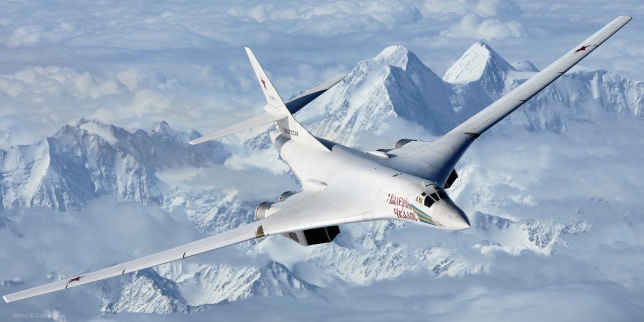
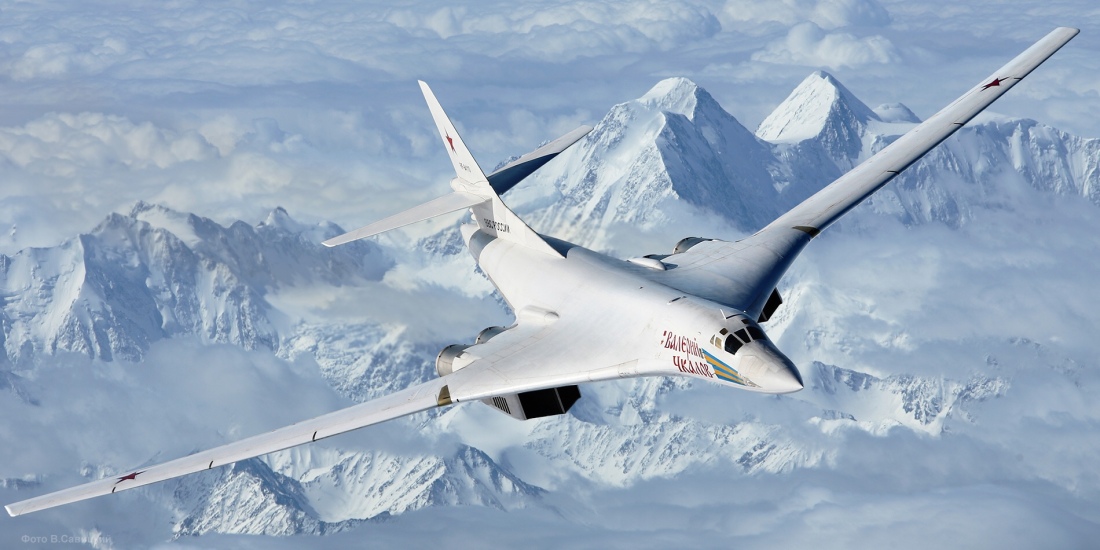
Tupolev Tu-160 has got a new lease of life as Russia is working to modernize its existing fleet of Tu-160s with improved engines and avionics. However, experts have pointed out that the one prominent drawback is that it is not stealthy.
“The production of a modernized Tu-160 strategic bomber will require close cooperation among several different plants and the organization of a whole production chain—something that has been a weak point in Russia,” elaborated the Jamestown Foundation, a research and analysis think tank on the update.
Caleb Larson of The National Interest explained that stealth is hard and expensive to achieve. “Russia’s only stealth aircraft, the Su-57 has had myriad teething problems and is unlikely to enter full serial production any time soon due to many issues — the low cost of oil, upon which the wobbly Russian defense budget depends, and engine issues that may be difficult to rectify any time soon,” he wrote.
tt
Air-to-air with a Tupolev Tu-160.jpg – Wikimedia Commons
Tu-160 is nicknamed “White Swan”(NATO reporting name “Blackjack”) as the white coating on the entire plane is for the protection of its crew. The thermal energy of the nuclear explosion which is reflected by the white color and, in theory, protects the crew.
The Russian origin bomber is capable of carrying the twelve strategic cruise missile Kh-55 MS which has a maximum range is 3,000km, and it is armed with a 200kt nuclear warhead. The plane can also carry Kh-15P, which has a range of up to 200km.
The Kickback can be fied with a conventional 250kg warhead or a nuclear warhead. The aircraft is also capable of carrying a range of aerial bombs with a total weight upto 40t.
Larson compared the Russian bomber with the American Rockwell B-1 Lancer. He stated that the two similarities between both are the variable-sweep wings and that both are supersonic.
“The B-1 Lancer is somewhat smaller and is a bomber in the classic sense. The Tu-160, on the other hand, is used more as a stand-off weapons platform, in which missiles are launched from the bomb bay doors while the “White Swan” would speed off at Mach 2+ to safety,” he stated.
He further added that it is the only Soviet-designed bomber that does not carry any defensive weapons, although its prodigious 88,000 pounds of payload capacity can carry a dizzying array of conventional and/or nuclear weapons.
The aircraft is highly computerized and the avionics systems include an integrated aiming, navigation, and flight control system, with navigation and attack radar, an electronic countermeasures system, and automatic controls.
The Tu-160 uses fly-by-wire controls. The aircraft is equipped with three-strut landing gear, a tailwheel, and a brake parachute. For take-off, the aircraft requires a 3.5km runway of solid concrete. The crew of the Tu-160 comprises a pilot, co-pilot, a navigator, and an operator.
Given the new lease of life, the Russian bomber may not be stealthy but is definitely a lethal weapon in the hands of Russia.

Saturday, August 29, 2020

The speed of the Russian nuclear horn (Daniel 7)

Credit: Shutterstock
Russia’s recently announced Kh-32 upgrades will provide Russia with expanded hypersonic strike capability, with the dual-use missile to be deployed as an anti-ship weapon to complement the hypersonic Kinzhal’s primary use against land-targets. With a range of up to 1000km and a high explosive warhead which can pierce the hull of most warships, and the potential to overcome ship-based air-defense systems.
The revelation that this solution is Kh-32 based indicates Russian hypersonic weapons use will be very specifically targeted in roles and deployments, in addition to pointing to the stop-gap nature of this particular solution, says William Davies, Associate Analyst at GlobalData. This particular Kh-32 upgrade being launched from modified SU-30s means this is a viable hypersonic air-launched munition for other Su-30 operators such as China, India, Vietnam, Malaysia, Algeria, with the platform being significantly more widely proliferated than the MiG-31 that carries the Kinzhal.
In particular, the upgrade will provide frontal aviation units deploying SU-30s with the capability to strike naval vessels including aircraft carriers from outside their defensive umbrellas. The development of the Kh-32 as a widely deployed anti-ship missile would strengthen Russia’s area-denial capabilities, complementing the use of other hypersonic solutions. The Kh-32 is initially being deployed on Su-30s but it could potentially be deployed on other modified platforms and could provide a number of other frontline aircraft with hypersonic strike capabilities, such as the Su-34 and Su-24.
Russia has previously mounted the Kinzhal on the MiG-31K, but despite it having a larger range, it was designed for use on land targets making the upgraded Kh-32 a significant boost to Russia’s offensive hypersonic capabilities. The Kh-32 can be employed with nuclear or non-nuclear warheads, but given its application as an anti-ship missile, its application is likely to be non-nuclear in nature despite the DoD categorizing it as a nuclear weapons delivery system.
GlobalData is this website’s parent business intelligence company.

Wednesday, August 26, 2020

Russia sends a nuclear warning to Babylon the Great

By William J. Broad
Aug. 25, 2020, 12:58 p.m. ET
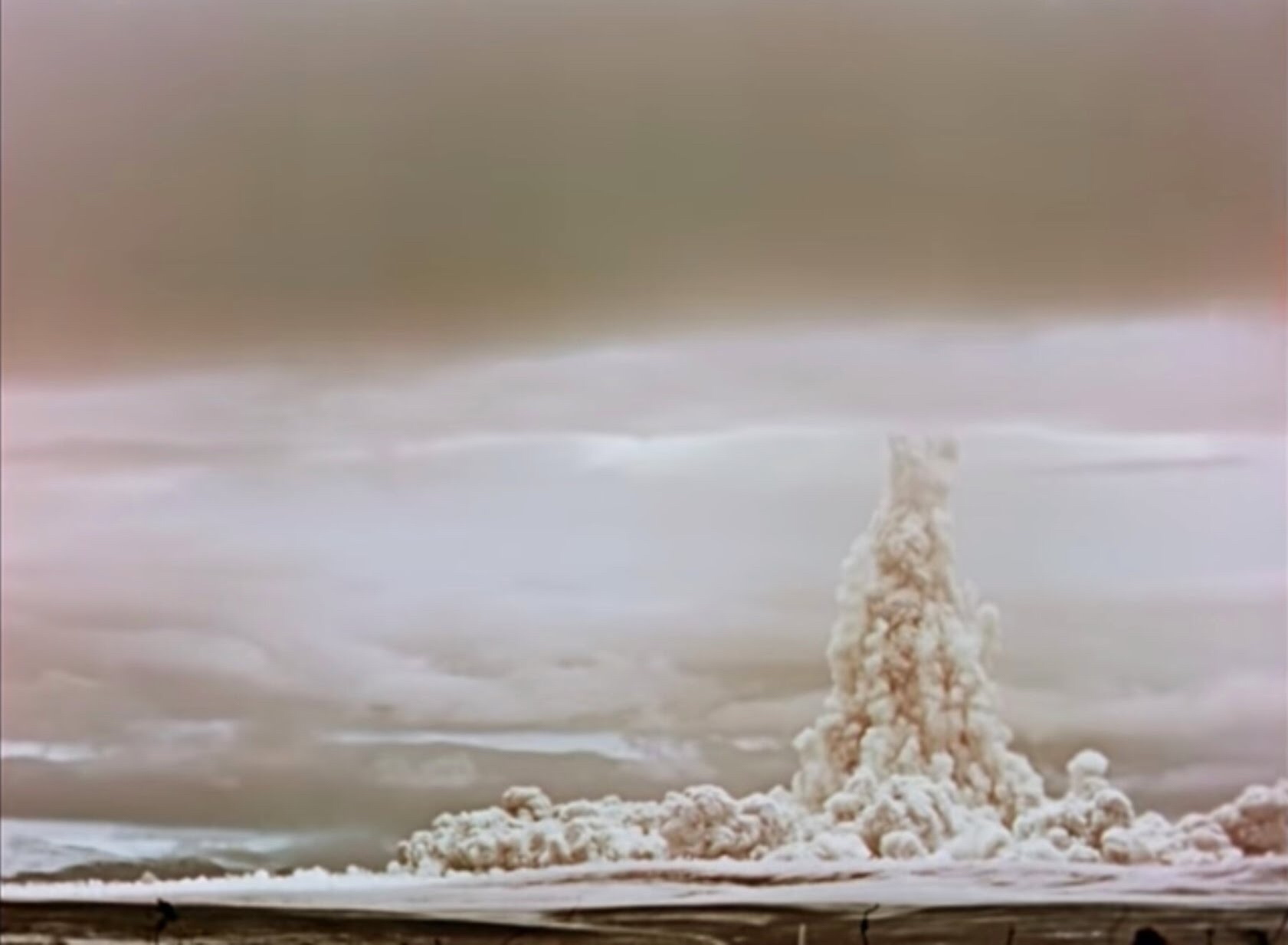
A Russian nuclear energy agency released formerly classified footage of the Soviet Union’s 1961 Tsar Bomba test.A still image from a 30-minute, previously secret documentary on the largest hydrogen bomb ever detonated.Rosatom
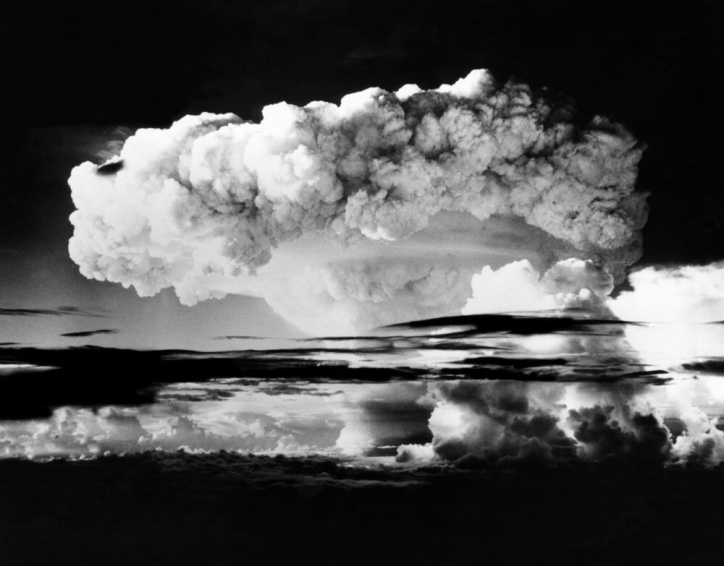
Hydrogen bombs — the world’s deadliest weapons — have no theoretical size limit. The more fuel, the bigger the explosion. When the United States in 1952 detonated the world’s first, its destructive force was 700 times as great as that of the atomic bomb that destroyed Hiroshima.
And in the darkest days of the Cold War, the Soviets and the Americans didn’t only compete to build the most weapons. They each sought at times to build the biggest bomb of all.
“There was a megatonnage race — who was going to have a bigger bomb,” said Robert S. Norris, a historian of the atomic age. “And the Soviets won.”
Last week, the Russian nuclear energy agency, Rosatom, released a 30-minute, formerly secret documentary video about the world’s largest hydrogen bomb detonation. The explosive force of the device — nicknamed Tsar Bomba, or the Tsar’s bomb, and set off on Oct. 30, 1961 — was 50 megatons, or the equivalent of 50 million tons of conventional explosive. That made it 3,333 times as destructive as the weapon used on Hiroshima, Japan, and also far more powerful than the 15 megaton weapon set off by the United States in 1954 in its largest hydrogen bomb blast.
ADVERTISEMENT
From several angles and distances, the video shows the development of the weapon’s gargantuan mushroom cloud, hinting at the bomb’s churning power and apocalyptic force.
Russia has previously released photos and video clips of the device, known officially as RDS-220. The Barents Observer, a publication in Norway, earlier reported on the video’s full release. It features closed captions in English, as well as surges of triumphal music.
“Top secret,” reads the opening caption.
In an interview, Alex Wellerstein, a nuclear historian at the Stevens Institute of Technology in Hoboken, N.J., called the release “a nice addition” to the growing body of public information. He said the bomb’s description in the video documentary was much fuller than the public would normally receive, but nonetheless carefully avoided the secret technical details “despite appearing to show the innards.”
Dr. Norris, the author of “Racing for the Bomb,” cited formerly classified American documents that revealed the largely dismissive reaction of American military officials to the colossal blast.
Roswell L. Gilpatric, the deputy secretary of defense in 1961, said in a speech just days before the giant Soviet test that American nuclear experts had judged the military value of such a blockbuster “so questionable that it was not worth developing.”
A top-secret document written in July 1963, nearly two years after the blast, noted that “the United States presently has the capability of designing” a weapon of such destructive force.
It never appeared.
Over decades, the big challenge for the makers of the nation’s nuclear arsenal (as well as Russia’s) turned out to be devising not big hydrogen bombs but small ones, which were judged as more useful for targeted attacks. Miniaturization let hydrogen bombs be made small enough so that many warheads could fit atop a single missile (putting many cities simultaneously at risk) or that they could be sent into war aboard trucks, submarines and other non-aerial platforms.
The secrets of miniaturization proved so remarkably difficult to master that they eventually became the stuff of spy scandals.
Still, as Dr. Norris put it, history has long credited the Russians for creating and demonstrating the fearsome power of “the big one” and providing a terrifying object lesson in why hydrogen weapons, as a category, are known as unthinkable.
Atomic Past, Present and Future
William J. Broad is a science journalist and senior writer. He joined The Times in 1983, and has shared two Pulitzer Prizes with his colleagues, as well as an Emmy Award and a DuPont Award. @WilliamJBroad