Monday, December 30, 2019

The Trampling Outside the Temple Walls Will Not End (Revelation 11)

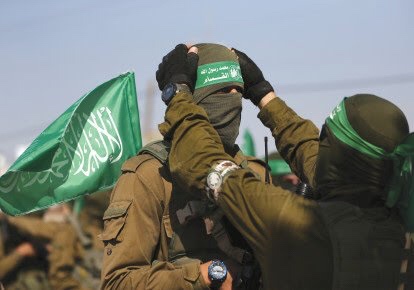
HAMAS MEMBERS in Gaza.. (photo credit:” REUTERS)
Hamas faces backlash over ‘ceasefire deal’ with Israel
By KHALED ABU TOAMEH
Hamas spokesman Abdel Latif Qanou on Sunday denied the report, saying the talk was only about “confirming previous understandings related to ending the blockade imposed on the Gaza Strip.”
The Palestinian Authority and several Palestinian factions have criticized Hamas for its reported readiness to reach a long-term ceasefire with Israel, warning that such a move would “solidify” the split between the West Bank and Gaza Strip.
The criticism came in response to a report that the Israeli Cabinet was scheduled to debate on Sunday and review the details of a proposed long-term ceasefire with Hamas. Channel 12 News reported on Saturday that National Security Adviser Meir Ben-Shabbat will brief the minsters on the details of the proposed deal.
Hamas spokesman Abdel Latif Qanou on Sunday denied the report, saying the talk was only about “confirming previous understandings related to ending the blockade imposed on the Gaza Strip.”
Senior Hamas official Khalil al-Hayya denied that his movement was conducting negotiations with Israel. Hamas was only discussing with Egypt ways of preserving the understandings to end the blockade on the Gaza Strip, he said.
Ibrahim Milhem, spokesman for the PA government, said that any deal between Hamas and Israel would serve Israeli interests and lead to the establishment of a “new separate Palestinian entity” in the Gaza Strip.
PLO Executive Committee member Azzam al-Ahmed said that “the cooperation between Israel and Hamas, together with some countries, “aims to solidify divisions among the Palestinians and geographically and legally separate the Gaza Strip from Palestine.”  The continued split between the West Bank and Gaza Strip, Ahmed warned, was designed to prevent the establishment of an independent Palestinian state on the pre-1967 lines.
Ahmed, in an interview with the PA’s Voice of Palestine radio station, claimed that Prime Minister Benjamin Netanyahu was seeking “to consolidate the de facto Hamas rule over the Gaza Strip, while taking additional dangerous measures to grab more land in the West Bank.”
Ibrahim Khraisheh, the PA’s Permanent Observer Representative to the United Nations, said that Defense Minister Naftali Bennet was moving towards easing restrictions on the Gaza Strip “while stepping up the [Israeli] siege of the West Bank.”
Mahmoud al-Zaq, a senior official with the Gaza-based Palestinian Popular Struggle Front, a party that does not belong to the PLO, said that his group “rejects Hamas’s effort to establish a weak political entity in the Gaza Strip by signing a ceasefire agreement with Israel.” He claimed that by striking a deal with Israel, Hamas was seeking to ensure its continued rule of the Gaza Strip.
Abdullah Kmeil, member of the Fatah “Revolutionary Council,” called on Hamas to stay away from any ideas that would deepen divisions among the Palestinians. “Everyone knows that the US and Israel are working with Hamas to establish a small Palestinian state in the Gaza Strip,” Kmeil said. “Our people will thwart these conspiracies by sticking to their national rights.”
The Palestinian People’s Party (formerly the Palestinian Communist Party) also reacted to the reports concerning a possible ceasefire agreement between Hamas and Israel by warning against “dubious deals” between the two parties.
Walid Awad, a representative of the party, argued that the purported deal between Hamas and Israel was consistent with US President Donald Trump’s yet-to-be-announced plan for Mideast peace, also known as the “Deal of the Century.” That deal, he claimed, envisages the detachment of the Gaza Strip from the West Bank.
PLO Executive Committee member Wasel Abu Yousef condemned the talk about a deal between Israel and Hamas as a “malicious plan aimed at undermining the Palestinian national enterprise.” He too claimed that any deal between the two sides would be “consistent with the American-Israeli scheme to liquidate the Palestinian cause.”
Abu Yousef also accused Hamas of seeking to appease Israel by halting the weekly protests near the Gaza-Israel border and allowing the construction of a US-funded field hospital in the Gaza Strip.
Last week the High Commission for the March of Return and Breaking the Siege [on the Gaza Strip] announced that the weekly protests, which began in March 2018, would be suspended for three months from the beginning of January 2020.
Hamas has been criticized by the PA and other Palestinian faction for allowing a US Evangelical Christian aid group to build a field hospital in the northern Gaza Strip. The new hospital is reportedly being established in the context of ceasefire understandings reached between Israel and Hamas under the auspices of Egypt, Qatar and the UN.

Iran Armed Forces Threatens Babylon the Great

TEHRAN, Dec. 29 (MNA) – Chief of Staff of Armed Forces Major General Mohammad Bagheri warned on Monday that Iranian Armed Forces will give a harsh response to adventures of enemies or their miscalculated measures.
Mehr News Agency
TEHRAN, Dec. 29 (MNA) – Chief of Staff of Armed Forces Major General Mohammad Bagheri warned on Monday that Iranian Armed Forces will give a harsh response to adventures of enemies or their miscalculated measures.
Making the remarks on the occasion of the 10th annual ceremony of Dey 9 Epic (Dec. 30, 2009), he added that Iran’s Armed Forces, under the Leadership of Ayatollah Seyed Ali Khamenei and in cooperation with intelligence services, will not let enemies including the US, Israel regime and their regional allies look for adventures.
In early December, in a reaction to the recent remarks of the FM of the Israeli regime, the spokesperson of the Iranian Foreign Ministry announced that the Islamic Republic will give harsh answer to any aggression or foolish measure by the enemies.
IRGC Chief Major General Hossein Salami has also warned that enemies will receive a harsh response if they adopt any mischievous act against the Islamic Republic of Iran.
Dey 9 Epic, marks massive rallies that were held on the 9th day of Iranian month of Dey (equivalent to Dec. 30, 2009) in support of the Iranian Establishment to put an end to months of foreign-sponsored unrest in 2009.
MNA/4810263

The TRIBULATION (Revelation 8 )

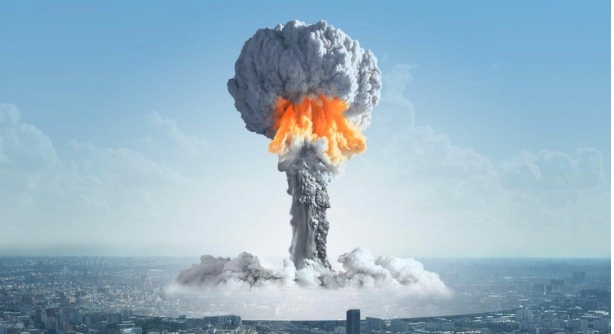
It is no exaggeration to say that for those who grew up during the Cold War, all-out nuclear war was “the ultimate nightmare.” The prospect of an ordinary day interrupted by air-raid sirens, klaxons and the searing heat of a thermonuclear explosion was a very real, albeit remote, possibility. Television shows such as The Day After and Threads realistically portrayed both a nuclear attack and the gradual disintegration of society in the aftermath. In an all-out nuclear attack, most of the industrialized world would have been bombed back to the Stone Age, with hundreds of millions killed outright and perhaps as many as a billion or more dying of radiation, disease and famine in the postwar period.
During much of the Cold War, the United States’ nuclear warfighting plan was known as the SIOP, or the Single Integrated Operating Plan. The first SIOP, introduced in 1962, was known as SIOP-62, and its effects on the Soviet Union, Warsaw Pact and China were documented in a briefing paper created for the Joint Chiefs of Staff and brought to light in 2011 by the National Security Archive. The paper presupposed a new Berlin crisis, similar to the one that took place in 1961, but escalating to full-scale war in western Europe.
Although the war scenario was fictional, the post-attack estimates were very real. According to the paper, the outlook for Communist bloc countries subjected to the full weight of American atomic firepower was grim. The paper divided attack scenarios into two categories: one in which the U.S. nuclear Alert Force, a percentage of overall nuclear forces kept on constant alert, struck the Soviet Union and its allies; and a second scenario where the full weight of the nuclear force, known as the Full Force, was used.
Under SIOP, “about 1,000” installations that were related to “nuclear delivery capability” would be struck. The scenario, which assumed advance warning of a Soviet attack and an American preemptive strike, would see the Alert Force attacking 75 percent of these targets. The attack would be a largely “counterforce” strike, in which U.S. nuclear forces attacked Soviet, Warsaw Pact and Chinese command-and-control and nuclear forces. The report states that 83 to 88 percent of all targets would be destroyed with 70 percent assurance.
In an Alert Force attack, 199 Soviet cities with populations of fifty thousand or greater would be struck. This would turn 56 percent of the urban population and 37 percent of the total population into casualties, most of whom would eventually die due to a post-attack breakdown of society. In China, forty-nine cities would be struck, turning 41 percent of the urban population into casualties and 10 percent of the overall population. In eastern Europe, only purely military targets would be struck, with a projected 1,378,000 killed by American nuclear attacks.
An all-out Full Force attack would be much worse. A Full Force attack would devastate 295 cities, leaving only five cities with populations of fifty thousand or more unscathed. 72 percent of the urban population and 54 percent of the overall population would become casualties—as the National Security Archive points out, that amounts to 108 million likely killed out of a total population of 217 million. In China, seventy-eight cities would be struck, affecting 53 percent of the urban population and 16 percent of the overall population. Casualties in eastern Europe would more than double, to 4,004,000.
Overall, an all-out U.S. attack on the Soviet Union, China and satellite countries in 1962 would have killed 335 million people within the first seventy-two hours.
The SIOP-62 report does not attempt to estimate U.S. casualties in a nuclear war. However, a 1978 report prepared for the Pentagon’s Office of Technology Assessment (OTA), “The Effects of Nuclear War,” spelled out in grim detail what would happen if the Soviet Union unleashed its arsenal on the United States.
The OTA report states that, in the event of a Soviet attack against U.S. nuclear forces, other military targets, economic targets and population targets, an attack could be estimated to kill between sixty and eighty-eight million Americans. With enough warning, major cities and industrial areas could be evacuated, but that would only lower the number of dead to between fifty-one and forty-seven million. Attacks on U.S. allies, including the NATO nations, Japan and South Korea, would undoubtedly occur but are not modelled in the study.
Another report, “Casualties Due to the Blast, Heat, and Radioactive Fallout from Various Hypothetical Nuclear Attacks on the United States,” postulated a Soviet attack against “1,215 U.S. strategic-nuclear targets. The attack involves almost 3,000 warheads with a total yield of about 1,340 megatons.” Because the attacks are carried out against hardened facilities, particularly MX and Minuteman III intercontinental ballistic-missile silos, the attacks are envisioned using SS-18 “Satan” ICBMs, each carrying ten 550-to-750-kiloton warheads. Attacks against U.S. bomber and refueling forces are carried out by ICBMs and submarine-launched ballistic missiles fired from off the coastline.
The result of even this modest attack, which largely spares U.S. cities to attack nuclear forces in the Midwest, is thirteen to thirty-four million deaths and twenty-five to sixty-four million total casualties. Still, bombarded by 1,215 nukes, the United States would lose far fewer people than Strategic Air Command estimated the Soviet Union would lose in 1962.
The discrepancy is probably because of the larger yields of U.S. nuclear weapons in the 1960s versus Soviet nukes in the 1980s, but also because at the time of the SAC report, Soviet nuclear forces were primarily bomber-based. The Soviet Union had between 300 and 320 nuclear weapons in 1962, all but forty of which were bomber-based. Bomber bases may have been closer to major population areas. A major draw of U.S. nuclear weapons to Soviet cities would have also been the presence of local airports, which would have functioned as dispersal airfields for nuclear-armed bombers. On the other hand, the Soviet attack would largely hit ICBM fields and bomber bases in low-population-density regions of the Midwest, plus a handful of submarine bases on both coasts.
As devastating as these projections are, all readily admit they don’t tell the entire story. While these three studies model the immediate effects of a nuclear attack, long-term problems might kill more people than the attack itself. The destruction of cities would deny the millions of injured, even those who might otherwise easily survive, even basic health care. What remains of government—in any country—would be hard pressed to maintain order in the face of dwindling food and energy supplies, a contaminated landscape, the spread of disease and masses of refugees. Over a twelve-month period, depending on the severity of the attack, total deaths attributable to the attacks could double.
While the threat of nuclear war between the United States and Soviet Union has ended, the United States now faces the prospect of a similar war with Russia or China. The effects of a nuclear war in the twenty-first century would be no less severe. The steps to avoiding nuclear war, however, are the same as they were during the Cold War: arms control, confidence-building measures undertaken by both sides and a de-escalation of tensions.
Kyle Mizokami is a defense and national-security writer based in San Francisco who has appeared in the Diplomat, Foreign Policy, War is Boring and the Daily Beast. In 2009 he cofounded the defense and security blog Japan Security Watch. You can follow him on Twitter: @KyleMizokami. (This first appeared several years ago.)
Image: Creative Commons.

Sunday, December 29, 2019

Sixth Seal: New York City (Revelation 6:12)

New York City Is Overdue For Large Earthquake: Seismologist


http://www.gothamgazette.com/graphics/2008/09/skyesfig3_cropped.gif
Won-Young Kim, who runs the seismographic network for the Northeast at Columbia University’s Lamont-Doherty Earth Observatory, said the city is well overdue for a big earthquake.
The last big quake to hit New York City was a 5.3-magnitude tremor in 1884 that happened at sea in between Brooklyn and Sandy Hook. While no one was killed, buildings were damaged.
Kim said the city is likely to experience a big earthquake every 100 years or so.
“It can happen anytime soon,” Kim said. “We can expect it any minute, we just don’t know when and where.”
New York has never experienced a magnitude 6 or 7 earthquake, which are the most dangerous. But magnitude 5 quakes could topple brick buildings and chimneys.
Seismologist John Armbruster said a magnitude 5 quake that happened now would be more devastating than the one that happened in 1884.

Israeli Troops Attack Palestinians Outside the Temple Walls (Revelation 11)

admin
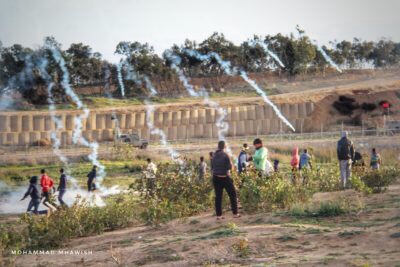
Israeli forces attacked Palestinians taking part in the weekly ‘March of Return’ protests near the fence separating the Gaza Strip from Israel, leaving a number of protesters injured. This will be the last official protest until March, according to organizers in Gaza, who are temporarily suspending the weekly protests.
Palestinian media outlets reported that Israeli forces shot and injured protesters east of Jabalia and east of Khan Younis on Friday.
Dozens of Palestinians also suffered from tear gas inhalation due to inhaling tear gas used by the Israeli troops in the eastern part of Gaza.
The “Great March of Return” rallies have been held every week since March 30 last year. The Palestinians want the return of those driven out of their homeland by Israeli aggression.
In March, a United Nations fact-finding mission found that Israeli forces committed rights violations during their crackdown against the Palestinian protesters in Gaza that may amount to war crimes.
The protest organizers announced on Thursday that the rallies would be suspended until March 2020, after which it would be held on a monthly basis.
Yousri Darwish, a member of the Supreme National Committee of the March of Return, said the decision to suspend the rallies was made in the best interest of the Palestinian people.
He said preparations for the commemoration of the Land Day would be done in the upcoming few months in which the protests would stop. The annual event is held on March 30 to mark the killing of six Palestinians by Israeli forces during mass protests against Israel’s seizure of their land in 1976.
Gaza has been under Israeli siege since June 2007, which has caused a severe decline in living standards.
Israel has also launched three major wars against the enclave since 2008, killing thousands of Gazans each time and shattering the impoverished territory’s already poor infrastructure.

World War III Will Start With Iran


As the United States enters an election year, prospects for global stability remain uncertain.  President Trump’s foreign policy stood at odds with those of his predecessor, and will likely a central point of contestation in the election.  At this point, several crises might emerge that would not only turn the election, but potentially bring about a wider global conflict.
Here are the five most likely flashpoints for world war in 2020 (See my World War III lists from back in 2017,  2018 and 2019).
None are particularly likely, but only one needs to catch fire. Let the wars begin!
Iran-Israel:
Iran and Israel are already waging low-intensity war across the Middle East. Iran supports anti-Israel proxies in Gaza, Lebanon, Syria, and elsewhere, while Israel feels comfortable in striking Iranian forces across the region. Israel has taken steps to quietly build a broad anti-Iran coalition at the diplomatic level, while Iran has invested deeply in cultivating ties with militias and other non-state actors.
It is hardly difficult to imagine scenarios that might bring on a wider, more intense war. If Iran determines to re-embark on its nuclear program, or decides to discipline Saudi Arabia more thoroughly, Israel might feel the temptation to engage in broader strikes, or in strikes directly against the Iranian homeland. Such a conflict could easily have wider implications, threatening global oil supplies and potentially tempting the United States or Russia to intervene.
Turkey:
Strains between Turkey and the United States have only grown over the past year. Tensions increased dramatically when the United States unexpectedly gave Turkey a green light to clear Syrian border areas of U.S.-supported Kurds, then immediately issued an about-face and threatened Ankara with sanctions. All the while, an arsenal of US nuclear weapons, by all accounts, remains at Incirlik Air Force base. Certain statements by President Erdogan suggested that he has immense aspirations for Turkey, aspirations which might include nuclear ambitions.
The state of the relationship between the U.S. and Turkey has decayed to the extent that some fear for the future of the NATO alliance. No one expects Erdogan to really go through with an attempted seizure of the weapons, and even if he did it’s unlikely Turkey could break the safeguards on the warheads in any kind of reasonable time. But Erdogan is not known to compartmentalize issues well, and it’s possible that linkages with other problems could push Washington and Ankara to the very edge. And of course, Russia hovers on the edge of the problem,
Kashmir:
Over the past decade, the gap in conventional power between India and Pakistan has only grown, even as Pakistan has tried to heal that gap with nuclear weapons. Despite (or perhaps because) of this, tensions between the rivals remained at a low simmer until steps taken by Prime Minister Narendra Modi to reduce the autonomy of Kashmir and to change citizenship policies within the rest of India. These steps have caused some unrest within India, and have highlighted the long-standing tensions between Delhi and Islamabad.
Further domestic disturbances within India could give Pakistan (or extremist groups within Pakistan) the idea that it has the opportunity, or perhaps even the responsibility, to intervene in some fashion. While this is unlikely to begin with conventional military action, it could consist of terrorist attacks internationally, in Kashmir, or internationally. If this happened, Modi might feel forced to respond in some fashion, leading to a ladder of escalation that could bring the two countries to the brink of a more serious conflict. Given China’s looming position and the growing relationship between Delhi and Washington, this kind of conflict could have remarkably disastrous international ripple effects.
Korean Peninsula:
A year ago, hope remained that negotiations between the United States and North Korea could succeed in permanently reducing tensions of the peninsula. Unfortunately, core problems in the domestic situations of both countries, along with a puzzling strategic conundrum, have prevented any agreement from taking hold. Tensions between the two countries now stand as high as at any time since 2017, and the impending U.S. election could imperil relations further.
The Trump administration continues to seem to hold out hope that a deal with North Korea could improve its electoral prospects in November. But North Korea has no interest in the terms Trump is offering, and has become increasingly emphatic about making its disinterest clear.  Recently, North Korea promised a “Christmas present” that many in the United States worried would be a nuclear or ballistic missile test. It turned out to be nothing of the sort, but if North Korea decides to undertake an ICBM or (worse) nuclear test, the Trump administration might feel the need to intervene forcefully. In particular, President Trump has a reputation for pursuing a deeply personalistic foreign policy style, and might feel betrayed by Supreme Leader Kim, producing an even more uncertain situation.
South China Sea:
U.S.-China relations stand at a precarious point. A trade deal between the two countries would seem to alleviate some tensions, but implementation remains in question. Economic difficulties in China have curtailed some of its naval construction program, just as a flattening of the defense budget in the United States has moderated shipbuilding ambitions. At the same time, China has worked assiduously to assure its relations with Russia, while the United States has sparked controversies with both South Korea and Japan, its two closest allies in the region.
Under such circumstances, it seems unlikely that either country would risk conflict. But President Trump has staked much of his Presidency on confrontation with China, and may feel tempted to escalate the situation in the coming year. For his part, President Xi faces the continuous prospect of turmoil at home, both in the Han heartland and in Xinjiang. Both sides, thus, have incentives for diplomatic and economic escalation, which always could lead to military confrontation in areas such as the South or East China Seas.
What Does the Future Hold for 2020?
The prospect of global conflagration in 2020 is low. Everyone awaits the result of the U.S. election, and a better understanding of the direction of US policy for the next four years. Still, every crisis proceeds by its own logic, and any of Pakistan, India, China, Israel, Iran, Turkey, or Russia might feel compelled by events to act. Focus on the election should not obscure the frictions between nations that could provide the spark for the next war.
Dr. Robert Farley, a frequent contributor to TNI, teaches at the Patterson School of Diplomacy and International Commerce at the University of Kentucky. He is the author of the Battleship Book and can be found at @drfarls.
Image: Reuters.

The New Cold War In Space

PUBLISHED THU, DEC 5 2019 2:06 AM EST
UPDATED THU, DEC 5 2019 2:43 AM EST
Holly Ellyatt
KEY POINTS
• Russian President Vladimir Putin said that he was “seriously concerned” about NATO’s “attempts to militarize outer space” when he met with members of the Kremlin’s Security Council last month.
NATO, the U.S. and Russia have a new domain to compete and conflict over: space.
Russian President Vladimir Putin warned Wednesday that the U.S. saw space as as “theater of military operations” and that the development of the U.S. Space Force posed a threat to Russia.
“The U.S. military-political leadership openly considers space as a military theater and plans to conduct operations there,” Putin said at a meeting with defense officials in Sochi, according to Russian news agency TASS.
“For preserving strategic supremacy in this field the United States is accelerating creation of its space forces, which are already in the process of operative preparations,” Putin said, adding that the world’s leading countries are fast-tracking the development of modern military space systems and dual purpose satellites and that Russia needed to do the same.
“The situation requires us to pay increased attention to strengthening the orbital group, as well as the rocket and space industry as a whole.”
Russia opposed the militarization of space, Putin insisted, but said “at the same time the march of events requires greater attention to strengthening the orbital group and the space rocket and missile industry in general.”
NATO too
Putin’s comments Wednesday reiterated those he made in late November to his security council, in which he said he was “seriously concerned” about NATO’s “attempts to militarize outer space.”
That comment came after NATO had declared space a fifth “operational domain” for the military alliance, alongside air, land, sea and cyber.
“Space is part of our daily life here on Earth. It can be used for peaceful purposes. But it can also be used aggressively,” NATO Secretary General Jens Stoltenberg said at a meeting of foreign ministers on November 20.
“Satellites can be jammed, hacked or weaponized. Anti-satellite weapons could cripple communications and other services our societies rely on, such as air travel, weather forecast or banking,” he said. “Space is also essential to the alliance’s deterrence and defense,” Stoltenberg added, referencing the organization’s ability to navigate, to gather intelligence, and to detect missile launches.
“Making space an operational domain will help us ensure all aspects are taken into account to ensure the success of our missions,” he said. “For instance, this can allow NATO planners to make a request for allies to provide capabilities and services, such as satellite communications and data imagery.”
He said that around 2,000 satellites currently orbit the Earth with around half of them owned by NATO countries.
Stoltenberg insisted that “NATO has no intention to put weapons in space. We are a defensive alliance.” He added the alliance’s approach to space will remain fully in line with international law. The 1967 Outer Space Treaty is a global agreement considered a foundation stone of international space law.
The treaty was first signed by the U.K., U.S. and then-Soviet Union at the height of the Cold War to promote the peaceful exploration of space. It banned the placing of nuclear weapons in space and limited the use of the Moon and all other celestial bodies to peaceful purposes only. It also established that space shall be free for exploration and use by all nations, but that no nation may claim sovereignty on any part of it.
Star Wars
There are other space treaties covering, for example, the rescue of astronauts, the moon, the International Space Station (ISS) and liability for damage caused by space objects. Still, the use of space for defensive activities is likely to be litigious and provocative territory.
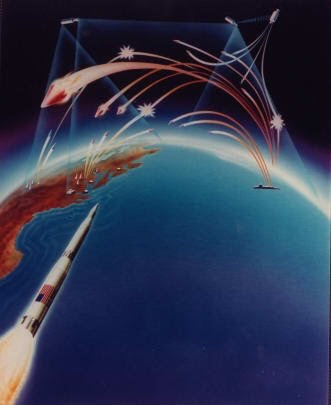
It’s not the first time that space has been seen as a potential realm for defense though, especially during the Cold War. The “Strategic Defense Initiative” was a program first initiated in 1983 under President Ronald Reagan. The aim of the program was to develop an anti-ballistic missile system that was designed to shoot down nuclear missiles in space, with potential missile attacks from the Soviet Union specifically in mind.
Artist’s concept of interceptor under development for the U.S. Army’s HEDI (High Endoatmospheric Def. Interceptor), a key element of its 1983 Strategic Defense. Initiative (aka Star Wars) Time Life Pictures | The LIFE Picture Collection | Getty Images
It was dubbed “Star Wars” because it envisaged that technologies like space-based x-ray lasers could be used as part of the defensive system. Funding shortages as well as the collapse of the Soviet Union in 1991 meant that the SDI was never built.
“Space is a war-fighting domain, just like the land, air, and sea,” Trump said. “We have the Air Force, we’ll have the Space Force.” In June 2018, he ordered the Pentagon to begin the creation of the new branch.
At the start of 2019, the U.S. unveiled an overhaul of its missile defense program in its “Missile Defense Review” in which it stated the need for a “comprehensive approach to missile defense against rogue state and regional missile threats.” The review also recognized “space is a new war-fighting domain, with the Space Force leading the way” and said it would ensure “American dominance in space.”
In a speech presenting more detail on the Missile Defense Review, Trump said the U.S. would “invest in a space-based missile defense layer. It’s new technology. It’s ultimately going to be a very, very big part of our defense and, obviously, of our offense,” he said.
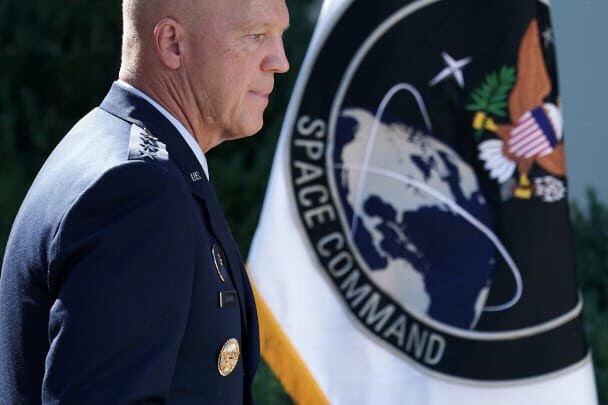
U.S. Air Force Space Command Gen. John “Jay” Raymond stands next to the flag of the newly established U.S. Space Command, the sixth national armed service, in the Rose Garden at the White House August 29, 2019 in Washington, DC. Citing potential threats from China and Russia and the nation’s reliance on satellites for defense operations, Trump said the U.S. needs to launch a ‘space force.’
Chip Somodevilla | Getty Images News | Getty Images
“The system will be monitored, and we will terminate any missile launches from hostile powers, or even from powers that make a mistake. It won’t happen. Regardless of the missile type or the geographic origins of the attack, we will ensure that enemy missiles find no sanctuary on Earth or in the skies above.”
Arms race in space?
Russia responded angrily to the comments, saying it was tantamount to the U.S. relaunching the Cold War-era “Star Wars” program. According to a statement from Russia’s foreign ministry, reported by Reuters, Russia condemned the strategy as an act of confrontation and it urged Washington to reconsider its plans.
“The strategy, de facto, gives the green light to the prospect of basing missile strike capabilities in space,” the statement said. “The implementation of these ideas will inevitably lead to the start of an arms race in space, which will have the most negative consequences for international security and stability,” it said.
“We would like to call on the U.S. administration to think again and walk away from this irresponsible attempt to re-launch, on a new and more high-tech basis, the still-remembered Reagan-era ‘Star Wars’ program,” it said, Reuters reported.
Experts say Russia is wary of the U.S., and NATO, opening up a new operational frontier in space as Russia would be easily out-competed by the combined NATO countries’ technological expertise, advances and weaponry in space. 
“I think when the Russians hear this, they primarily think of the ‘Strategic Defense Initiative’, they think of missile defense, and those are the kinds of things they can’t compete in those areas as well and something they would be very keen to avoid (competing over). The question is, what is NATO actually going to do here?,” Daragh McDowell, principal Russia analyst at Verisk Maplecroft, told CNBC Wednesday.
Russia was quick to criticize NATO’s announcement of space as a new operational domain with Putin telling his security council that “we are also seriously concerned about the NATO infrastructure approaching our borders, as well as the attempts to militarize outer space.”
Earlier this year, Putin had said Russia needs to heavily upgrade its space industry, telling his security council in April that “it is obvious that it is necessary to fundamentally modernize the rocket and space industry,” according to news agency TASS. He also said that leading positions in space exploration were essential for solving national development tasks, ensuring the country’s security and technological and economic competitiveness, TASS reported.
Christopher Granville, managing director of EMEA and Global Political Research at TS Lombard, told CNBC Wednesday that Russia had spent considerable time and effort, in the last few decades, developing technologies to defend against “any conceivable U.S. strategic defense or anti-missile defense capabilities.”
“And if the U.S. were hypothetically to develop new capabilities in outer space, then Russia would have to come up with new responses in addition to the weapon system that Putin announced with some fanfare last year,” he said, referencing Putin’s revealing of new nuclear weapons in March 2018 that he said were “invincible.”