Showing posts with label nevada. Show all posts

Thursday, June 25, 2020

Donald Trump will resume nuclear testing

Jun 24th 2020
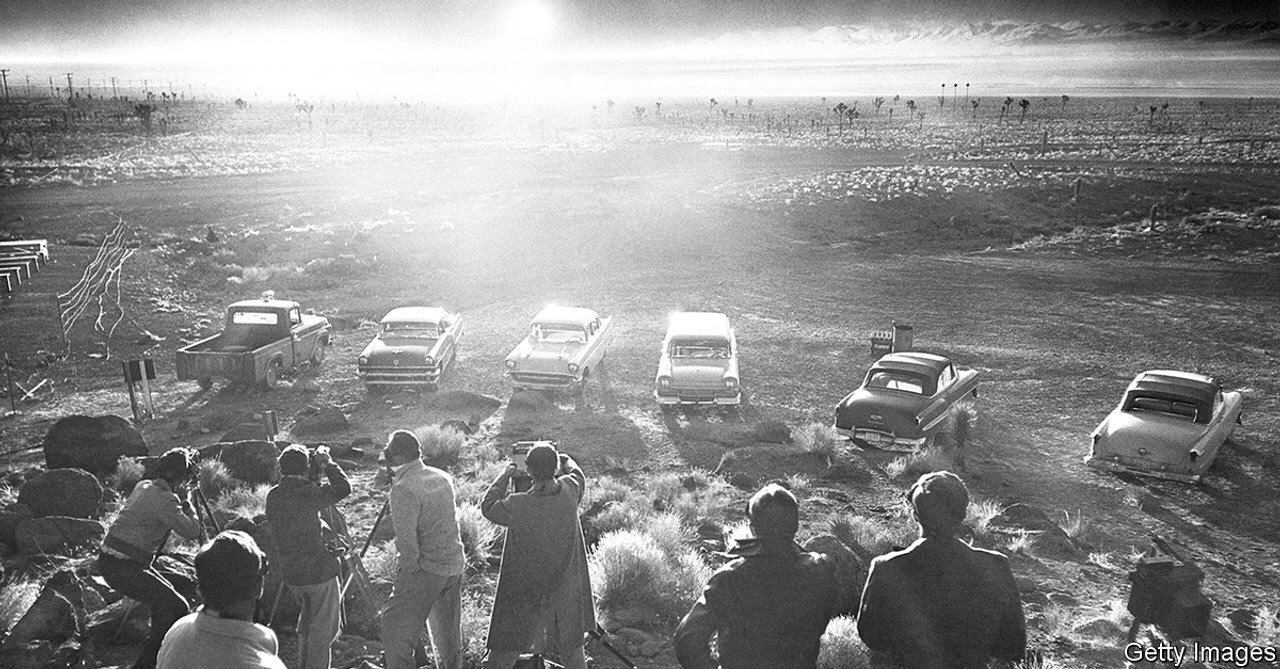
Over four decades, America’s government conducted 928 nuclear tests in Nevada. The mushroom clouds could be seen from Las Vegas, where the chamber of commerce cannily issued tourist calendars with dates, times and plum viewing spots. On September 23rd 1992, the ground shook for the last time. President George H.W. Bush, following the Soviet Union’s example the previous year, joined a moratorium on nuclear-weapons testing that has been extended by every president since. Yet some fear that America’s 28-year nuclear lull may be drawing to a close.
On June 23rd the State Department told Congress that it suspected that Russia had conducted “nuclear weapons-related experiments that have created nuclear yield”, in violation of the Comprehensive Test Ban Treaty (CTBT). It also said that excavation and other activity at China’s Lop Nur test site “raise concerns regarding China’s adherence to its testing moratorium”. All three countries signed the CTBT in 1996, but only Russia has ratified it. The treaty would not enter into force until 44 designated countries ratify it; of those, India, Pakistan and North Korea have not even signed up.
Most experts say the accusations are thin gruel. America itself does in Nevada much of what it says China is doing at Lop Nur. Moreover, all three countries conduct “subcritical” tests, in which there is no critical mass of plutonium, no chain reaction and therefore no yield. Under the CTBT, these are kosher. Some, however, can be outwardly indistinguishable from illicit tests with tiny yields. In 1997 a Russian “test” turned out to be an earthquake.
But the charges are ominous. In May, according to the Washington Post, American officials considered conducting a “rapid test” to demonstrate the country’s nuclear prowess, with the intention of forcing Russia and China into trilateral nuclear talks, something that China has thus far resisted.
Detonating a nuke is relatively straightforward. American law requires the government to be able to conduct a nuclear test within two to three years of a presidential order. The problem is that it can be done properly, or quickly, but not both. A “fully instrumented” test, designed to capture useful data, would take at least 18 months, according to the National Nuclear Security Administration (NNSA). But a crude detonation designed as a theatrical act of chest-beating, rather than a meaningful scientific endeavour, could be slapped together in months, well before Mr Trump’s first term concludes in January.
There are also economic and environmental issues. A test would cost somewhere between tens and hundreds of millions of dollars, according to insiders. And although the Nevada site is kept in working order, the population of Las Vegas and its environs has more than tripled since 1992, coming uncomfortably close. “When they used to do underground tests, it would at times rock buildings in Las Vegas,” says Cheryl Rofer, who worked at Los Alamos as a scientist from 1965 to 2001 (though modern tests would have far smaller yields). An editorial in the Las Vegas Sun, one of the city’s newspapers, offered a pithy response to the idea of churning up the ground again: “No. Hell no. Not now. Not ever.” The sentiment is widespread. Polls conducted last year show that 72% of Americans (and 59% of Republicans) disapprove of testing.
Unsurprisingly, the Department of Energy, which oversees nuclear weapons, and its laboratories, like Los Alamos in New Mexico, are not keen on the idea. Nor are the Pentagon or the armed forces. On June 16th a dozen distinguished scientists, many formerly associated with America’s nuclear laboratories, wrote an open letter to Mitch McConnell, the Senate majority leader, arguing that explosive testing “would serve no technical or military purpose”. That is because there are now sophisticated ways to inspect and improve nuclear weapons without setting them off.
America spends eye-watering sums to tend its arsenal; the NNSA requested nearly $16bn for the coming fiscal year. That buys some impressive kit. Modern supercomputers can simulate thermonuclear explosions with remarkable fidelity. In 1993, shortly after the last test, the world’s most powerful supercomputer, at Los Alamos, could manage less than 60 gigaflops, a measure of computing speed. Today’s equivalent, at the Oak Ridge National Laboratory in Tennessee, can exceed 148 petaflops, which is more than 2m times faster. American government laboratories own six of the world’s 20 fastest supercomputers, though China has been catching up. The debate over testing is in part a “conflict of generations”, says one senior scientist: many who cut their teeth on explosive tests distrust the new, virtual ways.
America also has an enviable pile of data from its old tests, having done more than every other country put together (see chart). It conducted 22 tests for every Chinese one. Its rivals would therefore have the most to gain from any resumption of testing. American data may be superior, too. Steven Pifer, a former American diplomat now at Stanford University, recalls visiting a Soviet test site in Kazakhstan in 1988 where the vertical test shafts were less than half the width of America’s, leaving far less space for instruments. India’s lone test of a hydrogen bomb is widely thought to have been a fizzle. Pakistan is eager to refine smaller nukes that could be aimed at Indian tank columns. The rush to testing might spell doom for the Nuclear Non-Proliferation Treaty (NPT), whose non-nuclear members are fed up with the lack of tangible progress towards disarmament.
Many experts reckon that even the truculent Mr Trump would shy away from a test. The aim at present, they suggest, is pactocide. Mr Trump’s administration is stacked with arms-control sceptics who never wanted America to sign the CTBT in the first place, viewing it as an irksome fetter on American power.
Having swept aside a series of other agreements—a nuclear deal with Iran in 2018, the Intermediate-range Nuclear Forces (INF) treaty with Russia last year and the Open Skies treaty in May—the treaty-phobes spy an opportunity to slough off the CTBT, too. In his recent book, “The Room Where It Happened”, John Bolton, America’s national security adviser until September, writes that “unsigning” it “should be a priority”. Mr Bolton is persona non grata in the White House these days, but his diplomatic nihilism lives on.

Sunday, February 21, 2016

Scarlet Woman Wins Nevada (Revelation 17:4)


Democratic presidential candidate Hillary Clinton speaks to supporters Saturday in Las Vegas after winning the Nevada Democratic caucuses.
Democratic presidential candidate Hillary Clinton speaks to supporters Saturday in Las Vegas after winning the Nevada Democratic caucuses. Photo: John Locher/Associated Press
LAS VEGAS, Nev.— Hillary Clinton beat back a stiff challenge from rival Bernie Sanders on Saturday, winning a close race in Nevada’s Democratic presidential caucuses.
“I am so so thrilled and so grateful to all of my supporters out there,” she said at a victory rally. “Some may have doubted us but we never doubted each other.”
With 81% of precincts reporting, Mrs. Clinton had a 52.1% lead compared with 47.8% for the Vermont senator.
The victory was a major relief for the Clinton campaign and allows the former secretary of state to move on to contests in South Carolina next Saturday and the states that follow with fresh momentum after being walloped in New Hampshire and winning by only the slimmest of margins in Iowa.
Mrs. Clinton had long been considered the favorite in Nevada. But Mr. Sanders’ 22-point victory margin in New Hampshire gave him significant momentum. An infusion of donations also allowed him to put staff on the ground and television ads on the air.
Naomi Barnes, left, shows her support for former Secretary of State Hillary Clinton during the Nevada Democratic presidential caucus in Las Vegas. Mrs. Clinton was declared the caucus winner, pulling ahead of Vermont Sen. Bernie Sanders in a tight race.
Naomi Barnes, left, shows her support for former Secretary of State Hillary Clinton during the Nevada Democratic presidential caucus in Las Vegas. Mrs. Clinton was declared the caucus winner, pulling ahead of Vermont Sen. Bernie Sanders in a tight race. Photo: Josh Edelson/Agence France-Presse/Getty Images
Mr. Sanders said in a statement that he had called to congratulate Mrs. Clinton. “I am very proud of the campaign we ran. Five weeks ago we were 25 points behind and we ended up in a very close election. And we probably will leave Nevada with a solid share of the delegates,” Sanders said in a statement.
“I am also proud of the fact that we have brought many working people and young people into the political process and believe that we have the wind at our back as we head toward Super Tuesday. I want to thank the people of Nevada for their support that they have given us and the boost that their support will give us as we go forward,” Sanders said.
In the hours before the caucuses started, Mrs. Clinton visited the Harrah’s employee cafeteria in Las Vegas late Saturday morning about 20 minutes after Mr. Sanders passed through the same room. “Hillary! Hillary! Hillary!” the room cheered as she entered.
Her husband, former President Bill Clinton, was nearby at the Caesars Palace hotel on the Las Vegas strip. “We’re doing everything we can,” he said. “We got a good response.”
Las Vegas hotel workers, many in uniform, swarmed a Democratic caucus site in a Caesars Palace ballroom, one of six at-large caucus locations in the city aimed at making it easier for shift workers to take part in the contest.
Waiting to get into the ballroom, Michael Jaumotte, a food service worker at Caesars, said he was backing Mr. Sanders. “I like that he’s not taking donations from big corporations,” he said. A group of housekeepers from the Bellagio Hotel arrived together wearing their brown uniforms and “Hillary” stickers.
Walking into his polling precinct at a middle school in Henderson, Nev., Senate Democratic leader Harry Reid said he would vote uncommitted, to stay neutral in the race. “Everyone knows the caucus setup here in Nevada are my doing,” said Mr. Reid, who was instrumental in moving the Nevada caucuses to the forefront of the nominating process.
“I want to make sure that Clinton and Sanders know that I’ve been fair. If I got involved on one side or another, it would be easy for them to say, you know he’s trying to affect the caucuses unfairly,” he said, adding that he would offer an endorsement after the caucuses are over.
Both Mrs. Clinton and Mr. Sanders made a point of spending at least part of their time in the days before the caucuses in the mountains and deserts of Nevada, away from the glam and glitter of Las Vegas.
Mr. Sanders spent Friday stumping in Elko and Reno before returning to Las Vegas for a large rally. Mrs. Clinton made stops in both Reno and Elko earlier in the week.
As Democrats in Nevada and Republicans in South Carolina head to the polls, WSJ’s Jerry Seib previews what the day’s results could mean for front-runners Hillary Clinton and Donald Trump. Photo: AP
State caucus rules give rural counties outsize weight in the delegate-allocation process, a directive aimed at ensuring candidates don’t just campaign in the cities.
Consequently, the road to victory in Saturday’s Democratic caucuses runs through places like Elko, a small mining community that is the closest thing to a major city in northeast Nevada, and Pahrump, a desert town of about 36,000 that boasts a handful of casinos, a couple of brothels—and Clinton and Sanders campaign field offices.
And both campaigns worked these sparsely populated communities, phoning supporters daily and driving to remote houses on dirt roads that aren’t on the maps to knock on doors and see if the people who answer might need a lift to caucus sites.
Mr. Sanders brought his pitch to Elko on Friday, a picturesque mountain town of 20,000 people that lies more than 300 miles north of Las Vegas in a conservative part of the state. He was following Mrs. Clinton, who flew in earlier in the week. Republican candidates, who hold their caucuses Tuesday, were expected to start arriving in northern Nevada over the next few days.
But the Vermont senator finished up his Nevada campaign late Friday in Henderson, Nev., the second largest city in the state. He didn’t predict victory in his speech, but instead forecast Saturday as a key date in his hopes for the presidency.
“It could well be that 10, 20, 30 years from now people will look back on what happens in Nevada and say this was the beginning of the political revolution,” Mr. Sanders said.
Though the overwhelming majority of the state’s people live in and around Las Vegas, campaigns ignore the rural areas at their own peril. In the 2008 Democratic race between Mrs. Clinton and Barack Obama, she won the state but Mr. Obama collected more delegates in part because of a stronger organization and presence in the rural areas.
Democratic presidential candidate Bernie Sanders speaks at a campaign event in Elko, Nev., a town of about 20,000 people.
Democratic presidential candidate Bernie Sanders speaks at a campaign event in Elko, Nev., a town of about 20,000 people. Photo: jim young/Reuters
“She won the popular vote, but she did not win the caucus because caucuses are based on delegates,” said Joan Kato, a former aide to Mr. Obama’s 2008 campaign who now serves as the state director for Mr. Sanders. Nevada has 23 delegates up for grabs in this year’s caucuses.
That was a mistake her campaign didn’t plan to repeat. She has offices in Elko, Pahrump and Carson City, and organizers across the state. Mr. Sanders has 12 field offices, though his campaign started organizing in Nevada months after Mrs. Clinton arrived.
The Clinton campaign says its staffers logged 1,250 miles across rural Nevada last summer, sending senior campaign leaders into communities like Ely, Winnemucca, Hawthorne and Tonopah for a listening tour that helped shape the campaign’s rural strategy.
Bill Clinton also visited Pahrump this month and spoke to a few hundred people at a local elementary school.
Gabe Alvare, a 24-year-old Clinton volunteer visiting from New York City, spent hours knocking on doors of known supporters on Wednesday in Pahrump, making sure they planned to show up for the caucus. He had stopped at many of the same houses a few days earlier. He offered Clinton yard signs, but there were no takers. Nye County is predominantly Republican, and some of the people seemed reluctant to post a yard sign that might antagonize neighbors. 
At the wheel of the GMC pickup truck in which Mr. Alvare traveled was Clinton supporter Frank Dix, 73, who lives in Pahrump and feels a special loyalty to the Clinton family.
“I’m partial to strong women,” Mr. Dix said. “Hillary dealt with Bill. That’s what my wife says about me. She says, ‘I had to be strong, because otherwise Frank would run all over me.’ ”
Navigating can be a challenge. The recession hit Pahrump hard, and construction on some roads seemed to stop before completion.
“We go where the houses are, not where the roads are,” Mr. Dix said.
There is no surefire way to get people to turn up at the caucus sites. One person mentioned that softball practice posed a potential conflict. A woman said her husband was planning to go, but he hasn’t been feeling good lately.
There have been some reassuring moments for Messrs. Alvare and Dix. Helaine Jennings, a 69-year-old retiree, answered her door and said she was all-in for Mrs. Clinton. When Mr. Alvare asked if she needed a ride, she declined. “We have two legs,” she said. “It’s very close.”
At a spartan office nearby, the Sanders campaign was working to get out the vote. Rick Bandell, a 75-year-old retiree, said he was thrilled to call one home and persuade an entire family to show up in support of Mr. Sanders.
Hillary Clinton greets supporters following a campaign rally at Truckee Meadows Community College in Reno, Nev., far from the glitter and glam of Las Vegas.
Hillary Clinton greets supporters following a campaign rally at Truckee Meadows Community College in Reno, Nev., far from the glitter and glam of Las Vegas. Photo: David Calvert/Getty Images
“I got four people in one call,” he said. “They’re going to caucus for Bernie. It’s very unusual. I’d be happy to just to get one.”
Republicans outnumber Democrats in Nye County, which includes Pahrump, by about 3 to 2, and the GOP complexion of the town is evident. At Mom’s Diner, next to the Clinton campaign office, 10 Pahrump supporters of GOP candidate Ted Cruz were meeting for lunch and plotting strategy.
What was also clear was that people of Pahrump were dialed in to the race.
At the Lakeside Casino and RV Park, 63-year-old Leanette Robertson paused from her video-poker game to discuss the Sanders-Clinton contest. She favors Mrs. Clinton but wasn’t sure she would be able to go to the caucuses because she had family visiting.
“She’s got a broad spectrum of issues she’s supporting,” Ms. Robertson said of Mrs. Clinton. “It’s not just the money issue. Bernie seems to be focused on one issue: the 1% of the 1%.”