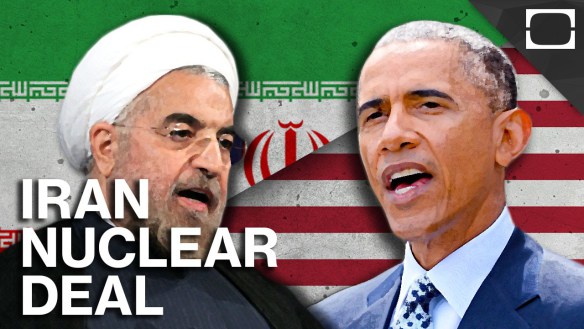
Showing posts with label The Iran Deal Is Obama’s Greatest Lieamerica. Show all posts

Thursday, September 6, 2018

How Obama Helped the Shi’a Horn


Iran, Iraq, and Obama
Lewis Morris
New information sheds light on Iran's involvement in Iraq. Just remember how much Obama "helped."
Recently declassified interrogation reports from a decade ago confirm a greater degree of Iranian involvement in the Iraq War than previously acknowledged.
Qais al-Khazali, a prominent Shiite politician and militia leader in Iraq, was captured and interrogated by coalition forces in 2007 for his suspected role in the death of five American soldiers. At the time, Khazali revealed that his group and other Iraqi Shiite militias had received training and arms directly from Iran’s Islamic Revolutionary Guard. This was during the height of insurrectionist violence targeting U.S. and allied troops in an effort to drive them from Iraq.
Khazali also revealed information about trips he took to Iran with Moqtada al-Sadr, one of the most powerful militant Shiites in Iraq. He told interrogators that Sadr and several other Iraqi political figures were sympathetic to Iran.
Khazali’s group won 15 seats in Iraq’s assembly in May. It’s only a sliver of the 329-seat total, but the group’s rapid growth signifies that Iran may be gaining influence in the Iraqi power structure. The Trump administration is currently mulling whether to declare Khazali’s group a terrorist entity. Khazali now claims that he is not connected to Iran, but we have only his word to confirm that.
These reports further detail Iran’s role in dragging out the Iraq war and causing the deaths of American troops there. This was part of its long-term strategy to become the premier power in the region, a strategy that was rewarded by our previous president.
Barack Obama began helping Iran’s cause by unilaterally abandoning Iraq. After that, the country spiraled into chaos, the Islamic State rose to power, and much of the hard-fought gains of the U.S. coalition were rolled back. He then rubbed salt in the wound by sending Iran a pallet of $400 million in cash.
The money, which was in gold, U.S. dollars, Swiss francs, and other currencies, was part of a $1.7 billion settlement over disputed funds from an arms deal dating back before the 1979 Iranian revolution. This payout came “coincidentally” at the same time the U.S. was working to release U.S. citizens held in Iran and trying to put together the Iranian nuclear deal.
Obama vigorously defended his actions and belittled any charge that the money was a ransom payment. When asked why $400 million had to be paid in cash, the State Department insisted that it was the only way to make a payment since Iran and the U.S. do not have any banking ties per U.S. law.
No matter whether Obama’s lackeys at State believed their own excuse about the lack of banking ties, that cash will be used to support terrorist activities. The U.S. will see — or more likely has already seen — that ransom money used against us to kill Americans somewhere in the world.
President Donald Trump has played a much stronger hand with Iran. By pulling out of the nuclear deal, he signified that the U.S. will not be snowballed or bullied into working with the terrorist state. Unfortunately, a significant amount of damage has already been done by our previous president, leaving Americans and our allies less safe.

Thursday, August 9, 2018

How Obama and Trump Have Lead US to the End


Obama’s Nuclear Deal Saved Iran From the Sanctions Trump Has Put Back On
News Analysis
As attention focuses on Iran and the sanctions President Donald Trump has put back in place, it’s worth revisiting events leading to the Joint Comprehensive Plan of Action (JCPOA)—known as the Iranian Nuclear Deal.
On Feb. 9, 2010, Iran began the crucial step of producing 20 percent enriched uranium. In response, the UN Security Council adopted Resolution 1929 on June 9, 2010, expanding sanctions against Iran.
On June 24, 2010, Congress tightened sanctions on firms investing in Iran’s energy sector and imposed new sanctions for selling refined petroleum to Iran. The EU followed suit on July 26, 2010.
On May 8, 2011, Iran’s Bushehr nuclear power plant began operations and achieved a sustained chain reaction. On June 8, 2011, Iran announced intentions to triple the rate of 20 percent enriched uranium production.
On Dec. 31, 2011, Congress passed legislation to sanction foreign banks if they processed transactions with Iran’s Central Bank. On Jan. 23, 2012, the EU imposed a phased ban on oil purchases from Iran.
On Feb. 15, 2012, Iran announced a number of advances, including new centrifuges allowing for faster uranium enrichment.
Negotiating tactics aside, economic sanctions were proving effective.
Iran’s GDP contracted by 6.6 percent in 2012. The official unemployment rate jumped to 14 percent. Iran’s economy was later estimated to be 15-20 percent smaller due to sanctions—which cost Iran an estimated $160 billion between 2012-2015.
In response, Iran’s currency collapsed, losing 80 percent of its value in the first ten months of 2012. On Oct. 1, 2012, the rial dropped by 15 percent.
The rial’s fall caused inflation to spike from an already uncomfortable 20.6 percent in 2011 to 27.4 percent in 2012. Inflation in Iran would peak at 39.3 percent in 2013.
As Iran’s economy was failing, the sanctions were preventing Iran from taking the last steps to becoming a nuclear weapons state.
On the Threshold
On Aug. 30, 2012, the IAEA reported that Iran was building stockpiles of 20 percent enriched uranium. The step from 20 percent enriched uranium to weapons-grade uranium is surprisingly small.
Foreign Policy wrote in January 2012, “If Iran decides to produce weapons-grade uranium from 20 percent enriched uranium, it has already technically undertaken 90 percent of the enrichment effort required. Using 20 percent enriched uranium as a feed, 250 kg UF6 can be turned to weapons-grade material in a month’s time.”
By late 2012 Iran had produced enough 20 percent enriched uranium to produce weapons grade uranium. Iran’s problem was the lack of a delivery system, as outlined in a 2012 Congressional Report:
“It is increasingly uncertain whether Iran will be able to achieve ICBM capability by 2015 for several reasons:
• Iran does not appear to be receiving the degree of foreign support many believe would be necessary.
• Iran has found it increasingly difficult to acquire certain critical components and materials because of sanctions.
• Iran has not demonstrated the kind of flight test program many view as necessary to produce an ICBM.”
Sanctions significantly impaired Iran’s ballistic missile program. Medium-range ballistic missile production was severely limited. ICBM’s were simply not attainable.
Negotiations
On June 14, 2013, Hassan Rouhani, a former nuclear negotiator, was elected president of Iran. Rouhani immediately called for negotiations.
On Sept. 27, 2013, Obama called Rouhani—the highest level contact between the United States and Iran since 1979. Talks began in October 2013. On Nov. 23, 2013, Obama announced the first round of sanctions relief, even while Congress was pushing for further sanction tightening. Obama’s announcement was material—$3 billion in cash plus another $16-17 billion in sanctions relief, boosting Iran’s foreign exchange reserves by 25 percent.
This translated into a flood of Trade Delegations visiting Iran—ten in the first two weeks of 2014. Iran’s economy began to recover immediately. GDP grew 3 percent in 2014. Inflation fell from 39 percent to 17 percent. As the Iranian economy grew so did Iran’s negotiating power.
On July 14, 2015, the Joint Comprehensive Plan of Action was reached. The JCPOA lifted all economic sanctions and gave Iran access to $120 billion in reserves held abroad. It also contained Sunset Clauses.
According to a 2015 report from the Foundation for Defense of Democracies, “The sunset clauses—the fatal flaw of the JCPOA—permit critical nuclear, arms, and ballistic missile restrictions to disappear over a five-to-15-year period. Tehran must simply abide by the agreement to emerge as a threshold nuclear power with an industrial-size enrichment program.”
The JCPOA stipulated that, “For eight years the ballistic missile restrictions will remain in place.”
Page 99 of the document contains defining language, which states “Iran is called upon not to undertake any activity related to ballistic missiles designed to be capable of delivering nuclear weapons.”
Note the crucial differences with the original language contained within Resolution 1929, which said “Iran shall not undertake any activity related to ballistic missiles capable of delivering nuclear weapons.”
Reversing Iran’s Situation
Iran has bolstered its ballistic missile capabilities, achieving up to 23 launches and masking ICBM development through its Space Launch Program.
On Aug. 22, 2017, Iran’s atomic chief shocked the International Community by declaring that Iran needs only five days to ramp uranium enrichment back up to 20 percent.
Recall the situation in 2012:
1 Iran had achieved 20 percent enriched uranium production. Stockpiles were sufficient to produce weapons-grade uranium.
2 Iran was facing intense international pressure regarding its nuclear ambitions.
3 The Iranian economy was on verge of collapse.
4 Iran’s ballistic missile program was underfunded and component constrained from sanctions.
5 Sanctions were costing Iran tens of billions each year.
6 Iran had no access to overseas cash reserves.
The JCPOA effectively solved Iran’s problems:
1 Iran retained capability to resume 20 percent uranium enrichment.
2 Iran’s nuclear capability was not materially reversed, merely suspended.
3 The Iranian economy immediately rebounded with sanction removal.
4 The JCPOA loosened restrictions on Iran’s ballistic missile program.
5 Foreign investment resumed.
6 Iran gained access to $120 billion in cash.
The New York Times summed things perfectly in July 2015, stating “Mr. Kerry described an Iranian capability that had been neutralized; the Iranians described a nuclear capability that had been preserved.”
On May 8, 2018, President Trump withdrew from the JCPOA. Sanctions on Iran are being re-imposed. The first round of sanctions became effective on Aug. 6, 2018. A second round of sanctions begins on Nov. 4, 2018:
Nov. 4 marks the anniversary of Iran’s takeover of the US. Embassy in Tehran.
• Iran celebrated the last anniversary with a parade featuring the Qadr missile, which has a range of 2,000km.
The rial began to fall in late 2017. Following U.S. withdrawal from the JCPOA, the rial collapsed. Official rates are meaningless and black market transactions must be used. According to Steve Hanke, a Professor of Applied Economics at Johns Hopkins University, Iran’s implied annual inflation rate was 186 percent on Aug. 2, 2018.
Street protests have broken out over the last week. In response, Iran announced it will implement a financial rescue plan to halt the rial’s decline. Any effect will be minimal.
The first round of sanctions prohibit Iran from using U.S. dollars—the primary currency for oil transactions.
The second round of sanctions target purchases of Iranian oil.
Views expressed in this article are the opinions of the author and do not necessarily reflect the views of The Epoch Times.
Friday, August 3, 2018

Obama Has Already Sold US Out to Iran


A woman walks past a mural painted along Palestine Square in the Iranian capital Tehran on July 24.Atta Kenare / AFP - Getty Images
Trita Parsi Trump's offer to meet with Iran's President Rouhani won't get us a better deal. We had our chance and lost it.
Iran has offered American deals to end their nuclear programs before, but we preferred belligerency to diplomacy
Jul.30.2018 / 7:42 PM E
After withdrawing from the Iran nuclear deal and threatening Iran with "consequences the likes of which few throughout history have ever suffered before," President Trump announced on Monday that he wants to meet with President Rouhani without preconditions to craft a new deal.
Trump thinks he can achieve this by sanctioning Iran until the rulers in Tehran beg for mercy. But if history is a guide, there will be no such capitulation by Iran: With the Iranians, one of the most costly things to do, both culturally and politically, would be to show Trump the respect and deference he desires after his aggressive string of insults.
So I am skeptical about Trump’s ability to pivot to diplomacy with Iran, but that is not to say that a better deal cannot be achieved. Indeed, better deals have often been on the table — but the United States rejected them at the time.

In March 2003, the Iranians sent a comprehensive negotiation proposal to the George W. Bush Administration through the Swiss ambassador in Tehran. Unlike the Iran nuclear deal, this proposal was not solely focused on nuclear matters: The Iranians offered to help stabilize Iraq, disarm Hezbollah and collaborate against all terrorist organizations (especially al Qaeda). They even offered to sign on to the 2002 Beirut Declaration, recognizing Israeli statehood in return for Israel’s recognition of a Palestinian state. And, of course, Tehran offered to open their nuclear program for full transparency.
But the Bush administration believed — much like Trump — that it could secure a better outcome by just continuing to pressure Iran and didn't even dignify Iran with a response. Instead, the State Department reprimanded the Swiss for having delivered the proposal in the first place.
Two years later, the Iranians sent another proposal through the Europeans: Having already expanded their nuclear program, Tehran offered to cap its centrifuges at 3,000. The Europeans didn't even bother to forward it to Washington, knowing the administration would reject anything that allowed Tehran to keep even a single centrifuge.
The Iranians had roughly 150 nuclear centrifuges at the time of the 2003 proposal; by the time the interim nuclear deal was struck in 2013, Tehran had 22,000.
During a closed White House briefing with a number of organizations that favored a peaceful resolution to the Iran situation in early 2014, a colleague asked one of America’s negotiators where a final deal likely would land in terms of centrifuges. Would it be possible to rollback Tehran’s centrifuges to 3,000 again? “We would jump on the opportunity to get that deal if it was offered today,” the official responded.
A few weeks later, I interviewed the Iranian foreign minister during one of the round of talks in Europe and asked the same question, trying to find out how the centrifuge issue likely would be resolved. To my surprise, Zarif explained that 3,000 had just been Iran’s opening bid in 2005. “We would have settled for 1,000,” he recalled with a smile. Eventually, Obama’s nuclear rolled back their program to 5,000 centrifuges — 2,000 more than their opening bid in 2005.
There are many similar examples; what they all have in common is that the United States usually believes that it is too strong to ever offer Tehran any concessions and doing so would ultimately undermine America’s standing. After all, Iran — unlike North Korea — doesn't even have nuclear weapons, the thinking seems to go.

Reality is, of course, quite different. Whenever the U.S. has managed to change Iranian policies, it has been as a result of offering valuable incentives and concessions. The diplomacy that led to the Iran deal, for instance, would never even have taken off had it not been for Obama, in secret negotiations, accepting nuclear enrichment on Iranian soil.
There is no guarantee that a “better deal” can be reached by Trump, and many of Trump’s demands are proven non-starters. But if Trump wants to explore realistic changes in Iran’s regional policies, missile defense or tougher restrictions on its nuclear program, he must first be willing to contemplate changes in U.S. policy.
Trump may have no objections to some of these: Tehran seeks respect and a recognition that Iran is a major regional power without whom stability in the region is unachievable. To Trump, granting them this may be unproblematic. His allies in Israel and Saudi Arabia, however, will vehemently oppose any measure that signals American acceptance of Iran’s growing standing.

From left, European Union High Representative for Foreign Affairs and Security Policy Federica Mogherini, Iranian Foreign Minister Mohammad Javad Zarif, British Foreign Secretary Philip Hammond, U.S. Secretary of State John Kerry talk before a group picture in Vienna on July 14, 2015, after Iran and six world powers agreed to a nuclear deal.Carlos Barria / Pool via AFP - Getty Images file
Trump may even be eager to grant Tehran some concession: Trump partly opposed the Obama’s nuclear deal because it only lifted secondary sanctions (sanctions the U.S. imposed on other countries trading with Iran) without touching America’s primary sanctions, keeping American companies from entering the Iranian market. (Few doubt that Trump would love to build Trump Towers in Tehran.)
But other changes in U.S. policy will be trickier. Iran, for instance, will not agree to limit its missile program if Washington continues to sell Saudi Arabia, Israel and the U.A.E. billions of dollars worth of advanced weaponry. In fact, both Riyadh and Abu Dhabi outspend Iran on weaponryby a factor of five and two, respectively, despite having far smaller populations. And while Iran cut back its defense capabilities through the nuclear deal, the Saudis and Emiratis both beefed up their defense spending. Unless Washington is ready to rethink its arms sales to its Arab allies — and Trump clearly wants to sell them more weapons — it should have no expectations that Iran will cut back its missile program.
Another non-starter is the idea that Iran must stop asserting its influence in Syria, Iraq and Lebanon while Washington continues to help Saudi Arabia starve the people of Yemen, turns a blind eye to the Saudi Crown Prince kidnapping the Lebanese Prime Minister and financing the spread of extreme Salafism (the ideology of al Qaeda and ISIS).
And then of course you have Trump’s unquestioning support for the Netanyahu government in Israel and the tensions between Hezbollah and Israel, where neither side is in a position to simply capitulate or walk away.
The bottom line is that a better, bigger deal invariable will entail both American and Iranian concessions. If Trump isn’t willing to recognize this, he should stop pretending that his reckless rhetoric and Twitter threats are aimed at paving the way for diplomacy.
Trita Parsi is the author of "Losing an Enemy — Obama, Iran and the Triumph of Diplomacy" and the President of the National Iranian American Council.

Tuesday, June 12, 2018

Obama national security adviser: Pulling out of Iran deal is the worst US move in Middle East since the Obama Deal

obama-iran-dealObama national security adviser: Pulling out of Iran deal is the worst US move in Middle East since Iraq War


"I think the pulling out of the Iran agreement is the worst mistake the United States has made in the Middle East since the Iraq War," Tom Donilon told David Axelrod on "The Axe Files," a podcast from the University of Chicago Institute of Politics and CNN.
Donilon served as President Barack Obama's national security adviser from October 2010 to June 2013 and helped lead that administration's "maximum pressure" campaign of sanctions against the Iranian regime. He said leaving the Iran nuclear deal -- a decision Trump announced in May -- comes "at a high cost, including with allies in Europe."
"The key wasn't US bilateral pressure on Iran," Donilon said. "The key was our ability to talk to the world about the value, the goal, which was not to have a nuclear Iran. Pull that together and get an agreement on the pressure campaign. You needed to have multilateral pressure in order to have an effective pressure campaign in Iran.
"So we will it be very difficult to reconstruct that now," Donilon said, alluding to the fact that many of the US' European allies opposed Trump's decision to leave the deal and have pledged to continue supporting it.
"There's nothing that we couldn't have pursued more effectively multilaterally while keeping the arrangement in place, that really has capped, rolled back and for extended period of time, pushed back the Iranian nuclear program," Donilon said.
In addition to Trump's move on the Iran nuclear agreement, Donilon also denounced the President's decision to withdraw from the Trans-Pacific Partnership after taking office in January 2017.
"I think we'll see pulling out of the TPP as one of the worst mistakes we've made in Asia since Vietnam," he said.
In March, 11 countries signed the sweeping trade agreement without the United States. In April, Trump directed his top trade and economic advisers look into rejoining the deal, but such a move may be prohibitively difficult.

Friday, June 8, 2018

Iran Opens New Nuclear Factory (Daniel 8:4)

Iran opens new nuclear facility for centrifuge production
By AMIR VAHDAT ASSOCIATED PRESS
TEHRAN, Iran — Jun 6, 2018, 4:02 PM E
Iran's nuclear chief on Wednesday inaugurated the Islamic Republic's new nuclear enrichment facility that is geared toward producing centrifuges which will operate within the limits of the nuclear deal Tehran signed with world powers.
Iranian state television broadcast an interview with Ali Akbar Salehi after nightfall, showcasing the facility at Natanz's uranium enrichment center.
In the interview, Salehi said the facility's construction began even before the 2015 deal was signed and that he hopes the first centrifuges — known as old-generation centrifuges — will roll out in a month's time.
In a gesture likely directed at the Trump administration's withdrawal from the deal, Iran on Tuesday informed the U.N. nuclear watchdog that it will increase its nuclear enrichment capacity, yet stay within the provisions of the accord.
The landmark agreement, which lifted crippling economic sanctions in exchange for Tehran limiting its uranium enrichment program, has been facing its greatest diplomatic challenges in the wake of President Donald Trump's decision to pull America out of it.
European nations and others involved in the accord are now trying to salvage it, and many companies that rushed to make billion-dollar deals with Iran now are backing out for fear of being targeted by U.S. sanctions.
Natanz, some 250 kilometers (155 miles) south of the capital, Tehran, includes underground facilities protected by some 7.6 meters (25 feet) of concrete, which offer protection from airstrikes.
Salehi's choice of Natanz to offer his speech came as no surprise.
The facility long has been a point of contention between Iran and the West since its public disclosure by an Iranian exile group in 2002. While Tehran long has maintained its nuclear program is for peaceful purposes, Western nations have feared Natanz represented a means for Iran to enrich enough uranium to produce atomic weapons.
The Stuxnet computer virus, widely believed to be an American and Israeli creation, caused thousands of centrifuges at Natanz to spin themselves to destruction at the height of the West's fears over Iran's program.
Under the 2015 nuclear deal, Iran agreed to store its excess centrifuges at Natanz under constant surveillance by the U.N. nuclear watchdog, the International Atomic Energy Agency. Iran can use 5,060 older-model centrifuges at Natanz, but only to enrich uranium up to 3.67 percent. Natanz was designed to have as many as 50,000 centrifuges operating there.
In Wednesday's interview, Salehi said mass-production for new-generation centrifuges will take years to be fully operational. "Every new generation of centrifuges needs eight to 10 years for testing," he said.
That low-level enrichment means the uranium can be used to fuel a civilian reactor but is far below the 90 percent needed to produce a weapon. Iran also can possess no more than 300 kilograms (660 pounds) of that uranium. That's compared to the 100,000 kilograms (220,460 pounds) of higher-enriched uranium it once had.
Iran also this week told the IAEA it had a "tentative schedule to start production of UF6," or uranium hexafluoride. Uranium hexafluoride gas is spun by centrifuges to make enriched uranium that can be used in nuclear weapons and atomic reactor fuel. That work is also restrained under the nuclear deal.
Earlier Wednesday, Iranian ambassador to the IAEA Reza Najafi told journalists in Vienna that Iran had given European nations "a few weeks" to come up with ways to protect the deal from America's pullout.
"These are the preparatory works for a possible scenario if in an unfortunate situation the (nuclear deal) fails then Iran can restart its activities without any limits," Najafi said.
"What I can say is right now, the negotiations at the expert level are continuing and we hope that it could reach some conclusion," he added. "Until then, we continue to exercise the most restraint but it is not (an) endless process."
French Foreign Minister Jean-Yves Le Drian warned Iran against restarting higher enrichment of uranium.
"It is always dangerous to flirt with the red lines," he said.

Wednesday, June 6, 2018

How Obama Helped the Iran Nuclear Horn

See the source image 
Secret Obama-era permit let Iran convert funds to dollars
JOSH LEDERMAN, MATTHEW LEE, The Associated Press
Updated: Wednesday, June 6, 2018, 1:34 PM
WASHINGTON (AP) - After striking an elusive nuclear deal with Iran, the Obama administration found itself in a quandary in early 2016: Iran had been promised access to its long-frozen overseas reserves, including $5.7 billion stuck in an Omani bank.
To spend it, Iran wanted to convert the money into U.S. dollars and then euros, but top U.S. officials had repeatedly promised Congress that Iran would never gain access to America's financial system.
Those assurances notwithstanding, the Obama administration secretly issued a license to let Iran sidestep U.S. sanctions for the brief moment required to convert the funds through an American bank, an investigation by Senate Republicans released Wednesday showed. The plan failed when two U.S. banks refused to participate.
Yet two years later, the revelation is re-igniting the bitter debate over the nuclear deal and whether former President Barack Obama was too eager to grant concessions to Tehran.
"The Obama administration misled the American people and Congress because they were desperate to get a deal with Iran," said Sen. Rob Portman, R-Ohio, who chairs the Senate panel that conducted the investigation.
And Republican Rep. Ed Royce, the House Foreign Affairs Committee chairman, accused Obama of trying to "hide a secret push to give the ayatollah access to the U.S. dollar."
Not so, former Obama administration officials said, arguing the decision to grant the license adhered to the spirt of the deal, which included allowing Iran to regain access to foreign reserves that had been off-limits because of U.S. sanctions. They said the public assurances that Iran would be kept out were intended to dispel incorrect reports about nonexistent proposals that would have gone much farther by letting Iran actually buy or sell things in dollars.
The former Obama officials disputed that the momentary access to U.S. banks to convert funds through the dollar constituted "access to the U.S. financial system." What's more, they dismissed the report as another example of a faulty approach to Iran policy by Republicans and by President Donald Trump, who last month withdrew the U.S. from the landmark 2015 nuclear accord.
"They continue to malign the deal in an effort to justify President Trump's unjustifiable decision," said Ned Price, who was Obama's White House National Security Council spokesman, referring to GOP lawmakers.
Still, the report by the Senate Permanent Subcommittee on Investigations sheds light on the delicate balance the Obama administration sought to strike after the deal, as it worked to ensure Iran received its promised benefits without playing into the hands of the deal's opponents. Amid a tense political climate, Iran hawks in the U.S., Israel and elsewhere argued that the United States was giving far too much to Tehran and that the windfall would be used to fund extremism and other troubling Iranian activity.
The Treasury Department license, issued in February 2016 and never disclosed, would have allowed Iran to convert $5.7 billion it held at Oman's Bank of Muscat from Omani rials into euros by exchanging them first into dollars. If the Omani bank had allowed the exchange without such a license, it would have violated sanctions that bar Iran from transactions that touch the U.S. financial system.
The situation resulted from the fact that Iran had stored billions in Omani rials, a currency that's notoriously hard to convert. The U.S. dollar is the world's dominant currency, so allowing it to be used as a conversion instrument for Iranian assets was the easiest and most efficient way to speed up Iran's access to its own funds.
"Yikes," one former Treasury official told colleagues in an email, as described by the report. "It looks like we committed to a whole lot beyond just allowing the immobilized funds to settle out."
The Obama administration approached two U.S. banks to facilitate the conversion, the report said, but both refused, citing the reputational risk of doing business with or for Iran.
Issuing the license was not illegal. Still, it went above and beyond what the Obama administration was required to do under the terms of the nuclear agreement, in which the U.S. and world powers gave Iran billions of dollars in sanctions relief in exchange for curbing its nuclear program.
The license issued to Bank Muscat stood in stark contrast to repeated public statements from the Obama White House, the Treasury and the State Department, all of which denied that the administration was contemplating allowing Iran access to the U.S. financial system.
Yet almost immediately after the sanctions relief took effect in January 2016, Iran began to complain that it wasn't reaping the benefits it had envisioned. Iran argued that other sanctions - such as those linked to human rights, terrorism and missile development - were scaring off potential investors and banks who feared any business with Iran would lead to punishment. The global financial system is heavily intertwined with U.S. banks, making it nearly impossible to conduct many international transactions without touching New York in one way or another.
As the Obama administration pondered how to address Iran's complaints in 2016, reports in The Associated Press and other media outlets revealed that the U.S. was considering additional sanctions relief, including issuing licenses that would allow Iran limited transactions in dollars. Democratic and Republican lawmakers argued against it throughout the late winter, spring and summer of 2016. They warned that unless Tehran was willing to give up more, the U.S. shouldn't give Iran anything more than it already had.
At the time, the Obama administration downplayed those concerns while speaking in general terms about the need for the U.S. to live up to its part of the deal. Secretary of State John Kerry and other top aides fanned out across Europe, Asia and the Middle East trying to convince banks and businesses they could do business with Iran without violating sanctions and facing steep fines.
"Since Iran has kept its end of the deal, it is our responsibility to uphold ours, in both letter and spirit," Treasury Secretary Jack Lew said in March 2016, without offering details.
That same week, the AP reported that the Treasury had prepared a draft of a license that would have given Iran much broader permission to convert its assets from foreign currencies into easier-to-spend currencies like euros, yen or rupees, by first exchanging them for dollars at offshore financial institutions.
The draft involved a general license, a blanket go-ahead that allows all transactions of a certain type, rather than a specific license like the one given to Oman's Bank Muscat, which only covers specific transactions and institutions. The proposal would have allowed dollars to be used in currency exchanges provided that no Iranian banks, no Iranian rials and no sanctioned Iranian individuals or businesses were involved, and that the transaction did not begin or end in U.S. dollars.
Obama administration officials at the time assured concerned lawmakers that a general license wouldn't be coming. But the report from the Republican members of the Senate panel showed that a draft of the license was indeed prepared, though it was never published.
And when questioned by lawmakers about the possibility of granting Iran any kind of access to the U.S. financial system, Obama-era officials never volunteered that the specific license for Bank Muscat in Oman had been issued for months.
According to the report, Iran is believed to have found other ways to access its money, possibly by exchanging it in smaller quantities through another currency.
JOSH LEDERMAN, MATTHEW LEE, The Associated Press